NATO to expand military pipelines in Eastern Europe – Spiegel
The bloc supposedly plans to extend pipelines from Germany to Poland and the Czech Republic for rapid jet fuel supply in potential war with Russia
RT | February 22, 2025
NATO is supposedly set to extend its Cold War-era fuel pipeline system from western Germany into Poland and the Czech Republic, according to Der Spiegel citing an internal memo from the Bundeswehr, Germany’s armed forces. The move comes as the bloc makes “operational plans for a possible Russian attack on the eastern states”, the newspaper wrote on Friday.
NATO’s Central European Pipeline System was built in the late 1950s and was designed “to meet operational needs in central Europe in times of peace, crisis and conflict.” It transported large volumes of kerosene, gasoline, and diesel fuel through Germany, France, Belgium, and the Netherlands, and was also used by the United States.
The plans include “storing fuel as far east as possible near the potential area of operations,” according to an internal memo. Now the fuel distribution is limited to NATO’s eastern flank, the existing pipeline network currently ends in western Germany.
The project is to cost €21 billion ($22 billion) and is expected to be largely completed by 2035, according to the report. Germany is ready to contribute more than €3.5 billion ($3,7 billion) to the project, Defense Minister Boris Pistorius told Der Spiegel. “For our soldiers, a reliable fuel supply is one of the essential requirements for their operational readiness,” he added.
A senior NATO official told Der Spiegel that while ammunition and spare parts could be airlifted, fuel transport by plane would be nearly impossible due to “immense consumption”. He told Der Spiegel there are “significant problems in the sustainable supply of fuel to the forces that would have to be relocated to the eastern border if necessary”. “The demand is gigantic,” the official claimed.
However, some factors could delay construction and increase costs, Der Spiegel added. The pipeline is to be laid under several rivers, including the Weser and Elbe, that should be “protected from possible accidents”.
In addition, there might appear “land issues” with the authorities and land owners that should be “clarified”, the newspaper wrote.
Russia has repeatedly argued that the Ukraine conflict was provoked by NATO expansion towards its borders, Kiev’s aspirations to join the US-led military alliance, and Ukraine’s policies toward the Russian-speaking Donbass region. Western officials have suggested that Russia could pose a threat to NATO amid the Ukraine conflict, but Russian President Vladimir Putin dismissed these claims as ‘nonsense,’ arguing they are used to justify Western military spending.
In December 2024, Russian Defense Minister Andrei Belousov stated that Russia must be prepared for any scenario, including a possible military conflict with NATO in Europe within the next decade.
Brazil’s Lula refused to sell Germany weapons ‘to kill Russians’
RT | February 21, 2025
Brazilian President Luiz Inácio Lula da Silva rejected an approach by German Chancellor Olaf Scholz to purchase arms for Ukraine. The Brazilian head of stage stressed he wouldn’t sell weapons “to kill Russians” or anyone else.
Speaking to reporters on Wednesday at a joint media conference with the Portuguese Prime Minister Luís Montenegro, Lula reiterated Brazil’s neutral stance in the ongoing conflict between Kiev and Moscow.
Germany, in contrast, has been among Ukraine’s key backers, having supplied it with billions worth of military aid. Da Silva recalled that in January 2023, Scholz visited Brazil as part of a tour to drum up support for Kiev in South America and requested cannons for the war.
”I told my friend Olaf Scholz: ‘I will not sell weapons to kill a Russian, to kill anyone. So, I want to apologize, but Brazil will not sell the weapons you need because I want peace, and if I want peace, I cannot fuel the war. We want peace between Russia and Ukraine. Now, this is only possible if both are at the negotiating table’,” he said.
Lula has long advocated for talks to resolve the conflict and insisted that supplying arms would only escalate the situation, hindering prospects for peace.
Last May Brasilia and Beijing jointly issued a six-point plan for settling the Ukraine conflict, emphasizing “dialogue and negotiation” as the only “viable way out of the crisis.”
Ukrainian leader Vladimir Zelensky dismissed the proposal as “just a political statement,” accusing them of colluding with Russia.
Lula hit back, saying that Ukraine should heed Brazil’s advice about seeking peace in the conflict. “Those who want to talk to us now could have talked to us before the war had started,” he said.
On Thursday, Russia’s top diplomat Sergey Lavrov and his Brazilian counterpart Mauro Vieira discussed the need to address the root causes of the Ukraine conflict and this week’s Russian-US talks in Riyadh, the foreign ministry in Moscow said. Speaking on the sidelines of G20 foreign ministers’ meeting in Johannesburg, South Africa, they also discussed upcoming high-level meetings and plans for collaboration between Moscow and Brasília, especially within BRICS, the ministry statement added.
VP JD Vance Criticizes European Censorship, Calls for Free Speech as Basis for US-Europe Alliances at CPAC
Vance warns European allies that censorship threatens the foundation of Western alliances
By Cindy Harper | Reclaim The Net | February 21, 2025
At the Conservative Political Action Conference (CPAC) on Thursday, Vice President JD Vance sharpened his criticism of America’s European allies while issuing a strong warning against censorship. His speech, which kicked off the three-day gathering, echoed the assertive stance he took at the Munich Security Conference last week.
Vance took aim at one of America’s closest international partners, highlighting growing ideological rifts over free speech. He criticized restrictive online censorship laws in the European Union, arguing that such measures could drive a wedge between the US and its allies under President Trump’s leadership.
“We’re going to continue to have important alliances with Europe, but I really do think the strength of those alliances is going to depend on whether we take our societies in the right direction,” Vance stated.
“You have to allow free speech to debate this stuff,” Vance declared, emphasizing the importance of open discussion on controversial issues, particularly immigration. “You have to stop doing things to the populations of the world. You’ve gotta give the populations of the world the opportunity to speak up and say, no more of this BS.”
The Vice President did not hold back in his criticism of the previous US administration, stating, “The Biden administration did more to destroy free speech, not just in the United States, but also in Europe, than any administration in American history.”
Vance also took direct aim at Germany, highlighting the contradiction of American taxpayers funding the country’s defense while its government cracks down on free expression. “Germany’s entire defense is subsidized by the American taxpayer,” he said. “Do you think the American taxpayer is gonna stand for that if you get thrown in jail in Germany for posting a mean tweet? Of course, they’re not.”
The Vice President framed his argument in terms of shared values, asserting that true alliances are built on a foundation of democratic freedoms. “You do not have shared values if you’re jailing people for saying we should close down our border,” he warned. “You don’t have shared values if you cancel elections because you don’t like the result. You do not have shared values if you’re so afraid of your own people that you silence them and shut them up.”
His message resonated with conservative leaders attending CPAC’s international summit, where discussions focused on resisting censorship and preserving national sovereignty.
Vance closed with a call for unity among Western nations based on principles of democracy and free speech. “Let’s have shared values. Let’s defend democracy. Let’s have free expression, not just in the United States, but all over the Western world. That is the path to strong alliances in Europe.” His words were met with enthusiastic applause from the CPAC audience.
Sacrificing Truth on Leviathan’s Altar
By James Bovard • Mises Wire • 02/19/2025
Last Sunday, 60 Minutes featured tyrannical German prosecutors boasting about persecuting private citizens who made comments that officialdom disapproved. Three prosecutors explained how the government was entitled to launch pre-dawn raids and lock up individuals who criticized politicians, complained about immigrant crime waves, or otherwise crossed the latest revised boundary lines of acceptable thoughts.
In a craven slant that would have cheered any mid-twentieth century European dictator, 60 Minutes glorified the crackdown: “Germany is trying to bring some civility to the world wide web by policing it in a way most Americans could never imagine in an effort to protect discourse.” Nothing “protects discourse” like a jackboot kick aside the head of someone who insulted a German politician on Facebook, right? Mocking German leaders is punished like heresy was punished 500 years ago—though no one has been publicly torched yet.
Do the priggish German prosecutors realize that they are the latest incarnation of nineteenth-century German philosopher G. W. F. Hegel? Hegel declared: “Men are as foolish as to forget, in their enthusiasm for liberty of conscience and political freedom, the truth which lies in power.” Hegel bluntly equated government and truth: “For Truth is the Unity of the universal and subjective Will; and the Universal is to be found in the State, in its laws, its universal and rational arrangements.” Hegel probably did more to propel modern totalitarianism than perhaps any other philosopher.
Unfortunately, many Americans favor the US government becoming a Ministry of Truth like the German government. Fifty-five percent of American adults support government suppression of “false information,” according to a 2023 poll. But other polls show that only 20 percent trust the government to do the right thing most of the time. So why would people trust dishonest officials to forcibly eradicate “false information”? Did some people skip logic class, or what? A September 2023 poll revealed that almost half of Democrats believed that free speech should be legal “only under certain circumstances”—perhaps only when a rascally Republican is president?
Hegelian notions of “Government = Truth” propelled censorship here in recent years. Three years ago, Americans learned they lived under a Disinformation Governance Board with a ditzy Disinformation Czar who boasted of graduating from Bryn Mawr University. A public backlash led to the board’s termination but federal censors quickly and secretly resumed their sway over the internet.
Though American censors rarely invoke Hegel, their schemes tacitly presume that political power is divine, if not in origin, at least in its effect. The Cybersecurity Infrastructure Security Agency (CISA), created in 2018, has relied on “censorship by surrogate,” subcontracting the destruction of freedom. CISA partnered with federal grantees to form the Election Integrity Partnership a hundred days before the 2020 presidential election. That project, along with the efforts of other federal agencies, created an “unrelenting pressure” with “the intended result of suppressing millions of protected free speech postings by American citizens,” according to a 2023 ruling by Federal Judge Terry Doughty.
What standard did CISA use to determine whether Americans should be muzzled? CISA settled controversies by contacting government employees and “apparently always assumed the government official was a reliable source,” Judge Doughty noted. Any assertion by officialdom could suffice to justify suppression of comments or posts by private citizens. But when did government I.D. badges become the Oracle of Delphi?
During the 2020 presidential election campaign, CISA established a “Rumor Control” webpage to deal with threats to the election—including rumors that the feds were censoring Americans. CISA targeted for suppression assertions by Americans such as “mail-in voting is insecure”—despite the long history of absentee ballot fraud. Biden won the presidency in part thanks to Democrats exploiting the covid pandemic to open the floodgates to unverified mail-in ballots. House Speaker Mike Johnson (R-LA) declared, “Twitter was basically an FBI subsidiary before Elon Musk took it over.”
Censors act as if truth and lies are both self-evident. But as an investigative journalist hounding federal agencies, I have seen how government minimizes disclosures of its outrageous conduct. On April 19, 1993, 80 people died in a massive fire during an FBI tank assault on the home of the Branch Davidians. On that day, the FBI was adamant that they had nothing to do with the fire and also claimed to possess audiotapes proving the Davidians intentionally committed mass suicide. They never disclosed that proof. But anyone who suggested that the FBI was connected to the fatal fire was derided as an anti-government nut case, if not a public menace. A Los Angeles Times book reviewer practically blamed my criticism of the feds on Waco and other cases for the 1995 Oklahoma City bombing. But year by year, the FBI’s Waco storyline fell apart. Six years after the fire, a private investigator found proof that the FBI fired pyrotechnic grenades at the Davidians’ home before the fire, obliterating the FBI cover-up.
The same pattern of delayed disclosures or leaks annihilated the US government’s credibility on the epidemic of Gulf War syndrome cases in the 1990s, the invasion of Iraq in 2003, and the glorious triumph for democracy and women’s rights after the US invaded Afghanistan. The “trickle down” version of truth was also stark in the notorious Duke Lacrosse case. With his persistent, savvy analysis and investigations, Mises editor Bill Anderson heroically helped vanquish a media and prosecutorial lynch mob.
Unfortunately, in Germany, and at least sporadically in the United States, “truth” is whatever the government proclaims. “Disinformation” is whatever contradicts the latest government pronouncements. It is irrelevant how many false statements politicians or bureaucrats make. Government retains a monopoly on truth and on the right to deceive.
Recent censorship schemes vivify how democracy is being turned into a parody: voters choose politicians who then dictate what citizens are permitted to think and say. Censors destroy freedom of thought as well as freedom of speech. Censorship seeks to force each person to live in mental isolation, with no sparks for their thoughts from fellow citizens. Shortly before Hegel’s rise to prominence, German philosopher Immanuel Kant wrote, “The external power that deprives man of the freedom to communicate his thoughts publicly, deprives him at the same time of his freedom to think.” By barricading individuals from each other, censors create millions of intellectual Robinson Crusoes, stranded on islands and trying to figure out everything for themselves. Prohibiting citizens from sharing facts of government abuses spawns a bastardized form of sovereign immunity. It minimizes opposition to political power grabs—often until it is too late to resist.
Other European nations are as bad or worse than Germany. Britain is notorious for raiding the homes and arresting anyone who makes allegations about immigrants and crime. According to Irish Senator Pauline O’Reilly, government must “restrict freedoms for the common good” when “a person’s views on other people’s identities” makes them “insecure.” Can I demand that government censor anyone who makes me insecure about my identity by mocking my vintage railroad engineer cap? By vastly expanding the definition of “hate speech,” politicians justify suppressing any views they disapprove.
Faith in officialdom to decree truth and punish error exemplifies growing political illiteracy. In earlier eras, Americans were renowned for heartily disdaining politicians who rose to power by making endless bogus promises.
Why would any prudent person expect bureaucrats to deliver “the truth, and nothing but the truth” like FEMA officials coming to the rescue after a flood? If the government can’t be trusted for reliable mail delivery, why in Hades would anyone trust government to judge and safeguard any thoughts citizens choose to share? Do people honestly expect that turning politicians into censors will evoke their inner sainthood? How can freedom of speech or any other freedom survive if so many people fall for so much BS from Washington?
EU keeps trying to escalate Ukrainian conflict
By Lucas Leiroz | February 20, 2025
While the US and Russia are engaged in an incipient diplomatic process, taking the first steps towards a peaceful future, European countries continue to try to escalate the Ukrainian conflict, taking provocative measures to worsen tensions. Recently, European leaders announced a new aid package to the neo-Nazi regime, which shows how the EU is not interested in any diplomatic negotiations – despite hypocritically complaining about not being part of the talks in Riyadh.
Western media recently reported that a new pro-Ukrainian military aid package is being prepared by the EU. The aid is valued at more than 6 billion euros, making it one of the largest packages in the entire European support campaign for Kiev since 2022. The plan is believed to involve the supply of weapons such as artillery shells, missiles and air defense systems, among other lethal equipment. The approval of the package is expected to be announced on February 24, during the three-year anniversary of the special military operation – when a delegation of EU’s high officials will be in Kiev.
“EU countries are preparing a military aid package worth at least €6 billion for Ukraine as it seeks to shore up Kiev’s strategic position at the outset of U.S.-led talks with Russia, according to three EU diplomats. The package, which should include everything from 1.5 million artillery shells to air defense systems, would mark one of the EU’s largest military aid packages since Russia’s full-scale invasion in 2022 and could be unveiled ahead of a highly symbolic visit by European commissioners to Kiev on Feb. 24,” Politico reported.
The EU is not only sending more weapons to Ukraine, but it is also further tightening anti-Russian measures. The bloc has agreed on a new package of coercive measures against Moscow – the 16th since the start of the special military operation. Even though all the sanctions imposed on Russia have so far proven futile, Europe continues to pursue a boycott strategy against Moscow, thus damaging its own strategic interests – as the sanctions obstruct energy cooperation, affecting industry and several other important sectors.
It is important to remember that, in parallel to all this, European countries continue to hold discussions about “sending troops to Ukraine”. Even though Moscow has made it clear many times that it will not accept the presence of Western forces in the conflict zone, considering any foreign soldiers as legitimate targets – the EU insists on worsening the scenario.
In fact, the entire European aid campaign for Ukraine is useless. Kiev does not gain any strategic benefit with the arrival of new European weapons, since this equipment will not be enough to reverse the tragic military situation of the Ukrainian forces – which are rapidly losing ground due to the strong Russian advance. Like all NATO weapons previously sent to Ukraine, the new European artillery systems will most likely be quickly destroyed by Russian high-precision bombings, generating zero impact on the battlefield.
In the same sense, after three years of repeated sanctions against Russia, it already seems clear that Moscow knows how to deal with this situation, circumventing the effects of coercive measures and making the economy grow despite Western aggression. The country is definitely growing, with the economy reaching increasingly better numbers, which is why new sanctions are not a cause for concern for the Russians, but rather for the Europeans themselves, who are more and more being harmed by the side effects of their own measures.
Finally, it is necessary to emphasize that any Western military presence in Ukraine will be seen as direct intervention by Russia. Moscow has already repeatedly said that European soldiers on the battlefield will be legitimate targets for Russian troops. In practice, any Western military operation in Ukraine will be a real suicide, since foreign soldiers will be priority targets for the Russian armed forces.
Instead of trying to escalate the war, Europe should take advantage of the current situation of diplomatic progress to reverse the mistakes made over the past three years. European countries now have the opportunity to lift sanctions, stop engaging in the war and re-establish ties with Russia. Previously, the Democrats were pressuring Europe to get involved in the war. With Trump and the Republicans, this pressure no longer exists, and the EU can simply change everything it has done so far.
However, unfortunately, the Europeans seem to be much more aggressive than the Americans themselves. The EU’s goal seems to be in taking the conflict to its ultimate consequences, even if European own interests are harmed by such irresponsible measures.
Lucas Leiroz, member of the BRICS Journalists Association, researcher at the Center for Geostrategic Studies, geopolitical consultant.
“Listen Carefully it’s Actually Much Darker”: How the Left is Framing Free Speech as a Front for Fascism
By Jonathan Turley | February 18, 2025
The defense of free speech by Vice President J.D. Vance in Munich, Germany, has led to open panic on the left in fighting to maintain European censorship and speech criminalization. The response of the American press and pundits was crushingly familiar. From CBS News to members of Congress, Vance (and anyone who supports his speech) was accused of using Nazi tactics. It is the demonization of dissent.
In one of the most bizarre examples, CBS anchor Margaret Brennan confronted Secretary of State Marco Rubio over Vance’s support for free speech given the fact that he was “standing in a country where free speech was weaponized to conduct a genocide.”
The suggestion that free speech cleared the way for the Holocaust left many scratching their heads, but it is an old saw used by the anti-free speech community, particularly in Germany.
When they came to power, the Nazis moved immediately to crack down on free speech and criminalize dissent. They knew that free speech was not only the “indispensable right” for a free people, but the greatest threat to authoritarian power.
Figures like Brennan appear to blame free speech for the rise of the Nazis because the Weimar Constitution protected the right of Germans, including Nazis, in their right to speak. However, the right to free speech was far more abridged than our own First Amendment. Indeed, it had many of the elements that the left has pushed in Europe and the United States, including allowing crackdowns on disinformation and fake news.
Article 118 of the Weimar Constitution, guaranteed free speech but added that it must be “within the limits of the general laws.” It did not protect statements deemed by the government as factually untrue and speech was actively regulated.
Indeed, Hitler was barred from speaking publicly. It was not free speech that the Nazis used to propel their movement, but the denial of free speech. They portrayed the government as so fearful and fragile that it could not allow opposing views to be stated publicly.
This ridiculous and ahistorical spin also ignores the fact that other countries like the United States had both fascist movements and free speech, but did not succumb to such extremism. Instead, free speech allowed critics to denounce brownshirts as hateful, dangerous individuals. To blame free speech for the rise of the Nazis is like blaming the crimes of Bernie Maddoff on the use of money.
Nevertheless, before the last election, the left was unrelenting in accusing those with opposing views as being Nazis or fascists. During the election, it seemed like a one-answer Rorschach test where Democrats saw a Nazi in every political inkblot.
While the narrative failed in spectacular fashion, the script has not changed. Rep. Seth Moulton (D-MA) expressed sympathy for the “absolute shock, absolute shock of our European allies” to be confronted in this fashion. Rather than address the examples of systemic attacks on free speech, Moulton reached again for the favorite talking point: “if you listen, listen carefully it’s actually much deeper and darker. He was talking about the enemy within. This is some of the same language that Hitler used to justify the Holocaust.”
Like Brennan, Moulton is warning that free speech can be a path to genocide. However, his take is that anyone claiming to be the victim of censorship is taking a page out of the Nazi playbook. The logic is simple. The Nazis complained about censorship. You complained about censorship. Thus, ipso facto, you are a Nazi.
Others joined the mob in denouncing Vance and supporting the Europeans. CNN regular Bill Kristol called the speech “a humiliation for the US and a confirmation that this administration isn’t on the side of the democracies.”
By defending free speech, you are now viewed as anti-democratic. It is part of the Orwellian message of the anti-free-speech movement. Democracy demands censorship, and free speech invites fascism.
It is hardly a novel argument. It was the very rationale used in Germany after World War II to impose what is now one of the most extensive censorship systems in the world. It was initially justified as an anti-Nazi measure but then, as has occurred repeatedly in history, became an insatiable appetite for speech controls. Indeed, the country returned to the prosecution of anything deemed disinformation and fake news by the government.
The result has indeed silenced many, but not those neo-Nazis who are flourishing in Germany. Past polling of German citizens found that only 18% of Germans feel free to express their opinions in public. Only 17% felt free to express themselves on the internet. As under the Weimar Constitution, fascist groups are portraying themselves as victims while finding alternative ways to spread their message.
Yet, the American media continues to peddle the same disinformation on the value of censorship. After its anchor made the widely ridiculed claim about free speech leading to genocide, 60 Minutes ran an interview with German officials extolling the success of censorship.
CBS’ Sharyn Alfonsi compared how the United States allows “hate-filled or toxic” speech while Germany is “trying to bring some civility to the worldwide web by policing it in a way most Americans could never imagine.”
German prosecutors (Dr. Matthäus Fink, Svenja Meininghaus and Frank-Michael Laue) detailed how they regularly raid homes to crack down on prohibited views with the obvious approval of CBS.
They acknowledged that “the people are surprised that this is really illegal, to post these kind [sic] of words… They don’t think it was illegal. And they say, ‘No, that’s my free speech,’ And we say, ‘No, you have free speech as well, but it also has its limits.’”
Alfonsi explained that the law criminalizes anything the government considers inciteful “or deemed insulting.” She then asked “Is it a crime to insult somebody in public?” The prosecutors eagerly affirmed, but added that the punishment is even higher to insult someone on the Internet.
Meininghaus started to explain that “if you’re [on] the internet, if I insult you or a politician …” Alfonsi could not even wait for the end of the sentence and completed it for him: “It sticks around forever.”
As CBS was completing the sentences of speech regulators, many in Europe were celebrating the Vance speech as breathing new life into the embattled free speech community. What is most striking is how the press and the pundits could not help themselves. They are eagerly proving Vance’s point. This is an existential fight for the “indispensable right.”
Jonathan Turley is the Shapiro professor of public interest law at George Washington University and the author of “The Indispensable Right: Free Speech in an Age of Rage.”
AfD-supporting lawyer fined €3,000 for criticizing German government…
… has gun license revoked and complaint filed with bar association
By Thomas Brooke | Remix News | February 19, 2025
The debate over free speech in Germany has taken a new turn following the case of Markus Roscher, a 61-year-old lawyer from Braunschweig, who was fined €3,000 for criticizing the government’s heating law.
Roscher described Vice Chancellor Robert Habeck, Chancellor Olaf Scholz, and Foreign Minister Annalena Baerbock as “malicious failures” in a post on X back in 2021. He was subsequently issued a penalty notice under the controversial Paragraph 188 of the German Criminal Code, which criminalized defamation against individuals engaged in public political life.
Roscher, who has been active on X for over 14 years and is well accustomed to the legal boundaries surrounding political debate, insists that his post was within the bounds of political criticism.
“I actually know myself to be quite well within the red lines,” he told Bild. “You have to formulate things pointedly to be heard. The lines of freedom of opinion have slipped with the red-green government (ed. the coalition of Social Democrats and Greens).” He further described his hefty fine as a “scandal for freedom of expression.”
Paragraph 188, introduced in April 2021, criminalizes insults against politicians if they significantly hinder their public work. It was initially passed under a coalition government of the CDU and SPD but has been increasingly enforced under the current administration. The law has led to numerous prosecutions against individuals who have criticized government officials online.
In Roscher’s case, the penalty order claimed that his statements portrayed politicians as “corrupt, stupid, and arrogant,” constituting “abusive criticism” that allegedly impeded their political activity. Following the charge, authorities also moved to revoke his gun license, citing “unreliability.”
Furthermore, his case was forwarded to the Kassel and Braunschweig Bar Associations, raising concerns that he could face professional sanctions. “If I now claim the same or something similar and get another conviction exceeding 90 daily rates, I can lose my license,” Roscher warned. “Then you get a job ban as a 61-year-old lawyer!”
Roscher believes that his support for the right-wing Alternative for Germany (AfD) has played a pivotal role in his prosecution. He asserts that the penalty order was politically motivated, arguing that he stood little chance in a legal battle, which led him to pay the fine without challenging it in the courts.
The scrutiny of political affiliations within Germany’s public sector was also highlighted by a leaked memo last month revealing that federal police officers who join or actively support the AfD could face disciplinary action, including dismissal. The memo cited a decree by Federal Interior Minister Nancy Faeser, explicitly stating that officers suspected of affiliation with the party could see their employment terminated.
The controversy has drawn international attention from U.S. billionaire Elon Musk and most recently from U.S. Vice President JD Vance, who labeled Germany’s online speech laws this week as “Orwellian.” Responding to a CBS “60 Minutes” interview with German prosecutors, Vance argued that Germany was effectively “criminalizing speech” and urged Europeans to “reject this lunacy.”
Roscher’s case is part of a broader pattern of speech-related prosecutions in Germany. Other recent incidents include a Lower Saxony man, Daniel Kindl, who was fined €1,800 for allegedly insulting Green Party MP Janosch Dahmen in an online post. Kindl’s remark, which dismissed Dahmen’s concerns about an alleged attack on Robert Habeck, was deemed criminal by prosecutors.
Several other individuals have faced legal consequences for online speech. A pensioner was fined €800 for a satirical comment about Foreign Minister Annalena Baerbock, joking that she had hit her head too many times on a trampoline. Another was arrested for retweeting a meme that called Economy Minister Robert Habeck an “idiot,” classified as a “politically motivated right-wing crime.” A Bavarian woman was fined €6,000 for calling Baerbock a “hollow brat” but was later acquitted after a lengthy legal process. Additionally, a civil engineer was sentenced to 30 days in jail after failing to appeal a fine for calling SPD politician Manuela Schwesig a “storyteller.”
Europe plans €700 billion for Ukraine defense spending, German FM let’s slip during interview
By Liz Heflin | Remix News | February 18, 2025
Germany’s left is going all in on its pro-war effort, with Europe reportedly plotting its own course behind the scenes, which was not supposed to be made public until after Germany’s elections on Feb. 23. The Berliner Zeitung has reported that German Defense Minister Annalena Baerbock, of the Green Party, let slip the details of Europe’s plan to provide weapons to Ukraine on its own, with a projected allocation of some €700 billion for such purchases, with much of the money coming from Germany.
“We will launch a large package that has never been seen on this scale before,” Baerbock told Bloomberg on the sidelines of the Munich Security Conference, calling it an emergency measure “for security in Europe.”
Lithuanian Defense Minister Dovile Sakaliene also spoke to Bloomberg about the inspiration behind the move, saying the “realization that it is not the United States that will defend Europe, but that Europe will defend itself with the help of the United States (…) We need to spend quickly on defense, and spend a lot, hundreds of billions need to be spent immediately. We will all need to act quickly, including Germany.”
It is interesting that Sakaliene notes “with the help of the United States.” The question is: Will the U.S. want anything to do with Europe’s plan for massive arms procurements to Ukraine when Trump has made clear the only goal is peace. Of course, Trump has also been adamant that Europe ups its own defense spending, but that has nothing to do with U.S. “help,” in fact, it is meant to cut it.
The plans to boost defense spending at a historic scale came just after an emergency meeting hosted by French President Macron in Paris, Macron got behind the idea of a “security force” to be deployed behind the future ceasefire line. While British Prime Minister Keir Starmer said the U.K. was ready to send troops to Ukraine if necessary, other countries are more reluctant.
“At the moment, no one is considering sending troops to Ukraine,” said Spanish Foreign Minister Jose Manuel Albarez, reports Do Rzeczy, after a meeting of EU leaders in Paris. Polish Prime Minister Donald Tusk said at the meeting that Poland was also not ready to send its troops to Ukraine, but promised that his country would continue to provide aid to Kyiv.
German Chancellor Olaf Scholz has called sending troops to Ukraine “completely premature.”
“It is a difficult situation for Europe. We welcome the talks about peace for Ukraine. But it must be a fair and sustainable peace. And: Ukraine must be part of these talks. Europe will keep on supporting Ukraine. This is what I stressed in my meetings with Volodymyr Zelensky,” he wrote on his X account.
Just an hour later, Scholz also wrote: “NATO is based on the fact that we always act together and share risks. This must not be called into question. There must be no division of security and responsibility between Europe and the USA.”
In terms of enforcing any eventual peace agreement, President Trump has said the United States will send zero troops.
Present at the meeting were France, U.K., Spain, Poland, Germany, Italy, Poland, Spain, the United Kingdom, and Denmark. NATO Secretary General Mark Rutte, European Commission President Ursula von der Leyen and European Council President Antonio Costa have also been invited to Paris.
An area of agreement among all parties was the need for greater defense spending across Europe, with joint financing also discussed.
On X, Tusk wrote: “If we, Europeans, fail to spend big on defense now, we will be forced to spend 10 times more if we don’t prevent a wider war. As the Polish PM, I’m entitled to say it loud and clear, since Poland already spends almost 5% of its GDP on defense. And we will continue to do so.”
Of course, it is hard to draw any sort of consensus on what Europe wants or expects when the vast majority of EU countries were not even at this latest meeting. As Fidesz MEP Andrász László posted on X: “If the 8 countries who gathered in Paris on Monday for a crisis summit supposedly represent ‘EU unity’, what should the two-thirds of EU countries think, who were not invited?” He then called the meeting an “absolute clownshow.”
There Is No Such Thing as Democracy without Free Speech. Period.
Truthstream Media | February 17, 2025
Truthstream Media Can Be Found Here:
Our First Film: TheMindsofMen.net
Our First Series: Vimeo.com/ondemand/trustgame
Site: TruthstreamMedia.com X: @TruthstreamNews
Backup Ch: Vimeo.com/truthstreammedia
DONATE: http://bit.ly/2aTBeeF
Newsletter: http://eepurl.com/bbxcWX
Ukraine lacks sovereignty – Kremlin
RT | February 16, 2025
Russia will need to take Ukraine’s lack of independence into account in any future negotiations, Kremlin spokesman Dmitry Peskov has said.
Given that in the past, Kiev backtracked on its promises at the behest of other countries, Moscow will need to consider this lack of autonomy in any upcoming talks, Peskov said in an interview published by Russia 1 TV journalist Pavel Zarubin on Sunday.
“That country cannot really answer for its words,” the spokesman said. “Each time it is necessary to make a certain adjustment when negotiating with them, for their deficit of sovereignty and the deficit of trust in them. Which will not go anywhere,” Peskov added.
The Kremlin spokesman cited the ill-fated 2014-2015 Minsk Agreements and the failed negotiations Moscow and Kiev held in Istanbul in 2022, soon after the full-blown escalation of the Ukraine conflict.
The Minsk ceasefire, which was ostensibly intended to freeze the conflict between Kiev and the Donetsk and Lugansk People’s Republics, was in fact only “an attempt to give Ukraine time” to build strength, former German Chancellor Angela Merkel admitted to Die Zeit in 2022.
“Ukraine would have been whole,” if the Minsk agreements had been followed, “and there would have been no civil war, and Russian people in the Donbass would have had no desire to separate from Ukraine,” Peskov claimed.
Similarly, Moscow and Kiev had already agreed on several points during the initial peace talks in Istanbul in 2022, the spokesman added.
“The [papers] were ready, they were ready to be signed. Then another side said, no, you can’t. And they were thrown out,” he said.
According to Ukrainian MP David Arakhamia, who was Kiev’s chief negotiator at the talks, then UK Prime Minister Boris Johnson came in person to demand that nothing be signed and that Ukraine continue fighting.
Moscow has ruled out any temporary solution akin to the Minsk agreements, insisting on a permanent, legally binding solution that addresses the core causes of the conflict. Any such settlement would need to be based on the points previously agreed upon in Istanbul, adjusted for the territorial “realities on the ground,” Russia has stated.
Germany’s AFD seeks ‘very good relations’ with Russia
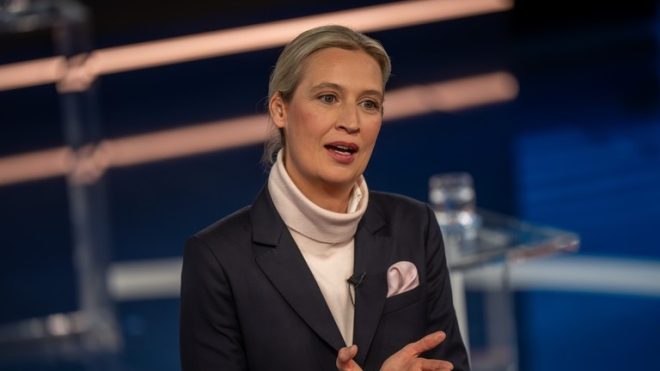
Co-leader of the Alternative for Germany (AfD) party, Alice Weidel © Global Look Press / Michael Kappeler
RT | February 16, 2025
Berlin needs to restore relations with Moscow for the sake of the nation’s economic well-being, Alice Weidel, co-leader of the right-wing Alternative for Germany (AfD) party, has said. Antagonizing Russia has brought the country nothing but trouble, she told Bild tabloid in an interview published on Sunday.
The AfD wants Germany to have “very good relations with our European neighbors” and with great powers as well, the politician said, adding that “it includes Russia.”
“Until two years ago, we sourced cheap natural gas from Russia through the Nord Stream,” Weidel said, referring to the Russian undersea pipelines delivering natural gas to Germany that were sabotaged via a series of explosions in autumn 2022.
Berlin has since taken steps to put an end to Russian energy imports as part of its EU sanctions policy, which is linked to the Ukraine conflict.
According to Weidel, the introduction of restrictions was a mistake since it primarily damaged the German economy. “What we want is to put an end to the sanctions policy,” the politician said, claiming her country currently has “the highest energy prices in the world,” which make the nation “no longer competitive.”
According to the Statista online data aggregator, Germany had the fifth highest electricity prices for households in the world as of March 2024, behind Italy, Ireland, Denmark and Belgium.
When repeatedly pressed by Bild on whether her party wants to restore “good relations” with a nation that supposedly threatens Germany, Weidel replied that Berlin has also been aggressive towards Moscow in its rhetoric over the past years.
The German government was climbing up “the escalation spiral,” the politician said, adding that Berlin’s politicians used belligerent rhetoric and provided weapons to Kiev during its conflict against Moscow.
“German tanks have been rolling against Russia again” for the first time since World War II, she said, referring to the heavy armor supplied to Ukraine as part of the country’s military assistance.
When asked about why she refrains from criticizing Russia’s role in the conflict, Weidel said that Berlin and Moscow should “sit down at the negotiating table” instead. “You have to talk to each other,” she stated, adding that her party was calling on Germany to join the peace negotiations to end the Ukraine conflict. That would be the “only serious policy,” she added.
The AfD has been gaining popular support over the past months despite being ostracized by the other major German political forces, which accuse it of being “far-right.” The party enjoys the backing of between 20% and 21% of the population a week ahead of the snap parliamentary elections, and is projected to come in second behind only the conservative Christian Democratic Union, this week’s polls suggest.
Pete Hegseth & J.D. Vance Tell Europe’s Leaders to Grow Up
By John Leake | Focal Points | February 15, 2025
Growing up is the often painful process of coming to terms with the reality of one’s own limitations, and recognizing that it’s impossible to gain anything in life without hard work and sacrifice. Wisdom lies in recognizing that—as the economist Thomas Sowell would put it—getting what we want often requires a tradeoff. Children, particularly the children of indulgent parents, struggle to recognize this. They want everything NOW and they don’t want to give up anything to get it.
For some time now I have perceived that the European Union—both the supranational entity and the constituent nations—are governed by childish people with childish ideas about what is best for their countries. This has been very painful for me to watch, because I love Europe and spent the happiest years of my life living there.
Especially distressing has been the ruin of Germany with stupid “green energy” initiatives that have wrecked it’s brilliant manufacturing sector, and with its bizarre welcoming of young males from the Arabic-speaking world.
The objective of these policies is apparently to destroy the 1). Economic security of young German men who had long enjoyed great, skilled labor jobs, and 2). the physical security of young German women.
The entire “green energy” hoax completely ignores the laws of thermodynamics, while allowing millions of young Arabic men into Germany ignores the basic reality that most of them have nothing to do in Germany but hang out and chase cute German girls. Any grownup man with a shred of common sense instantly recognizes the folly of these polices.
Equally idiotic has been the willingness of Germany’s so-called leaders to wreck the the excellent relationship that former German Chancellor Gerhard Schroeder forged with Russian President Vladimir Putin.
This relationship—expressed by the construction of the NordStream Pipeline—was built on the essential facts that Germany needed Russia’s plentiful and cheap gas, while Russia (which has an economy smaller than that of Texas) needed a market in which to sell it.
Under the baleful influence of the equally moronic Neocons in Washington, German officials decided to wreck this relationship by playing along with the U.S. fantasy of dominating Ukraine, even if it meant destabilizing the balance of power in Europe and wrecking Germany’s fruitful relationship with Russia.
In the last few days, Secretary of Defense Pete Hegseth and Vice President J.D. Vance have been in Europe, with Hegseth giving talks to NATO officials in Brussels and Vance giving a talk at the Munich Security Conference.
In stark contrast with the creepy weirdos in the Biden administration, the youthful and handsome Hegseth and Vance cut fine figures at their respective talks, which were the most incisive I’ve heard in years. Compared to Kamala Harris’s mealy-mouthed and jarring ramble at the 2022 Munich Security Council—which was apparently designed to insult Russia and dismiss its legitimate security concerns—Vance’s talk was elegant and crystal clear.
The message of both Hegseth and Vance to Europe’s leaders was essentially the same—namely, it’s time for them to grow up and recognize the hard facts of life. Just as the U.S. can no longer afford to indulge its own “regime change” fantasies all over the world, Europe can no longer afford to wreck itself with inane, virtue-signaling fantasies about green energy, mass migration, and Ukraine.
Vance also pointed out the sheer nonsense of claiming to be dedicated to democracy while at the same time persecuting popular parties and even trying to nullify election results. The overheated rhetoric about the rise of conservative populist parties being “far right” and “Nazi” has gotten so tired that no one outside of privileged political and leftist circles believes it.
Hegseth made the following clear:
- NATO membership for Ukraine is not a realistic outcome of a negotiated settlement
- As part of any [postwar] security guarantee, there will not be US troops deployed to Ukraine
- A return to Ukraine’s 1991 borders, an official Ukrainian war aim, is “an unrealistic objective.”
- Stark strategic realities prevent the United States of America from being primarily focused on the security of Europe.
- The United States will no longer tolerate an imbalanced relationship which encourages dependency.
In other words, the U.S. will no longer pursue an antagonistic relationship with Russia in Europe, especially in Ukraine, but will seek a negotiated settlement. If the Europeans want to persist in having an antagonistic relationship with Russia, they are on their own and will have to pay for it.
Hegseth was criticized for what appeared to be making concessions to Russia before President Trump had even commenced negotiations with Russia. The (Neocon) National Review gave him a hard time for this, and an equally hard time for apparently walking back some of these remarks the following day, which made him seem amateurish.
And yet, let’s face it— a return to Ukraine’s 1991 borders is “an unrealistic objective” at this point.
Is a single American, English, German, or Austrian reader of this post willing to die fighting Russia in order to ensure that Ukraine’s 1991 borders are restored?
If you, dear reader, are too old to fight in Ukraine, would you be willing to sacrifice one of your children to restore Ukraine’s 1991 borders?
Samuel Johnson famously remarked:
When a man knows he is to be hanged in a fortnight, it concentrates his mind wonderfully.
Likewise, when a man knows that either he or his young sons are going to be sent abroad to die to maintain Ukraine’s 1991 borders, it concentrates his mind wonderfully. In light of this, I believe it is high time for the Neocon armchair warriors in Washington to quit talking and start enlisting.
Join the army, get into shape, and get your asses over to Ukraine. On the flight over, you may take heart in reading Kipling’s poem to a “Young British Soldier,” which concludes with this heart-rousing stanza:
When you're wounded and left on Afghanistan's plains,
And the women come out to cut up what remains,
Jest roll to your rifle and blow out your brains
       An' go to your Gawd like a soldier.
              Go, go, go like a soldier,
              Go, go, go like a soldier,
              Go, go, go like a soldier,
                  So-oldier of the Queen!
Neocons, go to your Gawd like a soldier!
Featured Video
More Iran War fallout: Maritime insurance industry shifts from London to China
or go to
Aletho News Archives – Video-Images
From the Archives
The Biggest Threat to Peace in Middle East
By Dr. Elias Akleh* | Sabbah Report | May 24, 2010
A build up of heightened tension in the Middle East is escalating in the last few weeks. American and Israeli postures towards Lebanon, Syria, and Iran have become more threatening. Listening to speeches of political leaders one hears talks only about war not peace. Iranians and Israelis are continuously training hard for a possible showdown. Both sides are conducting extensive war games every month. This led Syrians to claim that Israel is preparing for a soon-to-come another war. The Jordanians also are warning that current stalemate of the peace process is an indication of a war breaking out this summer. The Russian President and his army chief hinted, a few months ago, that the US and Israel were planning for an attack on Iran.
Indeed Iran is, as it has been for last few years, the target of most of the threats and accusations of supporting terrorism. Escalating incitement against Iran the American Defense Department sent last month (April) to Congress a report on Iran’s military claiming Iran could develop intercontinental ballistic missiles capable of reaching the US by 2015.
Ignoring the fact that N. Korea, India, Pakistan, and Israel are proven to have nuclear weapons while Iran does not, the US Secretary of State Hillary Clinton chose in her speech, to the nuclear Non-Proliferation Treaty review conference at the UN, to focus on Iran’s alleged nuclear ambitions putting the whole world at risk as she put it. According to Clinton Iran’s acquisition of nuclear weapons, rather than Israel’s more than 200 nuclear bombs, is destabilizing the Middle East. She called on the world’s nations to rally around US efforts to hold Iran, not other nuclear countries, to account.
The accusation that Usama Bin Laden is living comfortably in Iran had received a boost after the broadcast of a documentary called “Feathered Cocaine”. This echoed the June 2003 claims of the Italian newspaper Corre de la Sierra that Bin Laden was in Iran according to some intelligence report, and according to Richard Miniter’s book “Shadow War”. … continue
Blog Roll
 Aletho News
- US Tells Allies That Ukraine-Bound Arms Could be Sent to Middle East
- Organized terrorism: Iran condemns killing of its diplomats in Lebanon
- Why could Gaza enter the regional war?
- Hamas official rejects Mladenov Plan linking disarmament to Gaza reconstruction
- Two Primary Elections for the Soul of ‘America First’
- Japan Clings to US Vassalage Despite Energy Crunch Caused By Iran War
- US Seeks Control Over Global Energy Infrastructure – Kremlin
- US senators target Orban government for standing up to Zelensky
- The deep-rooted culture of corruption in Ukraine
- Iran mobilizing one million soldiers to ‘create hell’ for any US ground assault: Report
- If Americans Knew
- Researchers at Human Rights Watch Resign Over Blocked Report on Palestinian Refugee Return
- Jewish Groups Are Backing a War Americans Don’t Want
- Eric Fingerhut Thinks He’s the President of the Jews
- Top Jewish Philanthropists, Rabbis Urge Israeli President to Take Action Against ‘Jewish Extremists’
- Don’t Be Fooled. Zionist Leaders Have Always Wanted to Control Southern Lebanon
- Israel’s widespread use of torture is a core element of its genocide against the Palestinian people
- In Israel’s War on Iran, Many Middle East US Bases Rendered “All But Uninhabitable”
- ‘Burn the lawn’: Israel pursues ‘Rafah model’ in southern Lebanon
- A genocide here, an amputation there
- Reports: Iran mobilizing 1M fighters, Israel-US run low on ammo, Israeli army faces shortage – Not a ceasefire Day 168
- No Tricks Zone
- Devastating Assessment Of Comirnaty Vaccine By Former Senior Pfizer Europe Toxicologist
- New Study: CO2 Is ‘Effectively Negligible’ As An Explanatory Climate Change Factor Since 2000
- Former Pfizer Toxicologist Dr. Helmut Sterz Tells Bundestag Hearing Pfizer Vaccine Should Have Never Been Approved
- Energy Expert: Germany’s Nuclear Phaseout Was A “500 Billion Euro Mistake”
- New Research: South Australia’s Mid-Holocene Sea Surface Temperatures Were 4°C Warmer Than Today
- Storing Green Energy To Last Germany 10 Days Would Require A 60-Million Tonne Battery
- New Studies: UK Sea Levels Were 4 Meters Higher Than Today During The Mid-Holocene
- Destructive Green New Deal: German Energy And Metal Group Warns Of Drastic Crisis
- New Study Documents A 20-Year Pause In Arctic Sea Ice Decline – Driven By Internal Variability
- Wake-up Call: Survey Shows Majority Of Germans Now Favor Postponing Climate Targets!
 Aletho News