Germany upset by China’s embrace of Russia – envoy
RT | May 13, 2024
China’s stance on the Ukraine conflict and close ties with Russia call into question its relationship with Germany and Europe, Berlin’s ambassador to Beijing has said.
China has ramped up trade with Russia since the start of the conflict, while refusing to condemn Moscow’s actions, Patricia Flor said in an interview with the South China Morning Post on Monday.
”For Germans and Europeans, Russia’s aggression is an existential threat. This is a nuclear power next to us that just invaded its neighbour. It has really shaken up people,” Flor told the news outlet. “The situation casts doubt on China’s relations with Germany and Europe.”
German Chancellor Olaf Scholz paid a visit to China in April, and met with President Xi Jinping, who outlined four principles to prevent the conflict in Ukraine from escalating. Among them was for the West to stop “adding fuel to the fire,” which he said would lay the groundwork for peace.
Germany, a NATO member, has emerged as a top supplier of military equipment and weapons to Kiev, and has trained Ukrainian soldiers. In 2022 and 2023, Berlin spent around €6.6 billion ($7.13 billion) on military assistance to the country, according to government data.
Beijing has insisted it remains neutral in the Ukraine conflict, and repeatedly called for the crisis to be settled through negotiations.
Economic ties between China and Russia are also “of great concern” to Germany, Flor said, referring to the alleged supply of dual-use goods and components by China to Russia. Western countries claim that the goods can be used by the Russian military. The US said in April that it was ready to impose secondary sanctions against Beijing over its alleged support for the Russian defense industry.
China has denied selling weapons to Russia. In April, Foreign Ministry spokesperson Mao Ning insisted that China “regulates the export of dual-use articles in accordance with laws and regulations,” and urged “relevant countries” not to “smear or attack the normal relations between China and Russia.”
Following the introduction of sanctions against Russia by the US, the EU and their allies, Russia redirected its trade flows to the Asia-Pacific market, primarily to China. Trade between the nations hit an all-time high of $240 billion in 2023.
The Climate Cult Reacts As Its Political Position Begins To Slip
By Francis Menton | Manhattan Contrarian | May 05, 2024
For two decades and more, the political position of the climate alarm cult in the U.S. and Europe has only seemed to strengthen with time. In the U.S., the Obama and Biden Administrations have both pushed huge regulatory initiatives to restrict use of fossil fuels (with only some modest roll-backs during Trump’s four years); some of the most sweeping restrictions got pushed through just a week ago. Meanwhile, blue states like California and New York have enacted ever-more-extreme restrictions by statute. In Europe, there has been a near all-party political consensus in favor of the “net zero” agenda, notably including even the mainstream conservative parties in the largest countries like the UK and Germany.
I have long said that sooner or later a combination of physical reality and cost would stop the “net zero” juggernaut in its tracks. Indeed, that has begun to happen, particularly in Europe. Elections for the European Parliament are coming up in about a month, with climate skeptic candidates and parties looking to score substantial gains.
So how is the left reacting? So far, the official talking point seems to be to belittle the resistance to fossil fuel restrictions as some kind of scheme of the “far right.” The “far right,” we are told, are those nefarious people who dare to stand up for maintaining the living standards of the working stiffs against those who would impoverish us all in the quixotic drive to reduce carbon emissions. Somehow, seemingly independent news organizations put out articles using the exact same words and phrases. Here are a couple of recent examples.
In the Washington Post on May 1, the headline is “How car bans and heat pump rules drive voters to the far right.” Subheadline: “Studies show that as energy prices rise, so do right-wing movements against green policies.” Excerpt:
A . . . backlash is happening all over Europe, as far-right parties position themselves in opposition to green policies. In Germany, a law that would have required homeowners to install heat pumps galvanized the far-right Alternative for Germany party, or AfD, giving it a boost. Farmers have rolled tractors into Paris to protest E.U. agricultural rules, and drivers in Italy and Britain have protested attempts to ban gas-guzzling cars from city centers. . . .
Th[e] resurgence of the right could slow down the green transition in Europe, . . . as climate policies increasingly touch citizens’ lives. . . . “This has really expanded the coalition of the far right,” said Erik Voeten, a professor of geopolitics at Georgetown University and the author of the new study on the Netherlands.
The Post’s writer, Shannon Osaka, seems genuinely surprised that the common people of Europe would place any value on maintaining their standard of living:
[C]hanges to driving, home heating and farming are beginning to affect individual Europeans — sparking criticism and anger. “What’s happening as we accelerate the pace of the transition is we’re now starting to get into sectors that inevitably touch on people’s lives,” said Luke Shore, strategy director for Project Tempo, a nonprofit research organization that is assessing how climate policies affect voting patterns in Europe. “We’ve reached the point at which it’s becoming personal — and for that reason, it’s also becoming more political.” The problem, researchers say, occurs when individual consumers feel that the cost of the energy transition is being borne on their shoulders — rather than on governments and corporations.
Who could ever have guessed that this might happen? As an example of crazy “far right” lunacy, the Post cites this line from the manifesto of the Party for Freedom in the Netherlands:
“Energy is a basic need, but climate madness has turned it into a very expensive luxury item.”
I mean, how could you get any more extreme “far right” than that?
In a very similar vein, we have a piece from the Guardian on April 30, with the headline, “How climate policies are becoming focus for far-right attacks in Germany.” Again, the gist is that this is just coming from extremists that you don’t need to pay any attention to. Excerpt:
At the marches held in Görlitz, a stronghold of the far right on the Polish border, and other towns across Germany every Monday night, supporters of [the Alternative for Germany and Free Saxony] parties vent their fury at immigration, coronavirus restrictions and military aid to Ukraine. But one group bears the brunt of the blame. “The Greens are our main enemy,” said Jankus, describing the AfD as a party of freedom and the Greens as a party of bans. “We don’t want to tell people how to heat their homes. We don’t want to tell people what kind of engine should be in their car.”
Freedom — there’s a really lunatic “far right” idea. Rather than trying to explain to the readers why there is something wrong with support of “freedom,” the Guardian instead veers off into characterizing these “far right” demonstrators as really, really bad people:
[Green] party speaker Carolin Renner said she and her colleagues had had death threats screamed in their faces, white-pride stickers stuck to their door and a daily barrage of hateful comments posted on their social media channels. Shortly before Christmas, protesters dumped horse manure in front of the Greens’ office in nearby Zittau.
Despite the characterizations, the article contains no actual example of anything described as a “death threat” or a “hateful comment.” We’ll just have to take the word of the Green Party spokesperson.
Well, the European elections are just about a month away at this point. The climate skeptic parties are expected to make some noticeable gains. However, the actual mandatory requirements for most people to ditch the gas-powered car for an electric one, or to buy a heat pump to heat their home, have not yet kicked in. When that happens, perhaps we will see a real political tornado.
Dr. Ghassan Abu Sitta speaks to Al Mayadeen on EU entry ban
Al Mayadeen | May 5, 2024
Doctor Ghassan Abu Sitta, a renowned Palestinian Plastic and Reconstructive surgeon, detailed to Al Mayadeen his experience in France’s Charles De Gaulle International Airport, where French authorities stopped and turned him back on Saturday.
Dr. Abu Sitta flew to France to speak at the French Senate at the invitation of the Ecologists Party (The Greens), however, he was stopped and interrogated after arriving at Charles De Gaulle airport, to be later put on a flight back home. French authorities told Abu Sitta that he was barred from entering EU member states after German authorities banned him from the Schengen Area.
The surgeon volunteered with Doctors Without Borders in the Gaza Strip, working in the besieged territories hospitals amid a blatant Israeli genocide, which he bore witness to.
He told Al Mayadeen that the main reason why French authorities denied him entry to the country was to deny him access to the International Criminal Court (ICC) in The Hague. The doctor was also scheduled to speak to authorities in the ICC, which is reportedly exploring issuing arrest warrants for Israeli war criminals, including Prime Minister Benjamin Netanyahu.
In the interview, Abu Sitta underlined the political pressure that the ICC is being subjected to from the United States Congress, the Joe Biden administration, and the European governments abetting the Israeli regime’s war on Gaza.
In this context, the humanitarian said that a European political decision has been made, aiming to silence any witnesses of Israeli war crimes in Gaza. This policy comes in parallel with an Israeli decision to assassinate all other witnesses to the war crimes remaining in the Gaza Strip or held in detention, Abu Sitta explained.
Moreover, Abu Sitta pointed to collusion between Israeli and European officials, aimed at restricting the movement of witnesses to the Israeli genocide of Palestinians, specifically to international courts.
Sweden rules out international Nord Stream probe
RT | May 4, 2024
There is no need for an international investigation into the explosions on the Nord Stream 1 and 2 natural gas pipelines, Sweden’s Foreign Ministry has told RIA Novosti news agency.
Last week, China’s deputy envoy to the UN, Geng Shuang, called for a probe into the September 2022 blasts that ruptured the pipelines, which were built to deliver Russian gas to Germany and the rest of Europe. Countries should work together on an investigation “to bring the perpetrators to justice in order to prevent the reoccurrence of similar incidents,” Geng said.
When asked about Beijing’s proposal by RIA Novosti on Friday, the Swedish Foreign Ministry insisted that “there is no need for an international investigation. It’s going to achieve nothing.”
“An investigation into the incidents was carried out by the Swedish authorities in accordance with the fundamental principles of independence, impartiality and the rule of law. Other national investigations are still ongoing,” the ministry stated.
Sweden conducted its own probe as the explosions on the Nord Stream pipelines occurred in the country’s exclusive economic zone. Germany and Denmark carried out separate inquiries. However, in February, the Swedish and Danish investigations were aborted. Stockholm said it had come to the conclusion that the case did not fall under Swedish jurisdiction, while Copenhagen concluded that “there was deliberate sabotage” of the pipelines, but found insufficient grounds to pursue criminal proceedings.
Russia is carrying out its own investigation into the Nord Stream blasts despite the refusal of Western nations to cooperate. Prosecutor General Igor Krasnov said earlier that Moscow had sent more than a dozen requests for legal assistance to Germany, Denmark, Finland, Switzerland and Sweden, but only received a single formal reply from Copenhagen.
Russian President Vladimir Putin and other officials suggested previously that the pipelines were targeted by the US or on Washington’s behalf.
Alleged Chinese spy working for AfD MEP Krah was an informant for German intelligence for years
‘Remarkable turn of events!’
By John Cody | Remix News | April 29, 2024
The news about Alternative for Germany (AfD) MEP Maximilian Krah’s assistant and his arrest for suspected espionage on behalf of China continues to make national headlines, but as more information comes out, the more German intelligence and the political establishment continue to look worse and worse.
Now, news reports have revealed that Krah’s employee, Chinese-German national Jian G., worked for the German domestic intelligence service for years before joining the AfD politician.
Krah has since commented on the new bombshell information, writing on X: “Remarkable turn of events!”
Much is at stake, as Krah is the top candidate for the AfD in the run-up to the EU parliamentary elections in June. The latest report shows that the powerful Office for the Protection of Constitution (BfV) not only recruited Jian G. as a spy, but also dropped him as an informant because there were concerns he was a double agent for China.
However, despite these suspicions, Jian G. gained German citizenship, became a member of the Social Democrats (SPD), and even passed the EU parliament’s security clearance.
Former minister Mathias Brodkorb questioned the story on X, writing:
They are really funny. Let’s assume the story is true:
1. The Office for the Protection of the Constitution is working with the man.
2. Then, the Office for the Protection of the Constitution ends the collaboration because the man could be a double agent.
3. Then the German state naturalizes this agent.
Intermediate question: Where was the Office for the Protection of the Constitution at that time?
4. Then, Krah wants to hire the man as an employee of the EU parliament. That cannot be done without a security check. So the EU parliament should actually have asked the German security authorities whether there was anything against the man. But apparently they didn’t. Otherwise, the man would not have been cleared and could not have been hired.
Intermediate question: Where was the Office for the Protection of the Constitution at that time? And you are now seriously asking what the problem is? Seriously?
One of the main questions is why the Office for the Protection of the Constitution never informed Krah or the AfD about their suspicions, which is standard operating procedure, and one designed to protect the country’s parties from foreign infiltration. Notably, allowing Jian G. to work for Krah created a favorable political scenario for the establishment to later arrest him in order to smear the AfD. Notably, Jian G. was arrested right before EU parliamentary elections.
The question now is whether the BfV purposefully kept the AfD in the dark for years about the information it knew in order to damage the party.
Working for the BfV all the way back in 2007
According to Bild newspaper, Jian G. was an informant for the Saxon Office for the Protection of the Constitution (BfV) since 2007 at the earliest. Previously, he had unsuccessfully offered to work for the federal branch of the BfV, but he was rejected, and referred back to the Saxon branch of the BfV.
Jian G. reportedly worked with the intelligence service on his own initiative, including supplying information that dealt with Chinese state actors taking action against Chinese exiles in Germany. Eight years after joining the Saxon BfV as an informant, the Saxon branch was informed by the Federal Office for the Protection of the Constitution that G. could be a double spy.
In 2015 and 2016, G. was then directly observed by the counterintelligence department of the Office for the Protection of the Constitution. Officers also questioned him about their suspicions but were unable to prove that he was a spy for China. He was therefore listed as a “suspected case” during that period.
In 2018, G. was finally removed as an informant by the Office for the Protection of the Constitution.
However, by that time, Jian G. had already made contact with Krah and then went on to work as his employee in the EU parliament beginning in 2019. He was then intensively monitored by the domestic intelligence service from 2020 and finally arrested in April 2024.
As noted above, despite the suspicion of espionage, the Chinese national was granted a German passport, was also a member of the SPD for a time, and was able to pass the security check for the EU parliament.
In addition, the BfV under Thomas Haldenwang (CDU), who is notoriously anti-AfD and publicly working against the party, failed to inform Krah or the AfD about the suspicion of espionage against Jian G.
As Remix News has documented, Haldenwang has made numerous remarks against the AfD, including on state-funded television, all in violation of neutrality. Haldenwang belongs to the CDU party.
Notably, this is standard procedure in such cases, which means the Office for the Protection of the Constitution withheld this information from the AfD in violation of past precedent and procedure.
Western media sees spies and saboteurs everywhere
By Patrick Poppel | April 29, 2024
An article entitled “Spies and Saboteurs” was published in the NZZ (Neue Züricher Zeitung). This choice of words reminds us very much of the time of the Second World War. A Russian agent is now suspected behind every corner in Europe. There were even reports of planned attacks by the Russian secret service on German soil. But most of the allegations concern disinformation and cyberattacks that are intended to destabilize Germany from Russia.
This article in the so-called “quality medium” is not an isolated case in the media world of Germany, Austria and Switzerland. Just a few days ago there was a scandal in Austria because an employee of the secret service was accused of working as a spy for Russia. Whether this is true or not, this person was immediately shown to be close to the opposition FPÖ party. In many Austrian media, bizarre connections to other political figures were described, without being able to prove this. The target of this report was clearly not this “agent” but the opposition party.
This anti-Russian opinion formation now flanks the anti-democratic and totalitarian developments, as there is already discussion in Germany about banning a party (AFD) that does not correspond to the mainstream.
The role of the systemic media in manipulating the political landscape must be questioned more closely in the future. Especially because they are financed by public structures. These media create an atmosphere in society, which is used as a basis for discussions in parliament and even changes in laws.
But it’s not just the media that is working against the opposition. There are now also demonstrations against the opposition in Germany, which are massively supported by the state media. These “protests against the right” must be analyzed as an artificially created movement. State-funded media, cultural associations and artists are gathering people here to take to the streets against the opposition.
The AFD in Germany and the FPÖ in Austria are repeatedly described as pro-Russian and individuals there have often been asked to explicitly distance themselves from Russia. Apart from that, these political forces cannot be described as pro-Russian, as they include many transatlantic politicians.
We have to ask ourselves why such a major campaign is now being organized against the opposition. The answer is that the system can no longer explain its own incompetence and work against the state’s sovereign interests. Only when you point your finger at someone do three fingers point back at you.
Fear of Russian espionage and sabotage is currently at a peak in Europe. It is expected that this situation will not change soon. This fear has existed in Eastern Europe for years, but now the West is also mired in this paranoia.
It is important to the media in the West to create threats and enemy images. Russia is currently the target of this propaganda. But in the future it could also become a different state. Just as people are afraid of Russia’s spies today, tomorrow they might be afraid of China’s economy or Africa waking up.
Europe is in a difficult situation due to geopolitical changes. And systems that get into trouble often tend to act irrationally. These are difficult times for the political opposition and happy journalists in Europe. Anyone who doesn’t follow the mainstream is excluded and attacked in the media.
However, these political and media instruments could also be just the beginning of further development. The first arrests have already been made and the investigation is continuing. The search for “enemies of the state” will not stop. In this context, one should just think about who the enemies of democracy are here.
Such a division in society never existed in Western Europe, even during the Cold War. Since the beginning of the Ukraine conflict in 2014, the mass migration in 2015 and the ongoing climate hysteria, society in the West has been divided into two groups. These two groups have no common points of contact with each other.
This is a very dangerous domestic political development. And the current media propaganda is not helping to ease the mood between the government and the opposition. It will only achieve the opposite and divide society even further.
The defamation of the opposition through these espionage scandals is a new stage in the political struggle and allows us to see exactly how cooperation between Western secret services, lobbyists, governments and the media works.
Patrick Poppel is an expert at the Center for Geostrategic Studies in Belgrade.
Yemen downs third US MQ-9 Reaper drone since November
The Cradle | April 27, 2024
The spokesman for the Yemeni armed forces, Brig. Gen. Yahya Saree, announced on 27 April that Sanaa downed another MQ-9 Reaper drone and that its troops successfully targeted the British-owned MV Andromeda Star crude oil tanker.
According to the US Central Command (CENTCOM), the Yemeni armed forces launched three anti-ship ballistic missiles into the Red Sea, causing minor damage to the Andromeda Star.
One of the missiles landed near a second vessel, the MV Maisha, but it was not damaged, CENTCOM said.
On Saturday, an unnamed US military official confirmed to CBS News that an MQ-9 Reaper drone “crashed” inside Yemen early on Friday and said an investigation is underway.
According to Saree, the $30 million drone was shot down by Yemeni air defenses in Sadaa province.
Yemen has downed three MQ-9 Reaper drones since the start of its operations in support of Palestine last November, costing the US government at least $90 million.
Despite launching an illegal war on the Arab world’s poorest country, the US has failed to deter attacks on the Red Sea and Indian Ocean by Sanaa.
The Yemeni armed forces initially targeted only Israeli-linked ships passing through the Bab al-Mandab Strait but expanded the operation to include US and UK ships after Washington and London began bombing the country.
An EU naval mission to “protect navigation” in the Red Sea has also failed to deter the attacks, as officials from Germany and France have said that the situation “remains the same.”
In the face of its failure, Washington recently offered Yemeni officials “an acknowledgment of its legitimacy” in exchange for its neutrality in the war on Gaza.
“[Washington] pledged to repair the damages, remove foreign forces from all occupied Yemeni lands and islands, and remove Ansarallah from the State Department’s ‘terrorism list’ – as soon as they stop their attacks in support of Gaza,” according to Yemeni sources who spoke exclusively with The Cradle.
The offer also included “severely reducing” the role of the Saudi-appointed Presidential Leadership Council (PLC) and “accelerating the signing of a roadmap” with the Saudi-led coalition to end the nine-year war that has decimated Yemen.
Nevertheless, Yemeni officials have maintained that their operations in the Red Sea, Gulf of Aden, and the Indian Ocean will continue until Israel stops the genocide of Palestinians in Gaza.
On 22 April, the Yemeni armed forces announced that they would expand military operations against Israeli-linked ships in the Red and Arabian Seas and the Indian Ocean following the discovery of mass graves around several of Gaza’s hospitals.
China calls for ‘international investigation’ into Nord Stream attack
RT | April 27, 2024
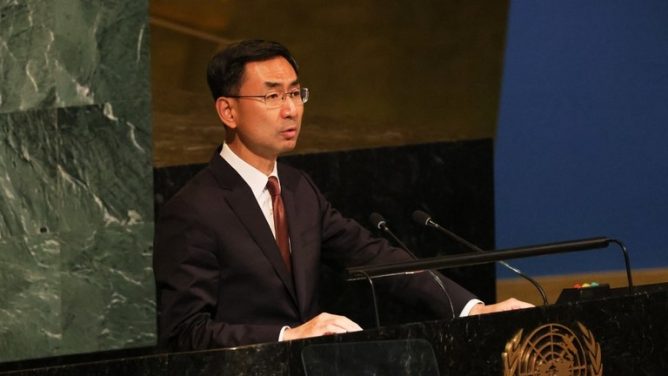
China’s deputy envoy to the UN has called for an international probe into the bombing of the Nord Stream gas pipelines, adding that Russia would be involved in such an investigation.
“With the situation standing where it is, one cannot help but suspect a hidden agenda behind the opposition to an international investigation, while lamenting the potential cover-up and loss of quantities of compelling evidence,” China’s Deputy Permanent Representative to the UN, Geng Shuang, said on Friday, according to the Xinhua news agency.
“We reiterate our call for the early launch of a UN-led international investigation to bring the truth to light for the international community,” Geng continued, adding that Western nations should “actively communicate and cooperate with Russia and jointly investigate the incident.”
Nord Stream 1 and 2 each comprised two separate pipelines, linking Russia and Germany. Three out of the four lines were destroyed in a series of explosions near the Danish island of Bornholm in September 2022, severing Germany’s energy ties to Russia and leaving its gas-dependent economy reliant on more expensive American liquefied natural gas.
Germany, Sweden, and Denmark all opened investigations into the attack, but Sweden and Denmark closed their inquiries in February. Swedish investigators published no conclusions, while the Danish team concluded that “there was deliberate sabotage,” but declined to blame the attack on anyone.
China and Russia have demanded an international investigation into the bombings since last year. However, the UN Security Council rejected a Russian request for such a probe last March, with Washington’s deputy envoy to the UN, Robert Wood, accusing Russia of trying to “discredit the work of ongoing national investigations.”
On Saturday, a spokesman for the German Foreign Ministry appeared to reject Geng’s proposal, telling Russia’s TASS news agency that an “investigation is already being conducted by the German Public Prosecutor General’s Office.”
Absent any official conclusions, two competing theories about the bombings have emerged. According to reports in the Western mainstream media, a team of Ukrainian commandos used a rented yacht to transport explosives to the blast sites, with the CIA and European intelligence agencies being made aware of the plot several months beforehand but ultimately failing to stop it.
American journalist Seymour Hersh has said that US President Joe Biden ordered the CIA to blow up the pipelines. Citing sources in the intelligence community, Hersh has claimed that CIA divers working with the Norwegian Navy planted remotely-triggered bombs on the lines in the summer of 2022, using a NATO exercise in the region as cover.
Russian President Vladimir Putin has said that he “fully agrees” with Hersh’s conclusions. Russian Prosecutor General Igor Krasnov, who is leading Moscow’s investigation into the blasts, said last month that “everyone knows perfectly well who did it,” and that “the tracks undoubtedly lead beyond the Atlantic,” – an apparent reference to the US.
Hamas calls on 18 countries signing hostage release initiative to expose Israel’s crimes
MEMO | April 27, 2024
Insurers claim ‘government’ could have sabotaged Nord Stream – Kommersant
RT | April 18, 2024
Insurance policies for the Nord Stream gas pipelines sabotaged in 2022 do not cover destruction or damage caused during military hostilities, Russian newspaper Kommersant reported on Thursday, citing a claim filed at the High Court in London by two major Western companies.
The reported claim by Lloyd’s of London and Arch Insurance comes in response to a court filing in March by Nord Stream AG, the pipeline’s operator.
The enterprise, which is 51% owned by Russian energy giant Gazprom, alleged at the time that insurers had failed to pay about €400 million ($438 million) for damage caused by the explosions at the pipelines, according to the Financial Times. Nord Stream AG reportedly estimates it would cost over €1.2 billion to fully repair the infrastructure and replace the lost gas inventory.
In response, the two insurers are said to have claimed that “loss or damage directly or indirectly occasioned by, happening through, or in consequence of war” cannot be covered by the policies. They added that Russia-Ukraine conflict, which began in February 2022, “satisfies the terms war, invasion hostilities or military power.” The insurers also argue the damage could have been caused “by or under the order of any government,” according to Kommersant.
Commenting on the report, Russian Foreign Ministry spokeswoman Maria Zakharova said major concerns have been raised over the credibility of Western insurance giants. Any refusal to pay liabilities adds to a series of hostile acts towards Russia, according to Zakharova, including the seizure of state assets and private property, as well as alleged threats to damage civilian infrastructure.
Built to deliver Russian natural gas directly to Germany via the Baltic Sea, the Nord Stream pipelines were damaged by unknown perpetrators in a series of explosions in September 2022. The blasts left three out of four pipelines inoperable, causing what is believed to be the largest single methane leak ever.
Shortly after the sabotage, Germany, Denmark and Sweden – in whose economic zones the attack took place – launched separate investigations, although no results have been published. Earlier this year, Denmark and Sweden said they had closed their probes.
The Russian authorities have claimed the US had the most to gain from the sabotage, pointing to the opposition to the pipelines repeatedly voiced by the White House. Moscow has also accused the West of stonewalling the investigation.
Last year, award-winning US journalist Seymour Hersh accused Washington of being behind the bombing, although the White House dismissed the allegations. Several Western media outlets later reported that Ukrainian citizens had been involved in the sabotage. Kiev has denied any connection to the attack.
As a result of the sabotage, gas supplies from Russia to Germany via Nord Stream 1 were halted. Nord Stream 2 had never been put into operation due to EU bureaucratic setbacks.
Scholz has one trump card in talks with China, but he’ll never use it
By Tarik Cyril Amar | RT | April 16, 2024
German Chancellor Olaf Scholz is on a three-day visit to China. He is not traveling alone. A large delegation of German business representatives, including from flagship companies such as Mercedes, Siemens, and BMW, is coming along. Scholz’s agenda is ambitious: The chancellor wishes to talk about international trade and competition, climate politics, the tensions over Taiwan, the war in Ukraine and Beijing’s relationship with Russia. Since Iran has just made use of its clear right to self-defense and retaliated following Israel’s illegal attack on Tehran’s diplomatic premises in Damascus, Scholz felt compelled to make a statement about that as well.
Two of these topics tower above the others: matters of trade and the relationship between China and Russia. Regarding trade, the crucial issue is that the West in general – led by the US – has embarked on a policy of de facto economic warfare against China, while constantly threatening to escalate further.
That was the essence of Janet Yellen’s recent Beijing trip; the US Treasury Secretary arrived with a list of demands to curb what America denounced as Chinese “overcapacity” and dumping, and left with a blunt warning that “nothing was off the table” in terms of additional strikes against China’s economy.
Then there is the EU, which as usual, follows Washington’s lead. Under hardliners like European Commission President Ursula von der Leyen and Vice President Margrethe Vestager, Brussels is ramping up anti-Chinese rhetoric and measures. Beijing has officially been declared a “partner for cooperation, an economic competitor, and a systemic rival.” With the EU Commission defining “economic security” clearly in opposition to China and launching probes targeting Chinese electric vehicles, wind turbines, and soon the procurement of medical devices, the accent clearly is on competitor and rival.
At the same time, however, German business leaders know that they cannot afford a policy of sustained conflict. A high-ranking Siemens executive has just gone public with a warning that “decoupling” from Chinese manufacturing would take “decades.” That, clearly, is just another way of saying it’s a very bad idea to even try.
Superficially, it may appear that there is an opportunity here for Scholz – an opportunist to a fault – to appear as a mediator or, at least, to deftly balance and weave between competing demands. The Global Times, a media outlet owned by the Central Committee of the Chinese Communist Party, prefaced the chancellor’s visit with a generally welcoming article, depicting Scholz as, in essence, a dove among hawks, arguing that while Foreign Minister Annalena Baerbock and Economic Minister Robert Habeck stand for confrontation, the chancellor is seeking to find a balanced approach.
Yet, even if he wanted to try to be smart and flexible, Scholz is hamstrung in multiple ways. He will struggle to be taken seriously because both Germany and its chancellor lack international standing, and Germany lacks leverage in its relationship with China.
Let’s look at the leverage deficit first: In economic terms, the Chinese-German relationship is substantial and complex. Many factors are important; multiple indicators are relevant, such as, for instance, foreign direct investment (which is currently dipping). But overall trade volumes suffice to show that Germany cannot speak to Beijing from a position of strength or even parity.
China, according to 2023 export data, is still Germany’s single biggest trading partner, as Bloomberg has noted. That is not unusual in today’s world: with the second-largest economy in the world (the largest in Purchasing Power Parity terms), China is the top trade partner for a total of 120 countries. China is also the largest (external) trade partner of the European Union as whole. However, from China’s perspective, Germany ranks only 8th among export destinations, less than the US, Japan, and even Vietnam.
None of the above means that the economic relationship with Berlin does not matter to Beijing, but it does mean that it matters even more for Berlin. Among rational actors, such a pattern of mutual dependency is a reason for cooperation. What it certainly is not is one-sided leverage for Germany. If anyone has the whip hand here, it’s China, which may have tried to “gently” signal this fact with Scholz’s intriguingly low-key, not to say humiliating reception on his arrival in the Chinese manufacturing metropolis Chongqing.
In fundamental terms, Germany, according to data from the International Monetary Fund (IMF), is a country of not quite 84 million people (in China, Chongqing alone is home to over 30 million inhabitants) with projected GDP growth this year down to almost zero (0.5 percent). China has a population of over 1.4 billion, and its GDP is estimated to grow by 4.6 percent.
In sum, China’s economy has problems, such as its over-expanded real estate sector, which are inevitable and often obsessively exaggerated by Western “China doomers.” Germany’s economy is a problem.
The German chancellor can only play a weak hand, due to economics. There is only one way to play it well, and that would involve politics. Scholz could create some room for maneuver for Germany if he did what the Global Times article signaled Beijing would like to see from him: to show some autonomy, a little bit of distance between himself and the hardliners now dominating both Washington and Brussels.
Indeed, for the China hawks in the West, the mere possibility that the German chancellor might go off script is such a nightmare scenario it had to be exorcised in one of America’s two most authoritative journals on international politics. Foreign Policy dedicated a whole article to, in essence, asking if Scholz will chicken out and be too conciliatory toward Beijing. If the Global Times sent an invitation of the “an-offer-you-should-not-refuse” kind, Foreign Policy’s message was “don’t you dare.”
Scholz should dare. It would be only rational because it is really the only trump card he has. As Foreign Policy acknowledges, the EU’s hardball approach cannot work if Berlin is not on board. Without the EU toeing the line, Washington’s game would become much more challenging, too. That is power right there: the power to balance and play both sides.
Unfortunately, this is where we come up against Scholz’s very narrow limits. This is no Bismarck. Instead, we are dealing with a chancellor who can be called the most recklessly and – it must be said, spinelessly – subservient to the US in Germany’s post-WWII history. Scholz grinned when Biden announced, in essence, that the US would destroy the Nord Stream pipelines if it felt like it. When it happened, nothing happened: Germany took it and kept grinning.
Under Scholz, Berlin has become a perfect client of the US. Accordingly, there is no real daylight between Berlin and Brussels either; another ultra-Atlanticist German, Ursula von der Leyen, runs the European Commission. True, some observers speculate that Germany is slyly cutting corners, but that will amount to too little, in absolute terms, for Beijing.
The issue of dependency also brings us to the penultimate irony of Scholz’s visit: The German chancellor has let it be known that he intends to challenge Beijing on its policy toward Russia and thus the war in Ukraine. In essence, Scholz seems to believe it is his job – and within his rights – to urge China to loosen its ties with Russia as well as to support the West’s unrealistic proposals for ending the war in Ukraine without acknowledging that Russia is winning it.
There are two things wrong with this astonishingly tone-deaf attitude: First, obviously, neither Germany nor the EU are in a position to make such requests of Beijing. They have neither the arguments nor the power to back them up. In such cases, the wiser and more dignified course is to be quiet. Second, less obviously, who is Scholz to try to interfere in the partnership between Moscow and Beijing, a partnership marked by rationality and respect for both partners’ national interests? As long as Germany offers a spectacle of unquestioning and irrational obedience to Washington, no one will be interested in its advice on how to cooperate.
That was the penultimate irony. Here is the ultimate one: Scholz’s visit is, most fundamentally, an outcome of the fact that the West has not been able to cajole China. With respect to Germany in particular, it is true that, according to a recent poll, two thirds of German businesses active in China complain of unequal treatment. And yet they are there. And yet a German chancellor still arrives with a planeload of business leaders.
The true message of the poll is about how indispensable China is, talk of “derisking” this and “decoupling” that notwithstanding. In the not-too-distant future, a successor of Scholz may well find himself on a similar trip, but to Moscow. Namely, when two realities will have become so compelling that they must be acknowledged: Russia, too, cannot be cajoled by the West; and, for Germany as well as for Europe as a whole, Russia, too, remains indispensable.
Tarik Cyril Amar is a historian from Germany working at Koç University, Istanbul.
Germany confirms its collaboration with genocide
By Rick Sterling | Dissident Voice | April 15, 2024
A three day Palestine conference in Berlin was forcibly shut down after three hours on Friday. Electricity was abruptly terminated in the midst of the presentation by Salman Abu Sitta, the 87 year old author of the authoritative “Atlas of Palestine”.
Former Greek Finance Minister and leader of DIEM25, Yanis Varoufakis, was prevented from entering Germany to attend the conference. He went on Twitter/X to send a message:
Do you know that the German Interior Ministry has just banned me from entering Germany? Indeed if that were not enough, I have been banned from talking to you via zoom, or indeed through a video message like this, exactly like this. The threat being that I will be tried in Germany for breaking German law. Why? Because of a speech that I published yesterday on my blog calling for universal human rights in Israel- Palestine …. So my question to my German friends, to Germans in general whether you agree with me or not doesn’t matter. … Is this (banning) in your name? Is it something that you feel comfortable happening in your democracy? From my perspective this is essentially the death knell of the prospects of democracy in the Federal Republic of Germany.
Another banned guest speaker was UK citizen Dr. Ghassan Abu Sittah. He reported on Twitter/X:
I have just returned from Germany where I was prevented from entering the country for attending a conference in Germany to give evidence on the war in Gaza and my witness statement as a doctor working in its hospitals. This morning at 10 I landed in Berlin to attend a conference on Palestine where I had been asked … to give my evidence of the 43 days that I had seen in the hospitals in Gaza, working in both Shifa and al-Ahli Hospital. Upon arrival I was stopped at the passport office. I was then escorted down to the basement of the airport where I was questioned for around 3.5 hours. At the end of 3.5 hours I was told that I will not be allowed to enter German soil and that this ban will last the whole of April. Not just that … if I were to try to link up by Zoom or Facetime with the conference even if I were outside Germany or if I were to send a video of my lecture to the conference in Berlin, then that would constitute a breach of German law and that I would endanger myself to have a fine or even up to a year in prison.
Dr. Abu Sitta further commented:
Germany is defending itself against Nicaraguan charges that it is an accomplice to genocidal war as described by the International Court of Justice. This is exactly what accomplices to a crime do. They bury the evidence and they silence or harass or intimidate the witnesses. …. This crackdown on free speech is a dangerous precedent… We are watching the first genocide unfold in the 21st Century and for Germany to become implicated as an accomplice in silencing the witnesses of this genocide does not bode well for the rest of the century.
A large contingent of police invaded the conference and shut off the electricity. Organizers told the reported 250 conference attendees to not provoke the police to violence. Afterward, organizers held a press conference reporting on the behaviour of police before and during the crackdown. Even before the conference, police tried to intimidate supporters of the conference and the owner of the conference venue. They threatened the venue owner might not be able to hold events in future if the conference went ahead. An organizer asked, “Are these the methods of the mafia or democracy?”
Western and Israeli media reported the closure was to prevent “anti semitism” or “hatred of Israel”. On this dubious and hypothetical basis, public education about a real ongoing massacre and mass starvation was made illegal.
Featured Video

Bombing Hitler’s Hometown
or go to
Aletho News Archives – Video-Images
From the Archives
‘Conspiracy Theory’ Now Fact: Greater Israel Has Arrived
By Kit Klarenberg | Mint Press News | January 28, 2025
Ever since Tel Aviv’s 1948 creation, much has been said and written about ‘Greater Israel’ – the notion Zionism’s ultimate end goal is the forcible annexation and ethnic cleansing of vast swaths of Arab and Muslim lands for Jewish settlement, based on Biblical claims this territory was promised to Jews by God. The mainstream media typically dismisses this concept as antisemitic conspiracy theory, or at most the fringe fantasy of a minuscule handful of extremist Israelis.
In reality … continue
Blog Roll
 Aletho News
- Trump admits Iran hit USS Ford carrier: ‘We ran for our lives’
- Battle for Hungary: EU attacks on Orban are a sign of worse things to come
- Iraqi resistance conducts drone strike on US-run base in Syria
- Failing to Defeat Hezbollah, Israel & US Pressure Syria’s Ahmed al-Sharaa to Join War
- US-Israeli war on Iran drives global fertilizer prices up 40%
- Hezbollah’s Surprise Weapons Redefine Ground Battle with Israel
- Yemen joins fight against US, Israel by firing missiles at occupied territories
- Seizing the Kharg: Washington’s path to defeat in the Persian Gulf
- Iran reports 500 US casualties in strikes on covert US military sites
- Pro-Israel terrorist arrested before assassination of pro-Palestinian activist
- If Americans Knew
- Researchers at Human Rights Watch Resign Over Blocked Report on Palestinian Refugee Return
- Jewish Groups Are Backing a War Americans Don’t Want
- Eric Fingerhut Thinks He’s the President of the Jews
- Top Jewish Philanthropists, Rabbis Urge Israeli President to Take Action Against ‘Jewish Extremists’
- Don’t Be Fooled. Zionist Leaders Have Always Wanted to Control Southern Lebanon
- Israel’s widespread use of torture is a core element of its genocide against the Palestinian people
- In Israel’s War on Iran, Many Middle East US Bases Rendered “All But Uninhabitable”
- ‘Burn the lawn’: Israel pursues ‘Rafah model’ in southern Lebanon
- A genocide here, an amputation there
- Reports: Iran mobilizing 1M fighters, Israel-US run low on ammo, Israeli army faces shortage – Not a ceasefire Day 168
- No Tricks Zone
- Devastating Assessment Of Comirnaty Vaccine By Former Senior Pfizer Europe Toxicologist
- New Study: CO2 Is ‘Effectively Negligible’ As An Explanatory Climate Change Factor Since 2000
- Former Pfizer Toxicologist Dr. Helmut Sterz Tells Bundestag Hearing Pfizer Vaccine Should Have Never Been Approved
- Energy Expert: Germany’s Nuclear Phaseout Was A “500 Billion Euro Mistake”
- New Research: South Australia’s Mid-Holocene Sea Surface Temperatures Were 4°C Warmer Than Today
- Storing Green Energy To Last Germany 10 Days Would Require A 60-Million Tonne Battery
- New Studies: UK Sea Levels Were 4 Meters Higher Than Today During The Mid-Holocene
- Destructive Green New Deal: German Energy And Metal Group Warns Of Drastic Crisis
- New Study Documents A 20-Year Pause In Arctic Sea Ice Decline – Driven By Internal Variability
- Wake-up Call: Survey Shows Majority Of Germans Now Favor Postponing Climate Targets!
 Aletho News