Germany and the EU Abandon Reason
Michael von der Schulenburg, Alexander Mercouris & Glenn Diesen
Odysee
Glenn Diesen | September 9, 2024
We had a discussion with Michael von der Schulenburg – a German top diplomat with the OSCE and 34 years in the United Nations. The topic of discussion was the transformation of Germany and the war in Ukraine. Michael von der Schulenburg argues the EU must change course on Ukraine or risk tearing itself apart.
Michael von der Schulenburg and Harald Kujat (the former head of the German Bundeswehr and former chairman of the NATO Military Committee) criticised NATO for provoking the war and sabotaging the peace agreement to use Ukrainians to fight and weaken a strategic rival. Germany is now de-industrialising, the political elites have rediscovered enthusiasm for war, the US and Ukraine attacked Germany’s critical energy infrastructure which EU partners consider to be legitimate, society is growing more pessimistic, freedom of speech is undermined, there are signs of political violence, and new political alternatives are emerging that are not acceptable to the government. Michael von der Schulenburg argues the EU no longer behaves as a rational actor. Where did it all go wrong?
Ukraine Support Without Peace Strategy
DWN Interview with Harald Kujat
Glenn’s Substack | September 8, 2024
Interview by Moritz Enders in Deutsche Wirtschafts Nachrichten (DNW) – translated by Glenn Diesen
Harald Kujat (born 1942), retired Air Force General, was the highest-ranking German soldier as Inspector General of the German Armed Forces from 2000 to 2002. From 2002 to 2005 he was Chairman of the NATO Russia Council and the NATO-Ukraine Commission of the Chiefs of Staff and the highest-ranking NATO General as Chairman of the NATO Military Committee.
Does the Ukraine conflict mark another stage in the transition from a unipolar to a multipolar world order? According to Harald Kujat, the former Inspector General of the German Bundeswehr, neither Russia nor Ukraine and their partners and supporters in the West seem to be able to win it. And at the same time, the next source of conflict is emerging: a conflict between the USA and China.
DWN: Can Ukraine still win the war or is it already de facto lost?
Harald Kujat: Neither Ukraine nor Russia can win the war, because neither will achieve the political goals for which they are waging this war. Ukraine wants to restore the country’s territorial integrity within the 1991 borders and become a member of NATO. But despite continued support from the West, recapturing the territories annexed or occupied by Russia on its own is a legitimate but unrealistic option given the military balance of power and the military situation that has developed during the war. It was declared at the NATO summit in early July that Ukraine’s path to NATO was irreversible. However, it was also emphasized that NATO would be able to issue an invitation if all allies agreed and all conditions were met. Not all member states, including the USA, are willing to do so. President Biden emphasized this again explicitly in an interview in early June.
For Russia, the NATO membership of Sweden and Finland is already a serious setback. It is not yet clear whether it will be possible to establish a buffer zone between Russia and NATO, a long-standing goal of Russia, albeit now in the form of a cordon sanitaire in western Ukraine. One conceivable option would be to admit western Ukraine into NATO if the areas annexed by Russia cannot be reintegrated. However, I am certain that Russia will only agree to a peace settlement if Ukraine does not become a member of NATO, because that is a core demand of Russia.
The United States will also not achieve its goal of weakening Russia politically, militarily and economically. Because of the close ties between Russia and China, this would also have an impact on China, the United States’ biggest geopolitical challenger. It has not been possible to force Russia to stop the attack through a wide range of sanctions. The economic consequences are borne primarily by the European states, while Russia’s economy is stable and domestic production is increasing there. Russia’s geopolitical influence has even grown due to the accession of important states to the BRICS organization and in relation to the global south. And the Russian armed forces are stronger than before the war.
However, two losers in this war are already clear today: the Ukrainian people and the European Union, which has fallen far behind in the power arithmetic of the major powers both politically and economically.
DWN: But could the Ukrainian offensive in the Kursk area, i.e. on Russian soil, which has been going on for more than two weeks, not influence the outcome of the war?
Harald Kujat: The Ukrainian armed forces have undoubtedly pulled off a coup with this advance. They discovered a weak point with the Russians and seized the opportunity that presented itself with determination and considerable success. There are, however, some notable aspects in connection with this operation.
Although Russian intelligence undoubtedly recognized that Ukraine was bringing together elements from several brigades with reconnaissance equipment, electronic warfare and army air defense to form a combat group, they evidently did not anticipate the Ukrainian leadership’s intention to undertake a cross-border advance. The Russian border security consisted mainly of young, inexperienced conscripts equipped only with light weapons. The fact that there was no immediate reaction with combat troops and that the organization of the resistance took a long time is extremely embarrassing for the Russian military leadership.
The Ukrainians’ conduct of the operation shows that they had an astonishingly good picture of the situation regarding the Russian forces. They managed to bring in additional forces relatively quickly to reinforce the initially small combat unit. They were also able to expand their advance in a fan shape. However, they had to accept considerable losses in personnel and material as they gained ground quickly.
So far, the Russian armed forces have limited themselves to stabilizing the situation. They could now bring in superior forces and try to defeat the Ukrainian combat unit. Or they could systematically wear down the enemy forces that had penetrated and possible reinforcements, thereby forcing them to retreat. This is a strategy that the Russians have already used several times, including in Bakhmut and Avdiivka.
The Ukrainians have given various statements about the aim of this advance, which have changed over the course of the operation. It is very likely that the nuclear power plant near Kursk was to be captured. When this did not succeed immediately, it was said that Russia should be forced to withdraw combat troops from the Russian-Ukrainian front in order to strengthen resistance in the Kursk region. The expectation was that this would reduce the pressure on the Ukrainian defense. In addition, the Ukrainian conquests of Russian territory were to serve as a bargaining chip in possible peace negotiations and could be exchanged for Ukrainian territory. Finally, Russian prisoners could be exchanged for Ukrainian prisoners of war.
However, Russia did not withdraw heavy combat units from the Donbas front, but only a few, smaller infantry units. As a result, the Russian forces in the Donbas are able to continue to make territorial gains and even increase their pressure on the Ukrainian defense lines. They are getting closer and closer to Pokrovsk, a strategically important city with sixty thousand inhabitants that could be conquered in the near future. In addition, Russia has rejected negotiations as long as Russian territory is occupied by Ukraine. Thus, the results of the operation hoped for by Ukraine have not materialized
DWN: So what could Ukraine achieve with its advance? Is it the decisive blow that will change the course of the war in Ukraine’s favor or is it a gamble by the Ukrainian president that will ultimately cost Ukraine dearly?
Harald Kujat: There is a high probability that the latter is the case. Because Ukraine is taking a big risk in withdrawing combat troops from the defense front, which is under great pressure, holding the thinned-out Donbas front and at the same time defending its positions in the Kursk area. The already critical military situation will therefore end up being much more difficult than before the advance into Russian territory. The short-term political success could soon end in a strategic defeat.
DWN: Will the war now simply continue until the American presidential elections or is there a chance of ending it through negotiations?
Harald Kujat: I fear that with the Ukrainian advance into Russian territory, the chance for a ceasefire and peace negotiations opportunities for the foreseeable future have been wasted. Russia has refused to negotiate as long as Russian territory is occupied. Both sides are only willing to negotiate if the conditions you demand are met beforehand. In addition, Russia can wait for the results of the American presidential election. I consider the Chinese proposal from February last year to be the only realistic option to bring both sides back to the negotiating table: to continue the negotiations without preconditions, where they were broken off in mid-April 2022.
DWN: What effects would the election of Donald Trump as the next American president have?
Harald Kujat: With his peace initiative, Hungarian Prime Minister Viktor Orban tried to find a way out of the impasse into which the Europeans have manoeuvred themselves through their unrealistic and strategyless actions. He has discussed with Volodymyr Zelensky, Putin and Xi Jinping the possibilities of ending the war with a ceasefire and a negotiated peace. Orban has also spoken with Donald Trump about his attitude. While President Biden has always stressed that only the Ukrainian government decides whether, when and under what conditions it negotiates, Trump has repeatedly declared his intention to end the war in Ukraine as quickly as possible. After the conversation with Trump, Orban wrote: “We have talked about ways to make peace. The good news of the day: He will solve it.” Trump confirmed this on his internet platform: “Thank you, Viktor. There must be peace, and as soon as possible.” The election has not yet been decided, but it would make sense for not only the two warring parties, but also the European states supporting Ukraine to prepare for this eventuality.
DWN: The German government has been criticized for its decision not to provide any new support for Ukraine beyond the measures already agreed. What impact will this decision have on the course of the war?
Harald Kujat: The German government has budgeted four billion euros for support for Ukraine in 2025. The German government also points out that the G7 states intend to grant Ukraine a loan of 50 billion euros, the interest on which will be paid from the proceeds of the frozen Russian state assets. And the NATO member states have also decided to provide 40 billion euros for support for Ukraine in 2025.
However, Ukraine’s financial needs are very high because not only the material expenses for waging war but also the state budget must be financed by around 50 percent of foreign donations.
Whether the planned financial support covers the necessary needs for the continuation of the war depends crucially on whether and to what extent the United States continues to support Ukraine after the presidential election on November 5. If the aid is not continued or not continued to the required extent, the European states supporting Ukraine could very quickly be faced with the decision of whether they are willing and able to compensate for the United States’ failure.
It is noteworthy, by the way, that in Germany the continuation and the amount of aid to Ukraine is being discussed, but the question of which strategy is being pursued with it plays no role. Supporting Ukraine in defending its independence and territorial integrity is a legitimate but not sufficient measure to achieve lasting peace and a secure future for the country. The collective West has been supporting Ukraine in its defensive war for two and a half years financially, with extensive arms deliveries and with humanitarian aid. Despite this selfless commitment and the risk of the war spreading to the whole of Europe, the military situation in Ukraine has become increasingly critical. The fact that this negative development is continuing and has even intensified in recent months should be a reason to at least now consider whether it is sensible to continue to support Ukraine in order to achieve an unattainable goal and thereby bring it closer to military defeat. If, despite the Western expenditure, the negative military development is expected to continue and even intensify, alternatives must be sought that will end the suffering of the Ukrainian population and the destruction of the country. Because the alternative to a timely negotiated peace would be a military defeat for Ukraine.
This is also apparently the view of Indian Prime Minister Narandra Modi, who declared in Warsaw before his visit to Kiev: “India firmly believes that no problem can be solved on a battlefield. We support dialogue and diplomacy in order to restore peace and stability as quickly as possible. To this end, India is prepared to make every possible contribution together with its friendly countries.”
Those who lack this insight should think of the UN resolutions of March 2, 2022 and February 23, 2023, which call for a “peaceful settlement of the conflict through dialogue, negotiations, mediation and other peaceful means,” and also remember the peace mandate of the Basic Law.
DWN: In addition, the Federal Republic also seems to be becoming more confrontational towards China. What are the reasons for this?
Harald Kujat: The 21st century is characterized by China’s rise to world power and by the rivalry between the great powers, the United States, Russia and China. The Ukraine war has made it clear that China is the only competitor of the United States, and increasingly has the political, economic, military and technological potential to replace the United States as the world’s leading power.
In order to deal with China, the United States needs to work closely with its European NATO allies. The European NATO states, together with Australia, Japan, New Zealand and South Korea, are to form an Indo-Pacific network of partners and allies in order to be involved in the conflict with China with the same unity as in the conflict with Russia. In NATO’s strategic concept, China is therefore already described as a systemic challenge to Euro-Atlantic security.
At NATO’s anniversary summit in Washington in early July, the Alliance’s heads of state and government went a step further. They declared that China had become a decisive factor in Russia’s war against Ukraine through its borderless partnership and extensive support of the Russian defense industry. This had increased the threat that Russia poses to its neighbors and to Euro-Atlantic security. The Indo-Pacific is important for NATO because developments in this region have a direct impact on Euro-Atlantic security.
The North Atlantic Alliance is thus taking a confrontational course with China. We Europeans must decide whether we want to participate in a future military conflict between China and the United States or strengthen the ability to assert ourselves politically, economically and militarily and become an independent factor of international stability with the ability to prevent and contain conflicts.
Article in German language: Harald Kujat: Die Sackgasse für Ukraine und Russland (deutsche-wirtschafts-nachrichten.de)
Russia offsets Ukraine’s Kursk offensive
By M. K. BHADRAKUMAR | Indian Punchline | September 8, 2024
Russian President Vladimir Putin has outwitted the West by his response to Ukraine’s Kursk offensive one month ago, which was widely celebrated as a tipping point in the conflict. The conflict is indeed at a tipping point today, but for an entirely different reason insofar as Russian forces seized the folly of Ukraine’s deployment of its crack brigades and prized Western armour to Kursk Region to reach an unassailable position in the most recent weeks in the battlefields, which opens the door for multiple options going forward.
On the contrary, the West finds itself in a ‘Zugzwang’, a situation found in chess whereby it is under compulsion to move when it would rather prefer to pass.
Putin’s address to the plenary of the 9th Eastern Economic Forum in Vladivostok on Thursday was eagerly awaited for what he had to say on the conflict in Ukraine. Several things stood out.
Putin no longer characterised the Ukrainian interlocutors as the ‘Kiev regime.’ Instead, he used the expression ‘Kiev government’. And he summed up: “Are we ready to negotiate with them? We have never given up on this.” Was he being a taunting poser, as the Kremlin leader who has tangoed with four American presidents already, expects a fifth with an “infectious” laugh, which makes him “happy.”
On a serious note, though, Putin took note that the “official authorities” in Kiev have regretted that if only they had followed up on the “signed official document” negotiated with Russian representatives at the Istanbul talks in March 2022 “rather than obeyed their masters from other countries, the war would have come to an end long ago.”
Putin implied that Kiev must regain its sovereignty. The conciliatory words were measured, possibly with an eye on the unravelling of political alignments within the ruling dispensation in Kiev. That is to say, Putin rejects Zelensky’s Ukrainian settlement process, but is willing to revive negotiations on terms first discussed at talks in Istanbul in March 2022 at the start of conflict.
Putin went on to discuss potential mediators. He singled out 3 BRICS member countries — China, Brazil, and India. Putin said Russia has “trusting relations” with these countries and he himself is in “constant contact” with his counterparts with a view “to help understand all the details of this complex process.”
Evidently, Putin is distressed that he is “constantly” being told by them about the human rights situation due to the conflict, Russia’s violation of Ukraine’s national sovereignty and so on. He regretted that they overlook the genesis of the conflict — the 2014 US-backed coup d’etat in Ukraine which was resisted by native speakers of Russian language, and over suppression of Russian culture and Russian traditions.
Fundamentally, Putin stressed, the West hoped to “bring Russia to its knees, dismember it… (and) they would achieve their strategic goals, which they had been striving for, maybe for centuries or decades.” In the given situation, therefore, Russia’s strong economy and military potential are its “main guarantee of security”. [Emphasis added.]
In such a scenario, what are the prospects going forward? Putin is sceptical about the West’s intentions. Yet, conceivably, he pampered the three mediator-countries who are also Russia’s key BRICS partners at the forthcoming Kazan summit next month (which is expected to focus on an alternative payment system for international trade.)
Moscow is wary that the BRICS partners are beating their luminous wings in the void without comprehending that the conflict in Ukraine is a civilisational war that has been going on for centuries since the Slavic peoples began developing their own Orthodox churches through more than half of Christian history.
Putin is a master tactician. Therefore, he will insist that Russia is open to dialogue with Ukraine — which is, of course, also a statement of fact — given the growing pressure on Russia from the Global South. But Putin does not harbour any hopes of Zelensky meeting the pre-requisites conducive to peace talks, which Putin had outlined at a meeting with the senior officials of Russian Foreign Ministry on June 14. If anything, new ground realities have since appeared.
This becomes clear from a TV interview Foreign Minister Sergey Lavrov gave in Vladivostok after Putin’s speech. Lavrov drew the bottom line: “Vladimir Zelensky is not ready for honest talks. The West will not let him near them. They have set the goal, if not to dismember the Russian Federation (even though this was stated as a goal), then to at least radically weaken it and to inflict a strategic defeat on us. The West will not allow him to make steps towards us. Zelensky is no longer able to understand what meets the interests of the Ukrainian people, since he has repeatedly betrayed them.”
Zelensky himself is zigzagging. He took a hard line in remarks at the meeting of the so-called Ramstein Format hosted by the US on Friday that brought together generals and defence ministers from 50 countries to coordinate on arms supplies for Kiev. Zelensky lamented that prohibitions on firing long-range, Western-provided missiles and rockets into Russia persisted. He’s now taking his case to President Biden.
Zelensky’s attendance in person at the Ramstein event “highlighted the sensitivity of the moment in a new, more active phase of the war,” as the New York Times reported. The daily quoted a Ukrainian expert commenting that “The main task of Zelensky at Ramstein is to bring some adrenaline to the partners.”
Indeed, the situation surrounding Zelensky is unenviable — the sluggish delivery of Western weaponry; Germany’s wavering stance during a budget crisis even as the eastern regions comprising former GDR openly opposes the war against Russia; France, an ardent supporter of the war, is caught up in a political crisis and an early presidential election next year may produce an anti-war leadership in Élysée Palace; the post-November 5 trajectory of US policies on Ukraine remain uncertain.
Meanwhile, US-European differences have surfaced regarding Washington’s egotistic proposal that the EU give a $50 billion loan to Ukraine and ensure that Russia’s frozen assets remain frozen until Moscow pays post-war reparations to Ukraine. Washington estimates that this way, the US won’t be on the hook for repaying the loan if the Russian assets somehow are unblocked. (The rules governing existing EU sanctions, which need to be renewed every six months, allow a single country to unfreeze assets, which Washington believes jeopardises the loan.)
In Donbass, events vindicate Putin’s strategy that a crushing defeat on Ukrainian troops on the most crucial sectors of the front would inevitably lead to Zelensky’s entire armed forces losing combat capacity. In fact, signs of this happening are already there.
Putin said with quiet confidence that Zelensky “accomplished nothing” from the Kursk offensive. The Russian forces have stabilised the situation in Kursk and started pushing the enemy from border territories while the Donbass offensive is “making impressive territorial gains for a long time.” In retrospect, Zelensky’s Kursk offensive turned out to be a Himalayan blunder, which has taken the war to a tipping point favouring Russia.
In this context, the extraordinary first-ever joint piece by the spy chiefs of CIA and Mi6 which appeared in Saturday’s FT shows that beneath word play and hyperbole, the Anglo-American strategy is in a cul-de-sac. Bill Burns and Richard Moore cannot even bring themselves to articulate what Biden’s objectives are despite admitting that “staying the course is more vital than ever.”
Burns and Moore hinted that covert (terrorist) operations by Krylo Budanov, Ukraine’s military intelligence chief, are the option left now in the proxy war. What a Shakespearean fall for a superpower!
EU nations to give Ukraine more tanks
RT | September 6, 2024
Germany, along with Denmark and the Netherlands, will supply 77 more Cold-War-era Leopard 1A5 tanks to Ukraine, Defense Minister Boris Pistorius has announced. In addition, Berlin intends to provide an additional twelve PzH 2000 self-propelled howitzers, he said.
Chancellor Olaf Scholz approved the delivery of German-made tanks to Ukraine back in January 2023. Kiev has since lost an unknown number of these tanks. The Russian military has released numerous videos showing the destruction of such hardware.
Speaking during a meeting of the Ukraine Defence Contact Group at US Ramstein military base in Germany on Friday, Pistorius met with Vladimir Zelensky, who attended personally in a bid to drum up more defense aid. The German minister assured the Ukrainian leader that Berlin “remains in a continuous delivery process for Ukraine.”
Pistorius estimated that Germany, together with Denmark, had already delivered 58 Leopard 1A5 tanks to Ukraine, with 77 more pieces of this hardware to be supplied in the near future.
“We will deliver twelve modern PzH 2000 howitzers to Ukraine, with six expected to arrive in the country by the end of this year,” Pistorius added.
He went on to say that air defense remains a crucial area for Kiev and that more hardware is needed to better fend off Russian missile strikes. According to the minister, Germany is funding the procurement of twelve IRIS-T air defense systems to be shipped to Ukraine. Moreover, Berlin has pledged more medium- and close-range systems, including more than 60 self-propelled Gepard anti-aircraft guns.
Pistorius also stressed that since November 2022, more than 16,000 Ukrainian service members have been trained on German soil.
In mid-July, the Bavarian daily Munchner Merkur, citing government data, claimed that Germany had secretly delivered a “huge” defense aid package to Ukraine between late June and early July. The package reportedly included ten Leopard 1A5 tanks, among other hardware.
The media outlet also alleged at the time that Berlin planned to send by an unspecified date 85 more tanks of this type to Ukraine as part of a joint project with Denmark.
Moscow has consistently warned that deliveries of Western weapons to Ukraine only serve to prolong the bloodshed, without changing the course of the conflict.
Germany faces political upheaval after historic AfD win
By Dénes Albert | Remix News | September 3, 2024
While the Alternative for Germany (AfD) is the big winner in Sunday’s German state elections, but it is unlikely to change the course of Germany on the national level over the short-term, even if the AfD’s policies could gain ground locally. Still, there are reasons to believe we could see long-term changes on the horizon.
While the AfD is still contained behind the firewall, the results in Thuringia and Saxony effectively “toppled” the governing coalition, and alongside the AfD, a new party, the Sahra Wagenknecht Alliance (BSW) has also become visible on the political scene.
Bence Bauer, director of the Hungarian-German Institute, explained this by saying that both the AfD and BSW agreed on most of the three major issues. These are the migration issue, Germany’s misguided Ukraine and arms transfer policy, and the economic policy vis-à-vis the German government.
With the German government in a very bad position, the AfD and BSW parties were able to ride the social discontent very well, to formulate an alternative.
“This is especially a great success for Sahra Wagenknecht, whose party is eight months old,” Bence Bauer stressed.
Based on initial statements, she would be willing to cooperate with the CDU, but Sahra Wagenknecht is demanding a very high price.
“It’s essentially about changing the CDU’s war policy,” said Samuel Ágoston Mráz, head of the Nézőpont Institute. However, he added, it could be a ploy on her part, as she has no intention for the CDU to actually accept her proposal. In short, it may not be an acceptable demand from the CDU just to form a state government.
Wagenknecht knows that the CDU is looking to 2025, and the east is not their top priority. After all, a Thuringia of only 2 million in a Germany of 80 million cannot be so important that it jeopardizes its showing next year in federal elections.
Another reason to not ultimately strike a deal with BSW is the fact that if BSW gets into government at the state level, this party could take root in the German system. Sahra Wagenknecht is now in two state parliaments, and if she gets into government, that will give her great potential for growth.
“I expect a protracted government formation,” added Mraz Ágoston Samuel. In this context, he recalled the claims that “the German economy will be ruined if the AFD comes close to power.” That is why Samuel believes the “firewall” will remain in place against the AfD.
“There will certainly be protracted coalition talks, I agree that the firewall will remain,” said Zoltán Kiszelly, director of political analysis at the Századvég Centre for Public Policy Studies. As he told our paper, the recent state elections in Germany seemed to be dominated by national issues, showing how dissatisfied voters are with the government. Of the mainstream parties, the CDU has held up best, but it remains to be seen what kind of alliances they will find.
Anti-Establishment Parties Have Triumphed in Germany’s Regional Elections
By Ekaterina Blinova – Sputnik – 02.09.2024
The Eurosceptic party, Alternative for Germany (AfD), won a regional ballot for the first time, surpassing Scholz’s ruling coalition.
AfD secured 32.8% in Thuringia, leading the race, followed by the Christian Democratic Union (CDU) with 23.6%, according to exit polls.
In Saxony, the Eurosceptic party garnered 30.6%, losing to the CDU by a narrow margin.
The Sahra Wagenknecht Alliance (BSW) claimed third place in both races, with 15.8% in Thuringia and 11.8% in Saxony.
Scholz’s “traffic-light” coalition of Social Democrats (SPD), the Greens, and the Free Democrats (FDP) performed poorly. The FDP failed to reach the 5% threshold required to enter either regional legislature, and the Greens did not make it into the parliament in Thuringia.
SPD received 6.1% and 7.3% in Thuringia and Saxony, respectively.
“We are ready to take on government responsibility,” AfD leader in Thuringia, Bjorn Hocke, declared, celebrating what he called a “historic victory.”
Omid Nouripour, co-leader of the Greens, lamented the outcome and described it as “a profound turning point” in German history.
The AfD’s victory sparked a heated debate, with mainstream Western media warning that Germany’s political center is “crumbling” ahead of the next federal election in September 2025. Some outlets noted that Scholz have been “humbled” by the German right-wing party.
Others highlighted the rise of anti-establishment parties in Germany, acknowledging that both AfD and BSW, which advocate halting arms supplies to Ukraine, and imposing immigration controls, have performed notably well.
Democracy kaput: Germans want peace with Russia, but their rulers only answer to Washington and Kiev
By Tarik Cyril Amar | RT | August 27, 2024
Since the beginning of the Ukraine Crisis in 2013/14, German governments, first under former chancellor Angela Merkel, then under her pathetic successor Olaf Scholz, have totally failed to help find a solution through compromise. This is no minor matter, and history won’t look kindly on Germany. Representing a traditionally significant if declining and now self-diminishing power in Europe, Berlin could have made a difference – quite conceivably one that would have saved hundreds of thousands of lives.
Yet things are what they are. Initially, under the thoroughly opportunistic yet usually intelligent Merkel, this German failure was mostly due to subservience to the US but practiced in Berlin’s then signature style of evasive shiftiness. Yes, Merkel helped Kiev sabotage the 2015 Minsk II agreement, which could have avoided large-scale war between Russia and Ukraine. But she did that on the sly and only admitted it retrospectively, when criticized for having been “soft” on Russia. “No, I wasn’t!” she, in essence retorted, “I did my part and lied like a street grifter!” What can one say? Ideas of personal dignity differ across cultures.
Under her successor, the merely opportunistic Scholz, Berlin’s approaches have reverted to a certain elementary simplicity. The so-called “Zeitenwende” (epochal turn) he announced two years ago with traditional German modesty means that his coalition government has obeyed Washington in an unprecedentedly self-harming manner. Accepting sabotage of vital infrastructure – Nord Stream – and the systematic demolishing of the German economy by America’s beggar-thy-vassal policy, Scholz has grinned submissively, while not just sacrificing national interests but taking a flamethrower to them.
At the same time – and with a certain consistency one may also observe in committed masochists – this government of death wish loyalty has also ruined Germany’s relationship with Russia with Teutonic furor and thoroughness. All to pander to a Ukrainian regime that now stands accused of blowing up Nord Stream. That accusation makes no sense. Kiev loves to do its worst, true. But it could not have done it without the US. And yet the accusation is the new party line handed down via the Wall Street Journal. It serves as yet another test of how much public humiliation Berlin will take. Answer: there’s no limit.
But Berlin is not Germany. A government so bizarrely out of touch with its own country and its interests is unlikely to represent its citizens well. For some of its members that is even a point of pride. Foreign minister and geometry expert Annalena “360 degrees” Baerbock has long declared that she doesn’t care what her voters want but only about what the Zelensky regime demands. Baerbock, then, must have been positively delighted by the results of a recent and solid opinion poll.
Conducted by the topnotch INSA pollster, the new poll proves that many Germans do not see foreign policy – especially with respect to Russia and Ukraine – the way their current, immensely unpopular and massively failing (as even the Economist admits) rulers do. Consider some highlights: Asked if they are in favor or against peace negotiations between Ukraine and Russia, 68% of respondents were in favor.
And 65% consider it a “good” or “very good” idea to offer Moscow a quid pro quo, in which Russia would agree to a ceasefire and negotiations, while the West would stop supplying Ukraine with weapons. It’s another matter that Moscow would be unlikely to accept such a deal; those times are over. But Germans outside the Berlin elite clearly prefer winding down the war in lieu of the forever-war scenario that NATO and EU officially promote.
A clear plurality of respondents, 46%, believe that their government has failed to engage in enough diplomacy to protect Germany from the risk of war. Only 26% feel that Berlin has done enough. Yet there is no duty more elementary for rulers than doing everything possible to protect citizens from the threat of war. They cannot always succeed. But those widely seen as not having tried hard enough lose their legitimacy. That much we have known, at the latest since English political philosopher and arch-realist Thomas Hobbes published his “Leviathan” in the seventeenth century.
Legitimacy may sound abstract. Let’s talk about elections then, especially as three important regional elections are coming up. In the länder (states) of Saxony, Thuringia, and Brandenburg, all in Germany’s East, the Berlin coalition parties are staring at serious, even devastating losses to be inflicted by two surging newcomers, the very rightwing AfD and the leftwing yet culturally conservative BSW, named after its leader Sarah Wagenknecht.
Could the decline of the coalition parties have something to do with their resolute detachment from many voters’ wishes and fears over foreign policy? Absolutely. Asked in the INSA poll if a party’s demanding or failing to demand peace negotiations for the Russia-Ukraine War is a decisive factor in casting their vote, 43% of respondents answered in the affirmative. The same share said “no.” But leaving almost half the electorate with a strong sense that you don’t care about what they care about – especially in matters of life and death, i.e. war and peace – is never a winning strategy.
It is true that the question focused specifically on an election at the federal level; that is, for Germany as a whole. Regional politics, you might be tempted to think, has different priorities. You’d be so wrong, though. For one thing, Germans love to use their many regional elections as a way to punish the federal government. Voters do not make a neat separation between voting locally and dishing out the pain centrally. On the contrary.
Second, the results of regional elections, therefore, constantly affect Berlin politics, at this point right into the sick heart of a coalition that is terminal already. Third, regional elections in what used to be East Germany before the West German takeover in 1990 are even more neuralgic, because as a rule, voters there tend to be especially skeptical about Berlin’s by now abject subservience to the US and self-defeating if neo-traditional Russophobia.
Germany’s current mainstream media, think tanks, and academic cadres – such as conformist historians Jan Behrends and Ilko-Sascha Kowalczuk – love to caricature, belittle, and patronize those Germans in the East of the country as in essence backward and brainwashed by Russians. (By the way, if you think that sounds weirdly familiar, that’s how Ukraine got its local civil war going in 2014.) Yet the Soviets/Russians haven’t had a say in eastern Germany for over a third of a century now. While Washington, of course, has maintained its propaganda grip. Maybe the proud domestic kulturträger (culture bearers) of NATO “value” Germany, and who love to look down on their eastern compatriots, should face their own lack of intellectual, political, and ethical independence instead. Where the fear of freedom cripples thought (while boosting careers), a little Kantian reliance on one’s own judgment might help.
In any case, belittling Germans in the East will make them only more determined, and rightly so, to vote their probably freer minds. And what freer minds in Germany see is a government that serves not their country but the US and Ukraine. That is a recipe for richly deserved defeat.
Tarik Cyril Amar is a historian from Germany working at Koç University, Istanbul, on Russia, Ukraine, and Eastern Europe, the history of World War II, the cultural Cold War, and the politics of memory.
Germany: Upcoming state elections to bring major political shift
By Dénes Albert | Remix News | August 26, 2024
On Sept. 1, two key East German states, Saxony and Thuringia, will hold landmark elections: The Alternative for Germany (AfD) looks unstoppable and the popularity of the left-wing Sahra Wagenknecht Alliance (BSW) is soaring.
The whole of Germany is watching anxiously as local people decide their future on Sept. 1. In the former East Germany, there is a growing discontent with the policies and actions of the federal coalition government, which, according to opinion polls, the Alternative for Germany (AfD) is now without doubt the strongest party in Saxony and Thuringia, followed by the Christian Democrats (CDU), while the Sahra Wagenknecht Alliance (BSW), which was formed in the winter, is in third place and starting to catch up with 15 to 20 percent.
The right-wing AfD, which is calling for more action against illegal immigration, and the similarly oppositional but left-wing BSW are not only united by a general dissatisfaction with the CDU; both parties are opposed to further support for Ukraine and call for peace as soon as possible.
A poll in January this year already showed that if the elections in Saxony had taken place then, the radical anti-immigration AfD would almost certainly have won the most votes, 37 percent, followed by the CDU with around 30 percent, while the Social Democrats would not even have been elected to the state parliament.
The latest figures show a slight difference, but this does not mean that Michael Kretschmer, who currently leads the CDU-SPD-Green coalition in Saxony, can sit back comfortably. Opinion polls show them with a lead of just 4 percent, while the AfD is a close second with 30 percent.
And the serious terrorist attack in Solingen on Friday and the steady increase in other migrant-related crimes are probably not a reflection on the Kretschmer’s side either.
In Thuringia, where the CDU is in government with the Greens, the AfD is confidently in the lead with 30 percent, with only 21 percent supporting the CDU and 3 percent the Greens.
Debate: Is A Demonstration Project Really Necessary?
By Francis Menton | Manhattan Contrarian | August 17, 2024
My repeated calls for a Demonstration Project of a zero-emissions electrical grid have led to a spirited debate among knowledgeable commenters. While most back my position, some say that a Demonstration Project is really not necessary and would be a waste of effort.
The gist of the argument of those disputing the necessity of a Demonstration Project is that it is so obvious that a zero-emissions grid powered predominantly by wind and solar generation cannot be achieved that the expense and effort of building an actual physical facility cannot be justified. Before the building of a physical demonstration project there would inevitably be an engineering feasibility study, and such a feasibility study would not get through its first day before everybody involved realized that this could never work. All it would take would be a few back-of-the-envelope calculations using basic arithmetic and the whole endeavor would be sunk.
Regular commenter Richard Greene leads the forces arguing against a demonstration project. From a comment by Richard on my August 10 post:
A good demonstration project that included manufacturing and farming is very likely not needed. A real local utility Nut Zero grid engineering plan on paper would have grid engineers laughing hysterically. The money allocated for backup batteries would be nowhere close to paying for the battery GWh capacity needed. Backup natural gas power plants could do the job, but gas backup is not wanted. . . . 100% wind and solar can never work due to compound energy droughts, wind drought and solar droughts (batteries are far too expensive).
Representative of the pro-demonstration project side is a comment from “dm” on the August 13 post. Excerpt:
Because many people doubt paper analyses, lived experience is a necessary teacher. Thus, demonstration projects are NEEDED to prove the folly of “sustainable” electricity grids. Furthermore, the demonstration projects MUST be in regions heavily populated with nut zero enthusiasts, and ALL costs MUST be paid SOLELY by households, businesses, institutions … located within the demonstration areas.
My natural sympathies here would lie with Richard’s side of this debate. How can spending what would likely be billions of dollars of public money be justified when calculations that I have made or verified myself show that the project will never come close to success?
But then we must look at what is happening in large states and countries that are proceeding toward the stated goal of a zero-emissions grid without ever having had a working demonstration project. In some of these cases (Germany, UK) the wasted resources are now into the trillions, not billions. And at some point the whole effort will inevitably be ended with some kind of hard-to-predict catastrophe (long blackouts? multiplication of consumer costs by a factor of ten or more?). By then, many of the working resources that have made the grid function will have been destroyed and will have to be re-created, at a cost of further trillions.
Consider the case of Germany. Germany is a very substantial country (80+ million people, making it twice the size of California and four times the size of New York), with the world’s fourth largest GDP at over $4 trillion annually. Germany was one of the first to start down the road to a zero-emissions grid back in the 1990s, and formally adopted its “Energiewende” fourteen years ago in 2010. Germany has proceeded farther than any other large country in converting its electricity generation to wind and solar.
And yet, as I look around for information on Germany’s progress toward zero-emissions electricity, I can’t find any concern or recognition that this might not be doable in the end. Perhaps that exists in German language sources that I can’t read. But from anything I can find, it looks like Germany is forging ahead in the blind faith that if only they build enough wind turbines and solar panels at some point they will have the zero-emissions electricity that they crave.
Go to the website of the Umweltbundesamt (Federal Environmental Agency) for the latest information. At least on the electricity front, you will not find any indication that there may be problems in achieving the zero-emissions utopian future:
The “Energiewende” – Germany’s transition towards a secure, environmentally friendly, and economically successful energy future – includes a large-scale restructuring of the energy supply system towards the use of renewable energy in all sectors. . . . [T]he switch towards renewables in the electricity sector has been very successful so far. . . . While in the year 2000 renewables accounted for 6.3 percent of electricity demand only, its [sic] share has been growing significantly over the past years, exceeding 10 percent in the year 2005 and 25 per cent in the year 2013. In 2023 renewable energy sources provided 272 billion kilowatt-hours of electricity and account for 51.8 percent of German electricity demand. With wind power being by far the most important energy source in the German electricity mix.
Some 30+ years into this process, and they’re only up to barely over 50% of their electricity from “renewables.” And while they may claim that “wind power [is] by far the most important source in the German electricity mix,” in fact when you get a breakdown you find that wind and solar together provided well less than 50%. According to solar advocates Fraunhofer Institute here, in 2023 “biomass” provided some 42.3 TWh of Germany’s electricity (about 8%), hydro provided 19.5 TWh (about 4%), and “waste non-renewable” (I think that means burning garbage) provided 4.5 TWh (about 1%). That leaves under 40% for wind and solar.
If they keep building solar and wind facilities, and expect batteries to be the backup, has anybody calculated how much battery storage they will need? Not that I can find. Here is a website of a company called Fluence, which is an affiliate of German industrial giant Siemens. They excitedly predict a rapid expansion of grid storage in Germany:
Storage capacity will grow 40-fold to 57 GWh by 2030.
Wow, a 40-fold increase! It may sound like a lot. But Germany’s average electricity demand is about 50 GW, so the 57 GWh of battery storage in 2030 will come to about 1 hour’s worth. Competent calculations of the amount of energy storage needed to back up a predominantly wind/solar grid run in the range of around 500 to 1000 hours.
Here from another website is a chart of the growth of energy storage in Germany up to this year.
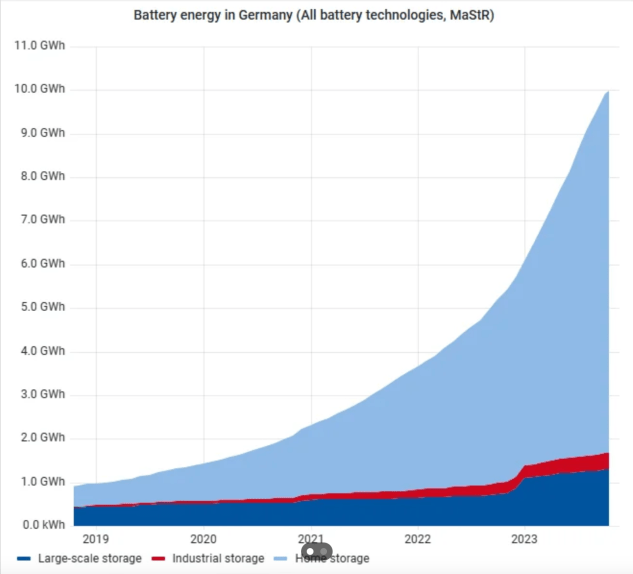
Look at that acceleration! But the 10 GWh of storage that they currently have will last no more than about 10 minutes when the wind and sun quit producing on a calm night.
In short, this large and seemingly sophisticated country is completely delusional, with no sane voices anywhere to be heard. A demonstration project that fails spectacularly is the only thing with any hope of saving them.
Featured Video

Houthis Keep Advancing as the Red Sea Crisis Deepens
or go to
Aletho News Archives – Video-Images
From the Archives
15 Saudi ‘hijackers’ were CIA agents working for US: Scholar
Press TV – April 13, 2016
Fifteen of the 9/11 “hijackers” from Saudi Arabia were CIA agents working for the United States government, which was seeking to destroy the Middle East for Israel and to double the American military budget, says Dr. Kevin Barrett, an American academic who has been studying the events of 9/11 since late 2003…. continue
Blog Roll
 Aletho News
- Damascus rejects Saudi request for Syrian fighters to counter Yemen: Report
- South Korea says will not send troops to join terrorist US war on Iran
- Russia Just Struck the Eyes of NATO’s War Machine in Ukraine
- Russia summons UK charge d’affaires over Kiev drone support
- NATO member warns bloc seeking pretext for war with Russia
- Macgregor: We Haven’t Seen the Worst of the Iran War Yet
- ‘We are not like everyone else’ laws that bind other nations do not apply to Israel, says Likud lawmaker
- Report: Saudi Arabia seeks allies’ assistance as missiles deplete amid war on Yemen
- Fuel Crisis Deepens: Pakistan Warns Tanker Attack in Red Sea Would Be an ‘Act of War’
- ‘Bucha massacre’ a false flag orchestrated by UK – Moscow
- If Americans Knew
- Robert Kraft: The Billionaire Friend of Netanyahu Pulling The Strings Behind the Macklemore/Ed Sheeran Blow Up
- Columbia Administered Fund Gives Big Money to Pro-Israel Groups
- Deportation Case of Palestinian Activist Salah Sarsour Tests First Amendment
- ‘We Will Not Forget’: Palestinians Mark 44 Years since Sabra and Shatila
- Why do we let Zionists decide what we can and can’t say?
- US welcomes Israeli, Iranian delegations to UN, but not Palestinians – Daily Update
- Biden’s Genocide Accomplices Targeted by New Accountability Campaign
- AIPAC’s Network Has Already Spent $67.2 Million to Shape the Midterm Elections
- Jewish Supremacist Manufacturing a Civilizational Threat to License Bigotry
- US bans Palestinian president from speaking at the UN
- No Tricks Zone
- New Study: ‘Global Drought Shows No Detectable Recent Acceleration Under Climate Warming’
- Economic Masterminds: German Socialists Suggest Taxing Productivity Gains Stemming From Using AI
- The South China Sea Has Not Been Cooperating With The Climate Change Narrative
- Energy Crisis: Germany Enters Heating Season With Historically Low Gas Reserve Fill Levels
- New Study: The Antarctic Ice Sheet Gained Mass From 2020-2024 Due To Staggering Snow And Ice Accumulation
- Study: Ocean Heating Rates From Thousands Of Years Ago ‘Dwarf’ Modern Ocean Heating Rates
- Climate Extremists Target, Attack Large-Scale Power Grid Infrastructure In Germany!
- New Study: Antarctic Ice Melt Has Contributed Less Than 1 Centimeter To Sea Level Rise In The Last 30 Years
- Fear Of Debate: Alarmist German Climate Scientist Calls On Mainstream Media To Discredit Skeptic Voices
- End-Of-August Arctic Sea Ice Extent Hasn’t Fallen In 20 Years, Official Data Show!
 Aletho News