Why Ukraine is being blamed for Nord Stream
The ‘official’ investigation was always a sham
By Malcom Kyeyune | Unherd | August 21, 2024
To understand the truth about the Nord Stream pipeline, one needs to master a certain form of “Kremlinology”. Everything about it is designed to obfuscate, every strand shrouded in prevarication and deceit.
From the start, the investigation was a textbook cover-up. The Swedish government rushed to secure evidence, citing their putative rights under international law, consciously boxing out any sort of independent, UN-backed inspection. Of course, after gathering all the evidence, the Swedish authorities studiously did exactly nothing, only to then belatedly admit that it actually had no legal right to monopolise the information in the first place.
The Germans, for their part, were also supremely uninterested in figuring out who pulled off the worst act of industrial sabotage in living memory against their country. In fact, over the course of a year-long non-investigation, we’ve mostly been treated to leaks and off-the-record statements indicating that nobody really wants to know who blew up the pipeline. The rationale here is bluntly obvious: it would be awfully inconvenient if Germany, and the West, learned the true answer.
Thus, the recent revelation that the true mastermind behind the ongoing deindustrialisation of Germany was none other than a Ukrainian by the name of “Volodymyr Z.” must have come as an unwelcome surprise. For not only is the idea that the authorities have suddenly cracked open the Nord Stream case not credible in the slightest, but the sloppy way in which the entire country of Ukraine is now being fingered is likely not an accident. Indeed, at the same time as the ghost of Nord Stream has risen from the grave, the German government announced its plans to halve its budget for Ukraine aid: whatever is already in the pipeline will be sent over, but no new grants of equipment are forthcoming. The German government is hunkering down for increased austerity, and so it is cutting Ukraine loose.
“The German government is hunkering down for increased austerity, and so it is cutting Ukraine loose.”
Germany, of course, is hardly alone. Even if there were enough money to go around, Europe is increasingly not just deindustrialising but demilitarising. Its stores of ammunition and vehicles are increasingly empty, and the idea of military rearmament — that is, creating entirely new military factories and supply chains — at a time when factories are closing down across the continent due to energy shortages and lack of funding is a non-starter. Neither France, the United Kingdom nor even the United States are in a position to maintain the flow of arms to Ukraine. This is a particular concern inside Washington DC, where planners are now trying to juggle the prospect of managing three theatres of war at the same time — in Ukraine, the Middle East and the Pacific — even though US military production is arguably insufficient to comfortably handle one.
And so, in an effort to save face in this impossible situation, Ukraine is now being held solely responsible for doing something it either did not do at all, or only did with the permission, knowledge, and/or support of the broader West. This speaks to the adolescent dynamic that now governs Western foreign policy in a multipolar world: when our impotence is revealed, find someone to blame.
The war in Ukraine, after all, was already supposed to be won, and Russia was supposed to be a rickety gas station incapable of matching the West either economically or militarily. Yet here we are: our own economies are deindustrialising, our military factories have proven completely incapable of handling the strain of a real conflict, and the Americans themselves are now openly admitting that the Russian military remains in a significantly stronger position. Meanwhile, Germany’s economic model is broken, and as its economy falls, it will drag many countries such as Sweden with it, given how dependent they are on exporting to German industrial firms.
10 years ago, during the 2014 Maidan protests, the realist John Mearsheimer caused a lot of controversy when he began warning that the collective West was leading Ukraine down the primrose path, and that our actions would lead to the destruction of the country. Well, here we are. At present, our only saving grace is the continuing offensive in Kursk — a bold offensive that will surely be remembered as a symptom of Ukraine’s increasing desperation.
Indeed, a far better guide of things to come can be found in the fingering of “Volodymyr Z.” as the true culprit behind the Nord Stream sabotage. Here, rather than accept responsibility for the fact that Ukraine was goaded into a war it could not win — mainly because the West vastly overestimated its own ability to fight a real war over the long haul — European geopolitical discourse will take a sharp turn towards a peculiar sort of victim-blaming. No doubt it will be “discovered” that parts of Ukraine’s military consisted of very unsavoury characters waving around Nazi Germany-style emblems, just as it will be “discovered” that journalists have been persecuted by oligarchs and criminals in Kyiv, or that money given by the West has been stolen, and that arms sent have been sold for profit to criminal cartels around the world.
All of these developments will duly be “discovered” by a Western political class that will completely refuse to accept any responsibility for them. Far easier, it seems, to calm one’s nerves with a distorting myth: it’s the Ukrainians’ fault that their country is destroyed; our choices had nothing to do with it; and besides, they were bad people who tricked us!
Berlin’s Brave New World: Secret Police Powers Spark Fear of Orwellian Overreach
By Didi Rankovic | Reclaim The Net | August 22, 2024
In Germany, the current authorities seem willing to dramatically depart from what have until now been Western democratic traditions, where law enforcement must have a crime to investigate, and a warrant to do so before it engages in searches and surveillance.
However, the government in Berlin plans to allow the Federal Criminal Police Office (BKA) the legal right to enter homes secretly (including for the purpose of installing spyware on people’s phones and computers.) In addition, BKA would be given the power to, also secretly, search homes.
The draft, seen by the German press, was cooked up at the Federal Ministry of the Interior and was explained by a spokesman as a needed reform of the BKA law in order to prevent “the dangers of international terrorism” and chose to single out “Islamist terrorism” as an example.
The promise here is that the BKA would use the new rights only to fight what they choose to consider terrorist activity, along with “a high bar” in place determining which case qualifies for this kind of treatment.
Judging by the statement of the same spokesman, German law enforcement now clearly doesn’t have “appropriate powers” to tackle the problem, hence the necessity to reform the law.
As for any details that would further clarify the situation, the Interior Ministry would not provide them as the planned reform is “still at a very early stage of internal government coordination.”
Among the early critics of this is the German Journalists’ Association, whose chairman Mika Beuster said that “secret break-ins are reminiscent of the methods of police states, not of liberal democracies.”
Meanwhile, such a shift in the way terrorist threat is investigated has the opposition – notably the rising Alternative for Germany (AfD), suspect that this will be used as yet another tool to go after political opponents.
AfD, and even media outlets supportive of its policies, have recently faced an unprecedented crackdown, led by Federal Interior Minister Nancy Faeser.
And now, the draft amendment of the law, also coming from her office, is dismissed by AfD MP Beatrix Von Storch as appearing to use the fight against terrorism as the pretext – “and the reason is more likely to be that she intends to further intimidate and monitor citizens and, last but not least, to persecute any government critics.”
Rising anger in Germany in response to Nord Stream “revelations”
What role did the German authorities have in the bombing of the Nord Stream pipeline?
By Maike Gosch | August 19, 2024
Last week, a number of reports and articles about the Nord Stream pipeline explosion shook the media landscape and citizens in Germany and around the world. After a long period of astonishing silence surrounding this monstrous event, things now seem to be moving. Are we slowly getting closer to the truth in this affair? In any case, the reactions from all sides were fierce and showed once again just how divided the political landscape is in Germany and Europe.
After the news first made the rounds in several German media outlets on August 14, 2024 that German investigators had identified a Ukrainian diving instructor (funnily enough named Volodymyr Z.) who allegedly blew up Nord Stream and then unfortunately escaped arrest due to a lack of cooperation from Polish authorities, further explosive revelations from the Wall Street Journal followed on the same day.
According to the WSJ article, the attack was led by the then-Commander-in-Chief of the Ukrainian armed forces and current Ukrainian ambassador to the UK, Valerii Zaluzhnyi, with president Zelenskyy having initially given the operation the green light. Then the Dutch military intelligence service MIVD found out about it, informed the CIA and the latter in turn urged president Zelensky to stop the operation. He then ordered Zaluzhnyi to abort the operation, but the general ignored the order and went ahead with the plan. According to the WSJ, just days after the attack, which occurred on September 26, 2022, the CIA gave the German Foreign Ministry a detailed account of how the covert operation went down. The Ukrainian government has rejected this account.
Much of this report seems implausible, so I consider the article to be more of a “limited hangout” than a clarification of this terrorist attack on our industrial infrastructure.
“Limited hangout” is a term from the intelligence world for a common ploy used by intelligence professionals: when the truth is beginning to emerge or the public is becoming too suspicious and impatient, and they can no longer remain silent or rely on a contrived cover story to deceive the public, part of the truth is admitted — sometimes even voluntarily — while still withholding the essential and truly risky facts in the case. The public is supposed to be distracted from and engaged with the disclosed information, so that the pressure it exerts eases (at least for a while).
One day later, on August 15, 2024, the German newspaper Die Welt published an interview with the former head of the BND (Bundesnachrichtendienst or Federal Intelligence Service of Germany), August Hanning, which also caused quite a stir. Mr. Hanning says that the attack, if it was carried out by the Ukrainian side, could only have been possible with strong logistical support from Poland and that for him there must obviously have been an agreement between the highest leaders in Ukraine and Poland, naming president Zelenskyy and president Duda.
These statements sound more plausible, but it is surprising that Mr. Hanning begins by saying that only Ukraine and Poland had an interest in and the means of blowing up the pipelines, and that he doesn’t mention other possible perpetrators, such as the US, but also Great Britain or the Scandinavian neighbouring states. Interestingly, however, he takes a very clear stance on the classification of the attacks and comes to a very different conclusion from most voices in the German political landscape, which we will get to below:
There has been considerable damage to the pipelines. […] I once spoke to external experts from the operators and they put it at up to 20 to 30 billion euros. The huge damage caused by state terrorism must be clearly stated and I also expect the German government to make it clear that compensation must be demanded. Also from the operators. I believe that huge damage has been caused by the activities of Ukrainian and Polish government agencies.
This astonishing accumulation of news within a few days around the investigation, which has been ongoing for two years without any results so far, has led some to suspect that this is a controlled action directed against Zelenskyy and part of the public’s preparation for him losing the support of the West and being replaced.
“Thank you, Ukraine!”
The reactions to this explosive news were not long in coming and proved once again what a divided information landscape we find ourselves in.
The German conservative newspaper FAZ led the way. In an article that directly followed the WSJ’s “revelations”, Reinhard Müller explained that the pipeline had been a legitimate military target (according to the headline); the text formulates it somewhat more cautiously: “could be considered a legitimate target”. His arguments: it is owned by a Russian state-owned company and also contributed to Moscow’s war of aggression against Ukraine. He also makes an argument oft-heard from German commentators whose loyalties clearly lie with Ukraine: at the time the pipeline was blown up, it was no longer serving Germany’s energy supply. Of course, this raises the question: if it no longer served Germany’s (and Europe’s, for that matter) energy supply, how could it have contributed to Moscow’s war of aggression? But let’s leave that aside for the moment. And we will come to the ownership structure later in the text.
He is also of the opinion that if the Ukrainian president or another commander commissioned it, it could also be seen as an act of defense permissible under international law. Müller takes the opportunity, while he’s on the subject of steep theses on international law, to take a similarly idiosyncratic swipe at the German government’s critics of its stance in the Gaza war:
Here, Ukraine, with its back to the wall, gives little cause for concern in terms of the selection of targets, the treatment of prisoners of war and also the prosecution of war crimes and international observation. In such extreme situations, the value of the Western community’s value-based approach is proven. The end does not justify every means — this also applies to Israel, which is also in a struggle for survival. The commitment to human rights, even in the fight against those who do not care about them, makes the decisive difference. Any far-sighted government should also recognise that this is in its own best interests. Only those who fight under the flag of humanity will be able to live in peace with their neighbors at all times in the long term.
So again, because this may be misleading, his statement is: Ukraine and Israel respect human rights, unlike their opponents, and thus fight under the flag of humanity and now the Western community’s value-based approach shows its worth in that we support them in this noble fight (also against our own industrial infrastructure), because (only) in this way can we live in peace with our neighbors in the long term. I would like to award the prize for the most absurd take to Mr. Müller.
But please read the article in its entirety yourself, which also claims that all allies have a duty (!) to rush to the aid of the invaded Ukraine at any time, including with their own soldiers. In legal terms, one would speak of a “minority opinion”; I would like to use stronger words, but I’m trying to control myself so as not to further the division here.
A few days later, the FAZ reported that Germany would be cutting back on military aid for Ukraine and that, according to the German government’s current budgetary planning, no new money would be made available for this with immediate effect.
What initially appeared to be a possible reaction to the revelations and a concession to the large part of the population that is critical of the German government’s NATO course (because of the upcoming elections in some German states?), turns out on closer inspection to be a less major change in policy. This year everything will continue unchanged, next year military support is to be halved and then in 2027 it will shrink to less than a tenth of the current amount. However, most geopolitical analysts expect the war to end by 2025 at the latest. And after that, according to Christian Lindner’s plans, the support will no longer come from the federal budget, but will be financed from the proceeds (interest) of the Russian central bank assets frozen by the G7 states.
There were also comments from abroad that caused an uproar. Polish prime minister Donald Tusk, for example, commented the revelations in a tweet as follows:
To all the initiators and patrons of Nord Stream 1 and 2. The only thing you should do today about it is apologise and keep quiet.
The tweet went viral and has been viewed 2.6 million times so far, which is no wonder as it was provocative to the max and triggered correspondingly emotional reactions. So not only should we silently accept the blowing up of the pipelines; we should also be ashamed to have built and supported them in the first place.
But what seems like pure election advertising for the AfD and Sahra Wagenknecht’s new party, BSW, may also have other economic and geopolitical backgrounds:
Since the beginning of the Ukraine war, we have been wondering about the increasingly aggressive and militant rhetoric against Germany from our neighboring country and cannot shake off the feeling that the new favourite child of the US and Great Britain is finally trying to get back at its neighbour, which is often perceived as overpowering, with borrowed courage.
In general, Poland plays an interesting role in the whole Nord Stream pipeline affair, a role that has received very little attention to date. This is because Poland (not just Ukraine) also lost both leverage/pressure and considerable transit income through the construction and commissioning of the pipelines, which allowed Russian natural gas to be supplied directly to Germany and the rest of Europe. And they worked together with the US, Denmark and Norway on an alternative to gas supplies from Russia and also wanted to get back into the game as a transit country for gas supplies from other countries of origin to Germany and Europe. However, as long as Nord Stream 1 and then Nord Stream 2 were available, the economic prospects for these plans were poor. It is a strange coincidence that the Baltic Pipe, a natural gas pipeline from Denmark to Poland, was opened on September 27, 2022 (only one day after the Nord Stream pipelines were blown up).
But back to Germany, where other politicians and journalists made it clear that even a possible terrorist attack by Ukraine would not change their “Nibelungentreue” — a German expression meaning absolute loyalty. CDU politician Roderich Kiesewetter initially explained in a video interview with Die Welt that the operation of Nord Stream 1 and 2 did not generate any income for Russia, as no gas was flowing through them at the time of the attack (I assume in order to substantiate his otherwise unfounded suspicions of Russia as the perpetrator, more on that later).
He may be hoping for a poor memory on the part of the audience here, but I think most Germans who have studied the topic still have a good memory of the situation in the autumn of 2022 and know very well that Russia had only halted gas supplies through Nord Stream 1 for a short time due to problems with the sanctions and turbine maintenance. This may also have been an attempt by Russia to mitigate or avert the sanctions in exchange for the resumption of gas supplies, or it may have been an attempt by Russia to force the certification and opening of Nord Stream 2, which was ready for use at that time.
In any case, it is clear that Russia was expressly willing and also able to start supplying gas via Nord Stream 2 at any time and that this was blocked by the German government for political reasons (keyword: certification procedure) and that the pressure from the population in this direction grew considerably, especially in the period shortly before the blast (keyword: hot autumn, we remember).
Mr. Kiesewetter omits these connections here in order to give the impression that the pipelines were actually already irrelevant at the time of the blast, which unfortunately — in the interest of truth — many other commentators also claim. As with so many issues these days, one would like to see neutral fact checks, which unfortunately we rarely get.
When Mr. Kiesewetter goes on to say that many elements of the article do not seem very credible, I even agree with him, but then he tries several times in the course of the interview to cast suspicion on Russia and talk about a “false flag” operation, albeit without any indications, arguments or evidence, so who is the conspiracy theorist now?
In addition, he then says that no German property was damaged because the attack took place in international waters. The location of the attack is obviously irrelevant to the ownership status, but Mr. Kiesewetter certainly knows that. And Nord Stream 2 is indeed owned by Nord Stream 2 AG, which is wholly owned by Gazprom, which in turn is a state-owned company. However, Germany has invested around 3.9 billion euros in goods and services in Nord Stream 2. And the Nord Stream 1 pipeline, which was also damaged, is held by Nord Stream AG, of which only 51 percent is owned by Gazprom through its subsidiary Gazprom International Projects North 1 LLC, while the other 49 percent is held by German, Dutch and French companies from the energy infrastructure sector.
In this respect, both German and European property was destroyed. Furthermore, the ownership structure under civil law is not the decisive factor in classifying the destruction of important energy infrastructure as a threat to national security, as the issue is how important it is for Germany’s economy and population, and not who owns the pipelines under civil law. Of course, Mr. Kiesewetter knows all about that too, he is an experienced politician who has been in the political business for a long time. Finally, the sentence that caused the most uproar:
Besides, Ukraine is the attacked (sic!), the security of Ukraine, whether they destroyed it or not, is in our interest.
So, in plain language: Ukraine’s security is in our (i.e., Germany’s) interest, even if it jeopardises our security with such a massive attack.
Finally, Julian Röpcke, full-time editor at the Bild newspaper, in his spare time apparently something of a war correspondent for the Ukrainian army and, according to his own description, an “arms delivery ultra”: he reposted his own tweet from November 2023 (i.e., shortly after the attack) with the note “Due to current events”, in which he praised the destruction of the pipelines:
Just to make this clear again: If Ukraine attacked Nord Stream: thank you very much. It was a Russian infrastructure project that made us dependent on their gas. Thanks a lot for ending that dependency, no matter who did it.
In other words: “Thank you, Ukraine!” (paraphrasing the famous tweet by Polish politician Radek Sikorski, shortly after the attack itself).
Moving the goalpost
What the reactions also reveal is an exciting shift in terms and evaluations among representatives and supporters of the German government’s and the EU’s current Ukraine policy. When the rather unlikely thesis of Russia being the perpetrator was initially put forward, Ursula von der Leyen, for example, was still saying:
Any deliberate disruption of active European energy infrastructure is unacceptable & will lead to the strongest possible response.
In short, right after the attack, it was clear to everyone and was not disputed by anyone (except perhaps by the German Greens, but that is such an extreme position that I am leaving it out here) that this was a massive terrorist attack against the energy infrastructure of Russia, Germany and also Europe, which was supplied with energy via these pipelines. It was also largely undisputed that this constituted a “casus belli” under international law, i.e., it was tantamount to a declaration of war and should actually trigger a NATO defense case under Article 5 of the North Atlantic Treaty.
But that’s yesterday news. Now that there is evidence that Ukraine was at least complicit in this act, the supporters sound very different: the pipelines were irrelevant (so why were they blown up at all?), the demolition was justified and Germany should be ashamed of having built them in the first place.
Storm of outrage
From other quarters, there was a lot of outrage about the news. Alice Weidel from the German right-wing AfD-Party commented the news as follows:
The economic damage to our country caused by the blasting of #Nordstream allegedly ordered by #Zelenskyy — and not #Putin, as we were led to believe — should be “billed” to #Ukraine. Any “aid payments” that burden the German taxpayer should be stopped.
Sahra Wagenknecht of the left-wing BSW (Bündnis Sahra Wagenknecht or Sahra Wagenknecht Alliance) wrote):
Should German authorities have known in advance about the attack plan on Nord Stream 1 and 2, then we would have a scandal of the century in German politics.
Many private commentators were equally stunned:
Nobody deserves a government that allows critical infrastructure to be blown away with complete equanimity.
For some, angry comments were not enough and they wanted to see action. Opposition Cologne-based lawyer Markus Haintz, for example, filed charges against Kiesewetter with the Ellwangen public prosecutor’s office due to his comments regarding the blowing up of the Nord Stream pipelines in the Die Welt interview.
Laughter through the tears
Fortunately for the soul, there were also many funny and satirical reactions. Berlin-based AI artist and satirist Snicklink posted this video. But other X users also had fun with pictures and photos making fun of the — from their point of view — implausible descriptions in the WSJ article.
What’s next?
So far (at the time of writing this article) no German government representative has commented on the WSJ investigation or the Die Welt interview, which is incredible in itself. I assume there were some emergency meetings on the weekend where the line of communication is being discussed and we can expect a statement soon. We can look forward to seeing how they position themselves here.
Sahra Wagenknecht is now calling for a committee of inquiry in the German Parliament to investigate the role of the German government in connection with the attacks on the Nord Stream pipelines.
This seems urgently needed — because that would be the appropriate forum to shed light on all these issues. For as interesting and sometimes entertaining as the reactions and discussions in the regular and social media are, such a state affair cannot be solved by swarm intelligence.
This article first appeared in German on Nachdenkseiten.
Iran Shuts Down German Soft Power Tool Institute in Tehran in Apparent Tit-for-Tat Move
By Ilya Tsukanov – Sputnik – 21.08.2024
Diplomatic relations between Iran and Germany have worsened progressively over the past five years thanks to Berlin’s growing propensity to walk lockstep with Washington on an array of issues, from the Iran nuclear deal to attempts to meddle in Iran’s internal affairs, and an effort to chide Tehran for its retaliatory strikes on Israel in April.
The German Foreign Ministry summoned Iran’s ambassador on Tuesday after the Islamic Republic shuttered two branches of German Language Institute of Tehran (formerly the Goethe Institute), which receive funding from the German government and operate under the auspices of the German Embassy.
Iran’s judiciary said it moved to close the “illegal centers” for “breaching” local laws, “committing various illegal actions and extensive financial violations.”
The German Foreign Office slammed the move, saying it was “in no way justifiable,” and that that the institute “is a popular and recognized meeting place where people put a lot of effort into learning languages under difficult circumstances.” The institute’s work is “intended to strengthen the connection between the people of Iran and Germany,” the Foreign Office assured.
The language centers’ closure comes a month after Berlin raided and shut down Islamic Center Hamburg, a Shia Islamic cultural center accused by Berlin of “promoting extremism and radical Islamic ideology,” “spreading aggressive antisemitism,” and providing support for Lebanese political and militia movement Hezbollah, which German authorities deem a “terrorist organization.”
German police also raided 53 affiliated properties across eight German states, banning affiliates in Berlin, Munich and Frankfurt, confiscating assets and shutting down four separate mosques.
German harassment and monitoring of Islamic Center Hamburg goes back to the 1990s. In 2022, its deputy director was expelled from Germany over alleged communications with Hezbollah. In 2023, after the start of the Gaza war, Greens politician Jennifer Jasberg demanded the center’s closure, saying she did not want Hamburg to serve as “a breeding ground for hatred against Israel.”
Iranian authorities blasted Islamic Center Hamburg’s closure as an act of Islamophobia, a boon for terrorism and a move “reminiscent of the racist policies of the Nazi regime.” Iranian acting foreign minister Ali Baqeri slammed the measure as an “unjustified move” that “flouts all principles of freedom of religion and thought.”
Iranian authorities said their investigation into the German Language Institute is ongoing, and indicated that other German state-affiliated entities are being looked at.
While it paints itself as “autonomous and politically independent” and engaged only in the exchange of culture and language, Germany’s Goethe institute has been characterized by some as a tool of soft power for Berlin. Russia froze Goethe Institute bank accounts in Russia in 2023 in a tit-for-tat move after Berlin moved to block the accounts of the Russian House of Science and Art in Berlin several months prior. Moscow said it would unblock the accounts “only after the complete and unconditional unfreezing of the bank accounts” of the Russian center.
The Goethe center was opened in Iran in 1958 under the auspices of the West German government, but saw its activities restricted after the 1979 Islamic Revolution, and banned completely in 1987. The institute was reopened in 1995 under the German Language Institute moniker.
Russia Denies Germany Sharing Information on Nord Stream Attacks
Sputnik– 21.08.2024
MOSCOW – The German Foreign Ministry’s statements that Berlin is sharing information with Moscow on the Nord Stream terrorist attacks are a lie, Russian Foreign Ministry spokeswoman Maria Zakharova said on Wednesday.
Oleg Tyapkin, the director of the Russian Foreign Ministry’s Third European Department, said in an interview with Sputnik that Russia had officially filed a claim against Germany regarding the investigation into the Nord Stream bombing and is seeking to hold talks on Germany fulfilling its international obligations in the fight against terrorism. On Monday, German Foreign Ministry spokesperson Sebastian Fischer said that Berlin is exchanging data with Russia on the Nord Stream bombings, but is not providing information on the interim results of the investigation.
“They [the German authorities] do not provide the facts they have on this investigation to the Russian side, although they are obliged to do so. Russia insists on holding official bilateral consultations in accordance with the current regulations. They, by the way, are prescribed in the UN anti-terrorist conventions,” Zakharova told a briefing, adding that these statement on the exchange of information “are a lie.”
Germany responds to all Russia’s inquiries regarding the Nord Stream attacks with empty formal replies, the diplomat said, adding that not a single such document contains factual information.
Britain’s Kursk Invasion Backfires?
By Kit Klarenberg | Global Delinquents | August 21, 2024
British Challenger 2 tanks reached Ukraine with enormous fanfare, ahead of Kiev’s long-delayed, ultimately catastrophic 2023 “counteroffensive”. On top of encouraging other proxy war sponsors to provide Ukraine with armoured fighting vehicles, Western audiences were widely told the tank – hitherto marketed to international buyers as “indestructible” – made Kiev’s ultimate victory a fait accompli. As it was, Challenger 2 tanks deployed to Robotnye in September were almost instantly incinerated by Russian fire, then very quietly withdrawn from combat altogether.
Hence, many online commentators were surprised when footage of the Challenger 2 in action in Kursk began to circulate widely on August 13th. Furthermore, numerous mainstream outlets dramatically drew attention to the tank’s deployment. Several were explicitly briefed by British military sources that it marked the first time in history London’s tanks “have been used in combat on Russian territory.” Disquietingly, The Times now reveals this was a deliberate propaganda and lobbying strategy, spearheaded by Prime Minister Keir Starmer.
Prior to the Challenger 2’s presence in Kursk breaking, Starmer and Defence Secretary John Healey had reportedly “been in talks about how far to go to confirm growing British involvement in the incursion towards Kursk.” Ultimately, they decided “to be more open about Britain’s role in a bid to persuade key allies to do more to help – and convince the public that Britain’s security and economic prosperity is affected by events on the fields of Ukraine.” A “senior Whitehall source” added:
“There won’t be shying away from the idea of British weapons being used in Russia as part of Ukraine’s defence. We don’t want any uncertainty or nervousness over Britain’s support at this critical moment and a half-hearted or uncertain response might have indicated that.”
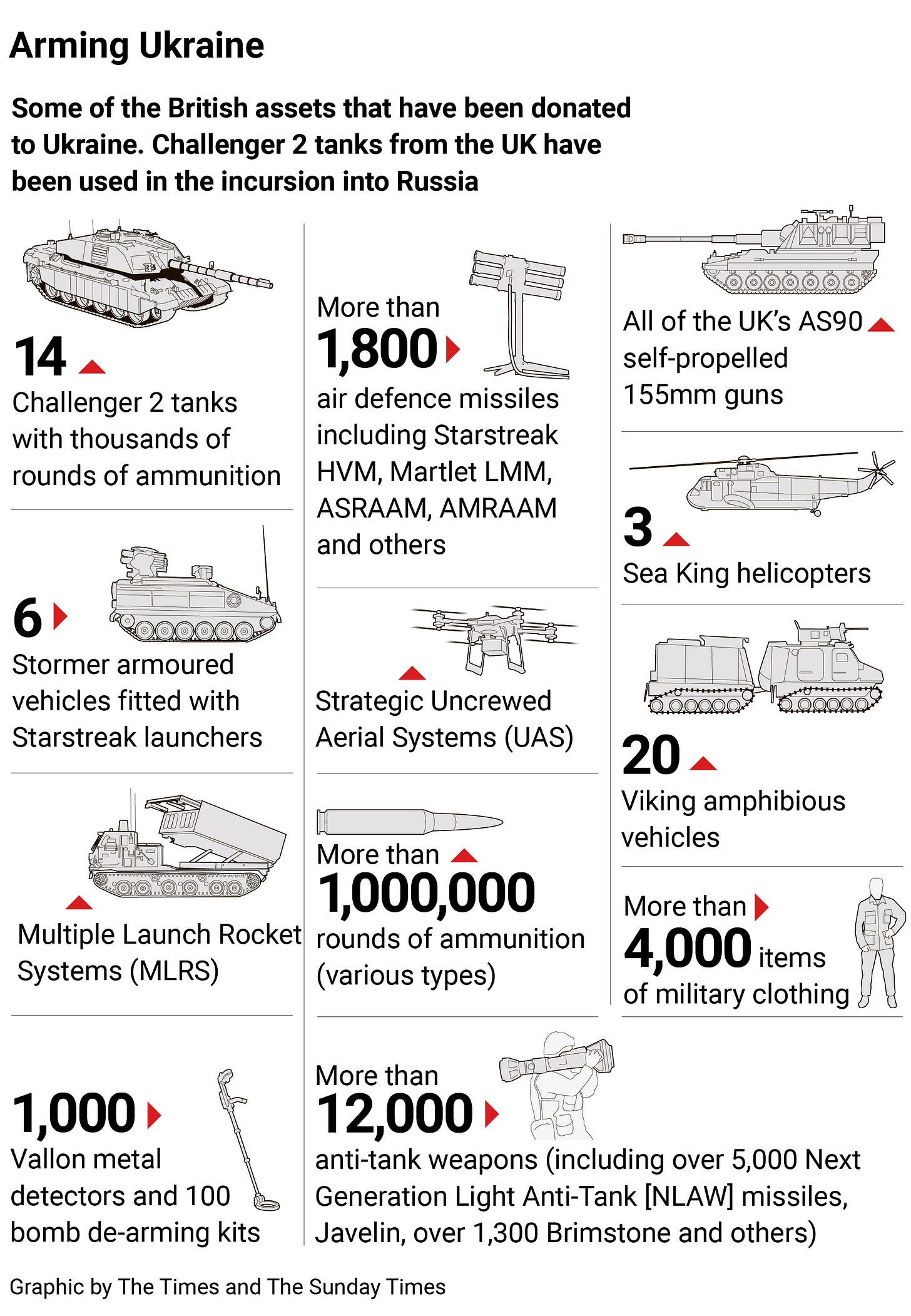
In other words, London is taking the lead in marking itself out as a formal belligerent in the proxy war, in the hope other Western countries – particularly the US – will follow suit. What’s more The Times strongly hints that Kursk is to all intents and purposes a British invasion. The outlet records:
“Unseen by the world, British equipment, including drones, have played a central role in Ukraine’s new offensive and British personnel have been closely advising the Ukrainian military… on a scale matched by no other country.”
Britain’s grand plans don’t stop there. Healey and Foreign Secretary David Lammy “have set up a joint Ukraine unit,” divided between the Foreign Office and Ministry of Defence. The pair “held a joint briefing, with officials, for a cross-party group of 60 MPs on Ukraine,” while “Starmer has also asked the National Security Council to draw up plans to provide Ukraine with a broader range of support.” On top of military assistance, “industrial, economic, and diplomatic support” are also being explored.
The Times adds that in coming weeks, “Healey will attend a new meeting of the Ukraine Defence Coordination Group,” an international alliance of 57 countries overseeing the Western weaponry flooding into Kiev. There, “Britain will press European allies to send more equipment and give Kyiv more leeway to use them in Russia.” The British Defence Ministry also reportedly “spoke last week to Lloyd Austin, the US defence secretary, and has been wooing Boris Pistorius, his German opposite number.”
Evidently, the new Labour government has an ambitious vision for the proxy war’s continuation. Yet, if the “counterinvasion” is anything to go by, it’s already dead in the water. As The Times notes, the imbroglio is primarily “designed to boost morale at home and shore up Zelensky’s position,” while relieving pressure on the collapsing Donbass frontline by forcing Russia to redirect forces to Kursk. Instead, Moscow “has capitalised on the absence of four crack Ukrainian regiments to press their attacks around Pokrovsk and Chasiv Yar.”
Similarly, commenting on Starmer’s wideranging efforts to compel overt Western action against Russia, a “defence expert” told The Times: “if it looks as if the Brits [are] too far ahead of their NATO allies, it might be counterproductive.” This analysis is prescient, for there are ample indications London’s latest attempt to ratchet tensions and drag the US and Europe ever-deeper into the proxy war quagmire has already been highly “counterproductive”, and boomeranged quite spectacularly. Indeed, it appears Washington has finally had enough of London’s escalatory connivances.
In repeated press conferences and media briefings since August 6th, US officials have firmly distanced themselves from the Kursk incursion, denying any involvement in its planning or execution, or even being forewarned by Kiev. Empire house journal Foreign Policy has reported that Ukraine’s swoop caught the Pentagon, State Department, and White House off-guard. The Biden administration is purportedly not only enormously unhappy “to have been kept out of the loop,” but “skeptical of the military logic” behind the “counterinvasion”.
On top being a clear suicide mission, the eagerly advertised presence of Western weapons and vehicles on Russian soil “has put the Biden administration in an extremely awkward position.” Washington has since the proxy war erupted been wary of provoking retaliations against Western countries and their overseas assets, and the conflict spilling outside Ukraine’s borders. Adding to US irritations, the British-directed Kursk misadventure also torpedoed ongoing efforts to secure an agreement to halt “strikes on energy and power infrastructure on both sides.”
This comes as Kiev prepares for a harrowing winter without heat or light, due to devastating Russian attacks on its national energy grid. Putin has moreover made clear that Ukrainian actions in Kursk mean there is no longer scope for a wider negotiated settlement at all. Which is to say Moscow will now only accept unconditional surrender. The US has also seemingly changed course as a result of the “counterinvasion”.
On August 16th, it was reported that Washington had prohibited Ukraine’s use of British-made, long-range Storm Shadow missiles against Russian territory. Given securing wider Western acquiescence to such strikes is, per The Times, a core objective for Starmer, this can only be considered a harsh rebuke, before the Labour government’s escalatory lobbying efforts have even properly taken off. The Biden administration had in May granted permission for Kiev to conduct limited strikes in Russia, using guided munitions up to a 40-mile range.
Even that mild authorisation may be rescinded in due course. Berlin, which like Britain had initially proudly promoted the presence of its tanks in Kursk, is now decisively shifting away from the proxy war. On August 17th, German Finance Minister Christian Lindner announced a halt to any and all new military aid to Ukraine as part of a wider bid to slash federal government spending. The Wall Street Journal reporting three days earlier that Kiev was responsible for Nord Stream II’s destruction may be no coincidence.
The narrative of the Russo-German pipeline’s bombing detailed by the outlet was absurd in the extreme. Conveniently too, the WSJ acknowledged that admissions of “Ukrainian officials who participated in or are familiar with the plot” aside, “all arrangements” to strike Nord Stream “were made verbally, leaving no paper trail.” As such, the paper’s sources “believe it would be impossible to put any of the commanding officers on trial, because no evidence exists beyond conversations among top officials.”
Such an evidentiary deficit provides Berlin with an ideal pretext to step away from the proxy war, while insulating Kiev from any legal repercussions. The narrative of Ukraine’s unilateral culpability for the Nord Stream bombings also helpfully distracts from the attack’s most likely perpetrators. This journalist has exposed how a shadowy cabal of British intelligence operatives were the masterminds, and potential executors, of the October 2022 Kerch Bridge bombing.
That escalatory incident, like Nord Stream’s destruction, was known about in advance, and apparently opposed, by the CIA. Chris Donnelly, the British military intelligence veteran who orchestrated the Kerch Bridge attack, has privately condemned Washington’s reluctance to embroil itself further in the proxy war, declaring “this US position must be challenged, firmly and at once.” In December that year, the BBC confirmed that British officials were worried about the Biden administration’s “innate caution”, and had “stiffened the US resolve at all levels”, via “pressure.”
The determination of Washington’s self-appointed “junior partner” to escalate the proxy conflict into all-out hot war between Russia and the West has only intensified under Starmer’s new Labour government. Yet, the Empire gives every appearance of refusing to take the bait, while seeking to curb London’s belligerent fantasies. This may be an encouraging sign that the proxy war is at last reaching its end. But we must remain vigilant. British intelligence is unlikely to allow the US to withdraw without a fight.
Lithuania Begins Building Base to House German Soldiers
By Kyle Anzalone | The Libertarian Institute | August 19, 2024
Vilnius started construction on a military base that would house over 4,000 German soldiers. The facility will be located just miles from the border shared with Belarus.
Lithuanian Defense Minister Raimundas Vaiksnoras described the construction as a “huge investment” that will cost over $1.1 billion. He said the German deployment represents “deterrence, to push the Russians out.” However, it is unclear where Lithuania plans to push Russia from as Moscow has not invaded the Baltic state.
At least two dozen German soldiers are already stationed in Lithuania. The German troop deployment, which is scheduled to surge to 4,800 troops by 2027, is Berlin’s first permanent garrison of soldiers deployed to Lithuania since World War 2. From 1941-1945, Nazi Germany occupied Lithuania. Under Hitler’s control, nearly Lithuania’s entire Jewish population was wiped out.
The deployment will provide a significant military surge to Lithuania, which has only 15,000 active duty soldiers. The base is located just 12 miles from the border with Belarus. Germany plans to deploy over 100 Leopard Tanks to the base.
Since the end of the Cold War, Washington has facilitated the expansion of the North Atlantic alliance up to the Russian border. Additionally, Brussels has increased military deployments to new members in Eastern Europe.
The Kremlin has consistently complained that the Eastward expansion of the bloc is a threat to Russian security. Russia has been invaded through its European borders multiple times. Prior to the Ukrainian invasion of Kursk, the last power which invaded Russia was Nazi Germany.
Germany about to decrease its aid to Kiev
By Lucas Leiroz | August 20, 2024
Support for Ukraine is increasingly showing signs of being reduced. The productive capacity of European countries no longer seems sufficient to meet Ukraine’s constant demand for weapons and military equipment, which is why a serious drop in supplies is likely to occur soon. Germany, which is currently experiencing an energy crisis and deindustrialization, seems to be one of the first countries to fail to fulfill its military aid agreements.
The German newspaper Bild recently reported that the “continuous supply” of weapons to the Kiev regime is at risk. The main reason for the production problems is the policy of budgetary restrictions. The article cites sources in the Ministry of Finance and communications between officials from different ministries and the German parliament. The sources state that there is no longer enough budget to continue supporting Ukraine, which is why a change in the military support policy is urgently needed.
According to the newspaper, Finance Minister Christian Lindner recently contacted Defense Minister Boris Pistorius and Foreign Minister Annalena Baerbock to discuss the issue. He emphasized the budget problems and the impossibility of continuing to finance arms production for Ukraine. According to Lindner, a solution could be found if the government submitted some kind of report justifying the need and urgency of providing new short-term funds for the military sector. However, since the government remains inactive, no special decision has been made by the Finance Ministry, which indicates that there will be a cut in military production soon.
There appears to be a conflict of interest between the ministries. Defense officials are unhappy with Lindner’s budget control and accuse him of “changing the rules of the game.” According to the defense industry, Lindner is responsible for destabilizing the budget for the military industry, thereby affecting the entire policy of supporting Ukraine. In fact, Lindner listed at least 30 German measures to support Kiev that “can no longer be carried out.” The Defense Ministry sees these initiatives as a sign that the Finance Ministry is simply no longer interested in continuing to fund pro-Ukrainian aid.
Earlier, the Defense Ministry had proposed a special package worth almost 4 billion euros for “unplanned spending” for Ukraine. The package included the urgent production of various equipment, such as artillery shells, drones, tanks and armored vehicles. However, within just three months, most of the package has already been spent and there is simply nothing left that can be produced with this funding, leaving few resources for the Finance Ministry to use in the assistance program.
Indeed, the officials responsible for finance are stating the obvious: there is no more money to finance the war. Meanwhile, the military, driven by anti-Russian paranoia and the fear that Germany will be the “next target”, claims that it must do whatever necessary to send even more weapons to Ukraine. In the midst of all this chaos, the Ministry of Foreign Affairs and other strategic sectors seem inert, not knowing what decision to make and unable to reach a consensus.
The crisis in Germany is nothing new. It had previously been reported that the country no longer had any funds to use in the war. Days before Bild published its article, Frankfurter Allgemeine Zeitung (FAZ) reported that Berlin was about to end its support for Ukraine due to the absolute lack of money. At the time, sources close to Lindner said that there was no longer any chance of continuing the assistance.
“End of the event. The pot is empty (…) [Berlin has] reached a point where Germany can no longer make any promises to Ukraine,” an unnamed source told journalists at the time.
The defense sector’s complaints about the budget are also not new. In July, Pistorius had already expressed his indignation with Lindner’s management, stating that he had received a budget smaller than what had been requested to meet German military priorities. In practice, the economy and defense sectors are in constant conflict in German politics, and inter-ministerial dialogue is extremely difficult.
“I got significantly less than I registered for. That is annoying for me because I cannot initiate certain things at the speed that the historic turning point and threatening situation require,” Pistorius said at the time.
All this institutional chaos was to be expected, since Germany is maintaining a support program that does not correspond to the country’s social and economic reality. Going through a serious energy crisis and an accelerated process of deindustrialization, Berlin is simply not growing economically enough to pay for the billion-dollar aid packages to the Kiev regime.
At some point, Germany will have to choose between paying Ukraine’s bills or its own.
Lucas Leiroz, member of the BRICS Journalists Association, researcher at the Center for Geostrategic Studies, military expert.
You can follow Lucas on X (formerly Twitter) and Telegram.
NATO’s War on Russia
From covert war in 2014 to the invasion of Russia in 2024
By Glenn Diesen | August 19, 2024
The use of NATO weapons to attack Russia is a controversial topic due to the ambiguity about the role of NATO. The common argument by the Western political-media elites is that Ukraine was attacked in an unprovoked Russian invasion, and NATO has every right to assist Ukraine with weapons to defend itself. This is an appealing narrative that serves the purpose of manufacturing consent from the public to send weapons worth billions of dollars to fight Russia. If one accepts this narrative, it is even seen to be immoral to put restrictions on Ukraine in terms of where these weapons are used as the country is correctly fighting for its survival. The problem with this narrative is that NATO is not a passive non-participant in this war.
The war began in February 2014 when Western governments backed the coup in Ukraine that removed the democratically elected President of Ukraine and replaced him with a government hand-picked by Washington.[1] On the first day of the new Ukrainian government, a partnership was established between the CIA, MI6 and the intelligence services of the new government in Ukraine installed by the US.[2] This happened before there were any conflicts between Russia and Ukraine, and it resulted in 12 secret CIA bases along the Russian borders. Over the next 8 years, the US instigated tensions with Russia, armed Ukraine, and sabotaged the Minsk peace agreement to extend and weaken Russia.[3]
The US developing Ukraine as a proxy against Russia was the reason for the Russian invasion in 2022. As reported by the New York Times : “Toward the end of 2021, according to a senior European official, Mr. Putin was weighing whether to launch his full-scale invasion when he met with the head of one of Russia’s main spy services, who told him that the C.I.A., together with Britain’s MI6, were controlling Ukraine and turning it into a beachhead for operations against Moscow”.[4]
When Russia invaded in 2022, it contacted Ukraine on the first day after the war to start negotiations to impose a peace agreement that would restore Ukraine’s neutrality.[5] The US and UK sabotaged the Istanbul peace agreement by promising Zelensky all the weapons he would need if he would walk away from the peace talks and fight. Both the Israeli and Turkish mediators confirmed that the US chose war as it saw an opportunity to fight Russia through a proxy and thus weaken a strategic rival. Numerous American leaders have since expressed that this is a great war as they get to weaken Russia without losing any American troops. NATO Secretary General Jens Stoltenberg has dismissed diplomacy and insists that “Weapons are the way to peace”.
Niall Ferguson wrote in Bloomberg in March 2022 that US and UK officials had confirmed that the only acceptable outcome for the war was the military defeat of Russia and regime change in Moscow. The objective was for “the conflict to be extended and thereby bleed Putin” as “the only end game now is the end of Putin regime”.[6] The US Helsinki Commission argued in March 2022 that peace must be achieved by “decolonising” Russia, the destruction of Russia by Balkanising it.[7] The President of Poland (Andrzej Duda) and the incoming Foreign Policy Chief of the EU (Kaja Kallas) have also defined victory in Ukraine in terms of breaking Russia into many small nations.
NATO is providing weapons, ammunition, training, war planning, intelligence, target selection, management of complex weapon systems, and mercenaries to fight Russia – all under the guise of “helping Ukraine” to defend itself. NATO has authorised the use of long-range missiles to strike inside Russian territory and provides its support in the invasion of Russian territory. From Britain to Germany, the success of conquering Russian territory is openly used as an argument to send more weapons.
In this context, if we look at the actual objectives of the US and NATO, rather than the childish assertion that the US is merely attempting to protect democracy, then one can only conclude that NATO has gone to war against the world’s largest nuclear power.
Russia’s dilemma: Emboldening NATO or risking nuclear war
The insanity of NATO’s relentless escalations in the Ukraine proxy war rests on the narrative that Russia will not defend its red lines as it is deterred by NATO. This delusion exists because all Russian responses are presented as “unprovoked” and thus occur seemingly in a vacuum. Yet, when the Western government toppled the Ukrainian government in February 2014 and subsequently threatened the Russian naval base in Sevastopol, Russia responded by seizing Crimea. When Western governments sabotaged the Minsk agreement for 7 years and then refused to give Russia any security guarantees in December 2021, Russia responded by invading Ukraine in 2022. When NATO began to send weapons to Ukraine to fight Russia, Russia responded by annexing four oblasts – Donetsk, Lugansk, Zaporizhiya, and Kherson.
How will Russia respond? Russia is faced with a dilemma: It has been restrained as retaliations could easily escalate into a NATO-Russia nuclear exchange, yet the failure to retaliate will only embolden NATO. Western media refers to the failure of Russia to respond as a reason for why NATO can continue to escalate, as Russia is not retaliating. Yet, with every step up the escalation ladder, the pressure mounts on Russia to restore its deterrent.
The retaliation will come, but Russia keeps its head cool to decide when, where and how it best serves Russian interests. The Western media is obsessed with the objective of humiliating Putin without considering the possible consequences. Anyone calling for a return to common sense is denounced as being soft on Russia, and the recognition of Russia’s nuclear deterrent is framed as accepting Russia’s “nuclear blackmail”. Consequently, warmongering is celebrated as morality while advocating for diplomacy is denounced as appeasement. In our narrative-driven media, even arguing that NATO has gone to war against Russia is deemed treasonous as it is depicted as “taking the side of Russia”.
The propaganda prevents us from asking the most important question: How exactly do we think this escalation will end? Irrespective of what narrative we have sold to our own public about defending democracy, from Moscow’s perspective, NATO has now placed itself in the same category as Napoleon and Hitler. Let’s pick up a history book and ask ourselves how Russia will likely respond: capitulation or a powerful response?
I was on the Indian TV channel WION discussing NATO weapons being used to target Russian territory.
[1] Ukraine crisis: Transcript of leaked Nuland-Pyatt call – BBC News
[2] The Spy War: How the C.I.A. Secretly Helps Ukraine Fight Putin – The New York Times (nytimes.com)
[3] Read the RAND report on how to overextend Russia: https://www.rand.org/pubs/research_reports/RR3063.html
[4] The Spy War: How the C.I.A. Secretly Helps Ukraine Fight Putin – The New York Times (nytimes.com)
[5] Address by the President to Ukrainians at the end of the first day of Russia’s attacks — Official website of the President of Ukraine
[6] Niall Ferguson: Putin and Biden Misunderstand History in Ukraine War – Bloomberg
[7] Decolonizing Russia: a Moral and Strategic Imperative – CSCE
Nord Stream 2: Is the Bus Coming for Zelensky and Duda?
By Hans Vogel | ARKTOS | August 17, 2024
Just a few days ago, a former German spy chief stated that the sabotage of the Nord Stream 2 pipeline was planned and ordered by Ukrainian satrap Zelensky and Polish President Andrzej Duda.
Now that the elaborate US narrative on the war in the Ukraine is beginning to come apart at the seams, now that the ultimate defeat of the Ukraine puppet government is becoming ever more apparent, the hour is approaching to throw Zelensky, that talented little piano player in his green T-shirt, under the bus.
With some two thousand Ukrainian soldiers being sacrificed on a daily basis on the altar of the Wall Street Money Gods, the Ukraine will soon have to perish. Now that the Kursk operation, planned on the Potomac and carried out by Western mercenaries, has failed, now that the inferiority of Western arms can no longer be hidden from the public, something was needed to divert attention.
This was done by dusting off an older issue: Nord Stream 2. Joe Biden once threatened to blow it up. However, when it was actually blown up, all of Washington’s lackeys in Europe pointed their little fingers at Russia. It was Putin who did it! Although the German economy was hit the hardest when competitively priced Russian natural gas, vital for its industry and keeping warm in winter, stopped flowing, the German government seemed at a loss. What would their masters in Washington allow them to say and do?
The Scholz government also began to divert the public’s attention, relying chiefly on two apparently mentally retarded, but nonetheless vocal cabinet members. One is Foreign Minister Annalena Baerbock, a bimbo of unparalleled imbecility, who tours the world making utterly dumb statements. The other is Robert Habeck, the Minister of Economics, who at least seems to have one brain cell more.
After US media suggested it was the Ukrainians who destroyed the pipeline, the former German spy chief joined the chorus, adding that Zelensky did it together with Duda.
Since his reelection in 2020, Duda initially seemed quite OK on account of his unflinching support for the Ukraine, especially after the start of the Russian Special Military Operation in February 2022. With much of the Ukraine historically having been part of Poland at different moments in history, Polish support for a Ukrainian government is always just a bit suspicious. Especially since many Polish nationalists have a very strong historical awareness and continue to regard the Ukraine as part of Poland.
There is, however, another side to Duda: he is a devout Roman Catholic and as such not to be regarded as a complacent and cooperative adherent of gender lunacy. Since this gender lunacy, represented by the LGB-whatever rainbow flag flown at US embassies, is a cornerstone of US foreign policy, the leader of a US satrapy cannot be allowed to ignore this issue or to oppose it! God of Money forbid!
Yet this is precisely what Duda has done. Correctly branding gender lunacy a “foreign ideology,” he was set on changing the Polish Constitution in order to prohibit lesbian and gay couples from adopting children.
Another stain on Duda’s reputation is his failed attempt to make it illegal to blame the Polish nation for anything unpleasant that happened on Polish territory to Jews during the years 1939-1945.
The fact Duda has been indicated as an accomplice in the Nord Stream 2 sabotage provides a nice insight into the way the Empire works. When there is a problem somewhere out there in the imperial boondocks, the local underlings are instructed to take care of the issue, and that way the imperial leadership does not need to soil its own hands.
When the bus arrives, it will crush Zelensky, but quite likely the Polish President as well. Two birds with one stone.
One has to admit, that took some shrewd and refined planning!
Germany must provide full disclosure over Nord Stream bombings – Lavrov
RT | August 19, 2024
Germany must stop concealing facts about the sabotage of the Nord Stream pipelines and must provide full transparency over its investigation into the incident, Russian Foreign Minister Sergey Lavrov has insisted. Moscow has already filed an official complaint against Berlin’s probe into the bombings.
The Nord Stream 1 and 2 pipelines, which were used to transport Russian natural gas to Germany and other parts of Western Europe, were sabotaged in September 2022 in a series of explosions under the Baltic Sea near the Danish island of Bornholm. The perpetrators have yet to be officially identified.
Moscow has accused Washington of orchestrating the attack, while Kiev has maintained that Russia blew up its own infrastructure. Sections of the Western media, meanwhile, have claimed that the sabotage was carried out by a “pro-Ukrainian group.”
In an interview with Izvestia published on Monday, Lavrov stressed that Germany, which has been investigating the incident, must “stop categorically refusing to present the facts that it couldn’t have failed to discover.”
He also suggested that when information formally requested by Russia is not presented officially, but instead appears in news articles, it raises “suspicions that all of this is staged” and that “the entire operation is designed to somehow divert public opinion” from the “true perpetrators, culprits, and clients [of the attack].”
Moscow will formally insist on a transparent international investigation into the bombings, Lavrov noted, claiming that it was “shameful” for Germany to “silently accept” that it had been deprived of a long-term energy supply crucial for its development as a country.
“Germany has swallowed it silently, without any comment,” Lavrov said.
Russian Foreign Ministry official Oleg Tyapkin told RIA Novosti that Moscow has officially filed a complaint with Berlin over its investigation into the Nord Stream bombings, and has “raised the issue of Germany and other affected countries fulfilling their obligation stemming from UN anti-terrorist conventions.”
He noted that the German authorities have issued a warrant for just one suspect in the attack, a Ukrainian citizen who is allegedly part of a group from the same country. Meanwhile, according to Tyapkin, German media have continued to suggest that the suspects may not even be connected to any particular country.
It appears likely that the German investigation “will be closed without identifying the true culprits behind the Nord Stream bombings,” Tyapkin stated, stressing that Russia would not accept this outcome.
Nord Stream 2 bombing and Zelensky’s “three men and a boat” story
By Martin Jay | Strategic Culture Foundation | August 17, 2024
Nord Stream 2 bombing is in the headlines again, with a recent report which appears to come from Kiev claiming that it was the Ukrainians all along who were behind it. The claims, which have been denied by Zelensky naturally, are preposterous as they are ill-timed. But what’s really behind this latest fake news story?
In a nutshell, Joe Biden needs to clean up his backyard to help Kamala Harris get elected and in Ukraine there is quite a bit of tidying up which needs doing – not only for Ukraine itself to sustain relations with a new administration in Washington but also for America’s relations with Germany and the EU.
And so a fable has been invented which both tidies up any loose ends between Washington and Germany – as the U.S. bombing the pipelines creates unease and tensions between the Biden administration and that of Scholz’s – as well as helping the Ukrainians and Harris.
The whole Nord Steam2 pipeline bombing which happened in September 2022, a few months after the Russian invasion, is a clever web of lies crafted by the Americans, when all along it was U.S. special forces with the help of the Norwegians who planted the devices in June of the same year, three months before they were finally detonated.
Initially, it was very suspicious at the speed of how Russia was blamed.
“Everything is pointing to Russia,” blared a POLITICO headline two days after the explosions. Quoted in the piece were a number of foreign commentators including a top German spymaster arguing that only Russia had the means and motives to do it. There is no elaboration however on motive given that it was Russia’s gas supply deal to Germany which was being abruptly halted.
Remarkably, a lie moves so quickly while the truth is still putting its shoes on. Within days, respectable leading analysts were also pointing the finger at Russia without a trace of evidence to support their ludicrous claims.
“We still don’t know 100 percent that Russia was responsible,” said Olga Khakova, deputy director for European energy security at the Atlantic Council. “But everything is pointing to Russia being behind this.” U.S. Energy Secretary Jennifer Granholm told BBC on Sept. 30 that it “seems” Russia was behind the sabotage.
Most western journalists followed the narrative put out by the Americans and chose just simply to not look at it too closely or too sceptically. If any had, they might have simply asked who are the winners and losers?
They would have only needed to look at the gas market in the following weeks and to see that the U.S. firms had new clients in Europe who were paying three times the normal price. That should have been a clue.
Secondly, the geopolitics and Germany. Biden hade it very clear just two weeks before the Ukraine war started when the German chancellor visited the Oval Office in February 2022, what Biden was planning on doing both about the pipelines and Germany itself whose leader Scholz was very reluctant to go to war with Ukraine.
“If Russia invades – that means tanks and troops crossing . . . the border of Ukraine again,” Biden said, “there will no longer be a Nord Stream 2. We will bring an end to it.”
When asked how he could do so as the pipeline was under Germany’s control, the U.S. president spelled it out: “We will, I promise you, we’ll be able to do it.”
Six months later, when the pipelines blew up, Germany quickly came on board with the war plan. Game changer.
Remarkably, Biden is not the first U.S. president to have plans to disrupt the pipeline which could lead some journalists to look at the Ukraine more deeply and wonder whether it was a U.S. plan all along to goad Putin into invading simply for the excuse to blow them up.
As former U.S. Secretary of State Condoleezza Rice noted back in 2014 when U.S. meddling in the internal affairs of Ukraine had peaked.
“You want to change the structure of energy dependence. You want to depend more on the North American energy platform… You want to have pipelines that don’t go through Ukraine and Russia. For years, we’ve tried to get the Europeans interested in different pipeline routes. It’s time to do that.”
Could there be a better example of a smoking gun that these comments? They’re certainly worth reflecting upon when weighing up who has the fake story, the Ukrainians or Seymore Hersh. The Americans are the only ones who had the longer-term motive, the military capability, the financial incentive and the geopolitical advantage to pull off the Nord Stream sabotage. If you are a journalist and you are ready to indulge yourself with the latest tour de force of fake news about Ukraine pulling it off, then you probably also believe in fairies at the bottom of the garden or toothpaste which claims to whiten your teeth.
Featured Video

Houthis Keep Advancing as the Red Sea Crisis Deepens
or go to
Aletho News Archives – Video-Images
From the Archives
15 Saudi ‘hijackers’ were CIA agents working for US: Scholar
Press TV – April 13, 2016
Fifteen of the 9/11 “hijackers” from Saudi Arabia were CIA agents working for the United States government, which was seeking to destroy the Middle East for Israel and to double the American military budget, says Dr. Kevin Barrett, an American academic who has been studying the events of 9/11 since late 2003…. continue
Blog Roll
 Aletho News
- Israel seeks ‘compensation’ from Washington over Saudi F-35 sale
- Saudi crown prince seeks dialogue with Ansarullah after Yemeni blows: Report
- Damascus rejects Saudi request for Syrian fighters to counter Yemen: Report
- South Korea says will not send troops to join terrorist US war on Iran
- Russia Just Struck the Eyes of NATO’s War Machine in Ukraine
- Russia summons UK charge d’affaires over Kiev drone support
- NATO member warns bloc seeking pretext for war with Russia
- Macgregor: We Haven’t Seen the Worst of the Iran War Yet
- ‘We are not like everyone else’ laws that bind other nations do not apply to Israel, says Likud lawmaker
- Report: Saudi Arabia seeks allies’ assistance as missiles deplete amid war on Yemen
- If Americans Knew
- CPJ demands release of arrested Palestinian-US journalist near Bethlehem
- Robert Kraft: The Billionaire Friend of Netanyahu Pulling The Strings Behind the Macklemore/Ed Sheeran Blow Up
- Columbia Administered Fund Gives Big Money to Pro-Israel Groups
- Deportation Case of Palestinian Activist Salah Sarsour Tests First Amendment
- ‘We Will Not Forget’: Palestinians Mark 44 Years since Sabra and Shatila
- Why do we let Zionists decide what we can and can’t say?
- US welcomes Israeli, Iranian delegations to UN, but not Palestinians – Daily Update
- Biden’s Genocide Accomplices Targeted by New Accountability Campaign
- AIPAC’s Network Has Already Spent $67.2 Million to Shape the Midterm Elections
- Jewish Supremacist Manufacturing a Civilizational Threat to License Bigotry
- No Tricks Zone
- New Study: ‘Global Drought Shows No Detectable Recent Acceleration Under Climate Warming’
- Economic Masterminds: German Socialists Suggest Taxing Productivity Gains Stemming From Using AI
- The South China Sea Has Not Been Cooperating With The Climate Change Narrative
- Energy Crisis: Germany Enters Heating Season With Historically Low Gas Reserve Fill Levels
- New Study: The Antarctic Ice Sheet Gained Mass From 2020-2024 Due To Staggering Snow And Ice Accumulation
- Study: Ocean Heating Rates From Thousands Of Years Ago ‘Dwarf’ Modern Ocean Heating Rates
- Climate Extremists Target, Attack Large-Scale Power Grid Infrastructure In Germany!
- New Study: Antarctic Ice Melt Has Contributed Less Than 1 Centimeter To Sea Level Rise In The Last 30 Years
- Fear Of Debate: Alarmist German Climate Scientist Calls On Mainstream Media To Discredit Skeptic Voices
- End-Of-August Arctic Sea Ice Extent Hasn’t Fallen In 20 Years, Official Data Show!
 Aletho News