German “Fact Checker” That Received Funding From Government, Facebook, Omidyar Network, and George Soros’ Open Society Foundations, Dismisses German Farmers As “Conspiracy Theorists”
By Didi Rankovic | Reclaim The Net | January 31, 2024
The expression is, “you can’t make that up” – to signal the level of the absurdity of a situation.
Meanwhile, groups calling themselves “fact checkers” and those bankrolling them keep making things up. And becoming used to it aside, their work still feels as if – “you can’t make that up.”
When names like the Omidyar Network, George Soros’ Open Society Foundations, and Meta start cropping up in the same sentence, you start believing anything could come out of an “alliance” of the sort.
Here we have yet another supposedly “fact-checking” effort that turned into a smear campaign against people engaged in lawful protest regarding economic, social, and political issues.
In this instance, in Germany. There the economy, and with it the government, has been in serious trouble ever since Germany, for political reasons, cut itself off from affordable gas. Those with the most to lose, such as farmers, have been hit the hardest.
One of the recent consequences, though you may not hear much about it in legacy media, have been mass and ongoing farmer protests. At the same time, efforts are under way to ban one of the country’s most popular parties, AfD. Both have been labeled as right-wing conspiracy theorists, Covid “misinformationists,” and even Russia supporters.
And this labeling work is being done by something called “Correctiv” – a group that says it is a news and fact-checking site. Correctiv gets its money from Omidyar, Soros, Meta, but also the current German government.
In a report on Public, US-based author Gregor Baszak goes into the weeds of the situation, that shows a beleaguered government resorting to decidedly undemocratic moves and pondering shockingly undemocratic ideas, such as banning political opposition.
Baszak talks about a Correctiv article that goes after the farmers as some sort of right wing menace, supposedly spreading not only Russian propaganda and Covid disinformation – just because of expressing anger over their business becoming unsustainable with the government’s fuel and vehicle subsidy cuts.
“The (Correctiv) article does not specify what ‘Covid disinformation’ the farmers spread,” Baszak writes. “Nor does it offer any evidence of ties between the farmers and the Russian government, only that ‘some X accounts’ that support the farmers wrote posts that ‘coincided with the methods of a pro-Russian propaganda network.’”
However, at least for the time being, what left-leaning German politician Sahra Wagenknecht has described as “the stupidest government in Europe” is succeeding in keeping its opponents divided by throwing damning, even false, accusations their way.
Germans expected to make their own bomb shelters – Bild
RT | January 28, 2024
Germans will be expected to turn their homes into bomb shelters in case a major war breaks out in Europe, newspaper Bild reported on Saturday, citing a draft document from the country’s Defense Ministry.
According to the report, the ministry is set to complete the work on the classified ‘Operational Plan’ (OPLAN) by April. The draft envisions Germany as a “transit country” crucial for the delivery of weapons and equipment rather than a state with an active frontline. For that reason soldiers would be tasked with securing key highways, railway stations and ports, Bild said.
At the same time, the state would have to rely on civilians to step in and cover some duties typically assigned to the military and police, including the protection of power plants.
There are only 579 functional bomb shelters in Germany, so the plan reportedly sees citizens setting up their own shelters in places such as basements and garages. Bild quoted the head of the Federal Office of Civil Protection and Disaster Assistance, Ralph Tiesler, as saying that building new shelters is “no longer feasible” due to time constraints.
Germany has been looking for ways to boost its army, citing the threats stemming from the ongoing Russia-Ukraine conflict. The government set the goal of increasing the size of the Bundeswehr from 183,000 soldiers to 203,000 by 2031.
Defense Minister Boris Pistorius stated this month that Russia could attack a NATO country “within five to eight years.” He later somewhat adjusted his assessment, telling Bild on Friday, “At the moment, I don’t see any danger of a Russian attack on NATO territory or on any NATO partner-country.”
Russia has repeatedly accused NATO of fearmongering and stoking tensions in Europe. The head of Russia’s Foreign Intelligence Service, Sergey Naryshkin, recently dismissed the claims that Moscow is planning an attack on NATO as “informational warfare.”
Germany’s dream of building a fleet of hydrogen-fired power plants is faltering
By Paul Homewood | Not A Lot Of People Know That | January 26, 2024
When green fantasies hit the brick wall of cold reality!
By 2035, Germany wants to produce 100% of its power in a climate-neutral way. To back up wind turbines and solar panels, whose production is expected to dominate in the coming years, the government initially envisioned a fleet of hydrogen-fired power plants.
But these plans are now faltering amid a prolonged government budgetary crisis, said Sigfried Russwurm, the president of Germany’s powerful industry association BDI.
In early August 2023, the German government triumphantly announced that the European Commission had essentially greenlit its plan for subsidised backup power plants.
That meant 8.8 GW of dedicated hydrogen power plants, alongside 15 GW of natural gas-powered ones that ought to switch to hydrogen by 2035 at the latest, in total representing about one-third of the German peak power demand of 2023. Climate-friendly power at the press of a button.
Because these plants would likely only produce power in periods of sustained low wind and low sun – known as “kalte Dunkelflaute” – they are unlikely to make a profit without state support.
And critically, the annual €7 billion earmarked for this purpose “evaporated” following a ruling from Germany’s top court, which restricted the government’s use of credit lines approved during the COVID-19 crisis.
With no hydrogen plants available as backup, coal power will likely be needed to fill the gap, the BDI chief warned.
“As long as the prospect of new backup power plants based on hydrogen does not get off the ground […] the solution in Germany will be the continued operation of coal-fired power plants,” Russwurm told the press on Tuesday (16 January).
Given budgetary constraints, the two industry associations are urgning the government to cut corners and ditch plans for hydrogen-fired power plants.
Industry groups are now urging the government to take action. “The Federal Government must now get its act together: We need a power plant strategy with clear framework conditions,” said energy industry association BDEW on 11 January.
“At least 15 gigawatts (GW) of new secure generation capacity will be needed in Germany by 2030,” the association added.
Given budgetary constraints, the two industry associations are urging the government to cut corners and ditch plans for hydrogen-fired power plants.
“To significantly reduce complexity and costs,” BDEW stresses the need to “reevaluate” the role afforded to hydrogen peak and hybrid power plants, due to their expensive components and limited impacts on supply security.
Russwurm is of a similar mind. Outlining the BDI’s priorities for the year, he used metaphors to explain what a hydrogen-fired power plant would look like.
Existing power plants can’t run on “pure” hydrogen because the “burners would simply melt”, he explained. Addressing this would require retrofitting the plants with ceramics, which would make them look like the nose of a spaceship folded inwards – a process that can be done but is costly, the BDI chief said.
“If these turbines are only supposed to run when the sun isn’t shining and the wind isn’t blowing, then they will be extremely expensive,” he added.
“I’m not even talking about the cost of hydrogen, which we don’t have, but only the investment costs of these new gas turbines and their new peripherals.”
Ultimately, this means Germany’s plan to entirely phase out coal power by 2030 looks unlikely to materialise. Instead, Germany will have to continue relying on gas-fired power plants to match growing demand for electricity.
https://www.euractiv.com/section/electricity/news/germanys-dream-of-building-a-fleet-of-hydrogen-fired-power-plants-is-faltering/
As the guy from BDI notes, 7 billion euros a year is just the cost of subsidising these hydrogen back up power plants. On top of that comes the cost of actually producing the hydrogen and the question of where the electricity will come from to do it.
Biden halts new LNG exports
The fuel is seen as a vital lifeline for Western Europe, which has cut itself off from cheaper Russian gas imports
RT | January 26, 2024
US President Joe Biden has ordered a pause on liquefied natural gas (LNG) exports from new projects in the country, citing their potential contribution to climate change. Energy costs in Western Europe have skyrocketed since nations such as Germany switched from Russian gas to American LNG, but Biden insists the continent doesn’t currently need additional supplies.
The pause will allow the US Department of Energy (DOE) to update the economic and environmental guidelines it uses when approving new export licenses, and will last for several months.
“During this period, we will take a hard look at the impacts of LNG exports on energy costs, America’s energy security, and our environment,” Biden said in a statement on Friday. The president added that the pause “sees the climate crisis for what it is: the existential threat of our time.”
According to the White House, roughly half of American LNG exports went to Western Europe last year, and the US has exceeded its annual delivery targets to the EU for each of the last two years. “Today’s announcement will not impact our ability to continue supplying LNG to our allies in the near-term,” Biden claimed in his statement.
Europe remains mired in an energy crisis. The continent’s former industrial powerhouse, Germany, is “in a particularly difficult situation” after abandoning Russian gas supplies, Economy Minister Robert Habeck told lawmakers last week. Prior to the imposition of sanctions on Moscow over the Ukraine conflict, Germany received 40% of its gas imports from Russia. Replacing this fuel with LNG from the US, as well as energy from Norway and the Netherlands, has come at a cost, with the German government forced to roll out massive subsidy packages to prevent its largest industrial firms from leaving the country.
German industrial output fell by 2% last year, while the entire economy shrank by 0.3% in the same time period, the country’s Federal Statistical Office reported last week. The office blamed the decline on high inflation, soaring energy prices, and weak foreign demand.
LNG is transported on large tanker ships to regasification plants, where it is heated to return it to a gaseous state. Germany has rushed to bring three such offshore plants online since early 2022, and plans to open three more over the coming months. The US has also built out its LNG export infrastructure to cope with the demand, including the Calcasieu Pass 2 project in Louisiana, which once certified will be the nation’s largest export terminal.
The Calcasieu Pass 2 facility will likely come before the DOE for approval in the coming weeks, where it will be stalled indefinitely by Biden’s pause. With half of the terminal’s output set to go to Germany, a spokesman for the project’s developer, Venture Global, told Reuters last week that the pause would send a “devastating signal to our allies that they can no longer rely on the United States.”
Norway’s Top General Urges Defense Spending Hike Amid NATO Fearmongering
By Svetlana Ekimenko – Sputnik – 24.01.2024
The specter of a “Russian threat” ostensibly looming is being invoked in the West increasingly loudly as justification for ramping up military spending, with Norway’s top brass the latest to lap up this tenuous narrative.
Norway has only a small window of opportunity to ramp up its defense spending in the face of a “looming threat” of military conflict with Russia, the head of the Norwegian Armed Forces has warned.
Jumping on the bandwagon driving the cynical “Russian bogeyman” narrative, General Eirik Kristoffersen claimed in a recent interview that Norway needs to build up its defenses before it is too late.
“The current window of opportunity will remain open for a year or two, perhaps three, which is when we will have to invest even more in our defense,” General Kristoffersen said in an interview with the local outlet Dagbladet. He added:
“We do not know what will become of Russia in three years. We need to prepare a strong national defense to be able to meet an uncertain and unpredictable world.”
The Norwegian general lamented the fact that Moscow was reportedly building up its weapons stockpiles at a greater speed and efficiency than NATO allies had expected.
Currently, NATO member Norway lags behind the alliance’s defense spending requirement of two percent of GDP per year. While originally setting itself the timeline of achieving that goal by 2026, apparently the raucous peddling of the concocted “Russia threat” is forcing Norway’s generals to lose sleep over the ominous forebodings.
“This is a calculated risk. If the danger was imminent right now, then we could not have given so many weapons [to Ukraine]. But that is not the case,” Kristoffersen said, while adding that Ukraine needs to be supported for as long as it takes.
Norway’s chief of defense also went as far as to urge Norwegians to begin stockpiling food, saying that “What the Norwegian population should think about is their own preparedness.”
These remarks by Kristoffersen echo those of his Swedish colleague. Commander-in-Chief Mikael Byden told Swedes to “prepare themselves mentally” for an open conflict with Russia. Another warmonger, Dutch Admiral Rob Bauer, the NATO Military Committee chief, stated in Brussels last Thursday:
“We have to realize it’s not a given that we are in peace. And that’s why we [NATO forces] are preparing for a conflict with Russia.”
Boris Pistorius, the German defense minister, claimed earlier that Russia may choose to attack a NATO country within “five to eight years.”
While pumping Ukraine with billions’ worth of weapons for its proxy conflict with Russia, the US-dominated alliance has upped the Russia threat narrative in recent months. The rants have been particularly timed to the growing “Ukraine fatigue” and dwindling support for continuing to aid the Kiev regime. Pistorius’ comments echoed a report in the German daily newspaper Bild. Quoting a “confidential Bundeswehr document,” it claimed that a conflict between NATO and Russia could erupt as soon as the summer of 2025.
The Kremlin has dismissed the report as “fake news,” with spokesman Dmitry Peskov doubting Bild’s credibility. Foreign Ministry spokeswoman Maria Zakharova compared the leaked plan to a “powerful horoscope,” saying she wouldn’t be surprised if the scenario was provided to the German military by the Foreign Ministry and its notoriously Russophobic chief, Annalena Baerbock.
German steel production plunges to 15-year low
The home of the largest steel industry in Europe, Germany is facing a continuous crisis over sky-high electricity prices
By John Cody | Remix News | January 24, 2024
Steel production in Germany is cratering, reaching a low point last seen during the 2008 global economic crisis. Steel production dropped to 35.4 million tons in 2022, a decrease of 3.9 percent from 2021.
The hardest hit segment of steelworks was the electrical steel industry, which saw its production sink by almost 9 percent to 9.8 million tons, a figure even lower than the 2009 low. Overall, all segments of the steelworks industry in Germany saw declines.
Since the beginning of the Russian-Ukrainian war, there has seen a continuous downward trend in the German steel sector, in large part due to soaring electricity prices.
Kerstin Maria Rippel, managing director of the German Steel Federation, cited “weak demand” and “intentionally uncompetitive” electricity prices as being factors behind the crisis.
“The annual balance of steel production in Germany clearly shows that the situation for the steel industry (…) is very serious,” she added.
In what appears to be a shot at the ruling left-liberal government, Rippel says that her association notes an “urgent need for political action” regarding transmission grid fees, which have doubled since the beginning of 2023.
She is calling for state subsidies from the “Climate Transformation Fund” to help the sector finance a turnaround.
“We need a clear political concept on how the path to climate neutrality is to be sustainably financed,” said Rippel.
Soaring energy and material costs have hit German industry particularly hard, and the role of the Christian Democrats (CDU) in pushing for the phasing out of nuclear power — a move also supported by the Greens — has also played a role.
The Alternative for Germany party has pointed to the current left-liberal government, along with the previous CDU-led government, as being behind the long-term decline in Germany’s industrial sectors. However, the situation has grown especially dire under Chancellor Olaf Scholz.
“Only on Monday, the pharmaceutical and chemical giant Bayer announced a ‘significant workforce reduction’ by the end of 2025. The tire manufacturer Continental is terminating the 40-hour contracts of thousands of employees, and the gear factory Friedrichshafen (ZF) apparently wants to cut 12,000 jobs. However, the traffic light government doesn’t care about any of this,” wrote the AfD in a statement.
The AfD says it will reverse the green “energy transition” and repair the Nord Stream pipelines in order to return cheap Russian energy to German industry. The party also promises to reduce the tax burden and bureaucracy to jumpstart the German economy.
Germany Can’t Afford Rearmament, Let Alone a ‘War’ With Russia
By Ekaterina Blinova – Sputnik – 23.01.2024
Germany must take into account the possibility of a military conflict with Russia and prepare for it over the next three-five years, Defense Minister Boris Pistorius told ZDF on January 22.
He insisted that the German Bundeswehr armed forces should become “a credible deterrent,” and that a German combat brigade would be deployed in the Baltics to become “fully combat-ready” by 2027.
In December, Pistorius signed an agreement for the permanent deployment of a Bundeswehr brigade to Lithuania and announced that the reintroduction of compulsory military service in Germany is now on the table.
Does Russia really present an imminent threat to German national security?
“If you ask me, and if you ask most people in my party, the answer is unequivocally no,” Gunnar Beck, Member of the European Parliament for the Alternative for Germany (AfD) party who is currently Vice-President of the Identity & Democracy Group in the Parliament, told Sputnik. “Ever since 1990, at the end of the Soviet Union, the Russian government has gone out of its way to intensify economic relations between Russia and Germany. We had extremely favorable energy contracts with Russia. And Russia was a growing export market for our agricultural and industrial goods. It’s due to our government’s policy, vis-a-vis Ukraine conflict that relations with Russia are now almost at an all time low. So, on the one hand, I think, German policy and EU policy has been a provocation. Nonetheless, I think that the Russian reaction to the sanctions in particular has been tough, but at the same time measured. So in my view, Russia is no immediate security threat to Germany. Categorically not.”
Germany Cannot Afford Rearmament
Not only is Germany’s justification for rearmament in question but also the nation’s ability to afford it, according to Beck. German industry is in a dire state as a result of the government’s policies, he stressed.
“Germany currently finds itself in what is probably the most serious economic crisis since the Second World War,” Beck said. “The government’s policies (…) are affecting all leading branches of German industry, which is suffering from high inflation, lack of qualified labor, bureaucracy and high tax levels. As a result, our exports have declined significantly. So we are in crisis, and German industry, which has always been the backbone of German prosperity, in particular, is in crisis.”
He listed three major reasons for the new talk of militarization:
- First, the German government’s energy and climate change policy;
- Second, unprecedented migration into Germany from outside Europe of unskilled workers and the astronomical cost to German public finances;
- Third, Germany’s policies on Ukraine and sanctions imposed on the Russian economy.
Berlin’s decision to follow Washington’s lead and slap sweeping sanctions on Russia has backfired on Germans on a much greater scale than on any of their Russian counterparts, according to the politician.
“In my view, Germany is in no fit state economically and financially to embark upon a massive rearmament program,” Beck said. “If the German government seriously did so, the consequence would be a further significant worsening of the economic crisis. The only way to finance such rearmament would be through a complete reversal of all the other policies and massive remigration of migrants from Germany. The government has given no indication that it is prepared to do so. In other words, I think these declarations are probably largely symbolic. Germany simply cannot afford it.”
Europeans Don’t Want to Fight Against Russia
The majority of Germans are not worried about a military threat from Russia, according to Beck, raising doubts as to whether Pistorius’ militarization plan would gain any popular traction in Germany and other European states.
“Diplomacy should be the West’s weapons of choice in its relations with Russia, not more armaments,” Geoffrey Roberts, emeritus professor of history at University College Cork, Ireland and a leading British scholar on Soviet diplomatic and military history, told Sputnik, stressing that Europeans have zero appetite for a major war with Russia.
“This bellicose rhetoric is part of a campaign by Western hardliners to further militarize Western states and societies, their aim being to prolong the Ukraine war for as long as possible and to create a permanent confrontation with Russia. Predictions of future war with Russia heighten existing tensions and solidify a mindset in which military power is seen as the solution to political problems,” Roberts continued.
Confrontation between Russia and NATO is fraught with serious risks and is “far more dangerous than anything that happened during the Cold war,” according to the professor.
“During the Soviet-Western Cold war there were many proxy wars and conflicts but nothing comparable in scope, scale and intensity to what is happening in Ukraine,” Roberts noted, referring to the West’s ongoing proxy conflict in Eastern Europe which involves NATO’s Special Forces, weapons, intelligence, military training and sabotage techniques.
“Western hardliners have whipped up an atmosphere of hysteria that could spread violence to other sections of the front-line between NATO and Russia. There is an urgent need for Western governments to heed popular calls for peace and a security settlement with Russia that will avert this new cold war – a conflict that could lead to catastrophe,” the professor concluded.
Moscow is closely observing the tone of European political discourse, warning against provocative rhetoric. Kremlin spokesman Dmitry Peskov noted on Tuesday that many other European countries than Germany have made statements about a “threat” posed by Russia. Earlier in January, Pistorius claimed that Russia could attack a NATO country “one day.”
“Now all European capitals are racing to declare an ephemeral danger that allegedly comes from Russia,” Peskov told reporters. He added that Europe has already invested heavily in the Ukraine conflict, but now see that their plan “failed” and the economic situation was “getting difficult.”
France’s and Germany’s Lack of Independence Forces Them to Continue Bankrolling Ukraine
Sputnik – 20.01.2024
While Western powers’ lavish financial and military contributions to Kiev’s war effort have so far failed to produce any meaningful results, many leaders seem eager to keep bankrolling Ukraine until it runs out of manpower.
The EU may be looking to amend the mechanism used to provide military support to Ukraine by creating a new fund in addition to the European Peace Facility (EPF) that has so far been used by Europe to funnel arms to Kiev.
According to Bloomberg, the new fund may have an annual budget of €5 billion but EU member states are yet to come to a consensus on how this initiative is going to work out.
Commenting on this development, Gabor Stier, senior foreign policy analyst at the conservative Hungarian daily Magyar Nemzet, told Sputnik that whatever shape and form this new fund is going to take, it will ultimately harm European states.
According to him, the EU leadership is essentially trying to come up with a plan to bankroll Ukraine regardless of what Hungary might think about it, with Stier referring to attempts by Hungarian Prime Minister Viktor Orban to come up with a plan to provide aid to Ukraine without harming the EU budget in the process.
Orban’s proposals – that involve dividing the aid to Kiev into smaller tranches and keeping track of exactly how this money would be spent – are very much disliked by Brussels, Stier said. The EU leadership is reportedly concerned that the Hungarian prime minister might veto options he does not like (as decisions to allocate funds under the auspices of EPF require unanimous agreement).
“There will be a new fund but with what money?” Stier inquired. “The first option would be a new fund where money from the EU budget would go into. This does not solve the issue with the Hungarian veto. The second option would involve creating a fund outside the EU budget. The problem with this option is that it would take too long as each (EU) country and its respective parliament would have to vote on it separately. There will be arguments and it will all drag on. While this would go on, Ukraine would already suffer a defeat.”
Thus, Stier suggests, the new fund will likely be filled with money from the EU budget.
“It is already clear that this fund will be designed through discussions within the EU, which is clear in light of the new strikes in Germany or in France. It seems that everyone is either not too keen to trust Ukrainian politicians or have reconsidered their approach to the allocation of funds,” he mused.
Stier also noted that some European states use Orban as “cover” by making it look like he is the lone obstacle on the way to agreeing on the Ukrainian aid issue.
“There are internal frictions, this much is clear. Earlier in Budapest, Slovakian Prime Minister Robert Fico voiced his agreement with Orban on everything related to Ukraine,”
he said. “Austria is also on the same wavelength as Orban. But when it comes to voting in Brussels, no one besides Orban says that they are against (the funding of Ukraine).”
According to Stier, even France and Germany essentially use Orban to “force Ukraine, who is brazenly spending all resources of the Western powers, to slow down somewhat.”
Only Poland, the Baltic states and the Scandinavian states wholeheartedly support Ukraine, he argued, along with the “Benelux and the Netherlands,” though the latter two have some “internal problems.”
He did note, however, that even though Germany, France and Italy may not be thrilled by the prospects of continuously financing Ukraine, they simply cannot stop doing so.
“This is how their dependence on the United States manifests,” Stier explained. “Europe is going to bear the financial burden in the future, that much is obvious.”
The analyst also claimed that this year is going to be “critical” for Ukraine in terms of financing, and that “more justifications are required to amass so much money everywhere” to support Kiev.
A ‘pro-Russian monster’ or a force for common sense? A new party is reshaping the German political landscape
By Tarik Cyril | RT | January 20, 2024
Germany is in severe crisis. Between a tanking economy and an increasingly unpopular government, the country has begun to show just how much stress it is under. Half a year ago, the head of German carmaker Volkswagen warned that “the roof is on fire,” while The Economist concluded that “disaster,” meaning not just the decline but collapse of the German car industry, is “no longer inconceivable.”
At this moment, the wintry beginning of 2024, German farmers are staging large-scale and escalating protests and forcing the ruling coalition into concessions, the trains are not running on time due to a strike, the country’s wholesale sector has dropped to pandemic-level pessimism, “dampening hopes of a rapid rebound in Europe’s largest economy,” as reported by Bloomberg, residential property prices are in record decline, and the office real estate market “has collapsed,” according to leading German news magazine Der Spiegel.
The Economist finds Germany to be “down” politically as well – in fact, self-relegated – from its status as leader of Europe (or, at least, the EU) to less than second fiddle (that would be France, perhaps): while “Angela Merkel was the continent’s undoubted leader, Olaf Scholz, has not taken on her mantle.”
That is a very British understatement. In reality, in the toxic yet key relationship with the US, Germany, with its hapless attempt to transfer the management concept of “servant leadership” to geopolitics, has now subordinated itself so thoroughly to American neocon-type interests that it has no leverage left at all. Because once you make your loyalty unconditional, you will be taken for granted: Selling oneself may be inevitable for any but the greatest powers. Selling oneself for free takes a special lack of foresight.
We could go on heaping up examples of malaise. But the gist is simple: Germans may love to lay it on thick when it comes to venting their misery and “angst” (I should know, being German), but, clearly, something has to – and will – give. The question is what.
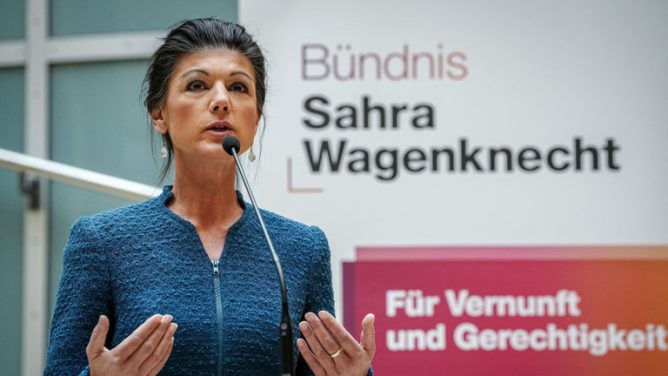
One political force that stands to gain from the crisis has just been established. (Another fairly new party that is profiting is the AfD.) Long rumored and in the making, 8 January saw the official founding of a new party, the Bündnis Sarah Wagenknecht – Vernunft und Gerechtigkeit (Alliance Sarah Wagenknecht – Reason and Justice), or BSW for short. Its leader Sarah Wagenknecht used to be the most popular top politician of the hard-Left party Die Linke, which she left with a bang.
As the name BSW suggests, the new party is, in part, a vehicle for Wagenknecht’s considerable personal political acumen and charisma. Opponents of “Red Sarah,” as the popular, generally right-leaning newspaper Bild still calls her, like to stereotype her as an “icon.” Yet, wiser from the failure of an earlier attempt to strike out on her own (under the label “Aufstehen,” roughly: “Stand Up”), this time, Wagenknecht has gone out of her way and made sure to do her homework, preparing a well-crafted organization, a set of junior leaders around her, and, last but not least, a solid program. This is politically significant: Unlike “Aufstehen,” the BSW will not fold quickly under the weight of its own problems.
On the contrary, the party’s chances of making a strong impact from the get-go are very good, as polls consistently indicate. The most recent one – commissioned by Bild and carried out just days after the party’s founding by a top pollster – shows that 14% of Germans would vote for the BSW in a federal election.
For comparison: the SPD, traditionally one of the core parties of Germany and the political home of Chancellor Olaf Scholz, reaches 14% as well. For the BSW this is an impressive figure, but for the SPD it is catastrophic. Meanwhile the Greens, the second partner in Berlin’s governing “Ampel” coalition, are at 12%. The FDP, the third “Ampel” component, would fail to get any seats at all (due to not crossing Germany’s electoral threshold of 5%). Sarah Wagenknecht’s own former party, Die Linke, would suffer the same fate. The only two parties that would do better than the BSW are the traditional center-right CDU (27%) and the populist-right/far-right AfD (18%).
In sum, with BSW, we are witnessing not the making of a fringe but a core movement in what seems to be emerging as Germany’s re-shaped party system, consisting of three traditional parties (SPD, CDU, and the Greens) and two new forces. The latter are coming from the right and left periphery but are likely to re-define the center, directly and by their pressure on the traditional players.
Representatives of the threatened traditional parties and their expert and mainstream media surrogates often denounce the challengers from the wings as extremists or, at least, irresponsible populists (just another way of saying “demagogue”). But they only have themselves to blame: The true cause of this tectonic movement is the failure of the traditionals. The challengers’ rise marks a reaction to it. Wagenknecht is right about this: Germany’s “democracy is imperiled most of all” by government policies that make ever more citizens feel left alone or alienated.
Against that background, the BSW promises more generous social policies, such as on education, wages, and pensions (and higher taxes for the wealthy). As Germany is doing badly economically, this will resonate. And Wagenknecht, a political “natural,” knows how to signal: She has just taken the side of the protesting farmers – as do the majority (68%) of Germans, according to polls.
Mainstream media are making desperate attempts to frame the rebellious farmers as serving extremists and somehow playing into the hands of – guess which country! – Russia. The ever more besieged minister of the economy Robert Habeck has even detected financing by – guess who! – “Putin!” (without, of course, providing any evidence). This time, these tired scare tactics are failing to catch on. Wagenknecht’s public call for chancellor Olaf Scholz to apologize to the farmers will fare better.
Crucially, Wagenknecht and the BSW have combined socially left approaches with a set of traditionally conservative stances, challenging, for instance, the hypertrophic development of new gender categories or, in general, “symbolical struggles” over hyper-sensitive terminology, so fashionable with what Wagenknecht dismisses as the “lifestyle Left.”
While this push-back against political correctness is a largely symbolic, though effective, operation, migration is a more substantial field. There as well, Wagenknecht has adopted positions closer to the right and center than the liberal left, stressing the need for control and limits. The fact that she herself had a Persian father and that prominent BSW heads are also non-ethnic Germans gives her a strong starting position for this kind of debate, shielding her points from dismissal as racist or xenophobic.
Given how many Germans feel, left alone in an economic crisis and also alienated by especially Green attempts at re-education in the spirit of urban upper class multiculturalism and gender obsessions, it will be hard to counter the BSW’s brand of socially left but otherwise centrist and even conservative policies. No wonder then that opponents are trying to portray Wagenknecht as a monster, along with the new party. Their playbook is predictable and boring: namely to smear them as being pro-Russian or even working in the service of Russia.
In reality, Wagenknecht has positioned her new party to resist the push for ever more confrontation with Moscow, especially with regard to Ukraine. At this moment, for instance, she is speaking up against the delivery of German Taurus cruise missiles to Ukraine, which is the latest fad among the insatiable “miracle weapon” addicts. More generally, she is demanding to shift from a policy of military confrontation by proxy to one of negotiation and compromise, which makes, of course, perfect sense.
For her enemies, there is an irony waiting to catch them: They may hope that accusing Wagenknecht of being too friendly toward Russia will weaken her appeal. Yet that ship has sailed. The days of making hay with unbridled neo-McCarthyism are ending. It is more likely, fortunately, that the BSW’s reasonable approach to foreign policy will only get it more sympathy and voters. As it should. Because remember: At this point, Germany is so dependent on the US that it is treated not only like a vassal, but like a vassal whose wishes and interests do not count. Even Germans who distrust Russia will come to understand that this is fundamentally unsound. In its own national interest, Germany must re-establish some balance by rebuilding its relationship with Russia.
Tarik Cyril Amar is an historian from Germany working at Koç University, Istanbul.
Germany considers delivery of tank ammunition to Israel amid genocidal Gaza war

Press TV – January 17, 2024
Germany’s government is considering the delivery of tank ammunition to Israel amid genocidal war against Gaza, the German magazine Der Spiegel has reported, as Western governments keep on backing the Tel Aviv regime for its ongoing massacre.
Israel requested Germany in November to approve the delivery of around 10,000 rounds of 120-millimeter precision ammunition manufactured by Rheinmetall, the report said.
The departments involved have already fundamentally agreed behind the scenes to fulfill a request from the Israeli government.
The Israeli ambassador to Germany, Ron Prosor thanked the German government for its unrelenting support it has shown.
“Since October 7, Germany has unmistakably stood by Israel and expressed its unreserved support,” Prosor told Der Spiegel. “Israel thanks Germany for this,” he added.
The German Chancellor Olaf Scholz emphasized that arms deliveries were also possible.
According to the report, in order to promptly address the request, there is consideration being given to releasing ammunition from the stocks of the German army as the industry is unable to provide the desired precision ammunition immediately.
In November apart from Germany, Israel had also asked other partners for military aid because of its heavy use of ammunition against the Gazans.
US President Joe Biden approved the delivery of 14,000 rounds of tank ammunition for almost $106 million at the beginning of December, after he bypassed Congress.
The Western-backed Israeli genocide in Gaza has been escalating because of the continuous support of Western governments, as they have been persistently arming Israel and supporting the regime with large amounts of funds.
Germany: Scholz’s ‘green’ government wants to buy 3 VIP helicopters for €200 million
By Denes Albert | Remix News | January 15, 2024
At a time when farmers are staging mass national protests over austerity measures that they say will put them under tremendous financial strain, German Chancellor Olaf Scholz and his ministers are aiming to purchase three new, luxury VIP helicopters that will cost €200 million.
However, the budget cuts for farmers are just one austerity measure, with the total budget cut expected to be €17 billion. The opposition is reacting with outrage over the news of the helicopter purchases, with the luxury helicopters designed for Chancellor Olaf Scholz and Defense Minister Boris Pistorius to attend appointments in Germany.
The German armed forces are supposed to replace the aging Cougar helicopters currently stationed in Berlin, which have a range of 850 kilometers and a cruising speed of up to 315 kilometers per hour. The VIP helicopters became famous when the former Social Democrat (SPD) Defense Minister Christine Lambrecht took her son on holiday in one of them.
The German newspaper Bild says that government officials probably suspect that citizens will not be happy about spending taxpayers’ money in a time of crisis, which is why they wanted to hide the €200 million expense.
German MPs do not recall this type of spending ever being discussed in the budget committee, and the helicopters were not included in the December budget proposal. The news is especially surprising considering German police still have so-called VIP Super Puma helicopters, which government representatives can fly in to emergency meetings.
The opposition is stunned, with Christian Democratic Union (CDU) budget expert Ingo Gädechens telling Bild that the government has lost touch with reality. He points out that the government wants to take €176 million from farmers this year, almost as much as the new helicopters cost.
“All of Germany is suffering from the collapse of fiscal policy. Austerity is everywhere,” the politician said. He added that it is obvious that Scholz’s travel convenience is the reason for the purchases and that ministers are more important than budgetary discipline.
However, Scholz may never get to experience the joy of riding a brand-new luxury helicopter, as the government cannot buy new helicopters without parliamentary approval. Now, it is up to the budget committee.
Scholz pushes fake Russian threats to distract Germans from economic problems
By Ahmed Adel | January 15, 2024
Germany is preparing for a war between NATO and Russia, which, according to the scenario of the German Defence Ministry, could begin in the European summer of 2025 after the defeat of the Ukrainian Army, reported Bild with reference to a secret document of the Bundeswehr. This is evidently a desperate attempt by the German chancellor to distract citizens from their economic woes.
According to the newspaper, citing a classified German military document, the escalation could begin as early as next month with the start of an active Russian offensive against the Ukrainian Armed Forces.
According to Bild, the German military considers the Suwałki Gap between Belarus and the Russian region of Kaliningrad to be the most likely site of confrontation. A situation could escalate in October if Russia deploys troops and medium-range missiles to Kaliningrad, and from December 2024, an artificially induced “border conflict” and “clashes with numerous casualties” could unfold as Russia would take advantage of political chaos in the US following the presidential election.
“The actions of Russia and the West are described precisely, indicating the location and month, and will culminate in the deployment of hundreds of thousands of NATO troops and the imminent start of war in the summer of 2025,” writes the article.
However, the article’s authors leave open the question of how this hypothetical escalation will end.
This is, of course, a ridiculous suggestion by the German Defence Ministry, especially as Moscow has repeatedly stressed that it does not want conflict with NATO or anything beyond its special military operation in Ukraine. Rather, this is an attempt by Chancellor Olaf Scholz to instil an unjustified fear in German society as his popularity continues to plummet in the context of a stuttering economy and continued failed policies.
More than 70% of Germans are dissatisfied with Scholz, according to a survey carried out by the INSA Institute for Bild. Specifically, 72% of voters do not approve of his performance, which is three percentage points more than at the beginning of December. Only one in five, 20%, think that Scholz has done a good job.
According to the researchers, 76% of those surveyed are generally dissatisfied with what the federal government does, whilst only 17% of citizens are satisfied. It is the worst indicator of the ruling coalition since it was formed in December 2021, Bild noted.
In 2023, the Scholz-led government faced numerous economic and leadership challenges that undermined public trust. Persistent inflationary pressures, exacerbated by fiscal policy, undermined household budgets, which caused widespread discontent. The lack of strategic direction and perceived indecision on critical issues, such as energy policy following the adoption of sanctions against Russia, further fuelled scepticism among voters. The leadership crisis, characterised by internal conflicts and disagreements, damaged the effectiveness and cohesion of the German government.
What especially frustrates Germans is the fact that sanctions were imposed on Russia, which has become the fifth-largest economy in the world by volume, whilst Germany is in recession. With a public budget deficit estimated at around 60 billion euros, the very model of the German economy appears to be threatened.
Germany is officially in recession and is expected to have ended 2023 with a drop in GDP of around 0.3%, according to a forecast from the European Commission. This is one of the worst economic results in the bloc, given that the growth forecast for the entire European Union in 2023 is 0.6%. Among the causes is the energy crisis that has hit Germany harder than the rest of the European bloc, mainly because the Germans slashed their supply of Russian energy after the start of the special military operation in February 2022.
Furthermore, with the increase in energy prices resulting from sanctions against Russia, Germany has also suffered an increase in general price inflation in the economy, forcing the European Central Bank to raise interest rates, thus affecting the population’s purchasing power and impacting consumption. Consequently, German companies have not only lost international competitiveness with the application of sanctions against the Russians, but now the country runs the risk of entering a process of deindustrialisation.
Under these conditions, the extreme right is experiencing a resurgence. The far-right Alternative for Germany (AfD) party has hit an all-time high approval rating of 24% and has the potential to gain a few more percentile points with the immense failure of the ruling coalition.
What is undeniable is the fact that Germany is experiencing a rapid decline, all spurred on by the reckless policies of Scholz that prioritised American interests instead of German, and he is now resorting to a fake Russian threat in a desperate attempt to distract citizens from their social and economic problems that he is responsible for.
Ahmed Adel is a Cairo-based geopolitics and political economy researcher.
Featured Video

The Sordid History of the CIA – Part 2
or go to
Aletho News Archives – Video-Images
Book Review
Jeffrey Epstein: A Jewish Individual?
The Occidental Observer | February 5, 2023
One Nation Under Blackmail: The Sordid Union between Intelligence and Organized Crime that Gave Rise to Jeffrey Epstein (Volume 1 & 2) by Whitney Webb
“Far from being an anomaly, Epstein was one of several men who, over the past century, have engaged in sexual blackmail activities designed to obtain damaging information (i.e., “intelligence”) on powerful individuals with the goal of controlling their activities and securing their compliance.”[1]

Jeffrey Epstein is dead and Ghislaine Maxwell is locked away in prison, and the thought-makers of our world seem keen to let the more explosive parts of the scandal dissipate from the public consciousness. As far as the mainstream media is concerned, Epstein and Maxwell were little more than well-connected socialites who ran a sex-trafficking ring for the rich and the powerful, and the focus has shifted instead to the criminal and civil cases seeking to achieve redress for the victims of sexual abuse.
On occasion some newspaper articles will mention the hidden cameras littered across Epstein’s properties, others the reams of CDs and hard drives found within them during the FBI raids. Altogether missing from the Netflix documentaries (Jeffrey Epstein: Filthy Rich [2020] and Ghislaine Maxwell: Filthy Rich [2022]) or the articles that spend their time narrowly focusing on the links between Epstein and Bill Gates, is the acknowledgement of the true nature of Epstein himself and the ultimate purpose of this sex-trafficking of minors — a sexual blackmail operation.
Not everyone is cowardly enough to let these controversial aspects lie untouched, as the newly released two-volume book One Nation Under Blackmail by independent reporter Whitney Webb seeks to blow wide open this media-enforced blackout. Utilizing primarily open-source information (that is, publicly accessible information such as books, newspapers articles and government reports),[2] Webb’s book delves into the life and times of Jeffrey Epstein and his deep ties to Jewish billionaires and Israeli intelligence. … continue
Blog Roll
Recent Comments


 Aletho News
- Trump’s ‘Board of Peace’ exports Israeli ‘ceasefire’ diplomacy to the world
- Israeli army closes dozens of cases involving killing of Palestinians inside torture camps
- Europe creates a ‘Russian government-in-exile’, consisting of a bunch of losers
- Munich, 2007: The Day the West Was Told No
- At The Munich Security Conference, AOC Gets It Wrong On Foreign Policy
- Europe Decided to Go to War With Russia by 2030, Already Preparing – Orban
- Russia and China Are Expanding Their Cooperation to Counter US Efforts to Bully Iran and Cuba
- NATO plotting maritime blockade of Russia – Moscow
- Jeffrey Epstein’s sinister shadow over West Asia
- The Sordid History of the CIA – Part 2
- If Americans Knew
- Israel battles Palestinian right of return, one Palestinian at a time – Not a ceasefire Day 127
- Noor’s short life of unimaginable suffering
- Israel Destroyed Gaza’s Hospitals. Now It’s Banning Doctors Without Borders.
- Is Spite of What Zionists Say, It’s a Good Thing to Criticize Governments
- Palestinian mother, daughter recount strip searches, harsh conditions in Israeli detention
- Israel used weapons in Gaza that made thousands of Palestinians evaporate
- ADL’s Stats Twist Israel’s Critics Into Antisemites
- Why Is the World Silent When the Gaza Genocide Is Not Over?
- In Gaza: 8,000 bodies under rubble, 3,000 missing – Not a ceasefire Day 126
- AZAPAC, the new PAC opposing Israeli domination of U.S policies
- No Tricks Zone
- Unfudging The Data: Dutch Meteorological Institute Reinstates Early 20th Centruy Heat Waves It Had Erased Earlier
- German Gas Crisis…Chancellor Merz Allegedly Bans Gas Debate Ahead of Elections!
- Pollen Reconstructions Show The Last Glacial’s Warming Events Were Global, 10x Greater Than Modern
- Germany’s Natural Gas Storage Level Dwindles To Just 28%… Increasingly Critical
- New Study Rebuts The Assumption That Anthropogenic CO2 Molecules Have ‘Special’ Properties
- Climate Scientist Who Predicted End Of “Heavy Frost And Snow” Now Refuses Media Inquiries
- Polar Bear Numbers Rising And Health Improving In Areas With The Most Rapid Sea Ice Decline
- One Reason Only For Germany’s Heating Gas Crisis: Its Hardcore-Dumbass Energy Policy
- 130 Years Later: The CO2 Greenhouse Effect Is Still Only An Imaginary-World Thought Experiment
- New Study Affirms Rising CO2’s Greening Impact Across India – A Region With No Net Warming In 75 Years
 Aletho News