German Business Fears Best Days Behind It as Economy Crushed by Loss of Russian Energy
By Ilya Tsukanov | Sputnik | July 24, 2023
European industrial behemoth Germany has found itself among the nations hit hardest by the West’s attempt to “punish” Russia for its military operation in Ukraine, with industrial output slumping and the country sinking into a recession earlier this year after losing access to the cheap and reliable supply of Russian hydrocarbons.
German business, administrative, and government leaders have expressed widespread dissatisfaction with the government’s energy and economic policy, and expressed fears that the Central European industrial powerhouse’s economy may have “passed its zenith,” with its best days behind it.
A survey of 484 company board members, managing directors, government ministers, and other senior decision-makers by the Allensbach Institute for Public Opinion Research for German media has found that only 24 percent of the country’s managerial class is satisfied with Economic and Climate Minister Robert Habeck’s job performance, down from 91 percent just a year ago.
Fewer than a quarter of those surveyed expect things to improve over the next six months, with two thirds saying there’s “little chance” the country can restore its lost international competitiveness, and 76 percent saying they don’t believe Habeck or the Ministry of Economic Affairs has the interests of German business in mind to a sufficient degree.
Among the top five problems cited by managers which hamper Germany’s competitiveness are high energy costs (77 percent), a shortage of skilled workers (70 percent), excessive government regulation (68 percent), a backlog in digitization programs (65 percent), and dilapidated infrastructure (61 percent).
58 percent of those polled said Germany appears to have “passed its zenith” economically, with just 22 percent expecting the economy to pick up again.
About three quarters of respondents expressed criticism of Chancellor Olaf Scholz’s Traffic Light coalition (which includes Scholz’s Social Democratic Party, the Greens – represented by Habeck and Foreign Minister Annalena Baerbock, and the Free Democratic Party). Satisfaction with the coalition government has dropped from 62 percent in 2022 to 21 percent now, with 65 percent of those polled suggesting the coalition’s policies are “weakening the country.”
The Allensbach Institute conducted its survey between June 13 and July 7, with the 484 businessmen and officials polled including 89 board members of large companies, 18 ministers, and 28 heads of firms.
The German economy officially sunk into a recession in May after economic growth shrunk by 0.3 percent in the first three months of 2023.
In the aftermath of the escalation of the Donbass crisis into a full-blown Russia-NATO proxy war in Ukraine in February 2022, Germany has faced all the problems other Western countries have related to the decision to decouple themselves economically from Russia, like high inflation and spiking energy prices. However, as Europe’s main industrial economy, Germany’s crisis has been even more painful for local businesses, which have expressed concerns about the loss of competitiveness to other global behemoths like the US and China due to the energy-intensive nature of their products.
Washington added insult to Germany’s injuries last year after announcing federal subsidies to certain “green” industries, effectively trying to entice European industry to relocate to the United States for tax breaks and cheaper energy.
Russian President Vladimir Putin warned in May 2022 that decoupling the European economy from Russian energy resources would threaten the entire region with widespread deindustrialization and loss of competitiveness.
Last month, German Finance Minister Christian Lindner announced that cuts in the budget had forced Berlin to halt additional contributions to the European Union’s budget.
“Germany is both an important supplier for other European countries and an important buyer. A lasting recession in the German economy will certainly have significant effects on France, Italy, Spain, Belgium, and the Netherlands,” Paris-based economist Jacques Sapir told Sputnik earlier this month.
“If this recession lasts until next spring, the economies of the countries mentioned will also go into depression, which in turn will affect the German economy even more,” Sapir predicted, characterizing Berlin and Europe’s anti-Russian sanctions policy as “a form of suicide.”
Hitler, Churchill, the Holocaust, and the War in Ukraine
Mike Whitney Interview with Ron Unz • Unz Review • July 17, 2023
 In the West, we’re taught that Hitler is the embodiment of all evil, but it’s more complicated than that, isn’t it? The more I read about Hitler, the more convinced I am that his views about the Versailles Treaty were fairly commonplace among Germans living at the time. It seems to me that if Hitler hadn’t emerged as the leader who promised to restore Germany (to its original borders), someone else would have taken his place. The real problem was the injustice of the treaty itself which exacted reparations that could not be repaid along with the partitioning of the German state. It was the onerous settlement of Versailles that ensured there would be Second World War not Hitler.
Am I wrong about this? And would you agree that our over-simplified “cartoonish” portrayal of Hitler prevents people from understanding the events that led to WW2?
Ron Unz—You’re correct on all those points, but the true history is even worse than that.
Germany had been very successful during the early years of the First World War, repeatedly defeating the Russians while occupying portions of northern France, but nevertheless its leaders then sought to end the horrible mutual slaughter in 1916 by proposing a peace without winners or losers. However, most of the Allied leadership harshly rejected any peace negotiations and were instead determined to continue the war until Germany was defeated and permanently crippled. I discussed that important forgotten history in a long article last year.
- American Pravda: Lost Histories of the Great War
Ron Unz • The Unz Review • November 28, 2022 • 8,100 Words
A couple of years later, after America had entered the war, Germany agreed to an armistice—an end to the fighting—on the basis of President Woodrow Wilson’s Fourteen Points, which seemed to offer a fair peace without a victory for either side. But this turned out to be a bait-and-switch operation, since once Germany had withdrawn its army from French territory and given up its powerful naval forces, the Allies then imposed a brutal starvation blockade upon the weakened country, inflicting many hundreds of thousands of civilian deaths until the new German government finally accepted very harsh peace terms. These included the dismemberment and occupation of portions of their country, permanent military weakness, and acceptance of the entire guilt of the war, as well as paying gigantic future financial reparations to the victorious Allies.
The outrageous terms imposed at Versailles deeply rankled all Germans, and the memory of the starvation imposed upon Germany during the war and even afterward was one of the reasons Hitler believed it was so important to somehow gain access to additional agricultural territory.
As for the German leader himself, several years ago I pointed out that his contemporaneous assessment by many leading figures was very different than one might imagine based upon his demonic portrayal in the historical propaganda-narrative later created after war broke out.
By resurrecting a prosperous Germany while nearly all other countries remained mired in the worldwide Great Depression, Hitler drew glowing accolades from individuals all across the ideological spectrum. After an extended 1936 visit, David Lloyd George, Britain’s former wartime prime minister, fulsomely praised the chancellor as “the George Washington of Germany,” a national hero of the greatest stature. Over the years, I’ve seen plausible claims here and there that during the 1930s Hitler was widely acknowledged as the world’s most popular and successful national leader, and the fact that he was selected as Time Magazine’s Man of the Year for 1938 tends to support this belief.
I discovered a particular example of such missing perspectives earlier this year when I decided to read The Prize, Daniel Yergin’s magisterial and Pulitzer Prize-winning 1991 history of the world oil industry, and came across a few surprising paragraphs buried deep within the 900 pages of dense text. Yergin explained that during the mid-1930s the imperious chairman of Royal Dutch Shell, who had spent decades at the absolute summit of the British business world, became greatly enamored of Hitler and his Nazi government. He believed that an Anglo-German alliance was the best means of maintaining European peace and protecting the continent from the Soviet menace, and even retired to Germany in accordance with his new sympathies.
Since the actual history of this era has been so thoroughly replaced by extreme propaganda, academic specialists who closely investigate particular topics sometimes encounter puzzling anomalies. For example, a bit of very casual Googling brought to my attention an interesting article by a leading biographer of famed Jewish modernist writer Gertrude Stein, who seemed totally mystified why her feminist icon seemed to have been a major admirer of Hitler and an enthusiastic supporter of the pro-German Vichy government of France. The author also notes that Stein was hardly alone in her sentiments, which were generally shared by so many of the leading writers and philosophers of that period.
There is also the very interesting but far less well documented case of Lawrence of Arabia, one of the greatest British military heroes to come out of the First World War and who may have been moving in a rather similar direction just before his 1935 death in a possibly suspicious motorcycle accident. An alleged account of his evolving political views seems extremely detailed and perhaps worth investigating, with the original having been scrubbed from the Internet but still available at Archive.org.
A couple of years ago, the 1945 diary of a 28-year-old John F. Kennedy travelling in post-war Europe was sold at auction, and the contents revealed his rather favorable fascination with Hitler. The youthful JFK predicted that “Hitler will emerge from the hatred that surrounds him now as one of the most significant figures who ever lived” and felt that “He had in him the stuff of which legends are made.” These sentiments are particularly notable for having been expressed just after the end of a brutal war against Germany and despite the tremendous volume of hostile propaganda that had accompanied it.
The political enthusiasms of literary intellectuals, young writers, or even elderly businessmen are hardly the most reliable sources by which to evaluate a particular regime. But earlier this year, I pointed to a fairly comprehensive appraisal of the origins and policies of National Socialist Germany by one of Britain’s most prominent historians:
Not long ago, I came across a very interesting book written by Sir Arthur Bryant, an influential historian whose Wikipedia page describes him as the personal favorite of Winston Churchill and two other British prime ministers. He had worked on Unfinished Victory during the late 1930s, then somewhat modified it for publication in early 1940, a few months after the outbreak of World War II had considerably altered the political landscape. But not long afterward, the war became much more bitter and there was a harsh crackdown on discordant voices in British society, so Bryant became alarmed over what he had written and attempted to remove all existing copies from circulation. Therefore the only ones available for sale on Amazon are exorbitantly priced, but fortunately the work is also freely available at Archive.org.
Writing before the “official version” of historical events had been rigidly determined, Bryant describes Germany’s very difficult domestic situation between the two world wars, its problematic relationship with its tiny Jewish minority, and the circumstances behind the rise of Hitler, providing a very different perspective on these important events than what we usually read in our standard textbooks.
Among other surprising facts, he notes that although Jews were just 1% of the total population, even five years after Hitler had come to power and implemented various anti-Semitic policies, they still apparently owned “something like a third of the real property” in that country, with the great bulk of these vast holdings having been acquired from desperate, starving Germans in the terrible years of the early 1920s. Thus, much of Germany’s 99% German population had recently been dispossessed of the assets they had built up over generations…
Bryant also candidly notes the enormous Jewish presence in the leadership of the Communist movements that had temporarily seized power after World War I, both in major portions of Germany and in nearby Hungary. This was an ominous parallel to the overwhelmingly Jewish Bolsheviks who had gained control of Russia and then butchered or expelled that country’s traditional Russian and German ruling elites, and therefore a major source of Nazi fears.
Unlike so many of the other historians previously discussed, after the political climate changed Bryant assiduously worked to expunge his suddenly unfashionable views from the written record, and as a consequence went on to enjoy a long and successful career, topped by the accolades of a grateful British establishment. But I suspect that his long-suppressed 1940 volume, presenting a reasonably favorable view of Hitler and Nazi Germany, is probably more accurate and realistic than the many thousands of propaganda-drenched works by others that soon followed. I have now incorporated it into my HTML Books system, so those so interested can read it and decide for themselves.

-
- Unfinished VictoryArthur Bryant • 1940 • 79,000 Words
Help me understand Munich. We’ve all been taught that Britain’s Neville Chamberlain caved in to Hitler’s demands on the annexation of Czechoslovakia’s Sudetenland which, in turn, fueled Hitler’s lust for global conquest. But was that really what happened? And was “appeasement” really such a bad idea or should the European leaders have accepted that Versailles was a disaster from the get-go and agreed to Hitler’s demands to restore Germany’s original borders?
Ron Unz—The First World War had led to the collapse of the multi-ethnic Austro-Hungarian, Czarist, and Ottoman empires, each of which had been politically dominated by one ethnic group at the expense of all the others. President Woodrow Wilson’s Fourteen Points and the Versailles Peace Conference had elevated the principle that nationalities should be given freedom and ruled by their own leaders, and this had served as the logical basis for most of the successor states thus created.
However, there was a blatant double standard in the political application of this policy, with the creation of the new country of Czechoslovakia being one of the most obvious examples. Like the much larger Austro-Hungarian Empire, Czechoslovakia was stitched together from several entirely different nationalities, with roughly half the population being the ruling Czechs and the other half being Germans, Slovaks, and Ukrainians, who had little political power and deeply resented the domination of the Czechs, who completely controlled the government and its administration.
Czechoslovakia had been established as an important strategic ally for France to use against Germany, geographically serving as an ideal staging area for bombing attacks, almost amounting to an unsinkable aircraft carrier directly jutting into the heart of its German neighbor. Since the country was intentionally designed to threaten Germany, the overwhelmingly German Sudetenland region had been included so as to strengthen its geographical border defenses. The Germans were actually the second largest nationality within Czechoslovakia, so the very name amounted to dishonest propaganda, and something like Czecho-Germania might have been a little more accurate.
One of Hitler’s main goals was to free the suppressed German populations of Central Europe and reunite them with their German homeland and this included the more than 3 million Sudeten Germans. The Czech government was also quite friendly with Stalin’s Soviet Union, and therefore seemed a particularly menacing potential military threat, a possible future base for Soviet attacks against Germany.
Hitler gradually rebuilt Germany’s strength and by March 1938 managed to reunite his country with the Germans of Austria, accomplished with the overwhelmingly enthusiastic support of the latter. He then demanded that the Sudeten Germans be freed by the Czechs and allowed to unify with Germany as well, being willing to potentially risk a wider European war with the British, French, and Soviets on that issue. To avoid this, the leaders of Germany, Britain, France, and Italy together negotiated an agreement at Munich, allowing the Sudeten Germans to secede and join Germany. This peace agreement was wildly popular across nearly all of Europe.
 However, once the Germans had been allowed to secede from Czechoslovakia, the Slovaks soon also did the same, establishing their own independent state of Slovakia (just as happened once again in 1993), and the entire country fell apart. At that point, Poland also grabbed a piece of disputed territory and the Hungarians threatened to do the same, so according to most accounts that I’ve read, the desperate Czech president turned to Hitler for support, and what was left of the country became a German protectorate.
Although anti-German propaganda soon portrayed the loss of Czech independence as a flagrant violation of the Munich Agreement, proof that Hitler couldn’t be trusted to keep his promises, the situation was really not so clear-cut since Czechoslovakia had already fallen apart and no longer existed. Furthermore, the Czechs had only been fully independent for twenty years after having previously spent nearly 700 years under German suzerainty, so in many respects, this merely restored the the traditional geopolitical arrangements in that part of Europe, doing so far more peacefully than when the Soviets invaded and occupied the Baltic States the following year.
Ironically enough, the Munich agreement signed by Chamberlain was reportedly so tremendously popular in Britain that if he’d called elections soon afterward, he probably would have won an overwhelming majority in Parliament, strongly consolidating his political hold over the British government for the next few years.
For those interested in a much more detailed discussion of this important history, I’d recommend the 1961 classic The Origins of the Second World War by renowned Oxford historian A.J.P. Taylor as well as David Irving’s outstanding 1991 volume Hitler’s War, available in HTML format on this website:
- Hitler’s War
David Irving • 1991 • 397,000 Words

Another excellent book covering this complex history is 1939: The War Had Many Fathers, published in 2011 by Gerd Schultze-Rhonof, a fully mainstream German professional military man, who rose to the rank of major-general in the German army before retiring. I’d also recommend David L. Hoggan’s extremely detailed narrative history in The Forced War, whose English version was originally published in 1989 and was long unavailable.
- The Forced War
When Peaceful Revisionism Failed
David L. Hoggan • 1989 • 320,000 Words
I should mention that both Schultze-Rhonof and Hoggan view these events somewhat differently than I have presented, with the former sharply condemning Hitler’s move into Czechia as a serious violation of the Munich Agreement and the latter arguing that the British government under Lord Halifax’s influence had always intended to orchestrate a war against Germany and was merely using the Munich Agreement as ruse to gain additional time for full rearmament before attacking.
Question 3: Churchill “The Drunken Poltroon”
I can’t make any sense of Churchill’s behavior prior to the war. Why was he so eager to declare war on Germany over a German territorial dispute with Poland many hundreds of miles away from his own country? Why did he think that should involve England? Besides, Churchill clearly had no way to transport British troops to Poland to defend the country nor would the battered British army have fared well against the better-trained and equipped Wehrmacht. In your book, Understanding World War II, you suggest that Churchill had benefactors who may have been pulling his strings and persuading him to do things that were clearly not in his country’s best interests. Is that what was going on, was Churchill just following a script that was written by others?
Ron Unz—Actually, Churchill only became a member of the British government on the day that war was declared against Germany, but he had indeed been strongly pressing from the outside for an anti-German policy by Chamberlain’s government, so the issue remains.
When I first encountered David Irving’s important historical work a few years ago, my biggest surprise was not the new information he provided about Hitler but the astonishing facts he revealed about Churchill. As I explained in my 2019 article on World War II:
I recently decided to tackle one of Irving’s much longer works, the first volume of Churchill’s War, a classic text that runs some 300,000 words and covers the story of the legendary British prime minister to the eve of Barbarossa, and I found it just as outstanding as I had expected.
As one small indicator of Irving’s candor and knowledge, he repeatedly if briefly refers to the 1940 Allied plans to suddenly attack the USSR and destroy its Baku oilfields, an utterly disastrous proposal that surely would have lost the war if actually carried out. By contrast, the exceptionally embarrassing facts of Operation Pike have been totally excluded from virtually all later Western accounts of the conflict, leaving one to wonder which of our numerous professional historians are merely ignorant and which are guilty of lying by omission.
Until recently, my familiarity with Churchill had been rather cursory, and Irving’s revelations were absolutely eye-opening. Perhaps the most striking single discovery was the remarkable venality and corruption of the man, with Churchill being a huge spendthrift who lived lavishly and often far beyond his financial means, employing an army of dozens of personal servants at his large country estate despite frequently lacking any regular and assured sources of income to maintain them. This predicament naturally put him at the mercy of those individuals willing to support his sumptuous lifestyle in exchange for determining his political activities. And somewhat similar pecuniary means were used to secure the backing of a network of other political figures from across all the British parties, who became Churchill’s close political allies.
To put things in plain language, during the years leading up to the Second World War, both Churchill and numerous other fellow British MPs were regularly receiving sizable financial stipends—cash bribes—from Jewish and Czech sources in exchange for promoting a policy of extreme hostility toward the German government and actually advocating war. The sums involved were quite considerable, with the Czech government alone probably making payments that amounted to tens of millions of dollars in present-day money to British elected officials, publishers, and journalists working to overturn the official peace policy of their existing government. A particularly notable instance occurred in early 1938 when Churchill suddenly lost all his accumulated wealth in a foolish gamble on the American stock-market, and was soon forced to put his beloved country estate up for sale to avoid personal bankruptcy, only to quickly be bailed out by a foreign Jewish millionaire intent upon promoting a war against Germany. Indeed, the early stages of Churchill’s involvement in this sordid behavior are recounted in an Irving chapter aptly entitled “The Hired Help.”
Ironically enough, German Intelligence learned of this massive bribery of British parliamentarians, and passed the information along to Prime Minister Neville Chamberlain, who was horrified to discover the corrupt motives of his fierce political opponents, but apparently remained too much of a gentlemen to have them arrested and prosecuted. I’m no expert in the British laws of that era, but for elected officials to do the bidding of foreigners on matters of war and peace in exchange for huge secret payments seems almost a textbook example of treason to me, and I think that Churchill’s timely execution would surely have saved tens of millions of lives.
My impression is that individuals of low personal character are those most likely to sell out the interests of their own country in exchange for large sums of foreign money, and as such usually constitute the natural targets of nefarious plotters and foreign spies. Churchill certainly seems to fall into this category, with rumors of massive personal corruption swirling around him from early in his political career. Later, he supplemented his income by engaging in widespread art-forgery, a fact that Roosevelt eventually discovered and probably used as a point of personal leverage against him. Also quite serious was Churchill’s constant state of drunkenness, with his inebriation being so widespread as to constitute clinical alcoholism. Indeed, Irving notes that in his private conversations FDR routinely referred to Churchill as “a drunken bum.”
During the late 1930s, Churchill and his clique of similarly bought-and-paid-for political allies had endlessly attacked and denounced Chamberlain’s government for its peace policy, and he regularly made the wildest sort of unsubstantiated accusations, claiming the Germans were undertaking a huge military build-up aimed against Britain. Such roiling charges were often widely echoed by a media heavily influenced by Jewish interests and did much to poison the state of German-British relations. Eventually, these accumulated pressures forced Chamberlain into the extremely unwise act of providing an unconditional guarantee of military backing to Poland’s irresponsible dictatorship. As a result, the Poles then rather arrogantly refused any border negotiations with Germany, thereby lighting the fuse which eventually led to the German invasion six months later and the subsequent British declaration of war. The British media had widely promoted Churchill as the leading pro-war political figure, and once Chamberlain was forced to create a wartime government of national unity, his leading critic was brought into it and given the naval affairs portfolio.
Following his lightening six-week defeat of Poland, Hitler unsuccessfully sought to make peace with the Allies, and the war went into abeyance. Then in early 1940, Churchill persuaded his government to try strategically outflanking the Germans by preparing a large sea-borne invasion of neutral Norway; but Hitler discovered the plan and preempted the attack, with Churchill’s severe operational mistakes leading to a surprising defeat for the vastly superior British forces. During World War I, Churchill’s Gallipoli disaster had forced his resignation from the British Cabinet, but this time the friendly media helped ensure that all the blame for the somewhat similar debacle at Narvik was foisted upon Chamberlain, so it was the latter who was forced to resign, with Churchill then replacing him as prime minister. British naval officers were appalled that the primary architect of their humiliation had become its leading political beneficiary, but reality is what the media reports, and the British public never discovered this great irony.
This incident was merely the first of the long series of Churchill’s major military failures and outright betrayals that are persuasively recounted by Irving, nearly all of which were subsequently airbrushed out of our hagiographic histories of the conflict. We should recognize that wartime leaders who spend much of their time in a state of drunken stupor are far less likely to make optimal decisions, especially if they are extremely prone to military micro-management as was the case with Churchill.
In the spring of 1940, the Germans launched their sudden armored thrust into France via Belgium, and as the attack began to succeed, Churchill ordered the commanding British general to immediately flee with his forces to the coast and to do so without informing his French or Belgium counterparts of the huge gap he was thereby opening in the Allied front-lines, thus ensuring the encirclement and destruction of their armies. Following France’s resulting defeat and occupation, the British prime minister then ordered a sudden, surprise attack on the disarmed French fleet, completely destroying it and killing some 2,000 of his erstwhile allies; the immediate cause was his mistranslation of a single French word, but this “Pearl Harbor-type” incident continued to rankle French leaders for decades.
Hitler had always wanted friendly relations with Britain and certainly had sought to avoid the war that had been forced upon him. With France now defeated and British forces driven from the Continent, he therefore offered very magnanimous peace terms and a new German alliance to Britain. The British government had been pressured into entering the war for no logical reason and against its own national interests, so Chamberlain and half the Cabinet naturally supported commencing peace negotiations, and the German proposal probably would have received overwhelming approval both from the British public and political elites if they had ever been informed of its terms.
But despite some occasional wavering, Churchill remained absolutely adamant that the war must continue, and Irving plausibly argues that his motive was an intensely personal one. Across his long career, Churchill had had a remarkable record of repeated failure, and for him to have finally achieved his lifelong ambition of becoming prime minister only to lose a major war just weeks after reaching Number 10 Downing Street would have ensured that his permanent place in history was an extremely humiliating one. On the other hand, if he managed to continue the war, perhaps the situation might somehow later improve, especially if the Americans could be persuaded to eventually enter the conflict on the British side.
Since ending the war with Germany was in his nation’s interest but not his own, Churchill undertook ruthless means to prevent peace sentiments from growing so strong that they overwhelmed his opposition. Along with most other major countries, Britain and Germany had signed international conventions prohibiting the aerial bombardment of civilian urban targets, and although the British leader had very much hoped the Germans would attack his cities, Hitler scrupulously followed these provisions. In desperation, Churchill therefore ordered a series of large-scale bombing raids against the German capital of Berlin, doing considerable damage, and after numerous severe warnings, Hitler finally began to retaliate with similar attacks against British cities. The population saw the heavy destruction inflicted by these German bombing raids and was never informed of the British attacks that had preceded and provoked them, so public sentiment greatly hardened against making peace with the seemingly diabolical German adversary.
In his memoirs published a half-century later, Prof. Revilo P. Oliver, who had held a senior wartime role in American Military Intelligence, described this sequence of events in very bitter terms:
Great Britain, in violation of all the ethics of civilized warfare that had theretofore been respected by our race, and in treacherous violation of solemnly assumed diplomatic covenants about “open cities”, had secretly carried out intensive bombing of such open cities in Germany for the express purpose of killing enough unarmed and defenceless men and women to force the German government reluctantly to retaliate and bomb British cities and thus kill enough helpless British men, women, and children to generate among Englishmen enthusiasm for the insane war to which their government had committed them.
It is impossible to imagine a governmental act more vile and more depraved than contriving death and suffering for its own people — for the very citizens whom it was exhorting to “loyalty” — and I suspect that an act of such infamous and savage treason would have nauseated even Genghis Khan or Hulagu or Tamerlane, Oriental barbarians universally reprobated for their insane blood-lust. History, so far as I recall, does not record that they ever butchered their own women and children to facilitate lying propaganda….In 1944 members of British Military Intelligence took it for granted that after the war Marshal Sir Arthur Harris would be hanged or shot for high treason against the British people…

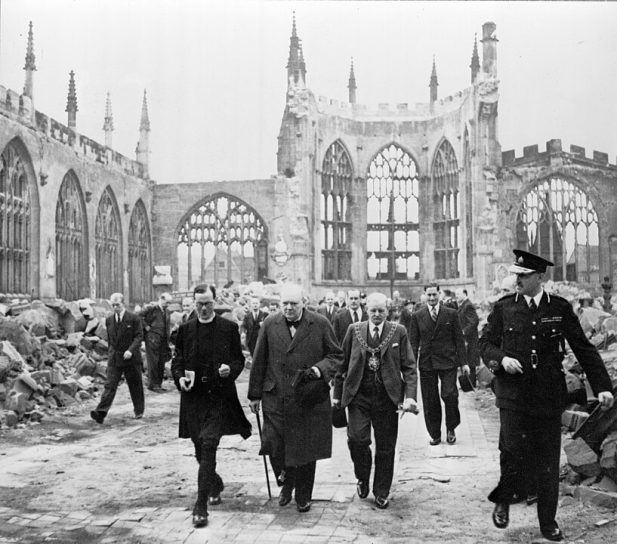
Churchill walks through the ruins of Coventry Cathedral in 1941
Churchill’s ruthless violation of the laws of war regarding urban aerial bombardment directly led to the destruction of many of Europe’s finest and most ancient cities. But perhaps influenced by his chronic drunkenness, he later sought to carry out even more horrifying war crimes and was only prevented from doing so by the dogged opposition of all his military and political subordinates.
Along with the laws prohibiting the bombing of cities, all nations had similarly agreed to ban the first use of poison gas, while stockpiling quantities for necessary retaliation. Since Germany was the world-leader in chemistry, the Nazis had produced the most lethal forms of new nerve gases, such as Tabun and Sarin, whose use might have easily resulted in major military victories on both the Eastern and Western fronts, but Hitler had scrupulously obeyed the international protocols that his nation had signed. However, late in the war during 1944 the relentless Allied bombardment of German cities led to the devastating retaliatory attacks of the V-1 flying bombs against London, and an outraged Churchill became adamant that German cities should be attacked with poison gas in counter-retaliation. If Churchill had gotten his way, many millions of British might soon have perished from German nerve gas counter-strikes. Around the same time, Churchill was also blocked in his proposal to bombard Germany with hundreds of thousands of deadly anthrax bombs, an operation that might have rendered much of Central and Western Europe uninhabitable for generations.
I found Irving’s revelations on all these matters absolutely astonishing, and was deeply grateful that Deborah Lipstadt and her army of diligent researchers had carefully investigated and seemingly confirmed the accuracy of virtually every single item.
The two existing volumes of Irving’s Churchill masterwork total well over 700,000 words, and reading them would obviously consume weeks of dedicated effort. Fortunately, Irving is also a riveting speaker and several of his extended lectures on the topic are available for viewing on BitChute after having been recently purged from YouTube:
- American Pravda: Understanding World War II
Ron Unz • The Unz Review • September 23, 2019 • 20,500 Words
 Irving’s 1987 Churchill book had laid bare his subject’s extremely lavish lifestyle as well as his lack of any solid income, together with the dramatic political consequences of that dangerous combination. This shocking historical picture was fully confirmed in 2015 by a noted financial expert whose book focused entirely on Churchill’s tangled finances, and did so with full cooperative access to his subject’s family archives. The story told by David Lough in No More Champagne is actually far more extreme than what had been described by Irving almost three decades earlier, with the author even suggesting that Churchill’s financial risk-taking was almost unprecedented for anyone in public or private life.
For example, at the very beginning of his book, Lough explains that Churchill became Prime Minister on May 10, 1940, the same day that German forces began their invasion of the Low Countries and France. But aside from those huge military and political challenges, Britain’s new wartime leader also faced an entirely different crisis as well, being unable to cover his personal bills, debt interest, or tax payments, all of which were due at the end of the month, thereby forcing him to desperately obtain a huge secret payment from the same Austrian Jewish businessman who had previously rescued him financially. Stories like this may reveal the hidden side of larger geopolitical developments, which sometimes only come to light many decades later.
The unacknowledged influence of secret payments to our own national leaders may be similar. George Washington law professor Jonathan Turley, a very prominent mainstream legal expert, recently published a column in The Hill expressing his total outrage that the American media was completely ignoring the massive corruption scandal involving Biden family members, who had received at least $10 million in secret financial payments from overseas interests. And just a few days ago, we learned that those payments to the Bidens had been made by a Ukrainian billionaire, perhaps helping to explain our current military confrontation with Russia over that country. Over the last year, Joseph Biden has sometimes been praised as another Winston Churchill, and that characterization may indeed be correct but not in the way intended.
Why was FDR so eager to drag the United States into a war that posed no threat to US national security? It seems to me, that FDR’s decision may have been shaped—not by principle—but by the expectation that if the industrial centers of Europe were left in ruins, the US would unavoidably emerge as the lone global superpower. That, of course, turned out to be exactly what happened. But keep in mind, the “tipping-point” Battle of Stalingrad ended in February 1943, whereas, D-Day took place in June, 1944. What that means, is that the United States did not enter the conflict for a whole 16 months after it was certain that Germany would lose the war. In other words, the US invasion was basically a mop-up operation aimed at ensuring US hegemony over western Europe while preventing the Soviet Union from spreading communism across the continent. (Perhaps, you disagree with my analysis??)
What can you tell us about FDR and his motivation to enter the war? Was it entirely his decision or were there other factors involved?
Ron Unz—It’s possible that FDR envisioned that a European war would lead to the destruction of industrialized Europe as an competitor and the establishment of American global hegemony. But I think his motivation for American involvement in a war was actually much simpler than that.
America had been hit especially hard by the Great Depression and although FDR had reached the White House based upon his promise to end it, after five years in office, his policies had largely failed.
The American economy had also been weak in 1914, but once the First World War broke out, the huge needs of the Allied countries boosted our industrial production to new heights, resulting in American prosperity. Similarly, many mainstream history books admit that it was only the outbreak of World War II in 1939 that finally pulled the American economy out of the Great Depression, but they never consider the possibility that FDR might have deliberately provoked the war for that purpose. However, as I wrote in 2018, there seems strong contemporaneous evidence to that effect:
During the 1930s, John T. Flynn was one of America’s most influential progressive journalists, and although he had begun as a strong supporter of Roosevelt and his New Deal, he gradually became a sharp critic, concluding that FDR’s various governmental schemes had failed to revive the American economy. Then in 1937 a new economic collapse spiked unemployment back to the same levels as when the president had first entered office, confirming Flynn in his harsh verdict. And as I wrote last year:
Indeed, Flynn alleges that by late 1937, FDR had turned towards an aggressive foreign policy aimed at involving the country in a major foreign war, primarily because he believed that this was the only route out of his desperate economic and political box, a stratagem not unknown among national leaders throughout history. In his January 5, 1938 New Republic column, he alerted his disbelieving readers to the looming prospect of a large naval military build-up and warfare on the horizon after a top Roosevelt adviser had privately boasted to him that a large bout of “military Keynesianism” and a major war would cure the country’s seemingly insurmountable economic problems. At that time, war with Japan, possibly over Latin American interests, seemed the intended goal, but developing events in Europe soon persuaded FDR that fomenting a general war against Germany was the best course of action. Memoirs and other historical documents obtained by later researchers seem to generally support Flynn’s accusations by indicating that Roosevelt ordered his diplomats to exert enormous pressure upon both the British and Polish governments to avoid any negotiated settlement with Germany, thereby leading to the outbreak of World War II in 1939.
The last point is an important one since the confidential opinions of those closest to important historical events should be accorded considerable evidentiary weight. In a recent article John Wear mustered the numerous contemporaneous assessments that implicated FDR as a pivotal figure in orchestrating the world war by his constant pressure upon the British political leadership, a policy that he privately even admitted could mean his impeachment if revealed. Among other testimony, we have the statements of the Polish and British ambassadors to Washington and the American ambassador to London, who also passed along the concurring opinion of Prime Minister Chamberlain himself. Indeed, the German capture and publication of secret Polish diplomatic documents in 1939 had already revealed much of this information, and William Henry Chamberlin confirmed their authenticity in his 1950 book. But since the mainstream media never reported any of this information, these facts remain little known even today.

Franklin Roosevelt and Winston Churchill at the Casablanca Conference, January 1943
So according to Flynn’s January 1938 account, FDR and his advisors had originally viewed a possible war with Japan as the key to America’s economic revival, but they subsequently shifted their focus to a European war against Germany instead, and I think a turning point may have been the widespread Kristallnacht riots against German Jews in November 1938, following the assassination of a German diplomat by a Jewish activist. These attacks outraged the very influential Jewish communities of America and Europe, completely undoing any positive consequences of the Munich Agreement a couple of months earlier and focused intense international hostility against Hitler’s Germany, which had previously worked out reasonably amicable relations with its small Jewish population while establishing an important economic partnership with the rising Zionist movement.
Ironically enough, according to Irving’s very detailed reconstruction, Hitler had nothing to do with the anti-Jewish riots and urgently sought to suppress them once they began. Instead, the attacks seem to have been orchestrated by Joseph Goebbels, his powerful Propaganda Minister, who had recently fallen from favor because of his high-profile love affair with a Czech actress, leading to the bitter complaints of his wife, a close friend of Hitler. Goebbels apparently hoped he could use the anti-Jewish riots to restore his influence in the Nazi hierarchy, but they instead had disastrous consequences, thus raising the remarkable possibility that the political fallout from an extra-marital affair may have played a crucial role in the outbreak of World War II.
Recently, I’ve watched a number of David Irving videos on Rumble all of which are extremely persuasive. I really have a hard time understanding why powerful Jewish groups characterize Irving as an antisemite. What’s that all about? It seems to me that he’s just providing evidence from “primary source” material that he’s acquired from personal interviews or historical archives. In other words, he’s just doing what you would expect any credible historian to do, presenting the facts without ‘fear or favor’. Can you help me understand why these Jewish groups are so hostile to Irving?
Ron Unz—Irving’s research methodology has always relied heavily upon the use of documentary material and as he spent years working on his landmark Hitler biography, he gradually realized that there seemed to be no such evidence that the German dictator had approved or even been aware of any Jewish extermination project, strongly suggesting that he had had nothing to do with it. Jewish activist groups had come to regard Hitler as a demonic figure, so they bitterly resented those unorthodox conclusions from such a world-famous historian, and as I explained in 2018, their attacks enormously escalated after he later agreed to testify as an expert witness in a Canadian trial:
Fred Leuchter was widely regarded as one of America’s leading expert specialists on the technology of executions, and a long article in The Atlantic treated him as such. During the 1980s, Ernst Zundel, a prominent Canadian Holocaust Denier, was facing trial for his disbelief in the Auschwitz gas chambers, and one of his expert witnesses was an American prison warden with some experience in such systems, who recommended involving Leuchter, one of the foremost figures in the field. Leuchter soon took a trip to Poland and closely inspected the purported Auschwitz gas chambers, then published the Leuchter Report, concluding that they were obviously a fraud and could not possibly have worked in the manner Holocaust scholars had always claimed. The ferocious attacks which followed soon cost him his entire business career and destroyed his marriage.
David Irving had ranked as the world’s most successful World War II historian, with his books selling in the millions amid glowing coverage in the top British newspapers when he agreed to appear as an expert witness at the Zundel trial. He had always previously accepted the conventional Holocaust narrative, but reading the Leuchter Report changed his mind, and he concluded that the Auschwitz gas chambers were just a myth. He was quickly subjected to unrelenting media attacks, which first severely damaged and then ultimately destroyed his very illustrious publishing career, and he later even served time in an Austrian prison for his unacceptable views.
Although Irving has never been directly focused on Holocaust issues, in some of his presentations he has emphasized the total lack of any documentary evidence to support the standard narrative, an extremely suspicious fact given the massive scale of the alleged extermination project and the notorious German tendency for meticulous record-keeping.
In my previous interview, I’d already discussed many of the reasons I’m so extremely skeptical of the reality of the Holocaust, so there’s no need for me to repeat those arguments here.
- Why Everything You Know About World War II Is Wrong
Question 7: The Holocaust
However, I’d like to add the important point that once I read the books of leading mainstream Holocaust scholars such as Lucy S. Dawidowicz, Deborah Lipstadt, and Peter Novick, I found that their contents actually provided some considerable evidence against the historical reality of their central topic. As I explained in 2018:
These days, my morning newspapers seem to carry Holocaust-related stories with astonishing frequency, and probably no event of the twentieth century looms so large in our public consciousness. According to survey data, even as far back as 1995, some 97% of Americans knew of the Holocaust, far more than were aware of the Pearl Harbor attack or America’s use of the atomic bombs against Japan, while less than half our citizenry were aware that the Soviet Union had been our wartime ally. But I’d suspect that anyone who drew his knowledge from the mainstream newspapers and history books during the first couple of decades after the end of the Second World War might never have even been aware that any Holocaust had actually occurred.
In 1999 Peter Novick published a book on this general theme entitled The Holocaust in American Life, citing that survey, and his introduction began by noting the very strange pattern the Holocaust exhibited in its cultural influence, which seems quite unique among all major historical events. In the case of almost all other searing historical occurrences such as the massive bloodshed of the Somme or the bitter Vietnam War, their greatest impact upon popular consciousness and media came soon afterward, with the major books and films often appearing within the first five or ten years when memories were fresh, and the influence peaking within a couple of decades, after which they were gradually forgotten.
Yet in the case of the Holocaust, this pattern was completely reversed. Hardly anyone discussed it for the first twenty years after the end of the World War II, while it gradually moved to the center of American life in the 1970s, just as wartime memories were fading and many of the most prominent and knowledgeable figures from that era had departed the scene. Novick cites numerous studies and surveys demonstrating that this lack of interest and visibility certainly included the Jewish community itself, which had seemingly suffered so greatly under those events, yet apparently had almost completely forgotten about them during the 1950s and much of the 1960s.
I can certainly confirm that impression from my personal experience. Prior to the mid- or late-1970s, I had had only the vaguest impression that virtually all the Jews and Gypsies of Europe had been exterminated during the Second World War, and although the term “Holocaust” was in widespread use, it invariably referred to a “Nuclear Holocaust,” a term long-since supplanted and scarcely used today. Then, after the Berlin Wall fell, I was quite surprised to discover that Eastern Europe was still filled with vast numbers of unexterminated Gypsies, who quickly flooded into the West and provoked all sorts of political controversies.

I found even more striking material in a widely-praised research study by Prof. Joseph Bendersky, Book Review Editor of the Journal of Holocaust Studies. Descriptively subtitled “Anti-Semitic Politics of the U.S. Army,” his volume ran more than 500 pages with 1350 endnotes and was based upon ten years of archival research, but when I read it in 2019, I discovered an extremely strange omission:
Oliver’s peremptory dismissal of the standard Holocaust narrative led me to take a closer look at the treatment of the same topic in Bendersky’s book, and I noticed something quite odd. As discussed above, his exhaustive research in official files and personal archives conclusively established that during World War II a very considerable fraction of all our Military Intelligence officers and top generals were vehemently hostile to Jewish organizations and also held beliefs that today would be regarded as utterly delusional. The author’s academic specialty is Holocaust studies, so it is hardly surprising that his longest chapter focused on that particular subject, bearing the title “Officers and the Holocaust, 1940-1945.” But a close examination of the contents raises some troubling questions.
Across more than sixty pages, Bendersky provides hundreds of direct quotes, mostly from the same officers who are the subject of the rest of his book. But after carefully reading the chapter twice, I was unable to find a single one of those statements referring to the massive slaughter of Jews that constitutes what we commonly call the Holocaust, nor to any of its central elements, such as the existence of death camps or gas chambers.
The forty page chapter that follows focuses on the plight of the Jewish “survivors” in post-war Europe, and the same utter silence applies. Bendersky is disgusted by the cruel sentiments expressed by these American military men towards the Jewish former camp inmates, and he frequently quotes them characterizing the latter as thieves, liars, and criminals; but the officers seem strangely unaware that those unfortunate souls had only just barely escaped an organized mass extermination campaign that had so recently claimed the lives of the vast majority of their fellows. Numerous statements and quotes regarding Jewish extermination are provided, but all of these come from various Jewish activists and organizations, while there is nothing but silence from all of the military officers themselves.
Bendersky’s ten years of archival research brought to light personal letters and memoirs of military officers written decades after the end of the war, and in both those chapters he freely quotes from these invaluable materials, sometimes including private remarks from the late 1970s, long after the Holocaust had become a major topic in American public life. Yet not a single statement of sadness, regret, or horror is provided. Thus, a prominent Holocaust historian spends a decade researching a book about the private views of our military officers towards Jews and Jewish topics, but the one hundred pages he devotes to the Holocaust and its immediate aftermath contains not a single directly-relevant quote from those individuals, which is simply astonishing. A yawning chasm seems to exist at the center of his lengthy historical volume, or put another way, a particular barking dog is quite deafening in its silence.
I am not an archival researcher and have no interest in reviewing the many tens of thousands of pages of source material located at dozens of repositories across the country that Bendersky so diligently examined while producing his important book. Perhaps during their entire wartime activity and also the decades of their later lives, not a single one of the hundred-odd important military officers who were the focus of his investigation ever once broached the subject of the Holocaust or the slaughter of Jews during World War II. But I think there is another distinct possibility.
As mentioned earlier, Beaty spent his war years carefully reviewing the sum-total of all incoming intelligence information each day and then producing an official digest for distribution to the White House and our other top leaders. And in his 1951 book, published just a few years after the end of fighting, he dismissed the supposed Holocaust as a ridiculous wartime concoction by dishonest Jewish and Communist propagandists that had no basis in reality. Soon afterward, Beaty’s book was fully endorsed and promoted by many of our leading World War II generals, including those who were subjects of Bendersky’s archival research. And although the ADL and various other Jewish organizations fiercely denounced Beaty, there is no sign that they ever challenged his absolutely explicit “Holocaust denial.”
I suspect that Bendersky gradually discovered that such “Holocaust denial” was remarkably common in the private papers of many of his Military Intelligence officers and top generals, which presented him with a serious dilemma. If only one or two of those individuals had expressed such sentiments, their shocking statements could be cited as further evidence of their delusional anti-Semitism. But what if a substantial majority of those officers—who certainly had possessed the best knowledge of the reality of World War II—held private beliefs that were very similar to those publicly expressed by their former colleagues Beaty and Oliver? In such a situation, Bendersky may have decided that certain closed doors should remain in that state, and entirely skirted the topic.

- American Pravda: Holocaust Denial
Ron Unz • The Unz Review • August 27, 2018 • 17,600 Words - American Pravda: Secrets of Military Intelligence
Ron Unz • The Unz Review • June 10, 2019 • 12,500 Words
Question 6: WWII and Ukraine, Connecting the Dots
In our last interview, you challenged two of the most widely-accepted claims about World War 2, that:
- Hitler started WW2
- Hitler’s invasion of Poland was the first step in a broader campaign aimed at world domination
You showed that both of these are not true. Even so, they are still accepted as fact by the vast majority of people in the West. My concern, is that this same pattern is repeating itself in Ukraine where we’ve been told repeatedly that the war was an “unprovoked aggression” by an imperialist Putin who sees Ukraine as merely the first step in restoring the Soviet Empire. This is the prevailing narrative we read in the media about Ukraine, but is it true?
In your opinion, who started the war in Ukraine and why is it important that our record of events be based on historical facts and not on the fabrications of political partisans?
Ron Unz—When Russia invaded Ukraine in late February 2022, I’d almost immediately noticed the remarkable parallels to Germany’s invasion of Poland, which caused the outbreak of World War II. In each case, influential Western interests had heavily orchestrated the war by encouraging powerful provocations while blocking any reasonable negotiations, so I quickly published an article emphasizing this historical analogy and pointing out that America had clearly been responsible for the Ukraine war.
Although FoxNews has become one of the outlets most rabidly hostile to Russia, a recent interview with one of their regular guests provided a very different perspective. Col. Douglas Macgregor had been a former top Pentagon advisor and he forcefully explained that America had spent nearly fifteen years ignoring Putin’s endless warnings that he would not tolerate NATO membership for Ukraine, nor the deployment of strategic missiles on his border. Our government had paid no heed to his explicit red-lines, so Putin was finally compelled to act, resulting in the current calamity:
Prof. John Mearsheimer of the University of Chicago, one of our most distinguished political scientists, had spent many years making exactly these same points and blaming America and NATO for the simmering Ukraine crisis, but his warnings had been totally ignored by our political leadership and media. His hour-long lecture explaining these unpleasant realities had quietly sat on Youtube for six years, attracting relatively little attention, but then suddenly exploded in popularity over the last few weeks as the conflict unfolded, and has now reached a worldwide audience of over 17 million. His other Youtube lectures, some quite recent, have been watched by additional millions.
Such massive global attention finally forced our media to take notice, and the New Yorker solicited an interview with Mearsheimer, allowing him to explain to his disbelieving questioner that American actions had clearly provoked the conflict. A couple of years earlier, that same interviewer had ridiculed Prof. Cohen for doubting the reality of Russiagate, but this time he seemed much more respectful, perhaps because the balance of media power was now reversed; his magazine’s 1.2 million subscriber-base was dwarfed by the global audience listening to the views of his subject.
- Why John Mearsheimer Blames the U.S. for the Crisis in Ukraine
Isaac Chotiner • The New Yorker • March 1, 2022 • 3,900 WordsDuring his long and distinguished career at the CIA, former analyst Ray McGovern had run the Soviet Policy Branch and also served as the Presidential Briefer, so under different circumstances he or someone like him would currently be advising President Joe Biden. Instead, a few days ago he joined Mearsheimer in presenting his views in a video discussion hosted by the Committee for the Republic. Both leading experts agreed that Putin had been pushed beyond all reasonable limits, provoking the invasion.
Prior to 2014 our relations with Putin had been reasonably good. Ukraine served as a neutral buffer state between Russia and the NATO countries, with the population evenly divided between Russian-leaning and West-leaning elements, and its elected government oscillating between the two camps.
But while Putin’s attention was focused on the 2014 Sochi Olympic Games, a pro-NATO coup overthrew the democratically-elected pro-Russian government, with clear evidence that Victoria Nuland and the other Neocons grouped around Secretary of State Hillary Clinton had orchestrated it. Ukraine’s Crimea peninsula contains Russia’s crucial Sevastopol naval base, and only Putin’s swift action allowed it to remain under Russian control, while he also provided support for break-away pro-Russian enclaves in the Donbass region. The Minsk agreement later signed by the Ukrainian government granted autonomy to those latter areas, but Kiev refused to honor its commitments, and instead continued to shell the area, inflicting serious casualties upon the inhabitants, many of whom held Russian passports. Diana Johnstone has aptly characterized our policy as years of Russian bear-baiting.
As Mearsheimer, McGovern, and other observers have persuasively argued, Russia invaded Ukraine only after such endless provocations and warnings were always ignored or dismissed by our American leadership. Perhaps the final straw had been the recent public statement by Ukraine President Volodymyr Zelenskyy that he intended to acquire nuclear weapons. How would America react if a democratically-elected pro-American government in Mexico had been overthrown in a coup backed by China, with the fiercely hostile new Mexican government spending years killing American citizens in its country and then finally announcing plans to acquire a nuclear arsenal?
Moreover, some analysts such as economist Michael Hudson have strongly suspected that American elements deliberately provoked the Russian invasion for geostrategic reasons, and Mike Whitney advanced similar arguments in a column that went super-viral, accumulating over 800,000 pageviews. The Nord Stream 2 pipeline carrying Russian natural gas to Germany had finally been completed last year and was about to go into operation, which would have greatly increased Eurasian economic integration and Russian influence in Europe, while eliminating the potential market for more expensive American natural gas. The Russian attack and the massive resulting media hysteria have now foreclosed that possibility.
So although it was Russian troops who crossed the Ukrainian border, a strong case can be made that they did so only after the most extreme provocations, and these may have been deliberately intended to produce exactly that result. Sometimes the parties responsible for starting a war are not necessarily those that eventually fire the first shot.
Just days after the war began, I pointed out that the total demonization of Russia and Vladimir Putin by our media and government seemed exactly similar to how they had treated Germany and Adolf Hitler three generations earlier.
Such international retaliation against Russia and individual Russians seems extremely disproportionate. As yet the fighting in Ukraine has inflicted minimal death or destruction, while the various other major wars of the last two decades, many of them American in origin, had killed millions and completely destroyed several countries, including Iraq, Libya, and Syria. But the global dominance of American media propaganda has orchestrated a very different popular response, producing this remarkable crescendo of hatred.
Indeed, the closest parallel that comes to mind would be the American hostility directed against Adolf Hitler and Nazi Germany after the outbreak of World War II, as indicated by the widespread comparisons between Putin’s invasion of Ukraine and Hitler’s 1939 attack on Poland. A simple Google search for “Putin and Hitler” returns tens of millions of webpages, with the top results ranging from the headline of a Washington Post article to the Tweets of pop music star Stevie Nicks. As far back as 2014, Andrew Anglin of the Daily Stormer had documented the emerging meme “Putin is the new Hitler.”
Ironically enough, the arguments of Mearsheimer and others that Putin was greatly provoked or possibly even manipulated into attacking Ukraine raise certain intriguing historical parallels. The legions of ignorant Westerners who mindlessly rely upon our disingenuous media may be denouncing Putin as “another Hitler” but I think they may have inadvertently backed themselves into the truth.
- American Pravda: Putin as Hitler?
Ron Unz • The Unz Review • March 7, 2022 • 7,900 Words - American Pravda: World War III and World War II?
Ron Unz • The Unz Review • October 24, 2022 • 4,700 Words
Related Reading:
NATO adopts new anti-Russia defense plan
RT | July 13, 2023
NATO passed a new defense plan at the Vilnius summit on Tuesday. The whopping 4,400-page document details the defense of critical locations in case of “an emergency” and lists a potential attack by Russia as one of the biggest threats, according to German media. The bloc’s secretary general, Jens Stoltenberg has welcomed what he called “the most comprehensive defense plans since the end of the Cold War.”
The document addresses two “main threats – Russia and terrorism,” and accuses the former of being “the greatest and most immediate threat to the security of allies and to peace and stability in the Euro-Atlantic region,” according to Germany’s Bild tabloid.
German Chancellor Olaf Scholz also called on his country and the other NATO members to “arm ourselves against a threat to our territory,” Bild added. The new plan also lists the military capabilities the bloc’s members must demonstrate, including new member Finland and applicant, Sweden.
The document reportedly claims a “violent” and “revisionist” Russia could potentially attack NATO territory. “We recognized that we could indeed be faced with an Article 5 situation again, in which part of NATO territory is under direct attack,” a military bloc official told German news agency, dpa.
To counter the supposed ‘Russian threat,’ the bloc plans to massively increase its Response Force (NRF) from the current 40,000 troops to over 300,000, comprising land, sea and air units, as well as rapidly deployed Special Forces.
The bloc also plans to significantly increase weapons production and stockpiling. The new strategy includes a “new Defense Production Action Plan to accelerate joint procurement, boost production capacity, and enhance Allies’ interoperability,” the NATO statement said.
According to Bild, the bloc would seek to build up armored “heavy forces,” and deploy more long-range artillery systems and missiles, as well as air defense systems.
NATO also plans to enhance what it calls ‘deterrence measures’ by sending additional forces to the Baltics and Eastern Europe. Battlegroups comprising 1,000 soldiers are to support the national armies of the Baltic States and Poland, Bild reported, citing the document.
The UK will be responsible for Estonia, Canada for Latvia, Germany for Lithuania, and the US for Poland, the German media outlet said. Berlin also plans to station a brigade of 4,000 soldiers in Lithuania, according to the German media.
Germany is also reportedly expected to serve as the NATO logistics hub in case of a major conflict. The bloc is also considering establishing a second Land Command, in addition to the existing station in Türkiye’s Izmir. Wiesbaden in Germany is being considered as a potential location since it already hosts a large US base, Bild reported.
Russia repeatedly stated that it considers NATO’s buildup on its borders as well as the bloc’s expansion to the east a threat to its national security. It also named preventing Ukraine from joining the bloc among the main reasons for launching its military operation in the neighboring country in February 2022.
Germany creates equity in Western Ukraine
BY M. K. BHADRAKUMAR | INDIAN PUNCHLINE | JULY 13, 2023
The hypothesis that the Anglo-Saxon axis is pivotal to the proxy war in Ukraine against Russia is only partly true. Germany is actually Ukraine’s second largest arms supplier, after the United States. Chancellor Olaf Scholz pledged a new arms package worth 700 million euros, including additional tanks, munitions and Patriot air defence systems at the NATO summit in Vilnius, putting Berlin, as he said, at the very forefront of military support for Ukraine.
German Defence Minister Boris Pistorius stressed, “By doing this, we’re making a significant contribution to strengthening Ukraine’s staying power.” However, the pantomime playing out may have multiple motives.
Fundamentally, Germany’s motivation is traceable to the crushing defeat by the Red Army and has little to do with Ukraine as such. The Ukraine crisis has provided the context for accelerating Germany’s militarisation. Meanwhile, revanchist feelings are rearing their head and there is a “bipartisan consensus” between Germany’s leading centrist parties — CDU, SPD and Green Party — in this regard.
In an interview in the weekend, the CDU’s leading foreign and defence expert Roderich Kiesewetter (an ex-colonel who headed the Association of Reservists of the Bundeswehr from 2011 to 2016) suggested that if conditions warrant in the Ukraine situation, NATO should consider to “cut off Kaliningrad from Russian supply lines. We see how Putin reacts when he is under pressure.” Berlin is still smarting under the surrender of the ancient Prussian city of Königsberg in April 1945.
Stalin ordered 1.5 million Soviet troops supported by several thousand tanks and aircraft to attack the crack Nazi Panzer divisions deeply entrenched in Königsberg. The capture of the heavily fortified stronghold of Königsberg by the Soviet army was celebrated in Moscow with an artillery salvo by 324 cannons firing 24 shells each.
Evidently, Kiesewetter’s remarks show that nothing is forgotten or forgiven in Berlin even after 8 decades. Thus, Germany is the Biden Administration’s closest ally in the war against Russia. The German government has stated its understanding for the Biden administration’s controversial decision to supply Ukraine with cluster ammunition. The government spokesman commented in Berlin, “We are certain that our US friends did not make their decision lightly, to deliver this sort of munition.”
President Frank-Walter Steinmeier remarked, “In the current situation, one should not obstruct the USA.” Indeed, the top CDU figure Kiesewetter suggested in an interview with the Green Party-affiliated daily taz that not only should Ukraine be given “guarantees, and if necessary, even provided with nuclear assistance, as an intermediary step to NATO membership.”
Coinciding with the NATO summit in Vilnius (July 11-12), Rheinmetal, the great 135-year old German arms manufacturing company, has disclosed that it is opening an armoured vehicle plant in western Ukraine at an undisclosed location in the next twelve weeks. To begin with, German Fuchs armoured personnel carriers will be built and repaired while there are plans afoot to manufacture ammunition and possibly even air defence systems and tanks.
Rheinmetall’s CEO told CNN on Monday that like other Ukrainian arms factories, the new plant could be protected from Russian air attack. Germany has more than doubled the 2022 allocation of €2 billion for upgrading Ukraine’s armed forces. It now touches around €5.4 billion with further plans to increase to €10.5 billion.
Now, is this all about Russia? Germany cannot be unaware that Ukraine has simply no hope on earth to defeat Russia militarily. Germany is playing the long game. It is creating equity in western Ukraine where it is not Russia but Poland that is its contender. Ever since the Tsarist army advanced into Galicia in 1914, Russia has had a difficult history with Ukrainian nationalists. If the current war in Ukraine spreads to western Ukraine, that cannot be Russia’s choice but out of some necessity forced upon it.
The Soviet victory in Ukraine in October 1944, the Red Army’s occupation of eastern Europe, and Allied diplomacy resulted in a redrawing of Poland’s western frontiers with Germany and Ukraine’s with Poland. Simply put, with compensation of German territories in the west, Poland agreed to the cession of Volhynia and Galicia in western Ukraine; a mutual population exchange created for the first time in centuries a clear ethnic, as well as political, Polish-Ukrainian border.
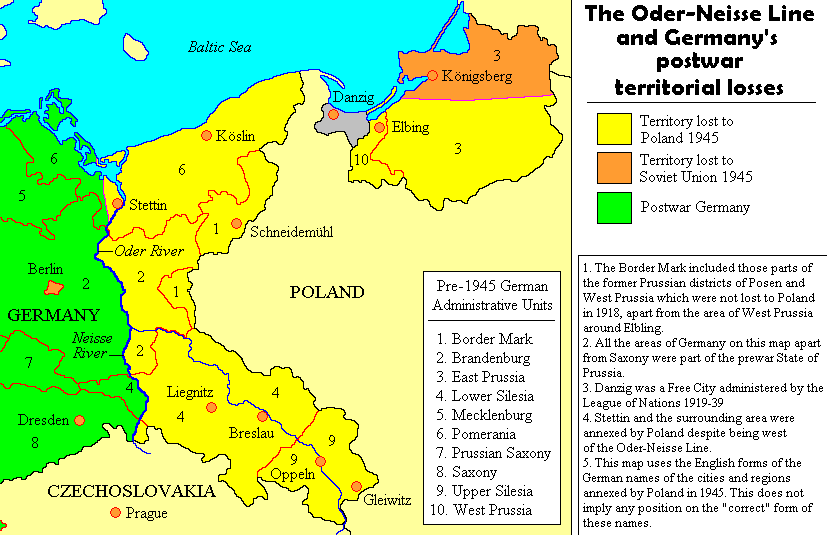
It is entirely conceivable that the ongoing Ukraine war will radically change the territorial boundaries of Ukraine in the east and south. Possibly, it can re-open the post-WW II settlement with regard to western Ukraine as well. Russia has repeatedly warned that Poland aims to reverse the cession of Volhynia and Galicia in western Ukraine. Such a turn of events will most certainly bring to the fore the issue of the German territories that are part of Poland today.
Perhaps, it was in anticipation of turbulence ahead that last October, eight months after the Russian intervention began in in February, Warsaw demanded WWII reparations from Berlin — an issue which Germany says was settled in 1990 — to the tune of €1.3 trillion.
Under the Potsdam Conference (1945), the “former eastern territories of Germany” comprising nearly one quarter (23.8 percent) of the Weimar Republic with the majority ceded to Poland. The remainder, consisting of northern East Prussia including the German city of Königsberg (renamed Kaliningrad), was allocated to the Soviet Union.
Make no mistake about the importance of the Eastern border for German culture and politics. Indeed, there is always something volatile about a “handicapped” Great Power when a whole new intensity appears in political, economic and historical circumstances, which prompts those in power to turn ideas into reality, and revanchist and imperialistic discourses that were quietly but steadily streaming below the surface of the carefully considered diplomatic efforts begin to probe pan-nationalist expansion.
In retrospect, Germany’s — in particular, then foreign minister and current president Steinmeier’s — diabolical role to align Germany with the neo-Nazi elements during the regime change in Kiev in 2014 and the subsequent German perfidy in the implementation of the Minsk Agreement (“Steinmeier formula”), as admitted recently in February by former Chancellor Angela Merkel should not be forgotten.
Suffice to say, even as Russia is winning the Ukraine war, the concern of the German foreign policy makers once again faces the need to redefine what was German. Thus, the war in Ukraine is only the means to an end. Recent reports suggest that Berlin may be moving, finally, toward meeting Ukraine’s pending demand for Taurus cruise missiles with a range exceeding 500 kms and unique “multi-effect war head” that can be a game changer in the combat dynamics on the battlefield and create the prerequisites for victory.
Equally, German soldiers already comprise about half of the NATO battlegroup already present in Lithuania. Defense Minister Boris Pistorius said two weeks ago while on a visit to Vilnius that Germany is preparing the infrastructure to permanently base 4,000 soldiers (“a robust brigade”) to Lithuania so as to have the capability to maintain military flexibility at the Eastern flank. The decision has support from both Germany’s governing coalition and its main opposition.
The CDU foreign policy expert and member of the Bundestag, Kiesewetter called the idea of establishing a German base in the Baltics a “decision of reason and reliability.” Indeed, there have been past attempts, historically speaking, to create German rule in the Baltics based on revisionist claims towards the new states of Estonia, Latvia and Lithuania where German colonists had settled as far back as in the 12th and 13th centuries.
German Parliament Approves Purchase of 60 Chinook Helicopters From US’ Boeing
Sputnik – 05.07.2023
BERLIN – The defense committee of the German parliament approved the purchase of 60 CH-47F Chinook heavy military transport helicopters from US company Boeing, a German daily reported on Wednesday.
The purchase is estimated at 7.2 billion euros ($7.8 billion) and adapting infrastructure for helicopter operation is expected to require about 750 million euros on top of that.
The first helicopters will reportedly be delivered in 2027.
In January, media reported, citing a document obtained, that the price of helicopters will almost double from 6 billion to 12 billion euros as some components have not even been designed yet and become more expensive due to inflation.
‘Responsibility for Israel’s right to exist’ pillar of Germany’s national security strategy

(Photo Credit: Getty Images)
The Cradle | July 3, 2023
On 14 June, Germany announced its first National Security Strategy since the end of World War II under the slogan “To promote world peace in a united Europe.”
While the strategy takes aim at several “integrated security” elements, from military and “terrorist” threats to those posed by climate change, healthcare, and “the decline of democracy,” the document also stresses that a central security pillar for Berlin is to “take on responsibility for Israel’s right to exist.”
“We will continue to bear responsibility for Israel’s right to exist … The responsibility for Israel’s right to exist remains a permanent commitment for us,” the executive summary reads.
While Germany’s position is not new, it confirms what many have seen as certain through the years. Former German chancellor Angela Merkel has repeatedly emphasized that Germany’s support for Israel’s “right to exist” is a national interest and “must never be questioned.”
During the visit of former Israeli Prime Minister Yair Lapid to Germany, Chancellor Olaf Scholz stressed that Germany “will always stand by Israel and that Germany and Israel. They are the closest allies, strategic partners, and friends.”
Berlin also remains one of the most important trading partners for Tel Aviv, as the volume of trade exchange between the two reached $5.2 billion in 2020. Both nations also partner in several defense projects.
Following the start of the war in Ukraine, Scholz described it as a “turning point” and stressed, “Germany must stand on the right side of history.” However, since making these statements, Berlin has only redoubled its reliance on US diktats, even after the Nord Stream 2 pipeline bombing cut the EU nation off from vital natural gas supplies.
In an article published by Foreign Affairs, Scholz stressed that today’s priority is “the defense of the rules-based world order,” that is, the defense of US hegemony over the world order, including Israeli supremacy in West Asia.
In this regard, Berlin’s National Security Strategy takes aim at Iran by accusing the Persian nation of “violating the human rights of its own citizens,” “pursuing its nuclear ambitions,” and even of “blocking efforts” to revive the 2015 Iran nuclear deal that was blown up by the US in 2018.
The document also takes aim at Russia, calling it “the most significant threat to peace and security in the Euro-Atlantic area” while calling China “a partner, competitor and systemic rival.”
Moreover, the document highlights that Germany “owes its security, as well as peace at the heart of Europe, to the United States of America.”
It also reaffirms Germany’s commitment to NATO, saying Berlin will increase its military spending to 2 percent of its GDP.
Another security issue for Berlin is the delivery of oil and gas from West Asia and spreading “democracy and protecting human rights” via government-funded NGOs.
German government to begin systematic surveillance of RSV
… so that public health authorities can identify “outbreaks” and “implement measures to … prevent spread”
eugyppius: a plague chronicle | July 1, 2023
The Scholz government plans to direct German public health authorities to begin systematic monitoring of RSV, the respiratory syncytial virus, which can cause serious symptoms in young children but is little more than a cold for healthy adults:
The respiratory syncytial virus (RSV) will very soon be made subject to mandatory reporting requirements. Doctors and laboratories will have to report infected patients by name to health authorities …
Up to now, there has been no obligation to report RSV in Germany, with the exception of the federal state of Saxony …
The stated reason is that RSV has caused a high rate of illness in children the past two seasons and placed a serious burden on paediatric clinics nationwide. The RSV outbreak in autumn 2022 has made it clear that an improvement in data collection is needed for early detection and avoiding an overload of the health system.
The planned reporting requirements will not only improve the collection of epidemiological data, but also enable public health authorities “to carry out targeted early investigations and implement on-site measures to limit an outbreak and prevent further spread.” …
My emphasis.
[The] coalition governments believes that several RSV vaccines will be approved in Germany in the foreseeable future. The additional data gleaned from reporting requirements would assist in the evaluation of vaccines and the design of vaccination strategies.
Let us get this straight: The virus pests imposed harmful and destructive hygiene measures on the greater part of the developed world for years, which failed to do anything much about SARS-2, but apparently limited exposure to many common viruses like RSV. After population immunity to these old endemic viruses had substantially waned due to these wrongheaded policies, we reopened, leaving these heretofore mostly harmless pathogens to tear through the respiratory tracts of young children with new fury. The virus pests, having failed in the most spectacular way possible, now hope to turn the minor disaster they caused into an occasion for future restrictions and impositions in daily life.
Note also the insidious role of the vaccinators. As soon is there is a jab for any virus, the pressure to begin counting that virus begins, thereby making a problem where nobody ever noticed one before. It’s thinly veiled marketing for the vaccine producers, undertaken by the health authorities at public expense.
Palestinian journalist wins wrongful termination appeal against DW
The Cradle | June 29, 2023
Palestinian-Jordanian journalist Farah Maraqa on 28 June announced winning an appeal filed by Germany’s Deutsche Welle (DW) media network over her unlawful dismissal for alleged “antisemitism.”
The decision comes nine months after the German judiciary ruled that her dismissal by state-owned broadcaster DW on charges of anti-Semitism was “legally unjustified,” which the German broadcaster appealed.
“It is a relief that the judge ruled in Farah’s favor and held Deutsche Welle accountable for this illegal dismissal,” Giovanni Fassina, director of the European Legal Support Center (ELSC), which advocates for the legal rights of Palestinians in Europe, said at the time.
In February 2022, DW fired Maraqa alongside five other Arab journalists – all Palestinian or Lebanese – accusing them of “antisemitism” in social media posts and articles they had written for outside publications.
The charges were based on the International Holocaust Remembrance Alliance’s (IHRA) controversial extended definition of antisemitism, which includes criticism of Israel’s military occupation of Palestinian land and the system of apartheid imposed on Palestinians.
The definition, which Germany adopted, has been criticized as a means of silencing pro-Palestinian support and dissent against Israeli policies.
In May 2021, DW reportedly sent an internal two-page memo to employees banning them from using terminology such as “colonialism” and “apartheid” when describing Israel.
Over the past few years, western outlets have come under fire for firing or suspending Arab journalists over alleged “antisemitism.”
In March, France24 suspended four journalists from their Arabic branch at the behest of the pro-Israel media monitoring organization, Committee for Accuracy in Middle East Reporting and Analysis (CAMERA).
Last October, the New York Times (NYT) fired Palestinian photojournalist Hosam Salam over social media posts supporting Palestinian resistance factions.
The freelance journalist was dismissed after the Israeli lobby organization Honest Reporting alerted the NYT of his posts.
Social media giants like WhatsApp, Facebook, and TikTok have also been accused of silencing or “purging” Palestinian journalists in Gaza and the occupied West Bank who report on Israeli war crimes.
Furthermore, Google employees accused the tech giant of censuring them for protesting against a controversial $1.2 billion contract signed with Israel to provide the country with advanced artificial intelligence (AI), which many fear will worsen human rights abuses in Palestine.
EU delivers ‘neither peace nor prosperity’ – Hungarian PM
RT | June 29, 2023
The Hungarian government has blasted the EU, declaring that in its current state it brings “neither peace nor prosperity” to member states. Prime Minister Viktor Orban, who was attending a summit of bloc leaders in Brussels, offered a similar assessment of the bloc.
Orban’s position was relayed via his government’s official Facebook account on Tuesday, the first day of the high-profile two-day gathering in Brussels. The statement apparently came from an interview that the Hungarian leader had given to the German media earlier in the week.
Asked by the German tabloid Bild whether he could explain the rising popularity of Alternative for Germany (AfD), a right-wing political party, the prime minister cited disillusionment with the EU as a possible cause.
“The European Union was created for two reasons. The first is peace – and now there is war. The second is prosperity – the economy is in an increasingly worrying state, it is difficult to maintain competition and it is increasingly difficult to ensure prosperity for people,” Orban argued.
“That is why I see the so-called protest parties gaining strength everywhere in Europe. I’m not talking about Germany alone, I’m talking about Europe in general,” he added.
Hungary stands out among EU members for having consistently criticized the West’s approach to the Ukraine conflict. Arming and training Kiev’s troops and punishing Russia with economic sanctions have not brought a truce any closer and have caused serious damage to the bloc itself, according to Budapest.
Ukraine is one of the top items on the agenda of the EU summit. The bloc’s leaders are expected to offer some form of security guarantees to Kiev and provide assurances of continued military assistance.
Orban told Bild that Ukraine has no chance to win against Russia regardless of the amount of Western money that is poured in, because eventually Kiev will run out of manpower.
15 Signs That You Might Be In An Abusive Relationship…
… With Your Government
The Naked Emperor | June 28, 2023
The Workplace Mental Health Institute delivers mental health training and consultancy to medium and large-sized organizations across the world. On their website they have various resources that you can download and put in your office, to help boost productivity, by addressing mental health issues.
One of their infographic downloads provides 15 signs that your might be in an abusive relationship. You may be in an abusive relationship if they [your partner]:
- Stop you seeing friends and family;
- Won’t let you go out without permission;
- Tell you what to wear;
- Monitor your phone or emails;
- Control the finances, or won’t let you work;
- Control what you read, watch and say;
- Monitor everything you do;
- Punish you for breaking the rules, but the rules keep changing!
- Tell you it is for your own good, and that they know better;
- Don’t allow you to question it;
- Tell you you’re crazy and no one agrees with you;
- Call you names or shame you for being stupid or selfish;
- Gaslight you, challenge your memory of events, make you doubt yourself;
- Dismiss your opinions;
- Play the victim. If things go wrong, it’s all your fault.
Now go back through that list and see which ones your government has subjected you to over the past three years. For most western countries it is every single one.
Your government has been mentally abusing you for years, in an almost identical fashion as an abusive partner would.
FDA responds to negative efficacy of variant boosters with another variant booster
By Daniel Horowitz – conservative review – June 21, 2023
The human experimentation of Operation Warp Speed was not an anomaly; it is the new normal, and the FDA is just getting started. The agency is now allowing the COVID vaccine manufacturers to change the formulation of their shots to continue to chase variants, themselves created by antigenic drift of the shots. And they continue to do so based on nothing more than measuring antibody titer levels. No human clinical trials necessary! Except, studies now show, and reality confirms, the more they chase variants, the more they create negative efficacy against the existing variant, thereby engendering a “need” for another formulation.
What was the response of the FDA to the increasing news of cataclysmic injuries and negative efficacy of the COVID shots for variants that are no longer dangerous? Last Thursday, the FDA’s VRBPAC unanimously approved a fall booster, advising Pfizer, Moderna, and Novavax to update their formulations for the so-called XBB.1.5 Omicron variant. So, officials pre-emptively approved a shot that doesn’t exist based on antibody level testing without human trials – all for a variant that not only is not dangerous but will actually be extinct by the time this poison reaches the market, just as they did with the bivalent formulation for the BA.4 and BA.4 variants.
To this day, the bivalent shot is the only one available, and according to the CDC, that variant doesn’t even exist! It is true that very few people are dumb enough to get this shot, but what they are trying to do is create an endemic schedule of COVID shots to time perfectly with the flu shots in the fall. They have already groomed people over the generation to “get their flu shot” every fall. So now the pharmacies will be waiting with the COVID needle to complete their seasonal updates.
So, what happens when you keep tricking the body to respond to a virus for strains that no longer exist? As the FDA approved these shots, the agency already had the peer-reviewed Cleveland Clinic study showing negative efficacy of the original COVID shots. Just days before this meeting, the Cleveland Clinic came out with a preprint showing negative efficacy for the bivalent booster shots too.
The study contrasted 11,990 employees of this venerable institution who chose to be “up to date” with the bivalent boosters compared to 36,344 employees who were “not up to date” and tracked their outcomes. It turns out that after about three and a half months, you were about 25% more likely to get COVID after having gotten the boosters as compared to the control group.
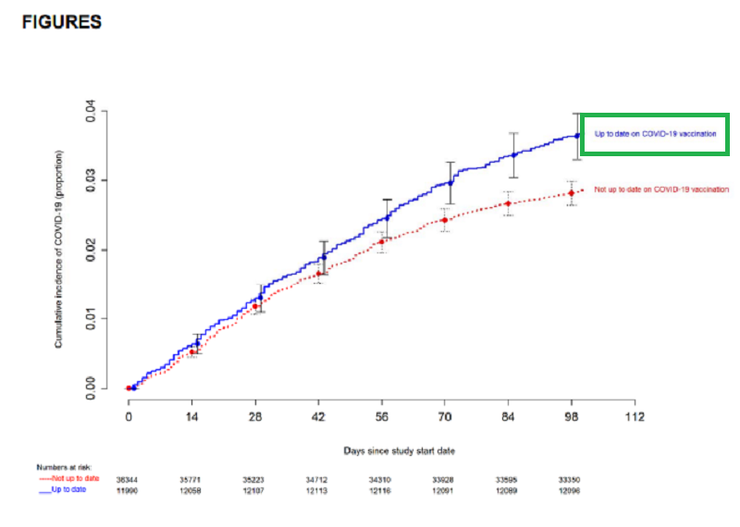
After adjusting for confounding factors between the groups, the study authors actually found a 33% rate of negative efficacy!
“This study’s findings question the wisdom of promoting the idea that every person needs to be ‘up-to-date’ on COVID-19 vaccination, as currently defined, at this time,” conclude the Cleveland Clinic researchers. They also observe, “It should be pointed out that there is not a single study that has shown that the COVID-19 bivalent vaccine protects against severe disease or death caused by the XBB lineages of the Omicron variant.”
The push for boosters comes at a time when more evidence proves a strong correlation between excess deaths and the vaccine take-up. A letter published in a peer-reviewed journal of Medicine and Clinical Science shows that Japan and Germany, two highly vaccinated countries, experienced sharp excess deaths coinciding with the vaccine take-up. They found very little excess death during the pandemic months before the vaccine was rolled out.
“It should be investigated to what extent the about 5%-10% highly significantly increased mortalities in Germany and Japan in 2021 and 2022 might be due to the pandemic countermeasures, including the vaccinations with their possibly underestimated immediate or protracted side effects,” concluded the researchers from Japan and Germany.
“From this point of view, it seems possible that a high vaccination rate has contributed to an increased all-cause mortality in some countries.”
The twisted irony is that, according to the CDC’s variant tracker, XBB.1.5 has gone from 80% of cases to less than 40% of cases in just a few months. It will clearly be obsolete by the fall. None of this was discussed at the FDA hearing. Of course, nothing about Pfizer’s own document showing five million cumulative reports of adverse events affecting every organ system was ever discussed. Hence, we have record injuries, negative efficacy, long-term immune imprinting causing the body to constantly respond inappropriately to wrong strains of the virus – all for a virus that is no longer deadly and for a population that has already gotten the virus!
That’s not just a lousy cost-benefit analysis; that is premeditated murder against the American people. What is the GOP plan to stop this? Or do Republicans even care? How can they continue to fund more COVID shots in the HHS appropriations bill, much less the broader FDA/CDC scheme to create new dangerous shots at warp speed?
Just how callously does the FDA regard human life? After its own VAERS system exploded with every adverse event imaginable, an outcome we now know officials anticipated, to this day they have not followed up on those safety signals. For example, according to the Informed Consent Action Network, the Standard Operating Procedures and Policies document for the FDA’s Vaccine Safety Team requires that its staff members identify VAERS adverse event reports that “need a rapid response and complex coordination,” after which they are supposed to “immediately” inform certain FDA management, who then alert other sub-agencies. Did that occur?
Well, more than a year after the ICAN’s record request, the agency responded, “A search of our records did not locate any documents responsive to your request.”
Where is the action from the House GOP? Why are they still only investigating the shutdown of schools in the past, but not the ongoing, premediated unleashing of deadly products on the American people?
Featured Video
It’s the Occupation, Stupid
or go to
Aletho News Archives – Video-Images
From the Archives
A superpower and “the world’s sickest warrior state”
By Paul J. Balles | March 8, 2010
Living through five or six major wars has hardened me to what I thought were the extremes of inhuman cruelty and brutality.
Two things made those extremes almost bearable: the brutality always revealed – at least according to the media coverage – the viciousness of the enemy. It was therefore quite understandable when our “brave men and women” pulverized the enemy.
Films of Japanese torturing captive Americans somehow justified holding Japanese Americans in internment camps during World War II; and only a small percentage of Americans found the bombing of Hiroshima and Nagasaki unreasonably vengeful at best, at worst, depraved.
The media giants in America portrayed the North Koreans as barbaric beasts with their captives, quite unlike their southern counterpoints – our allies during the Korean War. No one ever felt the need to explain how the South Koreans were a civilized breed while the North Koreans were absolute savages, at least according to the official line.
In Vietnam, our warriors justifiably (or so the media made us believe) dropped napalm on the North Vietnamese who had the gall to hide in villages and tunnels to ravage our invaders. At least it was accepted practice until some rogue photojournalist filmed a young girl screaming down a Vietnamese road in flames. … continue
Blog Roll
 Aletho News
- How Indonesia’s tilt toward the US left it stranded in the Strait of Hormuz
- US has no choice but to retreat from Iranian borders: Top commander
- Iran Retaliation Strikes Chemical Plant Near Dimona
- AWACS’ Destruction is a Major Loss for US Military – Ex-DoW Analyst
- Israel’s Iran Strategy Uses US Military & Gulf States as Its Pawns
- Iran: Trump wanted regime change, now just begging for Hormuz to open
- IRGC: Israeli, US universities in region legitimate targets after strikes on Iranian university
- Trump admits Iran hit USS Ford carrier: ‘We ran for our lives’
- Battle for Hungary: EU attacks on Orban are a sign of worse things to come
- Iraqi resistance conducts drone strike on US-run base in Syria
- If Americans Knew
- Israel is assassinating journalists again, more than any other nation, anywhere, ever – Not a ceasefire Day 170
- Over 300 US service members wounded, majority have brain injuries – Not a ceasefire Day 169
- Researchers at Human Rights Watch Resign Over Blocked Report on Palestinian Refugee Return
- Jewish Groups Are Backing a War Americans Don’t Want
- Eric Fingerhut Thinks He’s the President of the Jews
- Top Jewish Philanthropists, Rabbis Urge Israeli President to Take Action Against ‘Jewish Extremists’
- Don’t Be Fooled. Zionist Leaders Have Always Wanted to Control Southern Lebanon
- Israel’s widespread use of torture is a core element of its genocide against the Palestinian people
- In Israel’s War on Iran, Many Middle East US Bases Rendered “All But Uninhabitable”
- ‘Burn the lawn’: Israel pursues ‘Rafah model’ in southern Lebanon
- No Tricks Zone
- German Science Blog Accuses PIK Climate Institute Of Hallucinating Climate Tipping Points
- Devastating Assessment Of Comirnaty Vaccine By Former Senior Pfizer Europe Toxicologist
- New Study: CO2 Is ‘Effectively Negligible’ As An Explanatory Climate Change Factor Since 2000
- Former Pfizer Toxicologist Dr. Helmut Sterz Tells Bundestag Hearing Pfizer Vaccine Should Have Never Been Approved
- Energy Expert: Germany’s Nuclear Phaseout Was A “500 Billion Euro Mistake”
- New Research: South Australia’s Mid-Holocene Sea Surface Temperatures Were 4°C Warmer Than Today
- Storing Green Energy To Last Germany 10 Days Would Require A 60-Million Tonne Battery
- New Studies: UK Sea Levels Were 4 Meters Higher Than Today During The Mid-Holocene
- Destructive Green New Deal: German Energy And Metal Group Warns Of Drastic Crisis
- New Study Documents A 20-Year Pause In Arctic Sea Ice Decline – Driven By Internal Variability
 Aletho News