Betrayed by western snapback: Iran dumps IAEA deal
Tehran’s attempt at diplomatic detente was met with an escalation by the US and the E3
By Fereshteh Sadeghi | The Cradle | November 25, 2025
Just hours before his visit to France to discuss Iran’s nuclear file, Iranian Foreign Minister Abbas Araghchi warned:
“International relations face unprecedented crises due to militant unilateralism. Repeated violations of international law – including ongoing conflicts in West Asia – reflect the backing of the United States and the tolerance of certain European states.”
This underscores Tehran’s defiant stance as it moves in its nuclear diplomacy. Just three months after Israeli-US airstrikes targeted Iranian nuclear sites, Tehran signed a significant security agreement with the International Atomic Energy Agency (IAEA). It did not last long.
The so-called Cairo Agreement, signed in September and brokered by Egypt, was meant to defuse tensions. Yet that same month, the western-backed IAEA was warned against “any hostile action against Iran – including the reinstatement of cancelled UN Security Council resolutions” in which case the deal would become “null and void.”
Of note, Iran–IAEA relations had been deteriorating since June during the 12-day US-Israeli war on Iran. The IAEA and its director general, Rafael Grossi, refused to condemn the attacks on Iranian civilians and nuclear facilities, and the targeted assassinations of nuclear scientists and senior military officers.
The IAEA’s refusal to condemn the US-Israeli violations made Iranians furious. They accused Grossi of paving the ground for the strikes and being Israel’s footman. The Islamic Republic formally lodged a protest with the UN Secretary General and the Security Council against Grossi, arguing he breached the IAEA’s neutrality.
Resistance to western coercion
The Iranian parliament – or Majlis – raised the bar by ratifying legislation that suspended cooperation between Tehran and the international nuclear watchdog. The law was passed immediately after the war ended on 25 June.
It declared Grossi and his inspectors “persona non grata” and forbade them from travelling to Iran or visiting Iranian nuclear facilities. The law stipulated that the suspension will continue so long as the security and safety of Iranian nuclear installations and scientists have not been guaranteed.
Nevertheless, the Egyptian-mediated Cairo Agreement appeared to thaw the standoff, if temporarily. It was signed in the presence of Iranian Foreign Minister Araghchi and Grossi, and ambiguously framed as a deal on “implementing the Safeguards Agreement.”
Few details were made public then; while the IAEA called it a deal on “practical modalities and implementation of the Safeguards Agreement”, the Iranian side insisted it was “a new regime of cooperation.”
State news agency, IRNA, elaborated, “the agency will not engage in monitoring activities provided Iran has not carried out environmental and nuclear safety measures at its bombed facilities.” IRNA referred to the Supreme National Security Council as the sole body that “could greenlight the IAEA monitoring missions inside Iran, case by case.”
Iran’s diplomatic maneuvering, including the deal with the IAEA, was obviously part of the broader strategy to prevent the UK, France, and Germany from activating the snapback mechanism, in the 2015 nuclear deal between Iran and the five permanent members of the Security Council plus Germany.
The European Troika (E3), who were clearly dissatisfied with the Cairo Agreement, reiterated “Tehran needs to allow inspections of sensitive sites and address its stockpile of highly enriched uranium.”
Snapback triggers collapse
A threat to terminate the Cairo Agreement actually came three days after it was clinched, when Iran’s Foreign Ministry warned that “launching the snapback mechanism would put the ongoing cooperation between Iran and the IAEA at risk.” Nevertheless, the UK, France, and Germany moved ahead with the snapback activation.
Araghchi’s first reaction noted that “in regards to the E3’s move, the Cairo agreement has lost its functionality.” Iranians had also vowed to halt cooperation with the IAEA. However, they did not fulfill that threat and collaborated in silence.
The IAEA inspectors visited some Iranian nuclear sites in early November. However, they were not given access to the US-bombed Fordow, Natanz, and Isfahan facilities.
Even this tactical compliance failed to shield Tehran from a new IAEA censure. On 20 November, the agency’s Board of Governors passed a US-E3-backed resolution ignoring Iran’s cooperation and demanding immediate access to all affected sites and data.
It was the straw that broke the camel’s back. Iran condemned the move as “illegal, unjustifiable, irresponsible, and a stain on the image of its sponsors.”
Araghchi on his X account posted, “like the diplomacy which was assaulted by Israel and the US in June, the Cairo Agreement has been killed by the US and the E3.”
For the second time, Iran’s top diplomat announced the termination of the Cairo Agreement, “given that the E3 and the US seek escalation, they know full well that the official termination of the Cairo Agreement is the direct outcome of their provocations.”
Iran’s representative to the IAEA, Reza Nadjafi, told reporters that “If the US claims success in destroying Iran’s Natanz and Fordow facilities, then what is left for inspections?” and further warned, “any decision (by the IAEA) has its own consequences.”
Back to confrontation
By applying pressure through the IAEA, the E3 and the US seek to coerce Iran into opening the doors of its bombed nuclear sites to the IAEA inspectors, to hand over the 400 kilograms of uranium enriched to 60 percent, which the US believes is still intact, and “to eliminate Iran’s ability to convert that fuel into a nuclear weapon.”
The collapse of the Cairo Agreement marks a return to the kind of standoff that defined US–Iran relations from 2005 to 2013, when Iran’s nuclear file was sent to the UN Security Council, and sanctions were imposed under Chapter VII.
Some skeptics believe US President Donald Trump’s administration would not only take Iran to the Security Council but would also cite the chapter in question, which sanctions the use of military force against any country deemed a threat to global peace.
While Iran signed the 2015 Joint Comprehensive Plan of Action (JCPOA) in hopes of avoiding that scenario, the US’s unilateral withdrawal under Donald Trump’s first term in 2018 and the E3’s failure to meet their obligations rendered the agreement toothless.
June’s US-Israeli bombing campaign against Iranian nuclear infrastructure confirmed for Tehran that western powers have no intention of engaging in diplomacy in good faith.
Toward a new strategy
According to IRNA, which echoes the official line of the Iranian government, “Iran feels that the goodwill gestures it has shown towards the IAEA and the United States, have drawn further hostility. Therefore, maybe now it is the time to change course and revise its strategy and the rule of engagement with international bodies, including the IAEA.”
Some observers believe Iran’s first step to map out a new strategy is pursuing the policy of “nuclear ambiguity, remaining silent regarding the whereabouts of the stockpile of the highly-enriched uranium and quietly halting the implementation of the [Nuclear] Non-Proliferation Treaty, without officially admitting it.”
In the latest development, the chairman of the Parliament’s National Security Committee has vowed that “Iran will sturdily pursue its nuclear achievements.” Ibrahim Azizi has cautioned the US and Europe that “Iran has changed its behavior post June attacks and they’d better not try Iran’s patience.”
That posture is hardening. In September, over 70 Iranian lawmakers urged the Supreme National Security Council to reconsider Iran’s defense doctrine – including its long-standing religious prohibition on nuclear weapons.
They argue that the regional and international order has changed irreversibly since Israel and the US jointly bombed the Iranian nuclear facilities. While citing Iran’s Supreme Leader Ali Khamenei’s 2010 fatwa banning nuclear weapons, they assert that in Shia jurisprudence, such rulings may evolve when conditions change – especially when the survival of the Islamic Republic is at stake.
Iran is also working to immunize itself against any escalation at the UN Security Council. Here, it banks on the veto power of Russia and China to neutralize any western effort to reimpose sanctions.
The collapse of the Cairo Agreement marks a turning point in Tehran’s nuclear diplomacy. It is a conclusion drawn from years of unmet commitments and military escalation that western multilateralism has exhausted its credibility.
The GRANITE ACT: Wyoming Bill Targets Foreign Censors With $10M Penalties

By Christina Maas | Reclaim The Net | November 24, 2025
The first cannon shot in a new kind of free speech war came not from Washington or Silicon Valley, but from Cheyenne. Wyoming Representative Daniel Singh last week filed the Wyoming GRANITE Act.
The “Guaranteeing Rights Against Novel International Tyranny & Extortion Act,” passed, would make Wyoming the first state to let American citizens sue foreign governments that try to police what they say online.
The bill traces back to a blog post by attorney Preston Byrne, the same lawyer representing 4chan and Kiwi Farms in their battles against censorship-driven British regulators.
Byrne’s idea was simple: if the UK’s Ofcom or Brazil’s Alexandre de Moraes wanted to fine or threaten Americans over online speech, the US should hit back hard.
Exactly one month after that idea appeared on his blog, it’s now inked into Wyoming legislative paperwork.
Byrne said:
“This bill has a long way to go until it becomes a law, it’s got to make it through legislative services, then to Committee, and then get introduced on the floor for a vote, but the important thing is, the journey of this concept, the idea of a foreign censorship shield law which also creates a civil cause of action against foreign censors, into law has begun.”
That “journey” may be the kind of slow procedural trudge that usually kills most ideas in committee, but the intent here is anything but mild, and, with the growing threat of censorship demands from the UK, Brazil, Europe, and Australia, there is a lot of momentum here to fight back.
“For the first time, state legislators are moving to implement rules that will allow U.S. citizens to strike back, hard, against foreign countries that want to interfere with Americans’ civil rights online,” Byrne continued.
The Act would let American citizens and companies sue foreign governments or their agents for trying to censor them, and, crucially, it strips away the usual escape hatch of sovereign immunity.
In its legal filing responding to the 4chan and KiwiFarms lawsuit, Ofcom insisted it has “sovereign immunity” and told the court there were “substantial grounds” for throwing out the case on that basis.
The regulator’s lawyers framed Ofcom as a protected arm of the British state, immune from civil claims even when its decisions target a platform based entirely inside the United States.
Ofcom treats the idea of “sovereign immunity” as something substantial but the First Amendment as something that does not exist at all.
The GRANITE Act is a defensive maneuver against a growing global trend. “Foreign governments and their agents increasingly seek to restrict, penalize or compel disclosure concerning speech occurring wholly within the United States,” the bill warns.
Such efforts, it argues, “conflict with the constitutions of the United States and of Wyoming and chill speech by Wyoming residents and entities.”
The act’s definition section is where its true reach becomes clear. It covers “any law, regulation, judgment, order, subpoena, administrative action or demand of a foreign state that would restrict, penalize or compel disclosure concerning expression or association” that would otherwise be protected under US law.
The text is well-researched and knows all the buzzwords of tyranny, naming the categories most likely to cause friction: “foreign online safety, hate speech, misinformation, disinformation, defamation, privacy, or ‘harmful content’ laws.” It’s a catalog of the modern speech-control toolkit, all of which Wyoming now places firmly outside its borders.
Wyoming’s approach also bars its own agencies from playing along. “No state agency, officer, political subdivision, or employee thereof shall provide assistance or cooperation in collecting, enforcing or giving effect to any measure” that qualifies as foreign censorship. The phrasing borrows from the constitutional doctrine of anti-commandeering, warning that local officials won’t be drafted into enforcing foreign censorship orders.
In Byrne’s view, that legal protection has let overseas bureaucrats act like international hall monitors, wagging fingers at Americans through threats of fines or content bans.
Byrne didn’t mince words about what he thinks this law could mean:
“If we get corresponding federal action, this law, and laws like it, could represent the single greatest victory for global free speech in thirty years.”
The teeth of the bill lie in its damages. The minimum penalty: ten million dollars. It matches the scale of fines already threatened by the UK and others, which have been dangling penalties of $25 million or 10 percent of global revenue for non-compliance.
The math, as he puts it, is simple. A country can censor an American, but that choice now comes with a very real price tag.
“Foreign countries can bully the shit out of American citizens and companies because they know that US law potentially protects them from consequences for doing so. We should take that immunity away from them.”
Byrne’s theory is that once the threat of US civil suits hangs over foreign regulators, the entire global “censorship-industrial apparatus” starts to wobble.
Byrne notes that the GRANITE Act would also relieve the White House from having to deal with diplomatic flare-ups over censorship complaints.
Trial lawyers would take over that job, freeing the president to “move on to other, more important matters.”
If the Act becomes law, the power to fight foreign censorship wouldn’t rest with federal agencies but with American citizens, state courts, and civil litigators. It would empower them to fight back against foreign censors.
In the global tug-of-war over speech, Wyoming could suddenly become a frontline jurisdiction.
The Money Behind the Muzzle: Germany’s Fivefold Surge in Speech Control

By Cindy Harper | Reclaim The Net | November 24, 2025
Government spending on digital speech regulation in Germany has surged over the past decade, increasing more than five times since 2020 and totaling around €105.6 million by 2025.
The findings come from The Censorship Network: Regulation and Repression in Germany Today, a detailed investigation by Liber-net, a digital civil liberties group that monitors speech restrictions and information control initiatives across Europe.
The report describes a sprawling alliance of ministries, publicly funded “fact-checkers,” academic consortia, and non-profit groups that now work together to regulate online communication.
It started as a handful of “anti-hate” programs and has evolved into a broad state-financed system of “content controls,” supported by both domestic and foreign grants.
Liber-net’s accompanying databases and map document more than 330 organizations and over 420 separate grants, rating each on a one-to-five scale according to its level of direct censorship involvement.
Between 2020 and 2021, public funding for these initiatives tripled, and by 2023 it had doubled again.

Source: The Censorship Network: Regulation and Repression in Germany Today
The Federal Ministry for Education and Research (BMBF) has been the leading funder, responsible for more than €56 million in allocations since 2017.
Much of this money has gone to the RUBIN consortium, a research group developing artificial intelligence tools designed to identify and filter “disinformation.”
Liber-net notes that these systems, while presented as safeguards against falsehoods, also concentrate control over what qualifies as legitimate speech.
Foreign contributions have further reinforced this system. The European Union has provided roughly €30 million since 2018, including €4 million for Deutsche Welle’s Media Fit program, which counters online narratives related to the Russia-Ukraine war.
The United States government has contributed about $400,000 to fourteen German organizations during the same period. These combined investments reveal a coordinated transatlantic interest in shaping the online information landscape.
The financial expansion has been matched by a more aggressive enforcement effort within Germany.
In June 2025, police executed around 170 raids targeting individuals accused of online “hate speech.” Earlier raids reported by CBS in February focused on similar allegations.
One of the most publicized cases involved David Bendels, editor-in-chief of Deutschland Kurier, a publication affiliated with the AfD. Bendels received a seven-month suspended sentence for posting a meme on X that showed Interior Minister Nancy Faeser holding a sign reading “I hate freedom of expression.”
The legal foundation for these operations is the Network Enforcement Act (NetzDG), which requires social media platforms to remove illegal or offensive content within strict deadlines.
Originally framed as a tool to combat extremism, the law has drawn opposition from parties across the spectrum, including the Left Party, the Free Democrats, the Greens, and the AfD.
They argue that it undermines open debate and gives private corporations excessive authority over what can be published online.
Liber-net’s research positions Germany as a key actor in Europe’s expanding structure of information control.
Liber-net concludes that Germany’s speech regulation framework has moved beyond addressing harmful content and now functions as a managed system for policing public discourse.
With significant funding, cross-border backing, and little transparency, the country’s “content control” network demonstrates how easily censorship can be institutionalized under the language of safety and social responsibility.
Arms industry investors in panic over Ukraine peace talks
RT | November 24, 2025
The prospect of a possible peace in Ukraine has caused “panic” among investors in the German defense industry, sending stocks of arms manufacturers such as Rheinmetall tumbling.
The US reportedly handed Kiev a 28-point peace proposal last week and gave it until Thursday to respond. The framework was discussed in Geneva on Sunday, with US President Donald Trump saying afterwards that “something good” may be happening.
The peace push immediately unnerved investors, triggering a fierce sell-off of shares in Rheinmetall, Germany’s largest arms manufacturer and a key supplier of military equipment to Kiev. Rheinmetall stock has fallen by over 14% over the past five days, with defense-electronics producer Hensoldt recording a similar drop.
“Investors fear that an end to hostilities could also mean the end of the “super-cycle” for defense stocks,” Boerse-Express wrote.
Germany has become Kiev’s second-largest arms provider after the US, and Rheinmetall, which produces tanks, artillery systems, and ammunition, recently reported surging profits for the first nine months of 2025, alongside a record order backlog driven by the conflict and rising EU military budgets. Company shares have climbed nearly 2,000% since fighting escalated almost four years ago.
During the previous US attempt to broker peace in February, Rheinmetall CEO Armin Papperger argued that even if the fighting were to end, it would be “wrong” for Europe to assume “a peaceful future.” In 2024, the company announced plans to build four manufacturing plants in Ukraine.
The broader European defense sector has been expanding at roughly three times its pre-2022 pace, Financial Times reported in August. Western leaders claim the accelerated buildup is needed to meet NATO readiness targets, maintain arms deliveries to Kiev, and deter what they describe as a potential Russian threat.
Moscow has called such claims “absurd” fearmongering aimed at justifying increased military spending and condemned what it calls the West’s “reckless militarization.”
Ally of ex-Bosnian Serb leader wins election
RT | November 24, 2025
A close ally of longtime Bosnian Serb leader Milorad Dodik has won a snap presidential election in Republika Srpska, the Serb-majority entity of Bosnia and Herzegovina, according to preliminary results.
Sinisa Karan’s apparent victory comes after Dodik was removed from office over his refusal to obey the rulings imposed by an international envoy overseeing the peace-monitoring regime in Bosnia.
Karan, the candidate of Dodik’s Alliance of Independent Social Democrats (SNSD) and the entity’s minister for scientific and technological development, took about 51% of the vote, after nearly all ballots were counted. Branko Blanusa, the candidate from the opposition Serb Democratic Party, won roughly 48%, with turnout just under 36%.
The snap vote was called after Bosnia’s state court convicted Dodik in February of failing to comply with the decisions of Christian Schmidt, the international high representative for Bosnia and Herzegovina. Schmidt, a German national, has a strong mandate to oversee the 1995 Dayton Peace Agreement, which ended the bloody 1992-1995 Bosnian War.
In 2023, Schmidt invoked his powers to annul legislation passed by Republika Srpska’s authorities that sought to strip state-level courts and police of jurisdiction in the entity and declared the envoy’s decrees non-binding. Dodik himself has branded Schmidt a “tourist” and declined to recognize his authority.
A state court in Sarajevo later found Dodik guilty of failing to implement Schmidt’s decision, sentencing him to one year in prison – a term he avoided by paying a court-approved fine – and banning him from holding public office for six years.
With election results coming in, Karan pledged to continue Dodik’s policies “with ever greater force,” adding that “the Serb people have won.” Dodik, meanwhile, promised voters that “I will remain with you to fight for our political goals,” stressing that Karan’s “victory will be my victory too.”
Both Karan and Dodik have advocated for close ties with Russia, with the former calling Moscow “one of the greatest allies and friends of Srpska.” Dodik has echoed the sentiment, suggesting that the West was using Ukraine to provoke “a war with Russia.”
Iran Dismisses US Dialogue Claims as “Not Credible”
Al-Manar | November 23, 2025
Iranian Foreign Ministry spokesperson Esmaeil Baqaei stated on Sunday that Washington’s professed willingness for dialogue lacks credibility, asserting that US claims are fundamentally inconsistent with its actions.
Speaking at a weekly press conference, Baqaei referenced recent remarks by the US president, stating that America has demonstrated in practice that it is not serious about negotiations.
The spokesman suggested that Washington either misunderstands the very concept of negotiation or approaches talks with a mindset that reduces them to dictation. He emphasized that such claims must be measured against the United States’ actual conduct.
Commenting on Tehran’s conditions for any potential talks with the US, Baqaei underscored that safeguarding Iran’s national interests remains the central and guiding principle.
“The other side has shown no genuine belief in negotiations,” he said, adding that as long as dialogue is treated as an imposition, the necessary conditions for genuine talks do not exist.
“What matters is that the US government has destroyed any basis for trust through its actions,” Baqaei stated. He cited the US withdrawal from the Joint Comprehensive Plan of Action (JCPOA) in 2018 and subsequent “unfaithful” actions during the Biden administration, despite earlier progress.
He further argued that the US decision to accompany the Zionist regime in its military aggression against Iran this past June provided further proof of Washington’s lack of intent to reach a reasonable and fair solution.
Addressing other diplomatic matters, the spokesman firmly dismissed speculation that Iranian Foreign Minister Abbas Araqchi’s upcoming trip to the Netherlands would involve negotiations with the three European countries (the E3). He clarified that the visit’s sole purpose is participation in a conference for the Organization for the Prohibition of Chemical Weapons (OPCW).
Baqaei conceded that consultations with other foreign ministers might occur on the sidelines in The Hague, but he explicitly labeled reports of negotiations with the European troika as untrue.
Russia, China upbraid anti-Iran IAEA resolution, urge West to drop threats
Press TV – November 21, 2025
Russia and China have, in the strongest terms, rebuked a recent anti-Iran resolution passed by the Board of Governors of the International Atomic Energy Agency (IAEA), calling for the settlement of the Islamic Republic’s nuclear issue through dialogue and cooperation.
Drafted by France, Germany, the United Kingdom and the United States and approved 19–3 with 12 abstentions on Thursday, the resolution sought to pressure Tehran by demanding it “without delay” account for its enriched uranium stocks and facilities damaged in the June attacks by the United States and Israel.
Russian Foreign Ministry Spokesperson Maria Zakharova announced at a press conference in Moscow that Russia continues to firmly emphasize finding political and diplomatic solutions to the issue of Iran’s nuclear program.
Asked about a recent telephone conversation between the Russian and Iranian foreign ministers, during which the issue of Iran’s nuclear program and related talks were discussed, Zakharova was cited by TASS as saying that Moscow is consistently committed to actively seeking political and diplomatic solutions to the Iranian nuclear issue.
The spokeswoman added that Moscow has repeatedly warned about the dangers of “military actions” that threaten the stability and security of West Asia, underlining that any military attack on nuclear facilities, especially those under the monitoring of the IAEA, is “unacceptable.”
Zakharova also said the US aggression against Iran’s nuclear sites undermined the principles the Non-Proliferation Treaty (NPT) — a treaty to which Iran has always been fully committed and which the IAEA has confirmed.
The Russian Foreign Ministry spokeswoman went on to say that despite the efforts on the part of some foreign actors to create chaos and trouble in Iranian society, Tehran still prefers the path of dialogue over war and believes that national interests can be secured based on equal dialogue and by taking into account mutual concerns.
She stressed that in order to resume the talks, Iran needs “serious guarantees” that its nuclear facilities will not be targeted by missile or air attacks again.
Zakharova further underlined that the West must put aside threats of sanctions and military threats and return to diplomacy with Iran.
IAEA urged to create ‘favorable conditions for cooperation’
Li Song, China’s permanent representative to the IAEA, told the Board of Governors on Thursday that pushing through a counterproductive resolution against Iran will “only make things worse,” stressing that the US, Israel, and key European states are fueling the ongoing crisis surrounding Tehran’s nuclear file.
“Countries that have recklessly resorted to the use of force and obsessively pursued confrontation and pressure are responsible for the current situation of the Iranian nuclear issue,” Li said.
The Chinese envoy stressed that Israel and the United States attacked Iranian nuclear facilities safeguarded by the IAEA in June, which led to a “fundamental change in the situation of the Iranian nuclear issue.”
“Such an act should be strongly condemned by the international community and the IAEA,” he said.
On the Cairo agreement reached between Iran and the IAEA in September, Li emphasized that the pact was “a positive development” and “an important opportunity” to fully revive safeguards cooperation.
He said the activation of the snapback mechanism by the UK, France, and Germany had “seriously undermined the good momentum of cooperation” between Tehran and the Agency.
Li added that the Iranian nuclear issue “can only be properly resolved” by respecting Iran’s legitimate NPT rights and ensuring the peaceful nature of its program through political, diplomatic, and safeguards mechanisms.
The envoy called on the BoG to “create favorable conditions for cooperation and dialogue” and to avoid “provoking confrontation.”
Iran moves to terminate Cairo agreement with IAEA
The Cradle | November 20, 2025
Iran notified the International Atomic Energy Agency (IAEA) on 20 November that it is terminating the cooperation agreement signed in Cairo in retaliation for the UN nuclear watchdog adopting a new resolution demanding expanded access and information on Iran’s nuclear facilities.
Iran’s envoy to the agency, Reza Najafi, said the resolution “will not add anything to the current situation” and described it as “counterproductive” shortly after the Board of Governors approved the text.
He warned that it would have “a negative impact on the cooperation that has already started between Iran and the agency.”
According to diplomats who attended the closed session, the 35-member board passed the resolution with 19 votes in favor, three against, and 12 abstentions.
The text requires Iran to report “without delay” on the status of its enriched uranium stock and on its nuclear sites that were bombed by Israel and the US during the 12-day war on Iran in June.
It also urges Iran to “comply fully and without delay” with its obligations under UN Security Council (UNSC) resolutions and to provide all information and access requested by the agency.
Western members of the board stated that “Iran must resolve its safeguards issues without delay” and called for “practical cooperation through access, answers, restoration of monitoring.”
Iran maintains that its nuclear program is peaceful and had earlier cautioned that the resolution would “adversely affect” ongoing cooperation. Najafi noted that Iran had already granted access to “all undamaged facilities,” while inspectors have not been to sites such as Fordow and Natanz since they were hit in the June war.
The agency says verification of Iran’s uranium stock is “long overdue,” and that it cannot inspect the bombed facilities until Tehran submits updated reports.
Iranian Foreign Minister Abbas Araghchi said the IAEA resolution was “unlawful and politically motivated,” initiated by the US and the European troika, and pushed through despite the 15 members voting against or abstaining.
He said the move ignored Iran’s goodwill, undermined the agency’s credibility and independence, and would disrupt cooperation.
The Foreign Minister had previously said that the Cairo agreement with the IAEA was defunct after Europe triggered snapback sanctions, but added that a negotiated solution remains possible if the opposing side acts in good faith.
Araghchi confirmed that he informed IAEA chief Rafael Grossi in a formal letter that the agreement is now considered terminated.
When Israeli attacks began in June, the IAEA estimated Iran held 440.9 kilograms of uranium enriched up to 60 percent.
Iran and several allied states argued that issuing another resolution would jeopardize efforts to advance dialogue.
Tehran has declared that the September inspection agreement with the IAEA is void, and Najafi said the new resolution “will have its own consequences,” adding that Iran would announce them later.
Germany Turns an X Post Into a Police Raid at Dawn

By Christina Maas | Reclaim The Net | November 18, 2025
The story starts with a tweet that barely registered on the internet. A few hundred views, a handful of likes, and the kind of blunt libertarian framing that is common on X every hour of every day.
Yet in Germany, that tiny post triggered a 6am police raid, a forced phone handover, biometric collection, and a warning that the author was now under surveillance.
The thing to understand is that this story only makes sense once you see the sequence of events in order.
The story goes like this:
- A man in Germany, known publicly only as Damian N., posts a short comment on X, calling government-funded workers “parasites.”
- The post is tiny. At the time he was raided, it had roughly a hundred views. Even now, it has only a few hundred.
- Despite the post’s obscurity, police arrive at Damian’s home at six in the morning.
- He says they did not show him the warrant and did not leave documentation of what they seized.
- Police pressured him to unlock his phone, confiscated it, took photos, fingerprints, and other biometric data, and even requested a blood sample for DNA.
- One officer reportedly warned him to “think about what you post in the future” and said he is now “under surveillance.”
- The entire action was justified under Section 130 of the German Criminal Code, which is meant to prohibit inciting hatred against protected groups.
- Government employees are not such a group, which makes the legal theory tenuous at best.
- Damian’s lawyer says the identification procedures and possibly the raid itself were illegal.
That is the sequence. A low-visibility political insult becomes a criminal investigation involving home searches, device seizure, and biometric collection.
The thing to understand is that this is not about one man’s post. It is about a bureaucracy that treats speech as something to manage and a set of enforcement structures that expand to fill the space they are given.
Start with the enforcement context. Germany has built a sprawling ecosystem around “online hate”: specialized prosecutor units, NGO tip lines, and automated scanning for taboo keywords.
The model is compliance first and legal theory second.
Once you create an apparatus like this, it behaves the way bureaucracies behave. It looks for work. It justifies resources by producing cases. A tiny X post with inflammatory language becomes a target because it contains the right keyword, not because it has societal impact.
Police behavior fits the same pattern. Confiscating phones is strategically useful because it imposes real pain without requiring a conviction.
Even prosecutors have said that losing a smartphone is often worse than the fine.
Early-morning raids create psychological pressure. Collecting biometrics raises the stakes further. None of this is about public safety. It is about creating friction for saying the wrong thing.
The legal mismatch is the tell. Section 130 protects groups defined by national, racial, religious, or ethnic identity.
There is also the privacy angle, which becomes impossible to ignore. Device access, biometrics, DNA requests: these are investigative tools built for serious crimes.
Deploying them against minor online speech means the line between public-safety policing and opinion policing has already been crossed. Once a state normalizes surveillance as a response to expression, the hard part becomes restoring restraint.
It is a deterrence strategy, not a justice strategy. And it reinforces why free speech and strong privacy protections matter. Without them, minor speech becomes an invitation for major intrusion.
The counterintuitive part is that the smallness of the post makes a raid more likely, not less.
High-profile content generates scrutiny and political costs. Low-profile content discovered through automated or NGO-driven monitoring is frictionless to act on. Unless people are reading Reclaim The Net, most people never hear of these smaller cases.
Looking ahead, the pressure will only increase. As more speech moves to global platforms that are harder to influence, local governments will lean more heavily on domestic law enforcement as their lever of control.
That means more investigations that hinge on broad interpretations of old statutes and more friction between individual rights and bureaucratic incentives.
This is particularly true in Germany and places like the UK, where the government doesn’t seem to feel any shame about raiding its citizens over online posts.
Germany lifts arms export restrictions to ‘Israel’
Al Mayadeen | November 17, 2025
The German government announced it will lift restrictions on arms exports to “Israel,” a move set to take effect on November 24. The decision follows what Berlin described as a “stabilized” ceasefire in Gaza that has been in place since October 10.
Government Spokesperson Sebastian Hille confirmed the move, stating, “The restrictions on arms exports to Israel… will be lifted.” Hille added that the decision comes after reassessing conditions on the ground, claiming expectations for adherence to the ceasefire and the delivery of humanitarian aid.
The original suspension, introduced in August 2025, was framed by Chancellor Friedrich Merz as a response to “Israel’s” declared plans to occupy Gaza City, which he said complicated the justification for continued arms transfers.
At the time, Merz noted that it was “increasingly challenging” to reconcile the stated objectives of disarming Hamas and freeing captives with the military escalation.
Surge in exports since October 2023
Following the start of the war in October 2023, German arms exports to “Israel” surged dramatically. While export approvals in 2022 amounted to roughly €32 million, by October 2023, licenses worth €203 million had been greenlit, €198.68 million of which came after October 7.
Between October 2023 and May 2025, Germany approved €485.1 million worth of arms exports to “Israel,” covering everything from firearms and ammunition to tank engines, electronic systems, and naval equipment. These transfers filled critical gaps for “Israel,” especially as US manufacturers were strained by military commitments to Ukraine and European partners.
Germany became “Israel’s” second-largest arms supplier after the US, accounting for about one-third of its military imports during this period.
August ban: Loopholes, legal theater
The August 2025 announcement of halting military equipment exports appeared to mark a turning point, but closer scrutiny revealed that the so-called ban excluded existing contracts, which continued to be fulfilled.
Critically, the same day the halt was announced, Germany approved a €500 million export license for the INS Drakon, a Dolphin-class submarine. Government lawyers would later argue that the license had been approved earlier, despite evidence to the contrary.
Other loopholes also weakened the suspension’s impact. The restriction only applied to items “clearly usable in Gaza,” leaving space for shipments ostensibly intended for other regions. Additionally, German firms like Renk AG and Sig Sauer immediately explored relocating production to the US to bypass restrictions.
Between August 8 and September 13, Germany issued no new approvals. But within the next nine days, €2.46 million in “other military goods” was approved. Compared to the €250 million authorized between January and early August 2025, the actual disruption was minimal.
Despite mounting domestic pressure, 73% of Germans favored tighter arms controls, and over 30 NGOs demanded a full embargo. German courts routinely dismissed legal challenges to the exports, citing plaintiffs’ lack of standing and the confidential nature of licensing decisions.
A return to status quo
Despite headlines about a policy shift, the August suspension did little to interrupt Germany’s arms pipeline to “Israel”. Existing contracts were honored throughout the 108-day suspension. Critics, including the BDS movement and human rights groups, labeled the suspension a public relations gesture rather than a genuine policy change.
As of late November, Germany will resume full military cooperation with “Israel”, reaffirming what many see as its enduring commitment to the doctrine of Staatsräson, the idea that “Israel’s” security is a cornerstone of German foreign policy, irrespective of the legal and humanitarian implications.
Orban Exposes EU Politicians’ ‘War by 2030’ Talk As Dangerous Confession
Sputnik – 17.11.2025
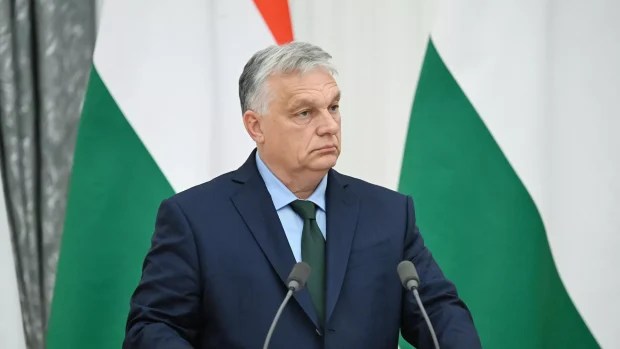
The statements articulated by European politicians about their readiness for war in 2030 indicate that Brussels is openly hatching military plans, Hungarian Prime Minister Viktor Orban said on Monday.
“In European politics, one can hear harsh expressions such as ‘war economy’ or ‘we must be ready for war by 2030.’ Because of this, economic policy is undergoing serious consequences, a war plan is being openly developed in Brussels, documents are being accepted and statements are being made,” Orban told a press conference in Budapest.
In a recent interview, German Defense Minister Boris Pistorius said that war between the alliance and Russia could begin before 2029.
Alternative for Germany Party Mulls Energy Cooperation With BRICS Countries – Lawmaker
Sputnik – 16.11.2025
SIRIUS, Russia – The right-wing Alternative for Germany (AfD) party is considering the possibility of cooperating with BRICS countries in the energy sector, lawmaker Steffen Kotre told Sputnik on Saturday.
“One of the reasons I am here is to meet with representatives of the BRICS nations. We discussed some positions on this issue [energy cooperation]. This is a positive process. Whether this will have any results is another matter. The main goal now is simply to get to know each other,” Kotre said on the sidelines of the BRICS-Europe symposium, which is underway in Russia’s Sirius Federal Territory.
The pressure on the AfD over its members’ trip to Russia is growing, but the party does not intend to abandon what it considers “a realistic political line,” the lawmaker noted.
“Quite the contrary, this pressure certainly strengthens our understanding that we will certainly achieve normal relations. And by this I mean a peaceful exchange of views with Russia,” he said.
Communication channels should be open in both directions, including to show Moscow that “there are sensible people in Germany and not only warmongers,” Kotre added.
Featured Video

or go to
Aletho News Archives – Video-Images
From the Archives
Israel Would Have No Qualms About USS Liberty-Style FALSE FLAG If Iran Campaign Falters – Analysts
By Ilya Tsukanov – Sputnik – 18.06.2025
Donald Trump is mulling whether or not to join Israel’s aggression against Iran as Tel Aviv faces problems sustaining its defenses against growing counterstrikes, and apparently lacks a realistic game plan for an end to hostilities after failing to achieve its goals. Analysts told Sputnik how the US could be ‘nudged’ into the conflict.
“The US is already assisting Israel with supplies, intel, refueling support, etc. One of the many US posts in the region could be attacked for a casus belli,” former Pentagon analyst Karen Kwiatkowski explained.
“If Trump doesn’t comply with Israel’s demand” and join its aggression voluntarily, “a false flag may be needed” to drag the US in, Kwiatkowski, retired US Air Force Lt. Col.-turned Iraq War whistleblower, fears.
Netanyahu has a diverse array of options at his disposal, according to the observer, including:
- a false flag against US assets abroad blamed on Iran or one of its Axis of Resistance allies, like the Houthis
- a US domestic attack or assassination blamed on Iran
- Iranian air defenses ‘accidentally’ hitting a civilian jetliner carrying Americans
- use of a dirty bomb or nuclear contamination somewhere in the region blamed on Iran
- even blackmailing by threatening to use nukes against Iran if the US doesn’t join the fight
Kwiatkowski estimates that Israel probably has “enough blackmail power” against President Trump and Congress to avoid the necessity of a false flag operation, but a “USS Liberty-style” attack, targeting the soon-to-be-retired USS Nimitz supercarrier that’s heading to the Middle East, for example, nevertheless cannot be ruled out entirely, she says. … continue
Blog Roll
 Aletho News
- Top PMU commander, over a dozen fighters killed in new US strikes on Iraq
- Is Netanyahu’s war gamble threatening the future of ‘Israel’?: FT
- Smotrich calls for annexation of South Lebanon to Litani River
- Echos of Gallipoli? Hormuz and the Geography of Hubris
- Pakistan PM backs Iran’s right to self-defense amid tensions
- Hungary blasts ‘fake’ EU accusation
- SAFE Debt Trap: Poland’s €43.7 Billion Bet on Unipolar Illusion
- War on Iran threatens global Gulf capital flows: FT analysis
- Mossad De Facto Admits To Inciting Riots In Iran
- Tehran: World grown thoroughly exhausted with US-Israeli ‘false flag storylines’
- If Americans Knew
- From Sde Teiman, the truth about Israel’s military justice system has been set free
- Child denied life-saving bone marrow transplant by Israel ‘because he is from Gaza’
- Raffi Berg: BBC Middle East Editor Exposed as CIA, Mossad Collaborator
- Jerusalem Archbishop Rebukes Netanyahu’s Statements on Christianity
- US to embed Palantir AI across entire military: Report
- Israeli-US war on Iran to drag on “a few more weeks” – Not a ceasefire Day 164
- Lebanon deaths top 1,200; Palantir AI to be embedded across US military – Not a ceasefire Day 163
- Israel’s assassination game: Take all pragmatists off the board
- Food shortages return to Gaza as Israel tightens aid restrictions under the cover of its war on Iran
- Trump demands trillions in payments from Gulf countries, billions from Harvard – Not a ceasefire Day 162
- No Tricks Zone
- Devastating Assessment Of Comirnaty Vaccine By Former Senior Pfizer Europe Toxicologist
- New Study: CO2 Is ‘Effectively Negligible’ As An Explanatory Climate Change Factor Since 2000
- Former Pfizer Toxicologist Dr. Helmut Sterz Tells Bundestag Hearing Pfizer Vaccine Should Have Never Been Approved
- Energy Expert: Germany’s Nuclear Phaseout Was A “500 Billion Euro Mistake”
- New Research: South Australia’s Mid-Holocene Sea Surface Temperatures Were 4°C Warmer Than Today
- Storing Green Energy To Last Germany 10 Days Would Require A 60-Million Tonne Battery
- New Studies: UK Sea Levels Were 4 Meters Higher Than Today During The Mid-Holocene
- Destructive Green New Deal: German Energy And Metal Group Warns Of Drastic Crisis
- New Study Documents A 20-Year Pause In Arctic Sea Ice Decline – Driven By Internal Variability
- Wake-up Call: Survey Shows Majority Of Germans Now Favor Postponing Climate Targets!
 Aletho News