A German-China-Russia triangle on Ukraine
BY M. K. BHADRAKUMAR | INDIAN PUNCHLINE | DECEMBER 24, 2022
The US Secretary of State Antony Blinken probably thought that in his self-appointed role as the world’s policeman, it was his prerogative to check out what is going on between Germany, China and Russia that he wasn’t privy to. Certainly, Blinken’s call to Chinese State Councilor and Foreign Minister Wang Yi on Friday turned out to be a fiasco.
Most certainly, his intention was to gather details on two high-level exchanges that Chinese President Xi Jinping had on successive days last week — with German President Frank-Walter Steinmeier and the Chairman of the United Russia Party and former Russian President Dmitry Medvedev respectively.
Blinken made an intelligent guess that Steinmeier’s phone call to Xi on Tuesday and Medvedev’s surprise visit to Beijing and his meeting with Xi on Wednesday might not have been coincidental. Medvedev’s mission would have been to transmit some highly sensitive message from Putin to Xi Jinping. Only last week, reports said Moscow and Beijing were working on a meeting between Putin and Xi Jinping later this month.
Steinmeier is an experienced diplomat who held the post of foreign minister from 2005 to 2009 and again from 2013 to 2017, as well as of Vice Chancellor of Germany from 2007 to 2009 — and all of it during the period Angela Merkel was the German chancellor (2005- 2021). Merkel left a legacy of surge in Germany’s relations with both Russia and China.
Steinmeier is a senior politician belonging to the Social Democratic Party — same as present chancellor Olaf Scholz. It is certain that Steinmeier’s call with Xi was in consultation with Scholz. This is one thing.
Most importantly, Steinmeier had played a seminal role in negotiating the two Minsk Agreements (2014 and 2015), which provided for a package of measures to stop the fighting in Donbass in the downstream of the US-sponsored coup in Kiev.
When the Minsk agreements began unravelling by 2016, Steinmeier stepped in with an ingenious idea that later came to be known as the Steinmeier Formula spelling out the sequencing of events spelt out in the agreements.
Specifically, the Steinmeier formula called for elections to be held in the separatist-held territories of Donbass under Ukrainian legislation and the supervision of the OSCE. It proposed that if the OSCE judged the balloting to be free and fair, then a special self-governing status for the territories would be initiated.
Of course, all that is history today. Merkel “confessed” recently in an interview with Zeit newspaper that in reality, the Minsk agreement was a western attempt to buy “invaluable time” for Kiev to rearm itself.
Given this complex backdrop, Blinken would have sensed something was amiss when Steinmeier had a call with Xi Jinping out of the blue, and Medvedev made a sudden appearance in Beijing the next day and was received by the Chinese president. Notably, Beijing’s readouts were rather upbeat on China’s relationship with Germany and Russia.
Xi Jinping put forward a three-point proposal to Steinmeier on the development of China-Germany relations and stated that “China and Germany have always been partners of dialogue, development, and cooperation as well as partners for addressing global challenges.”
Similarly, in the meeting with Medvedev, he underscored that “China is ready to work with Russia to constantly push forward China-Russia relations in the new era and make global governance more just and equitable.”
Both readouts mentioned Ukraine as a topic of discussion, with Xi stressing that “China stays committed to promoting peace talks” (to Steinmeier) and “actively promoted peace talks” (to Medvedev).
But Blinken went about his mission clumsily by bringing to the fore the contentious US-China issues, especially “the current COVID-19 situation” in China and “the importance of transparency for the international community.” It comes as no surprise that Wang Yi gave a stern lecturing to Blinken not to “engage in dialogue and containment at the same time”, or to “talk cooperation, but stab China simultaneously”.
Wang Yi said, “This is not reasonable competition, but irrational suppression. It is not meant to properly manage disputes, but to intensify conflicts. In fact, it is still the old practice of unilateral bullying. This did not work for China in the past, nor will it work in the future.”
Specifically, on Ukraine, Wang Yi said, “China has always stood on the side of peace, of the purposes of the UN Charter, and of the international society to promote peace and talks. China will continue to play a constructive role in resolving the crisis in China’s own way.” From the US state department readout, Blinken failed to engage Wang Yi in a meaningful conversation on Ukraine.
Indeed, Germany’s recent overtures to Beijing in quick succession — Chancellor Olaf Scholz’s high-profile visit to China last month with a delegation of top German CEOs and Steinmeier’s phone call last week — have not gone down well in the Beltway.
The Biden Administration expects Germany to coordinate with Washington first instead of taking own initiatives toward China. (Interestingly, Xi Jinping underscored the importance of Germany preserving its strategic autonomy.)
The current pro-American foreign minister of Germany Annalena Baerbock distanced herself from Chancellor Scholz’s China visit. Evidently, Steinmeier’s phone call to Xi confirms that Scholz is moving according to a plan to pursue a path of constructive engagement with China, as Merkel did, no matter the state of play in the US’ tense relationship with China.
That said, discussing peacemaking in Ukraine with China is a daring move on the part of the German leadership at the present juncture when the Biden Administration is deeply engaged in a proxy war with Russia and has every intention to support Ukraine “for as long as it takes.”
But there is another side to it. Germany has been internalising its anger and humiliation during the past several months. Germany cannot but feel that it has been played in the countdown to the Ukraine conflict — something particularly galling for a country that is genuinely Atlanticist in its foreign-policy orientation.
German ministers have expressed displeasure publicly that American oil companies are brazenly exploiting the ensuing energy crisis to make windfall profits by selling gas at three to four times the domestic price in the US. Germany also fears that Biden Administration’s Inflation Reduction Act building on foundational climate and clean energy investments may lead to the migration of German industry to America.
The unkindest cut of all has been the destruction of the Nord Stream gas pipeline. Germany must be having a fairly good idea as to the forces that were behind that terrorist act, but it cannot even call them out and must suppress its sense of humiliation and indignation. The destruction of the Nord Stream pipelines makes a revival of German-Russian relationship an extremely tortuous affair. For any nation with a proud history, it is a bit too much to accept being pushed around like a pawn.
Scholz and Steinmeier are seasoned politicians and would know when to dig in and hunker down. In any case, China is a crucially important partner for Germany’s economic recovery. Germany can ill afford to let the US destroy its partnership with China also, and reduce it to a vassal state.
When it comes to the Ukraine war, Germany becomes a frontline state but it is Washington that determines the western tactic and strategy. Germany estimates that China is uniquely placed to be a peacemaker in Ukraine. The signs are that Beijing is warming up to that idea too.
All Rights Reserved © 2022 Indian Punchline
German FM Baerbock calls Nigeria a colony of Germany
Free West Media | December 23, 2022
 The fact that history and geography are not necessarily among the strengths of German Foreign Minister Annalena Baerbock (Greens) has been known at least since her last reports about tank battles in the 19th century or countries that are “hundreds of thousands of kilometers” away. The circumference of the Earth is just over 40,000km, so such countries remain an enigma.
Now Baerbock has added to fresh suspicions about her educational background in a new statement via Twitter. “Today we are taking a step that was long overdue: we are bringing twenty Benin bronzes back to their native Nigeria. That will not heal all wounds of the past. But we are showing that we are serious about coming to terms with our dark colonial history,” wrote the Foreign Minister. The problem: Nigeria was not colonized by Germany, but by Great Britain.
The Benin Bronzes are a group of several thousand metal plaques and sculptures that have adorned the Royal Palace of the Kingdom of Benin since the 16th century. In the era of the colonization of Africa, they were sold as looted art by the United Kingdom in 1897 – to Germany, among others.
Very little is known about Baerbock. The name is a very unusual one in Germany, and there are no other families with this name. Her “biography” and “family” appear to have been fabricated. In his book that has just been published, bestselling author Gerhard Wisnewski has revealed the gaps in the Foreign Minister’s story.
Baerbock herself dismissed her suspicious CV in an “interview” with a kindergarten child, calling herself a little “forgetful”.
The German Foreign Minister might have no clue what she is talking about most of the time, but she is determined to create “good optics” nonetheless. Baerbock employs a personal stylist who receives a monthly flat rate of 7,500 euros. This was first reported by the Bild newspaper. Accordingly, the make-up artist Claude Frommen has been working for the politician for four years.
“Ms. Frommen takes care of Foreign Minister Baerbock’s make-up and hairstyling for picture and television appointments,” confirmed a spokesman for the Foreign Ministry. The stylist also accompanies her on her trips abroad. “I let you shine” is her professional motto.
Frommen is a renowned make-up artist from Berlin whose clients include executives from politics, the media and business. On her website, Frommen lists film productions and photo studios as well as the Green Party among her clients. “Years of traveling all over the world have shaped my thoughts and feelings.”
Previously, Baerbock’s cabinet colleague and party colleague Robert Habeck also drew attention to himself with his tax-financed vanities. The Federal Ministry of Economics and Technology employs a personal photographer for almost 100,000 euros a year.
Selling a war: How German media stirs up militancy in society and works to prevent negotiations with Russia
By Felix Livshitz | RT | December 22, 2022
Last week, the University of Mainz published a study of German news coverage of events in Ukraine, and Berlin’s official response to the crisis. The conclusions confirm that since February 24, the media has played a major role in keeping the conflict going, and making a negotiated settlement less likely, due to almost universally biased, pro-war, anti-Russia content being published at all stages.
Researchers at the university analyzed German-language reporting on the Ukraine conflict between February 24 and May 31, assessing the content of around 4,300 separate articles published by the country’s eight leading newspapers and TV stations: FAZ, Suddeutsche Zeitung, Bild, Spiegel, Zeit, ARD Tagesschau, ZDF Today, and RTL Aktuell.
During this time, Ukraine was portrayed positively in 64% of all coverage, and President Vladimir Zelensky in 67%. By contrast, Russia was portrayed “almost exclusively negatively” 88% of the time, and President Vladimir Putin in 96% of cases. Almost all reports – 93% in total – attributed sole blame for the war to Putin and/or Russia. The West was named as “jointly responsible” in only 4% of instances, Ukraine even less so at 2%.
The perspectives of Russia on the conflict were only considered or mentioned in 10% of news reports, less than the viewpoint of any other country, including Moscow’s neighbors. Alternative for Germany and the Left Party, which both oppose arming Ukraine and prolonging the fighting, “had practically no media presence in reporting on the war.”
Government messaging and statements from ministers were completely dominant, being the focus in 80% of news coverage, more than four times above the figure for opposition parties.
In media discussions of “measures most likely to end the war,” economic sanctions against Russia were “by far the most frequently reported,” and approved of in 66% of cases. Diplomatic measures were mentioned “much less frequently,” while “humanitarian measures” were even less regularly featured.
In all, 74% of the reports surveyed portrayed military support to Ukraine “extremely positively.” Delivery of heavy weapons was endorsed “a little less clearly, but still considered to be largely sensible,” with 66% “overwhelmingly in favor.” Less than half – 43% – gave the impression that diplomatic negotiations would be useful, and this was largely due to Der Spiegel’s reporting that clearly marked diplomacy as the most sensible option for Berlin “by far.”
“Der Spiegel was the only media examined to rate diplomatic negotiations more positively than the delivery of heavy weapons,” the academics conclude.
The report did identify one area where media coverage was “certainly not pro-government.” On certain rare occasions, Chancellor Olaf Scholz and his coalition were strongly criticized “for hesitating to flood Ukraine with heavy weapons” by all outlets apart from Der Spiegel.
The report adds that “not all members of the government were equally affected by the criticism.” While those who escaped censure aren’t listed, it’s a fair bet they are representatives of government coalition parties such as the Greens, who have been demanding that Berlin flood Kiev with arms from day one.
Overall, though, the study offers a disturbing view into how Germany’s entire media lined up behind the cause of war and a dangerous escalation against Russia. Meanwhile, consideration of alternative policies, such as supporting a diplomatic settlement or urging Ukraine to engage in productive negotiations to end the fighting as early as possible was almost completely absent – or indeed completely withheld – from any news reporting or analysis.
It also shows how journalists are among the most aggressive and effective lobbyists for war. Germany is just one country, and a similar investigation of media coverage of the conflict in any Western state would inevitably reach similar conclusions. In many cases, the findings could possibly be even more drastic, in terms of the one-sided, pro-war picture presented to average citizens by the press, and the lack of opposing, pro-diplomacy viewpoints.
This would surely be the case in the UK and US, the two countries most eagerly pushing proxy war with Russia. It has been confirmed that Kiev and Moscow reached a negotiated interim settlement in early April, whereby Russia would withdraw to its pre-February 24 position, and Ukraine would promise not to seek NATO membership in return for security guarantees from a number of countries.
However, at the very last minute, then-UK Prime Minister Boris Johnson reportedly flew to Kiev and demanded that Zelensky step away from talks. This shocking fact has barely been mentioned in English-language news, but this should not surprise us.
These organizations and the journalists who work for them seem to have a forever war to sell. For that to happen, the Western public apparently cannot be allowed to know it’s possible to achieve peace by alternative means to death and destruction. It is also necessary, it appears, to mislead Europeans about the consequences of the conflict for their own economies and personal lives, as the University of Mainz study proves.
Between February 24 and May 31, the proportion of reports that mentioned or were about the “influence of the war on Germany,” such as energy shortages and price inflation, never rose above 15% in total per week. It is only lately the country’s media has begun to recognize this damage, and explored what it means for the average citizen. A majority of the public may not see the huge recession coming, or have any idea that it is self-inflicted.
Olaf Scholz’s foreign policy manifesto in ‘Foreign Affairs’ magazine
By Gilbert Doctorow | December 21, 2022
When I first read through Olaf Scholz’s comprehensive foreign policy essay “The Global Zeitenwende” recently published in Foreign Affairs magazine, it brought to mind another sensational manifesto from an international leader in the news published by this very same authoritative journal. That was an essay ‘written’ by then Prime Minister of Ukraine Yulia Tymoshenko for the late spring 2007 issue.
There are several things these two essays have in common aside from centrality of Ukraine and of Russian malevolence in their thinking about the world. Publication of the Tymoshenko article gave rise to accusations of plagiarism against her for lifting some well known phrases from the writings of Henry Kissinger without attribution. In the case of Scholz, there is a more subtle kind of ‘plagiarism,’ in that he, like Tymoshenko, is clearly not the sole author of the text published over his name. I will go into these matters in some detail below.
Another common feature is the extraordinary way in which these essays were crafted so as to slot into the susceptibilities and preferences of the American foreign policy establishment. The authors seem to have checked every possible box whether or not it was directly relevant to their overriding argument or to the nations they represent.
A third commonality is apt timing of the publication. In the case of Tymoshenko, her fierce denunciation of Russia in which she deployed every calumny invented by the American Neo-Conservatives came just a few months after Vladimir Putin delivered his now famous speech on Russian claims against the US-led West at the Munich Security Conference. The sheer temerity of the Russian leader whose speech was witnessed by Senator John McCain and other American political worthies seated in the front rows left the U.S. Administration of George W. Bush infuriated and confounded over how to respond. As soon as they found their footing and their voice, they initiated what has ever since been a vast Information War directed against Russia.
Tymoshenko’s article in Foreign Affairs was the first cannon shot in this war of words. The publishers were most obliging, because such service to the State Department in disseminating a document they had to know was fake was the price they willingly paid to receive privileged access to high government officials on a regular basis and thereby provide value to their subscriber base at home and abroad numbering in the hundreds of thousands that makes FA the most widely read journal of its kind.
By giving pride of place to Scholz’s foreign policy manifesto today, when the will and strength of European solidarity with the USA over the war in Ukraine is top of mind and is being questioned by some in the mainstream media, FA continues this line of service to the powers that be.
******
I dealt with the peculiarities of the Tymoshenko manifesto in an essay dated 10 November 2009 that I published on my blog and then republished as a chapter (29) in my 2010 book Stepping Out of Line. In that piece, I used close textual analysis to show that many turns of speech and lines of thinking were utterly inconsistent with supposed authorship by a native Ukrainian of her generation while they were second nature to American political commentators.
In this same essay, I emphasized that the kind of misrepresentation practiced in the publication of Tymoshenko’s text by FA was not a one-off development in America’s war of words on Russia. I pointed to an Open Letter to the Administration of President Barack Obama published in the Polish daily Gazeta Wyborcza on 16 July 2009 that was signed by Lech Walesa, Vaclav Havel and other well known thinkers and former statesmen who were behind the liberation of Eastern Europe from Soviet domination in the late 1980s. This appeal to the American President to ensure greater U.S. attention be given to the security of their region had a number of explicitly Russophobe points, including the insistence that Russia’s policy towards their countries was revisionist and threatening. Russia was said to be using overt and covert economic warfare in pursuit of its aims.
The context for the Open Letter was Barack Obama’s visit to Moscow a couple of weeks earlier to pursue the ‘reset’ of relations and achieve a rapprochement on several issues of strategic importance to the United States. Mainstream media, including The New York Times, carried the Open Letter.
The American public took it to be a cri de coeur of freedom fighters. In reality it was concocted by a team of ghost writers under the supervision of the German Marshal Fund and its boss Ron Asmus. This later came out in an expose written by Jacob Heilbrunn for the journal The National Interest.
For all of the above reasons, my first thoughts about possible American authorship of the Scholz manifesto had to be tested. However, the verdict of two German-speaking experts who examined the texts at my request was that German, not English was the source language and that the points made here were in line with what Scholz has said in speeches he has delivered around Germany in the past few weeks. And yet, I insist, that in its particulars the manifesto was made to appeal to the American readership of FA.
******
Olaf Scholz is notable for his cunning. In short order, as the days of the Merkel chancellorship faded, he leveraged his prominence as a regional politician (mayor of Hamburg) into national standing. And when the Social Democrats emerged from the last elections as the leading party, though one still without a majority in the Bundestag, he succeeded in putting together a governing coalition relying on The Greens. This fox of a man surely recognized The Greens as politically primitive and so, malleable to his purposes, whereas forging yet another Grand Coalition with the CDU/CSU, who would be peers in terms of experience in federal cabinets, would have limited his power. Indeed, the outcome has been a federal government in which the highly visible posts of Economic Affairs (Robert Habeck) and Foreign Affairs (Annalena Baerbock) were filled with utterly inexperienced and incompetent high-ranking Greens politicians whose missteps and foolish statements in public space have diminished the Greens’ weight in a government that the Chancellor dominates.
However, cunning is not the same thing as intellectuality. The author(s) of the manifesto published in Foreign Affairs magazine show a mastery of the skills required to write effective propaganda that you acquire in a political science milieu not in an administration responsible for governing one city on a day to day basis, as was the milieu of Herr Scholz for decades before he rose to the chancellorship.
Am I being unfair or pedantic in calling Scholz a plagiarist when he put his name to a paper written by a team under his direction possibly with inputs from overseas friends in the USA? Isn’t that what political leaders do regularly when they stand on the dais and read speeches that were written by their professional speech writers?
Yes, but speeches are not the same thing as contributions to a journal that is published by political scientists with academic credentials for political scientists with academic credentials.
This is plagiarism in a form that is all too widespread in German political culture. Over the past couple of decades there were a number of scandals involving high politicians there whose doctoral theses were exposed as ghost written or plagiarized in the formal sense of the word. This directly results from the high respect that Germans as a society give to the Herr Doktor moniker. Political aspirants with burning ambition are all too tempted to go for broke.
Had he wished to be more honest with his own people and with the world, Scholz could have said his manifesto was co-authored with one or more experts so that everyone could better judge where this thinking was coming from and challenges to the thinking would be less politicized. Joe Biden did as much when he published his own manifesto in 2017-2018 on “standing up to the Russians” in FA with Michael Carpenter presented as co-author.
*****
Now let us look at the content of the manifesto which is firstly a very carefully trimmed narrative of what over the past thirty years has brought us to the present turning point in the road, or “Global Zeitenwende,” and secondly, a road map to the future, which the author(s) say, in the subtitle to the manifesto, will enable us “to avoid a New Cold War.”
In their hands, the narrative of European and world history over the past thirty years is the story of Russian revanchism that exists in a vacuum, without context of provocations and escalations from the USA, the EU and other actors, and propelled by the animus of one man, Vladimir Putin.
The key message about Russian culpability for everything comes in a couple of paragraphs. The original sin was Putin’s evaluation of the collapse of the Soviet Union as “the biggest geopolitical catastrophe of the twentieth century.” From that the authors fast forward to Putin’s “aggressive speech” at the February 2007 Munich Security Conference, “deriding the rules-based international order as a mere tool of American dominance.” This was followed in short order by the war Russia launched against Georgia in 2008. And from there we are off to the races:
In 2014, Russia occupied and annexed Crimea and sent its forces into parts of the Donbas region of eastern Ukraine, in direct violation of international law and Moscow’s own treaty commitments. The years that followed saw the Kremlin undercut arms control treaties and expand its military capabilities, poison and murder Russian dissidents, crack down on civil society, and carry out a brutal military intervention in support of the Assad regime in Syria. Step by step, Putin’s Russia chose a path that took it further from Europe and further from a cooperative, peaceful order.
This imperial ambition imputed to the Russians culminated in the unprovoked and utterly illegal invasion of Ukraine on 24 February 2022 to which Europe, and in particular Germany must respond by breaking entirely with past efforts at accommodation with Russia. Instead Germany must rearm and become the leading defender of Europe.
The authors walk a thin line between claiming European leadership for Germany and lauding the Americans for saving Europe presently from the Russian assault. They are giving the Americans exactly what Washington has been demanding for more than a decade: the commitment to raise defense spending to 2% of GDP. The text even finds space to go into specific procurement items coming up, such as the “dual purpose” (meaning nuclear enabled) American F-35 warplane. Such details obviously are calculated to bring holiday cheer to the Washington establishment.
It is interesting that the manifesto speaks about avoiding a New Cold War when it is patently obvious that we are in the midst of exactly that and should count ourselves lucky that it has not yet escalated to a hot war that quickly becomes nuclear war. We may assume from the text that Scholz is holding out division into hostile blocs as the defining moment for a Cold War. And while formal declaration of anti-NATO alliances has not and may never emerge, the present reality is precisely the formation before our eyes of the Global South in confrontation with the Collective West. The Russia-Iran-China axis is there for all to see even if it is not a formally constituted military bloc. Moreover, a key constituent element of the Cold War, namely an ideological dimension, has in the past several years taken definitive shape in the notion of free democratic nations versus authoritarian nations. As for declaring a Cold War, what is there more to wait for?
Scholz’s manifesto completely distorts history to the point where it even overlooks the finding by the EU, following an investigation by then French President Sarkozy, that the Georgian War was caused by the military assault by Tbilisi on Ossetia, not by some unprovoked Russian attack on the Georgians. More importantly, it is totally blind to where his thinking would and may yet lead Germany and the world.
First, within Europe, his claim that Germany will be the leader of European defense and have the strongest military on the Continent goes directly in the face of a similar ambition of the Poles, the front-line state in the confrontation with Russia that will be receiving the greatest assistance of Washington, because the Poles, unlike the Germans, are putting their bodies on the line in the fight with the Russians over Ukraine.
The German leader’s hopes to become Washington’s closest ally by unquestioningly signing on to the American propaganda line also runs up against the ambitions of the French. It is no accident that the manifesto was issued so as to compete for attention with the visit of Emanuel Macron to Washington, in the knowledge that Macron was bringing to the overlords Europe’s complaints over unfair trading practices embedded in the latest Congressional legislation.
The biggest problem with Scholz’s road map at this Zeitenwende is that it is blind, as is Washington, to where the armed conflict on Ukrainian territory is taking us all. Ukrainian military victory is simply unattainable and sooner or later Kiev will fold. Scholz’s manifesto makes it plain that what lies ahead is what all sides are now calling a ‘long war.’
Yes, Germany will greatly expand its military spending and make amends for the pitiful forces of the present day Bundeswehr. However, the Russians will not go back to their bear caves and hibernate when the fighting stops in Ukraine. Indeed, what I now see is that progressively, over the past 300 days of warfare, Russian society has moved from consumerism and consolidated around patriotism. The ‘fifth column’ Liberals have now mostly left the country and moved to where their assets have long been kept in the West. Russian industry, under state direction, has risen to the challenge of supplying the army with equipment and munitions that are being expended at the highest daily rate since WWII. This trend will only accelerate going forward, as the Russian economy reorganizes on a war footing. Moreover, and most importantly, the small professional army that Russia built up from the start of Putin’s tenure in the presidency has been replaced conceptually by plans to develop an army scaled to offset the whole of European conventional forces. This means, as we have heard repeatedly from the host of the Evening with Vladimir Solovyov talk show, a standing army of three million men and women. And, against that coming force, Mr. Scholz’s Bundeswehr will be as pitiful in the future as it is today when facing Russia. Meanwhile, hopes for an even partial return to normality in relations between East and West on this Continent will be in vain, to the great loss of all sides.
© Gilbert Doctorow, 2022
Former Austrian vice-chancellor launches peace platform
Free West Media | December 20, 2022
The launch of a remarkable peace initiative has been reported from Austria. The initiator of the “Platform for Peace and Neutrality” is the former FPÖ boss Heinz-Christian Strache. On Monday, a highly acclaimed panel discussion took place in Vienna.
Guests included FPÖ veteran Andreas Mölzer, the former Liberal National Councilor Peter Fichtenbauer, AfD member of parliament Christina Baum, former Baden-Württemberg AfD member of parliament Heinrich Fiechtner and non-aligned Efgani Dönmez.
The motive for the event and the founding of his platform was that there were “no loud and audible peace initiatives,” explained Strache, who moderated the discussion. Russia is not being invited to the negotiating table, he added, blaming Western nations for not taking the initiative.
Former MEP Mölzer stated: “Nothing positive is being brought to the table from the European side at the moment.”
The panellists also agreed that Russia was being portrayed too negatively in the Western media. However, the causes of the war are much more complex, stated Mölzer. He added: “Not everyone who is critical [of the war], is a Putin supporter.”
For the AfD member of parliament Christina Baum, who had already spoken out in the Bundestag against Sweden and Finland joining NATO, Russia or Kremlin chief Putin was not responsible for the war in Ukraine. “The aggressor is the one who forces his opponent to take up arms,” she quoted Frederick the Great as saying. Even before the war, she thought, “I hope Putin won’t lose his nerve,” because he was “permanently provoked”.
The former Greens and ÖVP member Dönmez, a representative from the camp of the mainstream parties also participated in the round of talks.
Dönmez pleaded for restraint and understanding towards Russia: “We are presented with a narrative, a story that we have to accept without thinking. As a mediator, I say: I would also like to understand Mr. Putin.” This also applies in the case of the Ukrainian President Vladimir Zelensky and the Turkish President Erdogan. Instead, the West is deliberately escalating tensions.
The war is a proxy war of the great powers, said Dönmez. The EU only acts as a “vassal state” of the USA. Putin did them a favor with the war: the EU has now moved closer to the USA and has distanced itself from Russia, while the EU should actually pursue an independent peace policy, explained Dönmez.
Asked by moderator Strache whether Ukraine was the epitome of “Western values”, ex-AfD member of parliament Heinrich Fiechtner replied: “Unfortunately yes, it is – in all its corrupt amalgamation.”
The roundtable convened in Vienna also agreed that Austria’s neutrality should be upheld, which has been increasingly undermined since the beginning of the war. “I think joining NATO is the last thing the Austrians want,” Strache said. AfD MP Baum agreed and expressed the opinion that “it is very important that Austria remains neutral”. She wished the same for Germany, but chances are slim that Atlanticist politicians will abandon their course.
New enemies
While a year ago the unvaccinated and those who refused to wear masks were marginalized in society, today friends of Russia or critics of the war are the new enemy to be denunciated and discriminated against.
The deputy leader of the Union parliamentary group in the Bundestag Andrea Lindholz (CSU) has demanded a “reporting office” and a “nationwide situation report” on alleged Russian disinformation.
“The danger of Russian propaganda and disinformation in Germany must not be underestimated,” Lindholz is quoted as saying. “Especially now that everything is getting more expensive, there is a risk that people will become more receptive to pro-Russian fake news,” the CSU politician told the Redaktionsnetzwerk Deutschland.
Of course, it is particularly insidious when more and more alleged “fake news” turn out to be true as is currently being experienced with the Corona pandemic.
The Other Lab in Wuhan: The German-Chinese “Laboratory for Virus Research”
By Robert Kogon | Brownstone Institute | December 19, 2022
The “lab-leak” theory is enjoying a strong revival at the moment, thanks in part to Elon Musk having obliquely endorsed it in a Tweet while clearly point the finger at Anthony Fauci: “As for Fauci, he lied to Congress and funded gain-of-function research that killed millions of people.”
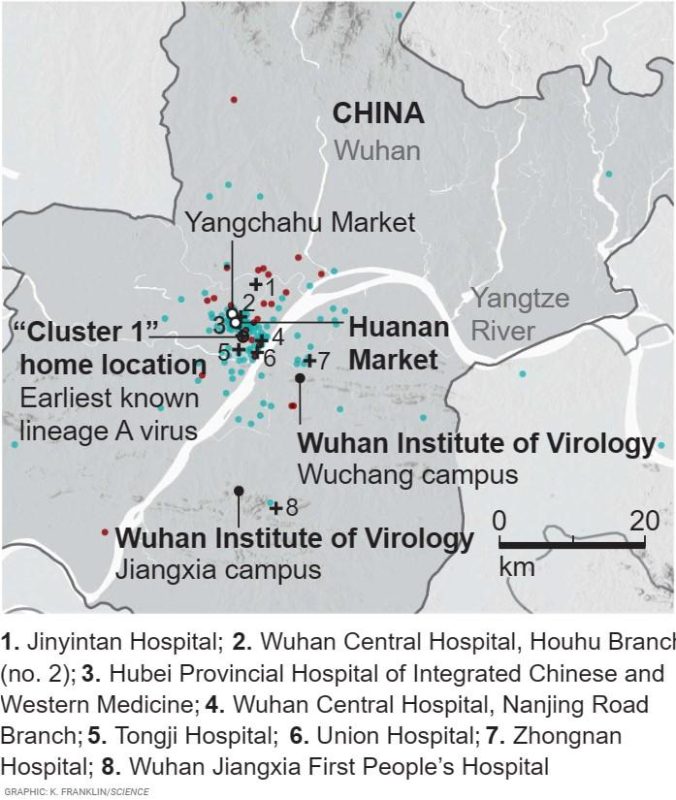
This despite the fact that an article in Science appeared to have already put the theory to rest over a year ago by showing that the initial cluster of Covid-19 cases in Wuhan was located on the opposite (left) bank of the Yangtze River from the Wuhan Institute of Virology, which is commonly supposed to be the pandemic’s epicenter according to the “lab-leak” theory.
But unbeknownst to most observers, there was in fact another infectious diseases lab in Wuhan, the German-Chinese Joint Laboratory of Infection and Immunity, and it is located on the same side of the river in the cluster.
The below map from the Science article makes the distance of the cluster from the two campuses of the Wuhan Institute of Virology clear – although the article itself coyly refrains from referring to the Institute.
Instead, the article shows that even if many of the earliest known cases of Covid-19 in Wuhan did not have any “epidemiologic link” to the famous Huanan wet market, the great majority of them were clustered in the vicinity of the market. This suggests – as per the quasi-official account – that the epidemic started in the market by way of animal-to-human (zoonotic) transmission and then spread to the surrounding area via “community transmission.”
Ergo, the “lab-leak” theory is dead.
Except that there is also an infectious diseases lab in the area of the cluster: the aforementioned German-Chinese Joint Laboratory of Infection and Immunity at Union Hospital, Tongji Medical College. The laboratory is a joint project of Union Hospital, Tongji Medical College and the University Hospital of Essen in Germany. Prof. Ulf Dittmar, chair of the virology department in Essen, has also referred to the joint laboratory as the “Essen-Wuhan Laboratory for Virus Research.”
(See interview here [in German]. It should be noted that in the cited interview, conducted in January 2020, Dittmar downplays the dangerousness of the novel Coronavirus and warns against “hysterical” reactions.)
Helpfully, the map from the Science article also indicates the locations of the Chinese host institutions of the joint laboratory: the Union and Tongji hospitals. Per the legend, they are indicated by crosses 5 and 6: right next to the home location of what the article identifies as “cluster 1,” an elderly husband and wife who represent “the earliest known case cluster and the only cluster admitted by 26 December. They had no known connection to Huanan Market.” (Red dots on the map indicate cases with a known connection to the market; blue dots those that have no known connection.) The Tongji Hospital is the closest to “cluster 1.”
Astonishingly, in early September 2019, only three months before the allegedly initial outbreak of Covid-19 just a stone’s throw from Tongji Hospital in Wuhan, then German Chancellor Angela Merkel paid a visit to none other than…Tongji Hospital in Wuhan. The hospital is also known as the German-Chinese Friendship Hospital.
A photo of Chancellor Merkel being welcomed by nurses at the hospital reception can be seen here. The accompanying article in the German newspaper Die Süddeutsche Zeitung notes another highly intriguing fact: the Essen University Hospital is not the only German teaching hospital with which Tongji has a “close partnership.”
It also has a partnership with the Charité Hospital in Berlin of Germany’s “state virologist” Christian Drosten! Drosten is the chair of the virology department at the Charité.
Now, it was none other than Christian Drosten who in mid-January 2020 – just a couple of weeks after the initial outbreak of Covid-19 just a stone’s throw from Tongji Hospital – devised the notoriously oversensitive PCR test that would become the “gold standard” for detecting the virus. Since Drosten’s PCR would also and especially be used to test people with no symptoms of the illness, it thus paved the way for the outbreak to obtain pandemic status.
Before the PCR test was adopted by the WHO, Drosten’s paper on it would be rushed through the peer-review process of the EU-funded journal Eurosurveillance in record time: going from submission to acceptance in anywhere from three-and-a-half hours to 27-and-a-half hours per the calculations of Simon Goddek.
According to accompanying tweets and Gettr posts in German, a photo that circulated on the two platforms earlier this year is supposed to show Drosten at a Tongji Medical College (or perhaps joint Tongji-Charité?) event. “What a coincidence,” some of the posts note ironically. (Here, for instance.) Many of the posts link a Charité webpage. But the link does not contain or no longer contains any such photo. It merely leads to generic information on a Charité-Tongji exchange program, thus leaving the source of the photo unclear.
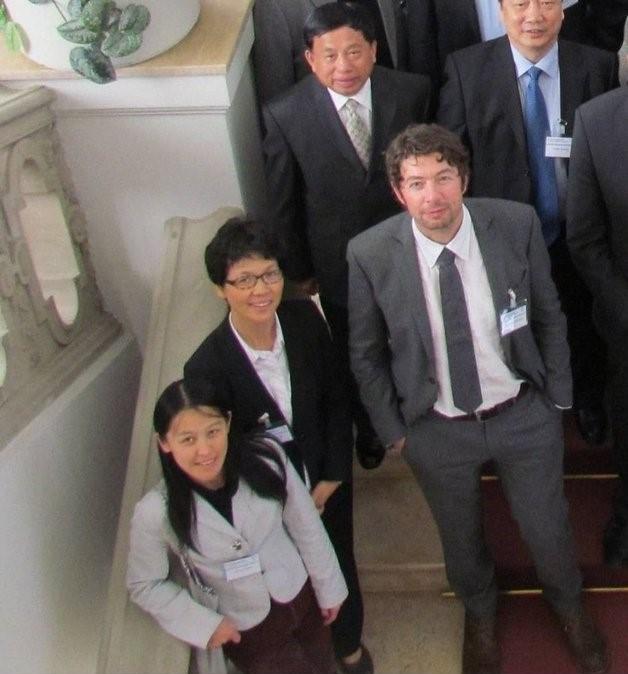
Christian Drosten at Tongji Medical College event?
A Google search result from the Tongji website (see below) tantalizingly notes that a “Sino-German Disaster Medicine Institute, Charité University in Germay [sic.] and Tongji Hospital was officially opened in Tongji Hospital, Wuhan, China.” But the indexed Tongji news article is not available nor is it cached, and the URL is not archived by the Wayback Machine either. Could this be the event at which Drosten is pictured? Perhaps Drosten could clarify.

In any case, thanks to a FOIA request, we know that Drosten participated in February 2020 email exchanges with Anthony Fauci and other international scientists about the possibility of a lab leak and that he was in fact, in contrast to other participants, particularly irritated about the hypothesis. Several of the others – including, n.b., Anthony Fauci – are clearly willing to entertain the possibility of a lab leak, and Jeremy Farrar of the Wellcome Trust even says that he is split 50:50 between lab leak and natural origin and that Edward Holmes of the University of Sydney is even 60:40 lab leak.
The doubts and open-mindedness of the other participants elicits an obviously pissy response from Drosten. “Can someone help me with one question,” he asks, “didn’t we congregate to challenge a certain theory, and if we could, drop it? …Are we working on debunking our own conspiracy theory?”
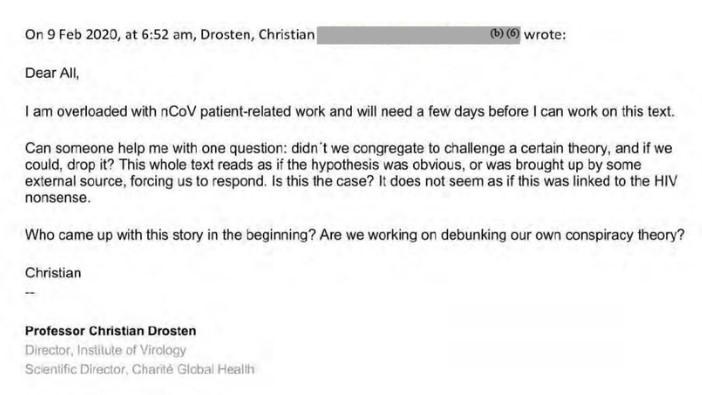
As the journalist Milosz Matuschek has pointed out in an article for the Swiss weekly Die Weltwoche, the FOIA release could prove to be a problem for Christian Drosten. For in a sworn statement to a German court, Drosten has insisted that he
had no interest in steering the suspicion about the origin of the SARS-CoV-2 virus in a certain direction. In particular, I had and I have no personal interest in ruling out the so-called laboratory thesis as origin of the virus. If there were indications for the correctness of the laboratory thesis, I would vigorously defend it in the scientific and public discussion.
Prosecute/Drosten?
Robert Kogon is a pen name for a widely-published financial journalist, a translator, and researcher working in Europe. Follow him at Twitter here. He writes at edv1694.substack.com.
Soaring energy prices cost EU $1 trillion – Bloomberg
RT | December 18, 2022
EU member states have spent roughly a trillion dollars (€940 billion) in the face of the bloc’s worst energy crisis in decades, Bloomberg is reporting on Sunday, citing calculations based on market data.
Soaring energy prices have sent its economies plunging into recession as most member states opted to stop importing gas from Russia, facing the necessity to turn to more expensive supplies.
The agency highlighted that the total estimated losses marks just the beginning of a full-scale crisis, as a period of high prices for energy could last years, while aid is already becoming unaffordable.
The security of energy supply is expected to remain an issue beyond next winter after the filled gas storage facilities across the region are emptied. The nations of the EU will have to refill their gas reserves for the next cold season with no deliveries from Russia, which also heats up competition for tankers.
Even with more import terminals for liquefied natural gas (LNG) coming online, the crisis will reportedly loosen its grip only in 2026, when additional production capacity from the US or Qatar becomes available. At the same time, prices should remain high to attract LNG away from other buyers from energy-hungry Asian buyers.
A state of emergency could linger for years, according to Brussels-based think tank Bruegel, as quoted by Bloomberg.
“Once you add everything up –bailouts, subsidies– it is a ridiculously large amount of money,” Martin Devenish, a director at consultancy S-RM, told the agency. “It’s going to be a lot harder for governments to manage this crisis next year.”
A rush to fill storage during summer, despite all-time high prices, has softened the supply squeeze so far. However, freezing weather is expected to give the region’s energy system the real test this winter.
Last month, Germany’s energy regulator, the Federal Network Agency, warned that German households and small businesses have failed their first gas-saving tests. The regulator noted that a reduction in consumption of at least 20% was required to avoid a gas shortage in the coming months.
Germany’s Gas Reserves “Emptying At Record Speed” As Country Struggles To Keep Warm, Lights On
By P Gosselin | No Tricks Zone | December 16, 2022
Germany’s gas reserves are emptying at record speed: 1% per day as the current wind/solar energy lull means more gas gets burned for electricity, heating.
Pleiteticker.de reports how Germany’s natural gas reserves “are emptying at record speed” because wind and solar power have been on the scarce side over the past few weeks. This means gas turbines have had to jump in to pick up the slack in electricity production – not one the German government had hoped as it wrestles with the heightening energy crisis.
“Germany is converting gas into electricity in record quantities,” pleiteticker.de reports. “Thanks to high pressure system ‘Erika’, the current December is colder than it has been for years. […] In recent days, gas storage facilities have therefore been emptying much faster than before. From December 12 onwards, more than one percent was withdrawn from gas storage facilities in Germany every day.”
“Last week, almost one third of all electricity was generated from natural gas. These are record figures,” writes pleiteticker.de.
If the cold persists through the winter, gas reserves threaten to become extremely tight before spring arrives.
But instead of blaming the energy woes on failed government policies, federal network agency head Klaus Müller criticizes the situation on the consumers, and worries “the gas storage may not last the whole winter.”
“A national gas shortage in winter can be avoided if, firstly, the savings target of at least 20 percent continues to be achieved,” the Federal Network Agency says. Here the government’s solution clearly is that citizens should accept freezing even more when it’s bitterly cold out.
Over 800 million euros paid for unproduced energy in 2021
The problem with wind power is that either too much or too little is produced, due to the weather. As mentioned above. the past weeks have seen little wind power being produced, and so gas turbines had to be fired up to keep the grid supplied.
But when it’s too windy, something needs to be done to keep the grid from being overloaded: wind turbines have to be shut down. That’s costing Germans 807 million euros this year because the excess electricity that could have been fed into the grid by the wind parks legally has to be compensated.
Pleiteticker here writes: “For the amount of electricity that the operators could have fed into the grid, they still receive compensation from the grid operators according to the statutory tariffs. And this sum is higher than ever this year: 807 million euros. Record value. For electricity that never existed.”
And the problem is getting bigger, according to the Federal Ministry of Economics.
“At the time of the worst energy crisis Germany has seen in a long time, when companies and consumers are hammered by energy prices like rarely before, Germany is paying money for energy that also doesn’t get produced,” comments pleiteticker.de.
So far Germany’s response to the energy crisis is plans to build many more turbines, with talks of even tripling its current installed capacity, which of course would only triple grid volatility, thus making it far more unstable than it already is and so create an even much bigger mess.
Committee of German Parliament Approves $10Bln Purchase of F-35 Jets From US
Samizdat – 14.12.2022
The Budget Committee of the German parliament approved the contract with the United States on the purchase of F-35 fighter jets worth 10 billion euros ($10.6 billion), a British news agency reported on Wednesday, citing sources in the committee.
According to the news agency, the committee green-lighted the purchase using money from a 100 billion euro ($106 billion) special defense fund established by the German government shorty after the start of Russia’s military operation in Ukraine in February.
First eight fighter jets are expected to be delivered by the US to Germany in 2026, the report said, adding that the new planes could replace old Tornado jets.
In July, Washington also approved a possible $8.4 billion sale of 35 F-35 jets to Germany including missiles and equipment.
In Germany, putative vaccine-induced causes of sudden death tripled after vaccine rollout
By Meryl Nass | December 13, 2022
What the graph below shows is that there are 6 codes on death certificates that correspond to “sudden deaths”—unexpected events that happened acutely and resulted in rapid demise.
Use of these codes jumped roughly 2-3 times from their 5 year average (even including the year of severe COVID (2020) in the five year average) in 2021, when the COVID vaccines began rolling out. The data are consistent for all 5 quarters in 2021-2022 for which data are available. The vaccines are killing us. Not COVID. Simply look at the data or the press conference (in German) where they were discussed..
Below is what the wonderful Jane Orient had to say:
Dec 13, 2022
COVID-19: Do you have enough life insurance?
If you have dependents, you need to protect them in case you die suddenly. Life insurance is the method used by most. Sudden, unexpected death of a breadwinner is not new, but the constant stream of hazards in the news should focus your attention.
Many scare stories turn out to be hype—especially those based on computer modeling (and serving an agenda). But the graph below shows actual occurrences. Sudden Adult Death Syndrome is real.

The source is the National Association of Statutory Health Insurance Physicians (KBV), which insures 72 million lives. Remember that if actuaries, in contrast to public health authorities, make a mistake, they and the companies they work for face consequences—including bankruptcy.
Just after the rollout of COVID-19 injections, there was a sharp, unprecedented spike in unexpected deaths, a 1,000% increase. The KBV denies a causal relationship to vaccination. The cause for the deaths is unknown, but it is not COVID-19. Authorities have not yet done appropriate studies to investigate a possible vaccine connection. Mainstream media did not attend a press event where data analyst Tom Lausen presented the figures, which he calls a “risk signal.”
From CDC data, equity investment advisor Edward Dowd calculates that Millennials, age 25 to 40, experienced an 84% excess mortality in the fall of 2021, coinciding with vaccine mandates and boosters—a Vietnam War-size event.
When it comes to New Year’s resolutions, number 1 should be providing as best you can for your family’s future, and carefully examining the risks you might be taking.
Jane Orient, M.D., Executive Director, Association of American Physicians and Surgeons, jane@aapsonline.org
Washington wants Europe’s total Dependence on the US
By Salman Rafi Sheikh – New Eastern Outlook – 12.12.2022
In March 2022, the Stockholm International Peace Research Institute (SIPRI) reported that “Europe is the new hotspot” of global arms import. While this development is attributed to the ongoing military conflict between Russia and Ukraine (US/EU/NATO), what’s equally, or even more, important to understand is how most of this European purchase is coming from the US and how the latter has turned the conflict into a money-making machine. The US is responsible for the so-called ‘energy crisis’ in Europe and, by selling expensive US gas to Europe, is making a lot of money. Of course, the US told the Europeans that doing so was necessary to reduce their critical dependence on Moscow. The Europeans, in their bid to ‘punish’ Russia, decided to increase their dependence on the US. This is now turning into an ugly issue, as European powers, as reports in the western mainstream media show, are now directly accusing the US of profiteering from war.
This criticism is based not just on the fact that Europe is buying expensive US gas and the latter is profiting from it. In fact, it is based upon the fact that Europe is now too dependent on the US to prevent its economic collapse. If Europe’s dependency on the US continues to increase, it will only come at the cost of its strategic autonomy.
Secondly, this is not just about gas. If gas is linked to economy, Europe’s increasing military purchase from the US is directly linked to its defence and security, or at least this is how it is being projected. This dependence in the defence field is most easily evident from the German purchase of F-35 fighter jets from the US. While the US is going to make a whole lot of money out of this multi-billion dollar deal, strings attached to this deal show how this deal is a direct reinforcement of European dependency on the US.
Martin Kroell, the President of the Federal Association of the German Aerospace Industry (BDLI), was quoted to have said that Germany, even after purchasing these jets, would not have the rights to maintain and repair these jets in Germany. They will be maintained “in other European countries in the network of the US Armed Forces, or by the US companies Lockheed … this creates a dangerous dependency.”
Let’s not forget that this sale happened, first and foremost, when the US started putting pressure in early 2021, when the Russia-Ukraine conflict began, on European nations to increase their defence capacity. But, using the pressure of this conflict, the US authorities managed to make a deal that did not give much leeway to the German authorities to really protect their interests. As another report confirms, the Germans made an ‘error’ in not demanding the involvement of their own “arms industry in the maintenance, repair, and support of these expensive aircraft.”
This is not Germany alone. Finland, for instance, is another country entering the phase of dangerous dependency on the US. It has already decided to buy 64 Block 4 F-35s for US$9.4 billion. Since the start of the Russia-Ukraine conflict, Finland has upped its weapon purchase, with, unsurprisingly, most of this purchase coming from the US.
While the conflict in Ukraine has led to many deals worth billions of USD, there is a growing fear in the continent that the US is now trying to start a new crisis with China. Such a conflict would create additional problems for Europe.
But the rhetoric being produced – and effectively used – by the US for Europe is to reduce dependence on China. Europe of course is concerned about this form of geopolitics. As Charles Michael, President of the European Council who recently met Xi, said in a tweet: “The EU promotes its interests and values in the world. With China, engaging openly on all aspects of our relationship is the only way forward.”
China, too, understands that Europe is far from being in agreement with the US over a joint China policy. Therefore, Xi was candid enough to tell the EU last week that the bloc should keep up its investment in China, adding that China and the EU must jointly “oppose de-coupling.”
But while the EU is fighting the US over forcing a policy on the EU vis-à-vis the China question and the economic consequences it could have for Europe in the long term, the US continues to make policies that directly impact the EU economy. The latest irritant is certainly the US Inflation Reduction Act (IRA), which gives tax breaks for components used in electric cars provided they are made in (North) America.
While the EU-based companies could set up factories in the US, this would effectively mean that these companies will add to the US economy more than the EU’s economy. In other words, the EU’s capital will be used to add to the US capital at the expense of the EU’s own economic health.
This pattern is similar to the way the EU capital is being used via expensive gas sales and weapon systems to help the US economy. This is precisely how the conflict in Ukraine has turned out to be a major source of profit for the US state.
What can the EU do? The Europeans are unlikely to be able to break out of this dependency relationship without first developing an independent global outlook. Imagine the economic scenario in the EU if, instead of supporting the US bid to expand NATO, it had taken an independent line. The EU did not take that line. Now, the EU accuses the US of its energy crisis. The question is: can it translate this anger into a concrete policy?
Featured Video
Yemen joins the war – Red Sea could be blocked next – Saudi regime at risk
or go to
Aletho News Archives – Video-Images
From the Archives
A superpower and “the world’s sickest warrior state”
By Paul J. Balles | March 8, 2010
Living through five or six major wars has hardened me to what I thought were the extremes of inhuman cruelty and brutality.
Two things made those extremes almost bearable: the brutality always revealed – at least according to the media coverage – the viciousness of the enemy. It was therefore quite understandable when our “brave men and women” pulverized the enemy.
Films of Japanese torturing captive Americans somehow justified holding Japanese Americans in internment camps during World War II; and only a small percentage of Americans found the bombing of Hiroshima and Nagasaki unreasonably vengeful at best, at worst, depraved.
The media giants in America portrayed the North Koreans as barbaric beasts with their captives, quite unlike their southern counterpoints – our allies during the Korean War. No one ever felt the need to explain how the South Koreans were a civilized breed while the North Koreans were absolute savages, at least according to the official line.
In Vietnam, our warriors justifiably (or so the media made us believe) dropped napalm on the North Vietnamese who had the gall to hide in villages and tunnels to ravage our invaders. At least it was accepted practice until some rogue photojournalist filmed a young girl screaming down a Vietnamese road in flames. … continue
Blog Roll
 Aletho News
- America Racing to Strategic Defeat in Iran: Lt Col Daniel Davis
- FTC Warns Visa, Mastercard, PayPal, Stripe Over Political Debanking
- Russian tanker approaches Cuba despite US oil blockade
- Marandi: Yemen joins the war – Red Sea could be blocked next – Saudi regime at risk
- Pro-Palestinian French member of European Parliament denied entry to Canada
- Pakistan to Host US-Iran Talks
- How Indonesia’s tilt toward the US left it stranded in the Strait of Hormuz
- US has no choice but to retreat from Iranian borders: Top commander
- Iran Retaliation Strikes Chemical Plant Near Dimona
- AWACS’ Destruction is a Major Loss for US Military – Ex-DoW Analyst
- If Americans Knew
- Israeli police block Catholic cardinal from entering Church of the Holy Sepulchre on Palm Sunday
- Israel is assassinating journalists again, more than any other nation, anywhere, ever – Not a ceasefire Day 170
- Over 300 US service members wounded, majority have brain injuries – Not a ceasefire Day 169
- Researchers at Human Rights Watch Resign Over Blocked Report on Palestinian Refugee Return
- Jewish Groups Are Backing a War Americans Don’t Want
- Eric Fingerhut Thinks He’s the President of the Jews
- Top Jewish Philanthropists, Rabbis Urge Israeli President to Take Action Against ‘Jewish Extremists’
- Don’t Be Fooled. Zionist Leaders Have Always Wanted to Control Southern Lebanon
- Israel’s widespread use of torture is a core element of its genocide against the Palestinian people
- In Israel’s War on Iran, Many Middle East US Bases Rendered “All But Uninhabitable”
- No Tricks Zone
- New Study Finds Warming Saves Lives…Cold Temperatures 12 Times More Deadly Than Excess Heat
- German Science Blog Accuses PIK Climate Institute Of Hallucinating Climate Tipping Points
- Devastating Assessment Of Comirnaty Vaccine By Former Senior Pfizer Europe Toxicologist
- New Study: CO2 Is ‘Effectively Negligible’ As An Explanatory Climate Change Factor Since 2000
- Former Pfizer Toxicologist Dr. Helmut Sterz Tells Bundestag Hearing Pfizer Vaccine Should Have Never Been Approved
- Energy Expert: Germany’s Nuclear Phaseout Was A “500 Billion Euro Mistake”
- New Research: South Australia’s Mid-Holocene Sea Surface Temperatures Were 4°C Warmer Than Today
- Storing Green Energy To Last Germany 10 Days Would Require A 60-Million Tonne Battery
- New Studies: UK Sea Levels Were 4 Meters Higher Than Today During The Mid-Holocene
- Destructive Green New Deal: German Energy And Metal Group Warns Of Drastic Crisis
 Aletho News