Et Tu, PayPal? The EU’s Role in Defunding Dissent
BY ROBERT KOGON | BROWNSTONE INSTITUTE | OCTOBER 15, 2022
PayPal appears unsure whether it should participate in the current crusade against online “disinformation” or not.
First it closed the PayPal accounts of The Daily Sceptic and the Free Speech Union, and even the personal account of their founder Toby Young, and then, two weeks later, it restored them. Then it announced that it would be docking $2,500 from anyone who uses its services in connection with “promoting misinformation” and then, two days later, it again reversed course and announced that this language was never intended to be included in its new Acceptable Use Policy (AUP).
It was not intended to be included? Well, where did it come from then?
Could the EU’s Code of Practice on Disinformation and its Digital Services Act (DSA), about which I wrote in my last Brownstone article, have something to do with PayPal’s skittish forays into “combatting disinformation?” Well, yes, they could, and you may rest assured that EU officials or representatives have already had a word with PayPal about them.
As discussed in my previous article, the Code requires signatories to censor what is deemed by the European Commission to be disinformation on pain of massive fines. The enforcement mechanism, i.e. the fines, has been established under the DSA.
PayPal is not, for the moment, a signatory of the Code. Furthermore, since it is neither a content platform nor a search engine – the potential channels of “disinformation” targeted in the DSA – it is obviously not in a position to censor per se. But the very first commitment in the “strengthened” Code of Practice unveiled by the European Commission last June is dedicated precisely to demonetization.
Unsurprisingly, given the nature of the business models of the most prominent signatories – Twitter, Meta/Facebook and Google/YouTube – this commitment and the six “measures” it comprises are mostly related to advertising practices.
But the “Guidance” that the Commission issued in May 2021, prior to the Code’s drafting, explicitly calls for “broadening” efforts to defund alleged purveyors of disinformation and contains the following highly pertinent recommendation:
Actions to defund disinformation should be broadened by the participation of players active in the online monetisation value chain, such as online e-payment services, e-commerce platforms and relevant crowd-funding/donation systems. (p. 8; emphasis added)
PayPal, the online e-payment service par excellence, was thus already in the Commission’s sights.
Somewhat illogically, given their own emphasis on advertising and the fact that an advertising-based revenue model and a donation or pay model would ordinarily be regarded as alternatives, the signatories of the “strengthened” Code thus pledged to
… exchange best practices and strengthen cooperation with relevant players, expanding to organisations active in the online monetisation value chain, such as online e-payment services, e-commerce platforms and relevant crowd-funding/donation systems. … (Commitment 3)
But the outreach to PayPal has not only occurred via third parties like the Code signatories.
In late May, shortly after the text of the Digital Services Act had been finalized – but before the European Parliament had even had the opportunity to vote on it! – an 8-member delegation from the parliament was dispatched to California to discuss the DSA and the related Digital Markets Act (DMA) with relevant “digital stakeholders.”
In addition to Code signatories Google and Meta, the “host list,” so to say – since the parliamentarians were to be the guests and they were inviting themselves! – also included PayPal. (See the delegation report here.)
Curiously, Twitter was not included among the companies and organizations to be visited, perhaps because of the turmoil unleashed by Elon Musk’s takeover bid. But, as touched upon in my prior article, Thierry Breton, the EU’s Internal Market Commissioner, had already paid a visit to Musk in Austin, Texas earlier in the month to have a word with him about the DSA.
No less than three of the delegation’s eight members – Alexandra Geese, Marion Walsmann and delegation head Andreas Schwab – were German, whereas Germans only account for around 13% of the total members of the parliament. This stark overrepresentation is telling, since Germany has undoubtedly been the prime mover behind the EU’s censorship drive, having already adopted its own online censorship law in 2017 with the express motivation of “combatting criminal fake news in social networks” (p. 1 of the legislative proposal in German here).
The German legislation, commonly known as “NetzDG” or the Network Enforcement Act, threatens platforms with fines of up to €50 million for hosting content that infringes any of a variety of German laws that restrict speech in ways that would be unthinkable and unconstitutional in the United States. It is also the source of the Twitter notices that many Twitter users will have received informing them that their account had been denounced by “a person from Germany.”
As noted above, PayPal is not presently a signatory of the Code of Practice on Disinformation. On July 14, however, just nine days after the passage of the DSA, the Commission issued a “Call for interest to become a Signatory” of the Code. The call is explicitly addressed to, among others, “e-payment services, e-commerce platforms, crowd-funding/donation systems.” The latter are identified as “providers whose services may be used to monetize disinformation.”
Evidently not satisfied merely with “deplatforming,” the Commission has thus made clear that the next frontier in its combat against “disinformation” is attempting to defund dissenters who, despite their discrimination by or banishment from the major online platforms, have managed to preserve a place in the online discussion thanks to platforms of their own.
PayPal, moreover, will know that the “exclusive” – in effect, dictatorial – powers that the DSA confers on the European Commission include the power to designate the “very large” online platforms that are susceptible to incurring the massive DSA fines of up to 6% of global turnover. PayPal will easily satisfy the “very large” size criterion of having at least 45 million users in the EU, but it is obviously not a content platform.
Nonetheless, this appears not to be so obvious to the European Commission. For the Commission press release on the call for signatories treats it precisely… as a content platform! Thus, the press release refers to “providers of e-payment services, e-commerce platforms, crowd-funding/donation systems, which may be used to spread disinformation.” Huh?
In the meanwhile, on September 1, the EU has opened a specially-dedicated office or “embassy” in San Francisco to conduct what it itself describes as “digital diplomacy” with US tech firms. The “ambassador,” Commission official Gerard de Graaf, is reportedly one of the drafters of the DSA. Perhaps he will be able to explain the intricacies of the DSA to PayPal – or even already has. PayPal headquarters are, after all, just a stone’s throw away in Palo Alto.
In any case, PayPal has been put on notice, and, with it, so too have dissident websites that depend on user support for their survival. Ignore the EU at your peril.
Robert Kogon is a pen name for a widely-published financial journalist, a translator, and researcher working in Europe. He writes at edv1694.substack.com.
PUTIN’S ASTANA PRESS CONFERENCE – HE AIN’T BIDEN
By Larry Johnson | A Son Of The New American Revolution | October 15, 2022
If you take the time to watch Vladimir Putin’s press conference yesterday (Friday) in Astana and then watch any recent cluster fark by Joe Biden, you will understand why the Russians are so calm in dealing with Ukraine. Putin is remarkable. Low key, well informed, articulate and not afraid of tough questions. He did not get any softballs here and, in fact, faced some tough questions. So much for the myth that Russia is a totalitarian state that brokers no dissent and requires everyone to toe a party line. That characterization more aptly describes the United States under the demented Joe Biden.
Here are the highlights with the relevant time stamp:
9:15 Putin is asked about Germany’s behavior. He notes incisively that Germany has put a priority on serving NATO rather than the interests of its nation and people.
14:40 Putin is asked about attending the G20 and meeting with Joe Biden. Putin said, there is no point. “There is no platform for any kind of negotiations at this point.” And we are in constant contact with some members of the G20, e.g. Turkey.
18;00 Putin is questioned directly about recent arrest of man in Moscow for listening to Ukrainian music. Putin responded that the arrest is wrong and we (Russia) should not behave like the West in trying to cancel a culture, in this case Ukrainian culture. He noted that Ukrainian is still a recognized language in Crimea and would remain so. He emphasized that Neo-Nazis and Nazi symbols on display in Ukraine are NOT Ukrainian culture and must be eliminated.
20:10 Mobilization was a hot topic. Will there be another wave of mobilization? Will there be “total mobilization”? Putin said the Defense Ministry initially planned a smaller number than the 300,000. Putin remarked that he doesn’t see any need right now to expand that number. There are 220,000 mobilized and the work of mobilization will be finished in two weeks.
22:00 Putin was asked about the men who fled Russia for other countries and calls in the Duma to confiscate their property. Putin said it must not be handled based on emotions. Rather it must be dealt with according to the law. In other words, each case must be litigated on an individual basis instead of a blanket action.
24:00 Another reporter cited one person mobilized who died allegedly with no training. Putin emphasized that the mobilized are supposed to receive 5 to 10 days refresher training. Then they go for specialized training that lasts 5 to 15 days. Then they undergo joint combat training. So far 33,000 men have been mobilized already with front line units and 16,000 in units with combat missions. Putin said he will order a review of the training regimen to ensure it is being done appropriately.
29:15 A reporter asked about the retaliatory strikes in response to the terrorist bombing of the Crimea bridge. Putin said there is no massive retaliation. Russia hit 22 of 29 targets and is now working on hitting the remaining 7. He said he saw no need for “massive retaliation” at this point.
30:00 Final question–NATO says that defeat of Ukraine by Russia will be the defeat of NATO. What happens if NATO deploys troops to Ukraine. Putin said “it could lead to a global catastrophe and I hope that those who talk about this will be smart enough not to undertake such dangerous steps.”
Whether you like or despise Putin, give the man his due. He spoke off the cuff. No notes in hand. He did not shy away from any question and he did not get angry or lose his cool. What a contrast with a Joe Biden press encounter. I think that Western politicians and pundits who disparage Putin as an incompetent dictator are making a very dangerous mistake. They fail to take this man at his word. Putin is establishing himself as a man who says what he means and means what he says
EU parliament wants to give up both Nord Stream pipelines: “Nord Stream” to be abolished
Establishment parties vote for doom in Brussels
FRONT NIEUWS | October 15, 2022
It should now be official. Nord Stream 1 and 2 are not repaired. Last week the EU parliament already voted on the further procedure with the two pipelines. Without much ado they simply decided to abandon the project, with the CDU/CSU, SPD, Greens, FDP and Free Voters voting in favour. This means: a further rise in gas prices and further deindustrialization of Germany and Europe, reports Wochenblick.at.
Europe on its way to the abyss
Germany, Austria and all of Europe are suffering from the suicidal sanctions against Russia. The industry goes bankrupt or migrates to the US, which lures German entrepreneurs with cheap energy and good conditions, traditional companies that have already survived economic crises and two world wars will not survive the impoverishment program of the system. The fate of Germany as one of the most important industrialized countries is thus sealed.
This vote shows very clearly that the old parties are simply not interested in promoting the interests of their own country, and even of Europe. They have opened the door to ever-increasing poverty and stabbed their own citizens in the back.
Bernhard Zimniok, MEP of the AfD, reported in a video about the vote and the attempted cover-up by Brussels:
Europe Reloaded – Heartfelt thanks to journalist and ER contributor Michel van der Kemp for producing a translation of the video:
Hello from Brussels. Last week, the EU Parliament voted on a motion to finally give up Nord Stream 1 and 2. In doing so, the EU Parliament made a mistake that was very helpful to us:it accidentally initiated a roll-call vote instead of an electronic vote, which nobody noticed at first and which the EU Assist website, which documents all voting results, has therefore recorded on its site. On the one hand, an electronic vote means that it is known exactly how many votes were cast for or against a motion or how many abstained. But it also means that the election takes place more or less anonymously, because no member of parliament has to raise their hand, they just press a button. A roll-call vote is practically the opposite: It is documented exactly which member of parliament voted and how. When the administration realized their mistake and changed it on their website, the child had already fallen into the well, because EU Assist documented exactly who voted and how. Of all the German MPs, only the three non-attached, one from the SPD, the left and of course we from the AfD voted against giving up Nord Stream 1 and 2. The Greens, FDP, Freier Wahler (Free Choice), CDU/CSU and all but one of the SPD MPs voted to finally abandon Nord Stream 1 and 2 and thus voted for the fact that gas prices will continue to rise and that we may soon run out of gas, so voting for potential blackouts and cold apartments. Anyone who supports these parties is calling for a loss of prosperity and the collapse of the German economy, indeed of the entire country. Only the AfD makes politics for Germany!
The “creative” destruction of Europe
The future impoverishment of Germany and all of Europe is probably entirely in the interest of those forces who have [in mind] something very different for the world. With the destruction of the European continent, the breeding ground for the Great Reset has been created. The peoples have been disintegrated and fragmented by mass migration, the economy is virtually non-existent, the population is impoverished and destitute.
“You will own nothing” is one of the dogmas of the future, which the WEF has put into circulation. No one will voluntarily surrender his property, and taking it is not possible without arousing the resentment of the people. This is different in the event of a major crisis, perhaps even a war, where in the end – except for a few – no one is left with anything. A dystopian “brave new world” can be built on such a foundation.
After the end of “Nord Stream” one no longer has to face the unpleasant question of who is responsible for the terrorist attack on the pipelines.
Corona is a Flat Circle
For the third autumn in a row, the German press screeches about overwhelmed hospitals, and there’s no reason to think they’ll ever stop.
eugyppius | October 15, 2022
It’s virus season, and the headlines are already here: Many New Corona Infections: Hospitals Demand Indoor Mask Mandate — Lauterbach Already Hopes for Corona Restrictions — High Covid Incidences: Medical Association Wants Compulsory FFP2 Masks Indoors — Corona: Baden-Württemberg Health Minister Considers Mask Mandate Possible. I could add a dozen more, but you get the idea. It’s the same reheated pablum from last year. Hospital staff have their backs against the wall; a new tide of Corona patients threatens to overwhelm their meagre resources; the Apocalypse threatens if we don’t immediately return to indoor plastic face coverings.
If you look at hospitalisations, though, you’ll have a hard time finding any crisis at all. Here, for example, are hospitalisations for severe acute respiratory infections since 2017, as published last week by the Robert Koch Institut:
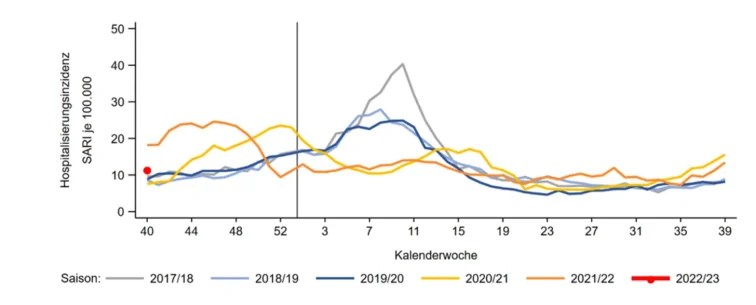
The red dot is where we are right now. Admissions are totally in line with the pre-pandemic era. The ICU admissions tell exactly the same story:
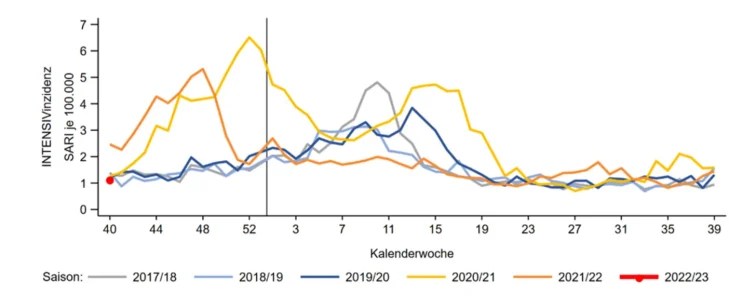
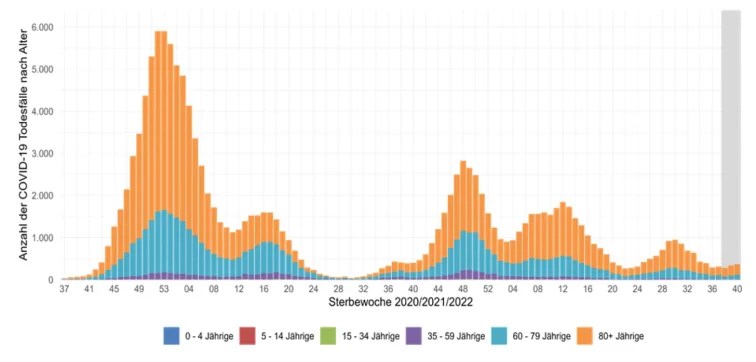
Nor is anybody really dying at the moment:
To the extent that there is any crisis at all here, it’s of our own making. Hospital patients with Corona diagnoses have to be treated according to strict isolation protocols, in special wards. These rituals are staff-intensive, and they effectively reduce across-the-board hospital capacity. It’s the same as our quarantine laws, which induce worker shortages by forcing millions of otherwise healthy Germans into isolation whenever they test positive. We could declare a rhinovirus pandemic tomorrow and suffer all the same problems from the common cold, and by the same token we could end all of this ourselves in an instant, by abolishing our foolishness and choosing to ignore SARS-2. Instead, we insist that this virus is dangerous and through our own behaviour we make it so.
The most onerous part of all this, is the inability of the German press to find a new narrative, ask new questions, or to change their reporting in any way at all — despite the totally different behaviour of Omicron and the near-universal levels of immune exposure to SARS-2. I know some of you complain that I repeat the same themes and arguments overmuch, but Germany has descended into some kind of purgatorial alternate reality, where it’s always March 2020, and our hospitals are always on the verge of melting down, and we never have enough information, so we just have to try masking and social distancing and hope for the best. They’re wrong about everything and they just keep telling the same lies over and over.
Sweden explains rejection of joint Nord Stream probe
Samizdat | October 14, 2022
Stockholm has rejected a plan to set up an official joint investigation team together with Germany and Denmark to look into the explosions that damaged the Nord Stream 1 and 2 gas pipelines in late September, Reuters reported, citing a Swedish investigator. Sweden reportedly argued that its own findings are too sensitive to share even with other EU nations.
The EU’s agency for criminal justice cooperation, Eurojust, recently came up with a proposal to establish a Joint Investigation Team (JIT) to launch a probe into the Nord Stream explosions, Reuters said, adding that Sweden blocked the initiative. On Friday, Mats Ljungqvist, a Swedish prosecutor involved in the nation’s probe into the incident, told the news agency that this development would impose unwanted obligations on his nation.
“This is because there is information in our investigation that is subject to confidentiality directly linked to national security,” Ljungqvist said, adding that his nation is already cooperating with Germany and Denmark on the matter anyway.
According to the prosecutor, establishing a JIT would involve signing a legally binding information-sharing agreement. Eurojust says on its website that a JIT mechanism indeed includes a legal agreement between the involved parties for the purposes of conducting criminal investigations.
Earlier, citing “security circles,” Germany’s Der Spiegel magazine said that Sweden considered the sensitivity level of its own probe’s findings to be “too high to share them with other countries.” News portal Tagesschau, owned by the German ARD broadcaster, also reported on Friday that Germany, Sweden, and Denmark initially wanted to investigate the incident together but “that’s not the case now.”
According to Tagesschau, Denmark also eventually opposed the idea of a joint probe. Now, all three nations will conduct their own separate investigations, it added. Swedish Prime Minister Magdalena Andersson denied the reports, however, adding that “we are working together with Germany and Denmark on this issue.”
Earlier, all three nations refused to grant Russia access to the probe, prompting Moscow to summon their ambassadors. Russia also said it would not recognize the results of any probe unless its specialists were allowed to participate. Andersson said on Monday that Stockholm would not share its investigation results with Moscow.
The Nord Stream 1 and 2 pipelines were damaged and rendered inoperable following a series of powerful underwater explosions off the Danish island of Bornholm. No nation conducting a probe into the incident has officially named any suspects that could have been involved in the alleged attacks on the pipelines.
Russian President Vladimir Putin has previously hinted at a potential “beneficiary.”
“One can now force the liquefied natural gas from the US on to European countries on a much larger scale,” he said earlier this week. US Secretary of State Antony Blinken called the incidents a “tremendous opportunity” for Europe “to once and for all remove dependence on Russian energy.”
Masks For Thee But Not For Me

eugyppius – October 13, 2022
Pictured is the Federal President of Germany, Frank-Walter Steinmeier, violating the Infection Protection Act, which requires masks in all local and long-distance trains. He pleads that he only took his mask off for a few seconds for the purposes of a short video message and some publicity photographs. Alas, the law provides for no such exception, and why should it? The official position of the German government is that unmasked people are a danger to themselves and others, particularly when they are on trains.
Now this is merely the latest in a string of similar incidents, including these barefaced mask mandate-happy Greens at Oktoberfest and German Chancellor Olaf Scholz’s unmasked government flight to Canada. It’s long become clear that nobody—not even the politicians most in favour of mandates—believes that masking is worth the trouble. And when you think about it, that’s depressing indeed, because how can we ever get rid of these rules if they are this discredited, and yet they persist?
Moscow demands answers on Nord Stream blasts
Samizdat | October 13, 2022
Russia will not recognize the results of the ongoing investigation into the explosions at the Nord Stream 1 and Nord Stream 2 gas pipelines in late September unless its experts are allowed to take part in the probe, Moscow has said. Russia’s foreign ministry revealed on Thursday it had summoned the representatives of Germany, Denmark and Sweden to convey its “bewilderment” over a lack of official reaction to a request for cooperation sent earlier this month by Russian Prime Minister Mikhail Mishustin.
In its press statement, the ministry noted that while Russian authorities and the country’s energy giant, Gazprom, have still not been granted access to the investigation, reports have been appearing which suggest that Berlin, Copenhagen and Stockholm have been far more accommodating to similar requests made by other nations, including the US.
Russian diplomats emphasized that if its calls for cooperation are ignored, Moscow will assume that the three European countries “have something to hide or [that] they are covering up the perpetrators of these terrorist attacks.”
“Russia will, of course, not recognize any ‘pseudo-results’ of such an investigation, unless Russian experts take part in it,” the statement read.
The warning comes after Swedish Prime Minister Magdalena Andersson announced on Monday that Stockholm would not share with Moscow the results of its investigation into the explosions that severely damaged the two conduits created to pump gas from Russia to Europe.
“In Sweden, our preliminary investigations are confidential, and that, of course, also applies in this case,” she explained.
The premier added, however, that Russia may conduct its own probe at the site if it so wishes.
Meanwhile, Swedish authorities have said they’d found evidence that points to sabotage.
Also on Monday, Russian President Vladimir Putin hinted that despite the denial of access to the probe, “we all know well who the ultimate beneficiary of this crime is.” Earlier, he had publicly laid the blame for the attack at the doorstep of the “Anglo-Saxons,” a Russian colloquialism for the US-UK bond.
Commenting on the blasts, US Secretary of State Antony Blinken had described them as a “tremendous opportunity” for Europe “to once and for all remove the dependence on Russian energy.”
The Nord Stream 1 and 2 pipelines were rendered inoperable on September 26 following a series of powerful underwater explosions off the Danish island of Bornholm.
Germany’s Green Party In Dire Straits
From most loved, to most hated… audiences are drowning out Green Party speakers at campaign rallies.
By P Gosselin – No Tricks Zone – October 8, 2022
The German Greens, who are partners with the SPD socialists in Germany’s government, are sinking dramatically in the public opinion polls as it becomes clear Green Party leader and Economics Minister Robert Habeck is driving the country’s economy into the ground at a dizzying speed.
Habeck, who currently also serves as Vice Chancellor, recently stunned millions of TV viewers when he appeared not to understand what bankruptcy is. Now as tomorrow’s state elections approach in Lower Saxony, the Green Party officials are scrambling to keep Habeck from doing more damage.
Blackout News reports that the Greens are “hiding” Habeck from the public in order to control the damage, and so far he has “had only one campaign appearance”. For that one particular appearance, “the audience had to stay outside, for security reasons” and “exclusively to selected members of his party.”
“In the polls, Robert Habeck has already experienced a significant plunge in the popularity of German politicians in recent days. So it’s no wonder that the Greens are literally hiding their once most popular politician ahead of the election in Lower Saxony,” reports Blackout News.
Desperate to find new sources of energy now that the Russian supply of natural gas has been halted, Habeck has angered his party base by extending the operating life for two nuclear power plants and putting lignite-fired power plants back on line.
In Göttingen, Habeck spoke at an election rally, but only in only in front of hand-picked audience after the police had completely sealed off the event.
Just a day earlier his party comrade Annalena Baerbock was “drowned out” by demonstrators. “Already at the beginning of her speech there was a deafening concert of whistles so that Baerbock could hardly be understood,” reports Blackout News. “In addition, there were shouts such as: ‘Baerbock must go’, ‘war-mongers’, ‘get lost’ and ‘impoverishment and war thanks to the Greens’, and ‘whoever votes Green, votes for war’.”
The mainstream media however, did not report on this.
Once the darlings of politics, the German Greens have seen their popularity plummet spectacularly over the recent weeks as Germany’s economy crashes due to excruciating energy shortages and price inflation.
“Therefore, on October 3, the Minister of Economics spoke only to a few dozen hand-picked party members and a few selected journalists,” according to Blackout News.
NORDSTREAM SABOTAGE: A NEW LOW FOR WESTERN MAINSTREAM MEDIA
By Dimitri Lascaris | October 7, 2022
The Guardian’s coverage of the recent Nord Stream sabotage highlights the increasingly absurd lengths to which Western media will go to promote the U.S. government’s hegemonic agenda.
Guardian coverage of this portentous event has included at least three, shameless exercises in propaganda-masquerading-as-journalism.
On September 28 – two days after natural gas began belching into the Baltic Sea due to multiple blasts targeting Nord Stream – the Guardian published an article by Philip Oltermann, the Guardian’s Berlin bureau chief, entitled “Nord Stream blasts could herald new phase of hybrid war, say EU politicians”.
By focusing attention on the perspective of EU politicians, the title of Oltermann’s article left no doubt as to its bias: E.U. governments have flooded Ukraine with weapons and have imposed sanctions on Russia that were plainly designed to destroy its economy. None of the E.U. officials quoted in the article can plausibly claim to be independent, objective arbiters of the debate over who attacked the Nord Stream pipelines.
According to Oltermann:
Roderich Kiesewetter, a member of parliament for the conservative Christian Democratic Union (CDU), told the Guardian the pipeline attack had the hallmarks of the “hybrid warfare approach” Russia has pursued for the last decade, with the aim of “dividing the European Union not by military but through social and diplomatic means”.
“We have to ask who has an interest in destroying this infrastructure,” said Kiesewetter, a member of the Bundestag’s committee on foreign affairs. While it was in the interest of the US, states in central and eastern Europe and the Baltics that Nord Stream 2 would never be activated, he argued that an act of state-sponsored sabotage by a Nato ally would have come attached with too large a risk of a political backlash.
“Russia, on the other hand, has an interest in sending us a signal: to threaten it could cause similar damage to pipelines between Algeria and France, to our power lines or submarine fibre-optic cables […] I consider it likely that Russia was behind this attack.”
What does Keisewetter mean by “hybrid warfare approach”, and why is this approach uniquely that of Russia? For decades, the U.S. military has degraded and destroyed the civilian infrastructure of its official enemies – for example, in Iraq and Libya. Therefore, one could just as easily argue that this act of sabotage has all “the hallmarks” of U.S. aggression.
Keisewetter does acknowledge that the U.S. (as well as certain unnamed European states) had an interest in killing the Nord Stream pipelines (more on that later), but he claims that the political backlash from their sabotage of Nord Stream would constitute “too large a risk”.
Yet, if recent history teaches us anything about relations between the United States and the E.U., it’s that the U.S. can get away with just about any betrayal of the E.U.’s trust.
In 2014, the Guardian and other Western media outlets revealed, thanks to whistleblower Edward Snowden, that the U.K. intelligence agency, GCHQ, had tapped into fibre-optic cables carrying global communications, and that GCHQ had shared vast amounts of data with its U.S. counterpart, the NSA. The targeted fibre-optic cables included three undersea cables with terminals in Italy.
The Snowden documents also disclosed that the U.S. had spied on E.U. internal computer networks in Washington and the E.U.’s United Nations office in New York, and that the NSA had conducted an electronic eavesdropping operation in a building in Brussels, where the E.U. Council of Ministers and the European Council were located.
At the time, Western media outlets also reported that the U.S. had secretly intercepted and monitored cell phone conversations of Angela Merkel, who was then Germany’s Chancellor.
What was the “backlash” resulting from U.S. spying on Merkel and other top E.U officials? What price did the U.S. government pay for undermining the integrity of telecommunications infrastructure in the E.U.?
Apart from a few theatrical, you-hurt-our-feelings protestations from E.U. leaders — for example, Merkel’s pathetic complaint to Obama that U.S. spying on her cell phone conversations was “completely unacceptable” — there was no meaningful “backlash”.
The E.U. imposed no sanctions on the U.S. It did not sever diplomatic relations with the U.S.. It did not close down a single U.S. military base. Indeed, since the Snowden revelations emerged, U.S.-E.U. relations have been conducted essentially on a business-as-usual basis.
Predictably, Oltermann mentions none of these facts in his article of September 28. In fact, Oltermann evinces no scepticism that the political backlash would be too great if, indeed, the U.S. and/or its proxies had sabotaged Nord Stream.
Oltermann continues:
Nord Stream has been at the heart of a standoff between Russia and Europe over energy supplies since the start of the Kremlin’s war in Ukraine, but it is not immediately clear who stands to benefit from the destruction of the gas infrastructure.
Several paragraphs earlier, Oltermann had revealed that a member of the Bundestag’s Foreign Affairs Committee had acknowledged that the U.S. and certain European states had an interest in preventing the activation of Nord Stream, yet it was “not immediately clear” to Oltermann who stands to benefit from the destruction of that infrastructure?
Oltermann then acknowledges that, in Germany, there had been calls recently “to open the pipeline as an energy crisis looms over Europe”, but he dismisses those calls as having come from “political parties on the far right and the far left.”
The reality is that, due to the inaccessibility of affordable Russian gas, Germany’s economy is now on the verge of collapse. That is why, immediately prior to the sabotage of Nord Stream, German protesters took to the streets to demand that Nord Stream be reopened and that a peaceful resolution of the Ukraine war be pursued.
Oltermann evidently believes that only Germans on the “far right” and “far left” are alarmed about the immense hardships that Germany’s economic collapse will inflict upon their families and millions of ordinary Germans.
On September 29, the day after the Guardian published Oltermann’s article, it published an editorial focused on the Russian Federation’s just-completed annexation of four Ukrainian oblasts. In that editorial, the Guardian’s editors wrote:
The annexations come alongside the mobilisation order, and, many believe, the damage to the Nord Stream pipelines (while Russia clearly appears the most plausible culprit, US intelligence has been notably cautious about ascribing blame).
Nowhere in the editorial, however, does the Guardian explain the basis for its claim that “Russia clearly appears the most plausible culprit”. Its editors do not offer a scintilla of evidence or logic to support their eye-popping claim that Russia may have blown up its own pipelines. Nor do they explain why U.S. intelligence would hesitate to accuse Russia of sabotage if Russia “clearly” was “the most plausible culprit”. When has U.S. intelligence been reluctant to level evidence-free accusations of criminality at Russia’s government?
Finally, on September 30, the Guardian published an article by Kate Connolly, the Guardian’s Berlin correspondent, entitled “Size of Nord Stream blasts equal to large amount of explosive, UN told”. Connolly wrote:
Intelligence sources quoted in the news magazine Spiegel believe the pipelines were hit in four places by explosions using 500kg of TNT, the equivalent to the explosive power of a heavy aircraft bomb. German investigators have undertaken seismic readings to calculate the power of the blasts.
The first signs of explosions were registered on Monday morning by a Danish earthquake station after suspicious activity in the waters of the Baltic Sea. A monitoring station on the Danish island of Bornholm measured severe tremors.
A representative of the Swedish coastguard told AFP: “There are two leaks on Swedish territory and two on the Danish side.”
It remains a mystery as to how the explosives reached the pipeline. According to initial reports, the explosions happened at depths of between 70 and 90 metres.
There has been speculation that mini submarines might have been used to deliver the explosives. However, the amount of explosives that would have been necessary to cause such large blasts make this theory increasingly unlikely.
Instead, experts are suggesting that maintenance robots operating within the pipeline structure may have planted the bombs during repair works.
If this theory proves to be right, the sophisticated nature of the attack as well as the power of the blast would add weight to suspicions that the attacks were carried out by a state power, with fingers pointed at Russia. Moscow has repeatedly underlined its capability to disrupt Europe’s energy infrastructure.
On Friday, Vladimir Putin blamed the US and its allies for blowing up the pipelines, raising the temperature in the crisis. Offering no evidence for his claim, the Russian president said in a speech to mark the annexation of four Ukrainian regions: “The sanctions were not enough for the Anglo-Saxons: they moved on to sabotage. It is hard to believe but it is a fact that they organised the blasts on the Nord Stream international gas pipelines.”
Three elements of Connolly’s report merit commentary.
First, who are “the experts” who suggest that maintenance robots operating within the pipeline may have planted bombs during maintenance? Connolly doesn’t tell us, nor does she explain why she omitted to reveal their identities. Are they government “experts”? Were they not authorized to speak publicly? If they were government experts, to what governments do they belong? Without this information, Connolly’s readers are unable to assess whether her sources do indeed have relevant expertise and are truly objective.
Second, Connolly claims that Moscow has repeatedly “underlined” its capability to disrupt Europe’s energy infrastructure. Really? I have never seen a threat from the Russian government to disrupt Europe’s energy infrastructure. If indeed the Russian government ever issued such a threat, then why doesn’t Connolly tell us when, how and by whom that threat was issued?
By contrast, the President of the United States explicitly threatened earlier this year to “bring an end” to Nord Stream if Russia invaded Ukraine. That threat was issued in a press conference with German Chancellor Olaf Scholtz:
What is most damning about Biden’s threat is his response to a reporter’s question about Germany. When the reporter points out to Biden that Germany – a supposedly key ally of the United States – is part-owner of Nord Stream, Biden doesn’t flinch. He simply disregards Germany’s stake in the project and declares (with the hapless, weak-kneed Scholz standing near him) “I promise you, we will be able” to bring Nord Stream to an end.
For the sake of appearances and diplomacy, Biden could have dissembled. He could have said something like “of course, we will consult with our German partners before taking any action to end Nord Stream” or “the decision about ending Nord Stream will be made jointly with the German government”. Yet Biden said no such thing, evidently believing that the whole world should know that Germany’s view of the matter was irrelevant to the U.S. government.
Connolly says nothing in her article about Biden’s recent, explicit threat to ‘bring an end’ to Nord Stream, but she does make an unsubstantiated claim that Moscow had “underlined” its capacity to disrupt Europe’s energy infrastructure.
Finally, Connolly reports that Putin blames “the Anglo-Saxons” – presumably, the British and Americans – for the Nord Stream sabotage.
Let us contemplate that fact for a moment.
If in fact Russia did not blow up its own pipelines, and if the Russian government is convinced that the British and Americans sabotaged Nord Stream, the world is likely heading toward a very dark place, both figuratively and literally. The Russian government is not likely to tolerate Western attacks on vitally important Russian energy infrastructure. Somehow, at some point, Russia is liable to retaliate against the West’s energy infrastructure. The disabling of key energy infrastructure may well have dire consequences for Western economies that are already reeling from a global energy crisis.
If one or more Western governments are behind the sabotage of Nord Stream, they have crossed a red line that will expose Western economies and citizens to heightened energy insecurity in the months and years ahead. They may well have hurt the West far more than they have hurt Russia.
The Case Against Russia
I am a lawyer. I was first called to the bar in the State of New York thirty years ago. For most of my career, I have specialized in class action litigation. Typically, on behalf of my clients, I’ve prosecuted claims of fraud and other forms of corporate wrongdoing. Often, the claims I advance involve potential criminality. The complex evidence underlying these claims must be assessed and interpreted with meticulous attention to detail, but also with a healthy dose of scepticism and common sense.
Like any case of potential criminality, I approach the question of who sabotaged Nord Stream like a lawyer. I bring to bear my experience litigating claims of wrongdoing. Among other things, I ask: who possessed a motive to commit the crime? Who had both the ability and the opportunity to carry it out? Are the protagonists and the witnesses marshalled for and against those protagonists credible? What do qualified experts say? Are those experts unbiased? Taking into account these and other considerations, what are the most rational inferences to be drawn from all available evidence?
Certainly, the Russian military possessed the capacity to destroy the Nord Stream pipelines, but what possible motive would it have to do so?
Gazprom, a fossil fuels behemoth that is controlled by the Russian state, invested over US$5 billion in Nord Stream 2. Moreover, had Russia wanted to stop the flow of gas to Europe through Nord Stream, all it had to do was turn off the gas taps in Russia. There was no need for Russia to destroy those pipelines and jeopardize a state-owned entity’s multi-billion-dollar investment.
As long as Nord Stream remained functional, the Russian government was able to offer an enticement to Germany to remove sanctions on Russia. As long as Nord Stream remains non-functional, Russia’s leverage over Germany is diminished considerably.
Moreover, it is questionable whether the Russian military had the opportunity to commit this sabotage.
The explosions occurred near Bornholm, a Danish island in the Baltic Sea. Bornholm is surrounded by states that are either members of NATO or have applied to join NATO (Sweden, Denmark, Germany and Poland). It is only 100 km from the Polish coastline.

NATO heavily monitors and effectively controls the western Baltic Sea, where the sabotage occurred. How could Russian saboteurs execute this challenging operation while escaping detection by NATO?
The Case Against the United States
Arguably, no government had a greater motivation to destroy Nord Stream than the United States government.
Joe Biden was by no means the first U.S. politician to express a desire to see Nord Stream terminated. For years, U.S. government officials have condemned Nord Stream 2 and have pressured Germany’s government to abandon the project.
Here are but a few examples.
In 2014, former U.S. Secretary of State and unrepentant war criminal Condoleeza Rice gave an interview in which she was asked whether Germany had been sufficiently “aggressive” with Russia. In response, Rice expressed her desire that Europe “depend more on the North American energy platform” and “the tremendous bounty of oil and gas we are finding in North America.” “You want to have pipelines that don’t go through Ukraine and Russia,” she added. “For years, we’ve tried to get the Europeans to be interested in different pipeline routes. It’s time to do that.”
In December 2021, as fears of a Russian invasion of Ukraine intensified, Victoria Nuland, Undersecretary of State for Political Affairs, was questioned by Republican Senator Ron Johnson about the Biden administration’s plans for sanctioning Russia. Johnson prefaced his questions by noting that, despite their differences, Republicans and Democrats were united in their hostility to Russia. Johnson also stated that it was important to make Vladimir Putin understand how “harmful” U.S. sanctions would be to the “Russian people”. Then, after noting the Senate’s strong support for sanctions on Nord Stream, Johnson asked Nuland whether the Biden administration was contemplating sanctions that “would prevent Nord Stream 2 from ever being completed.” Nuland replied “absolutely”.
If Victoria Nuland is familiar to you, that might be due to her infamous 2014 conversation with U.S. Ambassador to Ukraine, Geoffrey Pyatt. A leaked recording of that conversation revealed that the U.S. government had handpicked the next Prime Minister of Ukraine in advance of a coup that overthrew Ukraine’s democratically elected President, Viktor Yanukovych. In Nuland’s conversation with Pyatt, Pyatt noted that E.U. officials did not agree with Washington’s choice for Ukraine’s next PM. In response, Nuland said to Pyatt “fuck the E.U.”
One cannot overstate the U.S. government’s contempt for the priorities of its European allies vassals.
Despite the extensive and unambiguous record of U.S. government hostility to Nord Stream, U.S. Secretary of State Antony Blinken laughably claimed, on the day after the sabotage, that the destruction of Nord Stream was in “no one’s interest”. If that were true, why would anyone destroy it?
It took the dim-witted Blinken less than one week to publicly contradict himself. On October 2, he giddily declared in a press conference with Canadian Foreign Minister Melanie Joly that the destruction of Nord Stream presented to the United States a “strategic” and “tremendous opportunity” to end Europe’s dependence on Russian gas.
Even in the absence of these and similar statements by U.S. officials, it would be obvious that the U.S. government has a motive to “bring an end” to Nord Stream.
The neocons who control U.S. government foreign policy covet, above all else, global hegemony. Maintaining U.S. global hegemony requires that the U.S. effect regime change in Russia and that it replace Russia’s nationalist government with a Yeltsin-like buffoon who will slavishly do the bidding of his American handlers. Only then will it be possible for the U.S. to isolate and ‘contain’ China, whose growing wealth and power is the primary impediment to U.S. hegemony. As long as the powerful German economy is closely intertwined with that of Russia, the U.S. government’s ability to undermine Russia’s economy will be limited.
Quite apart from that, the U.S. fossil fuels industry stands to gain enormously from the E.U.’s rejection of Russian fossil fuels. As Blinken acknowledged, U.S. gas producers are undoubtedly licking their chops at the “tremendous opportunity” created by Nord Stream’s destruction.
Not only did the U.S. have the motive to destroy Nord Stream, it had both the technological capability and the opportunity to do so.
The site of the sabotage lies in waters that are effectively controlled by NATO.
According to Flightradar24 data, U.S. military helicopters habitually and on numerous occasions circled for hours over the site of the Nord Stream sabotage near Bornholm Island earlier in September.
Moreover, in June of this year, the U.S. military conducted the BALTOPS naval exercise off the coast of Bornholm to demonstrate NATO’s mine hunting capabilities. According to an official publication of the Navy League of the United States, this exercise was used as “an opportunity to test emerging technology”:
In support of BALTOPS, U.S. Navy 6th Fleet partnered with U.S. Navy research and warfare centers to bring the latest advancements in unmanned underwater vehicle mine hunting technology to the Baltic Sea to demonstrate the vehicle’s effectiveness in operational scenarios.
Experimentation was conducted off the coast of Bornholm, Denmark, with participants from Naval Information Warfare Center Pacific, Naval Undersea Warfare Center Newport, and Mine Warfare Readiness and Effectiveness Measuring all under the direction of U.S. 6th Fleet Task Force 68.
By contrast, I’m aware of no reports of the presence of Russian military assets at or near the site of sabotage in the months leading up to the incident. (If you have seen such reports, I encourage you to share them with me.)
Immediately before the explosions that disabled Nord Stream, German protesters had taken to the streets to call for the reopening of Nord Stream in the face of skyrocketing energy bills. What better way to prevent the German government from acceding to public pressure than making it impossible for Nord Stream to deliver gas to Germany?
Of course, this circumstantial evidence does not prove definitively that the U.S. military or a proxy acting with the consent and support of the U.S. government sabotaged Nord Stream, nor does it disprove definitively that Russia sabotaged its own pipelines.
Nonetheless, the totality of the circumstantial evidence makes a mockery of claims by the Guardian and other pro-NATO, Western media outlets that Russia is ‘the most plausible culprit’.
By any rational measure, the United States government is, by a wide margin, ‘the most plausible culprit’.
Another plausible culprit is Poland.
Not only is Poland closer to the site of the sabotage than Russia, Poland’s government is intensely hostile to Russia.
Poland’s government detests the Nord Stream pipelines. Using highly undiplomatic language against a fellow NATO and E.U. member, the Polish government has repeatedly castigated Germany’s government for the Nord Stream project. In 2021, for example, it accused Germany of forming a “brutal alliance” with Russia against the interests of other European states.
Shortly after the sabotage was revealed, Radek Sikorski, the former foreign and defence minister of Poland, tweeted an image of natural gas spewing from the site of the Nord Stream sabotage, along with the words “Thank you, USA.” He quickly deleted the tweet after it went viral.

It may well be that Poland played a role in the attacks on Nord Stream, but it is difficult to imagine that it would commit a crime of this magnitude without the consent and support of the U.S. government, NATO’s dominant member.
Where do we go from here?
Danish and Swedish authorities are reportedly conducting an investigation into the Nord Stream attacks. The Kremlin claims that it has not been invited to participate in the investigation, while Nord Stream operators say that they were unable to inspect the damaged sections of the pipelines because of restrictions imposed by Danish and Swedish authorities who had cordoned off the area.
Denmark is a member of NATO, while Sweden has applied for NATO membership.
If Germany was a truly sovereign state, its government would demand an independent, international investigation into the attacks on Nord Stream.
Moreover, no investigation supervised by a NATO or a wannabe-NATO government could be truly independent, especially if Russian authorities have been excluded from the investigation. All NATO states, and particularly NATO’s most powerful member (the U.S.), have a strong interest in pointing the finger at Russia.
The fact that Germany’s government has not demanded a truly independent investigation speaks volumes about Germany’s supposed sovereignty, but the German government’s feeble response should surprise no one. At the behest of their masters in Washington, German ‘leaders’ committed their country to economic suicide months ago.
Sooner or later, however, the truth about Nord Stream may well emerge. If it is ultimately demonstrated that the United States or a U.S. proxy attacked Nord Stream, and did so at a moment when Germany’s economy is collapsing under the weight of an energy crisis, the consequences will be enormous, not only for Russia’s relations with the West, but also for Germany’s (and the E.U.’s) relations with the United States and NATO.
Indeed, the Nord Stream sabotage may ultimately prove to be one of the most consequential crimes of the twenty-first century. If the U.S. committed the crime, Western media will have played a key role in protecting the criminals who did it.
I leave you with this video clip of an October 3, 2022 interview of Professor Jeffrey Sachs, former director of the Earth Institute at Columbia University. When Dr. Sachs has the temerity to suggest that the U.S. government is behind the Nord Stream sabotage, two Bloomberg reporters freak out and attempt, unsuccessfully, to shut him down. (Check out his priceless facial expression when the Bloomberg reporters lose it.)
Food, energy, housing: True German inflation is 56 percent
Free West Media | October 7, 2022
Prices are skyrocketing and we are all getting poorer – everyone feels the price shock, but in statistics it shows up much smaller. Official inflation figures are around 10 percent. But many citizens notice in their everyday life: Prices are rising – in the supermarket, at the gas station – much faster.
The true inflation is much higher: That’s why there is now the inflation radar from pleiticker.de – one can find it updated daily on their homepage. They have calculated price developments in the areas that really matter: housing, energy and basic foodstuffs. With the latest figures, inflation there was a whopping 56,3 percent over the past year – and 11,6 percent over the past week alone. For the average net income of a German household (€3 600), this means a loss in value of €1 296. This is mainly driven by the rise in energy costs. The price of electricity has risen by an unbelievable 344 percent in the past year.
The official figures, on the other hand, are hardly meaningful: The figures from the Federal Statistical Office are significantly lower and not very plausible for the reality of people’s lives for two reasons: On the one hand, it includes hundreds of products in its unrealistic “shopping basket”. On the other hand, the price shock for electricity and gas only becomes visible in the Federal Statistical Office’s inflation calculator with a long delay. Instead of the market price, the current consumer price is used, which reflects even more favorable market prices from the past. The real market price only reaches the end consumer after many weeks.
Germany economy is grinding to a halt
The German economy is slipping as a consequence of the exploding electricity and gas prices and the galloping inflation, which has now solidified in the double-digit range. The former Bild editor-in-chief Julian Reichelt has been documenting the German economic bankruptcy with a new project, called pleiticker.de.
The project is described as follows on the website pleiticker.de: “Every day, companies collapse under the exploding energy costs and file for bankruptcy. More and more people can no longer afford to live. Pleitticker.de documents the crisis that Economics Minister Robert Habeck doesn’t want to see […] The truth is: the wave of bankruptcies has long been here.”
At the beginning of September, the Economics Minister said: “I can imagine that certain sectors will simply stop producing for the time being. Don’t become insolvent.”
This is illustrated on the website not only by the sheer numbers, but also by numerous reports on the effects of the failed policy – for example on already known company bankruptcies, impending waves of insolvencies in clinics and other sectors or the mass terminations of gas customers by the public utility company.
The website also examines actual inflation, because according to Reichelt, the so-called “shopping basket” of the Federal Statistical Office does not reflect the price increases for many everyday products, but, for example, prices for home cinema systems, surfboards, services from domestic staff or visits to the opera. Essentially these are items and services that few avail themselves of.
Reichelt’s new portal therefore calculates the authentic inflation rate in the areas of housing, energy and staple foods.
Journalists who touted ‘climate’ price hikes demand pay rise
Hacks from the German regional public broadcaster WDR, have been demanding inflation compensation for themselves – in order to cope with the price increases that they themselves have demanded
Lorenz Beckhardt, WDR journalist and Quarks editor, called for a “warning strike in WDR” on Twitter: “With a few exceptions”, public service broadcasting is not done by people who “earn top salaries”. He does not offer any details on his own remuneration and whether he counts himself among his “struggling colleagues”.
The journalists want to push through a 5 percent salary hike and inflation compensation – mainly to be able to cope with the massively rising food and energy prices. For this reason they stopped work on Wednesday, October 5.
The irony is particularly biting: Not long ago, Lorenz Beckhardt had personally demanded price increases – for the sake of the “environment”. In July 2019 he appealed to politicians in a comment on: “Make meat, driving cars and flying so damn expensive that we can put an end to it. Please! Quickly!”.
Now that he has got what he wanted, he is whining about money. For the likes of Beckhardt this is obviously not a contradiction.
Totally clueless or complicit politicians?
The next hurdle facing the Scholtz federal government’s energy policy is that nobody in Berlin can say how much gas will actually be available to supply the country in winter. Despite – allegedly – well-filled storage tanks, gas in unknown quantities are not intended for Germany at all, but flows abroad.
Officially, Germany’s gas storage facilities are more than 90 percent full. But that is no reason for relief, because the gas is not reserved for German consumers and companies. The news magazine Focus recently reported on a letter from the Ministry of Economic Affairs to the deputy chairman of the Union parliamentary group, Jens Spahn, which stated: “The Federal Government does not have any knowledge of where the individual stored gas is going.”
The Federal Network Agency told the German weekly Bild am Sonntag: “The stored gas is largely owned by gas traders and suppliers who often operate across Europe.”
Particularly riling is that this also applies to the gas that Trading Hub Europe buys with state aid and has stored under trusteeship of the Federal Network Agency in the former Gazprom storage facility in Rehden. So, although this gas was financed with tax money, it is not reserved for Germany.
It can be purchased by all national and international companies registered on the German gas market to the highest bidder. For German gas customers, whether private or corporate, this is tantamount to a resounding slap in the face: their own government obviously shows no interest in ensuring energy security and giving preference to German customers.
CDU politician Jens Spahn, also criticized this outrage: “The very expensive gas bought in our storage facilities must reach German consumers in winter,” he demanded. In view of the crisis, that should actually go without saying, but in Germany, of course, politicians are pursuing Anglo-Saxon priorities.
Incidentally, neighboring Austria has a similar problem: according to the head of Austria’s largest energy storage company, RAG, a gas storage capacity of 85 percent should be reached by the end of the month. But even there, the country owns just under half of the gas.
Whodunit?
By Way of Deception, Thou Shalt do War
By Doug E. Steil | Aletho News | October 7, 2022
With the mainstream crying Russia, which makes zero sense… (I have the keys to the taxi I’m driving, which pays my bills but to turn it off, I’ll blow it up also:
On 25 July 2022, Gazprom announced it will reduce gas flows to Germany to 20% of the maximum capacity, or 50% of the current throughput. The company shut down the pipeline for 10 days because of maintenance.
On 31 August 2022, Gazprom halted any gas delivery through Nord Stream 1 for three days, officially because of maintenance. On 2 September 2022, the company announced that natural gas supplies via the Nord Stream 1 pipeline would remain shut off indefinitely until the main gas turbine at the Portovaya compressor station near St Petersburg was fixed from an engine oil leak.
And the alternative mainstream crying USA, which makes more sense, but the plethora of memes and ease in which the ‘almost mainstream’ talks about this option… including the infamous ‘thank you USA’ tweet from the (Jewish) former Polish foreign minister, Sikorski, who then deleted it (after millions of views and re-tweets)… it all looks remarkably ‘black or white’; and this, as always, should be a red flag.
Who? How? Why? are the questions everyone is asking… but no one asked when?
So when did this happen?
On 26 September 2022, Danish and Swedish authorities reported a number of explosions at both Nord Stream lines (only string A in NS2): the resulting damage causing a series of gas leaks. The European Union considers the incident to be intentional sabotage.
Anything else occured on September 26, 2022?
Rosh Hashanah 2022 began in the evening of Sunday, September 25 and ended in the evening of Tuesday, September 27.
Ah… but what is Rosh Hashanah ?
Rosh HaShanah (Hebrew: רֹאשׁ הַשָּׁנָה, Rōʾš hašŠānā, lit. “head of the year”) is the Jewish New Year. The biblical name for this holiday is Yom Teruah (יוֹם תְּרוּעָה, Yōm Tərūʿā), literally “day of shouting or blasting.” It is the first of the Jewish High Holy Days (יָמִים נוֹרָאִים, Yāmīm Nōrāʾīm; “Days of Awe”).
Literally day of shouting or BLASTING?
Who suffers most with Nordstream being blown up? Germany. Do a little google search for « germans to freeze this winter »… there are thousands of articles… most written even before september…
Nordstream was a way for Germany to get gas direct from Russia, without paying expensive transit costs through Eastern European middlemen… Eastern European middlemen.

Featured Video

Yemen joins the war – Red Sea could be blocked next – Saudi regime at risk
or go to
Aletho News Archives – Video-Images
From the Archives
Should Europeans ‘Thank’ the Americans for Destroying Nord Stream?
By Robert Bridge | Strategic Culture Foundation | September 29, 2022
With an investigation continuing into the destruction of the Nord Stream gas pipeline that provided energy supplies to Europe from Russia, there appears to be just one prime suspect, and that should surprise nobody.
Following the sabotage of the Nord Stream 1 and 2 gas pipelines, former Polish Foreign Minister Radoslaw Sikorski already seemed to know the identity of the perpetrator when he tweeted out: “Thank you, USA.”
At first glance, it seemed that Sikorski was speaking sarcastically, berating Washington for carrying out an attack that will have severe repercussions for the people of Europe. After all, how could anyone see any good coming from the termination of Europe’s primary source of gas reserves with winter just around the corner? It was Sikorski’s homeland of Poland, after all, that urged its citizens to collect firewood in the face of dwindling gas reserves.
In fact, the Polish diplomat was speaking one-hundred percent literally… continue
Blog Roll
 Aletho News
- Growing insecurity, soaring prices fuel protests in north as regime bans evacuation: Sources
- Iran denies responsibility for ‘depraved’ attack on Kuwait desalination plant
- Bring The Troops Back. End This War Now!
- Can we please stop calling Israel the ‘only democracy in the Middle East’ now?
- US should start removing its troops for Germany, proposes AfD co-leader Chrupalla
- Iran Red Crescent: 600 educational centers attacked in US-Israeli ‘war crimes’
- Russian Oil Tanker Arrives in Cuba Amid U.S. Blockade
- America Racing to Strategic Defeat in Iran: Lt Col Daniel Davis
- FTC Warns Visa, Mastercard, PayPal, Stripe Over Political Debanking
- Russian tanker approaches Cuba despite US oil blockade
- If Americans Knew
- Israeli police block Catholic cardinal from entering Church of the Holy Sepulchre on Palm Sunday
- Israel is assassinating journalists again, more than any other nation, anywhere, ever – Not a ceasefire Day 170
- Over 300 US service members wounded, majority have brain injuries – Not a ceasefire Day 169
- Researchers at Human Rights Watch Resign Over Blocked Report on Palestinian Refugee Return
- Jewish Groups Are Backing a War Americans Don’t Want
- Eric Fingerhut Thinks He’s the President of the Jews
- Top Jewish Philanthropists, Rabbis Urge Israeli President to Take Action Against ‘Jewish Extremists’
- Don’t Be Fooled. Zionist Leaders Have Always Wanted to Control Southern Lebanon
- Israel’s widespread use of torture is a core element of its genocide against the Palestinian people
- In Israel’s War on Iran, Many Middle East US Bases Rendered “All But Uninhabitable”
- No Tricks Zone
- New Study Finds Warming Saves Lives…Cold Temperatures 12 Times More Deadly Than Excess Heat
- German Science Blog Accuses PIK Climate Institute Of Hallucinating Climate Tipping Points
- Devastating Assessment Of Comirnaty Vaccine By Former Senior Pfizer Europe Toxicologist
- New Study: CO2 Is ‘Effectively Negligible’ As An Explanatory Climate Change Factor Since 2000
- Former Pfizer Toxicologist Dr. Helmut Sterz Tells Bundestag Hearing Pfizer Vaccine Should Have Never Been Approved
- Energy Expert: Germany’s Nuclear Phaseout Was A “500 Billion Euro Mistake”
- New Research: South Australia’s Mid-Holocene Sea Surface Temperatures Were 4°C Warmer Than Today
- Storing Green Energy To Last Germany 10 Days Would Require A 60-Million Tonne Battery
- New Studies: UK Sea Levels Were 4 Meters Higher Than Today During The Mid-Holocene
- Destructive Green New Deal: German Energy And Metal Group Warns Of Drastic Crisis
 Aletho News