Merkel’s ‘confession’ may be ground for tribunal – Moscow

RT | December 8, 2022
A confession by former German chancellor Angela Merkel regarding the true nature of the Minsk agreements – a roadmap for peace in Ukraine that was brokered by Berlin – could be used as evidence in a tribunal involving Western politicians responsible for provoking the ongoing conflict between Moscow and Kiev, Russian Foreign Ministry spokeswoman Maria Zakharova has said.
The former German leader admitted in an interview with Die Zeit on Wednesday that the actual purpose of the Minsk agreements was to give Ukraine time to prepare for a military confrontation with Russia.
“They talk a lot about legal assessments of what is happening around Ukraine, certain tribunals and so on in all sorts of ways,” Zakharova said during a media briefing on Thursday. “But this is a specific reason for a tribunal.”
She claimed that Merkel’s comments were nothing short of the testimony of a person who had openly admitted that everything done between 2014 and 2015 was meant to “distract the international community from real issues, play for time, pump up the Kiev regime with weapons, and escalate the issue into a large-scale conflict,” Zakharova added.
She said Merkel’s statements “horrifyingly” reveal that the West uses “forgery as a method of action,” and resorts to “machinations, manipulation and all kinds of distortions of truth, law and rights imaginable.”
The spokeswoman claimed that the West had known well in 2015, when it spent hours negotiating the second part of the Minsk accords, that it would never even attempt to fulfill any part of the agreements and would instead pump weapons into Kiev.
“They did not feel sorry for anyone: women, children, the civilian population of Donbass or the whole of Ukraine. They needed a conflict and they were ready for it back then, in 2015,” Zakharova said.
Earlier this month, a number of Western officials called for the creation of a special UN-backed court to investigate alleged war crimes committed by Russia during its ongoing military campaign in Ukraine.
The Kremlin has said the West has no legal or moral right to set up any courts to investigate or prosecute Russia over the conflict, which Moscow claims was ultimately provoked by the US and its allies.
EU had better become more independent from US to overcome crisis

By Lucas Leiroz | December 8, 2022
As the security crisis and energy instability worsen in Europe, mainly in Germany, the unfeasibility of continuing the current European model of automatic alignment with American foreign policy becomes increasingly evident. American rivalry with Russia, passively embraced by European states, seriously violates EU’s interests and places the entire bloc under a serious threat.
Germany is the most economically important country for the EU and at the same time the most dependent on Russia. Without any energy sovereignty and dependent on the partnership with Moscow to supply its internal market, Berlin sought for decades to maintain pragmatic relations with Russia, capable of overcoming any political or ideological rivalries, aiming exclusively at the well-being of the German people and the local economy. But this stance has been completely abandoned.
During the early days of the Russian special military operation in Ukraine, Germany was the first country to try to somehow resist American pressure for sanctions, at least as far as energy is concerned. But the Scholz government was absolutely unable to resist pressure from Washington and quickly “surrendered”, favoring the American anti-Russian strategy and harming German interests.
Obviously, without the energy to power its industry, the negative effects have already started to be seen in Germany, but the situation will only get worse as winter gets more severe in Europe. With high energy prices and no prospect of improvement in the short term, as well as under a strong crisis of legitimacy with constant mass protests, the country is truly immersed in a severe crisis which consequences spread beyond national borders, since, with the largest European economy weakened, the whole EU is affected.
However, energy and economy are just some of the problems facing Berlin. The German adherence to American sanctions was not the only anti-strategic attitude taken by the government, which also strived to become one of the biggest arms suppliers for the neo-Nazi regime in Kiev, to the point of causing irreversible damage to domestic military reserves.
Before the Russian operation in Ukraine, military experts already frequently reported the obsolescence of the German military apparatus and its inability to defend the country, whose only hope in a possible conflict situation would be to rely exclusively on the “goodwill” of its NATO partners. Now, with Berlin sending its few weapons to Kiev and with an industry weakened by the energy crisis, unable to continue replenishing stocks, the situation is even more hopeless, placing Germany at a very serious level of subservience to the US.
In fact, on December 8, 2022, Olaf Scholz marks one year in the German government, and, as we can see, his administration so far has been a real disaster for the strategic interests of the German state and the entire EU. To sum it up, it is possible to say that his rise to power marked the decline of any German participation in the proposal of a “sovereign” Europe. Earlier, Angela Merkel was an active advocate of increasing the EU’s political autonomy, despite her close ties with the US. Merkel even became Emmanuel Macron’s main partner when the French president announced in his Sorbonne speech the project of achieving a “European sovereignty”.
As a politically stable and considered for years the “de facto” leader of the EU, Merkel tried to make Germany the economic pillar of a more independent Europe in relation to the US. Macron has emerged as an important ally, considering France’s military power – having even proposed the creation of a European army outside NATO. Thus, both countries together would have the conditions to lead a new shift in the bloc, making it a more “distant” ally of the US, defending its own interests without automatic alignment. But the fragility of the Scholz government prevented any process in this direction.
Scholz’s weakness and unpopularity caused his government to passively accept foreign impositions and escalate participation in the Ukrainian conflict, harming its own economy and people. More than that, Scholz passively accepted the humiliation imposed by the West in the attacks on the Nord Stream pipelines. Several intelligence reports point to the involvement of the US, UK and Poland in the sabotage, and even so Germany remains inert and submissive.
These events hindered any idea about “European sovereignty”. Macron’s project for the continent has lost force and today France acts more independently. Germany was unable to play a leading role in managing a new future for the European bloc and has consolidated itself over the last twelve months as an American satellite state, also reflecting its subservience to other European states, economically weaker, which did not have any posture other than increasing the irrational automatic alignment with the US.
As a result, Europe loses the opportunity to become an independent bloc amidst the rise of a multipolar world. At some point in the near future, European leaders will try to reverse the mistakes that are being committed now, but they will find it much more difficult. Weakened, the US-led NATO will become more reactive and aggressive in the future, seeking to retain all zones of influence it still has. And, as Washington has already made clear with the Nord Stream attacks, sabotage and aggression are possible options for forcing Europe to maintain its submissive posture.
Lucas Leiroz is a researcher in Social Sciences at the Rural Federal University of Rio de Janeiro; geopolitical consultant.
Merkel confirms Ukraine peace deal was a ploy

RT | December 7, 2022
The 2014 ceasefire brokered by Berlin and Paris in Minsk was an attempt to give Kiev time to strengthen its military and was successful in that regard, former German chancellor Angela Merkel argued in an interview published on Wednesday.
In an extensive interview about her 16 years in power, Merkel told Zeit magazine her policy towards Russia and Ukraine was correct, even if not successful.
“I thought the initiation of NATO accession for Ukraine and Georgia discussed in 2008 to be wrong,” Merkel said. “The countries neither had the necessary prerequisites for this, nor had the consequences of such a decision been fully considered, both with regard to Russia’s actions against Georgia and Ukraine and to NATO and its rules of assistance.”
She described the September 2014 Minsk agreement as “an attempt to give Ukraine time.” France and Germany had brokered a ceasefire after the failure of Ukraine’s attempt to subdue the republics of Donetsk and Lugansk by force.
“[Ukraine] used this time to get stronger, as you can see today,” Merkel continued. “The Ukraine of 2014/15 is not the Ukraine of today. As you saw in the battle for Debaltsevo in early 2015, [Russian President Vladimir] Putin could easily have overrun them at the time. And I very much doubt that the NATO countries could have done as much then as they do now to help Ukraine.”
The defeat at Debaltsevo resulted in the second Minsk protocol being signed in February 2015. Merkel said that it was “clear to all of us that the conflict was frozen, that the problem had not been solved, but that gave Ukraine valuable time.”
Meanwhile, she defended the decision to build the Nord Stream 2 pipeline for Russian gas, since refusing to do so would have “have dangerously worsened the climate” with Moscow given the situation in Ukraine. It just so happened that Germany couldn’t get gas elsewhere, she added.
Asked for any self-criticism, Merkel told Zeit that “the Cold War never really ended because Russia was basically not at peace,” and that NATO “should have reacted more quickly to Russia’s aggressiveness” in 2014.
Pyotr Poroshenko, who became president of Ukraine after the 2014 US-backed coup in Kiev, told a domestic audience in August 2015 that Minsk was a ruse to buy time for a military build-up. He admitted as much to the West in July 2022, in an interview with German media.
Russia sent troops into Ukraine on February 24, citing Kiev’s failure to implement the Minsk agreements, designed to give the regions of Donetsk and Lugansk special status within the Ukrainian state. The Kremlin recognized the Donbass republics as independent states, which have since voted to join Russia alongside with most of the regions of Kherson and Zaporozhye, and demanded that Ukraine officially declare itself a neutral country that will never join any Western military bloc. Kiev insists the Russian offensive was completely unprovoked.
Can Germany’s plan for confrontation with Russia work?
By Drago Bosnic | December 8, 2022
On November 14, Der Spiegel published a report according to which leaked documents of the German Ministry of Defense indicate that the Bundeswehr is preparing for a war with Russia. The secret draft titled “Operational guidelines for the Armed Forces” was authored by the German Chief of Defense Staff, General Eberhard Zorn. It was written in late September and according to General Zorn, “an attack on Germany can potentially happen without warning and can cause serious damage, even existential. Therefore, the defense capabilities of the Bundeswehr are essential for the survival of the country.” The German Chief of Defense Staff stressed the need for a “mega-reform” of the Bundeswehr, adding that “for approximately 30 years, the focus placed on missions abroad no longer does justice to the current situation, with possible consequences that endanger the system.”
Instead, General Zorn thinks it’s crucial for Germany to focus on “the Atlantic defense of the Alliance,” with the “capacity to provide visible and credible deterrence, to dominate Germany’s military action plan.” In this regard, specifically, “the Bundeswehr must arm itself for a forced war, since a potential confrontation on NATO’s eastern flank has once again become more probable.”
The draft clearly identified Russia as the “immediate threat”. However, the designation makes little sense, as Russia is now over 1,500 km away from Germany, with Belarus, Poland and Ukraine standing between the two countries. While it made some sense for Germany to maintain a large, highly trained military force with constant combat readiness during the (First) Cold War, as the USSR had approximately half a million soldiers in East Germany at the time (in addition to other Warsaw Pact member states), the situation is effectively reversed nowadays.
It’s precisely NATO that’s encroaching on Russia’s western borders, with the crawling expansion including coups and other interventions in various Eastern European and post-Soviet states. This aggression by the political West forced Moscow’s hand, culminating with the February 24 counteroffensive. However, the German plan has already been set in motion and no matter how ill-conceived it is, an analysis of how it could play out is in order. The plan certainly isn’t new, as it has been in the works for well over half a year. Back in early March, the German government announced it would allocate approximately €100 billion to upgrade the Bundeswehr, which has become a mere shadow of what it was during the heydays of the (First) Cold War.
The 2021 budget for Bundeswehr was approximately €50 billion. If Berlin was to increase that by close to 100%, it would put extreme pressure on the struggling German economy. Such a massive upsurge in military spending wouldn’t only take away from other branches of the government, but it would also come at a time when the sanctions boomerang from the failed economic siege of Russia is ravaging all of the European Union. The bloc hasn’t even begun recovery from the fallout of the COVID-19 pandemic, but it’s already facing severe economic contraction resulting from anti-Russian sanctions and policies. Much of Germany’s prosperity was based on access to cheap Russian energy, which is now a thing of the past thanks to Berlin’s suicidal subservience to “Euro-Atlantic values”.
In essence, this means that Germany is doomed to massively increase military spending while having significantly fewer resources at its disposal to do so. This doesn’t even factor in how the German people would react to such a momentous foreign (and, to a large extent, domestic) policy shift. As the EU’s largest and most important economy, Germany would also cause shockwaves throughout the bloc if it were to go ahead with such a plan. With Russian energy supplies either gone or effectively unaffordable, any government in power in Berlin would have virtually the entire German private sector against it, with the notable exception of the arms industry, which would be the only one not contracting thanks to increased orders for the Bundeswehr.
On the other hand, even this plan is bound to hit several major snags before it’s even put in motion. The US Military Industrial Complex dominates in NATO, making it the primary beneficiary of German (re)militarization. Domestic weapons production has atrophied significantly in the last 30 years, while the globalization of the world economy led to the rest of it being outsourced to other countries, both in Europe and elsewhere around the globe.
New reports indicate that Berlin’s decision to supply weapons and munitions to the Kiev regime is severely depleting German stockpiles, a problem further exacerbated by the significant slowdown of component imports from China. This is also the result of the German government’s self-destructive push for an economic decoupling of the EU and the Asian giant. Beijing has been extremely patient with the bloc’s subservience to Washington DC, but it seems this patience has now run out.
Another major issue will be the reaction of other EU members. With the notable exception of the clinically Russophobic Baltic states and Poland, the rest of the bloc is extremely concerned with the economic fallout of the failed sanctions war on Russia. As the German economy contracts, the rest of the EU will almost certainly follow suit, causing massive political instability.
At least half a dozen European governments have already fallen, while the neoliberal elites in Brussels are now forced to contend with new anti-liberal political parties in power in several EU member states. This is bound to cause further rifts within the bloc. It will be followed by the general militarization of the EU, which will further erode the already falling living standards and cause more political instability. This will turn Europe into an economically devastated bulwark that serves no other purpose except to contain Russia while the US shifts focus to the Asia-Pacific region.
Drago Bosnic is an independent geopolitical and military analyst.
Coup plot an example of government’s diversionary tactics – German MP
RT | December 7, 2022
A lawmaker from the right-wing Alternative for Germany party, Eugen Schmidt, has called into question the authorities’ claims that a group of QAnon followers had been plotting a coup to overthrow the German government. The MP alleged that the powers-that-be in Berlin arranged the arrest of dozens of people on Wednesday merely to divert Germans’ attention from an increasingly acute energy crisis.
Speaking to Russia’s Izvestia media outlet on Wednesday, Schmidt pointed out that the vast majority of the suspects are in their 60s or even 70s. He noted that the elite troops who officials say were part of the conspiracy had served before 1990, when the German Democratic Republic was still around, and added that these soldiers are “long past their prime.”
With this in mind, the lawmaker argued, the official position that these individuals had been planning to storm the German parliament sounds downright “absurd” and “ludicrous.”
According to Schmidt, the entire case is merely an attempt by the German government to create a furor in the media that would eclipse “catastrophic problems in the German economy.”
He stressed that, amid the worsening energy crisis and with deteriorating weather, many Germans “have no means to pay [the bills]” because they “receive fairly modest salaries.” The MP also cited energy prices that are up to five times higher than last year.
He went on to say that ever more people are starting to ask themselves “who’s to blame?” Bearing the responsibility for the current situation, the MP proposed, is the “incompetent government.”
“So, now, right before our eyes, a media provocation is being concocted with the sole purpose of diverting [the people’s] attention from their everyday problems,” the AfD politician concluded.
On Wednesday morning, German police announced it had carried out multiple raids across the country, arresting 25 members and supporters of an alleged terrorist group.
According to officials, the suspected conspirators had been planning to form an armed group to overthrow the government and install a regime modeled after the German Reich of 1871.
A former MP for the AfD is among the detainees, along with a Russian national.
Ambassador proud of Germany’s destruction under her regime
RT | December 7, 2022
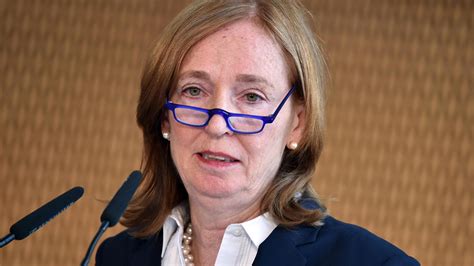
The conflict in Ukraine has fundamentally transformed Germany for the better, Berlin’s envoy to Washington has argued, while acknowledging her country has been far more affected by the economic backlash of anti-Russian sanctions than the US.
Emily Haber opened the op-ed, published by the Washington Post on Monday, with a description of “dimly lit” German airports and streets, cold homes and public buildings, rising gas prices and inflation running at 10%. The country also has to deal with over a million displaced Ukrainians, who are entitled to full health insurance, social benefits, housing and education at government expense.
“Increasingly, it is Europe (and not least Germany) that is bearing the brunt of the sanctions, not the United States,” writes Haber, before pivoting to argue that this doesn’t really matter.
German suffering is “almost nothing” compared to the hardships of the Ukrainian people, according to Haber, but more importantly, “our national psychology is undergoing a profound transformation.”
She calls the decades-long assumptions underlying Berlin’s policies, mainly that trade would promote “stability, transparency and, eventually, systemic change” an illusion that has been dispelled by the conflict.
“To be sure, there are dissenting voices, and there is discontent brewing in some parts of the country,” the ambassador notes in passing.
Germany has cut itself off from Russian energy imports, increased the export of weapons – mainly to Ukraine – and amended its constitution to create a 100 billion-euro fund for NATO-mandated “defense spending.”
Chancellor Olaf Scholz’s decision to increase military spending in February is the “most significant turning point in decades” for Germany, according to Haber. Even the reunification in 1990 “vindicated past strategic decisions and did not require a break with them,” unlike what’s happening now.
While admitting that all of this may seem irrelevant to Ukraine – whose priorities ought to matter more, she suggests – Haber is still proud of the “real and lasting” change Germany has achieved “in such a short time and at great psychological and material cost.”
“And we are happy to see that it is deepening our already close ties with our allies – first and foremost the United States,” she concludes.
Major New Autopsy Report Reveals Those Who Died Suddenly Were Likely Killed by the Covid Vaccine
BY WILL JONES | THE DAILY SCEPTIC | DECEMBER 5, 2022
A major new autopsy report has found that three people who died unexpectedly at home with no pre-existing disease shortly after Covid vaccination were likely killed by the vaccine. A further two deaths were found to be possibly due to the vaccine.
The report, published in Clinical Research in Cardiology, the official journal of the German Cardiac Society, detailed autopsies carried out at Heidelberg University Hospital in 2021. Led by Thomas Longerich and Peter Schirmacher, it found that in five deaths that occurred within a week of the first or second dose of vaccination with Pfizer or Moderna, inflammation of the heart tissue due to an autoimmune response triggered by the vaccine had likely or possibly caused the death.

Case characteristic of five deaths likely or possibly caused by the Covid vaccines
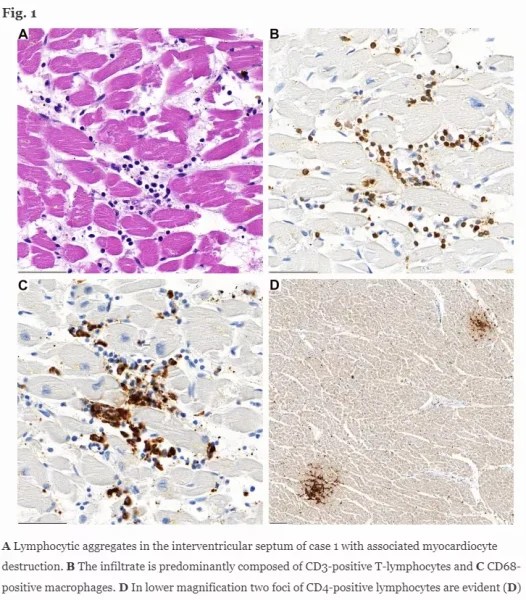
Lymphocyte immune cells (white blood cells) are shown in blue and brown among the heart tissue, causing localised inflammation that proved fatal
In total the report looked at 35 autopsies carried out at the University of Heidelberg in people who died within 20 days of Covid vaccination, of which 10 were deemed on examination to be due to a pre-existing illness and not the vaccine. For the remaining 20, the report did not rule out the vaccine as a cause of death, which Dr. Schirmacher has confirmed to me is intentional as the autopsy results were inconclusive. Almost all of the remaining cases were of a cardiovascular cause, as indicated in the table below from the supplementary materials, where 21 of the 30 deaths are attributed to a cardiovascular cause. One of these is attributed to blood clots (VITT) from AstraZeneca vaccination (the report was looking specifically at post-vaccine myocarditis deaths), leaving 20 from other cardiovascular causes.

For the five deaths in the main report attributed as likely or possibly due to the vaccines, the authors state:
All cases lacked significant coronary heart disease, acute or chronic manifestations of ischaemic heart disease, manifestations of cardiomyopathy or other signs of a pre-existing, clinically relevant heart disease.
This indicates that the authors limited themselves to deaths where there was no “pre-existing, clinically relevant heart disease”, making the report very conservative in which deaths it was willing to pin on the vaccines.
Dr. Schirmacher told me:
We included only cases, in which the constellation was unequivocally clear and no other cause of death was demonstrable despite all efforts. We cannot rule out vaccine effects in the other cases, but here we had an alternative potential cause of death (e.g. myocardial infarction, pulmonary embolism). If there is severe ischemic cardiomyopathy it is almost impossible to rule out myocarditis effects or definitively rule in inflammatory alterations as due to vaccination. These cases were not included.
We did not aim to include or find every case but the characteristics of definitive, unequivocal cases beyond any doubt. Only by this way you can establish the typical characteristics; otherwise less strict criteria may lead to ‘contamination’ of the collective; it is absolutely plausible that by these criteria we may have missed further cases but the intention of our study was never quantitative or extrapolation and there are numerous positive and negative bias. But we wanted to establish the fact not the size.
It is of course very possible that the vaccines also cause death where there is an underlying cardiovascular condition, and indeed, that it is more likely to do so. Thus these five deaths are the minimum from these autopsy cases in which the vaccines are involved – those in which there is no other plausible explanation.
It is worth noting here that initially in 2021, when the autopsies were first carried out, Dr. Schirmacher stated his team had concluded 30-40% of the deaths were due to the vaccines. These earlier estimates may give us a better indication of how many of the deaths the authors really think are attributable to the vaccines, when they are unconstrained by highly conservative assumptions (and looking at causes besides myocarditis). Note that these percentages are based on a selection of deaths that occurred shortly after vaccination, not a random sample of all deaths, so the authors rightly warn that no estimation of individual risk can be made from them.
Did the autopsies find spike protein from the vaccines present in the heart tissue? The samples from the five vaccine-attributed deaths were tested for infectious agents including SARS-CoV-2 (in one instance revealing “low viral copy numbers” of a herpes virus, which the authors deemed insufficient to explain the inflammation). However, no tests were done specifically for the virus spike protein or nucleocapsid protein, such as have been used successfully in other autopsies to aid attribution to the vaccine, so unfortunately this evidence was unavailable for these autopsies.
The autopsies in the report also only cover doses 1 and 2, not any booster doses, and only deaths within 20 days of vaccination, so the report doesn’t address directly the question of what’s been causing the elevated heart deaths since the booster rollouts from autumn 2021 or whether the vaccines can trigger cardiovascular death weeks or months later. (Other autopsies have confirmed that the spike protein can persist in the body for weeks or months after vaccination and trigger a fatal autoimmune attack on the heart.)
What the report does do, however, is establish that people who die suddenly in the days immediately following vaccination may well have died from a vaccine-related autoimmune attack on the heart. It also confirms how deadly even mild vaccine-induced myocarditis can be – and thus why studies like the one from Thailand, finding cardiovascular adverse effects in around a third of teenagers (29.2%) following Pfizer vaccination and subclinical heart inflammation in one in 43 (2.3%), and the study from Switzerland finding at least 2.8% with subclinical myocarditis and elevated troponin levels (indicating heart injury) across all vaccinated people, are so worrying.
The authors of the new study diplomatically write that the “reported incidence” of myocarditis after vaccination is “low” and the risks of hospitalisation and death associated with COVID-19 are “stated to be greater than the recorded risk associated with COVID-19 vaccination” – notably declining to commit themselves to the official propositions that they dutifully repeat.
The fact that those who die suddenly after vaccination may have died from the hidden effects of the Covid vaccine on their heart is thus now firmly established in the medical literature. The big remaining question is how often it occurs.
Dr. John Campbell has produced a helpful overview of the report’s findings in his latest video.
The rate of respiratory infection among German children is now approaching 25%, as lockdown harms continue
Without regular exposure to common pathogens, mothers can no longer confer crucial early immunity to their infants through breast milk.
eugyppius: a plague chronicle | December 5, 2022
The German fever gauge, Grippe Web, suggests that nearly one in four German children under 15 are currently suffering some kind of respiratory infection.

Thick red line: rate of acute respiratory infection in children in 2022/23; thin orange line: the rate in 2021/22; dotted orange line; the rate in 2020/21. Thick green line: the rate in adults 2022/23; thin green late: the rate in 2021/22; dotted green line: the rate in 2020/21.
The rate is especially high in children under 4, a demographic that has seen elevated rates of illness for over a year now.

Red line is 0-to-4 year-olds.
This isn’t the vaccines (almost no children under 5 have been vaccinated), and it’s not just a coincidence or a bad year for RSV either. It’s a direct consequence of mass containment. While lockdowns didn’t do much about SARS-2, they appear to have reduced the incidence of other, slower-moving viruses considerably. Young women in particular have been underexposed to RSV for three years now, with the result that their breast milk confers far less passive immunity against common viruses than it did in the pre-pandemic era.
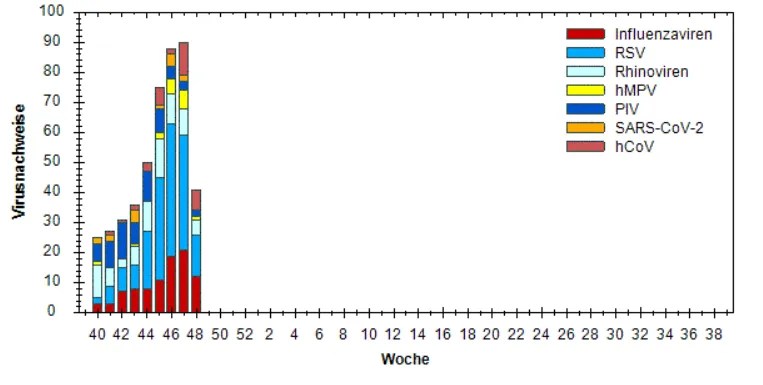
The chart, from the flu surveillance division of the RKI, shows that RSV is by far the most dominant infection among under five years olds. The virus is particularly dangerous for infants.
Measures sold to the public as means of keeping our healthcare system from collapsing, have thus resulted in unprecedented pressure on German pediatric treatment facilities and hospitals, with dying children facing delayed operations and long transfers to outlying hospitals. Obviously it doesn’t help that the zealous vaccinators have driven away scarce healthcare staff with their mandates and other pointless harassment. All those people who spent 2021 singing the praises of lockdowns and crowing that they hadn’t had so much as a cold since the pandemic started, should now be made aware of what their policy preferences actually cost. Adults are supposed to get mild upper respiratory infections once in a while. If they don’t, their infants will get them instead, and some will die.
The Manhattan Contrarian Energy Storage Paper Has Arrived!
By Francis Menton | Manhattan Contrarian | December 1, 2022
Today my long-awaited energy storage paper was officially published on the website of the Global Warming Policy Foundation. Here is a link. The paper is 22 pages long in the form in which they have published it plus another few pages for an Executive Summary and table of contents. They have given it the title “The Energy Storage Conundrum.”
Most of the points made in the paper have been made previously on this blog in one form or another. However, there is a good amount of additional detail in the paper that has never appeared here. I’ll provide one example of that today, and more of same in coming days.
The main point of the paper is that an electrical grid powered mostly by intermittent generators like wind and sun requires full backup from some source; and if that source is to be stored energy, the amounts of storage required are truly staggering. When you do the simple arithmetic to calculate the storage requirements and the likely costs, it becomes obvious that the entire project is completely impractical and unaffordable. The activists and politicians pushing us toward this new energy system of wind/solar/storage are either being intentionally deceptive or totally incompetent.
If you follow the news on this subject at a general level, you might find this conclusion surprising. After all, there are frequent announcements that this or that jurisdiction has entered a contract to purchase some seemingly large amount of batteries for grid-level storage. The Report cites data from consultancy Wood Mackenzie as to announced plans or contracts for storage acquisition in all major European countries, and cites other reports as to announced plans from California and New York in the U.S. The title of the April 2022 Wood Mackenzie paper on Europe certainly gives the impression that these people have the situation under control and know what they are doing: “Europe’s Grid-scale Energy Storage Capacity Will Expand 20-fold by 2031.” Impressive!
But this is one of those subjects on which you have to look at the actual numbers to evaluate whether the plans make any sense. In this situation, you need to compare the amount of energy storage that would be required for full backup of an almost-entirely wind/solar grid (with fossil fuels excluded), to the actual quantity of grid-scale energy storage being acquired.
Consider the case of Germany, the country that has gone the farthest of any in the world down the road to “energy transition.” My Report presents two different calculations of the energy storage requirement for Germany in a world of a wind/solar grid and no fossil fuels allowed (both of which calculations have been previously covered on this blog). One of the calculations, by a guy named Roger Andrews, came to a requirement of approximately 25,000 GWh; and the other, by two authors named Ruhnau and Qvist, came to a higher figure of 56,000 GWh. The two use similar but not identical methodology, and somewhat different assumptions. Clearly there is a large range of uncertainty as to the actual requirement; but the two calculations cited give a reasonable range for the scope of the problem.
To give you an idea of just how much energy storage 25,000 (or 56,000) GWh is, here is a rendering (also from my Report) of a grid-scale battery storage facility under construction in Queensland, Australia by Vena Energy. The facility in the rendering is intended to provide 150 MWh of storage.
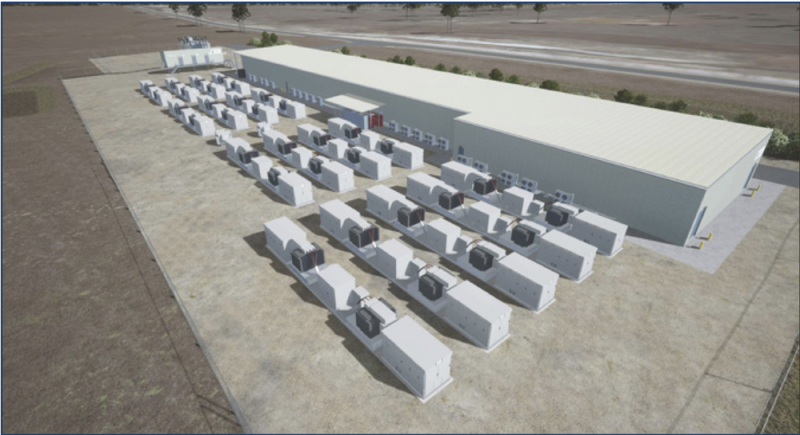
Remember that 150 MWh is only 0.15 of one GWh. In other words, it would take about 167,000 of these facilities to provide 25,000 GWh of storage, and about 373,000 of them to get to the 56,000 GWh in the larger estimate.
And against these projections of a storage requirement in the range of tens of thousands of GWh, what are Germany’s plans as presented in this “20-fold expansion” by 2031? From my Report:
In the case of Germany, Wood Mackenzie states that the planned energy storage capacity for 2031, following the 20-fold expansion, is 8.81GWh.
Rather than tens of thousands of GWh, it’s single digits. How does that stack up in percentage terms against the projected requirements?:
In other words, the amount of energy storage that Germany is planning for 2031 is between 0.016% and 0.036% of what it actually would need. This does not qualify as a serious effort to produce a system that might work.
The story is the same in the other jurisdictions covered in the Report. And remember, these are the jurisdictions that consider themselves the leaders and the vanguard in the transition to renewable energy. For example, New York, with an estimated storage requirement for a mainly-renewables grid of 10,000-15,000 GWh, is said by trade magazine Utility Dive to be “forging ahead” with plans to procure some 6 GW of grid storage (presumably translating into about 24 GWh). That would come to around 0.2% of what is needed. Unless, of course, New York simultaneously “forges ahead” with its plans to triple the demand on the grid by electrifying all automobiles and home heating; in that case the 24 GWh would be back down to less than 0.1% of the storage requirement.
California? The Report cites another article from Utility Dive stating that the California Public Utilities Commission has ordered the state’s power providers to collectively procure by 2026 some 10.5 GW (or 42.0 GWh) of lithium-ion batteries for grid-scale storage:
The additional 10.5 GW of lithium-ion storage capacity, translating to at most about 42 GWh, would take California all the way to about 0.17% of the energy storage it would need to fully back up a wind/solar generation system.
However bad you might think this situation is, it’s worse. Am I the only person who has ever made these simple calculations? I certainly have never seen them anywhere else.
I would be very happy to be proved wrong about any and all of this. All I say is that the proponents of this miraculous fantasy energy future owe it to the rest of us to build a working demonstration project before forcing us all to adopt their utopian scheme at ruinous cost, only to find out that it won’t work and can’t work.
Here’s what tells you all you need to know: not only is there no working demonstration project anywhere in the world of the wind/solar/storage energy system, but there is none under construction and none even proposed. Instead, the proponents’ idea is that your entire state or country is to be the guinea pig for their dreams. After all, they are “saving the planet.” If there has ever previously been something this crazy in the history of the world, I certainly can’t name it.
War on Global Agriculture: The Unsustainable ‘Sustainable’ UN Agenda 2030
By F. William Engdahl | Global Research | December 1, 2022
Over the past weeks a coordinated all-out assault on our agriculture—the ability to produce food for human existence—has begun. The recent G20 governmental meeting in Bali, the UN Agenda 2030 Cop27 meeting in Egypt, the Davos World Economic Forum and Bill Gates are all complicit. Typically, they are using dystopian linguistic framing to give the illusion they are up to good when they are actually advancing an agenda that will lead to famine and death for hundreds of millions if not billions if allowed to proceed. It’s driven by a coalition of money.
From G20 to Cop27 to WEF
On November 13 the G20–representatives of the 20 most influential nations including the USA, the UK, the European Union (though it’s no nation), Germany, Italy, France, Japan, South Korea, and several developing countries including China, India, Indonesia and Brazil,– agreed on a final declaration.
The first major item is a “call for an accelerated transformation towards sustainable and resilient agriculture and food systems and supply chains.”
Further, “working together to sustainably produce and distribute food, ensure that food systems better contribute to adaptation and mitigation to climate change, and halting and reversing biodiversity loss, diversify food sources…”
In addition they called for “inclusive, predictable, and non-discriminatory, rules-based agricultural trade based on WTO rules.”
As well, “We are committed to supporting the adoption of innovative practices and technologies, including digital innovation in agriculture and food systems to enhance productivity and sustainability in harmony with nature…”
Then comes the revealing statement: “We reiterate our commitment to achieve global net zero greenhouse gas emissions/carbon neutrality by or around mid-century.” [i](emphasis mine)
“Sustainable agriculture” with “net zero greenhouse gas emissions” is Orwellian doublespeak. For an outsider to UN linguistics, the words sound too good. What in fact is being promoted is the most radical destruction of farming and agriculture globally under the name “sustainable agriculture.”
Following the Bali G20 confab by only days was the United Nations’ COP27 annual Green Agenda Climate Summit meeting in Egypt. There, the participants from most UN countries along with NGOs such as Greenpeace and hundreds of other green NGOs drafted a second call. COP27 launched something they revealingly call FAST– UN’s new Food and Agriculture for Sustainable Transformation (FAST) initiative. Fast, as in “to abstain from food…”
According to Forbes, FAST will promote a “shift towards sustainable, climate-resilient, healthy diets, would help reduce health and climate change costs by up to US$ 1.3 trillion while supporting food security in the face of climate change.” We are talking big numbers. $1.3 trillion by transition to “sustainable, climate-resilient, healthy diets” that would reduce cost of climate change by $1.3 trillion. [ii] What’s really going on behind all these words?
Big Money Behind
According to the UN Food and Agriculture Organization speaking to Reuters during COP27, within a year the FAO will launch a “gold standard” blueprint for reduction of so-called Greenhouse gases from agriculture.
The impulse for this war on agriculture comes not surprisingly from big money, FAIRR Initiative, a UK-based coalition of international investment managers which focuses on “material ESG risks and opportunities caused by intensive livestock production.”
Their members include the most influential players in global finance including BlackRock, JP Morgan Asset Management, Allianz AG of Germany, Swiss Re, HSBC Bank, Fidelity Investments, Edmond de Rothschild Asset Management, Credit Suisse, Rockefeller Asset Management, UBS Bank and numerous other banks and pension funds with total assets under management of $25 trillion.[iii] They are now opening the war on agriculture much as they have on energy. The UN FAO Deputy Director for Climate Change policies, Zitouni Ould-Dada said during the COP27 that, “There has never been this much attention to food and agriculture anytime before. This COP is definitely the one.” [iv]
The FAIRR claims, without proof, that:
“food production accounts for around a third of global greenhouse gas emissions and is the main threat to 86% of the world’s species at risk of extinction, while cattle ranching is responsible for three quarters of Amazon rainforest loss.” [v]
The FAO plans to propose drastic reduction in global livestock production, especially cattle, which FAIRR claims is responsible for:
“nearly a third of the global methane emissions linked to human activity, released in the form of cattle burps, manure and the cultivation of feed crops.”
For them, the best way to stop cow burps and cow manure is to eliminate cattle. [vi]
Unsustainable Sustainable Agriculture
The fact that the UN FAO is about to release a roadmap to drastically reduce so-called greenhouse gases from global agriculture, under the false claim of “sustainable agriculture” that is being driven by the world’s largest wealth managers including BlackRock, JP Morgan, AXA and such, tells volumes about the true agenda. These are some of the most corrupt financial institutions on the planet. They never put a penny where they are not guaranteed huge profits. The war on farming is their next target.
The term “sustainable” was created by David Rockefeller’s Malthusian Club of Rome. In their 1974 report, Mankind at the Turning Point, The Club of Rome argued:
“Nations cannot be interdependent without each of them giving up some of, or at least acknowledging limits to, its own independence. Now is the time to draw up a master plan for organic sustainable growth and world development based on global allocation of all finite resources and a new global economic system. [vii](emphasis mine)
That was the early formulation of the UN Agenda 21, Agenda2030 and the 2020 Davos Great Reset. In 2015 UN member nations adopted what is called the Sustainable Development Goals or SDGs: 17 Goals to Transform our World. Goal 2 is “End hunger, achieve food security and improved nutrition and promote sustainable agriculture.”
But if we read in detail into proposals of COP27, G20 and Davos WEF of Klaus Schwab we find what is meant by these nice sounding words. Now we are being inundated with claims, unverified, by numerous government and privately-funded think tank models that our agriculture systems are a major cause of, yes, global warming. Not only CO2 but methane and nitrogen. Yet the entire global greenhouse gas argument that our planet is on the brink of irreversible disaster if we do not radically change our emissions by 2030 is unverifiable nonsense from opaque computer models. Based on these models the UN IPCC insists that if we do not stop a global temperature rise of 1.5 C above the level of 1850, by 2050 the world will essentially end.
The War Is Just Beginning
The UN and Davos WEF teamed up in 2019 to jointly advance the SDG UN Agenda 2030. On the WEF website this is openly admitted to mean getting rid of meat protein sources, introducing promoting unproven fake meat, advocating alternative protein such as salted ants or ground crickets or worms to replace chicken or beef or lamb. At COP27, discussion was about “diets that can remain within planetary boundaries, including lowering meat consumption, developing alternatives, and spurring the shift towards more native plants, crops and grains (thus reducing the current reliance on wheat, maize, rice, potatoes).” [viii]
The WEF is promoting a shift from meat protein diets to vegan arguing it would be more “sustainable”. [ix] They also promote lab-grown or plant-based lab meat alternatives such as the Bill Gates-funded Impossible Burgers, whose own FDA tests indicate it is a likely carcinogen as it is produced with GMO soy and other products saturated with glyphosate. The CEO of Air Protein, another fake meat company, Lisa Lyons, is a special WEF adviser. WEF also promotes insect protein alternatives to meat. Note also Al Gore is a Trustee of WEF. [x]
The war on animal raising for meat is just getting deadly serious. The government of the Netherlands whose Prime Minister Mark Rutte, formerly of Unilever, is a WEF Agenda Contributor, has created a special Minister for the Environment and Nitrogen, Christianne van der Wal. Using a never-invoked and outdated EU Natura 2000 nature protection guidelines designed allegedly to “protect moss and clover,” and based on fraudulent test data, the Government just announced it will forcibly close 2,500 cattle farms across Holland. Their goal is to force fully 30% of cattle farms to close or face expropriation.
In Germany the German Meat Industry Association (VDF), says that within the next four to six months Germany will face a meat shortage, and prices will skyrocket. Hubert Kelliger, a VDF board member said, “In four, five, six months we will have gaps on the shelves.” Pork is expected to experience the worst shortages. The issues in meat supply are due to Berlin insisting on reducing the numbers of livestock by 50% to reduce global warming emissions. [xi] In Canada, the Trudeau government, another Davos WEF product, according to the Financial Post of July 27, plans to cut emissions from fertilizer 30 per cent by 2030 as part of a plan to get to net zero in the next three decades. But growers are saying that to achieve that, they may have to shrink grain output significantly.
When the autocratic President of Sri Lanka banned all import of nitrogen fertilizers in April 2021 in a brutal effort to return to a past of “sustainable” agriculture, harvests collapsed in seven months and famine and farmer ruin and mass protests forced him to flee the country. He ordered that the entire country would immediately switch to organic farming but provided farmers with no such training.
Combine all this with the catastrophic EU political decision to ban Russian natural gas used to make nitrogen-based fertilizers, forcing shutdowns of fertilizer plants across the EU, that will cause a global reduction in crop yields, and as well the fake Bird Flu wave that is falsely ordering farmers across North America and the EU to kill off tens of millions of chickens and turkeys to cite just a few more cases, and it becomes clear that our world faces a food crisis that is unprecedented. All for climate change?
*
F. William Engdahl is strategic risk consultant and lecturer, he holds a degree in politics from Princeton University and is a best-selling author on oil and geopolitics. He is a Research Associate of the Centre for Research on Globalization (CRG).
Notes
[i] G20 Bali Leaders’ Declaration, Bali, Indonesia, 15-16 November 2022, https://www.consilium.europa.eu/media/60201/2022-11-16-g20-declaration-data.pdf
[ii] Kit Knightly, COP27 reignites the war on food, https://www.theburningplatform.com/2022/11/13/lab-grown-meat-nuclear-yeast-vats-cop27-reignites-the-war-on-food/
[iii] https://www.fairr.org/about-fairr/network-members/page/14
[iv] Sarah El Safty, Simon Jessop, COP27: UN food agency plan on farming emissions to launch by next year after investor push, November 10, 2022, https://www.reuters.com/business/cop/cop27-un-food-agency-plan-farming-emissions-launch-by-next-year-after-investor-2022-11-10/
[v] FAIRR Initiative, Where’s The Beef, https://www.fairr.org/wheres-the-beef/
[vi] Simon Jessop, Gloria Dickie, Global investors write to U N to urge global plan on farming emissions, June 9, 2022, https://www.reuters.com/business/sustainable-business/exclusive-global-investors-write-un-urge-global-plan-farming-emissions-2022-06-08/
[vii] Club of Rome, Mankind at the Turning Point, 1974, https://web.archive.org/web/20080316192242/http:/www.wiseupjournal.com/?p=154
[viii] THE SHARM EL SHEIKH CLIMATE IMPLEMENTATION SUMMIT, cop27.eg 1, Round table on “Food Security” 7th November 2022, https://cop27.eg/assets/files/days/COP27%20FOOD%20SECURITY-DOC-01-EGY-10-22-EN.pdf
[ix] Vegan, vegetarian or flexitarian? 3 ways to eat more sustainably, October 28, 2022, https://www.weforum.org/agenda/2022/10/vegan-plant-based-diets-sustainable-food/
[x] WEF, Have we reached the end of meat?, https://www.weforum.org/podcasts/house-on-fire/episodes/have-we-reached-the-end-of-meat
[xi] J. Shaw, Germany cutting back meat production to fight global warming, November 21, 2022, https://hotair.com/jazz-shaw/2022/11/21/germany-cutting-back-meat-production-to-fight-global-warming-n512518
Copyright © F. William Engdahl, Global Research, 2022
Featured Video

The Truth About the Trump Shootings with Ken Silva
or go to
Aletho News Archives – Video-Images
From the Archives
Trans ‘milk’ as good as the real thing – NHS
RT | February 18, 2024
The drug-induced nipple secretions of trans women are as good as mothers’ breast milk for babies, the University of Sussex Hospitals NHS Trust claimed in a letter to campaigners made public in a report by British think tank the Policy Exchange on Sunday.
The healthcare trust’s medical director, Rachel James, argued that the off-label prescription drug cocktail men transitioning to female take in order to produce milk was “similar to the natural hormones which encourage lactation to develop when the baby is newly born.”
“The evidence which is available demonstrates that the milk is comparable to that produced following the birth of a baby,” James wrote in the letter, sent to Children of Transitioners last August.
Biological men who wish to lactate must first take hormones to grow milk glands and then take high doses of either domperidone or metoclopramide to stimulate milk production. Neither drug is approved for this use, though they are occasionally prescribed off-label to biological women who have trouble lactating.
However, domperidone’s own manufacturer, Janssen, warns patients the drug “may cause unwanted side effects affecting the heart in a breastfed baby” and “should be used during breastfeeding only if your physician considers this clearly necessary.” … continue
Blog Roll
 Aletho News
- Anthrax Attacks Paved Way for COVID-Era ‘Junk Drugs and Vaccines’
- How Real Is the Impact of Western Sanctions on Israel?
- France, You Are Guilty: How Paris Turned Western Sahara into the Maghreb’s Powder Keg
- 2025 Nature Paper Claiming Worsening Global Drought Gets RETRACTED …Heavily Flawed
- Your Milk Is Not the Problem
- The Truth About the Trump Shootings with Ken Silva
- ARE PATIENTS BEING PROPERLY INFORMED ABOUT OZEMPIC?
- US lawmaker blocks $2.8 billion weapons sale to Israel: Report
- Yemeni army claims responsibility for strikes on sensitive sites in Saudi capital, Aramco facilities in Yanbu
- Iran Judiciary issues indictments against 159 US, Israeli officials for assassination of Leader, commanders
- If Americans Knew
- Salah Sarsour’s Legal Team Says DHS Has Not Met Its Burden to Prove He Is Deportable
- An analysis of tax forms by The Intercept show Kraft’s charity and LLC have donated to Friends of the IDF and AIPAC’s super PAC.
- Israeli attacks kill four Palestinians in Gaza – Daily Update
- Inside Gaza’s death trap of collapsing, bombed-out buildings
- The everyday items Israel bans from Gaza every day
- Inside the siege, the ruined buildings of Gaza – Daily Update
- Debunking The Claim That Macklemore Has A “History Of Antisemitism”
- CPJ demands release of arrested Palestinian-US journalist near Bethlehem
- Robert Kraft: The Billionaire Friend of Netanyahu Pulling The Strings Behind the Macklemore/Ed Sheeran Blow Up
- Columbia Administered Fund Gives Big Money to Pro-Israel Groups
- No Tricks Zone
- 2025 Nature Paper Claiming Worsening Global Drought Gets RETRACTED …Heavily Flawed
- New Study: ‘Global Drought Shows No Detectable Recent Acceleration Under Climate Warming’
- Economic Masterminds: German Socialists Suggest Taxing Productivity Gains Stemming From Using AI
- The South China Sea Has Not Been Cooperating With The Climate Change Narrative
- Energy Crisis: Germany Enters Heating Season With Historically Low Gas Reserve Fill Levels
- New Study: The Antarctic Ice Sheet Gained Mass From 2020-2024 Due To Staggering Snow And Ice Accumulation
- Study: Ocean Heating Rates From Thousands Of Years Ago ‘Dwarf’ Modern Ocean Heating Rates
- Climate Extremists Target, Attack Large-Scale Power Grid Infrastructure In Germany!
- New Study: Antarctic Ice Melt Has Contributed Less Than 1 Centimeter To Sea Level Rise In The Last 30 Years
- Fear Of Debate: Alarmist German Climate Scientist Calls On Mainstream Media To Discredit Skeptic Voices
 Aletho News