Russia sanctions a ‘dead horse,’ seriously damaged economy – German regional heads
RT | January 27, 2018
Anti-Russian sanctions have achieved nothing other than placing a significant burden on the German economy, prime ministers of two German federal states have argued, calling on fellow regional leaders to demand their lifting.
The German government should gradually lift sanctions it imposed against Russia over its alleged role in the Ukrainian crisis, Minister President of Saxony-Anhalt Reiner Haseloff told journalists in the German city of Magdeburg on Friday. He said he would raise the issue at a conference of the heads of five German states on Monday and urge them to adopt a unified position against the anti-Russian sanctions.
The initiative has already been supported by Bodo Ramelow, Minister President of Thuringia, who said the German economy had already suffered enough because of the effects of the sanctions. “There must be an exit strategy [as to] the anti-Russian sanctions,” Ramelow told the German DPA news agency, adding that “they have already seriously damaged us economically.”
Sanctions are “a dead horse one should not ride anymore,” Ramelow told Der Spiegel as he pointed out that they did not actually contribute anything to the resolution of the Ukrainian crisis. Ukraine’s problems cannot be “solved through a symbolic policy at the expense of our industries,” he said.
Economic restrictions that the EU imposed against Russia indeed put a heavy burden on the economy of Germany, and its eastern states in particular. Between 2014 and 2016, the volume of Russian imports to the eastern German states has halved while the volume of their export to Russia has decreased by one third, Der Spiegel reported citing the German Federal Statistical Office.
Eastern German states might lose access to some markets for a long period of time, Ramelow warned, adding that Germany’s agriculture and food industries are hit particularly hard by this situation. “However, this is not just about agriculture, but also about machine industry and the [sector] of engineering technologies,” he added.
The head of Thuringia also said that the initiative of the East German states might receive backing from other parts of Germany. “I have heard that Bavaria could possibly support it,” Ramelow said, as cited by DPA.
In the meantime Haseloff, a member of the German Chancellor Angela Merkel’s Christian Democratic Union (CDU), said that he would put the issue of lifting the anti-Russian sanctions on the agenda of the ongoing collation talks between the CDU and the Social Democrats. The politician, who is part of the CDU negotiating team, said he would do so in case the head of the eastern German states succeed in forming a unified position on the issue.
In December 2017, a study published by the Kiel Institute for the World Economy showed that Germany is de facto Europe’s biggest loser from the EU penalties introduced against Russia. German exports to Russia dropped nearly 40 percent with the country losing €618 million ($768 million) each month because of the sanctions.
The sanctions were introduced in 2014 over Russia’s alleged involvement in the conflict in eastern Ukraine and its reunification with Crimea. The EU restrictions targeted Russia’s financial, energy and defense sectors, along with some government officials, businessmen and public figures.
Moscow responded by imposing an embargo on agricultural produce, food and raw materials on countries that joined the anti-Russian sanctions. Since then both sides have repeatedly broadened and extended the restrictive measures.
Germany stops arms sales to Saudi Arabia
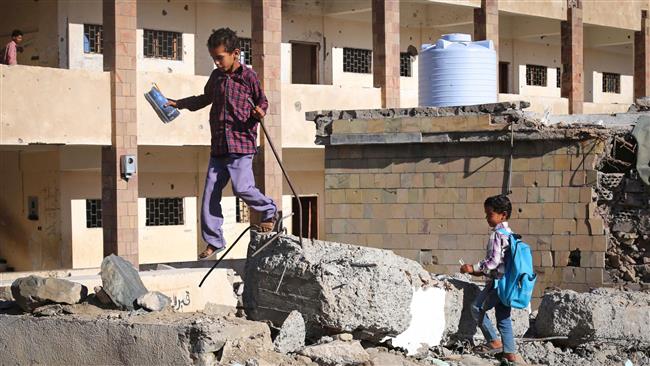
Yemeni children walk outside a school that was damaged in a Saudi air strike in the southern Yemeni city of Ta’izz. (By AFP)
Press TV – January 20, 2018
Germany has stopped selling weapons to Saudi Arabia and almost all of its allies waging war on Yemen, in a decision likely to have both an impact on the Riyadh regime and a domino effect on other Western and non-Western countries exporting arms to Saudi Arabia.
German government spokesman Steffen Seibert said on Friday that the Federal Security Council was no longer issuing export licenses that “are not in accordance with the conclusion of the exploratory talks,” Germany’s official DPA news agency reported.
The official was referring to ongoing negotiations among the German political factions of the Christian Democratic Union, the Christian Social Union, and Social Democrats on the formation of a new coalition government.
A draft paper on arms exports that came out of those talks said “the federal government, with immediate effect, will no longer export arms to countries as long as they are involved in the Yemeni war.”
Around 13,600 people have died since Saudi Arabia started leading a number of its vassal states in an invasion of Yemen in March 2015.
The war, which enlists the participation among others of the United Arab Emirates, Jordan, Egypt, Bahrain, Kuwait, Morocco, Sudan, and Senegal, has been reinforced by weapon supplies and logistical support from the United States and the United Kingdom.
Washington signed a $110-billion arms deal with Riyadh last year.
By stopping its own arms sales to Saudi Arabia, European heavyweight Germany may become a model for other Western and non-Western powers already under pressure to end their arms sales to the Riyadh regime. Rights groups have long called for an arms embargo on Saudi Arabia over potential war crimes in Yemen.
A United Nations panel recently compiled a detailed report of civilian casualties caused by the Saudi military and its allies during the war, saying the Riyadh-led coalition has used precision-guided munitions in its raids on civilian targets.
“The attacks were carried out by precision-guided munitions, so it is likely these were the intended targets,” the panel’s report said, according to Al Jazeera.
Saudi Arabia and the UAE were among the top recipients of German-made weaponry in 2016.
The DPA report said, “The German public is traditionally wary of arms deals and [Chancellor Angela] Merkel has been pressured to end sales to countries with precarious human rights records.”
The only exception to the German freeze is Jordan, which will be receiving 130 million euros’ (158 million dollars’) worth of military equipment. Jordan hosts a squadron of German Tornado fighter planes and other hardware used by German Armed Forces.
German opposition calls to reverse online hate speech law
RT | January 7, 2108
New online hate speech regulations which took effect Monday, stipulates that German authorities can impose huge fines of up to €50 million ($60.1 million) on social media platforms which fail to promptly delete offensive content.
The parliamentary leader of the Left Party, Sahra Wagenknecht, called the legislation a “slap in the face for all democratic principles,” claiming the courts, rather than private companies, should determine what constitutes unlawful content.
Nicola Beer, the General Secretary of the liberal Free Democrats (FDP), expressed similar sentiments. “The past few days have clearly shown private providers aren’t always able to make the right decision,” she told the Welt am Sonntag newspaper.
Other politicians, such as the leader of the Greens, Simone Peter, argued the law hampered free speech in Germany, leaving it at hands of US corporations to decide what was “hate speech” and what was not.
US should have withdrawn its estimated 200 nukes from Europe long ago – Moscow
RT | December 18, 2017
The US should withdraw the nuclear weapons it has deployed in Europe rather than upgrading them, a senior Russian diplomat has said. Moscow is concerned that the upgrades are making the bombs more suitable for actual combat.
The US stores an estimated 200 of its B61 nuclear bombs in countries like Germany, Belgium, Italy, the Netherlands and Turkey as part of NATO’s nuclear sharing program. Russia has long considered the continued presence of American nuclear weapons in other nations as a hostile gesture after the Cold War.
“Russia has long withdrawn its nuclear weapons to its national territory. We believe that the American side should have done the same a long time ago,” Mikhail Ulyanov, head of the non-proliferation and arms control department in the Russian Foreign Ministry, told RIA Novosti.
“They are actually planning to upgrade them to be, according to some retired American military officials, ‘more suitable for combat use’ thanks to better precision and somewhat reduced power,” the diplomat said, adding that Moscow suspects that the US may have plans to deploy additional nuclear bombs to Europe under the guise of an upgrade.
In August, the US National Nuclear Security Administration announced a second successful test of the B61 – the 12th version of the bomb with no nuclear warhead. The first test was conducted in March. The Mod12 version is meant to replace a number of older designs by refurbishing them, with the process expected to start in 2019.
Moscow criticized the US not only for keeping nuclear weapons in non-nuclear nations, but also for training its NATO allies in their deployment. Such actions, Russia believes, violate the spirit of America’s non-proliferation commitments.
The Trump administration plans to spend over $1 trillion upgrading America’s nuclear arsenal, claiming it is necessary to keep up with Russia.
German Minister Drafts Law Allowing Intelligence to Spy on Citizens – Report
Sputnik – December 1, 2017
Germany’s Interior Minister Thomas de Maizière worked out a draft proposal that might force automotive and tech corporations to provide the country’s intelligence agencies with “back door” access to any digital device, including smartphones, laptops, private cars and smart TVs, the RedaktionsNetzwerk Deutschland (RND) reported.
The politician has justified his idea by the fact that the country’s security services are increasingly facing difficulties breaking through the systems that protect digital items.
For instance, the locking systems on cars have become so advanced and intelligent that their owners are informed via messenger even about the slightest movements of their vehicles. With the new law, De Maizière wants to prevent these automatic notifications if the law-enforcement services believe it to be justified by their investigation.
The initiative also goes further and intends to provide the German intelligence agencies with “backdoor” access to any device connected to the internet. In this case, they would only require the authorization of a judge to demand the secret data from tech corporations and hack into someone’s phone. The move, which is considered a preventive measure to ensure security and quickly find criminals, “dramatically extends” the state’s capability to conduct espionage against its citizens, RND wrote.
The initiative has caused severe criticism among activists and the country’s politicians, especially due to Germany’s previous espionage record.
In 2015, German intelligence agencies were reported to have been spying on European politicians and companies at the behest of the US National Security Agency (NSA).
UAE buys new weapons worth $684 million from US firm
Press TV – November 14, 2017
The United Arab Emirates (UAE) has signed a new deal with an American arms manufacturer under which the firm would supply the small Persian Gulf country with laser-guided bombs, authorities say.
The deal, announced Tuesday at the Dubai Airshow and worth 2.5 billion dirhams ($684.4 million), would see the American missile maker Raytheon Co. sell GBU-10 and GBU-12 Paveway laser-guided bomb kits to Abu Dhabi, among other weapons.
UAE authorities also signed arms deals with Germany’s Rheinmetall to buy artillery from the company. The contract will also enable Rheinmetall to support Etihad Airways with transportation equipment.
The purchase of weapons comes amid the UAE’s involvement in a deadly campaign, led by Saudi Arabia, against Yemen. More than 10,000 people have been killed and over two million have been displaced since March 2015, when the regime in Riyadh began the campaign.
Abu Dhabi has also announced plans for buying 75 Mirage 2000-9 aircraft from the French multinational company Dassault and Thales to upgrade its air force fleet. That comes despite increasing calls for a halt to the UAE’s contribution to the devastating Saudi-led airstrikes on civilian areas in Yemen.
Saudi Arabia and the UAE are two major recipients in the Persian Gulf of weapons from the United States and other Western countries. Other countries in the region have accused the two of sparking an arms race by their excessive purchase of modern weaponry from the West.
Reports over the past few years have indicated that much of the UAE’s modern weaponry have found their way into the hands of militants in Libya, where Abu Dhabi supports an administration opposed to Tripoli’s internationally-recognized government.
Washington’s economic war against Russian gas supplies to Europe unacceptable – Gerhard Schroeder
RT | October 20, 2017
The United States would like to weaken Russia’s energy cooperation with the European Union, said former German Chancellor Gerhard Schroeder, adding it’s unacceptable to create barriers to Russian gas deliveries to the German market.
“It’s wrong if the Americans and the European Union somehow resist each other on this issue. And still there are attempts to create some difficulties for this project [Nord Stream 2 gas pipeline – Ed.],” he told Rossiya 24 news channel.
According to Schroeder, “the fact the Americans will try entering the German market with the help of sanctions and to dominate with its liquefied shale gas is nothing but the signs of an economic war, and such war is unacceptable.”
Germany is interested in gas which it “will receive for sure and which will be cheaper than shale gas,” said Schroeder.
The ex-chancellor said German authorities were right to call the Nord Stream 2 gas pipeline purely an economic project which should not be politicized.
Last week, European Commissioner for Competition Margrethe Vestager said the EU has no legal means to stop the pipeline that will deliver natural gas from Russia to Germany.
The Nord Stream 2 pipeline will double the capacity of the existing Nord Stream pipeline, which goes under the Baltic Sea to Germany. The Gazprom-led project is opposed by the Baltic States and Poland.
During the EU summit on Friday, Polish Prime Minister Beata Szydlo described the Nord Stream 2 pipeline as a threat to European energy security.
Russian President Vladimir Putin said this week Moscow faces obstacles constructing the new route despite the fact that diversification of gas supplies is cost-effective, beneficial to Europe and serves to enhance the security of supplies.
The Kremlin has repeatedly said the pipeline is strictly about business, accusing the United States of trying to thwart the project, as it wants to export its own liquefied natural gas to Europe.
Manipulation or Not? US Role in German Bundestag Elections
Sputnik – October 15, 2017
The Bundestag elections were “undoubtedly” influenced by the US, an ex-head of a German trade union, Friedhelm Klinkhammer, said, commenting on a recent Ifop poll according to which many Europeans believe the US interferes in political processes in other countries. However, German researcher Dr. Martin Thunert adheres to a different point of view.
Many mainstream German journalists are members of the pro-American “Atlantic Bridge” foundation, which is why they often cover certain events in a biased manner, the former division head of one of the largest German trade unions, ver.di, at the NDR broadcast company, told Sputnik Germany.
“Before their appointment, all of these journalists visited the United States, where they clearly perfected their pro-American position,” Klinkhammer said.
He stressed that during the parliamentary election campaign in Germany, Merkel’s domestic policy was barely covered and without any criticism, while her foreign policy was presented in an exaggeratedly positive manner, with the chancellor being portrayed as an outstanding German politician and the actual head of the EU.
“This line of ‘silence’ in domestic politics and exaltation of her foreign policy that was consistently followed by the media guaranteed that Merkel didn’t attract negative attention, even though she alone was responsible for the consequences of Germany’s migration strategy. Thus journalists diverted attention from Merkel and focused on the Alternative for Germany (AfD) instead,” Klinkhammer noted.At the same time, Dr. Martin Thunert, an expert on the US and research fellow at the Heidelberg Center for American Studies, does not believe that the influence of the “Atlantic Bridge” foundation determined the results of the elections to the German Bundestag.
Thunert himself attended the meetings of the organization, and he is confident that journalists are not blind executors of other people’s orders.
“I think that if the US would have really applied some kind of manipulations in this area, Merkel’s results would be better,” the expert said.
Moreover, Thunert believes that the situation in which different factions, united by common interests, support some candidates and campaign against others is a normal process in a pluralistic society. Influence should not be equated to manipulation, he noted.
Commenting on the fact that most of the Europeans surveyed by Ifop think that the Americans manipulate elections in other countries, the expert said: “I do not fully understand this, because I think that influencing or expressing a preference for a certain person is not the same as manipulating. Before the Brexit referendum, Obama quite clearly said that Britain should refrain from supporting the withdrawal from the EU. Influence? Yes. But manipulation is something else, something illegal, for example, when individuals try to ‘hack’ vending machines or bribe voters.”
The latest public poll conducted by the leading French pollster Ifop shows that one-third of UK residents think that the US exerts influence on elections in other countries. The percentage is even higher in Germany and France (over 40 percent).At the same time, only 21 percent of UK residents and less than 30 percent of continental Europeans, however, believe that Russia influences the elections of other countries.
SEE ALSO:
‘Shaping Politics’: Why the US ‘Interferes’ in Elections in Foreign Countries
US Interference Represents Real Threat to Security in Middle East – Iran Foreign Ministry
Footfall in the attic of Europe’s geopolitics
By M K Bhadrakumar |Indian Punchline | September 27, 2017
The German Question has been at the very core of geopolitics in Europe at least since 1453, a poignant year in world history signifying the notional end of the Middle Ages. Ottoman Sultan Mehmed the Conqueror put an end to the Byzantine Empire by capturing Constantinople (present day Istanbul); France recaptured Bordeaux, marking the end of the Hundred Years’ War. For the next four centuries, the German Nation lurked as a fragmented space in the heart of the Holy Roman Empire, sucking instability from outside, until late 19th century when a re-united Germany began ‘exporting’ instability.
The European Union project aimed at containing German revanchism following World War II by diverting its energies and attention to the Cold War struggle. But with the end of the eighties, things began changing dramatically with the unexpected unification of Germany and the unforeseen disbandment of the Soviet Union. The EU has since proved incapable of managing the re-emergence of German power and itself increasingly resembles the old Holy Roman Empire. (“I speak Spanish to God, Italian to women, French to men, and German to my horse,” Emperor Charles V once said.)
Against the above backdrop, Sunday’s election to the German Bundestag assumes great significance. The importance of Germany in terms of its location, size, population, economy and military strength add up to immense potential. To what extent is Germany going to ‘pull its weight’; the likely elements of continuity and change in the German Question; how the emergent internal order of Germany is going to impact European (as well as Eurasian and Euro-Atlantic) balance of power – these are big questions.
The reactions of the US, Russia and France to the election victory of Chancellor Angela Merkel provide insight into the power dynamic. The US President Donald Trump phoned up Merkel on September 23 “to wish her country a successful election” on the next day “when Germans go to the polls” and to underscore “the steadfast bond between the United States and Germany.”
Trump hasn’t spoken to Merkel after she won the election on Sunday. When asked about it on Tuesday, the White House Press Secretary Sarah Sanders said that “they’re working on timing for a second call of congratulations. But I don’t believe that’s taken place yet today… No, I think they’re just working on the logistics piece of both leaders coordinating.”
The Russian President Vladimir Putin called up Merkel on Tuesday and congratulated her “on CDU/CSU’s success”. The crisply worded Kremlin readout said that they “reaffirmed their readiness to carry on with business-like, mutually beneficial cooperation” between the two countries.
The French President Emmanuel Macron, on the other hand, made a major speech on Tuesday at the Sorbonne, hot on the heels of Merkel’s victory, on the future of Europe. Macron reiterated his proposals for the eurozone having its own budget and finance minister to ensure the stability of the single currency union and “to weather economic shocks”.
Macron also proposed a shared European military intervention force and a shared defense budget and a European defense strategy to be defined by the early 2020s. He offered to open the French military to European soldiers and proposed other EU member states do the same on a voluntary basis. He suggested the creation of a European intelligence academy to better fight against terrorism, and a shared civil protection force. He said that a European asylum agency and standard EU identity documents could better handle migration flows and harmonize migration procedures.
It is no secret that Merkel has had difficult relationships with both Putin and Trump. Indeed, Merkel has little in common with their ‘world view’ and they are far from enamored of her being a flag carrier of western liberalism. Merkel’s foreign policy is very much centered on supporting global institutions and she has also remained at the forefront of defining a common European response to geopolitical challenges.
Merkel’s diplomatic relations with Trump have been reserved at best and their stances on trade, climate change and immigration are poles apart. Trump has been a trenchant critic of Merkel’s move to allow over one million refugees to enter Germany in 2015. When it comes to Putin, Merkel is unforgiving on Russia’s annexation of Crimea and its alleged intervention in Donbas. At the bottom of it all, the fact remains that the ‘regime change’ in Ukraine has been Merkel’s botched up project, thanks to Russia’s counter-offensive. The bitterness and mutual suspicions cannot easily dissipate.
What salvages the German-American relationship is that ultimately it is also a close institutional relationship (which is not the case with Russia.) In the final analysis, Germany remains dependent on the US military and economic leadership.
The Russian commentaries have caricatured that Merkel won a hollow victory. An acerbic commentary carried by RT is titled Merkel’s days as German Chancellor are probably now numbered. Disarray in German politics suits Russia, since Merkel has been the main exponent of the EU sanctions against Russia. And disunity within the EU in turn shifts the balance in favor of Moscow, which will be far more comfortable dealing with European countries at the bilateral level, none of them individually being a match for Russia.
The alacrity with which Macron has spoken goes to show France’s keenness to preserve its axis with Germany. Merkel is Macron’s best bet in Berlin. Despite her election losses, she intends to remain at the helm of European affairs. The EU is at a historic crossroads, with Brexit and Trump’s ‘America First’ changing the alchemy of European integration. Macron’s speech aims at strengthening Merkel’s hands as she begins the painful process of cobbling together a new coalition government in Berlin with partners who have divergent views on European integration.
Macron is due to meet Merkel on Thursday at the EU summit in Tallinn, Estonia. Read an analysis by Spiegel entitled Uncertainty Dogs Europe After German Election.
Germany at a turning point
By M K Bhadrakumar | Indian Punchline | September 25, 2017
The elections to the German Bundestag on Sunday throw up big surprises. Chancellor Angela Merkel will lead the next coalition government, too – her fourth successive win – but in all other respects, the results signify that Germany’s post-World War II politics is at a turning point.
First and foremost, the two mainstream parties that have dominated German politics have now come to represent only 53% of the electorate. The level of fragmentation is stunning for a country that is synonymous with the ‘middle path’. Second, Merkel’s CDU (Christian democrats) has lost support and her coalition partner SPD (social democrats) suffered a humiliating defeat. Third, the right-wing nationalist AfP – reviled as ‘neo-Nazis’ – won over 13% votes and secured 94 seats in the 709-member Bundestag, the first time such a thing is happening in Germany’s post-World War II political history.
Then, there are the sub-plots. The SPD has vowed to sit in the opposition, which means Merkel may have to form the next government with the rightist CSU (Christian socialists) and leftist Green Party as coalition partners, which makes an improbable alliance of convenience. The CDU-led government’s economic policies are likely to be subjected to pulls and counter-pulls from the two coalition partners CSU and Green Party, which are at loggerheads ideologically.
Interestingly, AfP’s main support base happens to be the former communist East Germany and, thus, an ‘East-West’ divide is surfacing after the German unification a quarter century ago.
Again, CDU lost popular support for the wrong reasons. Under the CDU-led government, the German economy did remarkably well. What cost Merkel heavily has been her refugee policies, which have been perceived as appeasement of Muslims opening the door to an influx of Islam in Germany. Merkel eventually took a tougher line on deportations but it was too little, too late. The issues of asylum, integration and deportation and the perceived ‘Islamisation’ of Germany dogged Merkel’s entire election campaign.
The ultra-nationalist AfD framed its campaign on the provocative platform, “Islam does not belong to Germany.” The party’s program calls for a ban on minarets and considers Islam to be incompatible with German culture.
The AfD leader Alexander Gauland has openly called for Germans to reclaim their history: “We have the right to be proud of the achievements of the German soldiers in two world wars.” The outgoing foreign Minister and SPD leader Sigmar Gabriel warned voters ahead of the poll against having “real Nazis in the German Reichstag for the first time since the end of World War Two”. Germany’s Central Council of Jews said its worst fears had come true in Sunday’s election.
The German policies are almost certain to be affected. Merkel will be under pressure to step up deportation of refugees. The AfD has tasted blood and sensing the national mood, it will surely intensify the ultra-nationalist campaign. Surely, the German discourse is poised to become much more homophobic, much more anti-migrant, much more-anti-Muslim. This will cast shadows on Germany’s relations with Turkey.
Again, Merkel’s approach to Russia will be keenly watched. The AfD – like most ultra-nationalists in Europe, is, ironically, “pro-Russia”. If the Russian strategy has been to discredit western democracies and break them into shambles, there ought to be quiet satisfaction in Moscow over what is unfolding in Germany.
At any rate, a weakened Merkel is not a bad thing for Moscow. (President Vladimir Putin and Merkel had an uneasy personal relationship.) Merkel will now be more susceptible from pressures from the German industry, where Russia has influential lobbyists, for normalization of business ties with Moscow.
The biggest impact of the German election will be felt on European integration processes. Merkel has been out on the back foot and she was a flag-carrier EU integration. Germany’s influence within the EU weakens in the period ahead. And, without a strong axis with Germany, France alone cannot lead European integration. In sum, coming on top of Brexit, EU will be rudderless without Germany’s leadership under an assertive Merkel.
Featured Video
Laith Marouf: Hezbollah’s position on US-Iran ceasefire
or go to
Aletho News Archives – Video-Images
From the Archives
Is Israel to blame for the Iraq War?
American Goy | March 10, 2008
I am so tired of this old canard that “Israel had nothing to do with USA’s war with Iraq – in fact, it officially advised America against it”.
Bullshit. … continue
Blog Roll
 Aletho News
- Laith Marouf: Hezbollah’s position on US-Iran ceasefire: What you’re not being told
- Israel’s priority lies in destroying chances of peace between Iran, US: Ex-UN nuclear chief
- Ceasefire for all or for none: Iran shuts Hormuz over Lebanon attacks
- Strait of Hormuz is Iran’s ‘nuclear weapon’ that forced US retreat: Medvedev
- Energy crisis will last for months – Kremlin envoy
- Europe’s quiet role in the war on Iran
- Forty days that shook the Empire: How Iran turned the tables on US and prevailed
- Netanyahu unilaterally declares Lebanon outside of ceasefire deal
- Israeli leaders: ‘Not a single goal’ achieved in war with Iran
- What on earth just happened? Trump, Iran, and the unlikely ceasefire
- If Americans Knew
- Gazans face a triple crisis: severe shortages of water and bread, healthcare in tatters
- NY Times reports how Netanyahu took the US into Iran War
- A sigh of relief over Iran, but Gaza and Lebanon in dire straits – Daily Update
- Thousands dead and neighborhoods razed to the ground: Aid agencies fear southern Lebanon is becoming the new Gaza
- The war the US is fighting for Israel could cost trillions
- ‘Cigarette Burns, Nail Wounds’: Toddler Tortured in Gaza to Coerce Father
- Trump Says US Sent ‘a Lot of Guns’ to Protesters in Iran
- Israeli forces destroy 17 UN peacekeeper cameras in south Lebanon
- US-Israeli strikes ‘completely destroy’ synagogue in Tehran
- Archbishop for US Military Says Iran War Is Unjust Under Catholic Teaching
- No Tricks Zone
- An Inconvenient Tree: Uncovered In Alps… Europe Much Warmer Than Today 6000 Years Ago
- New Study Reports A 60% Slowdown In Greenland’s Ice Loss Rate In The Last Decade
- Low Intensity Tornado Wrecks Major Solar Farm, Creating A Potential Toxic Dump
- New Study Finds Warming Saves Lives…Cold Temperatures 12 Times More Deadly Than Excess Heat
- German Science Blog Accuses PIK Climate Institute Of Hallucinating Climate Tipping Points
- Devastating Assessment Of Comirnaty Vaccine By Former Senior Pfizer Europe Toxicologist
- New Study: CO2 Is ‘Effectively Negligible’ As An Explanatory Climate Change Factor Since 2000
- Former Pfizer Toxicologist Dr. Helmut Sterz Tells Bundestag Hearing Pfizer Vaccine Should Have Never Been Approved
- Energy Expert: Germany’s Nuclear Phaseout Was A “500 Billion Euro Mistake”
- New Research: South Australia’s Mid-Holocene Sea Surface Temperatures Were 4°C Warmer Than Today
 Aletho News