Unminced Words By Climate Scientist Hans von Storch
“Scientists Too Quick To Claim Last Word”
No Trick Zone | November 18, 2013
The Resonator, the research podcast of the German Helmholtz Research Group conducted a long interview (1 hr 40 min!) with climate scientist Hans von Storch director of the GKSS Research Center. In the interview von Storch was asked about his views on a wide variety of climate science related issues.
Overall the interview saw a Hans von Storch who spoke frankly and openly. Some of the remarks he made raised my eye brows. In general von Storch, best described as a non-alarmist warmist, views the climate debate as being dominated by the more extreme positions from both sides, with voices in the middle getting drowned out. He levels a fair amount of criticism at the climate science community, but does so without naming any persons in particular.
Due to the sheer length of the interview, I will only look at the points that I found interesting and relevant as skeptic.
Scientists too quick to accept dramatic scenarios
At the 15-minute mark von Storch describes a science that is so politicized with both sides are trying to make it black and white, and a debate that has been overly shrill. Some scientists, he says, have tended to accept dramatic scenarios and consequences even when there’s little evidence behind them. He also talks of a group of scientists who fancy themselves as the ultimate authority and who have the last word. All the exaggerations and projections of doom, gloom and disaster have led to an overall discrediting of the field.
“Science and Nature are pretty bad journals”
At the 29-minute mark von Storch says he sees himself as someone who needs a lot of time before he is convinced of anything. I was surprised to hear him call both Science and Nature “pretty bad journals” when it comes to the quality of their articles. Hans von Storch cites an article published by Science claiming that the climate was going to tip in the year 2047, calling the report “a real doozy“. He says that science journals must remain sufficiently critical and not let themselves get caught up with the zeitgeist. Von Storch admits that he has not always been popular among the community.
Overall von Storch doesn’t blame the media much for the hysteria, implying that the hysteria stems more from scientists communicating poorly. The media are only interpreting what the scientists are spewing. Projections of snowless winters, for example, were hardly helpful in lending credibility to climate science.
Scientists dramatizing for attention and prestige
At the 37-minute mark von Storch believes some scientists succumbed to drama in order to get attention and prestige, and says that the such are only damaging the credibility of climate science.
Models too CO2-centric
At the 40-minute mark von Storch discusses possible reasons why the warming has stalled and thinks other explanations need to be examined, such as solar activity and aerosols. He finds climate models too CO2-centric in general. Here he appeals for more patience to let the science unfold.
At the 45 minute mark he fires harsh criticism at scientists who promote a society governed by an elite technocracy, calling the idea “stupidity”. He calls the proposals made by a group of scientists in favor of appointing future councils to represent the interests of future generations “peculiar”.
At the 59-minute mark, on whether storms are becoming more frequent and severe, von Storch says he doesn’t think this is the case and that the disasters are more about the over-development of coastal areas.
Hockey stick was “something dumb” – an attempt to steer politics
On the hockey stick chart, at the 63 minute mark, von Storch has some blunt words on how it was possible to for it to become the icon that it became. He recalls having examined the chart himself and found it deficient.
“I believe it was something dumb by scientists who wanted to steer politics.”
He thinks the climate science community were too quick to call it the last word. Hans von Storch sees critique of the hockey stick and confirmed and that’s why it no longer appears in the IPCC reports. Scientists, von Storch reminds us, should not be so quick to claim absolute truth.
Also, von Storch believes that the oceans could be warming up, but that there is very little data out there to confirm it.
Mummy, The Ocean’s Eaten My Heat!!
By Paul Homewood | Not A Lot Of People Know That | September 24, 2013
I’ve been meaning to post on this for a while. We often hear the claim that all of the missing heat has been gobbled up by the oceans.
Now, let’s leave aside some of the obvious problems with this theory, such as:
- How all of this heat has selectively and mysteriously managed to avoid land areas.
- How warm water has managed to sink instead of rise.
- How the water at, or near, the surface seems to have escaped this warming.
And get straight to the nub of the matter.
Water has a much higher heat capacity than air. According to NOAA,
The oceans store more heat in the uppermost 3 meters (10 feet) than the entire atmosphere (above it).
So let’s run some very simple calculations.
In the last decade, most models were predicting something of the order of 0.2C global warming. If, instead of warming the atmospheric , this extra heat has gone into the sea, its effects will be much diluted, with the result that increases in sea temperatures will be much, much less than 0.2C.
(Remember, it takes much more energy to warm a bucket of water by 1C than a bucket of air.)
The suggestion is that, as there has been no noticeable warming in the upper 100 meters, this “hidden heat” is as far as 2000 meters down.
So, ocean temperature should have increased by:
2000 Meters Divided By 3 Meters = 666.6
0.2C Divided By 666.6 = 0.0003C
The idea that we can:
- measure sea temperatures throughout all the oceans of the world
- measure it throughout the whole depth down to 2000 meters and more.
- take into account seasonal changes
- take into account shifting ocean cycles and currents.
and still be able to measure the overall temperature to better than three ten thousandths of a degree is patent nonsense.
So step forward Professor Ted Shepherd, a leading atmospheric scientist and recently installed as Grantham Chair in Climate Science at Reading University.
He had this to say to the Guardian.
“The heat is still coming in, but it appears to have gone into the deep ocean and, frustratingly, we do not have the instruments to measure there,”
Or to put it another way, we have no idea whether it is or not, but in the meantime we’ll still cling to our theory.
What if we named hurricanes after climate change deniers? Revisited
As scientific evidence shows that climate change is creating increasingly frequent and devastating storms, and with climate scientists declaring these extreme weather events as the new normal, we propose a new naming system. A system that names extreme storms caused by climate change, after the policy makers who deny climate change and obstruct climate policy.
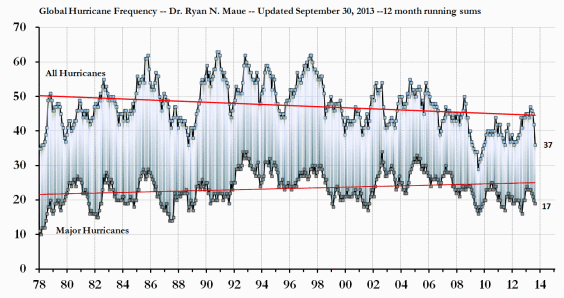
Closing in on the November 30th ending of the 2013 hurricane season:

Atlantic Hurricane Season Quietest in Decades

~
~
http://www.youtube.com/watch?v=Ku_IseK3xTc#t=66
Related article
Thom Hartmann’s ‘Last Hours’ video negated by IPCC AR5
By Anthony Watts | Watts Up With That? | October 13, 2013
From The End is Near department comes this video documentary from lefty talk radio guy Thom Hartmann that claims we are on the verge of a “mass extinction” due to climate change. Only one problem; the IPCC says “no” to his scenario. Ooops.
From the YouTube description, bold mine:
“Last Hours” is the first in a series of short films that explore the perils of climate change and the solutions to avert climate disaster. Each subsequent film will highlight fact-based challenges facing the human race, and offer solutions to ameliorate these crises. The initial short film series will culminate in a feature film to be presented prior to COP21, the 2015 UN Conference on Climate Change in Paris.
An asset for the climate change movement, “Last Hours” will be disseminated globally to awaken modern culture worldwide about the various dangers associated with climate change.
“Last Hours” describes a science-based climate scenario where a tipping point to runaway climate change is triggered by massive releases of frozen methane. Methane, a powerful greenhouse gas, has already started to percolate into the open seas and atmosphere from methane hydrate deposits beneath melting arctic ice, from the warming northern-hemisphere tundra, and from worldwide continental-shelf undersea methane clathrate pools.
Burning fossil fuels release carbon that, principally through greenhouse effect, heat the atmosphere and the seas. This is happening most rapidly at the polar extremes, and this heating has already begun the process of releasing methane. If we do not begin to significantly curtail the use of carbon-based fossil fuels, this freed methane threatens to radically accelerate the speed of global warming, potentially producing a disaster beyond the ability of the human species to adapt.
This first video is designed to awaken people to the fact that the earth has experienced five major extinctions in the deep geologic past — times when more than half of all life on earth vanished — and that we are now entering a sixth extinction. Industrial civilization with its production of greenhouse gases has the ability to trigger a mass extinction; in the extreme, it could threaten not just human civilization, but the very existence of human life on this planet.
The world community and global citizens urgently need to chart a path forward that greatly reduces green house gas emissions. To take action and follow the pathway to solutions to the climate crisis, you can explore this website and you can also sign-up for future updates. Thank you.
It’s the old “methane emergency” meme again.
But here’s the problem.
Apparently Thom never got the memo from the IPCC AR5. Note the third and fourth items in Table 12.4 from the IPCC:

Definitions for this table can be found in the section “TFE.5: Irreversibility and Abrupt Change” in the draft report. They say:
“Abrupt climate change is defined in AR5 as a large-scale change in the climate system that takes place over a few decades or less, persists (or is anticipated to persist) for at least a few decades, and causes substantial disruptions in human and natural systems.”
But alas, IPCC says Clathrate methane release is very unlikely, and they have high confidence in that assessment. Permafrost doesn’t seem to be much of a problem either, as it doesn’t seem to have the potential for abrupt climate change.
Looks like Thom Hartmann will have to rework his video.
Related articles
Understanding The IPCC AR5 Climate Assessment
By Dr. Richard Lindzen | Watts Up With That? | October 8, 2013
Each IPCC report seems to be required to conclude that the case for an international agreement to curb carbon dioxide has grown stronger. That is to say the IPCC report (and especially the press release accompanying the summary) is a political document, and as George Orwell noted, political language “is designed to make lies sound truthful and murder respectable, and to give an appearance of solidity to pure wind.”
With respect to climate, we have had 17 years without warming; all models show greater tropical warming than has been observed since 1978; and arctic sea ice is suddenly showing surprising growth. And yet, as the discrepancies between models and observations increase, the IPCC insists that its confidence in the model predictions is greater than ever.
Referring to the 17 year ‘pause,’ the IPCC allows for two possibilities: that the sensitivity of the climate to increasing greenhouse gases is less than models project and that the heat added by increasing CO2 is ‘hiding’ in the deep ocean. Both possibilities contradict alarming claims.
With low sensitivity, economic analyses suggest that warming under 2C would likely be beneficial to the earth. Heat ‘hiding’ in the deep ocean would mean that current IPCC models fail to describe heat exchange between surface waters and the deep ocean. Such exchanges are essential features of natural climate variability, and all IPCC claims of attribution of warming to mans activities depend on the assumption that the models accurately portray this natural variability.
In attempting to convince the public to accept the need to for the environmental movement’s agenda, continual reference is made to consensus. This is dishonest not because of the absence of a consensus, but because the consensus concerning such things as the existence of irregular (and small compared to normal regional variability) net warming since about 1850, the existence of climate change (which has occurred over the earths entire existence), the fact that added greenhouse gases should have some impact (though small unless the climate system acts so as to greatly amplify this effect)over the past 60 years with little impact before then, and the fact that greenhouse gases have increased over the past 200 years or so, and that their greenhouse impact is already about 80% of what one expects from a doubling of CO2 are all perfectly consistent with there being no serious problem. Even the text of the IPCC Scientific Assessment agrees that catastrophic consequences are highly unlikely, and that connections of warming to extreme weather have not been found. The IPCC iconic statement that there is a high degree of certainty that most of the warming of the past 50 years is due to man’s emissions is, whether true or not, completely consistent with there being no problem. To say that most of a small change is due to man is hardly an argument for the likelihood of large changes.
Carbon restriction policies, to have any effect on climate, would require that the most extreme projections of dangerous climate actually be correct, and would require massive reductions in the use of energy to be universally adopted. There is little question that such reductions would have negative impacts on income, development, the environment, and food availability and cost – especially for the poor. This would clearly be immoral.
By contrast, the reasonable and moral policy would be to foster economic growth, poverty reduction and well being in order that societies be better able to deal with climate change regardless of its origin. Mitigation policies appear to have the opposite effect without significantly reducing the hypothetical risk of any changes in climate. While reducing vulnerability to climate change is a worthy goal, blind support for mitigation measures – regardless of the invalidity of the claims – constitutes what might be called bankrupt morality.
It is not sufficient for actions to artificially fulfill people’s need for transcendent aspirations in order for the actions to be considered moral. Needless to add, support of global warming alarm hardly constitutes intelligent respect for science.
~
Richard S. Lindzen, Massachusetts Institute of Technology, October 5th, 2013
The Government Can’t Even Figure Out How To Shut Down Its Websites In A Reasonable Way
By Mike Masnick | Techdirt | October 2, 2013
With the government shutdown, you have may have come across a variety of oddities involving various government agency websites that were completely taken offline. This seems strange. Yes, the government is shut down, but does that really mean they need to turn off their web servers as well, even the purely informational ones? I could see them just leaving them static without updating them, but to completely block them just seems… odd. Even odder is that not all websites are down and some, such as the FTC’s website appears to be fully up, including fully loading a page… only to then redirect you to a page that says it’s down. Julian Sanchez, over at Cato, explores the various oddities of government domains that are either up or down — or something in between.
For agencies that directly run their own Web sites on in-house servers, shutting down might make sense if the agency’s “essential” and “inessential” systems are suitably segregated. Running the site in those cases eats up electricity and bandwidth that the agency is paying for, not to mention the IT and security personnel who need to monitor the site for attacks and other problems. Fair enough in those cases. But those functions are, at least in the private sector, often outsourced and paid for up front: if you’ve contracted with an outside firm to host your site, shutting it down for a few days or weeks may not save any money at all. And that might indeed explain why some government sites remain operational, even though they don’t exactly seem “essential,” while others have been pulled down.
That doesn’t seem to account for some of the weird patterns we see, however. The main page at NASA.gov redirects to a page saying the site is unavailable, but lots of subdomains that, however cool, seem “inessential” remain up and running: the “Solar System Exploration” page at solarsystem.nasa.gov; the Climate Kids website at climatekids.nasa.gov; and the large photo archive at images.jsc.nasa.gov, to name a few. There are any number of good reasons some of those subdomains might be hosted separately, and therefore unaffected by the shutdown—but it seems odd they can keep all of these running without additional expenditures, yet aren’t able to redirect to a co-located mirror of the landing page.
He also takes on the issue of the FTC redirect, in which he notes that the redirect after loading the full page shows that they’re not saving any money at all this way, meaning it makes absolutely no sense at all.
Still weirder is the status of the Federal Trade Commission’s site. Browse to any of their pages and you’ll see, for a split second, the full content of the page you want—only to be redirected to a shutdown notice page also hosted at FTC.gov. But that means… their servers are still up and running and actually serving all the same content. In fact they’re serving more content: first the real page, then the shutdown notice page. If you’re using Firefox or Chrome and don’t mind browsing in HTML-cluttered text, you can even use this link to navigate to the FTC site map and navigate from page to page in source-code view without triggering the redirect. Again, it’s entirely possible I’m missing something, but if the full site is actually still running, it’s hard to see how a redirect after the real page is served could be avoiding any expenditures.
Sanchez tries to piece together why this might be happening, and points to a White House memo which explicitly says that agencies should shut stuff down even if it’s cheaper to keep them online:
The determination of which services continue during an appropriations lapse is not affected by whether the costs of shutdown exceed the costs of maintaining services…
It’s difficult to see how this helps anyone at all. But it does yet a good job (yet again) of demonstrating that logic and bureaucracy don’t often go well together.
Expensive Energy Kills Poor People
 More stunning pictures of Al Gore’s mansion at link
By Willis Eschenbach | Watts Up With That? | September 27, 2013
Lesotho (pronounced “Leh – soo – too”), is a mountain fortress of a country, totally surrounded by South Africa. The people there, the Basotho (pronounced “Bah – soo – too), are tough as nails, and you’d have to be. It’s high desert country, cold in the winter, not much water. The Basotho are fiercely independent.
Back in the early days, they fought off the Germans who tried to take their land. The Germans then drove them off of the fertile lowlands and into the arid mountains. So their King cut a deal with the English King for the country to be a British Protectorate … very clever, one of the few parts of Africa that was never a colony of anybody. These days, curiously, most of the time the country is populated by old folks, and women and kids—the only real employment for hundreds of miles around are the mines of South Africa … including the coal mines. So the men are all at work in South Africa, and the country runs on the money that the miners send home.
Of a wintry morning in Maseru, the capital, there’s a haze across the city from the thousands and thousands of coal fires. By and large, these fires are warming poor women’s shacks and shanties, and cooking what passes for their kids’ breakfasts. They burn coal because it’s what they have. There are no forests, so they can’t burn wood. There are no great herds of cattle, so they can’t burn dung.
And as a result, Maseru mornings have that curious acrid smell that only comes from coal, and the haze that comes from coal burnt in leaky stoves and open three-stone fires.
I bring up this image of dirt-poor people in a dirt-poor country to provide a clear context for the New York Times report of the latest lethal IPCC recommendation, which they describe as follows:
To stand the best chance of keeping the planetary warming below an internationally agreed target of 3.6 degrees Fahrenheit (2 degrees Celsius) above the level of preindustrial times, the panel found, no more than one trillion metric tons of carbon can be burned and the resulting gas released into the atmosphere.
Just over half that amount has already been emitted since the beginning of the Industrial Revolution, and at the rate energy consumption is growing, the trillionth ton will be released somewhere around 2040, according to calculations by Myles R. Allen, a scientist at the University of Oxford and one of the authors of the new report. More than three trillion tons of carbon are still left in the ground as fossil fuels. SOURCE
First, the “internationally agreed target” of 2°C? I don’t recall any international agreement on that, except perhaps among attendees at one of the IPCC’s annual moribund quackathons held in Rio or somewhere.
But lets look instead at the important issue, the numbers that they give for carbon. They say we’ve burnt a half-trillion tonnes, and that we should stop when we’ve burned another half trillion tonnes, and leave the other two-and-a-half trillion tons of fossil fuels in the ground. Leave it in the ground … the mind boggles. Never happen.
So in a scant few decades, the women of Maseru are supposed to just stop burning coal? And do what? Burn their furniture? They could pull up the floorboards and burn them … if they had floors …
Dont’cha love these guys? Don’t they understand that their policies KILL PEOPLE! I apologize for shouting, but they seem to be congenitally blind to the results of their actions, so perhaps their ears still work. Do they have a plan in hand for fueling Maseru, and a thousand other Maseru’s around the world? Wind won’t do it. Sun won’t do it. So in a couple decades … what?
Here’s what they avert their eyes from.
Artificially increasing energy prices for any reason harms, impoverishes, and kills the poor.
Yes, kills. People die from the cold. If the women of Maseru have to pay more for coal, they have less money to pay for food. So they will buy a bit less coal and a bit less food, and somewhere in there, in the hidden part that far too many people don’t want to think about, kids are dying. It’s already happening. The World Bank and the US are currently refusing to fund coal-fired power plants around the world … rich people refusing cheap energy to poor people, on my planet that is disgusting and criminal behavior.
Can’t say much more than that without excessively angrifying my blood, thinking about rich 1%ers like the IPCC conclave and Myles R. Allen trying to make all fossil fuels more expensive, and blithely ignoring the lethal consequences of their actions. So I’ll leave it there, but spread the word.
Expensive energy kills poor people.
Featured Video

Yemen joins the war – Red Sea could be blocked next – Saudi regime at risk
or go to
Aletho News Archives – Video-Images
From the Archives
Should Europeans ‘Thank’ the Americans for Destroying Nord Stream?
By Robert Bridge | Strategic Culture Foundation | September 29, 2022
With an investigation continuing into the destruction of the Nord Stream gas pipeline that provided energy supplies to Europe from Russia, there appears to be just one prime suspect, and that should surprise nobody.
Following the sabotage of the Nord Stream 1 and 2 gas pipelines, former Polish Foreign Minister Radoslaw Sikorski already seemed to know the identity of the perpetrator when he tweeted out: “Thank you, USA.”
At first glance, it seemed that Sikorski was speaking sarcastically, berating Washington for carrying out an attack that will have severe repercussions for the people of Europe. After all, how could anyone see any good coming from the termination of Europe’s primary source of gas reserves with winter just around the corner? It was Sikorski’s homeland of Poland, after all, that urged its citizens to collect firewood in the face of dwindling gas reserves.
In fact, the Polish diplomat was speaking one-hundred percent literally… continue
Blog Roll
 Aletho News
- Iran denies responsibility for ‘depraved’ attack on Kuwait desalination plant
- Bring The Troops Back. End This War Now!
- Can we please stop calling Israel the ‘only democracy in the Middle East’ now?
- US should start removing its troops for Germany, proposes AfD co-leader Chrupalla
- Iran Red Crescent: 600 educational centers attacked in US-Israeli ‘war crimes’
- Russian Oil Tanker Arrives in Cuba Amid U.S. Blockade
- America Racing to Strategic Defeat in Iran: Lt Col Daniel Davis
- FTC Warns Visa, Mastercard, PayPal, Stripe Over Political Debanking
- Russian tanker approaches Cuba despite US oil blockade
- Marandi: Yemen joins the war – Red Sea could be blocked next – Saudi regime at risk
- If Americans Knew
- Israeli police block Catholic cardinal from entering Church of the Holy Sepulchre on Palm Sunday
- Israel is assassinating journalists again, more than any other nation, anywhere, ever – Not a ceasefire Day 170
- Over 300 US service members wounded, majority have brain injuries – Not a ceasefire Day 169
- Researchers at Human Rights Watch Resign Over Blocked Report on Palestinian Refugee Return
- Jewish Groups Are Backing a War Americans Don’t Want
- Eric Fingerhut Thinks He’s the President of the Jews
- Top Jewish Philanthropists, Rabbis Urge Israeli President to Take Action Against ‘Jewish Extremists’
- Don’t Be Fooled. Zionist Leaders Have Always Wanted to Control Southern Lebanon
- Israel’s widespread use of torture is a core element of its genocide against the Palestinian people
- In Israel’s War on Iran, Many Middle East US Bases Rendered “All But Uninhabitable”
- No Tricks Zone
- New Study Finds Warming Saves Lives…Cold Temperatures 12 Times More Deadly Than Excess Heat
- German Science Blog Accuses PIK Climate Institute Of Hallucinating Climate Tipping Points
- Devastating Assessment Of Comirnaty Vaccine By Former Senior Pfizer Europe Toxicologist
- New Study: CO2 Is ‘Effectively Negligible’ As An Explanatory Climate Change Factor Since 2000
- Former Pfizer Toxicologist Dr. Helmut Sterz Tells Bundestag Hearing Pfizer Vaccine Should Have Never Been Approved
- Energy Expert: Germany’s Nuclear Phaseout Was A “500 Billion Euro Mistake”
- New Research: South Australia’s Mid-Holocene Sea Surface Temperatures Were 4°C Warmer Than Today
- Storing Green Energy To Last Germany 10 Days Would Require A 60-Million Tonne Battery
- New Studies: UK Sea Levels Were 4 Meters Higher Than Today During The Mid-Holocene
- Destructive Green New Deal: German Energy And Metal Group Warns Of Drastic Crisis
 Aletho News
