Greenland eyes Chinese investment amid ‘new world order’
RT | May 27, 2025
Greenland is weighing the possibility of inviting Chinese investment to develop its mining sector in light of tensions with the US and limited engagement with the EU, the island’s business and mineral resources minister, Naaja Nathanielsen, told the Financial Times on Tuesday.
An autonomous territory of Denmark, Greenland holds vast but hard-to-exploit reserves of minerals such as gold and copper. Foreign capital is essential for developing the resources, yet recent geopolitical tensions have made it difficult to secure reliable partnerships.
“We are trying to figure out what the new world order looks like,” Nathanielsen said, adding that Greenland was “having a difficult time finding [its] footing” in evolving relationships with its Western allies.
The Arctic island signed a memorandum of understanding with the US on mineral development during President Donald Trump’s first term. However, according to Nathanielsen, it’s coming to an end. The government in Nuuk had tried, unsuccessfully, to renew it during the administration of former US President Joe Biden.
Following Trump’s return to office in January, Greenland hoped to revive discussions of renewing the memorandum. Instead, the US president talked about purchasing the island and refused to rule out using military force to assert US sovereignty over it.
Nathanielsen called such statements “disrespectful and distasteful,” adding that Greenland “has no wish to be American.”
China has shown interest in the Arctic’s mineral wealth, including oil, gas, and minerals. It has invested in Russian energy projects and has expressed interest in Greenland’s mining sector. No Chinese companies, however, are currently operating active mines in Greenland, although one firm holds a minority stake in an inactive project.
According to Nathanielsen, Chinese investors might be holding back because they don’t want “to provoke anything.”
“In those terms, Chinese investment is of course problematic, but so, to some extent, is American,” she said.
Greenland would prefer closer cooperation with the EU, which aligns more closely with its environmental priorities, the minister said. However, the bloc’s engagement has been slow, with only one project, led by a Danish-French consortium, currently in development. The mine is expected to begin operations within five years.
At present, Greenland has two functioning mines: one for gold, operated by the Icelandic-Canadian firm Amaroq Minerals, and another for anorthosite, a light-colored industrial rock, managed by a subsidiary of Canada’s Hudson Resources.
Battle for Tech Metals: What Are 17 Rare Earth Elements and What Are They Used For?
By Ilya Tsukanov – Sputnik -10.01.2025
Whether it’s Greenland, Ukraine, West Africa or East Asia, rare earths are an element of the global geopolitical competition hiding just below the surface. What are the rare earth elements, where are they concentrated, and what are their major uses? Check out our explainer for a detailed breakdown.
Basic Facts
Rare earth minerals are a group of 17 silvery-white soft heavy metals, mostly consisting of the lanthanides, a family of 15 elements grouped together in the Periodic Table, plus scandium and yttrium, which have similar chemical properties and are often found in deposits alongside the others.
Despite their name, rare earths aren’t especially rare, with one of the rarest – lutetium, some 200 times more common than gold. Rather, what makes the resources rare is finding them in large, easy to find and mine clusters.
Rare Earths and Their Uses
Lanthanum (La): Used in nickel-metal hydride batteries for hybrid vehicles, lighting, camera lenses and other special glass, and as a catalyst for petroleum refining.
Cerium (Ce): Added to an array of alloys for increased strength and corrosion protection, magnets, for burn treatments, glass polishing agents, lightbulbs and household wares including ceramics.
Praseodymium (Pr): Key component for aircraft engine-grade high-strength alloys, powerful magnets (including for use in wind turbines), tough didymium glass, and fiberoptic cables.

USGC data-based map of global rare earth element mines and known strategic reserves by country. © Photo : Stratfor
Neodymium (Nd): Used for everything from magnetotherapy to magnetic motors, microwave communications, microphones, headphones, loudspeakers, hard drives, automotive electronics, fluorescent and energy-saving lamps and lasers.
Promethium (Pm): Key component for luminous paint, portable X-rays, and atomic batteries for critical electronics, from the military and aerospace to pacemakers.
Samarium (Sm): Active ingredient in a popular cancer-cell killing agent; used in combination with other elements in magnets, lasers and nuclear reactor control rods for neutron absorption.
Europium (Eu): Another excellent neutron absorber, as well as red phosphor for TVs, blue color in LEDs, and therapeutics tool.
Gadolinium (Gd): Active ingredient for MRI drugs. Also used in nuclear propulsion systems, metallurgy, microwave and magnetic refrigeration.
Terbium (Tb): Key tool for chemical screening; green phosphor for TVs and monitors, used in lighting, military grade sonar and other sensors.
Dysprosium (Dy): Used to make powerful permanent magnets, lasers and lighting, electric drive motors for EVs and wind turbines, transducers, resonators, and dosimeters for measuring ionizing radiation.
Holmium (Ho): Another neutron-absorber useful for radioimmunotherapy, magnets, as well as optics, microwave, medical, dental and laser surgery equipment.
Erbium (Er): Added to lasers and optics used in medicine, as well as optical communications, with strong neutron-absorbing qualities. Also useful for chemical analysis and crystal growth.
Thulium (Tm): Used in military and industrial-grade lasers, as a source of radiation for portable X-rays, for meteorology and high-temperature superconducting tools, and popular anti-counterfeiting agent.
Ytterbium (Yb): Key element in X-ray components, memory devices, tunable lasers, amps and displays; metal-strengthening component and burnable poison for controlling nuclear reactions.
Lutetium (Lu): Used in petroleum refining, polymerization, lithography, tomography, as a phosphor for some light bulbs. Also used for tumor treatment, and to build the world’s most accurate atomic clocks.
Scandium (Sc): Key ingredient for high-grade lightweight alloys for everything from military and commercial aircraft to sporting equipment, small arms, high intensity discharge lamps, dentistry, and as an oil refinery tracing agent.
Yttrium (Y): Another metal-strengthening alloy. Also used for high-temperature superconducting, a surprising array of medical applications (from drug labeling and cancer treatment to surgical needles) as deoxidizer and nodulizer, the red color in cathode ray tubes, radar and synthetic gems.
Pro-independence leader rebuffs Trump’s plan to buy Greenland
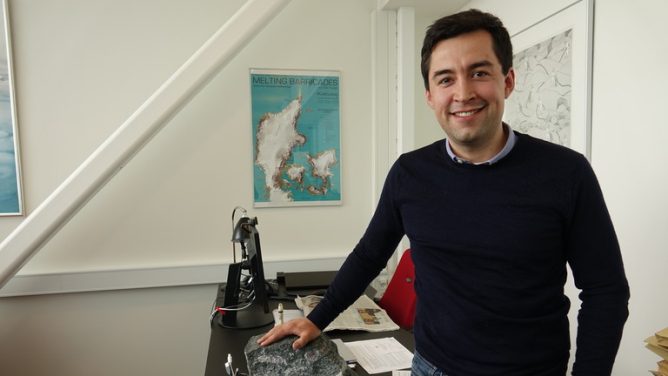
Greenland’s natural resources minister Mute Egede in his office in Nuuk, Greenland, on May 4, 2017. © Julia Waeschenbach / Getty Images
RT | January 8, 2025
Greenland’s pro-independence leader has rejected US President-elect Donald Trump’s proposal to buy the Arctic self-governing island from Denmark.
Trump has revived his old idea of acquiring the mineral-rich territory as he is preparing to assume the presidency on January 20. “Greenland is an incredible place, and the people will benefit tremendously if, and when, it becomes part of our nation,” Trump wrote on his Truth Social platform recently, vowing to “protect it, and cherish it, from a very vicious outside world.”
Greenland’s prime minister, Mute Bourup Egede, who has been campaigning for the island’s independence, reiterated that Greenland should not belong to any foreign power.
“Let me repeat – Greenland belongs to the people of Greenland. Our future and fight for independence is our business,” Egede wrote on Facebook on Tuesday.
“While others, including Danes and Americans, are entitled to their opinions, we should not be caught up in the hysteria and external pressures distract us from our path. The future is ours and ours to shape,” he added. Egede reaffirmed that his government was working towards Greenland’s eventual break with Denmark.
The former Danish colony of around 57,000 people has been a self-governing territory since 1979. In 2009, Greenland was granted the right to declare independence through a referendum.
Trump first floated the idea of purchasing Greenland in 2019, when it was rejected by the local government and officials in Copenhagen. The president-elect’s son, Donald Trump Jr., made an unannounced trip to the island on Tuesday. “Greenland loves America and Trump!!! Incredible people with an equally awesome reception,” he wrote on X.
Danish Prime Minister Mette Frederiksen has said that she welcomes US investment in Greenland, but stopped short of endorsing Trump’s renewed interest in the island. “The starting point of the government is very clear: the future of Greenland should be decided in Greenland. Greenland belongs to the Greenlanders,” she told TV 2.
“The United States is Denmark’s most important ally. Today’s discussion does not change that,” the prime minister added.
Trump has floated other bold foreign policy ideas, such as transforming Canada into America’s “51st state” and reclaiming US control over the Panama Channel. The leaders of Canada and Panama have rejected these proposals.
Greenland women sue Denmark over involuntary contraception campaign
RT | March 5, 2024
A group of indigenous women in Greenland have sued Denmark over an involuntary contraception campaign aimed at limiting the birth rate in the Arctic territory in the 1960s and 1970s, Danish broadcaster DR reported on Monday.
The 143 Inuit women claim Danish health authorities violated their human rights when they fitted them with intrauterine contraceptive coil devices. The women are seeking total compensation of nearly 43 million kroner ($6.3 million).
“The lawsuit was filed this morning. My clients chose to do this because they received no reply to their request for compensation in October,” the lawyer for the plaintiffs, Mads Pramming, said.
“Their human rights were violated, they are the living proof.”
In October, 67 women, now in their 70s and 80s, demanded compensation of 300,000 kroner ($44,000) each.
Records based on data from the national archives disclosed by the Danish broadcaster in 2022 revealed that 4,500 indigenous women, reportedly half of the fertile women in Greenland, became part of the involuntary contraception campaign.
Coil implants were fitted between 1966 and 1970 to women and girls as young as 13, without their consent or even knowledge in some cases. The small device, made from plastic and copper and fitted in the uterus, makes it difficult for sperm to fertilize an egg.
Denmark carried out the campaign secretly with the alleged purpose of limiting the rate of birth in Greenland by preventing pregnancies, the outlet said. The population on the Arctic island was booming at the time because of high living standards and better health care.
In September 2022, the governments of Denmark and Greenland launched an investigation into the program with Danish Health Minister Sophie Lohde pledging to “get to the bottom” of this “deeply unfortunate case.”
The probe’s conclusions are expected to be made public next year. However, Naja Lyberth, who was 14 when she had a coil fitted, said the group could not wait until then and that the women would seek justice in court.
“The oldest of us are over 80 years old, and therefore we cannot wait any longer,” Lyberth, told Greenland broadcaster KNR. “As long as we live, we want to regain our self-respect and respect for our wombs.”
The case is not the first time Greenlandic people say they have suffered at the hands of Danish authorities.
In 2022, Denmark apologized and paid compensation to Inuits more than 70 years after a failed social experiment.
In 1951, 22 Inuit children were taken from their homeland to Denmark, enticed with the promise of a good education worthy of the country’s future elite. Copenhagen intended for the children to return home as role models for Greenland. Only six are still alive today, all in their 70s.
Greenland was a Danish colony until 1953, after which it acquired home rule.
Claims that ‘Global Boiling’ Led to “Shocking” Melting of Greenland Ice Sheet are Nonsense
The Ice Sheet is Currently Bigger Than Normal
BY CHRIS MORRISON | THE DAILY SCEPTIC | AUGUST 8, 2023
The new era of ‘global boiling’ has brought a return of the much loved climate scare story featuring the imminent demise of the Greenland ice sheet. The Daily Mail recently ran a headline noting the ‘Impact of Global Boiling‘, saying it has “shocking” photos showing how much the ice sheet has melted during the “hottest month ever recorded on Earth”. Snow melt is said to be higher than the 1981-2010 average.
But, alas, those who strive for accuracy in these matters are likely to quibble. The Earth is not “boiling” – that is the unhinged raving of the UN Secretary-General Antonio Guterres – the claim about July comes from a computer model, while “ever” refers to data of varying quality going back barely 150 years. Furthermore, the surface balance of ice on the Greenland ice sheet is higher than the 1981-2010 average, and could improve on last’s year performance, when there was little or no loss of the surface mass after the brief summer melting season.
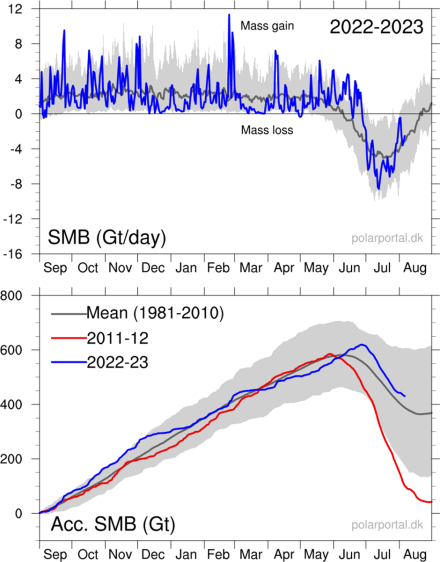
If the Mail is “shocked” by how much the Greenland ice sheet has melted this year, it probably didn’t consult the polar portal site run by Danish meteorologists, which updates an accurate record on a daily basis. Both graphs above show the effect of a cold June where the ice loss was considerably lower than the previous year. Warmer weather arrived from the south in late June in time for the peak summer melt season.
As the second graph shows, the accumulation of surface ice on Greenland is more than the 1981-2010 average, and a big improvement on a decade ago. But as the Daily Sceptic noted recently, the current improvement can be seen in an even better light. A number of scientific institutions still use a decadal 1981-2010 average for comparison purposes, despite data to 2020 being available. The cynical might note that the ice sheet lost just 51 gigatonnes a year in the 1980s, compared to an annual loss of 244 gts in the 2010s. Updating the average figure would greatly amplify the recent, and continuing, recovery in the surface ice mass.
The ”shocking” before and after photos revealing how snow melts in the summer, even in Greenland, were taken by NASA satellites over the Frederikshab Glacier running down to the warmer south-west coast. The information and photos came from a NASA blog aimed at educators headed ‘Wasting Away (Again) in Greenland‘. More than halfway through the 2023 melting season, reports NASA, “Greenland has seen a substantial transformation of its snow cover”. This line – if it’s summer in Greenland, the snow melts – is readily taken up by the Mail. “According to scientists, snow falls on the Greenland ice sheet every winter… but experts say hotter summer temperatures are reducing the amount of snow cover.” The NASA blog is heavily quoted: “More than halfway through the 2023 melting season, Greenland has seen a substantial transformation of its snow cover. … Changes are the result of the increasing warmth of summer weather that took hold across the region in late June.”
Hold the front page – snow melts during the summer in Greenland, not many dead.
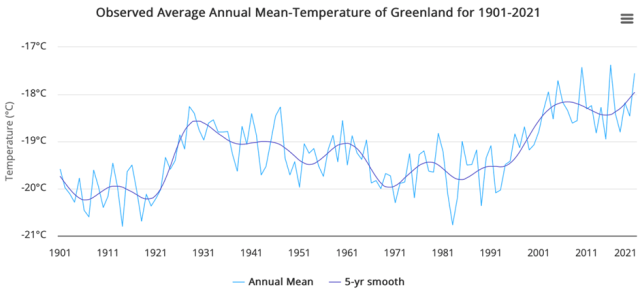
It is not difficult to find areas of rock in Greenland, especially in the south-west where most of the population of 55,000 live. The climate in this area is characterised as ‘low Arctic’ and temperatures are well above freezing in the warmest months. Ice in the Arctic waxes and wanes on a cyclical basis, while the long-term Greenland temperature is fairly stable. At a time when the planet has seen a gentle period of warming over the last 100 years, Greenland even held back slightly on the general trend. The five-year moving average of -18.57°C in 1929 compares with a measurement in 2021 of –17.96°C. The largest boost, as with other areas of the world, occurred in a short period in the 1980s and 90s, as the World Bank graph below shows. Since that time, as elsewhere, the rate of warming has considerably declined.
The Greenland ice sheet is the alarmist scare story that keeps on giving because water flowing off the land can increase sea levels. The Mail notes that scientists have already warned this year that the Greenland ice sheet is the “hottest it has ever been” and will cause global sea levels to rise by 20 inches by 2100 if it keeps warming at the same pace. In fact this information is linked to an earlier article that referenced a science paper quoting temperatures between 2000-2011. The next paragraph of the current story reports a rise of four feet or 1.2 metres by 2300, “even if we meet the 2015 Paris climate goals, scientists have warned”. Scientists might “warn”, but all these opinions of greatly increased sea level rises are produced by climate models, often assuming outlandish future scenarios.
Again, as we have noted in numerous articles, sea level rises are notoriously difficult to calculate since land rises as huge weights are lifted from it. Many areas in the northern hemisphere show falls in coastal sea levels, and this process is ongoing since the Earth is currently in an interglacial phase. In fact, current rises of 2mm a year are tiny compared with the huge boosts between 12,000 to 4,000 years ago.
Again, hold that front page – shock 2mm annual rise will lead to civilisation being inundated in the next century by a catastrophic seven inch increase in sea levels. Not many expected to die.
Chris Morrison is the Daily Sceptic’s Environment Editor.
Greenland to Receive NATO Representation for First Time Ever
By Igor Kuznetsov – Sputnik – 21.03.2023
In recent years, the Arctic has once again risen to one of the top priorities for the US and NATO. The region, rich in natural resources, has been designated as a potential corridor for strategic competition, particularly with Russia and China, and is seeing massive military investments.
Greenland’s government, Naalakkersuisut, and the Danish Foreign Ministry have for the first time agreed to send a Greenlandic diplomat to NATO to represent the remote part of the Danish Realm.
“It is important that Greenland increases its insight into the security policy development in the High North and NATO’s focus on the region,” Greenland’s Department for Foreign Affairs, Business and Trade said in a statement.
“It is also important that NATO increases its understanding of the special conditions of our region and our society, and familiarizes itself with our interests, our values and priorities,” Greenlandic Minister for Foreign Affairs, Business and Trade Vivian Motzfeldt said.
Lida Skifte Lennert, who has 25 years of experience in Greenland’s central administration behind her, will become the island nation’s first permanent representative at the US-led alliance’s headquarters in Brussels.
Greenland, the remotest part of the Danish Realm, has recently become a key area of US and NATO interest amid the military build-up in the far north. The US opened a consulate in Greenland’s capital Nuuk and has shown a keen desire to secure access to the rare minerals found in the Greenlandic depths. In 2019, former US President Donald Trump notoriously shocked Denmark with an surprise offer to buy Greenland, but received a cold shoulder from Copenhagen.
In recent years, the Arctic has returned to the top of the US security and defense agenda. Already in the Pentagon’s 2019 Arctic strategy the region was designated as a potential corridor for strategic competition, particularly with Russia and China. Denmark, too, has placed a greater emphasis on the military upgrade of its faraway territories, the Faroe Islands and Greenland.
The world’s largest island has notoriously harsh weather conditions, a dramatic lack of infrastructure and a slim 55,000 population, in which native Inuit comprise a majority. Nevertheless, it has since World War II repeatedly hosted US military bases, most notably the Thule Air Base, the northernmost US military installation, located some 1,500 kilometers from the North Pole, and the now-defunct Sondrestrom Air Base, which was turned over to the Greenlandic government in 1992. The Thule Base remains intact and plays a key role in the US military’s ability to detect and provide early warnings for ballistic missile attacks. It also harbors the world’s northernmost deepwater port and was promised an upgrade in 2022.
Camp Century that operated between 1959 and 1967 at the height of the Cold War, was yet another sign of US involvement on the island. The ice-cap base was intended as a platform for nuclear launches that could survive a first strike from the enemy. However, the missiles were never fielded and the necessary consent from the Danish government to do so was never achieved. Subsequently, the project was aborted as unfeasible as the ice sheet was realized to lack the necessary stability. Nevertheless, the project ran a nuclear reactor that was later removed. Still, hazardous waste buried under the ice has since become an environmental concern, particularly in recent years.
Earlier this year, Denmark Proper and the US were reported to be negotiating a new defense cooperation agreement, which was confirmed by Danish Foreign Minister Lars Lokke Rasmussen. He also said that the agreement should create “the possibility of a permanent American presence.”
Greenland received home rule in 1979 and passed a self-rule law in 2009, which would allow the island to declare full independence, but it would have to be approved by a referendum among the Greenlandic people. There are several parties in Greenland pushing for full independence from Denmark. A string of polls have consistently indicated that while there is a clear majority for full independence among Greenlanders, there is clear opposition to it, if it were to imply a fall in living standards. Currently, Greenland is dependent on an annual subsidy of around $600 million from Copenhagen, which accounts for about two-thirds of the island’s budget and one-quarter of the nation’s entire GDP. The rest of the economy relies on fisheries and tourism. Payments from the US for the network of military installations also play a part.
The Media Is Lying About Greenland and Climate Change
By Vijay Jayaraj | Real Clear Energy | September 13, 2021
The mainstream media is hell-bent on instilling climate fear among the masses. This means that they can never get over their obsession with weather events in the Arctic, which is one of their favorite subjects for projecting a climate catastrophe.
The Greenland Ice Sheet has been of great interest to climate alarmists. Any small change in ice sheet mass is promoted in the media as a product of man-made climate change. Last week, media outlets across the globe claimed that there has been rain for the first time at the Greenland summit.
“Rain fell at the normally snowy summit of Greenland for the first time on record,” read CNN’s headlines. Others went a step further and declared it a sign of climate doomsday. “Rain On Greenland Ice Sheet, Possibly A First, Signals Climate Change Risk,” read another headline.
Unfortunately, for the mainstream media, climate history nearly always comes back to haunt their claims of unprecedented events. Records reveal that this is not the first rainfall in Greenland, and certainly not the first on the Greenland summit peak, which stands at around 10,000 feet.
Records Show Past Rain Events in Greenland
A 1975 report prepared for National Science Foundation (NSF) by Corps of Engineers, U.S. Army, at the Cold Regions Research and Engineering Laboratory documented the summer climate at Greenland ice sheet. It showed at least two rainfall events have occurred, once in 1933 at 8,840 feet and again in 1950 at a much higher altitude. The 1950 rainfall event was above 9,500 feet and very close to the Greenland summit peak, thus contradicting mainstream media claims of unprecedented rainfall at the summit.
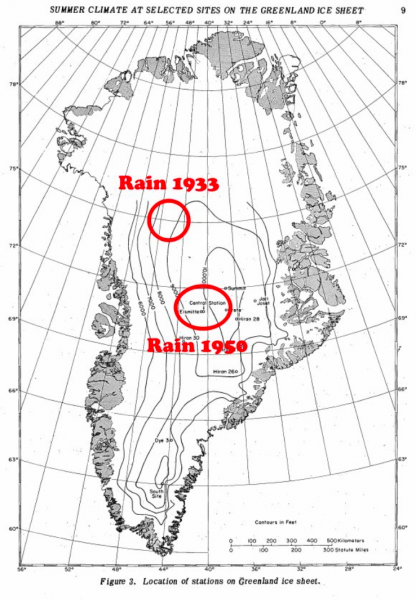 The NSF report states, “According to Hogue (1964) heavy rainfall seldom occurs above 6,000 ft on the Greenland ice sheet. However, at Watkins (75°N, 48°W, and elevation 8,840 ft) rain was reported to have occurred in July 1933. Hogue also notes that in the Centrale-Eismitte area, drizzle and rain were each reported once in a three-year period, on 20 and 21 June 1950, respectively.”
The site of the previous rainfall event, Centrale-Eismitte, is close to the 9,800-feet mark where the current rainfall event occurred. It would be a pure lie — or gross ignorance — to claim that rainfall at such an altitude has never occurred before at Greenland.
Headlines That Portray an Incomplete Reality
Besides misleading the public on the “first-time rain event,” these media outlets have also concealed the reality of the situation in Greenland, especially in 2021.
This year, Greenland’s surface mass balance (SMB) was higher than the 30-year average during many days of the year. SMB is the net balance between the accumulation and ablation on a glacier’s surface, typically denoted by mass gain and mass loss.
Data on Greenland’s SMB is available at Polar Portal, where Danish research institutions display the results of their monitoring of the Greenland Ice Sheet and the sea ice in the Arctic.
SMB data for 2021 show that there has been no significant melting and there was also a surprising gain in the SMB during the summer months, which is usually the melting season.
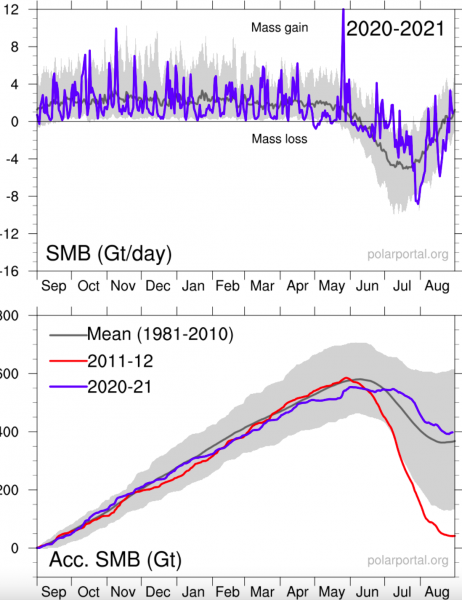
During July and August, the total accumulation of SMB (as measured in gigatons) was higher than the 30-year average (1981-2010). This can be attributed to the unexpected gain in SMB during the summer months.
So not only has the media lied to the public about the “never-before” rainfall event, it has also withheld the truth about the above-average SMB that was witnessed during the past 50 days.
This endless parade of lies about Greenland and the Arctic will likely continue. Even above-average snow accumulations will be kept out of the news and one-time warm weather events (especially during the melt season) will be used as “proof” for global warming.
Vijay Jayaraj is a Contributing Writer to the CO2 Coalition, Arlington, Va., and holds a master of science degree in environmental science from the University of East Anglia, England. He resides in Bengaluru, India.
Greenland’s Ice Cap Above Average This Year
By Paul Homewood | Not A Lot Of People Know That | September 5, 2021
You will no doubt recall the Greenland meltdown scare a few weeks ago, when the media went mental after a few sunny days there:

It probably won’t surprise you to learn that the ice sheet actually finished the summer with an above average volume of ice, according to the Danish Meteorological Institute:
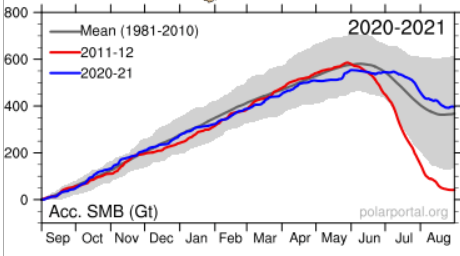
The Greenland Icesheet Surface Mass Balance excl Glacier Calving
http://polarportal.dk/en/greenland/surface-conditions/
As I pointed out at the time, this year’s summer melt has been one of the shortest on record, beginning a month late. Indeed last year’s summer melt was also truncated, but you won’t see this reported anywhere in the media.
When glacial calving is added into the figures, Greenland is still losing ice, but at a much lower rate in recent years than a decade ago, mainly due to glaciers becoming more stable.
In the last ten years, 2403 Gt has been lost. This may sound a lot, but equates to only 6.7mm of sea level rise. A giga-tonne, by the way, is 1 Billion tonnes, and Greenland sits under 2.6 million of these. At the current rate, it would take 10,000 years for the ice sheet to melt, by which time we will probably in the middle of the next ice age!!

https://podaac-tools.jpl.nasa.gov/drive/files/allData/tellus/L4/ice_mass/RL06/v02/mascon_CRI/greenland_mass_200204_202106.txt
This Year’s “ Greenland Meltdown” Scare
By Paul Homewood | Not A Lot Of People Know That | July 30, 2021
Boy, they are getting desperate now!
From Sky:

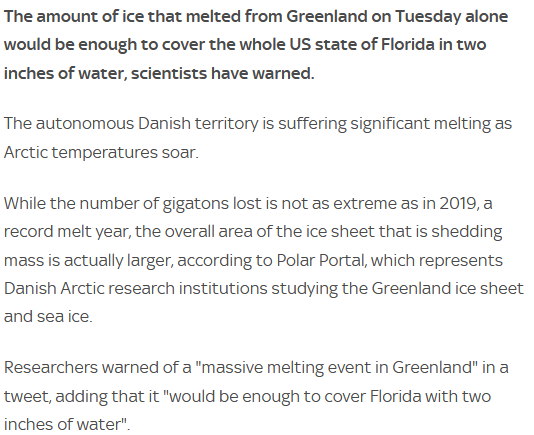
In fact, until this week Greenland had barely had a summer at all, with heavy snow meaning that the ice mass was way above average for the time of year. Even with the latest melt, the cumulative ice mass balance is still about a quarter above the 1981-2010 mean:

http://polarportal.dk/en/greenland/surface-conditions/
According to DMI, the grey band indicates:

http://polarportal.dk/en/greenland/surface-conditions/
In other words, anything within that grey band has happened at one time or another since 1981. There is therefore nothing unusual at all about the June 28th melt, and it certainly does not mean Florida will get flooded. It is something that happens every summer.
Melting of ice in Greenland, as well as the opposite, snowfall, is determined by the weather. Whereas the last two months have been dominated by low pressure, this week has seen high pressure take over. High pressure means plenty of sunshine, which in turn is what melts the ice. It has nothing to do with carbon dioxide.
Weather forecasts suggest high pressure will remain for a few more days, before giving way to low pressure and more snow:

BBC Forecast 30th June
With the end of Greenland’s melt season just a couple of weeks away, it looks as if we will end up with a pretty much average ice mass balance.
As for claims that the Arctic is warming three times faster than the global average, the Arctic has actually been colder than normal this summer. It is usually only during winter when Arctic temperatures are above normal, when of course it makes no difference whatsoever.
And so far this summer Arctic sea ice extent is doing what it always done at this time of year:


http://ocean.dmi.dk/arctic/index.uk.php
Yet every year, we get the same fraudsters out, trying to persuade the gullible public that the Arctic is melting down rapidly.
Debris from abandoned WW II-era Arctic military base polluting Greenland
cbc news | September 11, 2016
… Baxter says there are likely still 800 cases of dynamite stored in a wooden shed on the abandoned base, along with buried ammunition all over the site.
“The army sent a demolitions expert up to dispose of [the dynamite], but he said it was too risky to fool with, so he left.” … Read full article
Sea level rise tipping points
By Rud Istvan | Climate Etc. | May 18, 2014
Sea level tipping points are a popular CAGW/media theory, easily suggested by images of calving icebergs and summer meltwater rushing down Greenland moulins. But they are alarmist precautionary mitigation fantasies rather than remotely possible future scenarios on multi-centennial time scales.
The core tenant of catastrophic anthropogenic global warming (CAGW) is that rising CO2 will raise temperatures and result in various catastrophes. IPCC, UNFCC and now the US NCA have argued this requires immediate drastic collective mitigation. Nature has not co-operated. Temperatures stopped rising (the pause), extreme weather did not increase (IPCC SREX), Australian drought turned to flood, Tuvalu has not disappeared, and polar bears thrive. So AR5 WG2 finally said adaptation might be a better response.
About the only urgent immediate mitigation rationale left is the precautionary principle: take expensive actions as just in case ‘insurance’. Precautions against some ‘tipping point’ beyond which the world is rapidly, disastrously, and irreversibly affected, which point at any cost we therefore dare not risk passing. No price is too high to pay to avoid a catastrophic tipping point according to this precautionary principle. Bad economics piled onto bad science.
One of the most marketed tipping points is sea level rise (SLR). The problem with ‘sudden’ SLR is that it did not happen in the Eemian interglacial. But that does not say it might not with CAGW added to this one, the Holocene.
There are only three ice bodies with enough water to cause a potentially rapid and large sea level rise. These are the Greenland, East Antarctic, and West Antarctic Ice Sheets. Since Antarctica as a whole may (inconveniently for CAGW) be accumulating ice [i], Greenland has been the ‘tipping point’ most frequently mentioned by official agencies [ii] and by the MSM. [iii]
There is no doubt that Greenland is losing ice mass, and at a recently increased rate. This has been measured in different ways (ice melt boundary, gravity (GRACE), iceberg calving… The ‘consensus’ is about 170- 200 Gt per year recently, but about 100Gtpy over satellite era Arctic cycles since the estimated loss was only about 7Gtpy in the 1990s.[iv] Winter snow accumulation is as important to net ice mass balance as the summer melt.
The observed mass loss should be put into perspective. According to the Byrd Polar Research Center the Greenland Ice Sheet comprises 2.62-2.93 E+6 km3. That is a total mass of about 2.67E+18Kg (uncertainty on volume, and uncertainty on density—firn, moulins, entrained air). A gigaton is E+12Kg. Greenland is estimated to be losing about E+14Kg per year averaged over two decades. At that rate, it would take about (2.67 E+18kg mass/E+14kg average annual mass loss) 27000 years to melt/sluff. Even the recent accelerated rate (if continued) would take over 14000 years.[v] That is longer than it took the great Laurentide Ice Sheet to disappear at the end of the last ice age. If Greenland ever did melt it would raise sea level by 6.7 meters. Even at the faster melt rate this would be (670 cm/140 centuries) 4.8 cm/century of sea– an additional 0.5mm/yr—more adaptation than mitigation.
It is unlikely that Greenland will melt. NEEM showed northwest Greenland was +5-8°C above the present for about 7 millennia during the Eemian. True, more ice melted there then than has up to now in the Holocene. The NEEM site cored ‘only’ 2537 meters of ice. At end of the Eemian the NEEM location ice was about 130 meters lower—‘only’ ≈2400 meters thick.
The only way a centennial or even millennial Greenland tipping point would be possible is if much of its ice ‘slid off’. It is true that the outer ice sheet edges are glaciers creeping seaward and sluffing—calving icebergs like the one that sank the Titanic in 1912 (before AGW). But it is not true that most of the Greenland ice sheet could ever creep off, since the underlying bedrock is bowl shaped. The most graphic 3D visualization is from Bamber, University of Bristol.

The thickest ice is over the deepest part of a bedrock bowl 1000-2500 meters deep, e.g. at the NEEM site. It is not going anywhere anytime soon. That ‘bowl’ interior is where the Greenland Sheet has been accumulating even as the edges sluff/melt. Creep decline becomes increasingly self-limited by underlying geology.

Greenland losing all its ice is geophysically impossible on millennial time scales, since it has to melt. Not something to worry about at all on centennial time scales, even as an implausible black swan or dragon king.
With Greenland geologically debunked as a possible SLR tipping point, attention turned to Antarctica. Whether Antarctica in total is gaining or losing ice is a matter of dispute between NASA and NOAA. Current NOAA ice loss is:

WAIS losing, EAIS gaining, the Peninsula about even. So any tipping point has to be sought in West Antarctica (WAIS). The general WAIS slope is from the Transarctic Mountain divide down to the sea, although some is anchored by the Executive Committee and Ellsworth mountain ranges.

Potential WAIS instability has been the subject of much scientific scrutiny. The original concerns were the large below sea level grounded portions of the Ronne (which is not part of WAIS but is still mostly in the Western half of Antarctica) and Ross ice shelves. (Floating shelf ice cannot further raise sea levels.) These have the largest volumes of ice creeping toward the sea. Like Greenland, much of the rest (and most of EAIS) is land anchored by underlying bedrock topology. On an annual basis fresh snow still replenishes most of the lost edge mass inland at higher WAIS elevations. It is the net mass balance along these seaward sloping WAIS ice sheet edges that might constitute sufficiently large tipping points.
 Ronne (1) is net gaining ice mass according to NASA. So it isn’t a plausible tipping point. Ross (19) might or might not be losing ice, but it is what ‘holds back’ almost half of WAIS. Ross also has more ice grounded deeper on the seabed, which if ungrounded (melted from below), would raise sea levels more. For years Ross was the main WAIS instability ‘tipping point’ concern.
 The ANDRILL program was designed to look at the underlying Ross seabed (both where the ice is grounded below sea level, and where it is floating shelf) to understand its behavior in previous interglacials. Andrill cores and creep rates suggest it has not before (well, for at least 3 million years and the entire Pleistocene Ice Age) and likely will not now collapse. The Ross shelf’s seaward creep has decelerated. [vi],[vii] Ross had bedrock islands ‘anchoring’ its grounded ice, retarding seaward creep. [viii] So Ross is not a plausible tipping point after all.
So 2014 attention turned to the only other possibility, the Amundsen Embayment, which is indisputably losing ice at an accelerating rate. Abetted by additional NASA PR and author interviews (Rignot of NASA JPL “Already gone into irreversible retreat, past the point of no return”), MSM alarmist headlines were, well, alarming. Reuters reported worldwide: “West Antarctic Glaciers in irreversible thaw: rising seas” CNN said: “Ice melt in part of Antarctica ‘appears unstoppable’, NASA says”
The MSM did not read these new papers carefully or in context (if at all). The first paper found Pine Island (22) plus Thwaites (21) plus the four lesser Amundsen Embayment glaciers are discharging ice more rapidly than all of Greenland (together ±330Gtyr). That is surprisingly 3-4x higher than any previous estimate, for example those also from NASA in 2011 shown above. The second paper used computer models of Thwaites (21) bottom melting to conclude it couldbecome unstable in 200 to 900 years. If so, the computer models suggested 1mm/yr of additional SLR thereafter. Not ‘in coming decades’ as Reuters said and NASA PR implied.
There is a deeper comprehension problem in this new NASA sponsored version of a SLR tipping point. The NASA NEWS about these papers says the Embayment region contains enough ice to raise global sea level by 4 feet (1.2 meters). That is true for the entire catchment basin of about 360,000 km2. [ix]For 1.2 meters of SLR, the entire catchment would have to become entirely ice free. That is highly unlikely. The interior portions are not flowing much toward the sea according to the first paper itself, and are also still accumulating ice. [x], [xi]

Sea level tipping points are a popular CAGW/media theory, easily suggested by images of calving icebergs and summer meltwater rushing down Greenland moulins. But they are alarmist precautionary mitigation fantasies rather than remotely possible future scenarios on multi-centennial time scales.
AR5 WG2 had it right that the best response to SLR is adaptation. Major coastal cities like New Orleans (3-10mm/yr), Jakarta (6-22mm/yr), and Bangkok (10-28mm/yr) are already subsiding at much faster rates than sea levels are or will foreseeably be rising.
Featured Video

America Racing to Strategic Defeat in Iran
or go to
Aletho News Archives – Video-Images
From the Archives
Should Europeans ‘Thank’ the Americans for Destroying Nord Stream?
By Robert Bridge | Strategic Culture Foundation | September 29, 2022
With an investigation continuing into the destruction of the Nord Stream gas pipeline that provided energy supplies to Europe from Russia, there appears to be just one prime suspect, and that should surprise nobody.
Following the sabotage of the Nord Stream 1 and 2 gas pipelines, former Polish Foreign Minister Radoslaw Sikorski already seemed to know the identity of the perpetrator when he tweeted out: “Thank you, USA.”
At first glance, it seemed that Sikorski was speaking sarcastically, berating Washington for carrying out an attack that will have severe repercussions for the people of Europe. After all, how could anyone see any good coming from the termination of Europe’s primary source of gas reserves with winter just around the corner? It was Sikorski’s homeland of Poland, after all, that urged its citizens to collect firewood in the face of dwindling gas reserves.
In fact, the Polish diplomat was speaking one-hundred percent literally… continue
Blog Roll
 Aletho News
- Growing insecurity, soaring prices fuel protests in north as regime bans evacuation: Sources
- Iran denies responsibility for ‘depraved’ attack on Kuwait desalination plant
- Bring The Troops Back. End This War Now!
- Can we please stop calling Israel the ‘only democracy in the Middle East’ now?
- US should start removing its troops for Germany, proposes AfD co-leader Chrupalla
- Iran Red Crescent: 600 educational centers attacked in US-Israeli ‘war crimes’
- Russian Oil Tanker Arrives in Cuba Amid U.S. Blockade
- America Racing to Strategic Defeat in Iran: Lt Col Daniel Davis
- FTC Warns Visa, Mastercard, PayPal, Stripe Over Political Debanking
- Russian tanker approaches Cuba despite US oil blockade
- If Americans Knew
- Israeli police block Catholic cardinal from entering Church of the Holy Sepulchre on Palm Sunday
- Israel is assassinating journalists again, more than any other nation, anywhere, ever – Not a ceasefire Day 170
- Over 300 US service members wounded, majority have brain injuries – Not a ceasefire Day 169
- Researchers at Human Rights Watch Resign Over Blocked Report on Palestinian Refugee Return
- Jewish Groups Are Backing a War Americans Don’t Want
- Eric Fingerhut Thinks He’s the President of the Jews
- Top Jewish Philanthropists, Rabbis Urge Israeli President to Take Action Against ‘Jewish Extremists’
- Don’t Be Fooled. Zionist Leaders Have Always Wanted to Control Southern Lebanon
- Israel’s widespread use of torture is a core element of its genocide against the Palestinian people
- In Israel’s War on Iran, Many Middle East US Bases Rendered “All But Uninhabitable”
- No Tricks Zone
- New Study Finds Warming Saves Lives…Cold Temperatures 12 Times More Deadly Than Excess Heat
- German Science Blog Accuses PIK Climate Institute Of Hallucinating Climate Tipping Points
- Devastating Assessment Of Comirnaty Vaccine By Former Senior Pfizer Europe Toxicologist
- New Study: CO2 Is ‘Effectively Negligible’ As An Explanatory Climate Change Factor Since 2000
- Former Pfizer Toxicologist Dr. Helmut Sterz Tells Bundestag Hearing Pfizer Vaccine Should Have Never Been Approved
- Energy Expert: Germany’s Nuclear Phaseout Was A “500 Billion Euro Mistake”
- New Research: South Australia’s Mid-Holocene Sea Surface Temperatures Were 4°C Warmer Than Today
- Storing Green Energy To Last Germany 10 Days Would Require A 60-Million Tonne Battery
- New Studies: UK Sea Levels Were 4 Meters Higher Than Today During The Mid-Holocene
- Destructive Green New Deal: German Energy And Metal Group Warns Of Drastic Crisis
 Aletho News