Remembering the Earthquake in Haiti Ten Years On
By Yves Engler · January 11, 2020

Ten years ago Sunday an earthquake devastated Haiti. In a few minutes of violent shaking hundreds of thousands perished in Port-au-Prince and surrounding regions and many more were permanently scarred.
It’s important to commemorate this horrifying tragedy. But this solemn occasion is also a good moment to reflect on Canada’s role in undermining the beleaguered nation’s capacity to prepare/respond/overcome natural disasters.
Asked my thoughts on Canada’s role in Haiti the day after the quake, I told reporter Paul Koring that so long as the power dynamics in the country did not shift there would be little change: “Cynically, it feels like a ‘pity time for the Haitians’ but I doubt much will really change,” says Yves Engler, a left-wing activist from Montreal who blames the United States, along with Canada, for decades of self-interested meddling in Haitian affairs. “We bear some responsibility … because our policies have undermined Haiti’s capacity to deal with natural disasters.”
Unfortunately, Canada’s response was worse than I could have imagined. Immediately after the quake decision makers in Ottawa were more concerned with controlling Haiti than assisting victims. To police Haiti’s traumatized and suffering population, 2,050 Canadian troops were deployed alongside 12,000 US soldiers (8,000 UN soldiers were already there). Though Ottawa rapidly deployed 2,050 troops they ignored calls to dispatch this country’s Heavy Urban Search and Rescue (HUSAR) Teams, which are trained to “locate trapped persons in collapsed structures.”
According to internal government documents the Canadian Press examined a year after the disaster, officials in Ottawa feared a post-earthquake power vacuum could lead to a “popular uprising.” One briefing note marked “secret” explained: “Political fragility has increased, the risks of a popular uprising, and has fed the rumour that ex-president Jean-Bertrand Aristide, currently in exile in South Africa, wants to organize a return to power.” Six years earlier the US, France and Canada ousted the elected president.
Canada and the US’ indifference/contempt towards Haitian sovereignty was also on display in the reconstruction effort. Thirteen days after the quake Canada organized a high profile Ministerial Preparatory Conference on Haiti for major international donors. Two months later Canada co-chaired the New York International Donors’ Conference Towards a New Future for Haiti. At these conferences Haitian officials played a tertiary role in the discussions. Subsequently, the US, France and Canada demanded the Haitian parliament pass an 18-month long state of emergency law that effectively gave up government control over the reconstruction. They held up money to ensure international control of the Interim Commission for the Reconstruction of Haiti, authorized to spend billions of dollars in reconstruction money.
Most of the money that was distributed went to foreign aid workers who received relatively extravagant salaries/living costs or to expensive contracts gobbled up by Western/Haitian elite owned companies. According to an Associated Press assessment of the aid the US delivered in the two months after the quake, one cent on the dollar went to the Haitian government (thirty-three cents went to the US military). Canadian aid patterns were similar. Author of The Big Truck That Went By: How the World Came to Save Haiti and Left Behind a Disaster Jonathan Katz writes, “Canada disbursed $657 million from the quake to September 2012 ‘for Haiti,’ but only about 2% went to the Haitian government.”
Other investigations found equally startling numbers. Having raised $500 million for Haiti and publicly boasted about its housing efforts, the US Red Cross built only six permanent homes in the country.
Not viewing the René Preval government as fully compliant, the US, France and Canada pushed for elections months after the earthquake. (Six weeks before the quake, according to a cable released by Wikileaks, Canadian and EU officials complained that Préval “emasculated” the country’s right-wing. In response, they proposed to “purchase radio airtime for opposition politicians to plug their candidacies” or they may “cease to be much of a meaningful force in the next government.”) After the first round of the presidential election the US and Canada pushed Préval party’s candidate out of the runoff in favor of third place candidate, Michel Martelly. A six-person Organization of American States (OAS) mission, including a Canadian representative, concluded that Martelly deserved to be in the second round. But, in analyzing the OAS methodology, the Washington-based Center for Economic and Policy Research, determined that “the Mission did not establish any legal, statistical, or other logical basis for its conclusions.” Nevertheless, Ottawa and Washington pushed the Haitian government to accept the OAS’s recommendations. Foreign minister Lawrence Cannon said he “strongly urges the Provisional Electoral Council to accept and implement the [OAS] report’s recommendations and to proceed with the next steps of the electoral process accordingly.”
A supporter of the 1991 and 2004 coups against Aristide, Martelly was a teenaged member of the Duvalier dictatorship’s Ton Ton Macoutes death squad. He is a central figure in the multi-billion dollar Petrocaribe corruption scandal that has spurred massive protests and strikes against illegitimate, repressive and corrupt president Jovenel Moïse. A disciple of Martelly, Moïse is president today because he has the backing of the US, Canada and other members of the so-called “Core Group”.
There was an outpouring of empathy and solidarity from ordinary Canadians after the earthquake. But officials in Ottawa saw the disaster as a political crisis to manage and an opportunity to expand their economic and political influence over Haiti.
On the tenth anniversary of this solemn occasion it is important to reflect not only on this tragedy but to understand what has been done by Canada’s government in our name and to learn from it so we can stop politicians from their ongoing strangulation of this beleaguered nation.
What Does PDVSA Have to Do with the Crisis in Haiti?
By Clodovaldo Hernandez – Supuesto Negado – November 7, 2019
Haiti has been on fire for weeks, without the so-called ‘international community’ or its associated press paying any attention.
Fuel shortages have plunged the Caribbean country back into social turmoil which borders on civil war. There are many causes behind this dramatic panorama, which has been exasperated by the decrease in production by Venezuelan state-run oil company PDVSA, corruption scandals in the Caribbean country and relentless US pressure on Venezuela, which have all damaged the PetroCaribe crude oil supply programme, which Haiti was reliant on.
PDVSA’s internal collapse, coupled with the labyrinth of obstacles placed by the US’ unilateral coercive measures (sanctions) against Venezuela, has forced the dismantling of what was one of Commander Hugo Chavez’s most powerful initiatives.
The project is a regional mechanism for selling oil at preferential prices with financing for the residents of the Antillean Basin. Local opposition groups and the Washington-led international coalition have, however, always branded the programme as a way for Venezuela to ensure support in the international arena based on the so-called ‘petro-chequebook.’
Internal corruption
Before the programme was damaged by PDSVA’s fall in production and the blockade [against Venezuela], there were already revelations of financial irregularities by unscrupulous Haitian civil servants and entrepreneurs who took advantage of Venezuelan aid to line their own pockets.
In Haiti, these crimes are particularly outrageous because the programme was conceived as a way of providing financial assistance to the government to address serious internal problems, exacerbated by the 2010 earthquake and five major hurricanes, including Hurricane Matthew in 2016.
Under the programme, PetroCaribe delivered crude oil to a state agency called the Monetisation Bureau of Development Aid Programmes, which proceeded to sell it to private Haitian companies. The resulting funds should have been used to rebuild infrastructure, especially in the areas of health, education, housing and roadways, however around US $2 billion is estimated to have been stolen.
The responsibility of Venezuelan officials in this and other Petro Caribe- related corruption cases remains to be seen.
The issue of corruption is so important in the Haitian political debate that in addition to demanding the resignation of pro-US President Jovenel Moise, the opposition and Haitian grassroots movements, which have led the wave of demonstrations in recent months, also demand the prosecution of those involved in irregularities that distorted the initial objectives of the programme. Opposition Deputies Youri Latortue, Moise Jean Charles and Shiller Louidor have been the flag-bearers of these demands.
The political reasons
In parallel, and in accordance with Washington’s instructions, the Haitian government of businessman Jovenel Moise, which is propped up by the US, has preferred to sever its relationship with PetroCaribe, supposedly to distance itself from the influence that revolutionary Venezuela exerted on previous Haitian presidents, such as René Preval and Michel Martelly.
Moise (whose name also appears amongst the list of alleged benefactors from the theft of PetroCaribe funds) was snared with promises that the US would supply the oil that Venezuela would no longer deliver. But that obviously hasn’t happened.
As the country ran out of fuel, what has been described as Haiti’s worst political crisis has erupted. The nation has lived in perennial instability due to, among other reasons, the continued interference of the US in its internal affairs.
Apart from Haiti, the PetroCaribe programme favoured Antigua and Barbuda, the Bahamas, Belize, Cuba, Dominica, Guatemala, Guyana, Grenada, St. Kitts and Nevis, St. Lucia, St. Vincent and the Grenadines, El Salvador, the Dominican Republic and Suriname. Guatemala and Belize abandoned the agreement in 2014 and 2017 respectively, and in June 2018 Venezuela announced that it was suspending shipments to all these nations due to a drop in production, with the notable exception of Cuba.
Denouncements of irregularities [in the programme’s funds] were well exploited by Venezuela’s opponents to discredit the project between 2016 and 2018. Simultaneously, the US toured the Caribbean offering to supply US oil extracted through fracking in exchange for support for its aggressive political moves against the Venezuelan government of Nicolas Maduro. Of course, in the US’ case, we aren’t talking about a social programme but rather winning the Caribbean market for its oil corporations, while continuing to strangle Venezuela economically.
In 2018, a Caribbean Energy Security Summit was held in Washington, which mentioned adopting sustainable renewable energy systems for the region. The political purpose, the true one, was later expressed by a spokesman for the US State Department: “That the Caribbean doesn’t increase its debt to the only energy supplier which has attended the region to date.”
PDVSA’s inability to continue honouring the programme, in addition to corruption scandals in countries like Haiti, allowed this goal to be achieved just as the US wished.
Now, the entire Caribbean region once again depends on the savage capitalism’s suppliers , and Haiti’s social protests are one of the first symptoms of this return to the harsh reality.
Clodovaldo Hernández is a Venezuelan journalist who has written for left leaning news sites Supuesto Negado and Aporrea.
Translation by Paul Dobson for Venezuelanalysis.
OAS election observers subvert Bolivian democracy
By Yves Engler · November 18, 2019
Organization of American States election observers have played an important role in subverting Bolivian democracy.
While some may find it hard to believe that a regional electoral monitoring body would consciously subvert democracy, their actions in the South American country are not dissimilar to previous US/Canada backed OAS missions in Haiti.
“The OAS Election Audit That Triggered Morales’ Fall in Bolivia”, explained a New York Times headline. For his part, Bolivian President Evo Morales said the OAS “is in the service of the North American empire.”
After the October 20 presidential election, the OAS immediately cried foul. The next day the organization released a statement that expressed “its deep concern and surprise at the drastic and hard-to-explain change in the trend of the preliminary results [from the quick count] revealed after the closing of the polls.” Two days later they followed that statement up with a preliminary report that repeated their claim that “changes in the TREP [quick count] trend were hard to explain and did not match the other measurements available.”
But, the “hard-to-explain” changes cited by the OAS were entirely expected, as detailed in the Centre for Economic Policy Research’s report “What Happened in Bolivia’s 2019 Vote Count? The Role of the OAS Electoral Observation Mission”. The CEPR analysis points out that Morales’ percentage lead over the second place candidate Carlos Mesa increased steadily as votes from rural, largely indigenous, areas were tabulated. Additionally, the 47.1% of the vote Morales garnered aligns with pre-election polls and the vote score for his Movement toward Socialism party. The hullabaloo about the quick count stopping at 83% of the vote was preplanned and there is no evidence there was a pause in the actual counting.
But, the OAS’ statements gave oxygen to opposition protests. Their unsubstantiated criticism of the election have also been widely cited internationally to justify Morales’ ouster. In response to OAS claims, protests and Washington and Ottawa saying they would not recognize Morales’s victory, the Bolivian President agreed to a “binding” OAS audit of the first round of the election. Unsurprisingly the OAS’ preliminary audit report alleged “irregularities and manipulation” and called for new elections overseen by a new electoral commission. Immediately after the OAS released its preliminary audit US Secretary of State Mike Pompeo went further, saying “all government officials and officials of any political organizations implicated in the flawed October 20 elections should step aside from the electoral process.” What started with an easy-to-explain discrepancy between the quick count and final results of the actual counting spiraled into the entire election is suspect and anyone associated with it must go.
At Tuesday’s Special Meeting of the OAS Permanent Council on Bolivia the representative of Antigua and Barbuda criticized the opaque way in which the OAS electoral mission to Bolivia released its statements and reports. She pointed out how the organization made a series of agreements with the Bolivian government that were effectively jettisoned. A number of Latin American countries echoed this view.
US and Canadian representatives, on the other hand, applauded the OAS’ work in Bolivia. Canada’s representative to the OAS boasted that two Canadian technical advisers were part of the audit mission to Bolivia and that Canada financed the OAS effort that discredited Bolivia’s presidential election. Canada is the second largest contributor to the OAS, which receives between 44% and 57% of its budget from Washington.
It’s not surprising that an electoral mission from the Washington-based organization would subvert Bolivian democracy. OAS electoral observers have played more flagrant role in undermining Haitian democracy. In late 2010/early-2011 the US/Canada used an OAS election “Expert Verification Mission” to help extreme right-wing candidate Michel Martelly become president. Canada put up $6 million for elections that excluded Fanmi Lavalas from participating and following the first round of voting in November 2010, forced the candidate whom Haiti’s electoral council had in second place, Jude Celestin, out of the runoff. After Martelly’s supporters protested their candidate’s third place showing, a six person OAS mission, including a Canadian representative, concluded that Martelly deserved to be in the second round. But, in analyzing the OAS methodology, the CEPR determined that “the Mission did not establish any legal, statistical, or other logical basis for its conclusions.” Nevertheless, Ottawa and Washington pushed the Haitian government to accept the OAS’s recommendations. Foreign minister Lawrence Cannon said he “strongly urges the Provisional Electoral Council to accept and implement the [OAS] report’s recommendations and to proceed with the next steps of the electoral process accordingly.” In an interview he warned that “time is running out”, adding that “our ambassador has raised this with the president [Rene Préval] himself.” The CEPR described the intense western lobbying. “The international community, led by the US, France, and Canada, has been intensifying the pressure on the Haitian government to allow presidential candidate Michel Martelly to proceed to the second round of elections instead of [ruling party candidate] Jude Celestin.” This pressure included some Haitian officials having their US visas revoked and there were threats that aid would be cut off if Martelly’s vote total was not increased as per the OAS recommendation.
Half of Haiti’s electoral council agreed to the OAS changes, but the other half did not. The second round was unconstitutional, noted Haïti Liberté, as “only four of the eight-member Provisional Electoral Council (CEP) have voted to proceed with the second round, one short of the five necessary. Furthermore, the first-round results have not been published in the journal of record, Le Moniteur, and President Préval has not officially convoked Haitians to vote, both constitutional requirements.”
The absurdity of the whole affair did not stop the Canadian government from supporting the elections. Official election monitors from this country gave a thumbs-up to this exercise in what they said was democracy. After Martelly won the second round with 16.7 percent of registered voters support Cannon declared: “We congratulate the people of Haiti, who exercised their fundamental democratic right to choose who will govern their country and represent them on the world stage.” The left weekly Haiti Progrès took a different view. Describing the fraudulent nature of the elections, the paper explained: “The form of democracy that Washington, Paris and Ottawa want to impose on us is becoming a reality.”
A decade earlier another OAS election mission helped sabotage democracy in Haiti. After voting for 7,000 positions an OAS team on site described the May 2000 elections as “a great success for the Haitian population which turned out in large and orderly numbers to choose both their local and national governments.”
As the opposition protested the scope of Fanmi Lavalas’ victory, the OAS jumped on a technicality in the counting of eight Senate seats to subsequently characterize the elections as “deeply flawed”. The 50 percent plus one vote required for a first-round victory was determined by calculating the percentages from the votes for the top four candidates, while the OAS contended that the count should include all candidates. OAS concerns were disingenuous since they worked with the electoral council to prepare the elections and were fully aware of the counting method beforehand. The same procedure was used in prior elections, but they failed to voice any concerns until Fanmi Lavalas’ landslide victory. Finally, using the OAS method would not have altered the outcome of the elections and even after Jean Bertrand Aristide got the seven Lavalas senators to resign (one was from another party) the “deeply flawed” description remained.
Haiti’s political opposition used the OAS criticism of the election to justify boycotting the November 2000 presidential election, which they had little chance of winning. The US and Canada used the claims of electoral irregularities to justify withholding aid and Inter-American Development Bank loans to the Haitian government. OAS Resolutions 806 and 822 gave non-elected opposition parties an effective veto over the resumption of foreign aid to Aristide’s government. The OAS claims of “deeply flawed” elections played an important part in a multipronged campaign to oust Aristide’s government.
In an editorial responding to the coup in Bolivia, People’s Voice called for Canada to withdraw from the Washington dominated OAS. Internationalist minded Canadians should support that position.
But we should also recognize the blow Morales’ ouster represents to any effort to subvert the OAS. The Bolivian President’s removal is a further setback to the Latin American integration efforts represented in forums such as the Community of Latin American and Caribbean States. A potential replacement for the OAS, CELAC included all Latin American and Caribbean nations. But Canada and the US were excluded. By helping oust Morales the OAS has taken revenge on a politician who pushed an alternative, non-Washington based, model for ‘Nuestra America’.
The word they won’t use to describe Canada’s role in Haiti

Molotov cocktail thrown at Canadian Embassy in Port-au-Prince
By Yves Engler · November 9, 2019
Something you can’t name is very difficult to talk about. Canada’s role in Haiti is a perfect example. Even when the dominant media and mainstream politicians mention the remarkable ongoing revolt or protesters targeting Canada, they fall on their faces in explaining it.
Not one journalist or politician has spoken this truth, easily verified by all sorts of evidence: “Sixteen years ago Ottawa initiated an effort to overthrow Haiti’s elected government and has directly shaped the country’s politics since. Many Haitians are unhappy about the subversion of their sovereignty, undermining of their democracy and resulting impoverishment.”
Last Sunday protesters tried to burn the Canadian Embassy in Port-au-Prince. Voice of America reported, “some protesters successfully set fire to business establishments and attempted to burn down the Canadian Embassy.” A few days earlier protesters threw rocks at the Canadian Embassy and demonstrators have repeatedly speechified against Canadian “imperialism”. In response to the targeting of Canada’s diplomatic representation in the country, Haiti’s puppet government released a statement apologizing to Ottawa and the embassy was closed for a number of days.
Echoing the protesters immediate demand for Jovenel Moïse to go, an open letter was released last Tuesday calling on Justin Trudeau’s government to stop propping up the repressive and corrupt Haitian president. David Suzuki, Roger Waters, Amir Khadir, Maude Barlow, Linda McQuaig, Will Prosper, Tariq Ali, Yann Martel and more than 100 other writers, musicians, activists and professors signed a letter calling on “the Canadian government to stop backing a corrupt, repressive and illegitimate Haitian president.”
While a number of left media ran the letter, major news outlets failed to publish or report on it. Interestingly, reporters at La Presse, Radio Canada and Le Devoir all expressed interest in covering it but then failed to follow through. A Le Devoir editor’s reaction was particularly shameful since the leftish, highbrow, paper regularly publishes these types of letters. The editor I communicated with said she’d probably run it and when I called back three days later to ask where things were at, she said the format was difficult. When I mentioned its added relevance after protesters attempted to burn the Canadian embassy, which she was aware of, she recommitted to publishing it. Le Devoir did not publish the letter when it was submitted to them, although an article published in their paper two weeks later did mention it.
My impression from interacting with the media on the issue is that they knew the letter deserved attention, particularly the media in Québec that cover Haiti. But, there was discomfort because the letter focused on Canada’s negative role. (The letter is actually quite mild, not even mentioning the 2004 coup, militarization after the earthquake, etc.)
On Thursday Québec’s National Assembly unanimously endorsed a motion put forward by Liberal party foreign affairs critic, Paule Robitaille, declaring “our unreserved solidarity with the Haitian people and their desire to find a stable and secure society.” It urges “support for any peaceful and democratic exit from the crisis coming from Haitian civil society actors.”
In March Québec Solidaire’s international affairs critic Catherine Dorion released a slightly better statement “in solidarity with the Haitian people”. While the left party’s release was a positive step, it also ignored Canada’s diplomatic, financial and policing support to Moise (not to mention Canada’s role in the 2004 coup or Moise’s rise to power). Québec Solidaire deputies refused to sign the open letter calling on “the Canadian government to stop backing a corrupt, repressive and illegitimate Haitian president.”
Even when media mention protests against Canada, they can’t give a coherent explanation for why they would target the great White North. On Wednesday Radio Canada began a TV clip on the uprising in Haiti by mentioning the targeting of the Canadian embassy and with the image of a protester holding a sign saying: “Fuck USA. Merde la France. Fuck Canada.” The eight-minute interview with Haiti based Québec reporter Etienne Côté-Paluck went downhill from there. As Jean Saint-Vil responded angrily on Facebook, these three countries are not targeted “because of the ‘humanitarian aid’ that the ‘benevolent self-proclaimed friends of Haiti’ bring to the ‘young democracy in difficulty’. This is only racist, paternalistic and imperialist propaganda! They say ‘Fuck Canada’, ‘Shit France’, ‘Fuck USA”’ because they are not blind, dumb or idiots.”
A few days earlier Radio Canada’s Luc Chartrand also mentioned that Canada, France and the US were targeted by protesters when he recently traveled to Haiti. While mentioning those three countries together is an implicit reference to the 2004 coup triumvirate, the interview focused on how it was because they were major donors to Haiti. Yet seconds before Chartrand talked about protesters targeting the Canada-France-US “aid donors” he mentioned a multi-billion dollar Venezuelan aid program (accountability for corruption in the subsidized Venezuelan oil program is an important demand of protesters). So, if they are angry with “aid donors” why aren’t Haitians protesters targeting Venezuela?
Chartrand knows better. Solidarité Québec-Haiti founder Marie Dimanche and I met him before he left for Haiti and I sent Chartrand two critical pieces of information chosen specifically because they couldn’t be dismissed as coming from a radical and are irreconcilable with the ‘benevolent Canada’ silliness pushed by the dominant media. I emailed him a March 15, 2003, L’actualité story by prominent Québec journalist Michel Vastel titled “Haïti mise en tutelle par l’ONU ? Il faut renverser Aristide. Et ce n’est pas l’opposition haïtienne qui le réclame, mais une coalition de pays rassemblée à l’initiative du Canada!” (Haiti under UN trusteeship? We must overthrow Aristide. And it is not the Haitian opposition calling for it, but a coalition of countries gathered at the initiative of Canada!)
Vastel’s article was about a meeting to discuss Haiti’s future that Jean Chretien’s government hosted on January 31 and February 1 2003. No Haitian representative was invited to the meeting where high level U.S., Canadian and French officials discussed overthrowing elected president Jean-Bertrand Aristide, putting the country under international trusteeship and resurrecting Haiti’s dreaded military. Thirteen months after the Ottawa Initiative meeting, US, French and Canadian troops pushed Aristide out and a quasi-UN trusteeship had begun. The Haitian police were subsequently militarized.
The second piece of information I sent Chartrand was the Canadian Press’ revelation (confirmation) that after the deadly 2010 earthquake, Canadian officials continued their inhumane and antidemocratic course. According to internal government documents the Canadian Press examined a year after the disaster, officials in Ottawa feared a post-earthquake power vacuum could lead to a “popular uprising.” One briefing note marked “secret” explained: “Political fragility has increased the risks of a popular uprising, and has fed the rumour that ex-president Jean-Bertrand Aristide, currently in exile in South Africa, wants to organize a return to power.” The documents also explained the importance of strengthening the Haitian authorities’ ability “to contain the risks of a popular uprising.”
To police Haiti’s traumatized and suffering population 2,050 Canadian troops were deployed alongside 12,000 U.S. soldiers and 1,500 UN troops (8,000 UN soldiers were already there). Even though there was no war, for a period there were more foreign troops in Haiti per square kilometer than in Afghanistan or Iraq (and about as many per capita). Though Ottawa rapidly deployed 2,050 troops officials ignored calls to dispatch this country’s Heavy Urban Search and Rescue (HUSAR) Teams, which are trained to “locate trapped persons in collapsed structures.”
Of course, these two pieces of information run completely counter to the dominant narrative about Canada’s role in Haiti. In fact, they flip it on its head. But, these two pieces of information — combined with hundreds of stories published by left-wing Canadian and Haitian media — help explain why some might want to burn the Canadian Embassy.
Haiti is the site of the most sustained popular uprising among the many that are currently sweeping the globe. Haitians are revolting against the IMF, racism, imperialism and extreme economic inequality. It’s also a fight against Canadian foreign policy.
The latter battle is the most important one for Canadians. Solidarity activists should highlight Haitians’ rejection of 16 years of Canadian disregard for their democratic rights. And they should not be afraid to use the words that describes this best: Canadian imperialism.
Trudeau ‘feminizes’ support for corrupt and repressive Haitian president
By Yves Engler ·July 31, 2019

Justin Trudeau and Jovenel Moïse
The Trudeau Liberals are attempting to “feminize” their support of an illegitimate government hated by the vast majority of Haitians. And Radio-Canada seems to have fallen for it.
After Radio-Canada published a story about nine of eighteen ministers in Jovenel Moïse’s newly proposed government being women, Haitian Canadian feminist Jennie-Laure Sully replied, “Haitians of all social classes have been demonstrating for more than a year demanding the resignation of the president and a change in the political system. But what does Radio-Canada talk about in this country? A cosmetic measure adopted by this fraudulently elected government accused of embezzlement and human rights violations. Gender parity in such conditions is a smokescreen (“poudre aux yeux”). Radio-Canada is doing identity politics of the lowest order while ignoring Canada’s role in maintaining corruption in Haiti.”
With little support among Haitians, Moïse needs good press in the two main countries sustaining his presidency. Recently he has been on a campaign to shore up his image in the US, publishing an op-ed in the Miami Herald and hiring a new Washington, DC, based lobbyist.
In presenting a gender balanced cabinet Moïse’s proposed Prime Minister, Fritz William Michel, deftly aligned with a stated foreign policy objective of Justin Trudeau. Along with praise for Moïse, Global Affairs Canada’s webpage about “Canada’s international assistance in Haiti” focusses on gender equity. At the top of the page, it lists a series of feminist goals under the heading of “To strengthen Haiti’s Government capacity to respond to gender equality issues.”
(In 2017 the Trudeau government launched a much-hyped Feminist International Assistance Policy, but their commitment to feminist internationalism is paper-thin. Since July 21, for instance, Ottawa joined Washington as the only country to vote against a UN Economic and Social Council resolution stating, “the Israeli occupation remains a major obstacle for Palestinian women and girls with regard to the fulfillment of their rights”; Canada signed a Memorandum of Understanding with the misogynist UAE; the Trudeau government was criticized by the chair of the UN Working Group on Business and Human Rights Surya Deva for gutting their promise to rein in Canadian mining abuses abroad, which disproportionately affect women.)
Moïse has faced massive popular protests in recent months, including multiple general strikes. As I detail here and here, the only reason he remains in power is because of support from Washington, Ottawa and a number of other countries. Canada has provided financial, policing and diplomatic support to the unpopular government. In the latest indication of diplomatic backing, Canada’s ambassador in Port-au-Prince, André Frenette, met Moïse to discuss “bilateral cooperation” two weeks ago. The embassy also continues to support a police force responsible for countless abuses. On Sunday Global Affairs Canada’s Haïti account tweeted “congratulations” to police graduates who they trained in collaboration with the US.
On July 15 Solidarité Québec-Haïti #Petrochallenge 2019 activists interrupted a press conference by Minister of La Francophonie and Tourism Mélanie Joly to call on the Trudeau government to stop propping up a corrupt, illegitimate and murderous Haitian president. As this video shows, Joly was unable to respond to our simple question.
While the disruption was reported on by various media outlets, Radio Canada wasn’t interested. More than any other major media outlet, the French language public broadcaster has been the mouthpiece for Canadian imperialism in Haiti over the past 15 years. Unlike other outlets, Radio Canada covers Haitian affairs fairly regularly. But, it is almost entirely from the perspective of ‘Ottawa/Canada doing good’ in the impoverished nation.
Radio Canada largely failed to report on Canada’s role in planning the 2004 coup; destabilizing Jean-Bertrand Aristide’s government; building a repressive Haitian police force; justifying politically motivated arrests and killings; militarizing post-earthquake disaster relief; pushing the exclusion of Haiti’s most popular party, Fanmi Lavalas, from participating in elections.
When active with Haiti Action Montréal in the mid 2000s I experienced the politicized nature of the subject at Radio Canada. I called the news editor to inquire if they’d received our press release and instead of a yes/no we might/we can’t send anyone to cover the event that is usually part of this type of media outreach, the news editor somewhat angrily accused me of being an Aristide supporter, which was odd both because the event was focused on Canada’s role in Haiti and Aristide was elected by the country’s historically excluded.
In a 2008 article titled “Embedding CBC Reporters in Haiti’s Elitist Media” Richard Sanders describes Radio Canada’s participation in a Canadian government funded project to support media outlets that were part of L’Association Nationale des Médias Haïtiens (ANMH), which officially joined the Group of 184 that campaigned to oust Aristide. Sanders writes about Québec journalists sent to “train” Haitian reporters for a month, but who were in fact being “submerged in the propaganda campaigns of Haiti’s elite media.” Assistant program director for Radio Canada news, Guy Filion was one of the reporters who interned with ANMH. Even though ANMH outlets barred Haiti’s elected president from its airwaves in the lead-up to the coup, Filion described those who “formed the ANMH” as “pro-Haitian and they are pro neutral journalistic people … as much as it can be said in this country.” Filion also praised the media’s coverage of the 2006 election in which Aristide’s Lavalas was excluded. In a coded reference to Aristide supporters, Filion noted, “even thugs from [large slum neighbourhood] Cité Soleil were giving interviews on television!”
Radio-Canada’s reporting on gender parity in a proposed new government helps legitimate Trudeau’s support of Moïse. It puts a progressive veneer on a corrupt, repressive and unpopular president who is dependent upon Radio-Canada’s patron. It is yet another attempt to justify Canadian policy that sides with the interests of multinational corporations and a small elite over the needs of Haiti’s impoverished majority.
Ex-Candidate Renois: Movement Demanding President Resignation to Repeat in Haiti
Sputnik – 07.03.2019
The US Embassy continues to support Haiti’s President Jovenel Moise despite an unprecedentedly large-scale protest movement and corruption charges against him. According to one of the opposition leaders, former presidential candidate Clarence Renois, US support is not enough to reassure the protesters.
Renois told Sputnik that if protests continue, the only option the US has to help President Moise retain power may be direct intervention. While Frantz Voltaire, director of the International Centre for Information and Documentation on Haiti, the Caribbean and the Afro-Canadian community noted that the incumbent president was elected with American support, while observers suspected the United States of manipulating the election.
Since the political crisis that broke out in Haiti on 7 February as a result of clashes between law enforcement and demonstrators, 26 people have died and 77 have been wounded in the country, according to the Inter-American Commission on Human Rights (IACHR).
Opponents of President Jovenel Moise have demanded his resignation and accused the president primarily of embezzlement of funds from Petrocaribe, a loan provided to Haiti by Venezuela.
“The Petrocaribe Foundation has launched an investigation. Venezuela has allocated several billion dollars in accordance with its assistance program to Haiti. These funds, unfortunately, were used for other purposes. The companies signed large contracts, but the projects were not implemented,” Frantz Voltaire told Sputnik.
“According to Haiti’s Superior Court of Auditors’ report, Jovenel Moise, who owns several companies, took advantage of these contracts. […] The president’s name appears on the list of suspects in this loud corruption scandal.”
Nevertheless, despite the unpopularity of President Moise, the American ambassador to Haiti, Michele Sison, expressed official support for the president, stressing that the United States recognises the legitimacy of Jovenel Moise’s government:
“We have always underscored, in our statements as well as our diplomatic conversations… our belief in the legitimacy of Haiti’s institutions and its elected officials,” Sison said in February.
According to opposition party leader Clarence Renois, it’s “opportunistic support”, since the non-recognition of the incumbent president could aggravate the crisis.
“If a major popular movement demanding the resignation of the president, like last week, will repeat, the US support will not change anything. The United States can’t decide on the current government.”
A similar situation occurred in 2004. “The US government supported the incumbent president [Jean-Bertrand Aristide — Sputnik] and the protest movement prevailed, overthrowing him. One-time support does not guarantee durable power,” Renois stressed.
“Youth groups and associations are dissatisfied with US policy in Haiti and often openly show their anger […] At such demonstrations, young people say that the US has too much influence.”
The Director of the International Centre for Information and Documentation on Haiti, the Caribbean and the Afro-Canadian Community, Frantz Voltaire, also noted an increase in anti-American sentiment.
“Fair or not, but the election of Jovenel Moise as the President of the Republic is attributed to the Americans. As in the case of his predecessor, Michel Martelly, it is believed that this president was imposed by the United States. And this is not only the opinion of society. Brazilian analyst Ricardo Seintenfus in his book, published two years ago, accused the United States of manipulating elections.”
According to Frantz Voltaire, in recent years, scandals associated with Western NGOs have badly damaged the reputation of the United States. The press spoke particularly negatively about the Clinton Foundation.
“There is a feeling of resentment towards American politicians. After the [2010] earthquake, it is not known where the international aid was directed. Bill Clinton has been accused of having promised a lot, but nothing has been done.”
“International aid was distributed by the US and NGOs, and, in both cases, it is not known where these funds went. There was no audit, no additional verification.”
According to data provided by the Associated Press, 33% of the $379 million collected for rebuilding Haiti was kept by the US government. According to CounterPunch magazine, of every dollar collected by the United States, only 42 cents was sent to NGOs to assist Haiti after the earthquake.
Canadian military in Haiti. Why?
By Yves Engler · February 22, 2019
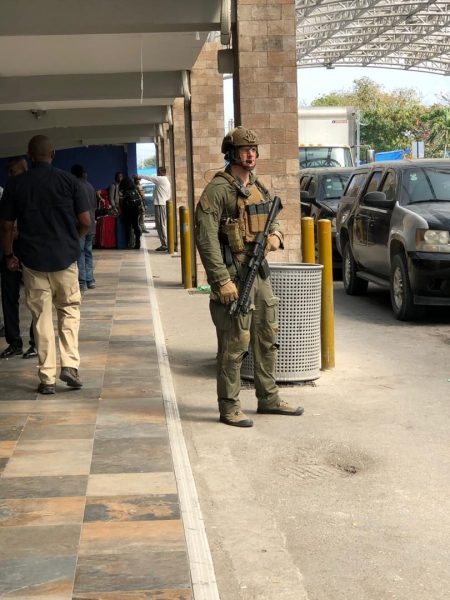 Canadian troops may have recently been deployed to Haiti, even though the government has not asked Parliament or consulted the public for approval to send soldiers to that country.
Last week the Haiti Information Project photographed heavily-armed Canadian troops patrolling the Port-au-Prince airport. According to a knowledgeable source I emailed the photos to, they were probably special forces. The individual in “uniform is (most likely) a member of the Canadian Special Operations Regiment (CSOR) from Petawawa”, wrote the person who asked not to be named. “The plainclothes individuals are most likely members of JTF2. The uniformed individual could also be JTF2 but at times both JTF2 and CSOR work together.” (CSOR is a sort of farm team for the ultra-elite Joint Task Force 2.)
What was the purpose of their mission? The Haiti Information Project reported that they may have helped family members of President Jovenel Moïse’s unpopular government flee the country. HIP tweeted, “troops & plainclothes from Canada providing security at Toussaint Louverture airport in Port-au-Prince today as cars from Haiti’s National Palace also drop off PHTK govt official’s family to leave the country today.”
Many Haitians would no doubt want to be informed if their government authorized this breach of sovereignty. And Canadians should be interested to know if Ottawa deployed the troops without parliamentary or official Haitian government okay. As well any form of Canadian military support for a highly unpopular foreign government should be controversial.
Two days after Canadian troops were spotted at the airport five heavily armed former US soldiers were arrested. The next day the five Americans and two Serbian colleagues flew to the US where they will not face charges. One of them, former Navy SEAL Chris Osman, posted on Instagram that he provided security “for people who are directly connected to the current President” of Haiti. Presumably, the mercenaries were hired to squelch the protests that have paralyzed urban life in the country. Dozens of anti-government protesters and individuals living in neighborhoods viewed as hostile to the government have been killed as calls for the president to step down have grown in recent months.
Was the Canadian deployment in any way connected to the US mercenaries? While it may seem far-fetched, it’s not impossible considering the politically charged nature of recent deployments to Haiti.
After a deadly earthquake rocked Haiti in 2010 two thousand Canadian troops were deployed while several Heavy Urban Search Rescue Teams were readied but never sent. According to an internal file uncovered through an access to information request, Canadian officials worried that “political fragility has increased the risks of a popular uprising, and has fed the rumour that ex-president Jean-Bertrand Aristide, currently in exile in South Africa, wants to organize a return to power.” The government documents also explain the importance of strengthening the Haitian authorities’ ability “to contain the risks of a popular uprising.”
The night president Aristide says he was “kidnapped” by US Marines JTF2 soldiers “secured” the airport. According to Agence France Presse, “about 30 Canadian special forces soldiers secured the airport on Sunday [Feb. 29, 2004] and two sharpshooters positioned themselves on the top of the control tower.” Reportedly, the elite fighting force entered Port-au-Prince five days earlier ostensibly to protect the embassy.
Over the past 25 years Liberal and Conservative governments have expanded the secretive Canadian special forces. In 2006 the military launched the Canadian Special Operations Forces Command (CANSOFCOM) to oversee JTF2, the Special Operations Regiment, Special Operations Aviation Squadron and Canadian Joint Incident Response Unit.
CANSOFCOM’s exact size and budget aren’t public information. It also bypasses standard procurement rules and their purchases are officially secret.While the Canadian Security Intelligence Service (CSIS), Communications Security Establishment and other government agencies face at least nominal oversight, CANSOFCOM does not.
During a 2006 Senate Defence Committee meeting CANSOFCOM Commander Colonel David E. Barr responded by saying, “I do not believe there is a requirement for independent evaluation. I believe there is sufficient oversight within the Canadian Forces and to the people of Canada through the Government of Canada — the minister, the cabinet and the Prime Minister.”
The commander of CANSOFCOM simply reports to the defence minister and PM.
“Even the U.S. President does not possess such arbitrary power,” notes Michael Skinner in a CCPA Monitor story titled “Canada’s Ongoing Involvement in Dirty Wars.”
This secrecy is an important part of their perceived utility by governments. “Deniability” is central to the appeal of special forces, noted Major B. J. Brister. The government is not required to divulge information about their operations so Ottawa can deploy them on controversial missions and the public is none the wiser. A 2006 Senate Committee on National Security and Defence complained their operations are “shrouded in secrecy”. The Senate Committee report explained, “extraordinary units are called upon to do extraordinary things … But they must not mandate themselves or be mandated to any role that Canadian citizens would find reprehensible. While the Committee has no evidence that JTF2 personnel have behaved in such a manner, the secrecy that surrounds the unit is so pervasive that the Committee cannot help but wonder whether JTF2’s activities are properly scrutinized.” Employing stronger language, right wing Toronto Sun columnist Peter Worthington pointed out that, “a secret army within the army is anathema to democracy.”
If Canadian special forces were secretly sent to Port-au-Prince to support an unpopular Haitian government Justin Trudeau’s government should be criticized not only for its hostility to the democratic will in that country but also for its indifference to Canadian democracy.
Canadian policy on Venezuela, Haiti reveals hypocrisy that media ignores
By Yves Engler · February 19, 2019
If the dominant media was serious about holding the Canadian government to account for its foreign policy decisions, there would be numerous stories pointing out the hypocrisy of Ottawa’s response to recent political developments in Haiti and Venezuela.
Instead silence, or worse, cheer-leading.
Venezuela is a deeply divided society. Maybe a quarter of Venezuelans want the president removed by (almost) any means. A similar proportion backs Nicolas Maduro. A larger share of the population oscillates between these two poles, though they generally prefer the president to opposition forces that support economic sanctions and a possible invasion.
There are many legitimate criticisms of Maduro, including questions about his electoral bonafides after a presidential recall referendum was scuttled and the Constituent Assembly usurped the power of the opposition dominated National Assembly (of course many opposition actors’ democratic credentials are far more tainted). But, the presidential election in May demonstrates that Maduro and his PSUV party maintain considerable support. Despite the opposition boycott, the turnout was over 40% and Maduro received a higher proportion of the overall vote than leaders in the US, Canada and elsewhere. Additionally, Venezuela has an efficient and transparent electoral system — “best in the world” according to Jimmy Carter in 2012 — and it was the government that requested more international electoral observers.
Unlike Venezuela, Haiti is not divided. Basically, everyone wants the current “president” to go. While the slums have made that clear for months, important segments of the establishment (Reginald Boulos, Youri Latortue, Chamber of Commerce, etc) have turned on Jovenel Moïse. Reliable polling is limited, but it’s possible 9 in 10 Haitians want President Moïse to leave immediately. Many of them are strongly committed to that view, which is why the country’s urban areas have been largely paralyzed since February 7.
In a bid to squelch the protests, government forces (and their allies) have killed dozens in recent months. If you include the terrible massacre reported here and here in the Port-au-Prince neighborhood of La Saline on November 11-13 that number rises far above 100.
Even prior to recent protests the president’s claim to legitimacy was paper-thin. Moïse assumed the job through voter suppression and electoral fraud. Voter turnout was 18%. His predecessor and sponsor, Michel Martelly, only held elections after significant protests. For his part, Martelly took office with about 16 per cent of the vote, since the election was largely boycotted. After the first round, US and Canadian representatives pressured the electoral council to replace the second-place candidate, Jude Celestin, with Martelly in the runoff.
While you won’t have read about it in the mainstream media, recent protests in Haiti are connected to Venezuela. The protesters’ main demand is accountability for the billions of dollars pilfered from Petrocaribe, a discounted oil program set up by Venezuela in 2006. In the summer demonstrators forced out Moïse’s prime minister over an effort to eliminate fuel subsidies and calls for the president to go have swelled since then. Adding to popular disgust with Moïse, his government succumbed to US/Canadian pressure to vote against Venezuela at the OAS last month.
So what has been Ottawa’s response to the popular protests in Haiti? Has Global Affairs Canada released a statement supporting the will of the people? Has Canada built a regional coalition to remove the president? Has Canada’s PM called other international leaders to lobby them to join his effort to remove Haiti’s President? Have they made a major aid announcement designed to elicit regime change? Have they asked the International Criminal Court to investigate the Haitian government? Has Justin Trudeau called the Haitian President a “brutal dictator”?
In fact, it’s the exact opposite to the situation in Venezuela. The only reason the Haitian president is hanging on is because of support from the so-called “Core Group” of “Friends of Haiti”. Comprising the ambassadors of Canada, France, Brazil, Germany and the US, as well as representatives of Spain, EU and OAS, the “Core Group” released a statement last week “acknowledging the professionalism shown by the Haitian National Police.” The statement condescendingly “reiterated the fact that in a democracy change must come through the ballot box, and not through violence.” The “Core Group’s” previous responses to the protests expressed stronger support of the unpopular government. As I detailed 10 weeks ago in a story headlined “Canada backs Haitian government, even as police force kills demonstrators”, Ottawa has provided countless forms of support to Moïse’s unpopular government. Since then Justin Trudeau had a “very productive meeting” with Haitian Prime Minister Jean Henry Ceant, International development minister Marie-Claude Bibeau declared a desire to “come to the aid” of the Haitian government and Global Affairs Canada released a statement declaring that “acts of political violence have no place in the democratic process.” Trudeau’s government has provided various forms of support to the repressive police that maintains Moïse’s rule. Since Paul Martin’s Liberals played an important role in violently ousting Jean-Bertrand Aristide’s government in 2004 Canada has financed, trained and overseen the Haitian National Police. As took place the night Aristide was forced out of the country by US Marines, Canadian troops were recently photographed patrolling the Port-au-Prince airport.
Taking their cue from Ottawa, the dominant media have downplayed the scope of the recent protests and repression in Haiti. There have been few (any?) stories about protesters putting their bodies on the line for freedom and the greater good. Instead the media has focused on the difficulties faced by a small number of Canadian tourists, missionaries and aid workers. While the long-impoverished country of 12 million people is going through a very important political moment, Canada’s racist/nationalist media is engrossed in the plight of Canucks stuck at an all-inclusive resort!
The incredible hypocrisy in Ottawa’s response to recent political developments in Haiti and Venezuela is shameful. Why has no major media dared contrast the two?
Canada backs repression, killing of protestors in Haiti
By Yves Engler · December 1, 2018
The Ugly Canadian has shown his elite-supporting, poor-bashing repressive face in Haiti.
Ottawa is backing the repression of anti-corruption protests and Justin Trudeau is continuing Canada’s staunch support for that country’s reactionary elite.
Over the past three months there have been numerous protests demanding accountability for public funds. Billions of dollars from Petrocaribe, a discounted oil program set up by Venezuela in 2006, was pilfered under former President Michel Martelly, an ally of current leader Jovenel Moise. After having forced out the prime minister in the summer over an effort to eliminate fuel subsidies, protesters are calling for the removal of Moise, who assumed the presidency through voter suppression and electoral fraud.
According to the Western media, a dozen protesters have been killed since a huge demonstration on October 17. But, at least seven were killed that day, two more at a funeral for those seven and pictures on social media suggest the police have killed many more.
Ottawa is supporting the unpopular government and repressive police. While a general strike paralyzed the capital on Friday, Canadian Ambassador André Frenette met Prime Minister Jean Henry Céant with other diplomats to “express their support to the government.” Through the “Core Group” Ottawa has blamed the protesters for Canadian trained and financed police firing on them. The Canada, US, France, Spain, EU, UN and OAS “Group of Friends of Haiti” published a statement on Thursday criticizing the protesters and backing the government. It read, “the group recalls that acts of violence seeking to provoke the resignation of legitimate authorities have no place in the democratic process. The Core Group welcomes the Executive’s commitment to continue the dialogue and calls for an inclusive dialogue between all the actors of the national life to get out of the crisis that the country is going through.” (translation)
In a similar release at the start of the month these “Friends of Haiti” noted: “The group praises the professionalism demonstrated by the National Police of Haiti as a whole on this occasion to guarantee freedom of expression while preserving public order. While new demonstrations are announced, the Core Group also expresses its firm rejection of any violence perpetrated on the sidelines of demonstrations. The members of the group recall the democratic legitimacy of the government of Haiti and elected institutions and that in a democracy, change must be through the ballot box and not by violence.”
But, in late 2010/early-2011 the Stephen Harper Conservatives intervened aggressively to help extreme right-wing candidate Michel Martelly become president. Six years earlier Trudeau’s Liberal predecessor, Paul Martin, played an important role in violently ousting Jean-Bertrand Aristide’s government. For two years after the February 29, 2004, overthrow of Haitian democracy, a Canada-financed, trained and overseen police force terrorized Port-au-Prince’s slums with Canadian diplomatic and (for half a year) military backing.
Since that time Ottawa has taken the lead in strengthening the repressive arm of the Haitian state (in 1995 Aristide disbanded the army created during the 1915-34 US occupation). Much to the delight of the country’s über class-conscious elite, over the past decade and a half Canada has ploughed over $100 million into the Haitian police and prison system.
Since his appointment as ambassador last fall Frenette has attended a half dozen Haitian police events. In April Frenette tweeted, “it is an honour to represent Canada at the Commissaires Graduation Ceremony of the National Police Academy. Canada has long stood with the HNP to ensure the safety of Haitians and we are very proud of it.” The previous October Frenette noted, “very proud to participate today in the Canadian Armed Forces Ballistic Platelet Donation to the Haitian National Police.”
Canada also supports the Haitian police through the UN mission. RCMP officer Serge Therriault currently leads the 1,200-person police component of the Mission des Nations unies pour l’appui à la Justice en Haïti. For most of the past 14 years a Canadian has been in charge of the UN police contingent in Haiti and officers from this country have staffed its upper echelons.
Canada is once again supporting the violent suppression of the popular will in Haiti. Justin Trudeau has taken off his progressive mask to reveal what is inside: The Ugly Canadian.
Yves Engler is the co-author, with Antony Fenton, of Canada in Haiti: Waging War on the Poor Majority. His latest book is Left, Right: Marching to the Beat of Imperial Canada
Featured Video
America Racing to Strategic Defeat in Iran
or go to
Aletho News Archives – Video-Images
From the Archives
An Expert Military Analysis of War with China
Actually, None is Necessary
By Fred Reed • Unz Review • December 13, 2020
The Correlation of Armed Forces: U.S. goods and services trade with China totaled an estimated $634.8 billion in 2019. Exports were $163.0 billion; imports were $471.8 billion. The U.S. goods and services trade deficit with China was $308.8 billion in 2019. Trade in services with China (exports and imports) totaled an estimated $76.7 billion in 2019. Services exports were $56.5 billion; services imports were $20.1 billion. The U.S. services trade surplus with China was $36.4 billion in 2019.
There is talk within the Washingtoniat of a possible war with China. Steve Bannon, who apparently was dropped on his head as a child, actually favors such a war. We hear the usual shoo-the-boobs alarm about how the Chinese are doing something terrible and we must gird our loins and American values and show them what for, bow wow, woof. The danger is that the current game of who-blinks-first in Asian waters might actually provoke a shooting war. You know the kind of thing: One warship refuses to get out of the way of another, a collision ensues, some retard lieutenant who signed up on waivers opens fire, and we’re off and running. It is not a good idea to let children play with matches.
The said war is discussed either in emotional terms by idiots or in purely naval terms by those familiar with such things, so we hear of the First Island Chain and the Second Island Chain and whose missiles against the other’s missiles and so on. This would be appropriate if we were fighting World War Two again. Which we aren’t. Let’s take a quick-and-dirty look at how such a war might go.
To begin the war, America would overestimate itself and underestimate China. This is doctrine in the Pentagon. … continue
Blog Roll
 Aletho News
- Poland rules out sending Patriot missiles to US/Israel amid war on Iran
- Tehran approves new Hormuz plan with major restrictions
- No Threat Can Force Iran’s Surrender /Trita Parsi & Lt Cl Daniel Davis
- UK’s New Pandemic Plan Would Turn Big Tech Into a Mass Location Tracking Network
- Growing insecurity, soaring prices fuel protests in north as regime bans evacuation: Sources
- Iran denies responsibility for ‘depraved’ attack on Kuwait desalination plant
- Bring The Troops Back. End This War Now!
- Can we please stop calling Israel the ‘only democracy in the Middle East’ now?
- US should start removing its troops from Germany, proposes AfD co-leader Chrupalla
- Iran Red Crescent: 600 educational centers attacked in US-Israeli ‘war crimes’
- If Americans Knew
- The Line Between Affinity and Conspiracy
- As Iran targets US military bases, will they be relocated to Israel? Not a ceasefire Day 171
- Will Trump Go Kamikaze?
- Is the University of Florida Shutting Down College Republicans over Israel Criticism?
- Jewish extremist arrested over alleged plot to firebomb Palestinian activist Nerdeen Kiswani’s home
- More than half of Palestinian child detainees have no charges
- The More Murderous Israel Gets, The More We Hear About “Antisemitism”
- Land Day and the Palestinian struggle after 30 months of genocide
- The Iran War Is About Palestine
- Israeli soldiers echo settler ideology, talk of revenge after targeting Palestinians and detaining CNN crew in the West Bank
- No Tricks Zone
- New Study Finds Warming Saves Lives…Cold Temperatures 12 Times More Deadly Than Excess Heat
- German Science Blog Accuses PIK Climate Institute Of Hallucinating Climate Tipping Points
- Devastating Assessment Of Comirnaty Vaccine By Former Senior Pfizer Europe Toxicologist
- New Study: CO2 Is ‘Effectively Negligible’ As An Explanatory Climate Change Factor Since 2000
- Former Pfizer Toxicologist Dr. Helmut Sterz Tells Bundestag Hearing Pfizer Vaccine Should Have Never Been Approved
- Energy Expert: Germany’s Nuclear Phaseout Was A “500 Billion Euro Mistake”
- New Research: South Australia’s Mid-Holocene Sea Surface Temperatures Were 4°C Warmer Than Today
- Storing Green Energy To Last Germany 10 Days Would Require A 60-Million Tonne Battery
- New Studies: UK Sea Levels Were 4 Meters Higher Than Today During The Mid-Holocene
- Destructive Green New Deal: German Energy And Metal Group Warns Of Drastic Crisis
 Aletho News