Despite its shortcomings, UNSC vote will tie Israel’s hands
By MK Bhadrakumar | The Cradle | December 25, 2023
The adoption of a resolution by the United Nations Security Council (UNSC) on Friday with focus on a pause in the fighting in Gaza to allow for the delivery of more humanitarian aid can be seen as a turning point in the tortuous journey toward imposing a sustainable ceasefire.
But a caveat must be added that the ultimate litmus test lies in the implementation of the UNSC resolution, as the past history of such resolutions on Palestine does not give cause for optimism.
In fact, Israel’s defiance was in full view already. As the Security Council passed the resolution, Israeli forces pushed ahead with their offensive into Gaza on Friday and ordered residents in Al Bureij — an area in central Gaza where Israel had not previously focused its offensive — to evacuate. The Israeli military’s chief spokesman Rear Adm. Daniel Hagari said on Thursday: “Our forces continue to intensify ground operations in northern and southern Gaza.”
UN Secretary General António Guterres was spot on when he told reporters after the resolution was passed that “a humanitarian ceasefire is the only way to begin to meet the desperate needs of people in Gaza and end their ongoing nightmare.”
The resolution itself is the outcome of week-long intense negotiations between the United States and the Arab countries that sponsored it — the UAE and Egypt, in particular — to settle for the lowest denominator, which meant accepting a Washington-friendly text that enabled the Biden administration to evade responsibility for another veto, for the third time since 7 October.
Unsurprisingly, the US negotiators brazenly resorted to pressure tactics by drawing on their usual diplomatic tool box — blackmail, arm-twisting and ultimatums — to water down the text to the extent that important provisions relating to a ceasefire and a UN mechanism to facilitate the delivery of humanitarian aid to Gaza and ensure its monitoring were abandoned.
And, yet, the US abstained in the vote at the end of the day, registering its reservations — principally, that the resolution was silent on the attack by Hamas on 7 October.
The unkindest cut of all is that the resolution accommodated the US diktat to replace the language describing an immediate cessation of violence with an ambiguous phrase calling on the parties to “create conditions for a cessation of hostilities.” The wording meets the Israeli requirement to have a free hand to continue with its barbaric military operations.
This anomaly, coupled with the absence of any reference to the condemnation of indiscriminate attacks by the Israeli military against civilians almost delivers the wrong signal that the Security Council is effectively becoming an accomplice to the destruction of Gaza — a misnomer that agitated Russia so much that it proposed a last-minute amendment to replace the phraseology in the resolution: “to create the conditions for a sustainable cessation of hostilities” with the unambiguous call “for urgent steps toward a sustainable cessation of hostilities.”
Russia’s demand for an immediate ceasefire was in line with a resolution overwhelmingly passed by the UN General Assembly recently, but the Americans would have nothing of that sort. The unfortunate part is that the Arab sponsors of the resolution caved in to US blackmail to veto the resolution. What transpired between the protagonists behind the scenes is not known.
The paradox is that, in reality, the Americans themselves were desperately keen to avoid casting a veto — the third in as many months — that would have made a mockery of President Joe Biden’s bombastic remark in his September speech at the UN last year that the permanent members of the Security Council should cast vetoes only under “rare, extraordinary situations to ensure the council remains credible and effective.”
All indications are that the US is acutely conscious of finding itself “diplomatically isolated and in a defensive crouch,” as the New York Times put it in an acerbic commentary on the Biden administration’s plight as “an increasingly lonely protector of Israel … (that) puts it at odds with even staunch allies such as France, Canada, Australia, and Japan.”
The commentary says that what rankles most is that first, when the US seems to have green-lit a massive Israeli military response to 7 October “without guardrails,” it:
“painfully confirmed to many in the (global) south this sense that there was a double standard” — and second, even more, “the Russian strategy works, because beyond the United Nations what everyone sees is Russia standing up for international law — and the US standing against it.”
The crux of the matter is that Israel’s Gaza operation is running into a Cornelian dilemma (dilemme cornélien) where sooner rather than later, it is obliged to choose one option from a range of options, all of which reveals a detrimental effect on itself.
Hamas’ top leaders have evaded capture so far, and Gaza’s armed resistance groups have continued to fire rockets into Israel, including two barrages that reached Tel Aviv and its environs last week.
According to another New York Times report,“ political commentators and some military experts have been lowering expectations for a quick and decisive Israeli victory.
“Nobody should imagine that there will be a situation where we put a flag on top of a hill and say: OK, we won, and now Gaza will be peaceful and safe. It will not happen,” said Gabi Siboni, a colonel in the reserves and a fellow at the conservative-leaning Jerusalem Institute for Strategy and Security. “The reality is that we are going to be fighting in Gaza for years to come.”
But is that sustainable — even if Israel controls the US Congress? Conceivably, Israel’s main goal in Gaza was to ethnically cleanse the Strip and drive the Palestinian population to Egypt and Jordan by killing and starving them and making Gaza unlivable.
The real significance of the UNSC resolution, therefore, lies in that such an Israeli game plan will not fly. By not vetoing the resolution, the US may also have signaled that it will not allow the ethnic cleansing. There seems to be an understanding on this score between the US and the Arab protagonists at the political level — Egypt, in particular.
On the other hand, can Israel really destroy Hamas while the Palestinian population remains in Gaza? No, it will not be possible. Now, there is reason to believe that Hamas is inflicting significant damage to the Israeli military. The retreat of the Golani Brigade from the Gaza operation also points in that direction.
The bottom line is that the Israeli operation in Gaza will have to take a different form during the next several weeks — one that is anchored on surgical strikes rather than continuing with the extended ground operation and open-ended Israeli occupation. With warts and all, the Security Council resolution that was passed on Friday paves the way for such a transition.
Almost all Saudi nationals oppose Arab ties with Israel, poll finds
Press TV – December 23, 2023
A new survey has found that 96 percent of Saudi Arabian citizens want Arab countries to cut all types of ties with Israel in response to the occupying regime’s war on Gaza.
Conducted by the Washington Institute for Near East Policy, a pro-Israel think tank based in Washington, the survey saw almost every Saudi agreeing with the proposal “Arab countries should immediately break all diplomatic, political, economic, and any other contacts with Israel, in protest against its military action in Gaza.”
The study further found that a big majority of the Saudis (91%) believe that “despite the destruction and loss of life, this war in Gaza is a win for the Palestinians, Arabs, and Muslims.”
The majority of respondents in Jordan, Lebanon and Egypt held favorable views towards the Palestinian resistance movement Hamas, but saw a 30-point growth in its popularity in the case of Saudi Arabians, compared to August.
The survey said 87% agree with the suggestion that “recent events show that Israel is so weak and internally divided that it can be defeated someday.”
Conducted to measure the change in shift of attitudes of Saudi nationals after the bloody war broke out, the survey was conducted from November 14 to December 6.
The results of the study are a clear manifestation of the difficulties the United States is going to face as it advocates for intertwined Arab-Israeli cooperation.
Prior to the war, the US was actively working towards achieving an agreement to normalize Saudi Arabia-Israel relations.
Earlier in September, during an interview with Fox News, Saudi Crown Prince Mohammed bin Salman stated that the two countries were getting closer to such an agreement “every day.”
After the war broke out, Riyadh put a pause on normalization talks and has made its diplomatic outreach public as one that seeks “to stop the ongoing escalation.”
The Israeli genocide in Gaza has significantly suppressed support for allowing contact with Israelis.
Reports: Hamas seeks release of Marwan Barghouti in any hostage deal
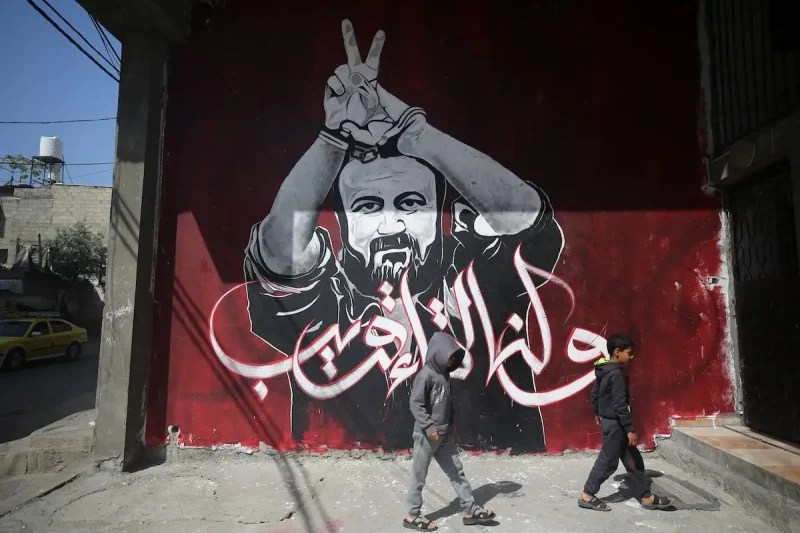
A mural shows jailed Fatah leader Marwan Barghouti, in Jabalia refugee camp in the northern Gaza Strip on April 16, 2023. [Majdi Fathi/NurPhoto]
MEMO | December 22, 2023
Qassam Brigades kill Ukrainian mercenaries in Gaza
The Cradle | December 21, 2023
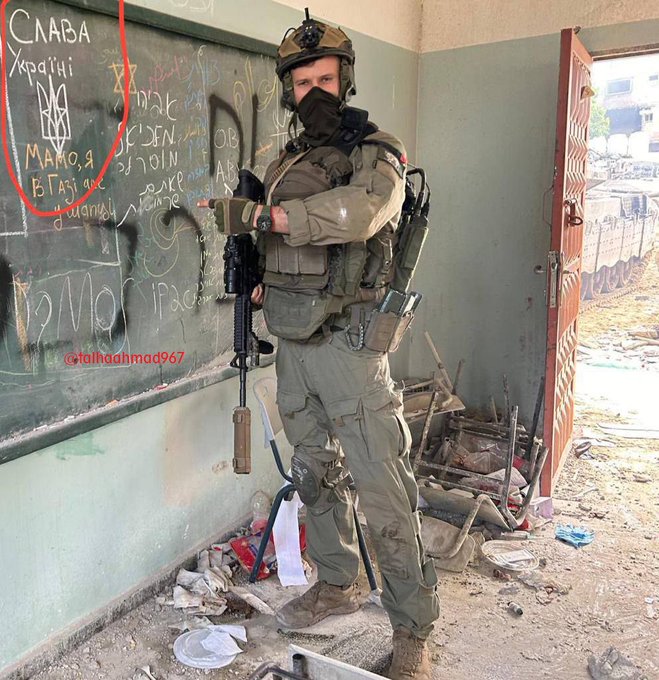
Fighters from Qassam Brigades, the armed wing of Hamas, ambushed and killed at least seven Ukrainian mercenaries who were fighting with the Israeli army in Gaza, Quds News Network reported on 21 December.
According to sources speaking with the network, Qassam fighters targeted the mercenaries on 14 November after spotting them on Hassanein Street in the Shujaiya neighborhood, one of the main centers of Palestinian resistance to the ongoing Israeli ground invasion.
The sources added that “the occupation army did not include the dead among the numbers it acknowledges about its losses among soldiers in Gaza,” and that the ambush killed soldiers from the Israeli army as well.
According to the sources, a video that circulated on social media of a unit of Ukrainian mercenaries in a Shujaiya school was recorded on the same day as the attack.
The video showed one mercenary writing in the Ukrainian language on a chalk board in the school.
It also showed a group of Ukrainian mercenaries in a neighborhood of Gaza City, hiding behind a wall.
Ukrainians fighting for Israel is a reversal of a dynamic that appeared in 2022, as reports emerged of hundreds of Ukrainian-born Israelis and several native Israelis traveling to Ukraine to join volunteer units after the Russian invasion.
The Quds Network report comes as the Israeli military announced the deaths of three additional soldiers on Thursday, Lavi Gehati, Omri Schwartz, and Yacoub Elian, during battles in the Gaza Strip. This brings the number of Israeli soldiers killed to more than 136, according to Israel, since the start of its ground invasion in Gaza on 27 October.
However, as The Cradle has reported, Israeli military leaders seeks to hide many of their soldiers’ deaths, and the number killed and wounded is likely much higher than the military’s official acknowledgements.
Hamas has released a flurry of combat videos in the past week showing its fighters targeting Israeli troops, armored personnel carriers, and tanks. This indicates that while Israel has caused massive destruction in Gaza, the Qassam Brigades are still strong militarily and are inflicting heavy losses on the Israeli army.
Analysis: Why Israel Will Continue Its Deadly Push Into Gaza City Centres
By Zoran Kusovac | Strategic Culture Foundation | December 19, 2023
Dramatic news reports, claims and videos have emerged from both sides involved in the Gaza fighting throughout the past week.
The week started with the Israeli army releasing several videos of Palestinians stripped to their underwear being marched through urban ruins. Israel’s PR machine disregarded the Palestinian outcry that followed. Israel staunchly asserted that the men were Hamas fighters and that their alleged mass surrenders signified that the end of the Palestinian group was close, even as many Palestinians and independent observers insisted that the men were civilians who had been treated against the laws of war by being publicly humiliated.
For its part, Hamas stuck to its usual practice of pushing its cause through video releases – skilfully edited to enhance the desired effects – purporting to confirm its constant and numerous successes against Israeli invaders, mostly showing hits scored against armoured vehicles.
Then came the news that stunned Israel and put a big question mark on its official line of Hamas being on the verge of collapse. First, nine soldiers were killed in a single operation in the Shujaiya neighbourhood of Gaza City on Tuesday. That shock was followed by another one on Friday, with the Israeli army admitting that it killed three Israeli captives, having mistaken them for enemies – even though they held white flags.
So what is really happening on the ground in Gaza?
Nothing we did not predict weeks ago: The war has entered a difficult, unpredictable and bloody phase of full-scale urban warfare where gains are small and slow, and losses can be huge.
Combat in narrow and cramped streets of old cities is known to be one of the most difficult ways to fight a war. Classic military theory calls for defended cities to be surrounded and blockaded by units just strong enough to prevent the defenders from breaking out, while the main force continues advancing and taking territory.
But the fight in Gaza is not about conquering fields and beaches – Israel’s proclaimed goal is to destroy Hamas. To do that, the first step is to control the ground where the enemy operates: the cities.
In the old days, cities needed strong walls to defend themselves, but in the last 100 years, weapons have advanced at a rapid rate, causing a change in tactics. Successful resistance against enemy attacks no longer depends on huge, expensive static bastions. Nowadays, small but potent man-portable weapons whose destructive power is hugely disproportionate to their size, such as anti-tank rocket launchers, grenade throwers, small mortars, assault rifles and many others, allow the defenders to turn each house and every street into a formidable defensive position.
From the 1940s to this day, almost all attempts to conquer cities held by determined defenders have ended in failure. The few victories attackers achieved were so costly that they often ended the offensive capabilities of those armies pushing into cities.
In their own ways, Stalingrad, Warsaw, Berlin, Dien Bien Phu, Vukovar, Sarajevo, Grozny and Fallujah – some successfully defended, others eventually succumbing to attacks – all confirmed the military wisdom that urban warfare should be avoided whenever possible.
Israel could not avoid urban warfare in Gaza. To have a chance of destroying Hamas, it has to deny it its operating ground, the three biggest urban agglomerations in the strip: Gaza City, Khan Younis and Rafah.
The second phase started with Israeli forces reaching the suburbs, first of Gaza City and then, after the temporary ceasefire expired, of Khan Younis. Treading slowly and carefully in expectation of a concentrated Hamas response, the Israeli military completed the encirclement of those two urban areas.
It would be naive to assume that Israel’s generals hoped that by isolating the two biggest built-up areas in the Gaza Strip, they would seriously impair the ability of the Qassam Brigades, Hamas’s armed wing, to fight back.
In reality, the encirclement of the two city centres is not a classic one where troops within the blockade cannot be reinforced nor receive any supplies. Hamas still has an unknown but probably major part of its tunnel network intact and can move in and out. They have some difficulties in doing so but Hamas fighters are not locked in.
Aware of the menace that tunnels present but also of the grave hazard of taking the fight into them, Israel has tried several approaches. It has destroyed as many tunnel entrances as it has found, mostly in the areas under its control, but many others that remain keep the danger acute.
After several attempts to send troops underground that ended in disaster, with troops falling casualty to Hamas booby traps, the high command abandoned that approach. It then reportedly mulled the idea of filling tunnels with seawater, claiming that the test-flooding was successful but it has not yet decided to mount a full-scale deluge operation.
This week’s Israeli actions on the ground strongly suggest that the Israeli army leadership realises that the only way towards achieving its proclaimed goal of annihilating Hamas is by taking, holding and controlling the ground throughout the currently surrounded centres of Gaza City and Khan Younis.
That in itself would not guarantee victory but could create conditions to squeeze Hamas fighters into tunnels, after which Israeli forces could block and destroy all entrances.
Flushing Hamas out would probably take weeks of heavy urban warfare with many more instances of massive losses – on both sides.
The more Israeli soldiers get killed in inner cities of Gaza, without still being able to claim the destruction of Hamas, the more the support for the continuation of the military operation would ebb. At some point, calls from Israel to stop the war could become louder than those encouraging it to continue.
EU announces probe into Musk’s X
RT | December 18, 2023
The European Union announced on Monday that it was taking “formal infringement proceedings” against Elon Musk’s X social media platform over a recently implemented law intended to crack down on illegal content and disinformation online.
The announcement of the probe comes weeks after X (formerly Twitter) was asked to provide assurances that it was complying with the terms of the European bloc’s Digital Service Act. Under the law, which came into effect in August, a company can be fined up to 6% of its annual global income or banned from operating in the EU if it is found to have breached the sweeping legislation.
“Today we open formal infringement proceedings against X,” Thierry Breton, the EU commissioner responsible for the law’s enforcement, wrote in a post on the social network on Monday.
Breton added that the move had been taken in response to a “suspected breach of obligations to counter illegal content and disinformation; suspected breach of transparency obligations,” and “suspected deceptive design of user interface.”
The probe will also look at the effectiveness of X’s ‘community notes,’ in which users can fact-check or provide comments on the accuracy of certain posts.
Responding to the charge on Monday, X said it was “cooperating with the regulatory process,” and added that it was “important that this process remains free of political influence and follows the law.”
The platform, which was subject to a multi-billion-dollar takeover by Elon Musk last year, said it was focused on “creating a safe and inclusive environment” for its users, which it said it balances against “protecting freedom of expression.” At the time of the takeover, Musk branded himself as a “free speech absolutist.”
On October 10, the EU warned X in a formal letter that it had received “indications” that the social media platform was “being used to disseminate illegal content and disinformation in the EU” related to Hamas’ attack in Israel on October 7.
In a letter to Breton, X chief executive Linda Yaccarino responded to say the firm was “working to address the operational needs of this fast-moving and evolving conflict.” She added that X had removed hundreds of Hamas-affiliated accounts from the service.
Earlier this year, X was among several tech giants to sign up to an EU code of conduct to prepare for the launch of the Digital Services Act in August. However, X withdrew from the agreement in May, prompting backlash from Breton. “You can run but you can’t hide,” he warned Musk and X.
Hamas: US and Britain back Israel’s genocide in Gaza

Palestine Information Center – December 17, 2023
The Hamas Movement has accused the Israeli occupation army of using different types of internationally prohibited ammunition and bombs in its genocidal war on the Gaza Strip and persisting in its indiscriminate bombardment of homes, shelter centers, tents and hospitals.
“All this is happening in full view of the world, with support from the US, Britain and some European countries,” senior Hamas official Osama Hamdan told a news conference in Beirut on Saturday.
Hamdan criticized the failure of the international community and the UN to stop the brutal Israeli aggression against Gaza as a result of the US use of its veto power to support what he called the “neo-Nazis” in their crimes and massacres.
“About 19,000 citizens of our people have been martyred and about 52,000 others have been injured, while there are approximately 800 missing persons — 70 percent of them children and women,” Hamdan pointed out.
Hamdan said that a staggering 45 percent of the martyrs in southern Gaza are displaced persons, which contradicts the Israeli occupation’s claims about the presence of safe zones.
“There is no safe place or safe passages in the Gaza Strip. These are lies the occupation keeps repeating and every official of the US administration keeps parroting. The entirety of Gaza, from its northernmost to southernmost areas, is targeted by the Zio-American weaponry,” Hamdan underscored.
“The war trio and losers, Netanyahu, Gantz and Gallant, achieved nothing of their aggressive goals and their ongoing Nazi war against the Gaza Strip … Their dreams and illusions will be shattered on the land of proud Gaza,” he said.
Most young Americans want Israel given to Hamas – poll
RT | December 16, 2023
Over half of US adults from ages 18 to 24 believe the ongoing crisis in Gaza should be resolved by abolishing the state of Israel and turning it over to Hamas and the Palestinian people, a new poll has found.
The Harvard-Harris poll, conducted this week and released on Friday, showed that 51% of young Americans believe the Israeli state should be “ended,” compared with 32% who favor a two-state solution. Just 17% said Arab countries should absorb the Palestinians to resolve the conflict. Among all age groups, six in ten Americans call for a two-state deal, while only 19% want Israel to be given to the Palestinians.
The survey marked the latest poll showing a dramatic divide between Americans young and old on issues relating to Israel and the Jewish people amid the ongoing war between West Jerusalem and Hamas. An Economist/YouGov poll released last week found that nearly half of US adults under age 30 either believe the Jewish Holocaust perpetrated by Nazi Germany is a myth or are not sure that it happened.
Two-thirds of 18- to 24-year-olds in the Harvard-Harris poll said they agree that “Jews as a class … should be treated as oppressors.” By contrast, 73% of Americans in all age groups – and 91% of respondents ages 65 and older – disagreed with the anti-Jewish statement. Similarly, half of the youngest respondents said they support Hamas in the war, while 81% of overall participants favor Israel. Six in ten young adults – but only 37% of overall respondents – believe Israel is committing genocide against the people of Gaza.
Americans are similarly divided on identity politics. For instance, 79% of young adults believe that “white people are oppressors” and that non-white people should therefore be shown favoritism in college admissions and employment, the poll found. Among all age groups, 65% of Americans oppose such anti-white discrimination.
Just 42% of Americans approve of how US President Joe Biden is handling the Israel-Hamas war, down from 45% in November, the poll showed. Only 32% believe that the country is on the “right track,” and 33% see the nation’s economy as heading in the right direction.
Such perceptions may bode poorly for Biden as he seeks reelection in 2024. The president has a net favorability rating of minus 10%, the poll showed. By comparison, independent presidential candidate Robert F. Kennedy Jr. has the highest favorability rating among all political figures listed in the survey, at plus 18%.
The poll found that if the election were held today, former President Donald Trump would defeat Biden by a margin of 43% to 35%, while Kennedy would garner 17% of the votes. More than seven in ten Americans believe that a vote for Biden would essentially be a vote for Vice President Kamala Harris because the 81-year-old incumbent wouldn’t likely complete a second term.
Israeli ex-detainee: Hamas fighters treated me and my kids with respect

Palestine Information Center – December 16, 2023
NAZARETH – Israeli ex-detainee in Gaza, Chen Goldstein-Almog, said that she and her three children were treated respectfully and not physically harmed or maltreated during their detention by Hamas fighters.
According to The New York Times, Goldstein-Almog had long conversations with her captors, sometimes for hours. “We talked about our families and the extreme danger we all faced.”
She explained that they were mostly detained in an apartment in Gaza, but she and her children were transferred during their detention period — which lasted 7 weeks — to different apartments, tunnels, a mosque, and even a destroyed supermarket, adding that during their movement between those places, the situation was terrifying due to the Israeli bombardment of the Gaza Strip.
She also said that the commander of the guards appeared educated and spoke Hebrew, pointing out that the guards taught her son 250 words in Arabic to keep him busy, brought him a notebook for study, regularly discussed with them what to eat and invited them to participate in cooking meals in kitchens.
She said that a Hamas fighter apologized to her for the killing of her husband and one of her daughters by other individuals, telling her that what had happened was wrong.
Goldstein-Almog affirmed that before her release, a guard told her “don’t go back to the Gaza envelope because we are coming back” and told her to go further.
Goldstein-Almog, 48, and her three children were captured on the first day of Operation “Al-Aqsa Flood” on October 7.
They were released in late November as part of a prisoner exchange between the Hamas Movement and the Israeli occupation during the temporary humanitarian truce.
Behind enemy bars: Palestinian and Israeli prisoners
The fair treatment of Israeli captives by Hamas has become part of the information war between Palestinians and Tel Aviv

By Robert Inlakesh | The Cradle | December 7, 2023
The issue of Prisoners of War (POWs) taken captive by Hamas-led Palestinian resistance forces has become one of the key justifications for Israel’s military assault on the Gaza Strip.
While western audiences are often presented with the image of these groups as bloodthirsty terrorists, a closer look reveals that Hamas and other factions may have treated Israeli captives more humanely than how Israel treats Palestinian political prisoners.
While the Israeli POW issue spans eight weeks, the plight of Palestinian captives has persisted since at least 1967. There are said to be some 137 Israelis that are currently being held captive in Gaza, whom Hamas claims all are males and/or soldiers.
In the seven-day truce struck in November between Hamas and Israel, the Palestinian resistance released 108 women and children held captive in Gaza. In return, Israel was to release 300 Palestinian women and children held in detention and permit much-needed aid into Gaza through the Rafah crossing with Egypt.
Stanley Cohen, a US attorney who has represented both Hamas and Hezbollah members, tells The Cradle that “the laws of war do not limit Prisoners of War to State actors.” He says that “all the laws of war apply, whether it’s state actors or non-state actors.”
This would mean that the same legal obligations on the treatment of POWs should apply to both Hamas and Israel, despite there being a greater moral expectation often placed on UN member states.
How Hamas treats Israeli POWs
Access to interviews with detainees is limited due to Israeli government restrictions on media interaction with the recently freed captives, especially since the embarrassing PR blunder in late October when one of the four Israelis unconditionally released before the truce – 85-year-old Yocheved Lifshitz – said at a presser that “they treated us very well” in Gaza, but had endured “hell” while being taken captive.
But despite the challenges in obtaining their full stories, certain facts stand out. Recent audio recordings quoted by Israeli media have revealed statements from freed prisoners who claim they were more fearful of Israeli actions than those by Hamas. One former detainee, criticizing the Israeli government, highlighted the lack of support and the challenges faced during their captivity:
“We were sitting in the tunnels and we were terribly afraid not that Hamas but Israel would kill us, and then they would say – Hamas killed you.”
Another former Israeli captive went further in expressing disdain for the Israeli government’s responses on and after the events of 7 October:
“The feeling we had there was that no one was doing anything for us. The fact is that I was in a hiding place that was shelled and we had to be smuggled out and were wounded. Not including the helicopter that shot at us on the way to Gaza. You claim that there is intelligence, but the fact is that we are being shelled. My husband was separated from us three days before we returned to Israel and taken to the tunnels. And you are talking about washing the tunnels with sea water? You are shelling the route of tunnels in the exact area where they are.”
Reports on the health of detainees suggest that there was a gradual decrease in food quantity inside Gaza, with claims that prisoners lost between 10 to 15 percent of their body mass. Dr Yael Mozer-Glassberg, an Israeli pediatrician, described the children’s experience as “psychological terror,” though her account should be viewed with some healthy skepticism.
Mozer-Glassberg’s accounts are the closest thing to a detailed explanation of how the freed Israeli captives were treated. According to a report published by Haaretz, the doctor repeated the following story of two children, stating that “the older one wouldn’t eat until the younger had finished eating and felt full,” adding that “these are the kind of stories I heard from my grandfather, who was a Holocaust survivor.”
When reading the language she employs to describe the conditions of the former captives, it is quite apparent that her account is geared towards exaggeration and that the doctor is not a neutral source.
Conflicting claims
On the other side of the spectrum are the Hamas-released videos showing the handover of mostly Israeli detainees to the International Red Cross. The footage is characterized by high-fives, smiles, waves, hugs, and even Arabic expressions of gratitude to their captors – visuals the Israeli government dismisses as propaganda.
Government spokesperson Eylon Levy said that Hamas “releases footage of crowds terrorizing the hostages in their final moments of captivity,” stating that the videos show how the group “continues to document its own atrocities.” Levy’s portrayal was a clear exaggeration, to say the least.
Tel Aviv’s health ministry has even gone as far as to suggest POWs were administered “drugs” to make them appear happy. Yet contrary to Mozer-Glassberg’s portrayals of terror, these videos provide more direct insights into the experiences of the freed Israelis.
Emily Hand, a 9-year-old Israeli girl who was held by Hamas, was returned to her father during the recent prisoner exchanges. Her father, Thomas, who had been paraded across western media after incorrectly being informed that his daughter was killed on 7 October, stated that “she [Emily] has lost a lot of weight, from her face and body, but generally doing better than we expected.”
Thai negotiator Dr Lerpong Sayed asserted that those he helped release were well cared for, receiving shelter, clothes, food, and water, with mental support provided equally to Thai and Israeli detainees – who he said were held together. There have also been reports of friendships blooming from within the Palestinian resistance groups’ detention tunnels, one between an Israeli woman and a Thai Worker. Claims of intentional injuries during transport and a letter expressing gratitude from a released captive’s family remain contested and unverified.
Hamas alleges that Israeli airstrikes have killed around 60 Israelis they were holding captive, including their Palestinian guards, with 23 of the bodies still trapped under rubble. The Israeli army, blaming Hamas, has discovered two of these corpses.
Amid varying accounts from families and doctors, it appears that conditions in the facilities where Israeli detainees were held were unpleasant, possibly exacerbated by Israel’s cutoff of all essential services at the start of the war.
A lack of hygiene, water, food, medicine, and electricity are all realities for the 2.3 million Palestinian civilians living in Gaza right now. If anything, the conditions that the Israeli captives faced were consistent with, if not better, than those faced by Gaza’s civilians.
How Israel mistreats Palestinian Prisoners
Unlike the Israeli detainees, freed Palestinian political prisoners have spoken directly to the international media and provided horrifying accounts of physical abuse, including torture, beatings, and even rape. According to a number of Palestinian women and children who were freed in the latest exchanges, they were threatened by Israelis not to speak out about their treatment in detention.
“There are no laws. Everything is permitted,” Lama Khater, a freed Palestinian captive, told the media. “I was led to the investigation handcuffed and blindfolded, I was threatened with being burned, I was explicitly threatened with rape and with deportation to the Gaza Strip,” she added.
Palestinian journalist Baraah Abu Ramouz, who was also freed from Israeli detention, gave the following testimony of what she witnessed:
“The situation in the prisons is devastating. The prisoners are abused. They are being constantly beaten. They’re being sexually assaulted. They are being raped. I’m not exaggerating. The prisoners are being raped.”
Mohammed Nazal had his fingers broken, his back bruised, and hands fractured by Israeli prison guards. “One week ago, we were savagely beaten with metal bars. I put my hands on my head to protect it from injury, but the soldiers did not stop until they broke my hands,” the 18-year-old freed prisoner said. Despite his clear injuries and horrifying testimony given to the media, where he said he was left lying on the floor in pain and was denied medical treatment, the Israeli authorities tried to claim he was a liar and released a video claiming he was unharmed. His testimonies and medical reports were later verified, revealing that Israel had lied and not Mohammed.
Ahed Tamimi, a Palestinian icon and activist who was being held without a charge, looked shaken and weak following her release, stating:
“The circumstances in the prison are very difficult, with daily abuse against female prisoners. They are left without water or clothes, sleeping on the floor and being beaten… The Israeli authorities threatened me with [targeting] my father if I spoke about anything that happens in prison.”
Their testimonies consistently highlight that conditions inside Israeli prisons further deteriorated after 7 October. Freed detainees spoke of physical and psychological abuse, and deprivation of essentials such as food, water, medical care, and proper sleeping arrangements.
Palestinian prisoner support and human rights association, Adameer reports that over 7,600 political prisoners are held in Israeli military detention, with more than 3,000 of these civilians captured since 7 October – far surpassing the total number of Israelis held in Gaza.
The overlooked Palestinian struggle
Tel Aviv’s claims that these Palestinians are all “convicted terrorists” is a farce. Israel’s military court system maintains a near 100% conviction rate for Palestinians, while thousands more are held under what is called “administrative detention” — jargon for those individuals detained without any charge. One testimony, which I recorded last year, came from now 22-year-old Abdul-Khaliq Burnat, who told a harrowing story from when he was held in Israel’s notoriously brutal al-Moskobiyya detention center:
“They shouted at me, beat me with their fists, slapped me and used tools. I was restricted with a plastic zip tie which cut into my wrists, whilst I was strapped to a chair in a stress position for 20 hours of the day … for three days they had me in a smelly, tiny cell; it was so cold in there and there wasn’t any light, I was stripped of all my clothes for the whole time and tied up naked, they didn’t give me any food and I couldn’t even use the bathroom.”
During his detention in May of 2021, Abdul-Khaliq says that he was informed daily by Israeli interrogators about how many women and children were being killed in Gaza at that time. His captors then brought his then 17-year-old brother Mohammed to the same detention center and beat him so severely that he was hospitalized on three separate occasions.
Mohammed Burnat still languishes in Israeli jail, where he has been held without a charge since his 2021 arrest. Abdul-Khaliq, who was first held captive for 13 months, at the age of 17, has again been taken captive by Israeli forces following the 7 October operation, and is currently being held in administrative detention.
When taking into consideration that the plight of Palestinian political prisoners represents one of the most important issues in contemporary Palestinian society, one can begin to understand the rationale and strategic thinking behind the resistance’s Al-Aqsa Flood operation to capture Israeli POWs.
Since 1967, Israel has detained over 1 million Palestinians, including tens of thousands of children, according to the UN.
Cases of torture, sexual abuse, and psychological trauma have been well documented throughout decades of Israel’s occupation of Palestine and detention of its people, yet this has not received a fraction of the media attention afforded to the Israelis imprisoned only two months ago.
Featured Video

Rewriting the risk? Inside the government’s vaccine safety messaging
or go to
Aletho News Archives – Video-Images
Book Review
“Davos Can Really Replace the UN”
Inside the book that maps the architecture behind global governance — from the Epstein files to the Pact for the Future
Lies are Unbekoming | April 1, 2026
On June 13, 2019, the United Nations and the World Economic Forum signed a partnership deal to “accelerate the implementation of the 2030 Agenda for Sustainable Development.” That same evening, WEF president Börge Brende — Norway’s former Foreign Minister — had dinner with Jeffrey Epstein at Epstein’s Manhattan townhouse. The Epstein files, released January 2026, contain an exchange between the two from the previous year. Epstein to Brende: “Davos can really replace the UN. C21, cyber, crypto . genetics… intl coordination.” Brende back to Epstein: “Exactly — we need a new global architecture. World Economic Forum (Davos) is uniquely positioned — public private.”
The next day, the UN General Assembly adopted the framework for restructuring global governance.
That sequence — the partnership signing, the Epstein dinner, the candid admission about replacing the UN with a public-private architecture, and then the formal adoption — opens Jacob Nordangård’s The Digital World Brain. Pages two and three. Footnoted to the UN resolution number, the Epstein files, and the General Assembly record.
I keep coming back to it because it captures what this book does that almost nothing else in the independent research space manages. I’ve followed Jacob’s work for years now and interviewed him about his research. Each book peels back another layer of the same institutional architecture, and each time I think he’s reached the limit of what can be documented, the next one goes further. Nordangård doesn’t speculate. He doesn’t editorialize much. He lays institutional actions next to each other in chronological order and lets the pattern announce itself. … continue
Blog Roll
 Aletho News
- Iran Threatens Retaliatory Strike on Stargate AI Project in UAE
- US sent ‘a lot’ of arms to Iranian protesters – Trump
- Barak Ravid Launders Deception To Allow Trump To Back Off Of His Power Plant Threat – Again
- REWRITING THE RISK? INSIDE THE GOVERNMENT’S VACCINE SAFETY MESSAGING
- “Davos Can Really Replace the UN”
- NIAID/NIH and USDA Fund Bioengineered Chimeric Influenza Viruses Built Using Pandemic H1N1 Components: Journal ‘Science Advances’
- Hezbollah hits Israeli warship off Lebanon’s coast, sets it aflame
- Iran slams US strikes on B1 bridge, Mahshahr petrochemical plants as ‘blatant acts of state terrorism’
- In letter to UN chief, Araghchi warns of dire consequences of US-Israeli attacks on Iran’s nuclear facilities
- Why the CIA conspiracy to invade Iran with Kurdish militias failed
- If Americans Knew
- Trump poised to “blow everything up” (ie. commit war crimes) in Iran – Daily Update
- In Iran, Israel-US take aim at “reason, research, and freedom of thought” – Daily Update
- US loses planes over Iran, Israel downgrades Lebanon war goals – Daily Update
- Israel Is Blocking Palestinians from Easter at Church Where Jesus Resurrected
- Plot to assassinate Palestinian activist follows harassment campaign promoted by Zionist groups and elected officials
- Prominent New York synagogue hosts presentation on why U.S. Jews should support the ethnic cleansing of Gaza
- Tapper vs. Piker: Is the CNN Anchor Auditioning for David Ellison?
- Shouldn’t Democrats Be Able to Condemn Genocide?
- Israel-US kill negotiators, destroy civilian structures, but Iran’s military capabilities still largely intact – Daily Update
- ‘War crime’: Global condemnation as Israeli ministers celebrate death penalty law targeting Palestinian prisoners
- No Tricks Zone
- An Inconvenient Tree: Uncovered In Alps… Europe Much Warmer Than Today 6000 Years Ago
- New Study Reports A 60% Slowdown In Greenland’s Ice Loss Rate In The Last Decade
- Low Intensity Tornado Wrecks Major Solar Farm, Creating A Potential Toxic Dump
- New Study Finds Warming Saves Lives…Cold Temperatures 12 Times More Deadly Than Excess Heat
- German Science Blog Accuses PIK Climate Institute Of Hallucinating Climate Tipping Points
- Devastating Assessment Of Comirnaty Vaccine By Former Senior Pfizer Europe Toxicologist
- New Study: CO2 Is ‘Effectively Negligible’ As An Explanatory Climate Change Factor Since 2000
- Former Pfizer Toxicologist Dr. Helmut Sterz Tells Bundestag Hearing Pfizer Vaccine Should Have Never Been Approved
- Energy Expert: Germany’s Nuclear Phaseout Was A “500 Billion Euro Mistake”
- New Research: South Australia’s Mid-Holocene Sea Surface Temperatures Were 4°C Warmer Than Today
 Aletho News