Hamas denies Qatari initiative including departure of its leaders from Gaza
MEMO | January 11, 2024
The Palestinian Islamic Resistance Movement has denied that a Qatari initiative will include the departure of Hamas leaders from the Gaza Strip. This was confirmed by senior Hamas official Osama Hamdan during a press conference in the Lebanese capital, Beirut, on Wednesday.
According to Israel’s Channel 13, “A new proposal has been delivered to Israel from Qatar, to release all the captured individuals [Israeli hostages in Gaza] in several stages, most of which will come near the end of the deal and after the Israeli army withdraws from the Strip.” The channel added that the proposal includes the departure of Hamas leaders from the Gaza Strip, although this has not been confirmed officially by either Israel or Qatar.
“There is no initiative of this nature,” insisted Hamdan. “The people did not leave their land, so how will the resistance that defends the people do so? Talk about the resistance leaving the land is a delusion, as is the idea of disarming the resistance, which is naive and does not reflect an understanding of the facts of the matter.”
He described the talk by the Israeli media about this initiative as “a deception and misinformation” to calm angry Israeli citizens, “especially the families of the hostages who are watching them being killed at the hands of the occupation forces without [Israeli Prime Minister Benjamin] Netanyahu caring about them.”
Hamdan reiterated his movement’s assertion that it will not accept any prisoner exchange initiative unless it is based on a complete end to Israel’s “aggression” against the Palestinians in the Gaza Strip.
“So far, there is no talk about any initiatives,” he added. “We are committed to our position and presented a clear vision to the mediators, and this vision is the basis for any ideas or initiatives in this context.”
Channel 13 said that the Qatari proposal will be presented to the Israeli War Cabinet and the Political and Security Ministerial Council, which will meet tonight to discuss the “day after” the war ends in Gaza.
Qatar’s Foreign Minister Mohammed Bin Abdul Rahman Al-Thani said on Sunday that the ceasefire negotiations in Gaza “are ongoing and are going through challenges… and the killing of a senior leader of the Palestinian Hamas movement [Saleh Al-Arouri] could affect them.”
He pointed out that discussion “with all parties” are ongoing. “We are trying to reach an agreement as soon as possible that leads to a ceasefire in Gaza, an increase in aid and the release of hostages and [Palestinian] prisoners.”
Egypt and Qatar, along with the US, are sponsoring efforts to reach a second temporary truce in the Gaza Strip.
Hamas launched Operation Al-Aqsa Flood on 7 October against Israeli military bases and settlements in the vicinity of Gaza, during which 1,139 Israeli soldiers and civilians were killed, many of them by the Israel Defence Forces, it has since been revealed. The operation was in response to “daily Israeli attacks against the Palestinian people and their sanctities,” said Hamas, notably Al-Aqsa Mosque in occupied Jerusalem. Around 240 Israelis were captured during the operation, 110 of whom have already been exchanged for some of the thousands of Palestinians held by Israel.
Almost 23,500 Palestinians have been killed in Israeli air and artillery strikes since 7 October, most of them children and women. Just under 60,000 have been wounded. Israeli bombs have laid much of the occupied Palestinian territory to waste. Thousands more Palestinians are buried under the rubble of their homes and other civilian infrastructure, including hospitals, schools and places of worship. Nearly all of the enclave’s 2.3 million people have been driven from their homes, many several times, and they are engulfed by a humanitarian catastrophe with acute shortages of food, water and medical supplies.
‘We want normalization with Israel after Gaza war:’ Saudi official
The Cradle | January 10, 2024
The Saudi Ambassador to the UK, Prince Khalid bin Bandar Al Saud, told the BBC on 9 January that Saudi Arabia wants to continue normalization plans with Israel after their brutal aggression on the Palestinian people in Gaza ends.
“Saudi Arabia wants to normalize its relations with Israel after the war in Gaza,” the Saudi ambassador told the British public service broadcaster, noting that “the two countries were about to reach an agreement before the 7 October war.”
Bandar made sure to note that normalization with Israel will only be possible if Palestine is granted its own state.
“Saudi Arabia still believes in establishing relations with Israel despite the unfortunate figures of the dead in Gaza,” he added, continuing: “But this cannot be at the expense of the Palestinian people, and it requires thinking about the issue of integrating Hamas into the future Palestinian state.”
The death toll in Gaza from Israeli aggressions is at least 23,210, with at least 59,167 Palestinians who have been wounded.
Israeli media has reported that Israeli Prime Minister Benjamin Netanyahu is holding “secret talks” with the White House regarding the resumption of normalization discussions with Saudi Arabia.
“A message was conveyed that Israel will not take steps that conflict with the vision of the US and that it will be prepared to discuss what was requested by Saudi Arabia relating to the Palestinian issue,” Hebrew news outlet Channel 12 reported on 9 January, adding that Saudi Arabia is “very interested” in reaching the normalization deal with Israel that will grant the kingdom the long-sought “megadeal” from the US.
Israel’s Channel 12 also noted that “for the US, the agreement that was appropriate before 6 October may be more appropriate now, in light of the war [in Gaza], as one of the goals Hamas had was to thwart the agreement.” The Israeli news outlet added that if normalization is achieved between Riyadh and Tel Aviv, it may prevent the escalation of a regional war and provide Saudi Arabia with the funding to help rebuild Gaza.
Riyadh’s desire for normalization comes in stark contrast to the feelings of 96 percent of the kingdom’s population, who believe that Arab states should swiftly sever diplomatic relations with Israel, according to a recent poll conducted by the Washington Institute for Near East Policy.
Haneyya: Israel failed to achieve its war goals in Gaza

Palestine Information Center – January 9, 2024
DOHA – Head of Hamas’s political bureau Ismail Haneyya has affirmed that the Israeli occupation regime failed to achieve any goal of its genocidal war on the Gaza Strip despite the massacres and destruction, stressing that the only way for the return of the Israeli captives to their homes alive is to release all the Palestinian prisoners.
“The declared goals of the war on Gaza are to eliminate the Hamas Movement, have their captives back and carry out the displacement plan, but I’d like to tell you that the enemy, despite the destruction and massacres, has failed to achieve any of its war goals,” Haneyya said in a conference on Gaza held by the International Union of Muslim Scholars in Doha.
Haneyya underlined that the Hamas Movement exists across the homeland and abroad as well as in the conscience of the Ummah and the world’s free people, so “it cannot be eliminated.”
Haneyya expressed his belief that the occupation state “only succeeded in exposing its bloodthirsty and murderous face to the whole world after committing all these massacres.”
The Hamas leader stressed that after about 100 days, the Israeli intelligence, its spy drones and its Western ally (US) failed to liberate a single captive from Gaza, adding that “the only way for the Israeli detainees to leave Gaza alive is when all the Palestinian prisoners are released from Israeli jails.”
He described the Israeli occupation’s escalation of its aggression in the West Bank as “dangerous and massive,” affirming that 350 West Bankers had been martyred since Operation “Al-Aqsa Flood” started.
He also said that the Israeli regime imposed martial law on the Palestinian citizens in 1948 occupied Palestine.
The Hamas leader hailed the resistance front in Gaza as “strong, cohesive and promising,” asserting that it can fight a long battle against the occupation.
Israel about to engage in two-front war
By Lucas Leiroz | January 9, 2024
In recent days there has been a major escalation in the Middle Eastern conflict. Israel has launched a series of attacks against targets outside Palestine, including Lebanon, resulting in the deaths of key members of anti-Zionist organizations. Israel’s targeted assassinations have been seen as an affront to Lebanese national sovereignty, increasing the risks of an open war between the Zionist state and Hezbollah.
Israel has been bombing its neighboring countries since the war began in October. However, the frequency and brutality of these raids has grown significantly in recent weeks. Lebanon has become one of the main targets of Israeli attacks, especially in strikes targeting strategic public figures. In one of these operations, Wissam al-Tawil, deputy head of the Radwan group, a special unit of the Shiite militia, was murdered. Al-Tawil was a high-ranking member of Hezbollah, which means there will certainly be a retaliation.
A few days earlier, a brutal Israeli attack in Beirut had left six high-ranking Hamas members dead, including the Palestinian organization’s deputy head, Saleh al-Arouri. At the time members of Hezbollah were not targeted, and the strike was aimed at killing Hamas militants gathered in Beirut. However, the fact that the attack was carried out on Lebanese soil obviously generated outrage among members of the Shiite militia, who promised retaliation for the violation of Lebanese sovereignty.
Hassan Nasrallah, general secretary of Hezbollah, made two statements about these events. According to him, Hezbollah is already fighting Israel, but is using only a small percentage of its combat potential. The militia’s involvement is “limited”, being focused on neutralizing Israeli intelligence targets on the border. For now, the objectives of these operations are, according to Nasrallah, to generate military pressure against Israel and help the Palestinians by eliminating IDF’s resources. However, Nasrallah made it clear that if Israel continues to violate Lebanese sovereignty, the group will launch a “war without restrictions”, using full power against Zionist troops.
Apparently, Israel is not interested in de-escalation. The attacks on Lebanon have continued even after Nasrallah’s warnings – and more targeted killings of Hezbollah members could happen at any time. In fact, Tel Aviv is currently in a complicated military situation. The war in Gaza has become “unwinnable”, as the debris from the bombings have severely damaged the IDF itself, preventing the flow of armored vehicles and creating a network of hiding places and barricades that favor Hamas.
There is currently a guerrilla war in Gaza, with members of the Palestinian Resistance having the advantage, as they know the terrain better and are skilled at carrying out surprise attacks and hiding among the debris of buildings and tunnel networks. Although Israel has managed to destroy the physical structure of Gaza, the consequences of its attacks have mainly affected civilian people and have not been extremely effective in neutralizing Hamas and other Palestinian militias. The result is an uncomfortable situation, with Israel involved in a permanent war of attrition.
Given this, Israel is betting on the internationalization of the conflict as a way of “winning” the war. Since it is not being successful in Gaza, the Israeli government hopes to generate new outbreaks of hostilities by launching attacks against Lebanon and Syria. The aim is to bring new actors into the war, creating a situation of total regional conflict that makes intervention by Israel’s Western partners “inevitable”.
The main problem with this Israeli “strategy” is that the consequences could be devastating. It will not be easy to garner Western support and justify an intervention in the conflict, as global public opinion is outraged by Israeli genocidal actions in Gaza. Furthermore, Hezbollah is showing patience and strategic mentality by avoiding symmetrical responses to Israeli attacks. The group is trying not to engage in an all-out war, as the IDF is already in a delicate situation and there is no need to open a new front. Hezbollah’s focus appears to be to launch surgical strikes across the border, delaying more involvement as long as possible.
To get a strong reaction from Hezbollah, Israel will have to further increase the brutality of its raids against Lebanon. And this will be a serious problem in the Zionist strategy, since by doing this Tel Aviv will be justifying Hezbollah’s reactions, and there will therefore be no legal arguments for the West to mobilize collectively to support Israel. In fact, without full Western support, Israel will not be able to fight a two-front war, being a real catastrophe for the IDF itself.
This is further evidence of how Israel took wrong actions at the beginning of the conflict. Instead of only responding to Hamas’ “Operation Al Aqsa Flood”, Tel Aviv chose to launch a campaign of genocide and territorial expansion, sinking into a prolonged war that will not be won so easily.
Lucas Leiroz is a journalist, researcher at the Center for Geostrategic Studies, geopolitical consultant.
You can follow Lucas on X (former Twitter) and Telegram.
Gaza destroys western divide-and-rule narratives
By Sharmine Narwani | The Cradle | January 4, 2024
It could be a clean sweep. Decades of western-led narratives crafted to exploit differences throughout West Asia, create strife amid the region’s myriad communities, and advance western foreign policy objectives over the heads of bickering natives are now in ruins.
The war in Gaza, it transpires, has blown a mile-wide hole in the falsehoods and fairytales that have kept West Asia distracted with internecine conflicts since at least the 1979 Islamic Revolution in Iran.
Shia versus Sunni, Iran versus Arabs, secular versus Islamist: these are three of the west’s most nefarious narrative ploys that sought to control and redirect the region and its populations, and have even drawn Arab rulers into an ungodly alliance with Israel.
Facts are destroying the fiction
It took a rare conflict – uncooked and uncontrolled by Washington – to liberate West Asian masses from their narrative trance. Israel’s genocidal assault on Gaza also brought instant clarity to the question of which Arabs and Muslims actually support Palestinian liberation – and which do not.
Iran, Hezbollah, Iraqi resistance factions, and Yemen’s Ansarallah – maligned by these western narratives – are now visibly the only regional players prepared to buttress the Gaza frontline, whether through funds, weapons, or armed clashes that aim to dilute and disperse Israeli military resources.
The so-called ‘moderate Arabs,’ a misnomer for the western-centric, authoritarian Arab dictatorships subservient to Washington’s interests, have offered little more than lip service to the carnage in Gaza.
The Saudis called for support by hosting Arab and Islamic summits that were allowed to do and say nothing. The Emiratis and Jordanians trucked supplies to Israel that Ansarallah blockaded by sea. The mighty Egypt hosted delegations when all it needed to have done was to open the Rafah Crossing so Palestinians can eat. Qatar – once a major Hamas donor – now negotiates for the freedom of Israeli captives, while hosting Hamas ‘moderates,’ who are at odds with Gaza’s freedom fighters. And Turkiye’s trade with the Israeli occupation state continues to skyrocket (exports increased 35 percent from November to December 2023).
Palestine, for the pro-west ‘moderate Arabs,’ is a carefully handled flag they occasionally wave publicly, but sabotage privately. So, they watch, transfixed and horrified today, at what social media and tens of millions of protesters have made crystal clear: Palestine remains the essential Arab and Muslim cause; it may ebb and flow, but nothing has the power to inflame the region’s masses like this particular fight between right and wrong.
The shift toward resistance
It is early days yet in the battle unfolding between the region’s Axis of Resistance and Israel’s alliances, but the polls already show a notable shift in public sentiment toward the former.
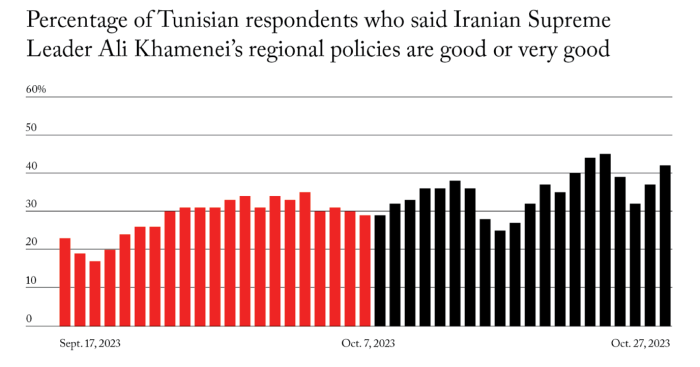
An Arab barometer poll taken over a six-week period – three weeks before and three weeks after the Al-Aqsa Flood operation – provides the first indication of shifting Arab perceptions. Although the survey was restricted to Tunisia, the pollsters argue that the country is “as close to a bellwether as one could imagine” and that it represents views similar to other Arab countries:
“Analysts and officials can safely assume that people’s views elsewhere in the region have shifted in ways similar to the recent changes that have taken place in Tunisia.”
The survey results should be of paramount concern to meddling western policymakers: “Since October 7, every country in the survey with positive or warming relations with Israel saw its favorability ratings decline among Tunisians.”
The US saw its favorability numbers plummet the most, followed by West Asian allies that have normalized relations with Israel. Russia and China, both neutral states, experienced little change, but Iran’s leadership saw its favorability figures rise. According to the Arab barometer:
“Three weeks after the attacks, Iranian Supreme Leader Ali Khamenei has approval ratings that matched or even exceeded those of Saudi Crown Prince Mohammed bin Salman and Emirati President Mohammed bin Zayed.”
Before 7 October, just 29 percent of Tunisians held a favorable view of Khamenei’s foreign policies. This figure rose to 41 percent according to the conclusion of the survey, with Tunisian support most notable in the days following the Iranian leader’s 17 October reference to Israel’s actions in Gaza as a “genocide.”

The Saudi shift
Prior to the 7 October operation by the Palestinian resistance to destroy the Israeli army’s Gaza Division and take captives as leverage for a mass prisoner swap, the region’s main geopolitical focus was on the prospects of a groundbreaking Saudi normalization deal with Tel Aviv. The administration of US President Joe Biden flogged this horse at every opportunity; it was seen as a golden ticket for his upcoming presidential election.
But Operation Al-Aqsa Flood ruined any chance for Saudi Arabia – home to Islam’s holiest sites – to seal that political deal. And with Israeli airstrikes raining down daily on Palestinian civilians in Gaza, Riyadh’s options continue to shrink.
A Washington Institute poll conducted between 14 November and 6 December measures the seismic shift in Saudi public sentiment:
A whopping 96 percent agree with the statement that “Arab countries should immediately break all diplomatic, political, economic, and any other contacts with Israel, in protest against its military action in Gaza.”
Meanwhile, 91 percent believe that “despite the destruction and loss of life, this war in Gaza is a win for Palestinians, Arabs, and Muslims.” This is a shockingly unifying statement for a country that has adhered closely to western narratives that seek to divide Palestinians from Arabs, Arabs among themselves, and Muslims along sectarian lines – geographically, culturally, and politically.
Although Saudi Arabia constitutes one of the few Arab states to have designated Hamas as a terrorist organization, favorable views of Hamas have increased by 30 percent, from 10 percent in August to 40 percent in November, while most – 95 percent – do not believe the Palestinian resistance group killed civilians on 7 October.
Meanwhile, 87 percent of Saudis agree with the idea that “recent events show that Israel is so weak and internally divided that it can be defeated some day.” Ironically, this is a long-stated Resistance Axis refrain. Hezbollah Secretary General Hassan Nasrallah was famously quoted as saying “Israel is weaker than a spider’s web,” upon its defeat by the Lebanese resistance on 25 May, 2000.
Prior to 7 October, Saudis had strongly favored economic ties with Israel, but even that number dropped dramatically from 47 percent last year to 17 percent today. And while Saudi attitudes toward the Resistance Axis remain negative – Saudi Arabia, after all, has been the regional epicenter for anti-Iran and anti-Shia propaganda since the 1979 revolution – that may be largely because their media is heavily controlled.
Contrary to the observations of the Arab masses, 81 percent of Saudis still believe that the Axis is “reluctant to help Palestinians.”
The Palestinian shift
Equally important to the discussion of Arab perceptions is the shift seen among Palestinians themselves since 7 October. A poll conducted by the Palestinian Center for Policy and Survey Research (PSR) in both the occupied West Bank and Gaza Strip between 22 November and 2 December mirrors Arab views, but with some nuances.
Gazan respondents, understandably, displayed more skepticism for the ‘correctness’ of Hamas’ Operation Al-Aqsa Flood, which triggered Israel’s genocidal assault on the Strip in which over 22,000 civilians – mostly women and children – have so far been brutally killed. While support for Hamas increased only slightly in the Gaza Strip, it tripled in the West Bank, with both Palestinian territories expressing near equal disdain for the western-backed Palestinian Authority (PA), which governs from Ramallah.
Support for acting PA President Mahmoud Abbas and his Fatah party was hit hard. Demands for his resignation are at nearly 90 percent, while almost 60 percent (the highest number recorded in a PSR poll to date in relation to this matter) of those surveyed want a dissolution of the PA.
Over 60 percent of Palestinians polled (closer to 70 percent in the West Bank) believe armed struggle is the best means to end the occupation, with 72 percent agreeing with the statement that Hamas made a correct decision to launch its 7 October operation, and 70 percent agreeing that Israel will fail to eradicate the Palestinian resistance in Gaza.
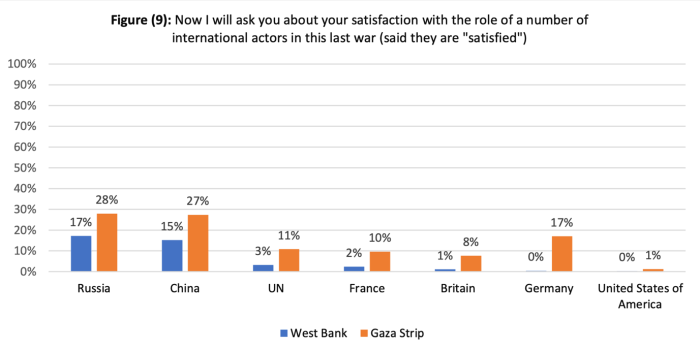
Palestinians have strong views about regional and international players, who they largely feel have left Gaza unprotected from Israel’s unprecedented violations of international law.
By far the country most supported by respondents is Yemen, with approval ratings of 80 percent, followed by Qatar (56 percent), Hezbollah (49 percent), Iran (35 percent), Turkiye (34 percent), Jordan (24 percent), Egypt (23 percent), the UAE (8 percent), and Saudi Arabia (5 percent).

In this poll, the region’s Axis of Resistance dominates the favorability ratings, while pro-US Arab and Muslim nations with some degree of relations with Israel, fare poorly. It is notable that of the four most favorable countries and groups for mostly-Sunni Palestinians, three are core members of the “Shia” Axis, while five Sunni-led states rank lowest.
This Palestinian view extends to non-regional international states, with respondents most satisfied with Resistance Axis allies Russia (22 percent) and China (20 percent), while Israeli allies Germany (7 percent), France (5 percent), the UK (4 percent), and the US (1 percent) struggle to maintain traction among Palestinians.
The numbers depend on the war ahead
Three separate polls show that Arab perceptions have shifted dramatically over Israel’s war on Gaza, with popular sentiment gravitating to those states and actors perceived to be actively supporting Palestinian goals, and away from those who are perceived to support Israel.
The new year starts with two major events. The first is the drawdown of Israeli reservists from Gaza, whether because Washington demands it, or due to unsustainable loss of life and injury to occupation troops. The second is the shocking assassination of Hamas leader Saleh al-Arouri and six others in Beirut, Lebanon, on 2 January.
All indications are that Israel’s war will not only continue, but will expand regionally. The new US maritime construct in the Red Sea has drawn other international actors into the mix, and Tel Aviv has provoked Lebanon’s Hezbollah in a major way.
But if the confrontation between the two axes escalates, Arab perceptions will almost certainly continue to tilt away from the old hegemons toward those who are willing to resist this US-Israeli assault on the region.
There will be no relief for Washington and its allies as the war expands. The more they work to defeat Hamas and destroy Gaza, and the more they lob missiles at Yemen, Iraq, and Syria, and besiege the Resistance Axis, the more likely Arab populations are to shrug off the Sunni-versus-Shia, Iran-versus-Arab, and secular-versus-Islamist narratives that have kept the region divided and at odds for decades.
The swell of support that is mobilizing due to a righteous confrontation against the region’s biggest oppressors is unstoppable. Western decline is now a given in the region, but western discourse has been the first casualty of this war.
Israeli police unable to verify ‘Hamas rape’ stories
The Cradle | January 5, 2024
Israeli police are unable to verify accounts of sexual assault allegedly committed by Palestinian fighters on 7 October, Haaretz reported on 4 January.
“The police are having difficulty locating victims of sexual assault from the Hamas attack, or people who witnessed such attacks, and decided to appeal to the public to encourage those who have information on the matter to come forward,” the newspaper reported.
“Even in the few cases in which testimonies were collected about sexual offenses committed on October 7, police failed to connect the acts with the victims who were harmed by them.”
Adi Edri, a police investigator tasked with probing alleged sexual crimes committed during the Al-Aqsa Flood operation, told Haaretz there are “circumstantial indications” that there are survivors of the 7 October attack who police have yet to contact.
“We’re looking for more than a single witness. For each scene, we’re looking for support for what happened there.”
Israeli police claim to have collected a small number of eyewitness testimonies. These testimonies include those of military personnel and of the Israeli search and rescue team, Zaka – which was behind some of the debunked stories of atrocities committed by Hamas, among them the claim of 40 beheaded babies.
“Despite having no expertise in forensic investigations or documenting crime scenes, these volunteers were given access to the various kibbutzim and Nova party sites to collect the bodies,” says The Cradle’s William Van Wagenen, US investigative journalist who has conducted extensive research into the events of 7 October.
Van Wagenen raises further questions about Zaka’s credibility, detailing how it “was suspected of using shadow organizations to funnel millions of dollars of donations for private use, even as the organization faced bankruptcy,” citing a 2019 report by Hebrew media.
Additionally, Zaka’s founder Yehuda Meshi-Zahav has been implicated in the sexual assault and molestation of women and children, according to a 2021 Haaretz investigation.
Haaretz reported in November 2023 that a significant lack of forensic evidence made it difficult to determine what happened on October 7. The November report also found that many of the allegations by volunteer workers, officials, and military personnel did not add up.
The latest Haaretz report comes one week after the New York Times (NYT) published a report detailing what it called the “weaponization” of sexual violence on 7 October.
The report centered around the case of Gal Abdush, who was killed on 7 October. NYT identified Abdush as “the woman in the black dress” whose corpse was seen in a video filmed after the attack – which was said to show evidence that she had been raped.
However, some of Abdush’s family members denied that she was sexually assaulted and claimed that NYT took advantage of them by interviewing them under “false pretenses.”
Questions continue to be raised over the veracity of many of the alleged atrocities committed by Hamas on 7 October, particularly with the growing amount of information that has surfaced regarding Tel Aviv’s role in the death of Israeli civilians that day.
Israeli family of key case in NY Times report refutes story of alleged rape by Hamas fighters
Press TV – January 4, 2024
The Israeli family of a key case in the New York Times report on alleged sexual violence by Hamas fighters on October 7 renounces the published story, saying reporters have manipulated them.
On December 28, the New York Times published a story, claiming that fighters of the Palestinian Hamas resistance group allegedly committed a pattern of gender-based violence against Israeli women when the group carried out the surprise Operation Al-Aqsa Storm against the occupying entity on October 7.
Authors of the report – Pulitzer Prize-winning reporter Jeffrey Gettleman, along with Anat Schwartz and Adam Sella – claimed that they had compiled the story based on over 150 interviews they conducted with purported victims or their families, mainly repeating October 7 testimonies that have been previously published and already debunked and discredited.
A third of the report, however, was devoted to the Abdush family, a working-class Mizrahi Jewish family who lost their daughter, Gal, known as “the woman in the black dress”, back then and how she was allegedly raped during the Hamas attack.
The report focused on footage that was captured on October 8 by a woman called Eden Wessely, who published it on her social media accounts. According to the report by the New York Times, “The video went viral, with thousands of people responding, desperate to know if the woman in the black dress was their missing friend, sister or daughter.”
A day after the report was published, the Israeli Ynet news site conducted an interview with Gal’s parents, who stressed that there is no proof she was raped, and that the paper’s reporters interviewed them under false pretenses, saying that they knew nothing about the sexual assault issue until the piece in the American daily was published. Furthermore, Gal’s sisters also strongly denied allegations of rape.
On January 1, Nissim Abdush, Nagi’s brother-in-law, repeatedly denied that his sister-in-law was raped in an interview with Israeli Channel 13.
Hamas has strongly rejected Israel’s allegations of rape and sexual assaults against its fighters, saying the regime is striving to demonize the resistance by such fabricated stories.
“We reject the Israeli lies about raping, which aim to distort the resistance and tarnish our humane and moral treatment of captives,” Hamas said in a statement in early December.
The Israeli regime waged the war on Gaza on October 7 after Hamas launched its operation against the occupying entity in response to the Israeli regime’s atrocities against Palestinians.
Since the start of the US-backed offensive, the Israeli regime has killed at least 22,300 Palestinians, mostly women and children, and injured over 57,000 others. Thousands more are also missing and presumed dead under the rubble.
Israel’s Gaza withdrawal, a prelude to full-out war
By Hasan Illaik | The Cradle | January 4, 2024
At the start of the new year, Israel’s occupation army began implementing the withdrawal of a large portion of its forces from the northern Gaza Strip.
This withdrawal did not mean the end of the war on Gaza, and it certainly did not suggest calm on the Lebanese-Israeli front. On the contrary, reducing the pace of the war in the Gaza Strip increases the possibilities of an Israeli war on Lebanon.
The battles taking place between the occupation army and Hezbollah along the southern Lebanese border since 8 October, in support of the resistance in Gaza, have been increasing in intensity day after day.
Washington and Tel Aviv have sought to maximize pressure on Hezbollah by warning of the possibility of a large-scale war between Israeli forces and the Lebanese resistance. These tactics were in effect long before the assassination of Hamas’ Deputy Head of the Political Bureau Saleh Al-Arouri on 2 January by an Israeli air strike in Dahiyeh, the southern suburb of Beirut. The killing of Al-Arouri now increases the chance of the war expanding.
The third stage is coming
The first stage of Tel Aviv’s war was the mass destruction and occupation of northern Gaza; the second stage is the occupation of key points in the south of the Gaza Strip, where Palestinian civilians have flocked for safety. The current troop withdrawal from the territory’s north means that the Israelis are cementing their southern plans and preparing to move on to phase three: the long, low-intensity war.
As it enters the third stage, the occupation army intends to maintain a geographical buffer surrounding the northern Gaza Strip. It also plans to continue occupying the Gaza Valley area (central Gaza), while completing its operations in Khan Yunis in the south.
The fate of the Philadelphia axis – or Salah ad-Din Axis – a strip of land on the border between Gaza and Egypt which Israel wants to control, will be left to deliberations between Tel Aviv and Cairo. This is to ensure that incidents do not occur that lead to tension between the two parties, as well as to guarantee that refugees do not flow from the south of the Gaza Strip towards Sinai.
Israel’s ground withdrawal from northern Gaza is taking place primarily because the occupation army’s target bank has been depleted. All targets prior to the start of the war have been destroyed, and all new operational targets have been bombed.
Despite this, the Palestinian resistance continues to carry out operations against Israeli forces. These organizations remain relatively unscathed in the entire area of the northern Gaza Strip, which will increase the ability of the resistance to inflict losses on occupation ranks, now and in the future.
This clear Israeli loss – in terms of Tel Aviv’s stated war objectives – has been made evident by two basic factors: First, that the occupation army cannot ‘cleanse’ the northern Gaza Strip house by house or tunnel by tunnel, because this process will take years, expose more of its soldiers to danger, and cannot be implemented without further displacing the entire population of northern Gaza or massacring them. It should be noted, despite Israeli attempts to portray matters otherwise, that hundreds of thousands of civilians are still present in the north.
Second, the Israeli government needs to gradually re-inject reserve soldiers into the country’s economy to jump-start it, and to ensure that the productive sectors are not exposed to damage from which recovery will take a long time. This, despite the fact that the US and much of Europe appear ready to assist Israel’s economy, if necessary.
These measures are being taken because Israel has patently failed to achieve the two main goals of its war, namely, eliminating the Hamas-led resistance in Gaza, and liberating the Israeli prisoners captured by the resistance on 7 October.
There remains a basic motive that must be noted: The Israeli army is currently putting all its efforts into implementing a US decision to push the war from its first and second phases into the third phase before the end of January 2024. This requires the war to be managed at a slower boil, drawing less attention to Israeli carnage and the mass suffering of Palestinians.
After three months of brutalities, Washington has assessed the Israeli army as unable to eliminate the resistance or the possibilities of regional escalation, and has noted the significant harm caused to the US administration of Joe Biden as he enters the presidential primary season.
An escalation with Lebanon
As the Israeli occupation army moves to focus its operations on the southern Gaza Strip, the intensity of military operations along the Lebanese border between Hezbollah and the Israeli army has also been ratcheted up.
Hezbollah increased its targeting of occupation soldiers, both in their visible locations and inside the settlements of northern Palestine.
The information capabilities of Hezbollah have developed in both sophistication and accuracy during the past months. The Lebanese resistance fighters have employed missile types not previously utilized, which have a greater range and better destructive capacity than previous generations.
On the other hand, Tel Aviv has doubled the firepower it used in southern Lebanon. The Israelis continue to limit their operations to the area south of the Litani River, and are not expanding their scope except to target resistance groups that carry out strikes across the border. In recent weeks, the occupation army’s destructive power has risen dramatically since the early days of the battle.
By increasing its strikes, Israel’s leadership seeks to inflict the greatest possible number of losses among the ranks of the resistance fighters, as well as to spread panic among southern Lebanese residents – displacing more of them, and destroying the largest possible number of homes. This places a burden on both Hezbollah and the Lebanese state in the reconstruction process after the end of hostilities.
But there is a longer-term goal to this Israeli military performance. The government in Tel Aviv, according to its official statements, wants Hezbollah to withdraw from the south of the Litani, to ensure the security of Israeli settlers in northern Palestine who abandoned their homes, either voluntarily or under evacuation orders from their army. By some estimates, the number of Israelis fleeing their settlements in occupied north Palestine has reached more than 230,000 people.
In parallel with the public statements, messages began arriving in Beirut, from the US and from European capitals, demanding what they call ‘the implementation of UN Security Council Resolution 1701,’ meaning Hezbollah’s withdrawal from the south of the Litani River.
According to emerging information, Tel Aviv is betting that Hezbollah will be deterred, as the 2019 economic collapse from which Lebanon has not yet recovered and the country’s long-running internal tensions are factors that will ultimately prevent Hezbollah from waging war.
Israel is therefore hoping that Hezbollah will yield to pressure and meet its demands regarding the withdrawal of its fighters from the border area with occupied Palestine.
The Israeli assessment of Lebanese affairs preceded its assassination of Al-Arouri in Beirut on 2 January. But in the same way that Israel military commanders and politicians have under-estimated and dismissed armed Palestinian resistance initiatives within occupied lands prior to 7 October, they continue to cling to a dated Israeli calculus that Hezbollah will never fully retaliate, or that it will only do so in a way that stops short of war.
Granted, Hezbollah does genuinely seek to limit the scope of the military confrontation, and has often pushed for a Gaza ceasefire to end hostilities throughout the region. Hezbollah is equally concerned about not disrupting the lives and livelihood of southern residents.
But while Hezbollah takes into account the complex political and economic Lebanese reality, it is not prepared to make concessions. Sources in the resistance axis say that Israel, as Hezbollah sees it, is not in a position to go to war with Lebanon when it cannot even compensate or digest the massive strategic losses it has incurred from Operation Al-Aqsa Flood.
Despite its desire to not expand the war, Hezbollah has already begun to prepare for it. Hezbollah’s party statement, issued after the assassination of Al-Arouri, indicates this, and field measures and developments will begin to appear in time.
What Israel was unable to achieve in Gaza (restoring deterrence) while facing the tight ranks of the region’s Axis of Resistance, it will most certainly not be allowed to gain in Lebanon.
The first signs of this will appear in the plans that Hezbollah is expected to carry out in response to Israel’s 2 January raid on Dahiyeh to assassinate Al-Arouri – the first of its kind since August 2006 – and to which its Secretary-General Hassan Nasrallah had previously threatened he would respond.
The bottom line is that Tel Aviv’s assessment of a war with Lebanon is based on its reading that Hezbollah wishes to prevent a major confrontation at any cost. Not only is this calculus wrong, but it has also muddled Israeli minds to the point where this may itself lead to the outbreak of a destructive war between the two sides.
Who else was killed by Israel alongside Al-Arouri in Beirut?

Hamas office in Beirut, Lebanon following Israeli drone attack in which Hamas deputy leader Saleh Arouri was killed on Jan. 3, 2024. [Houssam Shbaro – Anadolu Agency]
MEMO | January 3, 2024
The deputy head of the Hamas political bureau, Saleh Al-Arouri, was not alone when he was martyred on Tuesday in an Israeli missile strike on an office in the southern suburb of the Lebanese capital, Beirut. The Hamas movement mourned him as well as the others, who included two of the most prominent commanders of the movement’s armed wing, Al-Qassam Brigades.
Among the seven killed by Israel was Azzam Al-Aqraa, Abu Abdullah, known as Ammar, who was the head of Al-Qassam outside Palestine. He was from the town of Qabalan in Nablus Governorate in the occupied West Bank. As one of the 400+ Palestinian men exiled to Marj Al-Zuhur by Israel in 1992, he was a former prisoner.
Another of those martyred by Israel in Beirut yesterday was Samir Fandi, known as Abu Amer, who was in charge of Al-Qassam operations in Lebanon. Fighters from Al-Qassam Brigades in Lebanon participated in Operation Al-Aqsa Flood on the border between 1948-occupied Palestine and Lebanon, when several were martyred. Israel’s Channel 14 revealed last July that Israel’s Shin Bet security agency had placed Fandi on the assassination list.
Al-Aqraa’s name appeared in the Israeli media several times, most recently in October 2022, when the apartheid state accused one of the Palestinian detainees in prison of having met him in Turkey and planned to work on infiltrating the Israeli Cellcom communications network.
A source told Arabi 21 that the other martyrs who were accompanying the senior officials and were killed in the Israeli raid were Ahmed Hammoud, Mahmoud Shaheen, Muhammad Al-Rayes, and Muhammad Bashasha.
Immediately after the news of the martyrdom of Al-Arouri and his companions was announced, marches took place in all of the refugee camps in Lebanon, including the Rashidieh camp in Tyre, from which Samir Fandi hailed.
Deputy head of Hamas politburo assassinated in Israeli strike
Press TV – January 2, 2024
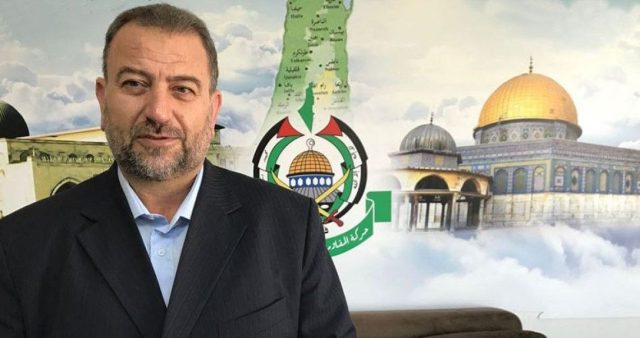
The deputy head of the political bureau of the Palestinian resistance movement Hamas has been assassinated in an Israeli drone attack in the southern suburb of the Lebanese capital of Beirut.
Lebanon’s al-Mayadeen television network reported on Tuesday that Saleh al-Arouri was killed as a result of an explosion in a building in al-Musharrafieh district in southern Beirut.
Arouri was killed in a “treacherous Zionist strike,” the television network said, adding that the blast took place after an Israeli drone bombed the building with three missiles, killing six people and wounding several others.
Hamas confirmed the martyrdom of Arouri as the chief of staff of the resistance movement in the occupied West Bank and the besieged Gaza Strip, praising him as the “architect” of Operation al-Aqsa Storm.
Hamas vowed in a statement that the killing of the resistance movement’s deputy will not “undermine the continued brave resistance” in Gaza.
“It proves once more the utter failure of the enemy to achieve any of its aggressive goals in the Gaza Strip,” Izzat al-Rishq, a member of the political bureau of Hamas, said in the statement.
The Israeli regime launched its devastating war on the Gaza Strip on October 7 after the territory’s Hamas-led Palestinian resistance groups carried out a surprise retaliatory attack, dubbed Operation Al-Aqsa Storm, against the occupying entity.
The Israeli military has also been carrying out attacks against the Lebanese territory since then, prompting retaliatory strikes from Lebanon’s resistance movement Hezbollah in support of the Palestinian people in the Gaza Strip.
The movement has vowed to keep up its retaliatory operations as long as the regime continues its onslaught on Gaza.
The relentless Israeli military campaign against Gaza has killed more than 22,000 people, most of them women and children. At least 57,000 individuals have also been wounded.
The regime has largely cut off access to water, food and power supplies to Gaza.
What We Have Learned
By Craig Murray | December 24, 2023
We have learnt this year that there is no crime so startling, so obvious and so visible to the whole world that the United States and Israel are not willing to commit it brazenly and openly. The massacre of 20,000 people includes the killing of babies and infants, the deliberate shooting of pregnant women and toddlers, the murder of old ladies in church and the execution of prisoners stripped naked.
This is all justified as “Israel’s right of self-defence”.
We have also seen the increasing rise of fascism as western governments crack down on their publics in order to curtail political resistance to the genocide. Tony Greenstein, Mick Napier and I have all been harassed under the Terrorism Act. I have left the country because I fear I am officially “under investigation” under the Terrorism Act and I fear I shall be arrested and placed in jail for two years awaiting trial. Numerous people have been arrested for expressing their horror at the massacre through placards, words or even songs that the police judge “offensive”. Police action is often prompted by instruction from self-appointed Zionist vigilante organisations.
We are also seeing, exactly as I predicted, a replay of the “War on Terror” state Islamophobic propaganda. Do you remember the famous “ricin plot” where the ricin found was the trace level to be found in every kitchen? The British government kept it Top Secret for two years that there was in fact no ricin. Or the non-existent Easter Bomb Plot where the “ingredient of improvised explosives” found turned out to be a bag of sugar?
In Germany they have a great deal of work to do to justify the world’s most extreme anti-Palestinian governmental racism, so they have invented a “Hamas terror plot” and arrested four young Muslims. No evidence at all has been produced to justify this.
Hamas has never, ever conducted any violent attack outside of Palestine and it has always been their policy not to do so – and it still is. The notion is ludicrous that at this time Hamas have decided to suddenly lose the propaganda war which they are winning worldwide, by attacking Germany.
Germany’s governments have form of course, not only for genocide, but also for enthusiastic creation of fake terrorism. The German government was heavily implicated both in false flag terrorist attacks in Tashkent, which I was able to investigate and report to the UK government in real time, and in the creation of a whole fake terrorist organisation, “The Islamic Jihad Union of Uzbekistan”, which was entirely the work of the CIA and the German security services. The aim at that time was to justify the German military airbase at Termez in Uzbekistan, operating into Afghanistan. People forget German participation on the losing side in the last Afghan war.
I have no doubt we are in for a period of more propaganda, fake terrorist plots, false flag actual terrorism and agent provocateur led terrorism. It is the only way the Establishment can hope to regain the propaganda narrative.
I have not quite got used yet to my new position as an itinerant terrorist, so I apologise that posting has been a bit scarce due to a lot of organisational bother and a general sense of discombobulation. This is being dashed off at Milan airport. I am very happy on a personal note to say that my family are joining me at an exotic venue for Christmas and New Year, so you may not hear much from me till mid-January as I owe my children a great deal of my attention.
I do wish you a safe and very happy festive season wherever you are, and hope you can be together with those you love. For all those living in fear and danger, particularly but not only those in Gaza, my thoughts along with those of millions around the world are with you now and always.
Shortly before the first Iraq War, between the invasion of Kuwait and the outbreak of real hostilities, I spent a minute in reply to one from John Major. I was working in a the Embargo Surveillance Centre, a Top Secret establishment operating from an underground NATO HQ in central London. We were among the recipients of a Christmas message from the Prime Minister which combined Christian wishes with a bellicose message. I replied in a formal minute with this verse from the carol It Came Upon the Midnight Clear:
But with the woes of sin and strife
The world has suffered long;
Beneath the angel-strain have rolled
Two thousand years of wrong;
And man, at war with man, hears not
The love-song which they bring; –
Oh hush the noise, ye men of strife,
And hear the angels sing!
Whomever the angels are to you, I hope you hear them sing.
Featured Video
Trita Parsi: Israel Set a Trap for Total War in the Region
or go to
Aletho News Archives – Video-Images
From the Archive
Zionism’s Violent Legacy
By Donald Neff | Washington Report On Middle East Affairs | January 1996
On January 4, 1948, Jewish terrorists drove a truck loaded with explosives into the center of the all Arab city of Jaffa and detonated it, killing 26 and wounding around 100 Palestinian men, women and children.[1] The attack was the work of the Irgun Zvai Leumi – the “National Military Organization,” also known by the Hebrew letters Etzel – the largest Jewish terrorist group in Palestine. The Irgun was headed by Revisionist Zionist Menachem Begin and had been killing and maiming Arabs, Britons and even Jews for the previous ten years in its efforts to establish a Jewish state.
This terror campaign meant that at the core of Revisionist Zionism there existed a philosophical embrace of violence. … continue
Blog Roll
 Aletho News
- Trita Parsi: Israel Set a Trap for Total War in the Region
- Trump’s Iran war is on an Israeli leash
- Saudi oil boss issues global supply warning
- Riyadh Says Its Oil System Is Intact. The Numbers Say Otherwise.
- Trump and Netanyahu Want to “Finish the Job” on Iran
- US ‘one-sided dictation’ not Iran’s beliefs makes rational talks impossible: Baghaei
- Iran’s Next Strike May Not Explode. It Could Shut You Down /Col Doug Macgregor
- Iran: US political targets legitimate if assassinations return
- Iraq shuts key border crossing with Iran under US pressure: Report
- Undersea Internet cables could be targeted in retaliation for attacks on Iran: IRGC deputy chief
- If Americans Knew
- The Israel Lobby’s Changing Fortunes
- AIPAC has become such a political liability that it’s shifting to a more “nimble” approach to buying politicians
- At least 160 Israeli settler attacks in 2 weeks
- Will Gaza’s Ancient Christian Community Disappear Forever?
- Israel’s vision of regional security rests on keeping Arab states weak
- Heidi Levine recounts how Palestinian youths helped save her in settler attack
- DAILY UPDATE: Latest essential news on Palestine, Israel, & region
- Trump’s Intensifying Sabotage of the ICC, for Israel’s Sake
- Israeli military detain US and UK volunteers in West Bank including Democratic NY politician Brad Lander
- Americans at National Conservatism Conference held in Israel this year criticize Israel
- No Tricks Zone
- E-Cars Reduce CO2 Emissions By Only 41% Compared To Internal Combustion Engine Vehicles
- Predictions Made By Renowned Climate Professor Over Past Decades Have Been Proven To Be Poor
- New Study Suggests Large Regions Of The Pacific Ocean Have Been Cooling For The Last 80 Years
- Germany’s Green Energy Debacle: High Energy Costs Force Kahla Porzellan to Close After 182 Years!
- New Study: 50 Years Of The Most Aggressive ‘Net Zero’ Policies Can Only Affect The Global Climate By 0.03°C
- US September “Heat” Was No Record…Many Records Set Decades Ago
- Latest European Green Energy Debacle; Portugal’s Largest Flagship Solar Park Insolvent!
- Green Energy Debacle: German Expert Professor Fritz Vahrenholt Warns Of Severe Economic And Social Consequences
- Two More Paleo Reconstructions Affirm Meters-Higher Sea Levels Across Ireland, Brazil 7000-6000 Years Ago
- New Study: Earth And Venus Surface Warmth Largely Explained By Convection And Lapse Rate, Not CO2 Or Radiation

