Hamas calls for an international committee to inspect Gaza hospitals
Palestine Information Center – November 5, 2023
GAZA – The Hamas Movement called on the Secretary-General of the United Nations to form an international committee to visit Gaza hospitals and verify the Israeli false narrative about being used for resistance activities.
The Movement strongly condemned the Israeli army spokesman’s claims regarding Indonesian and Hamad hospitals in Gaza as media fabrications.
According to the Movement, the occupation is attempting to use the claim that Hamas constructed tunnels beneath the buildings as justification for its attacks on the Qatari and Indonesian hospitals in the northern Gaza Strip.
“This is just a lie to cover up the Israeli crimes committed against injured people and civilians.”
The Movement also confirmed that the Israeli allegation about a tunnel entrance under the Indonesian hospital is, in fact, a fuel store for the facility, while the alleged tunnel beneath Hamad Hospital is just a room for pumps and electricity generators.
Targeting more than 100 hospitals and medical centers and putting about 16 hospitals out of service refutes the Israeli army spokesman’s allegations.
Additionally, Hamas refuted Israeli claims that it is stealing fuel, an accusation that UNRWA has categorically refuted.
Why a global anti-Hamas coalition pushed by Macron is a bad idea
By Rachel Marsden | RT | November 2, 2023
Last week, standing beside Israeli Prime Minister Benjamin Netanyahu during a visit to Jerusalem, French President Emmanuel Macron suggested recycling the global coalition of 86 nations against Islamic State (IS, formerly ISIS) to focus on Hamas.
“Hamas is a terrorist group, whose objective is the destruction of the state of Israel. This is also the case of ISIS, of Al-Qaeda, of all those associated with them, either by actions or by intentions,” Macron said, betraying a short and selective memory. The stated goal of IS wasn’t to eradicate Israel – it was to establish a caliphate in Syria and Iraq, then broaden it into Arab countries. IS was first and foremost a threat to the stability of Syria – the same country whose government the US and its Western allies actively hindered in its fight against terrorism by making a failed attempt at overthrowing President Bashar Assad through Pentagon and CIA-backed training and equipping of “Syrian rebel” jihadists. As for Al-Qaeda, Israel was even reportedly at one point helping treat wounded militants from the group who were fighting their common enemy, the Iranian-backed Hezbollah, in Syria – in turn effectively hindering the fight against IS, as Syria and Hezbollah worked to destroy it.
The Global Coalition against Daesh (another name for IS), founded in 2014, explicitly excluded Russia, whose invitation by Damascus to help it eradicate the terrorist threat can be largely credited for Syria’s stabilization, and the fact that it’s rare to even hear any talk of IS anymore. Russia’s involvement in neutralizing the terrorist group, coupled with former US President Donald Trump’s refusal to continue funding Washington’s incursion into Syria, beyond hunkering down in the oil-rich Kurdish part, was the ultimate key to IS’ defeat. So with apparently little left for it to do now, Macron recommends that the coalition that mostly sat and watched – while Russia, Iran, and Syria did the heavy lifting – take on Hamas. Who does he think is going to do the work this time? Russia, which is still excluded from the coalition? Syria, which has recently taken incoming missile fire from Israel? Iran’s Hezbollah allies, who lost 1,000 men fighting IS in Syria – and whom Netanyahu has placed in the same basket as Hamas as an enemy of Israel? Good luck with that.
So with the most effective anti-IS fighters excluded from fighting Hamas, who’s left in Macron’s proposed coalition? There’s the Global South, including some African countries that just kicked out French troops for their own failed counterterrorism missions which had led to multiple coups and the flourishing of jihadism. It’s doubtful these nations will now be keen to embark on yet another counterterrorism mission alongside the same forces that they just expelled.
Then there are all those members of the international community who are quietly thinking what United Nations Secretary General Antonio Guterres dared to say aloud last week – that Hamas’ brutal attack on October 7, which left close to a thousand civilians and hundreds of military and security personnel dead, “did not happen in a vacuum.” He was, of course, hinting at Israel’s longstanding, UN-recognized oppression of civilians in Gaza. His statement begs yet another question: Is Hamas really a global threat? Or is it just Israel’s problem?
Anti-Israel unrest has reverberated outside of the immediate conflict zone, including in Western Europe and the US, but these protests have nothing to do with Hamas. Instead, citizens elsewhere in the world are merely reacting to perceived injustices, particularly in light of what they consider to be an overwhelmingly pro-Israel bias on the part of the Western establishment, which initially and drastically minimized concerns over the protection of Palestinian civilians. So any global action against Hamas seems futile.
The anti-IS coalition targeted the terror group’s propaganda, with its website stating that IS’ “use of social media tied to acts of terrorism is well-documented. In response, Coalition partners are working together to expose the falsehoods that lie at the heart” of its ideology. They’re free to do that, but why bother when there’s already open debate among those who have the opportunity to see reports from the ground and assess the situation for themselves? Governments can’t be trusted not to promote their own propaganda under the guise of combating it – all to secure an advantage for their preferred narrative.
Just consider the recent example of propaganda emitted by one of the self-styled gatekeepers of truth: European Commission President Ursula von der Leyen. “Russia and Hamas are alike… their essence is the same,” she said. Nah, actually they aren’t the same at all. And not even Israel has been saying that, but still, “Vladimir Putin wants to wipe Ukraine from the map. Hamas, supported by Iran, wants to wipe Israel from the map,” von der Leyen explained. Besides the hot take on Putin’s intentions regarding Ukraine, that’s like saying that since Warren Buffet has a bank account, and I have a bank account, then I’m also a billionaire. This is exactly the kind of nonsense that Western anti-propaganda campaigns end up spewing.
The anti-IS coalition was made to tackle IS. If that’s no longer an issue, then just toss it in the trash. How many interventionist entities does the West need to spearhead, anyway? There are already more than enough vehicles and coordination mechanisms for intelligence sharing, propagandizing, and security operations. Besides, there’s no proof that better intelligence could have helped Israel when Egyptian and American officials have claimed that Netanyahu had warning of the impending Hamas attack. About the only thing that more useless Western-led bureaucracy would help is the West’s own hunger for more of it.
Rachel Marsden is a columnist, political strategist, and host of independently produced talk-shows in French and English.
Hamas holds strong in Gaza despite army’s best efforts: Israeli media
The Cradle | November 2, 2023
Hebrew newspaper Maariv reported on 2 November that the Israeli army is facing a difficult and complex situation the more it deepens its ground assault on the Gaza Strip.
“The fighting in the coming days is expected to be much more difficult … The officers describe how it is evident that Hamas prepared itself to fight against IDF forces,” Maariv reports.
At the current stage, Hamas “is very far from a breaking point or crisis,” it says, adding that it has managed to maintain an organized method of fighting that relies mainly on tunnel warfare,” in which the fighters regularly ascend from out of tunnels and ambush Israeli soldiers with anti-tank weaponry.
The Panther APC armored vehicle, which Hamas ambushed on 28 October, proved to be the “most difficult event for the IDF so far,” Maariv wrote.
Fighters emerged out of a tunnel and struck the armored vehicle with anti-tank missiles, killing at least 11 soldiers and wounding several more. Israel has announced an investigation to determine the military failures that led to the incident.
Since then, several more Israeli soldiers have been killed as a result of intense clashes and anti-tank missile ambushes carried out by the resistance.
Eighteen Israeli soldiers have been killed inside the Gaza Strip since Tuesday, among them a senior officer. Intense fighting continues to rage on.
The Qassam Brigades announced on 2 November that its forces destroyed an Israeli tank and an armored personnel carrier with Al-Yassin 105 rockets.
Israel’s army also announced the killing of dozens of Hamas militants and breaching the group’s first defensive line.
The military has also allegedly begun an operation to destroy Hamas’ tunnels, Walla news outlet reported.
“Under no circumstances” should Israeli forces attempt to enter the tunnels; an ex-military chief was quoted as saying.
According to an Israeli officer cited by Walla, the Israeli army aims “to collapse the entrances and the tunnels” on Hamas and turn the underground network into a “death zone.”
However, as Maariv notes, Hamas has continued to use tunnels that the army had claimed to have destroyed in previous wars.
After Operation Guardian of the Walls in 2021, the army “greatly exaggerated and arrogantly overestimated the intensity of the damage to the tunnels” and the “psychological effect” that was meant to scare Hamas into fighting above ground out of fear that the tunnels would become “death traps.”
This assessment was “disconnected from reality on the ground,” Maariv said, adding that Hamas “will fight hard … and will not surrender easily.”
Israel has vowed to completely eradicate Hamas and dismantle its vast underground network of tunnels.
Gaza: Where is Hezbollah?

lecridespeuples | Resistance News | November 2, 2023
Following the spectacular “Al-Aqsa Flood” operation launched by the Palestinian resistance in Gaza, the army of occupation has inflicted an unprecedented level of massacre and destruction on its defenseless civilian population, trapped in the world’s largest concentration camp. While Israel’s official stated aim is the annihilation of the Palestinian resistance, its unofficial objective seems to be the ethnic cleansing of the entire Gaza Strip, where everything is being done to make life impossible, paving the way for the definitive liquidation of the Palestinian cause.
Since the beginning of this crucial phase in the Arab-Israeli struggle, where the stakes seem existential on both sides, all eyes have been turned towards the northern border of occupied Palestine, with concern, hope and/or frustration: while NATO provides Israel with all its political and military support, will the Lebanese Hezbollah, which has always vowed to stand firmly by the Palestinians and fight the occupier relentlessly until the total Liberation of Palestine, intervene at the hour of truth?
Why are all eyes on Hezbollah?
“France is ready for the international coalition against ISIS, to which we are committed for our operation in Iraq and Syria, to also fight against Hamas. […] We must also conduct this fight in such a way as to avoid setting the whole region ablaze. I warn Hezbollah, the Iranian regime, the Houthis in Yemen and all the factions in the region that threaten Israel not to take the ill-considered risk of opening up new fronts. To do so would be to open the door to a regional conflagration from which everyone would lose. This is a necessity for all the peoples of the region: let’s do everything we can to avoid adding tears to tears and blood to blood.“
These were the words spoken by French President Emmanuel Macron in Tel Aviv on October 24, 2023, at a press conference with Israeli Prime Minister Benyamin Netanyahu, whom he had come to assure of his unconditional support, going so far as to make the ignoble and grotesque proposal of involving French and NATO armed forces in the fight against Palestinian resistance. If he was the first (and only) to suggest this idea, he was not the first to threaten the Lebanese Hezbollah not to open a new front against Israel. The arrival of a large American war fleet in the Mediterranean has been widely interpreted as an attempt to intimidate the entire “Resistance Axis” in general (an informal alliance comprising, in addition to Palestinian Resistance factions, the Lebanese Hezbollah, Iran, Iraq, Syria and Yemen) and Hezbollah in particular. When he announced the deployment of aircraft carriers in a speech on October 10, US President Joe Biden made it clear what he was talking about:
The United States has also enhanced our military force posture in the region to strengthen our deterrence. The Department of Defense has moved the USS Gerald R. Ford Carrier Strike Group to the Eastern Mediterranean and bolstered our fighter aircraft presence. And we stand ready to move in additional assets as needed.
Let me say again — to any country, any organization, anyone thinking of taking advantage of this situation, I have one word: Don’t. Don’t. Our hearts may be broken, but our resolve is clear.
Yesterday, I also spoke with the leaders of France, Germany, Italy, and the UK to discuss the latest developments with our European allies and coordinate our united response.
This macabre ballet of Western leaders renewing their unconditional allegiance and support to the State of Israel clearly indicates, in addition to their abject and irreversible moral decay, the seriousness of the threat hanging over the occupier, and underlines Israel’s fragility far more than its strength: if Hamas, the weakest link in the Resistance Axis, can break all the defensive lines around Gaza in the space of a few hours, shattering forever any illusions about the superiority of the Israeli army, the devastating consequences of a regional war against Israel suddenly appeared in people’s minds more forcefully than ever. Israel would face total annihilation. Hezbollah alone, with more than 100,000 men and an even greater number of rockets and precision missiles, would be capable of inflicting casualties on Israel considerably greater than those of October 7, seizing and holding to vast territories in occupied northern Palestine and destroying the country’s vital infrastructure. And what if States like Syria and Iran intervened? The Supreme Leader of the Islamic Republic, Ali Khamenei, was in no way exaggerating when he declared that, by visiting Israel, Joe Biden, Ursula von der Leyen, Olaf Scholz, Rishi Sunak, Emmanuel Macron and others had come to the bedside of a dying friend:
The evil powers in the world can see that the Zionist regime is falling apart and on the verge of destruction due to the very strong, decisive blow of the Palestinian fighters. Thus, by making these trips, by expressing solidarity with the Zionist regime and providing it with criminal tools such as bombs and other weaponry, they are struggling to keep the wounded, crippled entity on its feet.
Russian President Vladimir Putin was even more explicit about the presence of US naval air forces off the coast of Israel, saying that they were specifically directed against Hezbollah:
“I do not understand why the United States is sending aircraft carriers to the Mediterranean. It has sent one group and has announced the intention of sending another one. I do not see any sense in it. What are they planning to bomb there? Lebanon? What are they planning to do there? Or are they doing this for intimidation? But there are people there who are no longer afraid of anything. The problem should not be addressed in this way. Instead, we should look for compromise solutions. This is what we should do. These actions are certainly whipping up tension. If the conflict spreads beyond the Palestinian territories, things will get out of control.”
Indeed, neither Hezbollah nor its allies are afraid, on the contrary: in fact, it’s fair to say that both in occupied Palestine and on the international scene, fear has changed sides. Moreover, if Joe Biden began by threatening Hezbollah and then the Axis of Resistance not to intervene in the conflict between Israel and Gaza, he quickly denied the allegation (spread by the Netanyahu government) that the United States would intervene alongside Israel if Hezbollah attacked (“It’s not true. I never said that”, Biden replied curtly), and his administration is now quietly advising Israel not to do anything that might bring Hezbollah into the picture.
Finally, let’s not forget that the Resistance Axis itself has issued the most explicit warnings to US forces: any open intervention alongside Israel will result in massive intervention by Palestine’s allies, with direct strikes not only against the Zionist entity (Yemen has already struck it four times with drones and missiles), but also against US forces in the Mediterranean and throughout the Middle East. And these are not empty threats: US bases in Iraq and Syria have been struck daily by Resistance factions since October 8 (so far, 23 attacks were acknowledged by the US command, and only two “retaliations” from the occupying US forces have taken place, which clearly demonstrates who is emboldened and who is intimidated). It’s clear that it’s not just Gaza that’s on the offensive, but all the forces of the Resistance Axis, whose enthusiasm and morale are at an all-time high since the spectacular success of the “Al-Aqsa Flood”, which was certainly no surprise for Hezbollah and its allies.
How does Hezbollah view the situation?
Far from adopting the defeatist and catastrophist view prevalent in the West due to the pervasiveness of racism, imperialism and Hollywood mythology, promoted by the most formidable media propaganda machine in history and extolling the invincibility of White armies — be they those of NATO or Israel, largely assimilated to the dominant civilization— the Resistance Axis does not consider Gaza to be on the brink of annihilation, but on the threshold of its greatest victory. Gaza is not in a defensive position, but one of initiative and conquest. Gaza is not fighting for survival, but leading the greatest liberation battle in the history of the Arab-Israeli conflict. And the Palestinian Resistance has launched its most audacious attack to date at a time of its choosing, when its forces and those of its allies are at their peak, and those of the enemy are more fragile than ever.
The immediate objectives of the Resistance in Gaza are the release of thousands of Palestinian prisoners held by Israel, an end to the desecration of the Al-Aqsa mosque and to ethnic cleansing in the West Bank and especially in East Jerusalem, and the lifting of the blockade. These three goals will most certainly be achieved, even if it takes several years. Experience showed this in 2006: whether it’s the capture of Gilad Shalit by Hamas in June 25 or the capture of Ehud Goldwasser and Eldad Regev by Hezbollah in July 12, Israel always starts out in a rage, launching campaigns of destruction in the hope of achieving military success or turning the civilian population against the Resistance, then realizes that none of these objectives can be achieved and that its army is heading for a debacle, and saves face by asking its US sponsor to stop vetoing ceasefire resolutions at the UN Security Council. The occupying power finally resolves to engage in negotiations and yields to the demands of the Resistance: Hezbollah freed all its prisoners in 2008, and Hamas freed over 1,000 in 2011. This is a recurring pattern, and there’s every chance of it happening again this time.
Admittedly, the destruction inflicted by Israel on Gaza, the scale of the massacres and the humanitarian stranglehold are unprecedented. But they are by no means a military achievement. The command, strength and capabilities of Hamas and the other Resistance factions in Gaza remain intact, as demonstrated by their ability to maintain rocket and missile fire against Israel on a daily basis, to prevent his groud invasion by daily attacks and to strike the Israeli territory more and more deeply. The 2006 war in Lebanon definitively proved that a simple air campaign, however violent, was incapable of liquidating, or even significantly weakening, a popular Resistance that has adopted guerrilla tactics. And the prospect of a ground offensive, whether in Lebanon or Gaza, has always remained wishful thinking on the Israeli side, as the fighters of Hezbollah, Hamas and Islamic Jihad only dream of this opportunity to inflict considerable losses on Israeli forces. Decades of low-cost occupation against civilians in the West Bank have rendered the IDF absolutely incapable of carrying out a real offensive against armed forces worthy of the name, and this prospect literally terrorizes all echelons of command, who even fear mass mutinies and desertion on the part of their soldiers, the most cowardly in the world. The proof is that for 25 days, Israel has been promising an imminent ground offensive, but has only made timid incursions on the edge of Gaza, in largely deserted areas, still suffering heavy losses that only strict military censorship and the black-out imposed on Gaza allows hiding for the moment: is such an army ready to confront an urban guerrilla, or will it be decimated? All the massacres of civilians only reflect the impotent rage of the occupying army and unmask its cowardice, barbarity and insatiable thirst for innocent blood. The atrocious images that are broadcast every day constitute an unfathomable disgrace and arouse the indignation of the entire world, which has clearly understood that the IDF is not an army of fighters, but of murderers of women and children. And the prestige of the Israeli army is not only shattered internationally, but in the eyes of the Israeli government, military command and population, which are more divided than ever.
Hezbollah, like the other forces of the Resistance Axis, is certainly not indifferent to the humanitarian aspect of the situation in Gaza, and will most certainly intervene in force if a red line is crossed. But the Islamic Resistance in Lebanon remains focused on the military aspect, in which, however difficult it may be to accept amid the daily scenes of carnage and plight of Gaza’s civilian population, the Palestinian Resistance holds the upper hand, just as the Lebanese Resistance never lost the upper hand throughout the 33 days of massacre and destruction in 2006. Destroying civilian infrastructure, massacring and starving populations and imposing a medieval siege on them, depriving more than two million people of water, electricity, fuel and medicine can only win a war against a weak political leadership, and a people incapable of enduring such suffering: but the Palestinians have long demonstrated that their resilience is, quite literally, unrivalled and foolproof. They would be slaughtered to the last man, woman, child and baby rather than give in to Israeli mass terrorism or become refugees for the third time, after the forced exoduses of 1948 (Nakba) and 1967 (Naksa), of which they are the direct descendants. But there is no doubt that if the Resistance in Gaza is seriously threatened in its integrity or even its existence, or if the entire Palestinian population is threatened with imminent forced displacement or humanitarian catastrophe, then Hezbollah and all the forces of the Resistance Axis will intervene with all their firepower, and this will be the end of the temporary usurping entity, even if the price to pay is enormous. If Hezbollah was ready for all-out war against Israel over Lebanon’s maritime borders, how could it hesitate when the Palestinian cause faced an existential threat? It is even possible that certain forces of the Resistance Axis have already taken the decision to intervene massively against Israel, but they will do so at the opportune moment, probably when the Israeli occupant is bogged down in Gaza and has suffered another military disaster, which the Resistance might even have an interest in “encouraging” as much as possible, by letting Israel believe that it has no intention of intervening massively. Leaving the enemy in doubt and uncertainty, exerting the necessary pressure to dissuade it from crossing certain limits, and reserving surprises for it, is an art in which Hezbollah and its allies excel, and they must wish for a major Israeli ground incursion into Gaza as ardently as Hamas and Islamic Jihad, who have promised to make it the invaders’ graveyard.
The speeches of Abu Obeida, spokesman for Hamas’ Al-Qassam Brigades, are by no means empty, bombastic language, but reveal the shared vision of the entire Resistance Axis with regard to the military situation in Gaza, and the unshakeable certainty of an upcoming triumphant victory, which will be multiplied tenfold in the event of a large-scale ground operation. Here are extracts from his speeches on October 30 and 31:
“In the continuity of the heroic battle of the Al-Aqsa Flood that the Palestinian Resistance, led by the Al-Qassam Brigades and the Al-Quds Brigades, launched, we stand firm against the aggression, and continue to write chapters of honor and pride and achieve success after success on the road to the inevitable victory, God willing.
Before your very eyes, the Resistance stands proud, its fighters still have their fingers on the trigger and are facing up to the situation on the ground, and the blessed rocket barrages have not stopped, continuing to hit Tel Aviv, Ashdod, Asqelon, Beersheva and the whole area around Gaza, in retaliation for the continuing perpetuation of massacres and the deliberate targeting of our innocent civilians.
Our forces, alongside other Resistance factions, continue their heroic deeds on the battlefield, confronting the futile ground incursion maneuvers carried out by the enemy army under a deluge of fire, in a vain effort to give an illusion of achievement and restore confidence in the Gaza Brigade, which was the main target of the Al-Aqsa Flood.
The enemy is doing its utmost to paint a deceptive image of success, and to boast a mirage of progress and achievement on the ground, but we know full well what its real objectives are. We have maneuvered in the field time and again to deny the enemy opportunities to advance, in accordance with our understanding of the battle.
O army of successive defeats, O caravan of vile rats coming to sully the soil of our worthy and proud Gaza, inform Yoav Gallant [Israeli Defense Minister] and Herzi Halevi [Chief of Staff of the Israeli forces] of what happened to you West of Bayt Lahia, East of Khan Younis and Beit Hanoun, and today in the Zaitoun neighborhood. Tell them how you let yourselves be lured like fools into an ambush of death and into fields of horror. And once again, come forward, for I swear by God, we’re waiting for you with bated breath.
O our Palestinian people, O Arab and Islamic nations, O free men of the world, we continue our battle, the battle of the Al-Aqsa Flood. And at our side is our resilient people, ready for any sacrifice, who continue to chant, despite the bloodshed, his immutable attachment to his cause with the noblest marks of devotion and loyalty, as every Palestinian is ready to give everything on the path to freedom for our people.
With our stance and achievements, we reaffirm, with the support of our people, the value and dignity of our lives. Our people, in all their components and factions, pledge their loyalty to the call to Resistance and stand tall, rising from beneath the rubble, whether as martyrs, draped in the shroud of victory heralded by their sacrifice, or as survivors, shouting with all their might their support for the Resistance, in a scene that dismays the Zionist cowards, who have worked hard to turn the people against us but have failed to separate the Resistance from its popular base. […]
Recently, the Zionist enemy began ground maneuvers on several fronts. The first front is in the north-west of the Gaza Strip, while the second stretches from the eastern center of the Strip to its south-east. They are also present around the Beit Hanoun crossing and in the vicinity of Beit Hanoun.
The criminal enemy approached these fronts after more than 20 days of bombardment using all types of weapons, attempting to displace our population and causing extensive destruction, presumably to restore the image of their defeated army that we shattered on October 7. As soon as these Zionist ground forces reached our defense lines and contact zones, our forces began harassing them and continue to defend themselves against the enemy’s planned attacks on all frontlines.
Our fighters are and have been engaged in fierce confrontations and direct clashes. Despite the enemy’s advance, our fighters have succeeded in engaging enemy forces and destroying 22 Zionist vehicles so far, using the highly penetrating Al-Yassin 105 shells and our devastating explosive guerrilla bombs that have been deployed in this battle.
Our fighters attacked the Zionist forces using various types of explosives and missiles, and they carried out infiltration operations from behind enemy lines in gatherings and advance areas, managing to kill many soldiers of the occupation. We continue to bombard ground forces with mortar shells and short-range missile barrages, while continuing to strike deep into enemy territory with rockets of varying ranges. Our naval forces successfully carried out multiple attacks on several naval targets, using the Al-Asif torpedo which entered service during this battle.
Our defensive operations continue and are only just beginning. By God’s grace and strength, we still have much in store. As we promised the enemy, Gaza will be its graveyard and a nightmare for its soldiers. […]
We affirm that the strategic results of this battle will consist of transformation at all levels and in all directions for the benefit of the Resistance and the project of Liberation of Palestine, all of Palestine, with the grace of God.”
This is on this assessment of the ground that Hezbollah plans its actions. And as Abu Obeida says in conclusion, let us recall that the ultimate goal of the Palestinian Resistance, Hezbollah and the Resistance Axis is not simply to lift the blockade or release the prisoners, to end the ethnic cleansing in the West Bank and the desecration of Al-Aqsa, nor even to impose a resolution of the conflict with the establishment of two States, a solution dead and buried for a long time due to Israeli colonization, in no way. The strategic goal of the Resistance Axis is to completely wipe out the State of Israel from the map, to expel all settlers and to establish a single Palestinian state from the Mediterranean Sea to the Jordan River. Additionally, following the assassination of Qassem Soleimani, the head of the Quds Force of Iran’s Islamic Revolutionary Guard Corps, the Resistance Axis forces announced that their goal was to drive out all U.S. forces from the Middle East. This long-term objective must be accomplished with as little loss of life as possible. It would be the inevitable result of a total regional war (which could have been triggered when Iran struck the US base of Al-Assad in Iraq, a first since Pearl Harbor), but it could cost the lives of hundreds of thousands of Lebanese, Syrians, Iraqis, Iranians and Yemenis if it were carried out today, the US empire being in clear decline but not yet in its terminal phase of collapse (even if Covid, the debacle in Afghanistan then in Ukraine and the economic and energy crisis allow us to expect this moment more acutely than ever). Strategic patience requires waiting for the opportune moment, when a war may not even be necessary (or will at least be much less deadly and would not involve NATO forces), for example if the collapse of the United States follows the model of the Soviet Union. Hezbollah Secretary General Hassan Nasrallah himself raised the hypothesis during an interview dating from 2019:
“The power of Israel depends essentially on that of the United States. Therefore, if something happens to the United States – like what happened to the USSR, for example a collapse of its economy, internal problems and discord, natural disasters or any other incident that could cause the United States to unite in focusing on their internal problems and reducing their presence and influence in the region – I assure you that the Israelis will pack up on their own and evacuate as soon as possible. Therefore, the destruction of Israel does not necessarily require war.”
Nasrallah stressed it again after the assassination of Qassem Soleimani in January 2020:
“Within the Axis of Resistance, our will and our objective must be the following: the answer to the murder of Qassem Soleimani and Abu Mahdi is to expel American forces from our entire region! If we achieve this goal, and we will achieve it God willing, the Liberation of Al-Quds, of the Palestinian people, the full return of all Palestine and all the holy places of Palestine to the Arab-Muslim Nation will be very close, a stone’s throw away. When the United States leaves our region, these Zionists will pack up and leave (hastily). It may not even require a battle against Israel.”
As difficult as it may be to say and accept, it would not make sense for Hezbollah to start a war that would sacrifice Lebanese civilians by the thousands and destroy the country’s infrastructure in order to save 5,000 or even 10,000 Palestinians. Especially if Hamas can achieve this victory alone, albeit at the cost of enormous sacrifices, as neither Hezbollah nor its allies want to compete with it to take the laurels. If the Resistance in Gaza makes it out by itself, the humiliation will only be greater for the Zionist entity, and will accelerate its inevitable demise: it would be a much greater shock for Israel to be defeated by Gaza alone than by an international coalition of forces, and it would shatter any sense of security for the settlers around Gaza, who might never come back. But if, at any point, the Palestinian cause itself is at stake, if Gaza or the Resistance are on the verge of annihilation, if it is a question of saving Al-Quds (Jerusalem) and the Al-Aqsa mosque, Hezbollah and the Resistance Axis will enter the war in full force and will not shy away from any sacrifice, absolutely none, even if it had biblical proportions. Indeed, the ideal would be a Liberation of Al-Quds on the model of the Prophet’s entry into Mecca, that happened without any major combat (because then the superiority of the Muslim armies was so overwhelming that no one dared to oppose it), but if they have no other choice to save Palestine, Hezbollah and the entire Resistance Axis will not back down from Armageddon itself.
Is Hezbollah standing idle?
Last but not least, it should be remembered that since October 7, Hezbollah has not been sitting idle: it has continued to confront Israel on south Lebanon, and to inflict serious losses on its forces. Hezbollah’s policy is simple: initially, it lets the different factions of the Palestinian Resistance in Lebanon hit Israel with rocket attacks, or attempted incursions, which it unofficially covers and facilitates but without officially participating; secondly, when the occupier retaliates, Hezbollah declares that it cannot tolerate this aggression against Lebanon, and that it will respond (by the way, this is in no way impudent: according to international law, an occupied people has the right to use force to liberate their lands; an occupier only has the right to pack up, and cannot ever invoke self-defense): thus Hezbollah can support the Palestinian Resistance without departing from the defined rules of engagement against Israel, and carry out daily attacks against Israeli bases, troops and settlements along the whole border (all the videos of Hezbollah operations are displayed on this Telegram channel) without the situation escalating into a total war.
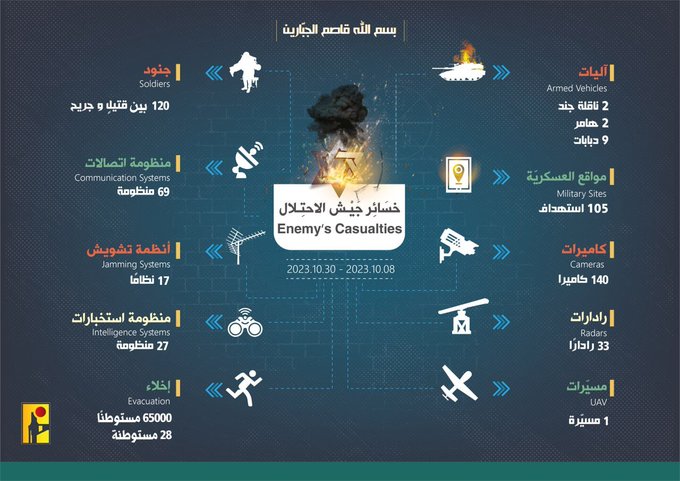
The Lebanese Resistance has just published this graph which indicates the losses inflicted on the occupier between October 8 and 30 “as part of operations on the road to the liberation of Al-Quds”: 120 Israeli soldiers were killed or injured, 65,000 settlers were evacuated from 28 settlements, 13 armed vehicles were destroyed (2 armored personnel carriers, 2 Humvees and 9 tanks) and 105 military sites were targeted. In addition, 69 communications systems, 17 jamming systems and 27 intelligence systems, 140 cameras, 33 radars and 1 drone were destroyed, so that Israel is almost completely blinded to what is happening on the Lebanese border, which would facilitate a major ground offensive from Lebanon. For its part, Hezbollah announced 49 martyrs so far: these are indeed low-intensity clashes, but on both sides, the losses in soldiers already represent almost a third of those of the entire July 2006 war, which is far from insignificant. Especially since this daily pressure on the occupier does not only represent moral support, but indeed military support. As Sheikh Naïm Qassem, Deputy Secretary General of Hezbollah, declared, Israel has amassed 5 brigades around Gaza, and 3 brigades on the Lebanese border: without the threat that Hezbollah poses to Israel, 8 brigades would be amassed around Gaza. It is therefore above all a matter of dividing the enemy’s forces, and of leaving its command in uncertainty, in order to paralyze its decisions and its willingness to massively commit its forces against the Palestinian Resistance. In this regard, the success is undeniable: to be convinced of this, one only needs to listen to the confused and contradictory declarations of Netanyahu, his ministers and the Israeli general staff on the launch of the ground operation, its timing, its scale, its objectives, etc.
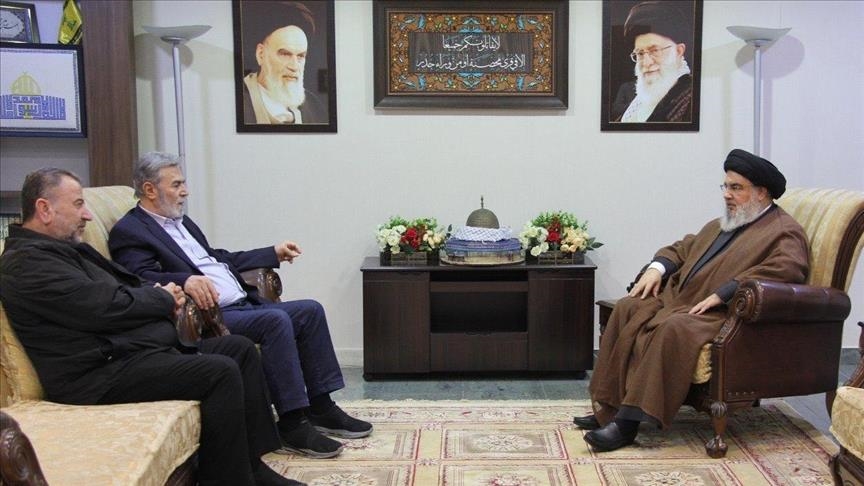
Lebanon: Hassan Nasrallah discusses developments with Ziyad Al-Nakhalah (Islamic Jihad) and Salah Al-Arouri (Hamas)
Additionally, Hezbollah is directly involved in the daily operations of the Resistance in Gaza, working closely with Hamas and Islamic Jihad cadres based in Lebanon in a common command room. Following Nasrallah’s high-profile meeting with Hamas and Islamic Jihad leaders on October 25, Hamas political leader Salah al-Arouri said:
“We are witnessing a heroic epic of Resistance in Lebanon against the occupier along the southern borders, where daily clashes break out and where martyrs fall daily among Hezbollah, the Al-Quds Brigades and the Al-Qassam Brigades. Hezbollah operates at all military and political levels, and our battle is also their battle. We share one goal and one destiny. Our struggle is united, our destiny is shared towards Al-Quds. We are in constant coordination in this battle.
Not all of our meetings with Hezbollah are public. We met Sayed Hassan Nasrallah on the first day of the battle. We are in constant meetings and maintain deep and precise communication with all the Resistance forces and our Hezbollah brothers, with Sayed Nasrallah on the front line.
If the enemy invades by land, it will mark a new and glorious chapter for our people and an unprecedented defeat for the occupation in the history of the Israeli-Arab struggle. Punishment for the crimes of the occupation is inevitable. We assure our people that the Resistance is doing well despite the crimes of the enemy and will ease your hearts regarding the extent of your suffering in the event of a brutal ground attack.
To the occupation, I declare this: be ready, because the battle has not yet begun.”
It is more than likely that Hezbollah was not surprised by the October 7 operation nor by its spectacular success, Nasrallah having constantly warned Israel not to underestimate the Palestinian Resistance, and to fear a massive reaction if they did not stop their ethnic cleansing in the West Bank and their provocations at the Al-Aqsa mosque: “Don’t miscalculate”, he kept warning the Israeli occupier and his new fascist government. We can even say that the Lebanese Resistance, which, thanks to its experience of liberating territories occupied by ISIS and Al-Nusra in Syria, has been planning an operation to invade Israel and liberate the Galilee for years, has transmitted its expertise to the Palestinian Resistance in Gaza, which took the Israeli army completely by surprise by launching an operation it expected on its northern border. Hezbollah is therefore directly linked to all aspects of the terrain and the situation, and assists the Resistance factions in all possible ways, similar to what the United States is doing for Israel.
What now?
Hezbollah’s decisions are influenced neither by the threats of enemies, nor by the reproaches (or even bitter insults) of friends who allow themselves to be carried away by emotion and see in Hezbollah’s attitude cowardice or a betrayal of the Palestinian cause. Hezbollah has never cared about “saving face” and is only driven by its long-term strategic vision, which is entirely focused on the total liberation of Palestine and the ways to achieve this strategic objective while minimizing sacrifices, if possible. Those who consider the eradication of Israel an unrealizable illusion are the same people who, in 1982, would have considered the desire of the nascent Hezbollah to expel by force the Israeli army which occupied half of Lebanon, or who, before October 7, would have found it inconceivable that the Resistance in Gaza could break the siege and inflict such losses and humiliation on the enemy. The red lines which, if crossed, would bring in Hezbollah and the Resistance Axis with all its firepower are probably clearly drawn, but it would not be wise to divulge them: it would be telling Israel that he can go this far without risking an all-out war. Leaving the enemy in confusion and exerting controlled pressure on the Lebanese border is the best strategy for this phase of the battle: Hezbollah demonstrates that he is present, that he is not afraid of confrontation or of escalation, and that he is ready for open war.
Whatever happens, October 7 will go down in history as a resounding victory for the Palestinian Resistance, and an earthquake for Israel. No massacre, no destruction, no genocide can ever erase it. As Sheikh Naïm Qassem pointed out, Israel has little choice today but between being content with the crushing defeat it has already suffered, or persisting in blind revenge and suffering discredit and defeat on a much bigger scale. Each of these two scenarios is satisfactory for the Palestinian Resistance and its allies, who will not abandon it, whatever the price to pay. And already, the confidence of Israeli society in its army and in itself, which has only become more fragile over the last two decades, is irremediably broken, and the process of remigration of Israeli settlers to Europe and America will only accelerate.
Hassan Nasrallah’s speech announced for November 3, in tribute to the martyrs of the Lebanese Islamic Resistance who fell in recent days, will finally break the silence of the Hezbollah Secretary General, an expert in psychological warfare, whose silence as well as his speeches are feared and deciphered by Israel. He will not necessarily make thunderous announcements, though many people expect him to do so, but he will clarify the very tense situation on the Lebanese border, which is getting worse every day, and could degenerate into open conflict at any time. Of all the speeches Nasrallah has given, this is probably the one that will be the most eagerly awaited and followed by both friends and enemies of the Party of God and Palestine.
Why I Support Hamas
And you should too
BY KEVIN BARRETT | OCTOBER 29, 2023
In this week’s False Flag Weekly News I outperformed Cat McGuire (for once) in saying things the ADL won’t like. Angered by the genocide of Gaza, I uttered many uncomplimentary and/or inflammatory remarks about the Chosen People and their Chosen State. But of all of the “oy vey” things I said, what the ADL will hate the most is my open declaration of support for Hamas.
And that, of course, is the most obvious reason to support Hamas: “They” really, really don’t want you to. The strategists who are trying to keep the genocide of Palestine going apparently realize that if significant numbers of Westerners start openly supporting Hamas and the rest of the Palestinian resistance, the Zionist goose will be well and truly cooked. That’s why they’ve used advanced propaganda techniques to inject the obligatory “I don’t support Hamas, but” disclaimer deep into the collective unconscious of the West in general and its relatively-Palestine-savvy people in particular.
“They” don’t really care if you deplore the massacre of thousands of Gazan women and children. “They” don’t mind if you support a two-state solution, or even a one-state solution. “They” can live with you calling for a ceasefire. “They” could care less if you utter words like apartheid or even genocide.
It’s like when Joel Stein said “I don’t care if Americans think we’re running the news media, Hollywood, Wall Street or the government. I just care that we get to keep running them.” The Zionist position is: “I don’t care if Americans think we’re committing human rights violations, apartheid, or genocide. I just care that we get to keep committing them.”
Americans complaining about Zionist human rights violations, apartheid, and genocide won’t stop those things. They will only be stopped at gunpoint. And it really does matter that people support the right of genocide victims to pick up guns and stop the genocide.
Jews, who think of themselves as paradigmatic genocide victims, should be the first to support armed resistance against genocide. And indeed, the smartest and most courageous Jews do. Check out what David Rovics has to say about Al-Aqsa Flood being the new Warsaw Ghetto uprising:
Hamas is the closest thing to an elected government the Palestinians have. In fact, the last time they had a real election in the Occupied Territories of the West Bank and Gaza, Hamas won by a landslide….Physically fighting back against an occupying army, according to international law that all the countries in the world have signed on to long ago, is justified, and is not “terrorism.”
Why Supporting Hamas Is Strategically Savvy
In any struggle between two sides, the outcome will be largely determined by the intensity of support enjoyed by each party to the conflict. Small, weak countries like Vietnam and Afghanistan were able to defeat the mighty USA because they were far more intensely committed to ending US occupation than Americans were committed to maintaining it. Like the Palestinians today, they were willing to accept a lopsided casualty ratio as they continued raising the price of occupation to the point that the occupier opted to stop paying it.
The Western propaganda apparatus currently allows and tacitly encourages pro-Zionist intensity, while making pro-Resistance intensity taboo. “I stand with Israel” is acceptable, even mandatory; “I stand with Hamas” is practically illegal and unthinkable.
When Side A is passionately and intensely supporting its fighters, while Side B mumbles apologies and obligatory disclaimers, obviously Side A will enjoy a morale advantage that will translate into an advantage on the battlefield. But when Side A is a criminal aggressor and genocide perpetrator, it may find it difficult to maintain its intense support, and to prevent neutral people who care about justice from becoming passionate supporters of the other side. So it will use every propaganda trick in the book to prevent neutrals and lukewarm supporters of the other side from becoming brazen and passionate.
The best way to change that pro-genocide Overton Window is to throw a brick through it. And tied to that brick, a simple message: “I SUPPORT HAMAS.”
Pro-Vietnam-War people really hated it when Jane Fonda high-fived Hanoi as thousands of Americans gathered in the streets to shout their support for the Viet Cong: “Ho, Ho, Ho Chi Minh, the NLF is going to win!” But that, and US troops fragging their officers, is what ended the war. Humanitarian complaints about napalmed babies and My Lai massacres were only useful insofar as they pissed off enough people to the point that they realized that the Vietnamese resistance fighters were the good guys, and Uncle Sam was the villain, and that all decent people had a moral duty to support the Vietnamese resistance. That shifted the Overton Window radically, to the point that “withdraw ASAP and to hell with the consequences” became a middle-of-the-road position and then a political reality.
If we can get a small but noticeable number of Americans openly and brazenly cheering for Hamas at the top of their proverbial lungs, it will have the same effect on ZOG that Al-Aqsa Flood had on Israelis: It will drive them crazy, puncture their inflated sense of invulnerability, and incite them to lash out in irrational and strategically counterproductive ways. ZOG’s mask will come off, and it will show its psychotic, genocidal face to America, just as the Israelis have shown theirs to the region, the BRICS nations, and the Global South.
And the Overton Window will shift. Pretty soon “end aid to Israel” and “one-state solution” will become middle-of-the-road positions and then political realities.
Why Supporting Hamas Is Your Moral Duty
I began by explaining why supporting Hamas is strategically savvy, rather than addressing the moral argument, because much of my audience already understands what I am now about to say. For them, the strategic benefits of supporting Hamas may not be evident, even though the moral arguments are.
So I risk belaboring the obvious in stressing that the most important point—the forest that people miss while peering at the trees—is that the Palestinian cause is just, and the Zionist one unjust. Every just war theory, whether Christian, Islamic, or secular, is based on the non-aggression principle: The side that initiates aggression, in this case by crossing the seas to invade and murder and steal the other side’s land and property, is in the wrong, while those fighting to stop that aggression are in the right. No sane person who takes the time to study the history of Palestine in a reasonably comprehensive and unbiased way can fail to conclude that there has never been a war in history that has been more obviously and completely just than the Palestinian war against Zionist invasion, occupation, and genocide.
And of all the big lies uttered in history, there has never been a bigger one than “The Israeli-Palestine conflict? It’s complicated.” No it isn’t. And it isn’t a conflict, it’s a genocide. The rights and wrongs are not the least bit complicated.
Zionist attempts to obfuscate the injustice of their genocidal project are so absurd that they would be hilarious if there were not right now more than a thousand Gazan children buried beneath the rubble of what used to be their homes, suffering and dying slowly in some cases, expiring quickly and mercifully in others. Consider the most popular excuses:
“Yahweh gave us Palestine 3,000 years ago. Surely that should count for something! What?! You don’t honor Yahweh’s 3000-year-old real estate deals?!!”
*“We deserve Palestine because of the Holocaust. So why isn’t Israel in Germany? Umm… next excuse!”
“We are an ethnic group so we deserve a state of our own. And yes, we know that there are tens of thousands of ethnic groups on Earth, and that virtually none of them have states, but we are just so special that we deserve one! And if you don’t agree, you are anti-Semitic!”
“We have gotten into terrible conflicts with every neighbor we’ve ever had, and have been expelled from more than 100 countries for no reason at all except that our neighbors like to pointlessly persecute us, so you ought to sympathize and side with us no matter what we do.”
“There are lots of terrible injustices, so if you complain about this one, you must be an anti-Semite!” Alternate version: “Genghis Khan (or Pol Pot or Stalin or Hitler) killed more people than we have, so why are you attacking us, you anti-Semite?”
“The Palestinians and their supporters, as we portray them in our propaganda machine, are very bad, wicked people, so you should cheer for us as we steal their stuff and exterminate them.”
“We are a democracy even though we murdered or expelled most of the people who should be voting in our elections.”
“Israel’s existence is really, really beneficial to US national security, even though it makes billions of people in geopolitically-crucial energy-rich countries hate America’s guts.”
“You have to support us because we call our enemies ‘terrorists’ and other nasty names.”
And when all else fails:
“Support us and do what we say, or you’ll never work in this town again!”
Refuting the extant arguments for Israel’s existence would be superfluous and an insult to the reader’s intelligence. They are not even arguments, just inarticulate, incoherent grunts and howls of tribally-intoxicated psychopathy.
But it may be worth unpacking one of them: the “terrorist” blood libel. Terrorism is usually defined as “A military tactic consisting of deliberately attacking civilians to incite fear and achieve a political objective.” And that is exactly what “Israel” is: A terrorist organization. Zionist terrorists have been attacking and terrorizing the civilian population of the territory they invaded, namely Palestine, ever since they got there. The various Zionist terror groups were so drunk on terrorism that they even terrorized each other, as well as their fellow aggressors and invaders, the British, in a bloody orgy of terror that has no parallel in modern history. Much of the story can be found in Thomas Suarez’s State of Terror: How Terrorism Created Modern Israel.
So the conflict is between terrorists who crossed the seas to attack the Palestinian civilian population in order to kill some and scare the others into leaving; and the civilian population they have been terrorizing. On one side, the Zionist terrorists; on the other, the Palestinian anti-terrorist Resistance. In this as in so much else, the Zionist propaganda machine has turned reality on its head.
Today, the Zionist terrorists continue to deliberately target and mass-murder Palestinian civilians by the thousands. About two-thirds of the Palestinians they kill are women and children. The Zionists probably kill about a hundred civilians for every Hamas fighter. Compare that to al-Aqsa Storm, the Hamas operation that killed roughly equal numbers of Israeli military fighters and civilians. And of the civilians killed in al-Aqsa Storm, the majority were killed by the Israeli military, whether accidentally in crossfire, or deliberately in accordance with the Hannibal Directive, which recommends eliminating both hostage-takers and hostages using overwhelming firepower in order to prevent the enemy from using hostages as a bargaining chip.
Hamas, unlike the Zionists, primarily targets the Israeli military, when it can. Clearly, al-Aqsa Storm primarily targeted the IDF. Hamas’s orders were to take hostages, but to avoid killing unarmed civilians. And while there may have been a few instances of Palestinians killing civilians, photo evidence proves that the worst carnage—music festival goers caught in heavy artillery crossfire, houses and kibbutzes and other buildings full of people destroyed by tank and artillery shells—was perpetrated by the IDF. Hamas soldiers, carrying light weapons, could not possibly have caused that kind of damage, or killed those large numbers of people.
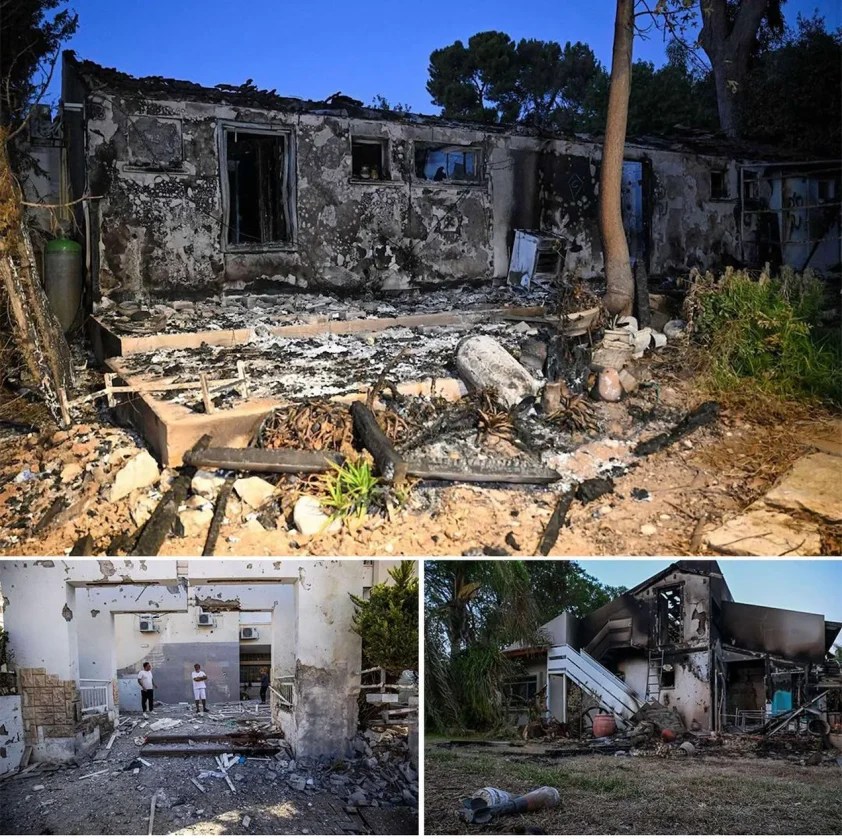
This and most of the rest of the damage to civilians on October 7 was meted out by Israeli heavy weapons, not Hamas’s light firearms
But what about the rockets? Since unlike Israel, Hamas doesn’t enjoy billions of dollars worth of of US-taxpayer-provided weaponry, it fires relatively unsophisticated rockets that cannot take out hardened military targets, but do frighten and occasionally harm Israeli “civilians.” So… is that terrorism? No—because Israelis are settlers, not civilians. Under international law, military resistance against occupation, including targeting settlers, is legitimate. So we can argue about proportionality—I would assert that Hamas errs on the side of mercy by doing a whole lot less settler-killing than it has every right to be doing — but at the end of the day, international law, morality, and basic common sense dictate that Hamas’s use of rockets to retaliate against massive genocide is justifiable… and rational, as part of a multi-pronged strategy to keep raising the costs of occupation to the point that the genocidal occupier will finally take Helen Thomas’s advice and “get the hell out of Palestine.”
Arguing with Orwell’s O’Brien
You know who has lost the argument not only by Godwin’s law a.k.a. reducto ad Hitlerum, but also by which party feels the need to use coercion to force the other party to shut up. The Zionist terrorists have not only lost the argument, they have no argument. No wonder they ceaselessly invoke Hitler and the Nazis. And no wonder they constantly run professors out of universities, get media personalities fired, launch specious persecutions and prosecutions, and generally terrorize everyone into going along with their genocidal absurdities.
Arguing with a Zionist is like arguing with Orwell’s O’Brien: He knows he’s full of shit, has no compunctions about it, and is going to do whatever it takes to ruin your life.
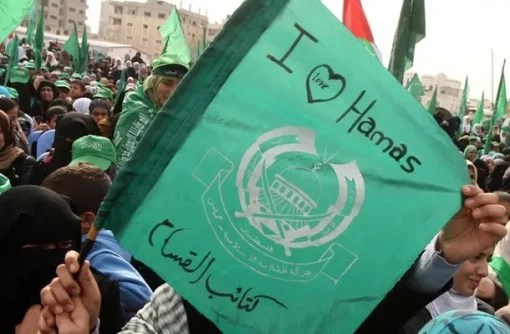
By saying “I like Hamas,” I’m supporting an anti-terrorist group that the Zionist terrorists have falsely and mendaciously labeled, in true Orwellian fashion, “terrorists.” Maybe they’ll try to get me prosecuted for “material support for anti-terrorism,” though I haven’t mailed so much as a dirham to Hamas, POB 123, Gaza Strip, Occupied Palestine, nor have I contributed to any Hamas GoFundMe’s or bought any donuts from the nice little old Hamas ladies at the local mosque. (If they were selling baclava, I’d consider it.)
If you’re honest with yourself, you’ll probably have to admit that the reason that you haven’t yet come around to openly supporting Hamas is fear: fear of what the Zionists might do to you. Well, I’m here to tell you that fear isn’t the right word for that. The correct word is cowardice.
The Palestinians continue to unite in resistance to genocide, even as the Zionists respond by forcing their children to die agonizing deaths, by the thousands, beneath mountains of rubble. And you can’t even openly and publicly admit that you support that Resistance? Come to think of it, maybe cowardice isn’t the right word. It isn’t strong enough.
Come on, grow some stones. Say it with me: “I… SUPPORT… HAMAS.”
Israeli ground troops face fierce resistance inside Gaza
The Cradle | October 29, 2023
The Palestinian resistance has continued to confront Israeli ground troops penetrating the Gaza border, after Tel Aviv announced an expansion of limited ground incursions into the besieged strip on Friday.
The Qassam Brigades launched a surprise attack on Israeli forces on Sunday “after infiltrating behind their lines and clashing with enemy forces” who were making an incursion northwest of Beit Lahia, their Telegram channel said.
In a statement released earlier on 29 October, Hamas’ Qassam Brigades announced that they “continue to confront the Zionist forces penetrating the Al-Amiriyya area northwest of Beit Lahia, where they engaged in armed clashes with them and targeted enemy vehicles with … mortar shells.”
The Qassam Brigades “carried out several sniping operations. The enemy admitted that a number of its soldiers were wounded in the clashes with our Mujahideen who … are still targeting enemy forces.”
They also targeted on Sunday morning a “gathering of enemy vehicles” with a suicide drone, according to the resistance group’s Telegram channel.
The armed wing of the Palestinian Islamic Jihad (PIJ) movement, the Quds Brigades, also announced on 29 October targeting Israeli forces attempting to enter the northern Gaza Strip with rockets and mortar shells.
Israel’s military announced earlier on 29 October that one of its officers was seriously hurt and another soldier moderately injured “in the northern Gaza Strip overnight.”
The Qassam Brigades released a video on Saturday evening, 28 October, showing their destruction of an Israeli armored vehicle believed to be carrying over a dozen soldiers. The attack took place near the Gaza Strip’s Shujaiya area.
Over the past week, Israel has carried out “limited” ground incursions into northern Gaza aimed at testing the waters for the planned invasion. The Israeli army said it struck several Hamas targets during small-scale incursions on 25 and 26 October.
Israeli troops took heavy losses the week before that while attempting to enter the Gaza Strip on land.
Tel Aviv announced on 27 October that it is “expanding” its limited ground activity in Gaza.
However, an army spokesman told ABC News that day that “the expanded operations taking place in Gaza are not an official ground invasion.”
So far, Israel has delayed fully invading Gaza and attempting to carry out its stated goal of “eradicating” Hamas, who are well prepared for an Israeli ground invasion.
Many experts, including The Cradle’s Hasan Illaik, have said recently that Israel will be unable to bear the cost of launching a full ground assault on the Gaza Strip. Such an invasion could also instigate the opening of several new fronts and the outbreak of regional war.
“We want to convey to our enemy that we are impatiently awaiting the opportunity to introduce [its forces] to new forms of demise,” Qassam Brigades spokesman, Abu Obeida, said on 28 October.
Israel Faces ‘Near Impossible Task’ in Gaza
By Scott Ritter – Sputnik – 29.10.2023
Israel has conducted a series of ground incursions into Gaza over the course of the past week, each one building on the other, increasing in scope and scale. This appears to be part of an Israeli strategy to lean gradually into an operation that, when finished, falls just short of a general assault on Gaza.
At the end of the day, however, Israel will most likely not be able to defeat the military forces of Hamas and other Palestinian resistance forces defending Gaza. Israel will have to either seek to defeat Hamas by laying siege to the Gaza Strip or commit to a full-scale attack on Gaza designed to clear the territory of all Hamas fighters.
History suggests that any such assault will be extremely difficult to accomplish.
The example of Operation Hubertus, the final German assault on Stalingrad, stands out. The Germans brought in elements of seven elite “Pioneer” battalions — combat engineers with extensive experience in urban warfare, having paved the way for prior German victories in Rostov and Voronezh. The Pioneers were the masters of military demolition, highly trained specialists in house-to-house fighting and the use of explosives and flame throwers. Around 1,800 of these elite assault engineers were assembled for the final drive to push the defending Soviet soldiers from Stalingrad.
On the first day of operations, the Pioneers suffered nearly 30% casualties. After several days of fierce fighting, the Pioneers were stopped less than 100 meters from their objective. However, their forces suffered between 60-70% casualties, and could not proceed further.
Operation Hubertus was doomed to fail from the beginning. According to an account of the fighting, “The constant bombardment and artillery shelling created a battlefield in which the Soviet defenders largely held the advantage over the assaulting Germans. The fields of rubble and craters were perfectly designed for defensive actions and could be improved with relatively little effort. This also provided ample hunting ground for the ever-present Soviet snipers.”
A similar observation can be made regarding the Allied attacks on Monte Casino, in Italy, in early 1944. A massive aerial bombardment destroyed a 6th century abbey. Elite German paratroopers dug into the rubble, and for months successfully held off repeated attacks. There can be no doubt that the excessive bombardment of Monte Casino ended up strengthening the positions of the German defenders.
In the battle of Iwo Jima, it took US Marines more than a month to secure the tiny island, largely because the Japanese had dug some 18 kilometers of tunnels into the 21-square kilometer island, some of which were more than 70 meters underground, from which they rode out heavy bombing and shelling, only to emerge and ambush the advancing Marines.
If one combined the above ground rubble of Monte Casino with the below-ground tunnel network of Iwo Jima, you might approximate the hellish scenario awaiting Israel in Gaza.
Over 500 kilometers of tunnels dug in under the 360 square kilometers that comprise the Gaza Strip, these tunnels are purpose built, designed to serve as transportation corridors, command centers, supply depots, dormitories and hospitals, defensive positions, and in support of offensive action. Simply put, there has never been a military operation against a target such as the one presented by Hamas in Gaza.
Israel has trained a small number of its elite special forces to carry out limited-scope operations in an underground environment. These operations, typically involving hostage rescue or direct action (i.e., eliminating a high value target), are conducted under very controlled circumstances, with the attacking forces proceeding only when the circumstances support a favorable outcome. As such, the experiences of these troops are counterproductive when it comes to transferring knowledge to the conventional forces that would bear the brunt of any Israeli assault on Gaza.
Simply trying to navigate the rubble-strewn streets of Gaza will be a nearly impossible task for the Israeli troops. The going will be slow, and the Israeli infantry will have to operate dismounted, exposing themselves to sniper fire and ambushes. Israeli vehicles will find themselves hemmed in without the ability to maneuver, making themselves vulnerable to mines, improvised explosive devices, and anti-tank weaponry. Close air support under these circumstances will be very difficult, effectively neutralizing Israel’s greatest advantage.
If Israel does not sync its above-ground actions with a simultaneous effort to defeat Hamas’ underground tunnel-based defenses, then the situation above ground will become even more precarious, with Hamas emerging from tunnels behind the Israeli forces, cutting them off and inflicting heavy casualties. But Israel is going to be operating largely blind underground, probing into a tunnel network designed by Hamas to protect against any such effort. Israel’s best bet would be to simply locate tunnel entrances and seal them off, leaving the Hamas forces underground to die of thirst, hunger, oxygen deprivation, or disease. But this will require the physical occupation of every square meter of the city, an immensely difficult problem from both a logistical and operational standpoint. It will also expose more Israeli forces to harm, resulting in a dramatic increase in casualties.
By reacting to the Hamas attack of October 7 in the way it has, Israel has literally walked into a trap designed by Hamas to defeat any Israeli incursion. Israeli forces are neither trained, equipped, organized, nor motivated to carry out the kind of brutal, bloody, and physically demanding combat that will be required to defeat Hamas above and below the ground in Gaza. Israeli political and military leaders have boxed themselves into a corner with their aggressive winner-take-all rhetoric. But now that the time has come to pay the price of their collective verbiage, the question becomes is this a price Israel is willing and able to pay?
The answer is probably no. Israel has defined victory as being predicated on the total defeat of Hamas as a military organization. This is most probably a mission impossible. Hamas, therefore, emerges victorious simply by surviving. Given the strong defensive position Hamas finds itself in, through a combination of its immense tunnel network and the destroyed urban environment brought on by Israeli bombardment, it is highly likely that Hamas will be able to hold off a concerted Israeli assault until which time the Israel Defense Forces, like the German Pioneer battalions in Stalingrad, exhaust themselves on the field of battle.
India’s solidarity with Israel is untenable
BY M. K. BHADRAKUMAR | INDIAN PUNCHLINE | OCTOBER 29, 2023
India’s muscular diplomacy, an attribute of the present government, has run into heavy weather. Body blows from multiple sources — spat with Canada; Maldives’ triumphalism about evicting Indian servicemen; China-Bhutan normalisation, etc. — testify to it.
On top of it comes the latest diplomatic faux pas at the UN GA over the Gaza situation and a not-entirely unrelated shock and awe dealt out by Qatar over the past week. Doha has handed down death sentences to eight Indian ex-naval officers on charges of spying for Israel.
Whichever way one looks at the Explanation of Vote (EoV) on Thursday’s UN General Assembly resolution on Gaza, India’s abstention was a mistake. Simply put, our diplomacy has become entrapped in our solidarity with Israel.
The topmost consideration for India at the UN GA debate should have been that the draft was tabled by the Arab and OIC countries with whom India has fraternal ties, and, second, it called for an “immediate, durable and sustained humanitarian truce” in Gaza, which is an urgent necessity.
Yet, France outclassed Indian diplomacy, exposing the need for more creative UN diplomacy on our part. France not only sought that some reference to Hamas’ raid into Israel on October 7 be made in the draft, but while on a recent visit to Tel Aviv, President Emmanuel Macron even proposed an alliance of like-minded countries to take on Hamas militarily.
Yet, when the crunch time came, France ultimately voted for the Arab resolution and issued an EoV justifying it. As France saw it, the imperative need today is to stop the fighting and the compelling reality is the importance of being on the right side of history when it comes to the Middle East crisis, where it has high stakes. The point is, in the final analysis, what stands out for the record is the actual voting, not the EoV.
It was apparent that the Canadian amendment — at Israel’s behest and sponsored by Washington from the rear — was a clumsy attempt to divide the votes by calling for “unequivocally rejecting and condemning the terrorist attacks by Hamas.” In a notable speech that drew wide acclaim, Pakistan’s ambassador to the UN Munir Akram highlighted the contradiction.
If Canada was being fair in its amendment, he said, it should as well agree to name Israel as well as Hamas. “We all know who started this. It is 50 years of Israeli occupation and the killing of Palestinians with impunity,” Akram argued, therefore, not naming either side was the best choice.
It appears that India was taken aback by Akram’s intervention at the UN GA during Agenda Item 70, Right to Self-Determination where he forcefully linked the Palestine issue and Kashmir problem. Alas, India’s abstention has only left the centre stage to Pakistan to occupy. This could be consequential. A prudent course would have been to identify with the stance of the Arab countries unequivocally, since this is a core issue for them and it is playing out in their region, first and foremost.
India should have factored in that feelings are running high in the West Asian region and the US-Israeli propaganda that the Arab world paid only lip-service to the Palestinian cause doesn’t hold good. There is unmistakable anger and anguish among the regional states and a groundswell of opinion has appeared demanding a settlement of the Palestine issue as an imperative of regional stability.
Fundamentally, the tectonic plates in regional politics have shifted following the Saudi-Iranian rapprochement under China’s mediation, which in turn triggered new thinking in West Asia giving impetus to a focus on development. Equally, the regional states prefer to address their issues increasingly on their own steam without external interference. China and Russia understand this but the US refuses to see the writing on the wall.
Therefore, it will prove to be damaging to our interests if a growing perception crystallises that Indians are carpetbaggers. The Indo-Israeli fusion through the past decade hasn’t gone unnoticed in the Muslim countries. They resent it, perhaps, but it may not surge into view because Arabs are a hospitable people. That said, their resentment may surface if push comes to shove and their core interests are involved.
The US-Israeli attempt to put the lid on the region’s growing strategic autonomy is one such core issue. It is far from the case that the regional states — be it Qatar, Iran, Egypt, Syria or even Turkey — do not understand that the Biden administration’s grandiloquent idea of a India-Middle East-Europe Economic Corridor is in reality a wedge to disrupt the nascent trends of unity among regional states so as to insert Israel into the regional processes and rekindle the flame of sectarian schism and geopolitical rifts, which the US invariably exploited to impose its hegemony in West Asia historically.
That is why, the three-way Qatar-India-Israel tangled mess of espionage, which should never have been allowed to happen, becomes a litmus test of mutual intentions in the geopolitics of the region. Lest it is forgotten, Qatar and Israel had once collaborated since the mid-nineties to prop up Hamas as an Islamist antidote to the secular-minded PLO under Yasser Arafat.
In a recent interview with the Deutsche Welle, former Israeli Prime minister Ehud Olmert disclosed, inter alia, “We know that the Hamas was financed with the assistance of Israel— for years — by hundreds of millions of dollars that came from Qatar with the assistance of the state of Israel, with the full knowledge and support of the Israeli government led by Netanyahu.”
That convergence — rather, Faustian deal — ended in 2009 following the three-week Gaza Massacre by Israel, whereupon, Doha drew closer to Tehran. Nonetheless, a pragmatic relationship continued, and in 2015, the Qatari government facilitated discussions between Israel and Hamas in Doha in search of a possible five-year ceasefire between the two parties. Suffice to say, Indian diplomacy is swimming in shark-infested waters. The news from Doha this week is a wake-up call.
Equally, our public discourse on Hamas as a terrorist organisation and our branding of that national liberation movement is surreal, to say the least. Although it may be difficult today for the government to openly deal with Hamas, it shouldn’t be that we lack a proper understanding of Islamism. If ever a Palestine settlement comes to fruition, Hamas will have a lead role in it as the fountainhead of resistance. India’s political elite must bear in mind this reality.
Eliminating the Hamas from the political landscape is no longer possible, given the massive grassroots support it enjoys among the Palestinian people, which is of course a proven fact in the successive elections held in Gaza and West Bank.
Hamas resists Israeli offensive in Gaza after violent night of airstrikes
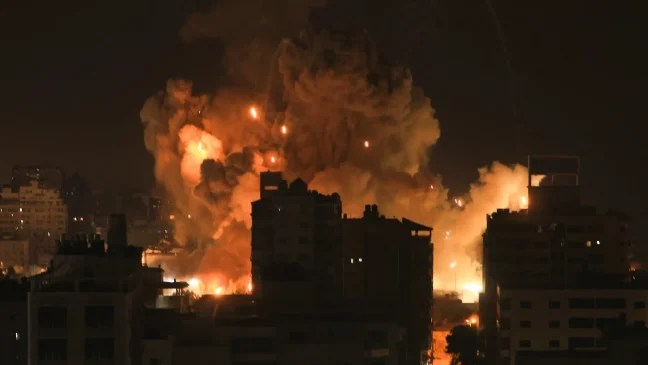
Gaza City during an Israeli airstrike on 8 October, 2023. (Photo Credit: MAHMUD HAMS / AFP)
The Cradle | October 28, 2023
Gaza-based Palestinian resistance faction Hamas announced on 28 October that its forces successfully held back invading Israeli troops who overnight launched large-scale ground operations into the coastal enclave under the cover of intense air raids.
Hamas says its forces dealt “heavy losses to the enemy’s ranks” as they repelled the ground incursion. Nonetheless, heavy clashes continue in several points of the northern Gaza Strip.
“The enemy fell into ambushes set up by the Palestinian resistance on several fronts. Kornet missiles and Yasin shells were used to repel the attack, and we expect the enemy to try again. The Israeli regime used helicopters to evacuate the wounded and the dead from the battlefield,” the Hamas statement reads.
For their part, Israeli media claims there are “no reports of Israeli casualties” and that “ground forces, including infantry, combat engineering forces, and tanks, remained inside Gaza […] operating deeper into the Hamas-run territory than previous limited incursions.”
On Friday night, the Israeli army began what officials described as an “expansion” of their ground operations into Gaza after several nights of “limited incursions” that were also repelled by the Palestinian resistance.
According to local reports, the elite US Delta Force has been accompanying Israeli troops into the besieged territory. However, Washington maintains that its forces only provide logistical advice to Tel Aviv.
The Israeli ground offensive was launched under the cover of a violent campaign of airstrikes by the Israeli air force, which decimated the northern Gaza Strip with hundreds of bombs, including internationally banned white phosphorous and cluster munitions.
Despite the intensity of the Israeli offensive, the Gaza resistance continued to launch rocket attacks toward the occupied territories, setting off alarms in several settlements.
As the clashes continue, Gaza remains unreachable to the outside world after Israel cut off all phone and internet services to provide cover for the genocide being committed against Palestinian civilians.
“This communications blackout means that it will be even more difficult to obtain critical information and evidence about human rights violations and war crimes being committed against Palestinian civilians in Gaza and to hear directly from those experiencing the violations,” Erika Guevara Rosas, senior director of research, advocacy, policy and campaigns at Amnesty International, said in a statement on Friday.
UN agencies and human rights organizations say they can still not reach their staff and health facilities inside Gaza.
Featured Video

Rewriting the risk? Inside the government’s vaccine safety messaging
or go to
Aletho News Archives – Video-Images
Book Review
“Davos Can Really Replace the UN”
Inside the book that maps the architecture behind global governance — from the Epstein files to the Pact for the Future
Lies are Unbekoming | April 1, 2026
On June 13, 2019, the United Nations and the World Economic Forum signed a partnership deal to “accelerate the implementation of the 2030 Agenda for Sustainable Development.” That same evening, WEF president Börge Brende — Norway’s former Foreign Minister — had dinner with Jeffrey Epstein at Epstein’s Manhattan townhouse. The Epstein files, released January 2026, contain an exchange between the two from the previous year. Epstein to Brende: “Davos can really replace the UN. C21, cyber, crypto . genetics… intl coordination.” Brende back to Epstein: “Exactly — we need a new global architecture. World Economic Forum (Davos) is uniquely positioned — public private.”
The next day, the UN General Assembly adopted the framework for restructuring global governance.
That sequence — the partnership signing, the Epstein dinner, the candid admission about replacing the UN with a public-private architecture, and then the formal adoption — opens Jacob Nordangård’s The Digital World Brain. Pages two and three. Footnoted to the UN resolution number, the Epstein files, and the General Assembly record.
I keep coming back to it because it captures what this book does that almost nothing else in the independent research space manages. I’ve followed Jacob’s work for years now and interviewed him about his research. Each book peels back another layer of the same institutional architecture, and each time I think he’s reached the limit of what can be documented, the next one goes further. Nordangård doesn’t speculate. He doesn’t editorialize much. He lays institutional actions next to each other in chronological order and lets the pattern announce itself. … continue
Blog Roll
 Aletho News
- The End of NATO
- 37 days of war on Iran cost US staggering $42bln, tracker shows
- Baghdad tells Asian refiners, traders to begin loading Iraqi crude amid Iranian exemption
- Under fire, Moscow and Tehran close ranks
- Iran, US receive Pakistan-mediated plan for ceasefire then final deal
- Iran submits demands for end to war as mediators scramble ahead of Trump deadline
- Iran Threatens Retaliatory Strike on Stargate AI Project in UAE
- US sent ‘a lot’ of arms to Iranian protesters – Trump
- Barak Ravid Launders Deception To Allow Trump To Back Off Of His Power Plant Threat – Again
- REWRITING THE RISK? INSIDE THE GOVERNMENT’S VACCINE SAFETY MESSAGING
- If Americans Knew
- Trump poised to “blow everything up” (ie. commit war crimes) in Iran – Daily Update
- In Iran, Israel-US take aim at “reason, research, and freedom of thought” – Daily Update
- US loses planes over Iran, Israel downgrades Lebanon war goals – Daily Update
- Israel Is Blocking Palestinians from Easter at Church Where Jesus Resurrected
- Plot to assassinate Palestinian activist follows harassment campaign promoted by Zionist groups and elected officials
- Prominent New York synagogue hosts presentation on why U.S. Jews should support the ethnic cleansing of Gaza
- Tapper vs. Piker: Is the CNN Anchor Auditioning for David Ellison?
- Shouldn’t Democrats Be Able to Condemn Genocide?
- Israel-US kill negotiators, destroy civilian structures, but Iran’s military capabilities still largely intact – Daily Update
- ‘War crime’: Global condemnation as Israeli ministers celebrate death penalty law targeting Palestinian prisoners
- No Tricks Zone
- An Inconvenient Tree: Uncovered In Alps… Europe Much Warmer Than Today 6000 Years Ago
- New Study Reports A 60% Slowdown In Greenland’s Ice Loss Rate In The Last Decade
- Low Intensity Tornado Wrecks Major Solar Farm, Creating A Potential Toxic Dump
- New Study Finds Warming Saves Lives…Cold Temperatures 12 Times More Deadly Than Excess Heat
- German Science Blog Accuses PIK Climate Institute Of Hallucinating Climate Tipping Points
- Devastating Assessment Of Comirnaty Vaccine By Former Senior Pfizer Europe Toxicologist
- New Study: CO2 Is ‘Effectively Negligible’ As An Explanatory Climate Change Factor Since 2000
- Former Pfizer Toxicologist Dr. Helmut Sterz Tells Bundestag Hearing Pfizer Vaccine Should Have Never Been Approved
- Energy Expert: Germany’s Nuclear Phaseout Was A “500 Billion Euro Mistake”
- New Research: South Australia’s Mid-Holocene Sea Surface Temperatures Were 4°C Warmer Than Today
 Aletho News