Behind enemy bars: Palestinian and Israeli prisoners
The fair treatment of Israeli captives by Hamas has become part of the information war between Palestinians and Tel Aviv

By Robert Inlakesh | The Cradle | December 7, 2023
The issue of Prisoners of War (POWs) taken captive by Hamas-led Palestinian resistance forces has become one of the key justifications for Israel’s military assault on the Gaza Strip.
While western audiences are often presented with the image of these groups as bloodthirsty terrorists, a closer look reveals that Hamas and other factions may have treated Israeli captives more humanely than how Israel treats Palestinian political prisoners.
While the Israeli POW issue spans eight weeks, the plight of Palestinian captives has persisted since at least 1967. There are said to be some 137 Israelis that are currently being held captive in Gaza, whom Hamas claims all are males and/or soldiers.
In the seven-day truce struck in November between Hamas and Israel, the Palestinian resistance released 108 women and children held captive in Gaza. In return, Israel was to release 300 Palestinian women and children held in detention and permit much-needed aid into Gaza through the Rafah crossing with Egypt.
Stanley Cohen, a US attorney who has represented both Hamas and Hezbollah members, tells The Cradle that “the laws of war do not limit Prisoners of War to State actors.” He says that “all the laws of war apply, whether it’s state actors or non-state actors.”
This would mean that the same legal obligations on the treatment of POWs should apply to both Hamas and Israel, despite there being a greater moral expectation often placed on UN member states.
How Hamas treats Israeli POWs
Access to interviews with detainees is limited due to Israeli government restrictions on media interaction with the recently freed captives, especially since the embarrassing PR blunder in late October when one of the four Israelis unconditionally released before the truce – 85-year-old Yocheved Lifshitz – said at a presser that “they treated us very well” in Gaza, but had endured “hell” while being taken captive.
But despite the challenges in obtaining their full stories, certain facts stand out. Recent audio recordings quoted by Israeli media have revealed statements from freed prisoners who claim they were more fearful of Israeli actions than those by Hamas. One former detainee, criticizing the Israeli government, highlighted the lack of support and the challenges faced during their captivity:
“We were sitting in the tunnels and we were terribly afraid not that Hamas but Israel would kill us, and then they would say – Hamas killed you.”
Another former Israeli captive went further in expressing disdain for the Israeli government’s responses on and after the events of 7 October:
“The feeling we had there was that no one was doing anything for us. The fact is that I was in a hiding place that was shelled and we had to be smuggled out and were wounded. Not including the helicopter that shot at us on the way to Gaza. You claim that there is intelligence, but the fact is that we are being shelled. My husband was separated from us three days before we returned to Israel and taken to the tunnels. And you are talking about washing the tunnels with sea water? You are shelling the route of tunnels in the exact area where they are.”
Reports on the health of detainees suggest that there was a gradual decrease in food quantity inside Gaza, with claims that prisoners lost between 10 to 15 percent of their body mass. Dr Yael Mozer-Glassberg, an Israeli pediatrician, described the children’s experience as “psychological terror,” though her account should be viewed with some healthy skepticism.
Mozer-Glassberg’s accounts are the closest thing to a detailed explanation of how the freed Israeli captives were treated. According to a report published by Haaretz, the doctor repeated the following story of two children, stating that “the older one wouldn’t eat until the younger had finished eating and felt full,” adding that “these are the kind of stories I heard from my grandfather, who was a Holocaust survivor.”
When reading the language she employs to describe the conditions of the former captives, it is quite apparent that her account is geared towards exaggeration and that the doctor is not a neutral source.
Conflicting claims
On the other side of the spectrum are the Hamas-released videos showing the handover of mostly Israeli detainees to the International Red Cross. The footage is characterized by high-fives, smiles, waves, hugs, and even Arabic expressions of gratitude to their captors – visuals the Israeli government dismisses as propaganda.
Government spokesperson Eylon Levy said that Hamas “releases footage of crowds terrorizing the hostages in their final moments of captivity,” stating that the videos show how the group “continues to document its own atrocities.” Levy’s portrayal was a clear exaggeration, to say the least.
Tel Aviv’s health ministry has even gone as far as to suggest POWs were administered “drugs” to make them appear happy. Yet contrary to Mozer-Glassberg’s portrayals of terror, these videos provide more direct insights into the experiences of the freed Israelis.
Emily Hand, a 9-year-old Israeli girl who was held by Hamas, was returned to her father during the recent prisoner exchanges. Her father, Thomas, who had been paraded across western media after incorrectly being informed that his daughter was killed on 7 October, stated that “she [Emily] has lost a lot of weight, from her face and body, but generally doing better than we expected.”
Thai negotiator Dr Lerpong Sayed asserted that those he helped release were well cared for, receiving shelter, clothes, food, and water, with mental support provided equally to Thai and Israeli detainees – who he said were held together. There have also been reports of friendships blooming from within the Palestinian resistance groups’ detention tunnels, one between an Israeli woman and a Thai Worker. Claims of intentional injuries during transport and a letter expressing gratitude from a released captive’s family remain contested and unverified.
Hamas alleges that Israeli airstrikes have killed around 60 Israelis they were holding captive, including their Palestinian guards, with 23 of the bodies still trapped under rubble. The Israeli army, blaming Hamas, has discovered two of these corpses.
Amid varying accounts from families and doctors, it appears that conditions in the facilities where Israeli detainees were held were unpleasant, possibly exacerbated by Israel’s cutoff of all essential services at the start of the war.
A lack of hygiene, water, food, medicine, and electricity are all realities for the 2.3 million Palestinian civilians living in Gaza right now. If anything, the conditions that the Israeli captives faced were consistent with, if not better, than those faced by Gaza’s civilians.
How Israel mistreats Palestinian Prisoners
Unlike the Israeli detainees, freed Palestinian political prisoners have spoken directly to the international media and provided horrifying accounts of physical abuse, including torture, beatings, and even rape. According to a number of Palestinian women and children who were freed in the latest exchanges, they were threatened by Israelis not to speak out about their treatment in detention.
“There are no laws. Everything is permitted,” Lama Khater, a freed Palestinian captive, told the media. “I was led to the investigation handcuffed and blindfolded, I was threatened with being burned, I was explicitly threatened with rape and with deportation to the Gaza Strip,” she added.
Palestinian journalist Baraah Abu Ramouz, who was also freed from Israeli detention, gave the following testimony of what she witnessed:
“The situation in the prisons is devastating. The prisoners are abused. They are being constantly beaten. They’re being sexually assaulted. They are being raped. I’m not exaggerating. The prisoners are being raped.”
Mohammed Nazal had his fingers broken, his back bruised, and hands fractured by Israeli prison guards. “One week ago, we were savagely beaten with metal bars. I put my hands on my head to protect it from injury, but the soldiers did not stop until they broke my hands,” the 18-year-old freed prisoner said. Despite his clear injuries and horrifying testimony given to the media, where he said he was left lying on the floor in pain and was denied medical treatment, the Israeli authorities tried to claim he was a liar and released a video claiming he was unharmed. His testimonies and medical reports were later verified, revealing that Israel had lied and not Mohammed.
Ahed Tamimi, a Palestinian icon and activist who was being held without a charge, looked shaken and weak following her release, stating:
“The circumstances in the prison are very difficult, with daily abuse against female prisoners. They are left without water or clothes, sleeping on the floor and being beaten… The Israeli authorities threatened me with [targeting] my father if I spoke about anything that happens in prison.”
Their testimonies consistently highlight that conditions inside Israeli prisons further deteriorated after 7 October. Freed detainees spoke of physical and psychological abuse, and deprivation of essentials such as food, water, medical care, and proper sleeping arrangements.
Palestinian prisoner support and human rights association, Adameer reports that over 7,600 political prisoners are held in Israeli military detention, with more than 3,000 of these civilians captured since 7 October – far surpassing the total number of Israelis held in Gaza.
The overlooked Palestinian struggle
Tel Aviv’s claims that these Palestinians are all “convicted terrorists” is a farce. Israel’s military court system maintains a near 100% conviction rate for Palestinians, while thousands more are held under what is called “administrative detention” — jargon for those individuals detained without any charge. One testimony, which I recorded last year, came from now 22-year-old Abdul-Khaliq Burnat, who told a harrowing story from when he was held in Israel’s notoriously brutal al-Moskobiyya detention center:
“They shouted at me, beat me with their fists, slapped me and used tools. I was restricted with a plastic zip tie which cut into my wrists, whilst I was strapped to a chair in a stress position for 20 hours of the day … for three days they had me in a smelly, tiny cell; it was so cold in there and there wasn’t any light, I was stripped of all my clothes for the whole time and tied up naked, they didn’t give me any food and I couldn’t even use the bathroom.”
During his detention in May of 2021, Abdul-Khaliq says that he was informed daily by Israeli interrogators about how many women and children were being killed in Gaza at that time. His captors then brought his then 17-year-old brother Mohammed to the same detention center and beat him so severely that he was hospitalized on three separate occasions.
Mohammed Burnat still languishes in Israeli jail, where he has been held without a charge since his 2021 arrest. Abdul-Khaliq, who was first held captive for 13 months, at the age of 17, has again been taken captive by Israeli forces following the 7 October operation, and is currently being held in administrative detention.
When taking into consideration that the plight of Palestinian political prisoners represents one of the most important issues in contemporary Palestinian society, one can begin to understand the rationale and strategic thinking behind the resistance’s Al-Aqsa Flood operation to capture Israeli POWs.
Since 1967, Israel has detained over 1 million Palestinians, including tens of thousands of children, according to the UN.
Cases of torture, sexual abuse, and psychological trauma have been well documented throughout decades of Israel’s occupation of Palestine and detention of its people, yet this has not received a fraction of the media attention afforded to the Israelis imprisoned only two months ago.
Military expert: Israel’s talk of flooding Gaza tunnels is ‘psychological warfare’
MEMO | December 6, 2023
Israel’s plans to flood the resistance’s tunnels in the Gaza Strip with seawater are part of its “psychological warfare” tactics and are unrealistic, retired Jordanian Colonel and military expert, Mohamed Al-Muqabla, has said.
During an interview with Quds Press yesterday, Al-Muqabla said Israeli occupation forces are “engaging in psychological warfare against the resistance and the people of Gaza. They are constantly discussing plans and tools that could be used to neutralise the effectiveness of the tunnels, weaken the resistance, and undermine its popular support.”
He added: “For the past two months, the Israeli occupation has been unable to discover the main tunnel entrances, despite having sensitive devices. All they have discovered are secondary tunnel entrances, which are often booby-trapped. The previous occupation’s talk about pumping gas into the tunnels to kill the resistance fighters was easier for them than using water, but for two months they have done nothing because they do not know the reality of the tunnels, which are not connected, and therefore the step of flooding the tunnels with water is unrealistic.
Hamas: Biden’s sexual violence claims “cheap Zionist propaganda”

Palestine Information Center – December 6, 2023
GAZA – The Hamas Movement has strongly denounced US president Joe Biden for adopting the Israeli narrative that accuses Palestinian resistance fighters of committing sexual assaults on October 7.
In a statement on Tuesday, Hamas said Biden’s sexual violence claims against its fighters reflected his moral decline and his adoption of Israeli propaganda.
Hamas said that Biden was “supposed to have a minimum level of objectivity and avoid repeating empty and baseless accusations and adopting cheap Zionist propaganda.”
“Repeating such a blatant lie is a Zionist behavior aimed at covering up the ethnic cleansing and genocidal crimes that are being committed by the criminal Nazi occupied army against our people, with American cover and weapons,” Hamas underscored.
Hamas also described Biden’s remarks as “an attempt to mislead the public opinion after the world has seen the good treatment the detainees received from the resistance.”
The Movement called on the international media outlets to side with the truth and debunk the new Zio-American claims against the Palestinian resistance, as they did before when they exposed the lies of beheading children and using Al-Shifa Hospital as a command and control center.
Israel can’t defeat Hamas in battle, so what’s next?
By Robert Inlakesh | RT | December 5, 2023
After a seven-day lull in the war between Israel and the Palestinian armed groups in Gaza, the resumption of hostilities has been given another green light from Washington. Having failed to lead its Israeli allies towards military victory, the US is permitting a dangerous escalation and rejects a peaceful solution that will prevent further civilian suffering.
Just minutes after the departure of US Secretary of State, Antony Blinken, from Palestine/Israel, the war in Gaza resumed, with a large aerial onslaught on Palestinian civilian infrastructure resulting in the deaths of nearly 200 civilians. The White House spokesperson John Kirby announced continued support for Israel’s “right and responsibility to go after Hamas,” but to what end is unclear. As the likes of former Israeli Prime Minister Ehud Barak admits that Hamas is far from falling apart, it begs the question: what really is the point of this war?
Following six weeks of war that resulted in likely over 20,000 Palestinian deaths, the Israeli military has failed to produce any evidence that it has made a significant dent on the military capabilities of Hamas and the other Palestinian armed groups in the besieged coastal enclave. While Israel forced its way into the major hospitals in northern Gaza, claiming that Hamas was using the sites as bases and command-and-control centers, the evidence produced by the Israel Defense Forces (IDF) does not support these allegations. The US government backed the idea that a command node had existed at the Shifa Hospital, and when the Israeli forces entered the hospital compound they presented weapons they claimed to have found there, as well as an empty tunnel. Any such images released to the public are curated and edited by the Israeli army, but if independently verified, they could serve as evidence of militant presence – still, not proof of a control center or node. Little of note was discovered in other hospitals, and American claims of having solid intel that confirms Israeli claims is dubious, considering previous public statements such as US President Joe Biden’s words about having seen “confirmed pictures of terrorists beheading children” which the White House later had to walk back.
At the start of this war, Israeli Prime Minister Benjamin Netanyahu announced that his government was going to “crush Hamas,” a goal that the US government backed publicly. Yet, Hamas has managed to not only inflict the largest blow against Israel in its history, but has also defended Gaza on the ground with countless documented cases of success against Israeli forces. The whole world is now talking about the formation of a Palestinian State, an idea that had been all but abandoned in favor of unconditional normalization agreements between Arab States and Israel, prior to the war. In addition to this, one of the predictable outcomes of the Israeli war on Gaza, has been a tremendous uptick in support for Hamas throughout the occupied territories. In the Middle East and throughout the Muslim World, Hamas militants have become heroes and are widely viewed as a valiant national resistance.
The Saudi-Israeli normalization deal, which the Biden administration’s Middle East policy revolved around, is dead in the water at this time as Riyadh moves closer to Tehran. According to Israeli polling data, Benjamin Netanyahu is only trusted by 4% of Israelis, while the most trusted national figure was recorded to be Israeli military spokesperson Daniel Hagari. Hagari, despite being trusted by Israelis, was turned into the “there is a list guy” and an online meme, after presenting a video in which he claimed a regular Arabic calendar named “terrorists”. That video, in which he referred to the list, was supposed to show evidence of Hamas keeping hostages at the Rantisi Children’s Hospital.
At least 10 countries have either withdrawn ambassadors from, or suspended ties with, Israel. All this as the largest pro-Palestinian protests to have ever taken place in the West continue to occur in capital cities like London and Washington DC. This, combined with a considerable drop in Joe Biden’s approval rating, all spell disaster for the US-supported war in Gaza.
The White House claims that it is putting certain restrictions on the Israeli army as it plans to invade the south of Gaza, but in the same breath offers unconditional support for Israel’s actions. At no point has the US government taken any responsibility for what has happened since October 7, there has been no apology for their lies, no change in strategy and no acknowledgement in the role that Washington has played in creating the situation on the ground in Gaza that facilitated the Hamas attack.
The real question now is: Where do we go from here? Israel aimlessly fights in Gaza and continues to kill thousands of Palestinian civilians, there is no sign of a Hamas defeat on the horizon and the humanitarian situation, which is described as “the worst ever” by UN Relief Chief Martin Griffiths, is further deteriorating. While these elements are all to be taken seriously, there is also the specter of a regional war erupting in the event that the Israeli attack escalates against Gaza. Lebanese Hezbollah is currently engaged in frequent battles along the Lebanese border and has been expanding the scope of its attacks on Israeli military targets.
The prisoner exchanges which took place between Israel and Hamas proved that the Palestinian group was capable of being engaged diplomatically. The exchange also worked to expose to the world that Israel was also holding women and children captive without any charges. Israeli civilian captives who were released, the majority of whom were filmed smiling, shaking the hands of and thanking Hamas fighters upon their releases, have been blocked from speaking to the media about their experiences directly. On the other hand, Palestinian women and children recounted abuse, torture and humiliation that they had suffered at the hands of their Israeli jailers. This represented another public-relations debacle for the Israeli government, who came off looking more guilty than Hamas.
The US government is in the driver’s seat of the war. It has the power to end the conflict at any time but continues to prolong this disaster. During the seven-day pause in hostilities, nothing shifted in Israel’s favor to make its victory possible. There can be no military solution to the war in Gaza, the US must recognise that this conflict will never end until the Palestinian people are granted justice and freedom. For 75 years the governments of the collective West have ignored the suffering of the Palestinian people, they have never been objective peace-brokers. Violence begets violence and hate begets hate, it is not possible to simply murder the Palestinians into submission. Even if Hamas were to be defeated, there will be more groups that emerge to take revenge for their fallen and fight for statehood in the future. If the international community comes together, this cycle can be broken, but it is going to take courage.
Robert Inlakesh is a political analyst, journalist and documentary filmmaker currently based in London, UK. He has reported from and lived in the Palestinian territories and currently works with Quds News. Director of ‘Steal of the Century: Trump’s Palestine-Israel Catastrophe’.
Turkish intelligence official warns Israel: Targeting Hamas officials abroad will have ‘serious consequences’

Head of Hamas’ politburo Ismail Haniyeh (Center)
Press TV – December 4, 2023
Turkey has issued a strong warning to Israel, saying the regime would face Ankara’s serious action if it tries to target key figures of the Palestinian resistance movement Hamas who are based outside Gaza, including in Turkey.
“Necessary warnings were made to the interlocutors based on the news of Israeli officials’ statements, and it was expressed to Israel that (such an act) would have serious consequences,” a Turkish intelligence official said on Monday, according to Reuters.
The warning came a day after the Israeli broadcaster Kan released a recording from Ronen Bar, who serves as the head of Israel’s so-called internal security service Shin Bet, in which he said that the regime would hunt down Hamas in countries like Lebanon, Turkey and Qatar even if it takes years.
Bar said the Israeli administration had set a goal to target Hamas officials who are based outside Gaza.
Key Hamas leaders, including its top political officials, live outside the besieged Gaza as part of the group’s policy to garner support from other countries for the fight against the Israeli regime.
Head of Hamas’ politburo Ismail Haniyeh has been shuttling between Qatar and Turkey in recent weeks amid Israel’s aggression on Gaza that has left nearly 16,000 people dead.
Turkish President Recep Tayyip Erdogan has repeatedly condemned Israel for its brutal military campaign against Gaza while warning the regime against political and economic consequences if it continues with the aggression.
The presence of Hamas leaders in Qatar helped the Arab country mediate a seven-day ceasefire in Gaza that ended on Friday.
Israel’s aggression against Gaza began on October 7 after Hamas launched a major military operation into the Israeli-occupied territories near Gaza, killing some 1,400 Israeli settlers and military forces.
Hamas: Israel made decision to resume its criminal aggression

Palestine Information Center – December 1, 2023
GAZA – The Hamas Movement said in a statement issued Friday that the Israeli occupation bore responsibility for the end of the truce for rejecting terms to free more hostages and extend it.
The Movement pointed out that Israel refused an offer to release more captives and the dead bodies of an Israeli family killed in Israeli air strikes.
“We offered to hand over the bodies of the Bibas family, release their father so that he can participate in their burial, and hand over two Israeli captives,” the group said in a statement.
Israel refused “all these offers because it had made a prior decision to resume its criminal aggression against the Gaza Strip,” it added.
Hamas held the US administration and its president, Biden, fully responsible for the continuation of Israeli war crimes in the Gaza Strip after its absolute support and the green light it gave it following its Secretary of State Anthony Blinken’s visit to Israel.
The group also stressed that the Palestinian people and resistance led by Al-Qassam Brigades are steadfast.
Hamas Military Wing Says Released 2 Russian Citizens in Response to Request of Moscow
Sputnik – 29.11.2023
MOSCOW – The military wing of the Palestinian movement Hamas, Al Qassam Brigades said on Wednesday that it released two Russian citizens in response to Moscow’s request.
Earlier in the day, the i24 broadcaster reported, citing Hamas, that the movement will release two Israeli women with Russian citizenship, in addition to 10 Israeli hostages whose release was agreed upon, as a sign of gratitude to Russian President Vladimir Putin.
“Al-Qassam Brigades [will] release two Russian detainees in response to a request from the Russian leadership,” the statement said.
Last week, Qatar mediated a deal between Israel and Hamas on a four-day truce and an exchange of some of the prisoners and hostages, as well as the delivery of humanitarian aid into the Gaza Strip. On Monday, Qatar announced that an agreement had been reached between Israel and Hamas on a two-day extension of the truce.
Over the five days of the truce Israel was able to secure the release of 61 Israelis and 25 foreign citizens held hostage by Hamas.
On October 7, Hamas launched a surprise large-scale rocket attack against Israel from the Gaza Strip and breached the border, killing and abducting people. Israel launched retaliatory strikes and ordered a complete blockade of Gaza, cutting off supplies of water, food, and fuel. On October 27, Israel launched a ground incursion into the Gaza Strip. The conflict has so far resulted in the deaths of an estimated 1,200 people in Israel and over 16,000 in the Gaza Strip.
Israeli detainee thanks resistance fighters for kind and humane treatment
Palestine Information Center – November 28, 2023
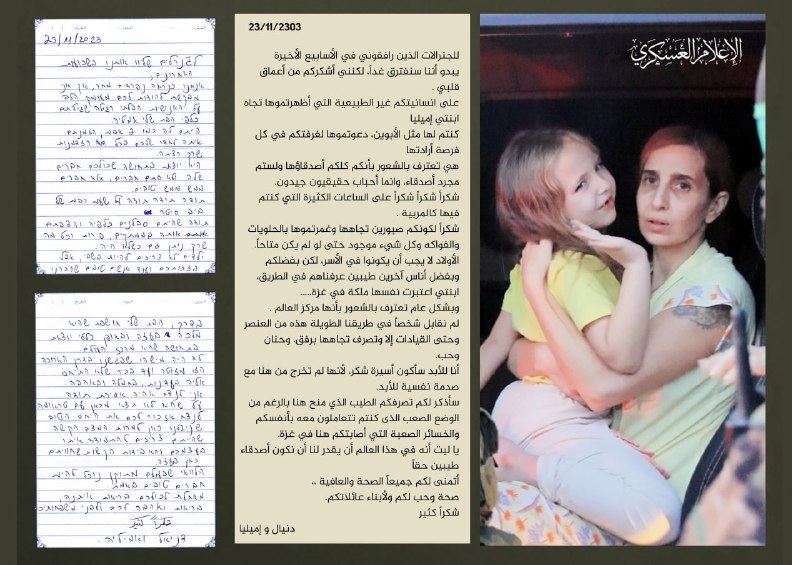
GAZA – Israeli ex-detainee Daniel Aloni has thanked the resistance fighters from al-Qassam Brigades of Hamas for treating her and her 6-year-old daughter Emilia kindly and humanely during their presence in captivity.
This came in a letter she wrote in Hebrew while she was in detention, in which she expressed her gratitude for al-Qassam fighters who were escorting and guarding her and her daughter during the days they had spent in Gaza.
Daniel and her daughter were among the first group of captives who were released on Friday by al-Qassam Brigades.
Below is the full text of the letter as translated from Hebrew and provided by the Brigades’ military media.
“To the commanders who have accompanied me in recent weeks, it seems that we will part ways tomorrow, but I want to thank you from the bottom of my heart for your extraordinary humanity that you have shown towards my daughter Emilia. You treated her like your own. You welcomed her in your room whenever she walked in. She says that you are all her friends, not just acquaintances. You are her true and good loved ones. Thank you, thank you, thank you for the countless hours you spent with her as caregivers. Thank you for being patient with her and showering her with sweets, fruits, and everything available, even if it wasn’t readily accessible. Children should not be in captivity, but thanks to you and other kind-hearted individuals and leaders we have met during our presence in her, my daughter considered herself a queen in Gaza and felt like she was the center of the world. We did not meet a single person, whether a member or leader, during our long stay [in Gaza], who did not treat her with kindness, tenderness, and love. I will forever be a captive of gratitude because she will not leave this place with a permanent psychological trauma. I will remember your kind manners, which you showed in here despite the difficult situation you were coping with yourselves, and the heavy losses that befell you here in Gaza. I wish in this world that we could be really good friends one day. I wish you all good health and well-being. Health and love to you and your families. Thank you very much. Daniel and Emilia.”
Israel’s ground war conundrum
By Hasan Illaik | The Cradle | November 27, 2023
Before dusk on 26 November, fighters from Hamas’ military wing, Al-Qassam Brigades, began the process of handing over to the International Red Cross a number of Israeli captives taken during the 7 October Al-Aqsa Flood operation. The transfer of these women and children took place in the Gaza Strip amid what appeared to be a security parade. Al-Qassam fighters arrived in four-wheel-drive vehicles and deployed themselves around the site, wearing full uniforms and bearing arms. Surrounded by civilians cheering on the resistance, the transfer of the Israeli captives was completed smoothly and quietly.
This event took place in Palestine Square in Gaza City on the third day of the truce that followed a 49-day war. Throughout the war, Gaza City has been subjected to a suffocating siege and an unprecedented Israeli air and artillery assault, not seen since at least 1982.
The handover process in Palestine Square also took place more than a month after the Israeli army began its ground operation, in which it aims to occupy Gaza City and all areas north of the Strip, destroy them, and displace their population permanently. But the visual of Al-Qassam fighters confidently standing guard in Palestine Square on 26 November, suggested to all present that they remained unharmed by Israel’s war.
The fighters transported the Israeli prisoners from their various hideouts and agreed-upon pickup sites to the square, while ensuring that these safe houses would not be discovered. Somebody issued the order, and others carried it out seamlessly, in a highly visible geographical area of less than 150 square kilometers. Keep in mind that Israel and the US have allocated enormous intelligence resources over the past six weeks to unearth the vast network of Hamas tunnels, and to discover the whereabouts of the prisoners.
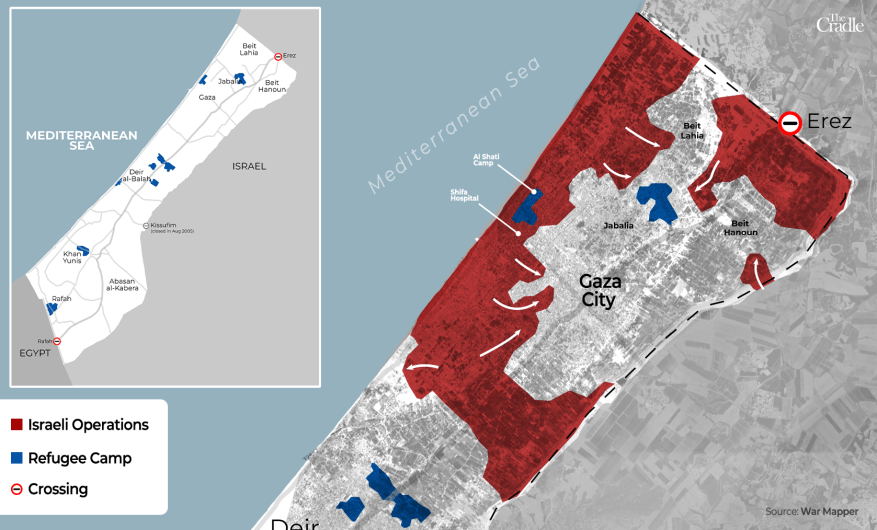
Map of Israeli operations in Gaza
This picture reveals, to a large extent, the results of Israel’s ground operation: civilian massacres and infrastructural destruction galore, but with little damage to the military structure of the Palestinian resistance. A number of its leaders have indeed been killed – most recently Al-Qassam’s northern commander and military council member Ahmed al-Ghandour – but its command and control system still ticks on effectively.
Israel’s ground limits
Further evidence of this lies in the inability of the occupation army to penetrate, unimpeded, all of northern Gaza. Israel precedes its ground movements with intense air strikes, then artillery shelling. After destroying everything in its path, its tanks begin advancing. It is almost impossible to confront tanks as they enter, because air fire clears spaces 500 meters ahead, while artillery shells pave the path 150 meters in front of the ground units.
However, whenever possible, the resistance fighters launch anti-armor missiles – Cornet, Conkurs, or similar types – with ranges exceeding one thousand metres. After the tanks reach their designated target, the resistance fighters emerge like ghosts from under the ground or rubble and fire anti-armor shells at them, usually Al-Yassin homemade shells, with a range of fewer than 150 meters. Or, alternatively, a fighter physically approaches the Israeli tanks and plants a sticky bomb that explodes in much the same way as a hand grenade.
The work of resistance does not end there. If the tanks do not retreat, and the occupation soldiers settle in, they will be attacked with machine gun fire or explosive devices. The Palestinian fighters film many of these operations, and the footage is delivered to the operations room, which decides what to publish.
It is clear that the resistance’s command and control system is still operating effectively.
Bigger than the 1973 war?
The Israeli ground operation in the northern Gaza Strip began after three weeks of preliminary air attacks and preparation by the invasion forces.
More than 100,000 soldiers were mobilized around the Gaza Strip, which has a total area of about 360 square kilometers.
Most of these troops belong to the regular forces, and Israel called up a further 300,000 reserve soldiers and officers – more than the number of reservists called up by Russia to fight on a 1,500 km front. In northern Gaza, Israel has thus far deployed its regular (non-reserve) combat brigades and battalions: Golani Brigade, Nahal Brigade, Givati Brigade, Paratroopers, Special Operations Force “Shayetet 13,” Special Staff Operations Unit (Sayeret Matkal), and so forth. All the regular forces that the occupation army could muster have been fully deployed in the Gaza Strip since the start of the fourth week of the war.
In addition, Israel has mobilized half of its artillery stock, half of its air force, and one thousand armored vehicles, including tanks and troop carriers.
Estimates of the Palestinian resistance suggest that the total number of regular and reserve forces deployed on the borders of the Gaza Strip, and inside it, exceeds the number of Israeli troops that participated in the 1973 war counterattacks on the Syrian and Egyptian fronts.
In this war, the Israelis have not attempted to penetrate Gaza from the “traditional axes,” that is, from the east toward the Shuja’iya neighborhood in Gaza City. Their incursion, instead, commenced in the center of the Strip, in the area called “Wadi Gaza” with low population and urban density, which means that the resistance’s ability to confront it is also low.
The occupation army was able to enter this area, from east to west, effectively severing the north of the Strip from its south. However, until the truce took effect, resistance fighters were still carrying out operations against Israeli troops, particularly in the Juhr al-Dik area.
The other axis of the incursion was in the Beit Lahia and Beit Hanoun areas of northern Gaza. As of 24 November, when a temporary truce was announced, the occupation army had been unable to control the region and continued to face deadly operations carried out by various resistance troops.
The third and main axis of advance is in western Gaza, along the shoreline of the northern Strip. Israeli tanks advanced from the north and from the centre, along the Mediterranean coast, to penetrate all the way to Al-Shifa Hospital and other government centers, such as the Legislative Council building.
Gaza Beach… the resistance’s weak point
Along the coastline, there are no defensive resistance tunnels, due to the nature of the land, the lack of population and infrastructure, and the possibility of seawater leaking into the tunnels. The most that the resistance could have achieved, defensively, in this axis, was to repel naval landings – not to stop the advance of tanks or the devastating airstrikes that precede them.
The main node in this axis is the Beach camp, which the occupation army has been unable to enter because of the ferocity of the resistance there.
So far, Tel Aviv has acknowledged the death of over 70 soldiers and officers, with hundreds of others wounded. Palestinian resistance sources confirm that the actual confrontation with Israeli troops only began after they entered the Shifa Medical Complex.
The frequency and intensity of Israel’s aerial and artillery bombardments do not allow resistance fighters to repel the occupation’s advancement, as the overwhelming firepower detonates most of the IEDs intended for tanks or infantry and blocks or destroys entrances to tunnels.
For this reason, the resistance waits for a lull in the bombing, the entry of tanks, and the reopening of the tunnels to begin its operations. At this stage, the fighters wait for Israeli infantry to emerge from their armored vehicles in order to target them. This has already occurred in a number of operations in the northern and western axes of occupation troops movements.
So far, the resistance confirms that it has damaged and destroyed more than 300 Israeli armored vehicles. Some of them were removed from service, while others are maintained in the field for reuse. The sources further confirm to The Cradle that the number of Israeli troop casualties, both dead and wounded, is many times greater than what Tel Aviv has announced.
Now, where to?
Before the 24 November truce, the occupation army had exhausted its ability to maneuver on the ground, having already deployed the majority of its regular combat forces in the northern and western axes.
It will need to search for innovative solutions if it seeks to advance toward densely populated areas in northern Gaza, such as Jabalia refugee camp, the Al-Zaytoun and Al-Shuja’iya neighborhoods, Al-Shati beach camp, and other vital places the Israelis have failed to penetrate. These areas are the ground zero of the Palestinian resistance, in which these forces have prepared themselves – and their tunnel infrastructure – for fierce and protracted confrontations.
The main reason the occupation government agreed to a short truce is that its ground incursion had hit this wall – in addition to other factors such as US pressure to release American captives. Simply put, the Israeli army needs to re-examine its plans and develop new strategies to advance in the field.
It is important to note that norms applicable in regular armed conflicts, as in Ukraine, Syria, Iraq, or Sudan, do not necessarily apply to the Gaza Strip. When a control map shows the Ukrainian army controlling a region, the Russian army has withdrawn from it, and vice versa.
In Gaza, a map showing the Israeli army in an area does not necessarily mean a withdrawal of Palestinian resistance forces, as the latter do not have armored vehicles or traditional formations to remove from enemy-invaded areas. Its fighters simply disappear underground to await the emergence of occupation soldiers from their tanks and such.
The bottom line is that maps currently circulated by governments, media, and think tanks that display Israel’s field advancement in Gaza – accurate or not – are not illustrating Israel’s ground control, but rather the depth of its incursions.
At the truce’s end, even if extended further, Tel Aviv will relaunch its ground operation. It will first prep the field with even more ferocious air bombardment than before, intended to displace more than 700,000 civilians remaining in the northern Gaza Strip and to impact the morale of resistance fighters.
It is also expected that the latter has studied the ground reality well, modified its defensive plans, carefully determined its goals, and reorganized its defense lines to fight the enemy with greater efficacy and inflict the greatest possible losses upon it.
Israel’s goal is to crush the resistance in northern Gaza in preparation for its next-phase war on the south – which may be fought differently, both strategically and tactically. What the resistance wants is to force the enemy to stop the war.
From the outset, Tel Aviv set two goals for its war in general, and for its ground operation in particular: destroy the resistance and liberate the prisoners. The 26 November scene in Palestine Square, in the heart of Gaza City, showed us a resistance still intact and able to exact a price from Israel.
Days later, the occupation government is still seething that Israeli captives were released according to terms dictated mainly by the resistance: military operations had to be frozen (and heavily monitored), Palestinian prisoners were liberated from Israeli detention, and aid began flowing back into the besieged Gaza Strip.
Fifty days into Israel’s staggeringly disproportionate war on Gaza, the Palestinian resistance is still able to impose its will – despite the occupation military’s unprecedented massacre of more than 20,000 civilians, the displacement of hundreds of thousands more, and the wholesale destruction of residential homes, hospitals, and schools.
When the conflict resumes in the days ahead, and the war between troops begins in earnest, the resistance may exact an even higher price from Israel, one that the Israelis can not tolerate.
Israel’s Greatest Failure: Hamas Stays and More Popular than Ever
By Robert Inlakesh | Covert Geopolitics | November 28, 2023
After repeatedly rejecting a truce with Hamas and labeling the idea “ridiculous”, Israel agreed to a four-day cessation of hostilities in Gaza and a prisoner exchange.
Six weeks of death and destruction, which Israeli and Western leaders declared should have led to the destruction of Hamas, have now bolstered the Palestinian movement’s image throughout the Arab world and beyond.
The four-day truce that was implemented this Friday provided a sigh of relief for those most affected by the war in the Gaza Strip, but has in many ways spelled disaster for the Israeli government. As women and children, held captive by both Hamas and Israel, are being reunited with their families, the threat of further warfare looms.
Although the loved ones of those released are now celebrating, the next steps will be crucial in determining the final outcomes of the 46-day battle that has now been placed on pause. At this time, it appears that the idea that “Hamas must go” is no more than a pipe dream.
On October 27, the United Nations General Assembly passed a resolution to the sound of overwhelming applause, calling for a truce to stop the fighting in the Gaza Strip. Although the non-binding resolution passed with a majority of 120 votes in favour, Israel and the United States outright rejected it.
Tabled by Arab nations, the call for a truce was labeled as a “defense of Nazi terrorists” by Gilad Erdan, Israel’s ambassador to the UN. This came after Hamas released four Israeli civilian hostages without conditions, for what the group said were humanitarian reasons.
Israeli Prime Minister Benjamin Netanyahu and others in his emergency war government, have repeatedly stated their goal of crushing Hamas and allied Palestinian armed groups in Gaza, refusing to negotiate with them.
The six-week-long aerial bombardment of densely populated civilian areas in the besieged Palestinian enclave, which also morphed into a ground war, has claimed over 20,000 lives according to some estimates, but failed to eliminate Hamas.
In fact, Israeli forces have not been able to show a single significant military achievement against the Palestinian armed groups. While Hamas claim to have struck 355 Israeli military vehicles during the past two weeks of fighting, publishing video evidence of dozens of attacks, Israeli forces have failed to assassinate senior leaders of Hamas, to free hostages by force, uncover major tunnel networks, or even publish proof that they have killed a significant number of Hamas fighters on the battlefield.
According to the Calcalist financial newspaper, the Gaza war was estimated early on to cost around $50 billion, roughly 10% of Israel’s GDP. In addition to this, the Israeli military has reportedly suffered losses in intelligence and monitoring equipment along their northern border, due to attacks carried out by the Lebanese group Hezbollah.
Yemen’s Ansarallah also seized a ship in the Red Sea, owned by an Israeli businessman, which has severely impacted trade through the southern port city of Eilat. This is not factoring in the inevitable long-term effects on things like Israel’s tourism sector or investment in its high-tech industry.
On top of this, we have seen immense pressure being placed upon US forces throughout Syria and Iraq, with daily attacks occurring against their military facilities, for the sole purpose of pressuring Washington to force an end to Israel’s attacks on Gaza.
Across the Arab World, the general public is also boycotting Western products on an unprecedented scale, in particular companies like McDonalds that have shown support for the Israeli army.
The blatant double standards of the collective West’s political and economic elites, as well as the establishment media, are also being severely criticized, as the likes of the BBC are feeling the heat for biased reporting on the issue of Palestine-Israel.
Instead of facing the wrath of the whole world and getting crushed, Hamas has not only survived, but is becoming more popular. While US President Joe Biden’s administration provided excuses for Israel’s invasions and bombings of hospitals in the Gaza Strip, claiming that Hamas has maintained a significant presence in places like the recently-raided al-Shifa Hospital, the world has risen in outrage against the atrocities Israel has committed in the Palestinian territory.
UN relief chief, Martin Griffiths, has called the humanitarian catastrophe in Gaza “the worst ever,” and it’s seen as a direct result of the US having drawn “no red lines” for Israel’s behavior in Gaza.
Meanwhile, Hamas scores victory after victory, from a guerilla warfare and political perspective, while its military capabilities appear to have been undiminished so far.
The Qassam Brigades, the armed wing of Hamas, that launched their attack on Israel on October 7, have managed to shift the world’s attention back onto the issue of Palestine, have freed political prisoners held in Israeli detention, while inflicting blow after blow against one of the most powerful military forces in the world.
Since the Kerry Peace Plan, which was a failed initiative set forward under the administration of Barack Obama, the US government has not made any real effort towards creating a viable Palestinian state.
In fact, until October 7, nobody was talking about a Palestinian state, the focus was instead on the issue of Saudi-Israeli normalization. It was clearly the shared belief of the Israeli and US governments that Hamas could be contained with the periodic issuance of Qatari aid grants, while the Palestinian Authority was to be strengthened only to deal with a number of militias that have formed in the West Bank over the past two years.
Today, the whole world is talking about the formation of a Palestinian state. There is also the notion of bringing the Palestinian Authority into power in the Gaza Strip, which would essentially mean the lifting of the 17-year economic blockade that the West has imposed on it. The issue of protecting the status-quo at Al-Aqsa Mosque in Jerusalem is also on the regional agenda in a serious way, while the government of Benjamin Netanyahu veers towards collapse.
If Israel and its Western backers choose to escalate the conflict further instead of finding a peaceful settlement, the war threatens to extend into a broader regional conflict; a threat to the stability of all nations involved. The pursuit of a ceasefire agreement can usher in a new era in the conflict, one in which Hamas will remain.
Peace is in the interests of the entire region, we have seen what the Israeli army has to offer and it has not resulted in the defeat of Palestinian armed groups, it has only scored a blow against civilians in Gaza.
This will be a hard pill for the Western governments to swallow, but the only solution to safeguarding civilian life and securing the release of all prisoners, will be through a peaceful resolution, not through more violence.
Israel has been unable to achieve any meaningful victories against the Palestinian militants.
Robert Inlakesh is a political analyst, journalist and documentary filmmaker currently based in London, UK. He has reported from and lived in the Palestinian territories and currently works with Quds News. Director of ‘Steal of the Century: Trump’s Palestine-Israel Catastrophe’. Follow him on Twitter @falasteen47
Featured Video

Trita Parsi: Israel Set a Trap for Total War in the Region
or go to
Aletho News Archives – Video-Images
From the Archive
Zionism’s Violent Legacy
By Donald Neff | Washington Report On Middle East Affairs | January 1996
On January 4, 1948, Jewish terrorists drove a truck loaded with explosives into the center of the all Arab city of Jaffa and detonated it, killing 26 and wounding around 100 Palestinian men, women and children.[1] The attack was the work of the Irgun Zvai Leumi – the “National Military Organization,” also known by the Hebrew letters Etzel – the largest Jewish terrorist group in Palestine. The Irgun was headed by Revisionist Zionist Menachem Begin and had been killing and maiming Arabs, Britons and even Jews for the previous ten years in its efforts to establish a Jewish state.
This terror campaign meant that at the core of Revisionist Zionism there existed a philosophical embrace of violence. … continue
Blog Roll
 Aletho News
- Trita Parsi: Israel Set a Trap for Total War in the Region
- Trump’s Iran war is on an Israeli leash
- Saudi oil boss issues global supply warning
- Riyadh Says Its Oil System Is Intact. The Numbers Say Otherwise.
- Trump and Netanyahu Want to “Finish the Job” on Iran
- US ‘one-sided dictation’ not Iran’s beliefs makes rational talks impossible: Baghaei
- Iran’s Next Strike May Not Explode. It Could Shut You Down /Col Doug Macgregor
- Iran: US political targets legitimate if assassinations return
- Iraq shuts key border crossing with Iran under US pressure: Report
- Undersea Internet cables could be targeted in retaliation for attacks on Iran: IRGC deputy chief
- If Americans Knew
- The Israel Lobby’s Changing Fortunes
- AIPAC has become such a political liability that it’s shifting to a more “nimble” approach to buying politicians
- At least 160 Israeli settler attacks in 2 weeks
- Will Gaza’s Ancient Christian Community Disappear Forever?
- Israel’s vision of regional security rests on keeping Arab states weak
- Heidi Levine recounts how Palestinian youths helped save her in settler attack
- DAILY UPDATE: Latest essential news on Palestine, Israel, & region
- Trump’s Intensifying Sabotage of the ICC, for Israel’s Sake
- Israeli military detain US and UK volunteers in West Bank including Democratic NY politician Brad Lander
- Americans at National Conservatism Conference held in Israel this year criticize Israel
- No Tricks Zone
- E-Cars Reduce CO2 Emissions By Only 41% Compared To Internal Combustion Engine Vehicles
- Predictions Made By Renowned Climate Professor Over Past Decades Have Been Proven To Be Poor
- New Study Suggests Large Regions Of The Pacific Ocean Have Been Cooling For The Last 80 Years
- Germany’s Green Energy Debacle: High Energy Costs Force Kahla Porzellan to Close After 182 Years!
- New Study: 50 Years Of The Most Aggressive ‘Net Zero’ Policies Can Only Affect The Global Climate By 0.03°C
- US September “Heat” Was No Record…Many Records Set Decades Ago
- Latest European Green Energy Debacle; Portugal’s Largest Flagship Solar Park Insolvent!
- Green Energy Debacle: German Expert Professor Fritz Vahrenholt Warns Of Severe Economic And Social Consequences
- Two More Paleo Reconstructions Affirm Meters-Higher Sea Levels Across Ireland, Brazil 7000-6000 Years Ago
- New Study: Earth And Venus Surface Warmth Largely Explained By Convection And Lapse Rate, Not CO2 Or Radiation

