Hamas condemns recent Israeli aggression on Syria
Palestine Information Center – December 1, 2018
GAZA – Islamic Resistance Movement, Hamas, on Saturday condemned the latest Israeli aggression on Syria.
Member of the Hamas Political Bureau Khalil al-Hayya said in statements to the PIC that the world should realize that Israel is the real threat to the region and international peace.
Al-Hayya called on the world countries to put an end to Israel’s aggression before it destroys the whole region.
“We condemn in principle any Israeli aggression on an Arab or Muslim land, because it comes from an occupying state that sees itself above the law,” he added.
Israeli warplanes on Thursday launched several airstrikes on different targets in Damascus countryside and southern Syria.
Hamas calls on UN to support Palestinians’ right to bear arms against Israel
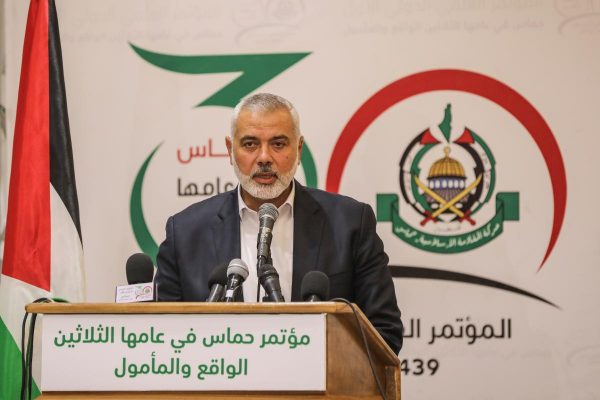
Head of the Political Bureau of Hamas Ismail Haniyeh makes a speech during a conference on 18 September, 2018 in Gaza City, Gaza [Ali Jadallah/Anadolu Agency]
MEMO | November 29, 2018
Hamas chief Ismail Haniyeh has called on the United Nations to recognise and support the Palestinian people’s right to bear arms against Israel in self-defence.
Haniyeh wrote to UN General Assembly (UNGA) President Maria Fernada Spinosa in advance of the organisation’s debate regarding Hamas rocket fire into Israel.
“We reiterate the right of our people to defend themselves and to resist the occupation, by all available means,” wrote Haniyeh, “including armed resistance, guaranteed by the international law.” He based the demand on international law drawn up and implemented by the UN, which gives states and peoples the right to defend themselves with arms if necessary, in the case of an external attack. “The General Assembly of the United Nations adopted dozens of resolutions that affirm the right of peoples to independence, self-determination and struggle by all available means, peaceful and non-peaceful, for that right. The UN singled out the Palestinian people for dozens of relevant resolutions, including 2621, 2649, 2787 and 3236,” he said.
After condemning the US for adopting Israel’s narrative of the conflict and justifying Israel’s aggression towards the Palestinians, Haniyeh insisted that “the last of these efforts is the attempt by the United States Ambassador to the United Nations… to submit a draft resolution condemning the Palestinian resistance and the right of our people to defend themselves against this racist and continuous occupation for more than seven decades.”
Israel’s Ambassador to the UN, Danny Danon, commented on Haniyeh’s letter, saying that Hamas “going to the UN for assistance is like a serial killer asking the police for assistance. Israel and the United States will continue to mobilize the countries of the world into a united front against the terrorism that Hamas engages in.”
The debate held in the UN today coincides with the International Day of Solidarity with the Palestinian People, which is held every year on 29 November. It comes two weeks after the latest Israeli assault on Gaza, which broke out after an undercover Israeli special forces operation in the strip was botched and compromised by Hamas. Days later, a ceasefire was declared, which was again broken by Israel the following morning when Israeli soldiers killed a Palestinian fisherman off the coast of Gaza.
READ: US lobbies for vote against Hamas at UN General Assembly
Israel army arrests Palestinian MP from West Bank home
MEMO | November 21, 2018
The Israeli army this morning arrested a member of the Palestinian Legislative Council from the occupied West Bank city of Al-Bireh, according to local witnesses.
Witnesses told the Anadolu Agency that an Israeli military force raided and searched the home of Palestinian MP Ahmad Attoun before arresting him.
The army, they added, also confiscated computers and mobile phones from Attoun’s residence.
The last time Palestinian legislative elections were held in 2006, Attoun – who represents Hamas – was elected for the city of Jerusalem.
Five years later in 2011, Israeli authorities deported him to the occupied West Bank city of Ramallah.
Israeli forces detained nine Palestinians in overnight raids carried out across the West Bank, according to an Israeli army statement.
The individuals were arrested for “suspected involvement in popular terrorist activities”, the statement reads, without elaborating on the nature of said “activities”.
According to Palestinian figures, some 6,500 Palestinians are currently languishing in Israeli detention facilities, including scores of women and hundreds of minors.
Israeli NGO Threatens to Sue Facebook for Hamas TV Station Account
Sputnik – 16.11.2018
Shurat Hadin, an Israeli nongovernmental organization (NGO) modeled off the US Southern Poverty Law Center, has threatened Facebook with a lawsuit if the social media giant continues to permit Hamas to run the Al-Aqsa TV page.
The group sent a letter to Facebook CEO Mark Zuckerberg and the head of its Israeli branch, Adi Soffer-Teeri, in which it claimed that, because Al-Aqsa TV in Gaza is run by Hamas, the governing party of the territory, and the US government considers Hamas to be a terrorist organization, the social media site is violating US law by continuing to allow the station’s Facebook account to function, the Jerusalem Post reported Thursday.
Like many news pages on social media, Al-Aqsa TV’s Facebook page carries video clips previously broadcast and links to news articles.
“This conduct is particularly egregious in light of the barrages of deadly missile and mortar attacks the Hamas has launched against Israeli civilians and residential centres in the last 24 hours,” writes Shurat Hadin President Nitsana Darshan-Leitner.
“Please be advised that, in the event Facebook continues to provide accounts or services to Al-Aqsa TV, we intend to notify the appropriate governmental authorities of Facebook’s willful violation of US and Israeli law,” Darshan-Leitner wrote. “In addition, we reserve the right to pursue all legal avenues, including civil litigation, against Facebook on behalf of the victims of Hamas’ terrorist attacks.”
The NGO claims that by allowing the account to operate, Facebook is violating the Anti-Terrorism Act of 1992, which prohibits American businesses from providing any material support, including services, to designated terrorist groups and their leaders.
Hamas started the TV station, which is named after the Al-Aqsa mosque in Jerusalem, in 2006 after it won elections in the territory of Gaza, which it has governed ever since.
Shurat Hadin was founded in 2003 and modeled after the Southern Poverty Law Center, a US NGO that brings financially crippling litigation against ‘racist’ groups, politicians and public figures. Israeli Prime Minister Benjamin Netanyahu’s son Yair took over as social media coordinator for the NGO earlier this year, the Jerusalem Post noted.
The group has gone after Facebook before for allowing Hamas to post on its social media site. In July 2016, Shurat Hadin sued Facebook for $1 billion on behalf of several families of victims of Hamas attacks. All the victims were either US nationals or US-Israelis with dual citizenship who died in Israel between 2014 and 2016. The suit alleged that Palestinian social media posts had fanned the flames of an explosion of violence since October 2015.
Filed in the US District Court for the Southern District of New York, a judge threw out the case in 2017, but not before Shurat Hadin tried to raise $30,000 to place billboards near Zuckerberg’s house in support of the suit.
Hamas condemn Israel destruction of Al Aqsa TV station

The Islamic Resistance Movement – Hamas – has condemned Israel’s destruction of Al Aqsa TV station in the Gaza Strip. A spokesman for the movement, Fawzi Barhoum, described the targeting of the TV Channel and demolishing of its headquarters as a blatant act of aggression against journalism and all free voices dedicated to communicating the truth.
Barhoum called on international, legal and media organisations to denounce this latest act of Israeli aggression against journalism and freedom of expression.
Hamas said that Israel’s crimes would never stop Palestinian journalists from continuing their humanitarian and professional mission to expose the occupation’s crimes against the Palestinian people.
In airstrikes late Monday, Israeli fighter jets tried to wipe the Hamas-run TV station in Gaza off the map.
Firing 10 missiles at the Al-Aqsa TV station, Israeli jets destroyed its headquarters, witnesses said.
Amid the airstrikes, the station went off the air briefly before resuming operations. Many buildings around the station were also damaged.
Oman rejects mediating between Israelis, Palestinians
Press TV – October 27, 2018
Oman says it will not act as a “mediator” between Israelis and Palestinians, playing down an earlier visit by Israeli Prime Minister Benjamin Netanyahu.
The sultanate was only offering ideas to help Israel and Palestinians to come together, Omani Foreign Minister Yousuf bin Alawi bin Abdullah told a security summit in Bahrain’s capital Manama on Saturday.
The remarks came a day after Netanyahu visited Oman in a rare visit, while accompanied by other senior Israeli officials, including the head of the Israeli spy agency Mossad.
“We are not saying road is now easy and paved with flowers, but our priority is to put an end to the conflict and move to a new world,” Reuters cited Abdullah as saying.
Despite apparently trying to sound impartial, Abdullah said Oman relied on the United States and efforts by US President Donald Trump in working towards the “deal of the century.”
The Trump administration has targeted the plan at the situation in the Palestinian territories.
Details are yet to emerge, but reports say it envisages a Palestinian state with limited sovereignty across about half of Israel-occupied West Bank and all the Gaza Strip. The deal also reportedly foresees potential disarming of the Palestinian resistance movement Hamas, and does not find Palestinians entitled to the eastern part of Jerusalem al-Quds as their capital.
This is while Abbas, who visited Oman before Netanyahu for three days, has renounced the plan, saying it has been devised without consulting the Palestinians. He also spurned any intermediary role by the US late last year after Washington recognized Jerusalem al-Quds as Israel’s “capital.”
In June, however, Saudi Arabia, the United Arab Emirates, Egypt, and Jordan assured the US of their support for the plan during visits to those countries by Trump’s senior adviser and son-in-law Jared Kushner, and Jason Greenblatt, the US envoy to the region.
Saudi Arabia’s Foreign Minister Adel al-Jubeir told the Manama gathering on Saturday that the kingdom believed the key to “normalizing” relations with Israel was the “peace process.”
The Omani minister also claimed Israel was “present in the region, and we all understand this, the world is also aware of this fact and maybe it is time for Israel to be treated the same and also bear the same obligations.”
Observers say Muscat has come to accommodate the US plan under pressure from Washington and Riyadh, the strongest US ally in the Persian Gulf region, which has been inching towards Tel Aviv over the past years.
Palestinian groups, however, condemned the Israeli prime minister’s visit to Oman, urging Arab countries to support the oppressed people of Palestine, instead.
Hamas warned about the dangerous consequences of Netanyahu’s visit for the people of Palestine. The Islamic Jihad movement also censured the visit, saying Oman acquitted Netanyahu of the crimes committed against innocent Palestinians by welcoming him to the country.
Commenting on Netanyahu’s visit, Paul Larudee, with the Free Palestine Movement, told PressTV, “What in the world would Netanyahu know about peace and stability, when his objectives and objectives of Israel have always been war and instability?”
“The importance is what their objectives are not. They are not about Arab unity, not about solidarity with Arabs who are suffering namely the Palestinians,” he said.
“These other countries realize that sooner or later they are potential targets of Israel… that they can be in the same place that the Palestinians are now,” Larudee said.
Lieberman: ‘We exhausted all options with Hamas’
Palestine Information Center – October 22, 2018
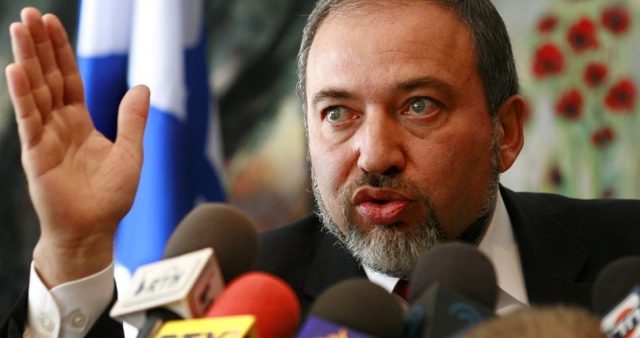
OCCUPIED JERUSALEM – Israel’s war Minister Avigdor Lieberman (Yisrael Beytenu) threatened to wage a bloody war against Gaza at the start of a meeting of the Knesset Foreign Affairs and Defense Committee.
“Wars are only conducted when there is no choice, and now there is no choice,” the minister claimed on Monday. “Anything less than the toughest response won’t help anymore. We have exhausted the other options.”
Lieberman alleged that Hamas was behind recent violence from the blockaded Gaza Strip and pays large sums to protesters.
“There is no popular uprising,” Lieberman said. “There is violence organized by Hamas. Fifteen thousand people don’t come by foot to the border at their own will. They come by bus and are paid.”
“I don’t believe in reaching an arrangement with Hamas,” he said. “It hasn’t worked, doesn’t work and won’t work in the future.”
Knesset Foreign Affairs and Defense Committee chairman Avi Dichter (Likud) also accused Palestinian Authority chairman Mahmoud Abbas of inflaming tensions in the Gaza Strip by preventing supplies and funding from reaching the people there.
“It is intolerable, unacceptable and unreasonable that Abbas closes the faucet for Gaza and Israel has to pay the price,” Dichter said.
Hamas: We will remain adherent to option of resistance
Palestine Information Center – September 28, 2018
GAZA – On the 18th anniversary of the Aqsa Intifada (uprising), the Hamas Movement has reiterated its adherence to the option of resistance against the occupation and its support for the March of Return until its intended goals are achieved.
“The reasons for the outbreak of the Aqsa Intifada still exist and escalate as the enemy persists in its crimes under the protection of imperialist powers,” Hamas stated on Friday.
Hamas also expressed its confidence that the Palestinian people would continue defending the Aqsa Mosque and remain vigilant about the dangers threatening it.
The Movement underlined that resisting the occupation is a legitimate right guaranteed by all divine laws and international conventions as a mean to restore the usurped national rights.
It pointed out that “the Aqsa Intifada proved the failure of the settlement process and that the Israeli occupation state only understands the language of force.”
Hamas also highlighted in its statement the issue of the stalled inter-Palestinian reconciliation, calling on the Palestinian Authority leadership to end its sanctions on Gaza and honor the 2011 Cairo agreement and the 2017 Beirut agreement in order to heal the rift in the Palestinian arena.
It’s clear the US and Israel favoured Abbas. It’s also clear he failed.
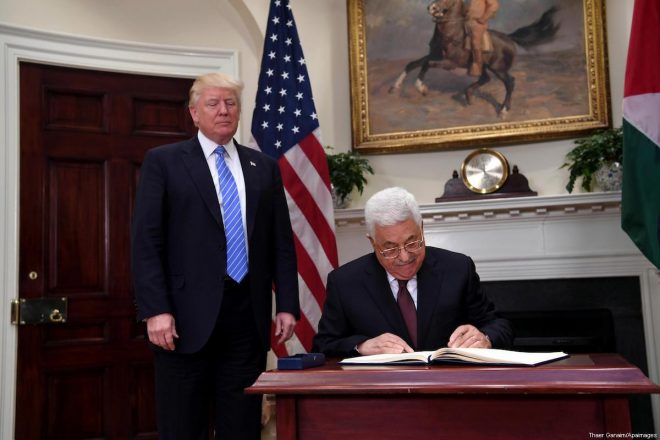
US President Donald Trump with Palestinian President Mahmoud Abbas in the Oval Office of the White House on May 3, 2017 in Washington, DC. [Thaer Ganaim/Apaimages]
By Dr Mohammad Makram Balawi | MEMO | September 18, 2018
A few years after Arafat assumed the leadership of the Palestinian national movement he tried to tempt the West to offer him something in return for what he called peace. Many people still remember him with his white sweater, in the United Nations General Assembly in 1974, saying: “I come bearing an olive branch in one hand, and the freedom fighter’s gun in the other. Do not let the olive branch fall from my hand.”
As one Fatah former leader and Arafat companion once told me, Arafat and his group always thought that liberation should happen within their lifetime and that they should enjoy its fruits. They were convinced from the early stages that they cannot beat the Zionists with all the American and Western support behind them. They were ready from the beginning for something other than complete liberation, unlike most Palestinians. It was not a surprise to my friend that Arafat ended up trapped with a lousy agreement, the Oslo Accords, engineered secretively by Mahmoud Abbas, his successor.
Almost all Palestinian factions, including those who are members of the Palestine Liberation Organisation (PLO), rejected it and many Fatah and Palestinian National Council (PNC) members resigned in protest against the agreement, including Mahmoud Darwish, Ibrahim Abu Lughod and Edward Said, who accused Arafat of treason.
The attempts of Fatah to lead the Palestinian national movement led eventually to the complete monopoly of the Palestinian national decision. All other factions who used to get their financial support and annual budget from the PLO had to concede to Arafat’s decisions even if they opposed them, and for those who refused to do so Arafat used to smear, intimidate and in many cases use brutal force against them, including assassination if necessary.
Although the PLO’s institutions and other Palestinian bodies had elections, most of the time they were decorative. Most of the Palestinian leadership, including Arafat, did not believe in leadership succession and democratic transition. Opposition was never allowed unless it was superficial and could beautify the face of the PLO and give legitimacy to the “historical leadership”, as Arafat and his group used to be called by their supporters.
In the eighties, after Hamas and Islamic Jihad (IJ) became serious contenders, Fatah tried to combat them. In the beginning Arafat refused to recognise that these movements ever existed. Then he spread a rumour, which many still believe in, that these movements were the creation of Israel to divide the national Palestinian decision. Fatah and its members used to assault members of Hamas and IJ, in universities, Israeli detention camps, mosques and wherever they could.
In 1993 the Oslo Accords were signed and from that moment on a deep rift was created between the Palestinian people, who were once always united behind resistance. Arafat believed, and made many Palestinians believe, that through diplomacy Palestinians could have their independent state. This sweet dream was a mere illusion, which Arafat eventually realised before his mysterious death.
The “peace process” – which was supposed to yield according to Oslo a Palestinian state within six years – continued for about two decades and managed only to consolidate Israeli control of the West Bank and the Gaza Strip. Arafat eventually realised that the United States and Israel had turned him into a policeman whose duty it is to keep his own people calm and accept the gradual annexation of land and the looting of resources.
By the beginning of the second intifada, which was triggered by Ariel Sharon’s intrusion into Al-Aqsa Mosque, Arafat started local resistance groups in secret and released many Hamas leaders and members from his prisons. Sharon and George W. Bush decided that it was time to get rid of him and the Israeli Army destroyed almost all the infrastructure Arafat managed to build with European aid in the West Bank, surrounded his headquarters in Ramallah, and imposed Mahmoud Abbas on him as a prime minister.
It was by then very clear that the Americans and the Israelis despised Arafat and favoured Abbas. Arafat’s health gradually and mysteriously deteriorated, he finally died and Abbas took over. Abbas did not believe in pressurising Israel using armed resistance, nor with peaceful resistance, as is evident in the way he runs the areas under his jurisdiction. He seems to believe that the only way to implement his plans of having a state is to convince the Americans and reassure the Israelis, which seems a very naïve approach.
Yet there were some serious obstacles to overcome. First was the armed Fatah groups Arafat founded and financed, which Abbas could liquidate quickly. The second is groups like Hamas, which Arafat, with all his might, could not contain. Abbas chose a new tactic; elections. Abbas managed to convince Hamas’ leadership to take part in the general elections in the West Bank and the Gaza Strip, inaccurately estimating that it would not get more than 30 per cent of the seats of the Legislative Council, and he would emerge victorious and impose his views on Hamas through democracy.
Abbas found no other way except to recognise the results of the elections but worked to undermine the work of the government which was formed by Hamas, and boycotted by most of the other Palestinian factions due to Abbas’ pressure. Through Fatah armed groups and PA security agencies, Abbas started with the help of people like Mohmmed Dahlan – who was then the head of the Preventive Security Force in Gaza – an armed revolt. Abbas made the work of the government almost impossible.
Local Hamas leaders got fed up of the situation and with their smaller and less equipped forces, kicked Dahlan and the armed leaders of Fatah out of the Gaza Strip, and Abbas in return cracked down on Hamas in the West Bank. From that time on Abbas and his group monopolised Palestinian representation under the pretext that Hamas carried out a coup in Gaza and unless it surrenders and hands over everything to Abbas there will be no reconciliation, which gave Abbas all the liberty he wanted to go on his way undisputed.
Yes, Abbas ruled undisputed, but it is very clear that he failed. Abbas worked for three decades to make the Oslo Accords a reality but ended up cursing his partners, the Americans and the Israelis, in a vulgar way, for he has nothing else he could do. Abbas lacks the courage to declare that he led the Palestinian people into a disaster, apologise and give way to a new leadership. One day, most probably soon, Abbas like Arafat will pass away, and leave his people face to face with his disastrous heritage.
Israeli minister urges assassination of Palestinian leaders
Palestine Information Center – September 16, 2018
Israel’s Internal Security Minister Gilad Erdan called for assassinating Hamas leaders in the besieged Gaza Strip to quell anti-occupation protests at the eastern borders.
Israel’s Channel 7 quoted Erdan as stating that Israel might increase secret assassinations in case Hamas continues to fuel anti-occupation protests on borderlands with Gaza.
Erdan vowed that the Israeli army will step up aggressions against Hamas no matter the cost.
Sometime earlier, Israeli lawmaker Haim Jelin called for launching attacks against Hamas resistance fighters so as to force the group to yield into a long-term ceasefire in response to an alleged incendiary balloon dropped at his home in Kibbutz settler community, near Gaza’s border area.
Featured Video
Laith Marouf: Hezbollah’s position on US-Iran ceasefire
or go to
Aletho News Archives – Video-Images
From the Archives
The Dirty Little Secret behind the “Global Terrorism Index”
The Omission of Israeli Terrorism in the Occupied Palestinian Territories
By Karin Brothers | Global Research | December 6, 2014
… The Israeli settlements — all of which are illegal – have been identified as a major impediment to peace. The refusal of a major “global” terrorism report to name the Israeli settlers as one of the groups most responsible for terrorism not only misrepresents a major source of regional violence but exposes the Global Terrorism Index as a propaganda tool that supports a U.S. agenda.
In recent years, governments have been attempting to thwart terrorism by blocking supportive fund-raising. When it comes to Israeli settlements, however, the US and Canada actually encourage fund-raising by giving organizations (such as Christian Friends of Israeli Communities (CFOIC) and the Jewish National Fund) financial support in the form of donor tax-deductions.
Charities which provide funds for the Israeli settlements should be regarded as terror-financing organizations. They should not only lose their tax-deductible status, but they should be banned because they support the violation of international humanitarian law. The terror-financing laws that are being strictly enforced for Muslim charities should be applied to Christian and Jewish charities as well. … Read full article
Blog Roll
 Aletho News
- The Black Cube Files: How Former Mossad Operatives Flipped a Nation
- Laith Marouf: Hezbollah’s position on US-Iran ceasefire: What you’re not being told
- Israel’s priority lies in destroying chances of peace between Iran, US: Ex-UN nuclear chief
- Ceasefire for all or for none: Iran shuts Hormuz over Lebanon attacks
- Strait of Hormuz is Iran’s ‘nuclear weapon’ that forced US retreat: Medvedev
- Energy crisis will last for months – Kremlin envoy
- Europe’s quiet role in the war on Iran
- Forty days that shook the Empire: How Iran turned the tables on US and prevailed
- Netanyahu unilaterally declares Lebanon outside of ceasefire deal
- Israeli leaders: ‘Not a single goal’ achieved in war with Iran
- If Americans Knew
- Gazans face a triple crisis: severe shortages of water and bread, healthcare in tatters
- NY Times reports how Netanyahu took the US into Iran War
- A sigh of relief over Iran, but Gaza and Lebanon in dire straits – Daily Update
- Thousands dead and neighborhoods razed to the ground: Aid agencies fear southern Lebanon is becoming the new Gaza
- The war the US is fighting for Israel could cost trillions
- ‘Cigarette Burns, Nail Wounds’: Toddler Tortured in Gaza to Coerce Father
- Trump Says US Sent ‘a Lot of Guns’ to Protesters in Iran
- Israeli forces destroy 17 UN peacekeeper cameras in south Lebanon
- US-Israeli strikes ‘completely destroy’ synagogue in Tehran
- Archbishop for US Military Says Iran War Is Unjust Under Catholic Teaching
- No Tricks Zone
- An Inconvenient Tree: Uncovered In Alps… Europe Much Warmer Than Today 6000 Years Ago
- New Study Reports A 60% Slowdown In Greenland’s Ice Loss Rate In The Last Decade
- Low Intensity Tornado Wrecks Major Solar Farm, Creating A Potential Toxic Dump
- New Study Finds Warming Saves Lives…Cold Temperatures 12 Times More Deadly Than Excess Heat
- German Science Blog Accuses PIK Climate Institute Of Hallucinating Climate Tipping Points
- Devastating Assessment Of Comirnaty Vaccine By Former Senior Pfizer Europe Toxicologist
- New Study: CO2 Is ‘Effectively Negligible’ As An Explanatory Climate Change Factor Since 2000
- Former Pfizer Toxicologist Dr. Helmut Sterz Tells Bundestag Hearing Pfizer Vaccine Should Have Never Been Approved
- Energy Expert: Germany’s Nuclear Phaseout Was A “500 Billion Euro Mistake”
- New Research: South Australia’s Mid-Holocene Sea Surface Temperatures Were 4°C Warmer Than Today
 Aletho News