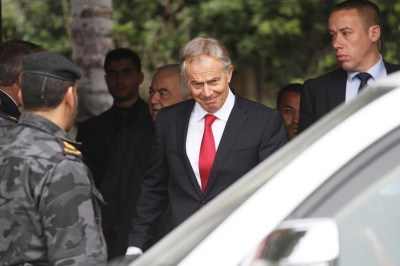
Senior member of Hamas’ political bureau Mousa Abu-Marzkouk yesterday revealed that Quartet peace envoy Tony Blair is trying to blackmail Hamas in return for reconstructing the Gaza Strip.
On his Facebook page, Abu-Marzouk revealed five conditions put by the Quartet that Hamas has to meet in order to make way for the reconstruction of what the Israeli occupation destroyed during last summer’s 51-day war in Gaza.
Abu-Marzouk said: “Once again, and in the name of the international community, Tony Blair is exploiting the tragedy made by the Israeli occupation that includes the destruction of homes and making people homeless.”
Expressing deep concern about the devastated people in Gaza, Abu-Marzouk said: “Destroyed homes of Palestinians in Gaza became shrines to Blair and his likes. Blair says that there is no reconstruction unless these five conditions are fulfilled, and Hamas has to agree to:
- Accept the Palestinian reconciliation.
- Accept the political programme based on a Palestinian state on 1967 borders.
- Reiterate that Hamas is a Palestinian faction with only Palestinian goals and it is not part of any Islamist movement with regional goals.
- Adopt the two-state solution as a final, not temporary, solution for the Palestinian-Israeli conflict.
- Send an assurance message to Egypt that Gaza is not a terror base for Sinai terrorists and hold talks with the Egyptian government to stop terrorism in Sinai.”
“These are the conditions for Hamas to be accepted by the international community as well as the Quartet’s conditions for rebuilding Gaza and improving living standards,” Abu-Marzouk said.
He added: “These conditions do not mean that Hamas will deal with the Zionist enemy; not even one condition was put on Israel.”
Abu-Marzouk refuted the conditions one by one. Regarding the reconciliation, he said: “It was achieved. I do not know what more is needed from Hamas, which conceded everything for a technocrat government.”
About the state on the 1967 borders, he said: “The problem is not with the Palestinian side, but with the other side. Blair should have spoken about it with Israel. He should have asked it whether it accepts a Palestinian state on the 1967 borders with Jerusalem as its capital and whether it accepts to dismantle settlements.”
Regarding Hamas’s goals, he stressed that Hamas is a Palestinian faction with Palestinian goals and it is not part of a regional Islamist movement. “We know that he means the Muslim Brotherhood,” he said.
“This is used by all as a pretext,” he stressed. “Hamas is a Palestinian movement and its history proves that as it has not carried out any of its operations outside the Palestinian lands. Even when its leaders were targeted outside Palestine, it did not respond in the same places.”
Meanwhile, he reiterated the importance of Hamas having links with any side offering help for it. “We have no interest to have hostility with any party wherever it is and whatever the ideological differences with it are,” he said.
About the two-state solution, Abu-Marzouk said: “Blair knows that any oppressive agreement cannot remain alive for too long. Any agreement imposed by the current powers cannot remain the same when these powers change.”
Regarding Egypt, he explained: “Egypt is not merely a neighbouring country; its stability and unity are in the Palestinian interest. We deal seriously and responsibly with anyone who harms Egypt. Gaza will absolutely not be a breeding ground for terrorism.”
Adding that Hamas’s relationship with Egypt is not of Blair’s concern.
February 18, 2015
Posted by aletho |
Deception, Ethnic Cleansing, Racism, Zionism | Gaza, Hamas, Israel, Palestine, Tony Blair, Zionism |
Leave a comment
“You want to forget Israel, do so. We cannot do it. You want to forget Palestinian People? Go ahead. We Won’t.” – Hezbollah Secretary General Sayyed Hassan Nasrallah
Predictably, Hamas is back: stronger than ever.
On Jan 14, 2015, Hamas suddenly convened a session of the Gaza parliament, suspended since a unity deal between Fatah and Hamas was agreed upon, this past April. There was no attendance by, or invitation to, Fatah. Thanks to illegitimate president Mahmoud Abbas’ leadership, Gazans were left to rot in the post-war depths of Israeli created misery compounded with a bitter winter living amongst Israeli produced rubble. Deliberate delays in reconstruction, materials and funding; the ongoing, unchanged and crippling Israeli siege; and the Palestinian Authority’s withholding of tens-of-millions of dollars to pay monthly salaries to Gaza’s civil servants, have created a need for the return of an Hamas government, for the Gazan people in Gaza.
In a speech before the re-activated parliament, Deputy Speaker of the Gaza parliament, Ahmad Bahar, warned, “A blowup is at a distance of two-bow lengths or less if the international community does not take action to end the suffering of the people of Gaza.”
An interesting choice of metaphor. At the top of Hamas’ agenda is opening Gaza’s one sea port to travel and commerce, i.e., imports of goods and passengers, whether Israel likes it or not. As reported by Ma’an News Agency, “On Sunday, a ministerial committee in blockaded Gaza announced plans to take necessary measures to prepare the coastal enclave’s sole port.” Young Palestinian children have been taking part in activities aimed at making the seaport into a better looking place for visitors.
The port in Gaza City is currently restricted, by Israel, to fishermen. Israel, however, only allows them to fish up to a maximum of six nautical miles from the shore. Opening the port and allowing fishermen access to all Palestinian waters were two main Palestinian demands during negotiations with Israel which ended the 50-day war in July and August. So, to prove the point, yesterday Israeli gun boats opened fire on fishermen that were inside that six-mile limit: just because they can. A similar incident was reported near Gaza City on January 31.
A border, a truce or a treaty with Gaza means nothing to Israel. This was highlighted this past Sunday morning when Israeli soldiers opened fire at unarmed Palestinian protesters marching near the border fence on their land, in their Gaza. This aggression came within days of Israel lifting quasi-restrictions on arresting, for maximum horror, Palestinian children at night (an average of 197 children are held in military detention every month, 13 per cent of whom are under the age of sixteen) and approving two-hundred-and-fifty more illegal settlement units after killing a Bedouin teenager audacious enough to protest this new Israeli land-grab on his ancestral lands. And, all the while, unchecked Israeli settlers were chopping down hundreds more olive trees: making sure that any future branch, offered in peace, would never survive, much less prosper.
Was this summer’s five week long nightly-news-reel review of the day’s grizzly carnage in Gaza not enough for the world to recognize the heinous mind-set that is fundamental to Israeli foreign policy? Did 2,129 Gazans, including 530 children, die uselessly in vain merely for the morbid titillation of a world momentarily distracted from their equally violent video games? Review of the divisive “progress” for peace in Gaza over the past six months shows that the answer is, oh, so shamefully, “yes.”
A newly bolstered Hamas is required. As the only sincere force for political and social good in Palestine this growing movement follows in the mold of Hezbollah’s effective example of leadership in Lebanon. Hamas leadership also provides badly needed social services and programs, and the only effective deterrent that the Israeli oppressors understand: armed resistance.
Hamas recruiting, reportedly, has increased dramatically in the post-war period. Training of all recruits and renewed preparedness for battle goes on daily. Of course. Likely, each and every Palestinian knows someone who was killed by targeted Israeli atrocity: perhaps a family member, perhaps a whole family. Remember: in Gaza, losing one’s whole family likely means having all your infant nieces and nephews, younger brothers or older sisters, your sons, your daughters, your father, mother, grandmother, grandfather, disappear, forever, in a cloud of collapsing concrete dust and Israeli gun powder smoke. Just six months ago, whole families were destroyed. Many times over.
A world of witnesses may have short memories: a Hamas recruit does not.
When the conditions for the truce with Hamas were agreed to by Israel, upon close examination of the troika selected to sit at the peace table (Egypt, Fatah, and Israel) without Hamas, only the disaffected, apathetic and myopic, would have bet a shekel on an actual peace treaty. Thanks to the skullduggery and complicity of this scheming troika, Gaza suffers worse than ever before. The three are in league in serving Israel’s goal of assimilating Palestinian territory via illegal settlements, walls and genocide, while all-the-time avoiding peace in order to continue their usual inhumane treatment, war crimes, violations of UN resolutions and inhumane immorality.
Israel wants conflict in Gaza and, again, war. As General of the People’s Front for the Liberation of Palestine Ahmad Jibril accurately and historically stated, “When someone approaches you through force and drives you out (from your land), you should confront it only with force as that enemy understands. No language, but force.” All observations indicate that Hamas is preparing to take up the sword and, again, defend Gaza.
The first garrison will likely be the Gaza seaport.
Solely due to their quest for international recognition and justice, this past month has been exemplary of Gaza’s plight. To start the New Year, on Jan 2., after repeated and vicious public encouragement from Hamas, Mahmoud Abbas reluctantly joined the International Criminal Court (ICC), despite Netanyahu’s constant warnings. The court is headed by international lawyer and sincere champion of true humanity, Prosecutor of the International Criminal Court; Mrs. Fatou Bensouda of Gambia. So, Israel is furious at the prospect of a fair trial, which it will lose, sending a pack of Zionists running, finally, from international warrants. Hamas spokesman Fawzi Barhoum said in a statement that, “this step will be a spark of hope that Palestinians will be able to see the Israeli leadership prosecuted and held accountable for their crimes.”
The cunning tactics employed by this troika ever since shows why the rise in Hamas’ renewed political strength is now required and that its upcoming use of the al-Qassam brigades will not be surprising.
This week, due to Israeli pressure on the Head of the United Nations Human Rights Council (UNHRC) William Schabas, a Canadian academic who was tasked in August with leading a separate United Nations backed group examining war crimes during the Israeli regime’s military offensive in Gaza, has resigned. He wrote in a letter “My views on Israel and Palestine, as well as on many other issues, were well known and very public,” adding, “This work in defense of human rights appears to have made me a huge target for malicious attacks.” Hamas spokesman in Gaza, Fawzi Barhoum, said on Tuesday, “This clearly displays the organized Israeli state terrorism that targets anyone who tries to unveil the truth and bring Israeli leaders to account in the international forums.”
Of Course.
Fresh from massacring, last week, at least twenty-three Egyptians in clashes between police and protesters on the fourth anniversary of the uprising that toppled President Hosni Mubarak, current president-for-life, General Abdel Fattah el-Sisi, who is playing host to the supposed Gaza peace talks, had his pet Supreme Court, on Saturday, ban Hamas’s military wing, the al-Qassam brigades and list it as a “terrorist” organization.
This is the same court that, as previously ordered by el-Sisi, outlawed the Muslim Brotherhood after having already changed the constitution in order to legally legitimize the coup that jailed Mohamed Morsi and, hence, his unopposed election as president, last year. An Hamas political official told Reuters, “We reject the Egyptian court’s decision against Qassam Brigades. It is a political, dangerous decision that serves only the Zionist occupation. After the court’s decision, Egypt is no longer a mediator in Palestinian-Israeli matters.”
As part of the cease-fire, Egypt guaranteed that its Rafah border crossing would open regularly. This has actually meant infrequent, unannounced openings of no more than three days, creating chaos. On the Egyptian side trucks full of goods were halted to a trickle and perishable goods allowed to rot, just like the Gazans, on the other side of the fence. As few as 300 people a day have managed to cross.
Previously, el-Sisi, as peace broker, had shown his sincerity to his task by finding and closing all tunnels across the Egyptian-Gaza border, further starving Gaza from its last lifeline of desperately needed goods. Then he ordered his military to shoot-to-kill any Gazans approaching his imposed 400 meter de-militarized zone on the Gaza side of the border fence. Gazan Health Ministry Spokesperson Ashraf al-Qudra told the AFP news agency on Friday that a youth was shot “in the back and the bullet settled in the heart. He died on the spot”. He was identified as Palestinian, Zaki Houbi. He was 17 years old.
Far- a-field, arch-villain, Bibi Netanyahu, was busy influencing a change of heart in his paid-for minions in the EU parliament. Before leaving for Europe in a lather, after the Jan. 2nd ICC disaster, he had already re-arrested all the Palestinian prisoners who had been released, per the cease-fire, from illegal detention in Israeli jails, including the duly-elected Hamas officials from the 2006 election. He next reacted by furiously, yet again, illegally freezing $127 million in tax revenues that by law must be transferred to the Palestinian Authority so that tens of thousands of public sector workers will finally be paid, as promised. For BiBi, that was just a warm-up. Israeli forces on Thursday destroyed a water network which feeds Palestinian villages and Bedouin dwellings in the northern Jordan Valley.
Suddenly, despite the ruling by the General Court of the European Union, on Dec. 17, that said correctly, “the blacklisting of Hamas in 2001 was based not on sound legal judgments but on conclusions derived from the media and the Internet,” all twenty-eight EU member states decided to appeal the court’s decision.
Now, the United Nations has stopped rebuilding homes in the war-ravaged Gaza Strip amid freezing temperatures, citing lack of funds from pledged donors.
Said a UNHRW spokesman, “$5.4 billion was pledged at the Cairo (aid) conference last October and virtually none of it has reached Gaza. This is distressing and unacceptable.”
Now, Israeli politicians are calling on the 122 member states of the International Criminal Court to cut all its funding in response to the beginning of its inquiry into probable war crimes in Gaza last year. Obviously, “[this] provides it (Israel) with the cover for its crimes against the Palestinian people,” said Hamas spokesman Sami Abu Zuhri.
Such is Zionist influence. Just like that.
As for Mr. Abbas, the recent cancelation of the Swedish ambassador’s visit said all that was needed. With his PA storm troopers, dressed in American made, black-on-black, riot gear, in daily battle with West Bank citizens, a meeting was apparently too risky in Ramallah. As the first EU member nation to formally recognize Palestine, this past October, Swedish Foreign Minister Margot Wallstrom was set to meet with Abbas and Israeli officials in Israel instead. This week, she indefinitely postponed a planned trip to Israel, reportedly in response to Israeli Minister for Foreign Affairs Avigdor Liberman’s refusal to meet with her when she came. Now, Mahmoud Abbas will fly to Stockholm on Feb. 10, fresh from serving up an obviously mushy UN draft resolution for Palestinian statehood that, as designed, failed to overcome the expected veto.
Hamas has been busy shoring up preparations, which also means foreign political support, new funding sources, besides stocks of munitions. A senior Hamas official on Thursday demanded that a seaport be fully opened in Gaza, warning of an “explosion” if Israel’s siege and the Egyptian closure of Rafah continue. He called on the “free people of the world’ to send ships to break the blockade, and urged the Arab League, the OIC, and Arab nations to uphold their responsibilities to Gaza.
Senior Hamas leader Dr. Mahmoud Zahhar said that his Movement gave the consensus government the chance to bear its responsibilities towards Gaza Strip. The results are obvious.
The stage appears to be set for another direct conflict between Israel and Hamas. Gaza cannot continue to suffer, after already suffering one of the most barbaric attacks in modern history. The people will not stand for it. Hamas will not stand for it. With more troops in training, new and replenished weaponry, increased sources of funding, and Palestinians from the West Bank to Gaza hungry for real national leadership, Hamas is ready. The only Government ever properly elected in Palestine is back.
With the re-opening of parliament the intention will be to open the Gaza City port, and therefore Gaza, to the world. Israel be damned. A port is a necessary lifeline, but also a statement of sovereignty for Gaza. Like the flag, a port is also a symbol of freedom: for Palestine. It will be defended. The prognostication now becomes: How many people will Israel kill when Hamas and a sympathetic world apply the cease-fire agreement; using Gaza’s territorial waters to bring promised relief via Gaza’s port.
As Mao famously, and accurately observed long ago,” Without An Army For The People: There is nothing for the people.”
Sadly, Israel has given this army for the people of Gaza no other alternative but death. Hamas prepares to fight.
Before it’s too late again, World: what say you?
Je suis Gaza? Je suis Hamas?
February 5, 2015
Posted by aletho |
Ethnic Cleansing, Racism, Zionism, Subjugation - Torture, Timeless or most popular, War Crimes | Gaza, Hamas, Hezbollah, Israel, Palestine, Zionism |
Leave a comment
The head of a UN inquiry into last summer’s Israeli military offensive in Gaza has said he will resign after Israeli allegations of bias, due to consultancy work he did for the Palestinian Liberation Organisation (PLO).
William Schabas, a Canadian academic, was appointed last August by the head of the UN Human Rights Council to lead a three-member group looking into war crimes during the offensive.
Al Ray reports that, according to the Guardian and in a letter to the commission, a copy of which was seen by Reuters, Schabas said he would step down immediately to prevent the issue from overshadowing the preparation of the report and its findings, which are due to be published in March.
Schabas’ departure highlights the sensitivity of the UN investigation just weeks after prosecutors at the international criminal court in The Hague said they had started a preliminary inquiry into atrocities committed in the Palestinian territories.
In the letter, Schabas said that a legal opinion he authored for the PLO in 2012, and for which he was paid some $1,300 (£900), was not different from advice he had given to many other governments and organizations.
“My views on Israel and Palestine as well as on many other issues were well known and very public,” he wrote. “This work in defence of human rights appears to have made me a huge target for malicious attacks.”
Israel has long criticized Schabas’ appointment, citing his record as a strong critic of “the Jewish state” and its current political leadership. Schabas said his work for the PLO had prompted the Human Rights Council’s executive to seek legal advice about his position from UN headquarters on Monday.
“I believe that it is difficult for the work to continue while a procedure is underway to consider whether the chair of the commission should be removed,” he wrote, adding that the commission had largely finished gathering evidence and had begun writing the report.
The appointment of Schabas, who lives in Britain and teaches international law at Middlesex University, was welcomed at the time by Hamas but was harshly criticized by Jewish groups in the US.
Schabas, at the time, had said that he was determined to put aside any views about “things that have gone on in the past”.
The commission is looking into the behavior of both the Israelis and of Hamas.
February 3, 2015
Posted by aletho |
Ethnic Cleansing, Racism, Zionism, War Crimes | Gaza, Hamas, Israel, United Nations, Zionism |
Leave a comment
Israel’s foreign minister has described as “inevitable” a third war with Lebanon and a fourth aggression in the besieged Gaza Strip in the wake of a recent retaliatory attack by Hezbollah.
“A fourth operation in the Gaza Strip is inevitable, just as a third Lebanon war is inevitable,” Avigdor Lieberman said in an interview with Israel’s Ynet on Sunday.
“There’s no doubt the rules of the game have been changed, what Hezbollah forced upon us. We don’t respond, but rather decide to contain this incident,” Lieberman said, adding that the Lebanese resistance movement is “more determined.”
The Israeli official also said that another war on the Gaza Strip was on the horizon, adding that Hamas was already rebuilding its military capacities.
“We saw 10 rockets being fired at the sea last week. We see every week how they’re rebuilding [their arsenal],” he said, referring to the Palestinian resistance movement.
Hezbollah killed two Israeli soldiers and destroyed at least nine Israeli military vehicles in a retaliatory attack on a military convoy in northern occupied territories on January 28. Tel Aviv said a 20-year-old sergeant and a 25-year-old captain were killed.
Following the attack, Hezbollah said the move was in retaliation for Israel’s January 18 attack on the Syrian section of Golan Heights, where six Hezbollah members and an Iranian commander lost their lives.
Jihad Mughniyeh, the son of martyred Hezbollah top commander, Imad Mughniyeh, was among those killed in the attack.
February 1, 2015
Posted by aletho |
Ethnic Cleansing, Racism, Zionism, War Crimes | Gaza, Hamas, Hezbollah, Israel, Lebanon, Palestine, Zionism |
Leave a comment
An Egyptian court on Saturday banned the armed wing of the Palestinian resistance group Hamas and listed it as a terrorist organization.
Hamas is an offshoot of Egypt’s Muslim Brotherhood which the Egyptian authorities have also declared a terrorist group and have repressed systematically since the army ousted one of its leaders, Mohammed Mursi, from the presidency in 2013.
“The court ruled to ban the Qassam Brigades and to list it as a terrorist group,” said the judge of the special Cairo court which deals with urgent cases.
Egypt had previously banned Hamas from operating in Egypt.
Egyptian officials claim weapons are smuggled from the Hamas-ruled Gaza Strip into Egypt, where they end up with militant groups fighting to topple the Western-backed Cairo government.
Islamist militants based in Egypt’s Sinai region, which has a border with Gaza, have killed hundreds of police and soldiers since Mursi’s political demise. The insurgency has spread to other parts of Egypt, the most populous Arab country.
Hamas on Saturday dismissed Egyptian media accusations for the group of standing behind deadly attacks in the Sinai Peninsula.
“Neither Hamas nor the Gaza Strip have anything to do with what happened in Sinai or any other place in Egypt,” Hamas spokesman Fawzi Barhoum said in a statement.
Barhoum termed claims by Egyptian media that Hamas was behind the attacks as “an attempt to demonize” the Palestinian group.
“Hamas does not interfere in the affairs of any Arab country, particularly Egypt,” he said.
The Palestinian faction has repeatedly denied accusations that it has carried out attacks in the North African state, saying it cannot act against Egypt’s national security.
Since then-army chief Abdel Fattah al-Sisi rose to power in Egypt in 2013 and was elected president, the country’s relationship with the besieged Gaza Strip has worsened.
In November, Egypt decided to create a one kilometer-deep buffer zone in the Sinai Peninsula along the border with Gaza by clearing more than 800 houses, displacing more than 1,100 families, and destroying and neutralizing hundreds of subterranean tunnels.
Gaza, which has been under a brutal illegal Israeli blockade for almost eight years, relied heavily on smuggling tunnels across the Egyptian border to obtain vital supplies. The only border crossing between Egypt and Gaza has also been routinely closed, leaving many Palestinians stranded or without access to important medical treatment.
The Egyptian Muslim Brotherhood has also repeatedly condemned the militant attacks in Egypt and denied any involvement.
However, the Sisi regime has clamped down severely on Mursi supporters. The crackdown has left at least 1,400 people dead and more than 15,000 imprisoned, with hundreds sentenced to death in trials the United Nations described as “unprecedented in recent history.”
(Reuters, Anadolu, Al-Akhbar)
January 31, 2015
Posted by aletho |
Wars for Israel | Egypt, Hamas |
Leave a comment
The mood of our uneasy times is incredibly bellicose, dark, apocalyptic and vengeful. The “war on terror” is like a virus that infects everything it touches. And it does seem to touch everything, from our popular television shows, to getting across borders, travelling overseas somewhere. You can’t read the Sunday paper without feeling queasy, a sense of dread tingling our nerves and spoiling our lovely morning coffee. Everyday brings a new jolt. And if terror doesn’t do the trick, fear of global warming, or running out of oil will spoil your day for sure.
I am particularly interested in probing the role that religious belief and mythological systems play in dividing us from one another, fuelling irrationality and hatred of others, and dampening any spirit of radical self-criticism. To illustrate the incendiary nature of religious belief, I will focus attention on the Israel-Palestinian conflict in the context of the Middle East. Perhaps no topic–Israel’s fate and role in the Middle East–is itself so incendiary and symptomatic of the failure of our global civilization to act justly.
The horrific Israeli war against Lebanon in 2006, the continuing assault on Palestinians in the Gaza strip, now virtually a prison, and the building of settlements in the West Bank, has revealed to the world the stark inadequacies of the old axiom, that “might is right”. I am fascinated with why Israel, particularly, believes that might is right, that war is the only message the Arabs understand and why Israel refuses to talk with their enemy. What belief system underpins the aggressions of Israel against the Palestinians and its Arab surroundings? Why is it so hard for us to criticize Israel in the west? Are there mythic underpinnings and reasons operating here, too?
September 11, 2001 set me on a pathway to understand what was behind this ghastly act of flying hijacked airplanes into the very heart of the American military-industrial complex. Why was it so easy for George W. Bush on a Sunday afternoon, Sept. 16, 2001, on the south lawn of the White House–to utter these words: “We need to be alert to the fact that these evil doers still exist. We haven’t seen this kind of barbarism in a long period of time. No one could have conceivably imagined suicide bombers burrowing into our society and then emerging all in the same day to fly their aircraft–fly US aircraft into buildings full of innocent people–and show no remorse. This is a new kind of-a new kind of evil. And we understand. And the American people are beginning to understand. This crusade, this war on terrorism is going to take awhile.”
Commentators of the day observed that Bush’s remark about crusade had come in an off-the-cuff comment to a journalist. Actually, he had struggled hard to find the right word. This was the word that came from his gut. It signified the struggle between Good and Evil. On January 29, 2002, Bush announced that: “States like these (Iran, Iraq. N. Korea), and their terrorist allies, constitute an axis of evil, arming to threaten the peace of the world.” Unwittingly, Bush was dragged back to the century’s old world of malediction–cursing one’s enemies.
One of the deep reasons why the West is open-hearted to Israel and hard-hearted towards Palestinians (and increasingly all Arabs) is the pre-eminence of “Israel” in the western, Christian imagination. Let me tell a personal story to illustrate my point. The Diary of Anne Frank has taken its place in the western religious imagination from its publication after the war until the present day. I can remember reading an expurgated version of the diary when I was a teenager. The excruciating drama of her hiding from the Gestapo, and her family’s eventual murder, was cut into my youthful memory. I somehow took on her suffering as my own. In my twenties, I read Holocaust narratives by the likes of Elie Wiesel (Night) who captured the horror of trains carrying Jews to the death-camps, Jews who didn’t know what was in store for them as they shuddered down the rails. I read the works of Jewish theologians who taught me that The Holocaust was the most horrific form of human suffering.
When I gradually made the journey from pietistic evangelicalism to liberation theology, like so many others, I read Gustavo Gutierez’s Liberation Theology text with amazement. There, the Exodus narrative was claimed as a paradigm for the liberation struggles of the oppressed everywhere. The spirituals of Black slaves incorporated Old Testament, Jewish imagery as they longed for “Moses” to lead them to the promised land of freedom, away from Pharaoh’s crushing contempt. “Israel” existed as a powerful metaphor–the Jews appeared to be the paradigm of profound suffering. Those suffering from the depredations of South African apartheid, or sugar plantations or the brutality of Latin American dictatorships–could find comfort in the story of the Exodus.
But I didn’t think about the real state of Israel that was forged through violence and terrorism in the 1940s on the historic land of Palestine. Nor did I pay any attention to what actually happened when the ancient Hebrews ventured into the “promised land”, instructed by their tribal sky-god to eliminate the Amalekites. What happened to them? Didn’t Yahweh tell the Israelites to murder, plunder and rape its inhabitants? When I think about Israel now, and the Diary of Anne Frank, I realize the power of Edward Said’s remark that Israel’s “other”, the Palestinians, have never had permission to possess their own narrative. It is not that Anne Frank’s diary ought not to be read. But the fact that we keep telling, and re-telling this story and its variants, leaves little room for other narratives. It contributes to the idea, I think, that Jewish suffering is unique, different from other forms of suffering, mysterious and resistant to rational understanding.
A diary for our time would, perhaps, be entitled The diary of Asthma al-Mugghayr, a 16-year old Palestinian, an account of what happened to his fellow and sister kids and family and community members in and around Rafah. Scribbling among the ruins, would Asthma write of watching his brother, Ahmad, 13 years-old, shot with a single bullet through his head while taking clothes off the drying line and feeding pigeons? Apparently the shot came from a house nearby, which been taken over by Israeli soldiers shortly before. Would he write by candle late at night, amidst the rubble, about the thirteen year old girl who was shot while she was walking to school? What would this teenage boy think about the Israeli commander who emptied his gun into the school girl?
What would Asthma think about the Occupation–a system of military check-points splitting towns and villages into ghettoes, curfews, closures, raids, mass demolition and destruction of houses and land expropriations? How would he characterize daily life, and the grotesque wall, that, when completed will total 400 miles–four times longer than the Berlin wall. Would Asthma write youthful poetry about being caged or displaced? Would this young man be driven mad? Would he confess to a concealed desire to be a suicide bomber?
Maybe Asthma would keep a record of just how many children have been killed. Two-thirds of hundreds of children killed at checkpoints, in the street, on the way to school, in their homes, died from small arms fire, directed in over half of the cases to the head, neck and chest–the sniper’s wound. Would these young men wonder why the Palestinians are always terrorists? Would he have taken his own life?
Why is it almost unspeakable to speak of the suffering of the non-Jew in the west? Why is the suffering of Palestinian people of so little concern and interest to the western mind and politicians? One answer surely is that both Christians and Jews share a common mythology: that Yahweh created the world, that the Jews are a chosen people, that they have been promised a land. Christians and Jews obviously differ regarding the significance of Jesus. But those who embrace him become part of the universal “people of God” who will inherit the earth when the redeemer returns to Zion. Islam has no place in the great purposes of God.
But there is something else. The United States and Israel have fused into a single entity in global politics and world history. Both are uniquely chosen to be redeemer nations, a light unto the nations. They have special status in the cosmic story. Israel is the US, and the US is Israel. The early Puritans were the “new Israel” and America was the Promised Land. America has never forsaken its historical sense of specialness before God, to be a redeemer nation. And, as we will now see, Israel’s imagined destiny was not only to be a homeland for dispossessed Jews. It was to be beacon of civilization in savage Arab lands, a light unto the nations.
We cannot understand the current crisis in the Middle East without understanding the religious mythology and historical circumstances underpinning the creation of the Jewish state of Israel. I can only highlight these. All of us, if asked, probably immediately link The Holocaust perpetrated in Germany with the creation of the state of Israel in 1948 in historic Palestine. Getting their own state was Europe’s payment for their suffering in the 1930s and 1940s. Now, they will be safe and less subject to anti-Semitic attacks or assaults. Many of us might even assume, without thinking too much about it, that God gave the land to the Jews. The Palestinians are Amalek. If they will not submit to Jewish rule they must, or will be, destroyed. The basis for this is the Old Testament, the shared sacred text of Christians and Jews. One cannot argue with sacred texts! Indeed, in 1971, Golda Meir told Le Monde that Israel existed as “the fulfilment of promise made by God Himself. It would be ridiculous to ask it to account for is legitimacy.”
Yet those of secular mind might want to ask some questions and probe into history deeply. At the dawn of the twentieth century, historians tell us, Europe’s ‘subject peoples’ (Poles, Czechs, Armenians, Serbs) dreamed of forming their own ‘nation-states’. Places where they might live free from fear. These states privileged particular ethnic groups–defined by language, or religion or antiquity. The Zionist movement originated in Europe at the end of the nineteenth century. The land of Zion, the ancient homeland (Israel actually existed for only 60 years in the thousands of years of life in historic Palestine) was an exultant space of hope for some Jews. Zionists dreamed of the restored ‘lost fatherland’. This was a powerful dream that turned into hard fact at the end of World War II.
Zionism coincided with the period of European imperialist expansion and acquisition of lands in Africa and Asia. Lands, including lands in Canada, were acquired and occupied in the name of a higher power, God, and a higher civilization. There is something very interesting here for our understanding of Israel and the crisis in the Middle East. Zionist ideologues like Moses Hess and Theodor Herzl (as did all Israeli leaders from Ben-Gurion onward) believed that they had a divine right to occupy the land that was plainly occupied by others. If they were soft on ‘divine right’, they simply accepted that they were going to lands that were empty. Not empty of real live people, but empty of civilization and proper cultivation. In other words, those who colonize, or steal, other peoples’ lands (be they in Africa, Asia or in the Nass River Valley in BC) carry ideas in their heads about their right to do so. They, the colonists, will cultivate the untended gardens and settle the savages in orderly, moral communities.
The Zionist project, Edward Said has argued, participated in the “great dispossessing movement of modern European colonialism, and with them all the schemes for redeeming the land, resettling the natives, civilizing them, taming their savage customs…” The natives are, to put it bluntly, irrelevant to begin with! They are inferior and marginal. Herzl admitted in his diary that “both the expropriation and the removal of the poor must be carried out discretely and circumspectly.” He thought that they had to be spirited across the border and denied employment. They existed, but not as full human beings. These inferior beings could be put on reservations, on compounds, on native homelands. They could be taxed, counted and used profitably. Then, the new society could be built in the vacated space. Thus, ‘empty’ actually means ‘uncivilized’. Now we can understand the slogan of Israelis who saw Palestine as a “land without people, for a people without land.”
Those are Ben-Gurion’s words. In 1937 he had argued that “we must expel the Arabs and take their places. He acknowledged the presence of Arabs on the land, but denied the presence of Palestinians. In her famous statement to The Sunday Times in 1969, then Prime Minister Golda Meir said: “There is no such thing as a Palestinian people. It is not as if we came and threw them out and took over their country. They didn’t exist.” During that same year, Zionist leader Menachem Begin told Kibbutz members the importance of denying the existence of Palestinians. “My friend, take care. When you recognize the concept of ‘Palestine’, you demolish your right to live in Kibbutz Ein Haboresh. If this is Palestine and not the land of Israel, then you are conquerors and not tillers of the land. You are invaders. If this is Palestine, then it belongs to a people who lived here before you came.”
But the Palestinians were there, weren’t they? At least 750,000 Palestinians were driven from their homes, and villages were destroyed or pillaged. Israeli propagandists used to push the story that the Palestinians just ran away, saying, “Here, Israel, take our homes, here’s the key, and don’t forget to look after our olive trees.” Contemporary Israeli historians like Benny Morris and Ilan Pappe have dispelled this farcical story. The Israeli armies and terror squads expelled the villagers through terror and massacre. This the Palestinians call the Nakba, “the original sin.” The process of ethnic cleansing began in the mid-1940s and has never ceased. Border raids, massacres, settlements, slaughter of 20,000 in Lebanon, expulsions, demolitions, arrests, torture, and assassinations, chicanery and all the tricks of road maps that never materialize. Israel is a big problem in the modern world. Perhaps even an anachronism.
Zionist strategy has always been to seize the moment when they can take-over all of Palestine. In 1947-8, under cover of conflict, 78% of historic Palestine was transformed into “Israel.” In 1967, Israel seized the opportunity to take-over the remaining 22% of Palestine. Israel justified the 1967 war as self-defence; thus they are blameless; just as they are in the recent disproportionate destruction of civilians in Palestine and Lebanon. Israel is the perpetual victim; the little David facing the Arab Goliath. Israel never initiates; it only responds.
There is little historic or contemporary evidence that the Israeli military, which runs the country and shapes its mental outlook, has a shred of commitment to a Palestinian state. Liberal critics who rail against the “occupation” of the West Bank or the Gaza and the settlements and the capture of Jerusalem are correct, but only from the Palestinian point of view. Israel is doing everything in its power, day after day, minute after minute, and one stone at a time, one olive grove, one goat at a time, to destroy the possibility of a Palestinian state. If it did exist, it would be tiny, fragmented, weak–an act of Palestinian surrender and humiliation.
Don’t we see through Israel and US games? Hamas was elected in democratic elections. US-Israel and the EU have done everything possible, short of utter starvation of the people, to destroy Hamas (and Hezbollah). They keep telling Hamas that they have to lay down their arms, and recognize Israel. But what are Israel’s borders to be recognized? Where are they drawn? Hamas might well agree to return to the 1967 borders with all settlements dismantled. This is just a wicked charade being played out on the international scene, and many fall for it, including Canada’s right-wing Prime Minister, Stephen Harper.
We in the west have a hard time seeing what is before our eyes. Another logical error, which we see committed all the time, is to talk of the “cycle of violence” in the Middle East. From our vantage point in Canada, we imagine both are to blame, tanks and F-16s on one side, suicide bombers on the other. Aren’t human beings violent creatures–we mutter to ourselves: just an endless cycle of violence. But the Israel/Palestine story is not one of moral equivalence. It is a story of brutal dispossession and oppression of one people by another; it is not simply a sort of Greek tragedy. The idea of a cycle of violence leaves Israel once again not guilty. Everyone is not an innocent victim.
At this point, one can see where the idea of enemies talking it out can be premature. You feel my pain, I will feel yours. If only we could listen. I’ve suffered, you’ve suffered. Let’s talk. But it is not true that Palestinians have not heard the Zionist story. They have heard it ad nauseum and have heard enough about Jewish suffering. Both sides do not need to listen. It is Israelis and Jews who need to listen. There is lots of evidence–from Jewish Israeli commentators–that most Israelis scarcely give two hoots about the sight of a white-scarfed women scrubbing through the rubble of a bombed out building for a trace of her child.
Can you imagine both sides in apartheid sitting down to talk and listen to one another? What form would the suffering of the white perpetrator of apartheid take? That’s the point, isn’t it–there is a perpetrator, there is a victim; there is an oppressor; there are the oppressed.
Funerals, observes the great Palestinian poet, Mourid Barghouti, are an “integral part of the lives of Palestinians wherever they were, in the homeland or in exile, in the days of their calm and the days of their Intifada, in the days of their wars and the days of their peace punctuated by massacres.” Thus, when Yitzhak Rabin spoke so eloquently of Israelis as absolute victims, and the eyes of those in the White House and the whole world grew wet, Barghouti said that he “knew that [he] would forget for a long time his words that day: “ We are victims of war and violence. We have not known a year or month when mothers have not mourned their sons.”
Barghouti says that Rabin “knew how to demand that the world should respect Israeli blood, the blood of every Israeli individual without exception. He knew how to demand that the world should respect Israeli tears, and he was able to present Israel as the victim of a crime perpetrated by us. He changed facts, he altered the order of things, he presented us as the initiators of violence in the Middle East and said what he said with eloquence, with clarity and conviction.”
Rabin told his story of soldiers returning from war, covered in blood, and funerals where those in attendance could not look into the eyes of grieving mothers. In a remarkable passage in the brilliant book, I saw Ramallah, Barghouti argues compellingly that it is “easy to blur the truth with a simple linguistic trick: start your story from “Secondly.” Yes, this is what Rabin did. He simply neglected to speak of what happened first. Start your story with “Secondly,” and the world will be turned upside-down. Start your story with “Secondly”, and the arrows of the Red Indians are the original criminals and the guns of the white men are entirely the victim….You only need to start your story with “Secondly”, and the burned Vietnamese will have wounded the humanity of the napalm, and Victor Jara’s songs will be the shameful thing and not Pinochet’s bullets, which killed so many thousands in the Santiago stadium. It is enough to start the story with “Secondly”, for my grandmother, Umm ‘Ata, to become the criminal and Ariel Sharon her victim” (pp. 177-78).
Zionism has been a beautiful dream for many Jews. But Zionism from the ‘standpoint of the victim’ is not a pretty picture. My conclusions may be troubling and disconcerting. But I think that the cause of global justice and world peace, and particularly peace in the Middle East, demands that we understand that the state of Israel is at the crossroads. Israel, the first modern ‘democracy’ to conduct full-scale ethnic cleansing as a state project, can continue towards an “ethnically cleansed” Greater Israel, or transform into a single, integrated, bi-national, multicultural state of Jews and Arabs, Israelis and Palestinians. In my view, the ferocity unleashed in Lebanon and the Gaza—laying sieges, causing electricity blackouts, bombing and shelling, assassinating and imprisoning, killing and wounding children and babies—can only be comprehended in terms of the Zionist project to eradicate any opposition to their goal of total domination in historic Palestine and the surrounding Middle East. Hezbollah was being taught the Zionist’s elementary lesson: we have the right to abduct, you do not.
Israel is an anachronism in our increasingly cosmopolitan world order in that Jews and the Jewish religion have exclusive privilege from which non-Jewish citizens are forever excluded. This is a “separatist project” in a world of individual rights, open frontiers and international law. Thus, in the Jewish state, one community, the Jews, is set above others, in an age when that sort of state has no place.
The wall being erected between Israel and Palestinian occupied territories is a symbol of the moral and institutional bankruptcy of the regime it is intended to protect. You cannot build pathways towards others if you believe they are inferior beings, or that you, and not they, are superior, chosen ones, with your suffering privileged above and beyond everyone else’s. Israel’s actions in the world towards and against the Palestinians—curfews, check points, bulldozers, public humiliations, home demolition, land seizures, shootings, targeted assassinations, and the separatist fence—indicate a state that appears to have lost is moral centre, and is possibly facing its own Nakba.
I believe that the United States’ unconditional support for Israel, and the adoption of an Israeli approach to foreign policy, is undermining the hopes and possibilities for peace in the Middle East and the rest of the world. The US’s catastrophic loss of international political influence and the degradation of its moral image has much to do with their bizarre approval of, and financial support for, Israel’s actions in the Middle East. Israel embraced the “war on terror” when the smoke was still rising from the Towers, immediately identifying the Palestinians as “terrorists” who had to be eliminated. Thus, Israel’s wars, now and in the past, are always presented to the world as wars of necessity, of self-defence.
The compelling question before Israel and the rest of the world is simply this: will Israel reinvent itself and dissolve the exhausted Zionist political project in favour of building a truly bi-national state in historic Palestine for everyone? We have reached a moral crossroads. In the new Middle East defined by the US, only Israel and the US may dominate, only they may be strong, only they may be secure. But in the just world that lies on the other side of the crossroads, this is unacceptable.
Dr. Michael Welton is a professor at the University of Athabasca. He is the author of Designing the Just Learning Society: a Critical Inquiry.
January 30, 2015
Posted by aletho |
Ethnic Cleansing, Racism, Zionism, Timeless or most popular | Hamas, Hezbollah, Human rights, Israel, Palestine, United States, Zionism |
Leave a comment
The European Union decided Monday to appeal a court ruling that says Hamas must be removed from the EU’s list of terrorist organisations, officials said.
The General Court of the European Union ruled Dec.17 that listing Hamas on the 2001 terrorist list was “not based on acts examined and confirmed in decisions of competent authorities, but on factual imputations derived from the press and the Internet.”
However, the European Council, composed of representatives of the 28 EU member states, decided to challenge the court’s ruling.
”This ruling was clearly based on procedural grounds and did not imply any assessment by the court of the merits of designating Hamas as a terrorist organisation,” EU foreign policy chief Federica Mogherini said in a press release.
”As a result of the appeal, the effects of the judgement are suspended until a final judgement is rendered by the Court of Justice,” Mogherini said.
In December 2001, the European Council adopted a terrorist list requiring the freezing of the funds of the people and entities listed.
January 19, 2015
Posted by aletho |
Deception, Ethnic Cleansing, Racism, Zionism, Subjugation - Torture | European Union, Hamas, Palestine, Zionism |
Leave a comment
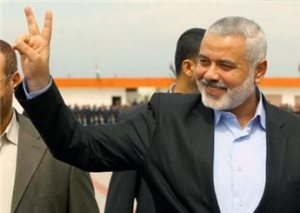 GAZA CITY – Deputy head of the Hamas political bureau Ismail Haniyeh said on Friday that the group is committed to the ceasefire with Israel but called for international attention to ensure Israel abide by its terms.
“We are committed to what was agreed on in Cairo as long as the occupation is,” he said in a statement to the press.
He said that Hamas was contacting Egypt and other outside parties to ensure Israel uphold its side of the bargain, which includes a partial lifting of the seven-year-old siege of Gaza that has not come to pass.
Haniyeh also called on Egypt to permanently open the Rafah crossing, assuring the country’s authorities that “the security and stability of Egypt is our priority.”
Egypt has closed Rafah, the principal connection between Gaza and the outside world due to the Israeli siege, for the majority of the past two months, only opening it for a few days at a time for limited passage.
Egyptian authorities blame Hamas for supporting the Egyptian Muslim Brotherhood and anti-government militants in the Sinai Peninsula, charges Hamas strenuously denies.
December 27, 2014
Posted by aletho |
Ethnic Cleansing, Racism, Zionism | Egypt, Gaza, Hamas, Israel, Palestine, Zionism |
Leave a comment
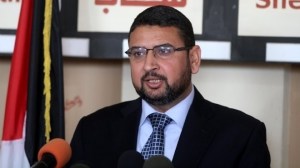 GAZA – Hamas Movement announced on Tuesday that the Palestinian Authority’s draft resolution tabled with the UN Security Council did not represent the Palestinian people.
Official spokesman for Hamas Dr. Sami Abu Zuhri said in a press release that the resolution did not have any national backing.
He said that the resolution was widely refused by the Palestinian factions, and asked the PA to withdraw it.
A number of Palestinian factions including the peoples party, national initiative party along with both the popular and the democratic fronts for the liberation of Palestine had declared their rejection of the draft resolution’s wording.
December 23, 2014
Posted by aletho |
Ethnic Cleansing, Racism, Zionism | Hamas, Israel, Palestine, Zionism |
Leave a comment
We, the leadership of the Islamic Resistance Movement Hamas, welcome the decision of the General Court of the European Union to remove Hamas from the European Union’s terrorist list and we consider this to be a step in the right direction and a means of making right a position that was wrong. This past position was not based on objective facts. In addition to this, it was in violation of and contradictory to international law as well as legal and humanitarian norms that guarantee the right of nations to resist occupation. It would be in the European Union’s best interest to align itself with international law and with legal and humanitarian norms and to refrain from violating these laws under the misguided pressure of Israel and its exploitation of the international community.
In this regard I urge the leaders and governments in the EU states to accept and cooperate with the decision of the Court and to take measures to make a brave political decision to remove Hamas from the European Union’s terrorist list in coordination with the Court’s decision and with the values of justice and law, as well as out of respect of the people’s will and their rights. I also urge the leaders and governments in EU states to avoid stalling or wasting time by taking measures or making appeals attempting to circumvent international law and objective facts.
I also hope that all international forces, including the United States, take the initiative and right the wrong that has been made in the past, which, as everyone knows, is a result of Israeli pressure and not a result of the facts on the ground.
I would like to remind everyone that throughout its long history since its inception 27 years ago, Hamas has, and continues to confine its legitimate resistance and struggle to Palestine and exercises this against the Israeli occupation. This is a natural right for the movement and for all nations under foreign occupation and it is in accordance with our religious and international laws, just as the other nations in the East and the West resisted their occupying forces.
We believe that this step by the General Court of the European Union, along with the initiatives made last week by a number of EU states and the Swedish government to recognise a Palestinian state and the rights of the Palestinian people, are all considered important steps that must be followed through in the context of setting the record straight and making the historical mistake against the Palestinian people right again.
The Palestinian people, as well as other people who have suffered and continue to suffer from unjust occupation, are looking forward to the day, in the near future, when the international community and the global superpowers will call things by their true name and explicitly expose the true terrorist forces, countries, and parties that exercise real terrorism against humanity. Such parties work together to commit acts of terrorism in its ugliest forms, in the name of the state, before the eyes and ears of the world without any accountability or deterrence, starting with Israeli terrorism.
December 17, 2014
Posted by aletho |
Ethnic Cleansing, Racism, Zionism, Illegal Occupation, Timeless or most popular, Wars for Israel | European Union, Hamas, Israel, Zionism |
Leave a comment
By Ibrahim Al-Madhoun | Al Resalah | December 15, 2014
The Hamas Charter is considered by the movement’s supporters as a key and stand-alone historical document pertaining to Hamas’s political and social ideology. In the event that this document is altered or amended, it would cause a state of undue and untimely confusion and tension within the ranks of the Hamas supporters. It would also be seen as a concession to international and Israeli pressures, even if the changes made to the charter were not substantial or even if the new charter was more extreme in crucial issues such as the recognition of Israel or dealing with international proposals. As long as such amendments form part of international demand or foreign advice, then any response to these demands will be seen as a concession and a weakness in the eyes of both Hamas’s supporters and the movement’s political opposition. It will also send a message to international forces that soft pressure on the movement actually works.
In addition to this, no amendment to the charter would sufficiently please the international community beyond altering the core of the Hamas’s political thought. No changes to the charter would satisfy Western forces unless they explicitly recognise the two-state solution and clearly accept the legitimacy of the continued existence of the Israeli state on Palestinian territories, while shunning the Palestinian national struggle in all its forms. From a strategic regional and international perspective, unless making concessions to these specific points there is no point in changing the charter, as such change may ultimately crack the intellectual infrastructure of Hamas and cause severe repercussions affecting its survival.
Palestinians still remember Fatah’s ill-fated political acquiescence, particularly the amendment of the organisation’s charter under the supervision of Yasser Arafat in 1996 to appease Bill Clinton. Although Fatah changed the PLO Charter under US pressure, it did not reap the fruits of this change and it ultimately did not serve the Palestinian cause. Instead, it caused disappointment and decline; a fate which may well befall Hamas if it makes the same mistake.
Although it may be true that some of Hamas’s positions need to be clarified, the best way to do this would not be to change the existing charter but to issue a new document explaining the movement’s strategic vision over a specified period of time. However, this document must be clear and understandable, devoid of any extra words and without any dense literary jargon. It must be focused on the clear political matters at hand and keep pace with social and political developments in the Palestinian arena, allowing for changes over the next five to ten years.
All political entities have their literatures and philosophies that serve to carry and propagate their core values and that cannot be altered; they must remain as a foundation stone and intellectual inheritance for all new recruits. Such entities can later be developed through practice, conflict, and building relationships, but their core values always remain the same. No one truly believes that changes to Hamas’s charter would bring respect, acceptance and understanding from the international community. This community only understands the language of power and force through the ability to raise some voices and silence others. And Hamas must not allow itself to be covertly silenced in such a way.
Translated by MEMO, 15 December, 2014
December 16, 2014
Posted by aletho |
Ethnic Cleansing, Racism, Zionism | Hamas, Israel, Palestine, Zionism |
Leave a comment
The national consensus government declared by Hamas and Fatah this summer has finished its interim term, Hamas spokesman said Sunday, as the Islamic Jihad movement urged the Palestinian Authority (PA) to stop security coordination with Israel.
Hamas spokesman Sami Abu Zuhri said in a press conference in Gaza City that the unity government’s six-month term had expired, and that dialogue should be resumed on a national level to discuss the future of the government.
“Any decision on whether the government should be disbanded or continued or be reshuffled must be made only through national dialogue and consensus,” Abu Zuhri said, adding that Hamas “isn’t interested in incitement, but rather seeks to maintain national unity.”
The Palestinian national unity government was formed following a reconciliation deal signed by Palestinian political rivals Hamas and Fatah in April.
The deal sought to end years of bitter and sometimes bloody rivalry between Hamas, which controls the Gaza Strip, and Fatah, which dominates the West Bank-based PA.
Palestinian parties agreed in September that the unity government would assume immediate authority over Gaza, however the government has so far failed to make any real changes on the ground in Gaza.
Abu Zuhri went on to criticize the PA for making what he called “politically motivated arrests.”
So far in November, 80 Palestinians have been detained in the West Bank for their political affiliation, he said, adding that 70 of them were still in PA custody.
“Hamas denounces the escalating violations and criminal acts by the PA security services against supporters of Hamas and the Palestinian resistance,” he added, calling on PA President Mahmoud Abbas and Prime Minister Rami Hamdallah to stop the detention campaign.
Similarly, the Islamic Jihad movement urged Abbas on Sunday to release all political detainees and refrain from detaining any Palestinian over their political affiliation.
Besides the recent wave of detentions, the movement said the security coordination between the PA and Israel has become a “real danger” to the Palestinian national unity.
Islamic Jihad spokesman Yousef al-Hasayna said in a statement that the appreciation expressed by the Israeli authorities regarding the PA’s readiness to continue coordinating with the occupation forces on the security level “is a strike to the nationalistic values of the Palestinian security services” and “is in contrast with the values and beliefs of the Palestinian people.”
“Israel is using this coordination to oppress the Palestinians and make sure no uprising will erupt in the West Bank and Jerusalem,” al-Hasayna said.
“The only one benefiting from this coordination is the Israeli occupation.”
Gaza reconstruction
Ongoing differences between Hamas and the PA have kept tensions high in Gaza.
Earlier this month, a senior United Nations official warned that another conflict will engulf Gaza unless stability in the territory is achieved rapidly.
“I do not see the national consensus government effectively governing Gaza,” Robert Turner, director of operations for the United Nations Relief and Works Agency (UNRWA) in Gaza, said.
“If we do not have political stability, a national Palestinian government, and at least an easing of the blockade, yes there will be another war,” Turner told reporters.
For 51 days this summer, Israel pounded the Gaza Strip by air, land and sea.
More than 2,160 Gazans, mostly civilians, were killed and 11,000 injured during seven weeks of unrelenting Israeli attacks in July and August.
The assault ended with an Egypt-brokered ceasefire agreement that calls for reopening Gaza’s border crossings with Israel, which, if implemented, would effectively end the latter’s years-long blockade of the embattled territory.
However, the Zionist entity had repeatedly blocked the entry of building material, prompting the UN in September to broker another deal. The reconstruction of Gaza has yet to begin.
The Palestinian Authority has estimated that the rebuilding Gaza will cost $7.8 billion.
UN chief Ban Ki-moon said during a visit to the Gaza Strip in October that the devastation he had seen was “beyond description” and “far worse” than that caused in the previous Israel-Gaza conflict of winter 2008-2009.
According to the UN, as many as 80,000 Palestinians homes were damaged or destroyed during the days of hostilities, a higher figure than was previously thought, and over 106,000 of Gaza’s 1.8 million residents have been displaced to UN shelters and host families.
Israel routinely bars the entry of building materials into the embattled coastal enclave on grounds that Palestinian resistance faction Hamas could use them to build underground tunnels or fortifications.
For years, the Gaza Strip has depended on construction materials smuggled into the territory through a network of tunnels linking it to Egypt’s Sinai Peninsula.
However, a crackdown on the tunnels by the Egyptian army after it overthrew then-President Mohammed Mursi has effectively neutralized hundreds of tunnels, severely affecting Gaza’s construction sector.
Economists in Gaza have estimated that as many as 400 trucks of equipment – from concrete to building materials and machinery – are needed every day for the next six months to meet the demand, but so far only around 75 trucks have made deliveries.
“I know there is frustration at the pace of reconstruction,” Turner said, adding that efforts were underway to fully implement a mechanism negotiated by the UN’s special coordinator in the Middle East, Robert Serry, to speed up the flow of goods.
Alaa Radwan, head of the Popular Committee for Monitoring the Reconstruction of the Gaza Strip, made a simple calculation: “Given the pace at which construction materials are currently entering Gaza, it will be at least 20 years” before the damage caused by this summer’s war is repaired.
While Hamas and people in Gaza have lamented the slow flow of goods, Turner was optimistic that the volume could be greatly increased if political stability could be brought to bear and if Egypt and Israel fully lifted their combined blockade.
“I do not believe the crossings are a problem,” Turnor said. “All the technical problems can be addressed. The question for me is that the political choke points be addressed.”
“If the political will exists… expanding the crossing to 800 trucks a day is just a matter of paying for the expansion.”
The crisis between Hamas and Fatah has been delaying the flow of reconstruction material into war-battered Gaza because the opening of border crossings, both under Israeli and Egyptian control, is conditional on PA personnel being stationed there.
According to the UN-brokered deal, all materials going into Gaza should be extremely monitored, including GPS tracking and video surveillance of their storage, to ensure nothing goes missing and ends up being used for “military purposes.”
On top of the slow pace of reconstruction and the bureaucracy, Fatah’s failure to pay employees of Gaza’s former Hamas government has further escalated tensions between the two rivals.
Moreover, the situation in Gaza was thrown into doubt early November after bombs targeted the houses of some 10 senior Fatah officials in Gaza.
Even though Hamas leaders rushed to denounce the attacks and called upon security services in Gaza to investigate into the attacks and bring those responsible for it to justice, the Fatah-led Palestinian Authority security services accused Hamas of having knowledge of the blasts before they happened.
Hamas top member, Khalil al-Hayya, however, slammed the accusations as “groundless” and “baseless,” saying whoever was behind the blasts was trying to thwart reconciliation and ensure the Palestinian Authority did not re-extend its control over Gaza.
Hayya also warned against using the incident as an excuse to avoid reconciliation, calling on all sides to uphold their responsibilities towards the national good.
(Al-Akhbar, AFP, Ma’an)
December 1, 2014
Posted by aletho |
Ethnic Cleansing, Racism, Zionism, War Crimes | Gaza, Hamas, Human rights, Palestine, Zionism |
Leave a comment

 Aletho News
 Aletho News