Unminced Words By Climate Scientist Hans von Storch
“Scientists Too Quick To Claim Last Word”
No Trick Zone | November 18, 2013
The Resonator, the research podcast of the German Helmholtz Research Group conducted a long interview (1 hr 40 min!) with climate scientist Hans von Storch director of the GKSS Research Center. In the interview von Storch was asked about his views on a wide variety of climate science related issues.
Overall the interview saw a Hans von Storch who spoke frankly and openly. Some of the remarks he made raised my eye brows. In general von Storch, best described as a non-alarmist warmist, views the climate debate as being dominated by the more extreme positions from both sides, with voices in the middle getting drowned out. He levels a fair amount of criticism at the climate science community, but does so without naming any persons in particular.
Due to the sheer length of the interview, I will only look at the points that I found interesting and relevant as skeptic.
Scientists too quick to accept dramatic scenarios
At the 15-minute mark von Storch describes a science that is so politicized with both sides are trying to make it black and white, and a debate that has been overly shrill. Some scientists, he says, have tended to accept dramatic scenarios and consequences even when there’s little evidence behind them. He also talks of a group of scientists who fancy themselves as the ultimate authority and who have the last word. All the exaggerations and projections of doom, gloom and disaster have led to an overall discrediting of the field.
“Science and Nature are pretty bad journals”
At the 29-minute mark von Storch says he sees himself as someone who needs a lot of time before he is convinced of anything. I was surprised to hear him call both Science and Nature “pretty bad journals” when it comes to the quality of their articles. Hans von Storch cites an article published by Science claiming that the climate was going to tip in the year 2047, calling the report “a real doozy“. He says that science journals must remain sufficiently critical and not let themselves get caught up with the zeitgeist. Von Storch admits that he has not always been popular among the community.
Overall von Storch doesn’t blame the media much for the hysteria, implying that the hysteria stems more from scientists communicating poorly. The media are only interpreting what the scientists are spewing. Projections of snowless winters, for example, were hardly helpful in lending credibility to climate science.
Scientists dramatizing for attention and prestige
At the 37-minute mark von Storch believes some scientists succumbed to drama in order to get attention and prestige, and says that the such are only damaging the credibility of climate science.
Models too CO2-centric
At the 40-minute mark von Storch discusses possible reasons why the warming has stalled and thinks other explanations need to be examined, such as solar activity and aerosols. He finds climate models too CO2-centric in general. Here he appeals for more patience to let the science unfold.
At the 45 minute mark he fires harsh criticism at scientists who promote a society governed by an elite technocracy, calling the idea “stupidity”. He calls the proposals made by a group of scientists in favor of appointing future councils to represent the interests of future generations “peculiar”.
At the 59-minute mark, on whether storms are becoming more frequent and severe, von Storch says he doesn’t think this is the case and that the disasters are more about the over-development of coastal areas.
Hockey stick was “something dumb” – an attempt to steer politics
On the hockey stick chart, at the 63 minute mark, von Storch has some blunt words on how it was possible to for it to become the icon that it became. He recalls having examined the chart himself and found it deficient.
“I believe it was something dumb by scientists who wanted to steer politics.”
He thinks the climate science community were too quick to call it the last word. Hans von Storch sees critique of the hockey stick and confirmed and that’s why it no longer appears in the IPCC reports. Scientists, von Storch reminds us, should not be so quick to claim absolute truth.
Also, von Storch believes that the oceans could be warming up, but that there is very little data out there to confirm it.
The coming crisis of climate science?
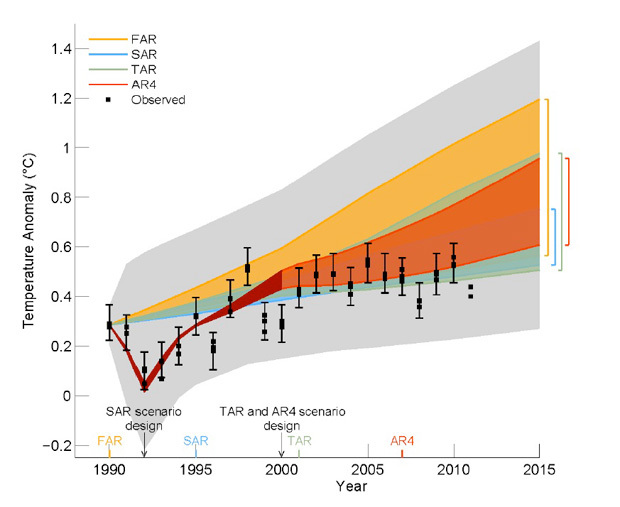
Figure 1.4 from Chapter 1 of a draft of the Fifth Assessment Report from the Intergovernmental Panel on Climate Change. Initials represent the First Assessment Report (FAR) in 1990, the Second (SAR) in 1995. Shaded banks show range of predictions from each of the four climate models used for all four reports since 1990. The last report, AR4, was issued in 2007. The black squares, shown with uncertainty bars, measure the observed average surface temperatures over the same interval. The range of model runs is indicated by the vertical bars. The light grey area above and below is not part of the model prediction ranges.
By Reiner Grundmann | September 19, 2013
With the fifth assessment report soon to be released by the IPCC the pre-publication buzz is well underway. A while ago unauthorised drafts circulated in the blogosphere and now the official leaks have found their way into news editing rooms. A central question picked up by most commentators is the ‘pause in global warming’, the ‘stagnation’, or the ‘hiatus’.
An anomaly presents itself for climate science in that model projections about future temperature increases do not concur with actual temperature observations. As expected, comments align with the agendas of the commentators, depending if one wants to defend the official modelling output or criticise it. These agendas are closely linked to policy options and the question if a lower observed temperature trend provides justification for political action on greenhouse gas emissions.
On this blog Hans von Storch expressed optimism as regards the ability of climate science to deal with this anomaly: ‘Eventually, we need to evaluate the different suggestions, but that will need time. No doubt that the scientific community will achieve this.’ Others are quick to pronounce climate science bunk. David Rose wrote in the Daily Mail ‘A leaked copy of the world’s most authoritative climate study reveals scientific forecasts of imminent doom were drastically wrong.’ Hayley Dixon in The Telegraph put it less blatant but still succinct in her opening sentence: ‘A leaked draft of a report by the UN Intergovernmental Panel on Climate Change is understood to concede that the computer predictions for global warming and the effects of carbon emissions have been proved to be inaccurate.’
Of course, both papers are on the political right and often skeptical about efforts to curb greenhouse gas emissions. It seems as if this topic is inconvenient for the left leaning papers who support action on climate mitigation. The Guardian so far is silent on the issue and prefers to write about new record lows of Arctic Ice coverage. When it looked last at this issue, Fiona Harvey bolstered the heat uptake by the oceans as explanation for the pause in global warming, thus doing away with a potential anomaly. At the same time she claims that climate scientists point out ‘that the trend is still upwards, and that the current temperature rises are well within the expected range.’ A quick glance at the graph above shows this is an illusion (the grey upper and lower bands are not part of the model prediction range).
Both the Mail and Telegraph quote Myles Allen (Oxford University) who tries to put the IPCC and its work into perspective. Says Allen: ‘we need to look very carefully about what the IPCC does in future… It is a complete fantasy to think that you can compile an infallible or approximately infallible report, that is just not how science works. It is not a bible, it is a scientific review, an assessment of the literature. Frankly both sides are seriously confused on how science works – the critics of the IPCC and the environmentalists who credit the IPCC as if it is the gospel.’
The Mail quotes Judy Curry (Georgia Institute of Technology) saying it makes ‘no sense that the IPCC was claiming that its confidence in its forecasts and conclusions has increased. For example, in the new report, the IPCC says it is ‘extremely likely’ – 95 per cent certain – that human influence caused more than half the temperature rises from 1951 to 2010, up from ‘very confident’ – 90 per cent certain – in 2007. Prof Curry said: ‘This is incomprehensible to me’ – adding that the IPCC projections are ‘overconfident’, especially given the report’s admitted areas of doubt.’
Both Allen and Curry call for a radical reform of the IPCC with Curry being more specific: ‘The consensus-seeking process used by the IPCC creates and amplifies biases in the science. It should be abandoned in favour of a more traditional review that presents arguments for and against – which would better support scientific progress, and be more useful for policy makers.’
Meanwhile in the Financial Post, Ross McKitrick wrote: ‘As the gap between models and reality has grown wider, so has the number of mainstream scientists gingerly raising the possibility that climate models may soon need a bit of a re-think. A recent study by some well-known German climate modellers put the probability that models can currently be reconciled with observations at less than 2%, and they said that if we see another five years without a large warming, the probability will drop to zero.’ (this seems to be a reference to the paper by Hans von Storch and Eduardo Zorita recently presented here on Klimazwiebel).
McKitrick goes on: ‘Judging by the drafts circulated this year, [the IPCC] is in full denial mode. Its own figure reveals a discrepancy between models and observations, yet its discussion says something entirely different. On page 9 of Chapter 1 it explains where the numbers come from, it talks about the various challenges faced by models, and then it sums up the graph as follows: “In summary, the globally-averaged surface temperatures are well within the uncertainty range of all previous IPCC projections, and generally are in the middle of the scenario ranges.” Later, in Chapter 9, it states with “very high confidence” that models can correctly simulate global surface temperature trends.’
McKitrick then makes a link between a ‘failed science’ and a ‘costly policy’: ‘since we are on the verge of seeing the emergence of data that could rock the foundations of mainstream climatology, this is obviously no time for entering into costly and permanent climate policy commitments based on failed model forecasts. The real message of the science is: Hold on a bit longer, information is coming soon that could radically change our understanding of this issue.’
This is where the crux of the matter lies. While it is indeed highly problematic to tie costly policies to flawed model forecasts the prospects of climatology are perhaps worth considering.
I chose as title for this blog post ‘The coming Crisis of Climate Science?’ The question mark is intentional and important. It could well be that in the coming year global surface temperatures pick up as expected. Existing models would be vindicated, end of story. The question is: how many more years should climatologists wait for this ‘renormalization’? It appears that mood is shifting towards alternative models and explanations. The timing of the fifth assessment report falls into this critical juncture where a lot of momentum has built up in favour of the current modelling practices which now prove so elusive. While the IPCC tries to make last minute rhetorical adjustments in order to accommodate anomalies, some of its participants, looking beyond, already indicate that this institution may have run its course. But even if the IPCC was reformed or dissolved, we still would have these questions in front of us:
How convincing is the climate science? How important should it be for climate policies? Do we need to implement climate policies, and if so, what should they be?
I can envisage an irony of history where climatology enters a period of crisis and looses its central place in public discourse about climate change, thus opening up discursive spaces for pragmatic options to deal with the problem.
Update: Global mean surface temperatures continued their sideways trajectory for the entire year of 2013 and October 2013 Arctic ice volume increased 50% from October 2012. – (Aletho News)
Related article
Featured Video

Rewriting the risk? Inside the government’s vaccine safety messaging
or go to
Aletho News Archives – Video-Images
Book Review
“Davos Can Really Replace the UN”
Inside the book that maps the architecture behind global governance — from the Epstein files to the Pact for the Future
Lies are Unbekoming | April 1, 2026
On June 13, 2019, the United Nations and the World Economic Forum signed a partnership deal to “accelerate the implementation of the 2030 Agenda for Sustainable Development.” That same evening, WEF president Börge Brende — Norway’s former Foreign Minister — had dinner with Jeffrey Epstein at Epstein’s Manhattan townhouse. The Epstein files, released January 2026, contain an exchange between the two from the previous year. Epstein to Brende: “Davos can really replace the UN. C21, cyber, crypto . genetics… intl coordination.” Brende back to Epstein: “Exactly — we need a new global architecture. World Economic Forum (Davos) is uniquely positioned — public private.”
The next day, the UN General Assembly adopted the framework for restructuring global governance.
That sequence — the partnership signing, the Epstein dinner, the candid admission about replacing the UN with a public-private architecture, and then the formal adoption — opens Jacob Nordangård’s The Digital World Brain. Pages two and three. Footnoted to the UN resolution number, the Epstein files, and the General Assembly record.
I keep coming back to it because it captures what this book does that almost nothing else in the independent research space manages. I’ve followed Jacob’s work for years now and interviewed him about his research. Each book peels back another layer of the same institutional architecture, and each time I think he’s reached the limit of what can be documented, the next one goes further. Nordangård doesn’t speculate. He doesn’t editorialize much. He lays institutional actions next to each other in chronological order and lets the pattern announce itself. … continue
Blog Roll
 Aletho News
- How I fell foul of the BBC thought police
- The End of NATO
- 37 days of war on Iran cost US staggering $42bln, tracker shows
- Baghdad tells Asian refiners, traders to begin loading Iraqi crude amid Iranian exemption
- Under fire, Moscow and Tehran close ranks
- Iran, US receive Pakistan-mediated plan for ceasefire then final deal
- Iran submits demands for end to war as mediators scramble ahead of Trump deadline
- Iran Threatens Retaliatory Strike on Stargate AI Project in UAE
- US sent ‘a lot’ of arms to Iranian protesters – Trump
- Barak Ravid Launders Deception To Allow Trump To Back Off Of His Power Plant Threat – Again
- If Americans Knew
- U.N. experts demand Israel release prominent Gaza doctor after reports of ‘severe torture’
- Israel’s Latest Genocide Is Against the Shias of Lebanon. Why Is the World Silent?
- How Eliot Cohen’s influence over U.S. war-making paved the way for Trump’s war crimes in Iran
- Israelis don’t pay for the weapons we ‘sell’ to them — US taxpayers do
- While Distancing from AIPAC, Most 2028 Democratic Hopefuls Are Still Embracing Israel
- A brief history of the Israeli nuclear program, the open secret at the heart of the Iran war
- Israeli Settlers Killed a Palestinian Farmer on His Own Land, in Front of His Father. Yes, Again
- The US-Israeli War on Science is an Assault on our Future
- 100+ International Law Experts Say US Strikes on Iran Violate UN Charter, Could Be War Crimes
- ‘Vile, Horrifying, Evil’: Trump Threatens to Bomb Nation of 90 Million People ‘Back to the Stone Ages’
- No Tricks Zone
- An Inconvenient Tree: Uncovered In Alps… Europe Much Warmer Than Today 6000 Years Ago
- New Study Reports A 60% Slowdown In Greenland’s Ice Loss Rate In The Last Decade
- Low Intensity Tornado Wrecks Major Solar Farm, Creating A Potential Toxic Dump
- New Study Finds Warming Saves Lives…Cold Temperatures 12 Times More Deadly Than Excess Heat
- German Science Blog Accuses PIK Climate Institute Of Hallucinating Climate Tipping Points
- Devastating Assessment Of Comirnaty Vaccine By Former Senior Pfizer Europe Toxicologist
- New Study: CO2 Is ‘Effectively Negligible’ As An Explanatory Climate Change Factor Since 2000
- Former Pfizer Toxicologist Dr. Helmut Sterz Tells Bundestag Hearing Pfizer Vaccine Should Have Never Been Approved
- Energy Expert: Germany’s Nuclear Phaseout Was A “500 Billion Euro Mistake”
- New Research: South Australia’s Mid-Holocene Sea Surface Temperatures Were 4°C Warmer Than Today
 Aletho News