Number of journalists held in Israeli jails rises to 17
Palestine Information Center – January 21, 2015
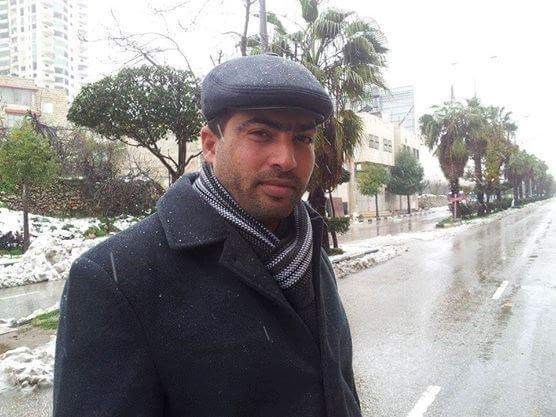
AL-KHALIL – The Israeli Occupation Forces (IOF) arrested at dawn Wednesday the journalist Alaa Jaber Titi, 33, after violently breaking into his home in Aroub refugee camp to the north of al-Khalil.
Family sources told a PIC reporter that more than one hundred Israeli soldiers surrounded Titi’s home and violently broke into his apartment.
The IOF arrested Titi, a reporter at al-Aqsa TV Channel, after carrying out searches in his house.
Titi’s arrest came only a week after his release from PA jails where he was detained for several times by PA security forces, in addition to spending four years behind Israeli bars.
Titi’s detention is considered the second arrest targeting journalists in two days after the journalist Mujahd Bani Mefleh was nabbed by Israeli forces on Monday from his home in Ramallah.
Palestine Center for Prisoners’ Studies pointed out in a statement issued Tuesday that 16 Palestinian journalists are currently held in Israeli prisons.
Journalists’ detention fell as part of Israel’s policy to cover up its crimes and violations against Palestinian people, the statement charged.
The human rights center stated that Israeli deliberate targeting of journalists will never succeed in hiding the truth or beautifying Israel’s image, calling on international media institutions and journalists’ syndicates to exercise pressures for the Palestinian detained journalists’ release.
For its part, Quds Press called on the Israeli authorities to immediately release its reporter Mohamed Muna and all the journalists illegally held in its jails.
Along the same line, Palestinian media forum strongly condemned Israel’s fierce arrest campaign against journalists; most recently was the detention of Titi and Mefleh.
The Forum said that following the two journalists’ arrest in the West Bank, the number of journalists held in Israeli prisons increased to reach 17.
The media forum also denounced the pregnant journalist Juman Abu Arafa’s detention on Monday while leaving al-Aqsa Mosque before being released and prevented from having access to the holy shrine for 15 days.
The forum warned against tight Israeli restrictions imposed on journalists working to reveal settlers’ crimes and Judaization policy in occupied Jerusalem.
“We call on International Federation of Journalists and Reporters Without Borders to bear their responsibilities and break their silence towards Israeli escalated violations against journalists in occupied territories, and to work for their release”, the forum’s statement concluded.
“We will hit your wife, your daughter, and your kids”
International Solidarity Movement | January 22, 2015
Beit Ummar, Occupied Palestine – Early Tuesday morning January 20, 2015 at 3:00 AM, Israeli occupation forces invaded the home of the Abu Maria family in the village of Beit Ummar. The occupation army used explosives to open the front door, surprising the sleeping family. This is the second violent night raid the family has experienced this week. Israeli soldiers were looking for Nidal, Ghassan, and Mohammed Abu Maria, three brothers who were summoned by the Israeli intelligence for questioning.

Window broken during Israeli army nigh raid
The mother of the family, 42 years old, was attacked as soon as the invading soldiers entered the home. Her arms were violently jerked behind her back, and once she was tied up, she was beaten on her head, neck and arms. One of the family’s five sons, Mohye, 18 years old, was cut on his face, neck and fingers. The attacking soldiers demanded he tell them where his brothers were.
The family’s father, Ahmed Abu Maria, has been imprisoned by the Israeli occupation forces for four months. The morning of the attack, Ahmed was taken into interrogation where Israeli investigators informed him that his family would be targeted that night. Ahmed related that he was told: “Tonight we will go to your family’s home. We will hit your wife, your daughter and your kids.” He was not allowed to warn or communicate these threats in any way to his family. The next day, Ahmed was allowed to contact his family and hear what happened to them during the night raid. The family describes this as psychological torture, designed to put pressure on the imprisoned father.

The occupation forces remained at the family’s home until nearly 7:00 AM. When they finally decided to depart the house, the invading soldiers left behind two official requests in Hebrew for the appearance of Nidal, Ghassan, and Mohammed the following morning at 8:30 AM at the prison in the nearby illegal settlement of Kfar Etzion. The family tried to explain to the occupation forces that two of the sons did not live in Beit Ummar, but farther north and it would be impossible for them to make the trip in time.
During the violent invasion at the Abu Maria’s house, the occupation forces also searched the neighboring uncle’s home for the youths. When they did not find the boys there as expected, and the family refused to tell the authorities exactly where they were living, the occupation forces stole over 3000 NIS (approximately $760 USD) from the uncle. This money was his life savings; without it, he does not know how he will survive.
Next morning the 20-year-old middle brother Ghassan Ahmad Abu Maria presented himself at Kfar Etzion prison as requested and was arrested. He is currently being held without charges and the family has been unable to get any information on his condition.
Photos by ISM
Night raid in Beit Ummar: arrests, violence and property destruction
International Solidarity Movement | January 18, 2015
Beit Ummar, Occupied Palestine – Early Wednesday morning, January 14, 2015, a massive deployment of 400 Israeli occupation forces invaded the village of Beit Ummar, north of Hebron. From 2:00 – 5:00 am, the occupation forces invaded approximately 100 Palestinian homes, arresting 25 males and leaving notices for 15 additional males to meet with the Israeli intelligence.

Occupation soldiers invaded the private homes with violent force, blowing open the front doors with explosions, ransacking the rooms, breaking the furniture inside, smashing windows, and attacking the residents. One of the victims of this brutal invasion was the family of 25-year-old Nidal Abu Maria.
Nidal is the oldest son of Ahmed Abu Maria, who has been imprisoned for the last four months. According to the family, the occupation soldiers forcibly entered their home with large aggressive dogs, blowing the door open with explosives. Nidal’s mother, sister, and two brothers ages 6 and 7 were inside, and awoke shocked to find soldiers inside their home. The occupation forces locked Nidal’s mother in a separate room, away from her children, and took her phone, noting the family members phone numbers from it. The pregnant sister attempted to speak to the young boys, who were scared of the military invasion and their dogs, when the occupation forces violently hit her in the face and told her to keep quiet. In addition to physical violence against the family, the soldiers also ransacked the home, destroying the windows, the furniture, and the entire kitchen. Nearly 99 other houses were also invaded this same night, and experienced the same destruction.

During this brutal night invasion, 25 males were taken from their homes and arrested without any official charges or explanations. According to Ma’an News, those detained were as young as sixteen years old. The youths were not known activists nor had there been any protests in Beit Ummar since the massacre in Gaza for them to take part in. Five were released the next morning, while the rest still remain in custody. Additionally, the invading soldiers left official request notices for 15 residents of Beit Ummar to report to the Israeli Intelligence at the Kfar Etzion prison in the nearby Kfar Etzion settlement the following day. Nidal Abu Maria, along with his brother and cousin, were among those that were requested to report to Kfar Etzion.
Nidal decided to not comply with the occupying army’s request, and did not report to the prison at9:00 AM on Wednesday as the soldiers demanded. However, after the occupation forces called him and his mother on the phone, threatening the lives of the family, he felt he had no choice. When Nidal answered one of the many phone calls from the military and questioned why he should follow orders from an occupying military, the Secret Service member told him, “I am the state of Israel, I am the one who has power, I am the law”.
Nidal and his brother reported to the Kfar Etzion prison on Thursday morning and were interrogated for several hours by the Israeli intelligence. During the interrogation when the brothers were being questioned, they were told, “We want to make sure you guys are ok, and that you are doing the right things and not the wrong things.” Additionally, the interrogator told Nidal, “If you miss your uncle (the martyr), I will send you to him.” Nidal interprets this as a direct threat against his life.
Nidal’s family is no stranger to such violence at the hands of the Israeli occupation. Nidal’s father has been detained and imprisoned eight times for a total length of five years – once on charges of organizing peaceful protests in Beit Ummar, while the other seven times were without official charges. Additionally, Nidal’s uncle Hashem Abu Maria was executed on July 25, 2014 during a peaceful protest against the 2014 massacre in Gaza. Hashem was shot in the heart by an Israeli sniper on the main street, while encouraging the children to go home rather than risk being hurt in the demonstration. Hashem worked for the Defence For Children International documenting child-rights violation in Hebron and according to Haaretz, this was the role that Hashem played in many protests. Nidal’s aunt, the wife of Hashem, has suffered greatly since his death, and even months later she is still afraid to sleep in the house without him.
Ten days after Hashem’s assassination, the occupation forces invaded Beit Ummar and arrested Ahmed, Nidal’s father. He is currently still imprisoned and has not been officially charged with any crime. Despite not facing official charges, Nidal’s family is told that he faces three years in prison.
In the year of 2014, over 400 residents of Beit Ummar were arrested and over 120 residents are still currently imprisoned, some without official charges. Additionally, 3 residents were killed during this time. When asked why Beit Ummar experiences such frequent violence at the hands of the occupation army, Nidal explains it has a lot to do with its location. “Beit Ummar is surrounded by three settlements: Migdal Oz, Kfar Etzion and Karmei Zur. The village is located close to the main road that connects the settlements from Bethlehem to Hebron. The official explanation from the occupation forces are that these actions are taken against Beit Ummar for ‘security reasons’.” These nearby settlements have confiscated nearly one third of the village’s land which is located in Area C. Additionally, much of the military violence against Beit Ummar can be attributed to their strong commitment to resistance against the occupation. Beit Ummar was the site of nearly two protests every week during the 2014 attack on Gaza.
For residents of Beit Ummar the recent violence happens whenever there is a new commander in the area. Nidal explains that the commanders like to introduce themselves by sending a strong message to the local Palestinian population. The new commander in the Beit Ummar area goes under the name Abu Abed and is a former member of the Israeli Intelligence.
Losses continue to pile up for Abu Haikel family on Tel Rumeida
CPT | January 17, 2015
The family’s cherished almond and cherry orchards are a thing of the past; only a few straggling trees survived the bulldozers of the Israeli Antiquities Authorities (IAA) in the last year. On 31 December 2014, the Abu Haikel family had their case protesting Israel’s takeover of the land on which they held a protected tenancy contract for more than sixty years heard in the Israeli High Court, only to find that the State of Israel, in a secret deal, had given the land to Hebron settlers in 2012. And this week, a section of the family’s retaining walls collapsed yet again because of the digging beneath them; the footpath to one of their front doors is also danger of collapse.
In the High Court hearing, the three judges glossed over why Israel took over the tenancy from the Abu Haikels in the first place and said they had done nothing to establish tenancy despite the fact they have faithfully paid rent on it for decades (See link to timeline below). However one judge still expressed her shock over the behavior of the State. She asked what criteria Israel had used for giving the land to the Jewish settlers of Hebron instead of putting the land on the market.
Nevertheless, the attitude of the court does not seem likely to produce an outcome favorable to the Abu Haikels. On their side is one lawyer supplied by the Hebron municipality; against them are three lawyers representing the State of Israel, the Jewish settlers of Hebron and the Israeli Antiquities Authority.
And in the meantime, despite the fact that no reputable archeological enterprise accomplishes its work with bulldozers, the family watches as the IAA continues to destroy its property and the property of its neighbors.
A member of the family visited Christian Peacemaker Teams on 14 January to update them on the family’s legal situation and next steps. He said a meeting was in the process of coming together with the Hebron Rehabilitation Committee, the PA Ministry of Tourism and some Israeli solidarity groups, but the prospects for improvement in the family’s fortunes look bleak.
“It’s very depressing to be in a situation where you never really win,” he said. “When the walls come down, you know they’re never going to be replaced…People ask us now, ‘Why are you bothering to put up a fight to save the land?’ What’s the point?’”
When asked why the family continues to resist, he replied, “Well if you don’t stop them at every point, the whole thing keeps on shrinking. The family has a huge fear that they will lose not just their land but their houses as well. Emmanuel Eisenburg, the so called ‘archaeologist’ in charge of the excavation has said he wants to dig under their houses because that’s where the Canaanite city was.”
A timeline of settlement expansion on the Abu Haikel’s land through 2014 is available here.
~
Background:
A checkpoint in Hebron
International Solidarity Movement | January 14, 2015
Hebron, Occupied Palestine – Checkpoints are numerous and inescapable in the H2 area of al-Khalil (Hebron), where thousands of soldiers guard around 600 Israeli Zionist settlers occupying heavily militarised settlement enclaves in the heart of the most populous Palestinian city in the West Bank. The Israeli military imposes numerous restrictions on the freedom of movement of Palestinians in the neighbourhoods of H2, affecting people as they attempt to live, work, study, and travel through their city. Shuhada checkpoint, leading from the H2 neighbourhood of Tel Rumeida into Palestinian-administered H1, is one of the larger and more heavily manned checkpoints.

One Israeli soldier looked through the purse of a young Palestinian woman as her daughter looked on. Even Palestinian children too young to carry bags for a soldier to search are subjected to the everyday sight of their older relatives being stopped, searched, questioned and detained by Israeli forces. Over a period of a couple of hours on Tuesday afternoon, an ISM activist witnessed Israeli soldiers stop and search around fifty Palestinian children, women, and men.

Barbed wire and fences frame the entry way into Shuhada checkpoint, as Israeli soldiers patrol the heavily militarised passage between the Palestinian neighbourhoods of Tel Rumeida and Bab el-Zawiye.

A very young Palestinian girl took a moment to look up at the heavily armed Israeli soldiers standing in her path. Armed with enormous rifles, chests strapped with body armour complete with pockets full of stun grenades and tear gas, the soldiers looked incongruous on the otherwise quiet, sunny street.

“I don’t understand why people think we want war, we just want peace,” one Israeli soldier told an ISM activist. The absurdity of his statement, as he stood with his rifle beside the checkpoint, seemed entirely lost on him. Deploying eighteen-year-olds with M16s to search kids’ shopping bags and their mothers’ purses, giving them control over the lives of Palestinians trying to keep surviving in the neighbourhoods of H2 in al-Khalil, creates a situation which, though it may sometimes seem quiet, is anything but peaceful. The soldiers stop whole families at the checkpoint: mothers, grandfathers, sisters laden with shopping bags. This young girl stood waiting off to the side as the Israeli military checked to make sure her relatives did not pose a “threat.”

Photo credits – ISM
Extremist Israeli Settlers Burn Palestinian Home Near Hebron
By Saed Bannoura | IMEMC & Agencies | December 31, 2014
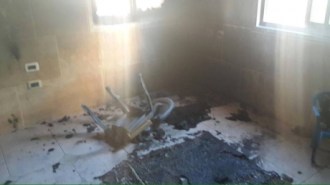 A Palestinian family from a village east of the town of Yatta, near the southern West Bank city of Hebron, narrowly escaped death on Wednesday at dawn, when a number of fanatic Israeli settlers hurled Molotov cocktails into their home as they slept.
The head of the Yatta City Council Mousa Makhamra told the Maan News Agency that the attack is a very serious and dangerous escalation, adding that it is an attempt to annihilate a family of seven; five children and their parents.
Makhamra added that the fanatic settlers, from Karmiel illegal settlement, infiltrated into ad-Deerat village, east of Yatta, at approximately 3 am, and throw the Molotov cocktails into the Palestinian home after writing racist graffiti on its outer walls.
Makhamra further stated that the family woke up in time, and their neighbors rushed in when they saw the house on fire, and rescued the family.
The fires consumed the furniture in the living room, but was controlled before it spread.
The settlers wrote racist anti-Arab graffiti, including the infamous statement “Death To Arabs”, and other graffiti.
Image Shehab News
Israeli Forces Train with Live Ammo in West Bank Civilian Areas

IMEMC News & Agencies | December 30, 2014
Israeli occupation forces, since the early hours on Monday, have been holding military training sessions with live ammunition, in the Khirbet Taweel area, South Nablus.
Member of the Popular Struggle Coordination Committee of Aqraba, Yousef Deriyyah, said that Israeli occupation forces, Sunday evening, bulldozed and damaged several dunams of wheat fields in preparation for the training.
The PNN further reports that military training has often targeted Palestinians, including children, causing injuries and home evictions.
Back in August, Israeli authorities evicted 1,300 Palestinians from their homes in the south Hebron hills, of the occupied West Bank, claiming that they are located in a military training zone.
In October, Israeli forces stormed Aida refugee camp without any provocation and began firing tear gas canisters, sound bombs and rubber-coated steel bullets at children in the streets.
Eyewitness said that soldiers were training by using families, children and homes as military practice.
Also in October, Israeli authorities distributed eviction notices to 19 Palestinian families in the Northern Jordan Valley area, in order to use the area for military purposes.
No donkeys allowed
International Solidarity Movement |December 17, 2014
Hebron, Occupied Palestine – Mohammad Saleh, a sixty-six-year-old Palestinian resident of Tel Rumeida, al-Khalil (Hebron), waited with his mule outside Shuhada checkpoint for nine hours over the course of two days. He spent four hours waiting before being allowed through on Monday (15/12/14) evening.
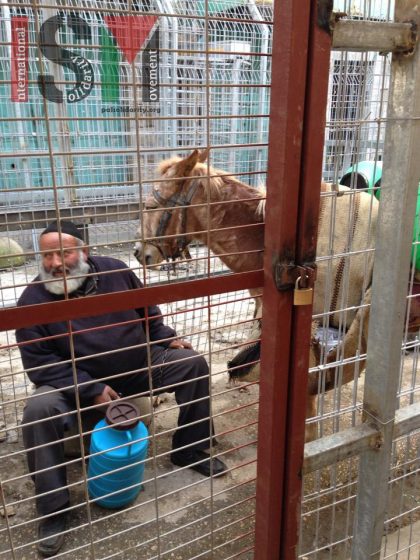
He then spent five hours Tuesday (16/12/14) attempting to cross in the opposite direction before eventually turning back, after being denied repeatedly by Israeli forces claiming that donkeys, mules, horses, and carts are not permitted to pass through the checkpoint.
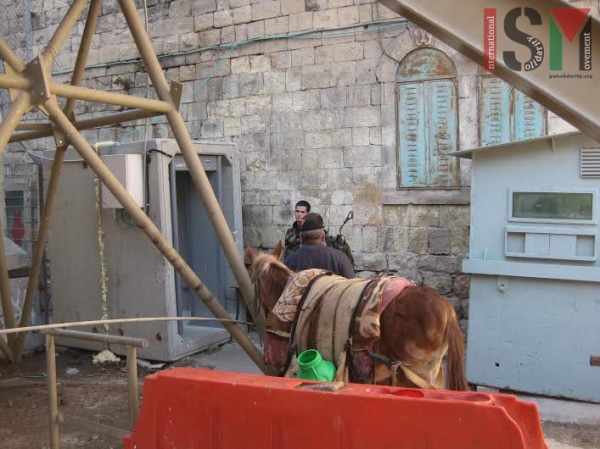
Shuhada checkpoint serves as the only clear passage between the H2 (Israeli-controlled) neighbourhood of Tel Rumeida and the H1 (Palestinian Authority-administered) neighbourhood of Bab Al-Zawiye, a route many Palestinians must traverse regularly in the course of their work and daily routines.
Mohammad arrived at the Bab Al-Zawiye side of the checkpoint at 13:40 on Mondayafternoon, his mule laden with empty milk jugs and saddlebags packed with various provisions. Israeli forces refused to let him through, claiming no animals were allowed past the checkpoint – a claim no one, including other international organisations at the scene as well as the Palestinian District Coordination Office for al-Khalil, had ever heard before.
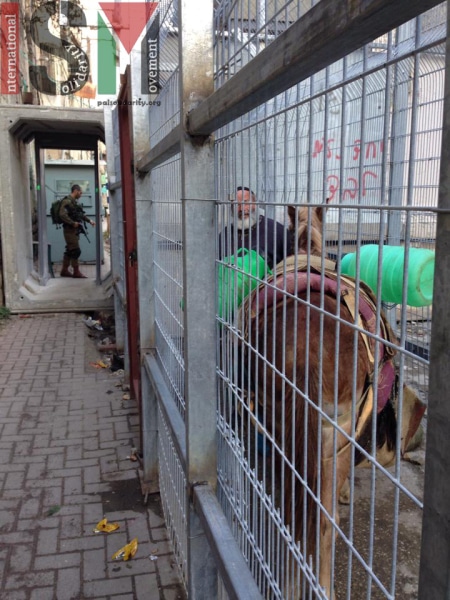
Mohammad explained that he had been allowed pass the checkpoint on Monday morning, with the promise that he would be let back through later in the day. When he returned, he found a new shift of soldiers and no one willing let him pass. The soldier manning the checkpoint claimed he needed permission from his commander to open the gate, which would allow Mohammad to pass with his mule.
An ISM volunteer at the scene later received a call explaining that the Israeli military’s new rule stated that horses, donkeys and mules were not permitted to pass through the checkpoint. No one, however, was able to explain why Mohammad had been allowed through that morning, but denied on his way home. “Look at my ID,” he told the soldier at one point, “I’m in your computer. I go through here all the time.”
He stayed waiting, sitting beside his mule on the cold concrete base of the fence, even as the afternoon turned into evening. The sky grew dark, though the lights from the checkpoint still illuminated the fences,
turnstiles, and barbed wire. Even the soldier seemed concerned, telling him to please go home, as it was cold and late and staying would not help him. But Mohammad had already made it clear he would not leave. About ten minutes later the soldier finally opened the gate, saying it was the “last time” that he would be allowed through. Although Mohammad heard the soldier’s message, it was clear he would not heed it. He intended to continue to resist, no matter what anyone told him.
Sure enough, the following morning he was once again standing outside the checkpoint, this time on the Tel Rumeida side, with full milk jugs tied to the back of his patient mule. The soldiers presented multiple reasons from denying him passage, from a prohibition on taking anything through the checkpoint too large to be carried through the turnstile, to the new rule against allowing donkeys, horses and mules through. ISM volunteers attempted to find a solution, offering to carry the milk jugs around the checkpoint and meet Mohammad and his mule on the other side. The Israeli soldiers manning the checkpoint rejected all suggestions.
“Is the donkey the problem or the milk the problem?” One ISM activist eventually inquired.
“The donkey’s the problem,” a soldier replied.
The animal could have easily passed through the metal detector; only last night ISM activists had witnessed the ludicrous sight of Mohammad’s mule strolling through the concrete structure, empty milk jugs banging against the corners of the gateway. The turnstile served as the only obstacle to the his passage – an obstacle the soldier could easily remove by opening the gate on the other side of the metal detector and letting the mule pass around the turnstile and into Bab Al-Zawiye.
After five hours of waiting, Mohammad’s comment seemed by far the most accurate. “The soldiers are the problem,” he had responded in Arabic.
Barring donkeys, mules, and horses and carts is only the latest in a string of frustrating, humiliating regulations imposed on the people living near the checkpoint, who must pass through to work, study, and shop for essentials such as fresh food. Just a few days earlier a group of elderly Palestinians, ill people, young children, and teachers at a local school had also been forced to wait, some for up to three hours, before being allowed through.
When Israeli forces shut down the checkpoint after it was burnt nearly a month ago , barring most people from passing through for over three weeks, the Palestinians were forced to adapt. Local people know ways around the checkpoint; several paths lead through local families’ yards and over the walls and rubble between Tel Rumeida and Bab Al-Zawiye. These “rabbit runs,” however, are entirely unsuited to traveling through with a mule – as well as for anyone sick, elderly, or carrying large heavy objects.
Since the attempted burning of the checkpoint, the Israeli military rebuilt it larger and with more obstacles for anyone traveling through. One side now has a metal detector, and both sides are equipped with vertical metal turnstiles which are a major impediment to anyone trying to move through with large baggage. Soldiers continue to use the burning of the checkpoint to justify collective punishment imposed on the entire Palestinian population – young and old, men and women, healthy and ill – who live or work near the Shuhada checkpoint.
Any Palestinian might be stopped while attempting pass through. Even with the checkpoint officially open, far too many are. Soldiers regularly search bags and make people remove their belts and empty their pockets before being allowed through. These everyday humiliations accompany frequent ID checks and detentions, serving as an inescapable reminder of the illegal Israeli occupation. Soldiers present at checkpoints routinely cite newly imposed rules and orders from superior officers as reasons for denying people passage, but whether someone passes easily through a checkpoint or must wait for hours often seems to be determined by nothing more than the soldiers’ caprice.
Many Palestinians must pass through Shuhada checkpoint multiple times in a day, carrying items as diverse as fresh vegetables, tubs of oil, and gas for cooking and heating their homes. During the hours ISM volunteers stood waiting with Mohammed, they witnessed multiple people struggle with the cumbersome design of the rebuilt checkpoint. One woman was carrying too many grocery bags to be able to fit into the turnstile. Someone on the other side of the turnstile had to reach a hand between the metal bars and move one bag through, returning it to the woman once she had passed. Another Palestinian, this time a young boy, needed the help of multiple passers-by over several minutes to figure out how to get two tubs of oil and a metal trolley through the turnstiles. Soldiers denied passage outright to boys who wanted to walk through the checkpoint with their bicycles.
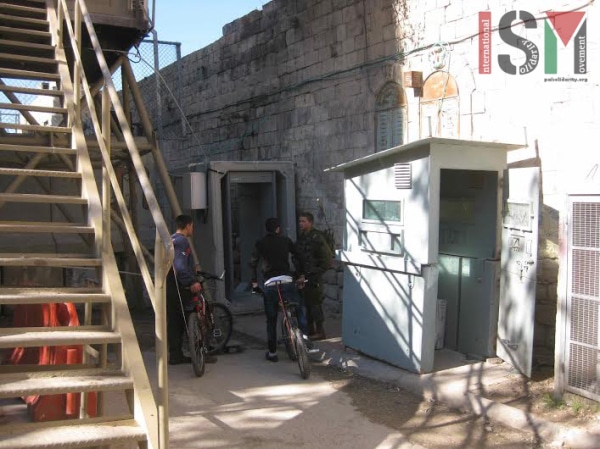
At one point on Monday night, a group of off-duty soldiers ran up Shuhada street and stopped near the checkpoint to rest, stretching and laughing, their easy freedom of movement a stark contrast to experiences of Palestinians struggling through Shuhada checkpoint. Almost all of Shuhada street has been closed off to Palestinians, reserved instead for the settlers and soldiers occupying H2. Even Palestinians who manage to get through the checkpoint must pursue long, circuitous routes between the surrounding areas of al-Khalil. Many, especially the elderly or disabled, are effectively barred from traveling to significant portions of the city their families have lived in for generations.
“I want to resist,” Mohammad told the ISM activists the first day they waited with him. He made sure the man translating said it twice, to make sure the ISM volunteers understood. “I want to resist,” he said, after over three long hours of waiting to be allowed through.
Palestinians repair thoroughfare in nonviolent action
CPTnet | November 15, 2014
 SOUTH HEBRON HILLS — On Saturday, 15 November 2014 the South Hebron Hills Popular Committee (a nonviolent Palestinian organisation resisting occupation in the South Hebron Hills region), coordinated an action to develop the road that connects the city of Yatta to At-Tuwani and surrounding villages located in the area Israel has designated Firing Zone 918. Under the watchful eyes of the Israeli military and police, the action was attended by members of the South Hebron Hills Popular Committee, residents of At-Tuwani, Israeli peace activists from Ta’ayush, and internationals from Christian Peacemaker Teams (CPT), International Solidarity Movement (ISM) and EAPPI.
The unpaved road that runs between villages and the town of Yatta is the access route that Palestinians travel for employment, education, water, healthcare, and other necessities of life. Surrounded by the tarmacked roads developed by the Israeli state for the settlers living illegally in the area, the rubble and holes in the Palestinian roads illustrate the stark inequalities of power that characterise the Israeli occupation, and the specific context of the South Hebron Hills and Firing Zone 918.
Because Israel bans Palestinian construction with tractors and other machines in the area without rarely-given Israeli permits, busy hands set about with buckets and hoes attempting to remove rubble and stones and fill in the many potholes on the road.
A member of the South Hebron Hills Popular committee from At-Tuwani explained, “This road serves all the people from Yatta and around… This is a very bad road – the school bus can’t [travel on it] and when people need to bring something by tractor, it is very difficult. This road is also not good if you need to use an ambulance to take people to the hospital. Ten years ago it was an asphalt road, but at the start of the Al Aqsa intifada (in 2002), Israel demolished the road.”
He also said, “we need to build a channel for rain water… Last year with the snow, all this is closed with water…You need a machine to fix this road but the DCO asks us for a permit, but will not give one to us to use a machine to work here… Now every week we try to fix it with small things, with our hands, before the rain comes.”
The racial politics of occupation are clear in his statement that “if a Palestinian comes alone to work here, the army and the police would arrest him quickly and stop him working, but it helps having international people and cameras to film everything.”
Despite the slow progress made with hands, buckets and hoes, six Israeli police and military jeeps arrived. They told the Palestinians they could not carry the work out without a permit, and a soldier declared such work a supposed ‘health and safety’ hazard, an ironic statement given the ‘health and safety’ hazards of the current state of the road, not to mention the myriad physical and psychological effects of occupation.
Legal issues surrounding the firing zone and the South Hebron Hills are complex, with numerous bureaucratic intricacies through which it is nigh impossible for Palestinians to gain a permit for construction. Members of the South Hebron Hills Popular Committee asserted the unlikelihood of gaining such a permit demanded by the military, and managed to converse with soldiers until the action ended at the time initially planned by the committee.
Jewish holiday leads to large influx of settlers, zionist tourists, and Israeli soldiers
International Solidarity Movement | October 12, 2014
Hebron, Occupied Palestine – Today in al-Khalil (Hebron), as part of the Jewish holiday of Sukkot, thousands of settlers and Zionist tourists descended upon the city. The Israeli military presence in Hebron, which is already a large and oppressive part of everyday life, greatly increased.

Hebron is the only city in the West Bank where there is an illegal settlement in the heart of the city. It is split into H1 and H2, H1 under Palestinian Authority Control, and H2 under Israeli military control.
This morning, in both the Salaymeh and Qeitun neighbourhoods, the checkpoints designating the end of H1 were extended further into Palestinian territory.


Israeli soldiers drove between Salaymeh and Qeitun, entering houses, hiding in alleyways, and aiming their guns at passing schoolchildren and other people in the area.

In the afternoon, the army presence was just as heavy, with children walking home past heavily armed soldiers.

In H1, Bab al-Zawiye (the centre of Hebron), Israeli forces partially closed the road to allow settlers and Zionist tourists through the checkpoint to visit a religious holy site.


They were escorted by approximately 45 Israeli border police and soldiers. Several Palestinian shops were forced to close for several hours, to allow the setters and tourists to pass.

The Ibrahimi mosque and nearby checkpoint was also closed today, with all Palestinian shops in the area forced to close with it.
Israeli troops seize Hebron home for military post
Ma’an – October 12, 2014
HEBRON – Israeli soldiers raided a private Palestinian home in Hebron on Sunday morning and turned the third floor of the house into a military post, the owner said.
Salim al-Salayma told Ma’an that Israeli troops broke into his house in the al-Baqaa neighborhood in eastern Hebron and locked him and his 17 family members on the first floor.
While the family was locked on the first floor, al-Salayma said, Israeli soldiers brought military equipment to the third floor, turning it to a military post.
An Israeli military spokeswoman did not immediately return calls seeking comment.
Israeli forces regularly occupy the homes of Palestinian civilians in the West Bank located in what they deem sensitive areas to conduct surveillance and enforce control.
Featured Video

Your Enslavement Begins in Gaza: The ‘Board of Peace’
or go to
Aletho News Archives – Video-Images
From the Archives
The US: The Century of Lost Wars
By James Petras | Global Research | September 12, 2018
Introduction
Despite having the biggest military budget in the world, five times larger than the next six countries, the largest number of military bases – over 180 – in the world and the most expensive military industrial complex, the US has failed to win a single war in the 21st century.
In this paper we will enumerate the wars and proceed to analyze why, despite the powerful material basis for wars, it has led to failures. … continue
Blog Roll
 Aletho News
- Iran to US: Sanctions and war failed; try diplomacy and respect
- China supplies Iran with radar, surveillance tech to track US stealth aircraft: Report
- Zelensky rejects territorial concessions to Russia
- German leader of EU’s largest faction sounds the alarm of possibility of right-wing forces coming to power in France, Poland
- Putin: Developing Russia’s nuclear forces ‘absolute priority’
- Hungary Blocks 20th Package of Anti-Russia Sanctions, $106B Loan to Ukraine – Szijjarto
- NATO Must Return to 1997 Borders for Peace in Ukraine – Finnish Politician
- Your Enslavement Begins in Gaza: The ‘Board of Peace’
- Israeli FOIA Data Reveals Massive Heart Injury Spike in Children Immediately After mRNA Shot Rollout
- What is Zionism? And what is anti-Zionism?
- If Americans Knew
- Average of five Palestinians killed by Israel every day in Gaza since ceasefire – Not a ceasefire Day 136
- Palestinian church leaders admonish Christian Zionist Mike Huckabee – Not a ceasefire Day 135
- Ominous messaging from Trump’s “Board of Peace” – Not a ceasefire Day 134
- ‘Christians Out’: Jerusalem Church Tagged With Hate Graffiti, Police Investigating
- Israeli Settlers Kill American Teen
- ‘We returned from hell’: Palestinian journalists recount torture in Israeli prisons
- No mercy for Gaza in Ramadan – Not a ceasefire Day 133
- The Israeli Government Installed and Maintained Security System at Epstein Apartment
- Tucker Carlson interrogated in Israel, has passport seized after interviewing US ambassador
- 6,000 Amputees in Gaza Face Impossible Recovery amid Israeli War Ultimatum
- No Tricks Zone
- New Research Reaffirms Clouds, Aerosols, And Surface Solar Radiation Are ‘Driving The Climate System’
- Germany: Electric Car Catches Fire At Charging Station, Sets Off Local “Inferno”, Widespread Damage
- New Study: Canada’s New Brunswick Was 1°C Warmer Than Today During The Medieval Warm Period
- Coal Power Back In Trend As Globe Tries To Keep Pace With Growing Demand For Power
- New Study: A 4°C Warmer Beaufort Sea Had ‘No Sea Ice’ 11,700 – 8200 Years Ago
- Unfudging The Data: Dutch Meteorological Institute Reinstates Early 20th Centruy Heat Waves It Had Erased Earlier
- German Gas Crisis…Chancellor Merz Allegedly Bans Gas Debate Ahead of Elections!
- Pollen Reconstructions Show The Last Glacial’s Warming Events Were Global, 10x Greater Than Modern
- Germany’s Natural Gas Storage Level Dwindles To Just 28%… Increasingly Critical
- New Study Rebuts The Assumption That Anthropogenic CO2 Molecules Have ‘Special’ Properties
 Aletho News