How Western press distorts Venezuela
By Aaron Benedek | Green Left | October 14, 2012
“Venezuela Elections ‘Free, But Not Fair’”, was Germany’s Spiegel Online headline on a piece about Venezuela’s October 7 presidential poll, won by socialist President Hugo Chavez by more than 55% of the vote. “Chavismo wins, Venezuela loses”, was The Wall Street Journal’s take.
Compared with such headlines, the Sydney Morning Herald’s reprint of a New York Times article “Socialist Chavez hangs onto Power in Venezuela” by William Neuman might seem a reasonably balanced report. It is not.
Note that politicians in Australia or the US get re-elected, but if you’re a socialist in Latin America you “hold onto power”.
Then there is the article’s very first clause, where we learn that Chavez is a “fiery foe of Washington”. Although no doubt a badge of honour for many, this language still paints Chavez as impassioned rather than considered.
This, along with the article’s other main Chavez descriptor of “polarising”, conveys an image of him being unreasonably confrontational and divisive in a way that the also accurate “a democratic leader who has withstood Washington orchestrated violence and sabotage” does not.
And then there is the assumption that the first thing to mention in an article about a Venezuelan election is Washington. The pitfalls of your reportage coming from the New York Times perhaps.
The article does convey a sense of joy on the street following Chavez’s re-election, but it’s always “his … revolution”, “his version of socialism”.
That a large section of the population feel some kind of ownership over the process of social transformation in Venezuela is never acknowledged. The Venezuelan people have agency in Neuman’s writing only if they’re part of the opposition.
Moreover, in selecting quotes and comments about Chavez “reigning forever”, “guns being fired into the air” and Chavez being a “former soldier”, some sense of violence and dictatorship is still conveyed. This comes straight after Chavez and his supporters once again peacefully won what in any other Western country would be referred to as a landslide electoral victory.
By contrast, we are informed of the opposition’s “democratic temperament” via the one full quote the re-elected president is afforded in the article.
What about a quote interpreting the election result and the future for Venezuela? Well there is one, just not from Chavez. It’s from Henrique Capriles, the opposition candidate who was resoundingly defeated.
After the election, we’re told Chavez is “ailing and politically weakened”, despite being re-elected for a fourth presidential term by 11 percentage points and holding a majority in the National Assembly.
It is said the opposition “raised the possibility that an upset victory was within reach”. To what extent the opposition relied on reprints of biased NYT articles about Venezuela to raise this sense of “possibility” is difficult to quantify.
Chavez, we’re told, will now move forward “even more aggressively … although his pledges were short on specifics”. For Neuman, the specifics detailed in the million or so copies of the 39-page plan for deepening popular participation and human-centred development over the next six years that were distributed for mass discussion, amendment and ratification by the Venezuelan National Assembly early next year do not count.
And how specific was the opposition’s plan? Capriles’ pledge to maintain the Chavez government’s social programs ― the same ones the opposition have violently opposed for a decade, but now pledge to improve.
We are informed, as always, that Chavez’s “health is a question mark”. Maybe he is going to die soon! And maybe the mainstream media will start showing some human decency and ease up on the celebrations when an elected leader gets cancer, but I would not hold my breath for either.
“Facing pressure from Mr Capriles,” Neuman says, “[Chavez] pledged to … pay more attention to the quality of government programs such as education.”
In reality, the popularity of the government’s social programs is such that Capriles had to publicly say the opposition was in favour of them, but leaked opposition documents revealed his plan to dismantle them.
Capriles had to pitch himself as a leftist and the opposition was forced to accept the election results due to the painstaking efforts to institute a transparent electoral system with unprecedented international supervision. But we are told it was Capriles who pressured Chavez.
And better still, the same opposition that denigrated the literacy and other mass education campaigns of the past decade is said to have forced the government “to pay attention to quality education”.
We are told Chavez spent much of the year insulting “Capriles and his followers” as “squalid good-for-nothings, little Yankees and fascists”. Left out is the opposition’s regular jibes about Chavez’s African facial features, his “common” way of speaking or his hilarious cancer-induced baldness.
And anyway, was it really the “Yankee and fascist” credentials of the opposition (that is, organising a fascist coup and getting funding from Washington) that “represented nearly half the electorate” as Neuman claimed? Or did those that voted for Capriles do so for a range of other reasons, not least among them that the private media sold him as a progressive left-wing candidate?
At any rate, Chavez’s insults, we’re told, “seemed to lose their sting” as the campaign went on (he can’t even insult effectively!) under the weight of the opposition’s growing “momentum”. The Chavez campaign filling Caracas’s seven major avenues with almost certainly the largest demonstration in Venezuela’s history three days before the vote clearly does not constitute momentum worth mentioning for Neuman.
Through selection of evidence, biased language, omission, and unsubstantiated claims, Neuman paints a false picture ― and this is an article that, by comparison with other Western media coverage, is relatively generous towards the Bolivarian process that has halved poverty in Venezuela.
Serious journalism regarding Venezuela requires covering the significant social achievements of the revolution and an informed discussion of its many shortcomings. Unfortunately, if Neuman’s article is anything to go by, the liberal corporate media will not provide you with either.
Related articles
- Chavez Wins Venezuelan Presidential Election with 54% of the Vote (alethonews.wordpress.com)
- A Hall of Shame for Venezuelan Elections Coverage (alethonews.wordpress.com)
Chavez Beats the Devil, Again
A Black Agenda Radio commentary by Glen Ford | October 10, 2012
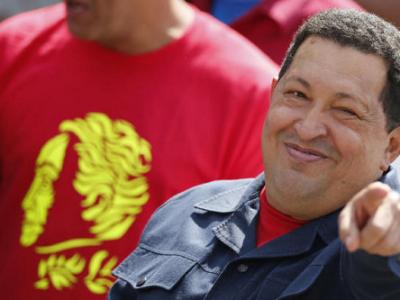
Venezuelan President Hugo Chavez won a resounding victory in last weekend’s elections. If you’ve been following U.S. corporate media coverage of the campaign, that may have come as a surprise to you. Chavez is routinely referred to as a “strongman” and other variations on “dictator” by the U.S. media when, in fact, he remains one of the most popular persons in all of Latin America. In the United States, his ten percent winning margin would be considered a landslide, but all the American media can talk about after Chavez’s latest victory at the polls is how much his lead has shrunk since the 2006 election, when he won by 25 percent.
Every time Chavez and his Bolivarian socialists win at the polls, the corporate media have to eat crow. One would think all that heartburn would force the U.S. press to finally admit that Chavez is the leader of oil rich Venezuela because large majorities of its citizens want him in the presidential palace, and are enjoying the fruits of his wealth distribution policies.
It is also impossible for American media, which are mouthpieces for their corporate owners and take their day-to-day cues from the State Department and the White House, to understand that most Venezuelans agree with Chavez when he denounces the imperialists in Washington. They knew what Chavez meant when he called President Bush “the devil” and said that he stank of sulfur, back in 2006. Venezuelans remembered how Bush backed a coup that almost toppled Chavez in 2002 – a coup that was reversed by a counter-rebellion of the people and loyal soldiers. They remember that the coup leaders’ first act was to abolish the Constitution and start drawing up lists of people to be thrown into prison, or worse. They remember the dark days when nearly all of Latin America was placed under the rule of generals allied with Washington, and the hands of the torturers and the death squads could reach into every family with impunity. They know who was the author of that nightmare: the United States.
That’s why Latin America is the corner of the world that has achieved the greatest success over the last 20 years in throwing off the dead weight of the North, by rejecting the so-called Washington Consensus. And that’s why, this time around, the Venezuelan opposition chose a candidate who pretended to be a leftist, himself. Challenger Henrique Capriles, a young state governor, styled himself as a protégé of former Brazilian president “Lula” da Silva, a more business-friendly type of leftwing politician. But Venezuela’s poor know who the opposition really are: affluent, mostly light-skinned people that live in swank neighborhoods and whose hearts dwell in Miami. The people who draw cartoons in opposition newspapers depicting Chavez as a monkey and openly sneer at his mixed race heritage – the heritage of most Venezuelans. They know what real democracy feels like, because they remember what living under the yoke of a rich white minority felt like. Democracy is having a government that’s not made up of those people whose hearts are in Miami. Democracy calls the top Yankee a devil, and the people cheer, and then the people vote.
Glen Ford can be contacted at Glen.Ford@BlackAgendaReport.com.
Related articles
- Chavez Wins Venezuelan Presidential Election with 54% of the Vote (alethonews.wordpress.com)
- A Hall of Shame for Venezuelan Elections Coverage (alethonews.wordpress.com)
Unasur praise for the reliability and transparency of Venezuelan electoral system
MercoPress | October 8th 2012
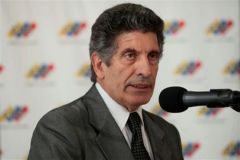 The head of the Unasur delegation sent to Venezuela to follow Sunday’s electoral process, Carlos Alvarez said that the country had given the world a lesson of democracy because of its extraordinary electoral system and the attitude of the opposition, among other positive elements.
“Venezuela has given the world a very important lesson because there were important sectors of the international community that had doubts or questioned the functioning of Venezuelan democracy”, said Alvarez during a press conference in Caracas.
On Sunday’s election, President Hugo Chavez won for the fourth consecutive time with a 54.84% support of ballots while the opposition leader Henrique Capriles managed 44.55% according to the official results from the Electoral Council having counted 95% of votes cast.
Alvarez admitted that many members of the international community “had doubts about how elections in Venezuela were won” and described as “ill-intended those who cast doubts over the functioning of the electoral system”, which he went on to describe as “excellent”.
“It’s an extraordinary lesson for the international community” and the fact that turnout was 80% is “a moving event” for a country were voting is not compulsory, and even more “if one looks back into history and remembers that only 25% to 30% of those registered use to vote”, underlined the former Argentine Vice-president and currently secretary general of the Latinamerican Integration Agency, Aladi.
“We have witnessed a process of excellence; the National Electoral council displayed an extraordinary job, parties and candidates admitted the results and we have accumulated a great experience for the creation of a South American Electoral Council”, said the head of the Unasur observers’ mission. “We came across a highly reliable electoral system and of technological excellence”.
Alvarez said that Unasur complied with all of its objectives and was present all over the Venezuelan territory, with forty delegates from ten different countries.
“It was a double challenge, we were one of the few organizations that came to follow the electoral process and at the same time the first such a mission was sent by Unasur. We are a technical mission, committed to transparency and the efficiency of the electoral systems of our countries”, pointed out Alvarez.
“I’m leaving on Wednesday after I present my report and I will with the satisfaction of the job accomplished, and the happiness of having been witness of the Venezuelan democratic festivity and of an historic event”, concluded Alvarez.
Related articles
- A Hall of Shame for Venezuelan Elections Coverage (alethonews.wordpress.com)
- Chavez Wins Venezuelan Presidential Election with 54% of the Vote (alethonews.wordpress.com)
Chavez Wins Venezuelan Presidential Election with 54% of the Vote
By Ewan Robertson | Venezuelanalysis | October 7th 2012
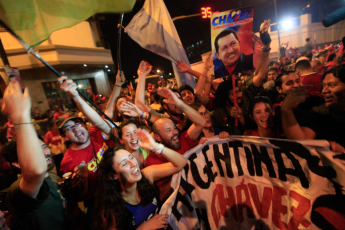
Mérida – Hugo Chavez has won the Venezuelan presidential election with 54.42% of the vote against 44.97% for opposition candidate Henrique Capriles Radonski. Chavez has made his victory speech, while Capriles has recognised his defeat.
The “first bulletin” results were announced by the president of the National Electoral Council (CNE), Tibisay Lucena, at around 10pm Venezuelan time, with 90% of the votes totaled, enough to give Chavez an irreversible victory.
The CNE president said, “Once again we’ve had a calm electoral process, without problems, with the joy of this people who decided to vote massively today”.
A spontaneous street party immediately kicked off in the centre of the Andean city of Merida, and a massive crowd of Chavez supporters began celebrating in front of the presidential palace, Miraflores, in Caracas.
“Venezuela will never return to neoliberalism and will continue in the transition to socialism of the 21st century,” Chavez declared to supporters from the “People’s Balcony” of the presidential palace, after his victory was confirmed.
“I want make a recognition to the whole Venezuelan people, the whole Venezuelan nation. Today the country of (Simon) Bolivar was reborn,” added the socialist president, while congratulating the country “for a civic and democratic day”.
The re-elected Venezuelan president also congratulated the Venezuelan opposition for recognising the CNE’s result, saying “they’ve recognised the truth, they’ve recognised the victory of the people”.
Meanwhile, Henrique Capriles, who was the candidate for the opposition Roundtable of Democratic Unity Coalition (MUD), recognised his defeat, stating to supporters “to know how to win, you need to know how to lose!”
He added, “We began the construction of a path and on it there are more than six million people who are looking for a better future…I’m convinced that this country can be better and I’m convinced that Venezuela is going to be better”.
Chavez received a total of 7,444,082 votes to 6,151,154 for his right-wing rival. He will govern for the 2013 – 2019 presidential term, his third constitutional term in office under the 1999 National Constitution.
Turnout was one the highest in Venezuela’s history, with 80.94% of the 19,119,809 registered voters in Venezuela participating in the election.
Venezuela Election Polls by “Respected” Consultores 21 Unreliable
By Erik Sperling | Venezuelanalysis | October 3rd 2012
With the Venezuelan presidential elections looming this Sunday, the U.S. press is dedicating increasing attention to the campaign between Hugo Chavez and opposition challenger Henrique Capriles. While nearly all polling companies, including the opposition-aligned Datanalisis, give double-digit leads for Chavez, many news organizations continue to give the impression that the race is a toss-up. Countless news agencies have focused heavily on polls conducted by Consultores 21, whose latest poll shows Capriles ahead 49.9 percent to 45.7 percent, to demonstrate that the contest is neck-and-neck.
Consultores 21 is “respected,” “reputable,” and “well-regarded,” according to the Wall Street Journal, ABC News, and Washington Post, respectively. Capriles himself has said “personally, I believe in Consultores. I’ve been looking at Consultores’ polls for many years.”
In a meeting with U.S. election monitors on Monday, influential opposition media figure Teodoro Petkoff said that Consultores is one of the only “serious” pollsters in Venezuela today (discounting Datanalisis as corrupt). It is entirely unclear how they come to this conclusion, however, as Consultores has an extremely poor record in previous Venezuelan electoral contests. For example: In the 2004 vote to recall Chavez mid-term, Consultores predicted a tie between those wanting Chavez to finish his term and those voting to recall. But the recall vote failed with Chavez garnering 60 percent of the vote.
In the 2006 presidential election between Chavez and opposition candidate Manuel Rosales, Consultores maintained that Chavez had just a 13% lead over his opponent. Chavez won that contest with a nearly 26 percent margin over Rosales (62.8% to 36.9%).
In the 2009 constitutional referendum to remove term limits for president, Consultores polls a month beforehand showed just 41.8 backing the referendum, with 56.20 opposed. The referendum passed with a 54 percent majority–almost a polar opposite result from the one predicted by Consultores.
Grave errors such as these by a polling company should have been more than enough to put them out of business. The continued existence of Consultores 21, despite their consistent lack of any semblance of accuracy, demonstrates its purpose as a mere campaign tool for opponents of Chavez. News organizations should be able to uncover and identify this type of blatant bias, and now must take steps to correct their misrepresentation of the status of the Venezuelan presidential election.
Related articles
- One Month before Venezuela’s Presidential Election Polls Show Huge Leads for Chávez (alethonews.wordpress.com)
- BofA Sees Chavez Re-Election Even as Lead in Polls Narrows – Bloomberg (bloomberg.com)
- Chavez Trails Rival Capriles for First Time in Poll (bloomberg.com)
- Chavez Rival Maintains Lead in August Consultores 21 Poll – Bloomberg (bloomberg.com)
Venezuelan Elections: a Choice and Not an Echo
By James Petras :: 10.04.2012
Introduction
On October 7th, Venezuelan voters will decide whether to support incumbent President Hugo Chavez or opposition candidate Henrique Capriles Radonski. The voters will choose between two polar opposite programs and social systems:
Chavez calls for the expansion of public ownership of the means of production and consumption, an increase in social spending for welfare programs, greater popular participation in local decision-making, an independent foreign policy based on greater Latin American integration, increases in progressive taxation, the defense of free public health and educational programs and the defense of public ownership of oil production. In contrast Capriles Radonski represents the parties and elite who support the privatization of public enterprises, oppose the existing public health and educational and social welfare programs and favor neo-liberal policies designed to subsidize and expand the role and control of foreign and local private capital. While Capriles Radonski claims to be in favor of what he dubs “the Brazilian model” of “free markets and social welfare”, his political and social backers, in the past and present, are strong advocates of free trade agreements with the US, restrictions on social spending and regressive taxation. Unlike the US, the Venezuelan voters have a choice and not an echo: two candidates representing distinct social classes, with divergent socio-political visions and international alignments. Chavez stands with Latin America, opposes US imperial intervention everywhere, is a staunch defender of self-determination and supporter of Latin American integration. Capriles Radonski is in favor of free trade agreements with the US, opposes regional integration, supports US intervention in the Middle East and is a diehard supporter of Israel. In the run-up to the elections, as was predictable the entire US mass media has been saturated with anti-Chavez and pro-Capriles propaganda, predicting a ‘victory’ or at least a close outcome for Washington’s protégé.
The media and pundit predictions and propaganda are based entirely on selective citation of dubious polls and campaign commentaries; and worst of all there is a total lack of any serious discussion of the historical legacy and structural features that form the essential framework for this historic election.
Historical Legacy
For nearly a quarter of a century prior to Chavez election in 1998, Venezuela’s economy and society was in a tailspin, rife with corruption, record inflation, declining growth, rising debt, crime, poverty and unemployment.
Mass protests in the late 1980’s early 1990’s led to the massacre of thousands of slum dwellers, a failed coup and mass disillusion with the dual bi-party political system. The petrol industry was privatized; oil wealth nurtured a business elite which shopped on ‘Fifth Avenue, invested in Miami condos, patronized private clinics for face-lifts and breast jobs, and sent their children to private elite schools to ensure inter-generational continuity of power and privilege. Venezuela was a bastion of US power projections toward the Caribbean, Central and South America. Venezuela was socially polarized but political power was monopolized by two or three parties who competed for the support of competing factions of the ruling elite and the US Embassy.
Economic pillage, social regression, political authoritarianism and corruption led to an electoral victory for Hugo Chavez in 1998 and a gradual change in public policy toward greater political accountability and institutional reforms which signaled a turn toward greater social equity.
The failed US backed military-business coup of April 2002 and the defeat of the oil executive lockout of December 2002 – February 2003 marked a decisive turning point in Venezuelan political and social history: the violent assault mobilized and radicalized millions of pro-democracy working class and slum dwellers, who in turn pressured Chavez “to turn left”. The defeat of the US-capitalist coup and lockout was the first of several popular victories which opened the door to vast social programs covering the housing, health, educational and food needs of millions of Venezuelans. The US and the Venezuelan elite suffered significant losses of strategic personnel in the military, trade union bureaucracy and oil industry as a result of their involvement in the illegal power grab.
Capriles was an active leader in the coup, heading a gang of thugs which assaulted the Cuban embassy, and an active collaborator in the petrol lockout which temporarily paralyzed the entire economy.
The coup and lockout were followed by a US funded referendum which attempted to impeach Chavez and was soundly trounced. The failures of the right strengthened the socialist tendencies in the government, weakened the elite opposition and sent the US in a mission to Colombia, ruled by narco-terrorist President Uribe, in search of a military ally to destabilize and overthrow the regime from outside. Border tensions increased, US bases multiplied to seven, and Colombian death squads crossed the border. But the entire Latin and Central American and Caribbean regions lined up against a US backed invasion out of principle, or because of fear of armed conflicts spilling beyond their borders.
This historical legacy of elite authoritarianism and Chavez successes is deeply embedded in the minds and consciousness of all Venezuelans preparing to vote in the election of October 7th. The legacy of profound elite hostility to democratic outcomes favoring popular majorities and mass defense of the ‘Socialist president’ is expressed in the profound political polarization of the electorate and the intense mutual dislike or ‘class hatred’ which percolates under the cover of the electoral campaign. For the masses the elections are about past abuses and contemporary advances, upward social mobility and material improvements in living standards; for the upper and affluent middle class there is intense resentment about a relative loss of power, privilege, prestige and private preferences. The right-wing elite’s relative losses have fueled a resentment with dangerous overtones for democracy in case of lost elections and revanchist policies if they win the elections.
Institutional Configuration
The right-wing elite may not control the government but they certainly are not without a strong institutional base of power. Eighty percent of the banking and finance sector is in private hands, as are most of the services manufacturing and a substantial proportion of retail and wholesale trade. Within the public bureaucracy, the National Guard and military the opposition has at least a minority actively or passively supportive of the rightwing political groups. The principle business, financial and landowners associations are the social nuclei of the right. The right-wing controls approximately one third of the mayors and governors and over forty percent of the national legislators. Major U.S. and EU petroleum multi-nationals have a substantial minority share in the oil sector.
The right-wing still monopolizes the print media and has a majority TV and radio audience despite government inroads. The government has gained influence via the nationalization of banks – a 20% share of that sector, a share of the mining and metal industry and a few food processing plants and a substantial base in agriculture via the agrarian reform beneficiaries.
The government has gained major influence among the public sector employees and workers in the oil industry, social services and the welfare and housing sector. The military and police appear to be strongly supportive and constitutionalist. The government has established mass media outlets and promoted a host of community based radio stations.
The majority of the trade unions and peasant associations back the government. But the real strength of the government is found in the quasi-institutional community based organizations rooted in the vast urban settlements linked to the ‘social missions’.
In terms of money power, the government draws on substantial oil earnings to finance popular long term and short term social impact programs, effectively countering the patronage programs of the private sector and the overt and clandestine “grass roots” funding by US foundations, NGOs and “aid” agencies. In other words despite suffering major political defeats and past decades of misrule and corruption, the right-wing retains powerful institutional bases to contest the powerful socio-economic advances of the Chavez government and to mount an aggressive electoral campaign.
Social Dynamics and the Presidential Campaign
The key to the success of the Chavez re-election is to keep the focus on socio-economic issues: the universal health and education programs, the vast public housing program underway, the state subsidized supermarkets, the improved public transport in densely populated areas. The sharper the national social polarization between the business elite and the masses, the less likely the right-wing can play on popular disaffection with corrupt and ineffective local officials. The greater the degree of social solidarity of wage, salaried and informal workers the less likely that the right can appeal to the status aspirations of the upwardly mobile workers and employees who have risen to middle class life styles, ironically during the Chavez induced prosperity.
The Chavez campaign plays to the promise of continued social prosperity, greater and continuing social mobility and opportunity, an appeal to a greater sense of social equality and fairness; and it has a bed rock 40% of the electorate ready to go to the barricades for the President. Capriles appeals to several contradictory groups: a solid core of 20% of the electorate, made up of the business, banking and especially agrarian elite and their employees, managers, and professionals who long for a return to the neo-liberal past, to a time when police, army and intelligence agencies kept the poor confined to their slums and the petrol treasury flowed into their coffers. The second group which Capriles appeals to are the professionals and the small business people who are fearful of the expansion of the public domain and the ‘socialist ideology’ and yet who have prospered via easy credits, increased clientele and public spending. The sons and daughters of affluent sectors of this class provide the “activists” who see in the downfall of the Chavez government an opportunity to regain power and prestige that they pretend to have had before the ‘revolt of the masses’. Capriles’ past open embrace of neo-liberalism and the military coup of 2002 and his close ties to the business elite, Washington and his right-wing counterparts in Colombia and Argentina assures the enraged middle class that his promise to retain Chavez social missions is pure electoral demagoguery for tactical electoral purposes.
The third group which Capriles does not have, but is vital if he is to make a respectable showing, is among the small towns, provincial lower middle class and urban poor. Here Capriles presents himself as a “progressive” supporter of Chavez social missions in order to attack the local administrators and officials for their inefficiencies and malfeasance and the lack of public security – Capriles, hyper-activity, his populist demagogy and his effort to exploit local discontent is effective in securing some lower class votes; but his upper class links and long history of aggressive support for right-wing authoritarianism has undermined any mass defection to his side.
Chavez on the other hand is highlighting his social accomplishments, a spectacular decade of high growth, the decline of inequalities (Venezuela has the lowest rate of inequalities in Latin America) and the high rates of popular satisfaction with governance. Chavez funding for social impact programs benefits from a year-long economic recovery from the world recession (5% growth for 2012), triple digit oil prices and a generally favorable regional political environment including a vast improvement in Colombian-Venezuelan relations.
The Correlation of Forces: International, Regional, National and Local
The Chavez government has benefited enormously from very favorable world prices for its main export-petroleum; it has also increased its revenues through timely expropriations and increases in royalty and tax payments, as well as new investment agreements from new foreign investors in the face of opposition from some US multinational corporations.
Washington, deeply involved in conflicts in oil rich Muslim countries, is in no position to organize any boycott against Venezuela one of its principle and reliable petrol providers; its last big effort at “regime change” in 2002-03, during the “lockout” by senior executives of the Venezuelan oil company backfired –it resulted in the firing of almost all US ‘assets’ and the radicalization of nationalist oil policy.
US efforts to ‘isolate’ the Chavez regime internationally have failed; Russia and China have increased their trade and investment, as have a dozen other European, Middle Eastern and Asian countries. The EU recession and the slowdown of the US and world economy has not been conducive to fostering any sympathy for any restrictions in economic ties with Venezuela.
Most significantly the rise of center-left regimes in Latin America, the Caribbean and Central America, has favored increasing diplomatic and economic ties with Venezuela and greater Latin American integration. In contrast Obama’s backing for the Honduran and Paraguayan coups and Washington-centered free trade agreements and neo-liberal policies have gone out of favor. In brief, the international and regional correlation of forces has been highly favorable to the Chavez government, while Washington’s dominant influence has waned.
One of the last Latin American bastions of US efforts to destabilize Chavez, Colombia, has sharply shifted policy toward Venezuela. With the change in regime from Uribe to Santos, Colombia has reached multi-billion dollar trade and investment agreements and joint diplomatic and military agreements with Venezuela, signaling a kind of ‘peaceful coexistence’. Despite a recent free trade agreement and the continuance of US military bases, Colombia has, at least in this conjuncture, ruled out joint participation in any US sponsored military or political intervention or destabilization campaign.
US political leverage in Venezuela is largely dependent on channeling financial resources and advisors toward its electoral clients. Given the decline in external regional allies, and given its loss of key assets in the Venezuelan military and among Colombian para-military forces, Washington has turned to its electoral clients. Via heavy financial flows it has successfully imposed the unification of all the disparate opposition groups, fashioned an ideology of moderate ‘centrist’ reform to camouflage the far right, neo-liberal ideology of the Capriles leadership and contracted hundreds of community agitators and ‘grass roots’ organizers to exploit the substantial gap between Chavez’s programatic promises and the incompetent and inefficient implementation of those policies by local officials.
The strategic weakness of the Chavez government is local, the incapacity of officials to keep the lights on and the water running. At the international, regional and national level the correlation of forces favors Chavez. Washington and Capriles try to compensate for Chavez regional strength by attacking his regional aid programs, claiming he is diverting resources abroad instead of tending to problems at home. Chavez has allocated enormous resources to social expenditures and infrastructure – the problem is not diversion abroad, it is mismanagement by local Chavista officials, many offspring of past clientele parties and personalities. The issue of rising crime and poor law enforcement would certainly cost Chavez more than a few lost votes if the same high crime rates were not also present in the state of Miranda where candidate Capriles has governed for the past four years
Electoral Outcome
Despite massive gains for the lower classes and solid support among the poor, the emerging middle class product of Chavez era prosperity, has rising expectations of greater consumption and less crime and insecurity; they look to distance themselves from the poor and to approach the affluent; their eyes look upward and not downward. The momentum of a dozen years in power is slowing, but mass fears of a neo-liberal reversion limits the possible electorate that Capriles can attract. Despite crime and official inefficiencies and corruption, the Chavez era has been a period extremely favorable for the lower class and sectors of business, commerce and finance. This year -2012- is no exception. According to the UN, Venezuela’s 5% growth rate exceeds that of Argentina (2%) Brazil (1.5%) and Mexico (4%). Private consumption has been the main driver of growth thanks to the growth of labor markets, increased credit and public investment. The vast majority of Venezuelans, including sectors of business will not vote against an incumbent government generating one of the fastest economic recoveries in the Hemisphere. Capriles’ radical rightist past and present covert agenda could provoke class conflict, political instability, economic decline and an unfavorable climate for international investors.
Washington is probably not in favor of a post-election coup or destabilization campaign if Capriles loses by a significant margin. The popularity of Chavez, the social welfare legislation and material gains and the dynamic growth this year ensures him of a victory margin of 10%. Chavez will receive 55% of the votes against Capriles 45%. Washington and their rightist clients are planning to consolidate their organization and prepare for the congressional elections in December. The idea is a “march through the institutions” to paralyze executive initiatives and frustrate Chavez’s efforts to move ahead with a socialized economy. The Achilles heel of the Chavez government is precisely at the local and state level: a high priority should be the replacement of incompetent and corrupt officials with efficient and democratically controlled local leaders who can implement Chavez’s immensely popular programs. And Chavez must devote greater attention to local politics and administration to match his foreign policy successes: the fact that the Right can turn out a half a million demonstraters in Caracas is not based on its ideological appeal to a ruinous, coup driven past, but in its success in exploiting chronic local grievances which have not been addressed – crime, corruption, blackouts and water shortages .
What is at stake in the October 2012 election is not only the welfare of the Venezuelan people but the future of Latin America’s integration and independence, and the prosperity of millions dependent on Venezuelan aid and solidarity.
A Chavez victory will provide a platform for rectification of a basically progressive social agenda and the continuation of an anti-imperialist foreign policy. A defeat will provide Obama or Romney with a trampoline to re-launch the reactionary neo-liberal and militarist policies of the pre-Chavez era – the infamous Clinton decade (of the 1990’s) of pillage, plunder, privatization and poverty.
Study: Venezuela’s Chavez 4th Most Popular President in the Americas
By Ewan Robertson | Venezuelanalysis | September 24th 2012
Mérida – Venezuelan President Hugo Chavez is the 4th most popular president in the Americas, according to a new study of presidential approval ratings in the region.
The study, by Mexican polling firm Consulta Mitofsky, gives President Chavez a “high” approval rating of 64%, gaining 6 percentage points since the firm’s last study and jumping up the table of presidential popularity levels.
The findings come less than two weeks before Chavez seeks re-election on October 7 against right-wing opponent Henrique Capriles Radonski.
According to the study, which measured the approval ratings of 20 leaders in the Americas by compiling public opinion polls from their respective countries, Ecuadorian president Rafael Correa is the most popular president in the Americas with an “outstanding” approval rating of 80%.
“Rafael Correa repeats his first place with 80% (a point less than his previous evaluation), maintaining the approval with which his presidency began almost five years ago,” the ‘Approval of Leaders: America and the World’ report stated.
He is followed by Maurico Funes of El Salvador and Guatemalan president Otto Perez, on 72% and 69% respectively.
Chavez and Correa are joined at the top of the popularity table by other presidents considered left or centre left, with Brazil’s Dilma Roussef on 5th with 62% approval, and Nicaraguan president Daniel Ortega on 7th place with a popularity of 59%.
Meanwhile, two months ahead of his re-election bid against Republican rival Mitt Romney, US President Barack Obama placed 10th in the study, receiving a “medium” approval rating of 49%. Canadian Prime Minister Stephen Harper was classed on a “very low” popularity of 37%, putting him down on 16th place.
The study highlights a north-south divide, with South American presidents enjoying an average approval of 50%, against 44% for leaders from the North of the hemisphere.
Many rightist presidents have dropped in popularity since the earlier 2012 study by Consulta Mitofsky, and find themselves on the bottom half of the table. Colombian president Juan Manual Santos still figures on the top half of the table with 54% approval, yet has dropped 13 percentage points and has lost his “high” approval rating.
Furthermore, Mexico’s Felipe Calderon placed 11th (46%), while Paraguayan President Federico Franco and Chilean President Sebastian Piñera share 17th place on 36%. Franco was came to power through an “institutional coup” in June by the Paraguayan Senate, and is less popular than deposed leftist president Fernando Lugo, who had 44% popularity in August 2011.
However, the findings aren’t all good news for South America’s “pink tide” governments, with 12th, 13th, and 14th places going to Argentina’s Cristina Fernandez (43%), Bolivia’s Evo Morales (41%) and Peru’s Ollanta Humala (40%) respectively.
The last places in the poll are occupied by the presidents of Honduras and Costa Rica, on approval ratings of 14% and 13%. The full study in Spanish can be accessed here.
Related articles
- Ecuador’s Correa and El Salvador’ Funes, leaders with the highest approval-rate (en.mercopress.com)
One Month before Venezuela’s Presidential Election Polls Show Huge Leads for Chávez
Venezuela Solidarity Campaign | September 18th 2012
With just one month left before Venezuelans go to the ballot box, a survey of recent opinion polls shows significant leads for Hugo Chávez in the race to be Venezuela’s next president.
The average of all 13 polls carried out in August and in the first week of September, saw Hugo Chávez on 51% and Henrique Capriles on 35% giving Chávez an average lead of 16% (See table 1).
Such a lead would translate into an advantage of more than two million votes for Hugo Chávez on October 7th.
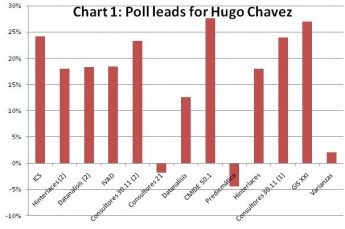 Of these 13 polls surveyed, 11 gave a lead for Hugo Chávez and just two put the main challenger, Henry Capriles Radonski, ahead. (See chart 1 to the right).
In the 11 polls putting Hugo Chávez ahead, all but one gives him a lead of between 13-28%. In contrast, the two polls that put Henry Capriles Radonski ahead gave him leads of just 2% and 4%. […]
Lee Brown who carried out the survey for the Venezuela Solidarity Campaign, said:
“Hugo Chávez clearly has a convincing lead according to the overwhelming majority of pollsters.
The evidence from looking at the full range of polls, rather than cherry picking, does not back up the claims of the campaign of Henrique Capriles Radonski that the race is close or that Capriles is ahead.
Nor is there any evidence that Capriles is making any real inroads into Chávez’s lead as they’ve also claimed.
Hopefully these statements from the right-wing opposition are just the kind of things that get said in the cut and thrust of a campaign.
But the bigger worry is that it’s part of an orchestrated claim by the opposition to give the impression of an impending victory and then to claim fraud on 7 October should they lose, as the polls suggest is very likely.”
Notes
1) The VSC analysis was based on the following poll results published in August and the first week of September, exactly one month before the election.
Related articles
- Hugo Chávez’s challenger and why he’s so confident (miamiherald.com)
- Chavez Rival Maintains Lead in August Consultores 21 Poll – Bloomberg (bloomberg.com)
Shame on You, Dan Rather: Rather’s False Reporting on Venezuela & President Hugo Chavez
By Eva Golinger | Postcards From The Revolution | May 30, 2012
Since Venezuelan President Hugo Chavez was diagnosed with cancer and a malignant tumor was removed from his pelvic region last June, all kinds of rumors, lies and speculations have circulated about his health. Most of the hype has come from known anti-Chavez media, such as the Miami Herald and several online blogs run by right-wing extremists like Bush’s former Assistant Secretary of State Roger Noriega, who’s been obsessed with Chavez for years. All cite unnamed sources who claim they have “insider information” about the Venezuelan head of state’s health. It’s been unsurprising that those media outlets, known for their decade-long distortions of Venezuela’s reality, would publish such falsities and morbid tales about President Chavez. But that a serious, veteran, investigative journalist, such as Dan Rather, would indulge in the necrophiliac story-telling about the Venezuelan President is truly disappointing.
Rather, who now runs his own show on HDNet, Dan Rather Reports, posted a report on Wednesday, May 30, claiming President Chavez’s health is “dire” and has “entered the end stage”. Rather also claims his unnamed “high-level” source, who he alleges is close to the Venezuelan President, told him Chavez won’t live “more than a couple of months at most”. In his brief report, which he calls an “exclusive”, Rather also bids in with his own biased language, calling the democratically-elected Venezuelan President a “dictator”.
What prompted Dan Rather to write such diatribe? Why would he join the ranks of Roger Noriega, the wretched Miami Herald and a slew of pseudo-journalists drooling over their morbid wet dreams of President Chavez’s failing health?
What is apparent is that Rather was quick to the gun to “break” his “exclusive” story. Just the day before, President Chavez hosted a cabinet meeting broadcast live on television that lasted more than four hours. The Venezuelan head of state appeared energized, optimistic and focused on his duties, and even sang a few heartfelt songs, as is custom for the eclectic and charismatic Chavez. He reaffirmed his candidacy for the October 7th presidential elections. (Yes, Venezuela is a democracy!) That’s a far cry from being on his “death bed”, as Rather implies.
President Chavez does have cancer. He’s been the first to inform on his health, and has been open about his treatment and recovery since his first operation last June to remove the initial tumor. Chavez then underwent five sessions of chemotherapy – four of which were done in Cuba. He was recuperating well and even played host to a major historical summit in Caracas last December to inaugurate the newly-formed Community of Latin American and Caribbean States (CELAC), in which all 33 nations in the region are represented.
But in early February, Chavez announced that a second, smaller tumor had been detected in the same area in his pelvic region, and had to be removed. He again returned to Cuba for surgery, and subsequently received several rounds of radiation therapy. According to Chavez, there was no metastasis, nor were any of his organs affected. On May 11, he returned to Venezuela after completing the treatment and expressed his optimism for recovery. “I’m on the plane… Heading for the Venezuelan fatherland. With more optimism than ever! We will live and we will conquer!” Chavez said that day in a message on Twitter.
Since then, the Venezuelan President has participated in several televised meetings and called in to different news programs to discuss his policies and provide updates on his health. He has admitted he can no longer be the “work horse” he was before, and now must limit himself to an 8-hour workday, ensuring he keeps his diet and sleep in check. But previous to his health scare, Chavez was a super-President, appearing on television in public events for hours – sometimes even eight hours – and participating in three to four activities daily, often in different parts of the country. He barely slept and drank excessive amounts of black, sugary coffee. He worked until the wee hours of the morning and listened to every voice, attended every request. His level of energy was extreme, as was his anxiety and commitment to continue rebuilding Venezuela and ensuring his policies reduced poverty and provided for the most needy.
Now, as Chavez runs for his third full term, his pace is no longer extreme, but it’s certainly on par or above his counterparts. Even throughout his cancer treatments, President Chavez was on top of his duties, informing the public via television and Twitter about budgetary issues and new projects underway. He never dropped the ball, despite the severity of his situation.
Chavez has cancer, and he is fighting it hard, with the same strength he has used to propel his nation forward, often against the toughest obstacles. But President Chavez is not “out of the game”, as Dan Rather morbidly implies. Polls show him with double-digit leads over the opposition presidential candidate, Henrique Capriles Radonski, a neoconservative known for his violent role in the April 2002 coup d’etat against Chavez. A majority of Venezuelans know – and love – President Chavez for his immense humanity and his passionate commitment to improving their lives. And they will vote for him again.
Dan Rather has always emphasized the necessity of “courage” in reporting, yet he shows cowardice and sloppy ambition by racing to publish unconfirmed reports on President Chavez’s health, and by touting slanderous epithets to describe the Venezuelan head of state. He also shows a complete lack of respect for President Chavez’s humanity by perpetuating gruesome rumors about his mortality. Mr. Rather appears to have left his journalist ethics and principles behind, and has chosen – at least in this case – to be a pawn of yellow journalism.
My disease is no more: Venezuelan President Chavez
Press TV – July 10, 2012
Venezuela’s President Hugo Chavez has declared that he has overcome his illness, dismissing allegations that any physical ailment will affect his campaigning for the country’s upcoming elections.
“Free, free, totally free,” Chavez told reporters at a four-hour press conference on Monday when asked if he was still afflicted with cancer.
“Thanks to God, I am here and every day I feel [I am] in [a] better physical condition, and I really don’t think this expression ‘physical restrictions’… will be a factor in the campaign,” he told the conference. … Full article
Media & Opposition: False Perceptions of Venezuela’s Democracy
By Rachael Boothroyd | Correo del Orinoco International | May 25th 2012
Earlier this week Al Jazeera English published an article by Nikolas Kozloff, a former academic turned author who now spends his time writing satire and lambasting the Venezuelan government while hiding behind his Oxford PhD as a veil of objectivity. The focus of Kozloff’s latest article was the Cuban-Venezuelan “Barrio Adentro” initiative, a social mission which provides free healthcare to Venezuela’s poor, and free, community based training for Venezuelan medical students.
Despite the program being one of the government’s most popular, and the fact that it is often cited as an exemplary case of Cuban internationalism and solidarity, in his article Kozloff instead decides to detail the alleged “harrowing” conditions that Cuban doctors are subjected to while treating patients in Venezuela.
According to Kozloff’s article, Cuban medical personnel are overworked, obliged to treat 60- 70 patients a day, constantly spied on, and used by the Venezuelan state for political purposes. The sources of Kozloff’s outlandish statements are none other than leaked documents from the US embassy in Caracas, which, the cables reveal, has been aiding dissident Cuban doctors to apply to the US government for “humanitarian parole” so that they might be transferred to Miami as “asylum seekers”.
According to the documents, 73 Cuban medical personnel were transferred to Miami by 2009. Despite the fact that over 80,000 Cubans have worked in the mission, with 30,000 Cuban medical personnel currently working in Venezuela, Kozloff finds that these 73 Cubans are representative enough of the whole Barrio Adentro mission for him to conclude that the program is “fraying at the edges” in the run-up to this year’s elections.
But questionable e-mails written by staunchly anti-Cuban US diplomats might not be the best sources for judging the merits of a social program which has, by all accounts, dramatically increased Venezuelans’ standards of living. So much so, that despite the vast amounts of propaganda against the healthcare program, the opposition’s candidate, Henrique Capriles Radonski, has been forced to pledge that he will maintain it should he by some miracle win the elections this year.
Kozloff’s selective analysis of the state of the Barrio Adentro program is typical of most “political commentaries” covering the Venezuelan elections in the international press, which are currently contributing to a distorted understanding of Venezuela’s political reality in the run up to the October elections.
Opposition Out of Touch
While most commentators either stress Capriles’ youth (he’s 39) and his energetic campaign, or apparent “indecision” on the part of Venezuelan voters, the reality on the ground is quite different in Venezuela. The opposition have faced defeat after defeat for the past two months.
Not only do nearly all polls in Venezuela give Chavez a 20-30% lead over his opponent, but the Capriles campaign has also made several tactical mistakes. In a move that alienated working class voters in May, Capriles announced that he did not attend the country’s International Workers’ Day march because he was an “employer” and not an employee. His campaign has also been responsible for the persecution and assault of several community media journalists, harking back to the days of repression under previous governments.
In the international arena, in a subtle snub against the Venezuelan opposition coalition, Colombian President Juan Manuel Santos stated in an interview that Chavez represented “stability” for the continent that was both essential for regional unity and beneficial for Colombia. Meanwhile US ally and former Colombian president Alvaro Uribe’s vocal support for Capriles has backfired, only serving to reinforce the perception of Capriles as the candidate of US imperialism amongst the Venezuelan public. Just this week, Capriles’ US advisor, Peter Greenberg, also admitted that Chavez’s lead over Capriles was “irreversible”.
These concerns are also being echoed by conservatives inside the country with even rightwing journalists such as Rafael Poleo mourning Capriles’ “hopeless” election campaign and members of the opposition coalition demanding that the campaign be restructured. “Capriles could be out anywhere today, but the rest of the country does not know about it… (his) strategy is not working, his candidacy is not growing, and Chavez’s illness has hyper-personalized electoral debate. People are only talking about Chavez”, explained Oscar Schemel, President of the Hinterlaces polling company.
Throughout this election campaign the opposition’s most serious failure is to have misunderstood the extent to which new mechanisms of participatory democracy have grown in Venezuela. The concept of democracy has taken on new meaning and the working class and organized communities are currently at the helm of an unprecedented experiment with radical new forms of democratic participation. Citizens’ democratic participation is now channelled through communal councils, communes, socialist workers’ councils and cooperatives, which extend the democratic process into their everyday lives and allow them to transform their own socio-cultural surroundings. Venezuelan democracy is no longer reducible to national elections every 6 years, rather it is something constructed every single day.
Following an unsuccessful 12-year battle against Chavez waged on its own terrain, the opposition is now attempting to compete on the Revolution’s terrain and the results are perhaps even less rewarding. The opposition has totally failed to understand just how Venezuela’s political terrain is constantly shifting and continuously being propelled forwards by the country’s new grassroots democratic format.
Just like Kozloff, the Venezuelan opposition continues to look at Venezuela from a distance. Their sources are US diplomats, US political advisors or the Venezuelan elite. From this perspective, Barrio Adentro is merely a political strategy. For Kozloff, it is merely the product of a transient deal with Cuba which can be rolled back should another government take power. For Capriles it is a program he must pledge to maintain in order to have any chance of winning votes.
But for many Venezuelans Barrio Adentro is more than a political strategy and more than a program, it is a social process which has become an integral part of their everyday lives, which has brought dignity, value and identity, and shaped their communities and changed their educational possibilities. These are changes that can’t be perceived from the upper class district of Altamira in Caracas, and much less from a newsroom in New York.
Related articles
- Germany Asks European Union to Step Up Support for Venezuela’s Opposition (alethonews.wordpress.com)
- Venezuelan Opposition Promises “Renewal” for Venezuela-Israel Relations (alethonews.wordpress.com)
- Why Do Venezuelan Women Vote for Chavez? (alethonews.wordpress.com)
- Capriles and Chavez Neck and Neck, and Pigs Might Fly, or Conduct a Poll (alethonews.wordpress.com)
- Immigration to Venezuela Double that of Emigration (alethonews.wordpress.com)
Venezuelan Opposition Promises “Renewal” for Venezuela-Israel Relations
Correo del Orinoco International | May 21st 2012
Over the weekend, Venezuela’s anti-Chavez minority confirmed reports that one of their own recently met with right-wing Israeli Prime Minister Benjamin Netanyahu and promised to re-establish ties with Israel if the opposition is somehow successful in this year’s presidential election. Speaking on behalf of the opposition’s so called Democratic Unity Roundtable (MUD), Metropolitan Mayor of Caracas Antonio Ledezma is said to have promised both economic and political rewards in exchange for Israeli support of MUD presidential hopeful, Henrique Capriles Radonski.
Though the MUD have been totally unable to improve their standing in polls which predict a sweeping electoral victory for Venezuelan President Hugo Chavez this October 7, Ledezma’s comments in Israel provide a troubling glimpse at wishful opposition thinking in a post-Chavez period.
“SOLIDARITY” WITH ISRAEL?
Though he was in Jerusalem last week for the 28th International Mayors Conference, opposition lawyer and politician Antonio Ledezma took advantage of his publicly-financed trip to meet privately with Israel’s Prime Minister Benjamin Netanyahu as well as the country’s Foreign Minister, Avigdor Lieberman. Asked about the closed-door meetings, Ledezma said he had used his time in Israel to spread “the message that the Venezuelan nation has respect for Israel”.
Ledezma told reporters he spoke with Netanyahu and Lieberman about “the Venezuelan people’s solidarity with the Jewish community” and, “in addition, our (opposition) disposition to reestablish relations with the State of Israel under a new government presided by Henrique Capriles Radonski”.
“In contrast to the current political policy in Venezuela”, he said, “Capriles will re-establish our historical ties”.
Not needing to say so openly, Ledezma’s reference to “historical ties” includes both the United States and Israel, in contrast to Chavez administration policies favoring relations with the entirety of the Global South, including China, Russia, Iran and Cuba, to name just a few.
Pleased with the opposition spokesman, and in direct reference to the Chavez administration, Israel’s Foreign Minister responded to Ledezma’s comments by stating, “nations in the global village of today need reasonable governments that help encourage cooperation among peoples”.
Guaranteeing an opposition victory, Ledezma added that “our people, who don’t know how to mistreat, who value peace and love for one’s neighbor, mustn’t be confused with the decisions of an intemperate administration which has broken our historical relations and is on its way out”.
The right-wing mayor, who withdrew from opposition primaries for lack of electoral potential, told Israeli media he believed “the opposition’s chances are equal (to Chavez’s) and even greater, mostly because it is bringing a message of renewal to all of Venezuela”. Ledezma added that he hopes “the current government will allow for democratic elections”.
President Chavez, who holds a double-digit lead against Capriles Radonski in every poll taken to date, instructed his government to break relations with Israel after the Israeli military killed some 1,500 Palestinians and wounded another 5,000 during its 2009 siege on Gaza.
At that time, the Venezuelan Ministry of Foreign Affairs issued a press release stating that “Israel has repeatedly ignored the calls of the United Nations, consistently and shamelessly violating the resolutions approved by overwhelming majorities of member countries, increasingly placing itself on the margin of international law” and added that “Israel’s state terrorism has cost the lives of the most vulnerable and innocent: children, women, and the elderly”.
During his 3-day trip to Israel, the opposition’s Ledezma made no mention of Israel’s segregationist policies towards the Palestinians, the widely-condemned but ongoing blockade against those in Gaza, nor did he question the inhuman prison conditions currently under international scrutiny as several Palestinian hunger strikers near death.
PROMISING RESOURCES
Late last week, Venezuelan philosopher and TV journalist Miguel Angel Perez Pirela denounced the meeting between Ledezma and the Israeli Prime Minister, calling it “further evidence” of opposition plans to “destabilize” the country. Pirela reminded viewers that MUD spokesmen have now met with former Colombian President Alvaro Uribe, with right-wing members of the anti-Chavez community in Southern Florida, and, now, with Israel’s Netanyahu.
Pirela explained that Ledezma spent tax-payer funds to finance his trip to Israel, and used his time in the Middle East to request Israeli support for MUD presidential hopeful Capriles Radonski. In exchange for support, he said, Israel was promised “access to the country’s resources” if the opposition were to somehow take this year’s presidential election.
“He who doesn’t want to see has the right not to; he can joke things off and accuse us of paranoia”, said Pirela, “but this smells rotten”.
“There are strong signs that they [opposition figures] are showing us the exact location from which the bullets will be fired”, he said, suggesting recent opposition meetings in Colombia, Miami, Florida, and Israel are evidence of a larger opposition strategy to destabilize Venezuela with international support.
With respect to Israel, in December 2011 and with no evidence to back his assertions, Israeli Vice Prime Minister Moshe Ya´alon accused Venezuela of working with Iran to create a “terrorist infrastructure” across the Americas that could be used to “attack the interests of the United States”.
In response to his statements, Venezuela’s Foreign Ministry affirmed, “such abusive and tendentious statements, which come from the representative of a government that itself participates in terrorist attacks against the Arab peoples, are part of a continuous campaign of aggression against our people”.
DEFENDING REVOLUTION
Speaking at a pro-Chavez rally on Friday, Mayor of the Caracas Libertador Municipality and head of the Chavez re-election campaign Jorge Rodriguez denounced the opposition’s international positioning. In the border state of Tachira backing grassroots efforts to re-elect Venezuela’s socialist President, Rodriguez accused Capriles Radonski of traveling to Colombia “to seek advice from known drug trafficker and confessed paramilitary figure, (former President) Alvaro Uribe”.
Rodriguez told those gathered, “the lazy Mayor of Caracas, Mayor Ledezma, recently made his way to Israel and is also meeting with representatives of the extreme right”.
“They’ve already lost hope in winning the election”, Rodriguez affirmed, “but if they try taking the path of destabilization they’ll face the people and homeland, ready to defend the Revolution”.
Related articles
- Germany Asks European Union to Step Up Support for Venezuela’s Opposition (alethonews.wordpress.com)
- Capriles and Chavez Neck and Neck, and Pigs Might Fly, or Conduct a Poll (alethonews.wordpress.com)
Germany Asks European Union to Step Up Support for Venezuela’s Opposition
A German news website has revealed that the German government has been pushing for Eurozone countries to adopt a more active role in backing the current Venezuelan opposition coalition, the Roundtable of Democratic Unity (MUD), in the run up to this year’s presidential elections.
In an article published by Amerika21 earlier this week it was revealed that German diplomats had taken advantage of a recent European Union Council meeting on Latin American affairs to call on members to offer “greater and more open support” to the MUD and its candidate Henrique Capriles Radonski, who will stand against incumbent President Chavez in October.
According to the website, German delegates at the meeting in April had said that support for Venezuela’s opposition “should not be hidden from the public”, despite calls from other European nations such as France and Portugal who argued for a “more discreet” approach.
The news was disclosed as a team of representatives from the German Parliament took part in a governmental delegation to Venezuela, where they met solely with members of the country’s political opposition.
According to Prensa Latina news, which had access to the delegation’s agenda, the diplomats met with leading figures from the Venezuelan political opposition such as MUD Secretary General, Ramon Guillermo Aveledo, and other leading figures from opposition parties such as Democratic Action (AD).
The representatives are also reported to have met with anti-government NGOs during their stay, including organizations such as the Venezuelan Prison Observatory, which has previously been accused of carrying out acts aimed at sabotaging the national government and receives funding from the US government.
Meetings with the head of Venezuela’s business federation, Fedecamaras, and the head of Venezuela’s chamber of commerce, were also amongst the delegation’s agenda. “In Venezuela we met almost exclusively with opposition forces, while in Chile, our next stop, we met with people from the government”, reported German representative Heike Hansel from the German Socialist Party, Die Linke, in an interview with Prensa Latina.
The German government currently led by Angela Merkel has recently come under fire for its open backing of French rightwing candidate, Nicolas Sarkozy, who lost his bid for reelection to socialist candidate, Francois Hollande, earlier this month.
The MUD currently receives direct financial support from US institutions such as USAID and the National Endowment for Democracy (NED), although President Chavez has warned that the US government may expand its support for the opposition into other areas as the elections draw nearer.
The Venezuelan President has also stated that the MUD is developing a strategy to contest this October’s election results in league with the US government.
Related articles
- US Shelters Venezuelan Fugitive, Criticises Existence of “Drug Kingpins” in Venezuela (alethonews.wordpress.com)
- CNN: The Latest Outlet for Roger Noriega’s Paranoid Speculations (alethonews.wordpress.com)
Featured Video
Laith Marouf: Hezbollah’s position on US-Iran ceasefire
or go to
Aletho News Archives – Video-Images
From the Archives
The Dirty Little Secret behind the “Global Terrorism Index”
The Omission of Israeli Terrorism in the Occupied Palestinian Territories
By Karin Brothers | Global Research | December 6, 2014
… The Israeli settlements — all of which are illegal – have been identified as a major impediment to peace. The refusal of a major “global” terrorism report to name the Israeli settlers as one of the groups most responsible for terrorism not only misrepresents a major source of regional violence but exposes the Global Terrorism Index as a propaganda tool that supports a U.S. agenda.
In recent years, governments have been attempting to thwart terrorism by blocking supportive fund-raising. When it comes to Israeli settlements, however, the US and Canada actually encourage fund-raising by giving organizations (such as Christian Friends of Israeli Communities (CFOIC) and the Jewish National Fund) financial support in the form of donor tax-deductions.
Charities which provide funds for the Israeli settlements should be regarded as terror-financing organizations. They should not only lose their tax-deductible status, but they should be banned because they support the violation of international humanitarian law. The terror-financing laws that are being strictly enforced for Muslim charities should be applied to Christian and Jewish charities as well. … Read full article
Blog Roll
 Aletho News
- The ‘Opposition Party’ Has Done Nothing to Stop the Iran War and Much to Goad Trump Into Continuing It
- Moscow backs Tehran on status of Lebanon in US-Iran deal
- How UK Regulator Ofcom Quietly Bypassed International Law to Police American Speech
- The Black Cube Files: How Former Mossad Operatives Flipped a Nation
- Laith Marouf: Hezbollah’s position on US-Iran ceasefire: What you’re not being told
- Israel’s priority lies in destroying chances of peace between Iran, US: Ex-UN nuclear chief
- Ceasefire for all or for none: Iran shuts Hormuz over Lebanon attacks
- Strait of Hormuz is Iran’s ‘nuclear weapon’ that forced US retreat: Medvedev
- Energy crisis will last for months – Kremlin envoy
- Europe’s quiet role in the war on Iran
- If Americans Knew
- This is ceasefire? Israel’s biggest massacre yet in Lebanon, another journalist killed in Gaza – Daily Update
- Tucker Carlson on Israel: This Is the Behavior of an Ally? Really?
- Gazans face a triple crisis: severe shortages of water and bread, healthcare in tatters
- NY Times reports how Netanyahu took the US into Iran War
- A sigh of relief over Iran, but Gaza and Lebanon in dire straits – Daily Update
- Thousands dead and neighborhoods razed to the ground: Aid agencies fear southern Lebanon is becoming the new Gaza
- The war the US is fighting for Israel could cost trillions
- ‘Cigarette Burns, Nail Wounds’: Toddler Tortured in Gaza to Coerce Father
- Trump Says US Sent ‘a Lot of Guns’ to Protesters in Iran
- Israeli forces destroy 17 UN peacekeeper cameras in south Lebanon
- No Tricks Zone
- An Inconvenient Tree: Uncovered In Alps… Europe Much Warmer Than Today 6000 Years Ago
- New Study Reports A 60% Slowdown In Greenland’s Ice Loss Rate In The Last Decade
- Low Intensity Tornado Wrecks Major Solar Farm, Creating A Potential Toxic Dump
- New Study Finds Warming Saves Lives…Cold Temperatures 12 Times More Deadly Than Excess Heat
- German Science Blog Accuses PIK Climate Institute Of Hallucinating Climate Tipping Points
- Devastating Assessment Of Comirnaty Vaccine By Former Senior Pfizer Europe Toxicologist
- New Study: CO2 Is ‘Effectively Negligible’ As An Explanatory Climate Change Factor Since 2000
- Former Pfizer Toxicologist Dr. Helmut Sterz Tells Bundestag Hearing Pfizer Vaccine Should Have Never Been Approved
- Energy Expert: Germany’s Nuclear Phaseout Was A “500 Billion Euro Mistake”
- New Research: South Australia’s Mid-Holocene Sea Surface Temperatures Were 4°C Warmer Than Today
 Aletho News