US enlists Cyprus, Jordan, Greece as ‘defensive platforms’ for Israel: Report
The Cradle | August 9, 2024
Washington has enlisted the island nation of Cyprus in its efforts to protect Israel from potential retaliations by Iran and Hezbollah to the recent Israeli attacks on Tehran and Beirut, Lebanese daily Al-Akhbar reported on 9 August.
A US military delegation visited Cyprus this week and held urgent meetings with Cypriot defense and intelligence officials.
“The delegation was accompanied by a logistical, military and security force carrying with it a large amount of equipment, weapons and modern air defense systems, in addition to helicopters,” Al-Akhbar wrote.
Cypriot officials said they had never seen such quantities of weapons before, the report went on to say.
According to the report, the US informed Cyprus that this equipment was “related to tensions in the region” and that the island would serve as “one of the interception platforms against expected attacks from Iran, Yemen and Hezbollah.”
It adds that the UK has reinforced its bases in Cyprus, and has sent experts and air defense equipment to the country.
The UK has two large military bases in Cyprus, which are British sovereign territory and make up 2.5 percent of the island’s area.
Germany has also reportedly expressed an intention to deploy naval forces to Cyprus and to assist in evacuations in case of a large-scale war.
“What further confused Cypriot authorities was the US request for joint military drills with American forces on the island’s land and seas … drills do not happen suddenly, but rather require a program that is prepared at least a year in advance, not 48 hours in advance,” Al-Akhbar said.
“Cypriot officials have been keen to communicate with … the axis of resistance, especially Hezbollah, to convey the message that what is happening ‘is happening against their will, and that they do not want to involve their country in any war.’ They expressed their fear that the island could become an arena for a confrontation with Iran, Hezbollah, and even Ansarallah.”
Yemen’s army and Ansarallah resistance movement is also preparing a response to the Israeli attack on Hodeidah port last month.
The Al-Akhbar report states that these messages are unlikely to change anything in the event of a wide-scale war, given that Cypriot authorities are also coordinating directly with Tel Aviv.
“Opening Cypriot airports and bases to the Israeli enemy to target Lebanon would mean that the Cypriot government is part of the war, and the resistance will deal with it as part of the war,” Hezbollah leader Hassan Nasrallah said in a speech in June, warning Cyprus against taking part in an expanded Israeli war on Lebanon.
Cyprus and Israel have stepped up military cooperation in recent years as part of a joint declaration signed in 2017 and have also carried out several joint military and naval exercises. In 2022, the two states carried out joint military exercises on the island nation’s territory. Cyprus denied Tel Aviv’s declaration at the time that the exercises were meant to simulate war inside Lebanon.
Hebrew newspaper Israel Hayom reported on 11 March this year that Israel is seeking to establish a port in the Cypriot city of Larnaca in case the port of Haifa is closed in a war with Hezbollah.
According to the Al-Akhbar report, Greece and Jordan are also deeply involved in Washington’s defensive plans for Israel.
In April, Jordan played a significant role in intercepting Iranian missiles and drones which targeted Israel in response to its destruction of the Iranian consulate in Damascus and the killing of several of its officials that month.
Israel killed Hamas chief Ismail Haniyeh in Tehran on 31 July, as he was visiting Iran as a diplomatic guest while attending the inauguration of the country’s new president. A day earlier, Israel killed a top Hezbollah commander in the Lebanese capital, targeting him in a residential building while killing several civilians, including children, in the process.
Hezbollah and Iran have both vowed severe retaliations to the illegal attacks.
De-escalation vs. self-defense: Double standards or racism?
By Jamal Kanj | Al Mayadeen | August 9, 2024
On the evening of July 30, an Israeli drone targeted a residential building in the Southern Suburb of Beirut, killing three women and two children, and injuring 74 civilians. “Israel” claimed the attack was aimed at an officer of the Lebanese Resistance. Targeting residential infrastructures outside a war zone is part of the Israeli army’s Artificial Intelligence (AI) program, known as “Lavender.” The AI Lavender program, as we have seen in Gaza, koshers the killing of up to 100 civilians or entire families in order to assassinate a single commander.
Less than 24 hours later, Israeli agents violated Iran’s sovereignty and assassinated Palestinian leader Ismail Haniyeh during his official visit to Tehran, like when “Israel” bombed the Iranian embassy complex in Damascus last April, killing 8 military advisors and an equal number of Syrian civilians and Iranian consular staff.
Rather than condemning the Israeli aggression, Western capitals called on the victims (Iran and the Lebanese Resistance) to de-escalate and exercise restraint. “No one should escalate this conflict,” Blinken told reporters on August 6. “We’ve been engaged in intense diplomacy with allies and partners, communicating that message directly to Iran.”
German Foreign Minister Annalena Baerbock took to X calling on “especially #Iran, to exercise restraint and de-escalate for the sake of the people in the region.”
Britain and France doubled down on the foreign violation of Iran’s sovereignty during the emergency UN Security Council meeting on July 31, blaming Iran, the victim in this case, for the dangerous escalation in the region. According to various resources, French President Emmanuel Macron told his new Iranian counterpart to end the “logic of reprisals” and for the “protection of civilian populations.”
Western powers called for de-escalation in response to the Israeli aggression against Iran and Lebanon. On the other hand, they defended “Israel’s” right to “self-defense” following the Palestinian revolt against the Israeli siege on October 7. Leaders from more than 14 countries, 8 including heads of state paid homage to declare solidarity with “Israel”. Yet, not a single Western leader called on “Israel” to de-escalate.
If “Israel” is perceived as the target of an attack, Western leaders promote Israeli “logic of reprisals” under the pretext of “self-defense”. Meanwhile, when others are targeted by “Israel”, then and only then, de-escalation is deemed necessary for the “protection of civilian populations.”
Returning to the German Foreign Minister’s recent post on X. When “Israel” was targeted on October 7, Germany saw no need to de-escalate “for the sake of the (Palestinian) people in the region.” De-escalation was necessary though, “for the sake of the (Israeli) people…” following the Israeli attack on Iran and Beirut.
Ironically, the call by Western leaders to “de-escalate” is not a genuine endeavor to avoid a wider conflict, but rather their proclivity to sanction Israeli wars. They sanctioned “Israel’s” war of genocide when they excused its aggression as “self-defense” and then refused to call for a ceasefire for more than six months. They empowered “Israel” by waging a proxy war against Yemen on its behalf. They enabled “Israel’s” defiance by continuing to supply the armament used to kill and maim the children of Gaza. They enabled Israeli-induced famine against 2.3 million people by refusing to accept the findings of the International Court of Justice and the International Criminal Court. More importantly, they enabled Israeli intransigence when, following the Israeli murder in Tehran and Beirut, the US president ordered US military deployments in the Middle East to defend “Israel” “against all threats from Iran.”
The above is not merely a double standard, but congenital Western racism toward the perceived “lesser” than equal people, for the US Administration, Canada, Britain, and the European Union’s unadulterated racism has for decades enabled “Israel’s” arrogance, both materially and diplomatically.
By the same Western definition of the right to self-defense, the Iranian government, the Lebanese Resistance, and Yemen have every right to exercise their right, according to international law following Israeli attacks on Tehran, Beirut, and Hodeidah in Yemen. This is more so than what Western leaders erroneously bestowed on an occupying power following October 7.
The Resistance is undoubtedly aware of Western powers’ efforts to delay and/or diffuse the response to Israeli extrajudicial assassinations. European leaders, for instance, have sent direct and indirect equivocal messages to Iran expressing a willingness to open a new chapter after the election of the new reformist president.
Arab and Western leaders have also cautioned the Resistance in Lebanon against taking any action that could jeopardize the “progress” in the ceasefire talks, when, in reality, the opposite is true. The Palestinians are in a stronger negotiating position with support from the Lebanese and the Yemeni fronts, not by the groveling of Arab regimes to Israeli enablers.
In fact, as it became clear that retaliation against “Israel” was imminent, the US, Qatar, and Egypt scrambled a statement on August 8 calling for a new round of ceasefire negotiations. This announcement was almost certainly coordinated in advance with “Israel”, as evidenced by Netanyahu’s unusually swift agreement to send a delegation “in order to finalize the details and implement the framework agreement.”
It is almost certain that the Resistance understands that all this is a ruse and outright prevarication by the Biden administration and two vassal Arab countries to muddy the waters, allowing “Israel” to literally get away with new murders. The aggrieved parties are expected to respond because allowing “Israel” to cross this redline would embolden Israeli intransigence and afford it a new opportunity to cross more dangerous redlines that could lead to a more destructive war in the future.
In the last decade, “Israel” has murdered at least five Iranian scientists, including its top civilian nuclear program chief Mohsen Fakhrizadeh in 2020. These assassinations came at a very little cost, if any, for “Israel”. However, the recent case of murdering an invited guest crosses a different redline that “Israel” and the West are unable to comprehend. In the East, protecting your guest is an honor that must be defended at all costs.
It’s implausible that the forces of Resistance would be dissuaded by the new American/Israeli gambit or the misplaced racist “de-escalation” rhetoric from the other Israeli enablers. According to public pronouncements from Iran, Yemen, and Hezbollah in Lebanon, a proportional retaliation against apartheid “Israel” is inevitable.
Patience is a virtue, and as some have suggested, ambiguity and waiting it out are part of that broader strategy. While that might be true, there is, however, a cost-benefit dynamic related to the time taken to make a decision. The Resistance is likely aware that further vacillation would decrease the benefits and fetter the momentum for an in-kind reprisal against “Israel”.
Why The Zionist Entity Decided To Take The Risk Of Regional War?
By Robert Inlakesh | Al Mayadeen | August 8, 2024
Despite the Israeli-US alliance pulling off two high-profile assassinations within hours and posed as if they are ready for an all-out war, it is clear that they could only handle a regional conflagration which would quickly end in a stalemate. If this escalation goes the wrong way, however, there are only two options left for them, and both are terrible.
The Zionist Entity was faced with a choice, after failing to reach victory in Gaza: either end the war or escalate. It was clear from Israeli Prime Minister Benjamin Netanyahu’s address to the US Congress that the leader of the Entity was bent on escalation and that he would receive bipartisan support in the United States for carrying out actions designed to achieve the desired goal.
Finding their justification in the massacre of 12 Syrian-Druze children in the occupied Golan Heights, quickly jumping to accuse Hezbollah, the Israeli military launched their attack on a multi-story building in southern Beirut. While the Zionists attempted to use the blood of the indigenous people of the Golan, living in Majdal Shams, for their own propaganda purposes, the people refused to allow them and blamed the Zionists for the massacre in their village, as Hezbollah vehemently denied any involvement.
The timing of the massacre came at a convenient time for the Zionist Regime, as the Israeli PM was at the tail end of his trip to the United States. Shortly afterward, the Israelis murdered seven Lebanese and injured around 80 in their attack on the southern suburbs of Beirut. The primary target was Hezbollah military leader Fouad Shokor, who was martyred along with three children and two women on Tuesday, July 30. Then, just hours later, the Hamas political leader Ismail Haniyeh was assassinated in the Iranian capital, Tehran.
None of this is by accident and the suggestion that the United States was not involved is simply ludicrous.
What Is The US-Israeli Strategy?
An all-out regional war will result in the annihilation of the Zionist Entity, for even with direct US involvement, the Zionists still can’t win. Even if we assume that nuclear weapons might be used, the firepower of the Resistance is such that the Israelis would experience a similar blow from the sheer scale of missile power directed toward them.
Knowing that victory is not possible, it appears evident, therefore, that strategies are in place to prevent a war from reaching its inevitable conclusion. The Israelis and Americans are frustrated by their devastating failures since the Hamas-led October 7 attack, whether it be in the inability of the Zionist military to secure a victory against the Palestinian Resistance in Gaza, or the US’ embarrassing defeat at the hands of Yemen’s Ansar Allah. The blows dealt to the Zionist Entity, in the security, military, political, societal, and economic spheres, are so great that it is unclear how they can ever recover.
Faced with such a predicament, the US-Israeli alliance had two options, either accept the strategic defeat and pursue a diplomatic solution to the chaos they have wrought over the past 10 months, or, escalate. The assassinations in Beirut and Tehran indicate they chose escalation.
The Israelis themselves have conducted two major war games over the past years, testing the capabilities of the Zionist military to fight a multi-front war, losing both times. Keep in mind that these military exercises were also conducted while assuming that the full strength of the Israeli military would be intact. At this time, the Zionist army is stretched thin, it is undertrained, overworked, and suffers from a lack of motivation and discipline. Additionally, it has lost many of its tanks and armored personnel carriers, as thousands have been damaged and destroyed in Gaza.
It suffices to say that Israel does not possess the capacity to fight the war it is pursuing, which is why the assassinations came as such a shock to many. However, as I have previously written here for Al Mayadeen, the Israelis had one last option left to prolong the war and the strategy is as follows:
Open up a war with Lebanon, but attempt to keep it limited to trade off blows and close the conflict with a stalemate. A war with Hezbollah will bring great carnage to Israeli infrastructure and result in scores of dead Israelis, thereby distracting the population from the war in the Gaza Strip. This would create an environment that could enable the Israeli prime minister to close a ceasefire deal with Hamas in Gaza. From there, the Zionist regime could then pivot to the West Bank, annexing around 60% of its territory and launching a military operation – similar to “Operation Defensive Shield” in 2002 – to murder the majority of the Resistance fighters there.
Under such a scenario, Benjamin Netanyahu will use the assassinations of Resistance leaders as trophies to brag about a supposed victory, while presenting the argument that his regime confronted an existential threat from multiple foes and survived. He will then use the land grab in the West Bank as proof of conquest and the killing of Resistance fighters there as a “security” achievement. This situation is what both the US and their Israeli allies see as the best-case scenario.
However, the situation could quickly spiral out of control and the damage done to the Zionist Entity could prove so great that it remains only a shell of itself if it manages to survive at all. It is a dangerous strategy, to say the very least, and although they may see it as a bold attempt to restore US-Israeli hegemony in West Asia, it also projects weakness and a lack of options. Such a risk, which could result in the end of the Zionist Entity, would only be taken if their backs were against the wall.
If this goes sideways for the Zionists, then they will likely have two options left. The first will be the infamous Samson Option, to use their nuclear weapons. The second could involve the deployment of regional forces into occupied Palestine to prevent the fall of the Zionist Entity.
The first option needs no further explanation; it is pure terror. The second has not been publicly discussed as of now but could also be implemented if it looks like the Israeli regime is about to collapse on the ground and Palestinian territory is close to liberation. If such an event occurs, it is plausible that the Jordanian and Egyptian armies could be deployed into occupied Palestine, in order to prevent the land from being taken over by Resistance fighters who are less likely to engage regional armies, this would also likely involve the presence of the Turkish armed forces who could potentially be deployed as well. Although there is no evidence to support this theory, it might be seen as the only way to de-escalate the situation if the Zionist Entity is on the brink of disintegration.
Regardless, the Zionists have gambled, and only time will tell how this will turn out.
Resistance Axis: a calculated, simultaneous strike on Israel
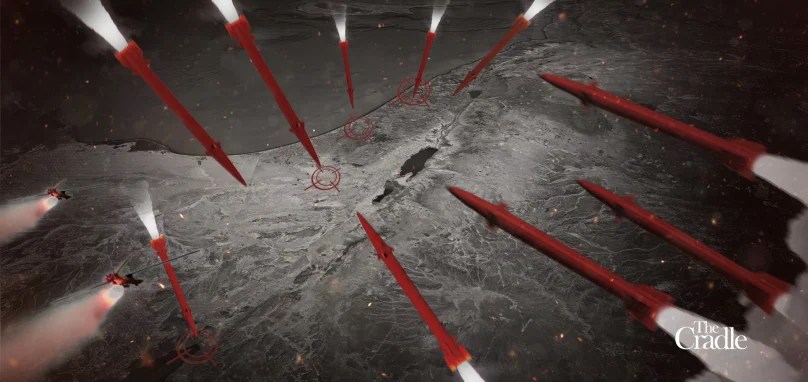
Hezbollah source: Iran, Lebanon, and Yemen will launch simultaneous retaliatory strikes against Israel, to overwhelm the Iron Dome.
By Ali Rizk | The Cradle | August 5, 2024
West Asia stands on a knife’s edge as the region’s Axis of Resistance prepares to retaliate against a series of recent Israeli assassinations and aggressions.
Iran, Hezbollah, and Yemen’s Ansarallah-aligned armed forces have vowed to make the occupation state pay a heavy price following the targeted killing of Hamas political bureau chief Ismail Haniyeh in Tehran and Hezbollah senior commander Fuad Shukr in southern Beirut.
Additionally, Israel bombed the Hodeidah port in Yemen following Sanaa’s successful ‘Yafa’ drone operation in Tel Aviv on 19 July.
An official from the Lebanese resistance has informed The Cradle that “The response will come at once from Iran, Hezbollah, and Yemen,” adding that the goal was to “inflict a painful blow to Israel which may not be achieved should separate retaliations be pursued.”
Executing the ‘Unity of Fronts’
Retaliation is all but certain and could happen within hours, according to senior US officials. A report yesterday by Axios claims that US Secretary of State Antony Blinken informed his G7 counterparts that the response could begin as early as within the next 24 hours.
Just yesterday, Ali al-Qahoum, a member of the political bureau of Ansarallah, emphasized that the response to Israel will not just come from Tehran:
We affirm our commitment to the battle, steadfastness, awareness, honor, and pride in standing with Palestine, the cause of the nation.
The critical question now is the scope and severity of the retaliation. Hezbollah Secretary General Hassan Nasrallah has promised a painful yet calculated blow to Tel Aviv. During Shukr’s funeral procession, Nasrallah warned that Israel had crossed the line, promising “a real and well-calculated response” – distinct from the cross-border operations Hezbollah has conducted against Israel since 8 October.
Flattening the Iron Dome
Other well-informed sources agree that the response could be coordinated, suggesting that retaliation from multiple fronts simultaneously is likely. They tell The Cradle that such an approach could take Israel’s primary air defense system, the Iron Dome, out of commission by preventing it from rapidly rearming. They believe this is achievable given Hezbollah’s capacity to launch a significant barrage of missiles and given Lebanon’s geographical proximity to potential Israeli targets.
These assessments appear to be consistent with those made by US officials who have warned that the Iron Dome could be overwhelmed by Hezbollah’s missile and drone arsenal should a full-scale war erupt.
Senior US military officials, meanwhile, have gone on the record cautioning that Washington would probably be unable to provide Tel Aviv with sufficient protection even in a single front, full-scale war with Hezbollah. US Joint Chief of Staff Charles Brown said as much in his remarks to the press in late June.
From our perspective, based on where our forces are, the short-range between Lebanon and Israel, it’s harder for us to be able to support them [Israel] in the same way we did in April [with Operation Truthful Promise].
Unwilling US support for Tel Aviv
Although much has been said about the US and its allies successfully thwarting Iran’s response to the Israeli attack on its consulate last April, it is noteworthy that all targeted Israeli military bases were hit during the Iranian retaliatory strikes. Operation Truthful Promise was intended more as a message, indicating that Tehran would no longer tolerate Israeli aggression against its interests.
US military reinforcements in the region may help intercept missiles and drones coming from Lebanon, while vassal state Jordan could also play a part as it did during Iran’s retaliatory strikes. However, this also makes US military assets and those of its partners legitimate targets for the Resistance Axis.
As former Pentagon analyst Michael Maloof explains to The Cradle:
Hezbollah would likely target US warships in the region that would take part in intercepting missiles directed at Israeli targets.
“As in 2006, I envision US involvement focused more on evacuating many of the 86,000 Americans now in Lebanon who would want to leave,” adds Maloof.
Washington’s top military officials also appear firmly opposed to being drawn into an active offensive role should a wider war erupt with Hezbollah, let alone a dreaded multi-front war. This stance is supported by statements from US Joint Chiefs of Staff Charles Brown, indicating the Pentagon’s limited willingness to protect the occupation state.
Note that Washington’s pledges to defend Israel have made no mention of potential offensive action, reflecting an American desire to avoid a wider war. Experts doubt the US will become heavily involved in any full-scale war, supported by public statements underscoring the importance of avoiding regional escalation – and voiced more privately, the desire to keep US military targets safe from retaliatory strikes.
Military risk and political calculations
As Brown said at the time, Washington’s main message is:
To think about the second order of effect of any type of operation into Lebanon, and how that might play out and how it impacts not just the region, but how it impacts our forces in regions as well.
The general – the most senior ranking US military official and the senior military advisor to the White House – was delivering a message that carries special significance amidst the recent developments.
By stating that an Israeli-initiated war on Lebanon put US troops at risk, Brown was essentially saying that a wider regional war was not seen as helping US interests by the Pentagon’s top brass.
Given these statements, it remains possible – though far from guaranteed – that the outgoing Biden administration may rein in Israel regardless of how painful a blow is delivered to it by the Axis of Resistance.
The upcoming US election in November is another factor that may prevent a regional conflagration. “The US getting more militarily involved with Israel,” warns Maloof, “would lead to riots in the streets of Chicago at the Democratic Convention later this month.”
These realities suggest a scenario where Washington might force Tel Aviv to absorb the Axis of Resistance’s retaliation, however severe it may be.
CENTCOM chief in Israel for ‘preparations’ against Iran, Hezbolla
The Cradle | August 4, 2024
The US CENTCOM chief arrived in Israel on 3 August to help Tel Aviv prepare for an Iranian retaliation to the killing of Hamas chief Ismail Haniyeh on its soil last week, as well as Hezbollah’s response to the strike on Beirut hours before.
General Michael Kurilla arrived in Israel on Saturday “as preparations continue for a possible attack against Israel from Iran [and Hezbollah] in retaliation for the assassinations of senior Hamas and Hezbollah leaders,” two US officials told Axios on 4 August.
Kurilla had already been planning a trip to Israel prior to the serious escalation, which saw Tel Aviv attack Beirut and Tehran within hours of each other.
“He is expected to use the trip to try to mobilize the same international and regional coalition that defended Israel against an attack from Iran on Apr. 13,” an official told Axios. At the time, Iran launched hundreds of drones and missiles at Israel in response to the destruction of its consulate in Damascus and the killing of several Iranian officials.
Three US officials told the outlet they expect an Iranian retaliation to Haniyeh’s killing “as early as Monday.”
According to the report, Washington is concerned it will be difficult to garner the same amount of regional support in defense of Israel as it did in April, given that Haniyeh’s assassination comes within the context of the Gaza war – for which Israel has drawn major criticism from the Arab world and internationally.
Kurilla is set to visit several Gulf nations, as well as the kingdom of Jordan – which played a major role in intercepting Iranian projectiles during the April attack. Amman has already vowed to confront any violation of its airspace.
Jordan also opened up its airspace to US and Israeli jets during Iran’s April operation. “The U.S. hopes the same will happen again if needed,” another US official told Axios.
US and Israeli officials also “don’t know if Iran and Hezbollah will conduct a coordinated attack or operate separately … they think both Iran and Hezbollah are still working on finalizing their military plans and approving them at the political level.”
Meanwhile, the Pentagon said Washington has been beefing up its presence in the region in anticipation of the Resistance Axis’s responses, which could potentially include Iraq’s resistance factions and Yemen’s Ansarallah movement.
Defense Secretary Lloyd Austin said the US will maintain the presence of the USS Abraham Lincoln aircraft carrier, and has ordered more ballistic missile and defense-capable cruisers and warships to the region.
An additional squadron of fighter jets has also been deployed, in line with US President Joe Biden’s vow to send new deployments in defense of Israel during his phone call with Benjamin Netanyahu on Thursday.
Iran’s Supreme Leader Ali Khamenei vowed last week a “harsh punishment” for Israel. Hezbollah chief Hassan Nasrallah also warned Tel Aviv: “You do not know which red lines you have crossed.”
Israeli aggression targets residential building in Beirut Southern Suburb
Al Mayadeen | July 30, 2024
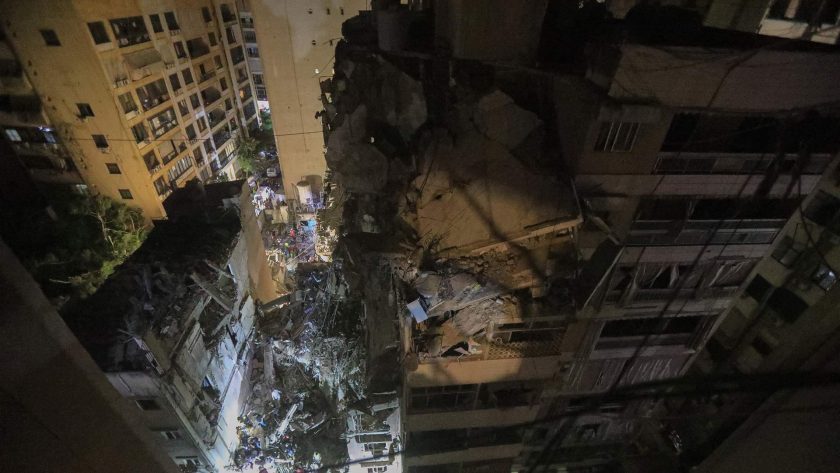
An Israeli strike targeted a residential building in the Southern Suburb of Beirut on Tuesday evening, destroying a substantial section of the structure.
The strike comes after continuous threats by Israeli occupation officials of a substantial aggression on Lebanon, since Saturday.
Al Mayadeen’s correspondent reported that the strike targeted the Southern Suburb of Beirut, where at least one explosion was heard.
In detail, our correspondent said that the strike targeted a residential building in Haret Hreik, resulting in the collapse of a substantial section of the structure.
“Israel” has been threatening a strike against Lebanon, after falsely accusing the Islamic Resistance in Lebanon – Hezbollah, of launching an attack on the Israeli-occupied Syrian town of Majdal Shams.
IOF says it targeted Hezbollah commander
The Israeli occupation forces spokesperson said the military targeted a commander responsible for the alleged Majdal Shams strike. He added that there is “no change in the directives of the Home Front Command,” which are a set of directives issued to settlers in times of war.
Strikes on the Southern Suburb of Beirut have been largely avoided by Israeli authorities, due to the warnings of the Resistance against such an escalation.
The last time an Israeli strike targeted the Suburb was on January 2, 2024, which killed the top Hamas official in Lebanon, martyr Saleh al-Arouri, and others.
Hezbollah responded to the aggression with wide-ranging strikes on Israeli military targets, attacking the Meron Air Traffic Control Base for the first time.
Veteran War Correspondent: Blast In Golan Heights Not From Hezbollah Rocket
By Ian DeMartino – Sputnik – 29.07.2024
On Saturday, an explosive fell onto a sports field in Majdal Shams in Israeli-occupied Golan Heights, killing 12 children. Israel blamed the Lebanese Shia movement Hezbollah. The group has denied the accusation.
Veteran war correspondent Elijah Magnier told Sputnik on Monday that what little information is available on the Golan Heights explosion that killed 12 Arab Druze Muslim children contradicts the official story offered by the Israeli government.
“First, [Israel has] refused any Western investigation by Israeli allies. So they don’t want anyone to investigate the type of rockets and/or the debris,” Magnier explained. “And the technical details of the explosions are very telling. The Falaq rocket that Hezbollah fires is a 50 kilogram explosive. Now, a warhead with such a quantity of explosive doesn’t leave the damage that was left by the explosion that happened in Golan Heights, [it would be] much bigger.”
Magnier, who has over 35 years of experience covering conflicts in Iran, Lebanon, Syria, Iraq, Libya, Sudan, Afghanistan and Yugoslavia, says that the evidence the Israelis have provided has been unconvincing.
“We have not seen any picture… of the guidance system, or any component that [we] need to understand what kind of rocket [or missile] that exploded in this place,” Magnier began. “They showed us two pieces with serial numbers that match the Falaq, but not on the same scene of the explosion. They’re completely different on a white plank. So, we don’t know where these pieces were taken from.”
“Normally, when the forensic team is on the scene, [they] take hundreds of photographs with every single piece before they touch anything. We haven’t seen all that, but we’ve seen a rush of accusing Hezbollah,” Magnier added.
“The diameter of the crater [from a Hezbollah Falaq rocket] can [be] between four to six meters and the depth can be… between 1.5 to 3 meters, which is not the case at all of the explosion we’ve seen,” Magnier described. “We’ve seen in this explosion only a small part of the fence [was] damaged and the other part of the fence is still intact. So, even the fragment of the explosion is different. The shrapnel is different.”
On Sunday, Israel bombed 12 settlements in Lebanon after saying that Hezbollah had crossed a “red line” in the attack. Hezbollah has vehemently denied it was involved. Magnier pointed out that they do not have a reason to attack Druze Muslims in Golan Heights, which is illegally occupied by Israel but still contains a large Muslim population.
“Hezbollah has thousands of civilian objectives [it could hit] that are close to the borders of Lebanon, and it can really destroy any village or any Israeli occupied city without the need to go to another village that is occupied by Druze Muslims who have [influence] in Syria and Lebanon and want to declare their support to the Palestinians,” argued Magnier, who added that Hezbollah has not been hitting civilian targets since it started shelling Israel in solidarity with the Palestinians in Gaza.
Magnier argued that a faulty Israeli air defense missile was a more likely culprit in the Golan Heights explosion.
“I can say that there are malfunctioning missiles and there are malfunctioning rockets that can fall anywhere and these incidents are very frequent, in particular with the Israeli interception missiles, where they say that only 60 to 65% reach their target and the others miss,” he said. “A strong possibility… an Israeli interception missile of the type Tamir… they carry around 10 to 15 kilograms of explosive and they have a very similar impact to what we’ve seen in the pictures provided on the ground by the people of Majdal Shams in the Golan Heights.”
Magnier noted that the size of the crater matched what the Tamir could create and that there was still grass from the field around the crater, which would not happen with a larger Falaq rocket.
“Everything there indicates that we’re talking about a small-sized missile [and] not a big sized rocket of 50 kilograms.”
On Monday, US and Israeli media reported that an Israeli official said its response was still coming and that it would be “limited but significant” in order to avoid an all-out war.
“So, we understand that Netanyahu is really trying to avoid being involved in a war that he doesn’t know what the consequences would be. He can start, but he can’t end it,” concluded Magnier. “What is the ultimate objective [in attacking Hezbollah]? Destroy Lebanon? Destroy the airport? He will have his airport destroyed. Attack the Capital? He will have Tel Aviv destroyed. So this is where we see that things are not as smooth as the Israelis are trying to show.”
Did an Israeli Iron Dome missile cause the Majdal Shams massacre?
By Ali Halawi | Al Mayadeen | July 28, 2024
The Majdal Shams strike resulted in the tragic loss of 12 lives, all natives of the occupied Golan. What insights can we recover from the evidence gathered following yesterday’s incident?
Israeli regime authorities claimed on Saturday afternoon that Hezbollah launched a rocket at the occupied town of Majdal Shams, killing twelve civilians, including 10 children, in the process.
The Israeli military command even specified the type of rocket artillery shell used in the alleged attack, which it claimed was the Falaq-1 rocket.
On the other hand, the Islamic Resistance in Lebanon – Hezbollah fully denied any involvement and responsibility for a deadly strike on the village in the Israeli-occupied Syrian Golan.
So where does the truth lie?
A brief analysis of the impact site and the video capturing the moment of the strike dismantles the Israeli narrative, bolstering Hezbollah’s account.
A few points must be made clear before analyzing the moment of the strike on Majdal Shams and the aftermath caused by the explosion.
First, Israeli officials said the Israeli occupation forces were able to identify the shell used in the attack as the Falaq-1 rocket, reportedly confirming their suspicions.
The Falaq-1 rocket is a rocket artillery shell with the following specifications:
- 240 mm caliber
- 1320 mm length
- Estimated 10 km range
- Maximum flight ceiling of 3.5 km
- 50 kg high explosive warhead
- Solid-propellant rocket
Second, high-explosive warheads usually contain a mixture of explosives alongside components that would act as shrapnel propelled by the pressure caused by the aforementioned explosives. Following the moment of impact with the surface, a crater should be formed.
The size of this crater varies according to several factors, which include the mass of the explosives, the pressure generated by the warhead into the ground, and the surface’s composition, among other elements.
Third, the Falaq rocket exhausts the solid propellant less than two seconds after being fired.
Israeli Iron Dome interceptors record multiple failures since October
Another important nuance that would aid Hezbollah’s denial of involvement is the failure of Iron Dome interceptors, Tamir surface-to-air missiles, on several occasions in the past months.
This includes a crash of an Iron Dome interceptor in Tel Aviv in early December 2023 and a fire caused by an Israeli interceptor in occupied al-Jalil following a failed interception of a Hezbollah drone on July 25, 2024.
There are many such incidents, with some being captured live on camera, including an event in which an Israeli Tamir missile struck a hospital in Tel Aviv on November 6, 2023.
Several technical issues related to an Iron Dome battery could result in a catastrophic interception failure. These issues include a malfunctioning engagement radar, a faulty radar seeker, a defective self-detonation sensor, and a compromised motor, among other potential problems. The most dangerous of these are faults in self-detonating sensors, which leave operators unable to destroy rogue surface-to-air missiles.
Did an Israeli Tamir missile impact Majdal Shams?
It is highly probable that faults in a surface-to-air missile fired from an Iron Dome launcher just behind Majdal Shams caused the grave massacre.
Majdal Shams, which is among the towns and cities occupied by “Israel” in 1967, hosts a vast majority of Arab Syrian Druze and a minority of Israeli settlers. The town and other similar demographics, where natives are significantly represented, have not come under the direct fire of the Islamic Resistance in Lebanon since October 8, 2023.
Although the Resistance has launched highly precise weapons such as an anti-tank guided missile and drones at Israeli military positions in towns such as Arab al-Aramshe, it never fired unguided rocket artillery weapons at these towns.
Specifically, Majdal Shams has never come under an attack by Hezbollah, throughout the nearly 300 days of intense confrontations near the Lebanese-Palestinian border.
The Resistance has also not been shy of taking responsibility for mishaps in the past, such as an incident in the 2006 war on Lebanon when a rocket launched by Hezbollah fighters impacted a home in occupied al-Nasirah.
The attack took place on July 19, 2006, and the Secretary-General of Hezbollah Sayyed Hassan Nasrallah took the nearest opportunity amid the ongoing war to apologize to the family.
“To the family that was hit in al-Nasirah — on my behalf and my brothers’, I apologize to this family,” he said.
“Some events like that happen. In any event, those who were killed in al-Nasirah, we consider them martyrs for Palestine and martyrs for the nation. I pay my condolences to them.”
A corresponding crater
As for evidence collected from the impact site, the crater formed by the projectile is around 2 meters wide and a few centimeters deep. This indicates that the warhead that detonated in the area is far less than 50 kg and closer to the 10 kg range.
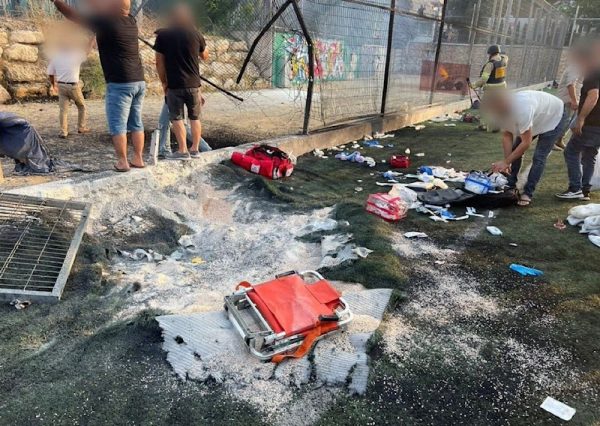
In comparison, a crater formed by a Falaq-1 rocket in Kiryat Shmona ripped through cement and caused extensive damage to nearby infrastructure as seen in this video.
The Falaq-1 rocket is among Hezbollah’s heaviest rocket artillery shells that can be fired from multiple rocket launchers and which can cause extensive damage to targets.
On the other hand, the crater seen in Majdal Shams could be more closely attributed to a Tamir missile.
The possibility that Hezbollah used a smaller caliber munition to conduct the attack is improbable, as it was Israeli authorities who claimed that the munition used in the attack was a Falaq-1 rocket.
Large flames produced by liquid propellant
Another aspect to examine is the relatively large amount of combustion that occurred as a result of the impact on the football field.
High-explosive warheads generally do not produce large fireballs upon detonation. Instead, they create a powerful blast wave and intense fragmentation. The explosion of an HE warhead primarily generates heat, shock waves, and shrapnel rather than a visible fireball. A large-sized and visible fireball is typically associated with the combustion of fuel, such as that found in rocket engines or fuel tanks.
As seen in this footage, the projectile produced a large fireball.
A Tamir missile launched from a nearby position is likely to contain a substantial amount of fuel, as the air defense rocket was designed to fly for around 70 km. This means that the majority of the fuel meant for the missile’s flight after take-off detonated and produced the fireball seen in the video.
Despite Israeli assertions of a Hezbollah attack using a Falaq-1 rocket, substantial analysis points towards a malfunctioning Israeli Tamir interceptor missile as the more plausible cause of the explosion. The discrepancies in crater size, the nature of the explosion, and Hezbollah’s historical targeting patterns all support this alternative explanation. The true story behind the Majdal Shams explosion remains shrouded, but the evidence presented here offers a compelling case for reconsidering the initial narrative.
Majdal Shams residents mourn martyrs, reject any Israeli presence
Al Mayadeen | July 28, 2024
Residents of Majdal Shams in the occupied Syrian Golan held a funeral ceremony on Saturday for the victims of the Israeli attack that targeted a football field in the town.
An Israeli Iron Dome interceptor missile struck a playground in the town, which is made up entirely of Druze Syrians, killing at least 12 civilians, including children, and wounding at least a dozen others.
“Israel” was quick to pin the blame on Hezbollah and claimed that the Lebanese group targeted the town with an “Iranian rocket”.
The Israeli Channel 13 reported that residents of Majdal Shams attacked members of Prime Minister Benjamin Netanyahu’s Likud party who attended the funeral.
Meanwhile, the Israeli news website Walla mentioned that Finance Minister Bezalel Smotrich was met with rejection and protests upon his arrival in the town.
“Get out of here. We don’t want you here, you killer,” the residents told Smotrich, accusing the Israeli Minister of making use of their children’s blood.
Following the Golan incident, Israeli occupation Prime Minister Benjamin Netanyahu vowed that “Israel will not let this murderous attack go unanswered and Hezbollah will pay a heavy price for it, a price it has not paid before,” according to a statement from his office.
Hezbollah denied Saturday that it targeted Majdal Shams, a Druze town where many residents have rejected Israeli nationality since the Israeli occupation of the Golan Heights in 1967.
In a statement, the Lebanese Resistance group said it “categorically denies the allegations reported by certain enemy media and various media platforms concerning the targeting of Majdal Shams.”
“The Islamic Resistance has no connection to this incident,” it affirmed.
Later, Axios cited an American official as saying Hezbollah officials told the UN that the Golan Heights incident was the result of an Israeli interceptor missile hitting the playground in Majdal Shams.
Hezbollah Denies Israeli Allegations of Targeting Majdal Shams
Hezbollah | July 27, 2024
The Islamic Resistance in Lebanon categorically denied in a statement the allegations made by some Israeli media outlets and various media platforms about targeting the Majdal Shams area in the occupied Golan Heights.
Hezbollah thus issued the following statement:
The Islamic Resistance in Lebanon categorically denies the allegations reported by some Israeli media outlets and various other media platforms about targeting the Majdal Shams area. Hezbollah affirms that it has no connection to the incident whatsoever and emphatically denies all false claims in this regard.
Commenting on the incident, Ghaleb Saif, head of the Druze Initiative, stated that the missiles that fell on the Syrian Golan and Galilee were Israeli interceptor missiles, which often cause significant damage to property and lives. “Every day, we see how Iron Dome missiles miss their targets and end up falling on us,” Saif added.
Lavrov: Hezbollah, Lebanese govt. avoid full-scale war with Israel, but some within regime seek conflict
Press TV – July 18, 2024
Russian Foreign Minister Sergei Lavrov says Lebanon’s Hezbollah resistance movement and the Lebanese government do not want a “full-blown war” with Israel but “some” within the regime are seeking it.
Speaking at a press conference at the UN headquarters in New York on Wednesday, the top Russian diplomat said “there’s a suspicion that some circles in Israel are trying to achieve just that.”
Lavrov, citing some American and European analysts, stressed that “escalation, as the practical developments show, is something which Israel is interested in.”
Hezbollah and Israel have been exchanging deadly fire since early October, shortly after the regime launched a genocidal war on Gaza following a surprise operation by the Palestinian Hamas resistance group.
Hezbollah has vowed to keep up its retaliatory attacks as long as the Tel Aviv regime continues its Gaza onslaught.
“Hezbollah has been very much restrained in its actions,” Lavrov further said, adding that its leader, Sayyed Hassan Nasrallah, has already “delivered a number of public statements which reaffirmed that position.”
“However, the sentiment is that there’s an attempt to provoke them, and to provoke them into a full-blown engagement,” the top Russian diplomat warned.
According a tally by the Associated Press, Israeli airstrikes on southern Lebanon since October have killed more than 450 people while Hezbollah’s retaliatory attacks have claimed 34 lives.
Israeli media say Hezbollah’s retaliatory strikes have displaced around 60,000 Israeli settlers from northern parts of the occupied lands.
Israel’s war on Gaza slammed as ‘collective punishment’
Elsewhere in his remarks on Wednesday, Lavrov stressed that Israel’s war on the besieged Gaza Strip has crossed the line and is now a form of “collective punishment” on the territory’s 2.3 million Palestinians.
“When it comes to collective punishment in violation of international humanitarian law, one cannot fight against one form of violation through other violations. It’s the same principle here,” he said.
The Tel Aviv regime has killed about 38,800 Palestinians, mostly women and children, in Gaza, since October 7.
Since the start of the war, the United States has supplied Israel with more than 10,000 tons of military equipment and used its veto power against all UN Security Council resolutions that called for an immediate ceasefire in Gaza.
Despite the unabated campaign of bloodletting, the occupying regime has so far fallen short of realizing its two main “goals”, namely defeating and eliminating Hamas, and releasing Israeli captives.
Featured Video

Alon Mizrahi: ‘Israel Must Be Dismantled’
or go to
Aletho News Archives – Video-Images
From the Archives
How a War with Iran Would Diminish American Power
By Greg Scoblete | The Compass | August 13, 2010
Jennifer Rubin wants a war with Iran:
But the emphasis on the existential threat to Israel ignores a more basic issue for Americans to ponder: a nuclear-armed Iran represents a dagger at the heart of America and an existential threat to our status as a superpower and guarantor of the West’s security. As to the former, Iran is pressing ahead with its long-range ballistic missile program. First the Middle East and Eastern Europe, then all of Europe and, within a matter of years, the U.S. will be within range of Iranian missiles. If those are nuclear and not conventional, what then? We’re not talking about whether Iran is going to be “merely” a destabilizing factor in the Middle East or whether it will set off an arms race with its neighbors or imperil Israel’s existence. We’re talking about whether America will then be at risk (and lacking sufficient missile-defense capabilities if we continue to hack away at our defense budget). The argument about whether mutual assured destruction can really work against Islamic fundamentalists who have an apocalyptic vision becomes not about Israel’s ability to deter an attack but about ours. Those who oppose American military action have an obligation to explain why America should place itself in that predicament.
I would argue that any obligation to present an explanation lies with those whose disastrous policy prescriptions with respect to Iraq lead America into the worst strategic blunder in the country’s recent history. That aside, note the blind faith in the power of the military to actually achieve its ends. … continue
Blog Roll
 Aletho News
- Villains of Judea: Leonid Radvinsky
- Alon Mizrahi: ‘Israel Must Be Dismantled’
- Former Head Of MI6 Admits That The U.S. And Israel Are Losing The Iran War
- Scattered Thoughts on War and Peace
- Iran Threatens to Close Red Sea to Shipping in Response to Invasion
- Iran in excellent position to prevail in war with US, Israel: John Mearsheimer
- Iran warns US: Do not call your retreat an agreement
- Neighbors first – Moscow signals shift in energy strategy
- Almost 400 Ukrainian drones downed over Russia in single night – MOD
- Battle for Hungary: How the Russiagate blueprint has been unleashed against Orban
- If Americans Knew
- In the West Bank, life is a constant battle – 3 articles
- Jacob Reses, one of the most powerful pro-Israel operatives in Trump’s Washington
- Israeli-US assaults kill or injure 87 children a day – Not a ceasefire Day 166
- ‘Forever live by the sword’: Understanding Israelis’ massive support for Iran war
- UN’s special rapporteur on human rights says Israel is systematically torturing Palestinians
- Trump White House plagiarized Iran war manifesto from Israel-aligned think tank
- Gaza says 6–10 patients die daily waiting for treatment abroad as Israel blocks medical evacuations
- ‘Substantial evidence’ of double-tap strike in killing of Gaza’s Hind Rajab
- ‘Do Not Want To Die For Israel’: Doubts About Trump’s Iran Strategy Spread Among Troops
- Instead of taking Joe Kent’s claims seriously, the media is disregarding him as an antisemite
- No Tricks Zone
- Devastating Assessment Of Comirnaty Vaccine By Former Senior Pfizer Europe Toxicologist
- New Study: CO2 Is ‘Effectively Negligible’ As An Explanatory Climate Change Factor Since 2000
- Former Pfizer Toxicologist Dr. Helmut Sterz Tells Bundestag Hearing Pfizer Vaccine Should Have Never Been Approved
- Energy Expert: Germany’s Nuclear Phaseout Was A “500 Billion Euro Mistake”
- New Research: South Australia’s Mid-Holocene Sea Surface Temperatures Were 4°C Warmer Than Today
- Storing Green Energy To Last Germany 10 Days Would Require A 60-Million Tonne Battery
- New Studies: UK Sea Levels Were 4 Meters Higher Than Today During The Mid-Holocene
- Destructive Green New Deal: German Energy And Metal Group Warns Of Drastic Crisis
- New Study Documents A 20-Year Pause In Arctic Sea Ice Decline – Driven By Internal Variability
- Wake-up Call: Survey Shows Majority Of Germans Now Favor Postponing Climate Targets!
 Aletho News