Lebanon parliament elects Aoun as president, ending two years of deadlock
Press TV – January 9, 2025
Lebanese lawmakers have elected army chief Joseph Aoun as Lebanon’s new president, putting an end to a two-year-long political deadlock in the crises-hit Arab country.
Legislators on Thursday chose Aoun after two rounds of voting in the 128-member parliament of the small Mediterranean country, which has been without a president since the end of the tenure of former president Michel Aoun, who is not associated with the newly-elected president, in October 2022.
Political neophyte Aoun, 60, is widely regarded as the favored candidate of the United States and Saudi Arabia, on whose financial support Lebanon relies as it works to recover from a 14-month bombardment by Israel mostly against the Arab country’s southern parts where the Lebanese Hezbollah resistance movement is based.
Hezbollah, which had exchanged daily fire with the occupying regime from October 2023 until a ceasefire in November, had previously supported Suleiman Frangieh, the leader of a small Christian party in northern Lebanon, as its preferred candidate.
However, Frangieh announced his withdrawal from the race on Wednesday and threw his support behind Aoun, seemingly paving the way for the army commander.
Aoun secured 99 out of 128 votes in Lebanon’s deeply divided parliament, with support from across the political spectrum, including Hezbollah legislators and their rivals. His election ended a prolonged leadership vacuum that had stalled key reforms and heightened fears of a broader collapse amid the nation’s multiple crises.
Following his election as president on Thursday, Aoun, who had served as the 14th Commander of the Lebanese Armed Forces since 2017, formally stepped down from his military role. He entered parliament to take the oath of office dressed in civilian attire.
Aoun will need to oversee the implementation of the US-brokered ceasefire between Israel and Lebanon while also establishing a new government capable of addressing postwar reconstruction.
In November, the World Bank provided a preliminary assessment estimating the war’s physical damage and economic losses at $8.5 billion.
However, any rebuilding efforts will be hindered by Lebanon’s severe economic crisis, a five-year downturn that commenced with a liquidity crisis in Lebanese banks. Since then, the country’s GDP has contracted by over a third.
Before Thursday’s parliamentary sessions, 12 attempts to elect a president had failed over the past two years.
Since October 2022, the small Mediterranean country has been functioning without a formal government, which has worsened a financial crisis that prompted Lebanon to default on $30 billion in Eurobond debt some five years ago.
Lebanon’s divided sectarian power-sharing system is often susceptible to deadlock due to both political and procedural challenges. The country, which is currently struggling with its crises, has experienced multiple prolonged presidential vacancies, including the longest one, which lasted nearly two and a half years from May 2014 to October 2016, ending with the election of former President Aoun.
Israeli forces set homes ablaze, block roads in southern Lebanon
Al Mayadeen | January 5, 2025
Israeli occupation forces made advances toward the town of Taybeh, opening fire with machine guns at homes, several of which were set ablaze by the invading units, Al Mayadeen’s correspondent in southern Lebanon reported on Sunday.
Explosions were also heard as the Israeli forces launched hand grenades during their infiltration into the neighborhood. In addition, the occupation forces erected an earthen berm to block the road linking the towns of Qantara and Taybeh.
Our correspondent further reported that Israeli forces carried out demolition operations on the outskirts of Aytaroun, followed by a barrage of machine gunfire aimed at the town, and a series of explosions at Tayr Harfa-Al-Jubayn junction.
These recent incidents bring the total number of Israeli violations since the implementation of the ceasefire agreement with Lebanon 40 days ago to more than 380.
Ongoing Israeli violations
Al Mayadeen’s correspondent in southern Lebanon reported that on Saturday morning, Israeli occupation forces carried out bombings between the towns of Odaisseh and Taybeh.
She noted that Israeli occupation forces continue bulldozing land in several towns, particularly in Houla, Bani Hayyan, and Markaba.
On Thursday, the Lebanese Army entered al-Naqoura to reposition its forces, following the withdrawal of Israeli troops from the area. This marked the third such Israeli withdrawal from territories occupied during the recent ground invasion.
Al Mayadeen’s correspondent in southern Lebanon reported that Israeli invading units were observed withdrawing from al-Naqoura’s neighborhoods toward Ras al-Naqoura and Alma al-Shaab while conducting sweeps with automatic rifles. At the same time, Israeli Merkava tanks continued to shell several homes in the area.
Our correspondent also noted that an Israeli military convoy, reinforced with eight Merkava tanks, a bulldozer, and Hummer vehicles, advanced from the town of Ramieh toward al-Salhani, al-Qawzah, and reached Wadi Mazlam near the outskirts of Beit Lif—territory that had not been accessed during the recent Israeli war on Lebanon.
However, Israeli soldiers conducted searches of homes and surrounding forests, and machine gun fire was heard within the village. Additionally, Israeli drones launched two missiles at the outskirts of Yater.
Hezbollah is “stronger and more resilient than steel” and “more powerful than ever before, as witnessed by the enemy,” affirmed Wafiq Safa, head of Hezbollah’s Coordination and Liaison Unit.
In his first media appearance after the war on Lebanon, Safa stated Sunday that Hezbollah is “ready for all challenges,” and “will stand with the people, behind them, and on the ground” to rebuild what was destroyed during the Israeli aggression.
During a tour in the southern suburbs of Beirut, specifically at the site where Hezbollah’s former Secretary-General martyr Sayyed Hassan Nasrallah was assassinated by “Israel”, Safa stressed that the group will be “involved in every aspect” that impacts the morale of the people.
He added, “We have always stood and will continue to stand with the people of resistance, protecting them from any harm internally, and there will be no possibility for anyone to break our morale,” reassuring everyone that there is no need for concern.
Regarding whether Hezbollah will respond to Israeli violations, Safa revealed that Hezbollah’s capabilities have been restored and that the group has the ability to confront any aggression in the manner it deems appropriate.
He added that what happens after the 60-day period designated for the withdrawal of the Israeli occupation forces from Lebanon “is up to Hezbollah and its leadership.”
Safa also noted that Lebanese Parliament Speaker Nabih Berri will engage with US mediator Amos Hochstein regarding the Israeli violations of the ceasefire agreement.
On the subject of electing a new Lebanese president, Safa asserted that Hezbollah does not veto the nomination of Lebanese Army Commander Joseph Aoun for the presidency but that of the leader of the Lebanese Forces party Samir Geagea, whose “project is destructive to Lebanon.”
Concerning the funeral of martyr Sayyed Nasrallah, Safa revealed that the ceremony will take place in the Southern Suburb after the 60-day period.
Elsewhere, he emphasized that martyr Sayyed Nasrallah’s “presence is embodied in the resistance, its fighters, and the people of resistance.”
What US mediation? 1000 Israeli violations in Lebanon go unchecked
The Cradle | January 2, 2025
Under the supervision of US special envoy and former Israeli soldier Amos Hochstein, Beirut and Tel Aviv reached a ceasefire agreement on 27 November after almost 14 months of intense conflict against the backdrop of the war on Gaza.
The Israeli military pledged to withdraw from Lebanese territory within 60 days of the agreement’s enactment.
To ensure compliance, a monitoring committee led by US General Jasper Jeffers was established, focusing on enforcing the cessation of hostilities and the full implementation of UN Security Council Resolution 1701.
Rampant Israeli violations
But Israel immediately undermined the truce, committing nearly 1,000 violations within the first month alone – one of many cases of the occupation state’s disregard for international agreements.
Additionally, occupation forces have continually obstructed the Lebanese army’s deployment at key points in southern Lebanon, and have leaked plans that Tel Aviv intends to maintain control over strategic areas in the country. Reports suggest there is an Israeli effort underway to establish a security buffer zone spanning from Abbad to the villages of Odaisseh and Kfar Kila.
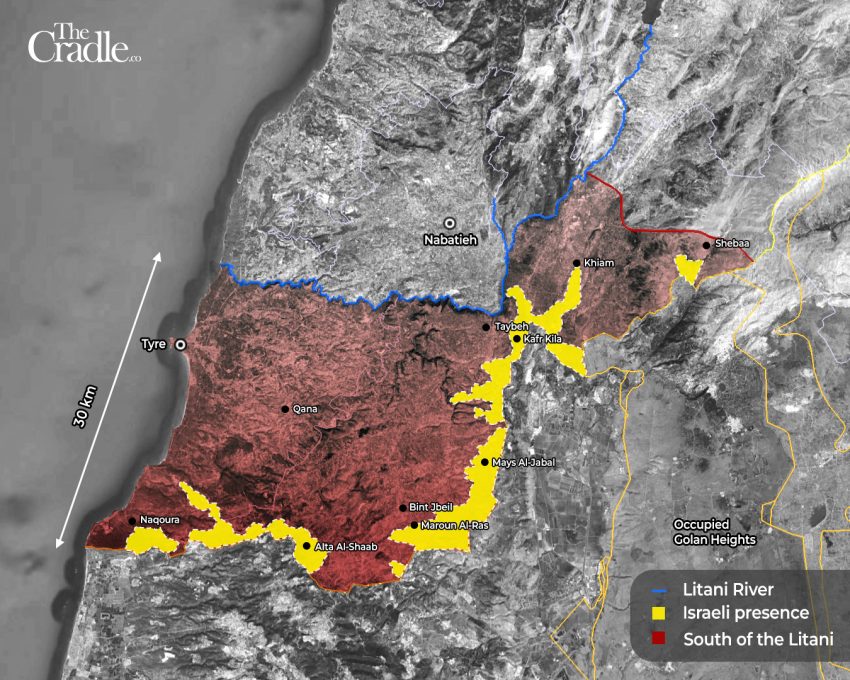
Map showing areas of Israeli military presence (in yellow) south of the Litani River in southern Lebanon, following the declared ceasefire. (Updated December 2024)
Meanwhile, from the onset of the ceasefire, Hezbollah assured the Lebanese government that it would not retaliate during the 60-day truce period, adhering strictly to the agreement terms and allowing the government and army to address Israel’s daily provocations.
The ceasefire followed intense internal and international pressure on the resistance movement to halt its battle with Israel, especially as the latter began to dangerously expand its bombing targets across the country. Simultaneously, the Israelis – having failed to achieve their stated war objectives and taken daily troops losses in their ground invasion – were pushing hard for a truce, citing the need to prevent an escalation that could extend to Beirut, risking mass civilian casualties.
This agreement may not be ideal for either party, but it is feasible to implement. Israel achieved tangible successes but failed to crush Hezbollah or eliminate it as an organization. For Hezbollah, the priority was ending the war to halt the destruction, despite the damages it sustained.
Consequently, both sides reached an agreement that Hezbollah described as a reiteration of the 1701 Resolution. It was not a deal of humiliation or defeat, contrary to how the group’s adversaries are eager to portray it.
It is important to note that Hezbollah chose a middle path between Hamas’ call to ignite a broader conflict under the banner of “Al-Aqsa Flood” and a policy of non-intervention, given that the Palestinian movement’s leadership did not involve Hezbollah in its decision to go to war.
Ethically, Hezbollah opted to open a limited support front, clearly defining its objectives: to exhaust the Israeli military and pressure it into halting the assault on Gaza. However, this calculation later proved to be flawed.
When the support front escalated into a full-fledged war, Hezbollah declared that its aim was to stop the conflict. When Israel requested a cessation of hostilities, Hezbollah agreed under acceptable conditions.
Ultimately, after over a year of conflict sparked by the Hamas-led Operation Al-Aqsa Flood, Hezbollah and Israel reached a 13-point agreement mediated by the US and France. While Tel Aviv agreed to withdraw from Lebanese territory within 60 days, its actions during the ceasefire depict a relentless drive to achieve militarily what it could not during the war.
The destruction of Lebanese homes and towns during the first month of the truce already far exceeds that caused during the conflict, with villages such as Bani Hayyan, Markaba, Shama, Al-Bayada, and Wadi al-Hujayr suffering devastating damage.
Israel’s brazen violations are not just restricted to border towns. Its truce violations include the prohibited operation of war drones over Beirut and its southern suburbs, and substantial military strikes in villages across the eastern Bekaa Valley.
The US looks the other way
The ceasefire monitoring committee, led by Tel Aviv’s staunchest allies, has faced significant challenges, largely due to Israel’s unwillingness to comply with the terms of the truce.
Sources reveal to The Cradle that so far, two meetings have been held at the United Nations Interim Force in Lebanon (UNIFIL) headquarters in Naqoura, southern Lebanon, with Israeli officers present, followed by a third meeting attended by Lebanese Prime Minister Najib Mikati – without the Israelis present.
The sources added that the first meeting lasted just 40 minutes, limited to introductory discussions on core topics. The second session, however, was marked by discord, as the Israeli side failed to uphold previously agreed-upon terms.
During that meeting, it became apparent to all that while the Lebanese army had finalized and approved a deployment plan for the western, central, and eastern axes, the Israelis refused to present any withdrawal strategy. Instead, they shifted blame to the Lebanese army for what they called “slow deployment,” further suggesting that the 60-day truce deadline was merely symbolic, not binding for the withdrawal of Israeli forces, and intended only for the withdrawal of Hezbollah troops from south of the Litani River.
Israeli representatives went further, baselessly claiming that the Lebanese army had no intention of implementing the agreement’s provisions to withdraw Hezbollah from south of the Litani.
During the discussions, Lebanese General Edgar Lowndes is said to have stormed out of the meeting after heated exchanges with the Israeli side, which downplayed its repeated attacks in Lebanon as insignificant and refused to classify them as breaches of the agreement. The Israeli delegation specifically argued that their use of drones in Lebanese airspace was not a violation of the truce, suggesting that the air breaches would continue unchecked.
The lead US official – a general – brought Lowndes back to the meeting and tried to keep the proceedings more formal thereafter. Following the session, high-level contacts took place between various committee members, with Lebanese caretaker Prime Minister Najib Mikati gathering French and American officers and the UNIFIL Commander to emphasize the need for Israel to respect the signed agreement that the Israeli army would withdraw from Lebanese territory within the agreed upon deadline.
In this context, the US general confirmed that envoy Hochstein would participate in the next committee meeting on 6 January to confirm the ambiguous issues, and agreed with his Lebanese counterparts that Israel is violating the ceasefire through its actions.
Patience amid provocation
While Hezbollah has exercised restraint and refrained from delivering any significant response beyond a single retaliation at the “Ruwaisat al-Alam site belonging to the Israeli enemy army in the occupied Lebanese Kfar Shuba Hills,” Israeli provocations have continued to test the limits of the ceasefire on a daily basis. As a source close to Hezbollah informs The Cradle :
“We will be patient until the 60-day period expires and diplomatic opportunities are exhausted, and after that there is no solution but resistance.”
International mediators now face growing pressure to enforce the agreement, with Lebanese Parliamentary Speaker Nabih Berri emphasizing the importance of French involvement in the monitoring process, given US partiality toward Israel.
The Lebanese Ministry of Foreign Affairs filed a formal complaint with the UN Security Council, citing 816 violations between 27 November and 22 December. Prime Minister Mikati has called for the swift and complete implementation of Resolution 1701, cautioning that delays could destabilize the region further.
Beirut also called for “enhanced support for UNIFIL and the Lebanese army to guarantee the protection of its sovereignty and to create the necessary security conditions for restoring stability and normalcy in the south of the country.”
It is evident that Israel is leveraging its perceived upper hand to manipulate the ceasefire agreement, interpreting its terms to align with its strategic objectives. By acting as if the balance of power has irreversibly shifted in its favor, the occupation state not only challenges the Lebanese side but openly flouts the agreement with actions such as air violations, justified under the guise of self-defense.
These provocations, coupled with threats to reignite hostilities and forcibly expel Hezbollah, reveal a calculated effort to establish new facts on the ground that were never part of the original accord.
Israeli demolition campaign intensifies in southern Lebanon
The Cradle | January 2, 2025
Israeli troops advanced into and heavily attacked the southern Lebanese village of Beit Lif on 2 January, in violation of the fragile ceasefire that Tel Aviv has been continuously breaching since it took effect in late November last year.
“The Roumieh area between Beit Lif and Yater was subjected to enemy artillery shelling,” Lebanon’s National News Agency (NNA) reported on Thursday afternoon, coming as Israeli forces entered and searched homes in the area.
According to Al Manar’s correspondent in the south, the Israeli army pushed into Beit Lif with several Merkava tanks, military hummers, a bulldozer, and infantry forces and began demolitions in the town. The sounds of heavy explosions and gunfire were heard.
Earlier on Thursday, an Israeli drone targeted the vicinity of a farm between the towns of Beit Lif and Yater with two missiles.
The new ceasefire violations occurred a day after the Israeli military set fire to homes in the Aitaroun-Bint Jbeil district.
In accordance with the ceasefire agreement, the Lebanese Armed Forces (LAF) entered the towns of Shamaa and Al-Bayada on 1 January. The two towns are among those that witnessed fierce clashes between the Lebanese resistance and the Israeli army during Tel Aviv’s failed ground operation in Lebanon, which began in early October and ended with the ceasefire on 27 November.
Al-Bayada and Shamaa were also heavily bombarded throughout the war that began in October last year.
NNA reported massive destruction of infrastructure – with entire neighborhoods and even the electricity network ravaged. “Everything was razed to the ground.”
Israel has violated the ceasefire – which is based on the implementation of UN Resolution 1701 – over 100 times since it took effect with deadly airstrikes, arrests of Lebanese citizens, troop advancements, and mass detonation campaigns in southern villages. Entire villages have been wiped out as a result of the demolition campaign.
Tel Aviv claims to be targeting Hezbollah infrastructure in the south, which the LAF was tasked to dismantle as per the agreement.
Israeli troops are required to withdraw from Lebanon within 60 days of the ceasefire’s announcement. So far, it has been over four weeks, leaving less than a month before the Israeli army must retreat, according to the agreement.
Security sources in Lebanon told The Cradle on 23 December that the Israeli army is unhappy with the LAF’s efforts to implement the ceasefire and is planning to maintain a presence in the south past the 60-day implementation period.
“Now is the opportunity for the Lebanese state to prove itself through political action,” Hezbollah’s Secretary-General Naim Qassem said in a speech on Wednesday, echoing recent comments by the resistance group’s MPs and officials.
Hezbollah officials have recently said that the current period represents a test for the Lebanese state regarding whether or not it will be able to protect the south from Israeli attacks and violations once the resistance is no longer present south of the Litani River.
“If the occupation takes any steps against Lebanon from the eastern front due to its expansion in Syria, we will carry out our national duty … anyone who believes that the resistance in Lebanon has weakened is deluded … We possess the resources and intellect to be in a position to confront the occupation. On the 61st day after the ceasefire, we will be in a position to make the Israeli enemy taste our wrath,” Hezbollah MP Ihab Hamadeh told Al Mayadeen on Wednesday.
UK doctor suspended over posts praising slain Hamas and Hezbollah leaders as ‘legends’
MEMO | January 1, 2025
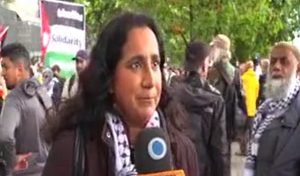 Dr Rehiana Ali, a British neurologist, was been suspended last week by the Medical Practitioners Tribunal Service (MPTS) following complaints about social media posts on Israel’s genocidal war on Gaza. The interim suspension, lasting 18 months and subject to review, prevents her from practising medicine pending a full investigation by the General Medical Council (GMC).
Israel seeks to occupy south Lebanon past 60-day truce period
The Cradle | December 24, 2024
Israeli forces are unhappy with the Lebanese army’s efforts to implement the ceasefire agreement announced on 27 November and are planning to maintain a presence in south Lebanon, according to exclusive information.
“The French conveyed to the Lebanese army that the Israeli military is not satisfied with what is happening [in south Lebanon] and that it will not leave before destroying all of Hezbollah’s infrastructure [south of Litani River, even after the 60-day implementation period ends],” Lebanese security sources told The Cradle on 23 December.
The information came as an Israeli attack killed two people in the town of Taybeh in southern Lebanon’s Marjayoun District.
The Lebanese National News Agency’s (NNA) correspondent in Marjayoun reported on Monday afternoon that “two people were killed and another was injured in an enemy raid that targeted a group of people near the official school in Taybeh.”
Israeli ground troops continued their campaign of mass detonations and destruction of homes and buildings across southern Lebanon, blowing up houses in Al-Bustan and Al-Zaloutieh in the Tyre District.
They also put up an Israeli flag on a hill in the Naqoura area overlooking the main entrance to the town, in violation of the ceasefire announced last month.
Israeli troops are required to withdraw from Lebanon within 60 days of the ceasefire’s announcement. So far, it has been four weeks, leaving only a month before the Israeli army must withdraw, according to the agreement that is based on UN Resolution 1701.
The Lebanese Armed Forces (LAF) has deployed across south Lebanon with the aim of dismantling Hezbollah infrastructure south of the Litani River – which is required to take place within the 60-day period.
Tel Aviv has violated the ceasefire over 100 times since it took effect with deadly airstrikes, arrests of Lebanese citizens, troop advancements, and mass detonation campaigns in southern villages.
Israeli forces have exploited the ceasefire to advance into areas they were unable to during recent ground battles with Hezbollah.
Hezbollah responded once to dozens of violations in early December with a limited rocket attack on an Israeli site in occupied Lebanese territory, prompting a massive and deadly Israeli response in south Lebanon.
Israel claims it is acting in line with the ceasefire agreement by targeting what it says is Hezbollah infrastructure. However, according to the agreement, dismantling the resistance’s presence in southern Lebanon is the responsibility of the Lebanese state and army. Earlier this month, the Israeli army bombed Khiam after the LAF entered the city to clear rubble and prepare for civilian entry.
A secret side letter between Washington and Tel Aviv reportedly guarantees that Israel can act with force against “threats.”
Israel’s Defense Minister Israel Katz vowed on 22 December that Tel Aviv would “crush” Hezbollah’s “head” if the Lebanese resistance group violates the ceasefire, coming during a visit to an Israeli army position in southern Lebanon.
Two days earlier, Hezbollah MP Ali Fayyad said that “the resistance will not be dragged into confronting Israeli violations and aggressions militarily, because its priority is the Israeli withdrawal from our land without giving it any pretext to exceed the 60-day deadline, and because we take into consideration the situation of our people who need shelter, reconstruction, and to clean up the effects of the war.”
“We want the Lebanese government and army to play their role in protecting the land and preserving sovereignty, based on the [agreement] based on Resolution 1701,” Fayyad added.
Lebanese Prime Minister Najib Mikati and UNIFIL called on Israel on Monday to hasten its withdrawal from southern Lebanon. Mikati called for the US and France to pressure Israel on the matter.
Hezbollah Secretary General Naim Qassem Assesses Developments in Lebanon and Syria
Speech of Secretary General of Hezbollah, Sheikh Naim Qassem, on December 14, 2024.

Axis of Tabyeen
In the name of God, the Beneficent, the Merciful. All praise is due to God, Lord of the worlds and may peace and blessings be upon the noblest of creation our master Muhammad and upon his pure, immaculate household and his pious, chosen companions and upon all the prophets and righteous ones until the rising of the Day of Resurrection. May the peace, mercy, and blessings of God be upon you.
I will speak about four points. The first point: our assessment of the events and aggression against Lebanon, and our current and future situation. Secondly: what is the future of the Resistance in Lebanon? Thirdly: what is Hezbollah’s plan of action for the upcoming phase? Fourthly: what is the [Resistance’s] stance on the developments in Syria?
I begin with our assessment of the events [concerning Lebanon] and our current and future situation. Supporting Gaza was a noble and lofty act; and it is a duty upon us, in fact, it is a duty upon the entire nation [of Islam], upon all Arabs and all Muslims. And when they [the Arabs and Muslims] did not fulfill their obligations, the Zionists became tyrannical, did what they did, and [became a] Pharoah upon the land. We were expecting that the aggression on Lebanon would occur — the criminal, usurping aggression of “Israel” on Lebanon — at any moment, but we did not know what timing the Zionists would choose for this aggression. This matter was before the Al Aqsa Flood, and continued after the Al Aqsa Flood, so the aggression was in September. We did not know the timing beforehand, however, in reality, this has nothing to do with supporting Gaza. This has to do with the “Israeli” expansionist project. Because the enemy wishes to eliminate any Resistance [movement] that stands in front of its expansionist project across the entire region.
What has the enemy accomplished through its aggression on Lebanon? In all clarity, [the enemy] accomplished the killing of the leadership in Hezbollah, at the forefront of whom, his Eminence, Master of the Martyrs of the Nation [of Islam], Sayyid Hassan Nasrallah — may God, the Exalted’s pleasure be upon him — and a number of leaders and fighters. [The enemy] accomplished breaches of the communications network, and the detonation of the pagers and communication devices. These are among the accomplishments of the enemy, and the toll [it took on us] was great and painful.
However, [the enemy] did not achieve its goals in these operations that occurred towards the end of the month of September. Then, it committed its brutal crimes against [our] civilians, villages, homes, the unarmed, children, and women. The crimes aimed to break the Resistance, but they were unable to do so
despite the great sacrifices [we faced]. Therefore, the “Israeli” crimes are not an achievement. In return, we achieved the prevention of the enemy from [achieving its goal of] eliminating the Resistance and “crushing it”, as it mentioned numerous times that it wanted to end Hezbollah’s existence. The resisting fighters prevented them from advancing in the battlefield [on the Lebanese border], and their rockets reached the internal front (the occupied territories), and we pained them greatly, and we displaced many of the settlers — approximately more than 200,000 settlers. Additionally, the Resistance killed hundreds of [their] soldiers, and wounded hundreds of [their] soldiers also, and caused economic and social damages, and various types of damages within the “Israeli” interior. So, what we achieved was preventing the enemy from accomplishing its goal of crushing the Resistance, and what the enemy achieved was causing us pain by killing our leaders and [targeting our] communications [devices].
We endured, and our people endured great sacrifices to prevent the Resistance from being broken, and here I salute them all — those brave ones who protected the Resistance, and carried it, and considered it to be their sole and fundamental choice in this confrontation and through these sacrifices. They were a support to the resisting, heroic fighters, who stood firm in the battlefield. The alternative to this enduring [of these sacrifices] — to those who say to us, “For what reason did you endure [all of this]?” — the alternative is surrender, and the loss of everything. Far be it [from us] that we surrender, and far be it [from us] that we are humiliated. This is something that is not possible with the Resistance of Hezbollah.
And here, [to] those who consider that the problem which occurred in Lebanon was that the losses were great — [they ask] “O’ Hezbollah, what are you doing with these great losses?” The question [should be], “What are we doing about this great aggression?” The aggression is the problem, the confrontation [of this aggression] is not the problem. [God] the Exalted has said, in His Glorious Book: “Do not weaken or grieve: you shall have the upper hand, should you be faithful. If a wound afflicts you, a like wound has already afflicted those people; and we make such vicissitudes rotate among mankind…” [Quran, 3:139-140]. Praise be to God who [has] steadied us, and praise be to God who has made us [have the] “upper hand”, and praise be to God who enabled us to achieve this confrontation with a true victory.
The “Israeli” enemy realized that the horizon in confronting Hezbollah’s Resistance was closed, so it went towards an agreement to stop the aggression. For the record, the agreement was brought by Hochstein, and it was agreed upon between “Israel” and America. It was presented to us through being presented to the Lebanese state and Mr. [Nabih] Berri. There were remarks from President [of Parliament] Berri, and there were remarks from us. We modified what we could in this agreement. Thus, he (Hochstein) is the one who brought the agreement, and we agreed according to the details we added within the agreement.
What made the enemy move towards [making an] agreement, and stopping this aggression? Three factors of strength and steadfastness [from us] caused the enemy, and those behind it, to despair over continuing [their aggression]. The first factor is the legendary steadfastness of the Resistance fighters on the battlefield. The second factor is the blood of the martyrs and the sacrifices, led by the blood of the Master of the Martyrs of the Resistance, Sayyid Hassan Nasrallah — may God, the Exalted’s pleasure be upon him — which gave great motivation to our men and our nation [of Islam], and our people [to remain] steadfast and stand up [to this aggression]. And the third factor is the comprehensive and effective political and Combat/Resistance-based management of the “Battle of the Mighty Ones” in a manner which led to this outcome. The enemy resorted to a ceasefire due to the factors of [our] strength and steadfastness.
[Now,] what is our assessment? Our assessment is that the Resistance triumphed because the enemy was unable to achieve its central goal, which is the elimination of Hezbollah, and it was unable to return [its] settlers without [coming to] an agreement, and it was unable to enter [its plan of creating] the “New Middle East” through the gate of Lebanon. We were an impenetrable barrier, we prevented it from achieving this goal through the gate of Lebanon. The Resistance remained until the last moment [of the war] on the battlefield, and the fighters continued to resist on the frontline, their heads held high, and in their great might. [Imam] Ali — peace be upon him — has said: “When God observed our truthfulness, He sent down upon our enemy defeat and sent down upon us victory.” [Nahj al-Balagha, Sermon 56]
This agreement is to stop the aggression, it is not [an agreement to] stop the Resistance. This agreement is an executive agreement derived from [U.N.] Resolution 1701 and is only related to the area south of the Litani River, whereby “Israel” withdraws to the Lebanese border, and the Lebanese army spreads [there] as the sole authority carrying arms, so that there are no [other] armed individuals or weapons in this area. The agreement has no relation to the Lebanese interior, the issues of the Lebanese interior, the relationship of the Resistance with the state [of Lebanon] and the army, the presence of weapons [amongst the Resistance], or any other issues that require [internal] dialogue and discussion.
We endured during this period hundreds of “Israeli” violations in order to help the implementation of the agreement and to avoid being an obstacle to it, and to expose the “Israeli” enemy and place all those concerned before their responsibilities. The government is responsible for following up on preventing violations, and the committee assigned to follow up on the agreement is responsible for preventing the “Israeli” violations and implementing the agreement. We as Hezbollah, monitor what is happening and act according to our assessment of what is best in interest. So much for the first point.
The second point: what is the future of the Resistance? It seems that we need to get to know the reality of the Resistance. What is the Resistance? The Resistance is faith and preparation. Faith, in God, the Exalted, and freedom, and dignity, and defending the truth, land, and homeland, “All might belongs to God, and His Apostle, and the faithful…” [Quran, 63:08]. And preparation is the preparation with weapons and resources to protect this faith in the face of the enemies, because the enemies will not stop at a limit. The enemies will always aggress; the enemies will always try to change the doctrine, the opinions, and the convictions; they will steal the blessings and resources. How will you face the enemies? How will you resist them? With words? That is not enough. With complaints? That is not enough. There is no option but to confront them by preparing the appropriate strength.
We have repeatedly said, over and over, and now I say, Palestine is the focal point for its liberation in this region. Why? Because the aggressive “Israel” occupying Palestine takes its aggression against Palestine as a point of focus for occupying the entire region. So, it is better for us to confront this cancerous tumor together in order to prevent its expansion on one hand, and to overthrow its occupation on the other. Everyone according to their capabilities, circumstances, and reality, not to watch and let “Israel” consume us one after the other.
The legitimacy of the Resistance comes from its belief in its cause, no matter the resources, whether they are great or few. When we talk about Resistance, we talk about confrontation, we talk about rights, we talk about land, we talk about a group who want to reclaim what is theirs and face the enemies who want to deprive them of their rights. This is legitimate on the level of faith, on the human level, on the global level, and on all levels.
This Resistance does not win by a knockout blow against its enemy, this Resistance wins by points. The Resistance may continue for ten years, [and] it may continue for 50 years; we do not know. The time period for which the Resistance will continue, to bring down the idol, to bring down the tyrant, and to bring down the occupier. This is Resistance, and thus it wins at times and loses at times. It takes a round and suffers a setback in another round; this is natural in the work of Resistance. What is important is its continuation, and what is important is its continuity in the field, no matter how limited its resources are. When the Resistance offers sacrifices, this does not mean that it has lost, but rather that it has paid the price for its continuity, for sacrifices are what allow the Resistance to take shape, they are what allow it to stand on its feet. When the enemy strikes the Resistance, kills people, and tries to surround it with weapons, force, and resources, what does it want? It wants to weaken the foundations of the Resistance; it wants to weaken the will of the Resistance so that it collapses. Therefore, sacrifices are the natural price for the continuity of the Resistance.
Imam Khomeini has said — may God sanctify his noble soul — “As long as we are upon the truth, then we are victorious.” This is the [true] victory. Victory is that you are not shaken. Victory is that the Resistance remains. Victory is that you do not respond to those discordant voices that live in a state of disappointment, despair, fear, and terror. The important thing is to remain on the truth. “Are we not upon the truth? Then we do not mind dying while being truthful”, as Ali al-Akbar (son of Imam al-Hussain) said in Karbala — may the peace of God, the Exalted be upon him.
Based on what has been said, the Resistance of Hezbollah continues with faith and preparation, and the sacrifices which [only] increase our responsibility in facing this expansionist enemy. This enemy, nothing can restrain it except the Resistance, and the land will not be liberated except by the Resistance. The experiences are present before us: Did Lebanon not get liberated except by the Resistance? Did “Israel” not leave the occupied border strip except through the Resistance? Were we able to stop “Israel” for 17 years, from 2006 until 2023, except through the Resistance? Was the victory in July, which prevented the “New Middle East” in 2006, not due to the Resistance? We are not saying, “Come to the Resistance to establish it.” We are saying, “Come to the Resistance that has been established, [and has] proven its effectiveness, and demonstrated that this enemy will never recede and will never leave the land except through Resistance.”
Therefore, it [the Resistance] is ongoing, and for every stage, [it has] its own methods and approaches. This means that the Resistance does not always have one form of confrontation. [In the case that] by God’s will, developments and certain conditions have occurred; we change some of the methods and approaches. The important thing is that the Resistance remains, but the methods and approaches are related to each stage separately, and this is what we will work on.
Yes, we defended Lebanon. We defended Lebanon because the recent aggression was against Lebanon, it was not just against us, even though we were directly targeted. This aggression against Lebanon, we repelled it and stopped it at the borders through the legendary Resistance of the fighters, their steadfastness, and the support of our people, our loved ones, and the solidarity of all the free people in Lebanon. I consider all the Lebanese people who sheltered, who supported, who wished for the victory of
the Resistance, and opposed “Israel”, to all be partners in the victory process because they supported the Resistance and stood by its side and with it.
If it hadn’t been for the steadfastness of the Resistance fighters on the frontlines, “Israel” would have reached Beirut and begun the following steps, of them: the settlement and colonization in southern Lebanon, weakening Lebanon’s capabilities, and controlling its politics and future. We are not speaking about an unknown enemy, and we are not speaking about ideas that are not applicable. Look at the crimes of this enemy, which have no parallel. Look at what it is doing in Gaza: 150,000 martyrs and wounded, almost complete destruction of Gaza. It [itself] declares, saying, “I do not wish to leave Gaza.” It says that it “wants North Gaza to be a demilitarized zone, devoid of civilian presence, devoid of people, devoid of homes, devoid of life.” It is [the one] thinking of settlement in Gaza. It [is the one that] says “it wants to annex the West Bank,” and it is working toward that with full cover from the greatest criminal, America, which supports it with all its resources. If the defense budget in America is 850 billion dollars, [then] all of it is in the service of “Israel”. If both parties [Democrat and Republican] are at the service of “Israel”, if around 500 planes came to the “Israeli” entity loaded with weapons and ammunition, as well as around 100 ships with the same, this means that the crimes we are seeing are made by America and by America’s decision, which always covers it.
Have you not seen what [has] happened in Syria? They destroyed all the capabilities of the Syrian army under the pretext of preemptive defense, under the pretext of fear for the future, under various titles, and America covers them directly. This is evidence of the expansionist policy, they want to wipe out the entire region, if it were possible for them — at any time possible for them, and in the other Arab countries, one by one — I will not name them now — they would do the same thing. They have their eyes on all Arab countries, the surrounding ones first, and then those further away second. This means that we are facing a dangerous expansionist enemy, which occupied part of the Golan by hundreds of kilometers. What did the world do? Why does [this] occupation happen? What is the “danger” present [for the enemy to carry out these acts]? There is no danger [to justify it], however it has expansionist intentions [and fulfills them at every opportunity].
So, we must continue with the Resistance. Yes, the Resistance, with its people and [the Lebanese] army, prevented it [the enemy] in Lebanon from achieving its expansionist goals. I am not speaking in slogans. Why [do I say] “with its people and army”? Because our army is a national army. Our army paid the price of tens of martyrs because it stands in the field. Our army is the one that will spread in the South to expel “Israel”. Our people are the ones who were cohesive, united, and cooperative until we reached this result.
The conclusion: Hezbollah is strong and recovering from its wounds. Hezbollah continues, and the Resistance continues, and Lebanon, with its elements of strength, continues. Lebanon is strong with its army, its people, and its Resistance, in preventing sedition from spreading within the structure of this trinity [Army-People-Resistance] and within Lebanon. Those who hoped for the end of Hezbollah, their hopes have been disappointed, and those who relied on “Israel” to tip the political balance [in Lebanon] in their favor over others, have failed in their reading [of the situation] and [in] their choices. And those who see Hezbollah as an effective and influential force in political life will see from us a welcome, and cooperation for the benefit of a strong and stable Lebanon, politically, economically, and socially. Lebanon rises with all of its sons and components.
What is Hezbollah’s program of action for the upcoming phase? I will mention them as five brief points. They are the work program that we will work on and [through which we will] be key partners in building the state.
First: implementing the agreement in the south of the Litani River.
Second: reconstruction, with the help of the state responsible for reconstruction, and cooperation with all countries, organizations, brotherly countries, and friends who wish to help Lebanon in [its] reconstruction.
Third: diligent work to elect a president on January 9th to set the wheels of the state in motion.
Fourth: participating through the state in an economic, social, and reform rescue program based on national belonging and equality under the law and the Taif Agreement, while confronting corruption and holding the corrupt accountable.
Fifth: positive dialogue regarding problematic issues.
Naturally, we have several problematic issues, [the matter] requires dialogue. What is Lebanon’s stance on the “Israeli” occupation of its land? We want to engage in dialogue to unify our perspective — how to confront the occupation and liberate the land, without living with the continuation of the occupation. How do we strengthen the Lebanese army to be a pillar of protection for Lebanon? What is Lebanon’s defense strategy to benefit from the Resistance and the people as a support for liberation? These and other questions need dialogue among the Lebanese.
The fourth and final point: we supported Syria because it is in a position of opposition to “Israel” and it contributed to enhancing the Resistance’s capabilities through its lands, for Lebanon and Palestine. However, now the regime has fallen at the hands of new forces. We cannot judge these new forces until they stabilize, take clear positions, and the situation of the regime in Syria becomes organized. From here, we say that some of what we desire we mention as an opinion and a stance.
Firstly, we hope that the choice of the new regime and the Syrian people will be cooperation between the two peoples and between the two governments in Lebanon and Syria on the basis of equality and the exchange of capabilities.
Secondly, we hope that all the parties in Syria, all the sects, and all the components will participate in shaping the new government and in participating in the new government so that the rule in Syria will be on the basis of the Syrian citizen and not on the seat of one group over another.
Thirdly, we also hope that this new ruling side will consider “Israel” as an enemy and not normalize relations with it.
These are the issues that will affect the nature of the relationship between us and Syria. It is the right of the Syrian people to choose their leadership, their rule, their constitution, and their future. We hope they will succeed in making choices that are not controlled by any other countries that have ambitions in Syria and want to serve the “Israeli” enemy. Yes, Hezbollah has lost at this stage the military supply route through Syria, but this loss is [nothing but] a detail in the Resistance’s work. Maybe, this new regime will come and this route may return in a natural manner, and maybe we will search for other routes. The Resistance is flexible, it does not stop at any specific limit; the important thing is the continuity of the Resistance. As for the methods and routes, they can change and shift. And it is upon the Resistance to adapt to the circumstances to strengthen its capabilities — the important thing is that it remains continuous and works on addressing its needs in different ways.
We do not believe that what is happening in Syria will affect Lebanon, but rather, on the contrary, there is now a preoccupation [for the enemy] in Syria, there are specific conditions in Syria, and [we pray that] — God willing — Syria will emerge stable and comfortable, doing what its people want.
The overall situation in the region is, in general, pressing. America and “Israel” control many paths in the region. This means that we are facing great pressure on the level of the entire region. However, we have faith that the active forces in the region will remain present and will move [towards the necessary actions]. And it is upon these active forces to reconsider their calculations and methods of action. It is not right for the active group to stay on tradition, to stay on the previous pattern. Whoever sees that their previous pattern does not produce, let them modify, let them change, and whoever sees that they have gaps, let them address the gaps. It is good to have an analysis after this great development in the region, and — God willing — the results will be positive.
Peace, all peace, to all lovers of freedom and liberation. Peace, all peace, to the noble martyrs. Peace, all peace, to our people who sacrificed, struggled, and gave. And peace to the legendary Resisters who raised our heads high. And the Resistance continues, God willing.
And may the peace, mercy, and blessings of God be upon you.
Edits: Resistance News
Lessons from Syria, Lebanon: Resistance is the only guarantor of sovereignty
By Mohamad Hasan Sweidan | The Cradle | December 12, 2024
On the heels of thinly veiled threats from Israeli Prime Minister Benjamin Netanyahu that deposed Syrian president Bashar al-Assad was “playing with fire,” and seizing the opportunity presented by the sudden collapse of the Syrian state, the occupation army invaded Syrian territory for the first time in 50 years.
The pretext of establishing a “buffer zone” was a transparent attempt to conceal Israel’s historic regional agenda: the weakening and fragmentation of Arab states to facilitate Tel Aviv’s regional domination.
Exploiting the power vacuum that ensued from the fall of Damascus, Israel launched hundreds of air strikes to cripple Syria’s already weakened military capabilities, and patted itself on the back for what it called the largest air blitz in its history. Its land forces and armored vehicles now lay a few kilometers from the Syrian capital, having literally driven through border terrain without a single challenge by opposing troops.
For many observers in neighboring Lebanon – and perhaps Iraq and other regional states – the Israeli rout answered a critical question: if they relinquished the will or capacity to defend themselves, would this too be Lebanon’s fate?
A legacy of expansionism
The concept of ‘Greater Israel’ is deeply rooted in Zionist ideology. From Theodor Herzl, the father of modern Zionism, to revisionist figures like Ze’ev Jabotinsky, and even Israel’s first prime minister, David Ben-Gurion, expansionist ambitions have been a consistent theme.
Oded Yinon’s plan, A Strategy for Israel in the Eighties, further solidified this vision. First made public in the magazine Kivunim (Directions) of the World Zionist Organization in February 1982, the plan was based on the vision of Herzl, and the founders of the Israeli state in the late 1940s, among them Polish-born, US Zionist leader Jacob Fishman.
From North Africa to the Levant to the Arabian Peninsula, Yinon advocated a strategy of breaking up and chronically weakening Arab states in order to ensure Israel’s long-term security.
“Israel’s policy, both in war and in peace, ought to be directed at the liquidation of Jordan under the present regime and the transfer of power to the Palestinian majority … The dissolution of Syria and Iraq later on into ethnically or religiously unique areas such as in Lebanon, is Israel’s primary target on the Eastern front … Iraq, rich in oil on the one hand and internally torn on the other, is guaranteed as a candidate for Israel’s targets. Its dissolution is even more important for us than that of Syria … The entire Arabian peninsula is a natural candidate for dissolution due to internal and external pressures, and the matter is inevitable especially in Saudi Arabia … Egypt is divided and torn apart into many foci of authority. If Egypt falls apart, countries like Libya, Sudan or even the more distant states will not continue to exist in their present form and will join the downfall and dissolution of Egypt.”
This destructive and expansionist drive is not confined to historical Israeli figures. Current Israeli Finance Minister Bezalel Smotrich has openly stated his desire for Israel to control territory extending to Damascus and including Jordan. In a 2016 interview, he is quoted as saying: “Our great religious elders used to say that the future of Jerusalem was to extend as far as Damascus.”
More recently, following the fall of Damascus, Smotrich pressed: “It is time to seize control of Gaza and strip Hamas of its civilian authority, cutting off its lifeline,” and to launch an all-out offensive in the occupied West Bank.
Such pronouncements, far from being isolated incidents, reflect a core Zionist principle that resurfaces with increased intensity during times of conflict.
The ongoing war in Gaza exemplifies this. Nearly 10 months after the start of the war, Netanyahu said of the Occupied Palestinian Territory: “It is part of our homeland. We intend to stay there.” Smotrich’s display of a ‘Greater Israel’ map encompassing all of historic Palestine and Jordan during a 2023 visit to Paris further illustrates these ambitions.
Historically, these far-right expansionist fantasies are rooted in religious beliefs that the ‘Promised Land’ stretches from the Nile River in Egypt to the Euphrates River in Iraq. These beliefs have been seeded and advanced by the leaders of the Zionist movement since its inception more than 120 years ago.
Breaking up West Asia
Their expansionist fantasies are not merely ideological. The Yinon Plan outlined a strategy for breaking Arab states into weak, sectarian ones, each dependent on Israel for survival. Iraq is to be divided into Kurdish, Sunni, and Shia states, Lebanon reduced to fragments, and Syria obliterated. This is not a theory – it’s a Zionist roadmap for domination, and the occupation state’s aggression in Syria is a direct implementation of these sinister goals.
Israel’s actions in Syria lay bare the insatiable greed of the occupation state. Without resistance movements in neighboring Lebanon, Israeli tanks would undoubtedly have rolled deep into Lebanese territory, seizing lands far beyond the south of the Litani.
The evidence is clear. Since the ceasefire between Israel and Lebanon took effect on 27 November, the Israeli occupation army has violated Lebanese sovereignty at least 195 times. These violations include airstrikes, drone incursions, artillery bombardments, and the destruction of homes – acts of terror meant to keep Lebanon on its knees.
The Lebanese government and armed forces, shackled by limited capacity and international neglect, have been unable to halt this aggression. International mechanisms like the five-member committee – comprising the US, France, Lebanon, Israel, and UNIFIL – are nothing more than diplomatic theatrics.
Resistance: The barrier against occupation
A day after the committee meeting on 9 December, the Israeli army committed 12 violations of the ceasefire agreement.
They meet, they talk, but they fail to act. While these parties dither, Tel Aviv tightens its grip, proving time and time again that the only language it understands is the language of force. This is why Lebanon’s resistance remains the only genuine national safeguard against Israeli aggression.
Southerners in Lebanon know this truth intimately: without the resistance, Israel’s greed knows no bounds. Every incursion, every violation, is a reminder that resistance is not just a choice – it’s a necessity.
The unrelenting aggression of the occupation state reveals a harsh reality; in a world dominated by power, weakness invites exploitation. Realists in international relations argue that power is the only currency that matters, and Lebanon’s experience validates this view.
Resistance movements have demonstrated that the balance of power is the sole way to curb Tel Aviv’s appetite and ambitions. Israel’s expansionism will not end with Syria or Palestine. It eyes every vulnerable nation in the region, seeking to carve it up and dominate.
The lesson is clear. Only through resilience and force can sovereignty be defended. Resistance is not just a shield – it is the only path to survival against an entity that thrives on destruction and occupation.
Events in Syria and Future Prospects
By Mikhail Gamandiy-Egorov – New Eastern Outlook – December 12, 2024
The tragic events in Syria have clearly demonstrated that internal betrayal is one of the greatest challenges for any sovereign state. This is particularly true when such betrayal serves the interests of those seeking to destroy sovereign nations.
Terrorist groups
Terrorist groups, following a brief advance across several fronts and battles in which the government army effectively refused to engage, managed to capture the Syrian capital, Damascus. Initially, it seemed that this was merely a temporary disarray caused by years of complacency. However, it soon became evident that a large-scale betrayal had occurred within Syria’s political and military apparatus, favouring forces long intent on dismantling the country as a unified state.
Events in Syria as a Lesson
The recent takeover of power in Syria by overt Salafist terrorists is undoubtedly a tragedy, both for Syria itself and for all advocates of a multipolar world. However, it is likely that many representatives of Syria and other Arab nations have not yet fully grasped the far-reaching consequences of what has happened. These consequences are likely to be deeply tragic, both for Syria and for the broader region.
In reality, an undeniable fact remains: an outright terrorist affiliated with ISIL or al-Qaeda—no matter how his true masters might now attempt to portray him—has seized power in one of the world’s oldest nations. This was achieved, of course, not without the involvement of various regimes and intelligence agencies, ranging from the United States and Britain to Israel and Turkey. Furthermore, given the presence of sleeper cells linked to al-Qaeda and ISIL in nearly every Arab country, the future implications for Arab states could be catastrophic. Yet even now, many seem either unaware of this or, like the terrorists themselves, are merely executing the orders of their Western and Israeli patrons.
Nevertheless, no matter how certain hostile forces attempt to discredit Russia and Iran for their alleged failure to assist their ally, the reality lies elsewhere: when internal traitors in a given country gain the upper hand with the tacit approval of part of the population, external intervention becomes utterly futile.
This became clear to Russia—whose Aerospace Forces continued striking advancing terrorist positions—to Iran, which was reportedly ready to deploy a significant military contingent to Syria, and to Lebanon’s Hezbollah, whose fighters performed admirably in battles, including those near the Syrian city of Homs. Meanwhile, Syrian troops abandoned their positions and retreated in haste, despite Hezbollah still recovering from intensive clashes with the Israeli regime, which could reignite at any moment. In such circumstances, it became increasingly apparent that it would be entirely illogical for Russia, Iran, and Hezbollah to continue fighting terrorist forces if the Syrians themselves no longer wished to resist.
Necessary Conclusions and Prospects
There were, of course, evident mistakes at the level of Syria’s leadership. Mistakes that Moscow and Tehran had repeatedly pointed out in private discussions. The necessary reforms were not implemented in recent years, even though the opportunity was certainly there — thanks to the relative peace in Syria and the lull in hostilities. Notably, this peace was largely achieved through the efforts and support of Russia, Iran, and Lebanon’s Hezbollah. These reforms were essential in the military sphere and many other areas, but they never materialised.
That said, despite these significant unresolved problems, the situation could not have unfolded as it did without mass betrayal. This is clearly evidenced by footage taken by Russian forces stationed in Syria, which not only confirm the lack of proper preparation among Syrian troops at the onset of the terrorist offensive but also highlight the betrayal by certain members of Syria’s political and military elite.
Who were the external players involved? It is almost certain that the Anglo-Saxons, the Israeli regime, Erdogan’s Turkey, and possibly some Arab states played a role. However, this has become a secondary issue. What truly matters now is that advocates of a multipolar world must closely monitor any attempts at betrayal within their own countries and eliminate them at the very earliest stages of destabilisation attempts—by the harshest means necessary. Furthermore, all necessary reforms across key sectors must be implemented without delay.
As for the enemies and rivals of a multipolar world order, their problems are only beginning. Engaging in a multi-front conflict against Russia across different parts of the globe, the representatives of the Western planetary minority and their agents aimed to provoke a new hot front for our country. They failed — the plans were clearly understood by Russian leadership. Consequently, all new Syrian problems now fall squarely on the enemies of multipolarity. The reemergence of al-Qaeda and ISIL terrorists will likely lead to another massive wave of refugees, increasing security threats. The West and several other nations still fail to understand that controlling terrorists indefinitely is impossible. Eventually, these groups slip out of control, bringing with them inevitable consequences.
So, to all the initiators of this campaign: best of luck in your “successes”, especially as former allies are already turning on each other. Pro-Turkish militants are clashing with pro-American Kurds from the so-called “SDF”, with the direct involvement of al-Qaeda, ISIL, and the US and Israeli regimes. Meanwhile, we will calmly observe from our side. Particularly as Syria’s leader, Bashar al-Assad, is now in Russia and has avoided the fate of Saddam Hussein or Muammar Gaddafi. As for those Syrians who are pleased with the “improvements”, they can fully immerse themselves in a world of total chaos and lawlessness — or, excuse me, democracy, freedom, and progress. Finally, regarding internal traitors: they always meet a grim end.
With Assad gone, Israel looks to expand while rival NATO-backed groups will turn on each other
By Omar Ahmed | MEMO | December 10, 2024
Militant commander calls for Israeli support, strikes on Syrian troops
Press TV – December 7, 2024
A commander from the so-called Free Syrian Army (FSA) militant group has reportedly expressed hope for friendly relations with Israel, urging the occupying regime to extend both political and military support for their insurgency against the Syrian government.
In an article published on Friday, the Times of Israel quoted an unnamed FSA commander as stressing the need for a clear political stance from the Israeli regime.
“We have enough fighters on the ground. What we need from Israel is a clear political stance against the Assad regime,” he stated.
The commander also called for increased aerial support from the Israeli regime, suggesting that the regime should attack the forces in Syria “wherever it sees them.”
“We are trying to block them on the roads and ambush them, but Israel should also take action from the air,” said the commander.
Highlighting the potential for friendship, he noted that the armed group is open to alliances “with everyone in the region – including Israel.”
He also referenced recent Israeli airstrikes in Lebanon, stating that they have significantly aided the militant group in its advancements on Syrian soil.
“We are thankful to Israel for its strikes against Hezbollah,” he said, adding, “We hope that after the fall of Assad, Israel will plant a rose in the Syrian garden and will support the Syrian people.”
Asked about the future of Syria, the militant commander affirmed, “We will go for full peace with Israel, we will live side by side as neighbors,” insisting that the group has never made “any critical comments about Israel.”
His comments come as militants, having suffered setbacks due to years of retaliatory operations by the Syrian military and its allies, are attempting to regroup in northern Syria.
There are growing reports of substantial Western and Israeli support for anti-Damascus factions, including those affiliated with Hayʼat Tahrir al-Sham.
The Syrian military continues its extensive campaign, reversing some of the territorial gains by the militants.
Erdogan’s Idlib shock shadows “Kursk”
By Alastair Crooke | Strategic Culture Foundation | December 6, 2024
‘Doomsters’ is an occasional Russian expression used to categorise commentators that only see the ‘dark side to events’ (a vice quite prevalent during the Soviet era). Marat Khairullin, a highly respected Russian military analyst, says, “Today, a network of mercenary war bloggers has begun another round of moaning – this time about Syria, where apparently everything is lost for Russia”.
“Many see the events in Syria (and some add Georgia to the mix) as attempts to open additional fronts against our country. Perhaps that’s true. But in that case, it’s more appropriate to draw direct parallels with the reckless attack on Kursk, which left the Ukrainian armed forces in an almost hopeless position”.
Khairullin views the activation of this jihadist insurgency in Syria as a similarly ‘desperate’ act. The background is that the Syria-Russia-Iran coalition had – through the Astana negotiations – “cornered the remaining Syrian terrorists into a 6,000 sq. km enclave. Without delving into the details, it was a process reminiscent of the [Ukrainian] Minsk Agreements—both sides were utterly exhausted and thus agreed to a ceasefire. Importantly, all sides understood this was only a temporary truce; the contradictions were so profound that no one expected the conflict to end”.
Aleppo fell quickly these past days, as “one division of the Syrian National Army outright defected to the Islamists (read: Americans)”. The defection was a set up. Northern Aleppo was occupied by the Syrian National Army, fully controlled, armed and funded by Turkey, which dominates northern Aleppo.
The key, Khairullin says, is this crucial point: The land is flat criss-crossed by few roads:
“ … whomsoever controls the airspace controls the country. Last year, Russia formed a new aerial unit called the Special Air Corps, reportedly tailored for overseas operations. It consists of four aviation regiments, including a regiment of Su-35s. Currently, just two Su-35s are overseeing the entirety of Syria’s territory. Imagine the impact when 24 such aircraft are deployed. And Russia is fully capable of such a deployment”.
The second crucial point is that “Iran and Russia have drawn closer. At the start of the Syrian war, relations between the two were decidedly ‘neutral-hostile’. By late 2024 however, we now see a very strong alliance. Israel and the U.S., by violating the peace agreements through this Turkish insurrection, have provoked a renewed Iranian presence in Syria: Iran has begun to expand beyond its bases, redeploying additional forces into the country. This gives Assad and his allies a direct pretext to expel the American and Turkish proxies from Aleppo and Idlib. This isn’t speculation — it’s straightforward arithmetic”.
Syria, however, is a key component to the Israeli-American plan to remake the Middle East. Syria is both the supply-line for Hizbullah, as well as a hub of resistance to Israel’s “Greater Israel Project”. Now that the permanent ‘Anglo’ Security State unreservedly is backing Israel’s ambition to assert regional hegemony, the West has okayed Erdogan’s jihadist insurrection against President Assad. The aim is to split Iran from its allies, weaken Assad and to prepare for the putative Iran overthrow. Reportedly, the Turkish initiative was hurriedly brought forward, to fit with Israel’s ceasefire plan.
Khairullin’s point is that this Syria ‘ploy’ is akin to Ukraine’s “reckless attack on Kursk”, which diverted Ukrainian élite forces from the beleaguered Contact Line, and then marooned these forces in an almost hopeless position in Kursk. Instead of weakening Moscow (as intended), ‘Kursk’ inverted NATO’s original objective – by becoming opportunity to eradicate a major portion of Ukraine’s élite forces.
In Idlib, the Islamists (HTS), writes Khairullin, “had gained dominance – imposing a strict Wahhabi regime and infiltrating the Turkish-backed Syrian National Army. Both groups are patchwork organizations, with various factions fighting over money, border crossings, drugs, and smuggling. Essentially, it’s a cauldron—not very combat-effective but highly greedy”.
“Our Aerospace Forces obliterated all command centres (bunkers) of Tahrir al-Sham … and there is a strong likelihood that the entire leadership of the group has been decapitated”, notes Khairullin.
The Syrian Army’s main forces are advancing toward Aleppo; meanwhile, the Russian Air Force is bombing relentlessly; its Navy held a large drill off the Syria coast on 3 December with test launches of hypersonic and Kalibr cruise missiles; and Wagner and the Iraqi Hash’ad forces (Iraqi PM forces that are now part of the Iraqi army) are grouping on the ground in support of the Syrian Army.
Israeli Intelligence Chief’s lately have begun to scent problems with this ‘clever initiative’ that dovetails so exactly with Israel’s pause in the Lebanon fighting; With the supply route from Syria cut, Israel then – in theory – would be in a position to commence ‘Part Two’ of its attempted onslaught on Hizbullah.
But wait … Israeli Channel 12 reports the possibility that events in Syria are creating threats against Israel “where Israel would be required to act”.
Shades of ‘Kursk’ – rather than Hizbullah being weakened, Israel adds to its military commitments? Erdogan too, may have wrong-footed himself with this gamble. He has infuriated Moscow and Tehran, and is being flailed at home for siding with the U.S. and America against the Palestinians. Further, he has drawn no Arab support (apart from a Qatari studied ambivalence).
Yes, Erdogan has cards to play in the relationship with Putin (control of naval access to the Black Sea, tourism and energy), but Russia is an ascendant great power and can afford to play some hardball in negotiations with a weakened Erdogan. Iran also has cards to play: ‘You, Erdogan, equipped the jihadists with Ukrainian drones; We can deliver the same to the Kurdish Workers Party’.
In the background is the bellicose language emerging from Team Trump, some of whom take harshly aggressive and hardline positions. These Israel-Firster and hawkish appointees by Trump likely emit their bluster as much to project an image of Trumpist strength to the American public, as to project a substantive project.
Trump is known for waving a big stick – and when he has played that tune for a little while, he slips in from behind, to complete a deal.
So we have had (from Trump): “If the hostages are not released prior to January 20, 2025, the date that I proudly assume Office as President of the United States, there will be ALL HELL TO PAY in the Middle East”.
In the ‘Middle East’? To whom exactly is this addressed? And what does it suggest? (No mention of the thousands of Palestinian detainees and prisoners held by Israel)? Sounds more like Trump has sipped at the Israeli Kool-Aid: ‘All problems derive from Iran’; Israel is the innocent adrift a sea of regional malignity.
Trump’s disciples believe Trump will impose his will to achieve ‘quiet’ in the Middle East – and impose on Putin an end to the Ukraine War. They are convinced Trump can ‘cut a deal’ in the form of an offer to Putin that he cannot refuse. (For, ‘the current ‘owners of the world’ are never going to let China/Russia just waltz in, form BRICS and assume the position of World Hegemon’).
It is a return to the old formula of Zbig Brzezenski: Promise Putin normalisation with U.S. (and Europe) and full sanctions relief, and pull Russia back into the western sphere – severed from a besieged China and Iran (with BRICS scattered to the wind under threat of sanctions).
It fails, however, to take account of how much the world has transitioned in the intervening years since ‘Trump One’. Bluster simply doesn’t carry the effect it used to: America isn’t what it was; nor is it obeyed as it once was.
Does Trump understand this accelerating global metamorphosis (as Will Schryver puts it), that “the only deal to be made with Russia is that of agreeing to the terms Russia dictates”:
“That’s what happens in the real world when you win a big war. And make no mistake, in this war, the Ukrainians have been slaughtered, the U.S./NATO has been humiliated, and the Russians are emerging from it indisputably triumphant, and more powerful on the world stage than they have been since the peak of Soviet strength decades ago”.
In other words, ‘big stick; quick deal’ may not answer to the new world of today.
Putin, in response to a questioner at Astana on 29 November, repeated an earlier warning:
“Let me underscore the key point: the essence of our proposal [on Ukraine, given at the Russian Foreign Ministry] is not a temporary truce or ceasefire, as the West might prefer – to allow the Kiev regime to recover, rearm, and prepare for a new offensive. I repeat: we are not discussing freezing the conflict, but its definitive resolution”.
What Putin is saying – very politely – to the West is that: You still ‘don’t get it’. To seek a deal on Ukraine is to treat the symptom and to ignore a cure. The West has its policy back-to-front, in other words. Putin is clear: A definitive solution would be to delineate the frontier between Atlanticist security ‘interest’ and the security interests of the ‘World Island’ (in Mackinder’s terminology): i.e. to settle the security architecture between the ‘Heartland and the Rim-land’. Once that is done, Ukraine falls naturally into its place. It’s at the end of the agenda, not first.
One highly-regarded foreign policy sage, Professor Sergei Karaganov, explains (original only in Russian):
“Our [Russian] goal is to facilitate the U.S.’s incipient retreat, as peaceably as possible, from the position of global hegemon (which it can no longer afford) to the position of a normal great power. And to expel Europe from being any international actor. Let it stew in its own juices … The conclusion is obvious. We must end the current phase of direct military conflict with the West, but not the broader confrontation with it. Trump will offer to ease pressure on Russia (which he cannot guarantee) in exchange for Russia refraining from a close alliance with China. The Trump administration will propose a deal, alternating threats with promises … but the U.S. already understands that it cannot win. America will remain an unreliable partner for the foreseeable future. Fundamental normalization of our relations with the U.S. should not be expected in the coming decade. Trump’s hands are tied by the Russophobia fanned by liberals for years. The inertia of the Cold War is still quite strong, and so are anti-Russian feelings among most Trumpists”.
“The foremost goal of the current war should be the decisive defeat in Ukraine of Europe’s rising revanchism. This is a war to ward off World War III and to prevent the restoration of the Western yoke. The initial negotiating position is obvious, it has been stated and should not be changed: NATO’s return to its 1997 borders. Beyond that, various options are possible. Naturally, Trump will try to up the ante. So, we should act pre-emptively”, Professor Karaganov advises.
Recall too, that Trump is, at heart, a sworn disciple of the cult of American primacy; American greatness. “He will act accordingly … The Russians will dictate the terms of surrender in this [Ukraine] war because their strength affords them that privilege, and there is nothing the U.S. and its impotent European vassals can do to alter that reality. That said, a decisive strategic defeat is going to be a very bitter pill to swallow for this second Trump administration. Hopefully they won’t opt to set the world on fire in a fit of humiliated madness”.
Featured Video

Trita Parsi: Israel Set a Trap for Total War in the Region
or go to
Aletho News Archives – Video-Images
From the Archive
Zionism’s Violent Legacy
By Donald Neff | Washington Report On Middle East Affairs | January 1996
On January 4, 1948, Jewish terrorists drove a truck loaded with explosives into the center of the all Arab city of Jaffa and detonated it, killing 26 and wounding around 100 Palestinian men, women and children.[1] The attack was the work of the Irgun Zvai Leumi – the “National Military Organization,” also known by the Hebrew letters Etzel – the largest Jewish terrorist group in Palestine. The Irgun was headed by Revisionist Zionist Menachem Begin and had been killing and maiming Arabs, Britons and even Jews for the previous ten years in its efforts to establish a Jewish state.
This terror campaign meant that at the core of Revisionist Zionism there existed a philosophical embrace of violence. … continue
Blog Roll
 Aletho News
- Trita Parsi: Israel Set a Trap for Total War in the Region
- Trump’s Iran war is on an Israeli leash
- Saudi oil boss issues global supply warning
- Riyadh Says Its Oil System Is Intact. The Numbers Say Otherwise.
- Trump and Netanyahu Want to “Finish the Job” on Iran
- US ‘one-sided dictation’ not Iran’s beliefs makes rational talks impossible: Baghaei
- Iran’s Next Strike May Not Explode. It Could Shut You Down /Col Doug Macgregor
- Iran: US political targets legitimate if assassinations return
- Iraq shuts key border crossing with Iran under US pressure: Report
- Undersea Internet cables could be targeted in retaliation for attacks on Iran: IRGC deputy chief
- If Americans Knew
- The Israel Lobby’s Changing Fortunes
- AIPAC has become such a political liability that it’s shifting to a more “nimble” approach to buying politicians
- At least 160 Israeli settler attacks in 2 weeks
- Will Gaza’s Ancient Christian Community Disappear Forever?
- Israel’s vision of regional security rests on keeping Arab states weak
- Heidi Levine recounts how Palestinian youths helped save her in settler attack
- DAILY UPDATE: Latest essential news on Palestine, Israel, & region
- Trump’s Intensifying Sabotage of the ICC, for Israel’s Sake
- Israeli military detain US and UK volunteers in West Bank including Democratic NY politician Brad Lander
- Americans at National Conservatism Conference held in Israel this year criticize Israel
- No Tricks Zone
- E-Cars Reduce CO2 Emissions By Only 41% Compared To Internal Combustion Engine Vehicles
- Predictions Made By Renowned Climate Professor Over Past Decades Have Been Proven To Be Poor
- New Study Suggests Large Regions Of The Pacific Ocean Have Been Cooling For The Last 80 Years
- Germany’s Green Energy Debacle: High Energy Costs Force Kahla Porzellan to Close After 182 Years!
- New Study: 50 Years Of The Most Aggressive ‘Net Zero’ Policies Can Only Affect The Global Climate By 0.03°C
- US September “Heat” Was No Record…Many Records Set Decades Ago
- Latest European Green Energy Debacle; Portugal’s Largest Flagship Solar Park Insolvent!
- Green Energy Debacle: German Expert Professor Fritz Vahrenholt Warns Of Severe Economic And Social Consequences
- Two More Paleo Reconstructions Affirm Meters-Higher Sea Levels Across Ireland, Brazil 7000-6000 Years Ago
- New Study: Earth And Venus Surface Warmth Largely Explained By Convection And Lapse Rate, Not CO2 Or Radiation

