Who is Massad Boulos, Tapped as Trump’s Advisor on Arab, Middle Eastern Affairs?
By Svetlana Ekimenko – Sputnik – 02.12.2024
Donald Trump lauded Massad Boulos as a “highly respected leader in the business world, with extensive experience on the International scene” in a post on his social media platform Truth Social on Sunday.
US President-elect Donald Trump has announced Massad Boulos as his pick for the position of senior advisor on Arab and Middle Eastern affairs.
Who is Massad Boulos?
Boulos is a Lebanese American businessman who is also father-in-law to Trump’s daughter, Tiffany.
Boulos helped Trump win back the swing state of Michigan by flipping Arab American voters frustrated with Joe Biden’s policies supporting Israel in its war on Hamas in Gaza and on Hezbollah in Lebanon, campaign officials told Reuters.
He assured Arab Americans during the election campaign that Trump was committed to ending the wars in the Middle East.
“Let’s move to peace, and let’s move to rebuilding Gaza and rebuilding Lebanon,” Boulos told Sky News in October, adding:
“We want Gaza to be prosperous. We want the Palestinian people to be prosperous, to live in peace, to live in harmony, side by side with the Israelis and full security on both sides.”
Trump’s in-law has ties to various factions in Lebanese politics, including the Free Patriotic Movement (Christian party aligned with Lebanese Shiite movement Hezbollah), and the Lebanese Forces Party, according to media reports.
He is familiar with Suleiman Frangieh, leader of the Christian Marada Movement and a candidate for Hezbollah’s faction in the 2022-2024 Lebanese presidential election, Reuters noted.
Massad Boulos, who has acted as a go-between for Trump and Mahmoud Abbas in the past, met with the Palestinian leader on the sidelines of the UN General Assembly in September, a senior Palestinian official told The Times of Israel. Abbas reportedly voiced willingness to work with Trump to reach a two-state solution to the Palestinian-Israeli conflict.
Boulos has friends who are close to Syria’s President Bashar Al-Assad, according to media reports.
Hezbollah responds to repeated truce violations by Israel with strike on military site
Press TV – December 2, 2024
Hezbollah has launched an attack on an Israeli military site in the occupied Kfarchouba hills in response to the regime’s repeated violations of the ceasefire agreement that was to bring an end to nearly 14 months of fighting between the two sides.
The Lebanese resistance movement said in a statement published on its Telegram channel on Monday that the strike on the Israeli army position in the Mount Dov area was an “initial warning defensive response,” and cited “the continued violation of Lebanese airspace by hostile Israeli aircraft, all the way to the capital, Beirut.”
The resistance group also criticized the “concerned authorities” for failing to stop Israeli attacks on Lebanese soil despite the ceasefire.
Since the ceasefire went into effect last week, Israel has carried out more than 50 attacks on Lebanese territory, which have killed and wounded several people.
Lebanese authorities said earlier on Monday that two people were killed and an army soldier was wounded in fresh Israeli strikes on southern Lebanon.
On Sunday, Israeli jets launched an airstrike over the southern Lebanese village of Yaroun, while troops shelled other towns and villages close to the border with the occupied territories, Lebanon’s official National News Agency reported.
Israel was forced to accept the ceasefire after suffering heavy losses following more than 14 months of fighting and failing to achieve its goals in its aggression on Lebanon. The truce agreement officially came into effect on November 27.
Hezbollah opened a support front for Palestinians in Gaza only a day after the Israeli regime unleashed its genocidal campaign in the besieged territory in October 2023, launching numerous retaliatory attacks against Israeli targets in the occupied territories.
Following the truce announcement, the resistance movement warned it was fully ready to counter further potential Israeli aggression against Lebanon.
When Is A Ceasefire Not A Ceasefire?
When it is set up by Washington and Israel is involved
By Philip Giraldi • Unz Review • November 30, 2024
We are possibly witnessing another stealthy move by Washington and Benjamin Netanyahu of Israel to enhance the Israeli position in a Middle East at war while pretending to do something else. President Joe Biden and his cast of know-nothings have been bleating for months about their desire to arrange a “humanitarian” ceasefire in Gaza and Lebanon while also alternatively whining about the Jewish state’s “right to defend itself,” but somehow the arrangements proposed have never quite satisfied Netanyahu. Bibi has repeatedly declared that he will not accept any halt to the fighting, presumably until all the Palestinians are dead, but would accept some kind of suspension of the conflicts as long as he has the option to return to unleashing the mass murder whenever it suits him. He deceptively labels that “making sure that the bad guy ‘terrorists’ abide by the agreement.” In that context of everyone lying to everyone else, Genocide Joe has managed to drag his sorry ass over the finish line with a “whereas laced” US endorsed temporary peace formula for Lebanon that suits Bibi just fine. In fact, it suited him so well that he could not resist renewing his attacking the Lebanese last Thursday even before the ink was dry on the ceasefire documents.
The ceasefire, arranged largely by Amos Hochstein, an Israeli who served in the Israeli army and is now Biden’s roving negotiator, was agreed to on November 27th. Its written provisions include 60 days for Hezbollah to withdraw to the Litani River, 18 miles north of the border, while Israel withdraws from all of south Lebanon that it has occupied. The Lebanese army will occupy the area vacated by Hezbollah and will work with the UNIFIL soldiers to monitor the process and maintain the peace in what will be designated as a weapons free zone. Complicating the agreement, there is a side letter from the United States to Israel confirming American support for Israel to “act in self-defense,” a term that Israel can exploit to reintervene in Lebanon. In the letter, the US also commits itself to share with Israel intelligence on Iran providing any support for Hezbollah. Israel is to be permitted to act “in self-defense” if Hezbollah violates the ceasefire in the area south of the Litani and it is also allowed to conduct reconnaissance flights over Lebanon to monitor developments. As usual, Prime Minister Netanyahu claimed a “win,” stating that he had reached an understanding with the US that Israel would “maintain full military freedom of action” in southern Lebanon. “If Hezbollah violates the agreement and tries to arm itself, we will attack. If it tries to renew terrorist infrastructure near the border, we will attack. If it launches a rocket, if it digs a tunnel, if it brings in a truck with missiles, we will attack.” As 35,000 Hezbollah militants actually live in the disarmed zone and presumably will try to return home, Israel will always have an excuse to resume its offensive.
To be sure, Lebanon was happy to accept any reprieve from the destruction wrought by Israeli bombs and artillery rounds, even if Israeli ground forces had been less than successful. Lebanon’s war losses have been calculated to be upwards of $8.5 billion dollars, together with thousands of civilians killed and injured. That includes Israel’s destruction of 100,000 homes and substantial impacts on health, education, and agriculture, according to the World Bank. But there is nevertheless, of course, a lot of speculation as to why any agreement was reached at all given Netanyahu’s unrelenting demand that he have a free hand to punish his neighbors and Biden’s usual cowardice whenever he is confronted by the Israeli gauleiter. The most interesting theory regarding why Israel has agreed to the US drafted ceasefire with Lebanon is that the Israeli government has finally figured out that it is not exactly winning its two little wars even though it has killed tens of thousands, or possibly even hundreds of thousands, of Arabs.
Regarding Israel’s own casualties, one assumes that the US Defense Department knows roughly or even in detail the numbers of dead and wounded that the Israel Occupation Force (IOF) is sustaining in its unconventional warfare in both Gaza and south Lebanon. Some credible analysts even have concluded that the Israeli military is under considerable pressure due to a high casualty rate in ground fighting involving its best soldiers, overreliance on reservists, and shortages of equipment and weapons in spite of the Biden airlifts occurring on an almost daily basis. There are reports that even the Pentagon is now running out of certain types of weapons, including artillery shells and smart bombs. A respite in the fighting against the still formidable Hezbollah enemy would be welcome both to the Israeli government and to the military planners particularly as the ceasefire is drafted to favor Israel, which can intervene in Lebanon at will just by alleging a Lebanese failure to enforce the agreement. Netanyahu may also be looking forward to the Trump factor in seven weeks. Donald Trump has always been a consequence free supporter of Israel and his cabinet is composed of hardcore Zionists. So, there is every reason for Netanyahu to believe that with Trump in power he will be able to manipulate circumstances involving both Gazans and Lebanese to enable a US supported move towards the large-scale attack on Iran that Bibi has wanted for decades.
“Victory” has also become elusive as fighting drags on well into its second year on all fronts and Israel’s “freeing of the hostages” has not only failed to materialize, it has resulted in the actual killing of some prisoners of Hamas by Israeli bombs and gunfire. Israel has failed to establish any of the “realities” it wanted to create by invading Lebanon: there is no buffer zone and instead a full IOF retreat, no Hezbollah disarmament, no Hezbollah withdrawal, and no Hezbollah removal from political power in Lebanon. Publicly, Israel got a decoupling between Gaza and Lebanon, but it also was punished with an international arrest warrant for multiple war crimes and genocide being issued against Israel’s Prime Minister and former Defense Minister. Even though the US has rallied around defense of Israel, the demands for isolating Israel worldwide due to its clearly demonstrated ongoing genocide will intensify.
The disruption and sinking of the Israeli economy due to the evacuation of the northern tier of the country under Hezbollah pressure, an increasing number of international boycotts, and the closure of many businesses, has been widely observed, as has also been the actual departure of many more educated Jewish Israelis holding US and European passports. There is considerable talk among antiwar Israeli Jews in the diaspora and even in liberal newspapers like Haaretz that Israel is in a very real sense self-destructing.
This all derives from the growing belief that the Israeli leadership has begun to realize that it does not have an effective military solution either to end the war in its favor nor to extend it to include the US as an ally in attacking Iran. If Netanyahu and his generals thought they could continue the carnage for another ninety days until the arrival of Donald Trump in the White House, they almost certainly would have gone in that direction without any talk of ceasefire. Instead, leaked reports suggest that the generals themselves are complaining that the government of Netanyahu “has no plan” and have demanded a cutback due to heavy losses.
There are, to be sure, other theories to explain the surprise development of the so-called ceasefire, particularly as it so closely involves the United States and Israel, neither which can be trusted. The lull in the fighting certainly gives the IOF a break during which time it can regroup and re-equip with the help of Washington. And, as noted above, the concession to Israel that it can re-engage if it determines that Lebanon is not abiding by the ceasefire will be easy to manipulate as Israel is, if anything, a master of deception. So the agreement to down arms benefits Israel with Netanyahu, backed by the US, continuing to be able to call the shots on what comes next on the Hezbollah front.
So will the ceasefire hold or is it another gimmick by the US and Israel? In fact, as noted above, the uneasy truce between Israel and the militant group Hezbollah was violated by Israel on its second day in Lebanon on Thursday, by an airstrike that it inevitably claimed targeted militants violating terms of the cease-fire deal. The Israeli strike was the first of its kind since the US backed ceasefire went into effect before dawn on the day before. In spite of the clear violation, neither of the war’s combatants, Israel or Hezbollah, seemed keen to immediately return to full-scale fighting. The Israeli military said the incident, near the border in southern Lebanon, had targeted two militants entering a Hezbollah rocket facility that had been used to fire into Israel. Lebanon’s army, which is set to play a major role in enforcing the truce, also accused Israel of violating the ceasefire “several more times” on Thursday afternoon. The Israeli military claimed that its soldiers had in fact interdicted other militants attempting to enter into southern Lebanon. “With the same power we used to secure the agreement, we will now enforce it no less so,” Lieutenant General Herzi Halevi, the Israeli military’s chief of staff, said in a subsequent video. It is no doubt precisely how Israel will behave in the future and how little the US, as a guarantor of the agreement together with France, will be tempted to intervene to maintain the peace contrary to Netanyahu’s wishes. That partisanship by Washington is precisely the problem and it suggests that the both the integrity and viability of the ceasefire might reasonably be questioned.
Philip M. Giraldi, Ph.D., is Executive Director of the Council for the National Interest, a 501(c)3 tax deductible educational foundation (Federal ID Number #52-1739023) that seeks a more interests-based U.S. foreign policy in the Middle East. Website is councilforthenationalinterest.org, address is P.O. Box 2157, Purcellville VA 20134 and its email is inform@cnionline.org.
Ceasefire with Hezbollah ends Israel’s illusion of reshaping West Asia by force: Hamas
Press TV – November 27, 2024
The Palestinian resistance movement Hamas says the ceasefire Israel eventually clinched with Hezbollah has shattered Prime Minister Benjamin Netanyahu’s “illusion” of reshaping West Asia by force.
On Tuesday, Netanyahu finally accepted the deal, which is expected to end the regime’s months-long deadly escalation against Lebanon.
It came after a meeting of his “security cabinet” to discuss a proposal put forward by the United States and France.
“The enemy’s acceptance of the agreement with Lebanon without fulfilling the conditions it set is an important milestone in shattering Netanyahu’s illusions of changing the map of the Middle East by force,” Hamas said in a statement published on its Telegram channel on Wednesday.
It said Netanyahu’s “illusions of defeating the Resistance forces or disarming them” were also sent to the oblivion.
The Israeli regime has killed more than 3,700 people in Lebanon, including 42 who perished across the country on Tuesday, besides wounding nearly 15,700 others.
“We commend the pivotal role played by the Islamic Resistance in Lebanon, in support of the Gaza Strip and the Palestinian resistance, and the great sacrifices made by Hezbollah and its leadership, led by the late Secretary-General Sayyed Hassan Nasrallah.”
“We appreciate the steadfastness of the brotherly Lebanese people and their constant solidarity with the Palestinian people in confronting the Zionist occupation and its brutal aggression, asking God Almighty to protect Lebanon and its people from all harm and evil,” Hamas said.
Israeli military commanders had pledged to eradicate Hezbollah in southern Lebanon. However, they were ultimately compelled to accept the ceasefire agreement without achieving any of those goals.
“We affirm that this agreement would not have been achieved without the steadfastness of the Resistance and the popular support around it. We are confident that the Resistance Axis will continue to support our people and back their battle with all possible means,” Hamas said in its statement.
Hezbollah has been responding to the Israeli aggression with hundreds of successful retaliatory strikes against various sensitive and strategic military targets across the occupied territories.
The Lebanese resistance movement recently announced killing more than 100 Israeli troops and injuring upwards of a thousand others during the strikes.
Ynet: With 50,000 troops, Israel unable to ‘capture a single village’ in Lebanon
Press TV – November 2, 2024
The Israeli military has so far failed to “capture even a single village” in southern Lebanon despite deploying over 50,000 soldiers for the ground invasion of Lebanon, an Israeli paper has lamented.
“After a month of ground operations involving five divisions and reserve brigades—exceeding 50,000 troops, three times the force used in the July 2006 war—Israel has been unable to establish a presence in southern Lebanon,” Hebrew-language daily Yedioth Ahronoth reported.
“Despite support from firepower and air support, the Israeli military still hasn’t managed to capture a single village in southern Lebanon.”
The report attributed the failure of the Israeli forces to Hezbollah’s “effective tactical strategies,” which include multiple defensive lines equipped with munitions capable of accurately targeting Israeli armored vehicles, tanks, and soldiers.
Additionally, it noted the Israeli army’s difficulties in mapping Hezbollah’s positions and countering the threat posed by small, hard-to-detect drones.
Hezbollah issued a statement on Friday, saying that in the past 45 days, it had destroyed a large number of Israel’s military vehicles, including 42 Merkava tanks, 4 military bulldozers, 2 Hummer vehicles, 1 armored vehicle, and 1 troop carrier.
More than 95 Israeli officers and soldiers have been killed and 900 others wounded since the regime started its ground invasion against Lebanon, the statement added.
Resistance fighters also downed three Hermes-450 and two Hermes-900 drones.
In an interview, Colonel Jack Neriya, a former advisor to Israeli prime minister Yitzhak Rabin, explained that Hezbollah fighters are deliberately allowing Israeli forces to advance, only to trap them in ambushes. This tactic has created a dire situation for Israeli troops, including elite units like Golani and other commandos, he said.
Neriya also warned that the human cost of any advance for Israeli forces could be severe, potentially surpassing “Israel’s” total casualties since the late 1940s.
Since October 2023, Israel has killed over 2,700 people in Lebanon. Most of them have lost their lives in the past month amid the intensified airstrikes and a ground offensive.
Israeli commandos carry out kidnapping operation in north Lebanon
The Cradle | November 2, 2024
Israeli naval commandos conducted a raid in northern Lebanon on 1 November, abducting one Lebanese man, prominent journalist Hasan Illaik reported for Al-Mahatta.
Some 25 soldiers landed Friday on the Lebanese coast in Batroun, a Christian town south of Tripoli. They raided a chalet near the beach and abducted a Lebanese man before escaping in speedboats, the report says.
Illaik provided surveillance camera footage from the incident showing a group of soldiers taking the abducted person with them.
The abducted man has been identified as Imad Amhaz, who had been attending a month-long captain’s training course at a maritime institute located in the area.
Illaik reported further that Lebanese security forces are investigating the incident and suspect the Israeli commandos collaborated with German naval forces deployed to the Lebanese coast as part of the United Nations Interim Force in Lebanon (UNIFIL).
By collaborating with German naval forces, the Israeli commandos could ensure that the Lebanese Navy, which is active in the region to combat smuggling to Europe, would not be able to disrupt the operation.
Illaik suggested that the Israeli commandos were likely from the Shayetet 13 or Sayeret Matkal divisions of the Israeli military.
Shayetet 13 specializes in sea-to-land incursions, sabotage, maritime intelligence gathering, maritime hostage rescue, and boarding.
Sayeret Matkal is a special reconnaissance unit (sayeret) of Israel’s General Staff (matkal).
On Saturday afternoon, Lebanon’s Caretaker Minister of Public Works and Transportation, Ali Hamieh, told the media that “The kidnapped person is a sea captain of civilian and commercial ships and is receiving his education at a civilian institute.”
He added that the government and security institutions are conducting the necessary investigations.
Saudi news station Al-Hadath claimed that the abducted man was a top Hezbollah operative, citing sources within the Islamic resistance movement.
However, Hezbollah’s media relations department rejected the Al-Hadath claim.
The media relations department issued a statement, saying: “Our policy is very clear; we have previously explained and confirmed in past statements that there are no sources in Hezbollah or sources close to Hezbollah that would provide such alleged information to Al Hadath and its affiliated channels, which are openly engaged in the Zionist propaganda machine against our resistance and the Lebanese people.”
Here’s why the Israeli military only knows how to fight civilians
By Robert Inlakesh | Al Mayadeen | October 31, 2024
While it may sound hyperbolic, the Israeli military is only truly prepared to commit high-tech civilian massacres and cannot confront any well-prepared foes. The Zionist regime’s history of asymmetric warfare lulled it into a false sense of security that supplemented their racist worldview, proving catastrophic for them in today’s multi-front war.
Who are the soldiers who make up the military?
In order to understand the Israeli military and how it fights, we first have to understand the society that shapes its soldiers. All Israelis are indoctrinated from a young age with a supremacist ideology through their school system and are geared toward military service from the moment they exit the womb. They believe their army to be “the most moral” on earth, while also believing in the concept of their own supremacy over others.
Any discussion on the Zionist armed forces must begin with recognizing who the Israeli public are because when every one of them finishes high school, they are required to do a 2-3-year stint of mandatory service, which is often followed by reserve service for some time. While there are the likes of the Ultra-Orthodox (Haredim) who do not serve due to religious reasons and liberal Israelis who often use mental health issues as an excuse, most are drafted into some section of the military.
Those soldiers who enter their mandatory years of service, who will actually experience real combat settings, will not enter direct warfare and are instead stationed at checkpoints, do crowd control, or participate in night raids that aim to arrest teenagers who do things like throw stones. This is why many young Israelis find it more mentally stimulating to join the Air Force or work on intelligence. It is not uncommon to find soldiers sitting at checkpoints, bored out of their minds and with frustrated looks. For journalists covering protests across the West Bank, the Israeli soldiers who are deployed to shoot at children/teenagers who burn tires and throw stones act as if they are playing a game of paintball.
These soldiers also quickly gain rank in the Israeli army, earning in a matter of years what most other militaries would usually only issue to their forces after 10 to 15 years of service. These are entitled individuals whose minds aren’t focused and especially over the past decades have become ill-disciplined, permitted to get away with all kinds of decisions they take on an individual basis. It is a citizens’ army, which means that they are very much part of the society as a whole.
If we look at the actions they have been able to commit during armed confrontations, especially inside the Gaza Strip, it is no wonder that they feel emboldened to take matters into their own hands at this time too. This is exemplified through the trend over the past year where their fighters have filmed themselves committing all kinds of crimes and perverted activities, posting this onto social media.
These videos that are posted gleefully on online platforms like Tiktok, where Israeli soldiers wear the underwear of Palestinian women they displaced and killed or blow up/bulldoze civilian homes, are not only reflective of a lack of discipline but also hurt the objectives of the Zionist entity too.
The following are two such cases that highlight how the soldiers damaged the Israeli army’s war efforts: 1) The instant release of information and photos/videos of Hamas leader Yahya Sinwar, which prevented their superiors from creating a false story about what happened and inflicting a psychological blow. 2) Israeli forces who seized the Rafah Crossing in May filmed themselves callously destroying the site and insulting the Egyptian army while committing an action that technically violated the normalization agreement between Cairo and “Tel Aviv”.
So why can the Israeli army not just clear up this problem? Well, we all saw what happened when 10 soldiers were detained over the gang-rape of a Palestinian detainee; who was being held at the Sde Teiman detention facility without any charge. This led to protests where thousands of Israelis rioted and stormed military facilities in what were dubbed the “right to rape” demonstrations. However, it wasn’t just protesters, the idea of the right of soldiers to gang-rape prisoners was expressed by members of the Israeli Knesset and received support from a large segment of the public.
Therefore, it is reasonable to assume that if the Israeli high command gives the order to begin prosecuting its soldiers for posting videos of themselves burning homes in Gaza and defecating on the floors of houses or committing a litany of other disgusting actions, they would face an internal uprising against such decisions.
What is the Israeli military strategy?
Understanding that Israeli society is inextricably linked to the armed forces, it also helps to shape how we view the mindset of this military. For instance, while in most societies around the world, a civilian death is perceived as more damaging than the death of a soldier, this is precisely the opposite for Israelis. This partly comes down to the supremacist myth of Israeli superiority and also the fact that soldier deaths have not been all that common, with the exception of occasional lone-wolf attacks here and there.
The doctrine of the Israeli military is roughly congruent with that of the US’ Counterinsurgency model that emerged during the so-called “War on Terror” in the early 2000s, yet it differs in key dimensions that make it way less effective than the American military.
In the 1990s and early 2000s, the Israeli military enjoyed asymmetry on the battlefield, heavily relying on their air force to respond to aggression with a significant force that would complete missions and achieve tactical victories at a very low cost to military personnel. While relying on their superior military vehicles/aircraft during the years of the Second Intifada (2000-2005), the Israelis managed to inflict a defeat on the West Bank-based Resistance groups, the most significant blow being delivered during their 2002 “Operation Defensive Shield” that resulted in around 500 Palestinians being killed.
In the year 2000, the Zionist regime withdrew from South Lebanon – as the situation became costly to their forces – then in 2005, they decided to do the same in the Gaza Strip after failing to crush Hamas during a battle that took place in northern Gaza back in October of 2004.
However, as the Zionists discovered in their 2006 war on Lebanon and later in their countless wars against Gaza, they were now facing a new kind of threat that today they describe as “rocket-based terror armies.” Throughout the past nearly two decades, the Zionist military believed that it could manage the threats posed by both the Palestinian and Lebanese Resistance, needing only to periodically attack in order to maintain “deterrence”.
Yet, between 2019 and 2020, the Israeli military began recalculating and released two important publications: “The Momentum Multiyear Plan” and “The Operational Concept for Victory”. In these documents, it is clear that the Israelis were seeking to adapt to their newly faced challenges. It presents a plan to integrate the developments of the technological “fourth industrial revolution” into military planning, noting that the short military operations that the Zionist armed forces had committed were not delivering the desired image of victory in the face of Iran’s ever-growing military power.
Therefore, the Israelis sought to implement a system that would link all their technological surveillance, reconnaissance, and spyware devices together. We see that in 2021, this new system begins coming into practice as the Zionists brag about their AI systems that helped them conduct the 11-day Gaza war in May of that year. The idea here was to use this system that would be eventually fully integrated to enable the Zionist entity to strike first and deliver undeniable blows resulting in strategic victory.
Then came October 7, when the Hamas-led Operation Al-Aqsa Flood flipped the world upside down for an overconfident Israeli military and its leadership. Suddenly, they were the side that had to muster a response to a blow that completely embarrassed them on every single level, delivered by the least powerful bastion of resistance they faced.
Understanding the Israeli strategy, it shouldn’t come as a surprise also that Hezbollah instantly began targeting the Zionist regime’s reconnaissance and spyware technology during its first phase of the war either.
If we look at their Counterinsurgency strategy in Gaza on the ground, we see that, unlike the US military, they don’t allow infantry to go through and clear buildings before tanks enter an area, instead they use armored vehicles to protect their soldiers and reduce the number of deaths. But the problem with this improvised US Counterinsurgency strategy is that in reducing soldier deaths, it also makes it nearly impossible to properly combat the fighters that they are supposed to be seeking out.
This is because the Israelis are simply too cowardly to follow a traditional Counterinsurgency strategy, attempting to perform this task without the required risk it involves. In the absence of anything to show for their ground operations, which are designed to keep their ill-prepared and ill-disciplined soldiers out of harm’s way, they began to just destroy more and more civilian infrastructure.
What has occurred before our eyes is that the Israelis have been knocked back to their armed strategies of the 1970s, where we see today that they are trying to besiege the Palestinian Resistance in northern Gaza the way they besieged the Egyptian military in 1973. Yet, in the current war inside the Gaza Strip, the Israeli ground forces aren’t prepared for the kind of strategies that were implemented during the October war.
The Israelis needed to reinstate their military dominance and were suddenly placed in the worst possible position, knowing only how to use their technology to kill from a distance, and appearing to have no coherent ground strategies, they were forced to use this rather useless army to achieve extremely difficult goals that their air force and AI tech couldn’t perform for them. In light of this understanding, genocide became the choice and the strategy.
In the past, civilian massacres weren’t simply used for the purpose of shedding blood for no reason – although the Zionist regime had no issue with this at all – the massacres that we saw periodically in Gaza were committed with the goal of inflicting real psychological blows on the Resistance and Palestinian public; in addition to sending a message to the wider region. This time, it is an uncontrolled mass slaughter campaign, allowing their racist unhinged soldiers to do whatever they choose to butcher innocent people and completely destroy the infrastructure of the Gaza Strip.
Why? The Zionist entity realized that it had no military options left and the only way to achieve a victory and rescue the image of strength they had lost was to unleash a genocide, to kill, displace, and destroy everyone and everything. Even their tactical achievements in Lebanon around a month ago are today being swept away by Hezbollah, to which they have no real answer. To their peril, it has become obvious that assassinations and booby-traps cannot achieve a strategic victory and in face-to-face combat, the Lebanese Resistance is clearly superior to them.
Israel’s Deadly Miscalculation: Consequences of Attacking Iran & Hezbollah
Dialogue Works | October 29, 2024
Seyed Mohammad Marandi is a Professor of English Literature and Orientalism at the University of Tehran and advisor to Iran’s nuclear negotiations team: (https://x.com/s_m_marandi)
US ambassador to Lebanon promotes ‘internal uprising’ to assist Israel: Report
The Cradle | October 29, 2024
A high-ranking Lebanese security source revealed to Al-Akhbar newspaper that the US Ambassador to Lebanon, Lisa Johnson, is continuing her agenda to prepare Lebanon for a “post-Hezbollah era” by mobilizing “internal” forces against the Islamic resistance movement while it fights the Israeli Army.
In discussions with Lebanese politicians, Johnson reportedly said, “Israel cannot achieve everything through war; it’s time for you to do your part and launch an internal uprising under the banner of ‘Enough.'”
The ambassador added, “The Lebanese people must show their desire to rise up and get rid of Hezbollah and return to the context that emerged after the assassination of Rafik Hariri, especially since the regional, international, and field circumstances are in your favor.”
According to the source, the ambassador asked the politicians, “Why do you seem afraid? Hezbollah has been defeated, its leadership is destroyed, and we are with you, and the entire free world stands by your side.”
Johnson encouraged her Lebanese allies to advocate for the election of Lebanese Armed Forces Commander General Joseph Aoun as President of Lebanon, saying, “He (Aoun) will appoint a strong commander for the Lebanese Army, and we will support the Army in restraining all Hezbollah supporters. You will have backing from Arab states and the West. But the time to act is now.”
According to the high-level Lebanese security source, Ambassador Johnson’s allies are conducting incitement operations to stoke internal sectarian tensions in areas where displaced persons, mostly Shia from Beirut’s southern suburbs and the south of Lebanon, are now staying after fleeing their homes due to Israeli bombing.
Lebanon’s society is multi-confessional and multi-national, making the country susceptible to division by outside forces. Lebanon is comprised of Christians (Catholic and Orthodox), Muslims (Sunni and Shia), Druze, and Palestinian and Syrian refugees.
Civil war engulfed Lebanon’s multifaceted society between 1975 to 1990. An estimated 150,000 people were killed.
The source speaking with Al-Akhbar added that “mobilization operations” are being carried out in some neighborhoods and areas controlled by the Lebanese Forces, a right-wing Christian political party, under the pretext of “protecting our areas from the chaos of the displaced and so that they do not turn into occupiers.”
In an effort to weaken Hezbollah, Johnson has also begun calling on politicians, civil organizations, and media professionals with whom she has influence to drive a wedge between Lebanon’s Shia community and Hezbollah.
The source said that Johnson has clearly stated her wish to take advantage of the current Israeli war to completely eliminate Hezbollah, not only militarily but politically as well.
“We do not only want to limit Hezbollah’s influence, but we will strike its support lines, and we are working non-stop to bring down the regime in Iran as well,” Johnson reportedly said.
Israeli minister threatens Bashar al-Assad: ‘You are in danger’
The Cradle | October 28, 2024
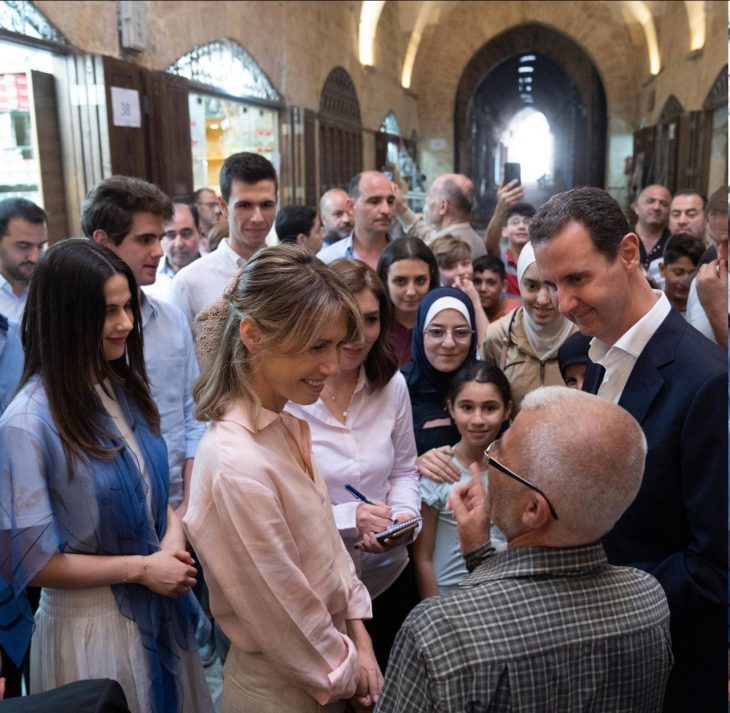
Israeli government minister and war cabinet member Gideon Saar threatened Syria’s President Bashar al-Assad on 27 October, warning that he will be “in danger” if his country continues to act as a “conduit” for Lebanese resistance movement Hezbollah.
Saar – who rejoined Benjamin Netanyahu’s government late last month – said during a conference that Tel Aviv “missed an opportunity” to “collapse” Assad’s government, which was “saved” by Iran and Hezbollah.
Syria must not be permitted “under any circumstances to be a conduit for weapons supply from Iran to Hezbollah,” the minister went on to say, adding that “Israel must make clear to Assad that if he chooses to harm Israeli security in this manner, he places his regime in danger.”
Israel “will not agree to Hezbollah’s renewed buildup of power through Syria, and will not agree to the opening of a front against it from Syrian territory,” he said. “Removing Assad from the Iranian axis will have far-reaching consequences for Israel’s security.”
Israel was heavily involved in supporting extremist groups against the Syrian government at the start of the US-led regime change war against Damascus, which began in 2011.
Fighters from Al-Qaeda’s Nusra Front were given Israeli air cover during the 2014 battles against Syrian government troops and Hezbollah in Quneitra. Wounded Nusra Front fighters were also treated at Israeli hospitals in the occupied Golan Heights.
Over the past several years, Israel’s air force has been waging an unofficial campaign of indiscriminate attacks against Syria, which aim to stifle the flow of weapons from Iran via Syria to the resistance in Lebanon. According to Lebanese analyst and journalist Khalil Nasrallah, this unofficial campaign – dubbed the ‘battle between wars’ – has failed.
Israeli attacks on Syria have increased since the start of the war in Gaza and Lebanon in October last year.
Since Israel’s massive escalation against Lebanon last month, nearly 2,000 people have been killed and over a million displaced. Israel has begun to target Lebanese–Syrian border crossings under the pretext that they are used to facilitate the delivery of Iranian weapons to Lebanon.
Hezbollah has promised its follower base recently that its military capabilities and weapons are in “great shape,” despite Israeli claims to the contrary.
The group has not yet used its more sophisticated and destructive weaponry against Israel.
Nasrallah’s Deputy Naim Qassem: Hezbollah will subdue the Israeli Beast
Full Speech by Naim Qassem, Deputy Secretary General of Hezbollah, on October 15, 2024.
Source : Al-Jazeera
Translation : resistancenews.org
In the Name of God, Most Gracious, Most Merciful.
Praise be to God, Lord of the Worlds. May prayers and salutations be upon the most deserving of creatures, our master, beloved leader, (the Prophet) Abul-Qassim Mohammad, upon his noble and pure family, upon his pious chosen companions, and upon all the Prophets and Righteous, until the Day of Judgment.
Peace be upon you, and God’s Mercy and Blessings.
Israel and its supporters fight, kill, and commit massacres. We find ourselves in a situation that demands we take a stand.
God Almighty has said in His Sacred Book: “Permission to take up arms is hereby granted to those who are attacked; they have suffered injustice. God has all the power to give victory to those who were unjustly expelled from their homes only because they said, “God is our Lord.” Had it not been for God’s repelling some people through the might of the others, the monasteries, churches, synagogues, and mosques in which God is very often worshipped would have been utterly destroyed. God shall certainly help those who help Him. He is All-powerful and Majestic.” [Qur’an, s. 22, v. 39-40] God Most High has spoken the truth.
We are in the Resistance. We have been uplifted by our great leader, His Eminence Secretary General Sayyed Hassan Nasrallah, may God the Most High be pleased with him, to whom we extend our sincerest greetings. This leader has filled every land with determination, jihad, glory, and victory.
O great leader, you have not abandoned us; your spirit remains with us. Did not the Almighty say: “(The martyrs) are alive with their Lord, receiving their sustenance” [Qur’an, s. 3, v. 169]? Your teachings are our constitution; your words illuminate our path, and your speeches mark the milestones of our journey. You have not left us. The Mujahideen confront their challenges with determination and strength, and your people stand firm, embodying the deep love of God. You have not left us: our hearts are filled with your love, our hope for victory is limitless, and your enemies fear your ghost, seeing you in every mujahid and every person who loves you. Your commands will be executed: we will defeat them and drive them from our land.
I would like to address several points.
First, let us recount what has transpired this year, so that both those close to us and those not so close may understand the vision that guides us and how we perceive the unfolding events. We regard Israel as a usurping and occupying entity, posing a genuine threat to the region and the world. Israel is an expansionist occupation that is not satisfied with Palestine; it seeks to dominate the entire Arab region, the whole Islamic world, and the globe from its position in the region. This occupying force is founded on murder, displacement, massacres, and the worst vices known to this earth. This occupation relies on three pillars: 1) criminality that instills fear, 2) unwavering support from the United States, and 3) time, meaning the notion that what it cannot seize today can be taken tomorrow or the day after.
The Palestinians, led by Hamas, initiated the Al-Aqsa Flood (on October 7) to expel the occupier and declare to the world that 75 years have passed during which the occupation has become entrenched, killing, expanding, displacing, exterminating, and committing every atrocity, leaving us with not an inch of this land. Is it not the right of the Palestinians to act against this occupation, to undermine its presence, and to prevent its continuation? Instead of questioning why the Al-Aqsa Flood occurred, we should ask why the occupation took place. The Al-Aqsa Flood has happened now, after 75 years of occupation. It is a legitimate right—an inherent right for the Palestinians and all who stand beside them.
In Lebanon, we cannot separate Lebanon from Palestine, nor the region from Palestine. Did not the Israelis officially and directly occupy Lebanon in 1978, refusing to leave despite Resolution 425? Did they not occupy again in 1982, maintaining their presence for a total of 22 years, from 1978 to 2000, only to be expelled by the Resistance? Why did Israel persist in occupying Lebanon? It established the Lahd Army, hoping to create a state in southern Lebanon as a precursor to further Israeli colonization, but this plan failed. In 2006, Israel attempted once more to advance into southern Lebanon, only to fail again. Clearly, Lebanon is part of Israel’s expansionist agenda. When Israel appears to cease its expansion, it is merely due to its incapacity; whenever it feels able to expand, it will.
That is why our support for the Palestinians is a support for justice, as they have a legitimate cause. By backing the Palestinians, we restrict Israel’s options for fulfilling its expansionist ambitions. On one hand, we strive to counter the threat to the Palestinians as much as we can, and at the same time, we confront it to prevent the expansion they desire.
Without the United States—the Great Satan—Israel would not have been able to establish such a foothold. The United States seeks a new Middle East. Condoleezza Rice articulated this in 2006, just days after the Israeli attack on Lebanon, when she responded to calls for a ceasefire by saying, “These are the birth pangs of a new Middle East.” However, they failed in 2006.
Today, Netanyahu utters those same words: he desires a “new Middle East.” This means that the United States and Israel, through their crimes and acts of extermination in Palestine, Lebanon, and the region, when the U.S. hands over control to Israel to do as it pleases—mobilizing all its military, political, media, and international resources—are complicit in this project. Thus, we face the threat of a new Middle East shaped by the Israeli-American partnership, executed by the Israeli criminal under the auspices of the Great Satan. When foreigners came to Lebanon with their ambassadors and envoys, asking us through intermediaries or directly to cease our war of support for Gaza so that settlers can return to the north of occupied Palestine, they demanded that we retreat 10 kilometers or more from the border to avoid provoking Israel. They avoid discussing the root of the problem: Israel’s occupation of Gaza and the extermination of the Palestinian people. We replied that they should get a ceasefire in Gaza, after which everything would return to normal in Lebanon, everything would revert to the way it was before. They responded that they couldn’t speak in such terms, and insisted that they wanted to separate Lebanon from Gaza. We did not yield to their demands.
We consider our resistance to be legitimate. It is defensive and has two objectives: rejecting the occupation and liberating the land. O people, you must understand that the project in the region is an expansionist one, and that the Palestinians are fighting for the liberation of their homeland. When we support the Palestinians, it is to help liberate their land and protect ours. And when Iran supports the Palestinians, it is to facilitate the liberation of Palestine, which would also be a blessing for Iran. This is not merely an Iranian project, but a Palestinian endeavor supported by Iran, Hezbollah, Yemen, Iraq, and the free peoples of the region. Is it fair that the entire arrogant imperialist world should support Israel in its aggression while we are denied the right to support the oppressed in their struggle for liberation? Contributing to this cause is an honor for Iran—the Iran of Imam Khomeini, may God sanctify him; the Iran of Imam Khamenei, may God preserve him—who has committed all of Iran’s resources to strengthen the Palestinians. It is Iran’s pride that the great martyr Qassem Soleimani worked to fortify this region in the face of Israeli occupation. In contrast, it is the shame and disgrace of the United States and its allies to support Israel’s criminality and murder.
I’m going to address a question that some people naively ask through the media: “Don’t you see the damage being inflicted in Lebanon?” I ask them: who is responsible for this damage? Is it the one defending the land or the one murdering our people and destroying our infrastructure? In defending ourselves, are we causing harm? Can’t you see that it is Israel that kills, Israel that attacks, Israel that commits these atrocities? I want you to understand that if we do not confront Israel—whether under the pretext of international resolutions meant to protect Lebanon and restore its rights, or the notion that Palestine is not our concern, or any other excuse—Israel will achieve its objectives. This is how Israel operates today: they sow terror, killing children and women and committing horrific massacres to undermine the will of the people. After that, all they have to do is say, “We want this village, we want this town, we want this country,” and people will surrender because they’ve seen what has happened before. But when we stand firm, when we take on the challenge and confront the enemy, when we endure sacrifices and inflict losses upon them, we will have protected generations for decades and centuries to come. It is natural to pay a price when we face the enemy, and these sacrifices—which we honor and praise—are necessary to liberate our land, deter the enemy, and thwart its plans, for the enemy also pays a price.
Secondly, how do we cope? As the Resistance, we fight with honor, targeting their military. Israel acts with monstrosity and ignominy, murdering children, women, the elderly, hospitals, humanitarian workers, and all those in the civilian sphere. Israel’s goal is to destroy and eradicate the Resistance and its people; they want to obliterate everything. When Israel initiated its recent campaign in Lebanon, it established three phases. The first was to strike at our leadership and military capabilities in order to deprive us of our ability to defend ourselves and confront the occupation. The second phase aims to eliminate Hezbollah’s presence. Finally, the third phase seeks to redefine Lebanon to serve Israeli and American interests, allowing them to govern it at will. However, they haven’t even succeeded in achieving the first phase. It is true that we have suffered greatly, and the loss of our leaders, including His Eminence the Secretary General—may God be pleased with him—has been significant and painful. Israel attempted to neutralize our military force by targeting our capabilities and missiles in various locations, but, thank God, they were unable to complete this first phase.
Let me clarify our position: there is only one way to achieve results, recover our territory, and halt the aggression, and that is through the steadfastness of the Resistance and the unity of its people around it. The Secretary General, His Eminence Sayyed Nasrallah—may God be pleased with him—has built a robust Resistance based on faith, trust in God, and preparation of all its capabilities. The mujahideen have hearts that aspire to a dignified life and do not fear death. As for the enemy, because he is morally bankrupt and all the resources at his disposal have proven useless, he has resorted to assassinating members of the Lebanese army, attacking UNIFIL forces, and bombing churches, places of worship, and mosques. Today, he even struck an aid convoy carrying the flag of the International Red Cross, prompting the Commissioner of UNRWA to declare that the agency has never faced such a situation since its inception. Even when Israel attacks UN forces, including UNIFIL, he demands they abandon their positions. Where are the emergency forces? Where is the UN? Where are France, Great Britain, and the United States? Where are all those who constantly lecture us on the necessity of respecting international resolutions? Israel disregards any international resolution. Israel does as it pleases, and international resolutions merely serve to remind Israel of the law, to no effect. Israel answers to no one.
In any case, we are facing a rampaging monster that cannot tolerate resistance preventing it from achieving its goals. But here’s the good news: we are going to grab its leash and take it back to the pen. Just wait and see.
Third, what are the equations of confrontation? We have moved from support (for Gaza) to direct confrontation with Israel since September 17, marked by the pager explosions, which were the first step toward war, culminating on September 27 with the assassination of His Eminence the Secretary General—may his soul be sanctified. Consequently, since September 17, we have entered a new phase: the confrontation of Israeli aggression against Lebanon. We are no longer in the support phase, which involved occasional escalations at the front line (along the border between Lebanon and occupied Palestine). Today, Israel has declared war against us. For the past two weeks, we have started the equation of the battlefield at the front line. The Mujahideen have been engaging the enemy in various locations, including Kfar Kila, Adaisseh, Yaroun, and Mays al-Jabal. In all honesty, their performance on the ground during these two weeks has exceeded their expectations. The mission of the Resistance is not to act as a regular army preventing a regular army from advancing; it is to conduct guerrilla operations against the enemy wherever it may be. So, when the Israelis boast that they have gained hundreds of meters in Lebanon, we respond that they are behind schedule, as they have been unable to advance in the past two weeks. In any case, as they advance, our young fighters are ready for increasingly tough confrontations.
In the first week on the front line, 25 Israeli soldiers were killed and 150 wounded. This was just in the first week. Of course, as usual, Israel has acknowledged only a fraction of those casualties. From one week ago to today—seven days since last Tuesday—we have established a new equation called “inflicting pain on the enemy,” ensuring that he feels the pain. Our missiles will reach Haifa and beyond, as our Sayyed (Nasrallah) wished. You have seen that our drone and missile strikes have reached Tel Aviv. Last Sunday alone, Israel acknowledged 100 killed and wounded—and of course, when Israel claims 100 casualties, we know there are likely more. The strike on Benyamina alone resulted in over 70 casualties. This demonstrates the Resistance’s resolve and capabilities. On Monday, we successfully targeted our missiles at Tel Aviv. Two million settlers from the Tel Aviv metropolitan area, Gush Dan, took shelter. A total of 194 towns and settlements went into their shelters, and warning sirens sounded everywhere. Ben Gurion Airport halted operations. This is all part of the “inflict pain on the enemy” equation, and it will continue.
Sidebar: On october 23rd, Hezbollah stated that the enemy’s losses have reached over 70 killed and more than 600 injured among the officers and soldiers of the Israeli army. Additionally, 28 Merkava tanks, 4 military bulldozers, one armored vehicle, and one troop transport vehicle had been destroyed. Three Hermes 450 drones and one Hermes 900 drone have also been shot down. These figures do not include Israeli losses in the military bases and barracks in the north and interior of occupied Palestine.
I tell you: since the Israeli enemy has targeted all of Lebanon, we have the right, from a defensive position, to target any point within the Israeli entity—whether in the center, north, or south. We will choose any point we deem appropriate. There are no limits in this equation, as Israel has opened this equation. In this regard, I’d like to point out something that many people may not be aware of. While we certainly cannot thank the enemy, it inadvertently aids us in striking back. How so? When we launch a missile, their anti-missile systems engage, and the debris falls on settlements and towns, which is a blessing. It’s not just about what we hit; it’s also about what their anti-missile systems hit when they fall back. Our drones and missiles are active, and sirens sound everywhere. You should understand that the sirens ringing throughout Israel are a sign of the impact on Israeli society.
Rewriting Resolution 1701: Hochstein’s diplomatic cover for Israeli expansion
By Anis Raiss | The Cradle | October 25, 2024
On 21 October, Amos Hochstein, born in Israel in 1973 and once an Israeli tank crewman, returned to Lebanon as a US envoy, not to protect peace but to redefine it on Tel Aviv’s terms.
The irony is undeniable: Israel, having lost 28 tanks in almost as many days during its latest invasion attempt, now sends one of its former tank crew members, not in battle, but in diplomacy – to achieve through words what military force could not secure: control over Lebanon through revisions to UN Resolution 1701.
Hochstein’s mission may appear to be an act of diplomacy, but is it really about fostering peace? Or is he aligning with Israeli policy to reframe control while eroding Lebanon’s sovereignty? The diplomatic veneer only thinly conceals the underlying agenda of control.
From Oslo to 1701: Reinterpreting peace for control
The Israeli playbook of manipulating peace processes is nothing new. In a 2001 leaked video, Israeli Prime Minister Benjamin Netanyahu boasted about his manipulation of the Oslo Accords, using vague phrases like “military facilities” to tighten Israeli control over contested areas.
Netanyahu openly stated, “America is something that you can easily maneuver,” hinting at the ease with which Israeli influence shapes US diplomacy – a dynamic that is evident today in Hochstein’s actions.
The Israeli army veteran’s push for amendments to Resolution 1701 is a clear continuation of this strategy: advancing the occupation state’s interests under the guise of diplomacy from Washington. Just as Netanyahu reinterpreted the Oslo Accords to solidify Israeli control, Hochstein’s proposed changes to 1701 seek to turn it into a tool for extending Tel Aviv’s influence. This is not diplomacy for peace; it is diplomacy for power.
1701: Israel’s unfinished battle
Resolution 1701, passed by the UN Security Council on 11 August 2006, marked a critical point for Israel, which found itself unable to defeat Hezbollah during the July War despite its advanced military capabilities.
Brokered by then-US Secretary of State Condoleezza Rice, the ceasefire allowed Israel a face-saving exit under the guise of diplomacy rather than face a prolonged, unwinnable battle. But the resolution has since been a point of ongoing contention – one Israel has repeatedly violated.
One notable violation is Israel’s continued occupation of Shebaa Farms, which contravenes both Resolution 1701 and the earlier Resolution 425. Hezbollah’s decision to remain armed, often criticized internationally and in some quarters domestically, becomes a logical and legally justified response under international law, given Israel’s occupation of Lebanese land. The ongoing presence of Israeli forces undermines the very peace that Resolution 1701 aimed to establish.
Tel Aviv’s disregard for the resolution extends beyond territorial occupation. Since 2013, Israel has repeatedly violated Lebanese airspace to conduct strikes on Syria, treating Lebanon’s skies like an unguarded backdoor for foreign interventions.
This belligerent behavior is akin to a trespasser using a neighbor’s yard to attack another – an act that undermines Lebanon’s sovereignty entirely. In August 2019, a significant escalation occurred when Israel launched a drone strike in Beirut, which then-president Michel Aoun condemned as a “declaration of war.”
Moreover, Israel’s occupation of the northern part of Ghajar village further violates both the Blue Line and Resolution 1701. Despite UNIFIL and the Lebanese Armed Forces deploying south of the Litani River, Israel’s persistent refusal to withdraw ensures that peace remains elusive, leaving Lebanon under the constant threat of Israeli aggression.
Rewriting 1701
The amendments proposed by Hochstein to Resolution 1701 reveal Israel’s broader strategy of using international mechanisms to further its objectives. These changes would extend UNIFIL’s jurisdiction two kilometers north of the Litani River, allowing international forces to conduct searches, patrols, and inspections without requiring approval from Lebanese authorities. These inspections can include searching vehicles, private properties, and suspected weapons sites.
Effectively, this is a demand for Lebanon to cede control over its own territory – a clear infringement on its sovereignty. Under the guise of peacekeeping, this would grant Israel indirect control over Lebanon’s internal security dynamics, especially since intelligence for these operations may be influenced by, or even originate from, Israeli sources.
Eyes on the south
Hochstein’s proposal raises critical concerns about intelligence oversight: Who will guide these operations, and how might covert Israeli interests be served? The potential involvement of Israeli tech companies like Toka, co-founded by former prime minister Ehud Barak, is telling.
Toka specializes in advanced surveillance technologies that can hack into and manipulate live or recorded video feeds from public and private security cameras, including those in ports, airports, and border crossings.
If Toka’s technology is deployed in southern Lebanon, it could potentially compromise the very systems used by UNIFIL. This technology, which leaves no trace, could be exploited to monitor Hezbollah and Lebanese military movements, all under the guise of international peacekeeping operations. The consequences would be profound: a complete erosion of Lebanon’s security, replaced by a surveillance network manipulated by Israel to serve its own strategic interests.
Israel’s covert surveillance approach can be seen in how it handles Beirut’s southern suburbs. The infamous Dahiya Doctrine advocates for overwhelming destruction of civilian areas to target Hezbollah strongholds, yet Israel seems to avoid fully enacting this policy – possibly due to its desire to preserve infrastructure that supports covert operations.
Technologies like Toka’s suggest a more calculated plan, enabling 24/7 monitoring of Hezbollah-controlled areas south of the Litani River. Armed with precise intelligence, Israel could execute targeted strikes or assassinations akin to those witnessed during the 2006 war, turning southern Lebanon into a zone of perpetual surveillance and intermittent violence – all under the pretense of adhering to Resolution 1701.
Berri’s rejection
Nabih Berri, long-time leader of the Amal Movement and a staunch ally of Hezbollah, immediately opposed Hochstein’s proposed amendments. As Speaker of Parliament since 1992, Berri has been a key figure in resisting Israeli encroachments and defending Lebanese sovereignty.
His longstanding relationship with Hezbollah and the broader Shia political movement positions him as a critical figure in Lebanon’s struggle against foreign intervention. Upon receiving Hochstein’s proposals, Berri recognized them for what they were: an attempt to undermine Lebanese sovereignty under the guise of enhanced peacekeeping.
While Hochstein framed these amendments as necessary for stability, Berri’s response was clear: the real issue is not a lack of oversight but Israel’s continued violations of Lebanese airspace and territory. As Berri emphasized, any genuine pursuit of peace must begin with holding Israel accountable for its aggression and ensuring it abides by existing UN resolutions.
He also announced that “the consensus among the Lebanese on Resolution 1701 is a rare consensus, and we are committed to it,” adding, “We reject any amendments to Resolution 1701, whether by increase or decrease.”
In an interview with Al Arabiya TV, Berri also stated, “I have been mandated by Hezbollah since 2006, and it agrees to 1701.”
Resolution 1701, meant to establish peace, is being reshaped into a surveillance tool – a mechanism for Israel to achieve what it could not through military means. The use of sophisticated surveillance technology, the selective enforcement of ceasefire terms, and the involvement of international forces all serve to undermine Lebanon’s sovereignty, rendering “peace” a hollow word.
Featured Video
Trita Parsi: Israel Set a Trap for Total War in the Region
or go to
Aletho News Archives – Video-Images
From the Archive
Zionism’s Violent Legacy
By Donald Neff | Washington Report On Middle East Affairs | January 1996
On January 4, 1948, Jewish terrorists drove a truck loaded with explosives into the center of the all Arab city of Jaffa and detonated it, killing 26 and wounding around 100 Palestinian men, women and children.[1] The attack was the work of the Irgun Zvai Leumi – the “National Military Organization,” also known by the Hebrew letters Etzel – the largest Jewish terrorist group in Palestine. The Irgun was headed by Revisionist Zionist Menachem Begin and had been killing and maiming Arabs, Britons and even Jews for the previous ten years in its efforts to establish a Jewish state.
This terror campaign meant that at the core of Revisionist Zionism there existed a philosophical embrace of violence. … continue
Blog Roll
 Aletho News
- Trita Parsi: Israel Set a Trap for Total War in the Region
- Trump’s Iran war is on an Israeli leash
- Saudi oil boss issues global supply warning
- Riyadh Says Its Oil System Is Intact. The Numbers Say Otherwise.
- Trump and Netanyahu Want to “Finish the Job” on Iran
- US ‘one-sided dictation’ not Iran’s beliefs makes rational talks impossible: Baghaei
- Iran’s Next Strike May Not Explode. It Could Shut You Down /Col Doug Macgregor
- Iran: US political targets legitimate if assassinations return
- Iraq shuts key border crossing with Iran under US pressure: Report
- Undersea Internet cables could be targeted in retaliation for attacks on Iran: IRGC deputy chief
- If Americans Knew
- The Israel Lobby’s Changing Fortunes
- AIPAC has become such a political liability that it’s shifting to a more “nimble” approach to buying politicians
- At least 160 Israeli settler attacks in 2 weeks
- Will Gaza’s Ancient Christian Community Disappear Forever?
- Israel’s vision of regional security rests on keeping Arab states weak
- Heidi Levine recounts how Palestinian youths helped save her in settler attack
- DAILY UPDATE: Latest essential news on Palestine, Israel, & region
- Trump’s Intensifying Sabotage of the ICC, for Israel’s Sake
- Israeli military detain US and UK volunteers in West Bank including Democratic NY politician Brad Lander
- Americans at National Conservatism Conference held in Israel this year criticize Israel
- No Tricks Zone
- E-Cars Reduce CO2 Emissions By Only 41% Compared To Internal Combustion Engine Vehicles
- Predictions Made By Renowned Climate Professor Over Past Decades Have Been Proven To Be Poor
- New Study Suggests Large Regions Of The Pacific Ocean Have Been Cooling For The Last 80 Years
- Germany’s Green Energy Debacle: High Energy Costs Force Kahla Porzellan to Close After 182 Years!
- New Study: 50 Years Of The Most Aggressive ‘Net Zero’ Policies Can Only Affect The Global Climate By 0.03°C
- US September “Heat” Was No Record…Many Records Set Decades Ago
- Latest European Green Energy Debacle; Portugal’s Largest Flagship Solar Park Insolvent!
- Green Energy Debacle: German Expert Professor Fritz Vahrenholt Warns Of Severe Economic And Social Consequences
- Two More Paleo Reconstructions Affirm Meters-Higher Sea Levels Across Ireland, Brazil 7000-6000 Years Ago
- New Study: Earth And Venus Surface Warmth Largely Explained By Convection And Lapse Rate, Not CO2 Or Radiation

