Bolivia denies Israel accusations of hosting Iran, Hezbollah bases
MEMO | October 23, 2024
Bolivia has denied accusations that it is hosting Iranian and Hezbollah bases within its borders, urging South American nations not to fall for such allegations and become divided.
In a virtual press conference on Monday, Israel’s Ambassador to Costa Rica, Mijal Gur Aryeh, stated that there are “other countries in the region that have Iranian and Hezbollah bases, particularly Venezuela and Bolivia”, without providing evidence or specific details on such an allegation.
Bolivia’s Foreign Ministry yesterday denied those accusations, however, saying in a statement that “Bolivia is a pacifist state that promotes the culture of peace, which is why it has constitutionally assumed the prohibition of installing foreign military bases in its territory.”
Calling Aryeh’s words “irresponsible, unfounded, and self-serving”, the Ministry called on other South American countries “not to fall into these provocations that seek to affect the relations of brotherhood between states and peoples of the region.”
It asserted that the Ambassador’s comments ”seek to generate confrontation between Latin American states, governments and peoples, against the objective outlined in the Community of Latin American and Caribbean States (CELAC) of consolidating Latin America and the Caribbean as a zone of peace”.
Leaked report finds Israel targeting UN troops in Lebanon, injured several with white phosphorus
The Cradle | October 23, 2024
Israel’s military has attacked UNIFIL troops deployed on the Lebanon–Israel border a dozen times, including possibly with white phosphorus, the Financial Times (FT) reported on 22 October.
According to a confidential report prepared by a country contributing troops to the UN mission, Israeli forces forcibly entered a clearly marked UN base and are suspected of using the incendiary chemical white phosphorus, injuring 15 UN soldiers.
Israeli forces began targeting UN troops shortly after launching ground operations across the border into Lebanon on 1 October.
UNIFIL has called the attacks “deliberate” and a “flagrant violation of international law.”
UN troops, which come from 50 separate countries, have rejected Israeli Prime Minister Benjamin Netanyahu’s demand that they evacuate their border posts to clear the way for current Israeli military operations in southern Lebanon.
Israel hopes to establish a so-called security zone and push Hezbollah fighters some 30 kilometers away from the border to positions behind the Litani River.
The confidential report viewed by FT includes photographs documenting the extent of the damage done to bunkers that shelter UN troops, perimeter walls, and observation towers at several bases.
On Sunday, an Israeli bulldozer deliberately demolished an observation tower and perimeter fence of a UN position in Marwahin.
On 10 October, two UN troops were injured when an Israeli Merkava tank opened fire and struck an observation tower at the UNIFIL headquarters in Naqoura on the Lebanese coast. The same day, Israeli forces fired at a UN bunker sheltering Italian troops in Labbouneh.
The report says the Israeli military first surveilled the area with drones and destroyed the bunker’s cameras before attacking.
Israeli forces also fired several munitions, which landed near a base and emitted “smoke of suspected white phosphorus” into it.
The FT notes that Israel has used white phosphorus in Lebanon throughout the past year. Its use is unlawful in populated areas under international law.
UN troops were deployed to the Lebanon–Israel border following Israel’s first invasion of Lebanon in 1978. Repeated invasion attempts were made in 1982, 2006, and 2024.
Israeli troops occupied large areas of southern Lebanon between 1982 and 2000 before armed resistance by Hezbollah forced them to withdraw.
The Hidden Motives Behind Hochstein’s Lebanon Visit and the Strategic Bet on the Resistance
By Zoulfikar Daher | Al-Manar | October 23, 2024
The first visit of US envoy Amos Hochstein to Beirut since the outbreak of Israel’s large-scale aggression against Lebanon came approximately three weeks after the Israeli enemy expanded its operations across southern Lebanon, the Bekaa, and even the southern suburbs of Beirut and the capital itself.
Prior to his visit, speculation arose about its true purpose: Was Hochstein bringing concrete solutions, or was he simply testing the waters and assessing the political landscape? Some questioned whether he was delivering Israeli demands aimed at pressuring Lebanon into submission. Did this move stem from American initiative alone, or was it coordinated with “Israel” as part of its efforts to impose terms? Alternatively, could it signal Israel’s realization that the conflict with the resistance is proving more difficult than anticipated, given the losses it has suffered along the Lebanese-Palestinian border?
There is a view that the Israeli enemy, recognizing the challenge posed by the resistance, is attempting to de-escalate while still hoping to extract some benefit from its tactical strikes. However, these strikes have done little to alter the situation. The resistance remains steadfast, its retaliation capabilities growing and reaching deeper into Israeli territory, while its capacity to manage the conflict remains strong.
Fearing that Israel’s “achievements” on the ground might slip away, the US administration appears to have dispatched Hochstein to reopen negotiations. The strategy follows a familiar pattern: escalate demands to the maximum in hopes of gaining concessions, all while threatening continued aggression.
Simultaneously, Israeli attacks intensified in various areas, particularly in the southern suburbs of Beirut (Dahiyeh). The timing of these escalations, paired with Hochstein’s visit, was no coincidence. “Israel” aimed to showcase its destructive capabilities, resorting to psychological warfare by targeting buildings associated with the Al-Qard Al-Hassan Association, although these were largely unoccupied. This was intended to send a message to the Lebanese leadership receiving the American envoy. The strikes continued the following night, extending to Al-Awzai and areas near Beirut’s governmental hospital. But the question remains: Can these aggressive moves impose Israel’s conditions on Lebanon?
Hochstein reportedly presented amendments to UN Resolution 1701, which included:
• Expanding the role of international forces and allowing them to operate without restrictions.
• Pushing the resistance several kilometers north of the Litani River, with some reports suggesting as far as the Owali River near Sidon.
• Assigning oversight of the resolution’s implementation to US, British, or German forces.
• Granting “Israel” unrestricted access to Lebanese airspace for supervision.
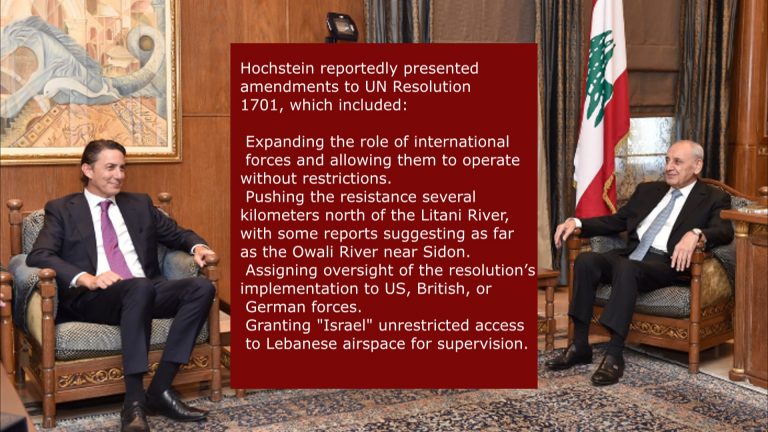
These terms essentially aim to hand “Israel” significant control, leaving Lebanon, its army, people, and resistance with little ability to defend national sovereignty. Some media and political voices have described this proposal as nothing less than a “surrender document.”
However, Parliament Speaker Nabih Berri reaffirmed Lebanon’s commitment to Resolution 1701, with no amendments. He emphasized that this is the final opportunity for the US to intervene diplomatically and halt the war. Berri made clear that Lebanon stands united on Resolution 1701, and that “Israel” must respect it. He anticipated that Hochstein would push Israel’s maximum demands but remained confident that nothing could be imposed on Lebanon. “Israel” has failed to achieve its objectives on the battlefield, and it will not succeed through diplomacy either.
Hochstein’s visit, it seems, was primarily a test of Lebanon’s resolve—an attempt to gauge whether the country, particularly the resistance, might offer concessions under pressure. But Lebanon’s leadership, backed by its steadfast resistance, will not yield. Neither the US, nor the Zionist entity, nor their allies can force Lebanon into submission.
Contrary to some perceptions, “Israel” is not in a position of strength. Those following the situation behind the scenes of Hochstein’s visit might believe “Israel” can impose its will, but the facts tell a different story. For over three weeks, it has faced setbacks along the border with Lebanon, failing to make significant gains or take control of any Lebanese towns. These developments underscore that the US-Israeli pressure campaign is shallow and ineffective against the united front of Lebanon, its resistance, and its people.
Ultimately, the outcome of this conflict will be decided on the battlefield, where the resistance, as emphasized by its leader, Sayyed Hasan Nasrallah (may he rest in peace), continues to hold the upper hand. The realities on the ground, both day and night, will shape the political and diplomatic consequences, not the other way around. The battlefield will determine the fate of this war, and indeed, the future of the entire region.
Media tour of Beirut hospital disproves Israeli claim of ‘Hezbollah bunker’
The Cradle | October 22, 2024
Journalists toured the Sahel Hospital in the Haret Hreik neighborhood of Beirut’s southern suburbs on 22 October, disproving claims made by the Israeli military that Hezbollah was storing hundreds of millions of dollars in cash and gold in a bunker below the hospital.
Independent journalist Steve Sweeney was among those visiting the hospital. He wrote on social media that he “had unrestricted access to all areas, including the basement, and all I found were the normal things found in any hospital, in any country across the world.”
“The hospital director believes it will be bombed by Israel, repeating a pattern seen in Gaza, with attempts to link the hospital to Hezbollah a smokescreen to justify an attack. We had to leave the hospital with drones flying overhead with the potential for Israel to strike at any moment,” he added.
L’Orient Today reported that the hospital was evacuated on Monday evening after the Israeli army said it was conducting “a reconnaissance of the complex” beneath which it said “hundreds of millions of dollars” belonging to Hezbollah were hidden.
Hezbollah has “hundreds of millions of dollars in cash and gold under the Sahel Hospital in Haret Hreik to fund its terrorist activities,” Israeli army Arabic-language spokesman Avichay Adraee wrote on social media.
“The Israeli allegations about the Sahel hospital are false, but we were forced to evacuate,” said the director of the health facility, Fadi Alameh, in an interview with Al Jadeed TV.
He also said that “the Sahel Hospital has nothing to do with the parties” and called on the army command to inspect it and confirm that no tunnels were under the building.
Later on Tuesday afternoon, an Israeli airstrike completely destroyed a high-rise building in the Ghobeiry region in the Beirut southern suburbs as Hezbollah’s Media Relations Officer, Mohammad Afif, was giving a press conference in the area, Lebanon’s National News Agency (NNA) reported.
At the press conference, Afif discussed Israel’s bombing on Sunday of multiple offices of the Al-Qard al-Hassan Association, which provides financial services to Lebanese civilians.
Afif said the bombing had “no justification at all. It is a licensed civil institution, and Hezbollah does not receive its allocations from this institution.”
“Al-Qard al-Hassan Association was prepared for the aggression, took all necessary precautions, and will meet its commitments.”
He also stated that despite recent Israeli bombings and the killing of Hezbollah leader Hassan Nasrallah, “Hezbollah’s military and logistical support lines have returned to what they were, and the enemy has suffered heavy losses in lives and tanks.”
“The resistance and the chain of command are in good health,” he added.
Late Monday, Israel also bombed residential buildings in the Jnah area of Beirut near the Rafic Harir Hospital, killing 13, the Lebanese Health Ministry said.
Hezbollah drone hits Netanyahu’s home as rocket barrage pummels Haifa
The Cradle | October 19, 2024
A Hezbollah drone launched from Lebanon targeted the private home of Israeli Prime Minister Benjamin Netanyahu on 19 October, the prime minister’s office said.
Saudi news outlet Al-Hadath first reported the drone attack, which targeted Netanyahu’s residence in the coastal city of Caesarea, located 60km north of Tel Aviv, early on Saturday.
The prime minister and his wife were not present at the time of the attack, and no injuries were reported.
Caesarea resident Yaheli Karbi told Haaretz that she saw a helicopter flying above the area near the Prime Minister’s residence around 7:30 am.
“I saw [the helicopter] hovering over Bibi’s house,” she said. “I then saw the drone arrives and heard it hit. There was a very strong smell of smoke,” she added.
The Israeli military said Saturday morning that some 55 rockets were fired from Lebanon at northern Israel within an hour, causing sirens to be activated in several cities and towns across the Upper, Western, and Central Galilee areas.
Some of the rockets were intercepted, while others landed in open areas, the military stated.
A short time later, Israel targeted a vehicle traveling on the Jounieh highway just north of Beirut, killing two people and injuring two others.
It was the first such Israeli strike in the area since the start of the war.
On Friday, Hezbollah launched several attacks on Israeli military targets.
The Lebanese resistance movement announced it launched a barrage of precision-guided missiles targeting the Kiryat Eliezer air base, located west of Haifa.
It also launched a swarm of assault drones at the Ein Shemer base, a missile defense and regional brigade base located east of the city of Hadera.
Israel has intensified its attacks on Hezbollah targets and Lebanese civilians and civil defense workers across the country, including two large massacres earlier this week.
An Israeli airstrike on Wednesday killed the mayor of Nabatieh, one of the largest cities in southern Lebanon. He and 16 others were killed at the municipal headquarters while in a meeting to coordinate aid deliveries to residents and those displaced by war.
On Monday, an Israeli strike massacred at least 24 people from the same family, 12 women, ten men, and two children, in Aitou, a village in the mountainous Zgharta district in northern Lebanon.
The family had rented a home in the Christian-majority town after being displaced from their home in the south by Israeli bombing.
UN troops to ‘stay in all positions’ inside Lebanon despite Israeli threats
The Cradle | October 15, 2024
The UN Under-Secretary-General for Peace Operations, Jean-Pierre Lacroix, confirmed on 14 October that the UN Interim Forces in Lebanon (UNIFIL) would “stay in all its positions” inside Lebanon after Israeli attacks injured at least five blue helmets.
“The decision was made that UNIFIL would currently stay in all its positions in spite of the calls that were made by the Israel Defense Forces to vacate the positions that are in the vicinity of the Blue Line,” Lacroix told reporters on Monday.
“I want to emphasize that this decision still remains,” he stressed, adding that the plan was confirmed earlier in the day by Secretary-General Antonio Guterres.
The statement came a few hours after the 15-member UN Security Council (UNSC) for the first time unanimously voiced “strong concerns” about the safety of UNIFIL troops.
“Against the backdrop of ongoing hostilities along the Blue Line, the members of the Security Council expressed their strong concerns after several UNIFIL positions came under fire in the past days,” said the council’s rotating presidency, currently Switzerland’s UN ambassador Pascale Baeriswyl.
“They recalled that UN peacekeepers and UN premises must never be the target of an attack,” the UNSC statement adds, without ever naming Israel.
Over the past week, UN positions and bases in southern Lebanon have come under repeated attacks by the invading army. In the most recent of these, UNIFIL revealed that Israeli tanks “destroyed the position’s main gate and forcibly entered the position.”
According to the Israeli military, the incursion into the UNIFIL base came after fighters from Lebanese resistance movement Hezbollah fired anti-tank missiles at Israeli troops, wounding at least 25 of them.
The UN decision to keep its troops inside Lebanon came just hours after Israeli Prime Minister Benjamin Netanyahu repeated his call for UNIFIL to “get our of harm’s way.”
UNIFIL was founded in response to Israel’s invasion of south Lebanon in 1978.
Stephane Dujarric, spokesman for the UN secretary-general, told reporters on Monday that “attacks against peacekeepers are in breach of international law, including international humanitarian law, and they may constitute war crime.”
Last week, Hezbollah accused Israel of using the UN troops as “human shields.”
“The Israeli enemy is attempting to use UNIFIL forces as human shields to cover its failure to advance … The operations room of the Islamic Resistance instructed the fighters to hold back and not engage with the movement to protect the lives of international soldiers,” the Hezbollah statement reads.
US says can’t continue supplying Ukraine, Israel together as Tel Aviv faces munitions shortage
Press TV – October 15, 2024
Israel is scrambling to supply interceptor missiles amid a looming shortage as the regime is bracing for more retaliatory attacks from the regional resistance, more than a year after it launched the genocidal war on Gaza, a report says.
The report by the the Financial Times came as the United States on Sunday confirmed that its military is sending an anti-missile system operated by American troops to aid the Israeli forces following the Tel Aviv regime’s failure to defend itself against Iran and as Tel Aviv has threatened it will attack Iranian sites.
“Israel’s munitions issue is serious,” the Financial Times cited Dana Stroul, a former senior Pentagon official with responsibility for the West Asia, as saying on Tuesday.
“If Iran responds to an Israel attack [with a massive air strike campaign], and [Lebanon’s] Hezbollah joins in too, Israel air defenses will be stretched,” she said, noting that US stockpiles were not limitless.
“The US can’t continue supplying Ukraine and Israel at the same pace. We are reaching a tipping point.”
Boaz Levy, chief executive of Israel Aerospace Industries, which makes the Arrow interceptors used to down ballistic missiles, said he was running triple shifts to keep production lines running.
“Some of our lines are working 24 hours, seven days a week. Our goal is to meet all our obligations,” Levy said.
While Israel does not disclose the size of its stockpiles, he said “it is no secret that we need to replenish stocks.”
Since early October 2023, Israel has been waging brutal two-front aggression that has killed more than 42,000 people in the Gaza Strip and at least 2,306 others in Lebanon so far.
Over the same period, the usurping regime has also assassinated several resistance leaders, including Hamas’s political bureau chief Ismail Haniyeh and Hezbollah Secretary General Sayyed Hassan Nasrallah.
In support of Palestinians in Gaza, resistance groups have launched retaliatory attacks on Israeli targets and vowed to keep fighting until the Gaza onslaught ends.
In response to Israel’s barbaric acts of assassination against the resistance front’s top leaders, Iran carried out Operation True Promise 2 earlier this month.
During the operation, Iran launched some 200 high-speed ballistic missiles at the Zionist entity’s military, espionage and intelligence bases, sending almost 10 million settlers into bomb shelters. Ninety percent of the fired Iranian missiles hit their targets.
Despite Israel’s intensified strikes on Lebanon, Hezbollah managed to conduct the deadliest strikes on the occupied territories in the past year over the weekend.
“We are not seeing Hezbollah’s full capability yet. It has only been firing at around a tenth of its estimated prewar launching capacity, a few hundred rockets a day instead of as many as 2,000,” Assaf Orion, a former Israeli brigadier general and head of strategy at the Israeli military, said.
“Some of that gap is a choice by Hezbollah not to go full out, and some of it is due to degradation by the IDF [Israeli military]. . . But Hezbollah has enough left to mount a strong operation,” Orion added.
“Haifa and northern Israel are still on the receiving end of rocket and drone attacks almost every day.”
Amid the rising retaliatory operations, the report cited analysts as saying “defense planners and Israel’s AI-powered air defenses were having to choose which areas to protect over others.”
“It’s only a matter of time before Israel starts to run out of interceptors and has to prioritize how they are deployed,” said Ehud Eilam, a former researcher at Israel’s ministry of military affairs.
The Zionist regime cannot fight Hamas and Hezbollah at the same time
By Robert Inlakesh | Al Mayadeen | October 12, 2024
The war that the Israeli regime has opened will not close until it is dealt a strategic defeat, one from which it will not likely recover.
After all of its gloating, the Zionist entity appears to have fallen for its own propagandistic bravado and is sleepwalking into the abyss. Having failed to defeat Hamas in Gaza, the Israelis appear to have lulled themselves into a belief that they had already crushed Hezbollah with their initial blows of the war.
When the Israelis detonated thousands of pagers on September 17, a day later detonating walkie-talkie devices, inflicting dozens of deaths and hundreds of serious injuries, this represented a momentary tactical victory for the settler project. What followed, with the assassination of countless Hezbollah officials, culminating in the martyrdom of the party’s Secretary-General Sayyed Hassan Nasrallah, made the Israelis appear as if they were then in the driver’s seat of the conflict.
Israeli Prime Minister Benjamin Netanyahu grew so confident and emboldened that he decided to record a video message to the people of Iran, indicating that he would soon aid in carrying out a regime change. The Zionist leaders ordered large-scale airstrikes against thousands of targets across Lebanon, devastating civilian infrastructure and inflicting over 2,000 deaths. The Israelis repeatedly pounded the Southern Suburb of Beirut with hundreds of tons of explosives, while expanding the nature of their strikes against Syrian territory too.
While the Arab and Muslim World entered a stage of collective mourning over the repeated attacks on Lebanon, processing the loss of one of its most cherished leaders in recent memory, the Israelis also decided to declare a ground incursion into South Lebanon. Terrorist tactics and assassinations have served as propaganda victory in the media battle of the optics, in addition to a temporary tactical victory, which certainly inflicted a blow.
Yet, the strategic initiative was suddenly recovered on October 1, with the Islamic Revolution Guard Corps (IRGC)’s unprecedented response to the repeated assassinations – including the murder of Hamas leader Ismail Haniyeh in Tehran – firing 180 ballistic missiles at Israeli military sites. Despite countless attempts to deflect, cover up, and downplay the effectiveness of the Iranian response, dubbed “Operation True Promise II,” the impact was felt throughout the entire region.
What also happened following this, with the repeated successful strikes against Israeli targets by Yemen’s Ansar Allah and the Islamic Resistance in Iraq, combined with repeated Hezbollah’s successes in repelling the Zionist forces’ attempts at penetrating Lebanese land, all worked at changing the direction of the tide. On October 7, Hamas demonstrated its ability to hit “Tel Aviv” with M90 rockets, which was followed by strikes on “Tel Aviv” by Ansar Allah and then Hezbollah.
After repeated costly failures along the Lebanese border, the Israelis then decided to invade Jabalia Refugee Camp in northern Gaza and begin a terror bombing campaign across northern Gaza, also carrying on its assassinations of journalists and educators in the besieged territory. However, despite the terror that they inflicted, when their forces entered on the ground and besieged Jabalia Refugee Camp, the Palestinian Resistance factions began executing sophisticated and daring ambush operations, exacting a significant price on their soldiers.
The al-Qassam Brigades – the armed wing of Hamas – then began firing drones at troop formations and even one toward Israeli settlements, indicating that their capabilities were much greater than they were previously believed to be by the enemy. Suddenly, the Israelis were in a position where the Palestinian Resistance was killing and injuring their soldiers in Gaza, while Hezbollah was doing the same from South Lebanon.
Although the Israelis dealt significant blows to the Axis of Resistance, it is now in an even more difficult position than it previously found itself in prior to its assaults on Lebanon. Hezbollah has replaced its military leadership and has had the time to plan, rid itself of potential security breaches, and take the initiative on the battlefield. We see that Hezbollah is today intensifying its rocket strikes against the Israelis, dealing significant blows and putting the Zionist entity in a position of embarrassment before its own public once again.
The Israelis now must mount significant offensive actions across all fronts and fight on, managing a battle with Lebanon, Gaza, the West Bank, Yemen, Iraq, and even Iran. Benjamin Netanyahu envisioned himself as the Israeli Prime Minister to inflict a 1967-style defeat on the regional resistance, yet he has dragged the entire entity into something very different. We are no longer in the days of Egyptian President Gamal Abdul Nasser or the PLO in the 1980s, Hezbollah and the regional Axis of Resistance axis are not an alliance that can be broken through assassinations of senior leaders, in addition to this, they are ready for the fight.
Hezbollah undoubtedly enjoys superiority on the ground, in face-to-face combat, while the Zionist military has only proven capable of pulling off sophisticated terrorist plots and assassinations, in combination with their elite video-game warriors who specialize in using advanced weapons from a distance. The reality is that typing on a keyboard or commanding controllers, while sitting in a fortified position, may deliver some tactical victories, but it will not win a war that requires immense physical courage, which the Israelis simply do not possess.
Even in the West Bank, where the Israelis frequently raid refugee camps and face off against poorly trained teenagers and men in their young twenties, armed with no more than light weapons, their special forces units have to call in backup and end up using air support. Even against the weakest link in the chain of Resistance groups, they struggle to hold ground in confrontations and never do so in a fair way. In Lebanon, they face committed, well-trained, and well-prepared fighters who do not fear death and crave the opportunity to confront them.
The Israeli regime may well pull off more trickery and terrorism on a grand scale, as it will turn to more assassinations, attempts to stir unrest, and perhaps special force operations deep into Lebanese or Syrian territory. There cannot be any doubt that there will be more challenges ahead, that the Israelis have many more tricks up their sleeves, and that the terror they plan to inflict will be painful, primarily to civilians. Yet, they do not possess the capability to win a multi-front confrontation and will be bled to death, so long as the Axis of Resistance continues to seize the initiative and respond forcefully to each escalatory violation of international law that the Israelis commit.
Sayyed Hassan Nasrallah, in his first speech issued during the Gaza Genocide, spoke of “scoring points” and that the “knockout blow” had not yet been delivered against the Israeli regime. What has happened during the past month is that the Israelis were being beaten on points and decided to begin throwing haymaker punches with the intent of ending the fight abruptly, taking a chance at victory. Some of those punches landed and knocked down the Axis of Resistance, yet they got back on their feet, dealt blows back to the Israelis, and are now fighting with even more intensity. Both sides have been hit and hurt, so this fight now looks like it will end with a KO.
The war that the Israeli regime has opened will not close until it is dealt a strategic defeat, one from which it will not likely recover. It is also a war that the United States has enabled and backed in every way. In today’s world, the Palestinians and Lebanese people are taking on not only the Zionists, but the US too.
Hezbollah says Israel using UN troops as ‘human shields’ in south Lebanon
The Cradle | October 8, 2024
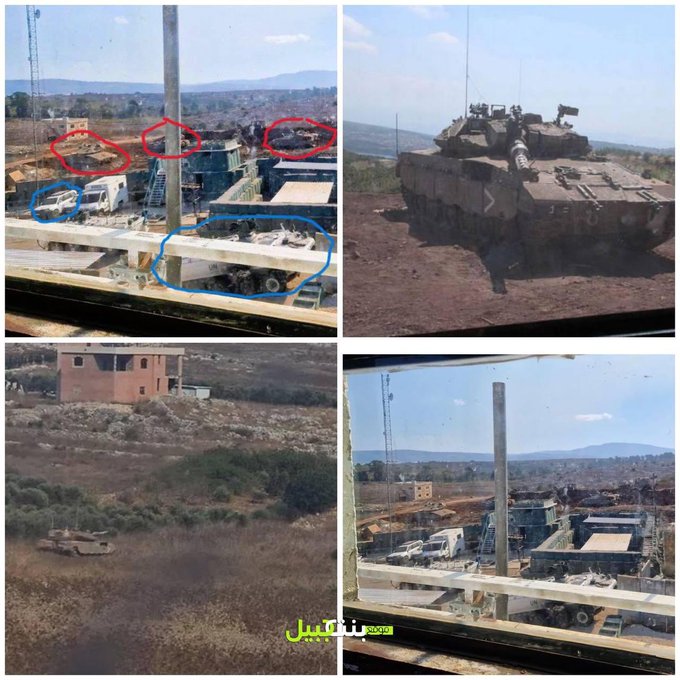
Hezbollah has ordered its fighters not to attack Israeli forces who established a forward operating base behind UN peacekeeping troops (UNIFIL) near a Lebanese border village, effectively using them as human shields.
“The Israeli enemy is attempting to use UNIFIL forces as human shields to cover its failure to advance toward the village, especially after its repeated and unsuccessful attempts to advance toward Maroun al-Ras and the loss of dozens of its soldiers, both killed and wounded,” a statement issued by the Islamic resistance movement on 7 October said.
“The operations room of the Islamic Resistance instructed the fighters to hold back and not engage with the movement to protect the lives of international soldiers,” the statement added.
The day before, UNIFIL had warned Israel’s operations near their position at Maroun al-Ras were an “extremely dangerous development.”
“It is unacceptable to compromise the safety of UN peacekeepers carrying out their Security Council-mandated tasks,” UNIFIL stated while reminding all actors in the conflict of their obligations to protect UN personnel and property.
On Saturday, UNIFIL said it remained in all positions near the border despite what it said was an Israeli request to “relocate.”
In response to the peacekeepers’ refusal, US foreign policy advisor Matthew Brodsky suggested in a post on X, “Israel should carpet bomb Irish area, then drop Napalm on it.”
Hezbollah fighters are resisting an Israeli ground invasion that began last week.
On Monday, Hezbollah fighters attacked a gathering of Israeli forces in Maroun al-Ras with rockets, while the Israeli army said it had deployed a third division to participate in ground operations in Lebanon.
Israel’s ground maneuvers follow its intensified bombing campaign of Lebanon that began on 23 September. Israel has bombed targets in south Lebanon, the Bekaa Valley, and around Beirut, killing more than 1,110 people since then. The widespread bombing of civilian homes has left over one million people internally displaced.
Hezbollah released a statement on Monday, the one-year anniversary of Hamas’ Operation Al-Aqsa Flood, saying it and the Lebanese people have paid a “heavy price” for its decision to enter the battle against Israel and open a support front for Gaza.
“The enemy continues its crimes and aggression without limits, but we are confident, if Allah wills, in our resistance’s ability to repel the aggression, and in our great and resistant people to endure and hold out until this calamity is lifted,” the statement affirmed.
US ‘Discussing’ Israeli Strikes on Iran, as IDF Troops Killed by Hezbollah w/ Seyed Mohammad Marandi
Rachel Blevins | October 4, 2024
Israel is promising a response to Iran’s retaliatory attack, with anonymous Israeli officials telling the media it could consist of more targeted assassinations, as well as attacks on Iran’s oil fields, nuclear sites and air defense systems. According to Biden, the U.S. is “discussing” strikes on Iranian oil fields, although he didn’t appear to finish his sentence when he was asked by reporters…
This, as Israel continues to bomb Beirut, targeting heavily populated civilian areas, and Israel’s attempt at a “limited” ground invasion was quickly met with heavy force from Hezbollah, leading to a over a dozen Israeli casualties.
Prof. Seyed Mohammad Marandi, of the University of Tehran, noted that one of Israel’s goals with the latest escalations is to terrorize the Lebanese people until they turn against Hezbollah. But given the fact that Israel has killed hundreds of civilians, displaced over 1.2 million, AND assassinated Hezbollah Secretary General Sayyed Hassan Nasrallah in a matter of weeks… their plan is already backfiring, as the public continues to show support for the Resistance.
Hezbollah’s indomitable resolve
By Lea Akil | Al Mayadeen | October 7, 2024
Despite repeated efforts by “Israel” and the US to dismantle resistance movements, especially in Lebanon and Palestine, these attempts have consistently fallen short. The core reason for this failure lies in the West’s misreading of the Resistance itself—the Resistance is rooted in deep historical injustices, sustained ideological strength, and has a great capacity to adapt. While leaders may be targeted and eliminated, their movements continue to thrive, fueled by an unwavering dedication to justice and freedom.
The assassinations of key figures like Hezbollah’s Secretary-General Sayyed Hassan Nasrallah, Commander Hajj Imad Mughniyeh, and Commander Fouad Shokor, among others, have not resulted in Hezbollah’s downfall over the years. Instead, the group has only grown stronger, showcasing the inability of “Israel” and the US to truly understand the dynamics of the Lebanese Resistance. These movements are not reliant on individual leaders; they are deeply rooted in collective resilience and continue to thrive despite targeted assassinations.
It’s clear that since the beginning of the war on Gaza, “Israel”, fully backed by the US, sought to dismantle Hezbollah through decisive strikes. This strategy began with the assassination of Commander Fouad Shokor in late July, followed by a series of pager attacks and the assassination of more Hezbollah officials. However, the martyrdom of Sayyed Nasrallah was meant to be the critical blow, aimed at triggering Hezbollah’s collapse and internal disintegration.
Common tactics like economic sanctions, military interventions, and targeted assassinations have been repeatedly used by the US and “Israel” to dismantle Resistance groups. However, history has shown that these strategies have failed.
Take the Gaza Strip, for example—besieged since 2007. “Israel” not only attempted to crush the Palestinian Resistance through relentless military assaults and a blockade but also to turn the people of Gaza against the Resistance by deepening their humanitarian suffering. The plan was clear: starve the population, deny them basic necessities, and push them to blame the Resistance for the hardships. Yet, rather than fracture the relationship, “Israel’s” siege had the opposite effect. The daily brutality, from bombings to the blockade that strangled their livelihoods, only reaffirmed for many in Gaza why resistance was essential for their survival and dignity.
The birth of resistance
Hezbollah was founded in 1982 in direct response to the Israeli occupation of Lebanon, which persisted until 2000. The Resistance movement succeeded in forcing the Israeli military to retreat from Lebanese territory, marking the first time “Israel” withdrew without a formal ceasefire agreement. This significant victory was largely attributed to Hezbollah’s unwavering resistance efforts.
The Israeli withdrawal elevated Hezbollah’s regional influence, establishing it as more than just a Lebanese resistance group—it became a symbol of Arab defiance against Israeli occupation.
“The era of defeat is over. Now is the era of victories.” — Hezbollah’s martyr Secretary-General Sayyed Hassan Nasrallah, July 25, 2006
This triumph not only bolstered Hezbollah’s military reputation but also fortified its position as a central force in Lebanon’s political landscape, intertwining its political influence with its military strength.
That said, it can be confidently stated that Hezbollah emerged from the war and invasion, which shaped it into a highly resilient organization. Its structure is designed to withstand losses, allowing it to regenerate leadership and produce new generations of military commanders, ensuring the continuity of its operations despite any setbacks.
The US and ‘Israel’s’ misreading of Hezbollah and Sayyed Nasrallah
On September 27, with backing from the US, “Israel” assassinated Sayyed Nasrallah, expecting this to cause the downfall of the resistance movement. Although the impact of Sayyed Nasrallah’s martyrdom on Hezbollah and the wider Axis of Resistance is hard to assess fully, it does not indicate that Hezbollah is close to collapsing. The group’s resilience extends beyond any one individual leader.
“Israel” and the US fail to grasp the true essence of his leadership. People didn’t rally behind him solely for his persona; they supported him because he represented their struggle for justice and liberation. Although he was a respected figure, the cause he embodied will endure beyond his lifetime.
“There are thousands of Imad Mughniyehs in Lebanon and in the world”. — Sayyed Hassan Nasrallah, 2010
Featured Video

Trita Parsi: Israel Set a Trap for Total War in the Region
or go to
Aletho News Archives – Video-Images
From the Archive
Zionism’s Violent Legacy
By Donald Neff | Washington Report On Middle East Affairs | January 1996
On January 4, 1948, Jewish terrorists drove a truck loaded with explosives into the center of the all Arab city of Jaffa and detonated it, killing 26 and wounding around 100 Palestinian men, women and children.[1] The attack was the work of the Irgun Zvai Leumi – the “National Military Organization,” also known by the Hebrew letters Etzel – the largest Jewish terrorist group in Palestine. The Irgun was headed by Revisionist Zionist Menachem Begin and had been killing and maiming Arabs, Britons and even Jews for the previous ten years in its efforts to establish a Jewish state.
This terror campaign meant that at the core of Revisionist Zionism there existed a philosophical embrace of violence. … continue
Blog Roll
 Aletho News
- Trita Parsi: Israel Set a Trap for Total War in the Region
- Trump’s Iran war is on an Israeli leash
- Saudi oil boss issues global supply warning
- Riyadh Says Its Oil System Is Intact. The Numbers Say Otherwise.
- Trump and Netanyahu Want to “Finish the Job” on Iran
- US ‘one-sided dictation’ not Iran’s beliefs makes rational talks impossible: Baghaei
- Iran’s Next Strike May Not Explode. It Could Shut You Down /Col Doug Macgregor
- Iran: US political targets legitimate if assassinations return
- Iraq shuts key border crossing with Iran under US pressure: Report
- Undersea Internet cables could be targeted in retaliation for attacks on Iran: IRGC deputy chief
- If Americans Knew
- The Israel Lobby’s Changing Fortunes
- AIPAC has become such a political liability that it’s shifting to a more “nimble” approach to buying politicians
- At least 160 Israeli settler attacks in 2 weeks
- Will Gaza’s Ancient Christian Community Disappear Forever?
- Israel’s vision of regional security rests on keeping Arab states weak
- Heidi Levine recounts how Palestinian youths helped save her in settler attack
- DAILY UPDATE: Latest essential news on Palestine, Israel, & region
- Trump’s Intensifying Sabotage of the ICC, for Israel’s Sake
- Israeli military detain US and UK volunteers in West Bank including Democratic NY politician Brad Lander
- Americans at National Conservatism Conference held in Israel this year criticize Israel
- No Tricks Zone
- E-Cars Reduce CO2 Emissions By Only 41% Compared To Internal Combustion Engine Vehicles
- Predictions Made By Renowned Climate Professor Over Past Decades Have Been Proven To Be Poor
- New Study Suggests Large Regions Of The Pacific Ocean Have Been Cooling For The Last 80 Years
- Germany’s Green Energy Debacle: High Energy Costs Force Kahla Porzellan to Close After 182 Years!
- New Study: 50 Years Of The Most Aggressive ‘Net Zero’ Policies Can Only Affect The Global Climate By 0.03°C
- US September “Heat” Was No Record…Many Records Set Decades Ago
- Latest European Green Energy Debacle; Portugal’s Largest Flagship Solar Park Insolvent!
- Green Energy Debacle: German Expert Professor Fritz Vahrenholt Warns Of Severe Economic And Social Consequences
- Two More Paleo Reconstructions Affirm Meters-Higher Sea Levels Across Ireland, Brazil 7000-6000 Years Ago
- New Study: Earth And Venus Surface Warmth Largely Explained By Convection And Lapse Rate, Not CO2 Or Radiation

