Trump and Putin begin addressing cumulated geo-strategic debris… amidst Trump’s ultimatum to Iran
By Alastair Crooke | Strategic Culture Foundation | March 24, 2025
The phone call on 18 March between Presidents Trump and Putin has happened. It was a success, insofar as it allowed both sides to label the result as ‘positive’. And it did not lead to a breakdown (by virtue of the smallest of concessions from Putin – an energy infrastructure truce) – something easily it could have done (i.e. devolve into impasse – with Trump excoriating Putin, as he has done to Zelensky), given the fantastical and unrealistic expectations being woven in the West that this would be the ‘decider meeting’ for a final division of Ukraine.
It may have been a success too, insofar as it has laid the groundwork for the absent homework, now to be handled by two teams of experts on the detailed mechanics of the ceasefire. It was always a puzzle why this had not been earlier tackled by the U.S. team in Riyadh (lack of experience?). It was, after all, because the ceasefire was treated as a self-creating entity, by virtue of an American signature, that western expectations took flight in the belief that details did not matter; All that remained to do – in this (flawed) estimation – was to ‘divvy out the cake’.
Until the mechanics of a ceasefire – which must be comprehensive since ceasefires almost always break down – there was little to discuss on that topic on Tuesday. Predictably, then, discussion (reportedly) seemed to have turned to other issues: mainly economic ones and Iran, underlining again that the negotiation process between the U.S. and Russia does not boil down to just Ukraine.
So, how to move to ceasefire implementation? Simple. Begin to unravel the ‘cats cradle’ of impedimenta blocking normalised relations. Putin, plucking out just one strand to this problem, observed that:
“Sanctions [alone] are neither temporary nor targeted measures. They constitute [rather], a mechanism of systemic, strategic pressure against our nation. Our competitors perpetually seek to constrain Russia and diminish its economic and technological capacities … they churn out these packages incessantly”.
There is thus much cumulated geo-strategic debris to be addressed, and corrected, dating back many years, before a Big Picture normalisation can start in earnest.
What is apparent is that whilst Trump seems to be in a tearing hurry, Putin, by contrast, is not. And he will not be rushed. His own constituency will not countenance a hastily fudged accord with the U.S. that later implodes amidst recriminations of deceit – and of Moscow again having been fooled by the West. Russian blood is invested in this strategic normalisation process. It needs to work.
What is behind Trump’s evident hurry? Is it the need for breakneck speed on the domestic front to push ahead, before the cumulated forces of the opposition in the U.S. (plus their brethren in Europe) have the time to re-group and to torpedo normalisation with Russia?
Or does Trump fear that a long gap before ceasefire implementation will enable opposition forces to push for the recommencement of arms supplies and intelligence sharing – as the Russian military steamroller continues its advance? Is the fear, as Steve Bannon has warned, that by rearming Ukraine, Trump effectively will ‘own’ the war, and shoulder the blame for a massive western and NATO defeat?
Or, perhaps Trump anticipates that Kiev might unexpectedly cascade into a systemic collapse (as occurred to the Karzai government in Afghanistan). Trump is acutely aware of the political disaster that befell Biden from the images of Afghans clinging to the tyres of departing U.S. transport planes (à la Vietnam), as the U.S. evacuated the country.
Yet again, it might be something different. I learned from my time facilitating ceasefires in Palestine/Israel that it is not possible to make a ceasefire in one place (say Bethlehem), whilst Israeli forces were concurrently setting Nablus or Jenin ablaze. The emotional contagion and anger from one conflict cannot be contained to one locality; it would overflow to the other. It was tried. The one contaminated the implied sincere intentions behind the other.
Is the reason for the Trump haste mainly that he suspects his unconstrained support for Israel eventually will lead him to embrace major war in the Middle East? The world of today (thanks to the internet) is much smaller than before: Is it possible to be a ‘peacemaker’ and a ‘warmaker’ simultaneously – and have the first taken seriously?
Trump and those U.S. politicians ‘owned’ by the pro-Israeli lobby, know that Netanyahu et al. want the U.S. to help eliminate Israel’s regional rival – Iran. Trump cannot both retrench the U.S. as a western hemisphere ‘Sphere of Influence’, yet continue to throw the U.S.’ weight around as world Hegemon, causing the U.S. government to go broke. Can Trump successfully retrench the U.S. to Fortress America, or will foreign entanglements – i.e. an unstable Israel – lead to war and derail Trump’s administration, as all is intertwined?
What is Trump’s vision for the Middle East? Certainly, he has one – it is one that is rooted in his unstinting allegiance to the Israeli interest. The plan is either to destroy Iran financially, or to decapitate it and empower a Greater Israel. Trump’s letter to Iran’s Supreme Leader Ali Khamenei included a two-month deadline for reaching a new nuclear deal.
A day after his missive, Trump said the U.S. is “down to the final moments” with Iran:
“We can’t let them have a nuclear weapon. Something is going to happen very soon. I would rather have a peace deal than the other option, but the other option will solve the problem”.
U.S. journalist Ken Klippenstein has noted that on 28 February, two B-52 bombers flying from Qatar dropped bombs on an “undisclosed location” – Iraq. These nuclear-capable bombers were carrying a message whose recipient “was clear as day; The Islamic Republic of Iran”. Why B-52s and not F-35s which also can carry bombs? (Because ‘bunker-buster’ bombs are too heavy for F-35s? Israel has F-35s, but does not have B-52 heavy bombers).
Then on 9 March, Klippenstein writes, a second demonstration was made: A B-52s flew alongside Israeli fighter jets on long-range missions, practicing aerial refuelling operations. The Israeli press correctly reported the real purpose of the operation – “readying the Israeli military for a potential joint strike with the U.S. on Iran”.
Then, last Sunday, National Security Adviser Mike Waltz boasted that multiple Anglo-U.S. airstrikes “took out” top Houthi officials, making it very clear that this is all about Iran:
“This was an overwhelming response that actually targeted multiple Houthi leaders and took them out. And the difference here is, one, going after the Houthi leadership, and two, holding Iran responsible”.
Marco Rubio elaborated on CBS: “We’re doing the entire world a favour by getting rid of these guys”.
Trump then followed up with the same theme:
“Every shot fired by the Houthis will be looked upon, from this point forward, as being a shot fired from the weapons and leadership of IRAN, and IRAN will be held responsible, and suffer the consequences, and those consequences will be dire!”
In a further piece, Klippenstein writes:
“Trump’s menu of options for dealing with Tehran now includes one he didn’t have in his first term: full-scale war – with “nuclear weapons on the table” (the Trident II low-yield option) Pentagon and company contracting documents I’ve obtained describe “a unique joint staff planning” effort underway in Washington and in the Middle East to refine the next generation of “a major regional conflict” with Iran. The plans are the result of a reassessment of Iran’s military capabilities, as well as a fundamental shift in how America conducts war”.
What is new is that the “multilateral” component includes Israel working in unison with Arab Gulf partners for the first time, either indirectly or directly. The plan also includes many different contingencies and levels of war, according to the documents cited by Klippenstein, from “crisis action” (meaning response to events and attacks), to “deliberate” planning (which refers to set scenarios that flow from crises that escalate out of control). One document warns of the “distinct possibility” of the war “escalating outside of the United States Government’s intention” and impacting the rest of the region, demanding a multifaceted approach.
War preparations for Iran are so closely restricted, that even contracting companies involved in war planning are prohibited from even mentioning unclassified portions, notes Klippenstein:
“While a range of military options are often provided to presidents in an attempt on the part of the Pentagon to steer the President to the one favoured by the Pentagon, Trump already has shown his proclivity to select the most provocative option”.
“Equally, Trump’s green light for the Israeli air-strikes on Gaza, killing hundreds, [last] Monday, but ostensibly targetted on the Hamas leadership can be seen as consonant with the pattern of taking the belligerent option”.
Following his successful assassination of Iran’s top general Qassim Suleimani in 2020, Trump seems to have taken the lesson that aggressive action is relatively cost-free, Klippenstein notes.
As Waltz noted in his press interview:
“The difference is these [Yemen attacks] were not pinpricks, back and forth, what ultimately proved to be feckless attacks. This was an overwhelming response that actually targeted multiple Houthi leaders and took them out”.
Klippenstein cautions that, “2024 may be behind us but its lessons aren’t. Israel’s assassination of top Hezbollah officials in Lebanon was largely perceived by Washington to be a resounding success with few downsides. Trump likely took back the same message, leading to his strike on [the] Houthi leadership this week”.
If western observers are seeing all of what’s going on as some repeat of Biden’s tit-for-tat or limited attacks by Israel on Iran’s early warning and air defences, they may be misunderstanding what’s going on behind the scenes. What Trump might now do, which is right out of the Israeli playbook, would be to attack Iran’s command and control, including Iran’s leadership.
This – very certainly – would have a profound effect on Trump’s relations with Russia – and China. It would eviscerate any sense in Moscow and Beijing that Trump is agreement capable. What price then his ‘peacemaker’ ‘Big Picture’ reset were he, in the wake of wars in Lebanon, Syria and Yemen, to start a war with Iran? Does Trump see Iran through some disturbed optic – that in destroying Iran, he is bringing about peace through strength?
Heavy Israeli airstrikes hit southern, eastern Lebanon
The Cradle | March 21, 2025
The Israeli army carried out heavy airstrikes on southern and eastern Lebanon on 20 March, claiming it targeted “terrorist infrastructure” and a “military site” belonging to Hezbollah.
Massive explosions were seen in video footage of an Israeli attack on the outskirts of the southern Lebanese town of Jbaa on Thursday evening.
Airstrikes also hit the town of Taraya west of Baalbek and the Shaara area near the town of Janta in the Bekaa Valley, in eastern Lebanon.
“A short while ago, the IDF struck a military site containing an underground terrorist infrastructure site in the Bekaa area in Lebanon, as well as a military site containing rocket launchers in southern Lebanon in which Hezbollah activity has been identified,” the Israeli army said in a statement.
“The IDF will continue to operate to remove any threat to the State of Israel and will operate to prevent any attempt by the Hezbollah terrorist organization to rebuild its forces,” it added.
Israeli forces recently expanded their occupation of southern Lebanon in violation of the ceasefire agreement, which was supposed to see Tel Aviv fully withdraw its forces from the country.
Israel has also relentlessly bombarded south and east Lebanon since the ceasefire was reached in November last year.
Tel Aviv claims to be acting on its rights within the deal by preventing Hezbollah from rearming itself. However, the agreement signed by Beirut does not include anything about Israeli forces having the right to attack the country or occupy its land, instead stipulating that the resistance’s presence and military infrastructure must be dismantled by the Lebanese army south of the Litani River in south Lebanon.
Israel accuses Hezbollah of having not fully withdrawn to the north of the Litani River, as per the agreement. It also accuses the Lebanese resistance of trying to reconstitute its forces.
“We maintain five points on the Lebanese side of the border to protect our territory. We will not relinquish control [of the five sites],” Israeli Prime Minister Benjamin Netanyahu said last week.
Remove Hamas and the other Resistance groups from the Home Office list of proscribed organisations
By David Miller | Al Mayadeen | March 14, 2025
The British government should de-proscribe all of the Palestinian and Lebanese Resistance groups currently listed on the anachronistic list maintained by the Home Office. The first and most obvious reason for this is that banning these groups does not in any way prevent or disrupt political violence in the UK. This sounds like a dramatic claim. So, let’s take a close look.
After a year and a half of genocide by the illegitimate Zionist entity, voices are beginning to be raised calling for the removal of Palestinian resistance groups from the government list of proscribed organisations. But what is the list and what offences are attached to it?
When I was detained by officers of SO15 or the Counter Terrorism Command (formerly the Special Branch) under Schedule 7 the other day, I was given a piece of paper with the legal basis of the detention which I was required to sign and was given a copy to keep. It states that the detention is to enable whether I appeared ‘to be a person who is or has been concerned in the commission of instigation of acts of terrorism.’
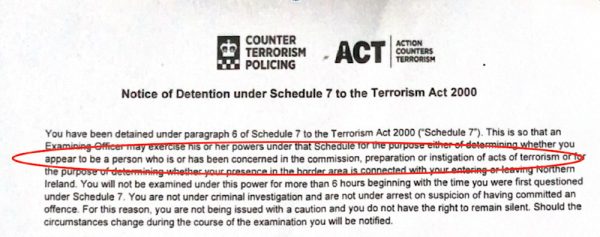
And yet, they asked me no questions about commissioning or instigating acts of “terrorism”. Not a single one.
Instead, they asked about extremism, the Western way of life, and asked me to characterise specific views on political violence. If the Trades Description Act applied to the Terrorism Act 2000 and to the activities of SO15, I would be making a complaint to the Heathrow Trading Standards Officer.
But the reason for this is that Schedule 7 is not really intended to disrupt actual terrorism, but to surveill and repress political views and political speech which is critical of UK foreign policy, including of course support for the Palestinians’ legitimate right to resist the Zionist occupation. Don’t believe me? Let’s look closely at the Home Office list of offences related to proscribed organisations.
As one can see from the offences below, none of them have anything to do with actual acts of violence. Let’s take each in turn.
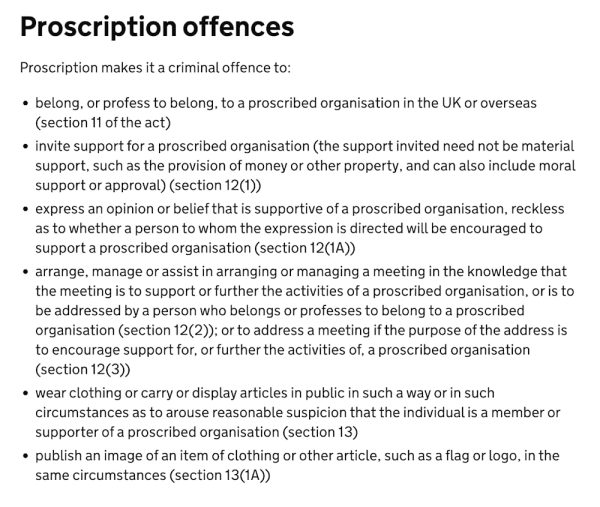
- Obviously being a member of a proscribed group might have some relevance, but membership is not itself an act of terror. And certainly, professing to be a member of Hezbollah is not, in itself, an act of terror.
- Inviting support for a proscribed group is an offence. How does one ‘invite’ support for a ‘terrorist’ organisation? The language is of course similar to the ‘notice’ issued to UK broadcasters on 19 October 1988. Otherwise known as the Broadcasting Ban, this was an attempt to suppress support for the Irish Republican movement and in particular its political wing Sinn Fein, which throughout the period remained a legal political party with many elected councillors in the north of Ireland. It made, as I argued at the time, no appreciable difference to the Irish Republican Army, the wing of the movement engaged in armed struggle. But what does it mean to ‘invite’ support? It’s not altogether clear and it is pretty plain that this particular provision has been of little use to the British state, resulting, as it has, in precious few convictions. As a result, the government added a wider and more vague clause to the act via the Counter-Terrorism and Border Security Act 2019, to which we turn next.
- Express an ‘opinion’ or ‘belief’ that is supportive of a proscribed organisation. What does that mean? It obviously has the potential to be stretched quite far into opinions and beliefs that are shared by most people, even in the UK. Is saying that Seyed Hassan Nasrallah, the assassinated leader of Hezbollah, was widely respected and admired an opinion which is ‘supportive’ of a banned group? Notice the language is ‘will be’ encouraged not ‘is’ encouraged. So, at best this is a conjectural crime which does not require that anyone is actually encouraged, only that the hypothetical ‘reasonable person’ might think that. Again, nothing here that relates to involvement in planning any ‘act’ of violence.
- Arranging or managing a meeting is, manifestly, not an act of violence, whether or not it involves giving ‘support’ for a proscribed organisation and whether or not a representative of the organisation speaks, or whether the purpose of the address is to encourage support. In fact, the more we hear the voices of those (in proscribed organisations and legal ones alike) who are involved in resisting the menace of Zionism and genocide, the better it will be for the possibility of ending the genocide.
- Next is Clothing: It is an offence to ‘wear clothing or carry or display articles in public in such a way or in such circumstances as to arouse reasonable suspicion that the individual is a member or supporter of a proscribed organisation’. Articles of clothing are also not in themselves acts of terror, no matter how they are displayed. Obviously, what they have in mind here is branding relating to specific organisations, such as a Hezbollah flag, a Qassam Brigades head band, or other perhaps less directly connected imagery or items. Obviously, given the attemtps of the Zionists and their craven allies in the British security state, there is a push to widen the parameters so they can scoop up more and more supporters of the Palestinians. Thus the case of the young women found guilty under these powers of sporting parachute patches (below).
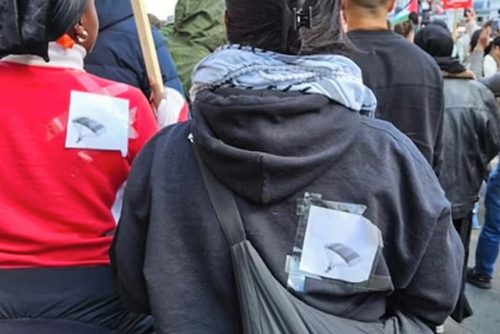
Or, the case of the young man found guilty of supporting Hamas for wearing a green headband with the Shahada (the Muslim profession of faith) on it (first below). This is of course not a ‘Hamas headband’. Al-Qassam Brigades, the military wing of Hamas, do have a specific headband with a gun on it! As can be seen, it is not at all similar (right below).
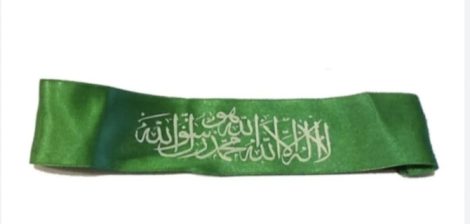

6. It is an offence to “publish an image of an item of clothing or other article, such as a flag or logo, in the same circumstances.” This is obviously intended to cover social media posts, which are manifestly not ‘acts’ or terrorism. This provision was inserted (12.4.2019) by Counter-Terrorism and Border Security Act 2019.
Overall, then, as we see these ‘proscription’ powers have nothing at all to do with interfering with material acts of political violence or armed struggle.
The proscription offences are not terrorism offences. It is an absurd nonsense, not to mention a colossal waste of resources, that SO15 are required to attempt to police thoughts, beliefs and speech as the vast majority of their activities at ports.
When the leading journalist Asa Winstanley was recently raided (but not arrested), he was told that it related to his alleged support for proscribed groups. A letter addressed to him ‘from the “Counter Terrorism Command” … indicates that the authorities are “aware of your profession” as a journalist but that “notwithstanding, police are investigating possible offenses” under sections 1 and 2 of the Terrorism Act (2006). These provisions set out the purported offense of “encouragement of terrorism.”’
And yet, if you look at the passage at the beginning of this article about commission or instigation of acts of terror, the implication is that to be of interest one would have to be involved in setting up a branch of Qassam Brigades in North London, or a version of Hezbllah’s Radwan Force in Reading. There is nobody in the entire counter-terrorism apparatus who believes that that is what Asa, me, or anybody else, is doing.
And when you put it like that, it’s also manifestly the case that neither Hamas, Hezbollah, the PFLP-GC or Palestinian Islamic Jihad are planning to set up branches in the UK, or – indeed – to carry out attacks here. Given the UK’s role in directly participating in the genocide, that is generous of them, but it appears to be a fact.
But more than that, free speech about armed groups fighting an almost universally acknowledged genocide should not be criminalised and proscribed.
And the case for proscribing their welfare, health, education and other manifest functions of Hezbollah and Hamas is even weaker.
They should be de-proscribed now.
‘The resistance will not let you stay’: Hezbollah chief addresses Israeli occupation of south Lebanon
The Cradle | March 10, 2025
Hezbollah’s Secretary-General Naim Qassem said on 9 March that Israeli forces currently occupying south Lebanon will inevitably face resistance if they do not withdraw.
“I tell the Israelis, if you remain at these points, this resistance will not let you continue there,” Qassem stated on Sunday.
“If the occupation continues, it must be confronted by the army, the people, and the resistance,” despite some people wanting “liberation through diplomacy,” the resistance leader added.
“We committed to the [ceasefire] agreement while the enemy violates it … it assaults people far from the border in their cars and in their homes,” he went on to say. “The ceasefire agreement is the one announced and distributed, and there is no secret agreement or clauses under the table.”
“The resistance is fine and continuing, but it was wounded and hurt and made great sacrifices … We had a security exposure and some shortcomings, and we are conducting an investigation to learn lessons and hold people accountable,” Qassem said.
The Hezbollah chief commented on the recent entry of hundreds of settlers into south Lebanon under Israeli army protection, calling “it the greatest evidence that we are not facing aggression in a single phase, but rather [an Israeli expansionist] project from the ocean to the Gulf.”
Israeli forces continue to occupy Labbouneh, Mount Blat, Owayda Hill, Aaziyyeh, and Hammamis Hill, despite the ceasefire implementation and withdrawal deadline expiring on 18 February.
Tel Aviv has violated the ceasefire agreement over 1,300 times with non-stop attacks and infiltration of Lebanon’s airspace since the deal was signed in November last year.
Israel claims to be acting on its rights within the deal by preventing Hezbollah from rearming itself. However, the agreement signed by Beirut does not include anything about Israeli forces having the right to attack the country, instead stipulating that the resistance’s presence and military infrastructure must be dismantled by the Lebanese army south of the Litani River in south Lebanon.
Tel Aviv accuses Hezbollah of having not fully withdrawn to the north of the Litani River, as per the agreement. It also accuses the Lebanese resistance of trying to reconstitute its forces.
A Lebanese soldier was killed by Israeli forces on Sunday when they opened fire at citizens in the border town of Kfar Kila. Another Lebanese soldier was shot in the leg and kidnapped on the same day.
On Friday, Israeli warplanes launched more than 20 air raids, targeting valleys and forested areas on the outskirts of Zebqin, Beit Yahoun, Al-Aishiyeh, Al-Rayhan, Ansar, and Al-Bissariya.
How UK counter-terror police colluded with Zionists to detain me after Beirut trip
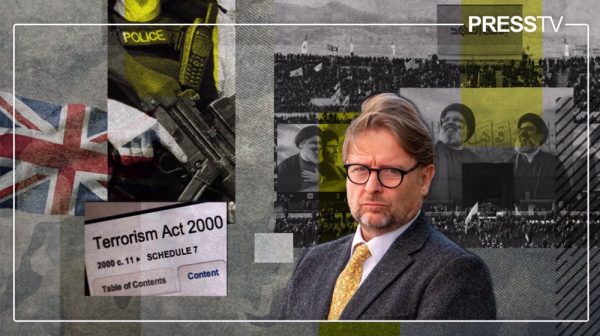
By David Miller – Press TV – February 27, 2025
At 21.32 local time on the evening of Monday, 24 February, I stepped off a plane from Istanbul to Heathrow and into the terminal building.
In front of me were a wide circle of people evidently waiting for someone, perhaps for a number of passengers. I knew right away one of them was me.
One of the SO15 (formerly special Branch) plain clothes officers of the Counter Terrorism Command, for it was them, asked for my passport and whether I had started my journey in Istanbul.
Of course I knew that they knew this was not the case. In any case, I had done nothing wrong in – as I said to them – visiting Beirut to cover the funeral of Hezbollah leaders Sayyed Hassan Nasrallah and Sayyed Hashem Safieddine.
This was my first taste of Schedule 7. They started to explain what Schedule 7 was and I said yes, I know about it. From being stopped before? No, because I am a researcher who studies terrorism legislation.
About then, on the moving walkway, I realised that the circle of people had only been waiting for me. I looked round and counted them out loud. I know I’m a big lad, I said, (I am over 6 foot) but did you really need eight officers to detain me?
So, we got to the interrogation room, which is, as past detainees will know, immediately behind passport control. Anyone coming out of that door is SO15 or a detainee.
For those who may face this experience in the future, it is worth explaining how the process goes. It’s a bureaucratic procedure.
There is a guidance hand book dictating how the process should be handled. First they have to read out the relevant extract from the Terrorism Act. It’s a whole page (see below) and they give you a copy, which they ask you to sign.
The essential bit is that you are being ‘detained’ as opposed to arrested in order that the ’Examining Officer’ can determine if you ‘appear’ to be a person ‘concerned in the commission, preparation or instigation of acts of terrorism’.
A couple of other details are of relevance. They can’t hold you for more than 6 hours after the time they first apprehend you. You are not under criminal investigation or under arrest and as a result ‘you do not have the right to remain silent’. If they do change their minds and arrest you, you do at that point have the right to remain silent and you should do so.
You have to participate in the process, answer questions and to accept being searched. You don’t have to answer questions that you think they are asking and only need to answer what they actually ask. There is no need to be unduly long winded!
The other point to note is that nothing you say can be used ‘in evidence in criminal proceedings’. (The only exceptions are that if you do not comply, that can be used in evidence and if you later rely on something in court which is ‘inconsistent’ with what you say, then the contents of your interview can be used).
You have the right to contact a next of kin/friend and a lawyer and you should exercise that right. The rules state that if you ask for a solicitor you cannot be questioned until your solicitor has consulted you.
And your solicitor can participate in the questioning either on the phone or in person, if you can get them out of bed to come to wherever you are detained!
Once in the room both I and my luggage were searched. They found little of interest. No devices. The only thing that they brightened at was a very small USB drive, which I had forgotten was in there.
I confirmed that I thought it had no security protection and they took it away. Later it was returned, much to my surprise. What was on it I asked? Only some teaching notes they said in disappointment.
Later, at home I checked. Hilariously there was only one file on the drive: a Powerpoint presentation on the ‘Zionist movement’.
And so we got to the actual interrogation. I estimate that mine started about 23.00, so there was a long period of silence while we waited for the solicitor to call back.
This was partly due to the police deciding that they could not call my first nominated solicitor because he wasn’t on their list, though he should not have needed to be.
Anyway, after I talked to my solicitor, we were off.
What followed was around two hours of questioning about my trip to Beirut. Why did I go, what did I do when I was there, did I support Hezbollah, and many other similar questions.
There is not space to tell it all blow by blow but here are some highlights which might be of use to others who like me are manifestly not involved in the commission of acts of terrorism, as everybody knows.
First, they wanted to know why I went. As I had already intimated when they first stopped me, I was there to cover the funeral as a journalist. As is public knowledge, I work as a journalist on a freelance basis.
I produce a TV show called Palestine Declassified for Press TV, and write for a variety of other publications such as Electronic Intifada, Mintpress, TRT World and Mayadeen English. I mentioned this as well as mentioning that I used to work at the university of Bristol until I was sacked.
They asked about that. I summarised the story including the four occasions on which I was exonerated of ‘antisemitism’ at Bristol (internal enquiry, two external QC reports and the internal appeal), followed by the ‘landmark’ victory at the Employment Tribunal in February 2024.
We went on to discuss my trip to Lebanon. What did I do there? I recounted that I had visited the southern village of Maroun El Ras which is within a mile of the border of occupied Palestine, high on a hill overlooking the colonial settlements of Avivim and Yir’on.
I went with a number of other foreign guests including from Ireland, Yemen, Brazil and various other countries. What was there I was asked? I replied (truthfully) that there was nothing in the village since almost all 600 houses had been destroyed.
The officer seemed confused: why would I want to visit then? Precisely because it had been destroyed by the Zionists, obviously.
We got fairly quickly to the question of whether I supported Hezollah as a proscribed organisation. I referred back to my Employment Tribunal at which similar questions had been asked somewhat ineffectually by the University of Bristol’s counsel Chris Milsom.
There I had said the same thing as I now stated: I ‘support’ the right as given in international law for the Palestinians (and indeed others under occupation) to resist including by armed force.
In case officers in SO15 or other actors need reminding of this, the relevant text is from the UN General Assembly resolution 38/17 of 1983, which states that it
“Reaffirms the legitimacy of the struggle of peoples for their independence, territorial integrity, national unity and liberation from colonial domination, apartheid and foreign occupation by all available means, including armed struggle”.
They went on to see if they could entice me into saying I specifically supported proscribed organisations like Hamas and Hezbollah. So, I obviously went on to say that it was not only a question of Hezbollah and Hamas, but also Palestinian Islamic Jihad and the PFLP-GC, which is of course not the same as the PFLP itself, which is not proscribed. It was instructive that my interrogator appeared not to know about PIJ and the PFLP-GC, asking me to repeat each name.
We also visited the topic of deproscription. The officer wanted to know why I thought that all of the four, groups should be de-proscribed.
It seemed like he thought this was a valuable concession from me. But, as he is, presumably, aware, the Terrorism Act (year) specifically notes that it is not illegal to call for de-proscription.
I include a table from the Home Office website which gives a list of the charges that can relate to proscribed organisations.
And then we were on to the question of terrorism. Did that mean that I thought they were not terrorist. At which point I am afraid I referred back to my decades long record of research on the question of terrorism and its role in propaganda including my early work on the struggle to decolonise the north of Ireland.
As if the sentiments encoded in the proscribed list or the Western use of the term ‘terrorism’ itself are necessarily subscribed to even by most British citizens, never mind the rest of the world. Let’s not forget that the way in which we use the term ‘terrorism’ in the west – in particular ‘Islamic terrorism’, has it origin in Zionist propaganda operations as has been shown by, for example, Remi Brulin.
At one point, apparently out of the blue I was asked: Are you a practising Muslim? I expressed some surprise at this question. In his defence my interrogator said that I had earlier noticed and asked about whether the small pile of folded prayer mats in the cupboard was in fact a small pile of folded prayer mats.
I had noted them earlier and wanted to check that’s what they were. Only the best for the predominantly Muslim ‘guests’ of the room! As the Guardian reports only 20% of Schedule 7 detentions are of white people (that’s including ‘white Irish’, and others stopped, like me for their solidarity activities, so it’s likely that the proportion of white ‘far right’ suspects stopped is lower than 20%)
The officer seemed mystified about my attendance at an event in which everyone must have been a supporter of Hezbollah. As if reporting on events and supporting those events is the same thing. He asked if everyone there supported Hezbollah.
I replied that I didn’t feel able to report any great knowledge on the consciousness of perhaps the million people there. But it is certainly the case that there were very many Hezbollah flags.
I did also note that there was a largish contingent from the Syrian Social Nationalist Party and made the point that the sheer numbers present suggested that Nasrallah has something of a larger reputation than just among party members and core supporters.
As we talked the officer started asking about Press TV, for which I work on a freelance basis. He evidently had not known what Press TV was as it took a long time for him to understand – after I told him that it was the English Language TV channel of the Iranian government – the equivalent of the BBC world Service.
Then he wanted to know about whether the people I work with at Press TV are extremists or have extreme opinions. Obviously I had to press him to explain what he meant by extremism. Given the British government abandoned its efforts to define the term in any legally robust way, he fared no better.
So he asked something about how many were opposed to western society. I was not impressed by this, since, as I said, most people in the world are opposed to the West, and many of them are British citizens.
And then; does Press TV support the recent ‘terrorism’ in this country?! Which terrorism, I enquired. And do you know what he said? He only said the Southport attack. That was not terrorism I said. Even his colleague butted in and agreed with me!
So we were back to finding specific examples and – put on the spot – he came up with the stabbing and car at Parliament in 2017. That, of course, was carried out by an individual who had made multiple trips to Saudi Arabia and appeared to have been inspired by an ISIS related ideology.
Before we got any further I was asked if Press TV covered incidents like this. The implication, of course, being that covering such activities might be tantamount to ‘supporting’ them.
Obviously, being a news service Press TV does cover political violence of many types, as does every other news organisation in the world.
But moving on I replied that in fact Press TV is opposed to those kind of attacks. I was on the verge of going on to say that this of course was different to the position of their colleagues in MI6 and in the government and indeed the BBC who are only too happy to collaborate in supporting ISIS/Al Qaeda in Syria if it suits their perception of British foreign interests. But I let that lie.
By now we were winding down and it was pretty clear they were about to release me, even if I had taken their claim that it would be over soon with the requisite heap of salt. At the end they asked if I had anything to ask, like we were coming to the end of a job interview.
I made one statement which was that it was abundantly clear to everyone in the room that I was not a person who was concerned in the ‘commission, preparation or instigation’ of acts of terrorism.
By way of defence of the detention the officer attempted to justify it in term of a British citizens attendance at the funeral of a terrorism leader, a defence which of course worked to deny that they had effectively been instructed by others to stop me. With that we were done and I was released at 1am too late to get home except via a prohibitively expensive taxi.
It appeared abundantly clear that SO15 did not have any real idea of who I was and had not prepared any case against me. It was just a normal Schedule 7 stop.
Except of course, it wasn’t. I had openly announced on X that I was in Lebanon for the funeral and had reported from my visit to Maroun El Ras and the Iran garden, on its outskirts both of which had been totally destroyed by Zionist bombardment.
I also posted a clip of my visit to Kfar Kila showing mass destruction of civilian infrastructure wreaked by the Zionists and my discovery of a US arms firm manufactured detonation wire used in blowing up civilian houses.
I also posted on the funeral itself, including while I was stuck in traffic on the way, as I arrived in the ‘nick of time’ and as the ceremony started.
Of course all of this was very triggering for the genocidal Zionists who track any deviation for the authorised position of pretending that the genocide is not happening and that those that resist are simply ‘terrorists’.
A wide range of anonymous trolls and Zionist regime assets started mass reporting the Met Police calling for me to be arrested and jailed. I know they say that the Zionists don’t have much power, but bouncing the Met into detaining a journalist on assignment seems like power of some sort.
Here is a select list of Zionist agents and assets who called for me to be arrested:
- Gary Spedding the Zionist asset who poses as being pro-Palestine – 23 February 1.44pm
- Sabrina Miller, Daly Mail journalist and former student at Bristol University – 23 February 2.09pm
- Labour Against Anti Semitism (LAAS) – 23 February 7.41 pm
- Campaign Against Antisemitism (CAA) – 24 February 1.15pm
All of the above were involved in one way or another in the campaign to have me sacked at Bristol, a decision that the Employment Tribunal found was flawed and unjustified, in its ‘landmark’ decision.
This was all topped off by reports on Monday in the Mail (published at 5 to one in the morning just as Monday 24th began) and later (at 5.25 pm) in the Telegraph. This latter report cited the fanatical Zionist Robert Jenrick, the shadow justice secretary, who was reported as saying: “David Miller isn’t even bothering to hide his anti-Semitism any more.
He’s now openly boasting of his support for a proscribed terrorist group. It’s shocking that for so long he held a senior position at Bristol University.” Of course no actual ‘antisemitism’ was on display, and I said no words capable of being construed as ‘openly boasting’ of ‘support’ for Hezbollah.
Jenrick has form a far as I am concerned in that he has in the past spent a not inconsequential amount of time trying to have me sacked from my post at Bristol. For example, when he was Housing minister he directly bullied the University of Bristol over my case.
The report ended by saying that the paper had (like the Mail claimed too) contacted me for comment. The facts are that I have had no such query from the Telegraph or from the Mail.
I must say that I did enjoy the column the next day by Stephen Pollard who presided over a significant number of libel defeats in his role as editor of the Jewish Chronicle. ‘Opening a communication from’ me back then he says was like ‘ingesting poison’. My parents would be proud.
What, self-evidently, happened in this instance was that the Zionist pressure worked its way through and an order to detain was issued. As to whether it came from the top of the counter Terrorism Command, the Home Office or elsewhere, we don’t know as yet.
But it is very much of a piece with the general picture post October 7 2023, which is that there is intense Zionist pressure on the counter terrorism and policing apparatus to weaponise both hate crime laws and terrorism legislation.
It is perfectly plain, as I have shown elsewhere that this pressure from Zionist lobby and intimidation groups and pressure from Zionist aligned politicians like Michael Gove, Suella Braverman, Stuart Polak, Robert Halton and the aforementioned Robert Jenrick, more than adequately explains all of the alleged rise in ‘antisemitism’ as well as almost all of the uses of the many Terrorism Acts on the statute books to oppress and repress those who will stand with the Palestinians in virtually any way.
And in recent months the attacks have widened to journalists, who’s historically recognised craft implies that they can report on all events without being attacked directly by the state.
But now, after Richard Medhurst, Sarah Wilkinson, Asa Winstanley and most recently Ali Abunimah, it is clear that journalists too are direct targets of the Zionists operating as they do via the allegedly sovereign justice apparatus of Western states.
David Miller is the producer and co-host of Press TV’s weekly Palestine Declassified show. He was sacked from Bristol University in October 2021 over his Palestine advocacy.
The next Israel-Hezbollah war is now unavoidable – and it will be worse
By Robert Inlakesh | RT | February 10, 2025
Another round of violence between Lebanon and Israel is not a matter of if, but when. Israel managed to extract a series of tactical victories from the war so far, but did not possess the capacity to defeat Hezbollah decisively. Now that Israel seeks to maintain freedom of action inside Lebanon, it threatens a much more violent outbreak than what was stopped by the November 27 ceasefire.
Much of the analyses offered on the conflict between Lebanon and Israel, which erupted into a paroxysmal battle in September 2024, trace its origins back to October 8, 2023. However, this take is limited in its scope and also often misses key lessons from the history of the conflict.
Understanding what shaped the Lebanon-Israel war
A day after the Hamas-led October 7 attack against Israel, it became clear, through the public statements and actions of the Israelis, that the war they sought to launch was intended to inflict maximum collective punishment on the civilian population of Gaza. Although it often goes unrecognized due to the shocking effects of the Hamas raid, at least 413 Palestinians were killed inside Gaza that day, most of them civilians. The next day, the Lebanese group Hezbollah began opening fire on Israeli monitoring equipment set up in the illegally occupied Shebaa Farms area.
After Israel conducted airstrikes in southern Lebanon and killed four Hezbollah members, the Lebanese armed group responded by opening fire on Israeli military sites and surveillance equipment on October 9. That same day, former Israeli Defense Minister Yoav Gallant declared a “complete siege” on Gaza and that “we are fighting against human animals” to justify blocking all food, water, and electricity from entering the territory.
Understanding the gravity of what had just happened, Hezbollah’s secretary general, Seyyed Hassan Nasrallah, understood that they were going to have to play a supporting role for the Palestinian armed groups in Gaza. However, the group did not want to drag Lebanon into a comprehensive war and repeatedly stressed this point. The one pledge that Nasrallah made was “Hamas will win,” offering no other red lines.
From October 8, 2023 to September 20, 2024, Israel was responsible for around 81% of all attacks between both sides, killing 752 people in Lebanon, while Hezbollah’s attacks killed 33 Israelis. The last time a war was fought between Lebanon and Israel was in 2006, which began when Hezbollah conducted a raid and kidnapped Israeli soldiers. The war was well planned by Hezbollah and resulted in a victory for the group, as Israeli forces retreated from Lebanese territory.
What made Hezbollah the first Arab force to claim a real victory over Israel in 2006 was down to the absolute power imbalance, in which a stalemate combined with tactical victories and a well executed plan made it a defeat of the Israeli military. After this, while Israeli forces committed thousands of violations of Lebanese sovereignty – by land, sea, and air – occasionally assassinating Hezbollah fighters in Syria that caused some brief border skirmishes, the two sides veered away from all-out war.
In 2019, however, the Israelis began working on a new security fence/wall along the Lebanese border, which cut into and annexed land clearly demarcated to be on Lebanon’s side of what is known as the Blue Line. In 2023, the most significant land grab was of the northern Ghajjar village, which was cut off from Lebanon and opened for Israelis to visit. In addition, Israeli forces repeatedly entered Lebanon in order to clear land between the fence and Lebanese farm lands, resulting in repeated standoffs.
During the period from 2006 to 2023, Israel had been working at infiltrating Hezbollah and spying on the political party, while the Lebanese group significantly strengthened its military power. This is of great significance to the conflict that has taken place over the past 16 months, because Hezbollah in 2006 was somewhat comparable in power to Hamas at the start of the war in October 2023.
Hezbollah was also born out of the conflict between the Palestine Liberation Organization (PLO) and Israel, when the Israelis launched their invasion of Lebanon in 1982. The Israelis killed around 20,000 Palestinians and Lebanese in that war, which ended with a ceasefire due to the PLO’s surrender and acceptance of deportation to Tunisia.
Yet, after the PLO’s fighters and leadership left, Israel did not leave Lebanese territory and instead occupied the south of the country, while deploying its allied militias, including the Phalange Party, to massacre thousands of civilians in and around the Palestinian refugee camps. The lesson learned here for all future movements that would emerge to fight Israel, was that you never surrender your weapons; hence the Hamas slogan ‘victory or martyrdom’. The single biggest achievement that Hezbollah recorded in its history was forcing Israel to withdraw from Lebanese lands and give up on their occupation.
Why war is inevitable
It is clear that the war between Lebanon and Israel, which lasted nearly two months, was not one that Hezbollah was prepared for. Even after Israel’s booby-trapped pager attacks, which injured thousands across Lebanon, including many civilians, the Lebanese group still sought to fight a limited battle, as evidenced by the speech given by Nasrallah at the time. However, Israel did not stop there and decided to kill most of Hezbollah’s senior leadership, including Nasrallah, making a war unavoidable.
As early as October 8, 2024, Israeli Prime Minister Benjamin Netanyahu was threatening Lebanon with the kind of destruction wrought on Gaza. While the assault that the Israelis launched was certainly devastating to the civilian population, killing nearly 2,000 people, it was clear that it had not decided to launch a Gaza-style attack. Meanwhile, Hezbollah began using heavier missiles from its vast arsenal, but was tame in its approach and was careful to make much of its strikes symbolic or aimed at military facilities. This had nothing to do with what either side may have liked to do, but there was strategic constraint, which appeared to be deteriorating into the final week prior to the ceasefire.
By late November, Israel had failed to make meaningful advances on the ground in southern Lebanon and did not achieve its objective of reaching the Litani River area. Meanwhile, Hezbollah was not capable of equaling the level of destruction that Israel was committing against Lebanese cities using their missile strategy, it was also fighting essentially blindfolded and standing on one leg after the blows it suffered. Both sides realized that the inevitable result would be a stalemate, so in order to stop further devastation, a ceasefire was reached.
After suffering a major disruption to its supply line through Syria, the loss of its leadership and many commanders, also battling to solve the issues of infiltration, Hezbollah was severely wounded, but not destroyed. While the Israeli tactical victories have now shifted the propaganda war to make Hezbollah appear to be on its last legs, it is far from done. In fact, it still maintains a formidable ground force of around 100,000 fighters, a domestic weapons production capacity, and an abundance of ammunition, which the Israeli military understands well.
The loss of Nasrallah is not a small thing and still lingers in the minds of each and every supporter inside the country, many of whom still yearn for revenge after what was just committed against their nation. Israel proved incapable of beating Hamas after 15 months of all-out devastation, committing one of the worst atrocities since the Second World War. Hezbollah is still a much more capable fighting force than Hamas, yet there are a number of constraints on it due to the domestic political/economic/social situation inside Lebanon.
If Israel chooses to stay inside Lebanese territory, for whatever reason, it will only be a matter of time before action is taken. The next round will also likely be much more bloody, and the death toll will make the conflict last year seem relatively insignificant in comparison. This may not happen in the immediate future and could even take over a year, but the conflict is far from over and that is because there isn’t really a ceasefire in effect as of now.
On November 27, Israel made a point of not only violating it from the first moments and later advancing further into southern Lebanon, it committed hundreds of violations of the ceasefire. Israel has made it very clear that the new reality is that it has full freedom of action and can remain inside pockets of southern Lebanon for as long as it chooses. Therefore, there will have to be a war to ensure that a real ceasefire is reached and Lebanese territory will not be open season for the Israeli military to bomb, shoot at, and kidnap civilians.
Netanyahu is now bragging about changing the map of the surrounding region, while his new army chief of staff, Eyal Zamir, recently declared “2025 will continue to be a year of combat.” Israel is acting aggressively, expanding its borders, and does not appear to be backing down from its warmongering with Iran, which will lead to even greater chaos. Hezbollah will have to carefully navigate Lebanon’s domestic terrain and when it acts, implement a well oiled plan if it chooses to retaliate against Israel’s daily assaults on its country. All of the signs point to a dangerous escalation brewing.
Robert Inlakesh is a political analyst, journalist and documentary filmmaker currently based in London, UK. He has reported from and lived in the Palestinian territories and currently works with Quds News. Director of ‘Steal of the Century: Trump’s Palestine-Israel Catastrophe’.
Despite US “Red Lines”, Lebanon Forms New Gov’t with Hezbollah Participation
Al-Manar | February 8, 2025
Lebanon announced on Saturday the formation of the awaited new government, a day after US Deputy Special Envoy to the Middle East visited Beirut to impose dictations and set “red lines” on the participation of Hezbollah.
Secretary General of the Council of Ministers Mahmoud Makkieh announced the 24-member cabinet, including Prime Minister Nawaf Salam.
Hezbollah and ally Amal Movement, known as the national Shiite duo are represented by 4 ministers. The fifth Shiite minister was agreed upon by PM Salam and Speaker Nabih Berri, the leader of Amal Movement.
Before the announcement of the government formation, President Joseph Aoun held discussions with Salam in Baabda Presidential Palace.
The two presidents were then joined by Speaker Berri, who said as he left the palace: “It’s about the blessings of St. Maroun,” in an optimistic message carried by local media that the government will be announced today.
Shortly after, President Aoun signed a decree accepting the resignation of caretaker Prime Minister Najib Mikati’s government and the decree appointing Nawaf Salam to form a new government.
Aoun and Salam then signed a decree to form a new government of 24 ministers.
Hezbollah is represented by two ministers: Minister of Public Health Rakan Nassereddine and Minister of Labor Mohammad Haidar.
Meanwhile, Amal movement is represented by Minister of Finance Yassin Jaber and Minister of Environment Tamara Al-Zein.
The fifth minister who was agreed upon by Speaker Berri and PM Salam is Minister of Administrative Development Fadi Makki.
Al-Manar correspondent said Free Patriotic Movement is not represented in the cabinet.
Salam Remarks
Following the announcement PM Salam said the new cabinet would prioritize financial reforms, reconstruction and the implementation of UN Resolution 1701.
“Reform is the only way to save the country,” Salam told reporters at the presidential palace.
“Reconstruction in south Lebanon is not a promise, but rather a commitment,” the new Lebanese premier added.
The formation of the new cabinet was expected on Thursday. But it was delayed due to Salam’s insistence to name the fifth Shiite minister.
Names of Ministers
The names of Ministers in the Lebanese Government are as follows:
Prime Minister: Nawaf Salam
Deputy Prime Minister: Tarek Mitri
Minister of Defense: Michel Mnassa
Minister of Foreign Affairs and Expatriates: Youssef Raji
Minister of Telecommunications: Charles El-Hajj
Minister of Energy and Water: Joseph Sadi
Minister of Interior: Ahmad Al-Hajjar
Minister of Justice: Adel Nassar
Minister of Finance: Yassin Jaber
Minister of Public Health: Rakan Nassereddine
Minister of Culture: Ghassan Salameh
Minister of Industry: Joe Issa El-Khoury
Minister of Economy and Trade: Amer Al-Bssat
Minister of Agriculture: Nizar Hani
Minister of Information: Paul Morcos
Minister of Social Affairs: Haneen Al-Sayyed
Minister of Public Works and Transport: Fayez Ressamni
Minister of the Displaced: Kamal Shehadeh
Minister of Labor: Mohammad Haidar
Minister of Youth and Sports: Noura Perqadarian
Minister of Tourism: Laura Al-Khazen Lahoud
Minister of Administrative Development: Fadi Makki
Minister of Education: Rima Karami
Minister of Environment: Tamara Al-Zein
US Envoy Ortagus Meets President Aoun, Imposes Dictations on Lebanon
Al-Manar | February 7, 2025
Lebanese President Joseph Aoun met on Friday with US Deputy Special Envoy to the Middle East Morgan Ortagus who said that Washington has set a “red line” over participation of Hezbollah in the new government.
“We are grateful to our ally Israel for defeating Hezbollah,” Ortagus said in a press conference, following a meeting with President Aoun.
“It is thanks to the Lebanese President Aoun and the Prime Minister-designate Nawaf Salam and everyone in this government who is committed to an end of corruption, who is committed to reforms and who is committed to making sure that Hezbollah is not a part of the new government in any form,” the US diplomat added.
“We have set clear red lines from the United States that (Hezbollah) won’t be able to terrorize the Lebanese people and that includes by being a part of the government,” she added, as quoted by Associated Press.
Ortagus’ remarks sparked ire in Lebanon, with some commentators, even those who oppose Hezbollah, considering them as imposed dictations and a violation to the Lebanese sovereignty.
For his part, President Aoun, emphasized that “permanent stability in south Lebanon is closely linked to the completion of the Israeli withdrawal from the territories it occupied during the last war, and the full implementation of Resolution 1701, including the provisions of the November 27 ceasefire agreement.”
“The release of Lebanese prisoners is an integral part of this agreement,” the president added, as cited by Lebanon’s National News Agency.
Later on Friday, the Lebanese Presidency Press Office issued a statement in which it said: “The presidency is not concerned with some of remarks made by US deputy Middle East envoy Morgan Ortagus in Baabda.”
Unarmed southern Lebanese defy Israeli occupation; injuries reported
Al Mayadeen | January 29, 2025
“Israel” continues to violate the ceasefire with Lebanon, persistently attacking residents of southern villages and demolishing homes and lands in the region.
In this context, the Lebanese Ministry of Health reported that five Lebanese civilians were injured, including two in critical condition, following an Israeli drone strike on the outskirts of Majdal Selem, near Wadi al-Slouqi.
Meanwhile, an Israeli military bulldozer conducted excavation operations at the western entrance to Mays al-Jabal, advancing beyond the UNIFIL headquarters in a provocative maneuver.
Invading Israeli units carried out extensive bulldozing operations on the outskirts of Marwahin, shielded by a Merkava tank while demolishing an artesian well in Houla and erecting new earthen fortifications.
Concurrently, an Israeli drone dropped three explosive bombs on the town of Tallousah, injuring one person and damaging a bulldozer and a truck. Additionally, Israeli forces set fire to homes between the towns of al-Qantara and Taybeh.
Residents defy the IOF, determined to reclaim their land
Despite the brutal Israeli assaults, residents of Maroun al-Ras continue attempting to enter their town from the northeastern side to retrieve the bodies of martyrs still under the rubble.
Al Mayadeen’s correspondent reported that residents of Maroun al-Ras bypassed Israeli forces controlling the northern entrance by using alternative routes to enter the town. During the incident, one civilian was shot and wounded by Israeli forces, while the invading Israeli units abducted four civilians in Maroun al-Ras, including a woman. While three have been released, one remains in captivity.
It is worth noting that gunfire from Israeli forces echoed as residents entered for the first time.
A resident of Maroun al-Ras stated, “Our return is our decision. We will liberate our land with stones and boiling oil, just as we did in the 1980s.”
Similarly, residents of Yaroun are preparing to enter their town from the northern entrance, reaffirming their resilience and commitment to their land, supported by the Lebanese Army.
The National News Agency reported that residents of Kfar Kila set up a tent on the Khardali road at the Deir Mimas-Qlayaa junction, declaring their intent to remain there until invading Israeli units withdraw.
The Lebanese Ministry of Health reported a total of 36 injuries from Israeli attacks the previous day, with six in Yaroun as residents attempted to re-enter, 20 in an airstrike on Nabatieh al-Fawqa, and 10 in an assault on Zawtar.
It is worth noting that the Israeli occupation forces launched on Tuesday evening two airstrikes on Nabatieh al-Fawqa in Southern Lebanon within the span of an hour.
The first strike injured 14 people, according to the initial figures reported by Lebanon’s Ministry of Health.
Thousands of southern Lebanese residents gathered at the entrances of their villages, preparing to return after the expiration of the 60-day deadline. This marks the fourth consecutive day of their return following the conclusion of the deadline for Israeli forces’ withdrawal, which ended on Sunday.
“Israel”—under US backing—confirmed through Prime Minister Netanyahu’s office that its forces would not fully withdraw from southern Lebanon after the expiration of the deadline.
Hezbollah responded late Thursday, declaring that “any violation of the 60-day deadline is a blatant breach of the agreement and an escalation of the assault on Lebanese sovereignty.” The Resistance movement emphasized that the Israeli occupation had entered a new phase that should be confronted by the Lebanese state using all available methods guaranteed by international law to reclaim and liberate the land.
In Lebanon, civilians amass to secure liberation
By Khalil Harb | The Cradle | January 27, 2025
Ignoring a foreign-imposed ceasefire ‘extension,’ southern Lebanese residents are reclaiming their villages from Israeli occupation, exposing the failures of both the invasion and US mediation – and it’s happening in both Gaza and Lebanon at the same time.
The image that Israel sought to project – both to its settlers and to the wider Arab world – of a resistance subdued, a nation defeated, and a broken will crumbled at dawn on 26 January as the 60-day deadline for the implementation of the ceasefire with Hezbollah approached.
The shattering moment came as the Lebanese people triumphantly returned to their recently occupied villages with unrelenting resolve, putting an end to two months of perceived acquiescence and Israeli ambitions to extend its occupation of the country beyond the truce.
Scrambling to attach legitimacy to Israel’s continuing violations beyond the ceasefire deadline, the White House issued a very brief statement on Sunday evening, announcing that the agreement would remain in effect until 18 February.
Within hours, the Lebanese presidency’s X account posted: “There is no truth to the news about Israel informing Lebanon that it will remain at five border points for 15 days.”
Israel’s miscalculated strategy
The occupation state, once again miscalculating the realities on the ground, appeared to have banked on its extensive aggression in southern Lebanon, coupled with a brutal two-month rampage through southern villages under the guise of implementing UN Security Council Resolution 1701, to craft a facade of victory.
During this time, villages south of the Litani River – spared military occupation during the war thanks to the fierce resistance – were ravaged through relentless bombing and destruction right up until the deadline. Tel Aviv seemed confident this violence, shielded by the ceasefire agreement, would entrench its control and bolster its narrative of dominance – a narrative it had deceived itself into believing.
The arrogance of Israel’s leadership, from Prime Minister Benjamin Netanyahu to his far-right political allies and opposition leaders, underestimated the resilience of the Lebanese. The illusion that the war and its aftermath had crushed the will of the southern villagers or forced new terms upon Hezbollah was put to an unanticipated test.
During Lebanon’s observance of the ceasefire – marked by the deployment of its army south of the Litani and Hezbollah’s adherence to truce terms – Israel misread this restraint as weakness. Toward the end of the truce period, Israeli leaders openly discussed prolonged occupation of southern Lebanon, citing security concerns for northern settlers who had yet to return home.
What Israel did not foresee was the convergence of two historical moments: the Lebanese reclaiming their villages and Palestinians in Gaza defying displacement by returning northward from the strip. This dual movement after two ceasefire agreements, powered by an unyielding indigenous attachment to the land despite a genocidal campaign against its natives, exposed the failure of Israeli calculations and those of its allies in the west and West Asia.
A ceasefire undermined by violations
The recklessness of the US-led armistice committee, chaired by US General Jasper Jeffers, compounded the situation. By treating Israel’s numerous violations of the ceasefire lightly, the committee allowed Tel Aviv to interpret the agreement as it pleased.
Under this pretext, Israeli forces executed airstrikes, demolished entire residential neighborhoods, and bulldozed agricultural and forest areas, electrical network lines, water wells, and numerous roads. The occupation army uprooted infrastructure and disrupted civilian life in southern Lebanon at a scale rivaling the destruction during the 15-month war itself.
According to estimates by Lebanese authorities, there were over 800 violations during the ceasefire, yet the armistice committee offered no meaningful condemnation. Civilians attempting to return home were targeted indiscriminately; as of Sunday night, the Lebanese Ministry of Health recorded 24 more martyrs and over 134 wounded across 21 southern villages, many of them women and children, in addition to the nearly 100 lives lost since the ceasefire began.
Complicit silence of ‘mediators’
Israel’s actions, enabled by international complicity, emboldened it to extend its occupation and deepen the suffering of the Lebanese. Meanwhile, General Jeffers, tasked with overseeing the ceasefire and implementing Resolution 1701, remained a bystander to these crimes.
His silence showed, yet again, Washington’s inherent bias, which – far from being a neutral mediator – has historically aligned with Tel Aviv’s interests. This raises a pertinent question: can the US genuinely claim impartiality in Lebanon’s political and security affairs?
A political source close to the resistance in Lebanon, speaking to The Cradle, says this bias risks destabilizing the country and rendering the truce meaningless.
The resistance, represented by Hezbollah, set things straight with its statement last Thursday, which warned against “a continued violation of Lebanese sovereignty.”
Hezbollah insisted that these violations must be dealt with “by the state using all means and methods guaranteed by international conventions … to reclaim the land.”
“While we will follow the developments of the situation, which are supposed to culminate in a complete withdrawal in the coming days, we will not accept any violation of the agreement and commitments, and any attempt to evade them under flimsy pretexts.”
Hezbollah’s warnings realized
Sunday’s events confirmed Hezbollah’s warnings. As civilians re-entered their villages en masse, the Lebanese Armed Forces (LAF) followed, deploying in areas where Israeli troops were reluctant to surrender. This mass mobilization dismantled Israel’s scorched-earth strategy, which sought to make the region uninhabitable and reconstruction efforts near impossible.
Israeli Prime Minister Benjamin Netanyahu’s government, desperate to balance internal political pressures and its failed Gaza offensive, miscalculated again. Instead of breaking the Lebanese spirit, it was met with a formidable display of unity and defiance.
In exchange for the Lebanese commitment to implement the requirements of the ceasefire, Hezbollah parliamentary representative Ali Fayyad says that this was met with “Israeli treachery, international complicity, and indifference.”
A source close to the resistance also tells The Cradle that the presence of Israeli occupation forces on even a single inch of Lebanese territory serves as a justification for continued resistance.
The source elaborates that the Netanyahu government, by attempting to circumvent the truce deadline, is pursuing several interconnected objectives. Chief among them is the strategy to intensify pressure on Beirut, both politically and militarily, with the aim of forcing it into submission to Israeli demands.
Additionally, Israel seeks to establish a so-called “burned zone” along the border, creating a buffer area that would further entrench its occupation. This maneuvering, the source adds, also serves Netanyahu’s domestic agenda.
By maintaining a foothold in southern Lebanon, he aims to deflect criticism from opposition figures within Israel who are pressuring him to avoid a full withdrawal. Moreover, Netanyahu is using the situation to attempt a rehabilitation of his government’s tattered image.
After the Gaza ceasefire exposed severe cracks in Israel’s political and military apparatus – especially as Palestinian resistance fighters emerged with renewed confidence and resilience – the embattled Israeli prime minister is desperate to project strength, particularly in the Lebanese context, as a way to recover from these reputational blows.
Unified resistance
This synchronized resistance across Lebanon and Palestine serves as a reminder of the region’s enduring struggle against occupation. As Israeli commentators acknowledge divisions within US policy circles – some supporting Israel’s attempts to prolong its occupation while others insist on adherence to withdrawal terms – Netanyahu’s agenda remains in disarray.
Reports of him lobbying President Donald Trump to permit the retention of five military sites in southern Lebanon show his desperation, but the people of Lebanon have already rendered this strategy futile.
The Lebanese resistance, bolstered by the actions of its citizens, has proven yet again that the occupation can and will be challenged.
Civilians liberated roughly 30 towns on Sunday, paving the way for the Lebanese army’s advance and signaling an unyielding determination to reclaim their sovereignty. While Israel may seek to manipulate international dynamics, the people of Lebanon have drawn a clear line: their land, their will, their victory.
Israel Considers Sending Weapons Seized in Lebanon to Ukraine
By Kyle Anzalone | The Libertarian Institute | January 26, 2025
Tel Aviv may be transferring Russian-made weapons that Israeli forces seized in southern Lebanon to Ukraine to be used in the fight against Russia. The potential arms shipments come following high-level meetings between Israeli and Ukrainian officials.
The potential arms shipments to Ukraine were first discussed by the Ukrainian Embassy in Israel, as was revealed on Facebook Tuesday. “During the meeting, the Ambassador thanked the interlocutor for a previously submitted proposal in the Knesset – to hand over weapons of Russian production to Ukraine seized by the IDF in Lebanon,” the post explained. “It is noted that this initiative would be an important step in recognizing the common threats facing both countries.”
On Wednesday, Israeli President Isaac Herzog met with Ukrainian President Volodymyr Zelensky at the World Economic Forum in Davos. “Among the main topics of our discussion were shared challenges, collaboration – particularly in the security sphere – and ways to achieve a just peace for Ukraine,” the Ukrainian leader posted on X.
Last year, Israeli forces invaded southern Lebanon and have been occupying much of the territory and preventing civilians from returning to their homes. During the operations against Hezbollah, Israeli forces are reported to have captured Russian-made weapons, including the Draganov sniper rifles, SPG-9 launchers, Kornet antitank missile, as well as Metis, Konkurs, Fagot, and Sagger missiles.
The Ukrainian Embassy said the increased ties between Russia and Iran are driving the potential arms shipments from Israel to Ukraine. “The sides also discussed the current joint challenges for both countries, in particular the military cooperation between Iran and Russia, which poses a threat to the national security of both Ukraine and Israel,” the Facebook post noted.
It’s unclear how large of a weapons cache Israeli forces have seized from Hezbollah. The Telegraph reports as many as 60% of the weapons were manufactured in Russia or the former USSR. The outlet also cited multiple Russian bloggers who reported that the weapons shipments from Israel to Ukraine are already underway.
I saw shredded bodies scattered on roads and hanging from trees in Lebanon: Journalist
By Hiba Morad | Press TV | January 18, 2025
Steve Sweeney, a British journalist who reported on the recent Israeli war on Lebanon, says he saw shredded and charred bodies, including those of children, scattered on the streets and hanging from trees as the Israeli regime bombed the country.
In a conversation with the Press TV website, Sweeney recounted the harrowing scenes he observed during nearly 70 days of relentless Israeli aggression against the Arab country, which resulted in massive death and destruction of civilians.
“Israel killed women and children in Lebanon. How do I know this? I know this because I saw the bodies. I saw people hanging from trees. I saw the remains of children who had been incinerated in these Israeli strikes,” he stated, presenting graphic details of the Zionist atrocities.
Sweeney, who exposed Israeli Hasbara after reporting how regime forces had stacked dollars and weapons in the basements of Sahel General Hospital in the Lebanese capital, called out the blatant lies propagated by the regime to justify preemptive strikes against displaced civilians and residential areas.
“We saw several massacres. It is difficult to put into words exactly what we witnessed. These were precision strikes, these were deliberate attacks. The goal was to kill the Shia community and instill fear, not just among the Shia, but also among the other communities that were sheltering them,” he noted.
“These people thought they were in safety, they were far away from the frontline of the fighting and they posed no threat to Israel whatsoever. This is a war crime. We saw the Shia community hunted down by Israel across Lebanon.”
According to the principle of proportionality in international law, as outlined in Article 51 of the UN Charter, even if there is a legitimate military target, attacking it is prohibited if the expected harm to civilians or civilian property is excessive in relation to the anticipated military advantage.

The rubble of buildings detsroyed in Israeli bombings in Beirut, Lebanon. (Steeve Sweeney/Press TV website)
Witness of the horror
The British journalist, who covered the war in the South, Baalbek, and the North, recalled the horrors he witnessed firsthand.
“There was a period when Israel was striking civilian buildings in civilian areas that were housing those who had already fled from the Israeli aggression in the South. Those who were killed were not Hezbollah fighters or military commanders. They were mainly women and children,” he told the Press TV website.
On December 4, Lebanese Health Minister Firass Abiad told reporters that a total of 316 children and 790 women had been killed in the Israeli assault on Lebanon.
A week after a truce was declared, Abiad reported that the death toll had reached 4,047, with 16,638 others wounded.
“What we saw was horrific, the massacres… We were at sights in Batroun and in Tripoli near the North and we saw scores of people killed, 23 people here, another 27 people there. In Saida we saw the same residential buildings targeted,” Sweeney told the Press TV website.
“I saw photos of a married couple, photos of children, toys and clothes of children among the rubble. It was something like a horror movie. There was massacre after massacre and war crime after war crime, mainly targeting displaced women and children.”
Reflecting on Israeli claims that these attacks were not deliberate, Sweeney dismissed them as blatant falsehoods. He asserted that Israel was losing on the battlefield and failing to achieve any of its military objectives. In response, its strategy shifted toward provoking civil strife and undermining support for the resistance—sending a clear warning to the Lebanese people that those who shelter the displaced would also be targeted.
“Israel wanted to sow discord among the Lebanese but it rather created a united Lebanon, a united people, who were not prepared to allow a component of the Lebanese people to be singled out. This was a war on all Lebanon, targeting the social fabric of the country,” the journalist said.

Lebanese women hold pictures of Hezbollah martyrs. (Steve Sweeney/Press TV website)
South Lebanon experience
Sweeney was among the first journalists to enter southern Lebanese border areas after the ceasefire.
“What we saw in the South was an apocalyptic scene. Village after village, town after town reduced to rubble. As we drove through we saw houses, apartment blocks destroyed, hospitals, schools, churches, mosques, civil defense centers,” he told the Press TV website.
He dismissed the narrative that Israeli forces were targeting only resistance fighters.
“A lie goes halfway around the world before the truth puts its shoes on, this is certainly a lie. Israel has told lie after lie. They say they had targeted a Hezbollah commander for example, yet they hit an entire building that is full of civilians,” he noted.
He hastened to add that the people of Lebanon are unshakeable and uncompromising, having made immense sacrifices yet refusing to submit or surrender.
“I was there at the very moment the people were returning to their homes or what was left of their homes for the very first time since the ceasefire. One woman, in particular, struck me when she was standing in front of her apartment block reduced into rubble, she had lost everything. Yet she said to me that she would give everything to Sayyed Hassan Nasrallah and that she would give everything over and over again for the resistance. Then she said: we have two choices, either surrender or resistance.”
The journalist also pointed out that Israel was deliberately targeting infrastructure, as well as touristic and religious sites.
“We saw again in Tyr, the historic seafront which was bombed by Israel in the aggression. It is the destruction of a city that is crucial to Lebanon in terms of tourism, industry, and the economy. Israel destroyed everything in the South to make it uninhabited,” he remarked.
“I attended the funerals of 11 martyrs from Hezbollah who died fighting to defend their land and territory from Israeli invaders, and again this was a quite moving experience for me. The entire village came out in support of the martyrs and I spoke to one of the women whose son was killed. Of course, she was very sad, but she said I have two other sons, and I would be happy to give them as well.”
Sweeney reflected on how, as a Westerner, he had come to understand the concept of martyrdom better.
“I spoke to a Sheikh (cleric) who explained the concept of martyrdom. He said martyrdom is a new life; a concept that is difficult for a Westerner like me to understand, but I kind of understand it more now after my experience in the last three months of the Israeli aggression,” he stated.
“Israel will never be able to destroy Hezbollah. What they do not understand is that they can decapitate leaders, but those will be replaced. The commanders in Hezbollah are replaced and its structure remains intact. But the most important point is that Hezbollah is the people, and it cannot be defeated.”
Describing the people of southern Lebanon, with whom he spent considerable time, Sweeney remarked that they come from a unique path, calling them “a very special, beautiful, and resilient people.”
Threats for revealing truth
Sweeney said he faced abuse, a smear campaign, and death threats for his reportage on the war and for exposing uncomfortable truths about the Zionist aggression on Lebanon.
“I was abused and received some threats from Israelis when I did an investigative report from inside al-Sahel hospital, which Israel claimed Hezbollah hid dollars in the basement; an outlandish claim they also used in Gaza to justify pre-emptive strikes on hospitals like al-Shifa hospital. I was not targeted but they put me on their radar,” Sweeney told the Press TV website.
“I searched every corner, every room including the basement. And all I found was what you find in any hospital anywhere across the world. I had nobody following me around, there was nothing that I was denied access to and I could open any door I wanted and go anywhere I wanted. I opened boxes, tapped the walls to see if there is anything behind them, I checked every inch. This is Israeli Hasbara.”
In one incident, as Sweeney and his colleagues entered Maroun al-Ras, Israel opened fire on them.
“I am not entirely sure if they were firing at us or it was a warning shot, but this is what they are doing to the people of the South, the people who are trying to return to their homes and villages, it is preventing them from doing so and booby-trapping houses and bulldozing buildings.”
On the killing of three of his colleagues in Lebanon, the British journalist said he previously had been in that area and participating in their funerals affected him deeply as a fellow journalist.
“The landscape of journalism particularly in southern Lebanon is one of oppression, and the Press jacket becomes a target. Journalists in Lebanon hold their weapon which is their pen and camera and Israel is afraid of them because there is no escaping from the exposure of what they are doing.”
On the killing of three of his colleagues in Lebanon, the British journalist said he previously had been in that area and participating in their funerals affected him deeply as a fellow journalist.
“The landscape of journalism particularly in southern Lebanon is one of oppression, and the Press jacket becomes a target. Journalists in Lebanon hold their weapon which is their pen and camera and Israel is afraid of them because there is no escaping from the exposure of what they are doing.”
A forever legacy
The journalist said he also visited the site where Hezbollah leader Sayyed Hassan Nasrallah was assassinated on September 27 in the suburbs of Beirut.
“It was a moving experience to stand where this great man was killed. His legacy will never die. What struck me the most was that Hassan Nasrallah died among his people, in a residential area—he was among the people,” he told the Press TV website.
“I think that says everything, about who he was, who he is, and his deep connection with the people. He was such an incredible figure. When he spoke to the nation, the whole of Lebanon would stand still and listen, and that was because what he said mattered to everybody. It mattered to the mechanic, the doctor, the student, the worker, it mattered to the United States, and to Israel.”
On September 27, amid indiscriminate aerial bombardments, the Israeli occupation forces dropped over 80 tons of US-made bunker-buster bombs on the southern suburb of Dahiyeh in Beirut, resulting in the assassination of Sayyed Nasrallah and his associates.
The attack followed the assassinations of top-ranking Hezbollah commanders such as Fuad Shukr and Ibrahim Aqil in separate strikes and preceded the killing of Sayyed Hashem Safiuddin, the head of Hezbollah’s Executive Council.
“He was an intelligent and thoughtful leader. If you listen to his speeches, to the power of his words, you understand that he will never truly die — he lives on in the people and in the resistance. His martyrdom is a huge loss, but it is not the end of Nasrallah. His legacy will endure forever,” Sweeney said.
He added that he has spoken to Lebanese people from all communities across the country, and all of them, “without question,” support the resistance against the Zionist enemy.
“They have made it clear: We either surrender or resist. Despite the horrors inflicted by Israel on the people of Lebanon — despite the destruction and the immense damage Israel has caused, not just physical but also psychological and economic, which should not be underestimated — the people of Lebanon remain unbreakable,” he asserted.
“I have heard this from so many people who have lost their homes, lost everything — they will continue to support the resistance. And should Israel attempt to encroach again on Lebanese sovereign territory, it will be met with fierce resistance.”
Sweeney concluded that, based on what he witnessed and experienced, this is not merely an Israeli war on Hezbollah but an Israeli war on all of Lebanon. And Lebanon has chosen resistance. He added.
Featured Video

Trita Parsi: Israel Set a Trap for Total War in the Region
or go to
Aletho News Archives – Video-Images
From the Archive
Zionism’s Violent Legacy
By Donald Neff | Washington Report On Middle East Affairs | January 1996
On January 4, 1948, Jewish terrorists drove a truck loaded with explosives into the center of the all Arab city of Jaffa and detonated it, killing 26 and wounding around 100 Palestinian men, women and children.[1] The attack was the work of the Irgun Zvai Leumi – the “National Military Organization,” also known by the Hebrew letters Etzel – the largest Jewish terrorist group in Palestine. The Irgun was headed by Revisionist Zionist Menachem Begin and had been killing and maiming Arabs, Britons and even Jews for the previous ten years in its efforts to establish a Jewish state.
This terror campaign meant that at the core of Revisionist Zionism there existed a philosophical embrace of violence. … continue
Blog Roll
 Aletho News
- Trita Parsi: Israel Set a Trap for Total War in the Region
- Trump’s Iran war is on an Israeli leash
- Saudi oil boss issues global supply warning
- Riyadh Says Its Oil System Is Intact. The Numbers Say Otherwise.
- Trump and Netanyahu Want to “Finish the Job” on Iran
- US ‘one-sided dictation’ not Iran’s beliefs makes rational talks impossible: Baghaei
- Iran’s Next Strike May Not Explode. It Could Shut You Down /Col Doug Macgregor
- Iran: US political targets legitimate if assassinations return
- Iraq shuts key border crossing with Iran under US pressure: Report
- Undersea Internet cables could be targeted in retaliation for attacks on Iran: IRGC deputy chief
- If Americans Knew
- The Israel Lobby’s Changing Fortunes
- AIPAC has become such a political liability that it’s shifting to a more “nimble” approach to buying politicians
- At least 160 Israeli settler attacks in 2 weeks
- Will Gaza’s Ancient Christian Community Disappear Forever?
- Israel’s vision of regional security rests on keeping Arab states weak
- Heidi Levine recounts how Palestinian youths helped save her in settler attack
- DAILY UPDATE: Latest essential news on Palestine, Israel, & region
- Trump’s Intensifying Sabotage of the ICC, for Israel’s Sake
- Israeli military detain US and UK volunteers in West Bank including Democratic NY politician Brad Lander
- Americans at National Conservatism Conference held in Israel this year criticize Israel
- No Tricks Zone
- E-Cars Reduce CO2 Emissions By Only 41% Compared To Internal Combustion Engine Vehicles
- Predictions Made By Renowned Climate Professor Over Past Decades Have Been Proven To Be Poor
- New Study Suggests Large Regions Of The Pacific Ocean Have Been Cooling For The Last 80 Years
- Germany’s Green Energy Debacle: High Energy Costs Force Kahla Porzellan to Close After 182 Years!
- New Study: 50 Years Of The Most Aggressive ‘Net Zero’ Policies Can Only Affect The Global Climate By 0.03°C
- US September “Heat” Was No Record…Many Records Set Decades Ago
- Latest European Green Energy Debacle; Portugal’s Largest Flagship Solar Park Insolvent!
- Green Energy Debacle: German Expert Professor Fritz Vahrenholt Warns Of Severe Economic And Social Consequences
- Two More Paleo Reconstructions Affirm Meters-Higher Sea Levels Across Ireland, Brazil 7000-6000 Years Ago
- New Study: Earth And Venus Surface Warmth Largely Explained By Convection And Lapse Rate, Not CO2 Or Radiation

