Israeli officials’ jaws drop over Hezbollah’s complex operations
Al Mayadeen | May 17, 2024
Multiple Israeli media outlets are reporting on Hezbollah’s military capabilities, following a series of top-tier attacks that targeted highly-prized Israeli surveillance and radar systems, while introducing new methods of engagement.
The Ynet news website said that Israeli officers serving on the northern front have issued a warning regarding the fact that Hezbollah can launch an attack on Israeli soldiers near the Palestinian-Lebanese border 30 seconds after locating them. The capability has been showcased in several videos published by the group’s Military Media unit, where Hezbollah utilized either suicide drones, anti-tank guided missiles, or artillery weapons of various types to target Israeli groupings and individual soldiers.
Moreover, the military correspondent for the Israeli Army Radio said that Hezbollah has carried out a number of “high-quality attacks on more distant targets, using more advanced military weapons.”
Hezbollah’s ‘amazing capabilities’ showcased in first-ever airstrike
On Thursday, Hezbollah launched an airstrike via an Ababil-T drone armed with two Soviet-era S-5 rockets on a grouping of Israeli soldiers in Metulla. The attack marked the first-ever aerial strike launched on Israeli positions by a Lebanese entity and the first Arab strike on Israeli positions since 1973.
The Israeli Army Radio‘s correspondent said that Hezbollah has made it “a normal” occurrence to launch dozens of rockets and missiles toward the Meron Air Traffic Control military base, one of the occupation’s strategic military sites, used to both coordinate offensive operations and track and discover aerial threats.
As for today’s attacks, the correspondent pointed to an attack conducted via several suicide drones that targeted Israeli officers and soldiers’ accommodation camps in Ga’aton. On this particular incident, the Israeli broadcaster Channel 14‘s correspondent said that the drone attack placed hundreds of thousands of Israelis in shelters and bunkers after sirens went off in Ben Ami, Gesher HaZiv, Evron, Nahariya, Sa’ar, Shlomi, Metzuba, Betzet, Achziv Miluot Industrial Zone, Liman, Rosh HaNikra, Avdon, Neveh Ziv, Manot, Ga’aton, Yechiam, Cabri, and Ein Yacov over 14 minutes.
Channel 14 also reported that Israeli officials have always “estimated that Hezbollah had amazing capabilities that would surprise everyone.”
Hezbollah’s Tel Shamayim operation dropped the jaws of Israeli officials
The broadcaster also said that Hezbollah’s attack on the “highly sensitive” Tel Shamayim facility “dropped the jaws” of Israeli security officers, the military’s Northern Command, and the Israeli political leadership. The site, located 35 km away from the border, was attacked by two suicide drones, escaping a complex and layered anti-air defense system before impacting its target.
It is worth noting that the Sky Dew High Availability Aerostat System (HAAS) in question hosts high-tech surveillance equipment, early detection systems, and an AESA radar. Hezbollah has slowly dismantled Israeli surveillance and radar systems across occupied territories, by targeting spyware installed on frontline sites, attacking the Meron Air Traffic Control Base, surgically striking radars, downing a surveillance balloon, and taking down the Sky Dew HAAS.
Hezbollah’s ATGMs, drones evade Israeli anti-air, electronic warfare systems
The UK-based The Independent noted Hezbollah has adapted its attacks in recent weeks, managing to reduce the number of fighters lost in confrontations.
At the same time, Hezbollah has introduced new methods to its attacks, maintaining a high output of operations, including complex and composite attacks.
The Israeli news website, Intelli Times, said that “Hezbollah succeeds in utilizing suicide drones and precision television-guided weapons,” while Israeli forces do not have “the ability to intercept them.”
According to the website, this occurrence is “astonishing” and raises questions about Hezbollah’s electronic warfare capabilities and its possible use of the Russian satellite navigation system. The outlet called the aforementioned operations “worrying”, stressing that Hezbollah “will do anything to disable as many [Israeli] systems as possible,” in preparation for an Israeli invasion of Lebanon.
“[Israel] fired 5 Iron Dome missiles at 3 drones [and perhaps more] and shot down only one. What do we do when a swarm of 100 or 200 arrives?”
Intelli Times claims that Hezbollah is not launching its drones to attack “Israel” but to survey and scan the preparedness of Israeli anti-air systems and search for blind spots.
“This is what the public needs to know. This may be a scary outlook but it will become true,” the website added.
Settlers fail to cope with Hezbollah’s operations
On his part, the head of the Merom HaGalil settlement council, Amit Sofer, said in an interview for Channel 12, “We stand here in front of residents and people who do not know to what extent they can remain strong and steadfast,” adding that such feelings are “being crushed day after day.”
Sofer noted that every Israeli assassination of a Hezbollah officer has led to large-scale attacks on Meron.
“After every response, we experience unending tension, and we must completely and definitely stop,” he added.
Sofer called on Israeli authorities to strive for a resolution to the confrontations, saying that ongoing engagement is an economic threat “which is increasing month after month.” Fed up with the current state of affairs, Sofer called on the Israeli military to “show [Hezbollah] for once that the owner of the house has gone crazy.”
“The situation here, in the end, is unbearable. People here are collapsing day after day,” Sofer emphasized.
Strategic setbacks for US, Israel as the Resistance Axis gains ground in Syria
Recent resistance operations in eastern Syria have established new rules of engagement that constrain both Washington and Tel Aviv

By Khalil Nasrallah | The Cradle | May 14, 2024
For several years, the presence of the region’s Axis of Resistance forces in Syria has remained vulnerable to US and Israeli attacks across the country, from east to west. The US has persistently attempted to disrupt the communication routes along the Tehran–Beirut axis, through which Damascus plays an important link.
Starting in 2017, after eliminating ISIS from this key border crossing, Axis forces have safeguarded passage of vehicles through the vital Al-Qaim–Al-Bukamal road and effectively established rules of engagement in eastern Syria, gradually limiting Washington’s tactical flexibility and dominance. This was a strategically important development – maintaining a foothold west of the Euphrates River to the far southeast of Syria continues to be essential for both state and non-state actors in the resistance.
A shift in tactical approach
Since the Palestinian resistance’s Operation Al-Aqsa Flood last October, many new shifts have emerged on the ground in eastern Syria. With an uptick in Iraqi resistance activities targeting US bases in both Syria and Iraq, a sort of tentative peace emerged in early February, coinciding with Kataib Hezbollah’s temporary suspension of operations.
During this period, the resistance forces secured new advancements that solidified their position, primarily because Washington had to grudgingly acknowledge the new ground realities – a fait accompli, if you will.
Although the US continued to carry out “retaliatory” strikes targeting the Iraqi resistance, which, to many, seemed to restore some level of peace, this came with significant compromises.
According to information obtained by The Cradle, the resistance groups have not only established a more pronounced military and political stance during this period of relative calm but have also forced the US to accept crucial losses in the field.
In short, not only has Washington retreated from its provocative operations against regional resistance forces, but Tel Aviv has likewise shown reluctance to launch further raids – so far – in eastern Syria to assassinate fighters affiliated with Lebanon’s Hezbollah.
The Israeli retreat is not a unilateral decision but a result of US recalibration of these risks. The occupation army cannot launch operations without the American green light and intelligence data, and Washington is currently reluctant to cover Israeli actions that will draw the US deeper into the morass in Syria and Iraq. It also seeks to avoid further resistance attacks on US bases and occupied Syrian oil fields, especially now that it has experienced direct blows from targeted munitions.
It is also not insignificant that the Iraqi resistance has directly targeted key Israeli ports. Tel Aviv cannot afford opening up further military fronts eight months into a conflict in which it is incapable of winning on a single front, in Gaza.
Rules of engagement in Eastern Syria
The rules of engagement in eastern Syria are distinct from those governing interactions in the western and central regions of the country, which primarily involve the Israeli entity and Resistance Axis forces alongside Damascus.
In the east, the main opposition to the resistance forces is the illegal US military occupation and its Kurdish allies.
This region, stretching across the Euphrates River to Albu Kamal, which abuts Iraq’s Al-Qaim crossing, represents a strategic foothold for the Resistance Axis established in 2017. This was achieved during the “Great Dawn” operations, a series of offensives in three stages led by resistance forces, the Syrian army, and their Russian allies.
These operations enabled the Syrian and Iraqi resistance forces to reach and secure the Al-Qaim crossing, effectively reconnecting the two countries for the first time since 2011, which offered the Axis a world of new tactical advantages.
The establishment of this route, known as the Tehran–Beirut road, was perceived by the US and Israelis as a strategic geopolitical setback to their goal of severing relations and routes between Iran and the Mediterranean. In response, Washington intensified its efforts to destabilize this area through raids and pressures and by supporting attacks by ISIS cells and other militant groups, aiming to prevent the resistance forces from cementing their positions and achieving stability.
These tensions would escalate significantly towards the end of 2019 and into early 2020, following US claims that its forces in Kirkuk were targeted in a rocket attack attributed to the Iraqi resistance.
Washington responded provocatively by launching heavy strikes against an Iraqi resistance faction in Al-Qaim, killing at least fifty fighters in an operation closely followed by the targeted assassinations of Iranian Quds Force Commander General Qassem Soleimani and Iraq’s Popular Mobilization Units (PMU) Deputy Head Abu Mahdi al-Muhandis.
One key goal of this unprovoked US escalation was to prevent the resistance connectivity project, specifically cutting off the roads of communication between Tehran–Baghdad–Damascus–Beirut, which is seen as threatening both the US presence and Israel’s security.
Following the strike on the Ain al-Assad airbase earlier this year, resistance forces moved to intensify their targeting of US military bases using missiles and drones, conducted multiple operations in the Syrian Desert to safeguard transit routes against Washington-backed terror groups, and established protective measures around the US occupation base in Al-Tanf, located near the Syrian–Jordanian–Iraqi border intersection.
Through these coordinated efforts, the Axis of Resistance imposed new rules of engagement, effectively balancing the scales by linking their actions at Albu Kamal and Al-Qaim with significant retaliatory strikes against US bases.
This approach led to a noticeable reduction in direct US military engagements – which, interestingly and unsurprisingly, coincided with a spike in ISIS cells attempting infiltrations in both Syria and Iraq.
This state of affairs persisted until the Iraqi resistance increased its operations against US troops in both Syria and Iraq, partly in solidarity with the Palestinian resistance in the Gaza Strip.
West Asia’s new reality
Between the rules of engagement that preceded the events of 7 October and those that followed the targeting of US bases, significant changes have occurred, especially after Iraqi resistance operations showcased the vulnerabilities of the American deterrence strategy.
The illegal US bases have been exposed as unsafe, not only in Syria and Iraq but also extending to Jordan. The results of the resistance operations can be summarized as follows:
The Axis has successfully established and strengthened its ground presence in areas Washington once viewed as its own stomping ground and has achieved a de facto truce that benefits long-term resistance goals across military, economic, and political domains.
Consequently, resistance troops are now more effectively pursuing the remnants of US-backed ISIS cells within the depths of the Syrian Desert. These terror cells, though engaged in continuous disruptive operations, are no longer seen as posing a strategic threat.
The Axis’ efforts can also now more effectively concentrate on the main front, against Israel, in support of the Palestinian resistance there. The rules of engagement with the US have been reinforced and are poised for further development in future stages, with plans to pose a more formidable challenge to the US presence across West Asia.
Iran’s Israel Strike Reshapes West Asia Forever
By Kit Klarenberg | Active Measures | May 3, 2024
On April 13th, Iran, alongside Lebanon’s Hezbollah and Yemen’s AnsarAllah, executed Operation True Promise, a vast wave of drone, cruise and ballistic missile strikes on the Zionist entity, launched in retaliation to Tel Aviv’s criminal bombing of Tehran’s Damascus embassy less than two weeks earlier, which killed two Islamic Revolutionary Guards Corps (IRGC) generals. As a result, history was made, and the world – in particular West Asia – will never be the same again.
Iran’s first ever strike on the entity, following decades of provocations, escalations, assassinations, incendiary threats, and determined lobbying for U.S.-led war against Tehran by Tel Aviv officials, the effort targeted airbases, Israeli Air Force intelligence HQ, and a constellation of air defense systems. The U.S., Britain, and France scrambled jets to help shoot the vast payload down – unsuccessfully – while Jordan controversially permitted Western powers to use its airspace for the purpose. The entity claimed a 99% interception rate.
However, extensive photo and video material shows many missiles hit their targets, and wrought much damage. In the process, Iran demonstrated to Tel Aviv and its Western backers a hitherto unknown ability to circumvent layer upon layer of protective measures, including top tier fighter jets, NATO-supplied air defense systems, and the much-vaunted Iron Dome. One by one, they largely failed in their duty, leading to the astonishing sight of Iranian missiles soaring unmolested over the Knesset.

This righteous scene no doubt sent untold chills scouring around Western and Israeli corridors of power, searching vainly for spines to run up. It also dispatched a palpable message – Tehran could, if it wished, have struck the Zionist legislature, but didn’t do so. For the time being, at least. The floor was now Tel Aviv’s, to decide whether – and how – to retaliate. A response came on April 19, in the form of pre-dawn drone sorties across Iran.
Initially framed by Western media as hugely impactful, in reality a small swarm of Israeli quadcopters attempted to breach Tehran’s air defenses, but ultimately couldn’t. An Iranian spokesperson subsequently referred to the effort as “failed and humiliating.” This characterization surely applies more widely to the pathetic state to which Tel Aviv has been reduced, following Operation True Promise’s seismic success. As we shall see, the Zionist entity now has little time remaining, and no good choices left to make.
‘New Equation’
Despite its astonishing optics, and unprecedented nature, some West Asian observers were disappointed that the attack on Israel wasn’t a decapitation. Such perspectives overlook the Islamic Republic’s longstanding commitment to caution. Devastation of Tehran’s Syrian embassy was without historic parallel, and clearly concerned with eliciting a major escalation, in order to drag the U.S. into total war. A measured, well-advertised show of strength deterred wider response, while signaling a major shift in Iranian policy towards the entity. IRGC commander Hossein Salami has said:
“We have decided to create a New Equation, and that is if from now on the Zionist regime attacks our interests, assets, personalities, and citizens, at any point we will attack against them.”
Those are fighting words, and Operation True Promise plainly demonstrated they can be backed with action. Iran has shown it can strike the entity directly from its own soil, its fleets of missiles and drones capable of traveling thousands of kilometers over both friendly and hostile airspace, separate timezones, and multiple countries. Along the way, Tehran will have gleaned an enormous amount of invaluable intelligence on the defensive capabilities, and vulnerabilities, not only of Israel, but the local Western infrastructure upon which its defenses depend.
Any future Iranian strike would make the most of whatever was learned on April 13th, and the data yield was likely enormous. Since Russia’s “Special Military Operation” began in February 2022, defense cooperation between Moscow and Tehran has reached extraordinary levels – and intensive learning and on-the-go refinement of battle strategy is core Russian military doctrine. As a nameless Ukrainian Army officer bitterly told Politico on April 3, Western weapons systems sent to Kiev “become redundant very quickly because they’re quickly countered by the Russians”:
“For example, we used Storm Shadow and SCALP cruise missiles [supplied by Britain and France] successfully – but just for a short time. The Russians are always studying. They don’t give us a second chance. And they’re successful in this.”
If there’s a next time too, Iran’s missile and drone fleet is likely to be considerably more sustained, playing out over several days, weeks, or even months, wave after wave, burst after burst. Estimates suggest around 300 separate projectiles fired at the entity during Operation True Promise. Largely unsuccessful attempts to repel the blitz by Tel Aviv alone cost $1.08 – 1.35 billion, according to an Israeli Occupation Force (IOF) general.
“One Arrow missile used to intercept an Iranian ballistic missile costs $3.5 million, while the cost of one David Sling missile is $1 million, in addition to the sorties of aircraft that participated in intercepting the Iranian drones,” they told local media. Meanwhile, an Israeli think tank researcher calculates the costs “were enormous”, comparable to what Israel spent during the entire 1973 Arab/Israeli war, which lasted almost three weeks.
Those sums were spent on missile interceptors, missiles, jet fuel, and other military equipment and infrastructure. It is uncertain how much Iran spent on the Operation, but it is undoubtedly orders of magnitude less. Some sources have suggested $30 million, which could well be accurate. This massive cost discrepancy is a very, very grave issue for the entity, as the U.S. can attest, given its embarrassing experiences attempting – and completely failing – to end AnsarAllah’s anti-genocide blockade of the Red Sea.
Almost immediately, Politico reported that the Pentagon was aghast that it was squandering missiles costing millions to shoot down $2,000 AnsarAllah drones. “That quickly becomes a problem because the most benefit, even if we do shoot down their incoming missiles and drones, is in their favor,” a CIA officer lamented. “We, the U.S., need to start looking at systems that can defeat these that are more in line with the costs they are expending to attack us.”
‘Israel Goes Under’
There is no sign publicly yet of Washington having rectified this concern, which may account for why US officials at the start of April offered AnsarAllah a sweeping offer of total surrender in return for ending the Red Sea blockade, which was rejected. But in the event of a subsequent Iranian strike on Tel Aviv, Tehran’s Shahed drones will not be used to deter shipping, but tie up, smoke out, and exhaust the entity’s air defenses.
This tactic was used to significant effect on April 13th, as it has been by Russia since its airstrikes on critical Ukrainian infrastructure began in late 2022. Now, Kiev is on the verge of being de-electrified, which will cause a battlefield and population displacement, with potentially devastating knock-on effects on neighboring countries, and states trying to keep Kiev’s lights on. It seems safe to say neither Israel nor its Western allies could sustain a serious defense to a protracted assault by Tehran, economically or materially.
That conclusion is supported by an April 22nd Wall Street Journal report, which revealed the Biden administration was shocked at the scale of Iran’s barrage. It “matched worst-case scenarios” outlined by U.S. intelligence and the Pentagon, an unnamed senior official despairing, “this was on the high end… of what we were anticipating.” White House Situation Room attendees on the day allegedly feared Israel and its allies would not be able to repel the assault. And they couldn’t.
On top of a mass crime against humanity amounting to a 21st century Holocaust, the entity’s genocide in Gaza has been utterly destructive to its own economy. A Financial Times investigation of November 6th 2023 documented how the assault has ravaged personal finances, job markets, businesses, industries, and the Israeli government itself. “Thousands” of companies were teetering on the brink of collapse, with entire sectors plunged into an unprecedented crisis. One in three businesses had either shuttered or were operating at 20 percent capacity.
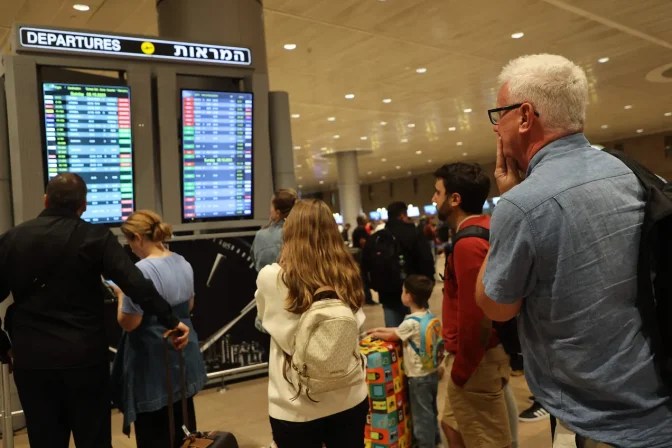
The race to escape Israel
One can imagine how much worse things have gotten in the six months since, and Israel isn’t yet embroiled in an all-out war. An extended period of mass strikes from Iran, AnsarAllah and Hezbollah could completely paralyzse the entity economically, render entire areas of the entity uninhabitable – or, at least, uninhabited – destroy infrastructure, and much more. Among the infrastructure in Tehran’s crosshairs could well be the Dimona nuclear power plant, which would unleash deadly chaos on a grand scale.
Resultantly, the entity’s “Samson Option”, under which it is committed to launch a mass nuclear strike if its existence is threatened, should no longer be taken very seriously. Israeli military theorist Martin van Creveld once boasted, “we have the capability to take the world down with us, and I can assure you that will happen before Israel goes under.” But Tehran’s hypersonic missile capabilities are in every way an effective counter-deterrent. They could even deliver a nuclear, or chemical/biological payload of their own.
‘Whoever Moves’
The Zionist entity’s Iranian drubbing is further exacerbated by its attempt to crush Hamas being an absolute disaster, in every conceivable way. The fiasco’s consequences are and will remain wide-ranging and grave, to the extent of fatal. This may account for Netanyahu’s flailing bid to draw Tehran into all-out war. After all, the scale of Israeli Occupation Forces’ defeat is such that in an absolutely scathing op-ed for Haaretz on April 11th, Zionist “journalist” Chaim Levinson lamented:
“We’ve lost. Truth must be told… It’s unpleasant to say, but we may not be able to safety [sic] return to Israel’s northern border… No cabinet minister will restore our sense of personal security. Every Iranian threat will make us tremble. Our international standing was dealt a beating. Our leadership’s weakness was revealed to the outside. For years we managed to fool them into thinking we were a strong country, a wise people and a powerful army. In truth, we’re a shtetl with an airforce, and that’s on the condition it’s awakened in time.”
Even the Western media, which since the genocide began has been at best silent and at worst complicit – and much more active in the latter sphere than the former – has acknowledged Tel Aviv’s battlefield cataclysm. The Economist, a nakedly Zionist publication that has whitewashed, diminished, or outright justified every conceivable crime committed by the IOF, has condemned the Forces’ “military and moral failures”, and how “its generals botched the strategy, and discipline among troops has broken down”:
“[Israel is] accused of two catastrophic failures. First, it has not achieved its military objectives in Gaza. Second, it has acted immorally and broken the laws of war. The implications for both the IDF and Israel are profound… Hamas fighters are still ambushing Israeli forces throughout Gaza and the group is reasserting itself in areas the IDF has left… Accusations that Israel has broken the laws of war are plausible.”

An Israeli Occupation Force psychopath
The Economist went on to slam a “lack of enforcement” of already virtually non-existent “rules of engagement” under which the IOF operate. A “veteran reserve officer” was quoted as saying commanders could arbitrarily “decide that whoever moves in his sector is a terrorist or that buildings should be destroyed.” A sapper in another unit admitted, “the only limit to the number of buildings we blew up was the time we had inside Gaza”:
“Soldiers have filmed themselves vandalising Palestinian property and, in some cases, put those videos online. On February 20 the IDF’s chief of staff published a public letter to all soldiers warning them to use force only where necessary, ‘to distinguish between a terrorist and who is not, not to take anything which isn’t ours – a souvenir or weaponry – and not to film vengeance videos.’ Four months into the war, this was too little, too late.”
That The Economist printed such things at all reflects how far the Zionist entity has fallen since October 7th. Now, it is a global pariah, viscerally loathed by the overwhelming majority of the world’s citizenry. Its once-vaunted military is not feared by adversaries, and their ability to unilaterally strike Muslim countries with total impunity, and no comebacks, is over. Tel Aviv’s claim to “defense” and security primacy, upon which much of its exports were successfully marketed for decades, has been amply demonstrated to be bogus.
Meanwhile, the entity has suffered population collapse, with concomitant mass brain drain and workforce freefall as settlers flee or get conscripted. Demand for mental health services has reached all-time highs, as the trauma of perpetrating genocide, and living under the daily threat of attack as Palestinians have since 1948, ravages soldiers and civilians alike. But scores of psychiatrists have relocated elsewhere due to stressful workloads, and likely won’t return. Such are the foundational flaws of a settler colonial state.
For many, these developments may be little consolation, coming as they do off the back of thousands of murdered and mutilated Palestinian children. Yet, they are unambiguous indicators that the Zionist entity is on the brink of extinction, which wasn’t the case before Hamas breached Gaza’s concentration camp walls on October 7th 2023. Palestine is now closer to being free than at any point since Israel’s creation. And there is no going back to “normal”.

Refaat Alareer
Time is now and forever on the side of the indefatigable, undefeated Resistance – so too justice, and virtue. We should never forget the immortal, galvanising words of Palestinian poet Refaat Alareer, slain in cold blood by a targeted IOF airstrike on December 6th 2023:
“If I must die, let it bring hope.”
How Big a Factor is Iran in the War on Gaza?
By Ted Snider | The Libertarian Institute | April 10, 2024
In both Ukraine and Gaza, the Joe Biden administration has adopted the dangerous doctrine of war management in which, while not stopping a war diplomatically, it attempts to contain it and prevent it from becoming a wider war into which the United States might get drawn.
This difficult to calibrate policy is being threatened in both theaters.
In the Middle East, two Israeli actions have escalated the calibrated strikes between Israel and Iran, up to the threshold that Iran could absorb without feeling the necessity to respond.
One was an airstrike in southern Lebanon that killed Ali Ahmad Hassin, an important Hezbollah commander. The more significant and volatile one was the April 1 attack on an Iranian embassy compound in Damascus that killed seven Iranian officers, including General Mohammad Reza Zahedi, the top Iranian Quds Force commander in Lebanon and Syria.
Zahedi is the most senior Iranian commander to be killed since war broke out on October 7. But what made this strike escalatory and dangerous is that it targeted an embassy compound under Iranian sovereignty. “When they attack our consulate,” Ayatollah Ali Khamenei said in a speech on April 10, “it is as if they have attacked our soil.” Khamenei called the decision to escalate to such an attack a “mistake” that “must be punished.”
A direct response by Iran against Israel could risk the nightmare scenario the United States has sought to avoid through its policy of managing wars. In that scenario, Iran retaliates in kind against Israel and Israel responds, drawing Iran and Hezbollah into the war in a manner that pulls in the Houthis as well as militias in Iraq and Syria. A Houthi source told Responsible Statecraft that “In case a full-scale war was to erupt between Hezbollah and Israel, Yemen and its leadership will stand with the party [Hezbollah] militarily, politically and economically” in a way that could even include “sending foot soldiers.” Such a force aligned against Israel could risk drawing the United States into the war.
In a speech on April 5, Hezbollah Secretary General Sayyed Hassan Nasrallah called the attack on Iran’s Damascus embassy “a turning point” and said that it is “certain that the Iranian response to the [bombing] of the Iranian consulate is coming without a doubt.”
He said, perhaps clearly for the first time, that Hezbollah could intervene in the event of a full-scale Israel-Iran war. “Everyone must prepare themselves, arrange their matters and be careful,” he said, “when the Iranian side responds to the targeting of the Iranian consulate and to the Zionist enemy’s possible response to the Iranian response.”
Nasrallah said that an Iranian response is inevitable and seemed to caution against the size of the Israeli counter-response, saying, not only that “everyone must prepare themselves,” but reminding that Hezbollah has “not used the main weapons nor the main forces and we have not called in the reserves.”
Nasrallah may have been leveraging a fuller Hezbollah entrance into the war to caution Israel and the United States against an even more escalatory Israeli counter-response to the response Iran feels it must deliver. Iran may have gone one step further, leveraging its entrance into the war in an attempt to stop the war altogether.
As Trita Parsi, Executive Vice President of the Quincy Institute first reported, an Arab diplomatic source told Jadeh Iran that Iran will respond to the Israeli attack on its embassy with a direct attack on Israel unless the United States orchestrates a ceasefire in Gaza. According to reporting in Jadeh Iran, “Iran has vowed to respond to the assassination of Zahedi.” However, in an “exchange of messages between Tehran and Washington” whose aim is “to contain escalation,” an Iranian proposal “stipulated a ceasefire in Gaza as a price” for not striking Israel in retaliation.
Though a causal line cannot be drawn, it is interesting that, in an interview recorded on April 3, President Joe Biden said, “I think what [Netanyahu’s] doing is a mistake. I don’t agree with his approach,” and then said, “So what I’m calling for is the Israelis to just call for a ceasefire, allow for the next six, eight weeks, a total access to all food and medicine going into the country.”
It is also interesting that the United States is participating in the latest round of ceasefire negotiations in Cairo. In an April 8 press conference, National Security Communications Advisor John Kirby said that CIA Director Bill Burns was in Cairo for the talks. He said that the Biden administration “is doing everything possible to broker a deal that secures the release of all the hostages and leads to an immediate ceasefire. And there’s simply no higher priority.”
CNN went further, reporting that Burns wasn’t just present or participating, but that he “presented a new proposal to try to bridge the gaps in ongoing negotiations to broker a deal to bring about a ceasefire.”
Hezbollah may be responding to the killing of one of their commanders by leveraging the threat of its entering the war to prevent the war from entering an uncontrolled series of escalations. Iran may be responding to the airstrike on its embassy that killed a general by leveraging its entering the war to stop the war altogether. How big a factor Iran is, and how powerful its leverage, may help determine what comes next, how big the Israeli counter-response to Iran’s promised response is and even, perhaps, the prospects of a future ceasefire.
A potential UAE-Hezbollah thaw?
By Radwan Mortada | The Cradle | March 31, 2024
The veiled details behind the recent visit of Wafiq Safa, head of Hezbollah’s Liaison and Coordination Unit, to the UAE remain undisclosed. Rumors propagated by Saudi media have tried to insinuate that the Lebanese resistance party aims to placate its stance towards Israel, possibly even contemplating concessions.
This narrative seeks to undermine or distort any real achievements gained during the rare trip. Despite all the conjecture, one development is undeniable: there has been a nascent shift in thawing the longstanding hostilities between Hezbollah and the UAE — a prominent Arab ally of both the US and Israel.
Strained relations
The sudden revelation of Safa’s visit to the Persian Gulf state on 19 March was indeed astonishing — a first by a senior Hezbollah official in many years — particularly given Abu Dhabi’s active role in clamping down on even pro-Hezbollah sentiments within the UAE.
The UAE’s track record includes arbitrary arrests and expulsions of Lebanese nationals under all sorts of dubious charges, often subjecting them to inhumane treatment, exemplified tragically in the case of Lebanese businessman Ghazi Ezzeldin, who was tortured to death while in Emirati custody last year.
News reports suggest that seven Lebanese citizens — four serving life sentences; two others facing 15 years in prison — remain incarcerated in the Emirates under charges of laundering funds for Hezbollah and Iran, and for the spurious claim of having made contact with Hezbollah. All of the detainees deny these charges.
In short, UAE authorities need little justification to accuse Lebanese individuals of ties to Hezbollah, which is designated a terrorist entity in the Emirates.
The UAE, it should be noted, is Tel Aviv’s closest Arab ally in West Asia, marked by Abu Dhabi’s decision in 2020 to normalize relations with the occupation state — with Bahrain, the first Arab state in the Persian Gulf to do so. Despite Israel’s genocidal war against Gaza, economic ties between the UAE and Israel continue to flourish, further entrenching their alliance against common adversaries.
Against this backdrop, Syrian President Bashar al-Assad emerges as an unexpected mediator, leveraging his amicable relations with the UAE leadership, united in their opposition to the Muslim Brotherhood.
Behind the scenes, the UAE has been quietly leveraging its international clout to lift US Caesar Act sanctions on Syria, with an eye on participating in the war-torn country’s reconstruction efforts. As the first Arab state to break Assad’s diplomatic isolation, the UAE has now seized the opportunity to engage with Hezbollah via its renewed Damascus channel.
Preliminary discussions, facilitated by Syrian General Intelligence Director Major General Hossam Louka, bridged the gap between the two parties. These exchanges, held on Syrian soil, involved representatives from both Hezbollah and UAE officials.
Louka also visited Lebanon and the UAE to meet with Emirati officials and the leadership of Hezbollah and convey a detailed message to Assad.
Contrary to the many sensationalized reports in regional media, informed sources tell The Cradle that Safa encountered no explicit demands from UAE officials during his visit. Instead, discussions centered on two pivotal objectives: first, securing the release of Lebanese detainees unjustly incarcerated in the UAE under charges of affiliation with Hezbollah, and second, improving the precarious conditions Lebanese expatriates face in the UAE, where their presence is securitized by the state.
The sources affirm the constructive nature of the meetings and indicate there may be imminent releases of the Lebanese detainees before the end of the holy month of Ramadan.
What do both parties want?
But the timing of Safa’s visit, as Israel escalates airstrikes on Lebanon, Syria, and Gaza, raises speculation about the implications of this renewed relationship. Safa himself is on a US sanctions list, while Hezbollah retains its designation as a terrorist organization by both Washington and the Persian Gulf states.
The UAE, having previously subjected Lebanese nationals to unjust treatment, now initiates efforts to mend ties with Hezbollah. Conversely, Hezbollah, having waged a war to free prisoners from Israeli detention, displays a willingness to engage in dialogue, even if the optics of its representative shaking hands with UAE officials may not be well-received back home.
Following the visit, Hezbollah issued a very brief statement:
“The head of the Liaison and Coordination Unit, Hajj Wafiq Safa, visited the United Arab Emirates as part of the ongoing follow-up to address the case of a number of Lebanese detainees there, where he met with a number of officials concerned with this case, and [a solution to this issue will be reached hopefully].”
Nevertheless, the underlying question remains: What does the UAE seek to achieve? Did it initiate this thaw in relations merely to reopen its embassy in Lebanon after years of closure and diplomatic strife? Does the UAE have hidden intentions concealing these superficial objectives — and what role could Hezbollah play in this equation?
Outreach to Iran via its allies
Early this year, as the regional war expanded, CIA Director William Burns wrote in Foreign Affairs magazine: “The key to Israel’s — and the region’s — security is dealing with Iran.”
Abu Dhabi too, knows that the relationship with Tehran is pivotal to resolving crises in the region. Hence, the UAE has taken a significant stride towards Hezbollah, recognizing its critical regional role. While this unusual meeting could have taken place in Damascus, in secret, the UAE opted instead for a public airing and even arranged for Safa’s transportation via plane to the Emirates.
Moreover, Abu Dhabi’s interest in improving relations with Hezbollah and its leadership could have direct security benefits. The Lebanese party has influence with Yemen’s Ansarallah resistance movement, whose naval operations in the Red Sea and other waterways are impacting international navigation and, thus, Emirati interests from the Persian Gulf to the Horn of Africa.
While a Syrian source tells The Cradle that the meeting yielded positive outcomes and is likely to be followed by further engagements, the visit carries implications that extend well beyond the immediate parties involved.
Beyond improving Hezbollah-UAE or Iran-UAE understandings, it will be essential to monitor the subsequent actions of Saudi Arabia’s leadership after this event.
In essence, these developments could lead to improved future relations between Hezbollah and Arab states of the Persian Gulf, in turn reversing Washington and Tel Aviv’s strategic target of clinching further normalization deals for Israel in West Asia.
Lebanon Sunni militant head affirms coordination with Hezbollah against Israel
MEMO | March 27, 2024
The head of a Lebanese Sunni political and militant group that has joined Hezbollah, a Shia resistance movement, in its fight against Israel said yesterday that the conflict has helped strengthen cooperation between the two groups, despite their sectarian differences.
Secretary-General of Al-Jamaa Al-Islamiya, or the Islamic Group, Sheikh Mohammed Takkoush, told AP that his faction has joined the fighting along the Lebanon-Israel border in response to the occupation state’s ongoing genocidal war on Gaza and its strikes against Lebanese towns and villages, which have killed civilians including journalists.
“We decided to join [the battle] as a national, religious and moral duty. We did that to defend our land and villages,” Takkoush told the news agency at his group’s headquarters in Beirut. “We also did so in support of our brothers in Gaza,” where he said Israel was committing an “open massacre.”
According to AP, the Islamic Group’s armed wing, the Fajr Forces, carries out its operations against Israel mainly from the southern city of Sidon.
Takkoush said that he believed Israel has ambitions to seize more territory “not only in Palestine but in Lebanon too.”
The group acts independently but coordinates closely with Hezbollah and with the Lebanese branch of Hamas, Takkoush said. “Part of [the attacks against Israeli forces] were in coordination with Hamas, which coordinates with Hezbollah,” he explained, adding that direct cooperation with Hezbollah “is on the rise and this is being reflected in the field.”
“Our relations with Hezbollah are good and growing and it is being strengthened as we go through war,” adding that all the weapons they use are from their own arsenal: “We did not get even a bullet from any side.”
In a report published in November, L’Orient Today said Takkoush’s faction, which has been described as a Muslim Brotherhood-affiliated group, may help Hezbollah boost its credentials among some Lebanese Sunnis, although “it is not guaranteed to extend Hezbollah’s influence beyond the war.” This is because “The Sheikh has neither the oratory skills and charisma of Hassan Nasrallah, his Hezbollah counterpart, nor the popularity of Saad Hariri.”
Hezbollah detains Dutch armed group in Beirut suburb
The Cradle | March 2, 2024
Hezbollah security personnel arrested six Dutch nationals in the southern suburbs of Beirut last Wednesday, Al-Akhbar reported on 2 March.
The men were found in possession of military-grade weapons, ammunition, and equipment.
The Dutch government claimed the six men were part of a special group sent to evacuate its nationals if the war between Hezbollah and Israel expanded.
Hezbollah handed over the men to the Lebanese Intelligence Directorate, where they were interrogated and kept in detention until early Friday morning.
Sources speaking with Al-Akhbar said the six men claimed to be members of the Dutch military, simulating an evacuation attempt from inside the southern suburb. Contact with them was lost after they entered the southern suburb and were stopped by Hezbollah security personnel. Two employees of the Dutch embassy residing in the southern suburb allegedly participated in the failed simulation.
However, journalist Hasan Illaik of the Lebanese news outlet Al-Mahatta reported that the embassy employees were not Dutch nationals and that the “Dutch ambassador to Lebanon quickly arrived at the ministry to pressure their release, under the pretext that they had not committed any crime. This is, of course, untrue given that this is a major violation of the law and that it was a significant security threat.”
Illaik added that, “even more suspiciously, the armed group claimed to have carried out the operation without consulting their own embassy. It was also discovered that they launched their operation from Kaslik,” a coastal town north of Beirut, “rather than from the embassy or a place affiliated with the embassy.”
Neither the Lebanese military nor the Dutch government provided an official statement or explanation for the incident.
Al-Akhbar reported as well on 2 March that Hezbollah’s security service arrested a Spanish national in the Al-Kafaat area in the southern Beirut suburbs several days ago. The man was filming with his phone on the street, claiming he was lost and needed to send his location to friends to pick him up.
However, during the interrogation, it was discovered that his phone contained an advanced program preventing access to the stored data.
High-level officials from the Spanish embassy then intervened to win his release. It was later discovered that the man possessed a diplomatic passport.
The arrests of the Dutch and Spanish nationals came as part of a program of additional measures initiated by Hezbollah security officials in response to increased efforts by Israeli and other foreign intelligence agencies to collect information needed to assassinate Hezbollah cadres.
Israel assassinated prominent Hamas leader Saleh al-Arouri in an airstrike in the southern Beirut suburb of Dahiya in December and prominent Hezbollah commander Ali Hussein Burji in January in south Lebanon.
Since the outbreak of the war with Israel on 8 October, the embassies of several western countries, including Britain and Canada, have brought in special forces, ammunition, and advanced equipment under the pretext of evacuating their diplomats and nationals if the situation deteriorates.
Al-Akhbar reported in November that mysterious foreign military cargo flights, potentially carrying equipment for use against Hezbollah, were landing at the Beirut and Hamat airports.
Between the 14 and 20 November, nine planes from various NATO countries were recorded landing at Beirut and Hamat airports, including several flying from Tel Aviv, according to Intelsky, a website monitoring aircraft movement in the region.
The Resistance Has a Plan for Israel. But on the Other Side, Fantastical U.S. Stratagems Ensure a Cascading Failure
By Alastair Crooke | Strategic Culture Foundation | February 19, 2024
In a speech on Tuesday, Hizbullah leader Seyed Nasrallah said that the Party will continue the border offensive until at least the Gaza massacre stops. The war in Gaza however, is far from over. And Nasrallah warned that even were a ceasefire to be reached in Gaza, “should the enemy perform any action, we will return to operating according to the rules and formulas that existed before. The purpose of the resistance is to deter the enemy, and we will react accordingly”.
Israel’s Defence Secretary Gallant has underlined that contrary to international consensus expectations, he too expects the war in Lebanon to continue. Gallant said the military has stepped up its attacks against Hizbullah by one level out of ten:
“The Air Force planes flying currently in the skies of Lebanon have heavier bombs for more distant targets. Hizbullah went up half a step, whilst we, a full one … We can attack not only at 20 kilometres [from the border], but also at 50 kilometres, and in Beirut and anywhere else”.
It is not clear what ‘red line’ Hizbullah would have to cross for Israel to significantly escalate its response to much higher levels; Israeli leaders have suggested that an attack on a strategic site; or an attack leading to major civilian casualties; or a substantive barrage on Haifa might constitute the breaking point.
Nonetheless, with three military divisions rather than the usual one now deployed in the north of Israel, the IDF has more forces poised for action on the northern border than it has preparing for an incursion into Rafah – at this point. It is clear, as Chief of Staff Halevy has specified, that Israel is “preparing for war” against Hizbullah (more than preparing for Rafah).
Is the threat to Rafah a bluff to put pressure on Hamas to concede on the deal and hostages? One way or another, both Israel’s political and military chiefs are adamant: The IDF will incurse into Rafah – ‘at some point’.
The qualitatively different Hizbullah strike on Safed on Israel’s northern regional command HQ on Wednesday – which resulted in 2 dead and 7 further casualties – is being treated in Israel as the gravest attack since the start of the war, with Ben Gvir calling it a “declaration of war”. Subsequent Israeli attacks killed 11 people, including six children, in a barrage of strikes on villages across southern Lebanon, in retribution for the Safed blitz – with the fierce exchange of fire still continuing.
The ‘Safed Strike’ deep into the Galilee very likely was intended to signal that Hizbullah is not about to capitulate to western demands that it provide Israel with a ceasefire that is intended to facilitate evacuated Israelis to return to their homes in the north. As Nasrallah confirmed in a scathing attack on those external (Western) mediators who serve only as Israel’s lawyers, and neglect to address the massacres in Gaza:
“It is easier to move the Litani River forward to the borders, than to push back Hezbollah fighters from the borders, to behind the Litani River … They want us to pay a price without Israel committing to a thing”.
In these circumstances, Nasrallah clarified that residents of northern Israel will not return to their homes – warning that even more Israelis risk being displaced:
“‘Israel’ must prepare shelters, basements, hotels and schools to house two million settlers who will be evacuated from northern Palestine, [were Israel to expand the war zone].”
Nasrallah outlined what is clearly the agreed Axis of resistance’s overarching strategic plan. (There has been a flurry of meetings between senior Axis principals over the last week, across the region, for which Nasrallah is speaking):
“We are committed to fighting Israel until it is off the map. A strong Israel is dangerous to Lebanon; but a deterred Israel, defeated and exhausted, is less of a danger to Lebanon”.
“The national interest of Lebanon, the Palestinians, and the Arab world is that Israel leaves this battle defeated: Therefore, we are committed to Israel’s defeat”.
Put bluntly, the Axis has its vision of the conflict’s outcome. And it is a “deterred, defeated and exhausted” Israeli State. By implication, it is an Israel that has relinquished the Zionist project – one that is reconciled to the notion of living as Jews between the River and the Sea – albeit with rights no different to others living there (i.e. Palestinians).
On the other side, the western strategic plan, as the Washington Post reports – which the U.S. and several Arab countries hope to present within a few weeks – is a long-term plan for peace between Israel and the Palestinians, including a “time frame” for the establishment of a provisional de-militarized Palestinian “state”:
“Imperatively, it begins with a hostage deal accompanied by a six-week cease-fire between Israel and Hamas. While it may be termed “cessation of hostilities” or an “extended humanitarian pause,” such a cease-fire will signal the de facto end of the war along the lines and scale that it has been fought since 7 Oct.”
The plan addresses “Post-war Gaza”, in terms already well-known. As senior Israeli commentator, Alon Pinkas, affirms:
“Parallel to the announcement U.S., Britain and possibly other countries will consider and eventually make a joint statement of intent by recognizing a provisional, demilitarized and future Palestinian state – without delineating or specifying its borders”.
“Such a recognition does not necessarily contradict Israel’s legitimate and reasonable demand to have overriding security control over the area west of the Jordan River in the foreseeable future … [it constitutes] a practical, timebound, irreversible path to a Palestinian state living side-by-side in peace with Israel … whose recognition could also be submitted to the UN Security Council – as a binding resolution. Once the Arab countries sign off on such a framework, the U.S. believes that neither Russia nor China would veto it …
“Within the “regionalization” phase however, the Americans will craft a regional security cooperation mechanism. Some in Washington imagine a reconfigured region with a new “security architecture” as a harbinger to a gradual Mideast version of the European Union, with greater economic and infrastructure integration”.
Ah – the New Middle East again!!!
Even Alon Pinkas, an experienced former Israeli diplomat, concedes: “If the plan seems too fantastical to you: You’re not alone”.
The basic improbabilities to this plan simply are disregarded. Firstly, Israel’s Finance Minister Smotrich responded to the reported American-Arab plan, saying: “there’s a joint American, British and Arab effort to establish a terrorist state” next to Israel. Second, (as Smotrich further notes): “They see the polls. They see how the absolute majority of Israelis oppose this idea [of a Palestinian State]”; and thirdly, some 700,000 settlers were installed in the West Bank – precisely to block any Palestinian State.
Is the U.S. really going to impose this onto a hostile Israel? How?
And, from the Resistance perspective, ‘a provisional, demilitarized and future Palestinian ‘state’, without delineated or specified borders, is not a state. It is truly a Bantustan.
The reality is that when a Palestinian State might have been a real prospect (two decades ago), the international community turned a willing ‘blind eye’ – for decades – to Israel’s successful and complete sabotage of the project. Today, circumstances are much changed: Israel has moved far to the Right and is in the grip of an eschatological passion to establish Israel on the entire “Land of Israel”.
The U.S. and Europe have only themselves to blame for the dilemma in which they now find themselves. And a policy stance – such as outlined by Biden – plainly said is doing untold strategic damage to the U.S. and its compliant European allies.
Even on the Lebanon track, let us be plain too, Israel’s demands from Lebanon go far beyond a mutual ceasefire. There is no guarantee, even should a ceasefire be reached in Gaza as part of a comprehensive hostage/end-of-war deal, that Nasrallah will agree to withdraw all his forces from the border with Israel, or conversely, that Israel will comply with its commitments.
And with the U.S. defining its Palestinian ‘solution’ as an improbable, provisional, disarmed and wholly impotent Palestinian entity, nestled within a fully militarised Israel, exercising ‘full security overlordship from the River to the Sea’, it would not be surprising were Hizbullah rather, to opt to pursue the Axis’ plan of a defeated, exhausted post-Zionism.
Israeli commentator, Zvi Bar’el, writes:
“Even were the American assumptions to become a working plan, it is still unclear what policy Israel will adopt on Lebanon. Even pushing Hezbollah back so that Israeli communities are no longer within the range of its anti-tank missiles does not remove the threat of tens of thousands of medium and long-range missiles. The deterrence equation between Israel and Hezbollah will continue to determine [the true] reality along the border”.
[The current U.S. working assumption, as presented by the Administration’s special envoy Amos Hochstein in his previous visits to Lebanon], “is that a border demarcation agreement between Israel and Lebanon will result in final and full recognition of the international border and thus deny Hezbollah the formal basis for justifying its continued fight against Israel to liberate occupied Lebanese territories. At the same time, it allows the Lebanese government to order its army to deploy its forces along the border in order to assert its sovereignty over its entire territory and demand that Hezbollah forces pull back from the border”.
This is just more wishful, ‘fantastical’ thinking. And it contains a flaw: Hochstein’s work plan does not include an agreement on the Sheba’a Farms, but only on the ‘Blue Line’ – the border agreed in 2000, but which is not recognized by Lebanon as an international border. If the issue of the Sheba’a Farms is not settled, Hezbollah will not be bound by a limited demarcation accord that omits the Sheba’a area.
Since Hamas’s attack on Israel on 7 October, every stratagem and protocol, dug from some musty West Wing cupboard, and upon which the U.S. leant, has failed. What was supposed to be a limited and compartmentalized military operation in Gaza by the IDF has turned into a regional firestorm. Aircraft carriers sent to deter other actors from getting involved failed with the Houthis; U.S. bases in Iraq and Syria became targets, with attacks on U.S. bases continuing, despite U.S. attempts at delivering deterrent ‘punches’.
Quite clearly, Netanyahu is ignoring Biden, and ‘defying the world’ – as this week’s headlines attest:
“Defying Biden, Netanyahu Doubles Down on Plans to Fight in Rafah” (Wall Street Journal )
“As Israel corners Rafah, Netanyahu defies the world” (Washington Post )
“U.S. won’t punish Israel for Rafah op that doesn’t protect civilians” (Politico )
“Egypt Builds Walled Enclosure on Border as Israeli Offensive Looms: Authorities are surrounding an area in the desert with concrete walls as a contingency for possible influx of Palestinian refugees” (Wall Street Journal ).
Netanyahu has vowed to forge ahead, saying on Wednesday that Israel would mount a “powerful” operation in the city of Rafah, once residents have been “evacuated”. Israelis explicitly say the White House is not opposed to the Rafah blitz, provided Palestinians are given the opportunity to “evacuate” (to where, is left unsaid). (Meanwhile, Egypt is building a refugee camp inside its border, surrounded by concrete walls …).
At this point, all of the U.S.’ various problems – the political polarization, widening war, funding for wars, the alienation amongst the swing-state Arab constituencies and Biden’s sinking ratings – are beginning to feed into, and reinforce, each other. What began as a foreign-policy issue – Israel defeating Hamas – has become a significant domestic crisis. Dissatisfaction within the U.S. at Israel’s conduct of the war is fuelling the growth of significant protest movements. Who can truly believe that yet another trip by Blinken to the region will solve anything at this point, asks Malcom Kyeyune?
It is hard to say where things in the region will stand, a couple of months from now. We have entered a period of breakdown and violence, as the forces pulling apart the old status quo cascade and mutually reinforce one another.
Lebanon rejects demands to push Hezbollah away from southern border
The Cradle | February 6, 2024
Lebanese caretaker Foreign Minister, Abdallah Bou Habib, voiced on 6 February the nation’s rejection of recent Israeli and international demands seeking to push Lebanese resistance group, Hezbollah, north of the Litani River, saying Beirut will not accept ‘partial solutions’ to resolving the cross-border conflict.
“Western countries demand the retreat of Hezbollah for about eight to ten kilometers north of Litani,” Bou Habib said in an interview with Nida al-Watan. “This is a formula that Lebanon rejects. [Beirut] will not accept ‘partial solutions’ that do not bring the desired peace and do not secure stability but will lead to the renewal of the war again and again.”
Instead, the foreign minister called for a “comprehensive implementation of UN Resolution 1701.”
UN Resolution 1701 was issued following the 2006 Israel–Hezbollah war, which called for, among other things, respect for the Blue Line, a border drawn up by the UN in 2000.
Bou Habib expressed Lebanon’s demands in relation to the liberation of Shebaa Farms and the Kfarchouba hills, saying, “What we hear from some foreign ministers of the Western countries is that Israel is not in the question of this withdrawal, and our answer was that Lebanon will only accept a complete solution to all border issues with Israel, and half solutions do not work and will not [be accepted].”
He also demanded that part of a potential deal be for Israel to “stop the air, land and sea violations that have exceeded 30,000 violations since 2006.”
On 5 February, Israeli Foreign Minister Israel Katz said that “time is running out” in relation to a diplomatic solution with Lebanon, adding to his French counterpart Stephane Sejourne during her visit to Israel that “if we do not reach a diplomatic solution on Lebanon, we will move militarily to return the residents of Israeli towns on Lebanon’s borders,”
Hezbollah has recently released statistics showing that over 230,000 settlers had evacuated because of their operations since 8 October.
US special envoy Amos Hochstein paid a visit to Israel to speak with Defense Minister Yoav Gallant in an attempt to develop a plan to de-escalate the crossfire between Lebanon and Israel.
Gallant requested for Hezbollah to be pushed back 8–10 kilometers from the border, an increase of UN forces and Lebanese army in the area, and the means to return settlers to the northern settlements.
Hezbollah’s Secretary General Hassan Nasrallah said during a recent speech in reference to Israeli threats and negotiation talks, “we don’t fear war, and there are no talks before the war on Gaza ends.”
Iraqi resistance is quietly but effectively hitting the Israeli regime where it hurts
By Wesam Bahrani | Press TV | January 2024
The Islamic Resistance in Iraq announced a drone attack on Sunday deep inside the Israeli-occupied Palestinian territories, marking another significant development amid the Israeli genocide in Gaza.
What makes it a major development is the location of the target. The Israeli Zevulun naval facility near Haifa Port was struck as part of a “new phase” of operations against the illegal Israeli occupation of Palestine as well as the illegal American occupation of Iraq and Syria.
A pattern is emerging of the Iraqi resistance attacking Zionist targets in the Mediterranean while the Yemeni military continues its operations against Zionist and US targets in the Red and Arabian seas.
In a statement on Sunday, the Iraqi resistance said it struck “four enemy targets”, which included three illegal American bases in Syria and “the Israeli Zevulun naval facility”.
In a sign of how quickly these operations are occurring, by Sunday afternoon the Iraqi resistance published another statement announcing an attack on another illegal US base in Erbil, northern Iraq.
The attack by the Islamic Resistance in Iraq near Haifa followed a successful operation against the Israeli port of Ashdod just two days before that, which followed two other operations against Haifa itself as well as drone attacks on the Israeli Karish gas rig.
All these military operations against the Zionist entity have one thing in common: strategically all these targets sit on the Mediterranean Sea.
Last month, the Iraqi resistance pledged a new phase in its operations against the Zionist entity and its American patrons, declaring that “more is to come” and in “solidarity with “our people in Gaza”.
The commander of Kataib Sayyed al-Shuhada, Abu Ala’a al-Walai, one of the senior officials in the Hashd al-Sha’abi (Popular Mobilization Units), recently spoke about the beginning of a new phase and said “This stage includes preventing Zionist shipping in the Mediterranean Sea and disabling the ports of the Zionist regime”.
In response to the now almost daily attacks on the illegal US bases in Iraq and Syria by the Iraqi resistance as well as targeting vital Israeli targets, America’s military response has seen deadly airstrikes on buildings belonging to Harakat al-Nujaba and Kataib Hezbollah.
These are the two prominent anti-terror groups belonging to the Hashd al-Sha’abi, which is an integral part of the Iraqi National Armed Forces.
The Commander of the Hashd al-Sha’abi for the Central Euphrates Operations in Iraq, Major General Ali al-Hamdani on Sunday declared that “The Americans only understand the language of the force and will not leave Iraq through dialogue”.
As Washington continues to violate Iraqi sovereignty by attacking and killing members of its armed forces and continues to violate Yemeni sovereignty by attacking Yemeni military positions (as the US claims) or redecorating the sand in the desert, one thing is clear: both parties targeted are undeterred.
American and British warships are trying their best to prevent Ansarullah from attacking Israeli vessels or ships heading to the occupied Palestinian territories, but it is simply not working.
The Islamic Resistance in Iraq is now seeking to target the other side of the Israeli occupation’s waters in the Mediterranean, which explains the strikes on Haifa, Ashdod and the Israeli regime’s natural reserves in the Mediterranean Sea.
Ansarullah-led Yemeni military and Iraq’s Hashd al-Sha’abi are with surgical precision targeting the Zionist entity’s naval and maritime interests, which the Israeli regime depends on for a significant amount of its trade.
Haifa Port itself (on the Mediterranean) is believed to handle up to 90 percent of vital commodities entering the occupied Palestinian territories.
These operations are causing notable damage to the Israeli economy amid a sizeable drop in shipping activity in the regime’s ports with Israeli officials speaking about workers being furloughed.
The threat posed to the regime’s economy, at the moment, is bigger in the port of Eilat (on the Red Sea), which has been targeted on various occasions by the Yemeni military in recent weeks, who have also imposed an embargo on ships docking at the Israeli occupied Palestinian ports.
As much as the US and its now “poodle” vassal, Britain, insist that the resistance operations from Yemen and Iraq have nothing to do with the Israeli genocidal war on Gaza, the writing is on the wall.
Every statement put out by the Islamic Resistance in Iraq or the Yemeni armed forces mentions “our brothers in Gaza” and “our occupied land in Palestine”.
These resistance operations in solidarity with the oppressed people of Gaza, targeting the infrastructure of the illegitimate Zionist entity and American military assets in the region will continue unless three conditions are met.
An unconditional ceasefire in Gaza, humanitarian aid entering the besieged territory and the withdrawal of the Israeli military from the blockaded strip where the death toll now tops 26,500.
There is no coordination between the Yemeni military (Ansarullah) and the Hashd al-Sha’abi, this is simply strategic thinking by both sides, something Washington and Tel Aviv are lacking.
On October 8, when the Palestinian resistance launched an unprecedented operation, the United States lacked a coherent strategy for West Asia, choosing to focus on Russia and China instead.
More than 115 days later, as the ripple effects of the faith, determination, and power of the Axis of Resistance is slowly being digested in the White House, Washington’s strategy remains incoherent.
It has and can only resort to “precision strikes” as putting boots on the ground in Yemen or allowing those boots to leave their bases in Iraq will rubber stamp the end of Biden’s presidency.
It would be like Vietnam and Afghanistan put together but on steroids.
The attacks by the Islamic Resistance in Iraq against the Israeli occupation and the American occupation will not only persist but expand as the genocidal war on Gaza rages on.
The Zionists will feel this in their ports, vital naval sites and trade in the Mediterranean for as long as their indiscriminate attacks against the women and children of Gaza continue.
Does Hamas need help in defending Gaza?
The Palestinian resistance doesn’t have the air defense systems to protect Palestinian women and children from Israeli attacks. But still, Hamas and other Palestinian resistance groups have been inflicting heavy losses on the regime’s military on ground zero.
Up to 80 percent of Hamas tunnels in Gaza are still intact despite months of Israeli attacks aimed at destroying them, according to a report by The Wall Street Journal, citing Israeli officials.
All that the Zionist regime has done is kill civilians and allow 2.3 million people to starve while the West, with the US in particular, has looked the other way.
That has prompted the resistance groups in the region to step up and help the oppressed Palestinians.
For Iraq’s Hashd al-Sha’abi, Yemen’s Ansarullah, Lebanon’s Hezbollah or the Islamic Republic of Iran, support for Gaza and the people of Gaza is not a matter of public relations or goodwill. They consider it a moral and religious duty.
Wesam Bahrani is an Iraqi journalist and commentator.
‘Swarming’ the US in West Asia, until it folds
The US is so deeply mired in an unwinnable battle from the Levant to the Persian Gulf that only its adversaries in China, Russia, and Iran can bail it out.
By MK Bhadrakumar | The Cradle | January 29, 2024
Deterrence in defense is a military strategy where one power uses the threat of reprisal to preclude attack from an adversary, while maintaining at the same time the freedom of action and flexibility to respond to the full spectrum of challenges. In this realm, the Lebanese resistance, Hezbollah, is an outstanding example.
Hezbollah’s clarity of purpose in establishing and strictly maintaining ground rules that deter Israeli military aggression has set a high regional bar. Today, its West Asian allies have adopted similar strategies, which have multiplied in the context of the war in Gaza.
America, surrounded
While the Yemeni resistance movement Ansarallah is comparable to Hezbollah in certain respects, it is the audacious brand of defensive deterrence practiced by the Islamic Resistance of Iraq that is going to be highly consequential in the near term.
Last week, citing sources in the State Department and Pentagon, Foreign Policy magazine wrote that the White House is no longer interested in continuing the US military mission in Syria. The White House later denied this information, but the report is gaining ground.
The Turkish daily Hurriyet wrote on Friday that while Ankara is taking a cautious approach to media reports, it does see “a general striving” by Washington to exit not only Syria but the entire region of West Asia, as it senses that it has been dragged into a quagmire by Israel and Iran from the Red Sea to Pakistan.
Russia’s special presidential representative for the Syrian settlement, Alexander Lavrentiev, also told Tass on Friday that much depends on any “threat of physical impact” on American forces present in Syria. The swift US military exit from Afghanistan took place with virtually no advance notice, in coordination with the Taliban. “In all likelihood, the same may happen in Iraq and Syria,” Lavrentiev said.
Indeed, the Islamic Resistance of Iraq has stepped up its attacks on US military bases and targets. In a ballistic missile attack on Ain al-Asad airbase in western Iraq a week ago, an unknown number of American troops sustained injuries, and the White House announced its first troop deaths on Sunday when three US servicemen were killed on the Syrian-Jordanian border in strikes earlier that day.
Calling Beijing for help
This situation is untenable for President Joe Biden politically — in his re-election bid next November — which explains the urgency of the National Security Adviser Jake Sullivan’s meeting with Chinese Foreign Minister Wang Yi on Friday and Saturday in Thailand to discuss the Ansarallah attacks in the Red Sea.
US National Security Council spokesman John Kirby explained Washington’s rush for Chinese mediation thus:
“China has influence over Tehran; they have influence in Iran. And they have the ability to have conversations with Iranian leaders that — that we can’t. What we’ve said repeatedly is: We would welcome a constructive role by China, using the influence and the access that we know they have…”
This is a dramatic turn of events. While the US has long been concerned about China’s growing sway in West Asia, it also needs that influence now as Washington’s efforts to reduce violence are getting nowhere. The US narrative on this will be that the “strategic, thoughtful conversation” between Sullivan and Wang will not only be “an important way to manage competition and tensions [between the US and China] responsibly” but also “set the direction of the relationship” on the whole.
Meanwhile, there has been hectic diplomatic traffic between Tehran, Ankara, and Moscow, as Iranian President Ebrahim Raisi traveled to Turkiye, and the moribund Astana format on Syria last week got kickstarted. Succinctly put, the three countries anticipate a “post-American” situation arising soon in Syria.
A US exit from Syria and Iraq?
Of course, the security dimensions are always tricky. On Friday, Syrian President Bashar al-Assad chaired a meeting in Damascus for commanders of the security apparatus in the army to formulate a plan for what lies ahead. A statement said the meeting drew up a comprehensive security roadmap that “aligns with strategic visions” to address international, regional, and domestic challenges and risks.
Certainly, what gives impetus to all this is the announcement in Washington and Baghdad on Thursday that the US and Iraq have agreed to start talks on the future of American military presence in Iraq with the aim of setting a timetable for a phased withdrawal of troops.
The Iraqi announcement said Baghdad aims to “formulate a specific and clear timetable that specifies the duration of the presence of international coalition advisors in Iraq” and to “initiate the gradual and deliberate reduction of its advisors on Iraqi soil,” eventually leading to the end of the coalition mission. Iraq is committed to ensuring the “safety of the international coalition’s advisors during the negotiation period in all parts of the country” and to “maintaining stability and preventing escalation.”
On the US side, Secretary of Defense Lloyd Austin said in a statement that the discussions will take place within the ambit of a higher military commission established in August 2023 to negotiate the “transition to an enduring bilateral security partnership between Iraq and the United States.”
Pentagon commanders would be pinning hopes on protracted negotiations. The US is in a position to blackmail Iraq, which is obliged, per the one-sided agreement dictated by Washington during the occupation in 2003, to keep in the US banks all of Iraq’s oil export earnings.
But in the final analysis, President Biden’s political considerations in the election year will be the clincher. And that will depend on the calibration by West Asia’s resistance groups, and their ability to ‘swarm’ the US on multiple fronts until it caves. It is this ‘known unknown’ factor that explains the Astana format meeting of Russia, Iran, and Turkiye on January 24-25 in Kazakhstan. The three countries are preparing for the endgame in Syria. Not coincidentally, in a phone call last Friday, Biden once again told Israeli Prime Minister Benjamin Netanyahu “to scale down the Israeli military operation in Gaza, stressing he is not in it for a year of war,” Axios‘ Barak Ravid reported in a ‘scoop’.
Their joint statement after the Astana format meeting in Kazakhstan is a remarkable document predicated almost entirely on an end to the US occupation of Syria. It indirectly urges Washington to give up its support of terrorist groups and their affiliates “operating under different names in various parts of Syria” as part of attempts to create new realities on the ground, including illegitimate self-rule initiatives under the pretext of ‘combating terrorism.’ It demands an end to the US’ illegal seizure and transfer of oil resources “that should belong to Syria,” the unilateral US sanctions, and so on.
Simultaneously, at a meeting in Moscow on Wednesday between the Russian Security Council Secretary Nikolay Patrushev and Ali-Akbar Ahmadian, secretary of Iran’s Supreme National Security Council, the latter reportedly stressed that Iran-Russia cooperation in the fight against terrorism “must continue, particularly in Syria.” Russian President Vladimir Putin is expected to host a trilateral summit with his Turkish and Iranian counterparts to firm up a coordinated approach.
The Axis of Resistance: deterrence means stability
Iran’s patience has run out over the US military presence in Syria and Iraq following the revival of ISIS with American support. Interestingly, Israel no longer abides by its “de-confliction” mechanism with Russia in Syria. Clearly, there is close US-Israeli cooperation in Syria and Iraq at the intelligence and operational level, which goes against Russian and Iranian interests. Needless to say, the backdrop of the imminent upgrade of the Russia-Iran strategic partnership also needs to be factored in here.
These developments are a vintage illustration of defensive deterrence. The Axis of Resistance turns out to be the principal instrument of peace for the issues of security that entangle the US and Iran. Clearly, there isn’t any method or any reasonable hope of convergence to this process, but, fortunately, the appearance of chaos in West Asia is deceiving.
Beyond the distractions of partisan argument and diplomatic ritual, one can detect the outlines of a practical solution to the Syrian stalemate that addresses the inherent security interests of the US and Iran that are embedded within an outer ring of US-China concord over the situation in West Asia.
Russia may seem an outlier for the present, but there is something in it for everyone, as the pullout of US troops opens the pathway to a Syrian settlement, which remains a top priority for Moscow and for Putin personally.
Featured Video

Alon Mizrahi: ‘Israel Must Be Dismantled’
or go to
Aletho News Archives – Video-Images
From the Archives
Allies Don’t Need Lobbies
By Jay Knott | Dissident Voice | September 24, 2013
In a recent article on Counterpunch, Rob Urie defended the traditional Marxist analysis of US policy in the Middle East. He argues that support for Israel is driven primarily by economic interest, not the Jewish lobby.
He starts by paying tribute to the idea that Western societies are uniquely racist. He says that the “Western narrative” claims there is an “Arab character”, and that this is “antique racist blather”. He gives no definition of these terms. Further, he establishes his credentials as part of the dominant current in the American left by claiming that “over a million people in Iraq died so ‘we’ in the West can drive SUVs.”1
When he tries to criticize bourgeois economics, he makes it clear he doesn’t understand the developments it has made since Marx’s day, using the mathematical discipline known as “game theory”. He dismisses the basic abstraction of economic theory, the idea of the rational individual, on the grounds that it is “devoid of history, culture and political context”. But abstractions are always devoid of something.
He defends a more concrete economic theory, mostly Marxist, with some input from another theorist of capitalist crisis, Hyman Minsky. This concrete theory leads him to the view that US activity in the Middle East is primarily driven by rational capitalist motives, the need to secure a supply of oil.
“Taking the totality of circumstance — former oil company executives launching war on an oil rich nation on a pretext they publicly proclaimed they didn’t believe shortly before taking office — and that upon launching their war proved to be non-existent, requires a willingness to overlook the obvious — that the war on Iraq was for oil, that is difficult to support.”1
Perhaps I’ve misunderstood him, but based on what he says in the rest of the article, this convoluted sentence seems to argue that, because president Bush and vice-president Cheney attacked Iraq on false premises, and they also said it was all about oil, and they are former oil executives, and Iraq has a lot of oil, it’s difficult to deny US attacks on Iraq are all about oil.
In fact, it’s not hard at all. As Urie points out, at times Bush and co. said that attacking Iraq was “protecting the world’s supply of oil.”1 But, as he also points out, they are congenital liars. Why should we believe them when they say they are trying to “protect” the oil supply? Protect it against what? When politicians “admit” attacks on Middle Eastern countries are wars for oil, they are parroting the neo-con party line, feeding the public, both left and right, with a plausible-sounding pretext. For right-wingers, “it’s a war for oil” is a reason to support war, and for leftists, it’s a way to feel better by complaining impotently about corporate greed. Both approaches help the war drive. … continue
Blog Roll
 Aletho News
- Zelensky unnecessarily involves Ukraine in the Middle East crisis
- Turkish tanker blacklisted by Ukraine hit in drone attack – media
- Canada, the U.S., and NATO: the inescapable trap
- Villains of Judea: Leonid Radvinsky
- Alon Mizrahi: ‘Israel Must Be Dismantled’
- Former Head Of MI6 Admits That The U.S. And Israel Are Losing The Iran War
- Scattered Thoughts on War and Peace
- Iran Threatens to Close Red Sea to Shipping in Response to Invasion
- Iran in excellent position to prevail in war with US, Israel: John Mearsheimer
- Iran warns US: Do not call your retreat an agreement
- If Americans Knew
- In the West Bank, life is a constant battle – 3 articles
- Jacob Reses, one of the most powerful pro-Israel operatives in Trump’s Washington
- Israeli-US assaults kill or injure 87 children a day – Not a ceasefire Day 166
- ‘Forever live by the sword’: Understanding Israelis’ massive support for Iran war
- UN’s special rapporteur on human rights says Israel is systematically torturing Palestinians
- Trump White House plagiarized Iran war manifesto from Israel-aligned think tank
- Gaza says 6–10 patients die daily waiting for treatment abroad as Israel blocks medical evacuations
- ‘Substantial evidence’ of double-tap strike in killing of Gaza’s Hind Rajab
- ‘Do Not Want To Die For Israel’: Doubts About Trump’s Iran Strategy Spread Among Troops
- Instead of taking Joe Kent’s claims seriously, the media is disregarding him as an antisemite
- No Tricks Zone
- Devastating Assessment Of Comirnaty Vaccine By Former Senior Pfizer Europe Toxicologist
- New Study: CO2 Is ‘Effectively Negligible’ As An Explanatory Climate Change Factor Since 2000
- Former Pfizer Toxicologist Dr. Helmut Sterz Tells Bundestag Hearing Pfizer Vaccine Should Have Never Been Approved
- Energy Expert: Germany’s Nuclear Phaseout Was A “500 Billion Euro Mistake”
- New Research: South Australia’s Mid-Holocene Sea Surface Temperatures Were 4°C Warmer Than Today
- Storing Green Energy To Last Germany 10 Days Would Require A 60-Million Tonne Battery
- New Studies: UK Sea Levels Were 4 Meters Higher Than Today During The Mid-Holocene
- Destructive Green New Deal: German Energy And Metal Group Warns Of Drastic Crisis
- New Study Documents A 20-Year Pause In Arctic Sea Ice Decline – Driven By Internal Variability
- Wake-up Call: Survey Shows Majority Of Germans Now Favor Postponing Climate Targets!
 Aletho News