Israel loses control of its borders
By Khalil Harb | The Cradle | January 23, 2024
Israel once reigned supreme on the back of some immovable narratives: widely spun myths of a “promised land,” a “land without a people,” the “only democracy in the Middle East,” and the “only secure place for Jews in the world.” Today, those lofty soundbites lie in tatters, with the occupation state reeling from an unprecedented blow to its foundational ideas.
This transformation has unfolded with unexpected intensity since the 7 October Al-Aqsa Flood resistance operation and Israel’s devastating, genocidal war on Gaza.
But it is not just the challenge of narratives that has Israel on its back feet. For the first time in its 76-year history, Israel’s entire security calculations have been turned upside down: the occupation state is today grappling with buffer zones inside Israel. In past wars, it was Tel Aviv that established these “security zones” inside enemy territory — advancing Israel’s strategic geography, evacuating Arab populations near their state border areas, and fortifying its own borders.
This shift can be attributed to various factors, including vulnerabilities within the so-called “Arab Ring States” (Egypt, Jordan, Syria, and Lebanon). Throughout its history, Israel has consistently exerted military and political dominance, enforcing security measures on neighboring states, with the unconditional backing of allies like the US and Britain.
Israel’s new border realities
But in this current war, Tel Aviv is slowly understanding that the equations and calculations of military confrontation have fundamentally changed — a process that began in 2000 when the Lebanese resistance, Hezbollah, forced Israel to withdraw from most occupied territories in southern Lebanon.
Today, Israel is horrified to find itself retreating from direct confrontation lines with its arch-enemies in Gaza and Lebanon. The formidable capabilities of the resistance now include drones, rockets, targeted projectiles, tunnels, and spanking new shock tactics, casting doubt on the feasibility of Israeli settlers remaining safe in any of Israel’s border perimeters.
There is now one common refrain among settlers in the north and south of occupied Palestine: “We will not return unless security is restored on the border.”
But prospects for their return appear elusive at present. The Israeli Defense Ministry, which pledged a swift and decisive war to safeguard its settlers over 100 days ago, is now actively devising plans to shelter approximately 100,000 people along the northern border, deeper inside its territory. This measure could involve evacuating settlements that may come under fire during any future military escalation with Hezbollah in Lebanon.
This situation implies three critical outcomes: any immediate return of settlers remains unlikely, additional evacuations are anticipated, and numerous Israeli families – in the interim – may establish permanent settlements in other, more secure locations at a much further distance from the borders with southern Lebanon and the Gaza envelope.
Failed objectives and the northern front
Preliminary reports from settler councils in the north assessed settler “displacement” to be around 70,000 in the initial weeks of the conflict. Subsequent reports, however, suggest a vastly higher figure of approximately 230,000.
Against this backdrop, Hezbollah Secretary-General Hassan Nasrallah emphasized a crucial point in his 3 January speech. He referenced Israeli Defense Minister Yoav Gallant’s concern that Israelis are not only reluctant to reside in the border regions, but that their apprehension about remaining in any part of Israel will also likely rise if Tel Aviv’s war fails to achieve its stated objectives.
Indeed, since 7 October, a significant toll has been exacted on Israeli forces, with 13,572 “soldiers and civilians” wounded in the battles in Gaza and along the northern border with Lebanon, as reported by Yedioth Ahronoth.
One suspects those numbers may be underreported. Skepticism has recently grown over the accuracy of the Israeli Ministry of Health’s data, with various experts, independent sources, and media investigations suggesting a considerably higher casualty count. The IDF Handicapped Organization, for example, estimates that approximately 20,000 individuals have been disabled in the ongoing war — a number much higher than the health ministry’s findings.
The secrecy surrounding Israeli casualties is particularly evident on the Lebanese war front, where data is virtually nonexistent, and Tel Aviv’s military censorship tightly controls all information flows. This leads to a critical question regarding Israel’s ability to establish strategic “border” equations as a compensatory measure for what appears to be a military and political setback in achieving its stated war goals — which include the elimination of Hamas and the release of all captives.
Moreover, doubts arise about Israel’s capacity to wage a major war in the north given its clear shortcomings in its southern military campaign, in which it faced heavily besieged adversaries with multiple vulnerabilities. The Lebanese resistance, in comparison to its Gazan counterparts, boasts considerable and many unknown military capabilities, which it can exercise from within a sovereign state that is neither besieged nor landlocked. Furthermore, Hezbollah, which singlehandedly routed Israel from its territories in both 2000 and 2006 — makes it plain that it has thus far revealed and utilized only a fraction of its new military capabilities.
Decolonization in progress
In November, Hezbollah’s introduction of the Burkan missile, a domestically-made weapon with a range of up to 10 kilometers and destructive power of 500 kilograms of explosives, adds a potent dimension to the confrontation.
While Hezbollah has primarily targeted Israeli military barracks and troop gatherings with the Burkan, hundreds of guided missiles such as Kornet and Katyusha rockets have been employed with precision against specific targets within empty residential settlements, extending up to 10 kilometers in geographic depth from Lebanon’s border.
As of the onset of 2024, Hezbollah has conducted over 670 military operations against all 48 Israeli outposts, spanning from Naqoura in the west to the occupied-Shebaa Farms in the east, along with 11 rear military positions.
This is a major advancement in the Lebanese resistance’s border strategy. For 15 years — from 1985 to 2000 — Israel struggled to defend its “border strip” in southern Lebanon. Today, it faces many hundreds of attacks on its positions in northern Palestine, but fears opening a second war front that could complicate its already militarily draining Gaza campaign.
The so-called “defense” line along the border with Lebanon is now heavily compromised. Deemed insufficient for safeguarding the hundreds of thousands of Israeli settlers in the north, the recently displaced residents are demanding assurances about the future safety of that zone and their ability to return.
In December, the head of the Upper Galilee Regional Council revealed that the Israeli government had effectively created a buffer zone approximately 10 kilometers wide by evacuating towns in the north. This area, stretching from Mount Hermon in occupied Syria to Ras al-Naqoura, is reported to be nearly devoid of residents, with Israeli forces predominantly present.
At the so-called Kibbutz Manara border, a settler told Hebrew Radio North that 86 of the settlement’s 155 homes had been completely destroyed by Hezbollah rocket fire, raising the question of whether settlers would even have homes to return to.
Even if Israel dares to launch a full-scale aggression against Lebanon, just as it has faltered in besieged Gaza for 17 years, it will not be able to guarantee its success in achieving its objectives on the Lebanese front.
A land of false promises
The days when Israel could impose security arrangements on its Arab neighbors through military force and political machinations are gone.
Previously, Israel attempted to establish a security strip inside southern Lebanon through operations like the 1978 “Litani Operation.” This vision ultimately collapsed in 2000, with the occupation state’s humiliating withdrawal from Lebanon.
Israel now seems to be revisiting this approach — via American intermediaries — aiming to clear the southern Litani of resistance factions by brandishing the threat of war against all of Lebanon. This is a perilous strategy, particularly given the precarious position of its army in Gaza.
Israel’s tactics of bulldozing and bombing entire residential areas in the northern and eastern parts of the Gaza Strip, ostensibly to create a security strip with a depth of up to 2 kilometers, have hit a hard wall. Even its US ally has raised objections about the territorial delineation from Gaza, and the military efficacy of such measures. But more importantly, the Lebanese and Palestinian resistance appear prepped to mirror Tel Aviv’s ploys by eliminating Israeli habitation in the Gaza envelope and northern Palestine.
‘Destroy our neighborhoods, and we will destroy yours.’ This is surely not a response expected by Israel, whose military and political leadership are unaccustomed to repercussions for their aggressions. This new tit-for-tat that the occupation state appears unequipped to counter only further highlights Israel’s fragility and irreversible decline.
Settlers refuse return to Gaza envelope: ‘Hamas not yet deterred’
The Cradle | January 19, 2024
Hebrew media reported on 19 January that tens of thousands of evacuated settlers from the Gaza envelope are refusing to return to their homes.
A former resident of the Sderot settlement, located less than a mile from Gaza, told Israel’s Channel 13 in an interview that settlers “will not return to Sderot in the current situation.”
This is “not only due to the threat of rockets … no one knows if the Palestinians from Gaza can reach us. No one knows where their tunnels extend to,” the settler said.
“I have been living in Sderot for years, and I cannot count the times they told us that Hamas is deterred.”
Sderot is one of the Gaza envelope settlements that was stormed by resistance fighters during the outbreak of Operation Al-Aqsa Flood on 7 October. Rockets struck the settlement at the onset of the attack, as Palestinian fighters made their way in.
The Hamas fighters seized the Sderot police station, taking around 30 of its force as captives. The fighters then waged a 20-hour battle with Israeli troops in which all of the policemen were killed. The Israeli military then destroyed the station, bringing it down on top of those inside.
Since being evacuated in October, Sderot and other Gaza envelope settlements have continued to be hit by rocket attacks launched by the Palestinian resistance in Gaza.
According to Hebrew newspaper Yedioth Ahronoth, the Israeli government is facing great difficulty in convincing the residents of the Gaza envelope settlements to return to their homes.
Last month, Israeli public broadcaster KAN reported that Tel Aviv was offering financial grants to those willing to return to the settlements located between four and seven kilometers from the Gaza border.
A meeting was held between Prime Minister Benjamin Netanyahu and the council chiefs of the Gaza envelope settlements on 16 January, according to a Channel 12 report.
The council chiefs reportedly demanded that “the process of returning … be delayed or extended until the summer and the start of the new school year, and for the state to continue to fund their stay in temporary accommodation until then,” The Times of Israel said.
Netanyahu also reportedly told the council chiefs during the meeting that the war could potentially continue until 2025.
“Netanyahu said he accepted their request, promised that financial assistance to residents would be applicable then as well, and instructed the relevant officials to draw up the necessary framework.”
Meanwhile, Hamas’ Qassam Brigades and other groups in Gaza are nowhere near defeat, continuing to engage the Israeli army in fierce clashes and deadly ambushes across the entirety of the Gaza Strip, including in north Gaza, where Israel has announced a scale-back of operations.
The scale-back came as Israeli officials were boasting that Hamas has been “dismantled” in the north. Despite this, the fighters have been able to fire large rocket barrages at Israel from northern Gaza.
Lebanese daily Al-Akhbar, reporting on 19 January, cited sources in the Palestinian resistance who said that the Israeli ground operation has achieved nothing – particularly in the north. The report added that in the north, Hamas has been able to replenish its supplies and rebuild its ranks.
And just as the Israeli settlers of the Gaza envelope refuse to return to their homes, so too do the settlers of northern Israel, where hundreds of thousands have also been displaced by Hezbollah’s operations on the Lebanese border.
Asymmetric Warfare: Why the Houthis Can Beat the Collective West
By Russell Bentley – Sputnik – 14.01.2024
Dr. Michael Parenti once said, “Economic violence is physical violence in slow motion.” The economic sanctions against Iraq in the 1990’s led directly to the deaths of half a million Iraqi children. Economic sanctions can be a weapon as deadly as any artillery shell or cruise missile.
The Houthis might at first appear to be vastly outmatched by the US/UK armada that has struck Yemen, but militarily and economically, the US and Europe are actually much more vulnerable than the Houthis. To put it simply, in both economic and military terms, the US, UK and Europe, and Israel, have a lot more to lose.
The Houthis are not alone – Hezbollah, considered to be one of the most effective fighting forces in the world today, has an estimated 100,000 highly trained and motivated and very well armed soldiers in Lebanon, and is already at (undeclared, but de facto) war with Israel, and will probably escalate in the next few days. In October, 1983, Hezbollah was able to kill 305 US and French occupation soldiers at a cost of only 2 KIA on the Hezbollah side.
Of the US and French soldiers, 220 were US Marines, the greatest single loss in one day of US Marines since the Battle of Iwo Jima in 1945. In the 2006 Hezbollah-Israeli War, in which Israel invaded southern Lebanon, Hezbollah was able to inflict “unacceptable casualties” on Israeli forces, which resulted in the withdrawal of IDF forces and the signing of UNSC1701. While the Lebanese casualties were significantly higher than Israeli, the conflict is generally seen as a tactical and strategic defeat for Israel. Israel and their US/EU allies would do well to remember both of these battles before continuing to escalate an already extremely volatile situation beyond the point of no return.
Escalation between Hezbollah and the IDF on Lebanon’s southern border will not only expand the current area of conflict into the eastern Mediterranean, it can quickly become a serious threat to the Israeli city of Haifa, only 20 miles from the Lebanese border. Haifa is Israel’s 3rd largest city, with a population of around 300,000. The Port of Haifa is Israel’s second largest by cargo tonnage, and the Haifa oil refinery (the largest, and one of only two in Israel) processes more than 66 million barrels of crude oil per year, more than a million barrels per week. The port, and especially the refinery would be prime targets, and significant damage to either, especially the refinery, would have serious repercussions for the Israeli economy.
The “massive attack” by US/UK naval forces against the Houthis involved airstrikes, as well as approximately 100 cruise missiles, at a cost of more than $1 million each. According to reports published by the Houthi military command and Western media, the attack killed five Houthis. Now, do the math. The US and UK just spent a collective $100 million to kill 5 Houthis and escalate and exacerbate an already volatile situation. Based on assurances from the Houthi government that only Israeli-connected shipping was under threat, the majority of Red Sea shipping traffic had actually continued the Red Sea unhindered.
This is no longer the case. As of January 13th, after the US/UK attacks and their possible continuation, the International Association of Independent Tanker Owners (Intertanko), which represents almost 70 per cent of all internationally traded oil, gas and chemical tankers, said in an advisory to members to “stay well away” from the Bab al Mendab strait, and for vessels travelling south via the Suez Canal to pause north of Yemen. This major disruption of tanker traffic may well have an upward influence on oil prices, coming as it does right on the heels of Saudi Aramco’s announcement of a $2 per barrel discount beginning in February.
The Huthis don’t even have to shoot at any more ships – just the threat of the possibility of Houthi or coalition missiles being fired has been enough to disrupt Red Sea shipping traffic, which carries 12% of all global trade goods, and a staggering 30% of all container goods. It is actually the US/UK “coalition” that has escalated the situation to dangerous levels that now interfere with much more shipping, including tanker traffic.
Palestine: EU’s Borrell bats for US
BY M. K. BHADRAKUMAR | INDIAN PUNCHLINE | JANUARY 11, 2024
The diplomatic arena of the Middle East was dominated in the past week by the US Secretary of State Antony Blinken’s regional tour to Türkiye, Jordan, Qatar, the UAE, Saudi Arabia, Israel, the West Bank and Egypt. It was a ‘road show’ to rally the leaders of the Arab countries behind the US but culminated in an acrimonious meeting in the West Bank between Blinken and the Palestine President Mahmoud Abbas marred by “quarrels and arguments,” according to Sky News Arabia.
The region is gripped by angst that Israel may provoke a fateful expansion of the conflict in the Gaza Strip to Lebanon and Iran after the assassination of a number of senior military figures from Hamas and Hezbollah in the recent days, which overlapped Blinken’s presence in the region and underscored Tel Aviv’s disdain toward diplomatic niceties. Two videos from the West Bank showed Israeli troops shooting a 17-year-old boy and repeatedly running over the dead body of a man they had shot last Friday.
The US fears the expansion of the conflict in the Middle East. Yet, Blinken was burdened with the contradiction that the rhetoric of Washington’s continued support for the Israeli operation is so visibly at odds with the words of President Joe Biden last week that he was doing “quiet” work with the Israeli government “to get them to significantly reduce their presence and largely withdraw from the Gaza Strip.”
Blinken claimed that “the (Arab) countries agreed to work together to help the Gaza Strip stabilise, chart a political path for the Palestinians and work towards long-term peace, security and stability in the region.” At the same time, he conceded that to do this, it is necessary to end the conflict in Gaza and identify a concrete path to the creation of a Palestinian state. Blinken flagged that the countries of the region are still interested in normalising relations with Israel, but only on the terms of a settlement of the Palestinian-Israeli conflict. Arguably, these could be incipient signs of a road map emerging.
The killing of senior Hamas and Hezbollah officials indicates that Israel is not making significant progress on the battlefield and the leadership is under compulsion to gather ‘trophies’ and claim ‘victory’. In a hybrid war, such killings will not significantly weaken the resistance movement. An effective leader was appointed overnight to head the IRGC’S Quds Force when the legendary Iranian general Qassem Soleimani was assassinated in 2020.
That said, the probability of a direct conflict between Israel and Hezbollah should not be overestimated, since the latter is well aware that an outbreak of hostilities is precisely what suits Tel Aviv. Iran also sizes up Israel’s calculus to drag the US into the war. According to reports, Iran has supplied cruise missiles to Hezbollah.
Against such a tumultuous backdrop, in a carefully choreographed sideshow, the European Union’s foreign policy chief Josep Borrell also appeared in the region at the same time as Blinken. Borrell’s destinations were Lebanon and Saudi Arabia. The EU announcement said that Borrell’s mission “will be an occasion to discuss all aspects of the situation in and around Gaza, including its impact on the region, especially the situation at the Israeli-Lebanese border, as well as the importance of avoiding regional escalation and of sustaining the flow of humanitarian assistance to civilians.”
While speaking to the media in Beirut, Borrell was highly critical of Israel’s war in Gaza and called for a pause “that could become a permanent one.” He also said, “It is imperative to avoid a regional escalation. It is absolutely necessary to avoid Lebanon being dragged into a regional conflict.” Borrell saw his mission as one to take stock of the situation and “to contribute to a way out of the crisis.”
Borrell met with the Head of Mission and Force Commander of the United Nations Interim Force in Lebanon (UNIFIL) General Aroldo Lazaro, a compatriot from Spain. Indeed, there has been some talk of deploying a peacekeeping force on Israel’s northern border with Lebanon.
Meanwhile, Al Jazeera reported, citing a government source in Beirut, that Borrell also had an unpublicised meeting with a delegation from Hezbollah led by Mohammad Raad, a member of the Lebanese legislature. Conceivably, this might have been a key item on his itinerary in Beirut.
While the US and several European countries, including Germany, the UK, Czech Republic, Austria, among others, regard Hezbollah as a terrorist organisation, the EU restricted itself to merely adding Hezbollah’s so-called “military wing” to its terror list, leaving the door open to interact with the movement’s political leadership if need arises.
That came in the wake of the group’s alleged 2012 suicide bus bombing in Burgas, Bulgaria, which killed five Israeli tourists and a Bulgarian driver. During a debate on the crisis situation in Lebanon last July, the European Parliament, for the first time, adopted a resolution calling for the EU to add the whole of Hezbollah to its list of banned terrorist organisations, but that hasn’t yet been acted upon.
Borrell’s meeting with the Hezbollah delegation would only have been with the knowledge of the Biden administration — it could even be providing a thinkable (and actionable) leitmotif of Borrell’s trip to Lebanon. BBC had reported a week ago on secret contacts between Israel and Hezbollah as well.
At any rate, by a coincidence, Borrell happened to be in Saudi Arabia when Blinken arrived there, and the two of them had a meeting. Later, in a prepared statement to the media after talks in Saudi Arabia with foreign minister Prince Faisal, Borrell also took a nuanced stance apropos Hamas, saying,
“And now we have to stop the killing of civilians in Gaza. We have to stop this great number of casualties. Hamas has to be eradicated. But Hamas is an idea, it represents an idea, and you cannot kill an idea. The only way of killing an idea –- a bad idea — is to propose a better one, to give a horizon to the Palestinian people, to their dignity, to their freedom, to their security, which has to go hand in hand with the security of Israel.”
Clearly, Borrell strove to break the ice by engaging with Hezbollah. Considering that the EU has been the US’ junior partner on major international issues, Borrell’s mission can be considered as substantive aimed at opening a diplomatic track to ease the Israel-Lebanon border tensions.
Equally, Borrell and Prince Faisal rekindled the so-called Peace Day Effort launched in September last year jointly by the EU with Saudi Arabia, the League of Arab States, Egypt and Jordan as an initiative “to reinvigorate the peace process in the Middle East.”
A joint statement issued at that time on the sidelines of the 78th session of the UN General Assembly, in the presence of almost fifty Foreign Ministers from around the world sought “to produce a “Peace Supporting Package” that will maximise peace dividends for the Palestinians and Israelis once they reach a peace agreement, … thus incentivising earnest efforts to reach it.”
As EU foreign policy chief, Borrell navigated international turbulence and divisions within the 28-member bloc to make Europe more united and turn it into a diplomatic heavyweight, but with patchy success. Of course, Ukraine spoiled the party. Palestine could well be Borrell’s last waltz. Borrell’s five-year term in Brussels ends in December.
Israel about to engage in two-front war
By Lucas Leiroz | January 9, 2024
In recent days there has been a major escalation in the Middle Eastern conflict. Israel has launched a series of attacks against targets outside Palestine, including Lebanon, resulting in the deaths of key members of anti-Zionist organizations. Israel’s targeted assassinations have been seen as an affront to Lebanese national sovereignty, increasing the risks of an open war between the Zionist state and Hezbollah.
Israel has been bombing its neighboring countries since the war began in October. However, the frequency and brutality of these raids has grown significantly in recent weeks. Lebanon has become one of the main targets of Israeli attacks, especially in strikes targeting strategic public figures. In one of these operations, Wissam al-Tawil, deputy head of the Radwan group, a special unit of the Shiite militia, was murdered. Al-Tawil was a high-ranking member of Hezbollah, which means there will certainly be a retaliation.
A few days earlier, a brutal Israeli attack in Beirut had left six high-ranking Hamas members dead, including the Palestinian organization’s deputy head, Saleh al-Arouri. At the time members of Hezbollah were not targeted, and the strike was aimed at killing Hamas militants gathered in Beirut. However, the fact that the attack was carried out on Lebanese soil obviously generated outrage among members of the Shiite militia, who promised retaliation for the violation of Lebanese sovereignty.
Hassan Nasrallah, general secretary of Hezbollah, made two statements about these events. According to him, Hezbollah is already fighting Israel, but is using only a small percentage of its combat potential. The militia’s involvement is “limited”, being focused on neutralizing Israeli intelligence targets on the border. For now, the objectives of these operations are, according to Nasrallah, to generate military pressure against Israel and help the Palestinians by eliminating IDF’s resources. However, Nasrallah made it clear that if Israel continues to violate Lebanese sovereignty, the group will launch a “war without restrictions”, using full power against Zionist troops.
Apparently, Israel is not interested in de-escalation. The attacks on Lebanon have continued even after Nasrallah’s warnings – and more targeted killings of Hezbollah members could happen at any time. In fact, Tel Aviv is currently in a complicated military situation. The war in Gaza has become “unwinnable”, as the debris from the bombings have severely damaged the IDF itself, preventing the flow of armored vehicles and creating a network of hiding places and barricades that favor Hamas.
There is currently a guerrilla war in Gaza, with members of the Palestinian Resistance having the advantage, as they know the terrain better and are skilled at carrying out surprise attacks and hiding among the debris of buildings and tunnel networks. Although Israel has managed to destroy the physical structure of Gaza, the consequences of its attacks have mainly affected civilian people and have not been extremely effective in neutralizing Hamas and other Palestinian militias. The result is an uncomfortable situation, with Israel involved in a permanent war of attrition.
Given this, Israel is betting on the internationalization of the conflict as a way of “winning” the war. Since it is not being successful in Gaza, the Israeli government hopes to generate new outbreaks of hostilities by launching attacks against Lebanon and Syria. The aim is to bring new actors into the war, creating a situation of total regional conflict that makes intervention by Israel’s Western partners “inevitable”.
The main problem with this Israeli “strategy” is that the consequences could be devastating. It will not be easy to garner Western support and justify an intervention in the conflict, as global public opinion is outraged by Israeli genocidal actions in Gaza. Furthermore, Hezbollah is showing patience and strategic mentality by avoiding symmetrical responses to Israeli attacks. The group is trying not to engage in an all-out war, as the IDF is already in a delicate situation and there is no need to open a new front. Hezbollah’s focus appears to be to launch surgical strikes across the border, delaying more involvement as long as possible.
To get a strong reaction from Hezbollah, Israel will have to further increase the brutality of its raids against Lebanon. And this will be a serious problem in the Zionist strategy, since by doing this Tel Aviv will be justifying Hezbollah’s reactions, and there will therefore be no legal arguments for the West to mobilize collectively to support Israel. In fact, without full Western support, Israel will not be able to fight a two-front war, being a real catastrophe for the IDF itself.
This is further evidence of how Israel took wrong actions at the beginning of the conflict. Instead of only responding to Hamas’ “Operation Al Aqsa Flood”, Tel Aviv chose to launch a campaign of genocide and territorial expansion, sinking into a prolonged war that will not be won so easily.
Lucas Leiroz is a journalist, researcher at the Center for Geostrategic Studies, geopolitical consultant.
You can follow Lucas on X (former Twitter) and Telegram.
Gaza destroys western divide-and-rule narratives
By Sharmine Narwani | The Cradle | January 4, 2024
It could be a clean sweep. Decades of western-led narratives crafted to exploit differences throughout West Asia, create strife amid the region’s myriad communities, and advance western foreign policy objectives over the heads of bickering natives are now in ruins.
The war in Gaza, it transpires, has blown a mile-wide hole in the falsehoods and fairytales that have kept West Asia distracted with internecine conflicts since at least the 1979 Islamic Revolution in Iran.
Shia versus Sunni, Iran versus Arabs, secular versus Islamist: these are three of the west’s most nefarious narrative ploys that sought to control and redirect the region and its populations, and have even drawn Arab rulers into an ungodly alliance with Israel.
Facts are destroying the fiction
It took a rare conflict – uncooked and uncontrolled by Washington – to liberate West Asian masses from their narrative trance. Israel’s genocidal assault on Gaza also brought instant clarity to the question of which Arabs and Muslims actually support Palestinian liberation – and which do not.
Iran, Hezbollah, Iraqi resistance factions, and Yemen’s Ansarallah – maligned by these western narratives – are now visibly the only regional players prepared to buttress the Gaza frontline, whether through funds, weapons, or armed clashes that aim to dilute and disperse Israeli military resources.
The so-called ‘moderate Arabs,’ a misnomer for the western-centric, authoritarian Arab dictatorships subservient to Washington’s interests, have offered little more than lip service to the carnage in Gaza.
The Saudis called for support by hosting Arab and Islamic summits that were allowed to do and say nothing. The Emiratis and Jordanians trucked supplies to Israel that Ansarallah blockaded by sea. The mighty Egypt hosted delegations when all it needed to have done was to open the Rafah Crossing so Palestinians can eat. Qatar – once a major Hamas donor – now negotiates for the freedom of Israeli captives, while hosting Hamas ‘moderates,’ who are at odds with Gaza’s freedom fighters. And Turkiye’s trade with the Israeli occupation state continues to skyrocket (exports increased 35 percent from November to December 2023).
Palestine, for the pro-west ‘moderate Arabs,’ is a carefully handled flag they occasionally wave publicly, but sabotage privately. So, they watch, transfixed and horrified today, at what social media and tens of millions of protesters have made crystal clear: Palestine remains the essential Arab and Muslim cause; it may ebb and flow, but nothing has the power to inflame the region’s masses like this particular fight between right and wrong.
The shift toward resistance
It is early days yet in the battle unfolding between the region’s Axis of Resistance and Israel’s alliances, but the polls already show a notable shift in public sentiment toward the former.
An Arab barometer poll taken over a six-week period – three weeks before and three weeks after the Al-Aqsa Flood operation – provides the first indication of shifting Arab perceptions. Although the survey was restricted to Tunisia, the pollsters argue that the country is “as close to a bellwether as one could imagine” and that it represents views similar to other Arab countries:
“Analysts and officials can safely assume that people’s views elsewhere in the region have shifted in ways similar to the recent changes that have taken place in Tunisia.”
The survey results should be of paramount concern to meddling western policymakers: “Since October 7, every country in the survey with positive or warming relations with Israel saw its favorability ratings decline among Tunisians.”
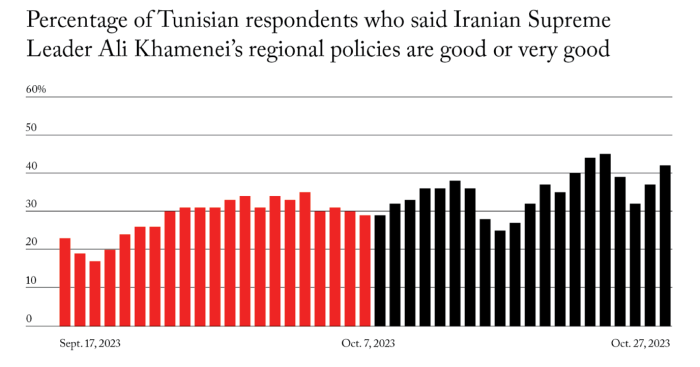
The US saw its favorability numbers plummet the most, followed by West Asian allies that have normalized relations with Israel. Russia and China, both neutral states, experienced little change, but Iran’s leadership saw its favorability figures rise. According to the Arab barometer:
“Three weeks after the attacks, Iranian Supreme Leader Ali Khamenei has approval ratings that matched or even exceeded those of Saudi Crown Prince Mohammed bin Salman and Emirati President Mohammed bin Zayed.”
Before 7 October, just 29 percent of Tunisians held a favorable view of Khamenei’s foreign policies. This figure rose to 41 percent according to the conclusion of the survey, with Tunisian support most notable in the days following the Iranian leader’s 17 October reference to Israel’s actions in Gaza as a “genocide.”

The Saudi shift
Prior to the 7 October operation by the Palestinian resistance to destroy the Israeli army’s Gaza Division and take captives as leverage for a mass prisoner swap, the region’s main geopolitical focus was on the prospects of a groundbreaking Saudi normalization deal with Tel Aviv. The administration of US President Joe Biden flogged this horse at every opportunity; it was seen as a golden ticket for his upcoming presidential election.
But Operation Al-Aqsa Flood ruined any chance for Saudi Arabia – home to Islam’s holiest sites – to seal that political deal. And with Israeli airstrikes raining down daily on Palestinian civilians in Gaza, Riyadh’s options continue to shrink.
A Washington Institute poll conducted between 14 November and 6 December measures the seismic shift in Saudi public sentiment:
A whopping 96 percent agree with the statement that “Arab countries should immediately break all diplomatic, political, economic, and any other contacts with Israel, in protest against its military action in Gaza.”
Meanwhile, 91 percent believe that “despite the destruction and loss of life, this war in Gaza is a win for Palestinians, Arabs, and Muslims.” This is a shockingly unifying statement for a country that has adhered closely to western narratives that seek to divide Palestinians from Arabs, Arabs among themselves, and Muslims along sectarian lines – geographically, culturally, and politically.
Although Saudi Arabia constitutes one of the few Arab states to have designated Hamas as a terrorist organization, favorable views of Hamas have increased by 30 percent, from 10 percent in August to 40 percent in November, while most – 95 percent – do not believe the Palestinian resistance group killed civilians on 7 October.
Meanwhile, 87 percent of Saudis agree with the idea that “recent events show that Israel is so weak and internally divided that it can be defeated some day.” Ironically, this is a long-stated Resistance Axis refrain. Hezbollah Secretary General Hassan Nasrallah was famously quoted as saying “Israel is weaker than a spider’s web,” upon its defeat by the Lebanese resistance on 25 May, 2000.
Prior to 7 October, Saudis had strongly favored economic ties with Israel, but even that number dropped dramatically from 47 percent last year to 17 percent today. And while Saudi attitudes toward the Resistance Axis remain negative – Saudi Arabia, after all, has been the regional epicenter for anti-Iran and anti-Shia propaganda since the 1979 revolution – that may be largely because their media is heavily controlled.
Contrary to the observations of the Arab masses, 81 percent of Saudis still believe that the Axis is “reluctant to help Palestinians.”
The Palestinian shift
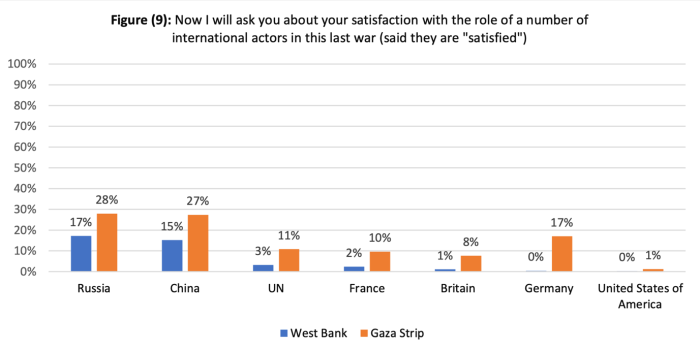
Equally important to the discussion of Arab perceptions is the shift seen among Palestinians themselves since 7 October. A poll conducted by the Palestinian Center for Policy and Survey Research (PSR) in both the occupied West Bank and Gaza Strip between 22 November and 2 December mirrors Arab views, but with some nuances.
Gazan respondents, understandably, displayed more skepticism for the ‘correctness’ of Hamas’ Operation Al-Aqsa Flood, which triggered Israel’s genocidal assault on the Strip in which over 22,000 civilians – mostly women and children – have so far been brutally killed. While support for Hamas increased only slightly in the Gaza Strip, it tripled in the West Bank, with both Palestinian territories expressing near equal disdain for the western-backed Palestinian Authority (PA), which governs from Ramallah.
Support for acting PA President Mahmoud Abbas and his Fatah party was hit hard. Demands for his resignation are at nearly 90 percent, while almost 60 percent (the highest number recorded in a PSR poll to date in relation to this matter) of those surveyed want a dissolution of the PA.
Over 60 percent of Palestinians polled (closer to 70 percent in the West Bank) believe armed struggle is the best means to end the occupation, with 72 percent agreeing with the statement that Hamas made a correct decision to launch its 7 October operation, and 70 percent agreeing that Israel will fail to eradicate the Palestinian resistance in Gaza.
Palestinians have strong views about regional and international players, who they largely feel have left Gaza unprotected from Israel’s unprecedented violations of international law.
By far the country most supported by respondents is Yemen, with approval ratings of 80 percent, followed by Qatar (56 percent), Hezbollah (49 percent), Iran (35 percent), Turkiye (34 percent), Jordan (24 percent), Egypt (23 percent), the UAE (8 percent), and Saudi Arabia (5 percent).

In this poll, the region’s Axis of Resistance dominates the favorability ratings, while pro-US Arab and Muslim nations with some degree of relations with Israel, fare poorly. It is notable that of the four most favorable countries and groups for mostly-Sunni Palestinians, three are core members of the “Shia” Axis, while five Sunni-led states rank lowest.
This Palestinian view extends to non-regional international states, with respondents most satisfied with Resistance Axis allies Russia (22 percent) and China (20 percent), while Israeli allies Germany (7 percent), France (5 percent), the UK (4 percent), and the US (1 percent) struggle to maintain traction among Palestinians.
The numbers depend on the war ahead
Three separate polls show that Arab perceptions have shifted dramatically over Israel’s war on Gaza, with popular sentiment gravitating to those states and actors perceived to be actively supporting Palestinian goals, and away from those who are perceived to support Israel.
The new year starts with two major events. The first is the drawdown of Israeli reservists from Gaza, whether because Washington demands it, or due to unsustainable loss of life and injury to occupation troops. The second is the shocking assassination of Hamas leader Saleh al-Arouri and six others in Beirut, Lebanon, on 2 January.
All indications are that Israel’s war will not only continue, but will expand regionally. The new US maritime construct in the Red Sea has drawn other international actors into the mix, and Tel Aviv has provoked Lebanon’s Hezbollah in a major way.
But if the confrontation between the two axes escalates, Arab perceptions will almost certainly continue to tilt away from the old hegemons toward those who are willing to resist this US-Israeli assault on the region.
There will be no relief for Washington and its allies as the war expands. The more they work to defeat Hamas and destroy Gaza, and the more they lob missiles at Yemen, Iraq, and Syria, and besiege the Resistance Axis, the more likely Arab populations are to shrug off the Sunni-versus-Shia, Iran-versus-Arab, and secular-versus-Islamist narratives that have kept the region divided and at odds for decades.
The swell of support that is mobilizing due to a righteous confrontation against the region’s biggest oppressors is unstoppable. Western decline is now a given in the region, but western discourse has been the first casualty of this war.
Israel’s Gaza withdrawal, a prelude to full-out war
By Hasan Illaik | The Cradle | January 4, 2024
At the start of the new year, Israel’s occupation army began implementing the withdrawal of a large portion of its forces from the northern Gaza Strip.
This withdrawal did not mean the end of the war on Gaza, and it certainly did not suggest calm on the Lebanese-Israeli front. On the contrary, reducing the pace of the war in the Gaza Strip increases the possibilities of an Israeli war on Lebanon.
The battles taking place between the occupation army and Hezbollah along the southern Lebanese border since 8 October, in support of the resistance in Gaza, have been increasing in intensity day after day.
Washington and Tel Aviv have sought to maximize pressure on Hezbollah by warning of the possibility of a large-scale war between Israeli forces and the Lebanese resistance. These tactics were in effect long before the assassination of Hamas’ Deputy Head of the Political Bureau Saleh Al-Arouri on 2 January by an Israeli air strike in Dahiyeh, the southern suburb of Beirut. The killing of Al-Arouri now increases the chance of the war expanding.
The third stage is coming
The first stage of Tel Aviv’s war was the mass destruction and occupation of northern Gaza; the second stage is the occupation of key points in the south of the Gaza Strip, where Palestinian civilians have flocked for safety. The current troop withdrawal from the territory’s north means that the Israelis are cementing their southern plans and preparing to move on to phase three: the long, low-intensity war.
As it enters the third stage, the occupation army intends to maintain a geographical buffer surrounding the northern Gaza Strip. It also plans to continue occupying the Gaza Valley area (central Gaza), while completing its operations in Khan Yunis in the south.
The fate of the Philadelphia axis – or Salah ad-Din Axis – a strip of land on the border between Gaza and Egypt which Israel wants to control, will be left to deliberations between Tel Aviv and Cairo. This is to ensure that incidents do not occur that lead to tension between the two parties, as well as to guarantee that refugees do not flow from the south of the Gaza Strip towards Sinai.
Israel’s ground withdrawal from northern Gaza is taking place primarily because the occupation army’s target bank has been depleted. All targets prior to the start of the war have been destroyed, and all new operational targets have been bombed.
Despite this, the Palestinian resistance continues to carry out operations against Israeli forces. These organizations remain relatively unscathed in the entire area of the northern Gaza Strip, which will increase the ability of the resistance to inflict losses on occupation ranks, now and in the future.
This clear Israeli loss – in terms of Tel Aviv’s stated war objectives – has been made evident by two basic factors: First, that the occupation army cannot ‘cleanse’ the northern Gaza Strip house by house or tunnel by tunnel, because this process will take years, expose more of its soldiers to danger, and cannot be implemented without further displacing the entire population of northern Gaza or massacring them. It should be noted, despite Israeli attempts to portray matters otherwise, that hundreds of thousands of civilians are still present in the north.
Second, the Israeli government needs to gradually re-inject reserve soldiers into the country’s economy to jump-start it, and to ensure that the productive sectors are not exposed to damage from which recovery will take a long time. This, despite the fact that the US and much of Europe appear ready to assist Israel’s economy, if necessary.
These measures are being taken because Israel has patently failed to achieve the two main goals of its war, namely, eliminating the Hamas-led resistance in Gaza, and liberating the Israeli prisoners captured by the resistance on 7 October.
There remains a basic motive that must be noted: The Israeli army is currently putting all its efforts into implementing a US decision to push the war from its first and second phases into the third phase before the end of January 2024. This requires the war to be managed at a slower boil, drawing less attention to Israeli carnage and the mass suffering of Palestinians.
After three months of brutalities, Washington has assessed the Israeli army as unable to eliminate the resistance or the possibilities of regional escalation, and has noted the significant harm caused to the US administration of Joe Biden as he enters the presidential primary season.
An escalation with Lebanon
As the Israeli occupation army moves to focus its operations on the southern Gaza Strip, the intensity of military operations along the Lebanese border between Hezbollah and the Israeli army has also been ratcheted up.
Hezbollah increased its targeting of occupation soldiers, both in their visible locations and inside the settlements of northern Palestine.
The information capabilities of Hezbollah have developed in both sophistication and accuracy during the past months. The Lebanese resistance fighters have employed missile types not previously utilized, which have a greater range and better destructive capacity than previous generations.
On the other hand, Tel Aviv has doubled the firepower it used in southern Lebanon. The Israelis continue to limit their operations to the area south of the Litani River, and are not expanding their scope except to target resistance groups that carry out strikes across the border. In recent weeks, the occupation army’s destructive power has risen dramatically since the early days of the battle.
By increasing its strikes, Israel’s leadership seeks to inflict the greatest possible number of losses among the ranks of the resistance fighters, as well as to spread panic among southern Lebanese residents – displacing more of them, and destroying the largest possible number of homes. This places a burden on both Hezbollah and the Lebanese state in the reconstruction process after the end of hostilities.
But there is a longer-term goal to this Israeli military performance. The government in Tel Aviv, according to its official statements, wants Hezbollah to withdraw from the south of the Litani, to ensure the security of Israeli settlers in northern Palestine who abandoned their homes, either voluntarily or under evacuation orders from their army. By some estimates, the number of Israelis fleeing their settlements in occupied north Palestine has reached more than 230,000 people.
In parallel with the public statements, messages began arriving in Beirut, from the US and from European capitals, demanding what they call ‘the implementation of UN Security Council Resolution 1701,’ meaning Hezbollah’s withdrawal from the south of the Litani River.
According to emerging information, Tel Aviv is betting that Hezbollah will be deterred, as the 2019 economic collapse from which Lebanon has not yet recovered and the country’s long-running internal tensions are factors that will ultimately prevent Hezbollah from waging war.
Israel is therefore hoping that Hezbollah will yield to pressure and meet its demands regarding the withdrawal of its fighters from the border area with occupied Palestine.
The Israeli assessment of Lebanese affairs preceded its assassination of Al-Arouri in Beirut on 2 January. But in the same way that Israel military commanders and politicians have under-estimated and dismissed armed Palestinian resistance initiatives within occupied lands prior to 7 October, they continue to cling to a dated Israeli calculus that Hezbollah will never fully retaliate, or that it will only do so in a way that stops short of war.
Granted, Hezbollah does genuinely seek to limit the scope of the military confrontation, and has often pushed for a Gaza ceasefire to end hostilities throughout the region. Hezbollah is equally concerned about not disrupting the lives and livelihood of southern residents.
But while Hezbollah takes into account the complex political and economic Lebanese reality, it is not prepared to make concessions. Sources in the resistance axis say that Israel, as Hezbollah sees it, is not in a position to go to war with Lebanon when it cannot even compensate or digest the massive strategic losses it has incurred from Operation Al-Aqsa Flood.
Despite its desire to not expand the war, Hezbollah has already begun to prepare for it. Hezbollah’s party statement, issued after the assassination of Al-Arouri, indicates this, and field measures and developments will begin to appear in time.
What Israel was unable to achieve in Gaza (restoring deterrence) while facing the tight ranks of the region’s Axis of Resistance, it will most certainly not be allowed to gain in Lebanon.
The first signs of this will appear in the plans that Hezbollah is expected to carry out in response to Israel’s 2 January raid on Dahiyeh to assassinate Al-Arouri – the first of its kind since August 2006 – and to which its Secretary-General Hassan Nasrallah had previously threatened he would respond.
The bottom line is that Tel Aviv’s assessment of a war with Lebanon is based on its reading that Hezbollah wishes to prevent a major confrontation at any cost. Not only is this calculus wrong, but it has also muddled Israeli minds to the point where this may itself lead to the outbreak of a destructive war between the two sides.
Flooding Gaza’s Tunnels Is Proof the Final Solution Has Begun
By Declan Hayes | Strategic Culture Foundation | December 15, 2023
Asking an engineering friend of mine with almost 50 years’ experience of handling water what obstacles Israel would face with flooding Gaza’s tunnels (and drowning all therein), he said there were three main issues to consider.
The first of these is that the total head of water or height water has to be pumped above sea level but, as Gaza is fairly flat, he did not see that as being particularly problematic. The second issue he drew my attention to was the distance to be pumped from the sea. He imagines this can be overcome by arranging a series of pumps in a line with holding tanks spaced over the total distance, though a canal system might also work. Given that the Gaza strip is narrow, approximately 9 km wide on average, he did not see any big issues there. The third issue he drew attention to was the volume of water needed, which is obtained by multiplying the diameter of tunnels by their total lengths, and perhaps adding something extra “for luck”. That total volume would determine the number and size of pumps needed for the volume of the tunnels and the duration of the exercise.
Thus, once Israel secures the Gazan shoreline and installs the appropriate pumping material, it is game on, all the more so as such engineering feats should be well within the capabilities of the Israeli/American alliance. As Egypt previously flooded the tunnels to stop ISIS attacks in the Sinai, we can rest assured Israel and America will be more than competent for the job in hand.
As Al Mayadeen, Al Jazeera and other outlets have reported that the Israelis have already begun flooding some of the tunnels, we can regard that as a done deal. Because Israel and its American sidekick have had years to plan all this and they don’t give a damn for either the human or ecological damage they will cause, we can expect Christmas 2023 in Gaza to be literally hell on earth.
Although you can read more here, here, here, here, here and here from these military, academic, and media sites on the technical and tactical issues involved in flooding the tunnels, let me just draw your attention to these articles here and here about the various laws on genocide Israel is blatantly violating to state that none of that matters a damn, as Israel has made it plain time and again that it is not constricted by any laws of either God or man.
The scenes from Gaza are already post-apocalyptic, with Israel parading naked men about as human shields, whilst shell shocked children have limbs amputated with no anaesthetic by heroic surgeons Israeli snipers shoot at through hospital windows and other innocent children, who dreamed childish dreams about being doctors, vets or gamers are now gone, their lives expunged like cigarette butts under Israeli jackboots.
In a previous article about these war crimes, I compared the Israeli army to Hitler’s doomed Sixth Army, which found itself marooned in Stalingrad, fighting the wrong war in what infamously turned out to be the wrong place.
Another friend wrote to me that: I would have thought that the most obvious comparable situation would have been the Warsaw Ghetto uprising of 1943, with Israel’s ‘defence’ minister Gallant playing the role of Jürgen Stroop, the Ordnungspolizei commandant, who boasted about clearing Warsaw of the ‘Jews and bandits,’ like Gallant speaking of ridding Gaza of ‘human animals’. In position papers, and in the public utterances of leading Israeli figures, it looks like the sheer violence of the Israeli response to the Oct’ 7th events, is to affect the ‘Final Solution,’ to the problem of Gaza. Not my words, but those of a Jewish member of the Knesset, critical of state policy towards the Palestinians. It now seems obvious that this ‘Final Solution’ will involve the forced expulsion of the entire Gaza population to the Egyptian controlled Sinai, with or without the cooperation of the client military regime in Cairo. I strongly suspect that plans drawn up years ago are now being put into effect, and notwithstanding world wide pro-Palestinian protests, it seems to me that this abominable plan will succeed, for it appears to have the tacit support of the U.S. and Western powers. What we may soon see is the largest forced exodus of people in either Europe or the Near East since 1945, since the forced departure of the Sudeten Germans from Czechoslovakia. The numbers from Gaza alone will be three times those of the original Nabka in 1948.
My friend, sadly, makes his case well. Gaza’s final solution will soon be in full throttle and, as with the original Nakba, no one of consequence can or will do a thing about it. No one but Hezbollah perhaps?
Hezbollah are currently engaged in taking potshots at Israel’s Northern District, which is the only district of Israel, where the majority of inhabitants are Arabs. As the Lebanese border becomes more volatile, the Druze, who form 8% of the area’s population and who are the attack dogs of the Israelis, might have to reconsider their options.
Certainly, Hezbollah’s ability to hold the line in Southern Lebanon will give the Druze of Northern Israel and Southern Syria food for thought as I, for one, would not like Hezbollah gunning for me if I lived in the area and was vulnerable to attack from them. Although Hezbollah gave the ‘Christian’ militias a pass when they defeated those Israeli proxies in the Lebanese civil war, fools’ pardons can only be dished out so many times.
Hezbollah long ago decided that its main regional enemy was Israel and it was not going to allow itself to be unduly distracted by others sniping at its heels. The Druze of Northern Israel, now that they are fully within range of Hezbollah’s entire arsenal, might really want to reconsider how long more they should be the bitch of Israel, which has the same sort of moral standing Jürgen Stroop had following the Warsaw Uprising.
As regards East Jerusalem and the West Bank, the final solution is only a matter of time. As I type this, Israeli drones are terrorising the village of Taybeh, the last Christian town on the West Bank. Elsewhere, in towns like Jenin, the Israelis continue to kill and plunder as they please. Christians continue to get beaten up in Jerusalem’s Old City and it is only a matter of time before the Al Aqsa mosque falls, just as the mosque in Hebron was transformed at gunpoint into a synagogue.
Although truly legendary rock stars like Roger Waters are to be admired for calling all this out, it will take much more than an octogenarian guitarist to stop this ongoing carnage. If we are to use Stalingrad, Stroop and Waters’ father (martyred at Anzio) as our templates, then the answer can only be found in military resistance, coupled with an unbending consensus that Gallant, Biden, Netanyahu and all like them must go the way of Stroop and his leather-clad chums.
But dreaming for such a consensus is as childish as the dreams of being doctors, surgeons or vets that once sustained those martyred Gazan children. If there is to be peace this Christmas or any Christmas in the Holy Land, then it must be a case of out with the old and in with the new. Or, to put it more prosaically, the military, economic and diplomatic dominance of the United States and Israel must be shattered by forces that can accommodate the dreams of a life with dignity of whatever Gazan children beat the odds and survive their genocide.
And, though that might sound as childish as anything those martyred children might have said, it is the only way. Not only must Israel and the United States be upended but so too must every Hollywood spun narrative, bought, bribed or bullied politician, media hack or parasitic NGO or charity that ever helped sustain them, their endless lies and their serial racketeering.
Israel having difficulties and suffering losses both on land and sea
By Lucas Leiroz | November 20, 2023
It seems increasingly clear that the conflict in Palestine is not an easy task for Israel. In addition to the difficulties of advancing on the battlefield and the heavy losses that the IDF has suffered during clashes with Palestinian troops, defeats at sea are beginning to occur. Yemeni forces, who previously declared full support for Palestine, captured an important Israeli merchant ship, taking new hostages and improving the Palestinians’ bargaining power in the prisoner exchange negotiation process.
Undoubtedly, Israel is stronger than its adversaries in the current Palestinian war. Tel Aviv is a state with a complex and organized structure, having a regular national army and sufficient strength to defeat armed militias such as Hamas and many other Palestinian armed groups. The problem is that the fighting is not happening symmetrically, and, despite territorial advances, Israel is clearly suffering significant damages, which could generate great difficulties in the near future.
The Al-Qassam Brigades, the military wing of Hamas, frequently announce the neutralization of Israeli soldiers and tanks. Several videos have been published on social media showing Hamas fighters using rockets and grenades against Israeli tanks and instantly disabling them. Confirming what had been predicted by analysts, Israel is having difficulty using its combat vehicles in an urban area full of debris. IDF’s bombings destroyed civilian buildings, making the ground in Gaza difficult terrain for tanks, which end up becoming an easy target for Hamas.
In the same sense, it is important to remember that Israel has not yet managed to enter the Hamas’ tunnels. The IDF claimed that the Palestinian Resistance was using Al Shifa Hospital and other civilian facilities as a human shield. With these excuses, several bombings were carried out against hospitals, but no bunkers were found. In practice, the IDF is unable to find the correct way to reach the enemy’s underground system. So, the bombings against civilians have really no strategic value.
However, the situation is complicated not only on the land battlefield. At sea, things are getting worse for the Zionist state, which is starting to suffer not only military but also commercial losses. On November 19, Yemen’s Houthi armed forces captured a major Israeli merchant ship in the Red Sea. The ship belongs to an Israeli businessman and was being operated by employees of German and Japanese companies on a voyage from Turkey to India.
Commenting on the topic on social media, Houthi military spokesperson Yahya Saree said that the seizure was a response to the “heinous acts against our Palestinian brothers in Gaza and the West Bank”, adding that “if the international community is concerned about regional security and stability, rather than expanding the conflict, it should put an end to Israel’s aggression against Gaza”.
A number of 25 people were reported taken prisoner by the Houthis. None of the crew are believed to be Israeli citizens, which makes the case even more complicated. By capturing an Israeli vessel with foreign crew, the Houthis create a situation of diplomatic instability for Tel Aviv. Countries whose citizens have been captured will demand a quick and safe rescue operation, but this is almost impossible to be achieved by military means. Therefore, the bargaining power of the Palestinians is increased. To avoid a diplomatic crisis with the possible death of foreigners in a naval operation, Israel will have to agree to release Palestinian prisoners, withdraw militarily or meet any other request from the Yemenis.
All these factors lead Israel to diplomatically and militarily difficult circumstances. The IDF has to face long military attrition, heavy losses and, in parallel, Tel Aviv has great diplomatic and political instability. The Netanyahu government is the most harmed by this crisis as any of its actions turn against it. If Netanyahu increases attacks, he is criticized for human rights violations and fomenting war. If he reduces the intensity of the fighting, opponents call him a weak leader and incapable of achieving Israel’s objectives.
In parallel to all this, the chances of the conflict reaching an international level raise day by day. Recently, Hezbollah published a video on its social media with the message “We are coming”. This has generated expectations that the Lebanese militia’s troops will begin a full-scale attack soon. The group has been a de facto participant in the conflict since the beginning, using artillery and drones to destroy Israeli military and intelligence infrastructure on the border with Lebanon. Considering the massive military power of Hezbollah – apparently the largest non-state armed group in the world – the beginning of a land incursion would greatly harm Israeli plans.
Lucas Leiroz, journalist, researcher at the Center for Geostrategic Studies, geopolitical consultant.
23 percent of 383 Israeli armored vehicles were destroyed in 5 days
By Boyko Nikolov | Bulgarian Military | November 13, 2023
Based on recent satellite images from northwest Gaza, it appears that the Israeli Army has sustained substantial losses, with 88 armored vehicles reportedly missing over five days. This accounts for approximately 23 percent of the 383 vehicles that could be seen in the area via satellite imagery.
Israeli forces have made notable progress, successfully dividing Gaza into two parts – north and south. However, through multiple video evidence, it’s clear that Hamas, along with other Palestinian militant groups, have managed to effectively incapacitate Israeli tanks and armored personnel carriers on several occasions.
Militias have employed a range of sophisticated techniques, among them are the use of explosives strategically placed on vehicles with the aim of neutralizing tanks’ active protection systems. This is typically followed by a storm of rocket-propelled grenades. Since the beginning of October, there have been verified reports of successful drone strikes on Israeli armored units operating outside the Gaza Strip.
Additional damage
The impact of the losses in Gaza is further underscored by the additional damage incurred by the Israeli armor on the Lebanon border in the North. As part of the ongoing tensions, Hezbollah’s anti-tank units have been particularly focusing on these vehicles. They are using anti-tank weapons that are far more sophisticated than those available to Palestinian militias.
Reports from regional media channels have revealed a concurrent rise in the attrition rates of Israeli armored vehicles. This correlates with the unfortunate news of the death of a tank brigade commander, Colonel Sheldag Zior. His loss signifies the most senior casualty within the Israeli force to date.
The rise in attrition rates correlates directly with the more frequent sightings of older tanks such as the Merkava IIIs, during the conflict in Gaza. Especially notable was the second week of October, when the number of Israeli armored losses surged.
Merkava tanks to Hamas hands
This was attributable to Hamas making significant progress, successfully seizing numerous military facilities and arms storage outside of Gaza. As a result, a considerable amount of new Merkava tanks and countless other armored vehicles fell into their hands.
Reports have been surfacing about substantial numbers of these vehicles undergoing destruction. As early as 2005, Israel embarked on the process to gradually retire the Merkava III from their primary service. The aim is to substitute the majority of the remaining Merkava III units with the upgraded Merkava V, commencing towards the end of 2023. Given the significant number of Merkava IIIs in use, analysts predict a possible shortage of the newer models.
However, obtaining accurate assessments of the casualties on both sides has become challenging due to the continued instability in the area.
War in Gaza: Decoding Nasrallah’s speeches
by lecridespeuples | Resistance News | November 13, 2023
Since he was elected Hezbollah Secretary General in 1992, following Israel’s assassination of his predecessor and mentor Sayed Abbas Mousawi, Sayed Hassan Nasrallah has achieved a very special status in the history of Arab & Muslim leaders. As Norman Finkelstein put it, “Nasrallah is the only political leader in the world from whom you learn in the speeches. He is a teacher. He is among the shrewdest and most serious political observers in the world today. Israeli leaders carefully scrutinize Nasrallah’s every word.” And denouncing the relentless censorship suffered by my translation of Nasrallah’s speeches on the Internet and social networks, he added: “Why are the rest of us denied this right? One cannot help but wonder whether Nasrallah’s speeches are censored because he doesn’t fit the stereotype of the degenerate, ignorant, blowhard Arab leader. It appears that Western social media aren’t yet ready for an Arab leader of dignified mind and person.”
Why is Nasrallah so feared, and paradoxically so listened to, by friends and foes alike? Why did the majority of Israeli citizens themselves, in the midst of war, trust his statements more than those of their own leaders? The reason is that Hezbollah’s credibility rests not only on two humiliating defeats inflicted on Israel in 2000 and 2006, the first in its entire history; but above all, it is because Nasrallah is a man of his word, who, if he doesn’t say everything he does or intends to do, scrupulously does everything he says. Counter-intuitive as it may seem, Nasrallah never lies, or at most by omission. In over 30 years, there has never been a false statement, a lie or an exaggeration from him, not even in the framework of his ongoing psychological warfare against Israel, where lies wouldn’t be a sin (“War is deception”, says a famous hadith of the Prophet). To quote Professor Finkelstein again, “Gamal Abdel Nasser was not serious. He gave all of these big speeches, this bombast, but there was nothing behind it. Every time he went to war, he said ‘We’re going to do this and that’, but he was defeated. I’m sorry, it’s just a fact. The first time you have a leader who’s serious, it’s Nasrallah. He says ‘We’ll do A’, we do A; ‘We’ll do B’, we do B. There’s no empty talk. That’s serious and I have to respect that.”
With Nasrallah’s credibility established, let’s ask ourselves what he really said during his speeches on November 3 and 11, and what this portends for the future.
Of the hundreds of speeches he has given over the past 30 years, the one on November 3 was undoubtedly the most eagerly awaited. The whole world hung on his every word, waiting to hear what Hezbollah would do to help the people of Gaza. Since Hamas’s spectacular operation on October 7, which caused an enormous earthquake felt not only in Israel but throughout the world, particularly in the largely pro-Zionist centers of Western power, the Palestinian population of the enclave has been subjected to a methodical war of extermination. And Hezbollah has always vowed solidarity with the Palestinian cause. So what was Nasrallah going to say during his first intervention, almost a month after the war began? Was he going to issue an ultimatum to stop the genocidal aggression against Gaza? Would he declare war on Israel and open a new front? Would he, as spokesman for the Axis of Resistance, announce the launch of the long-heralded “Great War of Liberation”, with, echoing the Palestinian “Al-Aqsa Flood”, a deluge of missiles on Haifa and Tel Aviv from Lebanon, Syria, Iraq, Iran and Yemen? These expectations were not reasonable, nor even rational. While Putin did announce the “Special operation” in Ukraine, which had been denied right up to the last second by his government, starting a war is not something that is usually announced, especially by Resistance movements based on guerrilla tactics. And Hezbollah, in such contexts, is used to acting before speaking, as demonstrated by the launch of operations against Israel on the Lebanese border in support of Gaza as soon as October 8.
When expectations are exaggerated, even on the part of the most reputable journalists and commentators, disappointment is inevitable. “Nasrallah barks but doesn’t bite”, ran the headline in an Italian newspaper, expressing the frustration of many, including his admirers. But a careful analysis of his words shows that there was no reason for disappointment. Quite the contrary, in fact.
A clear commitment
First of all, it was clear from the third minute of the speech that Nasrallah was not going to announce anything truly historic: referring to his forthcoming annual speech on November 11, Hezbollah’s Martyr’s Day, during which he would talk more about the martyrs, those of Hezbollah, the Palestinian Resistance and the people of Gaza, it was already clear that no major upheavals were planned. But what he announced was enough to reassure those hoping for a “miracle”: Nasrallah made it clear that even if Israel’s objectives in Gaza are illusory (to annihilate Hamas), and that yet another military failure was very likely and foreseeable, he assured us in no uncertain terms that if Hezbollah remained in the background for the time being and contented itself with forming a support front, if need be, Hezbollah would do everything necessary to ensure victory for Gaza, and for Hamas in particular. This included waging open, all-out war against Israel, which he insisted on, in order to deter Israel and reassure the Palestinian people & Resistance, and also to psychologically prepare the Lebanese population (and, beyond that, the populations of Middle Eastern countries and indeed the whole world) for the eventuality of Armageddon. Here are a few significant extracts of his speech:
“In 1948, when the world abandoned the Palestinian people, this entity was founded, and the Palestinian people and all the countries and peoples of the region paid the price. The Palestinians paid the highest price, but other peoples also suffered the tragic consequences: the Jordanians, the Egyptians, the Syrians, the Lebanese. And it may well be that Lebanon is the country that has suffered most from the consequences of the existence of this bellicose, usurping entity whose appetites (territorial & bloodlust) are insatiable. This is an undeniable historical truth. And today, the same thing is happening.
What is happening today in Gaza is not a war like other wars in the past. It’s not an event like any other. This is a pivotal, decisive, historic battle. What comes after will be nothing like what came before. And that means we all have to assume our duties. When we talk about assuming our duty, we have to determine the short-term objectives we all have to work towards. And as far as we’re concerned, there are two objectives: the first is to put an end to the aggression against the Gaza Strip. And the second objective is for Gaza to be victorious, for the Palestinian resistance in Gaza to be victorious, and in particular for Hamas itself to be victorious. These goals must be ours, resolutely, and we must work tirelessly to achieve them.
The first objective, to put an end to the war, has clear and indisputable reasons: they are humanitarian, moral, religious and legal. As for the second objective, o brothers and sisters, o listeners, it is in everyone’s interest. Certainly, victory in Gaza is first and foremost in the interest of the Palestinian people, of all the Palestinian people: victory in Gaza would mean victory for the Palestinian people, victory for the prisoners in Palestine, victory for the West Bank, the Gaza Strip, Al-Quds (Jerusalem), Al-Aqsa Mosque and the Church of the Holy Sepulchre. But it would also be the victory of the countries and peoples of the region, and above all of the neighboring countries. Victory in Gaza today is Egypt’s national interest. Victory in Gaza today is Jordan’s national interest. Victory in Gaza today is Syria’s national interest. And first and foremost, victory in Gaza today is Lebanon’s national interest. For what would an Israeli victory in Gaza mean, if the Resistance were defeated in Gaza? What would be the consequences for Palestine, for the Palestinian cause? And above all, what would be the consequences of an Israeli victory for Lebanon, in security, political, popular and demographic terms? […]
What happens on our front is very important, and has a great influence. Some people, who expect or demand that Hezbollah should quickly enter into a comprehensive and all-out war with the enemy, may think that what we’re doing is modest, but if we look objectively at what’s happening on the Lebanese border, we’ll see that it’s very important and meaningful. Of course, whatever happens, we won’t be satisfied with that. We won’t be satisfied with what we’re already doing, and we’ll do more. […]
If our position were simply one of political support, speeches and daily demonstrations, Israel would be reassured on its northern border, and would have sent all its forces to Gaza, and some to the West Bank. But this is what the Lebanese front has accomplished. Today, Hezbollah has been able to mobilize (and thus neutralize):a third of the Israeli army is blocked at the Lebanese border against our mujahideen who are fighting it at the border; and a large part of these forces are elite troops and essential units of the Israeli army that could have been sent to Gaza;
-
half of Israel’s naval forces are present in the Mediterranean, opposite us and opposite Haifa;
-
a quarter of the air force is mobilized in the direction of Lebanon;
-
almost half of Israel’s missile defenses (Iron Dome, Patriot batteries, etc.) are turned towards Lebanon;
-
almost a third of its logistical forces are directed towards Lebanon.
This is one of the direct results of our action on the border. These figures are precise and verified. So much for the first point.
Secondly, tens of thousands of settlers have been evacuated by the army or have fled the north of occupied Palestine on their own. 43 settlements have been evacuated. And the majority of those still there are soldiers, not civilians. In the south, around Gaza, 58 settlements have been evacuated. And all these settlers evacuated from the north and south represent a very strong psychological, moral, financial and economic pressure on Israel, to the point that the Israeli Finance Minister raised the alarm in this regard, and this is very important to apply pressure and play for time.
Thirdly, and perhaps most importantly, the operations we are launching on the border and in the Shebaa farms have created a state of anxiety, expectation, fear and even panic among the enemy’s political and military leaders, as well as the United States. They fear that this front will escalate into a full-scale war, or even spread into a regional war. And this is a realistic fear: it can happen, and the enemy must take it into account in his calculations. And this is what he is doing with the utmost seriousness, constantly expressing this fear and talking about it, and giving it great importance in his decisions. […]
On the Lebanese front, things are going to develop and even escalate in any direction depending on two things, one of two fundamental things: firstly, the development and outcome of events in Gaza. Our front is a front of support and solidarity with Gaza, and therefore it develops and escalates in the light of events there, and according to what the nature of events, threats and developments on the ground in Gaza really demands. And the second thing that will decide what happens on our Lebanese front is the behavior of the Zionist enemy vis-à-vis Lebanon.”
In the light of these statements, it seems clear that all those who have attributed to Hezbollah a position of neutrality, withdrawal or even cowardice and treachery, likening his promises to vain Nasser-style bombast, have not been paying close enough attention. If Hezbollah is content to be a supporting front, it’s because it believes that Gaza is capable of prevailing, and that a victory for Gaza alone would serve the cause of the Liberation of Palestine far better.
And as for thunderous announcements, Nasrallah’s first speech did contain one quite remarkable one: the threat to go to war directly against the United States itself, or even to neutralize its aircraft carriers in the Mediterranean Sea, which is far more consequential than any kind of threats against Israel:
“I declare with all sincerity, frankness and clarity, while maintaining strategic uncertainty: all scenarios on the Lebanese front are possible, and all options are on the table. We can make the choice (of all-out war) at any time. And we must all be ready and prepared for any scenario. And I say to the Americans: threats and intimidation are useless with us and with the Resistance movements in the region. They are of no use either against the Resistance movements or against the countries of the Axis of Resistance. Threats and intimidation against the Resistance will lead you nowhere.
Your aircraft carriers in the Mediterranean Sea don’t scare us, and never will. And I’m telling you in all honesty, those aircraft carriers you’re threatening us with, we’ve prepared everything we need to deal with them! O Americans, remember your defeats in Lebanon, Iraq and Afghanistan, and your humiliating retreat from Afghanistan. O Americans, those who defeated you in Lebanon in the early 1980s [on October 23, 1983, a suicide attack on the Marines’ headquarters in Beirut killed 241 US soldiers and officers who were taking part in the Lebanon war on the Israeli side, and drove them out of Lebanon; this attack is widely attributed to Hezbollah] are still alive, and at their side today are their children and grandchildren, and all are waiting for you with bated breath.“
As sensational statements go, this one is hard to beat.
Doublespeak?
The preceding analysis seems to me indisputable enough. The one I’m about to propose is more questionable – and more likely to please those who hope we’re witnessing the Final Liberation War.
As I said in my previous article, even if certain forces of the Axis of Resistance, whether Hezbollah or others, had already decided to go to full-blown war, it would be in their interest to make Israel believe the contrary, so as to let it engage meaningfully and get bogged down in Gaza, then attack it by surprise when, as happens in every war (because Israel never learns from its mistakes and keeps at it), finally understanding the imminence of a military, economic and moral disaster, it would call its US godfather to the rescue and ask him to vote for a ceasefire in order to save face. In this scenario, Hezbollah and its allies would only have to divide the enemy’s forces and paralyze part of them to ensure the failure of the troops in Gaza, while sending signals to the Israeli army (and the Americans) that they would go no further. And perhaps these signals were what so disappointed all those who had hoped to see Hezbollah unleash an all-out war against Israel, for at the end of his speech – a crucial moment – Nasrallah seemed to assert that the moment of Liberation was still a long way off:
“Concerning our horizon, I declare to our Palestinian people, to our brothers and sisters in Gaza, to all Resistance fighters and dignified men in Palestine and in our region, that since the Resistance movements were founded after the creation of the Zionist entity, we have been waging the battle of endurance, resilience and patience. Our battle has not yet reached the stage of dealing the fatal blow. We still need time before we can deliver the final blow to Israel. Let’s be realistic. We win step by step, we win by a succession of small victories. That’s how we won in Lebanon in 1985 [expulsion of Israel from ¾ of occupied Lebanese territory], then in 2000 [expulsion of Israel from southern Lebanon], then in 2006 [release of all Lebanese prisoners held in Israel]. That’s how the Resistance won in Gaza, how the Resistance achieved things in the West Bank. That’s how the Resistance won in Iraq. That’s how Afghanistan won. Through endurance, resilience, the ability to endure the sacrifices inflicted by the enemy. Here lies our main strength.”
Did Nasrallah need to spell it out so clearly, so bluntly, so explicitly, instead of leaving further doubt? Isn’t this a kind of “green light” to Israel and the US? Or was it something else? What if, in reality, he skilfully measured his words throughout the whole speech, so as to say enough, on the one hand, to reassure the Palestinians, Lebanese and Arab peoples who were eagerly waiting for him and direly needed moral support, and dissuade Israel and its allies from going too far, while reassuring, on the other hand, the American-Zionist enemy by making it believe that in reality, Nasrallah is only doing what’s necessary to maintain his credibility (saving face is paramount for imperialist forces, who are incapable of understanding that this concern may be indifferent to their adversaries), and isn’t prepared to risk a regional conflagration? This would be a real balancing act, which he would appear to have pulled off with flying colors, since after his speech, Israel and the United States seem to have received what they interpreted as Hezbollah’s subliminal “green light” and have stepped up their campaign. By the way, Hezbollah and the Axis of Resistance have done likewise, and continue to erode and exhaust the enemy: as Nasrallah announced in his speech on November 11, Hezbollah strikes are slowly but surely becoming more frequent and more severe, hitting Israel further and further away, using kamikaze drones and “Volcano” missiles with an explosive charge of up to 500 kilograms for the first time, and even retaliatory strikes targeting and killing settlers, as a retaliation for murdered Lebanese civilians: Israeli deaths and injuries on the Lebanese front number in the hundreds (Nasrallah mentioned 350 wounded, including many critical cases, in one hospital alone) and may already have paralleled those of 2006. Despite all this, the Axis of Resistance is still careful to maintain a measured escalation, to climb its ladder “step by step” indeed, and not to go beyond the stage that will trigger a loss of control of the situation and a regional war: for while the Resistance movements have the advantage when it comes to the war of attrition, aimed at provoking a gradual collapse of the enemy until the moment comes to deliver the “fatal blow”, the most devastating firepower is on the American-Israeli side. And it’s worth pointing out that, had Hezbollah and the other factions of the Resistance struck Israel and the US bases on October 8 as hard as they are doing now, the great war would already have broken out: but the more time passes, the more Israel’s hopes, capabilities and resources are drained, the more the US diplomatic cover is exhausted, and the less likely it is that a new front will be opened.
Indeed, it’s quite possible that the time for the “coup de grâce” is imminent: not only against the Israeli entity, but perhaps even against the United States itself, whose bases in Syria and Iraq are being struck daily and with increasing intensity, with the avowed aim of expelling their forces. A few passages from Nasrallah’s first speech directly suggest this:
“After the October 7 operation, the panic in Israel was such that from the very first day, the United States opened its strategic arms depots to the Israeli army. In the very first days, Israel asked for new weapons, new missiles, 10 billion dollars… While the Axis of Resistance had not even begun anything serious! Is this Israeli entity a powerful country? It can barely stand upright! The fact that all the European and Western presidents, prime ministers, ministers, generals, politicians rushed to revive this moribund country demonstrates its extraordinary fragility. […]
We must realize that the United States are the real cause of this war, and that Israel is merely its instrument. The United States is preventing the Security Council from condemning Israel, preventing a ceasefire, preventing an end to the aggression in Gaza. They are indeed the ‘Great Satan’, as described by Imam Khomeini. They are primarily responsible for all the massacres of the past and present century, from Hiroshima to Vietnam, Iraq, Afghanistan, Lebanon, Palestine and the whole region. And they must be held accountable for their crimes and massacres, and punished for everything they have perpetrated against the peoples of our region. And within this framework, the Islamic Resistance in Iraq has decided to attack the military bases of the American occupier in Iraq and Syria to drive him out, considering that it is the United States that is leading the battle in Gaza, and that it must pay the price for its aggression and support for Israel, its occupation and crimes in Iraq, Syria and Palestine.”
Has the time come for the extirpation of the Israeli “cancerous tumor” AND the expulsion of US forces from the Middle East, the promised “just retribution” for the murder of Qassem Soleimani? Many objective elements suggest that the time is more propitious than ever, from the earthquake of October 7 to the terminal disintegration of Israeli society even before these events (let’s not forget that Netanyahu was already disgraced and that the whole country was on the brink of civil war because of the judicial reform project), the draining of Western financial and military resources in Ukraine, the economic and energy crisis, and, above all, the unprecedented orgy of bloodshed unleashed in Gaza, which has massed populations all over the world against Israel. More than ever, public opinion is ready to accept the necessity of Israel’s demise, as the two-state solution is clearly nothing more than a joke. Nasrallah emphasized this point in his November 11 speech:
“Through its aggression and massacres, Israel aims to make Gaza bend and obtain surrender not through military victory but through mass terror, and also to regain its deterrence capacity towards the entire Axis of Resistance, but it will not achieve this objective: on the contrary, the choice of Resistance will be more and more massive, as has happened since 1948. And in so doing, Israel is inflicting many defeats on itself: for example, its monstrous and barbaric nature is becoming increasingly clear to the world’s peoples and governments alike. For over 20 years, the international media, and unfortunately even some Arab media, have worked tirelessly to portray Israel, its leaders and its settlers, illegitimately called “a people”, as good and decent fellows who aspire only to peace and peaceful coexistence. But all that is falling apart today. Israel is dealing a fatal blow to the project of normalizing its relations with Arab-Muslim countries, which was so dear to its heart, and which all the Arab & Muslim peoples had already rejected. But more important than this is the change in world public opinion, which has seen Israel’s true face behind the cloak of lies: Israel claims to protect children, but kills them by the thousands; the same goes for women. This current transformation is in the interests of the Resistance, its project and its peoples, as well as Gaza. The daily demonstrations being organized in our Arab and Islamic world are very important, but they are also happening in Washington, New York, London, Paris and other European and Western countries, whose people are putting massive pressure on their governments to end the aggression against Gaza. Even leaders who initially expressed unconditional support for Israel and opposed the ceasefire as a gift to Hamas are now calling for an immediate cessation of hostilities, with the exception of the USA and its UK servants. But the bloody aggression against Gaza, the massacres, the shredded bodies of women and children, deliberately and openly targeting hospitals, are making this war unbearable for the whole world, and putting pressure on the aggressors. Time is against the enemy and those who support him.”
Between their disgust at the ongoing genocide in Gaza, which will eventually convince them that Israel, since its genesis, has been a Judaic equivalent of ISIS, and the economic backlash of American and European sanctions against Russia following its intervention in Ukraine, Western peoples, who are demanding an end to the aggression from their governments in unprecedented demonstrations, will also weigh in to prevent their leaders from embarking on a military operation to rescue Israel that could trigger World War III, and a planetary economic and financial collapse. And as the idea of deporting 2 million Gazans to the Sinai desert has left Western leaders cold, the “remigration” of 6 million Jews to the most beautiful cities in Europe and America will seem like a much easier pill to swallow.
Finally, let’s remember that while Nasrallah has indeed repeatedly envisaged Israel’s demise following the collapse of the United States on the Soviet model, with no risk of triggering World War III (because without the protection of their US sponsor, the Zionist settlers would feel powerless and leave on their own in their millions), he did envisage another, far more dramatic scenario in a October 1, 2017 speech, which clearly contradicts his “small gradual victories” theory:
“I want to send a clear message to Israelis and Jews in Occupied Palestine and (all over) the world: from the beginning, within the Resistance, we have emphasized that our battle is directed against the Zionist invaders who occupy the land of Palestine and our Arab territories. Our battle is not against the Jews as followers of the heavenly Jewish religion (recognized by Islam) or as people of the Book [the Torah]. It was the Zionist movement that used Judaism and Jews to carry out a project of colonialist occupation in Palestine and the region, in the service of the British a hundred years ago, then later in the service of US policies.
Jews who have been brought from all corners of the world must know that they are but cannon fodder in a Western colonialist war against the Arab and Islamic peoples in this region. And today they are fuel for US projects and policies that target the people of the region. And when our people defend their existence, their land and their honor against Zionist gangs, they are unfairly accused of anti-Semitism. This accusation is found in every corner of the world.
I say today to the Jewish scholars, to their eminent personalities, to their thinkers: those who brought you from all corners of the world to Palestine for their own interests are ultimately working towards your destruction. You must know this, because it is written in your religious books.
The current Israeli government, led by Netanyahu, is leading your people to annihilation and destruction. For he only plans for war, and keeps seeking it. He worked in the past to prevent the signing of the nuclear deal with Iran, and he failed. And he is currently working with Trump to tear up that agreement and push the region into a new war. If Trump and Netanyahu push the region into another war, it will come at your expense, and it is you Israelis who will pay a very high price for these stupid policies of your head of government.
And Netanyahu is also pushing the region towards war against Lebanon, Syria, Gaza and the Resistance movements, under false titles and defensive pretexts, and a preventive war as he claims. And here, I hope that all Israelis will listen carefully to what I am going to say: Netanyahu, his government and his military leadership do not have a correct assessment of the magnitude this war will have if they manage to kindle its flames. How big will it be, what will be its battlefields, who will participate in it, who will enter it… Netanyahu, his government and his military leaders do not know how this war will end if they start it.
And I also confirm to you on this subject that they do not have a fair image of what awaits them if they undertake an act as stupid as this war. They have neither clarity (of vision), nor precise evaluation, nor fair picture of what awaits them. If they light the blaze of the next war, (they have no idea) how far it will reach, what areas it will embrace, and who will participate in it.
This is why today I call first and foremost on all Jews except Zionists to detach their considerations from Zionist calculations which themselves lead to final destruction.
And I call on all those who came to occupied Palestine believing in the promises that they would find the land of milk and honey to leave it. I call on them to leave Palestine and return to the countries from which they came so as not to be fuel in any war that the government of the fool Netanyahu leads them into. Because if Netanyahu launches a war in this region, there may not be time for them to leave Palestine, and there will be no safe place for them in occupied Palestine.
The enemy government must know that times have changed, just as it must know that those with whom it hopes for an alliance will be a burden to them, because they are themselves in need of protectors (and cannot help anyone). And the scale of the massacres committed by Israel against the Palestinian people and the peoples of the region, its partnership with ISIS and its open complicity in the project of partition of the region through its open and eager support for the secession of Kurdistan, all of this will cause the peoples of the region to render a momentous verdict against them.
And I conclude by saying to the Israelis, to the grassroots Israeli people in this usurping entity: you know that what your political and military leaders tell you about Israel’s ability to achieve victory in any upcoming war is largely made up of lies and illusions. What you have been told is largely made up of lies and illusions. And you know the extent of the flaws and breaches that exist within your army and your society.
And that is why you must not allow stupid and arrogant leaders to lead you into an adventure in which there may be the end of all things and this whole entity.”
While this scenario may have seemed a ludicrous fantasy in 2017, it is undeniable since October 7th, with Israel being humiliated and hit from all sides (Gaza, West Bank, Lebanon, Syria, Iraq, Yemen). Israel didn’t listen to Hamas’ warnings and got October 7. If they don’t heed Nasrallah’s much more ominous warning, they may well be on their last breath.
What happens next?
While neither imperialism nor Zionism cares about human lives, not even those of their own soldiers and citizens, who are effectively nothing more than fuel for their plans for domination (the “Hannibal procedure” in Israel, applied massively on civilians since October 7th, is a clear proof of this), the Axis of Resistance wants to preserve human lives at all costs, first and foremost its own, but also those of others, Zionists included: they want to kick out the invaders, not to kill them. This is why they have been repeatedly urging them to leave on their own before it’s too late. According to Islamic morality, which has nothing to do with the genocidal Talmudic teachings, an innocent life is worth an innocent life. And the cadres of the Axis of Resistance, who act on the basis of rational calculations, empirical analysis and a long-term vision, not on the spur of the moment, will know better than anyone how to wait and seize the best moment to deliver the “final blow” to the “temporary usurping entity”. There’s no point in trying to predict this fateful moment by focusing on speeches: at the end of his speech on November 11th, Nasrallah made it clear that for Hezbollah, it’s the ground and the weapons that speak first. Speeches and comments only come afterwards:
“In Lebanon, it’s the battlefield that speaks. Because the battle we are waging is unique. I don’t announce things in advance, only for the fighters to carry them out. Our policy in battle is that it’s the field that acts, it’s the field that speaks. And only then do we explain and comment on the actions in the field. That’s why eyes must remain riveted on the battlefield, and neither on our statements nor on my lips.”
It is therefore to the battlefield that we must turn our eyes, and despite the atrocious martyrdom of the people of Gaza, we must above all consider their indomitable character, their legendary courage and the heroic struggles of the Hamas & Islamic Jihad Resistance, backed by forces in Lebanon, Irak and Yemen. This is a sight for sore eyes, and it should reassure us about the outcome of this battle. Time is clearly on the Resistance’s side. Whether the final War of Liberation is near or far, if the “Sword of Al-Quds” in 2021, which was the first battle between Gaza and Israel deliberately instigated by the Palestinian Resistance, had already given us a glimpse of it with its unforgettable images of settlers hastily packing their bags and fleeing by the hundreds, the “Al-Aqsa Flood” has brought us closer than ever.
Whatever happens, Israel has lost the initiative, and will probably never regain it. On May 25, 2000, in his Liberation speech in Bint Jbeil, Nasrallah famously declared that “Israel is weaker than a spider’s web”, provoking bewilderment and mockery, but as he pointed out quoting Israeli media, today, many Israelis are more convinced of this truth than he is. In the same speech, Nasrallah also said that “The time of defeats is over, and we have well and truly entered the era of victories”. This prediction has been confirmed over and over, in ever more spectacular fashion, and can infallibly serve as our compass to predict the future.
Featured Video

Alon Mizrahi: ‘Israel Must Be Dismantled’
or go to
Aletho News Archives – Video-Images
From the Archives
Allies Don’t Need Lobbies
By Jay Knott | Dissident Voice | September 24, 2013
In a recent article on Counterpunch, Rob Urie defended the traditional Marxist analysis of US policy in the Middle East. He argues that support for Israel is driven primarily by economic interest, not the Jewish lobby.
He starts by paying tribute to the idea that Western societies are uniquely racist. He says that the “Western narrative” claims there is an “Arab character”, and that this is “antique racist blather”. He gives no definition of these terms. Further, he establishes his credentials as part of the dominant current in the American left by claiming that “over a million people in Iraq died so ‘we’ in the West can drive SUVs.”1
When he tries to criticize bourgeois economics, he makes it clear he doesn’t understand the developments it has made since Marx’s day, using the mathematical discipline known as “game theory”. He dismisses the basic abstraction of economic theory, the idea of the rational individual, on the grounds that it is “devoid of history, culture and political context”. But abstractions are always devoid of something.
He defends a more concrete economic theory, mostly Marxist, with some input from another theorist of capitalist crisis, Hyman Minsky. This concrete theory leads him to the view that US activity in the Middle East is primarily driven by rational capitalist motives, the need to secure a supply of oil.
“Taking the totality of circumstance — former oil company executives launching war on an oil rich nation on a pretext they publicly proclaimed they didn’t believe shortly before taking office — and that upon launching their war proved to be non-existent, requires a willingness to overlook the obvious — that the war on Iraq was for oil, that is difficult to support.”1
Perhaps I’ve misunderstood him, but based on what he says in the rest of the article, this convoluted sentence seems to argue that, because president Bush and vice-president Cheney attacked Iraq on false premises, and they also said it was all about oil, and they are former oil executives, and Iraq has a lot of oil, it’s difficult to deny US attacks on Iraq are all about oil.
In fact, it’s not hard at all. As Urie points out, at times Bush and co. said that attacking Iraq was “protecting the world’s supply of oil.”1 But, as he also points out, they are congenital liars. Why should we believe them when they say they are trying to “protect” the oil supply? Protect it against what? When politicians “admit” attacks on Middle Eastern countries are wars for oil, they are parroting the neo-con party line, feeding the public, both left and right, with a plausible-sounding pretext. For right-wingers, “it’s a war for oil” is a reason to support war, and for leftists, it’s a way to feel better by complaining impotently about corporate greed. Both approaches help the war drive. … continue
Blog Roll
 Aletho News
- Zelensky unnecessarily involves Ukraine in the Middle East crisis
- Turkish tanker blacklisted by Ukraine hit in drone attack – media
- Canada, the U.S., and NATO: the inescapable trap
- Villains of Judea: Leonid Radvinsky
- Alon Mizrahi: ‘Israel Must Be Dismantled’
- Former Head Of MI6 Admits That The U.S. And Israel Are Losing The Iran War
- Scattered Thoughts on War and Peace
- Iran Threatens to Close Red Sea to Shipping in Response to Invasion
- Iran in excellent position to prevail in war with US, Israel: John Mearsheimer
- Iran warns US: Do not call your retreat an agreement
- If Americans Knew
- In the West Bank, life is a constant battle – 3 articles
- Jacob Reses, one of the most powerful pro-Israel operatives in Trump’s Washington
- Israeli-US assaults kill or injure 87 children a day – Not a ceasefire Day 166
- ‘Forever live by the sword’: Understanding Israelis’ massive support for Iran war
- UN’s special rapporteur on human rights says Israel is systematically torturing Palestinians
- Trump White House plagiarized Iran war manifesto from Israel-aligned think tank
- Gaza says 6–10 patients die daily waiting for treatment abroad as Israel blocks medical evacuations
- ‘Substantial evidence’ of double-tap strike in killing of Gaza’s Hind Rajab
- ‘Do Not Want To Die For Israel’: Doubts About Trump’s Iran Strategy Spread Among Troops
- Instead of taking Joe Kent’s claims seriously, the media is disregarding him as an antisemite
- No Tricks Zone
- Devastating Assessment Of Comirnaty Vaccine By Former Senior Pfizer Europe Toxicologist
- New Study: CO2 Is ‘Effectively Negligible’ As An Explanatory Climate Change Factor Since 2000
- Former Pfizer Toxicologist Dr. Helmut Sterz Tells Bundestag Hearing Pfizer Vaccine Should Have Never Been Approved
- Energy Expert: Germany’s Nuclear Phaseout Was A “500 Billion Euro Mistake”
- New Research: South Australia’s Mid-Holocene Sea Surface Temperatures Were 4°C Warmer Than Today
- Storing Green Energy To Last Germany 10 Days Would Require A 60-Million Tonne Battery
- New Studies: UK Sea Levels Were 4 Meters Higher Than Today During The Mid-Holocene
- Destructive Green New Deal: German Energy And Metal Group Warns Of Drastic Crisis
- New Study Documents A 20-Year Pause In Arctic Sea Ice Decline – Driven By Internal Variability
- Wake-up Call: Survey Shows Majority Of Germans Now Favor Postponing Climate Targets!
 Aletho News