Hezbollah’s Unchartered Frontier
By Ghassan Kadi | The Saker Blog | October 31, 2019
Following the Israeli invasion of Lebanon in June 1982, Lebanon looked like it had totally lost its independence and ability of self-determination. Later on, and with Israeli boots still on Lebanese ground, the Lebanese government was coerced to reach the 17th of May (1983) peace accord with Israel; and which was in reality tantamount to terms of surrender.
By then, the underground resistance, known back then as “The Lebanese Resistance”, was launched, and it was already causing much concern for the Israeli occupiers. As for the 17th of May accord, the then Lebanese President, Amin Gemayel, found himself between a rock and a hard place; supporters of the accord and those against. And even though back then the supporters were a political and military majority, Gemayel did not want to be remembered in the books of history as the President who surrendered to Israel, and refused to ratify the accord.
What happened afterwards is now history. The resistance gained momentum, and with all the might of the Israeli army and the large number of local Lebanese militia that collaborated with it, Israel had to leave Lebanon defeated in April 2000.
This epic victory couldn’t have happened without two men; President Hafez Assad and Hassan Nasrallah.
Hezbollah was a small organization back in 1982 and Nasrallah was not the founding leader. He became the leader after founding leader Abbas Al-Musawi was killed by Israel in 1992. Nasrallah has been the leader ever since, and has managed to evade many would-be assassination attempts and many disasters that would undermine the sovereignty and integrity of not only Lebanon, but also Syria.
This is not meant to be a historical narrative. The stops I shall make are meant to be those pertinent to the standing of Hezbollah and how it is perceived by the Lebanese community.
Hezbollah has had thus far three major victories. The first was the afore-mentioned victory over Israel in 2000 when the Israeli army was made to retreat from Lebanon unconditionally. Never before had Israel ever left occupied Arab land unconditionally. This is not to mention that southern Lebanon is rich in water, something Israel lacks and is in dire need for. The defeat was so humiliating that Israel had to save face, calling it a “tactical withdrawal”.
The second victory came in July 2006 when the Israeli incursion and massive bombing of Lebanon did not result in any Israeli gains and Israel again withdrew from Lebanon under heavy casualties; including marine casualties.
The third victory was in Syria where Hezbollah played a huge role in staving off the attack on its Syrian ally.
For any Lebanese or Arab to even attempt to take away from Hezbollah its achievements is tantamount to national treason; and I cannot make this statement more vehemently.
With the Arab World divided on lines based on foundations essentially that of capitulation and accepting the American/Israeli roadmap, and that of the opposite dipole of independent decision-making, it is not a surprise therefore that Hezbollah has been gaining momentum in the hearts and minds of Arabs of the so-called resistance axis.
In my previous article, I predicted that the current widely popular uprising in Lebanon can eventually be diverted by the enemies of Hezbollah in order to transform the anger against corruption into anger against the political ally of the government; ie Hezbollah. In a matter of a few days since, this prediction is taking form. There has been increasing criticism of Hezbollah for allegedly turning a blind eye to the burgeoning state of corruption in the government.
Nasrallah addressed the issue recently in a televised speech. His words however fell short of generating a sense of satisfaction in the protesters, even from many protagonists of the axis of resistance. Deep down inside, even many of the staunchest supporters of Hezbollah believe that it has seriously overlooked the consequences of its silence in regards to the three years of extreme corruption of the Aoun tenure.
Cartoons showing president Aoun on his presidential chair with Nasrallah as his shadow are circulating on social media. There are rallies in heartlands of Hezbollah, expressing utter dis-satisfaction with the government. A close friend of mine who wishes not to be named told me that “Nasrallah should understand that protecting the integrity of a country is not restricted to guarding its borders against invaders, but also guarding its economy and domestic wellbeing”. He added that ”… even though Nasrallah was exemplary in protecting Lebanon’s state borders from Israel, he allowed for the economic borders, the infra-structure borders and the public services borders of Lebanon to be breached and looted dry from within by his corrupt political allies”.
There are unconfirmed stories alleging that there are $800 Bn worth of looted money banked in Swiss accounts by corrupt Lebanese politicians. If true, this would constitute a massive figure by any standards, let alone that of a country of 4.5 million citizens. What seems to be certain is that the central bank (Banque Du Liban) has only $11-12 Bn out of the $120 Bn that local banks have deposited.
The domestic and international enemies of Hezbollah and the axis of resistance are already using everything in their armament to turn the anger of the Lebanese people against Hezbollah. They are digging up skeletons such as a video interview of Nasrallah back in 1982, long before he became Hezbollah chairman, and circulating it on social media, in which Nasrallah says that Hezbollah’s ideology is based on establishing a Muslim state in Lebanon, adjunct to Iran. And, even though Nasrallah has made many statements later on that emphasize the importance of plurality and unity of Lebanon, that dated video is the one stealing the show right now.
At this juncture, it must be stated that even most of the staunchest supporters of the axis of resistance do not want for Lebanon to become a religious state by any definition.
In more ways than one, Hezbollah, and Nasrallah in particular, have taken on board too many agendas to juggle; that of an anti-Israel resistance spearhead, a political power in Lebanon, and according to many, a Shiite religious agenda, or at least a commitment to empower the minority Shiite sector of Lebanon.
The truth of the matter is that any two of the above three are incompatible with each other, let alone all three, and for as long as Hezbollah seemingly clings to all of them, it is creating the Achilles Heel that can lead to its own undoing.
Unlike the IRA, Hezbollah does not have a separate political wing. And unlike Gerry Adams who represented Sinn Fein, Nasrallah represents both, the military as well as the political side of Hezbollah; and also the religious. He therefore has put himself in a situation in which he cannot distance himself from any actions and/or decisions that can or may backfire.
Politics is a dirty quagmire, and Lebanese politics in particular is dirtier than most, if not the dirtiest. If Hezbollah wanted to remain above it and with the sole objective to protect Lebanon’s southern borders, being involved in politics was not essential for its survival.
By entering the world of politics, Hezbollah had to play by the rules of the Lebanese ruling Mafia. And even though Nasrallah said on many occasions that the military might of Hezbollah will only be used against Israel, in reality it isn’t and wasn’t. To begin with, there is a haunting and daunting feeling within Lebanon that Hezbollah will forcefully crush any potential move to disarm it. Secondly, when the political opposition threatened to control the streets in May 2007, Hezbollah made a pre-emptive move. This was not a wise decision, even though it was followed by an almost immediate surrender of its positions to the Lebanese Army. In the minds of many Lebanese, this remains till now, a dark point in the history of Hezbollah; one that is replayed and replayed to remind people of how determined Hezbollah can be if challenged. As mentioned in the previous article, after this event, Hezbollah irreversibly lost a huge chunk of its Sunni support base.
It can be argued that the amazing military victories Hezbollah scored made it complacent, even perhaps too self-assured. But this again has been another unwise move. Unless a popular resistance force does all it can to maintain its popularity and grass-roots support, it can easily fall into a state of rot, leading to its own demise.
Hezbollah has many lethal domestic and international enemies that failed to defeat it militarily, and now they are trying different ways to crack its spine.
Leading up to this, Hezbollah managed to establish an iron-curtain in regard to its modus operandi. Nasrallah is rarely seen in public, and when he appears in public, his appearance is never pre-announced. All security measures are always taken to guarantee his safety, and even the “army” units themselves are invisible, even during war; and this was what drove the invading Israelis up the wall fighting an “invisible enemy”.
Yet with all of those precautions, Hezbollah entered the domain of Lebanese politics from the most vulnerable vantage point.
At this juncture again, with the Lebanese Government facing a most uncertain future, and likely to end up in chaos, perhaps even anarchy, or at the most hopeful scenario, holding thieving politicians accountable and having their loot confiscated, Hezbollah needs to have a second take at its political venture in Lebanon and decide to go totally underground. If it doesn’t, it may find itself facing a battle it is not prepared to fight; one that it can easily lose.
Two weeks into the uprising, and apart from the resignation of PM Hariri, there are no signs of any relenting on President Aoun’s side. The street protests are escalating despite purported thuggish attempts to stifle them. This uprising is in fact Lebanon’s revolution of the silent majority, the majority that did not partake in the 1975-1989 civil war and all conflicts thereafter. Its ranks seem to have already been penetrated by various domestic, regional and international parties with vested interests as some claim. There are many rumours floating around; rumours of the Lebanese American Embassy recruiting people with little or no experience and no clear job qualifications, rumours of Soros investing $600 m in the uprising, rumours of $150 as a daily stipend for every demonstrator, and the truth is that no one knows if any of such rumours or others are accurate.
There are even rumours and photos circulating on social media of alleged Hezbollah members bashing and terrorizing peaceful demonstrators. Whatever the facts, such images are causing untold damage to the stand, popularity and integrity of Hezbollah.
There is a legitimate reason for the Lebanese to rise up against their government, and irrespective of the final outcome, the silent majority has finally spoken, and Hezbollah must find its way to regain its support base if it wants to survive this ordeal.
And to survive it, the leadership of Hezbollah ought to go back to the rationale behind its own raison d’être as a resistance force. Popular resistance is one of people against an oppressor. Currently, the majority of Lebanese people see their politicians as their oppressors. They are not currently looking beyond their southern borders, nor looking at the potential danger of Israeli aggression. They are worried about survival. They are demanding an end to the thieving of politicians and the restoration of services like water, electricity and fuel. They want their dignity and financial security back, and alarmingly they are increasingly seeing Hezbollah as a part of their problem; not the solution.
In Lebanon, sectarian measures are always used to gauge political opinion, and in this respect, Hezbollah has reached wide popularity among all Muslims with nearly all Shiites and perhaps up to 70-80% of Sunnis supporting it especially after the outcomes of the July 2006 war with Israel. At that time, perhaps at least 50% of Lebanese Christians supported it too. After the events of May 2007, the Shiite support remained unwavering, but the Sunni support slumped to something like 50% with some decrease in popularity among Christian Lebanese. The recent corruption of the Aoun government coupled with the street uprising has enhanced the percentage of the anti-Hezbollah sentiment among Sunnis and Christians, and for the first time ever, street action has shown anger against Hezbollah even in Shiite areas. All up, and based on an educated guess only, from a national support based of at least 65-70% back in 2006, the tally has seemingly now dropped to 40-45%. This is a serious development and Hezbollah leadership ought to be aware of it.
In hindsight, Hezbollah should not have taken any political role in Lebanon. Rather, it should have stayed totally as an underground movement and force. After all, the political cover did not give it any “protection”. It was its own military might that guaranteed its survival on the ground in Lebanon. Perhaps it is time for Hezbollah to retrace its past steps, be humble enough to accept that it has made mistakes, put the euphoria of military victories aside for a moment and learn from the serious political mistakes it has committed.
This is an unchartered frontier for Hezbollah; a battle that it might not have either trained or prepared itself for. It may turn out to be its ultimate challenge.
Nasrallah Says Suspicious Sides Exploited Popular Protests, Urges Supporters to Leave Streets
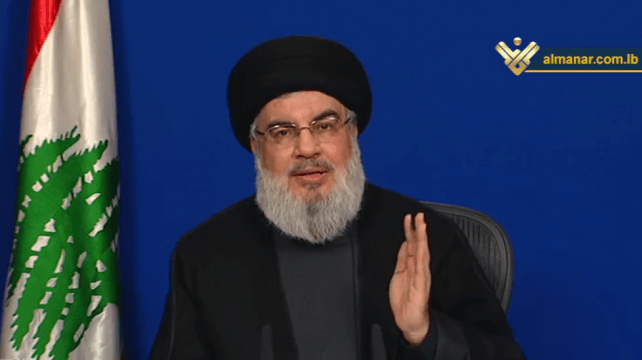
By Marwa Haidar| Al-Manar | October 25, 2019
Hezbollah Secretary General Sayyed Hasan Nasrallah urged the resistance supporters on Friday to leave the streets, noting that a dangerous scheme aimed at targeting Lebanon on the political level has being prepared.
In a televised address to the Lebanese people on the latest local developments, Sayyed Nasrallah said that Hezbollah at first hailed the popular protests but noted that such rallies have turned out to be politically exploited by foreign powers and suspicious sides inside Lebanon.
His eminence listed the achievements of the nation-wide protests which started on October 17, noting that its major achievements were the package or reforms and 2020 budget which was with no taxes.
As he stressed that Hezbollah doesn’t accept toppling the presidency, Sayyed Nasrallah noted that the resistance party also doesn’t back the government resignation.
In this context, Hezbollah S.G. pointed to a call by President Michel Aoun to meet protests representatives.
Sayyed Nasrallah vowed, meanwhile, that the package of reforms announced by Prime Minister Saad Hariri will be implemented on its due dates, stressing that Hezbollah won’t allow delay in this regard.
Achievements of Popular Protests
Noting that Lebanon is witnessing critical events, Sayyed Nasrallah reminded of Hezbollah’s stance at the start of the popular protests.
“We have stressed that Hezbollah respects the popular protests,” Sayyed Nasrallah said, noting that the resistance party didn’t want to take part in the protests in order for these rallies to be far from political affiliations.
“What happened was very good, especially in the first days of the protests, and must be preserved,” his eminence said, noting that he had warned against the politicization of the rallies.
Sayyed Nasrallah then listed the achievements fulfilled by the popular movements which swept across different areas in Lebanon.
“One of the protests’ achievements is announcing a budget with no taxes, something that is very important.”
He hailed the package of reforms announced by Premier Saad Hariri as “unprecedented,” noting that it was dismissed and misunderstood by many “in a suspicious way”.
Sayyed Nasrallah in this context, vowed that the reforms package will be implemented on its due dates, and that Hezbollah will not allow the delay in this regard.
Talking further about the achievements, Sayyed Nasrallah said the “popular protests indicate that people have regained self-confidence and hope of achieving the change.”
He said that the nation-wide protests “paved the way for political parties to be serious in countering corruption,” noting that the package of reforms is the first step towards countering corruption.
Vacuum and Chaos
Sayyed Nasrallah said that President Michel Aoun had called for dialogue with protest representatives, noting that the remarks of the president were distorted.
As he said that Hezbollah and his allies are open to dialogue with protesters, Sayyed Nasralah stressed that any solution to the current crisis should avoid political vacuum.
In this context, Sayyed Nasrallah called on protesters to choose their representatives.
“O’ protesters choose a leadership that can talk on your behalf. If you can’t do so, then let the people in the protest venues choose representatives in order to hold talks with President Aoun.”
“Any solution should be away from vacuum in political institutions and authority, for such vacuum, in light of hard economic, livelihood and financial condition, would lead to chaos and collapse.”
“We don’t accept toppling of presidency, as we don’t back the government resignation,” Sayyed Nasrallah said.
Commenting on calls for early parliamentary elections, Sayyed Nasrallah said that such step is complicated; stressing that reaching a deal on elections law by political parties in Lebanon is something difficult.
“They say that Hezbollah had contributed to political vacuum before the election of President Aoun,” Sayyed Nasrallah said, referring to remarks by officials belonging to some political parties in Lebanon.
“It’s not right that we took the country to the vacuum. Yes we disrupted the presidential elections, but the government and parliament were working. The roads weren’t blocked as well as the universities and schools were not shut.”
Blocking Roads
Hezbollah S.G. said that blocking roads is one of the civilian forms to protest. However he pointed to the duration of these moves, noting that after nine days, they cause harm for people and hamper their lives.
He also condemned offensive acts staged by protesters who belong to some political parties.
The checkpoints established in the roads by political parties’ supporters who ask the people for their IDs remind of the civil war, Sayyed Nasrallah said.
“I call on protesters to open the roads. Stay in the protest venues but open the roads for people to go to their work, universities and schools.”
Meanwhile, Sayyed Nasrallah denied as baseless, rumors that there are calls to the Lebanese Army to clash with protesters.
Suspicious Sides
Sayyed Nasrallah reiterated Hezbollah’s stance which voiced support to the protests at the first days.
“In the first days we didn’t consider the protests suspicious. We didn’t believe that there is a conspiracy behind such moves.” Sayyed Nasrallah said.
But the scene has changed now, Sayyed Nasralah said, noting that “what started spontaneously has been largely exploited by political parties.”
“Some protests have been financed by embassies and suspicious sides,” his eminence affirmed, adding: “social and livelihood demands have been diverted to target resistance.”
“Several sides are exploiting popular protests to settle their account with Hezbollah and implement foreign agendas.”
“Lebanon has entered dangerous phase, there are prospects that our country will be politically targeted by international, regional powers,” his eminence warned.
“We have information that an anti-resistance scheme is being prepared for Lebanon.”
Sayyed Nasrallah also responded to those who say that Hezbollah ‘is not in the camp of Imam Hussein(PBUH)’ because of his reservations on the protests in the last few days.
“Unlike the current protests, Imam Hussein’s revolution had a clear and sincere leadership,” Sayyed Nasrallah said.
“In the first days of protests we didn’t prevent people to take part in protests. Last Saturday I urged Hezbollah members (not supporters) to refrain from participating since their participation affects the social identity of the rallies,” his eminence said.
“Today, and based on new givens and suspicions I call upon the resistance crowds to leave the streets and the protest venues,” Sayyed Nasrallah concluded.
The Lebanese Fall – Hezbollah’s Latest Challenge
By Ghassan Kadi | The Saker Blog | October 22, 2019
Hezbollah is facing a new challenge, and this time it is not a military one, but rather political.
Perhaps few countries need peaceful “popular revolutions” more than Lebanon does. In my simplistic way of thinking, Lebanon should actually be on the top of the list; followed by the USA.
Corruption in Lebanon is endemic. Its politicians are in reality the heirs of dynasties with self-given “birthrights”. Lebanon is ruled, owned, and manipulated by a few families and bloodlines that virtually own everything and have control on whatever happens in the country. This excludes the very few new comers such as the Hariri dynasty, Hezbollah, and the incumbent President Aoun, among others that one can count on the fingers of one hand.
Before President Aoun was finally elected, Lebanon had a presidential vacuum and had no head of state for 29 long months. It took all that time for the feuding Mafias to finally come to an agreement that guaranteed their positions and vested interests before they were convinced that Aoun was the right choice.
Aoun does not come from any of the political-feudal lineages. As a former Army Chief, and despite his history as a former enemy of Syria in the 1980’s who turned into a supporter twenty years later and eventually became a political partner of Hezbollah, he was finally endorsed even by his Christian Maronite arch-rival, Samir Geagea, the head of the rightwing “Lebanese Forces” as a conciliatory president. This was what finally gave him the numbers to be elected and ended the presidency vacuum crisis.
Aoun was perhaps the first Lebanese president to be elected by consent of many rivals and former political and strategic enemies. After all, he had the backing of Hezbollah and the approval of Geagea. He had all that was needed to embark on a journey of reform.
And “Reform and Change” was the motto of his political party.
As a former enemy of Syria, he took voluntary exile in France in 1984 and started his movement of alleged reform. As he returned to Lebanon in 1999, in the years leading up to his election, his rhetoric was that of holding politicians accountable for corruption.
In 2008 Aoun visited Syria, his former enemy, and was greeted by President Assad like a head of state. He had a huge reform agenda, but whether he was genuine or not, by the time he was elected as President in 2016, he was already in his eighties and suffering ill health.
As a president and if anything at all, he followed the footsteps of those he was meant to hold accountable by endorsing his son-in-law Gibran Bassil to become a Member of Parliament and a Minister. But this is not all, he acted in a manner as if he has passed on the presidency and the running of Lebanon to Bassil.
This would have gone well had Bassil been “clean”, but he soon proved to be corruptible as hell. Bassil is now perhaps the most hated Lebanese politician. He is believed to have amassed billions of dollars of corruption funds. The current Lebanese uprising in the streets of Lebanon and the world are aimed at many Lebanese politicians; but mainly Bassil.
What is pertinent is that the political backdrop that eventuated in guaranteeing Bassil’s position has originally come from Hezbollah who has secured the presidency of his father-in-law; President Aoun.
In hindsight, Hezbollah has made a bad gamble on Aoun, and this is forgivable perhaps, but what is unforgivable was turning a blind eye to thus far three years of unimaginable corruption of the Aoun tenure.
Admittedly, the Lebanese Cabinet, headed by Saad Hariri, an opponent of Hezbollah, is an all-inclusive cabinet. Politically, strategically and militarily protected by Hezbollah in a manner that represents all political parties of Lebanon, the ambient Lebanese cabinet has Nasrallah as its patron. Right or wrong, this is the general understanding in the streets of Lebanon now.
For the sake of giving itself a constitutional cover and parliamentary majority, Hezbollah’s gamble on Aoun is failing. Aoun is losing ground and for Hezbollah to continue to support him would be an act of political suicide.
Currently, everything about what looks like a “Lebanese Revolution” looks legitimate and worthy of support. Thus far, the protestors have been peaceful and civilized. Lebanon is a country rich in many ways; well-educated human resources, agriculture, water, tourism venues, untapped oil/gas, you name it. People are angry because their government has not yet been able to build up enough infrastructure after the 1975-1989 Civil War that destroyed much of it. The country is reeling from growing unemployment, the high cost of living and a lack of basic local services like water, power and garbage management. Add to this the factor of low income, it becomes understandable that the Lebanese are sick and tired of having to put up with a seemingly endless legacy of government incompetence and rising taxes.
So once again, Lebanon needs a peaceful popular revolution that can provide reform; not more destruction, and the current uprising, which hasn’t been given a name yet, will inevitably, for better or for worse, yield some outcomes.
What seems probable is that President Aoun will be forced into retirement at the very least. And, this may only be the prelude to further developments. However, what we are seeing now in Lebanon is not necessarily a “Lebanese Spring”. The seasonal aspect of it does not necessarily mean that it is a “Lebanese Fall” either. It is a Lebanese test; and most specifically a defining moment for Hezbollah.
Thus far, Hezbollah has been “faultless” in as far as deterring Israel, protecting its own ground base and providing enough popular support to guarantee its popularity.
And the support of, and well regard for Hezbollah did not only come from the Shiite sector of the Lebanese community. After all, Hezbollah represented resistance, and this ideological arm has no sectarian boundaries. But what Hezbollah seems to have failed to realize is that it cannot bank on ideology alone, all the while turning a blind eye on corruption.
It has to be said as it is. Hezbollah is becoming increasingly perceived in Lebanon as having a role in protecting its corrupt government. This situation is inviting the “Soros connected” forces to take control of the “Lebanese Revolution”.
But as events in Lebanon are changing on daily basis, we must look back at the Arab Spring and what came out of it.
There is a revolution in Lebanon and I support it. People on the streets are genuine and have legitimate demands. But this revolution is headless and has fingerprints of meddlers already. After all, as we see virtually millions of Lebanese flags appearing all over the world, including some that are 300 and 400 meters long, we ought to ask where did they come from and who paid for them? And, who is giving the greenlight for mainstream media coverage to this all?
After the Israeli war with Hezbollah in July 2006, Shiite Muslim Hezbollah had a huge popularity in Lebanon even in the Muslim Sunni as well as Christian regions. This changed soon after Hezbollah made the decision to control the streets of Beirut in May 2007. Ever since, Hezbollah lost a fair chunk of its popularity outside the Shiite sect.
Nasrallah must make his position clear in regard to the street protests and his stand on the ugly corruption that is bringing Lebanon to its knees. He had to urgently respond to the street rallies during the 2005 so-called “Cedar Revolution”, where protestors wanted Syrian troops out of Lebanon, and the counter pro-Hezbollah protestors demanded the opposite. The schism back then brought Lebanon close to civil war again. A repeat of such a scenario now is potentially more dangerous and inflammatory than back then.
Hezbollah rose victorious, both politically and militarily, and with victory in Syria, the position of Hezbollah in Lebanon has never been stronger. Hence a wise and appropriate response to the current crisis is paramount.
The situation occurring presently is quite different to the events of 2005. It is no longer ideological. People are literally unemployed, angry and hungry. They blame the corrupt government, and are pointing the finger at Hezbollah for its silence.
Hunger and popular anger do not stop at sectarian boundaries.
Nasrallah has been making the right decisions thus far, but he cannot afford to be complacent. Each and every camel has a straw that can break its back, and Aoun is not the one for Nasrallah to count on for political survival; quite the contrary in fact.
Even within the ranks of heartland pro-Hezbollah territory, there is an element of opposition to the Aoun administration and its political and economic bankruptcy.
The success of Hezbollah as a liberating force in Lebanon may well have reached a crossroad now. How the protests and the issues voiced are dealt with, will define the future of Hezbollah. It can cause it great damage or, if quickly respond to with sympathy and solutions to the issues raised by the groundswell of angry and fed-up protesters, Hezbollah can maintain the grassroots support they enjoyed. It is time for Hezbollah to revisit the viability of its political alliances.
The progress of the popular uprising thus far, sounds too good to be true. However the substantial support this uprising is receiving, both domestically and internationally is ominous. International support can only be based on political interests aimed at reducing the stronghold of Hezbollah and to weaken the position of the axis of resistance.
Without a figure head, without a clear agenda, the Lebanese uprising is likely to end up like the Egyptian uprising back in 2011. The street anger will be employed by the meddlers in order to serve their own agendas, and the suffering of the people will not be reduced. This is my fear.
Hezbollah Firmly Denies Involvement in Beirut Downtown Motorcade
Al-Manar | October 22, 2019
Hezbollah stressed on Monday it has no relation with the motorcade which threatened protests in Beirut Downtown and was thwarted by Lebanese Army.
In a statement, Hezbollah’s Media Relations Office firmly denied involvement in the motorcade.
“The Media Relation would like to affirm that Hezbollah definitely has no relation with the motorcade which went about Beirut Downtown tonight,” the statement released late Monday said.
Lebanese media reported that a motorcade including alleged supporters of Hezbollah and Amal movement attempted to attack protesters in Beirut Downtown, with the Lebanese Army confronting them and saving the protesters.
A video showing the motorcade went viral on social media, with pro-resistance activists stressing that such moves are suspicious and aim at tarnishing Hezbollah’s image.
Hezbollah Secretary General Sayyed Hasan Nasrallah expressed solidarity with protesters who have been since last Thursday staging demonstrations and rallies across Lebanon in protest against hard livelihood conditions and corruption in the state institutions.
In his speech in the Arbaeen commemoration in Baalbeck on Saturday (October 19, 2019), Sayyed Nasrallah stressed that the resistance party stands beside the protesters urging all Lebanese parties including Hezbollah to bear the responsibilities in a bid to solve the long-term crises in the country.
Source: Hezbollah Media Relations (Translated by Al-Manar English Website)
Israel Directing Policy Through US Treasury: Sanctioning Hezbollah’s Political Allies in Lebanon
By Patrick Henningsen | 21st Century Wire | September 12, 2019
Nearly three years into the Trump administration, one thing is clear: as it struggles to wage any new direct shooting or proxy wars, Washington has instead relied on economic warfare against its perceived enemies, and largely on behalf of the state of Israel.
Through the U.S. Treasury Department and its own openly pro-Israel agents of influence, namely Secretary Steve Mnuchin, along with his Under Secretary for Terrorism and Financial Intelligence Sigal P. Mandelker, Israel has been able to attack and undermine all of its own geopolitical enemies and region rivals. The chief mechanism for achieving this is by directing the US government to label any person, politician or state agency – as a “terrorist,” or as a terrorist entity, thus allowing the US government to apply sanctions against any person or entity which Israel designates as its enemy, or even potential enemy. As a result of this runaway policy, the list of sanctioned persons and organisations by the Trump administration is the most in history.
Firmly in its crosshairs is Lebanon’s well-established political and military wings of the Hezbollah organisation. There is a fundamental flaw in the West’s framing of Hezbollah though, starting with its origins. It is a fact of history that Hezbollah was born out of Israel’s illegal occupation of southern Lebanon. Had Israel not invaded and occupied this region, or prosecuted its long and violent military campaign during and after the Lebanese Civil War, then it’s possible the Hezbollah movement may never had formed. It was born out of Israel’s occupation. Indeed, Iran has been traditional supporter of the group – which has drawn the ire of Washington and Tel Aviv who view both Iran and Hezbollah as a joint obstacle to US-Israeli strategic security objectives in the Middle East. In order to elevate Hezbollah to ‘most targeted status,’ US officials have had to repeatedly fabricate claims that Hezbollah is acting as major global terrorist organisation. In the same breath, US officials, like Secretary of State Mike Pompeo will enthusiastically drift out the well-worn fable that ‘Iran is the world’s number state-sponsor of terror’.
Earlier this year, the US also announced that henceforth, Iran’s leading military divisions, the Iran Revolutionary Guard Corps (IRGC) and Quds Force – would now be designated as a “terrorist organisation.” The cold irony of course, is that Hezbollah militias are presently fighting (and defeating) actual terrorist organisations like al-Qaeda and ISIS (both of who have been created, as well as armed and financed by numerous western and gulf states, including the United States) in Syria, Iraq and Lebanon. Since 2013, Hezbollah militia have played a pivotal role in ejecting al Qaeda and ISIS terrorists from their enclaves in Syria, thus thwarting the regime change objectives of US, UK, France, NATO member states, Turkey, Qatar, Saudi Arabia, and also Israel too. Likewise for IRGC and Quds special military advisors deployed in Iraq and Syria to help subdue the invading terrorist brigades. The same is true for Iranian-backed militias in Iraq like the Hash’d Shaabi (People’s Mobilization Units), predominantly Shia, who were pivotal in Iraq’s ultimate victory over ISIS in 2017. Veteran journalist Patrick Cockburn summed it up when he concluded that the greatest threat to building peace in Iraq was not ISIS, but rather, Donald Trump determined to pick a fight with Iran. Documentation on the number of casualties is still difficult to determine, but on the aggregate, between Hezbollah, Hash’d, Iranian forces, the losses sustained in the fight against ISIS and al Qaeda number in the tens of thousands – and likely far more than the combined US soldier death tolls in 18 year-long War on Terror in Iraq, Afghanistan and beyond. Regardless of general western ignorance of what has actually transpired in Syria since 2011, and in Iraq since 2014, the people who actually live in the Middle East know the severity of this largely foreign-backed terrorist usurpation.
Regardless of the facts on the ground, neconservatives and war hawks in the Beltway are still happily pressing ahead with their policies. With Tel Aviv carefully leading from behind, Washington has successfully pressured many of its allies to obey its geopolitical dictates, with the UK, Argentina and Paraguay all falling into line this year by designating Hezbollah – both its political and military wings – as a terrorist organisation, as well as pressuring Brazil to follow suit.
Of deeper concern for Washington though, is that Hezbollah is defending Lebanon’s borders from what is undoubtedly the region’s most prolific aggressor – Israel. In just the last few weeks, Israel has attacked no less than 4 of its neighbours, including unprovoked military strikes against Syria, Lebanon, Iraq and of against Palestinians living under illegal Israeli occupation in Gaza. Hezbollah also poses another threat to Israeli hegemony in the region because of its unflagging support for Palestinian resistance against Israel’s violent occupation and ethnic cleansing of the native Palestinian people. Similarly, the Islamic Republic of Iran also supports the Palestinian resistance cause, which is also a predicate for Israel’s various and sundry fabricated claims about a ‘secret Iranian nuclear arsenal,’ and imagined conspiracy that ‘Iran is occupying Syria’ – all of which are designed to garner leverage in Washington whereby US officials can view Hezbollah an accomplice to “Iran’s threat world peace.” This is the sort of geopolitical gymnastics which Israel is attempting to perform on a daily basis in order to justify the longest-running, most brutal and inhumane apartheid regimes in modern history – being waged against Palestinians and Arabs in the Middle East.
Targeting Hezbollah’s Political Allies
Still, Washington insists on basing its international relations on these numerous fabricated claims about Iran and Hezbollah drafted by Israel’s J Street lobbyists and the Prime Minister’s office in Tel Aviv. Now the Trump administration is taking this method a step further by threatening to sanction any political allies of Hezbollah in Lebanon. With military options practically off the table, this is the only remaining option for Washington and Tel Aviv to try and undermine Hezbollah which is now a political force in Lebanese politics, forming a working majority in the Lebanese Parliament along with its allies, as well as holding key ministerial and cabinet positions. But will it work?
Future Sanctions Will ‘Absolutely’ Target Hezbollah Allies in Lebanon: US Envoy
Al-Manar – September 13, 2019
US envoy said on Thursday that future sanctions could target allies of Hezbollah in Lebanon.
“In the future we will designate, because we have to, individuals in Lebanon who are aiding and assisting Hezbollah, regardless of their sect or religion,” the new US assistant secretary of state for Near Eastern affairs, David Schenker, said in an interview with local LBCI television.
When asked by the interviewer if this means sanctions will target allies of Hezbollah, Schenker said “absolutely,” adding that the US is constantly reviewing its sanctions lists.
Earlier on Tuesday, US State Department announced it has issued sanctions against four alleged Hezbollah members, Ali Karakeh, Mohammad Haydar, Ibrahim Aqil and Fouad Shukr.
The administration of Presdient Donald Trump has ramped up sanctions on Hezbollah and other resistance groups since the US withdrew from the Iran nuclear deal in May 2018.
Last month, the US Treasury slapped sanctions on the Lebanese Jammal Trust Bank, claiming the bank “brazenly enabling” Hezbollah’s financial activities. And in June, the Treasury took the unprecedented step of sanctioning two sitting Hezbollah MPs, Amin Sharri and Mohammad Raad, alongside security head Wafiq Safa.
Israel Whimpers at the First Kornet Fired by Hezbollah
By Marwa Osman | American Herald Tribune | September 4, 2019
In the past few days, Hezbollah’s retaliatory attack and destruction of a small Israeli Wolf combat vehicle in the upper Galilee has made headlines in both Arab and international media. The attack was in response to the Israeli aggression on Damascus on August 24 resulting in the killing of two Hezbollah engineers and also to an Israeli drone attack on the capital Beirut, the first of its kind since August 2006, in violation of the “rules of engagement” that have been established between the two sides.
When the decision was taken by the leadership of the resistance to respond to the aggressions against Damascus and the capital Beirut, the Israeli regime was the first to consider that retaliation as inevitable. No one in the world believes Hezbollah’s promises more than Israel does.
Within a few hours, Israeli occupation soldiers embarked on a previously trained plan to evacuate all of its positions and bases along the area believed to be a supposed target for insurgents. However, there was no need to intensify pressure on soldiers and settlers to abide by orders, since it was enough for them to hear the words of Sayyed Hassan Nasrallah about Hezbollah’s promise to retaliate, prompting them to act impulsively, in line with their leadership’s decision and completely disappear.
The Israeli decision to evacuate all their military posts along the border, varying in depth from five to seven kilometers, effectively stole the life from territories on the borderline with Lebanon. The illegal colonial settlers, whose presence had declined sharply over the past decade in these bordering areas, were shocked to see that the soldiers who were supposed to protect them had fled their positions, leaving the settlers for their own fate.
Moreover, just as these settlers understood from their army’s actions that Hezbollah was preparing for a strike, they understood that Hezbollah ended its operation when the soldiers were seen returning to their original duties.
This is what happens to someone who has been struck by deterrence. To be deterred means to be afraid of everything around you. Not to trust yourself or those who are close to you or anyone who is supposed to protect you. To be deterred means to be aware that your margin of error is narrowing day by day. To be deterred means that you are fixated in front of your TV, waiting for an official statement from your enemy, to tell you when it is time to get out into the sun.
The Israeli occupation forces’ plan did not succeed in hiding the “real” targets from the resistance fighters who were monitoring the Israeli movements, from ground control points and via drones.
Despite the adherence of the occupation army formations deployed in the northern region to the orders of their command to evacuate positions along the border with Lebanon and freeze all inspection patrols, the Resistance managed to select the appropriate area of operations, and waited for the target.
At approximately 4 pm on Sunday, September 1, the Israeli Wolf multi-purpose vehicle was traveling on route 899 medium speed. The vehicle came from the eastern side of the settlement of Avivim, from the side of the Malikiyah settlement, to cross the back road down behind Avivim, and then turn around the area known as “Magayer Salha”, and up to the road next to the settlement of Yeron, which was the point of impact between the Wolf and the Kornet.
Hezbollah’s planned and precise response revealed the weakness of the Israeli fortifications and defense engineering, and the sterility of its plans, which it had intensified in recent years, with the aim of reassuring the inhabitants of border settlements and raising the morale of its occupation soldiers along the northern front.
Anyone who witnessed how strange the evacuation of the Avivim border military base was, which is responsible for the protection of the west within the area of responsibility of the Galilee Division (91) deployed in the occupied Galilee and whose area of responsibility extends almost 20 km from the borderline, would definitely be shocked to know that it is that same brigade that announced earlier this year the formation of a new reserve battalion, called the “gates of fire,” in order to defend the border area against what it called “the risk of Hezbollah fighters storming” the Galilee.
This time, perhaps, they did not have the opportunity to test the capabilities of the new battalion, because they had already fled, leaving the settlers to their fate, before any crossfire even began.
Marwa Osman is a PhD located in Beirut, Lebanon. University Lecturer at the Lebanese International University and Maaref University and former host of the political show “The Middle East Stream” broadcasted on Al-Etejah English Channel. Member of the Blue Peace Media Network and political commentator on issues of the Middle East on several international and regional media outlets including RT, Press TV, Al Manar and Al Alam. Writer in several news websites including Khamenei.ir, Modern Diplmacy, Shafaqna, Italian Insider.
Hizbullah Reminds Israel of Its Power
By Helena Cobban | Lobe Log | September 5, 2019
On September 1, Hizbullah fighters on Lebanon’s border with Israel fired two precision-guided missiles over the border, apparently hitting an Israeli “Wolf” armored personnel carrier (APC) and inflicting casualties of unknown severity on its occupants (see below). The strike came a day after Hizbullah head Hassan Nasrallah warned that the organization would retaliate for Israel’s killing, a few days earlier, of two Hizbullah fighters in Syria and Israel’s deployment of explosive drones against Hizbullah-related targets in eastern Lebanon and the capital, Beirut.
The Israelis responded to the attack on the Wolf by firing a number of rockets and artillery shells, seemingly at random, into uninhabited parts of southern Lebanon, with no casualties reported.
On September 2, Hizbullah released a video of the attack on the Wolf, which took place in broad daylight. The video shows Hizbullah operatives launching two guided missiles against a military vehicle, each of which causes a large explosion. Hours later, Nasrallah told his supporters that this cross-border action—the first since the extremely destructive Hizbullah-Israel war of 2006—represented a new stage in the struggle against Israel. He warned, too, that his fighters would henceforth feel free to bring down any of the scores of military drones that Israel deploys in Lebanese airspace each month.
Taken together, the events of late August through September 1 underscored that the situation of reciprocal (if highly asymmetrical) deterrence that has existed between Israel and Hizbullah since the end of the 2006 fighting remains in place.
This situation has significant impact not only for the peoples of Lebanon and Israel but also in the broader regional arena, in which the Israel-Hizbullah balance plays a key role. For though Hizbullah has always, since its emergence in 1985, been an authentic, indigenous Lebanese movement, it is also a key ally of the Islamic Republic of Iran. So if Israel, some parts of the U.S. government, and other regional actors such as Saudi Arabia are considering launching any significant military attack against Iran, then Hizbullah’s ability and willingness to join the battle by counter-striking against high-value targets inside Israel is a factor that anti-Tehran war planners have to take into account.
Iran does have, as I wrote here recently, a broader network of regional allies, of which Lebanon’s Hizbullah is only one part. But Hizbullah is unique by virtue of the special role its conflict with Israel plays in affecting strategic thinking and decision-making in Israel and elsewhere. Hizbullah, as everyone in the Middle East is aware, is the only body, governmental or non-governmental, that has been able to inflict significant military defeat on Israel—and not just once, but twice.
The first defeat became clear in May-June of 2000, when the Israeli military that had been occupying a strip of Southern Lebanon since 1978 simply pulled up its stakes and withdrew. The decisive earlier battle against Hizbullah that led PM Ehud Barak to take that decision had actually happened four years earlier. In 1996, Israel launched a scorched-earth attack against Lebanon that failed to either destroy Hizbullah or turn the Lebanese population against it. When Barak became PM, he judged, quite sensibly, that the casualties that Israel’s occupation force had continued to take in Lebanon since 1996 were all for naught.
In 2006, another Israeli PM, Ehud Olmert—who had far less military experience and military savvy than Barak—thought he would try his hand at diminishing the considerable amount of military and political power that Hizbullah had continued to accrue in Lebanon. With huge support from President George W. Bush and most European governments, Olmert launched another scorched-earth attack against Lebanon, once again aimed at either destroying Hizbullah or turning the Lebanese public against it. In the two years prior to 2006, there had been quite a lot of (Saudi-supported) anti-Hizbullah agitation in Lebanon, so perhaps Olmert hoped to gain advantage from that. If so, he failed miserably. Lebanese from all political and religious persuasions rallied strongly around Hizbullah.
That was not the only thing that went wrong with the war from Olmert’s point of view. Some three weeks into the conflict, it became clear that even the Israeli air force’s destruction of critical Lebanese infrastructure (gruesomely celebrated in Israel thereafter as the “Dahiyeh Doctrine”) could not force Hizbullah to cry “uncle.” Olmert and his advisors decided to send in Israeli ground forces. But the ground units all proved woefully ill-prepared for their task. It soon became clear that neither they nor the air force could stop Hizbullah’s well-trained rocketeers from continuing to fire missiles deep into Israel’s interior.
Thirty-three days into the campaign, both leaderships agreed it was time to stop. They negotiated a ceasefire through the mediation of the Lebanese government and the United Nations. The ceasefire’s basic structure was a return to the status-quo ante. All the Israeli troops recently deployed into Lebanon had to immediately withdraw. All hostilities and cross-border military actions had to cease. The United Nations beefed up its southern Lebanon peacekeeping force, which since 1978 had been a fairly ineffective presence along the border.
For Israel, the 2006 war was a crushing defeat—and for its ground forces, in particular, a humiliation. (One explanation for the three vicious assaults Israel launched against Gaza in 2008, 2012, and 2014 was that the country’s military leaders sought to regain from Israel’s citizens the high esteem they had always previously enjoyed—esteem that had been very badly dented in 2006.)
For Hizbullah, the 33-Day War of 2006 was unquestionably a victory, though one bought at a high price in the human and material losses suffered by all the Lebanese people.
The essential victory that Hizbullah won in 2006, as in 1996, was that it faced down Israel’s extremely hi-tech military and survived with its core military and political networks and its ability to inflict significant destruction inside Israel all intact—and without having made any political concessions. This is, of course, why Israel and its acolytes and supporters in the West all hate it so deeply.
In the limited military exchange that Hizbullah and Israel engaged in on September 1, the underlying facts about the reciprocal deterrence that has existed between them since 2000 were on full display.
For some years now, the Israeli military has been taking advantage of the chaotic situation in Syria to mount sporadic attacks against various targets there, including some that they claim are connected to Hizbullah or the Iranian military. At periodic meetings that Israeli officials have conducted with their counterparts in Russia, which has long been allied with the Syrian government, the two sides have sketched out rudimentary “rules of engagement” for such raids. In July, the Israelis extended their campaign to interrupt Iran’s export of weapons and advisors yet further, sending F-35s to attack two locations in Iraq that were allegedly being used by Iran’s Islamic Revolutionary Guard Corps (IRGC). In July, and again in late August, it struck at Hizbullah operatives inside Syria, killing at least two of them.
Of all the targets thus attacked, only Hizbullah retaliated directly against Israel. It did so in a measured and limited way that nonetheless served to remind Israelis of their continuing vulnerability to Hizbullah’s military muscle and military/political smarts.
Israel’s reaction to the announcement Nasrallah made on August 31, that Hizbullah “would retaliate” for Israel’s killing of its operatives in Syria, was intriguing. As was widely reported in the (always military-censored) Israeli media, the Israeli military ostentatiously announced that it would pull troops back from front-line positions facing Lebanon, in what seemed like a deliberate move to de-escalate tensions.
Israel’s responses to the Wolf attack, which happened the very next day, were also intriguing. Firstly, in the military sphere, its retaliation against Hizbullah/Lebanon was notably restrained, a fact that could perhaps be attributed to PM Benjamin Netanyahu’s reluctance to get Israel into yet another complex imbroglio in Lebanon with his country’s next general election coming up September 17—except that, in the context of, say, Gaza, Israeli leaders have often seemed to judge that launching an attack could be a valuable part of an election strategy.
Secondly, in the informational sphere, Netanyahu went out of his way to deny that the attack on the military vehicle had caused any casualties. The video that Hizbullah made and distributed of the incident seemed clearly to show that the vehicle was an APC, and that the two missiles that struck it caused massive explosions. Other news footage from inside Israel showed injured soldiers being carried out and evacuated to a nearby military hospital. But Israeli spokesmen, faithfully parroted by reporters from the local and foreign media—all of whom are subject to Israeli military censorship– described the vehicle as merely a military “jeep” and said the footage showing apparent medevac operations had been faked by the military, using dummies.
This strange claim seemed aimed either at reassuring Hizbullah that its operation had already “succeeded” enough that it need not launch any follow-on attacks—or, perhaps more plausibly, at damping down any desire Israelis might have had for a large-scale retaliation.
But throughout this whole episode, Israel’s leaders were still clearly signaling that they agree that “You don’t mess with Hizbullah.”
This has wider implications for the regional balance between Israel and Iran. One essential fact in that balance is that the alliance between Hizbullah and Iranian leadership goes far deeper than any mere coalition of convenience and is, in practice, unbreakable at this point. Another is that Hizbullah’s home turf and principal area of operations directly abuts Israel—and it cannot be defeated there. Remember, after all, that Hizbullah first emerged in the mid-1980s under the difficult circumstances of a harsh Israeli occupation of one third of Lebanon—and that it showed first, that it could successfully organize to throw off that occupation and, then, that it could repel the next big attempt Israel made, in 2006, to destroy it.
Much about the regional balance has changed since 2006. The biggest change has been the heartbreakingly protracted civil war in Syria, a conflict that weakened the Syrian government which had long been a key part of the Iran-led coalition and considerably weakened Damascus’s ability to protect the Syrian homeland from incursion by all manner of hostile foreign forces, including those of Israel, the United States, and Turkey. (Syria’s civil war has, however, provided Hizbullah and the IRGC with valuable opportunities to act and train in complex urban-conflict environments.) Another change has been a considerable weakening of U.S. military-political power in Iraq, with the diffusion of some U.S. military capabilities into Syria. All these changes—along with others that have taken place in the Arabian Peninsula and elsewhere in the region—undoubtedly affect the balance of power between Israel and Iran. But the inescapable facts, that Hizbullah can cause wide damage within Israel’s heartland and withstand the strongest counter-attacks that Israel can launch against it, still remain.
Veteran Middle East analyst and author Helena Cobban is a Senior Fellow at the Center for International Policy and the CEO of both Just World Books and the nonprofit Just World Educational. JWE’s website Justworldeducational.org makes freely available to the public a variety of resources on war, peace, justice, and the Middle East.
Facebook threatens to block Palestine news site for using the term ‘Hezbollah’
MEMO | September 3, 2019
Facebook has threatened to block the page of Quds News Network and stop its work on the social media site after it publishing news about the Lebanon’s Hezbollah, QNN told MEMO.
The threat came through a notice sent to QNN’s Facebook page as a result of the network’s coverage of the recent tensions on Lebanon’s southern border.
The network has been targeted by an incitement campaign, with efforts to remove its Facebook page, and several of the page’s administrators having their personal accounts deleted. Some of QNN’s posts have also been removed or temporarily blocked.
Commenting on the campaign, QNN said it will continue to perform its media mission and use all the available tools to deliver the voice of Palestine to all parts of the world despite the crackdown and hate campaign it is facing.
It said the attacks it is facing are part of Facebook’s targeting of Palestinian media organisations and aimed to please Israel which seeks to stop the occupation’s crimes from being exposed on an international basis.
“The recent threats are only a prelude to stricter measures which may include the deletion or blocking of Palestinian and Arab pages, away from the freedom of opinion and professionalism claimed by Facebook.”
Quds News Network was launched in 2011 as the first Palestinian news community on the social networking site, aimed at spreading a full picture of the situation in Palestine. It has over than 6.6 million followers on Facebook.
Netanyahu Does Something Stupid Again
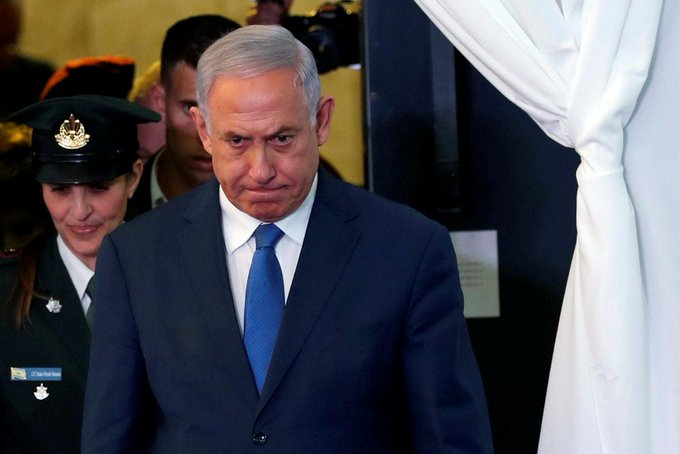
Israeli PM Benjamin Netanyahu arrives to review an honor guard with his Ethiopian counterpart Abiy Ahmed in Jerusalem September 1, 2019. Credit: Ronen Zvulun/ Reuters/ Twitter)
By Jeremy Salt | American Herald Tribune | September 2, 2019
With general elections coming up on September 17, Benyamin Netanyahu made a calculated gamble last week and lost.
The attempt to assassinate someone by drone in Beirut failed. Two drones were sent into the largely Shia suburb of Dahiya, where Hizbullah’s political, media and welfare offices are based. The first drone, for surveillance, crashed on to the roof of a Hizbullah media office, causing damage inside but no human casualties. This forced the Israelis to abort the entire mission. They themselves destroyed the second drone, for assassination, according to the veteran Middle East correspondent Abdul Bari Atwan. The target for murder was clearly a senior Hizbullah figure or – as some have speculated – a representative of the Iranian government. Israel certainly did not send a drone to Beirut just to put a hole in the roof of a building.
As this was the first attack on Beirut since 2006, when Israel jets pulverized Dahiya day after day, Hizbullah threatened retaliation. It never says when, how or where it will strike back but this time it retaliated almost immediately, destroying an Israeli APC (armored personnel carrier) at a military outpost across the armistice line.
That Netanyahu would launch such an attack without taking precautions to ensure the safety of civilians and military personnel in the north would have played badly before the public had not the government covered its tracks by firing a flurry of missiles into Lebanon and claiming in a media barrage that while the APC was indeed hit by the ‘terrorists’ no-one suffered even a scratch, as Netanyahu eventually claimed.
It may be some time, it may be never, that the truth comes out but the story pitched by the Israeli government and military has all the elements of high comedy, not sophisticated, more Bud Abbott and Lou Costello than Lenny Bruce. First the Israelis said the vehicle that was struck was a military ambulance, with no-one inside it. Then they admitted it was an APC, but again no-one was inside, as they had all gone somewhere else half an hour earlier, whether for a smoke, a meal or a pee we don’t know.
Likud minister Yoav Galllant said no-one had been hurt in the missile strike, even as footage was being shown of wounded soldiers being flown by helicopter to an army hospital but he was speaking out of turn, so the government said.
In fact, noone had been hurt. This was no more than a decoy operation. Israel wanted Hizbullah to think it had scored some kind of victory, so it dressed up store dummies as soldiers and had them carried away on stretchers. It turned out that Israel just wanted to fool Hizbullah. That was the point of the whole exercise. Ha ha, Hasan, the joke’s on you. Noone had been hurt after all. “The staged evacuation seems to have worked” wrote the veteran Zionist propagandist David Horowitz.
The fact that settlers in the north had been sent scurrying into their bomb shelters by the Hizbullah missile strike was soon overtaken by glowing reports of farmers back in the fields and children back in the classroom as usual now that the cross-armistice line missile fusillade had died down.
Readers will decide how much of this malarky they can believe. For most, probably none of it. Behind the propaganda smokescreen lies a core truth, which is that Netanyahu, Israel’s nincompoop-in-chief, launched a failed mission into Beirut, rather reminiscent of his failed attempt to kill the senior Hamas figure Khalid Mishael in 1997. The would-be assassins were arrested, and the panicked, sweating Netanyahu, close to nervous collapse, saved from his own folly only by the intervention of the Jordanian king.
The drone attack in Beirut was designed to deliver an election victory but backfired badly and had to be covered up as quickly as possible with what seems on the surface to be a complete cock and bull story.
The APC held eight men. If they had been inside when it was struck by Hizbullah’s missile, all would have died or would have been badly wounded, as Hizbullah claimed they were. If they were killed or wounded, Netanyahu, approaching the end of an election campaign, would have had to prevent the public from knowing, even to the ludicrous extent of telling it that the wounded soldiers shown in video footage were actually store dummies dressed up as wounded men. The truth – if there were casualties – would have doomed his re-election prospects.
The drone attacks on Beirut included a strike on a PFLP (Popular Front for the Liberation of Palestine) base in the Bika’a valley. Other drone attacks on the same day were launched against Hashd al Sha’abi (Popular Mobilization Forces) units and regular Iraqi army bases in north Iraq close to the Syrian border. Iraqi intelligence believes the attacks were launched from the Kurdish region of northeastern Syria, controlled by the largely Kurdish Syrian Democratic Forces (SDF), the US puppet militia. In the same time frame, the Zionists also attacked a military position close to Damascus.
These simultaneous attacks on three countries call to mind the rabid dog running around snapping at anyone who comes close. There was no immediate provocation for any of these missile strikes and drone attacks but in Israel’s case there never has to be. The Israelis say Hizbullah’s missile retaliation brought the two sides to within 30 minutes of another war, and they say another one is coming anyway. This can hardly be news to anyone. Hizbullah has enough precision missiles to devastate Israel and the longer the Israelis wait the more it will have, so unfortunately another war is only a matter of time and perhaps a much shorter time than people might think.
Even though Israel has been flying drones over Lebanon for decades, an attack in central Beirut is unusual. It might not be the first, however: Lebanon’s former Prime Minister, Rafiq Hariri, may have been assassinated in 2005 by a missile fired from an Israeli drone, and not killed by a car bomb, the generally accepted explanation. The UN investigation into Hariri’s death was grossly prejudicial, especially in the case of the reports filed by the first lead investigator, Detlev Mehlis, and came to nothing anyway. The charges against Lebanese suspects were dropped, at which point the UN tribunal switched its suspicions to Hizbullah, without having any prior evidence. This investigative route has ended in a dead end as well. The one chief suspect never investigated, even though standing out above all the others because of its long track record of murder and mayhem in Lebanon, is Israel.
In 2010 Hasan Nasrallah revealed that Hizbullah had intercepted Israel’s electronic communications and had captured images of an Israeli drone tracking Hariri across Beirut and into the mountains every day for three months. Along with an AWACS (Airborne Warning and Control System) plane, an Israeli drone was hovering over the precise point on the corniche road when Hariri was assassinated.
Looking at the evidence, Thierry Meyssan has argued that a highly refined missile fitted with a warhead based on a ‘nano’ amount of enriched uranium may have been used rather than a car bomb (‘Revelations on Rafik Hariri’s Assassination,’ Voltaire Network, November 29, 2010).
However, whether drone missile or car bomb, Nasrallah implicated Israel in the murder. If the question cui bono is to be asked the answers are clear. It was immediately assumed in the ‘west’ that Syria must have been responsible, given the often difficult relationship between Hariri and the Syrian government, but the only beneficiaries of the assassination were Israel and its rightwing proxies in Lebanon.
Israel violates Lebanon’s air space as a matter of course. Over the years it has overflown Lebanon many thousands of time. It frequently flies across Lebanon to attack Syria. At the international level, no sanctions have ever been introduced to stop it, just as no sanctions have ever been introduced to stop it doing anything it wants to do. This will continue until the big war comes along, and then all those who could have done something to head it off but did nothing will be throwing up their hands in horror.
Apart from flights aimed at bombing targets in Lebanon or Syria, Israel’s aerial intrusions would have other purposes, including intimidation of the Lebanese civilian population and the unrest this might generate.
Most probably it would also want to draw Hizbullah out and, through retaliation to one of its attacks, see if it has missiles capable of bringing down its aircraft. A lost plane and pilot would be worth the cost of knowing. As the neutralization of Israeli air power must be a primary objective of Hizbullah and Iran, Hizbullah probably does have such weapons, but Israel is going to have to wait until the next war to find out.
Israeli artillery shells southern Lebanon, drone drops incendiary devices along border
Press TV – September 1, 2019
Israeli artillery units have struck the southern part of Lebanon shortly after an Israeli drone violated the Lebanese airspace, and dropped incendiary material that sparked a fire in a forest at the border.
Lebanon’s official National News Agency reported that Israeli forces launched several 155-millimeter shells on the Jabal al-Rous area in the occupied Shebaa Farms and Kfarshouba Hills on Sunday afternoon.
The report added that the Israeli forces opened fire from their posts in the al-Zaoura area in Syria’s occupied Golan Heights.
An Israeli unmanned aerial vehicle, meanwhile, dropped incendiary devices on a forest in the border area of Bastara.
The Lebanese army said in a statement that the drone entered Lebanese airspace at 11:15 a.m. local time (0815 GMT) on Sunday, and dropped an unspecified number of devices, causing fires in some areas.
It added that the army would continue to follow up on Israeli violations of Lebanese airspace with the United Nations Interim Force in Lebanon (UNIFIL).
Images published by the private LBCI television network showed smoke rising from a tree-covered hill, reportedly caused by the weapons.
Tensions have been high recently between Israel and the Lebanese resistance movement Hezbollah in connection with the Israeli attacks on August 25 in Syria and Lebanon. Hezbollah has pledged to retaliate.
Hezbollah’s Secretary-General Sayyed Hassan Nasrallah said on Saturday evening that the resistance movement was determined to give a response to Israel over its recent drone incursion into Lebanon.
“The need for a response is decided,” he said during a televised speech ahead of the Islamic lunar calendar month of Muharram – the 10th day of which marks the martyrdom anniversary of Imam Hussein, the third Shia Imam and Prophet Muhammad’s grandson.
The Hezbollah chief added that the response was about “establishing the rules of engagement and… the logic of protection for the country. Israel must pay a price,” he said.
“Israel should know that the Lebanese air space is not open to her,” Nasrallah said, adding that the Israel attack could open the door to assassinations if left unanswered.
Nasrallah noted that the response to the Israeli attack could come from anywhere in Lebanon and not only from the Shebaa Farms south of the country, where Hezbollah normally stations most of its military equipment.
“The response will come from Lebanon. We will choose the place and time,” he said.
On August 26, Hezbollah said Israel had sent two drones into Lebanon on a bombing mission the previous weekend.
According to the resistance movement, the first drone had fallen on a building housing Hezbollah’s media office in the suburb of Dahieh. The second drone, which appeared to have been sent by Israel to search for the first one, had crashed in an empty plot nearby after being detonated in the air, it added.
Following the drone raids, Nasrallah vowed in a televised speech that fighters of the resistance movement would counter any further violation of the Lebanese airspace by Israeli drones.
Israel Uses Its Firepower, Far and Wide
By Paul R. Pillar | LobeLog | August 27, 2019
Israel recently has been expanding its military attacks across much of the Middle East, hitting multiple countries. The aggressive campaign far outpaces anything any adversaries of Israel have been doing to it, or even trying unsuccessfully to do to it.
Over the past two years Israel has used combat aircraft to conduct scores of attacks in Syria. Israel has stayed silent about most of this campaign of bombardment, but when it speaks it says the targets it hits are associated with Iran. The most recent widening of Israel’s assaults have involved Lebanon, including drone attacks on facilities in suburban Beirut associated with Hezbollah—a departure from the cease-fire established after the last Israeli-Hezbollah war.
The most dramatic geographic widening of the Israeli assault came last month with multiple attacks, reportedly conducted with F-35s, in Iraq—which, of course, does not even border Israel. Among the targets hit was one facility that is 500 miles from Israel but only about 50 miles from the Iranian border.
It is difficult to identify anything being fired in anger in the opposite direction that justifies such an expansive Israeli military campaign. In January of this year, Israel’s missile defense system intercepted a missile heading for the Israeli-occupied Golan Heights, but that is about as close as anyone in Syria, Lebanon, or Iraq has come lately to inflicting damage on Israel. Planned or failed attempts to inflict such damage all appear aimed at retaliating for Israel’s own attacks. Israel claimed that sorties it conducted this past weekend in Syria had thwarted an Iranian attempt to launch attack drones against Israel. That claim is unconfirmed, but it is quite plausible that, as suggested by Israeli sources, Iran was indeed planning such an operation to retaliate for the Israeli attacks last month in Iraq. One searches in vain for hostile operations that are unprovoked and not attempted tit-for-tat responses to Israel’s own actions.
The escalated Israeli military campaign exhibits some longstanding attributes of Israeli policies and practices. One is to assert a right to seek absolute security even if that means absolute insecurity for everyone else. The mere possibility of someone harming Israel is taken as sufficient reason to inflict certain harm on someone else. Israeli Prime Minister Benjamin Netanyahu, in commenting on the most recent Israeli operations in Syria, said that Israel “won’t tolerate attacks on its territory.” Evidently that means asserting the privilege of attacking anyone else’s territory, even if those countries have not already attacked Israel.
Domestic politics figures into such matters, in Israel as elsewhere. With an Israeli election looming, Netanyahu has a political reason to use aggressive operations to bolster his image as a tough-minded guardian of Israeli security.
The operations also are part of the larger anti-Iran theme that the Israeli government uses to keep a regional rival weak, preclude any rapprochement between that rival and the United States, blame someone other than itself for all the ills of the region, and distract international attention from subjects involving Israel that Netanyahu’s government would rather not talk about. The Israeli government wants to retain Iran permanently as a perceived threat, loathed and isolated, rather than to negotiate away any issues or problems involving Iran. Netanyahu demonstrated this when, after years of sounding an alarm about a possible Iranian nuclear weapon, he opposed the very agreement that closed all possible paths to such a weapon. His government demonstrated it again this week when it opposed President Trump’s expressed willingness to meet and negotiate with Iranian President Hassan Rouhani.
Israel’s heightened military aggressiveness has multiple bad consequences, in addition to being an affront to the sovereignty of multiple regional states. It pours gasoline on fires in places that need de-escalation, not escalation. It is certain to provoke more attempts at retaliation. Hezbollah Secretary-General Hassan Nasrallah was quite explicit in promising such retaliation in response to the recent Israeli attacks in Lebanon.
Given the close U.S. association with Israel, the Israeli attacks disadvantage the United States in its own relations with the affected states, in the form of increased resentment and lessened willingness to cooperate with Washington. This type of reaction is appearing today in Iraq, as a result of the Israeli attacks there. The episode has been the occasion for a powerful bloc in the Iraqi parliament to call for the withdrawal of all U.S. troops from Iraq and for shouts of “Death to America” to accompany “Death to Israel” at the funeral of one of those killed in the attacks.
No benefits offset these harmful consequences. It is useful to recall the previous time, before last month, that Israel attacked Iraq: the bombing of an Iraqi nuclear reactor in 1981. Far from setting back the Iraqi development of a nuclear weapon, the attack energized and accelerated what until then had been a semi-moribund program. Armed attacks on states have a way of provoking that sort of reaction.
U.S. policy has failed to recognize these realities. Following the attacks in Iraq, the Pentagon did issue a statement—in the course of denying direct U.S. involvement—that “we support Iraqi sovereignty and have repeatedly spoken out against any potential actions by external actors inciting violence in Iraq.” But such mild language will hardly deflect Israel from its present course when Secretary of State Mike Pompeo calls Netanyahu and, according to the official State Department statement, “expressed support for Israel’s right to defend itself from threats posed by the Iranian Revolutionary Guard Corps and to take action to prevent imminent attacks against Israeli assets in the region.”
It is not just current U.S. policy that fails to recognize realities, but also wider discourse in the United States about troubles in the Middle East. A question that needs to be pondered carefully is, “Who is destabilizing the Middle East?” Stoked by the Trump administration’s own unrelenting campaign of hostility toward Iran, the stock and overly simple answer has been, “Iran.” That is an insufficient answer even when excluding Israel from the picture. And Israel does get excluded, and excused, for the variety of reasons—ranging from religious doctrine and historical legacies to the inner workings of domestic U.S. politics—for the strong U.S. favoritism toward Israel.
It may be too much to ask for consistency rather than hypocrisy in such matters, but the rest of the world easily perceives the hypocrisy. It at least would be honesty to acknowledge that the U.S. approach toward the region has been shaped not by which players are or are not destabilizing the region, but instead by U.S. fondness for some players rather than others.
Paul R. Pillar is Non-resident Senior Fellow at the Center for Security Studies of Georgetown University and an Associate Fellow of the Geneva Center for Security Policy. He retired in 2005 from a 28-year career in the U.S. intelligence community. His senior positions included National Intelligence Officer for the Near East and South Asia, Deputy Chief of the DCI Counterterrorist Center, and Executive Assistant to the Director of Central Intelligence.
Featured Video

More Iran War fallout: Maritime insurance industry shifts from London to China
or go to
Aletho News Archives – Video-Images
From the Archives
Allies Don’t Need Lobbies
By Jay Knott | Dissident Voice | September 24, 2013
In a recent article on Counterpunch, Rob Urie defended the traditional Marxist analysis of US policy in the Middle East. He argues that support for Israel is driven primarily by economic interest, not the Jewish lobby.
He starts by paying tribute to the idea that Western societies are uniquely racist. He says that the “Western narrative” claims there is an “Arab character”, and that this is “antique racist blather”. He gives no definition of these terms. Further, he establishes his credentials as part of the dominant current in the American left by claiming that “over a million people in Iraq died so ‘we’ in the West can drive SUVs.”1
When he tries to criticize bourgeois economics, he makes it clear he doesn’t understand the developments it has made since Marx’s day, using the mathematical discipline known as “game theory”. He dismisses the basic abstraction of economic theory, the idea of the rational individual, on the grounds that it is “devoid of history, culture and political context”. But abstractions are always devoid of something.
He defends a more concrete economic theory, mostly Marxist, with some input from another theorist of capitalist crisis, Hyman Minsky. This concrete theory leads him to the view that US activity in the Middle East is primarily driven by rational capitalist motives, the need to secure a supply of oil.
“Taking the totality of circumstance — former oil company executives launching war on an oil rich nation on a pretext they publicly proclaimed they didn’t believe shortly before taking office — and that upon launching their war proved to be non-existent, requires a willingness to overlook the obvious — that the war on Iraq was for oil, that is difficult to support.”1
Perhaps I’ve misunderstood him, but based on what he says in the rest of the article, this convoluted sentence seems to argue that, because president Bush and vice-president Cheney attacked Iraq on false premises, and they also said it was all about oil, and they are former oil executives, and Iraq has a lot of oil, it’s difficult to deny US attacks on Iraq are all about oil.
In fact, it’s not hard at all. As Urie points out, at times Bush and co. said that attacking Iraq was “protecting the world’s supply of oil.”1 But, as he also points out, they are congenital liars. Why should we believe them when they say they are trying to “protect” the oil supply? Protect it against what? When politicians “admit” attacks on Middle Eastern countries are wars for oil, they are parroting the neo-con party line, feeding the public, both left and right, with a plausible-sounding pretext. For right-wingers, “it’s a war for oil” is a reason to support war, and for leftists, it’s a way to feel better by complaining impotently about corporate greed. Both approaches help the war drive. … continue
Blog Roll
 Aletho News
- More Iran War fallout: Maritime insurance industry shifts from London to China
- US-Israeli aggression on Iran triggers review of GCC countries’ investment pledges to Washington
- Russia slams UK plan to seize tankers suspected of carrying its oil
- Pakistan ramps up food exports to Persian Gulf nations as war deepens food insecurity
- Iran submits response to US plan, sets terms for war’s end: Tasnim
- US vs Iran: Kharg Island Talk — Bluff or Escalation? Ex-Military Officer Weighs In
- Zelensky unnecessarily involves Ukraine in the Middle East crisis
- Turkish tanker blacklisted by Ukraine hit in drone attack – media
- Canada, the U.S., and NATO: the inescapable trap
- Villains of Judea: Leonid Radvinsky
- If Americans Knew
- ‘No Innocent Children’: Far-right Israeli Lawmaker Defends Killing of Palestinian Family
- Mossad’s promises helped Netanyahu convince Trump that Iran could be toppled
- US Arms Control Official Refuses To Comment When Asked If Israel Has Nuclear Weapons
- Veterans warn US landing could be ‘more Gallipoli than Vietnam’
- Israel may be committing war crimes in Lebanon – Not a ceasefire Day 167
- In the West Bank, life is a constant battle – 3 articles
- Jacob Reses, one of the most powerful pro-Israel operatives in Trump’s Washington
- Israeli-US assaults kill or injure 87 children a day – Not a ceasefire Day 166
- ‘Forever live by the sword’: Understanding Israelis’ massive support for Iran war
- UN’s special rapporteur on human rights says Israel is systematically torturing Palestinians
- No Tricks Zone
- Devastating Assessment Of Comirnaty Vaccine By Former Senior Pfizer Europe Toxicologist
- New Study: CO2 Is ‘Effectively Negligible’ As An Explanatory Climate Change Factor Since 2000
- Former Pfizer Toxicologist Dr. Helmut Sterz Tells Bundestag Hearing Pfizer Vaccine Should Have Never Been Approved
- Energy Expert: Germany’s Nuclear Phaseout Was A “500 Billion Euro Mistake”
- New Research: South Australia’s Mid-Holocene Sea Surface Temperatures Were 4°C Warmer Than Today
- Storing Green Energy To Last Germany 10 Days Would Require A 60-Million Tonne Battery
- New Studies: UK Sea Levels Were 4 Meters Higher Than Today During The Mid-Holocene
- Destructive Green New Deal: German Energy And Metal Group Warns Of Drastic Crisis
- New Study Documents A 20-Year Pause In Arctic Sea Ice Decline – Driven By Internal Variability
- Wake-up Call: Survey Shows Majority Of Germans Now Favor Postponing Climate Targets!
 Aletho News