Paraguay Labels Hamas, Hezbollah ‘Terrorist Groups’; Israel Applauds
teleSUR | August 19, 2019
Israeli Prime Minister Benjamin Netanyahu praised Paraguay’s decision Monday to label Palestinian organization Hamas and Lebanese militant group and political party Hezbollah, as “international terrorist organizations,” a move that comes shortly after Argentina first blacklisted Hezbollah.
“I welcome the decision of Paraguayan President Mario Abdo to define Hezbollah and Hamas as terrorist organizations,” Netanyahu said in a statement before he added that Israel is “working so that more countries will also take this important step.”
Paraguay announced its decision on Monday to designate the Lebanese group, along with the political faction of Hamas that governs Gaza in Palestine, as terrorist groups. The South American country’s presidency detailed that Hamas and Hezbollah will be ranked “international terrorist organizations” and al-Qaeda and the Islamic State group “global terrorist organizations”. The difference between the labels was not made clear.
With this resolution, the country “recognizes and reaffirms its commitment to redouble efforts to prevent and combat violent extremism”, the presidency stated.
Several states have already listed both groups as terrorists, among them Israel, the United States, and Canada. Washington designated Hezbollah as a terrorist organization in 1997. However, the U.S. has been recently leading a fierce campaign in the backdrop of its warmongering against Iran and has been pushing more and more countries to designate the Hezbollah (which is backed by Iran) as a terrorist group.
Argentina was the first Latin American country to take the step, gaining recognition from Washington’s neoconservatives, including U.S. Secretary of State Mike Pompeo.
Following Argentina’s move, a group of Republican lawmakers called on Pompeo to pressure Brazil and Paraguay to act the same and to designate Hezbollah.
“Argentina, Brazil, and Paraguay are in a unique position to take meaningful strides in the fight against terrorism at the hands of Hezbollah,” said Republican Senator Marsha Blackburn in a statement at the time.
“We must recommit to ensuring that Hezbollah and other Iranian proxies are denied the resources they need to escalate their campaign of global terrorism,” added Ted Cruz, another Republican senator and co-signatory of the letter to Pompeo.
Hezbollah and Hamas leaders say their movements are resistance movements. The Palestine Islamic Resistance Movement (Hamas) was created out of the military occupation of the West Bank, Jerusalem, and Gaza, while the Lebanese Party of God (Hezbollah) rose to oppose the presence of Israel in the south of Lebanon.
The pressure exercised on Israel to leave the south of Lebanon (2000) and Gaza (2005) produced massive popular support which resulted in victories in both municipal and national elections. Both armed groups shifted since then towards increasingly passive policies, though at the same time they continue to be condemned to ostracism by Israel, the U.S. and Europe.
Last month, Trump’s administration imposed sanctions on Hezbollah political officials, including members of the Lebanese parliament, accusing the group of threatening the “economic stability and security of Lebanon and the wider region.”
RELATED:
Iran Delenda Est
By Stephen J. Sniegoski • Unz Review • July 25, 2019
After Carthage had been significantly weakened by Rome in the Second Punic War (218 to 201 BC), Cato the Elder, a leading Roman senator, is said to have ended all his speeches with the words: “Carthago delenda est!” (“Carthage must be destroyed!”). This destruction ultimately took place in the Third Punic War (149–146 BC). A somewhat similar situation exists today in the United States, where war hawks demand that Iran–which in no way could effectively attack the United States, or even conquer America’s Middle East so-called allies—be stripped of its ability to protect itself.
Of course, what makes the American situation different from ancient Rome’s is that Rome sought to eliminate Carthage for its own interests whereas the United States is largely acting to advance the military interests of Israel (and to a lesser extent Saudi Arabia) because of the immense power of the Israel lobby in the United States. In short, the destruction of Iranian power would enable Israel to solidify its dominance of the Middle East.
An insightful article by James North notes: “Iran in 2019 is no danger to U.S. interests anywhere. . . . The U.S. is squeezing Iran mainly because Israel wants it to. . . . Iran is the only regional power that is deterring him [Netanyahu] from completely annexing the West Bank. Iran is also a major supporter of Hamas, the resistance movement in Gaza.”
As North points out: “Israel wants the Iranian government destroyed, and Netanyahu has been instigating the United States for years to attack Teheran.” Obviously, Israel does not want any country in the Middle East to be able to contest its hegemonic power, which it maintains by virtue of its influence on the U.S. government and through its possession of top- level military weapons—especially its nuclear arsenal—the threatened use of which would likely cause the United States to intercede on Israel’s behalf to prevent a nuclear holocaust.
Support for Israel does not mean that American presidents have done everything sought by the Israel lobby, especially when it required outright war. Bush the Younger, for example, did not make war on Iran after defeating Saddam’s Iraq in 2003, although that was what Israel and its American supporters sought. And President Obama’s nuclear deal with Iran [Joint Comprehensive Plan of Action (JCPOA)] in 2015 to prevent its development of nuclear weapons was vehemently opposed by Israel and its American myrmidons because they regarded it as far too favorable toward Iran, especially since it would terminate sanctions that had been placed upon it.
While Iran is not allowed to develop nuclear weapons, a 2019 report by Stockholm International Peace Research Institute (SIPRI) described Israel’s nuclear arsenal as consisting of: “30 gravity bombs capable of delivering nuclear weapons by fighter jets; an additional 50 warheads that can be delivered by land-based ballistic missiles; and an unknown number of nuclear-armed, sea-launched cruise missiles that would grant Israel a sea-based second-strike capability.” Considering this completely unbalanced nuclear-arms situation, it would be reasonable to assume that Iran is threatened far more by Israel than Israel is by Iran. But that is not how the Alice-in-Wonderland U.S. media and politicians present the situation.
Israel and its American supporters wanted an overall diminution of Iranian military power—not just a restraint on nuclear power—which they contended would be enhanced by the increased wealth accruing to Iran due to the nuclear deal’s elimination of existing sanctions. Obama, however, held that he had maintained Israel’s military superiority over Iran. As Avi Schlaim, an Israeli historian, wrote: “Obama has given Israel considerably more money and arms than any of his predecessors. He has fully lived up to America’s formal commitment to preserve Israel’s ‘qualitative military edge’ by supplying his ally with ever more sophisticated weapons systems. His parting gift to Israel was a staggering military aid package of $38bn for the next 10 years. This represents an increase from the current $3.1 to $3.8bn per annum. It is also the largest military aid package from one country to another in the annals of human history.”
Donald Trump ran in the 2016 U.S. presidential election as something of a non-interventionist, especially promising to stay out of conflicts in the Middle East. Trump stated that “[w]e will stop racing to topple foreign regimes that we know nothing about, that we shouldn’t be involved with. Instead, our focus must be on defeating terrorism and destroying ISIS, and we will. Almost two year later, Trump would continue to repeat his non-interventionist promise when he stated on December 19, 2018, that “[w]e have defeated ISIS in Syria, my only reason for being there during the Trump Presidency.” However, from the beginning of Trump’s presidential campaign, his expressed non-interventionist position was negated by his staunch support for the interests of Israel.
Trump made the renegotiation of the Iran nuclear deal—a deal he described as disastrous—as one of his main foreign affairs campaign promises. Moreover, hardline supporters of Israel loomed large in his campaign team, such as son-in-law Jared Kushner, David M. Friedman, and Jason D. Greenblatt. And Trump selected Michael Flynn, a strong critic of Iran, who was a senior adviser to Trump during his presidential campaign and also his first national security adviser. Flynn’s pro-Israel credentials loomed large since he had coauthored a book, The Field of Fight: How We Can Win the Global War Against Radical Islam and Its Allies, with staunch neocon Michael Ledeen.
Trump’s advisers would become even more pro-Israel and anti-Iran with the addition of John Bolton, who played a significant role in bringing about the war on Iraq in 2003, as national security adviser in April 2018, and Mike Pompeo who became Secretary of State in April 2018. Both of these key figures have pushed for an attack on Iran.
Like many evangelical Christians, Pompeo is more supportive of Israel than most Jews. He has said that it is “possible” that Trump is meant to save the Jewish people, like Esther in the Old Testament, who used her wiles to prevent a massacre of Persian Jews.
Trump announced the U.S. withdrawal from the nuclear deal with Iran on May 8, 2018. This carried out his campaign promise and was something he could do unilaterally since the nuclear deal was a non-binding political agreement, not a treaty ratified by the U.S. Senate. Trump alleged that Iran was violating the agreement though there was no evidence for this. The International Atomic Energy Agency (IAEA), which was authorized to verify and monitor the nuclear deal, had repeatedly found Iran to be in compliance, and the Trump administration had not officially disputed IAEA’s assessment when the United States was still a member of the JCPOA.
After pulling out of the nuclear agreement, the United States was in the strange position of demanding that Iran still abide by it. Furthermore, the United States levied a series of sanctions which quickly had a devastating impact upon the Iranian economy.
On May 21, 2018 , almost two weeks after the United States exited from the nuclear deal, Secretary of State Pompeo, in a speech to the conservative Heritage Foundation, presented 12 demands (he would shortly add one more, human rights) for inclusion in any new nuclear treaty with Iran, most of which being unrelated to nuclear weapons. These requirements included: terminating support for any alleged terrorist groups—which meant groups hostile to Israel and Saudi Arabia, such as Hamas, Hezbollah, and the Houthis; removal of all forces under Iranian command in Syria, even though Iran played a significant role in defeating the Jihadi rebels there; disarming and demobilizing Shiite militias in Iraq, even though these militias played a major role in defeating ISIS; ending the Islamic Revolutionary Guard Corps’ support for alleged terrorists from the perspective of Israel and Saudi Arabia; ceasing Iran’s threatening behavior against its neighbors such as Israel, Saudi Arabia, and the United Arab Emirates; and ending threats to international shipping and cyberattacks. The totality of these requirements would have left Iran unable to defend itself against its enemies. In short, Pompeo’s demands could only be accepted by a government of a thoroughly defeated country. His demands emulated Rome’s treatment of Carthage after the Second Punic War before it was obliterated following the Third Punic War.
While the neocons and Israel firsters in his administration are pushing for war with the Iran, Trump acts as if he wants to avoid such a conflict. He certainly had the opportunity to launch war with Iran after it downed a U.S. surveillance drone—a massive RQ-4A Global Hawk costing around $130 million–over the Strait of Hormuz, which the United States claimed was in international waters. Whether this was true of not, the U.S. government has had a history of going to war over questionable, or outright false claims, such as the sinking of the U.S.S. Maine that led to the Spanish-American War; the alleged attack on an American ship in Gulf of Tonkin, which caused a much greater involvement in the Vietnam War; and the claim that Iraq had WMD, which ultimately led to the U.S. invasion of that country.
According to reports, Trump’s advisers were divided on how to respond. Bolton, Pompeo, and the CIA director, Gina Haspel, sought a military response, which Pentagon officials opposed. Trump initially called for a military strike on Iran in response but then aborted the mission at the last moment because, he claimed, it would lead to a large number of Iranian casualties, which was disproportionate to what Iran had done.
One interesting explanation for the non-attack put forth by the website Moon of Alabama provides some information that indicates that Trump planned a fake attack and instructed members of his administration to ask the Iranians for permission to bomb an area of their country that would not do any real damage. The Iranians, however, rejected this setup. While Trump’s explanation might seem questionable, given the myriad of leaks that have come out of his administration, it is hard to believe that this aforementioned strategy would be discussed, much less be proposed to Iran.
Trump realizes that war with Iran would not lead to any easy victory for the U.S. and would cause a devastating impact on the world oil market. He not only would want to avoid this situation per se but would grasp the likelihood that a war with Iran would entail a morass that would almost guarantee his defeat in the 2020 election, for it is quite clear that most Americans are opposed to such a war.
But how does this approach affect Israel and its American minions? Philip Weiss, a staunch Jewish critic of Israel, contends: “Trump’s climbdown represents a real defeat for the Israel lobby. Clearly Israel and its rightwing supporters wanted an attack on Iran and they did not get it.” But as I pointed out earlier, the Israel lobby does not get everything it wants especially when its plan might embroil the United States in a large war.
But what about Trump’s need for funds from large pro-Israel donors for the 2020 election? Last-minute funds from multi-billionaire Sheldon Adelson were quite likely the key to Trump’s hairbreadth victory in the 2016 election. Would he get support from Adelson and other pro-Zionist billionaires if he does not make war on Iran as they desire?
As pointed out earlier, if the United States were enmeshed in war with Iran, Trump would almost be guaranteed to lose the 2020 election no matter how much money Adelson and his fellow pro-Israel plutocrats contribute to his campaign. Also, this group will not be as crucial for Trump in the 2020 election because he has already amassed a large war chest, which was lacking in 2016. Moreover, Republican funders who provided monetary support to other Republican candidates in the 2016 primary election would have these funds available for Trump in 2020 since almost all would prefer Trump over any Democrat.
Furthermore, even if Trump does not make war on Iran, he has provided benefits to Israel and the Adelsons that the Democrats are not likely to offer. For example, Trump has moved the U.S. embassy to Jerusalem, recognized Syria’s Golan Heights as part of Israel, and, of course, placed heavy sanctions on Iran.
Moreover, Trump awarded the Presidential Medal of Freedom to Adelson’s wife, Miriam, and she has reciprocated, writing: “Would it be too much to pray for a day when the Bible gets a ‘Book of Trump,’ much like it has a ‘Book of Esther’ celebrating the deliverance of the Jews from ancient Persia?”
Given what Trump has already done for Israel and the Adelsons, it would be quite reasonable that the couple would believe that Trump would take a more militant stance toward Iran, even making war, in his second administration when he would not have to worry about re-election. Also, there is no evidence that any Democratic candidate for the presidency would do as much for Israel.
The fact of the matter is that by pulling out of Obama’s nuclear agreement and threatening sanctions on all countries that attempt to deal with Iran, the United States has already seriously weakened Iran, forcing it to greatly reduce its funding of Syrian groups and even its closest ally Hezbollah.
As an article in the Washington Post of May 18, 2019, points out: “Hezbollah, the best funded and most senior of Tehran’s proxies, has seen a sharp fall in its revenue and is being forced to make draconian cuts to its spending, according to Hezbollah officials, members and supporters.
“Fighters are being furloughed or assigned to the reserves, where they receive lower salaries or no pay at all, said a Hezbollah employee with one of the group’s administrative units. Many of them are being withdrawn from Syria, where the militia has played an instrumental role in fighting on behalf of President Bashar al-Assad and ensuring his survival.”
In addition to this diminution of support, Israel has been bombing Iranian targets in Syria. And Syria is of vital importance to Iran. Leading figures in Iran have referred to Syria as “a golden ring of resistance against Israel” and Iran’s “35th province.” Assad’s Syria has provided a conduit for arms from Iran to reach Hezbollah and, to a lesser extent, Hamas. With Iranian arms those groups play a critical role in Iran’s strategy to deter, and if necessary, retaliate against an Israeli attack on it. However, a weakened Hezbollah would not be able to effectively attack Israel, much less provide substantial help to Iran in combat with the United States.
But how long will the Iranian populace be willing to have their government supply its allies as their own standard of living continues to plummet due to the U.S. sanctions? Iran is not a totalitarian state, such as North Korea where the population is virtually under total control. There is considerable evidence that while the great bulk of the Iranian population is willing to undergo great sacrifice in defense of their own country, they are not willing to do the same in support of Iran’s allies. And a significant number of Iranians are already critical of these ties.
If the United States continues to rely on sanctions but does not attack Iran militarily, it could cause Iran to give up supporting its proxies, who themselves would have become weaker as a result of diminished support from Iran.
Although the current Iranian government could support some type of compromise peace, it certainly would not concede to the harsh demands put forth by Pompeo. Iranian Foreign Minister Mohammad Javad Zarif told NBC News that “room for negotiation is wide open” once the United States removes its stringent sanctions, but another Iranian official, presumably at the behest of Ayatollah Khamenei, who is the actual ruler of Iran, added that negotiations would not include Iran’s missiles.
What has been the result of Trump’s treatment of Iran? There has yet to be a Carthaginian peace that Israel and its American supporters would like. Iran will remain a power that could resist Israel. However, the sanctions have weakened Iran and its allies, which should mean that Iran will not be as aggressive as it has been, and thus Israel’s position in the Middle East has improved for the time being. Nonetheless, it is not apparent how long this will continue. And undoubtedly Israel and its American supporters will continue to believe, or at least pretend to believe, that Israel still faces annihilation unless the United States does more for it.
Nasrallah: Banned in the West but Mandatory Viewing in Israel
By Tim Anderson | American Herald Tribune | July 22, 2019
In his speech on the 13th anniversary of the defeat of the Israeli invasion of Lebanon in 2006, Hezbollah Secretary General Sayyed Hassan Nasrallah warned Tel Aviv of the consequences of its constant urging of war against Iran. The Zionist state would be swept up in any such
war and would suffer “a terrible defeat”, he said.
In the upside-down world of western war propaganda, Nasrallah’s warning is portrayed as a ‘terrorist threat’, while Israel’s repeated attacks on Syria and constant urging of war against Iran are presented as self-defense. In this way, war in the entire Middle East region is normalized, for western audiences.
In an apparent paradox, Nasrallah’s voice of resistance is banned in many western countries. Facebook, for example, will automatically block any link to the Hezbollah news site, al Manar. However, in Israel Nasrallah’s words are carefully reported and studied.
There is a good reason for this. The USA and Britain, in particular, want to prohibit Nasrallah’s clear and insistent logic of resistance to the colony in Palestine; while Israel wants colonists to remain up to date on the latest detail from their northern nemesis. Of course, Nasrallah’s speeches carry a fair degree of morale-building rhetoric, of his confidence in victory and so on. But he speaks with the unique credibility of a commander in chief, as well as that of a strategic analyst. When he speaks of inflicting damage on Israel, his southern neighbors know that Hezbollah has done that before, driving zionist forces out of Lebanon throughout the 1990s and again in 2006.
No other resistance commander speaks so plainly and in such detail. Iran’s legendary General Qasem Soleimani, for example, rarely makes any public statements.
This latest message led with the warning over the war against Iran, and specified the vulnerabilities of Israel. Showing a map of occupied Palestine, Nasrallah emphasized the capabilities of the Lebanese resistance and the close proximity of all Israel’s military, logistic and industrial facilities. Hezbollah now has tens of thousands of accurate missiles and its retaliation would focus on the north and on the north coast.
Zionist leaders, recognizing that Hezbollah is now well embedded in the Lebanese government, seem to have abandoned any attempt to distinguish the resistance party from Lebanon. On more than one occasion Minister Yisrael Katz has threatened to send Lebanon back “to the stone age”. This is part of Israel’s (obsessive but futile) campaign to remove Iranian presence from both Syria and Lebanon. In December 2017 Katz threatened “This time, all of Lebanon will be a target … we will return Lebanon to the Stone Age.” Nasrallah responded in kind. Al Manar’s summary of the long speech (‘Sayyed Nasrallah confident of victory: we will pray in al Quds!’, 16 July) emphasized the devastating impact of Hezbollah’s retaliation against Israel.
Lebanon’s resistance forces are prepared for a counter-invasion of Galilee (northern Palestine) and would focus attacks on the coastal strip from Netanya to Ashdod, which included the main airport, arms depots, military facilities, petrochemical plants, power facilities and ports. Israel would suffer a “terrible defeat” and would be “on the verge of vanishing”. Nasrallah repeated his earlier statements about the weakness of Israeli ground forces. In other themes, Nasrallah said the Kushner plan for Palestine was doomed to failure, that with looming victory, Hezbollah had withdrawn many of its forces from Syria and, in Lebanon, the resistance backed internal de-escalation and stability.
In her report on the speech, Dr. Marwa Osman (‘Nasrallah’s surprises for Israel’, 21 July) pointed out that the resistance leader’s central message was a deterrence to the Netanyahu regime’s drive for war on Iran. The Zionist fear of Iran is logical. A bloc led by Tehran remains the main existential threat to Israeli expansion and apartheid.
Iran has told Washington that any attack on its territory will lead to counter attacks on US forces and proxies in the region. The Hezbollah leader has now made explicit the scope of the response of the Lebanese
resistance, on multiple targets in occupied Palestine.
Nasrallah’s Surprises for Israel
By Marwa Osman | American Herald Tribune | July 21 ,2019
Hezbollah Secretary-General Sayyed Hassan Nasrallah sent messages of “reassurance” to the Lebanese interior that the country was “not weak” in exchange for warning messages to the American axis, when he appeared for an interview on Al Manar Channel on July 12.
The date of the interview of the Secretary-General, Mr. Hassan Nasrallah, on Al-Manar TV, was not exclusively linked to the 13th anniversary of the outbreak of the July 2006 war. Nasrallah chose to address public opinion at a sensitive regional and international time as the possibility of war is being talked about more than ever in light of the recent developments in the Strait of Hormuz. The message that Nasrallah wanted to convey, seems clear: If you are willing to become a partner in the war against Iran, then you shall not be excluded from that “fire”, because “when you start a war against Iran, you open the war in the entire region.” So, the “advice” to the countries of the region was that “it is our responsibility to work to prevent the US war on Iran.”
“If the UAE were destroyed when the war broke out, would that be in the interests of the rulers and the people of the Emirates?” asked Nasrallah, while emphasizing that Israel must understand that in the event of any war in the region, it will not remain on the sidelines and that Iran can bomb it with ferocity and force.
However, despite tensions in the region, Nasrallah said, “What prevents the United States from going to war is that its interests in the region are at stake.” Trump canceled the military strike on Iranian military positions, in response to Tehran downing a US spy drone that violated Iranian airspace, “because Iranians sent a message to Americans through a third country telling them that if any target was bombed in Iran, then US presence in the region will be bombed as well.”
The words of Nasrallah reflect the concept that Iran, despite the siege and the sanctions it is facing, will not retreat. “Iran will not negotiate directly with America, and will not negotiate under the pressure of sanctions.” The latter will “strengthen domestic production, move them to a faster track in the application of the resistant economy, and strengthen relations with neighboring countries and the world.” However, Iran does not close doors to international efforts, “in a way that preserves interests and dignity.” Even the Islamic Republic, “was always ready for dialogue with Saudi Arabia and calling for it, but the answer was more [Saudi] belligerence.”
Iran’s policy of deterrence also applies in the face of the Zionist entity. 13 years after the 33-day war, “the resistance in Lebanon today is stronger than ever. The deterrence lies between a popular force and a country that considers itself a superpower in the region. This equation is recognized by the enemy with its leaders, officials and media.” Nasrallah said today that the enemy is more afraid of resistance than ever before, speaking of the development of its human and military capabilities. “We may or may not have missiles to shoot down planes, these are areas of constructive ambiguity against the enemy,” Nasrallah said.
In contrast to the Lebanese development, “the Israelis failed to restore confidence after the July war, despite everything that was done, and the acquisition of sophisticated weapons from the US, and all the military drills they conducted. The Secretary-General of Hezbollah advised the Israelis not to use expressions like “we will send back Lebanon to the Stone Age”, because it is not only the northern part of Israel that falls in the range of Hezbollah’s missiles, but also ” the most important point is the coastal strip from Netanya to Ashdod, where the heart of the entity relies, and the bulk of the illegal settlers reside, along with all basic governmental institutions.
Nasrallah asked “If there is resistance with tens of thousands of missiles capable of attacking that area, can our enemy handle this? That will be the real Stone Age. The enormous destruction is the minimum that will happen.” This state of major deterrence will prevent Israelis from resorting to war, according to Nasrallah, who is very optimistic that “it is true that our lives are in the hands of Allah, but according to the sense of logic, I will get to pray in al-Quds.”
Nasrallah stressed that Hezbollah did not withdraw from Syria, “There are no areas we have completely evacuated. We are still in all the regions where we were, but we have reduced our presence, so there is no need to keep all our elements there. ” However, if “the need arises, they will return and maybe with greater numbers, despite sanctions and austerity.”
In his interview, Nasrallah discussed the so-called American “deal of the century“, saying that “it does not have the elements of success, and it has a set of factors to blow it from within.” And what stands behind it is the unity of the Palestinian position, the steadfastness of Iran, which is basically the only remaining logistical support for Palestine, the failure of the project in Syria, the victory in Iraq and Yemen, the strength of the axis of resistance, and the absence of an Arab lever for the deal. Saudi Arabia could have played this role, had it not been for its failure in Yemen. ”
Nasrallah also revealed that the Trump administration is seeking to open channels of communication with Hezbollah through intermediaries, as the US also is trying to impose itself as a mediator in the demarcation of land and sea borders with our enemy. “The term ‘demarcation’ is wrong,” he said. “The land border is originally planned, and these borders are required.” As for sea, the link between the sea and land routes is of utmost importance. He also stressed that the oil wealth will be protected by the resistance, «Lebanon is not weak. It is enough for us to say, this is our land and this is our water, and we want to sign deals with companies [to start drilling for oil], and the Israeli will not dare to enter it.”
The messages sent by Hezbollah Secretary-General Hassan Nasrallah to the Israeli enemy last week reached Tel Aviv and imposed itself as a priority on the politicians and the media, and then the settlers, prompting the head of the enemy government to devote his speech at the beginning of the Council of Ministers to respond to it.
It is estimated Nasrallah’s words exceeds this time the usual influence on the Israelis based exclusively on internal accounts, that is, between Lebanon and the enemy, to exceed the regional accounts that are more present compared to the past due to the tension and escalation in the region.

It is clear from Netanyahu’s own speech last week that Nasrallah’s “map speech”, where he touched on specific areas in occupied Palestine and promised to destroy them in the event of a war, is placed at the top of Israel’s official agenda and was also marked by a very impressive Israeli media attention with a special discussion table in each TV channel, with the participation of a large number of Israeli experts and commentators, according to their specialties.
It was clear that the interview proved to the Israelis the mistake of betting on the restrictions they erroneously assume against Hezbollah, and can be a starting point for the wrong calculations, which are distributed as follows:
– Lebanese restrictions, including positions and voices issued from within in Lebanon that disparage Hezbollah and its protective role, which in essence is not limited to protectionism emanating from the Lebanese arena, but also, and from an advanced position, from outside Lebanese borders.
– US sanctions, which assume that Tel Aviv is restricting Hezbollah’s decisions and reducing its margin of maneuver, and pushing it to retreat in the face of Israel’s attacks. It is also similar to betting on the possibility of Hezbollah retreating as a result of the shrinking of Hezbollah’s financial resources. (In this case they need to reread the history of Hezbollah)
– Israel’s constant intimidation techniques which clearly are not working, like promising destruction and the targeting of humans and stone, and taking back Lebanon to the “Stone Age”.
These Israeli considerations left out the most important consideration of all. This consideration is the main motivation for the resistance: confronting the existential threat, whether in retaliation or attack mode, all the way from Beirut to Tehran and what lies between them. It is a consideration that will make all other Israeli faux considerations disappear at the decision-making table in Tel Aviv.
Any military aggression against Iran will drag entire Mideast into chaos: Nasrallah
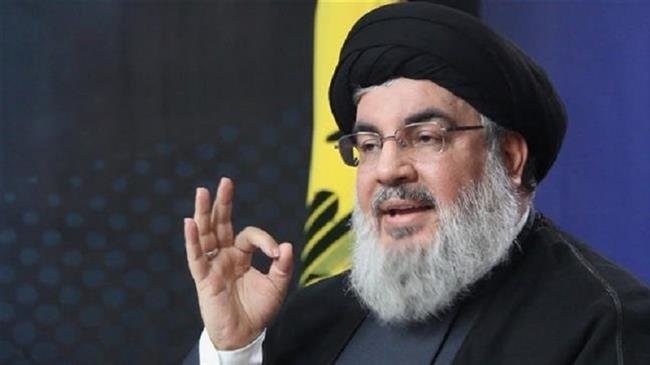
Press TV – July 19, 2019
The secretary general of the Lebanese Hezbollah resistance movement has warned the US that any military aggression against Iran will drag the entire Middle East into disarray, stressing that Washington will definitely not be the one who determines the end of such a scenario.
“As Leader of the Islamic Revolution (Ayatollah Seyyed Ali Khamenei) has said, the US is not capable of imposing a military war on Iran. The White House knows that if a war against Iran happens, the entire region will get entangled, and the US will not be the one who finishes it,” Sayyed Hassan Nasrallah said in a meeting with the visiting Iranian parliament speaker’s special advisor on international affairs, Hossein Amir-Abdollahian, in Beirut on Friday.
Tensions have been running high between Tehran and Washington since last year, when US President Donald Trump unilaterally withdrew the US from the 2015 multilateral nuclear deal, officially known as the Joint Comprehensive Plan of Action (JCPOA), and unleashed the “toughest ever” sanctions against the Islamic Republic.
Recently, the US has taken a quasi-warlike posture against Iran and stepped up its provocative military moves in the Middle East, among them the June 20 incursion of an American spy drone into the Iranian borders.
The Islamic Revolution Guards Corps (IRGC) shot down the advanced US-made RQ-4 Global Hawk over Iran’s territorial waters off the coastal province of Hormozgan after the unmanned aircraft breached the country’s airspace on a spying mission.
Nasrallah then described resistance as the sole and most efficient option in the face of the Israeli regime’s crimes, acts of aggression and excessive demands.
He also lauded Iran’s political and democratic plan for a referendum among all historic residents of Palestine, inclusive of Muslims, Christians and Jews, as realistic and logical.
“The occupying Zionists, however, are the most irrational creatures on the earth, and do not understand anything other than the discourse of resistance,” the Hezbollah chief noted.
He further termed Trump’s controversial proposal for “peace” between the Israeli regime and Palestinians, dubbed “the deal of the century,” as hollow, stating that the Zionists are the root cause of corruption and insecurity in the region.
Nasrallah also highlighted that Hezbollah bears no grudge against Jews, warning members of the religious community not to play in the hands of Zionists’ land grab policies.
The Hezbollah secretary general emphasized that the anti-Israel resistance front is now in its best form even though the US and the Israeli regime continue with their fiendish moves in the region.
“Americans are seeking to impede the purge of the last remnants of terrorists in Syria, and are prolonging the (Syrian) crisis through various means in a bid to prevent the return of Syrian refugees to their homeland. They will fail in their interventionist policies in the region though,” Nasrallah concluded.
Amir-Abdollahian, for his part, congratulated Hezbollah’s victory during the 33-day war in July 2006, and discussed latest regional and international developments besides bilateral political and parliamentary relations between Tehran and Beirut with the Hezbollah chief.
US Imposes Sanctions on Hezbollah Senior Leader Over 1994 Terror Attack in Argentina
Sputnik – July 19, 2019
Hezbollah’s top figure, Salman Raouf Salman, stands accused of the bombing of a Jewish centre perpetrated 25 years ago in Argentina’s capital Buenos Aires.
The United States has introduced sanctions on a senior Hezbollah leader, a Colombian-born Lebanese national Salman Raouf Salman, over his complicity in terrorist attacks, according to the US Treasury. The top Hezbollah operative is accused of coordinating the bombing of a Jewish community centre in Argentina’s capital, Buenos Aires in 1994.
The Treasury’s Office of Foreign Assets Control (OFAC) said it added Salman Raouf Salman to its specially designated nationals list.
Treasury undersecretary of terrorism and financial intelligence Sigal Mandelker stated that Salman has continued to orchestrate terrorist operations in the Western Hemisphere for Hezbollah since the attack in Buenos Aires.
On Thursday, Argentina’s authorities designated the Lebanese-based Hezbollah movement as a terrorist organisation and decreed a freeze of all financial assets belonging to the group.
The move coincided with the 25th anniversary of the violent attack on the Mutual Israelite Association of Argentina community centre in Buenos Aires in 1994 that left 85 people dead and hundreds injured. Hezbollah denied any role in the attack.
Iran and Hezbollah Stand Ready for War
By Jeremy Salt | American Herald Tribune | July 18, 2019
Individually or collectively the construct known as ‘the West’ has had its foot on the neck of the Middle East and North Africa for more than two centuries. Occasionally the foot has been lifted but never voluntarily, only when ‘the West’ was no longer capable of holding it in place. Examples are France’s unwilling retreats from Syria in 1946 and Algeria in 1962, and Britain’s final loss of control over Egypt following the failure of the ‘tripartite aggression’ of 1956, otherwise known as the Suez War.
When they came to Palestine the Zionists packaged themselves as standing on the ramparts of civilization against barbarism. As ‘Western civilization’ had always been spectacularly uncivilized in its treatment of black and brown people, the Zionists were standing on the ramparts of Western barbarism, not civilization.
An existential moment seems to be approaching in Middle Eastern history. The so-called West has dominated the region and North Africa since Napoleon landed a French army in Egypt in 1798. Since then, few countries that have escaped invasion, occupation, subversion and the overthrow of governments.
The record is seamless, continuing with the destruction of Iraq, Libya and Syria and the current confrontation with Iran. Ever-tightening sanctions imposed since the 1979 revolution are designed to implode the country from within, with military attack repeatedly threatened by the US and Israel.
Unless and until this long historical cycle of violence across the region is broken, the Middle East seems doomed to suffer its repetition endlessly. At this juncture of history, however, the West is not what it used to be and is no longer capable of imposing its will on the Middle East except at tremendous cost to itself.
The former imperial powers, Britain and France, are now no more than satraps of one power, the US, a single imperial power in noticeable decline. The costs of its wars alone have been enormous. Since 2001 it is estimated to have spent $5.6 trillion on wars in the Middle East and Afghanistan and on combatting ‘terrorism’ in other arenas.
This is money every American knows – and Donald Trump said in 2016 that he knew – is needed for urban redevelopment and the upgrading of broken infrastructure and inadequate social services across the country. Furthermore, there is no American public appetite for more wars in the Middle East.
Conversely, as imperial decline approaches the point of imperial exhaustion, the determination of the ‘axis of resistance’ is strengthening. It is now speaking back to the West and Israel in the same dominant language that the west has always used, which of course is the language of force. In the mainstream media, this will be called ‘defiance’ rather than what it is, which is the rising determination of the people of the Middle East to determine their own future and finally shake off the fetters of external domination. The message being sent forth by both Iran and Hezbollah is that if the collective West and/or Israel dare attack again they will be ready for them.
The message being sent forth by both Iran and Hezbollah is that if the collective West and/or Israel dare attack again they will be ready for them.
This is not empty talk. Hassan Nasrallah, Hezbollah’s Secretary-General, always means what he says and only says what he means. No-one follows his statements more closely and takes them more seriously than the Israeli military command. He is an enemy who has earned their respect.
In June Iran’s Revolutionary Guard shot down a $200 million RQ-4 high altitude drone, the biggest and most sophisticated in the US drone fleet. Although the US had only recently designated the Revolutionary Guard as a “foreign terrorist organization,” and although it claimed, falsely, that the drone had been flying over international waters, it did not retaliate. Trump claimed that he called an attack off when he learned that it would cause 150 civilian casualties. In fact, the real reason seems to have been that Iran passed on the message through a third party that if the US attacked it would immediately strike at US targets in the Gulf.
John Bolton and Benyamin Netanyahu have been pushing hard for war, against strong resistance within the US administration. If they succeed, Iran has warned that it will immediately close the Strait of Hormuz to all shipping and retaliate against US military bases and other targets in the gulf. Any war started in the gulf will quickly spread across the region, involving Israel. Conversely, any war started by Israel against Lebanon and Hezbollah will quickly spread to the gulf.
The effects will be felt around the world with an infinitely worse effect on the global economy than the energy crisis which followed the 1973 war, when Israel was caught napping in the occupied Sinai and would have lost the war but for Anwar Sadat’s betrayal of his Syrian wartime ally, Hafez al Assad and but for emergency arms shipments flown directly to Israel’s Sinai front by the US.
Hassan Nasrallah is showing such confidence that it has to be assumed that he knows something about Hezbollah’s weaponry that we don’t and Israel probably does not either. Very probably it is the capacity to seriously degrade Israel’s air power. This is an issue Iran and Hezbollah have been working on for decades, as it is the key to the outcome of any future war.
Hezbollah is far stronger now than it was when it humiliated Israel in 2006. It can fire enough missiles simultaneously to overwhelm Israel’s anti-missile systems. They can reach any corner of enemy territory. If Hezbollah is also capable of shooting down aircraft, Israel faces the prospect of starting another war it cannot win, with far worse consequences than it has ever faced in its history.
Israel has had one outstanding victory since 1948. This was in 1967 when it attacked Egypt and Syria, rendering their ground forces useless by destroying their air ccover before going on to occupy the Golan Heights and the rest of Palestine. It was this war that gave rise to the myth of Israeli invincibility, exploded only six years later when Egyptian forces crossed the Suez Canal and routed the occupying Israeli forces.
Israel’s 1982 war on Lebanon was more of an onslaught on a defenseless civilian population, a prelude to its massacres by air and artillery in Gaza. Close to 20,000 people, overwhelmingly civilians, were killed in Lebanon before it was over. Given the combination of airpower, artillery, armor and the number of ground troops (80,000 to 100,000) Israel simply swamped lightly-armed Palestinian and Syrian resistance.
Israel’s occupation of southern Lebanon lasted for more than two decades before being ended by Hezbollah in 2000. Since 1985 Hezbollah had vastly improved its capacities at all levels, including electronic warfare, enabling it to intercept Israeli communications and ambush and destroy even elite units. Unable to defeat Hezbollah and facing a rising tide of anti-war sentiment at home, the Israeli government finally decided to cut and run, virtually overnight.
Frustrated, Israel struck back in 2006, only to be thwarted again in an even more humiliating defeat. Its reserves were so poorly disciplined that commanders hesitated to send them into battle, but even elite forces such as the Golani Brigade were outfought by Hezbollah’s part-time soldiers. Even with total command of the air Israel proved incapable of seizing and holding territory only a few kilometers north of the armistice line. Thoughts of advancing across the Litani river and taking on the professional core of Hezbollah’s fighting forces had to be abandoned.
The US held the door open for Israel week after week, giving it the time it said it needed to finish off Hezbollah. Suffering one setback after another, however, Israel was not up to the task. After 34 days it had had enough and retreated, leaving behind the wreckage of dozens of armored vehicles, including the supposedly invulnerable Merkava tank, destroyed by Hezbollah’s Sagger anti-tank missiles. Hezbollah had also taken the war to sea, crippling an Israeli warship in an apparent missile strike.
The unpalatable truth for the Israeli military command was that its ground forces had been outsmarted and outfought along Hezbollah’s first line of defense in the south. Even with its air power Israel proved incapable of moving beyond this line.
In the years since 1982, as the weaknesses behind the myth of the ‘invincible’ Israeli armed forces have been gradually exposed, the enemies Israel has vowed so often to obliterate have been catching up, reaching the point of armed capacity where Nasrallah says Israel is too frightened to attack again.
He has mocked it for taking 13 years to discover tunnels Hezbollah had dug from Lebanon. In a recent interview with Al Manar television station, marking the 13th anniversary of the 2006 war, he taunted Israel by showing a map of all the strategic targets Hezbollah will hit along the coastal strip if Israel dares to go to war again. They include Ben-Gurion airport, petrochemical plants, arms depots and the ports of Tel Aviv and Ashdod (Palestinian Isdud).
Nasrallah referred to “game-changing” offensive weapons that could bring Israel to “the verge of vanishing.” They include drones and precision missiles but when asked whether Hezbollah also had anti-aircraft missiles he would not say, referring only to a policy of “constructive ambiguity.”
Hezbollah claims that it can reach any part of Israel with its missiles and is capable of inflicting massive destruction of civilian and military targets. A land invasion has also been planned, with Nasrallah saying Hezbollah has “several scenarios” for the penetration of Galilee by its forces.
Since 2006 Israel has repeatedly threatened to destroy Lebanon in the next war. The template would be Dahiyeh, the largely Shia suburb of Beirut, which Israel sought to obliterate from the air in 2006. Military, intelligence and political figures have all threatened that the next time around the ‘Dahiyeh strategy’ would be applied to the entire country. One Israeli ‘ defense official’ says that in the next war Lebanon will “experience” a level of destruction not seen since the Second World War. “ …. We will crush it and grind it to the ground.” (David Kenner, ‘Why Israel fears Iran’s presence in Syria,’ The Atlantic, July 22, 2018).
Nevertheless, behind the bluster and threats lies fear. No one but Hezbollah and perhaps Iran really knows the size and capacity of Hezbollah’s missile arsenal but US and Israeli estimates put the number at between 100,000-130,000. Hezbollah is capable of firing 1200-1500 missiles a day. In recent years Israel’s developing nightmare has been that these weapons would be launched in sufficient numbers and with sufficient accuracy to destroy civilian and military infrastructure and paralyze daily life. In fact, as Nasrallah’s confident remarks indicate, that point seems to have been reached.
Just as Hezbollah is ready for the next war so is Iran. The target of European subversion and intrigue since the 19th century, Iran has been threatened and punished with economic sanctions, assassination and subversion since it dared to take hold of its own future in 1979. Telegraphing their punches in advance, the US and Israel have repeatedly threatened it with obliteration.
The scholar Sayed Mohammad Marandi has written on Iran’s position in the face of these continuing threats (‘Iran faces US aggression and European hypocrisy but this time it’s ready,’ Middle East Eye, July 12, 2019). Basically, Iran has had enough. Writes Professor Marandi: ‘Repeated threats of nuclear holocaust and genocide by Israel’s Prime Minister Netanyahu and Trump are deeply embedded in western civilization’s centuries-old tradition of colonization, mass slaughter and moral absence.”
Given the west’s record “there is no reason to expect that a declining and desperate empire will conduct itself in a civilized manner today.” Iran’s preparations include the development of a formidable arsenal of missiles, the acquisition of weaponry needed to fight a sea war in the gulf and the construction of underground military facilities.
Retaliation by Iran would involve the destruction of oil and gas facilities as well as oil tankers and other shipping on both sides of the Strait of Hormuz. Finally, “western establishment politicians and pundits seem to thrill at sending nations back to the stone age. But be sure that if there is war, this time around Iran and its allies will make sure they come along for the ride.”
As Professor Marandi, as President Rouhani and Ayatollah Khamenei have all made clear, and as Nasrallah has made clear, these current targets of the west are prepared to fight back with all the weapons at their disposal. This is not a question of the Iranian government or Hezbollah merely being punished but being destroyed, at a time, however, that the West – as led by the US – has never been in a weaker position to impose its will without incurring incalculable military and economic costs to itself.
If John Bolton and Benyamin Netanyahu get the war they want, Iran and Hezbollah, knowing that the object is their destruction, will strike back with full force from day one. The devastation on both sides would be massive, with the possible use of nuclear weapons part of the picture. A climactic point seems to be approaching fast in the history of the Middle East.
The Only Strategic Rationale for America’s Involvement in Syria Finally Revealed
By Elias Samo | Strategic Culture Foundation | July 6, 2019
“Washington lacks a clear strategy in Syria “; those were the recent words of Robert Ford, the last American ambassador to Syria who served prior to and during the first few years of the Syrian uprising from 2010 to 2014. A man of Ford’s intricate knowledge of the Syrian/American political dynamic is surly knowledgeable enough to assess America’s policy towards Syria. He goes on to say, “It is hard to explain the fundamental American mission in Syria… Is it to fight Daesh? Or is it to help promote a Kurdish autonomous district in Northeastern Syria… Or is it to resist Iranian encouragement?” It is partially all three; however, oddly enough, Mr. Ford avoids the obvious top priority and strategic rationale for America’s involvement in Syria: The Protection of Israel.
To alleviate this dereliction by the executive branch for not presenting a clear strategy in Syria, as the former ambassador asserts, the Congress took it upon itself to identify American strategic interests in Syria and make recommendations to Trump. However, it is legitimate to ask: what do American congressmen know about Syria to qualify them to determine American strategic interests in the country? It is very unlikely for American congressmen to know much about Syria; they are dictated the Israeli narrative and that is all they need to know.
Irrespective of who or what motivated the congressmen to seek information to develop a framework for American strategic interests in Syria and eventually send a letter signed by nearly four hundred congressmen- roughly seventy five percent of the total number of congressmen from both chambers and both parties- to the president about their findings and their recommendations, the congressmen called upon United States Institute of Peace (USIP) to establish a Syria Study Group (SSG) to provide them information about Syria to comprehend the situation and formulate recommendations to Trump.
The SSG was established in February 2019 and gave its interim report to Congress May 1, 2019; the report consists of detailed seven single-spaced typewritten pages.
Subsequent to the SSG submitting of its interim report to Congress on May 1, the four hundred congressmen Letter was sent to the president on May 20. It would be natural to assume that the Letter is a condensed reflection of what the interim report contained and recommended; that was not the case. The elaborate and detailed interim report dealt with a multitude of issues centered around American national security. Ironically, the Letter to the President focused on the sources of threats to Israeli security: terrorism, Syria, Lebanon (Hezbollah), Iran, Turkey and Russia. Just a note regarding the difference in emphasis in the two documents. In the seven – page single spaced interim report Israel is mentioned nine times, it is mentioned twenty one times in the two page Letter.
The first paragraph of the Letter states “[…] we recommend several specific steps to advance our regional security priorities, including assisting our ally, Israel, in defending itself in the face of growing threats, including on its northern border.” The reference to northern border is Syria and Lebanon. As for Syria, it suffices to note that Israel occupied the Syrian Golan for fifty two years and annexed it recently with Trump’s blessings. Syria has not fired a shot at Israel in decades while Israel has fired hundreds of shots at Syria just recently; there are no Syrian boots on the ground in Israel, while there are Israeli boots on the ground in Syria. So much for the threat to Israel emanating from Syria. As for the Lebanese scenario, it is similar to that of Syria, albeit on a smaller scale, with one addition: Hezbollah which Israel views as a source of imminent threat. However, it suffices to note that it is Israel which has been the source of violent onslaughts against Hezbollah. The Letter, in the succeeding paragraphs, elaborates further on the acquisition by Syria and Hezbollah of large and more threatening sophisticated weapons to threaten the security of the regional, nuclear super power: Israel. Need one point out the ridicule?
In the third paragraph, the Letter asserts: “While our nation has encouraged more stable and inclusive political systems in the Middle East, the regime in Tehran has spread its influence and destabilized its neighbors for its own gain.” To say this is an outrageous distortion of the truth would be an understatement. There is not a sane Iraqi, Syrian, Lybian, Yemeni and most Muslim Arabs who would vouch to such a distortion. In fact, internationally, the US and Israel are viewed as sources of threat to international peace and security; both have boots on foreign ground but no foreign boots on their ground.
Russia receives a jab at the fourth paragraph for its role “[…] to ensure the survival of the Assad regime.” It adds “Furthermore, in providing Damascus with advanced weapons like the S-300 anti-aircraft, Moscow is complicating Israel’s ability to defend itself from hostile action emanating from Syria.”
The last part of the Letter contains three recommendations which are interrelated and converge on the core of the Letter; the security of Israel:
- Underscore Israel’s right to self-defense.
- Increase pressure on Iran and Russia with respect to activities in Syria.
- Increase pressure on Hezbollah.
Beyond any conceivable doubts, the Letter was dictated by Israelis or their advocates in Washington, signed and submitted by the 400 congressmen to Trump; the height of hypocrisy. What is dismaying is that hardly any voices of protest were raised in American society at large or the political or intellectual segments about the fact that four hundred congressmen, who are elected by Americans to serve American interests, at a time when the US is bogged down in the Arab region, sign and submit a letter to the US President concerned almost exclusively with Israel’s Security.
These congressmen had an opportunity to make a coherent recommendation on US policy in the Arab region in the interest of American National Interest, but instead chose to make recommendations to safeguard the wellbeing and security of a foreign state: Israel.
US Sanctions Hezbollah Elected Parliamentarians
Al-Manar | July 9, 2019
The US Treasury placed two Hezbollah members of Lebanon’s parliament on its sanctions blacklist on Tuesday — the first time Washington has taken aim at the party’s elected politicians.
The Treasury named the head of the Loyalty to Resistance parliamentary bloc Hajj Mohammad Raad and MP Amin Sherri to a ‘terror-related’ blacklist, claiming that Hezbollah uses its parliamentary power to advance its alleged ‘violent’ activities.
Also placed on the blacklist was Hajj Wafiq Safa, Hezbollah top security official.
Hezbollah is a Lebanese resistance group that defends the nation against the Israeli and takfiri enemies. Because of its huge popular representation, it managed to have a 13-member parliamentary bloc, mainly tasked with securing the socioeconomic rights of the citizens and advocating the resistance political principles.
The US administration, which supports the Zionist entity and the Arab dictators against the will of most of the Muslims and Arabs, has always viewed Hezbollah resistance as an enemy, blacklisting both its military and political wings.
Nasrallah: Zionist Axis Defeated, We Have Enough Missiles to Redraw the Map of the Middle East
Speech by Hezbollah Secretary General Sayed Hassan Nasrallah on Friday, May 31, 2019, on the occasion of Al-Quds (Jerusalem) International Day.
Transcript:
[…] Another element indicating (the improbability of a war against Iran) is the field data, and I mean the (triple) Summit which I have just mentioned. And we are now entering the (4th section of my speech devoted to the triple) Arab Summit (in Mecca on May 30-June 1). The Summit was convened in emergency. Why? There are two reasons, two clear reasons that are mentioned in the (final) statements (of the Summit).
The first reason… The first reason… I remember that during the first days of the war of aggression against Yemen, His Eminence the (Supreme) Leader, Sayed [Khamenei], said that the young (fighters) of Yemen would rub the Al-Saud’s noses in dirt. Some days ago, the Saudi (army) bit the dust (once again). That’s what happened.
The first reason (for the improbability of war against Iran), that I mentioned earlier, is that Saudi Arabia has recognized the fact that there was no way out against the missiles of the Yemeni army and Popular Defense Committees, which they call the ‘Houthi’ missiles, and against their drones, and my proof is what happened in Yanbu’ (strikes of a Yemeni drone against oil installations in Saudi Arabia). It is a failure, a complete disaster. On the technical, military, security levels, and on every other level, it is a colossal failure. And it is a great success for our Yemeni brothers.
And that’s why in the joint statement at the conclusion of the Arab Summit, from the first line, points 1, 2, 3, 4, 5, 6, 7, 8, 9 and 10 only speak of Houthis, Houthis and yet again Houthis, as well as Iran. This clearly shows how much the issue of our Yemeni brothers is present and is the main cause for convening this triple Summit.
The second reason (indicating the improbability of a war against Iran) is that the Saudi regime and its allies understood with certainty that there will be no US war against Iran. You are dreaming (O Saudis), you spend your money for nothing and you incite for war to no avail. Trump will not fight for you, while it was your greatest hope. The last thing the Saudis had left was this hope (on which they have staked everything). Is there anything they can do? Do the Saud have alternatives (to prevail)? Who will go to war against Iran? The Saud themselves? While in Yemen, according to the information of the Saudis themselves, these young Yemeni fighters who have no army, no huge capacities, who are besieged, isolated, hungry, sick, whatever you want, but Saudi Arabia fails, is defeated and broken against them! And you (the Saudis) would go to war against (such a formidable power as) Iran? Who (will dare attack Iran)? Will they hire Netanyahu to launch a war against Iran? Let him first take care of his own problems (electoral and with Israeli justice)!
It’s the end of the road (for the Saud)! All their plans and hopes rested, in recent weeks, on Trump, on Trump’s incitement (to war), on Bolton, on Pompeo and all their fellow evil men in b or p, who were threatening to attack Iran and devastate this country. But it’s over. All their hopes were dashed.
That is why this Summit was convened in Mecca, as I said, to call the Arab and Muslim worlds and the Gulf countries for help. ‘Hasten therefore (to our help), O Arabs’ (cried the Al-Saud dynasty)! I wrote here… Where is this paper?… I wrote (a summary about it)… “Saudi Arabia convened the triple Summit to strengthen itself with the support of the Gulf it has torn apart…” For who is responsible for the crisis in the Gulf Cooperation Council? Saudi Arabia! “(Saudi Arabia convened the triple Summit) to strengthen itself with the support of the Gulf it has torn apart, of the Arabs it has crushed…” Is there a single Arab country left where Saudi Arabia has not created discord and division? And until now, up to this very day, there are Arab countries torn with civil wars, and Saudi Arabia is (the main) responsible. And there are Arab countries under threat of falling into civil wars (Algeria, Sudan…), and we must look (for the hand of) Saudi Arabia (behind it). “(Saudi Arabia convened the triple Summit to strengthen itself with the support of the Gulf it has torn apart), of the Arabs it has crushed and of the Muslims among whom it has spread the sedition of takfir.”
See Pakistan: Saudi Arabia wants to become stronger by getting the support of this country, while it propagated its takfiri ideology there among the Taliban, who created innumerable problems for the Pakistani military and the Pakistani people. Today, Saudi Arabia is calling on all these countries to save it (and get it out of the Yemeni quagmire).
First, regarding the Summit… I will conclude my remarks with a few words. Regarding the (Mecca) Summit, such is the context that explains it. It is a call for help, a cry for help, an intercessory request… You know it’s Ramadan (where all wishes can be fulfilled), so the Saudis make prayers, express wishes, cajole (the Arab governments) so that they’d fulfill their wishes, because of their failure and powerlessness, and because their hopes were dashed. The opposite Axis (United States, Israel, Saudi Arabia) isn’t in any case in a position of strength. It is in a position of weakness and failure, desperate, greatly confused and completely discouraged. This is the truth.
Second, let us consider the Joint Statement issued after the Summit. We see that it is composed of 10 points, which speak only of Iran and the “Houthis”, as they call them, but in the end of this Statement, as we commemorate the International Day of Al-Quds (Jerusalem), at the very end of this Statement, really the last two lines, we read: “And about the Palestinian cause, the main cause of the Arabs, the Summit has confirmed its commitment to the resolutions of the 29th Arab Summit (of April 2018) in Dhahran (Saudi Arabia), or Al-Quds Summit, and the resolutions of the 30th Arab Summit in Tunis (in March 2019).” Period. They did not even devote two lines to Palestine! They gave it only a line and a half of their final Statement! That’s the importance of Palestine for the Arab Summit. I do not even know if they actually talked about it (during their discussions), I just read the final Statement.
And about the Summit of the Gulf Cooperation Council, there is a really funny thing, the 4th point. Listen to the 4th point (of the final Statement) of the Summit of the Council of the Gulf Cooperation: “Confirms the strength, harmony and resolution of the Gulf Cooperation Council and the unity of its members around a common line to face these threats.” And they say that while they are besieging Qatar! They have been besieging the State and the people of Qatar for over a year! It’s really hilarious, Uncle! By God, some people really don’t realize that they have become the laughing stock of the world! The whole world mocks them, demeans and humiliates them!
Another point about the Arab Summit, we have a duty to praise the position expressed by Iraq and the President of the Republic of Iraq. It’s a remarkable position, courageous and excellent. What a shame that the rest of the Arab Presidents, Kings and Emirs did not talk the same way! And the Iraqi delegation has not said that they wanted to wage war against Saudi Arabia, the UAE, or anyone, nothing like it! They spoke in a balanced manner (without taking sides with Iran nor Saudi Arabia). You could do the same thing (and display a conciliatory neutrality). What prevented you from doing so, O Arabs? What a pity that (the participants of this) Summit, in spite of the failure, powerlessness and confusion (of Saudi Arabia), and the economic exploitation of the situation by the United States, have not talked in conciliatory terms about Iran, when Iran itself, a few days ago, said via its delegates that they were ready to talk with the Gulf states, and conclude pacts of non-aggression with them! Why did they not adopt the same open and conciliatory diplomatic language? If they had done so, their money, their safety, their security, their interests and even their dignity would not be violated by Trump morning and evening.
On the Arab Summit, I have one more thing to say: as a Lebanese party who participate in the government of Lebanon, we (Hezbollah) consider that the position of the official Lebanese delegation to the Arab Summit contradicts the Ministerial Declaration (of the Hariri government) and violates the commitments and promises of the Lebanese government, who received the confidence of the Parliament on the basis of this Declaration. Where is the promised neutrality, O official Lebanese delegation to the holy city of Mecca? You could have said… It was not even required that you take a position similar to that of Iraq. You could simply have said that the Lebanese government was committed to neutrality (in regional conflicts) and that such a stance was required in the national interest of Lebanon, which had to remain neutral, as it had done in previous Summits.
That is why we reject this position (expressed by the Lebanese delegation), which we consider unacceptable and condemn because it does not represent Lebanon. It represents only the members of the delegation (as individuals) or the political parties they belong to. It is impossible that this be the official position of Lebanon, a position which publishes a Statement with 10 paragraphs condemning Iran and only dedicates a line and a half to Palestine, the whole Statement expressing support for an Axis (US-Saudi-Israeli) against another (the Axis of Resistance).
Of course, the Future party could have made a statement of their own supporting eloquently the Final Statement of this Summit held in Holy Mecca, it is their natural right. We wouldn’t mind at all because (it is common knowledge) that we have opposite stances (on regional issues). We have already said that neutrality is not required of political forces. And we are the first not being neutral (and strongly and publicly announcing our stances against the US, Israel, the Saud…). But we agreed that the Lebanese government would remain neutral. The Lebanese State must remain neutral (because it is composed of both pro-American and pro-Iranian forces). And what happened in Mecca is contrary to the commitments and promises (made by the Future Alliance heading the government), and to Lebanon’s national interest.
This brings me to the last point (of my speech). (I’m sorry) for being so long, on this night of Ramadan, but it is a sensitive issue whose mention cannot be postponed. Regarding the delimitation of the (land and sea) borders (between Lebanon and Israel), as I have said repeatedly, as a Resistance, we have no problem and we comply with the decisions of the State. And for all that is happening at the borders, we leave everything in the hands of the State, whether what is happening is good or bad, right or wrong. Regarding the demarcation of our land and sea borders, we will respect all the decisions of State, (and we do not have a say).
And by making these statements, I do not exaggerate. Some brothers think that my words are conciliatory but do not coincide with reality, but no, I tell the strict truth when I say that we in Hezbollah trust the Lebanese officials who are in charge of this issue, and who are committed to upholding all Lebanon’s rights to land and water, in terms of maritime (space), oil and gas (resources present in the Mediterranean). We have (full) confidence in them, and that’s why we do not intervene in this issue. So much for the positive points, for I will now turn to a very different point.
On this issue, what is the United States striving to achieve through (its envoy) Mr. [David] Satterfield and his ilk? The USA is very strong to exploit all things, and exploit (all situations) in an evil way (in their interests and to our detriment). Since Lebanon needs a rapid delineation of borders, especially at sea, to (be able to exploit) oil and gas (resources at sea), and since Lebanon needs a calm situation in order to get financial loans —for we speak mainly about loans, not grants—, in this context, the United States come to… I hope that all the Lebanese will listen to me.
The United States wants to exploit the (indirect) negotiations (between Lebanon and Israel) on the demarcation of land and maritime borders to solve another adjacent, unrelated problem in the sole interest of Israel, and that Israel has been unable to resolve for years, namely precision missiles and the manufacture of precision missiles.
For over two years, (we have been contacted constantly by) ambassadors, embassies, foreign intelligence services, including those countries that consider us officially as terrorists, it does not bother them. They asked us the following questions, or (rather) addressed us the following messages: you have precision missiles, and this is something that Israel will not tolerate, and when Israel will learn their place (of storage), they will bomb them. That’s the message that we kept receiving for over two years. That’s (the first point).
The second point was the accusation that we’d have precision missile factories in Lebanon, which is (allegedly) a red line for Israel that will not be tolerated, and the warning that if Israel gets to know their location, they will bomb them. We hid this matter to the public for two years so as not to worry anyone, and to settle this matter behind the scenes. But some things happened during this week that lead me to speak out today because I think this whole issue will soon be discussed in the media, this topic being debated today in wider circles. I prefer to publicly state our position on this issue, rather than let the (State) officials being responsible for sending messages or answering questions (about this topic), and it is better that these answers come directly from me so that the United States, Israel and others receive them distinctly. (That’s better), isn’t it? That’s why I mention it.
Regarding the first point, the precision missiles issue, we are people who always tell the truth, we never lie. We can of course not reveal the truth without lying, or tell only part of the truth, but we never lie. That’s why when they asked us (if we had precision missiles), we answered that yes, we had precision missiles, and then you remember that two years ago, the tenth day (of ‘Ashura), I announced quite clearly that we have precision missiles able to hit all the targets required in the Zionist entity.
And today, on this (International) Day of Al-Quds (Jerusalem),on the 40th anniversary of the announcement of this Day, I say to the world that yes, we have in Lebanon enough precision missiles to change the face of the region and (upset) all equations!
But I say nothing new. That’s what I said for ‘Ashura two years ago. And to all those who have asked us, we said yes, we had precision missiles. And to all those who said or transmitted messages (Israeli threats), we said that there was no problem… It’s been 1, 2 and 3 years that these messages circulate, and that our response has been given and reached Israel: any time they tried to intimidate us by speaking of Israel, of red lines, of unacceptable things, of bombing, of (a violent) reaction, etc., our answer was clear, and I then repeated it publicly (in an interview) with Al-Mayadeen TV and then in a live speech. And I’ll repeat it again: we said that against any aggression, any Israeli strike against any target related to the Resistance in Lebanon, be it missiles or anything else, Hezbollah will retaliate immediately, directly and with (great) force!
And that’s why for 1 year, 2 years and 3 years now, they never bombed (Lebanon). And even more, Israel is going to the UN to (complain) that under the Al-Ahed football stadium, there would be missiles, and at such other place as well, (and then the UN) asks the government to verify if missiles are present at a given location, etc. It is not out of manners or decency that Israel does not strike our missiles. It is because we are strong that they don’t dare to do so (because they fear our retaliation), and that we will respond to any aggression by a similar attack, if not more!
The issue of precision missiles was therefore over (with a dead end for Israel). No one can do anything against it. So the issue has been upgraded with the accusation of possession of precision missile factories (in Lebanon). A few months ago, a (Lebanese) official said that the United States had contacted him to tell him this and this. I replied: “My dear official —I do not say anything specific to protect his identity—, this information is false. We do not have —and I speak with complete frankness— we have no precision missile factory in Lebanon.” He asked if the Iranians had such factories in Lebanon. I told him that the Iranians had no factory in Lebanon, be it for precision missiles or other missiles, or anything at all.
So far —I say so far, until tonight, until this International Day of Al-Quds—, there are no precision missile factories (in Lebanon). So the Americans left and came back later (with new charges), saying that there were such factories in such and such place, until what they said recently, namely that the process of delimitation of maritime borders was obstructed by the fact that in such region, there were precision missile factories. Again, several Lebanese officials asked me about it, and I said that it was not true. In this region, there are military facilities, supplies and equipment of Hezbollah, but no precision missile factory. That’s all.
What is my point? These (false accusations) have been accompanied by various threats. I will not say what the threats were because there is no reason for me to reveal them, but several threats were made, so that Lebanon settles this issue (precision missile factories) and destroys such and such installations, razes them to the ground and terminates them. But my dear (US) friends, do you know who you are dealing with? In what world do you live (to believe that your threats can frighten Hezbollah)? It is absolutely inconceivable for us.
In addition, we, in Hezbollah, are more trustworthy and reliable than the Americans and their predecessors, and more trustworthy and reliable than the Israelis and their predecessors. When I tell you that there is no precision missile factory, this means that there is none. And if there were such a factory, I would have said this evening on TV that there is such a factory, as I’ll prove in a moment.
I will explain my problem with this question and conclude my speech. My problem is that… That’s why I did not want to discuss this issue only with Lebanese officials, but I wish that we all (Lebanese) take part in it. The very discussion of such issues with the United States, merely allowing them to ask us about (our weapons), this door should be in my opinion closed. It is not their business, they have no right to inquire about our weapons. The US does not have any right to meddle in it. Whether there are precision missile factories in Lebanon or not, it is not their business. Israel, which is right next to us, manufactures missiles, warplanes, tanks, nuclear and chemical weapons. Let them go there and make the same requests! As for us, it is our right —and that’s what I want to add this evening—, it is our absolute right to possess any type of weapons to defend our country. And it is our absolute right to manufacture any type of weapons, because to have weapons, there are only three possibilities: either you buy them, or someone gives them to you, or you manufacture them.
In Gaza, what do they do? They make them. In Yemen, what do they do? They make them. But the Saudi mentality is unable to conceive that Yemenis can manufacture their own missiles and drones (and they accuse Iran of supplying them). What do you want me to do about it? In Iran, what are they doing? They manufacture their own weapons! And we absolutely have the right to do the same. I affirm that the United States do not have the right to debate with us on this right. That’s the first point. How does it concern you? Whether we have such factories or not, it’s none of your business. I assure you that there are no such factories yet, but you have no right to ask me in the first place! Whether there are such factories or not, mind your own business! We have every right to have all the weapons that allow us to defend our country, whether we buy them, they are given to us or we manufacture them. That’s the first point.
Second, if the United States continues to bring up this issue, I tell them this: we have all the technical and human capacity, thanks to our youth, to manufacture precision missiles, and we are perfectly able to import in Lebanon all the equipment required to open such factories. I declare tonight that if the United States continues to bring up this issue, let the whole world know that we will open precision missile factories in Lebanon!
So far, we have no such factories (in Lebanon), but if they continue to bring up this issue, they will convince us to do so! Then, the government talks about many problems of the Lebanese industry. Today, one of the greatest evils in the world is arms sales… Why are you laughing, I’m serious! We are able to manufacture precision missiles and sell them to the world, and thus help the Lebanese Treasury. Is that okay with you?
This is why I advise Satterfield to stay calm and do the job he is asked to do (without encroaching on our business), since he claims to be there to help… But who does he (really want to) help? Because you know that in general, the United States are not intermediaries. They are only there to lobby and defend the interests of Israel, and God help our Lebanese brothers responsible for these negotiations. Let Satterfield close this file and not waste his time in (idle) threats, and stop exerting himself. He should stop exerting himself (in vain).
This is our natural right (to have all the weapons required), we will remain attached thereto, and threats lead to nothing with us. These threats are not new, but date back to 2 or 3 years. I have answered them, and I do not want to have to repeat myself, okay? Be it now, before or after, our position remains the same.
In conclusion, O my dear and noble brothers, on this Day of Al-Quds, on this 40th year of the celebration of this Day, our (Resistance) Axis is in a position of strength, as is our front (the battlefield). It is true that in recent years we have made many sacrifices, but by the grace of the blood of martyrs, we got out of all these sacrifices stronger and more present. And it is full of strength, determination, faith and confidence that I tell you all that we can defeat the Deal of the Century and make it fail, and at the forefront the Palestinian people: when Palestinians are unanimous in their sovereign position, as I called it, about the Deal of the Century and the Conference in Bahrain (which are condemned by all factions), nobody can impose anything, neither to Palestinians nor to the region.
When the Syrian people refuse to cede the Golan, Golan will never become Israel’s, even if Trump redraws maps and signs below, as announced by Netanyahu yesterday. Let them sign anything they want, do what they want, and say whatever they want, (it will be futile). If we stay present in the field, on all battlefields, if we remain attached to our rights, and above all, before, after and with everything, if we trust in God and in His promise of victory, if we believe in Him, in our peoples, in our generation, in our men, in our women, in our brains and in our minds and willpower, the future belongs to Al-Quds, and not to Trump or to all the insignificant midgets who work for Trump.
Peace be upon the soul of the great Khomeini, who founded this Day, happy (al-Quds) holiday, and may God grant you victory and glory.
See the previous parts of this speech translated in full:
Resistance Axis, Arab & Muslim Peoples will Never Forsake Palestine
In the Next War, Missiles from Lebanon, Gaza, Syria & Iran will Strike Israel, Trump’s Deal of the Century Doomed to Fail
A War against Iran would Destroy Israel, the Saud and US Hegemony
Translation: resistancenewsunfiltered.blogspot.com
Israel Looks to Bolster Diplomatic Cover for New Level of Civilian Bombing in Lebanon
By Whitney Webb | MintPress News | June 28, 2019
During a conference hosted on Tuesday by the Mossad-linked Shurat HaDin or Israel Law Center (ILC), Israel’s Public Security and Strategic Affairs Minister Gilad Erdan demanded that international laws on warfare be amended because current international law pertaining to warfare “serves terrorists.”
Erdan claimed that groups like Lebanon’s Hezbollah use existing international laws of war “to destabilize the ability of democracies to defend their citizens” and “force [democracies] to fight against terrorists with their hand chained behind their backs.” The ILC’s director, Nitsana Darshan-Leitner, seconded Erdan’s claim but argued that changing international law is difficult, thus making it more practical to change how existing laws of war are interpreted, a task she suggested be performed by military prosecutors.
According to the Jerusalem Post, the laws currently governing international warfare are aimed specifically at reducing the suffering of civilians and, as the Post article suggested, Erdan wanted to change these measures aimed at protecting civilians prior to the “next war” between Israel and Lebanon because in that war “Israel will have no choice but to harm Hezbollah rocket sites and Lebanese infrastructure.” Erdan’s argument hinges on the commonly repeated accusation by Israeli officials that Hezbollah uses civilians as cover for military operations, but a comprehensive 249-page study by Human Rights Watch found that not to be the case. In fact, the study found that even “a simple movement of vehicles or persons – such as attempting to buy bread or moving about private homes – could be enough to cause a deadly Israeli airstrike that would kill civilians.”
Bolstering diplomatic cover for a coming war
As MintPress previously reported, Israel’s government has been preparing for an imminent war with Lebanon and specifically Hezbollah — which is a strong political force in Lebanon, with the coalition of which it is part holding a legislative majority in Lebanon’s parliament — for well over a year. It has warned prominent U.S. Senators not only that it planned for a “bloody” war against Lebanon, but that the Israeli military planned specifically to target Lebanese civilians and civilian infrastructure, including residential areas.
During a visit to Israel last March, U.S. Senator Lindsey Graham (R-SC), a close ally of the Trump administration, stated that Israel’s Likud-led government was requesting “ammunition, ammunition, ammunition” from the U.S. government, as well as diplomatic support for when Israel strikes civilian targets — such as “civilian apartment buildings, hospitals, and schools” — because Hezbollah has become “integrated” into these structures.
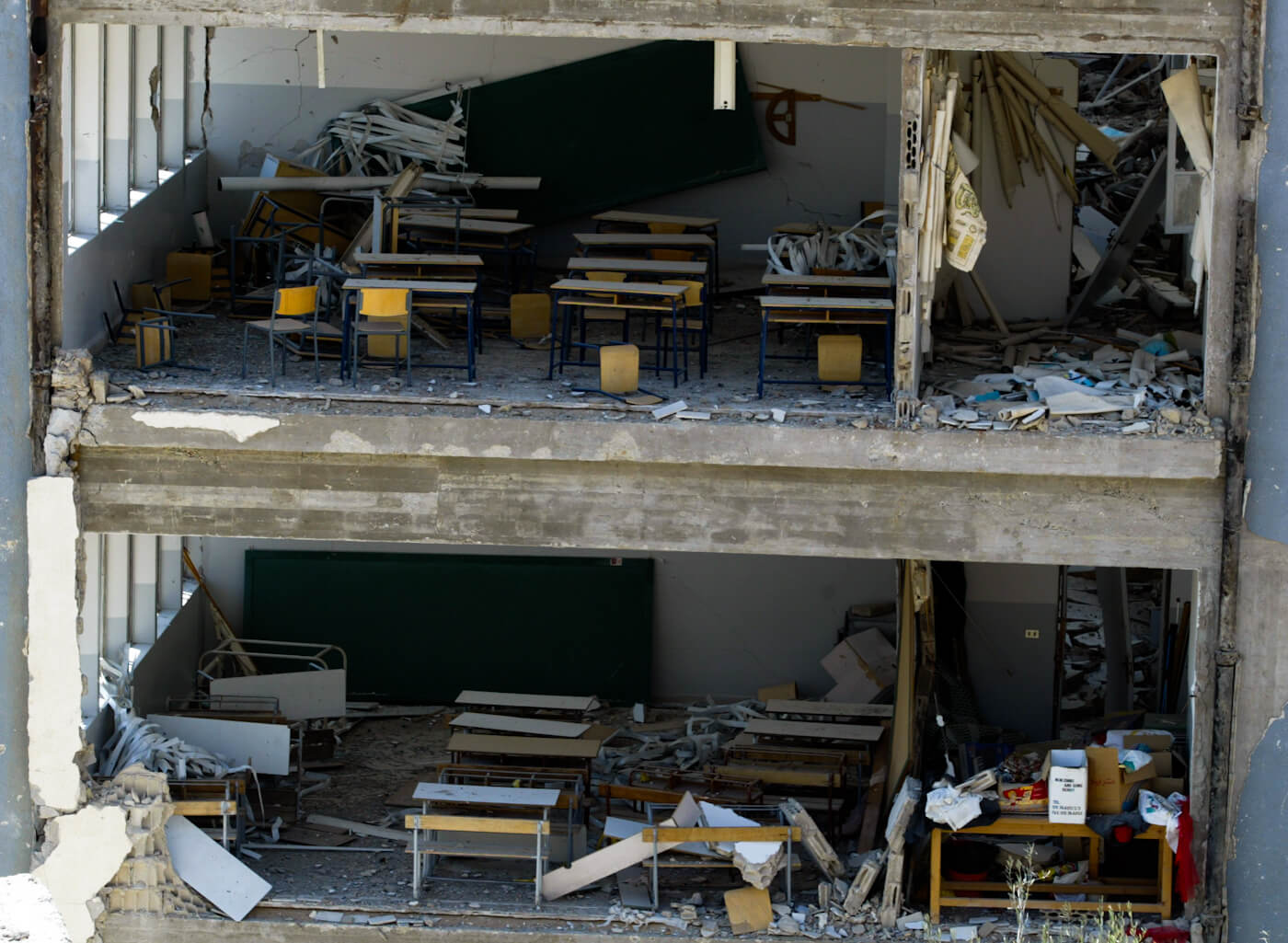
A school building destroyed by Israeli bombs in the southern Lebanese town of Bint Jbeil, Aug. 27, 2006. Sergey Ponomarev | AP
Prominent Israeli politicians have also made the case for targeting Lebanese civilians in the coming war between Israel and Lebanon. For instance, Naftali Bennett, who until recently was Israel’s minister of education, told Haaretz in 2017 that civilians “must” be targeted the next time Israel and Lebanon go to war:
The Lebanese institutions, its infrastructure, airport, power stations, traffic junctions, Lebanese Army bases –- they should all be legitimate targets if a war breaks out… This will mean sending Lebanon back to the Middle Ages.”
Past impunity expands to cover new atrocities
Under existing international law, the bombing of residential buildings, hospitals and schools is a clear war crime, though this hasn’t stopped Israel’s government from bombing these same structures in Gaza with regularity in recent years. In addition, during the 2006 war between Israel and Lebanon, Israel’s military killed at least 1,109 civilians, injured over 4,000 and displaced an estimated 1 million according to figures compiled by Human Rights Watch. The staggering civilian death toll sparked condemnation from international human-rights groups.
Thus, Erdan’s recent comments suggest that Israel’s government, in a war against Lebanon it plans to instigate under the guise of “preventative” defense, is planning to commit war crimes on a much larger scale than what was done in 2006 and is thus pushing for international law to be changed to accommodate those plans. However, Israel has long been able to avoid accountability for war crimes, especially following the U.S. adoption of the “Negroponte doctrine” to protect Israel from criticism as well as any punitive action taken by the U.N. Security Council in relation to war crimes committed by Israel.
This makes it more likely that this current push led by Erdan to alter international law is aimed more at global public opinion, by redefining international law so that Israel could avoid being accused of war crimes for such attacks on civilians and civilian infrastructure in a future war.
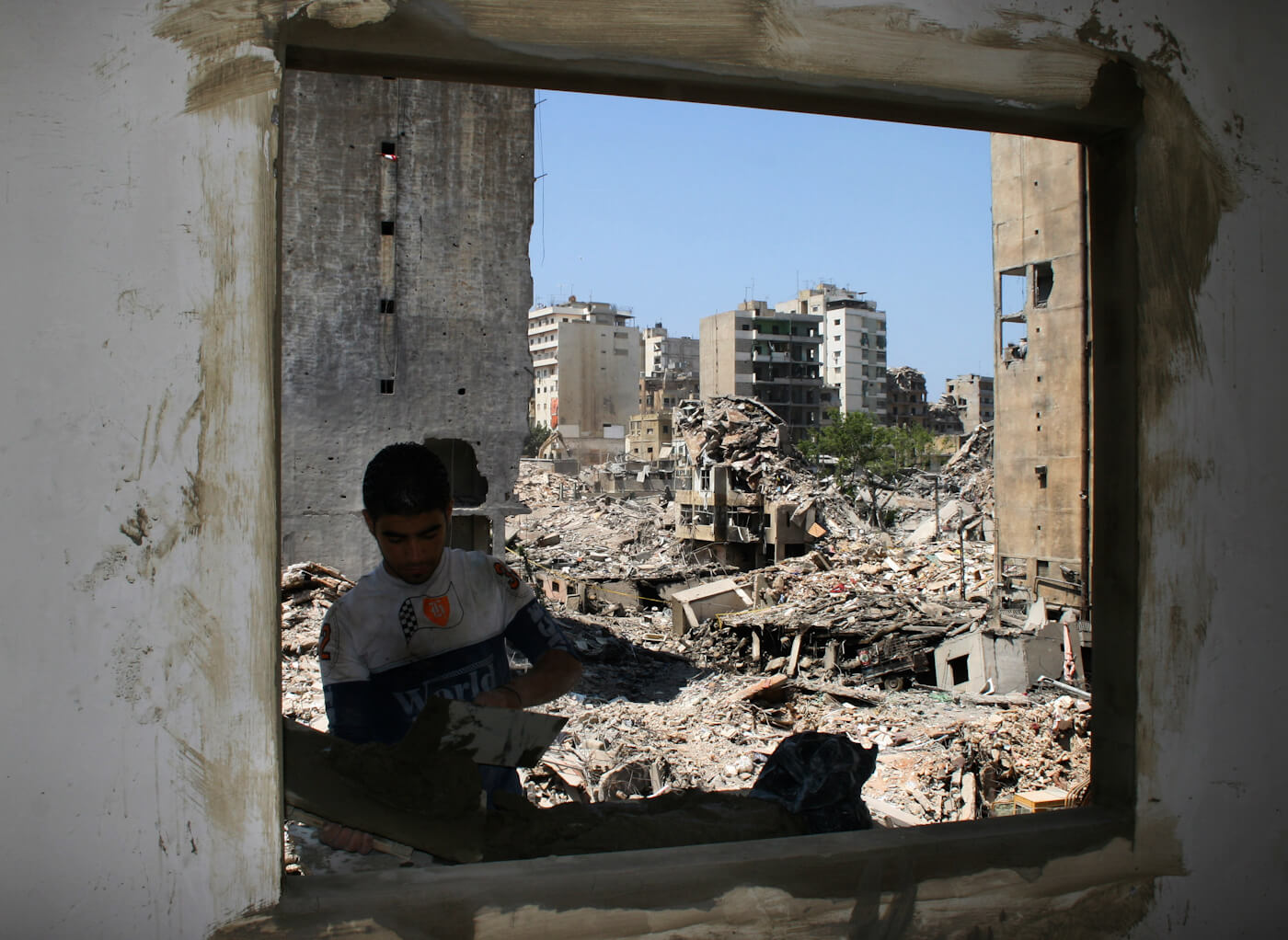
A man repairs a home, in the background buildings destroyed by Israeli airstrikes in the southern suburbs of Beirut, Lebanon, Aug. 27, 2006. Photo | AP
Part of the strategy in targeting Lebanese civilians specifically appears to be Israel’s strong desire to win a “decisive victory” against Hezbollah in this future war, as opposed to the humiliating defeat its military suffered in 2006. It appears that key figures in Israel’s government believe that the grand scale of planned attacks on Lebanese civilians and civilian infrastructure will result in so much destruction and death that it will help to ensure an Israeli victory.
Though it is unlikely Israel’s effort will succeed in changing international law, it may change how its government interprets such laws — as Darshan-Leitner recently suggested — and use such interpretations to secure even more robust diplomatic cover from its more influential allies such as the United States and to more easily avoid the war crime label from international media outlets and foreign governments. Such a move may also prompt the Trump administration in the U.S. to do the same, particularly given the slew of recent pardons given to accused and convicted U.S. war criminals by President Donald Trump.
US troops “prepared to die for the Jewish state”
In addition, the U.S. military itself is likely to quickly become embroiled in this coming Israel-Lebanon war, given that head of U.S. Central Command (CentCom), Lt. Gen. Richard Clark, told the Jerusalem Post last year that IDF leadership (as opposed to American military leadership) would “probably” have the last word as to whether U.S. forces would join the IDF during a future war and that U.S. troops were “prepared to die for the Jewish state.” IDF Brigadier General Zvika Haimovitch responded to Clark’s comments by stating: “I am sure once the order comes we will find here U.S. troops on the ground to be part of our deployment and team to defend the state of Israel.”
While much media attention has focused on the possibility of an imminent U.S. war with Iran, it is important to point out — especially in light of Israel’s comments — that Israel has been planning for over a year to go to war with Lebanon. Indeed, last year, Israeli officials told U.S. Senators Lindsey Graham and Chris Coons (D-DE) that “Southern Lebanon is where the next war is coming.”
Yet, the push for war with Iran and the planned war against Lebanon may be related, given that Hezbollah’s Secretary-General Sayyed Hassan Nasrallah stated the following late last month:
Any attack on Iran will not remain confined to Iran’s borders. The entire region will burn, leading to all U.S. forces and interests in the region being annihilated.”
Whitney Webb is a MintPress News journalist based in Chile. She has contributed to several independent media outlets including Global Research, EcoWatch, the Ron Paul Institute and 21st Century Wire, among others. She has made several radio and television appearances and is the 2019 winner of the Serena Shim Award for Uncompromised Integrity in Journalism
Nasrallah Vows to Confront US Middle East Plan

Al-Manar | June 1, 2019
Hezbollah Secretary General Sayyed Hasan Nasrallah stressed on Friday that the axis of resistance is stronger than ever before, while ‘Israel’, despite its military strength, is weaker than ever.
During a ceremony held by Hezbollah to mark Al-Quds International Day in Dahiyeh, Sayyed Nasrallah pointed out that the Palestinian resistance was advancing and developing immensely and it “became able to control large areas in occupied Palestine in any future war, at a time when the image of ‘Israel’ was destroyed after the defeat of its ground army who couldn’t stop the resistance rockets.”
Sayyed Nasrallah rejected the US conditions for mediating a border and maritime dispute with the Zionist entity, saying Washington, through its envoy who was tasked to negotiate the land and maritime border demarcation between Lebanon and the Zionist entity, was using the talks to the Israeli benefit, bringing up an Israeli claim that Hezbollah has precision missiles factories. “The US wants to blackmail the negotiations on border demarcation in order to open the issue of Hezbollah’s precision rockets arsenal,” he said, but warned that [David] Satterfield should focus on the border demarcation issue and only that.
The Hezbollah leader acknowledged that Hezbollah has the weapons but do not produce them. However, he said Hezbollah may consider setting up such factories if Washington continues to use the talks on border demarcation to discuss the resistance capabilities since it is Lebanon’s right to defend itself. “We have in Lebanon precision rockets that are able to target direct posts in ‘Israel’ and that would change the face of the region,” he said, but warned that Hezbollah will respond to any Israeli aggression on any resistance target in Lebanon quickly, directly and strongly.
His Eminence said that ‘Israel’ fears the resistance in Lebanon and that Israeli officials talk about resistance deterrence and capabilities, pointing out that Hezbollah has “accurate missiles that can reach all the targets required in ‘Israel’ and that are able to change the face of the region.
“The US attempts to control Iraq have failed, the Iraqi stance from regional issues is totally different and uncontrolled,” he said. “Iraq today returned to its regional role and has a capable, struggling and influential people in the region’s issues,” He said.
Sayyed Nasrallah gave the so-called Deal of the Century the lion’s share in his speech, assuring that the US was mistaken by betting on regional people’s weariness to impose the deal. “The main challenge today in front of Palestine and Al-Quds is the deal of the century, or Trump’s deal, and it’s our duty to confront it.”
“We have a deep hope that we, the people of this region, can stop the ‘crime of the century’,” he said, indicating that the US administration and ‘Israel’ are working day and night with Arab regimes to realize the deal.
The US, he said, was able to “contain the Arab Spring popular protests and derail it towards a wrong way, however, Syria overcame the scheme of destroying it, and it remained pro-resistance.”
“Yemen, which is an essential part of the resistance axis, rejects the deal of the century and protests in support for Al-Quds,” Sayyed Nasrallah said. “American tools in the region are unable to protect themselves and some regimes are concerned of implementing the deal of the century,” he said, pointing out that the three summits in Mecca were a proof of the Saudi failure and weakness.
The S.G. said the Zionist entity and the US were no longer as strong as before. “‘Israel’ fears missiles from Lebanon, Gaza, Syria and claims the existence of rockets in Iraq,” he said, adding there’s no leadership in ‘Israel’ and total reliance on US support. However, he said the US was no longer the same as before 20 years after it sent its troops to the region and came out of it defeated.
Sayyed Nasrallah detailed the reasons why the possibility of an upcoming war against Iran was remote. “One reason that there’s no war is that Iran is strong, otherwise the war could have been launched. The other reason is that the CIA knows that a war on Iran will set the region on fire and won’t stop behind its borders.”
“The whole region will ignite and the US troops and interests will exterminate if a war on Iran was launched,” Hezbollah leader warned.
A war on Iran will make ‘Israel’ and Al Saud pay the price, his eminence indicated, wondering how Saudi Arabia, which failed and was defeated in Yemen, would be able to wage war on Iran.
“Trump fears own interests and is only after an economic war against Iran and other states,” he went on to say.
While he hailed the balanced Iraqi stance in the emergency summit that convened Arab leaders in the Saudi city of Mecca overnight Thursday, Sayyed Nasrallah rejected and condemned the Lebanese delegation participation in the summit, saying the Lebanese official stance was inconsistent with the dissociation item in the ministerial statement and violated it.
Sayyed Nasrallah began his speech by saluting the participants and demonstrators across the world to mark this special day. “I thank you, this audience, for reviving this jihadi-moral occasion that is linked to our fate, our pride, our freedom and our sanctities.”
“Attempts to make this day as for a certain sect have failed,” the S.G. said, adding that “the sincerity of all those who walk on the road to restore Al-Quds could be stronger than any siege.”
“Throughout 40 years, Al-Quds enemies bet that this day will be forgotten, but they were mistaken,” he said. “We have been commemorating the week of Al-Quds in many cities of the world. Al-Quds Day protests in Bahrain confirm that the Bahraini people and scholars are innocent of the Deal of the Century’s summit.”
“Al-Quds rallies in Iran serve as a message to US and regional regimes,” his eminence said, adding that Trump will wait for a long time before receiving a phone call from Iran.
The ceremony marking Al-Quds day, with its main emblem “Towards Al-Quds”, was held in Beirut’s southern suburb (Dahiyeh) Friday overnight gathering a huge public and political participation. During the ceremony, organized by Hezbollah, a symbolic military parade was held in which Hezbollah fighters chanted “Oh Quds, we shall march towards you” during the parade. Hezbollah fighters also recalled the oath of allegiance to resistance leaders, Imam Ruhollah Khomeini, Sayyed Ali Khamenei & Sayyed Hasan Nasrallah.
In July 1979, the Supreme Leader of the Islamic Revolution in Iran, Imam Ruhollah Al-Khomeini, announced Al-Quds International Day, voicing a complete support to the Palestinian cause against the Zionist enemy.
Although this Day is marked annually every last Friday of the Holy Islamic Month of Ramadan, Imam Khomeini has deliberately given it an international attribute in order to be the day of all the oppressed worldwide.
Featured Video

More Iran War fallout: Maritime insurance industry shifts from London to China
or go to
Aletho News Archives – Video-Images
From the Archives
Allies Don’t Need Lobbies
By Jay Knott | Dissident Voice | September 24, 2013
In a recent article on Counterpunch, Rob Urie defended the traditional Marxist analysis of US policy in the Middle East. He argues that support for Israel is driven primarily by economic interest, not the Jewish lobby.
He starts by paying tribute to the idea that Western societies are uniquely racist. He says that the “Western narrative” claims there is an “Arab character”, and that this is “antique racist blather”. He gives no definition of these terms. Further, he establishes his credentials as part of the dominant current in the American left by claiming that “over a million people in Iraq died so ‘we’ in the West can drive SUVs.”1
When he tries to criticize bourgeois economics, he makes it clear he doesn’t understand the developments it has made since Marx’s day, using the mathematical discipline known as “game theory”. He dismisses the basic abstraction of economic theory, the idea of the rational individual, on the grounds that it is “devoid of history, culture and political context”. But abstractions are always devoid of something.
He defends a more concrete economic theory, mostly Marxist, with some input from another theorist of capitalist crisis, Hyman Minsky. This concrete theory leads him to the view that US activity in the Middle East is primarily driven by rational capitalist motives, the need to secure a supply of oil.
“Taking the totality of circumstance — former oil company executives launching war on an oil rich nation on a pretext they publicly proclaimed they didn’t believe shortly before taking office — and that upon launching their war proved to be non-existent, requires a willingness to overlook the obvious — that the war on Iraq was for oil, that is difficult to support.”1
Perhaps I’ve misunderstood him, but based on what he says in the rest of the article, this convoluted sentence seems to argue that, because president Bush and vice-president Cheney attacked Iraq on false premises, and they also said it was all about oil, and they are former oil executives, and Iraq has a lot of oil, it’s difficult to deny US attacks on Iraq are all about oil.
In fact, it’s not hard at all. As Urie points out, at times Bush and co. said that attacking Iraq was “protecting the world’s supply of oil.”1 But, as he also points out, they are congenital liars. Why should we believe them when they say they are trying to “protect” the oil supply? Protect it against what? When politicians “admit” attacks on Middle Eastern countries are wars for oil, they are parroting the neo-con party line, feeding the public, both left and right, with a plausible-sounding pretext. For right-wingers, “it’s a war for oil” is a reason to support war, and for leftists, it’s a way to feel better by complaining impotently about corporate greed. Both approaches help the war drive. … continue
Blog Roll
 Aletho News
- More Iran War fallout: Maritime insurance industry shifts from London to China
- US-Israeli aggression on Iran triggers review of GCC countries’ investment pledges to Washington
- Russia slams UK plan to seize tankers suspected of carrying its oil
- Pakistan ramps up food exports to Persian Gulf nations as war deepens food insecurity
- Iran submits response to US plan, sets terms for war’s end: Tasnim
- US vs Iran: Kharg Island Talk — Bluff or Escalation? Ex-Military Officer Weighs In
- Zelensky unnecessarily involves Ukraine in the Middle East crisis
- Turkish tanker blacklisted by Ukraine hit in drone attack – media
- Canada, the U.S., and NATO: the inescapable trap
- Villains of Judea: Leonid Radvinsky
- If Americans Knew
- ‘No Innocent Children’: Far-right Israeli Lawmaker Defends Killing of Palestinian Family
- Mossad’s promises helped Netanyahu convince Trump that Iran could be toppled
- US Arms Control Official Refuses To Comment When Asked If Israel Has Nuclear Weapons
- Veterans warn US landing could be ‘more Gallipoli than Vietnam’
- Israel may be committing war crimes in Lebanon – Not a ceasefire Day 167
- In the West Bank, life is a constant battle – 3 articles
- Jacob Reses, one of the most powerful pro-Israel operatives in Trump’s Washington
- Israeli-US assaults kill or injure 87 children a day – Not a ceasefire Day 166
- ‘Forever live by the sword’: Understanding Israelis’ massive support for Iran war
- UN’s special rapporteur on human rights says Israel is systematically torturing Palestinians
- No Tricks Zone
- Devastating Assessment Of Comirnaty Vaccine By Former Senior Pfizer Europe Toxicologist
- New Study: CO2 Is ‘Effectively Negligible’ As An Explanatory Climate Change Factor Since 2000
- Former Pfizer Toxicologist Dr. Helmut Sterz Tells Bundestag Hearing Pfizer Vaccine Should Have Never Been Approved
- Energy Expert: Germany’s Nuclear Phaseout Was A “500 Billion Euro Mistake”
- New Research: South Australia’s Mid-Holocene Sea Surface Temperatures Were 4°C Warmer Than Today
- Storing Green Energy To Last Germany 10 Days Would Require A 60-Million Tonne Battery
- New Studies: UK Sea Levels Were 4 Meters Higher Than Today During The Mid-Holocene
- Destructive Green New Deal: German Energy And Metal Group Warns Of Drastic Crisis
- New Study Documents A 20-Year Pause In Arctic Sea Ice Decline – Driven By Internal Variability
- Wake-up Call: Survey Shows Majority Of Germans Now Favor Postponing Climate Targets!
 Aletho News