Will the Mediterranean Sea save Lebanon from drowning in debt?
Steven Sahiounie | Mideast Discourse | October 16, 2020
The Lebanese population faces between six to twelve hours of electricity cuts per day, and in some rural areas, there is simply no electricity provided by the government grid. Amid the backdrop of decrepit infrastructure, government corruption, devalued currency, and widespread poverty, Lebanon began talks with Israel concerning their maritime borders in the gas-rich Mediterranean Sea on Wednesday at the UNIFIL headquarters at Naquora.
The UN peacekeeping force UNIFIL has been monitoring the disputed land boundary since Israel’s’ military withdrawal from south Lebanon in 2000, ending a 22-year occupation. The two sides met together in the same room but directed their communications through a US mediator.
The US is the mediator between the two countries which remain technically ‘at war’ while hoping to end a long-running dispute which could eventually see Lebanon producing gas to convert to domestic electricity, as well as a potential revenue producer which could pay off Lebanon’s huge debts. Lebanon’s currency has lost 80 percent of its value against the dollar over the last year, and its debt-to-G.D.P. ratio is one of the world’s highest.
Lebanon and Israel are struggling to deal with high COVID-19 infection rates, while Netanyahu is slipping in the polls due to abuse of power charges, and the Lebanese government is in limbo after being labeled as corrupt and inept, while desperate for cash from foreign donors as it faces the worst economic crisis since its 1975-1990 civil war. The financial collapse was compounded by an explosion at the Port of Beirut in August, killing nearly 200 people.
Israel is already pumping gas from huge offshore fields, and this meeting will allow both sides to proceed further within the safety of an understanding of the maritime borders.
US pressure
The talks follow years of diplomacy by Washington, and the Trump Administration had hoped to use the Naquora meeting as a dramatic media show less than a month after landmark US-sponsored normalization agreements between Israel and the United Arab Emirates and Bahrain; however, this showy plan was aborted.
The US envoy David Schenker explained that these talks “have nothing to do with the establishment of diplomatic relations or normalization.” However, it was last month that the US turned up the pressure on Lebanon to start the talks with a deadline for the agreement before the US election on November 3, while the second round of talks is scheduled for October 28.
The Naquora meeting
President Michel Aoun is the key person managing the off-shore energy resources portfolio, and he placed a representative from the Lebanese Petroleum Administration (LPA) on the negotiating team as a nod to pressure from Washington who had insisted on civilian presentation, whereas Hezbollah requested only military and technical delegates.
There are four points on the agenda of the Naqoura talks: setting the land reference point from which to depart toward the sea; defining the southern maritime border where the disputed area is located; agreeing on the land border demarcation after the completion of the maritime demarcation, and exchanging documents and handing over copies to the United Nations.
The Lebanese Negotiating team
Brigadier General Bassam Yacine is the lead negotiator, Marine Colonel Mazen Basbous is the head of operations in the Lebanese military, Najib Masihi is a Lebanese American expert in maritime and territorial boundaries, and Wissam Shbat is a board member of LPA and head of its geology and geophysics unit.
Lebanon’s offshore possibilities
In 2017, Lebanon’s information minister announced the Cabinet had approved licenses for Italy’s Eni, Frances’s Total, and Russia’s Novatek to carry out exploratory drilling off the Lebanese coast in two of Lebanon’s 10 offshore blocks to determine whether oil and gas exist in the area.
Analyst Diana Kaissy, who heads the Lebanese Oil and Gas Initiative think-tank, said it was “impossible to know” the extent of the accessible reserves before exploration operations begin, but she said, “preliminary evaluations” showed the five blocks offered by the government were the “most promising,” with block nine bordering a sector disputed by Israel.
At issue is more than 330 square miles in the Mediterranean that Israel and Lebanon both claim is in their exclusive economic zone. The pressure to resolve the dispute has mounted as Israel and Cyprus have begun exploiting offshore gas.
Lebanon estimates it has 96 trillion cubic feet of natural gas reserves and 865 million barrels of oil offshore. Israel is aiming to get a percentage of a contested area of 860 square kilometers that Lebanon is claiming.
The 1982 UN Convention on the Law of the Sea (UNCLOS) stipulates that coastal states have sovereign rights in a 200-nautical-mile exclusive economic zone (EEZ) concerning natural resources; however, the maritime dispute does not fall within the UNIFIL’s current mandate, and Israel is not a party to UNCLOS.
Lebanon reached a maritime border agreement with Cyprus in January 2007. This prompted Beirut, in July and October 2010, to deposit with the United Nations the geographical coordinates of the southern and southwestern maritime borders of that EEZ. Cyprus went ahead and signed an EEZ delimitation accord with Israel in December 2010.
Lebanon and Israel could share in the disputed 860 square kilometers, which covers Lebanon’s offshore gas Blocks 8, 9, and 10. The “Hoff line” proposal gave Lebanon 550 square kilometers, which was rejected as Beirut insists on full rights in this disputed area. Lebanon has refused to join the Eastern Mediterranean Gas Forum or any other regional mechanism that includes Israel; therefore, it has been more or less isolated in the eastern Mediterranean gas process given the emerging alliance between Israel, Egypt, Cyprus, and Greece.
France’s Total energy company is set to begin gas exploration in Block 9 by the end of the year, while Israel approved in June oil, gas exploration in Block 72, close to Lebanon’s Block 9 where exploration will soon start.
Hezbollah and Amal
Hezbollah’s Secretary-General Hassan Nasrallah in a joint statement with Amal, the country’s other main party of resistance, released hours before the talks were due to start, called for the negotiating team to be revised to include only members of the military.
The Lebanese preconditions included having military and technical delegates, instead of diplomatic delegates, and setting no timeline to reach a deal, to avoid US pressure on the negotiations.
Last month the US placed sanctions on the top aide to Nabih Berri, the leader of Amal, for corruption and financially enabling Hezbollah.
Rare maritime talks do not mean normalization with Israel: Hezbollah
Press TV | October 9, 2020
The Lebanese Hezbollah resistance movement says a UN-brokered indirect maritime negotiations with Israel do not signify “reconciliation” or “normalization” with the Zionist entity.
Hezbollah’s parliamentary bloc said in a statement on Thursday that the talks have “absolutely nothing to do with either any reconciliation with the Zionist enemy… or policies of normalization recently adopted… by Arab states.”
“Defining the coordinates of national sovereignty is the responsibility of the Lebanese state,” it said in a statement.
Lebanon’s parliament speaker Nabih Berri last week announced the talks would go ahead.
UN spokesman Stephane Dujarric has recently said Lebanon’s maritime border talks, to be held at the headquarters of the UN peacekeeping force UNIFIL in the southern town of Naqoura, will start around mid-October.
The issue of the sea frontier is especially sensitive as Lebanon hopes to continue exploring for oil and gas in a part of the Mediterranean.
In February 2018, Lebanon signed its first contract for offshore drilling for oil and gas in two blocks in the Mediterranean with a consortium comprising energy giants Total, ENI and Novatek.
Hezbollah Deputy Secretary General Sheikh Naim Qassem on Monday strongly condemned normalization with Israel as a betrayal of the Palestinian cause, emphasizing that Arab rulers scrambling to establish diplomatic ties with the Tel Aviv regime have reaped nothing but humiliation and disgrace.
He underlined that Palestinians are at the vanguard of the resistance front seeking to liberate Jerusalem al-Quds, calling for support for them.
Qassem was reacting to the recent decisions by the United Arab Emirates and Bahrain to sign contentious US-mediated normalization deals with Israel.
Israeli prime minister Benjamin Netanyahu signed the deals with UAE Foreign Minister Sheikh Abdullah bin Zayed Al Nahyan and Bahrain’s Foreign Minister Abdullatif Al Zayani during an official ceremony hosted by US President Donald Trump at the White House on September 15.
Palestinians, who seek an independent state in the occupied West Bank and Gaza with East Jerusalem as its capital, view the deals as betrayal of their cause.
Hezbollah is credited with ending two decades of Israeli occupation of southern Lebanon in 2000.
Lebanon marks the Resistance and Liberation Day on May 25 each year. In May 2000, the Israeli regime was forced by Hezbollah to withdraw its troops from Lebanon, ending nearly two decades of occupation of the country’s south.
Hezbollah was established following the 1982 Israeli invasion and occupation of southern Lebanon.
Since then, the movement has grown into a powerful military force, dealing repeated blows to the Israeli military, including during a 33-day war in July 2006.
Will Lebanon be the next US-NATO humanitarian war?
By Steven Sahiounie | Mideast discourse | October 2, 2020
The waters off Lebanon are the scene of a gathering Armada of French and American naval ships. What appeared at first to be a humanitarian response to the devastating Beirut Port explosion on August 4, is now feared to be the prelude of the next US-NATO humanitarian war.
French President Emmanuel Macron blamed Hezbollah and all of the Lebanese politicians Sunday and warned of a new civil war. “I’m ashamed of the Lebanese political leaders. Ashamed,” Macron repeated.
He accused them of “collective betrayal” while putting their parties and personal greed above the needs of the Lebanese people.
Some political observers now believe that Lebanon may well be going the way of Somalia, as evidenced by the characteristics of a failing state, such as lack of governance, corruption and incompetence, chronic humanitarian problems, and persistent social tensions.
Prime minister-designate Moustapha Adib stepped down September 26, and Lebanon’s Central Bank reserves may soon dry up and the government would no longer be able to subsidize basic goods such as fuel, medicine, and wheat.
Macron has been pressing Lebanese politicians to form a Cabinet made up of technocrats that can work on urgent reforms, and Macron has traveled twice to Beirut since August 4, while making it a personal mission to try to repair the devastated country, which some see as a neo-colonial farce.
Macron criticized the Lebanese system of sectarian politics, “as if competence was linked to religious confession.”
He lambasted Hezbollah demanding to know its characteristics and identity, and he criticized Lebanese political leaders from all parties and dynasties. Each Lebanese faction has found a foreign godfather and has ended up as a pawn in a regional and international chess game. Tens of billions of dollars have reportedly been looted by politicians and deposited in European and American banks.
US-NATO Humanitarian wars
In 1999 NATO updated its ‘Strategic Concept’ to allow members to defend not only other members but also conduct ‘non-Article 5 Response Operations’. It would be under this mechanism that a US-NATO military operation, along with an Arab Gulf coalition, would be used to attack, invade and defeat Hezbollah in Lebanon.
Since 2002, it was agreed that NATO forces could be sent “wherever they are needed,” regardless of the location, and in 2006 the NATO Response Force (NRF) of 25,000 troops has been fully operational.
US President Bill Clinton and NATO waged the humanitarian war on the former Yugoslavia, which broke a larger nation into ‘bite-sized’ pieces.
Critics of the US-NATO bombing of Yugoslavia have argued that certain attacks forming part of the campaign violated international humanitarian law. Noam Chomsky argued that the main objective of the US-NATO war was to force Yugoslavia into the Western economic system since it was the only country in the region that stood alone in defiance of the US world domination.
Hezbollah targeted by US-NATO war machine
Hezbollah’s prominence in the Lebanese government caused foreign donors and investors to stay away, because of US sanctions targeted on anyone with ties to the group, based on their designation as a terrorist group.
Hezbollah’s leader, Sayyed Hassan Nasrallah, said on Tuesday, “We welcomed President Macron when he visited Lebanon and we welcomed the French initiative, but not for him to be judge, jury and executioner, and ruler of Lebanon.”
Nasrallah has headed the group since 1992 as Secretary-General; however, its military wing is considered as a terrorist organization in 21 countries, as well as by the Arab League and the European Union.
Hezbollah’s 1985 manifesto listed its objectives as the expulsion of “the Americans, the French and their allies definitely from Lebanon, putting an end to any colonialist entity on our land”.
In 2008, the Lebanese government unanimously recognized Hezbollah’s existence as an armed organization and guarantees its right to “liberate or recover occupied lands”.
Hezbollah is an armed resistance group, as well as a political party that has seats in Parliament through free and fair elections. Their ally in Parliament is the ‘Amal Movement’, and together they hold the majority of Parliamentary seats. In a democracy, the majority rules and this is why recently Hezbollah and Amal insisted on choosing the Finance minister, which became a conflict point in the view of Macron.
Hezbollah is resisting the Israeli occupation of Shebaa Farms, an area in the far south of Lebanon. Moreover, Hezbollah also is resisting the Israeli occupation of Palestine. At one time, all of the Arab world demanded the rights for the Palestinian people, who have lived under brutal military occupation since 1948, and the UN has ratified resolutions calling for a 2-state solution, where Palestine would be given the land of the 1967 borders, and both Israel and Palestine would live side by side in peace.
In 2017, Ron Prosor, former Israeli ambassador to the UN said Hezbollah was then “10 times as strong now as it was in 2006, and its military infrastructure permeates Lebanon.” He added that Lebanese President Michel Aoun has also “embraced” Hezbollah’s arsenal as “a principal element of Lebanon’s defense.”
Many critics tried to blame Hezbollah for the Beirut Port blast on August 4, but the Lebanese officials and locals admitted that Hezbollah had no access to the Port, or authority over it. Even officials known to be antagonistic of Hezbollah admitted that the blame would not plausibly stick on Hezbollah. The exact cause is not known, but it may have been an accident borne of corruption and ineptitude, or it could be sabotage, according to President Michel Aoun. MP Machnouck, member of the Sunni-led ‘Future Party’ stated he was convinced Israel was responsible.
The elimination of Hezbollah is Israel’s top priority
A former director of Israel’s Counter-Terrorism Bureau, Brig. Gen. Nitzan Nuriel, said that another war between Israel and Hezbollah was “only a question of time.”
Hezbollah is the only force that Israel has faced that has caused the Israeli Defense Forces to retreat without success. Defeating Hezbollah is a top Israeli priority.
Under the Obama Administration’s Middle Eastern policy, Iran became a negotiations partner, while pressuring Israel to conclude a peace agreement with the Palestinians.
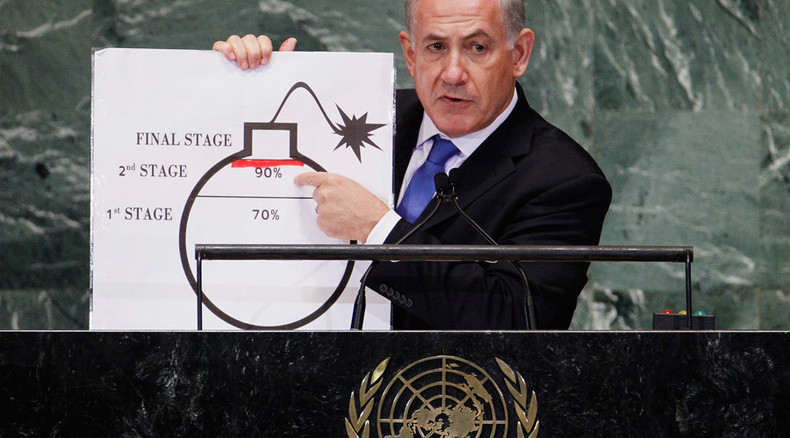
Netanyahu recently gave a virtual speech to the UN Security Council, in which he displayed a detailed map of Beirut, and he predicted the location of where a future explosion would occur, and he blamed Hezbollah for having a weapons factory and warehouse at the location, which was a residential area. During the Netanyahu speech, Nasrallah was also giving a live televised speech in Lebanon and was told what Netanyahu had claimed. He immediately invited all media to go to the location that Netanyahu portrayed in his map, and inspect for themselves if there were any weapons or warehouse present. Later, the media arrived, and live local TV coverage showed that in fact, the location was a cooking gas canister factory. This confirmed the Israeli accusation was false and led experts to assume a direct connection between the Port blast, and the Israeli proposed blast in Netanyahu’s map.
The Israeli occupation of Lebanon
Israel occupied the south of Lebanon for 23 years, during which men, women, and children were imprisoned in Khiam Prison, where they were routinely tortured, abused and many died. Hezbollah aligned with many other Lebanese resistance groups, who resisted the occupation vociferously until Israel gave up and left in 2000. The south of Lebanon is populated by both Shite Muslims and Christians. The steadfastness of Hezbollah is remembered by those Lebanese citizens. However, the North of Lebanon was never occupied and lived free of fear, oppression, and intimidation which may have influenced many Lebanese citizens to either support or reject Hezbollah. As they say, “Your view depends on where your seat is.”
Using ISIS as ground troops by US-NATO
Recently, the Lebanese Army fought fierce battles against Radical Islamic terrorists near Tripoli in the north, in the area of Wadi Khalid.
In 2016, Efraim Inbar, an Israeli scholar, and the director of the Begin-Sadat Center for Strategic Studies wrote, “The continuing existence of ISIS serves a strategic purpose,” and added that ISIS “can be a useful tool in undermining” Iran, Hezbollah, Syria, and Russia and should not be defeated. He wrote, “Stability is not a value in and of itself. It is desirable only if it serves our interests,” and stressed that the West’s “main enemy” is not ISIS; it is Iran.
Saudi Arabia part of the Coalition against Hezbollah
The King of Saudi Arabia rarely gives speeches; however, he made a televised speech in which he accused Hezbollah of the Beirut Port blast, apparently unaware that that accusation has been debunked. This is the same King who summoned Prime Minister Saad Hariri from Lebanon to be kidnapped and forced to resign in Saudi Arabia. It was President Macron who personally negotiated Hariri’s freedom.
It appears that Saudi Arabia will be among the first Arab countries to send support for a US-NATO attack on Lebanon to eliminate Hezbollah.
Steven Sahiounie is an award-winning journalist and political commentator.
Hezbollah Media Refutes Netanyahu’s Claims about Missile Depot, Opens Site Shortly after His Remarks
Al-Manar | September 29, 2020
Hezbollah Media Relations Department has issued a statement in which it invited media outlets to inspect the Beirut site falsely claimed by Zionist PM Benjamin Netanyahu as a missile Depot.
A large number of cameramen and reporters gathered near the alleged site around two hours after Netanyahu’s remarks in the context of the step organized by Hezbollah to refute the Zionist claims in light of the critical political conditions in Lebanon.
Head of Hezbollah Media Relations Department, Hajj Mohammad Afif, stressed that today’s tour aims at proving that Netanyahu’s story is wrong, adding that the Resistance is not concerned with exposing every site claimed by the Zionist enemy as a missile depot.
Netanyahu had alleged that Hezbollah stores missiles at a depot in a residential area in Jinah, adding that it lies near a gas facility and that its explosion will be similar to that of Beirut port.
The Israeli intelligence command has prepared a plan to provoke the Lebanese against Hezbollah by weaponry by unveiling maps of its locations in Lebanon and launching a propaganda that promotes its threat in light of the Beirut Port explosion, Al-Manar English Website reported on August 25, 2020.
Hezbollah Secretary General Sayyed Hasan Nasrallah announced the invitation during his televised speech, highlighting that it would be shortly after Netanyahu’s remarks so that the inspection will be very credible.
The following video shows the iron factory full of the media reporters shortly after Netanyahu’s remarks… continue to Al-Manar for video tour
Lebanon hits back at Israel, defends Hezbollah at UN Human Rights Council session
Press TV | September 29, 2020
Beirut has strongly reacted to the Israeli envoy’s interventionist remarks against Hezbollah at a UN Human Rights Council session, describing the resistance movement as an “inseparable part” of Lebanon and slamming the regime’s history of rights violations in Lebanon and other Arab states.
The Lebanese Ministry of Foreign Affairs and Emigrants issued a statement on Monday in condemnation of the comments by Merav Marks, the legal counselor to the Israeli mission to the UN and international organizations in Geneva, who had attacked the Hezbollah resistance movement for its role in Lebanon during a general debate at the 45th session of the UN Human Rights Council.
The Israeli envoy accused the UN Human Rights Council of not dealing with what she called Hezbollah’s efforts to hamper the mandate of the United Nations Interim Force in Lebanon (UNIFIL) and attempts to manipulate the Lebanese government.
In its statement, the ministry said Lebanon’s Permanent Mission to the UN and other International Organizations in Geneva exercised its “right to respond to the Israeli enemy’s envoy, as has been the case whenever there is an attack on Lebanon and its right to resistance.”
The ministry then described Israel as “an occupation force armed with sophisticated weapons and in possession of a nuclear arsenal, with which it threatens its neighbors.”
Israel” has a history of flagrant human rights violations and international crimes in Lebanon and in other Arab lands that it has occupied. The international community should one day fulfill its duty to prosecute the perpetrators… Today we are marking the 38th anniversary of the Sabra and Shatila massacre, one of the ugliest crimes against humanity in modern history,” the statement pointed out.
“Lebanon stresses its right to resistance to liberate its land and defend its sovereignty,” the ministry said, underlining that Hezbollah resistance movement is “an inseparable part” of Lebanon.
The ministry also lashed out at the Israeli envoy over her remarks regarding last month’s deadly Beirut port explosion, which killed some 200 people, wounded thousands more and ravaged buildings in surrounding residential neighborhoods.
The Israeli envoy had tried to link Hezbollah to the blast, claiming the movement was putting the interests of Iran before that of its own nation, and that the explosion “is a clear demonstration of that.”
The Lebanese Foreign Ministry said in response that “the Occupation (Israeli) force has sought to put itself in the position of the Lebanese judicial authority in the issue of the port blast, in which investigations have not yet been completed.”
“The hypothesis of a foreign plot should not be ruled out, and in this case, this (Israeli) force will be the main suspect,” it added.
The explosion has been followed by other upheavals in the country, including thousands-strong rallies and the resignation of the entire government of former prime minister Hasan Diab.
Hezbollah has called for accountability for the explosion, while strongly urging countrywide unity and integrity.
Wary of Hezbollah’s power in defending Lebanon, the Israeli regime and its allies have been doing all in their power — from sanctions to targeted killings — to undermine the movement’s political and military influence in the Arab country.
The regime has, in recent months, stepped up its violations of Lebanese airspace in spying missions on southern Lebanon, where Hezbollah is mainly based, drawing condemnations from Beirut, Hezbollah and the UN Interim Force in Lebanon (UNIFIL).
The resistance movement was established following the 1982 Israeli invasion and occupation of southern Lebanon. Since then, the movement has grown into a powerful military force, dealing repeated blows to the Israeli military, including during a 33-day war in July 2006.
Lebanese PM-designate steps down amid political turmoil
Press TV – September 26, 2020
Lebanon’s Prime Minister-designate Mustapha Adib has announced his resignation amid a deadlock over government formation in the crisis-hit country.
In a televised address on Saturday, Adib said he was stepping down from “the task of forming the government” following a meeting with Lebanese President Michel Aoun.
He also noted that the kind of cabinet that he wanted to establish “was bound to fail” and that he was keen on protecting national unity.
“I apologize to the Lebanese people,” he added.
The announcement came almost a month after Adib, former Lebanese ambassador to Berlin, was appointed by the president to form a new government.
Lebanon is currently mired in the country’s worst economic and financial crisis in its modern history.
It has been waiting for a new administration since outgoing Prime Minister Hassan Diab resigned on August 10, a few days after a powerful explosion in the capital killed more than nearly 200 people, injured thousands and caused losses worth billions of dollars.
The blast took place in Beirut port warehouses storing highly explosive material, specifically ammonium nitrate, commonly used in both fertilizer and bombs.
The explosion — one of the biggest non-nuclear explosions the world has ever seen — flattened much of the strategic port and left buildings in ruin.
Following the blast, the US and European countries have been mounting pressure on Lebanese officials to form a government that secures the West’s interests.
The United States on September 8 slapped sanctions on two former cabinet ministers in Lebanon over support for Hezbollah as it vowed to isolate the resistance movement.
French President Emmanuel Macron paid two visits to Lebanon, where he called for a “new political pact” among Lebanese political factions and said he had proposed a roadmap to authorities to unlock billions of dollars in funds from the international community.
In a meeting with Aoun, Macron threatened Lebanese leaders with sanctions if they do not submit to reforms and a “political change,” Lebanon’s Arabic-language al-Mayadeen television news network reported.
The French president’s colonial-style sojourn sparked a swift backlash among the Lebanese nation.
Many Twitter users denounced what they deemed as interference in the internal affairs of Lebanon, which gained independence from the French colonial rule more than seven decades ago.
France says no ‘tangible’ evidence supporting US allegation of secret Hezbollah explosive stores
RT | September 19, 2020
France has pushed back against Washington’s assertion that Hezbollah has stockpiles of ammonium nitrate stashed around Europe, stating there’s no indication of such stores existing in its own country.
“To our knowledge, there is nothing tangible to confirm such an allegation in France today,” French Foreign Ministry spokeswoman Agnes von der Muhll said in response to the US State Department’s alarming claim.
The spokeswoman stressed that France would not allow such “illegal activity” on its territory and that it would respond to such actions with “the greatest firmness.”
On Thursday, Nathan Sales, the US State Department’s coordinator for counterterrorism, alleged that Lebanon’s Hezbollah had caches of dangerous chemicals in France, Spain, Italy, and other European states. He said that the chemicals had been smuggled into the country hidden in first-aid kits, but did not provide evidence backing his incendiary accusation.
Hezbollah is creating stockpiles of chemicals so that “it can conduct major terrorist attacks” at the bidding of Tehran, which backs the group, Sales claimed. He alleged that the stores include ammonium nitrate, an industrial chemical linked to the massive explosion that destroyed much of Beirut, Lebanon last month. It’s believed that the blast was triggered by the unsafe storage of the substance.
The United States has designated Hezbollah as a terrorist organization, but its elected arm is considered a legitimate political organization by France.
Washington recently announced sanctions on two Lebanon-based companies, accusing the companies of being “owned, controlled, or directed by Hezbollah.”
US Fails to Control Lebanon Because Hezbollah, Amal ‘Represent the Majority’ – Journalist
Sputnik – 10.09.2020
While US officials claim that their recent sanctioning of former Lebanese government ministers was designed to expose the corruption of the country’s politicians, one expert tells Sputnik that Washington’s recent action is nothing more than a continuation of a longstanding, but unsuccessful, Western campaign to control Lebanon.
US Assistant Secretary of State for Near Eastern Affairs David Schenke declared on Tuesday that political allies of Hezbollah will have to “choose between bullets and ballots,” as they stand to be held “accountable for any enabling of [Hezbollah’s] terrorist and illicit activities,” Arab News reported.
This came amid the two-day Lebanon leg of Schenke’s tour of the Middle East, which also included stops in Qatar and Kuwait.
That same day, the US Department of the Treasury’s Office of Foreign Assets Control sanctioned former Lebanese Minister of Transportation and Public Works Yusuf Finyanus and former Lebanese Minister of Finance Ali Hassan Khalil, who Washington claims “provided material support to [Hezbollah] and engaged in corruption.”
Laith Marouf, an award-winning multimedia producer as well as a media policy and law consultant with the Community Media Advocacy Center, joined Radio Sputnik’s By Any Means Necessary on Wednesday and told hosts Sean Blackmon and Jacquie Luqman that what is occurring right now is a continuation of “twenty-some” years of attempts by Washington and “imperial forces” to control Lebanon’s government.
Marouf explained that Khalil is a member of the Amal Movement, which is “allied with Hezbollah,” and Finyanus is aligned with the Christian Marada party of Suleiman Frangieh. These parties are “allied with the sovereigntist movements in Lebanon,” which virtually means they “represent the majority of the [country’s] population.”
Because of this, he asserted, the US’ attempts to gain control have been unsuccessful. “The majority of the Lebanese have lived [through] the crises,” he said, referring to a “cycle” of Western military aggression and sanctions that has occurred in the years following the Lebanese Civil War.
“There’s not going to be a change in the population demographics without a major, major war,” he argued.
Hezbollah vs Israel 2006: Who has upper hand 14 years on?
Middle East Observer | August 14, 2020
Senior Lebanese political analyst Nasser Qandil explores what has changed between Hezbollah and Israel over the last 14 years since the ‘July War’ or ‘The Second Lebanon War’ in 2006.
After tracing the major changes and transformations in the military balance of power between the two sides over the last 14 years, Qandil then explores the current challenges facing Hezbollah inside Lebanon, particularly regarding the deepening economic and political crises in the country.
Note: we have added our own sub-headings in the below transcript to make for easier reading
Source: Al Mayadeen News
Date: July 12, 2020
Transcript:
Hezbollah 14 years on from the July War
Nasser Qandil:
Actually, regarding (Hezbollah’s) achievement of liberation (in the year 2000) free from any conditions or negotiations, any analyst can figure out that after the year 2000, the region was involved in a race between the Resistance and (Israeli) Army of occupation in which both (sides) tried to reinforce the reality that they wanted to reflect on May 24, 2000 (i.e. just before the liberation).
Israel wanted to say that it has positioned itself on the borders with the purpose of protecting the interior (of Israel); that the era of (the war of) attrition has ended; and that it is moving into a stage where it is able to direct (its) deterrent capacity at will. In contrast, the Resistance wanted to say that Israel has humiliatingly and forcefully withdrawn (from Lebanon); and that this withdrawal is not only the beginning of a countdown of the (Israeli) entity’s capacity to hold onto (occupied) land, but also (its capacity) to go to any (new) war again as well.
Israel’s withdrawal from Gaza in 2005 and the Al Aqsa Uprising (“Al Aqsa Intifada”) certified what the Resistance was saying. (Israel’s) 2006 war on Lebanon was the contest that had to settle the previous contests and the (side) who wins this round, cements what it has said. Israel has worked on a plan, theory, mechanisms and appraisals, that is, it didn’t go haphazardly to war (in 2006). In short, Israel counted on “air warfare” theory and put it into practice in the (2006) war. However, the Resistance was aware of that, so it opted to strengthen its power on land, in order to cancel out the theory of air warfare, and to bring the enemy to the land to fight, engage in (battles) of attrition, and (ultimately) defeat it.
The Resistance was the victor. This was the outcome (of the war), because when we talk about ‘victory’ we are not referring to the historic and final defeat. Rather, we are just discussing this war (in 2006) in which the Resistance achieved victory and Israel was defeated again. As in the Lebanon war of the year 2000, or (more accurately) as reflected by the liberation in the (year) 2000, Israel lost its first pillar, that is, its ability to occupy (Lebanon) and remain in it. It also lost its second pillar in the 2006 war, which is its ability to wage war and achieve the goals (that it sets) as it wills.
After the 2006 war, the issue (between both sides) persisted. They entered a totally new and different race. The entity of the (Israeli) occupation is fighting to restore its honor and rehabilitate its image, whereas the Resistance is fighting the battle of becoming a regional power able to make the deterrence weapon (itself as) the policymaker. Since the year 2006, America put its weight behind (Israel’s goals) since Israel is not able to survive any longer without American protection and support. America went to Iraq after realizing that Israel superiority is (gradually) being eroded, and that it is important to rehabilitate its power and control through the American military presence to compensate for the deficiency in Israel’s ability that came about after Lebanon’s liberation in the year 2000 and the Al Aqsa intifada.
Host:
We all remember Condoleezza Rice and the ‘New Middle East Project’.
Nasser Qandil:
Exactly, and this was at the heart of the 2006 war. However, before this (war), America went to Iraq in order to redress the imbalance occurred after Lebanon’s liberation in 2000 and the Al Aqsa intifada, but they failed. The “July War” (2006) came as a second rehabilitation supported by American pressure, calculations and backing. It was a new failure that was added to the accumulated record of failures.
The only available alternative (choice) then was going to a great war, i.e. to topple Syria. This was like Armageddon. Nevertheless, other different battles, the Yemen war and the battle over the future of Iraq, occurred alongside the war (in Syria). They were no less important than the (war in Syria). Today, 14 years after the July War (in 2006), we can talk about facts and not about general trends only. The resistance (movements) transformed from being a resistance force into an Axis of Resistance. This becomes a fact; it is not just words. Today, when his eminence Sayyed (Hassan Nasrallah) speaks and says “I will kill you” – we’ll discuss this later – this (statement) reflects the (powerful reality) of the Axis of Resistance, from Beirut, to Palestine, to Iraq, to Yemen, to Iran and to Syria. This is the first major transformation that occurred between the years 2006 to 2020 during the heat of the several wars that raged over the map of the region.
The second (major transformation during these years): the ‘missile belt’ is now able to strike – from any point (within the Axis of Resistance) – any target in occupied Palestine (i.e. Israel). This means that as the resistance in Palestine is able to target all (areas of Israel) north of Gaza, the resistance in south Lebanon can target the entire (area of Israel) south (of Lebanon); the resistance from Iraq is even able to reach the (Mediterranean) sea; the resistance in Yemen can cover the whole territory of Palestine; and that’s besides (the missiles capabilities of) Syria and Iran.
The Host:
The entire Israeli intelligence efforts have lately been centered on the missile capabilities of the resistance.
Nasser Qandil:
This ‘(missile) belt’ has been completed; it is not a subject of discussion anymore.
The third (major) development is the entrance of the drones (UAVs). The use of this weapon is not restricted to the Lebanese front line. Israel has evidence that confirms that. How many times were drones sent by the resistance from Lebanon? How many times were the Israelis lost because they failed to track the drones sent from Gaza? (Further evidence lies in) the drones in Yemen, and the achievement of the Aramco attack (in Saudi Arabia) that the godfather of the Dimona (Israeli nuclear program) and Thomas Friedman wrote about it an important article in the New York Times. The article states that what happened in Aramco (can be) repeated on all American military bases in the Middle East, and can be repeated (in a strike) on Dimona. Moreover, one of the Israeli generals quoted by Thomas Friedman during a telephone conversation says that it seems that we must now relinquish the status of being the number one technicians in the Middle East, (and cede that status) to Hezbollah and its allies, and (we ought to) call upon our people to carry hand rifles in any coming wars in which drones are used. Henceforth, the third factor is the drones.
The fourth (major) new factor is the precision-guided missiles which formed the center of the struggle during the last two or three years of the Syrian war. The Israeli (air) raids which initially aimed at stopping the supply of weapons to the resistance (from Syria to Lebanon) turned into a specific goal (during these years) which became ‘preventing the resistance from the possibility of transforming their missiles into precision-guided ones’. Today, the Israelis speak about precision-guided missile factories and this signifies that they have surrendered to this fact.
The last issue we are ignorant of was revealed by the video published (recently) by (Hezbollah’s) military media which says “Mission accomplished”. Certainly, it is not referring to the precision-guided missiles because his eminence Sayyed (Hassan Nasrallah) has already announced clearly and publicly that ‘yes, we have enough precision-guided missiles to hit any vital Israeli military installation in occupied Palestine’. But we still don’t know what is meant by “Mission accomplished”. This will stay one of the resistance’s surprises in the coming wars.
Israel 14 years on from the July War
Nasser Qandil:
What have Israel and America achieved in return? Their situation now is similar to that in the July War (2006); they go to war today on one foot only. It was the air force in (the) July (War) that they relied upon, and it is the financial sanctions (that they rely upon) today. Did the Resistance succeed in breaking this foot? I say “Yes, and we will expand on this discussion later.
Host:
We will continue discussing why the resistance succeeded…
Nasser Qandil:
In the first section we talked about the progress achieved by the resistance (Hezbollah) from 2006 to 2020. Israel also worked (on building its power) during these 14 years. Let us see what it did.
Host: … and of course (Israel) was given a green light by the US.
Nasser Qandil:
First of all, Israel focused on the home front. Its main aim was not to draw up a plan to seize the initiative, but to face the fallout of the July War. The resistance (Hezbollah) has risen higher and higher in its level of readiness, its networking capabilities (i.e. greater integration of the Resistance Axis across the region), and its ability to wage war. Meanwhile, what did the (Israeli) entity do?
(First), the Iron Dome that (Israel) was preparing (in order to intercept) Katyusha missiles is now threatened by precision-guided missiles and drones. (The Israelis) went back to saying that they will shoot down missiles with hunting rifles!
(Second), the (Israeli) home front has further collapsed, and now in the time of Corona, it is even worse.
Third, political fragmentation, which is one of the repercussions of the July War. Since the July War, the (Israeli) entity has been mired in its inability to reestablish a historical (political) bloc capable of leading the entity politically. This fragmentation reached its peak with three (consecutive) repeats of the election.
The last point that (Israel) has discovered (over the last 14 years) is that there is no solution to is broken spirit, because we are not only talking about equipment, armies, weapons and logistical plans, we are talking about human beings, about their mental condition. The resistance (Hezbollah) is now becoming more and more confident that it can bring down the (Israeli) entity. When his eminence Sayyed (Nasrallah) comes out and says in one of his recent appearances that there is a real possibility that the (Israeli) entity will collapse without war, and that this generation is going to witness the liberation of Jerusalem… On the other hand, we find the (Israeli) entity in a state of frustration. No matter how many (Israeli) generals say “We will win. Victory is ours in the coming war. We are waiting for the right opportunity to wage war”… what are you (Israelis) waiting for? You and the Americans said: “Time is not in our favor. Yesterday’s war is better than a war today, and a war today is better than a war tomorrow.”
Host:
Who is going to achieve Israel’s goals today? Who is the principal agent? The US? Because, as you said in one of your articles, Sayyed Nasrallah’s recent speech on 7/7/2020, presents the most vivid example of the (resistance’s) ability to defeat the Israeli occupation and American hegemony. But how is he (Nasrallah) able today to combine this (military) resistance with economic resistance?
Nasser Qandil:
What I want to get to is that in one of his appearances, his eminence Sayyed Nasrallah cut to the chase and said: “The resistance (Hezbollah) has already overtaken Israel. Israel is still standing thanks to US protection.” In 1996, the Resistance discovered – and this was the secret behind the liberation in the year 2000 – that the Israelis remained (in Lebanon) because they were under the illusion that the border buffer zone (that Israel established within Lebanese territory) protects the (Israeli) entity from the missiles of the resistance. So if (Israel) realizes that the border (buffer zone) is pointless and that the entity will be targeted no matter what, it will withdraw. And this is what happened (in the year 2000).
Today, his eminence Sayyed (Nasrallah) tells us that the resistance is certain that the (Israeli) entity continues to survive only because of the American presence (in the region), and that the decisive battle with the entity is a battle to expel the Americans from the region.
Whoever analyses the (American) sanctions and the logic behind them will discover that they are not aimed at escalating the situation such that it provokes a full-scale confrontation. This is nothing but propaganda. In fact, these sanctions have direct political goals. I mean, (Lebanese) parties affiliated to the US (in Lebanon) are proposing (very high demands such as) the disarmament (of Hezbollah) and the implementation of Resolution 1559 because this is the American approach. Just as they (Americans) did in 1983 with (Lebanese) President Amine Gemayel when they told him that they were (about to attack) Syria at the same time in which they were engaged in negotiations with (Syria). Two months later, McFarlane) the special US envoy to the Middle East) was asked: “why did you back out (of the attack)? You would have put (Gemayel) in big trouble.” McFarlane answered: “if we told (Gemayel) that we were (negotiating) with Damascus, he would have beat us to it. We trick our allies to make them think that we are escalating for the sake of imposing stronger terms in the negotiations.”
What do Americans want from the Caesar Act? Why are the Americans putting pressure on Lebanon, blocking access to US dollars in the (Lebanese) market, preventing the transfer of dollars to the country, and closing lines of credit – via the Central Bank of Lebanon’s accounts -for the purchase of fuel? What do they want? The Americans are not hiding (their intentions). They told us what they want. James Jeffrey (US Special Representative for Syria Engagement) told us. Why the Caesar Act? He said in the live appearance he made in which he spoke about the Act. He said ‘we wish to go back to (the balance of power) that existed before 2011. What does he mean by “before 2011”? He means the time when “we (Americans) will acknowledge the victory of President Assad. We were not present (in Syria before 2011), but Hezbollah and Iran were not there either. We leave (Syria), but (Hezbollah and Iran must) leave too.”
So he (Jeffrey) wants to ensure the security of the (Israeli) occupying entity in southern Syria by hinting at sanctions against Russia as the main target of the Caesar Act. Syria will be hit by sanctions anyway and Iran is drowning in a sea of sanctions. Therefore, these sanctions are actually against Russia. The Caesar Act was introduced originally at the beginning of 2016 in order to reach a compromise with Russia in relation to the battle in Aleppo. However, (the Caesar Act) now aims at reaching an agreement with Russia over the terms of the withdrawal of US forces from Syria and is not aimed at (prolonging) their stay.
Second, regarding Lebanon, David Schenker (US Assistant Secretary of State for Near Eastern Affairs) publicly appeared on TV and said that Hezbollah is involved in ‘corruption, smuggling, money laundering, causing devastation, and that it is the cause of the crisis (in Lebanon)’ etc. Give it to me directly (Schenker), what do you want? He (Schenker) told us directly that “you are suffering greatly (due to the economic crisis). You have promising gas reserves in the (Mediterranean) sea, but they are in a region that is the subject of a dispute with Israel. We (the US) presented you with a plan, so accept it! So the US wants an exit strategy that provides the (Israeli) occupying entity with a security belt on the Syrian and the Lebanese fronts, and (the US seeks to achieve this) by exerting “maximum pressure on the resistance”.
———
Nasser Qandil:
This is the third pillar of the power of the Resistance. The first pillar is military capability. The second pillar is the political front, meaning the Axis of Resistance. The third pillar is economic reconstruction. Without a resistance economy, the resistance cannot speak of an ability to maintain a level of cohesion within its support base and environment. What I want to say here is that the measures and steps taken by the resistance are not new. It is not true that the resistance, being under pressure at the moment, is now discovering or searching (for solutions). This was in fact its original program. Its original program was and is ‘Openness to the East’, that (Lebanon) have multiple sources (for economic, financial, and political relations). Its original program is aimed at breaking the borders (created by) Sykes-Picot between the countries of the region to form a single (economic) market. Its original program is aimed at relying on industry, agriculture and the national currency for exchange with neighboring countries and where possible. This is the original plan of the resistance. But this plan is now being put into action. It is not a negotiating weapon to lure Americans into easing conditions. If the Americans want to cooperate they are welcome, but if they don’t we will proceed (with this plan). Either way, this plan is not subject to review. Industry and agriculture are objective needs (of Lebanon).
In terms of industry and agriculture, Lebanon … Lebanon, by the way – in the year 1960, the Iraqi market was running 60% of the Port of Beirut and 30% of Lebanese industrial production. Today, Lebanon, which used to export milk, cheese, juice, clothing and shoes to the Gulf, imports 200 million dollars worth of milk and cheese only! Thus, the revival of the agricultural and manufacturing sectors, which were destroyed by the rentier economy, was and is the original plan. We are not talking about a knee-jerk reaction.
Host:
Has the goal (behind the sanctions) become counter-productive? Because the Lebanese internal consensus over the economic resistance that Sayyed Nasrallah called for was remarkable. I want you to comment briefly because we exceeded the time allocated for this file. The Patriarch (Bechara Boutros) al-Rahi said today: “The Lebanese people today do not want any majority (group in Lebanon) to tamper with the constitution and to keep them away from (Lebanon’s) brothers and friends.” This is noteworthy as well Mr. Nasser, is it not?
Nasser Qandil:
The truth is, the speech of his Beatitude (al- Rahi), at certain points, was vague and unclear. It seemed like he was targeting the resistance by talking about neutrality and keeping Lebanon out of conflicts. However, today there may be another direction. I think the Lebanese people know that when we talk about buying oil products in Lebanese pounds… if you don’t want to buy them from Iran, then buy them from Saudi Arabia. Aren’t you friends with Saudi Arabia and the UAE? Let these countries sell us oil products in Lebanese pounds. Half of the demand for dollars in the Lebanese market is because of oil imports. We are depleting the reserves of the Central Bank of Lebanon. They will last us for five years instead of ten if we keep using them for oil imports.
His eminence Sayyed Nasrallah announced that Iran is ready to help, and since oil imports are consuming half of the budget, the resistance is proposing to remove half of the pressure on the US dollar, meaning (that the exchange rate) would return to 3000 or 4000 (Lebanese pounds per dollar) if we buy these oil products in Lebanese pounds. We are not bound to (importing) from Iran exclusively. Bring any offer from any other country.
Host:
True… for the Americans, the (economic) war was aimed at Hezbollah. However, the entirety of Lebanon is suffering the consequences of this war.
Nasser Qandil:
Here, I want to say something so we can put things in the right perspective. When the uprising began in October (2019), Pompeo and his team went beyond warnings. (Jeffery) Feltman (Former Assistant Secretary of State for Near Eastern Affairs) said before the American Congress: “Do not overestimate the influence of this uprising. Let’s not allow Lebanon to become prey for China and Russia.” He said frankly that China wants Lebanon to be a base for its 5G (technology) in the Middle East.
The Americans are backtracking from this (maximum economic pressure) approach not only because of economic (considerations). Do not be mistaken. This is because a highly powerful security message was delivered to the Americans about what the resistance might do if the situation (in Lebanon) deteriorated further.
—————
Nasser Qandil:
When someone with the great prominence, status, and figure of Sayyed Nasrallah comes out and says: “I will kill you, I will kill you, I will kill you” … These words were written down (on paper). He did not say them out of anger during his speech. He was establishing a (new) equation. He said: “You are making me choose between hunger or death. My answer is: I will kill you, I will kill you, I will kill you.” Mediators received questions asking them “what is going on? (what does Nasrallah mean here by ‘I will kill you’)” Then they got the answer. The answer might be – I do not know the answer, only the resistance knows it – but it might be in the form of strong military strike that the US and Israel would never expect. Is it the announcement of the zero hour for the expulsion of US forces from Iraq and Syria? Maybe. Is it a precision guided missile attack on the Dimona (nuclear reactor in Israel), for example? Maybe. Is it a (codeword) for opening up the (military) front in the south of Lebanon, and the Golan Heights front (from Syria) under the title of liberating the Shebaa Farms and the Golan Heights in one go? Maybe. This is the level and size (of the warning that Nasrallah directed).
The resistance will not stand idly by while its people suffer (from the deteriorating economic crisis). It will fight hunger by establishing the foundations of economic reconstruction because this is its project. This (economic reconstruction) has nothing to do with merely fighting (US) sanctions. (The resistance) found an opportunity to launch this project. Other (Lebanese parties) did not accept these proposals (before). Now it is the chance (to put them forward).
Do we want to change Lebanon’s identity by (economically) cooperating with China and giving rise eastern totalitarianism and who knows what, as some (in Lebanon) claimed? No. But does it make sense that the NATO (member) Turkey dares to go to Russia and buy S400 (missile systems), while we (Lebanese) don’t dare to buy Kalashnikov bullets that former Prime Minister Saad Hariri pledged to buy but did not dare to allocate funds for? We have 10 billion dollars’ worth of offers from China to build power plants, factories and tunnels under BOT (Build–operate–transfer) contracts, but we don’t have the courage to accept these offers because we are afraid that the US might be upset with us!
Host:
Saudi Arabia itself is now negotiating with China over avenues of cooperation…
Nasser Qandil:
Everyone is turning to China. (Check) the Boston Harbor now, all the equipment for loading, operating, and unloading are Chinese!
Host:
This all goes back to the American-Israeli concerns, Mr. Nasser.
Nasser Qandil:
This is the economic vision of the resistance. The (military) dimension (of this whole picture) is something else. The (military) dimension is the following: when they raise the bar of the financial threat, we raise the bar of the military-security threat.
Please help us keep producing independent translations for you by contributing as little as $1/month here
After Beirut blast, Israel revives tales of Hezbollah ammonium nitrate terror plots
By Gareth Porter | The Grayzone | August 26, 2020
Israeli officials have exploited the massive explosion at the Port of Beirut this August to revive a dormant propaganda campaign that had accused the Lebanese militia and political party Hezbollah of storing ammonium nitrate in several countries to wage terror attacks on Israelis.
The Israeli intelligence apparatus had planted a series of stories from 2012 to 2019 claiming Hezbollah sought out ammonium nitrate as the explosive of choice for terrorist operations. According to the narrative, Hezbollah planned to covertly store the explosive substance in locations from Southeast Asia to Europe and the US — only to be foiled repeatedly by Mossad. In each one of those cases, however, the factual record either contradicted the Israeli claims or revealed a complete dearth of evidence.
The narrative first debuted in the Israeli press after a June 2019 story in the British pro-Israel daily The Telegraph on alleged Hezbollah storage of the explosive around London. The Times of Israel introduced for the first time the much broader theme that Hezbollah planned to use the explosive for “huge, game-changing attacks on Israeli targets globally.”
Next, “new details” appeared in the Hebrew daily Yedioth Ahronoth from “unnamed Israeli intelligence officials,” disclosing how Israel had supposedly stymied ammonium nitrate-based terror plots by Hezbollah in London, Cyprus and Thailand.
Following the calamity of the Beirut explosion, the narrative story was opportunistically revived in the Israeli media, with The Times of Israel summarizing an Israeli Channel 13 report citing an “unsourced assessment” that Hezbollah “apparently planned to use the ammonium nitrate stockpile that caused a massive blast at Beirut’s port this week against Israel in a ‘Third Lebanon War’.”
A review of the supposedly open-and-shut cases in both Thailand and Cyprus, however, reveals serious questions about the evidence used to accuse Hezbollah suspects and the role of the Mossad in those cases. It also shows that an alleged Hezbollah plot involving ammonium nitrate in New York City was contrived by the FBI and Justice Department without any real evidence.
Thailand: Muddling the Issue, Bending the Law
The arrest of Hussein Atris, a dual Swedish-Lebanese citizen, in Bangkok on January 13, 2012 occurred after the Mossad received a report that a terrorist attack was due to occur in the middle of that month. The Israeli intelligence agency had given the Thai police a list of 14 or 15 suspects — all Iranian or Lebanese — to be placed under surveillance, including Atris.
But it was Atris who received the bulk of attention. After his arrest, he told police about goods he had stored in a commercial building in Bangkok. Shortly after his arrest, he was taken out of his cell to a house where he was interrogated by three Mossad agents, as was typical of Mossad operations in countries where Israel cultivated close relations with law enforcement. On January 17, Thai police visited the commercial building near Bangkok and reportedly found 4.8 tons of urea fertilizer and 40 liters (100 pounds) of ammonium nitrate.
Atris was immediately charged by the police with “possession of prohibited substances.” But in fact, the ammonium nitrate that Atris had stored in the building was not illegal; it was merely a component of frozen gel packs for sore muscles commonly bought and sold wholesale and retail all over the world.
The boxes of gel packs were stored along with electric fans, slippers and copy paper on the second floor of the building. And as Atris explained to his interrogators and to a reporter from the Swedish dailyAftonbladet who interviewed him in jail, he had been purchasing various goods in Asia and exporting them to other countries like Liberia. He had already arranged for a freighter to ship the goods he had stored there, as the chief of Bangkok metropolitan police confirmed in an interview with the New York Times.
The Mossad interrogators refused to accept the explanation by Atris and accused him of lying about his business. Further clouding the picture, police found two tons of urea fertilizer in bags labeled as cat litter on the same floor as the cold packs. But Atris told an interviewer he had never dealt with fertilizer in his business, and that he believed “it must have been placed in our storage facility by someone, probably Mossad.”
Mossad and its Thai allies were committed to the idea that Atris was a Hezbollah operative from the beginning, even though they apparently had no actual hard evidence to back it up. The claim of Hezbollah membership was nevertheless sold successfully to cooperative local and national news media. A Reuters story headlined “Thailand: Hezbollah man arrested in terror scare.” When he was brought to trial in 2013, Atris firmly denied any links to Hezbollah, and the court ultimately found that there was no evidence to support the contention by the police and Mossad that he was in any way involved with the Lebanese movement.
International press coverage of the case blurred details in a way that incorrectly suggested terrorist intent. When Atris’s case went to trial in July 2013, Agence-France Presse falsely reported that he and “unidentified accomplices” had “packed more than six tons of ammonium nitrate into bags,” thus confusing the already commercially-packaged cold packs with the urea fertilizer, which was not an illegal substance under Thai law and which he specifically denied owning. Time magazine distorted the case more seriously by referring to the bags of urea fertilizer as “chemicals being assembled into explosives… in bags labeled as kitty litter.”
In the end, Atris was convicted of “illegal possession” of ammonium nitrate, which was a banned substance under Thai law. However, the country had not intended for the provision to apply to frozen gel packs for pain relief, which are commonly traded in bulk internationally.
Despite the absence of any evidence that Atris was either a Hezbollah agent or a terrorist, the US State Department bowed to its Israeli allies and declared him to be “a member of Hezbollah’s overseas terrorist unit.”
Cyprus: The mysterious appearance of ammonium nitrate
In 2015, the Cypriot government’s prosecuted Canadian-Lebanese Hussein Bassam Abdallah for allegedly being part of a Hezbollah ammonium nitrate terrorist plot after police found 420 boxes of the fertilizer in the house where he was staying. Yet virtually no details about the case were ever released because the entire legal process took place behind closed doors. What’s more, Abdallah’s defense was never made public.
Furthermore, information from the Kuwaiti daily Al-Jarida, which Israelis have often used to disseminate propaganda into the Arab Middle East, raises serious questions about the origin of the ammonium nitrate found in the house where Abdallah was staying. The newspaper published a story citing a “private source” who said that Mossad agents had been tracking Abdallah, following his every movement and intercepting all his phone calls from Cyprus. The Mossad surveillance continued, according to the story, “until he obtained the materials and fertilizer, after which Cypriot authorities were informed [and] raided his place of residence and arrested him and seized two tons of [ammonium nitrate].…”
By reporting an apparent Mossad account that the ammonium nitrate was not at the house until just before Mossad tipped off the police, the Al-Jarida account obviously suggested that the timing of its appearance was not merely coincidental.
This was not the first time that Mossad-related evidence against one of its targets turned out to be highly suspect. Two Iranian men who were visiting Mombasa, Kenya in 2012 were charged with having buried 15 kg of the explosive RDX on a golf course. However, they had been interrogated — and one of them allegedly drugged — by three Mossad agents. Though Kenyan police had supposedly been carrying out constant surveillance on them for the entire length of their stay, no direct evidence of the Iranians ever possessing RDX came to light. That anomaly resulted in the case against the Iranians being thrown out by Kenya’s Court of Appeal , and suggested that Mossad itself had planted the explosive on the golf course.
In Abdallah’s case, the evidence also indicated the use of a classical prosecution tactic was employed to force him to admit to a Hezbollah ammonium nitrate terrorism plot: forcing a plea bargain on him by the threat of a much longer sentence if he refused to plead guilty.
After the first week of interrogation, a Cypriot security official told a journalist that Abdallah denied all charges against him and was not “cooperating” — meaning he was not admitting what both Israel and Cyprus wanted him to. Weeks later, however, following a trial closed to the public, Abdallah admitted to all eight charges against him. The semi-official Cyprus News Agency reported he had given the police a statement that the ammonium nitrate was to have been used for terrorist attacks against Jewish or Israeli interests in Cyprus. In return he was given a six-year sentence instead of the 14 years he would have received without the deal.
Abdallah’s defense lawyer, Savvas A. Angelides, pressed his client to accept the plea bargain, advancing the political interests of Cyprus as a close ally of Israel. For his part, Angelides had his eyes on a high-level national security posting in his country’s government. Sure enough, in early 2018, the lawyer was appointed Defense Minister of Cyprus.
The idea that Hezbollah obtained ammonium nitrate for use in New York City – another Israeli contention – was not supported by any evidence whatsoever. In this case, a Lebanese-American named Ali Kourani stood accused of hatching a Hezbollah terror plot. But the closest the US Justice Department could come to linking to ammonium nitrate was a statement in its criminal complaint against him.
It claimed that in May 2009, Kourani “entered China at an airport in Guangzhou, the location of Guangzhou Company-1, i.e., the manufacturer of the ammonium nitrate-based First Aid ice packs sized in connection with thwarted IJO attacks in Thailand and Cyprus.” The suggestion that a trip to Quangzhou somehow counted as evidence of an effort to procure ammonium nitrate for Hezbollah terrorism was patently absurd.
London and Germany: Mossad’s phantom Hezbollah explosives
The next apparent Israeli intel dump arrived in the form of a June 2019 story in the Telegraph UK, a right-wing Murdoch-owned daily which loyally follows Israeli propaganda lines. According to the report, in 2015, the UK MI5 intelligence service and London’s Metropolitan Police were tipped off by the Mossad about thousands of ice packs containing three tons of ammonium nitrate in warehouses in Northwest London. The Telegraph revealed that London police had arrested one man “on suspicion of plotting terrorism” but had eventually released him without charges. That detail was the giveaway that the British had come to realize that they had no evidence linking cold packs or their owner to any Hezbollah terrorist plot — contrary to the Israel narrative.
The Telegraph’s suggestion that MI5 decided not to prosecute to disrupt the threat isn’t credible, because no one was ever prosecuted. And its implication that the British government kept quiet about the episode because it was protecting the Iran nuclear deal did not apply once Trump tore up the agreement in 2018. The British government, which banned Hezbollah in February 2020, has never suggested that the Lebanese militia had been plotting to use ammonium nitrate from warehouses in the UK to carry out terrorist attacks.
According to a report this May by Israel’s Channel 12, days before Germany announced its banning of Hezbollah from the country, Mossad had gathered information on alleged Hezbollah terrorism-related activities in Germany. The supposed plotting consisted of the identification of warehouses in southern Germany where the Mossad said Hezbollah was storing ‘hundreds of kilograms” of ammonium nitrate.
After the information was presented to German intelligence and law enforcement agencies, according to the report, the German Interior Ministry announced in April 2020 that it was banning Hezbollah. It simultaneously raided four mosque associations accused of being close to Hezbollah. But German law enforcement never announced any action regarding warehouses supposedly holding ammonium nitrate, indicating that the German government found nothing that backed up the claims by Mossad.
Hoping to seize the Beirut explosion as a historic propaganda opportunity, the Israelis clearly believe they can fashion a new and more powerful narrative by knitting together false claims related to these episodes. Their objective is to achieve their longtime objective of forcing Hezbollah out of the Lebanese government by implicating it in the calamitous blast. So far, Western corporate media appears inclined to accept the baseless Israeli claims on face value. The day after the blast in Beirut, the Washington Post reported that Hezbollah “has long shown an interest in acquiring [ammonium nitrate] for use in a variety of terrorist plots.”
Hezbollah shoots down intruding Israeli drone
Press TV – August 23, 2020
The Lebanese resistance group Hezbollah says it has shot down an Israeli drone that had violated the country’s airspace.
The drone was downed near the border town of Aita al-Shaab, Hezbollah said in a statement.
It also said that the drone is currently in the possession of the resistance group.
The Israeli military later confirmed that the drone fell in the Lebanese territory, but added that there was no concern of information being leaked.
The shoot-down of the Israeli drone came one day after Hezbollah Deputy Secretary General Sheikh Naim Qassem said the Lebanese resistance movement will neither allow Israel nor its sponsors the chance to launch an aggression against Lebanon, warning the Tel Aviv regime and its allies of a heavy price.
“We will neither give Israel nor anyone who recognizes it the opportunity to launch an attack without paying the price. We will not capitulate to those who wish to rob us of our honor and victory… We want to protect Lebanon, its sovereignty and independence, whereas they [those who recognize Israel] do not care if Israel is still occupying our lands,” Sheikh Qassem said during a ceremony in the Lebanese capital Beirut late on Friday.
Lebanon’s government, Hezbollah and the UN Interim Force in Lebanon (UNIFIL) have repeatedly condemned Israel’s overflights, saying they are in clear violation of UN Security Council Resolution 1701 and the country’s sovereignty.
UN Security Council Resolution 1701, which brokered a ceasefire in the war of aggression Israel launched against Lebanon in 2006, calls on Tel Aviv to respect Beirut’s sovereignty and territorial integrity.
In 2009, Lebanon filed a complaint with the UN, presenting over 7,000 documents pertaining to Israeli violations of Lebanese territory.
The Hariri Assassination Verdict: A Billion Dollar Trial Ended after 15 Years
By Soraya Sepahpour-Ulrich | American Herald Tribune | August 19, 2020
On February 14, 2005, an explosion rocked Beirut killing and injuring hundreds of people chief among them the former Prime Minister of Lebanon, Rafik al-Hariri. The West was quick to blame Hezbollah and Syria. In 2006, Israel and its tanks rolled into Lebanon.
15 years later, on August 4th, another explosion rocked Lebanon. This time, the fingers were again pointed at Hezbollah and its ‘Iran backers’. And once again, Israeli tanks crossed into Lebanon.
After years of investigating the first incident, on Tuesday, August 18, 2020, Syria and Hezbollah were evicted of involvement in the 2005 explosion. Judges at a U.N.-backed tribunal said Tuesday that there was no evidence the leadership of the Hezbollah militant group and Syria were involved in the 2005 suicide truck bomb assassination of former Lebanese Prime Minister Rafik Hariri.”
Yet reading the Western media headlines, one would think that the judge had found Hezbollah guilty. Just as the most recent explosion was blamed on Hezbollah. But what would Hezbollah gain from such horrific acts? If not Hezbollah, ‘cui bono’? The answer is simple. Proving it is not.
The 1967 war resulted in the exponential expansion of Israeli water sources including the control of the Golan “Heights” (also referred to as the Syrian Golan). For decades, Syrian Golan and the return of its control to Syria had posed a major obstacle to the Israeli-Syrian peace negotiations. Israel’s water demands make it virtually impossible to accommodate this process. In fact, even with full control of the Golan, Israel’s water crisis in 2000 was so acute that it prompted Israel to turn to Turkey for water purchase.
Importantly, Syria’s presence in Lebanon since the outbreak of the Lebanese civil war in 1975 played a crucial role in hindering Israel’s never-ending water demands. Although the 1955 Johnston Plan (under the auspices of the Eisenhower administration) proposed diverting water from Lebanon’s Litani River into Lake Kinneret, it was not officially formulated, though it remained an attractive prospect. In 1982, Israeli forces established the frontline of their security zone in Lebanon along the Litani. Numerous reports alleged that Israel was diverting large quantities of Litani water.
On June 6, 1982, Israel advanced into Lebanon. However, the Syrian army halted the Israeli army advance in the battle of Sultan Yakub and the battle of Ain Zahalta. Sharon’s plan to conquer all of Lebanon and destroy Syria as a military power was thwarted. In reviewing the book and the battles, the famous scholar and activist, Israel Shahak, opined that “the principal purpose of the Israeli invasion of Lebanon was destruction of the Syrian Army” [1].
A 1987 book by Col. Emmanuel Wald of the Israeli General Staff entitled “The Ruse of the Broken Vessels: The Twilight of Israeli Military Might (1967-1982) reveals the aims of the 1982 invasion of Lebanon and the month of pre-planning that had gone into it. Wald writes that Ariel Sharon’s master plan codenamed “Oranim” was to defeat the Syrian troops deployed in the Bekaa Valley all the way to the district of Baalbek in North of Lebanon. According to Wald, “during the first days, it was quietly approved by the U.S.”.
Sharon’s plans were put in the backburner. Though the urgency of the successful implantation of the plan was not lost on Israelis; perhaps made even more urgent in the face of the 1991 Lebanese-Syrian Treaty of Brotherhood, Cooperation and Coordination. The treaty was a challenge to Israel and its diversion of water and annexation. When Syria replaced Israel as the dominant power in southern Lebanon in May 2000, Israeli fears grew that Syrian success in controlling the Golan and by extension, Lake Kinneret, would have a devastating effect on Israel.
Washington, always ready to serve Israel, passed the Syrian Accountability Act and the Lebanon Sovereignty Restoration Act. Without any hesitation to investigate the explosion, Washington and the West did not hesitate to place the blame on Syria and Hezbollah. Much to the delight of The Washington Institute, the pro-Israel think tank, the United States implemented the Act which in addition to sanctions, called for the withdrawal of Syrian troops from Lebanon. In 2006, the deck was cleared for Israel to attack Lebanon.
Although the Tribunal found no ties to Syria or Hezbollah leadership, it did convict Salim Ayyash – a Hezbollah member. The question is, was Ayyash a rogue member acting on his own or was he a member of Israel’s “Arab Platoon” (Ronen Bergman, 2018) [2].
The Arab Platoon a clandestine commando unit whose members operated disguised as Arabs, were trained fighters who could operate inside ‘enemy’ lines, gather information, and carry out sabotage and targeted killings. Their training included commando tactics and explosives, but also intensive study of Islam and Arab customs. Nicknamed the “Mistaravim” (the name by which the Jews went in some Arab countries), they practiced Judaism but in all other aspects were Arabs.
It is not clear to this writer if Ayyash was a Hezbollah member or a Mistaravim. However, it is evident that neither Syria, Lebanon, nor Hezbollah benefited from the attack.
Curiously, the initial tribunal date coincided with the Lebanon port explosion which devasted the country, even making it appear as if the explosion and the delay in the hearing would benefit Hezbollah. Undoubtedly, the findings of the Tribunal must have been very disappointing for Israel and its backers who had placed the blame on Hezbollah and Syrian leadership. It may be reassuring for some and worrying for others that the FBI is in Beirut investigating. The FBI has managed to build quite a reputation for cover ups.
Beirut has been devastated. And as with 2006, every foe is out to grab a part of this beautiful country. During the 2006 war, while Israel bombed Lebanon, Carlyle profited greatly – as did the Saudis, the U.S., and of course, Israelis. The systematic destruction of Lebanon translated into a significant opportunity for the Carlyle Group and with the ‘crisis, they announced a $1.3 billion fund for investment in the region. They were not alone. The rush was on. The big investment banks — Morgan Stanley, Goldman Sachs, and Lehman Brothers – all increased their presence in the region. Israel, the perpetrator as the benefactor, received an increase of USD 500 million additional in aid package from the U.S. in September of the same year (Ynet News).
With millions of funds from CIA/NED spent in Lebanon over the past few years (NED 2018, etc.), the country is ripe for its enemies to bend it to their will. Clearly, this would not benefit Hezbollah, Iran, or Lebanon. Fingers have also been pointed at Israel for being the culprit. It may take several years for the truth to come out – and be proven. At the end of the day though, cui bono?
Endnotes
[1] Sahak, Israel. Israel Considers War With Syria as It Ponders 1982 Invasion of Lebanon, The Washington Report on Middle East Affairs (September 30, 1992).
[12] Ronen Bergman. Rise And Kill First; The Secret History of Israel’s Targeted Assassinations. P. 24. Random House 2018
Featured Video

Trita Parsi: Israel Set a Trap for Total War in the Region
or go to
Aletho News Archives – Video-Images
From the Archive
Zionism’s Violent Legacy
By Donald Neff | Washington Report On Middle East Affairs | January 1996
On January 4, 1948, Jewish terrorists drove a truck loaded with explosives into the center of the all Arab city of Jaffa and detonated it, killing 26 and wounding around 100 Palestinian men, women and children.[1] The attack was the work of the Irgun Zvai Leumi – the “National Military Organization,” also known by the Hebrew letters Etzel – the largest Jewish terrorist group in Palestine. The Irgun was headed by Revisionist Zionist Menachem Begin and had been killing and maiming Arabs, Britons and even Jews for the previous ten years in its efforts to establish a Jewish state.
This terror campaign meant that at the core of Revisionist Zionism there existed a philosophical embrace of violence. … continue
Blog Roll
 Aletho News
- Trita Parsi: Israel Set a Trap for Total War in the Region
- Trump’s Iran war is on an Israeli leash
- Saudi oil boss issues global supply warning
- Riyadh Says Its Oil System Is Intact. The Numbers Say Otherwise.
- Trump and Netanyahu Want to “Finish the Job” on Iran
- US ‘one-sided dictation’ not Iran’s beliefs makes rational talks impossible: Baghaei
- Iran’s Next Strike May Not Explode. It Could Shut You Down /Col Doug Macgregor
- Iran: US political targets legitimate if assassinations return
- Iraq shuts key border crossing with Iran under US pressure: Report
- Undersea Internet cables could be targeted in retaliation for attacks on Iran: IRGC deputy chief
- If Americans Knew
- The Israel Lobby’s Changing Fortunes
- AIPAC has become such a political liability that it’s shifting to a more “nimble” approach to buying politicians
- At least 160 Israeli settler attacks in 2 weeks
- Will Gaza’s Ancient Christian Community Disappear Forever?
- Israel’s vision of regional security rests on keeping Arab states weak
- Heidi Levine recounts how Palestinian youths helped save her in settler attack
- DAILY UPDATE: Latest essential news on Palestine, Israel, & region
- Trump’s Intensifying Sabotage of the ICC, for Israel’s Sake
- Israeli military detain US and UK volunteers in West Bank including Democratic NY politician Brad Lander
- Americans at National Conservatism Conference held in Israel this year criticize Israel
- No Tricks Zone
- E-Cars Reduce CO2 Emissions By Only 41% Compared To Internal Combustion Engine Vehicles
- Predictions Made By Renowned Climate Professor Over Past Decades Have Been Proven To Be Poor
- New Study Suggests Large Regions Of The Pacific Ocean Have Been Cooling For The Last 80 Years
- Germany’s Green Energy Debacle: High Energy Costs Force Kahla Porzellan to Close After 182 Years!
- New Study: 50 Years Of The Most Aggressive ‘Net Zero’ Policies Can Only Affect The Global Climate By 0.03°C
- US September “Heat” Was No Record…Many Records Set Decades Ago
- Latest European Green Energy Debacle; Portugal’s Largest Flagship Solar Park Insolvent!
- Green Energy Debacle: German Expert Professor Fritz Vahrenholt Warns Of Severe Economic And Social Consequences
- Two More Paleo Reconstructions Affirm Meters-Higher Sea Levels Across Ireland, Brazil 7000-6000 Years Ago
- New Study: Earth And Venus Surface Warmth Largely Explained By Convection And Lapse Rate, Not CO2 Or Radiation

