US Iran sanctions amount to aggression against entire world: Nasrallah
Press TV – April 22, 2019
The secretary general of the Lebanese Hezbollah resistance movement has denounced US economic sanctions against Iran, describing the punitive measures as “an act of aggression” against all world nations.
“US efforts to increase economic pressure on Iran, especially its pledge to drive the country’s oil exports to zero, will have negative repercussions and will affect the entire world, including the US itself,” Sayyed Hassan Nasrallah said as he addressed his supporters via a televised speech broadcast live from the Lebanese capital Beirut on Monday evening.
He then called on world nations to stand up against “US arrogance,” pointing out, “The tyrannical US government has no respect whatsoever for international law and regulations.”
Nasrallah also lashed out at Saudi Arabia and the United Arab Emirates for following in US footsteps and joining Washington’s economic pressure campaign against Iran.
The Hezbollah chief also roundly rejected media allegations that the Israeli regime is planning to launch a surprise war against Lebanon this summer.
“There is very little likelihood that Israel would launch another war on Lebanon. The Israeli army is not prepared for any aggression against the country. I personally don’t think such a thing would happen,” Nasrallah highlighted.
The Hezbollah chief also dismissed claims of infighting between Russian and Iranian forces in Syria’s eastern province of Dayr al-Zawr as well as the northern province of Aleppo, stating that Saudi-owned al-Arabia television news network has “disseminated such lies.”
“Saudi-backed media outlets are spreading lies and fallacies about Hezbollah, Iran and the region to a large extent,” Nasrallah said.
The Hezbollah secretary general then slammed Saudi Arabia and the UAE for spreading terrorism and chaos in countries like Yemen, Sudan and Libya.
Nasrallah also blamed Wahhabism for the emergence of regional terrorism and Takfiri terrorist groups like al-Qaeda and Daesh.
Wahhabism is the radical ideology dominating Saudi Arabia, freely preached by government-backed clerics there, and inspiring terrorists worldwide. Daesh and other Takfiri terror groups use the ideology to declare people of other faiths as “infidels” and then kill them.
“There are many agents in the Middle East, who are pushing for sectarian strife to serve the interest of the Zionist regime (of Israel). All those seeking to colonize the region will only raise public awareness,” the Hezbollah chief said.
Elsewhere in his remarks, Nasrallah touched upon the economic crisis in Lebanon, demanding greater cooperation and unity among Lebanese political factions.
“All Lebanese parties agree that Lebanon is suffering from serious financial woes. They are all involved in coping with the economic crisis. Resolving Lebanon’s problems requires patience and efforts by all political parties. Ministers affiliated to Hezbollah, lawmakers as well as specialists have already prepared a number of draft solutions for Lebanon’s economic crisis,” Nasrallah underlined.
Maximum Pressure on Iran Still Isn’t Working
By Paul R. Pillar | LobeLog | April 2, 2019
Almost a year after President Trump reneged on U.S. commitments in the Joint Comprehensive Plan of Action (JCPOA), otherwise known as the Iran nuclear deal, there is not the slightest sign that this move is achieving the declared objective of Iran crawling back to the negotiating table to negotiate a “better deal.” Tehran instead has been exuding perseverance and hardline resistance. The most recent high-level Iranian statement, a speech by Supreme Leader Ali Khamenei marking the Persian new year, was full of recalcitrance. Khamenei’s themes included self-sufficiency and boosting Iran’s defense capabilities.
It is not surprising that determined opponents of the JCPOA—the most vocal of whom are determined opponents of any agreement with Iran—have been trying hard to spin this situation to make it look as if something positive is being accomplished. Patrick Clawson of the Washington Institute for Near East Policy, for example, suggests that the new year’s speech was “not the confident Khamenei of days past” and that the speech indicated that “the Trump administration has had considerable success convincing Khamenei that the pressure will continue, and that Iran cannot count on outlasting U.S. hostility.”
It also is not surprising that when The New York Times ran a story by Ben Hubbard, reporting from Beirut, about the financial strains that Hezbollah and other Iranian clients are feeling, columnist Bret Stephens jumped into action. “Heavens to Betsy,” Stephens exclaimed in a column in the next day’s Times, arguing that this must mean President Barack Obama was wrong when he said sanctions relief “wouldn’t make much difference in terms of Iran’s capacity to make mischief in the Middle East.”
Actually, Obama was right. The fallacy that Stephens, and others who defend the Trump administration’s re-imposition of nuclear sanctions, are promoting is that making life more difficult, costly, or painful for someone else somehow advances U.S. interests—at least if the U.S. government sufficiently hates whoever that someone else is. That would be true only if schadenfreude were a U.S. national interest, which it isn’t. Pain infliction serves U.S. interests only if it changes the targeted country’s behavior in a desired direction, by either limiting its capabilities or inducing it to change its policies. Regarding Iran over the past year, this is not happening.
It’s Not All About the Money
Most of Hubbard’s article—the part Stephens doesn’t mention—describes how and why Iran and its clients are not changing their policies and operations despite the financial pinch. The reporter notes that the client groups “are relatively inexpensive, remain ideologically committed to Iran’s agenda and can promote it through local politics in ways that the United States struggles to thwart.” Many of the groups “have income streams that give them some financial independence.” That certainly is true of Lebanese Hezbollah, which also benefits from having achieved broad acceptance as a political actor. Hubbard recalls how much pushback Secretary of State Mike Pompeo received on this point when he recently met with senior Lebanese officials. Foreign Minister Gibran Basil, standing next to Pompeo at a subsequent public appearance, said, “From our side, for sure, we reiterated that Hezbollah is a Lebanese party, not terrorist. Its deputies are elected by the Lebanese people with great popular support.”
The article mentions that, to the extent Iran is scaling back militia operations in Syria, this may be due less to financial reasons than to the fact that Iran’s ally Bashar al-Assad has largely won the war. In Iraq, financial stringency has led Iran not to curtail involvement but instead to seek stronger economic ties with its next-door neighbor. Militias that Iran sponsored “are now paid by the Iraq government, giving Iran leverage in Iraqi politics at little cost to itself.”
Hubbard quotes an anonymous Hezbollah fighter as saying that a financial pinch would not push members away from the organization. “You’re not in Hezbollah for the money,” he said. Something similar could be said about Iran in the Middle East. Iran’s activity in the region is shaped not by the money but instead by Tehran’s perception of what is in Iran’s security interests.
None of this should be surprising. Hubbard notes that “recent history suggests that financial pressure on Iran does not necessarily lead to military cutbacks.” As multiple independent studies have concluded, that also is true of the recent and not-so-recent history of Iran’s overall activity in the Middle East, including activity that the United States finds objectionable.
Continued Iranian Compliance with the JCPOA
Stephens tries to milk another supposed accomplishment out of the administration’s pressure campaign by pointing to the fact that Iran is still observing its obligations under the JCPOA despite the United States having reneged on its own commitments. While acknowledging that Iran outwaiting Trump has something to do with this, Stephens also says the Iranian compliance “suggests an edge of fear in Tehran’s calculations. The U.S. can still impose a great deal more pain on the Islamic Republic if it chooses to do so.”
Reflect first on the irony of an anti-JCPOA voice like Stephens pointing to Iran’s continued rigorous observance of its obligations under the JCPOA—the terms of which Stephens and other opponents have been excoriating for three years—as a supposed accomplishment of the Trump administration’s pressure campaign. Reflect further on how much Iran’s compliance with those obligations undermines opponents’ rhetoric about how Iran supposedly has been hell-bent on getting nuclear weapons, with the JCPOA just a way-station where it gets an economic fillip. If that really were Iran’s intention all along—and given that it is not now getting the fillip—Iran would have renounced the JCPOA as soon as the United States reneged.
Think also about what sort of diplomacy Stephens’s suggestion implies: that the way to get another state to stick to agreed terms is not to stick to them oneself but instead to renege and then to threaten something worse. That would be a bizarre brand of diplomacy, to put it mildly, and one that neither the United States nor anyone else could use to get much business done.
“Tehran’s calculations” are unlikely to be anything like what Stephens suggests they are. The Trump administration, through both its actions and its rhetoric, has given Iranian leaders ample reason to conclude that the administration is determined to punish Iran as much as possible no matter what Iran does. Any hesitation within the administration not to push the sanctions pedal all the way to the metal appears to be a reaction not to Iranian restraint but instead to economic concerns about how elimination of waivers for importing Iranian oil would affect the world oil market and ultimately the price of gasoline at the pump.
Iranian Patience Not Unlimited
Iran’s continued compliance with the JCPOA despite U.S. reneging definitely involves an Iranian decision to outwait Trump. This is partly, but not solely, a matter of some Democratic presidential candidates, as Stephens correctly notes, stating their intention if elected to bring the United States back into compliance with the agreement. Iran is making its decisions about nuclear policy within a larger context in which not Iran, but instead the United States under Trump, is the isolated actor. It is not just Iran but all the non-U.S. parties to the JCPOA that are committed to its preservation. So is the larger world community, as expressed in the unanimously adopted United Nations Security Council Resolution 2231.
Iran may continue to outwait Trump, despite not getting the economic relief it bargained for, until the end of the current U.S. presidential term. Politics inside Tehran probably would make it impossible to wait any longer. This is where the 2020 U.S. presidential election comes into play. Former Deputy Secretary of State William Burns, when asked about this subject recently, replied, “My sense right now is that this Iranian regime would like to try and wait out the Trump administration. But if the president was elected to a second term, then their interest in doing that probably goes out the window.”
If that happens, the damage from the pressure campaign will not be limited to the consequences that Stephens ignores, such as how economic warfare against Iran has become economic warfare against Western allies and has contributed to the poisoning of U.S. relations with them. The damage will include a new Iranian nuclear crisis that was totally avoidable if only the administration had not embarked on its destructive course a year ago.
‘Declare war on Lebanon, take out Syria’s S-300s’: Outgoing Israeli general on handling neighbors
RT | April 20, 2019
Israel has the full arsenal needed to take on Hezbollah in Lebanon and eliminate the Iranian threat in Syria, the outgoing IDF Northern Command chief boasted, warning Damascus against using S-300s to protect its sovereignty.
“If our freedom of movement is threatened, we will remove the threat. We know how to do that,” General Yoel Strick told Ynet News, adding that Israel will soon introduce “advanced weapons systems” to ensure it can continue to violate neighboring states’ airspace and to strike targets in Syria with impunity.
If the Syrians employ Russian S-300s against our planes, and we take them out, it will be seen as a legitimate move on our part.
While acknowledging that such a drastic move might damage Tel Aviv’s relations with Moscow, Strick expressed hope that it wouldn’t come to that. Moscow had supplied the Arab Republic with S-300 air defense systems following the downing of a Russian Il-20 reconnaissance plane with 15 airmen on board in mid-September, during an Israeli raid.
Also on rt.com Israel took out ‘Iranian missile site’ in Syria… or something like that
Moscow also warned Israel that it will suppress all satellite navigation, radars and communications systems of combat planes over the Mediterranean Sea if their maneuvers threaten Russian forces. Since then, Israel has been staging its intrusions via Lebanon, where the Jewish State is trying to keep Hezbollah in check.
Also on rt.com Netanyahu confirms Israeli military shelled Syrian province to prevent ‘Iran entrenchment’
Hezbollah is inseparable from Lebanon as a country, due to the militant group’s strong political presence, the general argued. Thus, he claimed, “if it were up to me, I would recommend declaring war on Lebanon and Hezbollah” – not out of bloodlust but only to thwart the group’s alleged plot to “invade” Israel.
I have no doubt what the outcome will be… It will be a decisive victory.
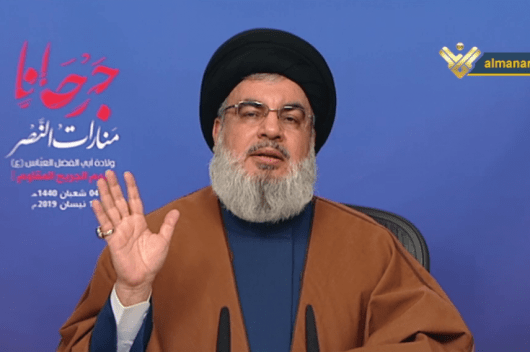
Nasrallah Warns: US Moves Will Not Remain Without a Response
Al-Manar – April 10, 2019
Hezbollah Secretary General Sayyed Hasan Nasrallah stressed that victories achieved in Lebanon are not the result of US and its allies’ tenders, indicating that the US sanctions and measures against Iran and its allies in the region “will not remain without a response.”
In a televised speech commemorating the day of Resistance Wounded Fighters, Sayyed Nasrallah emphasized that the security and peace “we are enjoying were made by our men, women, detainees and wounded, and these terrorists do not have the right to show that they are the ones who gave us stability.”
Sayyed Nasrallah considered that the US is humiliating an entire nation for the sake of terrorist ‘Israel’ and terrorist groups which it’s providing all facilities to.
As he voiced support to the Iranian Revolutionary Guards, His eminence condemned and decried the US decision to classify the IRGC as a “terrorist organization,” saying the US insolence and folly set a precedent. “This decision shows that the US audacity and folly went beyond limits.”
“Blacklisting the IRGC is an evidence that it is strong and not weak and this is an expected move by the Great Satan,” Sayyed Nasrallah said, adding that it was also a proof of the US failure and fiasco in the region.
His eminence dismissed reports about possible sanctions against Speaker Nabih Berri and other Hezbollah allies as “mere intimidation.”
We’ll Respond at the Right Time
The Hezbollah S.G. stressed that the Revolutionary Guards has a great role in defending the peoples of the region and had sacrificed a large number of martyrs and wounded for the sake of people of our region, indicating that it occupies a central, advanced, and the most influential place regionally.
“Until now we have only settled with condemnation, denouncement, patience, and managing the situation calmly in the face of sanctions and terror lists, but our patience does not mean that we, the axis of resistance, do not have the cards of strength,” Hezbollah’s S.G. warned, indicating that options remain open.
“It seems that the US blacklists will be prolonged. Our choices are open but we will act calmly, with a cool head and at the right time, in all battlefields and arenas,” Sayyed Nasrallah said. It is our natural right and ethical, religious and humanitarian duty to confront all those who might threaten our country, resistance and achievements through their sanctions and measures, he added.
Sayyed Nasrallah expressed his solidarity and support to the Iranian people who have been plagued by floods which hit Iranian areas. He said that Trump, who is bragging about humanitarianism, is blocking aid for Iranians suffering from the hurricane, expressing gratitude to all humanitarian efforts to collect aid to flood victims in Iran.
Yemen’s Steadfastness Protects the Palestinian Cause
Regarding the war on Yemen, His Eminence pointed out that four years have passed on the war and no one sees that the unarmed and oppressed people who are still steadfast and growing stronger are still fighting armies, pointing out that the war on Yemen is an American-Saudi-British-Israeli aggression.
Sayyed Nasrallah said that had Bin Salman won in Yemen war, he would have forced the Palestinians to sign on the deal of the century, stressing that Yemeni’s steadfastness throughout these years have protected the Palestinians. “What would have happened to Gulf countries and leaderships had the authoritarian Bin Salman won the war on Yemen?” he wondered, “he would have been presented as the great historical leader and victory will be presented in a misleading way.”
The Hezbollah leader indicated that there was an American insistence by Trump personally to continue the war on Yemen, pointing out that the steadfastness of the Yemeni people protects the Palestinian cause and Palestine and every occupied Arab land.
US Move to Blacklist Hezbollah Allies a Scarecrow
Sayyed Nasrallah briefly addressed the internal situation. He criticized what he called the US provocative policy of instigating strife in Lebanon, pointing out that it was continuing despite the failure of Pompeo’s recent visit.
He pointed that it was surprising that some Lebanese in Washington were working on blacklisting Hezbollah’s allies and friends in Lebanon. “The US move of blacklisting Hezbollah allies in Lebanon is just a scarecrow till now. There is not a single indication about an intention to place Nabih Berri and other allies on the terror list and we sense that there are Lebanese in Washington who are working in this direction, but so far this remains an intimidation campaign. When the matter reaches our allies, this means that they are targeting all our people.”
Unity, Resistance Only Way for a Free Lebanon
As for Lebanese concerns that Trump’s decision on the Golan Heights might affect the status of the Shebaa Farms and the Kfarshouba Hills, Sayyed Nasrallah said: “Our territorial border is linked to our national will and not to Trump’s decision.”
“We were killed and wounded and massacres were committed in our villages and cities through Israel’s aggression and the US support. Our peace, security and achievements were made by our people, martyrs and wounded. The achievements that were made in Lebanon are not from the blessings of America.”
Sayyed Nasrallah stressed the importance of the current spirit of cooperation among the political forces in addressing the current situation regardless of any tensions here or there. “Lebanese should choose between keeping Lebanon in the safe zone or responding to those who are leading it towards sedition,” Sayyed Nasrallah said, adding that the only way for keeping Lebanon free, sovereign and stable is through unity and resistance.
“I voice my support to Speaker Nabih Berri who has repented in Doha in front of the world’s parliamentarians to say the truth with a loud voice and show everyone the path of salvation: unity and resistance,” his eminence said.
Sayyed Nasrallah began his speech by hailing all wounded fighters who suffered and sacrificed themselves for the sake of this nation, saying: “thanks to your sacrifices, we are enjoying victories, security and the power of deterrence. The enemy doesn’t dare to wage any war because of your wounds and sacrifices.”
He said there was no place for neutrality in the battle of truth and in defending the oppressed.
Throughout his speech, Sayyed Nasrallah recalled the martyrdom anniversary of Sayyed Mohammad Baqer Al-Sadr and his sister, and hailed his enormous intellectual achievements.
Secret Document Reveals Plans for Civil War in Lebanon, Israeli False Flags, and Invasion
By Randi Nord | Geopolitics Alert | April 5, 2019
Beirut – During his visit with US Secretary of State, Mike Pompeo, Lebanese President Michael Aoun reportedly received a US-Israeli document detailing plans for creating a civil war in Lebanon with covert false flag operations and possible Israeli invasion.
Although the source of the document is Israeli and created in partnership with Washington, no one knows who presented it to Aoun. The Lebanese TV station, Al-Jadeed, initially reported the document on Lebanese TV and a video on its website. Geopolitics Alert translated the report for this article.
Israel and the United States Foment Civil War in Lebanon
The document details American plans to splinter the Lebanese Internal Security Forces, a domestic institution separate from the Lebanese Army. The plans involve Washington investing 200 million dollars into the Internal Security Forces (ISF) under the guise of keeping the peace but with the covert goal of creating sectarian conflict against Hezbollah with 2.5 million specifically dedicated to this purpose.
The document states the ultimate goal is to destabilize the country by creating a civil war in Lebanon which will “help Israel on the international scene.” The United States and Israel plan to accomplish this by supporting “democratic forces,” sounding remarkably similar to the same strategy used in Syria, Libya, Venezuela, and elsewhere.
According to the document, although “full load of our firepower will be unleashed,” they somehow do not anticipate any casualties. They do, however, expect the civil war to “trigger requests” for intervention from the Israeli Defense Forces (IDF) which Israel must only agree to after extreme reluctance.
The document says Israel will also play an important role by creating “covert false flag operations” as the conflict progresses. Perhaps these operations would include chemical attacks similar to the chemical attacks on civilians in Syria or even direct attacks on Lebanese or Israel civilians to blame on Hezbollah and justify international intervention.
The document admits that the United States and Israel will need an unprecedented amount of credibility to pull this off and also admits that the Lebanese Army may be an obstacle, likely due to the Army’s diverse makeup. As a legitimate political party with members throughout all aspects of Lebanese society, Hezbollah already has members and allies throughout the ISF as well as the Army.
Venezuela FM takes Middle East tour, set to meet Nasrallah
Press TV – April 3, 2019
Venezuela’s foreign minister has embarked on a Middle East tour taking him through Turkey, Lebanon, and Syria, amid US measures to prop up the Latin American country’s opposition figure and self-proclaimed “interim president” Juan Guaido against President Nicolas Maduro.
Jorge Arreaza arrived in Turkey on Monday and was assured by his Turkish counterpart Mevlut Cavusoglu of Ankara’s support for the Latin American nation in the face of US pressure. “It should not be in a way that ‘I am a big country and I can determine entire rules,’” Cavusoglu said, referring to Washington’s sanctions against Venezuela and its efforts to oust Maduro, Turkish paper Hurriyet reported.
On Tuesday, the top Venezuelan diplomat traveled to Lebanon on a two-day visit. Lebanese President Michel Aoun received him at the presidential Baabda Palace in Beirut. Arreaza, who conveyed a message from Maduro to Aoun, also met with his Lebanese counterpart Gebran Bassil.
He was also slated to meet with Lebanese Prime Minister Sa’ad Hariri, Lebanese news portal Naharnet reported. According to Lebanese daily al-Joumhouria, he will also be holding a meeting with the Hezbollah resistance movement’s Secretary General Seyyed Hassan Nasrallah.
Back in January, Hezbollah conveyed its support for Maduro amid mounting US pressure for him to resign and hand over power to Washington-backed Guaido. Hezbollah-associated lawmaker Mohammad Raad was cited by Lebanese TV channel Al Manar as saying at the time that “Nasrallah stands with the Venezuelan people and with its free leadership.”
The Venezuelan foreign minister, meanwhile, expressed satisfaction with the visits to the countries in remarks to Prensa Latina. “They are two countries that respect international law and with which there are friendly and fraternal relations,” the Cuban news agency cited him as saying.
The visit to Lebanon “opens a new stage in bilateral ties with the possibility to expand economic cooperation, especially Venezuela’s advisory in the country’s energy sector,” the agency added, citing the top diplomat.
Also in January, the US took the lead in recognizing Guaido as Venezuela’s president after the head of the opposition-ruled Congress named himself the country’s interim chief executive. Washington has been pressuring other countries into following suit and has not ruled out using the military option to oust Maduro’s government.
Many countries, including Iran, Russia, China, and Cuba, however, back Maduro, spurning the subversive American efforts targeting Venezuela’s sovereignty.
Arreaza is next to travel to Syria, with which Caracas has similarly warm relations.
Lebanon Decides to Confront Israel And The US in Shebaa, Kfarshouba And Syria
By Elijah J. Magnier | American Herald Tribune | March 28, 2019
Lebanese Judge Ahmad Mezher has given orders that a survey be conducted of Lebanese occupied territories in the Shebaa Farms, Kfarshouba, Huneen, Ideise and Bleeda. These villages are bordering Hasbaiya, Rashaya al-Fukhar and Kiyam and have been under Israeli occupation since 1981, as Syria’s Golan Heights have been since 1967. This step coincides with the illegal “gift” of the Syrian Golan Heights offered by US President Donald Trump to his closest ally Prime Minister Benyamin Netanyahu. Although Trump’s move was verbally condemned by the international community, no other state or international body seems likely to openly oppose Trump’s move at the moment.
However, Lebanon has decided to confront this move on the ground, showing its readiness to defend its territory if US “gifts” were ever seen to include Lebanese occupied territories. The Lebanese presidency, the Parliament and the government agreed that it is the right of Lebanon to regain its occupied territory and that the equation “the army, the people, the resistance” is united under one umbrella. Thus, the possibility of confrontation between the Resistance – i.e. Hezbollah in this case – and Israel is now on the table.
The level of tension and chances of confrontation increased during Lebanese President Michel Aoun’s visit to Moscow. During meetings with his homologue Russian President Vladimir Putin, the Christian President Aoun rejected US pressure on his country. The US establishment, including Secretary of State Mike Pompeo and his envoys to Lebanon, wants to prevent the over one and a half million Syrian refugees in Lebanon from returning home. President Aoun also rejected Trump’s gift to Netanyahu, stating clearly that the Golan Heights is Syrian territory illegally occupied by Israel, and not the property of the US to dispose of as it will.
It remains unclear whether the Shebaa Farms, Kfarshouba and neighbouring villages are part of Trump’s gift to Israel. This is why Lebanese authorities have requested the judiciary authority officially survey the southern Lebanese territories occupied by Israel. If, in response to the survey, any attempt is made to assert that these areas are part of Israel, then the Lebanese triad (the army, the people and the resistance) will be bound to recover its occupied territory. The timing of the decision is important because it shows the readiness of the Lebanese government to raise the subject and to confront Israel in the wake of the US decision on the Golan Heights, a territory closely linked to the Lebanese farms and villages. As recently as 2009 some of these lands were contested between Syria and Lebanon, but now that Lebanon is in a better position than Syria to vindicate its claims against Israel, the Syrian government will be happy for it to do so.
President Aoun raised these issues with President Putin in the context of Trump’s previous gift of Jerusalem, by virtue of his recognition of an undivided Jerusalem as the capital of Israel. Lebanon fully supports the right of return of Palestinians to their land, particularly since there are over 800,000 Palestinians living in Lebanon. Just as the US would prefer these Palestinians to remain in Lebanon, the US now seems to want Lebanon to accept an ongoing presence of Syrian refugees on Lebanese soil. The US policy of keeping Syrian refugees in Lebanon has several goals.
The first is to shift the religious balance of power in Lebanon. Most Syrian refugees are Sunni (mainly hostile to Assad and to his allies) and the US would like to see a Sunni plurality in Lebanon to confront Shia Hezbollah and the society behind it. All Israeli wars have failed to curb Hezbollah and could not reduce its strength. On the contrary, Hezbollah military power is increased to an unprecedented level domestically and regionally. Moreover, in the last Lebanese Parliamentary polls, Hezbollah won more votes than any religious party, surprising everyone. Support for Hezbollah goes beyond any one religious confession; it has proved itself as a force defending Christians and Shia against Wahhabi takfiri extremists. Confronting Hezbollah face to face would lead to certain failure, hence the US need to strategically build another society to stand against it.
President Aoun insists on the return of Syrian refugees to Syria, notwithstanding the financial incentives being offered by the US and Europe to keep them in Lebanon. The presence of the refugees upsets the religious equilibrium in Lebanon, and accelerates the process by which Christians are becoming a minority on Lebanese soil. The religious terrorism that hit the Middle East over the last decade targeted regional minorities, notably the Christians. The same NATO leaders whose governments sponsored takfiri terrorism against Christians in the Levant proposed to Lebanese Christian leaders that they leave the land of their ancestors and settle in the west. Christians who were raped, murdered and terrorized by ISIS and al-Qaeda in Iraq and Syria would have suffered the same fate in Lebanon had Hezbollah decided to entrench themselves in the south of Lebanon, in the Beirut suburbs, or in selected villages of the Bekaa Valley.
Moreover, the Lebanese President considers the Syrian refugees a security and a financial burden that is placing a heavy burden on the fragile and chaotic Lebanese infrastructure. These refugees currently represent a third of the total Lebanese population.
Another objective of US refugee policy in Lebanon is to recover from Syrian President Bashar al-Assad what it failed to achieve by arming militants to overthrow his government over the last 8 years. The US establishment would like to keep over 5 million Syrian refugees outside Syria, mainly in Lebanon, Jordan, Turkey and Europe. This, in US thinking, could impede forthcoming presidential elections in Syria, and prevent both the rebuilding of the Syrian Army and the reconstruction of the country. Syrians are skilful craftsmen; keeping them away from home impedes rebuilding. All these US objectives do not help Lebanon in any way. On the contrary, they weaken Lebanon, which needs a healthy relationship with neighbouring Syria for its security and commercial development.
Trump has made the Middle East less secure. He has offered Israel an illegal and unnecessary gift. Israel was already controlling the Syrian Golan Heights; Syria posed no threat to it. Syria had not fired a bullet against Israeli occupation of the Golan for 30 years and will be busy for the next ten years rebuilding its destroyed infrastructure. Moreover, the late President Hafez Assad had engaged with Israel, through US mediation, to negotiate a peace deal in exchange for the Golan Heights. It was Israel who rejected the deal at the last minute. Assad then said he would leave liberation of the territory to the generation to come.
The US establishment is undermining Lebanon’s security and peace by imposing one and a half million refugees on the country, destabilizing the local society, and threatening to impose sanctions if Lebanon does not submit to US bullying.
Trump gave Jerusalem to Israel and can no longer be considered a partner in any peace process. This realization has given new urgency to the Palestinian cause. He is not willing to give a state to the Palestinians, but he is disposing of their rights.
US forces are unwelcome in Syria, occupying a third of the country and a bordering passage, while ISIS no longer controls any Syrian territory in the north-east. At the same time the US is keeping tens of thousands of Syrian refugees at the al-Rukban camps from returning home.
In Iraq, the parliament is divided between those willing to see the last US soldier depart and those who want to maintain some training and intelligence collaboration. Iraqi politicians are afraid of asking the US to stay or to leave permanently for fear of seeing ISIS return with US support in either case (if US forces stay there is fear of seeing the US support for ISIS, an eventuality Iraqis also fear if the US were to leave).
Finally, the US is now seen as a superpower ruled by a thug sucking wealth from the oil-rich Arab countries, forcing them to buy US weapons so that Middle Easterners can continue killing each other at their own expense. Arab countries, once very rich, are imposing local taxes they have never imposed before on their own nationals and are going through a financial crisis unheard of for decades. Syria, Iraq, Yemen, Palestine and Lebanon are on the floor financially and even Saudi Arabia, the Emirates, Qatar and Bahrain are not in their best financial shape. Iran’s nuclear deal was revoked and since Trump took power the country is facing the harshest sanctions ever.
It is unclear when the next war may erupt to challenge US hegemony in this part of the world. It is clear that Russia and China are already present in the Middle East, ready to take the place of a US establishment which is no longer regarded as a friendly nation by any state but Israel.
Elijah J. Magnier is a veteran war correspondent Senior Political Risk Analyst with over 35 years’ experience covering Europe, Africa & the Middle East.
Sayyed Nasrallah: “Liar” Pompeo Visited Lebanon to Incite against Hezbollah
Al-Manar – March 26, 2019
Hezbollah Secretary General Sayyed Hasan Nasrallah lashed out at “liar” US Secretary of State, Mike Pompeo, who visited Lebanon last week, stressing that the US official’s remarks didn’t contain just single true issue.
In a speech broadcast via Al-Manar on Tuesday, Sayyed Nasrallah commented on Pompeo’s joint press conference with Lebanese Foreign Minister, Gebran Bassil last week.
The resistance leader stressed that the US official had visited Lebanon to incite the Lebanese people against Hezbollah, noting that had it not been for Hezbollah, Pompeo would have not made his visit to Lebanon.
On the other hand, Sayyed Nasrallah commented on the US decision to recognize the so-called “Israeli sovereignty” on the occupied Golan Heights, describing the move as “crucial and decisive event in the Arab-Israeli struggle.”
Recognition of ‘Israeli Sovereignty’
Sayyed Nasrallah started his speech by offering condolences to Iraqis over the Mosul ferry disaster which killed dozens of people earlier last week.
His eminence then saluted Palestinian people over their steadfastness in face of continued Israeli aggression in Gaza and West Bank.
Sayyed Nasrallah also didn’t forget to salute Yemeni people, over their heroic achievements throughout four years of Saudi-led war on the Arab impoverished country.
Hezbollah S.G. described the US move to recognize ‘Israeli sovereignty’ over Golan Heights a crucial and decisive event in the Arab-Israeli struggle, noting that “condemnation statements are no more enough.”
Talking about the indications of the US move, Sayyed Nasrallah said President Donald Trump’s decision means that he doesn’t care about millions of Muslims and Arabs- including his allies-, as well as about international laws, noting that the entire world recognizes the Syrian sovereignty on the Golan Heights.
“The entire world recognizes Golan as a Syrian land. Only Trump was the exception, just for the sake of ‘Israel’. This proves that the US administration neither recognize the United Nations nor the international laws, and uses these organizations just to serve its own interests.”
In this context, Sayyed Nasrallah stressed that the international organizations and laws are incapable of restoring the rights of the people.
“The top priority of the US administrations and especially the current administration is ‘Israel’. There is no consideration for any other issue when it comes for the interest of ‘Israel’.”
Sayyed Nasrallah meanwhile, recalled when Trump administration recognized Al-Quds (Jerusalem) as the capital of the Zionist entity, stressing that the silence of the Muslim and Arab world “opened the door for all these violations.”
“After the move to recognize Al-Quds what was been left more? The Arabs and Muslims stance towards Al-Quds has encouraged Trump to take similar actions regarding the Golan,” Sayyed Nasrallah said.
Sayyed Nasrallah called on Arab states to withdraw the 2002 Arab initiative during an upcoming Arab summit in Tunis. On the other hand Sayyed Nasrallah stressed that the only way to regain Syrian, Lebanese and Palestinian occupied lands from the Zionist entity is the resistance.
“Liar” Pompeo
Sayyed Nasrallah the commented at statement made by Pompeo last week at length, discussing most of the points mentioned by the US official during his press conference with FM Bassil.
“First, in shape: Pompeo was reading a written statement in which Hezbollah was mentioned 18 times while Iran was mentioned 19 times. He refused to answer the reporters’ questions.”
“We feel happy when an official from the world’s most powerful state is concerned over our role. We feel happy when the administration of The Great Satan is annoyed by Hezbollah.”
Sayyed Nasrallah said that Pompeo’s remarks on Hezbollah “made us more faithful that we are in the right position.”
“Second, in the content: I didn’t find in Pompeo’s remarks a single true and right statement. The US is fighting in the region on behalf of ‘Israel’.”
“Pompeo talked about stability and prosperity in Lebanon. He described Hezbollah as the main problem in the country and the region for the past 34 years. However he didn’t mention massacres and crimes committed by the Israeli occupation throughout these years. According to Pompeo, ‘Israel’ poses no threat to Lebanon and the region, but Hezbollah does, and this is a big lie.”
“Pompeo said that Hezbollah is an obstacle in front of the Lebanese people’s dreams. Is that true? The Lebanese people dream of securing peace in their country, dream of regaining its land and in preventing other countries from violating its wealth, dream of building a powerful state and countering corruption. Does Hezbollah pose an obstacle in this regard, or it is a party that has been working to achieve these dreams?” Sayyed Nasrallah wondered.
Commenting on Pompeo’s remarks that Hezbollah is seeking destruction through its “terrorists wing”, Sayyed Nasrallah lashed out the US official, stressing that the US itself has been for many years seeking destruction and committing crimes across the world.
Touching upon Hezbollah’s engagement in the Syrian war, Sayyed Nasrallah said that Pompeo in his remarks last week in Beirut was addressing Hezbollah’s incubating environment, stressing that the Lebanese resistance party had defended Lebanon against Takfiri terrorists supported by the US.
“All know what Lebanon’s fate would have been if ISIL and Nusra had controlled Syria.”
Commenting on Pompeo’s question on how Hezbollah missiles can save Lebanon, Sayyed Nasrallah described such remarks as “stupid”, stressing that Israeli attacks against Lebanon have been since years ago.
“An official from the most terrorist state in the world came to Lebanon to incite the Lebanese people against Hezbollah’s resistance.”
Sayyed Nasrallah then described Pompeo as a “liar”, recalling the US official remarks on Syrian refugees.
“The US has been preventing Syrian refugees in Rukban camp and other areas from returning to their land.”
Commenting on Pompeo’s remarks when he asked “what Hezbollah and Iran have offered to Lebanon,” Sayyed Nasrallah addressed the US official as saying: “Had it not been for Hezbollah, you would have not made your visit to Lebanon.”
Berri to Pompeo: Hezbollah Lebanese Party Represented at Parliament & Government, Resistance Results from Israeli Occupation
Al-Manar | March 22, 2019
Lebanon’s Speaker of the House, Nabih Berri, welcomed this Friday at Ain Tineh the US Secretary of State Mike Pompeo and an accompanying delegation.
The one-hour meeting touched on “the importance of maintaining stability in Lebanon and the need to deal with the maritime borders issue, including Lebanon’s Special Economic Zone.”
Pompeo expressed the United States’ desire to “assist with the efforts of the United Nations so as to address this issue.”
Speaker Berri, in turn, stressed that “the solution begins with the maritime borders.”
Talks also focused on the US sanctions imposed on Hezbollah, and their negative repercussions on Lebanon and the Lebanese.
In this regard, Berri maintained that “the laws passed by the Lebanese parliament conform to international laws and ensure transparency in financial trading at all levels.”
He stressed that Hezbollah is a “Lebanese party represented at the parliament and the government. Its resistance and that of the Lebanese are the result of the continued Israeli occupation of Lebanese territory.”
Pompeo later met with the PM Saad Hariri and then President Michel Aoun.
France shuts down ‘anti-Semitic’ groups after pledge to fight worst surge ‘since World War II’
RT | March 21, 2019
Emmanuel Macron has ordered the closure of four organizations accused by officials of promoting jihad and anti-Semitism. Earlier, the French president pledged to fight an unprecedented surge of anti-Semitism in the country.
The move comes at the request of Interior Minister Christophe Castaner, who said the groups “foment hatred, call for discrimination and justify violence,” and must be closed.
The ministry separately said the groups advocated armed jihad and indoctrinating young people. They also promoted organizations like Hamas, Palestinian Islamic Jihad and Hezbollah – all listed as terrorist organizations by the EU, the ministry stressed.
French government spokesman Benjamin Griveaux labeled the groups as “openly anti-Semitic and dangerous associations” during a cabinet meeting on Wednesday.
The development comes a month after Macron pledged to the Jewish community to fight against what he called a “resurgence of anti-Semitism unseen since World War II.” He said France will redefine anti-Zionism as a form of anti-Semitism in line with the preferences of pro-Israel groups. The decision was welcomed by the government of Israel.
The French government reported a 74-percent increase in anti-Semitic incidents in 2018 in the country compared to previous year. The pledge from Macron came after thousands of people, including two former French presidents, rallied across the country to condemn anti-Semitism in response to the desecration of a Jewish cemetery in the Strasbourg area.
The banned organizations are the Zahra Center France, the Shia Federation of France, the Anti-Zionist Party and France Marianne TV. Center Zahra France was targeted by an anti-terrorist raid in October, and was followed by the seizure of assets for six months. The French authorities accused the group, which is based in northern France, of being a vehicle for propagating radical Shiite Islam. The three others organizations are reportedly working under the center’s umbrella.
The man behind the Zahra Center and Anti-Zionist Party is Yahia Gouasmi. He is a Lebanese-born Shia Muslim, who has been living in France since the 1960s. An avowed critic of Zionism and Israel, his stated goal is to oppose the Israeli lobby in France and hold the Jewish state accountable for crimes against Palestinians and other nations. He launched the party in 2009 after the Israeli bombings of the Gaza Strip during Operation Cast Lead.
Featured Video

Bombing Hitler’s Hometown
or go to
Aletho News Archives – Video-Images
From the Archives
‘Conspiracy Theory’ Now Fact: Greater Israel Has Arrived
By Kit Klarenberg | Mint Press News | January 28, 2025
Ever since Tel Aviv’s 1948 creation, much has been said and written about ‘Greater Israel’ – the notion Zionism’s ultimate end goal is the forcible annexation and ethnic cleansing of vast swaths of Arab and Muslim lands for Jewish settlement, based on Biblical claims this territory was promised to Jews by God. The mainstream media typically dismisses this concept as antisemitic conspiracy theory, or at most the fringe fantasy of a minuscule handful of extremist Israelis.
In reality … continue
Blog Roll
 Aletho News
- IRGC: Israeli, US universities in region legitimate targets after strikes on Iranian university
- Trump admits Iran hit USS Ford carrier: ‘We ran for our lives’
- Battle for Hungary: EU attacks on Orban are a sign of worse things to come
- Iraqi resistance conducts drone strike on US-run base in Syria
- Failing to Defeat Hezbollah, Israel & US Pressure Syria’s Ahmed al-Sharaa to Join War
- US-Israeli war on Iran drives global fertilizer prices up 40%
- Hezbollah’s Surprise Weapons Redefine Ground Battle with Israel
- Yemen joins fight against US, Israel by firing missiles at occupied territories
- Seizing the Kharg: Washington’s path to defeat in the Persian Gulf
- Iran reports 500 US casualties in strikes on covert US military sites
- If Americans Knew
- Over 300 US service members wounded, majority have brain injuries – Not a ceasefire Day 169
- Researchers at Human Rights Watch Resign Over Blocked Report on Palestinian Refugee Return
- Jewish Groups Are Backing a War Americans Don’t Want
- Eric Fingerhut Thinks He’s the President of the Jews
- Top Jewish Philanthropists, Rabbis Urge Israeli President to Take Action Against ‘Jewish Extremists’
- Don’t Be Fooled. Zionist Leaders Have Always Wanted to Control Southern Lebanon
- Israel’s widespread use of torture is a core element of its genocide against the Palestinian people
- In Israel’s War on Iran, Many Middle East US Bases Rendered “All But Uninhabitable”
- ‘Burn the lawn’: Israel pursues ‘Rafah model’ in southern Lebanon
- A genocide here, an amputation there
- No Tricks Zone
- Devastating Assessment Of Comirnaty Vaccine By Former Senior Pfizer Europe Toxicologist
- New Study: CO2 Is ‘Effectively Negligible’ As An Explanatory Climate Change Factor Since 2000
- Former Pfizer Toxicologist Dr. Helmut Sterz Tells Bundestag Hearing Pfizer Vaccine Should Have Never Been Approved
- Energy Expert: Germany’s Nuclear Phaseout Was A “500 Billion Euro Mistake”
- New Research: South Australia’s Mid-Holocene Sea Surface Temperatures Were 4°C Warmer Than Today
- Storing Green Energy To Last Germany 10 Days Would Require A 60-Million Tonne Battery
- New Studies: UK Sea Levels Were 4 Meters Higher Than Today During The Mid-Holocene
- Destructive Green New Deal: German Energy And Metal Group Warns Of Drastic Crisis
- New Study Documents A 20-Year Pause In Arctic Sea Ice Decline – Driven By Internal Variability
- Wake-up Call: Survey Shows Majority Of Germans Now Favor Postponing Climate Targets!
 Aletho News