CIA, Mossad Behind Killing of Imad Mughniyeh, Washington Post Confirms
Al-Akhbar | January 31, 2015
A report from the Washington Post on Friday confirmed that the CIA and Israel’s spy agency Mossad were behind an elaborate plot to kill Hezbollah commander Imad Mughniyeh in a 2008 car bomb attack in Syria.
Citing former intelligence officials, the newspaper reported that US and Israeli spy agencies worked together to target Mughniyeh on February 12, 2008 as he left a restaurant in the Syrian capital Damascus.
He was killed instantly by a car bomb planted in a spare tire on the back of a parked car, which exploded shrapnel in a tight radius, the Post said.
On January 19, Jihad, Mughniyeh’s 24-year-old son, was also killed by Israeli forces in Syria, along with five Hezbollah members and and an Iranian general in a helicopter airstrike near the city of Quneitra.
The bomb that killed Mughniyeh, built by the United States and tested in the state of North Carolina, was triggered remotely by Mossad agents in Tel Aviv who were in communication with the CIA operatives on the ground in Damascus.
“The way it was set up, the US could object and call it off, but it could not execute,” a former US intelligence official told the newspaper.
The CIA declined to comment to the Post about the report.
According the newspaper, the authority to kill required a presidential finding by George W. Bush. Several senior officials, including the attorney general, the director of national intelligence and the national security advisor, would have had to sign off on the order, it added.
The newspaper said that during the Iraq war, the Bush administration had approved a list of operations aimed at Hezbollah, and according to one official, this included approval to target Mughniyeh.
“There was an open license to find, fix and finish Mughniyeh and anybody affiliated with him,” a former US official who served in Baghdad told the Post.
According to the newspaper, American intelligence officials had been discussing possible ways to target the Hezbollah commander for years, and senior US Joint Special Operations Command agents held a secret meeting on the issue with the head of Israel’s military intelligence service in 2002.
“When we said we would be willing to explore opportunities to target him, they practically fell out of their chairs,” a former US official told the Post.
Though it is not clear when the agencies realized Mughniyeh was living in Damascus, a former official told the newspaper that Israel had approached the CIA about a joint operation to kill him in Syria’s capital.
The agencies collected “pattern of life” information about him and used facial recognition technology to establish his identity after he walked out of a restaurant the night he was killed.
In 2013, an Al-Akhbar investigation into the 2008 assassination revealed that Mossad, under the leadership of Meir Dagan at the time, was responsible for the operation, which took around six weeks to implement, from A to Z.
Mossad and CIA have repeatedly planned and carried out assassinations on Hezbollah’s senior commanders and members in Lebanon and Syria.
In 2013, Hezbollah commander Hassan al-Laqqis was assassinated in the suburbs of Beirut, an attack that the resistance group said was orchestrated by Israeli intelligence.
On Friday, Hezbollah Secretary-General Hassan Nasrallah spoke about the latest attack on Hezbollah members in Quneitra, stressing that Israel had “planned, calculated and took a premeditated decision to assassinate” Hezbollah fighters.
(AFP, Al-Akhbar)
Nasrallah: The Rules of Engagement with Israel Are Over
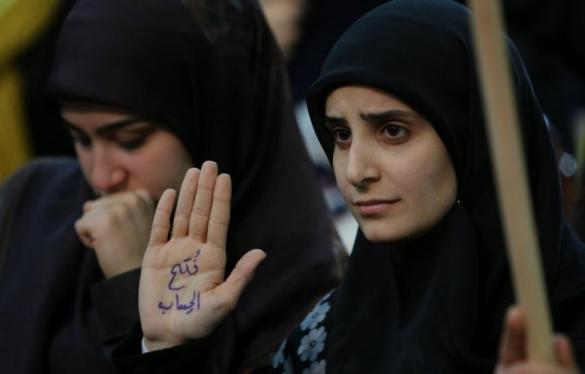
A Hezbollah supporter with the words “time for retribution” written on her hand attends a memorial ceremony to honor six Hezbollah fighters killed in Syria by an Israeli airstrike, during which Hezbollah Secretary-General Hassan Nasrallah made a televised speech. Al-Akhbar/Marwan Tahtah
Al-Akhbar | January 30, 2015
“Don’t try us,” Hezbollah Secretary-General Hassan Nasrallah told Israel in a televised speech Friday broadcast during a memorial ceremony to honor the six Hezbollah fighters and the Iranian general killed in an Israeli airstrike in Syria earlier this month.
On January 18, an Israeli helicopter airstrike on the Syrian city of Quneitra near the Israeli-occupied Golan Heights killed six fighters of Lebanon’s resistance movement Hezbollah, including a commander, Mohammed Abu Issa, and the son of assassinated senior commander Imad Mughniyeh, as well as Iranian Revolutionary Guard General Mohammed Ali Allahdadi.
Hezbollah has been fighting alongside President Bashar al-Assad in Syria against rebels in the nearly four-year Syrian conflict.
According to Nasrallah, who spoke for an hour and a half, Israel had “planned, calculated and took a premeditated decision to assassinate” the fighters, saying that the motive behind the attack was crystal clear.
Hezbollah’s chief said that while Israel isn’t worried about thousands of armed militants from the al-Nusra Front — al-Qaeda’s branch in Syria — near territories it occupies, the Zionist state “was scared on January 18 of six unarmed Hezbollah fighters and an Iranian in civilian vehicles.”
Observers from the United Nations Disengagement Observer Force (UNDOF) confirmed in a report published in December documenting cooperation and coordination between the Israeli army and militant groups in Syria.
The UNDOF report said that observers witnessed several meetings between rebel leaders and Israeli army forces between December 2013 and March 2014, in addition to witnessing the transportation of injured militants to Israeli hospitals following confrontations between the militants and the Syrian army near the occupied Golan border.
Nasrallah said that those killed in the Quneitra attack showed a “fusion of Lebanese-Iranian blood on Syrian soil, and reflects the unity of the cause and the unity of the fate of the countries in the axis of resistance.”
“When the blood of Palestinians, Lebanese, Syrians and Iranians unites, we will enter an era of triumph,” he added.
The deaths of Allahdadi and Issa revealed that commanders were present on the ground alongside fighters, Nasrallah said, adding that Jihad Mughniyeh’s death showed how entire families and not just individual members were joining the resistance.
Nasrallah extended his condolences to the families of the Hezbollah fighters as well as the families of the eight Lebanese soldiers who were killed last week in clashes with al-Nusra Front militants in the area of Tallet al-Hamra near Ras Baalbek on the Lebanese-Syrian border.
Nasrallah’s remarks came two days after Hezbollah claimed responsibility for an attack against an Israel Occupation Forces (IOF) convoy in Israeli-occupied Lebanese Shebaa Farms that left a number of Israeli soldiers dead.
According to Israeli figures, two soldiers were killed and seven others were wounded, although Hezbollah-owned Al-Manar news channel said the toll was much higher.
“They killed us in broad daylight, we kill them in broad daylight … they struck two of our vehicles, we targeted two of their vehicles,” Nasrallah said, likening the Quneitra strike to the one by Hezbollah in Shebaa.
“The only difference is that we announced that Israel struck our fighters in Quneitra half an hour after the attack, whereas the Israelis didn’t,” Nasrallah continued, adding that the number of casualties on the Israeli side was “debatable.”
The Shebaa Farms area is a mountainous, narrow sliver of land rich in water resources measuring 25 square kilometers (10 square miles). It has been illegally occupied by Israel since the 1967 Middle East war, although Lebanon has never ceased to call for its restitution.
Israel occupied most of southern Lebanon for 22 years until 2000 and the two countries are still technically at war.
“The Israelis can’t kill our people and then go to sleep … their farmers can’t stay in their fields and their soldiers can’t stroll up and down the border as if they merely killed mosquitoes,” Nasrallah said, asserting that the Zionist state would pay a price for all of its criminal actions even if that meant going to war with Israel.
“We don’t want war but we are not afraid of going to war,” Nasrallah assured. “I think the Shebaa attack was a clear message … Israel was humiliated on Wednesday.”
Nasrallah said Hezbollah would retaliate against any future Israeli attacks on its members “whenever, however and wherever,” adding that the Hezbollah “no longer cares about the rules of engagement anymore.”
“Don’t try us,” Nasrallah defiantly said to Israel.
Since the January 18 airstrike, troops and civilians in northern Israeli-occupied territories of Palestine and the occupied Golan Heights have been on heightened alert and Israel has deployed an Iron Dome rocket interceptor unit near the Syrian border.
“Israelis have been on edge ever since they targeted our fighters in Quneitra,” Nasrallah stated.
Following Wednesday’s attack, Israeli forces hit several Lebanese villages along the border, killing a 36-year-old UN peacekeeper.
Israeli warplanes routinely violate Lebanon’s airspace and have launched several attacks against Syrian targets in recent months, some reportedly carried out from over Lebanon.
On Thursday, Lebanon’s National News Agency (NNA), said Israeli fighter jets penetrated deep into Lebanese airspace, startling residents as the jets flew over the capital Beirut. Israeli jets were also seen flying over southern Lebanese towns.
Nasrallah said Israel has violated Lebanese’ sovereignty and the 1701 UN resolution “thousands of times” and “on daily basis.”
Moreover, Nasrallah slammed the Arab League as “nonexistent” when it came to fighting Israel and supporting Palestinians, saying the 22-member league has served Israel more than the Palestinians. He gave the 51-day Israeli summer assault on Gaza that left 2,300 Palestinians dead as an example of the Arab League’s failure.
Israeli army spokesman Lieutenant Colonel Peter Lerner said Wednesday’s attack was the “most severe” Israel had faced since 2006, when its war with Hezbollah killed more than 1,200 people in Lebanon, mostly civilians, and some 160 Israelis, mostly soldiers.
Spain Blames ’Israel’ for Peacekeeper’s Death
Al-Manar | January 29, 2015
Spain has held the Tel Aviv regime accountable for the death of a Spanish peacekeeper serving with the United Nations Interim Force in Lebanon (UNIFIL) during an exchange of fire between Israeli forces and fighters from Lebanon’s Hezbollah resistance movement.
“It was because of this escalation of violence, and it came from the Israeli side,” Spanish Ambassador Roman Oyarzun Marchesi told reporters in New York on Wednesday.
Marchesi further noted that his country demands full investigation into the killing.
The Spanish defense ministry said in a statement that 36-year-old Corporal Francisco Javier Soria Toledo “died this [Wednesday] morning during incidents between Hezbollah and the Israeli army in the area of responsibility of the Spanish contingent.”
Spain’s Prime Minister Mariano Rajoy expressed on Twitter his “great sadness at the death of a Spanish soldier in Lebanon.”
The Security Council also condemned the peacekeeper’s death in its strongest terms, and extended its sincere sympathies.
See also :
Israel blames Hezbollah for Spanish peacekeeper’s death on Lebanese border
RT | January 28, 2015
Israeli Foreign Minister Avigdor Lieberman has blamed Hezbollah for the death of a Spanish UN peacekeeper killed in retaliatory Israeli mortar fire in southern Lebanon on Wednesday.
After a series of cross-border strikes that left two IDF soldiers and a Spanish peacekeeper from the UN Interim Force in Lebanon (UNIFIL) dead on Wednesday, Lieberman called Spanish Foreign Minister Jose Manuel Garcia Margallo to express his condolences.
He also claimed that the Lebanese government was responsible for any attacks that come from its territory.
Lieberman called on Israel to respond to the attack in a “forceful and disproportionate manner.”
Earlier in the day, Prime Minister Benjamin Netanyahu also warned that Israel could retaliate harshly.
“To those who are challenging us in the north, I suggest you look at what happened in the Gaza Strip,” he said. … Full article
Israel Attacks Southern Lebanon After Hezbollah Targets Army Convoy
Al-Akhbar | January 28, 2015
Israel hit Lebanon with a number of rockets after an anti-tank missile was fired at an Israel Occupation Forces (IOF) convoy near the Lebanon border on Wednesday.
The Israeli army said on its Twitter feed that an “initial reports indicate a military vehicle was hit, apparently by an anti-tank missile in the area of Har Dov,” using Israel’s term for the Shebaa Farms which is also close to the ceasefire line with Syria.
Lebanon’s Hezbollah resistance movement claimed the attack.
“At 11:25 (0925 GMT) this morning, the Quneitra martyrs of the Islamic Resistance (Hezbollah) targeted an Israeli military convoy in the Shebaa Farms composed of several vehicles which was transporting several Zionist soldiers and officers,” Hezbollah said in a statement broadcast on the group’s Al-Manar television channel
Al-Manar said nine Israeli vehicles were targeted in the attack. Al-Mayadeen news channel’s Director Ghassan Ben Jeddo, said at least 15 Israeli soldiers have been killed.
There were conflicting reports on whether an Israeli soldier was abducted during the attack. Al-Akhbar English could not independently confirm the information at this time.
The Shebaa Farms area is a mountainous, narrow sliver of land rich in water resources measuring 25 square kilometers (10 square miles). It has been occupied by Israel since the 1967 Middle East war.
An Israeli security source, meanwhile, said a number of people were wounded in the incident after their vehicles came under “very heavy fire at close range,” saying the incident was still ongoing.
He said it was not clear whether the vehicles had been hit by an anti-tank missile, a rocket or a mortar, but said Israeli forces had returned fire, hitting targets across the border.
Israeli newspaper the Jerusalem Post said the Israeli army fired at the southern Lebanese village of Kfar Shouba.
Two sources told AFP that more than a dozen shells had been fired on Lebanese border villages and that Israeli warplanes were flying over the area.
A spokesperson for the United Nations Interim Force in Lebanon (UNIFIL), which monitors the Lebanese-Israeli border, reported that one of its soldiers, a Spanish citizen, was killed after sustaining serious wounds by Israeli shelling in the border village of Abbasieh.
“At least 15 shells have been fired against five villages in the south,” one security source said, adding that the village of Majidiyeh was hardest hit.
Another security source said the Israeli army was firing a new shell into the area about every two minutes, and was also firing artillery.
The Lebanese army is deployed in all five villages that were shelled, but it was unclear whether Hezbollah had a presence there.
Al-Mayadeen said the Israeli strikes were ongoing.
Israeli newspaper Haaretz reported that mortar shells had hit the village of Ghajar, which straddles the border between Lebanon and the Israeli-occupied Golan Heights.
Images broadcast from the scene showed large plumes of white smoke billowing across the area and police sealed off several roads close to the border in northern Israel.
Commenting on the attack, Israeli Prime Minister Benjamin Netanyahu said Israel was ready to act “with force” following the border attack.
Referring to the bloody Israeli assault on the Gaza Strip this summer, Netanyahu added: “I suggest that all those who are challenging us on our northern border, look at what happened in Gaza, not far from the city of Sderot.”
“Hamas suffered the most serious blow since it was founded this past summer and the [IOF] is prepared to act on every front.”
Retaliation for Israeli attacks in Syria
The attack came hours after Israeli aircraft struck alleged Syrian army artillery positions early on Wednesday, and one day after rockets were launched at the Israeli-occupied Golan Heights.
On January 18, an Israeli airstrike on the Syrian city of Quneitra killed six fighters of Lebanon’s resistance movement Hezbollah, including a commander and the son of assassinated senior commander Imad Mughniyeh, as well as Iranian Revolutionary Guards General Mohammad Ali Allahdadi.
The Hezbollah brigade which carried out the attack, the Quneitra martyrs of the Islamic Resistance, was named in reference to the deadly strike in Quneitra, indicating that Wednesday’s attack was in retaliation for the killing of its members.
Hezbollah Secretary-General Hassan Nasrallah had previously warned Israel against any “stupid” moves in Lebanon and Syria, vowing to retaliate and make sure Israel pays the price for any aggression against the neighboring countries.
Israeli airstrikes on Syria “target the whole of the resistance axis,” Nasrallah said in reference to Syria, Iran and his government, who are sworn enemies of Israel.
“The repeated bombings that struck several targets in Syria are a major violation, and we consider that any strike against Syria is a strike against the whole of the resistance axis, not just against Syria,” he said, adding the “axis is capable of responding” anytime.
Since the airstrike, troops and civilians in northern Israeli-occupied territories of Palestine and the occupied Golan Heights have been on heightened alert and Israel has deployed an Iron Dome rocket interceptor unit near the Syrian border.
The last Israeli war on Lebanon in the summer of 2006 killed more than 1,200 Lebanese, most of them civilians, and 160 Israelis, most of them soldiers.
Nasrallah is expected to deliver a speech on January 30 regarding the Israeli strikes.
(Al-Akhbar, AFP, Reuters)
Two Rockets Fired from Syria Hit Israeli-Occupied Golan Heights
Al-Akhbar | January 27, 2015
At least two rockets fired from Syria hit the Israeli-occupied Golan Heights on Tuesday, prompting Israeli forces to return fire, the Israeli army said.
There were no immediate reports of casualties on the Israeli side.
Israeli army spokesman Peter Lerner claimed in a text message to AFP that the Syrian fire was “intentional, not spillover from the Syrian civil war,” as has sometimes been the case in the past.
A source from within the Syrian foreign ministry told Al-Akhbar English that the rockets were not fired by the army, claiming that they had been launched from rebel-held areas.
In September, Israeli Occupation Forces (IOF) fired at a Syrian military position after what it said was stray fire from fighting between soldiers and Islamist rebels close to the armistice line on the Golan.
There has been repeated fire across the ceasefire line since the uprising in Syria erupted in March 2011, not all of it stray.
In August, five rockets fired from Syria hit the Israeli-occupied sector of the Golan Heights and, in July, Israel shelled Syrian army positions when a rocket struck territory it occupies.
Tensions have soared along the ceasefire line since a January 18 an Israeli airstrike killed six Hezbollah fighters and an Iranian general near Quneitra on the Syrian-held side of the strategic plateau.
Defense Minister Moshe Yaalon said Friday that Israel was prepared for any retaliation by Lebanon’s Hezbollah resistance movement.
“Israel will hold responsible governments, regimes and organizations on the other side of our northern borders over any violation of Israel’s sovereignty, or an attack on soldiers or civilians,” he said during a tour of the Golan and the nearby border with Lebanon.
Nasrallah said in an interview with Al-Mayadeen last week that Israeli airstrikes on Syria “target the whole of the resistance axis,” in reference to Syria, Iran and Lebanon.
“The repeated bombings that struck several targets in Syria are a major violation, and we consider that any strike against Syria is a strike against the whole of the resistance axis, not just against Syria,” he said, adding the “axis is capable of responding” anytime.
Israel has deployed its Iron Dome missile defense system in the north, where local media say it is amassing tanks and infantry reinforcements.
Israel seized 1,200 square kilometers (460 square miles) of the Golan from Syria in the Six-Day War of 1967 and annexed it in 1981 in a move never recognized by the international community.
Syria and Israel are still officially in a state of war.
Observers from the United Nations Disengagement Observer Force (UNDOF) confirmed in a report published in December documenting cooperation and coordination between the Israeli army and militant groups in Syria.
The report revealed ongoing communication between armed groups’ leaders and Israeli army officers.
(AFP, Al-Akhbar)
Congress Seeks Netanyahu’s Direction
By Robert Parry | Consortium News | January 22, 2015
Showing who some in Congress believe is the real master of U.S. foreign policy, House Speaker John Boehner has invited Israel’s Prime Minister Benjamin Netanyahu to address a joint session and offer a rebuttal to President Barack Obama’s comments on world affairs in his State of the Union speech.
Boehner made clear that Netanyahu’s third speech to a joint session of the U.S. Congress – scheduled for Feb. 11 – was meant to counter Obama’s assessments. “There is a serious threat in the world, and the President last night kind of papered over it,” Boehner said on Wednesday. “And the fact is that there needs to be a more serious conversation in America about how serious the threat is from radical Islamic jihadists and the threat posed by Iran.”
The scheduling of Netanyahu’s speech caught the White House off-guard, since the Israeli prime minister had apparently not bothered to clear his trip with the administration. The Boehner-Netanyahu arrangement demonstrates a mutual contempt for this President’s authority to conduct American foreign policy as prescribed by the U.S. Constitution.
In the past when Netanyahu has spoken to Congress, Republicans and Democrats have competed to show their devotion by quickly and frequently leaping to their feet to applaud almost every word out of the Israeli prime minister’s mouth. By addressing a joint session for a third time, Netanyahu would become only the second foreign leader to do so, joining British Prime Minister Winston Churchill who never used the platform to demean the policies of a sitting U.S. president.
Besides this extraordinary recognition of another country’s leader as the true definer of U.S. foreign policy, Boehner’s move reflects an ignorance of what is actually occurring on the ground in the Middle East. Boehner doesn’t seem to realize that Netanyahu has developed what amounts to a de facto alliance with extremist Sunni forces in the region.
Not only is Israel now collaborating behind the scenes with Saudi Arabia’s Wahhabist leadership but Israel has begun taking sides militarily in support of the Nusra Front, al-Qaeda’s affiliate in the Syrian civil war. A source familiar with U.S. intelligence information on Syria said Israel has a “non-aggression pact” with Nusra forces that control territory adjacent to the Israeli-occupied Golan Heights.
The quiet cooperation between Israel and al-Qaeda’s affiliate was further underscored on Sunday when Israeli helicopters attacked and killed advisers to the Syrian military from Lebanon’s Hezbollah and Iran. In other words, Israel has dispatched its forces into Syria to kill military personnel helping to fight al-Nusra. Iran later confirmed that one of its generals had died in the Israeli strike.
Israel’s tangled alliances with Sunni forces have been taking shape over the past several years, as Israel and Saudi Arabia emerged as strange bedfellows in the geopolitical struggle against Shiite-ruled Iran and its allies in Iraq, Syria and southern Lebanon. Both Saudi and Israeli leaders have talked with growing alarm about this “Shiite crescent” stretching from Iran through Iraq and Syria to the Hezbollah strongholds in Lebanon.
Favoring Sunni Extremists
Senior Israelis have made clear they would prefer Sunni extremists to prevail in the Syrian civil war rather than President Bashar al-Assad, who is an Alawite, a branch of Shiite Islam. Assad’s relatively secular government is seen as the protector of Shiites, Christians and other minorities who fear the vengeful brutality of the Sunni jihadists who now dominate the anti-Assad rebels.
In one of the most explicit expressions of Israel’s views, its Ambassador to the United States Michael Oren, a close adviser to Netanyahu, told the Jerusalem Post in September 2013 that Israel favored the Sunni extremists over Assad.
“The greatest danger to Israel is by the strategic arc that extends from Tehran, to Damascus to Beirut. And we saw the Assad regime as the keystone in that arc,” Oren told the Jerusalem Post in an interview. “We always wanted Bashar Assad to go, we always preferred the bad guys who weren’t backed by Iran to the bad guys who were backed by Iran.” He said this was the case even if the “bad guys” were affiliated with al-Qaeda.
Saudi Arabia shares Israeli’s strategic view that “the Shiite crescent” must be broken and has thus developed a rapport with Netanyahu’s government in a kind of “enemy of my enemy is my friend” relationship. But some rank-and-file Jewish supporters of Israel have voiced concerns about Israel’s new-found alliance with the Saudi monarchy, especially given its adherence to ultraconservative Wahhabi Islam and its embrace of a fanatical hatred of Shiite Islam, a sectarian conflict between Sunnis and Shiites that dates back 1,400 years.
Though President Obama has repeatedly declared his support for Israel, he has developed a contrary view from Netanyahu’s regarding what is the gravest danger in the Middle East. Obama considers the radical Sunni jihadists, associated with al-Qaeda and the Islamic State, to be the biggest threat to Western interests and U.S. national security.
That has put him in a different de facto alliance – with Iran and the Syrian government – since they represent the strongest bulwarks against Sunni jihadists who have targeted Americans and other Westerners for death.
What Boehner doesn’t seem to understand is that Israel and Saudi Arabia have placed themselves on the side of the Sunni jihadists who now represent the frontline fight against the “Shiite crescent.” If Netanyahu succeeds in enlisting the United States in violently forcing Syrian “regime change,” the U.S. government likely would be facilitating the growth in power of the Sunni extremists, not containing them.
But the influential American neoconservatives want to synch U.S. foreign policy with Israel’s and thus have pressed for a U.S. bombing campaign against Assad’s forces (even if that would open the gates of Damascus to the Nusra Front or the Islamic State). The neocons also want an escalation of tensions with Iran by sabotaging an agreement to ensure that its nuclear program is not used for military purposes.
The neocons have long wanted to bomb-bomb-bomb Iran as part of their “regime change” strategy for the Middle East. That is why Obama’s openness to a permanent agreement for tight constraints on Iran’s nuclear program is seen as a threat by Netanyahu, the neocons and their congressional allies – because it would derail hopes for militarily attacking Iran.
In his State of the Union address on Tuesday, Obama made clear that he perceives the brutal Islamic State, which he calls “ISIL” for the Islamic State of Iraq and the Levant, as the principal current threat to Western interests in the Middle East and the clearest terror threat to the United States and Europe. Obama proposed “a smarter kind of American leadership” that would cooperate with allies in “stopping ISIL’s advance” without “getting dragged into another ground war in the Middle East.”
Working with Putin
Thus, Obama, who might be called a “closet realist,” is coming to the realization that the best hope for blocking the advances of Sunni jihadi terror and minimizing U.S. military involvement is through cooperation with Iran and its regional allies. That also puts Obama on the same side with Russian President Vladimir Putin who has faced Sunni terrorism in Chechnya and is supporting both Iran’s leaders and Syria’s Assad in their resistance to the Islamic State and al-Qaeda’s Nusra Front.
Obama’s “realist” alliance, in turn, presents a direct threat to Netanyahu’s insistence that Iran represents an “existential threat” to Israel and that the “Shiite crescent” must be destroyed. There is also fear among Israeli right-wingers that an effective Obama-Putin collaboration could ultimately force Israel into accepting a Palestinian state.
So, Netanyahu and the U.S. neocons believe they must do whatever is necessary to shatter this tandem of Obama, Putin and Iran. That is one reason why the neocons were at the forefront of fomenting “regime change” against Ukraine’s elected pro-Russian President Viktor Yanukovych last year. By splintering Ukraine on Russia’s border, the neocons drove a wedge between Obama and Putin. [See Consortiumnews.com’s “Neocons’ Ukraine-Syria-Iran Gambit.”]
Even the slow-witted mainstream U.S. media has begun to pick up on the story of the emerging Israeli-Saudi alliance. In the Jan. 19 issue of Time magazine, correspondent Joe Klein noted the new coziness between top Israeli and Saudi officials.
He wrote: “On May 26, 2014, an unprecedented public conversation took place in Brussels. Two former high-ranking spymasters of Israel and Saudi Arabia – Amos Yadlin and Prince Turki al-Faisal – sat together for more than an hour, talking regional politics in a conversation moderated by the Washington Post’s David Ignatius.
“They disagreed on some things, like the exact nature of an Israel-Palestine peace settlement, and agreed on others: the severity of the Iranian nuclear threat, the need to support the new military government in Egypt, the demand for concerted international action in Syria. The most striking statement came from Prince Turki. He said the Arabs had ‘crossed the Rubicon’ and ‘don’t want to fight Israel anymore.’”
Not only did Prince Turki offer an olive branch to Israel, he indicated agreement on what the two countries consider their most pressing strategic interests: Iran’s nuclear program and Syria’s civil war. In other words, in noting this extraordinary meeting, Klein had stumbled upon the odd-couple alliance between Israel and Saudi Arabia – though he didn’t fully understand what he was seeing.
On Tuesday, the New York Times reported that Obama had shifted his position on Syria as the West made a “quiet retreat from its demand” that Assad “step down immediately.” The article by Anne Barnard and Somini Sengupta noted that the Obama administration still wanted Assad to exit eventually “but facing military stalemate, well-armed jihadists and the world’s worst humanitarian crisis, the United States is going along with international diplomatic efforts that could lead to more gradual change in Syria.”
At the center of that diplomatic initiative was Russia, again reflecting Obama’s recognition of the need to cooperate with Putin on resolving some of these complex problems (although Obama did include in his speech some tough-guy rhetoric against Russia over Ukraine, taking some pleasure in how Russia’s economy is now “in tatters”).
But the underlying reality is that the United States and Assad’s regime have become de facto allies, fighting on the same side in the Syrian civil war, much as Israel had, in effect, sided with al-Qaeda’s Nusra Front by killing Hezbollah and Iranian advisers to the Syrian military.
The Times article noted that the shift in Obama’s position on Syrian peace talks “comes along with other American actions that Mr. Assad’s supporters and opponents take as proof Washington now believes that if Mr. Assad is ousted, there will be nothing to check the spreading chaos and extremism.
“American planes now bomb the Islamic State group’s militants in Syria, sharing skies with Syrian jets. American officials assure Mr. Assad, through Iraqi intermediaries, that Syria’s military is not their target. The United States still trains and equips Syrian insurgents, but now mainly to fight the Islamic State, not the government.”
Yet, as Obama adjusts U.S. foreign policy to take into account the complex realities in the Middle East, he now faces another front in this conflict – from the U.S. Congress, which has long been held in thrall by the Israel lobby.
Not only has Speaker Boehner appealed to Netanyahu to deliver what amounts to a challenge to President Obama’s foreign policy but congressional neocons are even accusing Obama’s team of becoming Iranian stooges. Sen. Robert Menendez of New Jersey, a Democratic neocon, said, “The more I hear from the administration and its quotes, the more it sounds like talking points that come straight out of Tehran.”
If indeed Netanyahu does end up addressing a joint session of the U.S. Congress, its members would face a stark choice of either embracing Israel’s foreign policy as America’s or backing the decisions made by the elected President of the United States.
~
Investigative reporter Robert Parry broke many of the Iran-Contra stories for The Associated Press and Newsweek in the 1980s. You can buy his latest book, America’s Stolen Narrative, either in print here or as an e-book (from Amazon and barnesandnoble.com).
Applauding Israel’s Transgressions
By AHMAD BARQAWI | CounterPunch | January 21, 2015
So after “headlining” that anti-terrorism joke of a parade last week and basking in the Parisian sun of selective humanitarianism and international solidarity with freedom of speech; the first order of (shoddy) business for Israeli Prime Minister Benyamin Netanyahu was lambasting the International Criminal Court, for merely entertaining the (anti-Semitic?) notion of investigating “possible” Israeli war crimes in Gaza (how dare they?), going as far as threatening to lobby member-states and allies to cut off funding for the tribunal and practically pull a repeat of the UNESCO farce when the Obama Administration, at the behest and for the benefit of its darling Israel, froze funding for the cultural organization, after granting the Palestinians full membership into the agency, plunging the UN body into the worst financial dire strait in its history.
It is more than likely that Netanyahu will get his way this time too.
The second order of business, however, was sending a military helicopter gunship over to Syrian territory and bombing a convoy belonging to the Lebanese Resistance Movement Hezbollah, killing six operatives including the son of assassinated leader Imad Mughnyyieh and field commander Mohammad Issa in addition to one Iranian General, in the Syrian village of Quneitra close to the border area with Lebanon in the Golan heights.
Business as usual for humanitarian extraordinaire Bibi and Co.
Of course this was no terrorist attack, at least not according to the mainstream media; so you won’t be seeing #jesuishizbollah anywhere on social media and no solidarity marches in real life, just another daily recount of internationally tolerable Israeli shenanigans in the region.
Evidently, unless it involves scraggy young men with weird, unpronounceable Middle Eastern names, wearing Keffiyehs, wielding shabby Kalashnikovs and storming the streets of a western city then it’s not terrorism, and in the case of the latest Israel airstrike in the Syrian Golan heights; it was just a military operation, clean and surgical, according to the BBC at least; not forgetting of course to tail the news with the little tidbit that this is not the first time Israel has conducted air strikes inside Syria, to “prevent the transfer of stockpiles of weapons from Syria to Hezbollah”. So, all should be fine and dandy then.
You see it’s completely acceptable for the BBC to venture justifications on behalf of the Israeli army for its various terrorist operations and transgressions in the region, we’ve seen it before in Palestine, Syria and Lebanon; covering Israeli crimes in the complacent mainstream media usually comes with peppered excuses and rationalizations that supposedly give some sort of subtle credence to any act of aggression committed by the Zionist entity, wrapping it with the usual, tattered caveat of “self-defense”; the AP’s report on the latest attack, for instance, highlighted the fact that Hezbollah had recently boasted of its “ability to hit any part of the Jewish state” with rockets, in reference to Hezbollah leader Hassan Nasrallah’s recent interview. Imagine the outrage!
Whereas if one so much as dared to attempt a mildly rational and lucid reading of the Charlie Hebdo massacre; he’d be immediately castigated at best and lumped into the same category as the Kouachi brothers as an Al Qaida sympathizer at worst; that’s the freedom of speech they were marching for in Paris I guess.
Speaking of Al Qaida; do you know who were rubbing their hands with ecstatic glee over the Israeli airstrike against Hezbollah? None other than Al Qaida’s very own Al Nusra Front (or the moderate Syrian opposition force worthy of caches of weapons and funding, according to the west) and other rag-tag, ideologically like-minded militant groups whose evident ironclad alliance with Israel has transcended the widely reported medical assistance and treatment of the injured in Israeli hospitals into providing direct military backing and air cover when needed especially in areas where the Syrian opposition’s tenuous grab is slipping in favor of the Syrian Army along with Hezbollah forces. Areas such as Al Quneitra.
In a sense this latest Israeli attack against a Hezbollah target in Syria serves as a perfect cliff note for the uninitiated to disentangle this seemingly complicated cobweb of alliances in the Syrian war. On the one side you have the Syrian Government of Bashar Al Assad backed by Hezbollah and Iran, while on the other you have a who’s who of the region’s nastiest terrorists; from the mismatched posses of Islamic extremists fighting under the Islamic Army moniker, to ISIS and Al Nusra Front, backed by the deep-pocketed Gulf monarchies along with Erdogan’s Turkey and the U.S., with Netanyahu’s Israel added to the mix for good measure. Talk about a true rogues gallery.
A cursory glance over GCC media and social networks is more than enough to note a certain air of unabashed exuberance over the Israeli airstrike; Syrian “revolutionaries” along with their GCC sponsors could not contain their jubilation as soon as news of the bombing broke; gloating over the assassination and mocking Hezbollah’s rhetoric of vowing vengeance for its slain operatives “at the time and place of its choosing”.
The rotten logic of the “lesser of two evils”, in reference to the Zionist regime, has become such a stable in the armory of the anti-Hezbollah/anti-Iran crowd in the Arab World, invoked every time the Israeli terrorist army commits a new atrocity to soften the impact of its crimes and desensitize the public to Israel’s parasitic existence on Arab lands. And this time was no different; with many reveling in the claim that Hezbollah “had it coming” for backing the government of Bashar Al Assad.
In an article confessedly titled “How Did We End up Applauding for Israel”, published in the Saudi-financed, crude Arabic daily Al-Sharq Al-Awsat, which by the way, itself exhibited an unmistakable celebratory tone while covering the latest Israel strike especially over the slain Iranian General, Saudi writer Abdel Rahman al-Rashed actually “laments” the fact that there are growing cheerleading voices in the Arab world for Israel and that (some) Arabs have become increasingly more vocal in their support for the Zionist entity just out of sheer “spite” for Hezbollah and Iran, especially on social media websites and even among supporters of Islamic Jihadi groups.
Nonetheless, al-Rashed places the brunt of the blame on… yes you guessed it… Hezbollah, Israel’s arch enemy, for ostensibly transforming poor, gullible Arabs en masse into hordes of hardcore Israel-enthusiasts, through its alleged role in the assassination of former Lebanese Prime Minister Rafiq Al Hariri (according to a sham international tribunal anyway), and the Lebanese party’s military involvement in the Syrian civil war. Talk about connecting all the wrong dots.
Never mind that the Lebanese movement has been the subject of an unrelenting smear campaign steeped in vile sectarianism, all manner of character assassination and outright fabrications targeting its leaders, and discrediting its military achievements against Israel ever since 2005, courtesy of Saudi Arabia along with the rest of the GCC club (aka Al Rashed’s sole meal tickets) and their labyrinthine network of media outlets including Al Sharq Al Awsat newspaper where anti-Shiite sentiments run amok and distinct pro-Israel bias reigns supreme.
Never mind the fact that the Arab public has been bombarded with a nonstop barrage of demonization and vilification sprees directed not only at Hezbollah, but also at any movement, party or political group which just so happens to adopt an anti-Israel stance and/or rhetoric, including the Palestinian movements of Hamas and the Islamic Jihad, only with the sole endgame of reshuffling the public’s priorities to accommodate the West’s political agenda in our region where Israel gets to sit snugly and comfortably in our midst all the while Iran is being touted and over-hyped as the biggest threat to the stability of the Arab world.
It’s true; we do applaud for Israel. Its transgressions and air strikes on Arab soil no longer provoke a sense of outrage or even the merest of condemnations, but we only have the GCC to thank for that.
Iranian Defense Minister: Iran to Arm West Bank Against Israel
Al-Akhbar | January 21, 2015
Iranian Defense Minister General Hossein Dehqan on Wednesday declared that Tehran will arm Palestinians in the West Bank against the Zionist state, according to the Iranian Fars news agency.
Naqdi stressed, during a memorial service marking the death of six Hezbollah members and an Iranian General killed by Israeli Occupation forces in Syria, that “arming the West Bank is a principal policy of the Islamic Republic and we will use every means and capacity” to fulfill this policy.
Dehqan warned that “the Zionists will receive a crushing response” and added “today the resistance front, as representative of all Muslims, is acting against the Zionists and the Takfiri stream and we will support it in every aspect with all our capacities,” reported Fars news agency.
On Wednesday, at a funeral procession for General Mohammed Ali Allahdadi, killed by Israel in Golan Heights, a Revolutionary Guards commander Major General Ali Jafari said “the path of martyr Allahdadi is unstoppable and will be continued until the liberation of the Holy Quds (Jerusalem) and obliteration of the Zionist regime.”
Jafari also took aim at Israel on Tuesday, saying, “The Zionists should await destructive thunderbolts.”
“They have in the past seen our wrath,” he announced, adding the Revolutionary Guards “will continue its support for Muslim fighters and combatants in the region.”
Mohsen Rezaie, secretary of Iran’s Expediency Council, on his part said that Hezbollah would eventually retaliate against “this recent atrocity,” but that the group was “prudent and has a long term plan and will not be infuriated.”
General Mohammed Ali Allahdadi died alongside six fighters from Lebanon’s Hezbollah resistance movement in the attack Sunday near Quneitra on the Syrian-controlled side of the Golan Heights.
An Israeli security source told AFP one of its helicopters carried out the strike, but a United Nations’ observer force in the Golan raised the possibility that drones may have been used.
The incident came days after Hezbollah chief Hassan Nasrallah threatened to retaliate against Israel for its repeated strikes on targets in Syria, and boasted the movement was stronger than ever.
(AFP, Al-Akhbar)
Iran’s IRGC confirms killing of its general in Syria’s Golan
Press TV – January 19, 2015
Iran’s Islamic Revolution Guards Corps (IRGC) confirms the killing of one of its generals in an Israeli airstrike on the occupied Golan Heights in Syria that also killed six members of the Lebanese resistance movement, Hezbollah.
“A number of fighters and forces of the Islamic Resistance along with Brigadier General Mohammad Ali Allahdadi were visiting the region of Quneitra and were attacked by a military helicopter of the Zionist regime,” the IRGC said in a statement on its website on Monday.
“This brave general and some members of Hezbollah were martyred as a result of this crime,” it added.
It said Allahdadi had traveled to Syria to provide consultation and help the Syrian government and nation counter the Takfiri and Salafi terrorists in the war-stricken country.
He gave “decisive” consultation about ways to stop and thwart the Israeli regime’s plots and crimes, it added.
The statement emphasized that the killing of the IRGC general and Hezbollah fighters would strengthen the movement’s determination to fight the Israeli regime.
“The Zionist regime’s criminal move to violate Syria’s airspace once again showed that the terrorist plot of the ISIL and Takfiri groups has been hatched in line with policies of the arrogant and Zionist system and in coordination with leaders of the White House and the occupying regime of al-Quds against the Muslim community,” the IRGC said.
They are not committed to any international regulations and human and moral principles to achieve their evil goals, it pointed out.
Jihad Mughniyeh funeral procession
Lebanon’s Hezbollah on Monday held a funeral procession for Jihad Mughniyeh in southern Beirut. Massive crowds took part in the event.
Jihad was among six Hezbollah fighters killed in Israel’s missile strike on Syria’s Golan Heights. He was the son of Hezbollah’s slain military commander, Imad Mughniyeh, who was assassinated in an Israeli-orchestrated bombing back in 2008.
Painful response
A source close to the Lebanon’s Hezbollah says the movement’s response to Israel’s deadly attack on members of the resistance would be “painful.”
“The attack against six Hezbollah members will have a painful and unexpected response, but it can be assumed that it will be controlled to prevent an all-out war,” the sources told the Lebanese As-Safir Arabic political daily on Monday.
A serious mistake
The Syrian information minister has slammed as a “serious mistake” the recent Israeli airstrike on the southwestern strategic Syrian city of Quneitra.
“Israel has made a serious mistake when it attacked on Syrian soil today,” Omran al-Zoubi said in an interview with Lebanese al-Manar TV on Sunday.
Al-Zoubi said the airstrikes proved the Tel Aviv regime was cooperating with terrorist groups, including the al-Qaeda-linked al-Nusra Front.
The Syrian minister said that Israel needs the terrorist groups to act as a “buffer zone” that separates it from the Syrian army and people.
Whoever fights the Syrian people and army is putting himself in the service of the Zionist project against Syria, Palestine and the Arab nation, he added.
Iran’s condemnation
Iran’s Foreign Ministry has strongly condemned the killing of six fighters of Lebanese resistance movement Hezbollah by Israel, Press TV reports.
“We condemn all actions of the Zionist regime as well as all acts of terror,” Iranian Foreign Minister Mohammad Javad Zarif told Press TV early on Monday, lashing out at Israel for committing acts of terrorism.
Zarif further censured the acts of terrorism against the people of Lebanon and the resistance movement, saying that “this has been a practice followed for a very long time,” the top Iranian diplomat noted. “The policy of state terrorism is a known policy of the Zionist regime,” he added.
Hezbollah statement
Lebanese resistance movement Hezbollah confirmed the death of six fighters in the new Israeli airstrike on the southwestern strategic Syrian city of Quneitra.
In a statement issued on Sunday, Hezbollah said 25-year-old Jihad Mughniyeh, the son of slain Hezbollah top commander Imad Mughniyeh, and five other fighters lost their lives in the fresh Israeli aerial assault against Syria.
Hezbollah identified the other victims as Mohammad Issa,42, Abbas Ibrahim Hijazi, 35, Mohammad Ali Hasan Abu al-Hasan, 29, Ghazi Ali Dawi, 26, and Ali Hasan Ibrahim, 21.
The martyrs were reportedly on a field reconnaissance mission in Quneitra when an Israeli military helicopter targeted their vehicle.
Fresh Israeli aggression
On Sunday, an Israeli military helicopter fired two missiles into Amal Farms in the strategic southwestern city of Quneitra, close to line separating the Syrian part of the Golan Heights from the Israeli-occupied sector.
The Israeli military has so far declined comment on the attack.
Press TV reported that the Israeli military has gone on high alert for the fear of a possible Hezbollah response to the regime’s new act of aggression.
Analysts believe the new Israeli assault is yet another attempt by Tel Aviv to change the balance of war in favor of the Takfiri militants fighting against Syria.
The new Israeli aerial raid comes as Syrian soldiers, backed by Hezbollah resistance fighters, have made numerous gains against the militants operating in Quneitra.
The Tel Aviv regime has carried out several airstrikes in Syria since the start of the nearly four-year-old foreign-sponsored militancy there.
Damascus says Tel Aviv and its Western allies are aiding the extremist terror groups operating inside Syria since March 2011.
The Syrian army has repeatedly seized large quantities of Israeli-made weapons and advanced military equipment from the foreign-backed militants inside the Arab state.
Berri reaction
Lebanese Parliament Speaker Nabih Berri has hit out at the Tel Aviv regime for disrupting stability in Lebanon.
“Every time we take steps forward in terms of achieving stability … Israel tries to create chaos,” local Lebanese media quoted Berri as saying on Monday.
“Israelis don’t want Lebanon to relax,” he said.
Lebanon’s al-Manar TV said later in the day that Tel Aviv is “playing with fire that puts the security of the whole Middle East on edge.
Reconciliation of political rivals in Lebanon
Press TV | December 25, 2014
Ever since the end of former president, Michel Sleiman’s tenure in May 2014, Lebanon has continued to function without a head of state.
The country is grappling with turmoil on its border with Syria due to different factors including the presence of foreign-backed Takfiri militants, a Syrian refugee crisis, and a spillover of the war in Syria.
Amid all this, Hezbollah and Saudi-backed Sa’ad Hariri’s Future Movement have held talks to try and diffuse tensions and pave the way for a joint fight against terrorism.
An atmosphere of cautious optimism prevailed over Lebanon after the resistance movement Hezbollah and the western and Saudi-backed March 14 Future Movement held their first dialogue session in over four years. The step has been praised by various Lebanese officials who have indicated that the dialogue process has got off to a good start. Hezbollah, in its first comments on the issue, highlighted the necessity of such a step as a means to strengthen the country against the menace of Takfiri terror.
To discuss Lebanon’s current political developments, Press TV has conducted an interview with Sukant Chandan, who is the co-founder of The Tricontinental from London, and Salah Takieddine, with Lebanon Future Movement from Beirut.
The Debate – Rivals Reconciliation (P.1)
The Debate – Rivals Reconciliation (P.2)
Riyadh nips Hezbollah-Future Movement dialogue in the bud
Al-Akhbar | November 21, 2014
Riyadh has ‘red-lighted’ the planned dialogue between Hezbollah and the Future Movement before it even began. The Saudi call for Hezbollah to be put on the list of terrorist organizations made at the United Nations threatens to renew tension between the two sides, following an undeclared truce in the media that did not last for more than a few days.
Is there a fixed Saudi, and consequently Gulf policy, vis-à-vis Lebanon? Are these countries really keen on the stability of this country, as they claim, when they hardly spare any occasion to exacerbate its divisions? These questions and others are being asked after the new Saudi escalation against Hezbollah, which is likely to aggravate the already complex situation in Lebanon and the region.
Saudi Arabia’s ambassador to the United Nations Abdallah al-Mouallimi called on the UN Security Council on Wednesday to place the Resistance Party on the list of terrorist organizations. In a special session on terrorism, Mouallimi called for punishing Hezbollah and other groups including the Abu al Fadl al Abbas Brigade, the League of the Righteous, and other “terrorist organizations fighting in Syria.”
Al-Akhbar learned that as a result of the new Saudi position, contacts will be made with Riyadh over the next few days to contain possible reactions. Well-placed sources warned against negative repercussions from the Saudi move over the ‘preliminary dialogue’ between Hezbollah and the Future Movement.
The sources expressed concern that this could put an end to the de-escalation that begun when Hezbollah Secretary General Sayyed Hassan Nasrallah, speaking during the Shia Muslim commemorations of Ashura, welcomed dialogue with the Future Movement. The sources told Al-Akhbar that the Saudi move, in addition to the sudden re-activation of the Special Tribunal for Lebanon (STL) after a long period of inactivity, by summoning political witnesses, will create tensions in the country, and are indicative of a Saudi veto on dialogue between the Future Movement and Hezbollah.
The sources asked, “How do the Saudis explain their position when barely two months have passed since their ambassador in Beirut Ali Awad Asiri celebrated his country’s National Day surrounded by deputies from Hezbollah? Why has Saudi Arabia made this call two days after the GCC summit, and as the UAE – which is influenced to a large extent by Riyadh’s position – placed a number of organizations on its terror list not including Hezbollah?”
The sources deduced that the Saudi policy is not yet ready to restore its balance in Lebanon and the region. The sources also had questions about Saudi-Israeli ‘intersection’ over trying to smear Hezbollah’s image as a resistance movement and link it to terrorism, something that Tel Aviv has sought for very long.
The sources described Mouallimi’s speech at the UN as a ‘sound bubble’ that will have no results, recalling Nasrallah’s declaration that Hezbollah will be where it has to be in Syria. They said the Saudi UN envoy’s move “demonstrates real disappointment in the ranks of the Saudi leadership over the failure of its project in Syria, with [Saudi]… making random accusations right and left.”
The sources pointed out that the Saudi envoy, in the course of justifying his call, cited the emergence of terror groups like ISIS and others, which he linked to the “practices of the Syrian regime” and the “sectarian policies of some countries,” rather than Saudi and Gulf support for these groups. The sources added, “Saudi Arabia is among the top supporters of terrorist Takfiri groups in Syria, which makes its talk about fighting terrorism lacking in any seriousness.”
The sources then linked the Saudi position to “growing concerns in the ranks of the Saudi leadership over the nuclear negotiations with Iran, and real fear from the possibility of the parties reaching an agreement that would undermine the Saudi leadership’s hopes to step up the siege on Iran.”
The sources ruled out any practical effect of the Saudi position in light of the current balance of power in the international organization, and in light of the responses the Saudi envoy heard regarding his proposal.
Iran’s envoy at the United Nations Gholam Hossein Dehghani had responded to Mouallimi’s call by emphasizing the need to make a distinction between legitimate resistance and terrorism, and the need to support the resistance. He also criticized regional countries for failing to match their words with deeds, and said that few governments in the region have taken the threat seriously, while the rest did not control their borders, did not stop ISIS from recruiting, and did not stop the flow of financial support to these “criminal organizations.”
For his part, Syria’s ambassador to the United Nations Bashar Jaafari accused Saudi Arabia of backing terrorism in the region, denouncing the inconsistencies in its diagnosis of the roots of terrorism. He said that al-Qaeda and its ilk had all grown thanks to Saudi patronage in Afghanistan. Jaafari also said that the carnage in Syria is supported by Saudi Arabia and Qatar, citing the call by 72 Saudi clerics for people to go for “jihad” in Syria, and wondered whether the Saudi government was serious about fighting terrorism.
Featured Video
Yemen joins the war – Red Sea could be blocked next – Saudi regime at risk
or go to
Aletho News Archives – Video-Images
From the Archives
Should Europeans ‘Thank’ the Americans for Destroying Nord Stream?
By Robert Bridge | Strategic Culture Foundation | September 29, 2022
With an investigation continuing into the destruction of the Nord Stream gas pipeline that provided energy supplies to Europe from Russia, there appears to be just one prime suspect, and that should surprise nobody.
Following the sabotage of the Nord Stream 1 and 2 gas pipelines, former Polish Foreign Minister Radoslaw Sikorski already seemed to know the identity of the perpetrator when he tweeted out: “Thank you, USA.”
At first glance, it seemed that Sikorski was speaking sarcastically, berating Washington for carrying out an attack that will have severe repercussions for the people of Europe. After all, how could anyone see any good coming from the termination of Europe’s primary source of gas reserves with winter just around the corner? It was Sikorski’s homeland of Poland, after all, that urged its citizens to collect firewood in the face of dwindling gas reserves.
In fact, the Polish diplomat was speaking one-hundred percent literally… continue
Blog Roll
 Aletho News
- Russian Oil Tanker Arrives in Cuba Amid U.S. Blockade
- America Racing to Strategic Defeat in Iran: Lt Col Daniel Davis
- FTC Warns Visa, Mastercard, PayPal, Stripe Over Political Debanking
- Russian tanker approaches Cuba despite US oil blockade
- Marandi: Yemen joins the war – Red Sea could be blocked next – Saudi regime at risk
- Pro-Palestinian French member of European Parliament denied entry to Canada
- Pakistan to Host US-Iran Talks
- How Indonesia’s tilt toward the US left it stranded in the Strait of Hormuz
- US has no choice but to retreat from Iranian borders: Top commander
- Iran Retaliation Strikes Chemical Plant Near Dimona
- If Americans Knew
- Israeli police block Catholic cardinal from entering Church of the Holy Sepulchre on Palm Sunday
- Israel is assassinating journalists again, more than any other nation, anywhere, ever – Not a ceasefire Day 170
- Over 300 US service members wounded, majority have brain injuries – Not a ceasefire Day 169
- Researchers at Human Rights Watch Resign Over Blocked Report on Palestinian Refugee Return
- Jewish Groups Are Backing a War Americans Don’t Want
- Eric Fingerhut Thinks He’s the President of the Jews
- Top Jewish Philanthropists, Rabbis Urge Israeli President to Take Action Against ‘Jewish Extremists’
- Don’t Be Fooled. Zionist Leaders Have Always Wanted to Control Southern Lebanon
- Israel’s widespread use of torture is a core element of its genocide against the Palestinian people
- In Israel’s War on Iran, Many Middle East US Bases Rendered “All But Uninhabitable”
- No Tricks Zone
- New Study Finds Warming Saves Lives…Cold Temperatures 12 Times More Deadly Than Excess Heat
- German Science Blog Accuses PIK Climate Institute Of Hallucinating Climate Tipping Points
- Devastating Assessment Of Comirnaty Vaccine By Former Senior Pfizer Europe Toxicologist
- New Study: CO2 Is ‘Effectively Negligible’ As An Explanatory Climate Change Factor Since 2000
- Former Pfizer Toxicologist Dr. Helmut Sterz Tells Bundestag Hearing Pfizer Vaccine Should Have Never Been Approved
- Energy Expert: Germany’s Nuclear Phaseout Was A “500 Billion Euro Mistake”
- New Research: South Australia’s Mid-Holocene Sea Surface Temperatures Were 4°C Warmer Than Today
- Storing Green Energy To Last Germany 10 Days Would Require A 60-Million Tonne Battery
- New Studies: UK Sea Levels Were 4 Meters Higher Than Today During The Mid-Holocene
- Destructive Green New Deal: German Energy And Metal Group Warns Of Drastic Crisis
 Aletho News