Nasrallah: EU giving “legal cover” for an Israeli war on Lebanon
Al-Akhbar | July 25, 2013
The European Union is paving the way for Israel to justify a war on Lebanon, Hezbollah’s general secretary said late Wednesday, two days after the 28 member states issued a decision to put Hezbollah’s military wing on its terror list.
“EU countries should know they are giving legal cover for Israel to launch any war on Lebanon because Israel can claim it is waging war on terrorists,” Sayyid Hassan Nasrallah said in a televised speech at the annual iftar ceremony held by the Women’s Committee of Islamic Resistance Support Association of Hezbollah.
“These countries make themselves undeniable allies during any Israeli aggression on Lebanon, on the resistance and on any target for the resistance [in the country],” Nasrallah added.
The EU 28-member bloc agreed Monday to blacklist Hezbollah’s military organization as a terrorist group following years of relentless US and Israeli pressure.
The EU cited accusations that the powerful Lebanese Shia movement was behind a bus bombing in Bulgaria last year which killed five Israelis and their driver, as well as the party’s involvement in the Syrian conflict.
Hezbollah has denied any involvement in the Bulgaria bombing.
Last month a new socialist-led Bulgarian government backed away from the claims of the previous administration, saying that the EU could not justify blacklisting Hezbollah solely based on the little evidence produced to implicate it in the crime.
“It is important that the (EU) decision be based not only on the bombing … because I think the evidence we have is not explicit,” Foreign Minister Kristian Vigenin had told national state radio BNR.
Nasrallah noted that the EU’s official statement will be issued within days and the party will see then what is to be discussed.
He also posed the question to the EU of why the union hadn’t considered placing Israel’s army on its terror list.
“[The EU] repeatedly admits that Israel occupies Arab land but hasn’t implemented international resolutions for ten years. The whole world has witnessed the Israeli massacres,” he said.
Nasrallah advised the member states to reconsider the decision, stating that it is doomed to fail and that “the decision wasn’t worth the ink it was written with.”
The EU’s blacklisting of Hezbollah’s military wing is merely the result of external pressure and interests, he said, instead of being based on values and principles. He added that the effect of the decision is nothing but psychological.
“In this country, resistance fighters fought the Israeli occupation, endured a lot of pressure and sacrificed martyrs. Then you come to those who are the sons of these people and say they are terrorists. This is abuse to fighters, to their people and to their successive governments,” Nasrallah stated.
“This decision aims at making us bow, at forcing us to step back and be afraid. But, I tell you that all you will get is failure and frustration,” he said, adding that anyone who thinks the resistance will be undermined by the decision is either “ignorant or delusional.”
The General Secretary hinted jokingly at having members of Hezbollah’s military wing in Lebanon’s new government, assuring viewers that the resistance has gained credibility among people in Lebanon and the Arab and Muslim world.
“The most important thing for the Lebanese resistance is to get the support of its people and to express their will, pride and view in defending their land and their sovereignty,” he said.
“The Resistance will remain and will be victorious by God’s will,” Nasrallah concluded.
Dozens wounded in Beirut blast on the eve of Ramadan
Al-Akhbar | July 9, 2013
At least 53 people were wounded after a bomb exploded Tuesday morning in a parking lot in the densely-populated area of Dahiyeh in Beirut’s southern suburb.
The bomb went off around 10:15 am local time.
Al-Manar television station said the explosion was from a car rigged with explosives stationed in a public parking lot of the Islamic Coop supermarket. The blast comes on a busy shopping day on the eve of the holy month of Ramadan.
Live footage from the station showed at least a dozen cars in the parking lot charred from the fire, as firefighters attempted to put out the flames.
Local news channels aired images of heavy black smoke rising over buildings on Muawad street in the Bir al-Abed neighborhood.
Residents of the area attempted to disperse the crowd gathered around the scene for fear of second bomb nearby, el-Nashra said.
Of the 53 people who were admitted to hospitals, 41 have been released while another 12 are still receiving treatment, Minister of Health Ali Khalil told reporters.
Politicians of all stripes quickly issued statements condemning the blast.
Prime Minister-designate Tammam Salam called on Lebanese to remain “vigilant.”
“The ugly crime that took place in the Southern Suburb of Beirut is part of an evil scheme targeting Lebanon’s stability and the security of the Lebanese,” he said in a statement. “It is a barefaced attempt to foment strife.”
It remains unclear who was behind Tuesday’s blast, but there is no shortage of suspects.
Hezbollah MP Ali Ammar pointed the finger at Israel, which launched a 34-day war on Lebanon in 2006 which reduced much of Dahiyeh to rubble.
But Salafi radicals affiliated with Syria’s anti-government rebels are also suspected to have been behind a series of recent attacks on Lebanon.
The bomb was the second major attack on Beirut’s southern suburbs, where Hezbollah maintains strong support, in recent weeks.
Suspected rebels have upped a campaign against Lebanon in what they claim is retaliation for Hezbollah’s intervention in the Syrian conflict.
In May, two rockets launched from hills above the capital struck Beirut’s southern Chiyah district, injuring four Syrian workers.
Dozens of rockets fired from Syria have hit Lebanon in recent weeks, killing and wounding a number of people since they began over the course of the Syrian conflict, now over two years old.
And two roadside bombs detonated late last month targeted a convoy that reportedly belonged to Hezbollah in East Lebanon near the Syrian border.
The last deadly car bomb in Beirut occurred on 19 October 2012, when Internal Security Forces Brigadier General Wissam al-Hassan was killed in a massive blast in the Ashrafieh neighborhood.
In the summer of 2006, the Bir al-Abed area in Beirut’s southern suburb received the heaviest air bombardment during the Israeli war on Lebanon.
One of the deadliest attacks in Bir al-Abed history was the 1985 attempted assassination of Sayyid Mohammed Hussein Fadlallah, which killed more than 80 civilians.
A string of bombings between 2004 and 2008 killed a number of high-profile military and political figures in Lebanon.
Israel Targets “Hezbollah Cells” in Nigeria
Al-Akhbar | July 2, 2013
In mid-May, Mustafa Fawwaz, a 49-year-old Lebanese living in northern Nigeria, was headed to the Amigo Mall, a property he co-owns with his brother Fawzi. Hours later, police stormed his supermarket and placed him under arrest.
A few days later, 48-year-old Lebanese Ahmad Tahini was arrested at Nigeria’s Kano International Airport before his flight departed to Beirut. On May 26, the police arrested 51-year-old Talal Rawda at his home, in addition to another Lebanese Hussein Noureddine.
The Nigerian police claimed these four men were part of a “Hezbollah cell,” evidence of which was a weapons depot located inside a house in Kano.
After 40 days of detention, Noureddine was released. The court accused the three remaining Lebanese men of committing “terror-related crimes” and “providing direct assistance to a terrorist group.” The indictment stated: “You confessed that you belong to the armed wing of Hezbollah, which is an international terrorist organization. You have therefore committed a crime.”
Trumped-up Charges
The main charge that led to the men’s arrest linked them to a questionable weapons cache. But the weapons found by police were old and rusting, having clearly been stored in inappropriate conditions.
A source close to the defendants said that the house where the weapons were found was originally owned by a former army general who was active in the Nigerian civil war – 40 years ago. He denies that the men are linked in any way to the weapons or any armed activity.
The three Lebanese men have been charged with terrorism by virtue of their membership in Hezbollah even though the Nigerian government does not consider the party a terrorist organization. This is the lawyer’s defense for the upcoming July 8 court date when he’ll ask the court to drop all charges.
As usual, Israel is connected to this debacle. An Israeli security official told a Western newspaper, “The security cell that was arrested is part of a Shia terror campaign targeting the West and Israel.” It is interesting that the Israeli official did not limit his accusations to Hezbollah but rather included the entire Shia sect.
Yet perhaps the strongest evidence of Israeli meddling in the investigation came from a source close to the detainees who claimed that a Mossad team was allowed to interrogate and investigate the defendants.
Israeli Objectives
Israel has always paid special attention to Nigeria, having signed several trade and industrial agreements with the African country. Yet since 2006, visits by Israeli presidents and security officials to Nigeria focused on signing security agreements and finalizing weapons deals. Nigeria specialists say that the Mossad’s close relations with Nigerian security agencies is not concealed in any way.
Israel hopes to accomplish several goals with these accusations. It seeks to pressure international, and especially European, public opinion to list Hezbollah, or at least its so-called armed wing, as a terrorist group. Another aim is to create fissures in Hezbollah by falsely accusing Lebanese businessmen and shutting down their businesses.
The US and Israel have different ways of targeting Lebanese in Africa. While the US treasury department accuses Lebanese of supporting terrorist organizations, Israel colludes with African security agencies to fabricate charges.
Hezbollah fighting in Syria to defend Lebanon from bloodbath
By Mahdi Darius Nazemroaya | RT | June 26, 2013
Mainstream media fail to mention that key anti-government forces in Syria swore to kill all the Shiite Muslims and to march straight into Lebanon after Syria.
Sheikh Hassan Nasrallah, Hezbollah’s secretary-general, announced his party’s entry into the Syrian conflict on May 25, 2013. The Syrian National Coalition immediately denounced Hezbollah while the US Department of State reacted to Nasrallah’s announcement on May 29 by demanding an immediate withdrawal of Hezbollah’s fighters from Syria. The rubber stamp Arab League would eventually, and very predictability, condemn Hezbollah’s entry into the Syrian conflict, whereas it has ignored the involvement of Saudi Arabia, Qatar, and their allies.
Qusayr, situated on the road between Damascus and the Mediterranean coastline of Syria in the northwestern portion of the Syrian Governate of Homs, would become a central focus of Hezbollah’s involvement inside Syria. After the victory in Qusayr, the war hawk Charles Krauthammer would embarrassingly proclaim that the US was hesitating too much while Russia and Iran were taking charge of the situation in Syria with Hezbollah.
The US had not hesitated in reality, but had failed to topple the government in Damascus. Most probably prompted by the pressure of their Saudi and Qatari paymasters, Egypt’s Muslim Brotherhood government would react to the victory in Qusayr by cutting its ties with Syria, calling for a no-fly zone, and attacking Hezbollah for its involvement in the Syrian conflict. As an indicator of the failure of its regime change project, the Obama Administration would leak to the press that it was considering a no-fly zone too. Ironically, Egypt’s President Morsi and many of the same people that criticize Hezbollah, Iran, and Russia for their involvement in Syria refuse to criticize Turkish, Saudi, Qatari, British, French, Jordanian, Israeli, and American involvement.
Hezbollah is also a Target of the Syrian Conflict
Undoubtedly Hezbollah did discuss its intentions to enter the Syrian conflict with its patrons in Tehran and coordinated with Iran and then, to a lesser extent, with Russia through Iranian officials and through consultations with Aleksandr Zasypkin, Russia’s ambassador to Lebanon, and then Russian Deputy Foreign Minister Mikhail Bogdanov during his April 2013 visit to Beirut. The involvement of Hezbollah in Syria, however, is purely defensive. Moreover, Hezbollah is one of the last external players to be involved in Syria.
It is the same type of reports that constantly claim there is a substantial Iranian military presence in Syria, but can never manage to give solid proof or any form of confirmation about their claims, that are the ones that simplistically de-contextualize Hezbollah’s involvement in Syria. For example, rockets were launched into Dahiyeh, the working class southern suburb of Beirut that is the political stronghold of Hezbollah in Lebanon’s capital district, and the town of Hermel, in Bekaa, hours after Nasrallah announced his party would enter the Syrian conflict.
Most reports about this failed to recognize the nature of the rocket attacks. The rocket strikes were more than a mere warning from the anti-government forces inside Syria, in fact they were part of a steady stream of escalation that deliberately aimed at expanding the war into Lebanon and spreading the fires of sedition. Attacks were being conducted in areas inhabited by Hezbollah supporters much earlier and before Hezbollah even intervened in Syria. Whether it is done intentionally or unintentionally, this type of reporting conceals the fact that Hezbollah intervened in Syria mainly to protect itself and Lebanon’s diverse population, and it fails to identify who the real perpetrators of the violence are. The mainstream media in places like the US and UK also fails to mention that key divisions of the anti-government forces inside Syria have sworn to kill all the Shiite Muslims they get their hands on, and to march straight into Lebanon after Syria.
From the beginning of the Syrian conflict Hezbollah agreed that the Syrian people should have the democratic freedoms that Hezbollah itself enjoys in Lebanon and it has agreed that Syria is in need of political reforms. Its entry into the Syrian conflict is aimed at preventing the takfiri death squads that have amassed in Syria from marching against Lebanon and committing the same type of crimes in the towns and homes of the Lebanese people they have been committing against the Syrian people. Because the takfiris have announced that they will purge the Levant of the Shiite Muslims and all others that they do not accept, the conflict was unavoidable. Rather than wait, Hezbollah chose to act in a war that the anti-government forces in Syria deliberately initiated against Hezbollah through a stream of assaults on the Shiites living on the Lebanese-Syrian border. As a preview of what is in store for the Shiites, after their defeat in Qusayr, the anti-government militias marched into Hatla and massacred many of its residents, including old people and young children who all had their throats slit. One video of the massacre titled “The storming and cleansing of Hatla” surfaced with the man filming it stating that all the Shia Muslims would suffer the same fate. What happened in Hatla, including stories about vicious rapes and mutilations, has only strengthened the support in Lebanon for Hezbollah’s intervention.
Hezbollah is protecting Lebanon and the Levant’s minority groups
On July 14, Nasrallah went on Lebanese television to say that Hezbollah was fighting to defend both the people of Lebanon and Syria from the abominations of “an American, Israeli and takfiri project to destroy not only Syria but the entire region.” Speaking on Al-Manar, he told his supporters and allies that the entire world had gone to Syria to fight in one way or another using their money or shipping weapons or through media warfare. It was only natural for Hezbollah as one of the main targets of the war to get involved. He added that the Lebanese government had unfortunately failed to protect the 30,000 Lebanese Christians and Muslims that have been attacked by the Syrian anti-government forces on their borders. Hezbollah acted to protect them.
Nasrallah’s sentiments are widely shared inside and outside Lebanon. According to Mohsen Saleh, a professor of political philosophy at the Lebanese University and an expert on Hezbollah, the threat of “takfirism” is now working to terminate all diversity in the region in league with Israel and the US. The Muslim Brotherhood is tied to this project too, but “it is now collapsing and in a state of decay” according to Saleh. “The Brotherhood came into power a hundred years too late,” he told me. While visiting him at his office, he explained that all of Lebanon’s different communities are afraid of the takfiris as they have witnessed their crimes in Syria. This is why the Maronite Catholic Church and the multitude of Christian denominations in Lebanon are increasingly standing behind Hezbollah. He confidently said that all of Lebanon’s different sects will improve their relations with Hezbollah due to the mutual threat they all face. When I asked Saleh about Lebanon’s Prime Minister-designate, who is linked to Hezbollah’s rivals in Lebanon, he pointed out that Tamman Saeb Salam is not a puppet. In a discreet gesture of support distinguishing him from the Hariri camp, Tamman has said that Hezbollah will remain a resistance group no matter what happens due to its intervention in Syria.
The Druze community, which is the Lebanese group that is the most vulnerable to a takfiri attack in the country, is reconsidering its relationship with Hezbollah. The Druze community is also unhappy about the statements of Walid Jumblatt, its prime chieftain, which have been supportive of anti-government activities in Syria. Trying to please his Saudi paymaster in Riyadh, Jumblatt has gone as far as to say that he personally supports the Saudi-backed Jubhat Al-Nusra. Well aware of the dangers to their community, the Druze of Syria have shunned Jumblatt and continued to support the Syrian government.
Russian officials have also supported Hezbollah’s stance, Moscow views Hezbollah’s position as one that aims to protect the different people of Lebanon and Syria. Moscow does not want the takfiri brigades to enter the North Caucasus or to attack any of its sister-republics and allies in Central Asia. As opposed to the United States and its allies, Russian foreign policy in the Middle East openly promotes diversity and the protection of Christians and minority groups.
Unlike Hezbollah, the US Does Not Give a Damn about Arab Christians
Dr. Naji Hayek, a Lebanese Christian, sums it all up by stating: “Hezbollah is fighting for us, for me!” He made the statement after we watched Michel Aoun live on Orange TV declaring that he supported Hezbollah after fighting erupted in the Lebanese city of Sidon. If the takfiris make inroads into Lebanon, he assured me that he would pick up his gun and fight too. Hayek, a surgeon, a professor at the Lebanese American University, and an advisor to Michel Aoun—the leader of the Free Patriotic Movement, the largest Christian political party in Lebanon—helped draft the Syria Accountability and Lebanese Sovereignty Restoration Act and used to submit intelligence reports about Syrian activities in Lebanon to the US Senate. He was once a member of Lebanon’s National Liberal Party and a close friend of Samir Geagea, the Christian warlord extraordinaire allied to the US and Saudi Arabia. Hayek was even injured while fighting against the Syrians for Michel Aoun.
Things have changed since then and new alliances have formed. Syria is an enemy no longer and Samir Geagea is no longer a friend. Hayek told me bitterly that the US has never hesitated to manipulate and then drop the Christians in Lebanon. He even showed me a heated email exchange between him and Jeffrey Feltman, while Feltman was serving as a US assistant-secretary in the US State Department, where Feltman in reference to Hezbollah accused the Free Patriotic Movement of being aligned with “evil.” In retrospect, Hayek realizes that the US had different motives when the Syria Accountability and Lebanese Sovereignty Restoration Act was drafted. Furiously, he talked about “the twenty-five year old kids working at the Lebanon Desk in the [US] State Department with [Bachelor of Arts] in history” that are disconnected from reality in the Middle East which he has had to deal with.
“I am not a fan of Bashar Al-Assad, but I support him one hundred percent, because the alternative in Syria is an extremist government,” Hayek emphasized. Should the Syrian government fall, Hayek’s fear was that the corrupt Hariri family and the March 14 Alliance would invite a Muslim Brotherhood government in Damascus to invade and occupy Lebanon. As a key interlocutor between Michel Aoun and the United States, he explained to me that the Hariri family had no problem with the Syrian presence in Lebanon and in fact they were opposed to a Syrian withdrawal from Lebanon and would obstruct his work in the United States. He explained that the reason for this was that the Hariris used the Syrian military to enforce their hegemony in Lebanon. “Hariri corrupted the Syrians,” he explained. The Hariri clan would bribe all the high ranking Syrian officers in Lebanon by paying them millions of dollars. The problems between the Hariris and Syria began when Bashar Al-Assad wanted to put an end to corruption in Syria and refused to let the Hariris continue with their game.
Related articles
- Hezbollah’s role in al-Qusayr ~ (DOC) (syrianfreepress.wordpress.com)
- Lebanese fear Gulf expulsion (arabtimesonline.com)
Suspected Syrian rebels fire over 12 rockets at Lebanon
Al-Akhbar | June 22, 2013
At least 12 rockets fired from Syria struck a Lebanese border village Saturday, hitting some homes but causing no injuries in the latest attack on Lebanon by suspected rebels, state news reported.
Lebanon’s National News Agency said rockets struck the homes Mohammed Kouja, Walid Kouja, and Taj Eddeine in the northern Akkar village of Dababiyeh.
The army rushed to evacuate the town of frightened residents, the report added.
The attack comes one day after a rocket reportedly fired from a Lebanese village northeast of the capital struck a mountainous area near the presidential palace in Baabda.
The grad, fired overnight Monday, knocked out a power line and caused a huge rumble in surrounding areas. Authorities later in the day discovered what they believed to be the launch site of the rocket hidden in a brush covered area near Ballouneh.
A second rocket that failed to launch was reportedly found at the site. No one has claimed responsibility for the attack, and its target remains unclear, but Syrian rebels have upped a campaign against Lebanon in recent months in what they claim is retaliation for Hezbollah’s intervention in the Syrian conflict.
Monday’s attack was the second such case of rockets being fired by suspected rebels against Lebanese targets from inside Lebanon. Last month, two rockets struck a southern suburb of Beirut injuring four Syrian workers.
Those rockets, launched from hills several kilometers southeast of Beirut, hit the Chiyah district where Hezbollah maintains strong support.
But dozens of rockets fired from Syria have hit Lebanon in recent weeks, killing and wounding a number of people since they began over the course of the Syrian conflict, now over two years old.
Related articles
- Several injured in Syrian rocket attacks on Lebanon (alethonews.wordpress.com)
- I think you can assume this was aimed at dahyeh (hezbollah) by sunnis and fired from a christian area to frame the christians (niqnaq.wordpress.com)
US imposes sanctions on Hezbollah, citing Syria role, Africa influence
Press TV – June 12, 2013
The US has declared “sanctions” on four alleged “ambassadors” of the Lebanese Islamic resistance group Hezbollah, citing the movement’s role in pushing back foreign-backed insurgents in Syria as well as its rising influence in West Africa.
The US Treasury Department announced Tuesday that it was imposing what appear to be vague sanctions against the four Lebanese individuals whom it claims are “fundraising and recruiting for Hezbollah” in efforts to expand its influence in West Africa, as well as South America and Middle East, The Los Angeles Times reports Wednesday.
Citing US officials, the report states the four men were acting as Hezbollah “ambassadors” in Sierra Leone, Senegal, Ivory Coast and Gambia.
The daily further quotes US Treasury officials as underlining “the alarming reach of Hezbollah’s activities,” pointing to the Islamic movement’s “growing military role” in the recent triumph of the Syrian Army over foreign-sponsored militant gangs that have waged a destructive war on the country in largely US-led attempts to overthrow the government of President Bashar al-Assad.
The mostly symbolic sanctions, according to the report, “grew out of an investigation of what Treasury said are Hezbollah’s expanding activities abroad, including in South America, the Middle East and Africa.”
The sanctions would supposedly “freeze any assets” the four men “may have in the United States and sever them from any contact with the US financial system.”
However, it is not even clear if and how much the Lebanese individuals, identified as Ali Ibrahim Watfa, Abbas Loutfe Jawaz, Ali Achmad Chehade and Hicham Nmer Khanafer, have under the control of American financial institutions.
The US government has in the past repeatedly “imposed” meaningless sanctions, in the form of freezing funds, against a number of Iranian individuals and officials that have absolutely no ties or holdings in the US or American financial institutions.
The development comes as the American government and some of its allies, including the Saudi Kingdom, have protested the supportive role of Hezbollah forces behind the Syrian Army to flush out mostly al-Qaeda-linked armed gangs that have terrorized the nation with massive weapons supplied to them through Turkey, Jordan and Lebanon by mostly Persian Gulf Arab kingdoms, with US and European blessings.
Featured Video
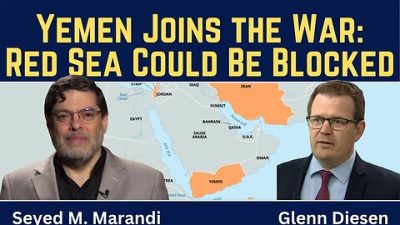
Yemen joins the war – Red Sea could be blocked next – Saudi regime at risk
or go to
Aletho News Archives – Video-Images
From the Archives
Should Europeans ‘Thank’ the Americans for Destroying Nord Stream?
By Robert Bridge | Strategic Culture Foundation | September 29, 2022
With an investigation continuing into the destruction of the Nord Stream gas pipeline that provided energy supplies to Europe from Russia, there appears to be just one prime suspect, and that should surprise nobody.
Following the sabotage of the Nord Stream 1 and 2 gas pipelines, former Polish Foreign Minister Radoslaw Sikorski already seemed to know the identity of the perpetrator when he tweeted out: “Thank you, USA.”
At first glance, it seemed that Sikorski was speaking sarcastically, berating Washington for carrying out an attack that will have severe repercussions for the people of Europe. After all, how could anyone see any good coming from the termination of Europe’s primary source of gas reserves with winter just around the corner? It was Sikorski’s homeland of Poland, after all, that urged its citizens to collect firewood in the face of dwindling gas reserves.
In fact, the Polish diplomat was speaking one-hundred percent literally… continue
Blog Roll
 Aletho News
- Growing insecurity, soaring prices fuel protests in north as regime bans evacuation: Sources
- Iran denies responsibility for ‘depraved’ attack on Kuwait desalination plant
- Bring The Troops Back. End This War Now!
- Can we please stop calling Israel the ‘only democracy in the Middle East’ now?
- US should start removing its troops for Germany, proposes AfD co-leader Chrupalla
- Iran Red Crescent: 600 educational centers attacked in US-Israeli ‘war crimes’
- Russian Oil Tanker Arrives in Cuba Amid U.S. Blockade
- America Racing to Strategic Defeat in Iran: Lt Col Daniel Davis
- FTC Warns Visa, Mastercard, PayPal, Stripe Over Political Debanking
- Russian tanker approaches Cuba despite US oil blockade
- If Americans Knew
- Israeli police block Catholic cardinal from entering Church of the Holy Sepulchre on Palm Sunday
- Israel is assassinating journalists again, more than any other nation, anywhere, ever – Not a ceasefire Day 170
- Over 300 US service members wounded, majority have brain injuries – Not a ceasefire Day 169
- Researchers at Human Rights Watch Resign Over Blocked Report on Palestinian Refugee Return
- Jewish Groups Are Backing a War Americans Don’t Want
- Eric Fingerhut Thinks He’s the President of the Jews
- Top Jewish Philanthropists, Rabbis Urge Israeli President to Take Action Against ‘Jewish Extremists’
- Don’t Be Fooled. Zionist Leaders Have Always Wanted to Control Southern Lebanon
- Israel’s widespread use of torture is a core element of its genocide against the Palestinian people
- In Israel’s War on Iran, Many Middle East US Bases Rendered “All But Uninhabitable”
- No Tricks Zone
- New Study Finds Warming Saves Lives…Cold Temperatures 12 Times More Deadly Than Excess Heat
- German Science Blog Accuses PIK Climate Institute Of Hallucinating Climate Tipping Points
- Devastating Assessment Of Comirnaty Vaccine By Former Senior Pfizer Europe Toxicologist
- New Study: CO2 Is ‘Effectively Negligible’ As An Explanatory Climate Change Factor Since 2000
- Former Pfizer Toxicologist Dr. Helmut Sterz Tells Bundestag Hearing Pfizer Vaccine Should Have Never Been Approved
- Energy Expert: Germany’s Nuclear Phaseout Was A “500 Billion Euro Mistake”
- New Research: South Australia’s Mid-Holocene Sea Surface Temperatures Were 4°C Warmer Than Today
- Storing Green Energy To Last Germany 10 Days Would Require A 60-Million Tonne Battery
- New Studies: UK Sea Levels Were 4 Meters Higher Than Today During The Mid-Holocene
- Destructive Green New Deal: German Energy And Metal Group Warns Of Drastic Crisis
 Aletho News