EU turns down Israel call to put Hezbollah on terror list
Press TV – July 24, 2012
The European Union has flatly rejected an Israeli call to blacklist Hezbollah as a terrorist group, saying there is no such agreement among the bloc’s member states.
“There is no consensus for putting Hezbollah on the list of terrorist organizations,” Cypriot Foreign Minister Erato Kozakou-Marcoullis, whose country currently holds the rotating EU presidency, said on Tuesday.
Israel’s hawkish Foreign Minister Avigdor Lieberman made the request for blacklisting the Lebanese resistance movement while sitting alongside the Cypriot minister at a news conference held after annual EU-Israel talks.
“The time has come to put Hezbollah on the terrorist list of Europe,” Lieberman urged. “It would give the right signal to the international community and the Israeli people.”
But Kozakou-Marcoullis highlighted Hezbollah’s active role as a political party, stating that the EU would consider the move if there were tangible evidence of Hezbollah engaging in acts of terror.
Lieberman’s call comes days after the sixth anniversary of Israel’s war against Lebanon in July 2006, a 33-day conflict which ended in Hezbollah’s victory and heavy losses on the Israeli side.
This raised serious questions about Tel Aviv’s long-boasted military capabilities and forced several Israeli commanders to resign over their poor handling of the war.
Related articles
- J’lem begins campaign to out Iran, Hezbollah as terrorists – Jerusalem Post (jpost.com)
- Why the Buenos Aires Bombing is a False Indicator on Burgas (alethonews.wordpress.com)
- EU to Upgrade Relations With Israel (alethonews.wordpress.com)
Why the Buenos Aires Bombing is a False Indicator on Burgas
By Gareth Porter | Dissident Voice | July 22nd, 2012
Immediately after the terror bombing of a busload of Israeli youth in Burgas, Bulgaria, both Israeli Prime Minister Benjamin Netanyahu and a “senior U.S. official” expressed certainty about Iran’s responsibility. Since then, the White House has backed away from that position, after Bulgarian investigators warned against that assumption before the investigation is complete.
Similary, it is generally assumed that Iran and Hezbollah were responsible for the terrorist bombing of a Jewish community center in Buenos Aires on July 18, 1994, because US and Israeli officials, journalists and commentators have repeated that conclusion so often. It was the first reference made by those who were most eager to blame the Burgas bombing on Iran, such as Matthew Levitt and Jeffrey Goldberg.
But that terrorist bombing 18 years ago was not what it has come to appear by the constant drip of unsubstantiated journalistic and political references to it. The identification of that bombing as an Iranian operation should be regarded as a cautionary tale about the consequences of politics determining the results of a terrorist investigation.
The case made by the Argentine prosecutors that Iran and Hezbollah committed that 1994 terrorist bombing has long been cited as evidence that Iran is the world’s premier terrorist state.
But the Argentine case was fraudulent in its origins and produced a trail of false evidence in service of a frame-up. There is every reason to believe that the entire Argentine investigation was essentially a cover-up that protected the real perpetrators.
That is what I learned from my ten-month investigation in 2006-07 of the case, the results of which were published in early 2008.
William Brencick, who was then chief of the political section at the US Embassy in Buenos Aires and the primary Embassy contact for the investigation of the AMIA bombing, told me in an interview in June 2007 that the US conviction about Iranian culpability was based on what he called a “wall of assumptions” — a wall that obstructed an objective analysis of the case. The first assumption was that it was a suicide bombing, and that such an operation pointed to Hezbollah, and therefore Iran.
But the evidence produced to support that assumption was highly suspect. Of 200 initial eyewitnesses to the bombing, only one claimed to have seen the white Renault van that was supposed to have been the suicide car. And the testimony of that lone witness was contradicted by her sister, who said that she had seen only a black and yellow taxicab.
That is only the first of many indications that the official version of how the bombing went down was a tissue of lies. For example:
- The US explosives expert sent soon after the bombing to analyze the crime scene found evidence suggesting that at least some of the explosives had been placed inside the community center, not in a car outside.
- The engine block of the alleged suicide car which Police said led them to the arrest of the Shi’a used car salesman and chop shop owner who sold the car, was supposedly found in the rubble with its identification number clearly visible — something any serious bombing team, including Hezbollah, would have erased, unless it was intentionally left to lead to the desired result.
- Representatives of the Menem government twice offered large bribes to the used car dealer in custody to get him to finger others, including three police officials linked to a political rival of Menem. The judge whose bribe was videotaped and shown on Argentine television was eventually impeached.
Apart from an Argentine investigation that led down a false trail, there were serious problems with the motives attributed to Iran and Hezbollah for killing large numbers of Jewish citizens of Argentina. The official explanation was that Iran was taking revenge on the Menem government for having reneged, under pressure from the Clinton administration, on its agreements with Iran on nuclear cooperation.
But in fact, Argentina had only halted two of the three agreements reached in 1987 and 1988, as was revealed, ironically, in documents cited by the Argentine prosecutor’s report on the arrest warrant for Iranian officials dated October 2006 (unfortunately never made available in electronic form). The documents showed that the Menem government was continuing to send 20 percent enriched uranium to Iran under the third agreement, and there were negotiations continuing both before and after the bombing to resume full nuclear cooperation.
As for Hezbollah, it was generally assumed that it wanted to avenge the Israeli killing of its “ally” Mustafa Dirani in May 1994. But when Hezbollah really wanted to take revenge against Israel, as it did after the Israeli massacre in Qana in 1996, it did not target civilians in a distant country with no relationship to the conflict with Israel; it openly attacked Israel with Katyusha rockets.
It is not clear yet who committed the latest terrorist bombing against Jewish civilians in Burgas, Bulgaria. But the sorry history of that Buenos Aires investigation should not be used to draw a premature conclusion about this matter or any other terrorist action.
~
Gareth Porter is an investigative historian and journalist specialising in U.S. national security policy. The paperback edition of his latest book, Perils of Dominance: Imbalance of Power and the Road to War in Vietnam, was published in 2006.
Nasrallah: US manipulated Syria grievances
Al Akhbar | July 18, 2012
 Hezbollah leader Hassan Nasrallah on Wednesday accused the US and Israel of using legitimate grievances in Syria as an excuse to destroy the country and the resistance to Israel’s control over the Middle East.
Speaking after the death of three senior Syrian politicians in a bomb attack on Wednesday morning, Nasrallah hailed the men and warned that Syria risked destruction if it slid further into civil war.
“(The West and Israel) took advantage of the legitimate demands of the Syrian people…they put Syria into a war, they forbade negotiations,” he said.
“What is required (by the US) in Syria is to divide it, to destroy it, to rip it apart just like Iraq,” he said, referring to the chaos left behind after 10 years of US occupation in Iraq.
Nasrallah said that Israel had been concerned by Syria’s increased military capabilities and had sought to sow discontent in the country.
“They looked at Syria and saw over the past years… first of all a new military strategy began in Syria,” he said, adding that before the uprising the country was “a real military power that (was) capable of presenting a real military threat to Israel.”
Speaking on the sixth anniversary of the 2006 war with Israel, in which the Jewish state suffered defeat at the hands of Hezbollah, Nasrallah said Hezbollah’s victory had increased concern about Syrian strength.
“There is only one army left that is not connected with the Americans. Its the Syrian army. Since the July (2006) war they have been working on destroying this army,” he said.
Nasrallah also confirmed that the “most important” weapons used against Israel in the war were supplied by Syria.
“Syria is a real supporter of the resistance… on the military level as well,” he said. “The most important missiles that landed in occupied Palestine were manufactured or made in Syria.”
Call for calm
Referring to Lebanon Nasrallah called for calm in the country which has seen an upturn in violence in recent months, much of it related to the Syrian crisis.
“I call for calm and patience. You have heard a lot of curses and you will hear a lot of curses in the future,” he said.
“This doesn’t concern only the Sunnis and the Shia… amongst all sects there are some who are trying to rip apart our community.”
The Shia leader also urged all sects in the country to move away from provocative language, calling for a new document dealing with sectarianism.
Under the new rules, he said, “if a Shia person, whether he be a politician or a religious person, if he says anything offensive then we, the Shia, will stand against him. Same goes for the Sunnis, the Druze and the Christians.”
“Can we go ahead and adopt such a document in Lebanon?”
He also backed the current government to continue despite ongoing tensions between rival factions, saying such debate was healthy.
“In the government we have disagreements… but there are positives as it shows it is a coalition government, not a government of Hezbollah,” he said.
Related articles
- Who’s Holding The Captured Lebanese? (alethonews.wordpress.com)
- Two of 11 Lebanese abducted in Syria to be released: captors (dailystar.com.lb)
Israel warns Lebanon of total destruction in new war
Al Akhbar | July 6, 2012
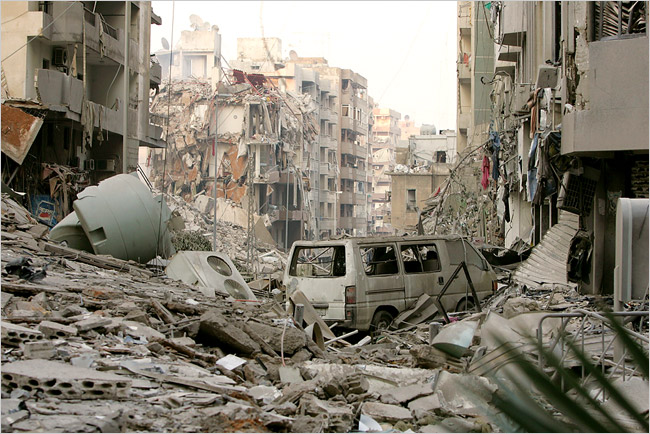
A senior Israeli general threatened Lebanon with destruction on Thursday, saying the military was prepared for a “very violent” war should conflict spark on the border.
Brigardier-General Hertzi Halevy, commander of the IDF’s 91st Division, told local Israeli media that any attack by Israeli forces would leave Lebanon more badly damaged than in the 2006 war, when Israel killed over 1,200 Lebanese and destroyed much of the country’s infrastructure.
“Lebanon will sustain greater damage than that done during the second Lebanon war,” Haaretz quoted Halevy as saying, referring to the 2006 attack. “The response will need to be sharper, harder, and in some ways very violent.”
Israel’s aerial bombardments of heavily populated areas such as Gaza and Beirut have been heavily criticized by rights groups and the UN, drawing claims of war crimes.
Referring to a UN report led by Richard Goldsmith, which concluded that Israel carried out a string of human rights abuses in its 2008-09 bombardment of Gaza, Halevy said war “cannot be nice.”
“After the Goldstone Report, people in the international community and in Israel thought that battle in a densely populated area could be carried out in a nicer way. It cannot be nice. Without the use of great force, we will find it difficult to achieve our aim, and the enemy should also know that,” he said.
Halevy’s provocative comments come a week ahead of the sixth anniversary of the 2006 war, with the general adding that Israeli forces should enter Lebanon with great force and wreak havoc in villages.
Israel and Lebanon’s powerful Hezbollah have exchanged warnings in recent months, with Hezbollah leader Hassan Nasrallah saying in May that his group had the ability to strike any target in “occupied Palestine.”
“Today, we are capable of not only striking Tel Aviv as an area, but also capable of striking specific targets in Tel Aviv and any place in occupied Palestine,” he said.
Halevy’s remarks also come after Israel destroyed one of its own spying devices in south Lebanon on Monday after it was discovered by Hezbollah.
Lebanese security sources said an Israeli drone fired an air-to-surface missile, while Hezbollah said the device was destroyed using a remote-controlled explosive.
Related articles
- Israel destroys spying device in Lebanon after Hezbollah discovered it (alethonews.wordpress.com)
Israel destroys spying device in Lebanon after Hezbollah discovered it

File photo shows Israeli spy devices near Lebanese capital which were concealed in fake rocks
Press TV – July 2, 2012
An Israeli warplane has fired missiles into southern Lebanon to destroy an espionage device Tel Aviv had planted in the area.
The move came after the Lebanese resistance movement Hezbollah discovered the spy system, apparently a listening device, in al-Zreiriyyeh area on Monday.
Some reports say the device was placed on Hezbollah telecommunications lines in the area.
The Lebanese army has discovered and dismantled several Israeli spy systems planted inside the country in recent years.
In December 2010, the Lebanese army said it had located two sophisticated, Israeli-made surveillance devices in mountains near the capital, Beirut.
Who’s Holding The Captured Lebanese?
By Wafiq Qanso | Al Akhbar | May 28, 2012
Conflicting reports dominated the story of the Lebanese pilgrims that were captured in Syria near the Turkish border. The event has transcended the captors and the abductees to become a foreign policy priority for many countries involved in the Middle Eastern crises.
The sequence of events surrounding the abduction of the Lebanese pilgrims last Tuesday in the vicinity of Aleppo, Syria goes as follows.
Lebanese Shia returning from a visit to religious sites in Iran were kidnapped by Syrian Sunnis fighting a regime that they view as allied to the hostages. The news reached Lebanon, which was seething with Syria-related tensions, from the “wars” in its north to the “conquests” of the Tariq al-Jdideh and Caracas neighborhoods of Beirut. Nothing could have been better designed to inflame passions and get the sectarian genie out of its bottle.
Shia in the southern suburbs of Beirut, South Lebanon and the Bekaa, took to and blocked streets, as Sunnis in the North, Beirut and the Bekaa had done the previous week. Some Syrian-owned shops in the suburbs were attacked, and some angry youths nabbed Syrian workers. Things could have developed further with tit-for-tat kidnappings or worse.
So the long-awaited Sunni-Shia fitna (strife) had finally arrived. The heat was turned up further by news from Iraq. The bombing of a busload of Lebanese Shia pilgrims killed three and injuring two.
This need not necessarily be what the kidnappers planned to begin with. But opportunities can be seized when they present themselves.
However, Hezbollah Secretary-General Hassan Nasrallah succeeded in averting an explosion. Shia supporters of Hezbollah and Amal heeded his call to come off the streets, as he promised to work on resolving the issue. Tempers cooled off a little, enabling a flurry of domestic and regional political contacts to be held.
Turkish intelligence then identified the location of the Lebanese pilgrims and their captors. The Turkish foreign ministry was informed that they “have the abductees.” Turkish chief diplomat Ahmet Davutoglu, eager for his country to regain the role of regional mediator, quickly made that public.
All of Lebanon – including its rival political camps – proceeded to voice its satisfaction, having earlier condemned the abduction. The country was swept by a wave of optimism and “love”. Al-Manar conveyed the greetings of the people of the southern suburbs to Sheikh Saad Hariri and their gratitude for his efforts, and Nasrallah did the same in his Bint Jbeil speech. Future Movement MPs strutted and swaggered on the resistance’s TV channel. Things looked like they were heading for a happier ending than the Lebanese could have hoped for.
Then something unexpected, and still unexplained, happened. The hostages were “lost” somewhere on the way between where they were being held in Syria and Adana airport in Turkey.
Informed sources offer two possible explanations for this.
The first is that the Turkish foreign ministry was over-hasty in announcing the release of the hostages. Davutoglu informed his Lebanese interlocutors that they “have the abducteees,” and that he expected them to be freed on Saturday night. But in intelligence parlance, “we have them” does not necessarily mean “they are in our custody,” especially given the profusion of armed Syrian opposition factions on the ground.
Davutoglu almost certainly spoke after the hostages had arrived at a point in Syria close to the Turkish border. There, something happened which held up the entire exercise, severely embarrassing the government in Ankara. Claims made about the hostages’ fate on various websites appeared implausible as Turkey had continued to reiterate the hostages’ well-being. Official Lebanese sources also told Al-Akhbar that “the hostages are all fine.”
The other explanation also relates to over-haste, but differently. After announcing the end of the affair, Ankara came under pressure from the US and Qatar. Why, they protested, should Nasrallah be given another victory and credibility boost? According to the sources, they saw it better to drag things out for a few days longer to make more use of the issue that could serve their interests on many levels.
First, it would help with eroding grassroots confidence in the Hezbollah leader. Nasrallah could also be blamed for any harm that may befall the hostages, after he included Bashar Assad in the list of people he thanked in his Bint Jbeil speech. One could refer in this regard to statements made yesterday by Syrian National Council (SNC) head Burhan Ghalioun and Syrian Liberal Party chief Ibrahim al-Zoabi.
Also, public anger would put an end to the recent easing of tensions in Lebanon, and keep the spotlight focused on the Shia masses – whose expressions of anger have hitherto been controlled – and away from the Salafi uprising in the north, the Tariq al-Jdideh incident, the accompanying emergence of armed manifestations, and all the talk of al-Qaeda sleeper cells and others in the process of waking up.
Following the same logic, a prolonged period of anxiety about the issue would cause a rift between the resistance’s mass base and both its leadership and the Syrians. When public anger and outrage boil over, Syrians cease to be “our dear brothers and guests living among us.” It is within this charged atmosphere that local officials in some areas with Shia majorities have been advising Syrian residents to take precautions for their safety.
Finally, the “national unity” displayed by Lebanese political rivals over the affair and their contacts with each other seemed to be establishing a basis which could be built on, amid renewed calls for national dialogue. That would relieve – and possibly refloat – Lebanon’s current government, with its policy of dissociation from developments in Syria, and lead to a general easing of tensions over developments there. That would not be to the advantage of the international campaign against the Syrian regime, in which Lebanon now has a pivotal role.
The facts remain unclear, and contacts are continuing to be held. Pending further developments, the Shia political leadership in Lebanon is acting with caution. Every effort is being made on the ground to contain the possible fallout, depending on how the affair concludes – especially if a decision has been taken somewhere to make things worse.
Related articles
- Nasrallah calls for restraint after Syria kidnapping (alethonews.wordpress.com)
Nasrallah calls for restraint after Syria kidnapping
Press TV – May 22, 2012
Hezbollah Secretary General Seyyed Hassan Nasrallah has denounced the abduction of 13 Lebanese citizens by Syrian armed militants but also called for restraint and a measured response.
On Tuesday, Nasrallah said it is the duty of the Lebanese government to ensure that the abducted people are able to return home safely.
“We will work day and night until those beloved are back with us… The Lebanese state and government have a responsibility to work toward the release of those kidnapped,” he added.
Commenting on the situation and the recent violence in Lebanon, he asked the Lebanese people to exercise self-restraint and said that nobody should resort to violence.
“I call on everyone to show restraint… It is not acceptable for anyone to block roads or carry out violent acts,” Nasrallah added.
Anti-Syrian government armed militants kidnapped the 13 Lebanese people near the Syrian town of Aazaz, which is on the border with Turkey. The Lebanese were returning to Lebanon after visiting Shia shrines in Iran.
The armed militants reportedly hijacked their bus, then kidnapped the men and released the women.
There is no more information about the whereabouts of the abductees.
Syria has been experiencing unrest since mid-March 2011. While the West and the Syrian opposition say the government is responsible for the killings, Damascus blames “outlaws, saboteurs, and armed terrorist groups” for the unrest and insists that it is being orchestrated from abroad.
Al-Manar reports:
… In response to some people who threatened to kidnap Syrian nationals in Lebanon, Sayyed Nasrallah said that this act of revenge is forbidden and that the Syrian nationals are “our brothers, and nobody should make such unacceptable act personally.” …
The names of the kidnapped men according to media reports:
Abbas Shoaib, Hassan Mahmoud, Hussein al-Siblani, Ali Abbas, Abu Ali Saleh, Mahdi Ballout, Hussein Arzouni, Hussein Omar, Mustafa Yassine, Mohammad Monzer, Awad Ibrahim, Ali al-Ahmar, Ali Zgheib, Rabih Zgheib, Ali Termos and Ali Safa.
Israel leading smear campaign against Hezbollah
Press TV – March 25, 2012
Lebanese resistance movement Hezbollah has rejected allegations made by right-wing Israeli and American activists accusing the movement of involvement in illegal activities, Press TV reports.
The US and Israeli activists have recently stepped up their propaganda campaign against the resistance movement and its finances, accusing Hezbollah of being involved in illegal activities, including drug trafficking and money laundering.
The Israeli daily Yediot Ahranot has recently claimed that Hezbollah is attempting to take control of Lebanon’s finance sector and banking system. This report was simultaneous with a high profile visit to Beirut by the US treasury undersecretary for terrorism and financial intelligence David Cohen.
”The US Zionist lobby has a big role to play in whipping up the congress and the US government with the power that they have in the government to send these officials to rattle the cage of the central bank, to send a message to the Lebanese that you’re vulnerable,” said Franklin Lamb with the Americans concerned for ME Peace.
High ranking Republican congressmen have also accused Hezbollah of involvement in a full range of criminal activities in the US to raise money. US Congressman Peter King, who last year accused the American Muslim community of a growing radicalization, described the Hezbollah movement as a violent murder gang, saying that it represents a growing threat to US national security.
”All of a sudden there is focus on the criminal aspect of drug dealing, money laundering, without specific facts to terrorism. Remember it was terrorism, terrorism, terrorism. It still is but that’s shopworn, that doesn’t have the credibility,” Lamb pointed out.
Hezbollah has, however, strongly denied any involvement in criminal activities, saying it is being targeted because of its stiff resistance against Israel and also because Tel Aviv failed to defeat the movement militarily in 2006.
Since that time Hezbollah appears to have grown both militarily and politically and is still seen by many as a legitimate resistance and liberating force.
Related articles
- Hezbollah: US Claims of Money Laundering Aim to Tarnish Resistance’s Image (alethonews.wordpress.com)
- Who was Behind the Delhi Bombing? (alethonews.wordpress.com)
- Hezbollah calls for political solution to Syrian crisis (altahrir.wordpress.com)
- Resistance will continue until liberation of al-Quds: Nasrallah (altahrir.wordpress.com)
Who was Behind the Delhi Bombing?
By Gareth Porter | Dissident Voice | March 3rd, 2012
The magnet bomb that exploded on an Israeli Embassy diplomat’s car in Delhi on February 13 seemed on the surface to be consistent with an Iranian-sponsored action.
It was carried out with same method by which Israel’s Iranian proxy, the Mujahedin-e Khalq, had assassinated an Iranian scientist in mid-January. It occurred on the anniversary of the 2008 assassination of Hezbollah operations chief Imad Mugniyeh, which Hezbollah had vowed to avenge. And it happened at the same time as what appeared to be attempted bombings in Bangkok and Tbilisi.
But a review of the evidence uncovered thus far makes the link to Iran begin to look very dubious. Instead, it points to the distinct possibility that the Israelis planned a carefully limited bomb attack that was not intended to cause serious injury to Israeli diplomatic personnel, but that would advance the larger Israeli narrative on the need to punish Iran.
The evidence surrounding that bomb itself indicates a series of decisions by the terrorist team that is fundamentally inconsistent with an Iranian-Hezbollah revenge bombing. The preliminary forensic analysis of the bomb itself had estimated it to be 250-300 grams of explosives, but sources in the investigation later reduced the estimate to 200-250 grams. The 250-gram bomb that exploded near the Delhi High Court in May 2011 did not even damage the car under which it had been placed and was characterised by Police Commissioner B K Gupta as a “low-intensity and mild blast”.
Burning questions
The main damage to the Israeli diplomat’s car was not from the explosion but from the fire, which burned so slowly that the occupants suffered no burns.
If the bomb had been filled with shrapnel of iron filings, nails or glass, or if it had been attached underneath the fuel tank or on the door next to the passenger, that bomb would have seriously injured or killed the passenger, Tal Yehoshua-Koren, the wife of the Israeli Defense Attaché. But Delhi police were able to determine that the bomb contained no such potentially deadly shrapnel. And an examination of the videos and photos of the car after the bombing revealed that the bomb had been attached instead to the rear of the vehicle, where it would have the least impact on the occupants.
Indian investigators obtained a fourth piece of evidence bearing on the intentions of the planners from their interview with Yehoshua-Koren. She told them the bomb did not go off for 30 to 40 seconds after she felt a bump from the rear of the car and saw the motorcyclist go past her window. Indian investigators had assumed that the bomb had operated on a five- or 10-second delay, like other magnet bombs with which they were familiar – only enough time for the motorcyclist to get far enough away from the blast.
Yehoshua-Koren did not get out of the car before the bomb went off, and suffered what the Israeli Defense Ministry called “moderate“ wounds – evidently from metal fragments from the rear hatch. She was nevertheless able to exit the car and get to the Israeli Embassy without any assistance.
Israeli commentary on the bombing suggested that the Iranian-sponsored terrorist team had simply proven to be ineffective in carrying out the bombing. But the combination of these four distinct indicators strongly suggests that the operation was planned so that the passenger in the car would not be injured.
Unclear patterns
Israel claimed that the evidence links the Delhi bombing to other alleged Iranian-Hezbollah plots in Tbilisi and Bangkok. Deputy Prime Minister Moshe Yaalon declared, ”It is the same pattern, the same bomb, the same lab, the same factory”.
But investigators in Delhi to concluded that the operations in Delhi and Bangkok were “unrelated“.
Despite the fact that a group of Iranian passport-holders were clearly involved with highly lethal bombs in Bangkok, there is good reason to doubt that they were working for Iran’s IRGC or Hezbollah. They spent their first three days in the country with Thai prostitutes at Pattaya. That profile suggests Iranian mercenaries, like the former kickboxer hired by Mossad to assassinate Iranian scientist Massoud Ali Mohammadi in January 2010, rather than Iranian or Hezbollah operatives.
India‘s importance
In the larger context, it is very difficult to believe that Iran would have chosen New Delhi as the location for revenge against Israel, given the importance of India as a buyer of Iranian oil and India’s delicately balanced political-diplomatic position in the larger conflict.
India had just replaced China as Iran’s single biggest crude oil customer, having increased its imports to roughly 550,000 barrels a day in January, which compensated for a drop in sales to China. And the government of Prime Minister Manmohan Singh had resisted pressure from the United States and Europe to reduce its purchases from Iran, even working with Iran to find ways to get around the planned sanctions against Iran’s National Bank. India’s Commerce Ministry was planning a large business delegation to Iran to discuss increased trade.
India had thus taken on the role of potential “spoiler” in the Western sanctions strategy against Iran. This central geopolitical reality prompted New Delhi’s “Economic Times” to ask, “Why would Iran go and poke its finger in the eye of its best customer, especially knowing full well that Israel will use even the flimsiest excuse to put the blame on it?”
Indeed, it was Israel, not Iran that stood to gain politically from the terrorist car bomb in Delhi. Israel was well aware that a terrorist bombing in Delhi that could be blamed on Tehran was a potential lever to change India’s policy toward Iran. As an Israeli official told the Wall Street Journal, if India were to adopt Netanyahu’s position that Iran was responsible for the bombing, it would take the India-Iran relationship to “a whole different level”.
Nearly two weeks before the bombing, Israel acted to ensure that Indians would assume that a terrorist attack in Delhi on that date had been carried out by Iran. A letter to the Delhi police on February 1 signed by the Israeli Deputy Chief of Mission in Delhi and the First Secretary responsible for security expressed concern that Iran and Hezbollah would take revenge on the anniversary of the Mugniyeh assassination by carrying out terrorist actions against Israelis. It also referred to the possibility of Iranian revenge for the assassination of the Iranian nuclear scientist Mustafa Ahmadi Roshan on January 11. Although the letter did not specify that an attack might take place in Delhi, Mossad chief Tamir Pardo led a delegation of intelligence officials on a visit to Delhi around the same time and turned over a list of 50 Iranian nationals with the request that they be kept under surveillance.
The Israeli letter referred to an alleged Hezbollah terror plot against Israelis that had been broken up in Bangkok in January. But the idea of a Hezbollah plan to kill Israelis in Thailand had come only from Israeli intelligence – not from any local sources. The Thai police detained Hussein Atris, a Swedish-Lebanese, in January only because Israeli intelligence officials had told them they “suspected” that he and two other Lebanese, whom they claimed were linked to Hezbollah, might carry out terrorist attacks at tourist sites popular with Israelis.
Atris admitted to owning large supplies of urea fertiliser and ammonium nitrate, which are ingredients in bombs, but Thai investigators concluded that they were not connected to any terror plot in Thailand, because of the absence of any other bomb components. The head of Thailand’s National Security Council, General Wichean Potephosree, a former chief of police, expressed doubt that Atris was a terrorist, as Israel had claimed.
After the Bangkok explosion, the Israelis renewed the claim of an Iran-Hezbollah terror threat in Bangkok, alleging that the bombs found in in all three capitals in mid-February were “exactly the same kind of devices”. But we now know that was not the case.
We may never be able to establish with certainty what happened in Delhi, Bangkok and Tbilisi earlier this month, but the evidence that has come to light thus far doesn’t support the widely accepted notion that Iran and Hezbollah were behind it. That evidence is consistent, however, with a clever Israeli “false flag” car bombing operation that would not injure the passenger but would serve its broader strategic interests: dividing India from Iran and pushing US public opinion further towards support for war against Iran.
~
Gareth Porter is an investigative historian and journalist specialising in U.S. national security policy. The paperback edition of his latest book, Perils of Dominance: Imbalance of Power and the Road to War in Vietnam, was published in 2006.
‘Some Arab states against political solution to Syria unrest’
Press TV – February 24, 2012
Hezbollah Secretary-General Seyyed Hassan Nasrallah has accused some Arab countries of stirring up trouble in Syria by blocking a political solution to the unrest in the country.
Nasrallah said on Friday that certain Arab countries are arming and funding terrorist groups fighting against the government of Syrian President Bashar al-Assad and prevent the opposition from entering into negotiations with the government.
The Hezbollah chief also accused those countries of sending fighters into Syria to fuel unrest in the country.
He also said that the US and the West do not want to send troops to Syria and instead they are trying to spark racial, tribal and sectarian confrontations in the country.
Head of Hezbollah resistance movement also accused the US and the West of adopting hypocritical approaches regarding protest movements in the Middle East region. Nasrallah said while the US and its allies describe dialogue as the only way to end protests in Bahrain, they all oppose political solution and support violence when it comes to Syria.
He also said that the US and Israel want to destroy the Middle East by dividing its people and spreading chaos.
Nasrallah has repeatedly said that the US and its allies oppose reforms in Syria and that they seek to ignite a civil war in the country.
Related articles
- Nasrallah Calls for Unconditional Dialogue in Syria (altahrir.wordpress.com)
Azerbaijan Claims More Iranian Terror Plots Without Providing Details or Evidence
New Alleged Hezbollah-Iran Joint Terror Operations in Azerbaijan
By Sibel Edmunds | Boiling Frogs Post | February 22, 2012
Azerbaijan claims it has ‘again’ busted another Iranian terror cell, but is refusing to provide any evidence or details. According to the report by the country’s state-run AZTV, on February 21 a terrorist cell operated by Hezbollah and Iran’s Revolutionary Guard had been discovered and dismantled. Allegedly the busted group, with guns and explosives, were planning attacks on ‘unspecified’ foreign nationals.
Despite reporters’ attempts the Azeri government refrained from providing any additional information:
Speaking to EurasiaNet.org, a spokesperson for Azerbaijan’s Ministry of National Security refused either to confirm or to deny the station’s report. Strangely, pro-government and state-run news sites have proven similarly skittish about delving into the AzTV report; no news about the arrests could be found on any of these websites on the morning of February 22.
Strangely enough, to back up the story AZTV aired footage of terrorist arrests from an incident that occurred in 2008! This new development appears to follow the very same pattern as Azerbaijan’s claim on the ‘alleged’ assassination plot against Israeli officials in Azerbaijan by an Iran-Sponsored terrorist group last month.
Earlier today APA news agency reported new details about this latest alleged Iranian terror operation. Supposedly, the terrorist group operated under two ringleaders – “Hamid” for Iran’s Revolutionary Guard, and “Haji Abbas” for an armed wing of Hezbollah, Mugavimat. This is supposed to establish the collaborative effort between the Iranian government and Hezbollah:
Azerbaijani Ministry of National Security disarmed the terrorist group of Iranian intelligence agency “Sepah” and “Hezbollah” in Azerbaijan.
The group members gathered material reconnaissance materials. The illegally acquired many weapons, ammunitions, explosives and explosive devices and began preparations to commit a terror act.A group of persons were detained in Azerbaijan over the last several days. Member of Nardaran Sanhedrin Karbalai Natig Karimov told APA that the majority of detained as a result of operative measures taken by the National Security Ministry and law-enforcement bodes were the residents of Baku villages, especially Nardaran. They are accused of establishing armed unit, illegal keeping of weapon, betrayal of motherland and drug trafficking.
Earlier this month Boiling Frogs Post reported on Iran’s formal rebuke to Azerbaijan for housing and accommodating Israeli intelligence agents and assassins to execute assassination plots against Iranian nuclear scientists. Azerbaijan denied the accusations by the Iranian government.
It is also important to note that intimate US-NATO ally Azerbaijani President Ilham Aliyev visited the North Atlantic Treaty Organization headquarters in Brussels on February 15 and has also met with Israeli President Shimon Peres and US Secretary of State Hillary Clinton over the past few weeks.
Boiling Frogs Post has been the only news site closely monitoring and reporting these developments in the US war on Iran operations’ Caucasus front. You can read our previous reports here, here, here and here.
Featured Video

America Racing to Strategic Defeat in Iran
or go to
Aletho News Archives – Video-Images
From the Archives
Should Europeans ‘Thank’ the Americans for Destroying Nord Stream?
By Robert Bridge | Strategic Culture Foundation | September 29, 2022
With an investigation continuing into the destruction of the Nord Stream gas pipeline that provided energy supplies to Europe from Russia, there appears to be just one prime suspect, and that should surprise nobody.
Following the sabotage of the Nord Stream 1 and 2 gas pipelines, former Polish Foreign Minister Radoslaw Sikorski already seemed to know the identity of the perpetrator when he tweeted out: “Thank you, USA.”
At first glance, it seemed that Sikorski was speaking sarcastically, berating Washington for carrying out an attack that will have severe repercussions for the people of Europe. After all, how could anyone see any good coming from the termination of Europe’s primary source of gas reserves with winter just around the corner? It was Sikorski’s homeland of Poland, after all, that urged its citizens to collect firewood in the face of dwindling gas reserves.
In fact, the Polish diplomat was speaking one-hundred percent literally… continue
Blog Roll
 Aletho News
- Growing insecurity, soaring prices fuel protests in north as regime bans evacuation: Sources
- Iran denies responsibility for ‘depraved’ attack on Kuwait desalination plant
- Bring The Troops Back. End This War Now!
- Can we please stop calling Israel the ‘only democracy in the Middle East’ now?
- US should start removing its troops for Germany, proposes AfD co-leader Chrupalla
- Iran Red Crescent: 600 educational centers attacked in US-Israeli ‘war crimes’
- Russian Oil Tanker Arrives in Cuba Amid U.S. Blockade
- America Racing to Strategic Defeat in Iran: Lt Col Daniel Davis
- FTC Warns Visa, Mastercard, PayPal, Stripe Over Political Debanking
- Russian tanker approaches Cuba despite US oil blockade
- If Americans Knew
- Israeli police block Catholic cardinal from entering Church of the Holy Sepulchre on Palm Sunday
- Israel is assassinating journalists again, more than any other nation, anywhere, ever – Not a ceasefire Day 170
- Over 300 US service members wounded, majority have brain injuries – Not a ceasefire Day 169
- Researchers at Human Rights Watch Resign Over Blocked Report on Palestinian Refugee Return
- Jewish Groups Are Backing a War Americans Don’t Want
- Eric Fingerhut Thinks He’s the President of the Jews
- Top Jewish Philanthropists, Rabbis Urge Israeli President to Take Action Against ‘Jewish Extremists’
- Don’t Be Fooled. Zionist Leaders Have Always Wanted to Control Southern Lebanon
- Israel’s widespread use of torture is a core element of its genocide against the Palestinian people
- In Israel’s War on Iran, Many Middle East US Bases Rendered “All But Uninhabitable”
- No Tricks Zone
- New Study Finds Warming Saves Lives…Cold Temperatures 12 Times More Deadly Than Excess Heat
- German Science Blog Accuses PIK Climate Institute Of Hallucinating Climate Tipping Points
- Devastating Assessment Of Comirnaty Vaccine By Former Senior Pfizer Europe Toxicologist
- New Study: CO2 Is ‘Effectively Negligible’ As An Explanatory Climate Change Factor Since 2000
- Former Pfizer Toxicologist Dr. Helmut Sterz Tells Bundestag Hearing Pfizer Vaccine Should Have Never Been Approved
- Energy Expert: Germany’s Nuclear Phaseout Was A “500 Billion Euro Mistake”
- New Research: South Australia’s Mid-Holocene Sea Surface Temperatures Were 4°C Warmer Than Today
- Storing Green Energy To Last Germany 10 Days Would Require A 60-Million Tonne Battery
- New Studies: UK Sea Levels Were 4 Meters Higher Than Today During The Mid-Holocene
- Destructive Green New Deal: German Energy And Metal Group Warns Of Drastic Crisis
 Aletho News