The FBI Hand Behind Russia-gate
By Ray McGovern | Consortium News | January 11, 2018
Russia-gate is becoming FBI-gate, thanks to the official release of unguarded text messages between loose-lipped FBI counterintelligence official Peter Strzok and his garrulous girlfriend, FBI lawyer Lisa Page. (Ten illustrative texts from their exchange appear at the end of this article.)
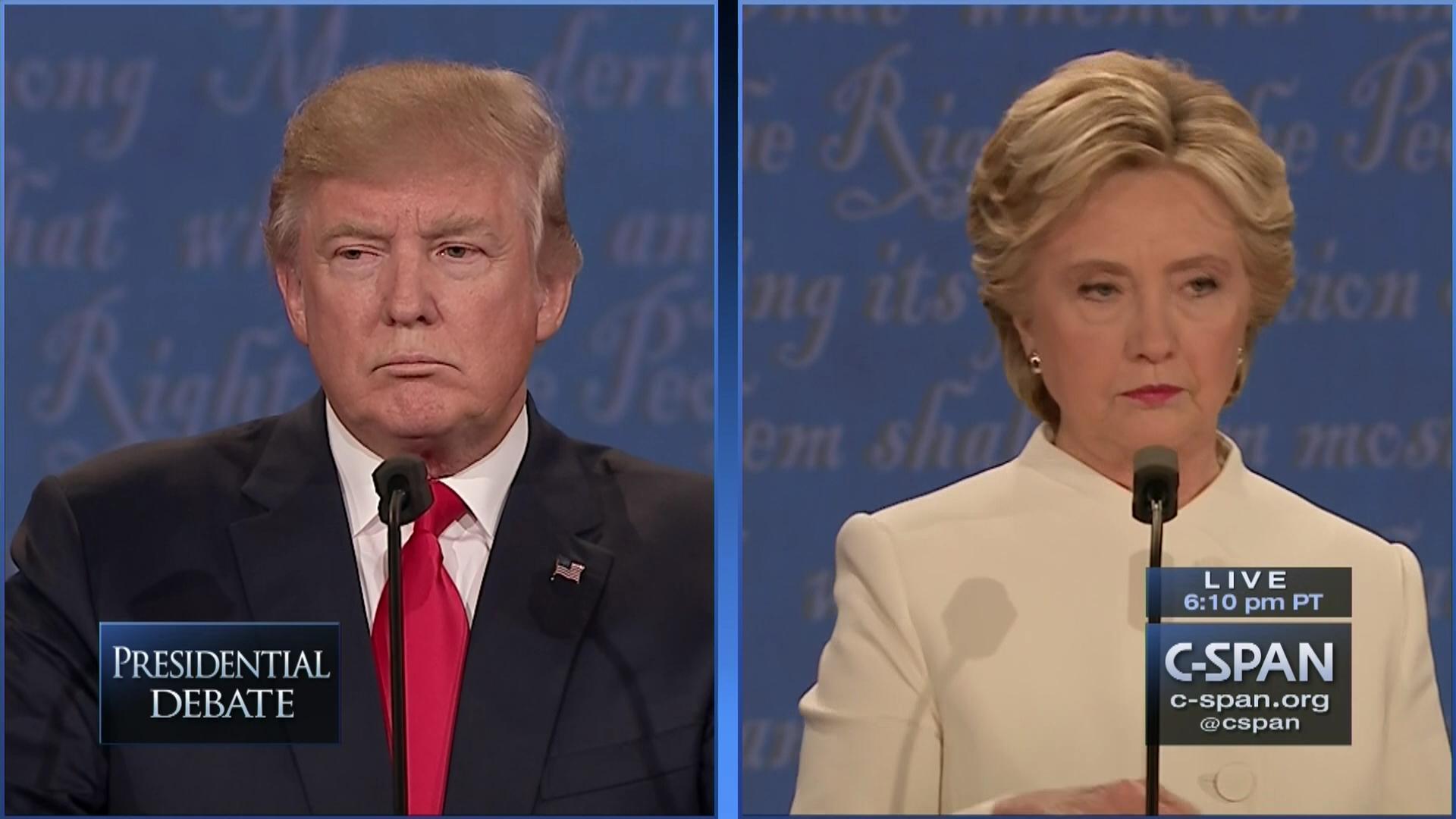
Donald Trump and Hillary Clinton in their third debate,
as Clinton called Trump Vladimir Putin’s “puppet.”
Despite his former job as chief of the FBI’s counterintelligence section, Strzok had the naive notion that texting on FBI phones could not be traced. Strzok must have slept through “Security 101.” Or perhaps he was busy texting during that class. Girlfriend Page cannot be happy at being misled by his assurance that using office phones would be a secure way to conduct their affair(s).
It would have been unfortunate enough for Strzok and Page to have their adolescent-sounding texts merely exposed, revealing the reckless abandon of star-crossed lovers hiding (they thought) secrets from cuckolded spouses, office colleagues, and the rest of us. However, for the never-Trump plotters in the FBI, the official release of just a fraction (375) of almost 10,000 messages does incalculably more damage than that.
We suddenly have documentary proof that key elements of the U.S. intelligence community were trying to short-circuit the U.S. democratic process. And that puts in a new and dark context the year-long promotion of Russia-gate. It now appears that it was not the Russians trying to rig the outcome of the U.S. election, but leading officials of the U.S. intelligence community, shadowy characters sometimes called the Deep State.
More of the Strzok-Page texting dialogue is expected to be released. And the Department of Justice Inspector General reportedly has additional damaging texts from others on the team that Special Counsel Robert Mueller selected to help him investigate Russia-gate.
Besides forcing the removal of Strzok and Page, the text exposures also sounded the death knell for the career of FBI Deputy Director Andrew McCabe, in whose office some of the plotting took place and who has already announced his plans to retire soon.
But the main casualty is the FBI’s 18-month campaign to sabotage candidate-and-now-President Donald Trump by using the Obama administration’s Russia-gate intelligence “assessment,” electronic surveillance of dubious legality, and a salacious dossier that could never pass the smell test, while at the same time using equally dubious techniques to immunize Hillary Clinton and her closest advisers from crimes that include lying to the FBI and endangering secrets.
Ironically, the Strzok-Page texts provide something that the Russia-gate investigation has been sorely lacking: first-hand evidence of both corrupt intent and action. After months of breathless searching for “evidence” of Russian-Trump collusion designed to put Trump in the White House, what now exists is actual evidence that senior officials of the Obama administration colluded to keep Trump out of the White House – proof of what old-time gumshoes used to call “means, motive and opportunity.”
Even more unfortunately for Russia-gate enthusiasts, the FBI lovers’ correspondence provides factual evidence exposing much of the made-up “Resistance” narrative – the contrived storyline that The New York Times and much of the rest of the U.S. mainstream media deemed fit to print with little skepticism and few if any caveats, a scenario about brilliantly devious Russians that not only lacks actual evidence – relying on unverified hearsay and rumor – but doesn’t make sense on its face.
The Russia-gate narrative always hinged on the preposterous notion that Russian President Vladimir Putin foresaw years ago what no American political analyst considered even possible, the political ascendancy of Donald Trump. According to the narrative, the fortune-telling Putin then risked creating even worse tensions with a nuclear-armed America that would – by all odds – have been led by a vengeful President Hillary Clinton.
Besides this wildly improbable storyline, there were flat denials from WikiLeaks, which distributed the supposedly “hacked” Democratic emails, that the information came from Russia – and there was the curious inability of the National Security Agency to use its immense powers to supply any technical evidence to support the Russia-hack scenario.
The Trump Shock
But the shock of Trump’s election and the decision of many never-Trumpers to cast their lot with the Resistance led to a situation in which any prudent skepticism or demand for evidence was swept aside.
So, on Jan. 6, 2017, President Obama’s Director of National Intelligence James Clapper released an evidence-free report that he said was compiled by “hand-picked” analysts from the CIA, FBI and NSA, offering an “assessment” that Russia and President Putin were behind the release of the Democratic emails in a plot to help Trump win the presidency.
Despite the extraordinary gravity of the charge, even New York Times correspondent Scott Shane noted that proof was lacking. He wrote at the time: “What is missing from the [the Jan. 6] public report is what many Americans most eagerly anticipated: hard evidence to back up the agencies’ claims that the Russian government engineered the election attack. … Instead, the message from the agencies essentially amounts to ‘trust us.’”
But the “assessment” served a useful purpose for the never-Trumpers: it applied an official imprimatur on the case for delegitimizing Trump’s election and even raised the long-shot hope that the Electoral College might reverse the outcome and possibly install a compromise candidate, such as former Secretary of State Colin Powell, in the White House. Though the Powell ploy fizzled, the hope of somehow removing Trump from office continued to bubble, fueled by the growing hysteria around Russia-gate.
Virtually all skepticism about the evidence-free “assessment” was banned. For months, the Times and other newspapers of record repeated the lie that all 17 U.S. intelligence agencies had concurred in the conclusion about the Russian “hack.” Even when that falsehood was belatedly acknowledged, the major news outlets just shifted the phrasing slightly to say that U.S. intelligence agencies had reached the Russian “hack” conclusion. Shane’s blunt initial recognition about the lack of proof disappeared from the mainstream media’s approved narrative of Russia-gate.
Doubts about the Russian “hack” or dissident suggestions that what we were witnessing was a “soft coup” were scoffed at by leading media commentators. Other warnings from veteran U.S. intelligence professionals about the weaknesses of the Russia-gate narrative and the danger of letting politicized intelligence overturn a constitutional election were also brushed aside in pursuit of the goal of removing Trump from the White House.
It didn’t even seem to matter when new Russia-gate disclosures conflicted with the original narrative that Putin had somehow set Trump up as a Manchurian candidate. All normal journalistic skepticism was jettisoned. It was as if the Russia-gate advocates started with the conclusion that Trump must go and then made the facts fit into that mold, but anyone who noted the violations of normal investigative procedures was dismissed as a “Trump enabler” or a “Moscow stooge.”
The Text Evidence
But then came the FBI text messages, providing documentary evivdence that key FBI officials involved in the Russia-gate investigation were indeed deeply biased and out to get Trump, adding hard proof to Trump’s longstanding lament that he was the subject of a “witch hunt.”
Justified or not, Trump’s feeling of vindication could hardly be more dangerous — particularly at a time when the most urgent need is to drain some testosterone from the self-styled Stable-Genius-in-Chief and his martinet generals.
On the home front, Trump, his wealthy friends, and like-thinkers in Congress may now feel they have an even wider carte blanche to visit untold misery on the poor, the widow, the stranger and other vulnerable humans. That was always an underlying danger of the Resistance’s strategy to seize on whatever weapons were available – no matter how reckless or unfair – to “get Trump.”
Beyond that, Russia-gate has become so central to the Washington establishment’s storyline that there appears to be no room for second-thoughts or turning back. The momentum is such that some Democrats and the media never-Trumpers can’t stop stoking the smoke of Russia-gate and holding out hope against hope that it will somehow justify Trump’s impeachment.
Yet, the sordid process of using legal/investigative means to settle political scores further compromises the principle of the “rule of law” and integrity of journalism in the eyes of many Americans. After a year of Russia-gate, the “rule of law” and “pursuit of truth” appear to have been reduced to high-falutin’ phrases for political score-setttling, a process besmirched by Republicans in earlier pursuits of Democrats and now appearing to be a bipartisan method for punishing political rivals regardless of the lack of evidence.
Strzok and Page
Peter Strzok (pronounced “struck”) has an interesting pedigree with multiple tasks regarding both Mrs. Clinton and Mr. Trump. As the FBI’s chief of counterespionage during the investigation into then-Secretary of State Hillary Clinton’s unauthorized use of a personal email server for classified information, Strzok reportedly changed the words “grossly negligent” (which could have triggered legal prosecution) to the far less serious “extremely careless” in FBI Director James Comey’s depiction of Clinton’s actions. This semantic shift cleared the way for Comey to conclude just 20 days before the Democratic National Convention began in July 2016, that “no reasonable prosecutor” would bring charges against Mrs. Clinton.
Then, as Deputy Assistant Director of the Counterintelligence Division, Strzok led the FBI’s investigation into alleged Russian interference in the U.S. election of 2016. It is a safe bet that he took a strong hand in hand-picking the FBI contingent of analysts that joined “hand-picked” counterparts from CIA and NSA in preparing the evidence-free, Jan. 6, 2017 assessment accusing Russian President Vladimir Putin of interfering in the election of 2016. (Although accepted in Establishment groupthink as revealed truth, that poor excuse for analysis reflected the apogee of intelligence politicization — rivaled only by the fraudulent intelligence on “weapons of mass destruction“ in Iraq 15 years ago.)
In June and July 2017 Strzok was the top FBI official working on Special Counsel Robert Mueller’s investigation into possible links between the Trump campaign and Russia, but was taken off that job when the Justice Department IG learned of the Strzok-Page text-message exchange and told Mueller.
There is no little irony in the fact that what did in the FBI sweathearts was their visceral disdain for Mr. Trump, their cheerleading-cum-kid-gloves treatment of Mrs. Clinton and her associates, their 1950-ish, James Clapperesque attitude toward Russians as “almost genetically driven” to evil, and their (Strzok/Page) elitist conviction that they know far better what is good for the country than regular American citizens, including those “deplorables” whom Clinton said made up half of Trump’s supporters.
But Strzok/Page had no idea that their hubris, elitism and scheming would be revealed in so tangible a way. Worst of all for them, the very thing that Strzok, in particular, worked so hard to achieve — the sabotaging of Trump and immunization of Mrs. Clinton and her closest advisers is now coming apart at the seams.
Congress: Oversee? or Overlook?
At this point, the $64 question is whether the various congressional oversight committees will remain ensconced in their customarily cozy role as “overlook” committees, or whether they will have the courage to attempt to carry out their Constitutional duty. The latter course would mean confronting a powerful Deep State and its large toolbox of well-practiced retaliatory techniques, including J. Edgar Hoover-style blackmail on steroids, enabled by electronic surveillance of just about everything and everyone. Yes, today’s technology permits blanket collection, and “Collect Everything” has become the motto.
Sen. Chuck Schumer, D-New York, with almost four decades of membership in the House and Senate, openly warned incoming President Trump in January 2017 against criticizing the U.S. intelligence community because U.S. intelligence officials have “six ways from Sunday to get back at you” if you are “dumb” enough to take them on.
Thanks to the almost 10,000 text messages between Strzok and Page, only a small fraction of which were given to Congress four weeks ago, there is now real evidentiary meat on the bones of the suspicions that there indeed was a “deep-state coup” to “correct” the outcome of the 2016 election. We now know that the supposedly apolitical FBI officials had huge political axes to grind. The Strzok-Page exchanges drip with disdain for Trump and those deemed his smelly deplorable supporters. In one text message, Strzok expressed visceral contempt for those working-class Trump voters, writing on Aug. 26, 2016, “Just went to a southern Virginia Walmart. I could SMELL the Trump support. … it’s scary real down here.”
The texts even show Strzok warning of the need for an “insurance policy” to thwart Trump on the off-chance that his poll numbers closed in on those of Mrs. Clinton.
An Aug. 6, 2016 text message, for example, shows Page giving her knight in shining armor strong affirmation: “Maybe you’re meant to stay where you are because you’re meant to protect the country from that menace [Trump].” That text to Strzok includes a link to a David Brooks column in The New York Times, in which Brooks concludes with the clarion call: “There comes a time when neutrality and laying low become dishonorable. If you’re not in revolt, you’re in cahoots. When this period and your name are mentioned, decades hence, your grandkids will look away in shame.”
Another text message shows that other senior government officials – alarmed at the possibility of a Trump presidency – joined the discussion. In an apparent reference to an August 2016 meeting with FBI Deputy Director Andrew McCabe, Strzok wrote to Page on Aug. 15, 2016, “I want to believe the path you threw out for consideration in Andy’s office — that there’s no way he [Trump] gets elected — but I’m afraid we can’t take that risk.” Strzok added, “It’s like an insurance policy in the unlikely event that you die before you’re 40.”
Insurance Policy?
Senate Judiciary Committee chair Chuck Grassley, R-Iowa, says he will ask Strzok to explain the “insurance policy” when he calls him to testify. What seems already clear is that the celebrated “Steele Dossier” was part of the “insurance,” as was the evidence-less legend that Russia hacked the DNC’s and Clinton campaign chairman John Podesta’s emails and gave them to WikiLeaks.
If congressional investigators have been paying attention, they already know what former weapons inspector Scott Ritter shared with Veteran intelligence Professionals for Sanity (VIPS) colleagues this week; namely, that Fusion GPS’s Glenn Simpson, who commissioned the Russia dossier using Democratic Party money, said he reached out to Steele after June 17, just three days before Steele’s first report was published, drawing on seven sources.
“There is a snowball’s chance in hell that this is raw intelligence gathered by Steele; rather he seems to have drawn on a single ‘trusted intermediary’ to gather unsubstantiated rumor already in existence.”
Another VIPS colleague, Phil Giraldi, writing out of his own experience in private sector consulting, added: “The fact that you do not control your sources frequently means that they will feed you what they think you want to hear. Since they are only doing it for money, the more lurid the details the better, as it increases the apparent value of the information. The private security firm in turn, which is also doing it for the money, will pass on the stories and even embroider them to keep the client happy and to encourage him to come back for more. When I read the Steele dossier it looked awfully familiar to me, like the scores of similar reports I had seen which combined bullshit with enough credible information to make the whole product look respectable.”
It is now widely known that the Democrats ponied up the “insurance premiums,” so to speak, for former British intelligence officer Christopher Steele’s “dossier” of lurid — but largely unproven — “intelligence” on Trump and the Russians. If, as many have concluded, the dossier was used to help justify a FISA warrant to snoop on the Trump campaign, those involved will be in deep kimchi, if congressional overseers do their job.
How, you might ask, could Strzok and associates undertake these extra-legal steps with such blithe disregard for the possible consequences should they be caught? The answer is easy; Mrs. Clinton was a shoo-in, remember? This was just extra insurance with no expectation of any “death benefit” ever coming into play — save for Trump’s electoral demise in November 2016. The attitude seemed to be that, if abuse of the FISA law should eventually be discovered — there would be little interest in a serious investigation by the editors of The New York Times and other anti-Trump publications and whatever troubles remained could be handled by President Hillary Clinton.
Sen. Lindsey Graham, R-South Carolina, who chairs the Judiciary Subcommittee of Judiciary on Crime and Terrorism, joined Sen. Grassley in signing the letter referring Christopher Steele to the Justice Department to investigate what appear to be false statements about the dossier. In signing, Graham noted the “many stop signs the Department of Justice ignored in its use of the dossier.” The signature of committee ranking member Sen. Dianne Feinstein, D-California, however, was missing — an early sign that a highly partisan battle royale is in the offing. On Tuesday, Feinstein unilaterally released a voluminous transcript of Glenn Simpson’s earlier testimony and, as though on cue, Establishment pundits portrayed Steele as a good source and Fusion GPS’s Glenn Simpson as a victim.
The Donnybrook is now underway; the outcome uncertain.
+++++++++++++
Sample text messages between Peter Strzok and Lisa Page, released to Congress and the media on December 13, 2016
++++++++++++++
03/04/2016
Strzok – God Hillary should win. 100,000,000-0.
Page – I know
++++++++++++
04/02/2016
Page – So look, you say we text on that phone when we talk about Hillary because it can’t be traced, you were just venting, bc you feel bad that you’re gone so much but that can’t be helped right now.
++++++++++
07/08/2016
Strzok – And meanwhile, we have Black Lives Matter protestors, right now, chanting “no justice no peace” around DoJ and the White House…
Page – That’s awful.
+++++++++
07/14/2016
Page – Have you read this? It’s really frightening. For Whites Sensing Decline, Donald Trump Unleashes Words of Resistance http://NYTI/ms/29WCu5!
Strzok – I have not. But I think it’s clear he’s capturing all the white, poor voters who the mainstream republicans abandoned in all but name in the quest for the almighty $$$
Page – Yeah, it’s not good.
Strzok – Poll Finds Emails Weighing on Hillary Clinton, Now Tied With Donald Trump http://nyti.ms/29RV5gf
Page – It is
+++++++++++++
07/26/2016
Strzok – And hey. Congrats on a woman nominated for President in a major party! About damn time! Many many more returns of the day!!
Page – That’s cute. Thanks
++++++++++
08/06/2016
Page – Jesus. You should read this. And Trump should go f himself. Moment in Convention Glare Shakes Up Khans American Life http://nyti.ms/2aHulE0
Strzok – God that’s a great article. Thanks for sharing. And F TRUMP.
++++++++
08/06/2016
Page – And maybe you’re meant to stay where you are because you’re meant to protect the country from that menace. To that end comma, read this:
Page – Trump Enablers Will Finally Have to Take A Stand http://nyti.ms/2aFakry
Strzok – Thanks. It’s absolutely true that we’re both very fortunate. And of course I’ll try and approach it that way. I just know it will be tough at times. I can protect our country at many levels, not sure if that helps
++++++++++++
08/09/2016
Page – He’s not ever going to become president, right? Right?!
Strzok – OMG did you hear what Trump just said?
+++++++++++
08/26/2016
Strzok – Just went to a southern Virginia Walmart. I could SMELL the Trump support…
Page – Yep. Out to lunch with (redacted) We both hate everyone and everything.
Page – Just riffing on the hot mess that is our country.
Strzok – Yeah…it’s scary real down here
+++++++++
10/20/2016
Strzok: I am riled up. Trump is a f***ing idiot, is unable to provide a coherent answer.
Strzok – I CAN’T PULL AWAY, WHAT THE F**K HAPPENED TO OUR COUNTRY (redacted)??!?!
Page– I don’t know. But we’ll get it back. We’re America. We rock.
Strzok– Donald just said “bad hombres”
Strzok– Trump just said what the FBI did is disgraceful.
END
Ray McGovern works with Tell the Word, a publishing arm of the ecumenical Church of the Saviour in inner-city Washington. He was an Army and CIA intelligence analyst for 30 years; prepared and briefed the President’s Daily Brief for Nixon, Ford, and Reagan; and is co-founder of Veteran Intelligence Professionals for Sanity (VIPS).
Immigration and Capital
By Maximilian Forte | Zero Anthropology | August 3, 2016
Immigration, rightly or wrongly, has been marched to the frontline of current political struggles in Europe and North America. Whether exaggerated or accurate, the role of immigration is situated as a central factor in the Brexit referendum in the UK, and the rise of the “America First” Trump movement in the US. It seems impossible that one can have a calm discussion about immigration today, without all sorts of agendas, assumptions, insinuations and recriminations coming into play. Staking a claim in immigration debates are a wide range of actors and interests, with everything from national identity and national security to multiculturalism, human rights, and cosmopolitan globalism. However, what is relatively neglected in the public debates is discussion of the political economy of immigration, and especially a critique of the role of immigration in sustaining capitalism.
Before going forward, we have to first dismiss certain diversionary tactics commonly used in public debate, that unfortunately misdirect too many people. First, being “anti-immigration” does not make one a “racist”. One does not follow from the other. Being a racist means adopting a racial view of humanity as being ordered according to what are imagined to be superior and inferior, biologically-rooted differences. Preferring “one’s own kind” (whatever that means) might be the basis for ethnocentrism, but not necessarily racism as such. It’s important not to always lunge hysterically for the most inflammatory-sounding terms, just because your rhetorical polemics demand an instant “win” (because you don’t win anything; you just sound like someone who doesn’t know what he or she is talking about). Also, xenophobia neither implies racism nor ethnocentrism, because it can exceed both by being a fear or dislike of anyone who is “foreign” or “strange”. Conversely, one can be entirely racist, and quite pro-immigration at the same time, as long as immigration is restricted to members of one’s own race. Other forms of racist pro-immigration policies would include slavery itself, indentured labour, down to the casual racism of “let’s have Mexicans, they make such wonderful gardeners”. Furthermore, the available survey data in the US suggests that, “far from being rooted in racism, opposition to immigration in the U.S. seems to be rooted in concerns about the ability of less-skilled immigrants to support themselves without Medicaid, SNAP, the earned-income tax credit, and various other supports” (Salam, 2016b). Salam adds this point: “My guess is that if immigration policy were not viewed through a racial lens, opposition to immigration would in fact increase substantially”. Also, there is a distinction to be drawn between opinions that are anti-immigrant and policies that are anti-immigration, even if there can be overlap between the two. Finally, all of this obscures the basic questions that are seemingly never asked today in most public debates: 1) Are questions about racism, identity, and openness the most important ones to be asked about immigration? And, 2) Why must workers be pro-immigration?
When we turn our attention to the current political economy of immigration in Europe and North America, and the relationship between immigration and capital, we might discover two odd absences. One is that those on the left who in past years were vocal critics of mass immigration, especially of the illegal kind, have either been silent on the topic in current debates, or have reversed positions without any explanation. Second, you may find Marxist writers who, armed with all of the necessary conceptual and empirical tools, avoid drawing explicit connections in their own work that could be the basis for a critique of immigration. My guess is that what explains both absences is this fear of being stigmatized as xenophobic, or worse yet, racist—but as shown above, such fear is illogical and should be pushed aside.
From the Left: Past Public Criticism of Immigration
In the not-too-distant past, leftist activists and politicians, such as Naomi Klein and Bernie Sanders, have both gone public in criticizing immigration for its role in depressing wages, increasing unemployment, deepening proletarian dependency and despair, and fostering an elitist form of cosmopolitan detachment from place. For the record, let’s review the two.
Naomi Klein argued that “rooted people” are “the biggest threat” to neoliberal capitalism because they have “roots and stories,” so the global capitalists prefer to “hire mobile people”. Klein also recognized that this “economic model creates armies of surplus labour,” and migrant labourers are useful in “keeping wages very, very low”. Naomi Klein also spoke of the rebuilding of New Orleans after Hurricane Katrina, where those who lost their homes, mostly African-Americans, did not get the jobs—instead, “a migrant workforce” was used.
Second, Bernie Sanders, who would later denounce “open borders” as a plot by the right-wing oligarchs, the Koch brothers, told Lou Dobbs the following in 2007:
“If poverty is increasing and if wages are going down, I don’t know why we need millions of people to be coming into this country as guest workers who will work for lower wages than American workers and drive wages down, even lower than they are right now.”
Dobbs added,
“And as we know, the principle industries which hire the bulk of illegal aliens—that is construction, landscaping, leisure, hospitality—those are all industries in which wages are declining….I don’t hear that discussed on the Senate floor by the proponents of this amnesty legislation.”
To which Sanders responded:
“That’s right. They have no good response.”
You can view/listen to the complete exchange here:
I am not playing this out here to rub salt into the wounds of Sanders supporters. Instead, it is simply to point how far back the left has retreated when it comes to a critique of the political economy of immigration, such that they can hardly have any legitimate complaint that the ground they vacated has been taken up by the Trump movement in the US, or by right-wing advocates of Brexit in the UK. As the Bloomberg article pointed out, “it’s Sanders’s rhetoric against guest-worker programs for legal immigrants that has brought him trouble with the left”. Should it have? Should Sanders have gone back on his record, and adopted his enthusiastically pro-immigrant stance (embracing even those who entered illegally)?
Yet Sanders is not the focus of this article; instead my broad purpose here is to argue for the negative in answering these questions. I will do so first by revisiting the work of a Marxist writer, David Harvey, even though he seems to evade the critique of immigration in his 2014 book on the contradictions of capitalism. While the writings of Marxist scholars can be useful for understanding how immigration works to uphold capitalism, and especially its neoliberal form, the writers themselves seem reluctant to draw out those connections too clearly, creating an eerie silence around what should be obvious.
Immigration: Serving the Owners of Capital
Those who consider themselves leftist and anti-capitalist while being pro-immigration with few if any restrictions, might be on the wrong side of the argument in one way or another. In David Harvey’s 2014 book, Seventeen Contradictions and the End of Capitalism, there are some useful insights about immigration’s role in propping up capital. However, the material is scattered throughout the book (I gathered the relevant elements below), and one might wonder if Harvey thus missed the eighteenth contradiction—the contradiction between unrestricted capitalism and the anti-immigration politics of working class movements. At least capitalists would think of the contradiction as an important one, given their now extreme public panic over the working class gaining the political upper hand, under the leadership of populist nationalists.
In Seventeen Contradictions Harvey notes that for many Marxists the contradiction between capital and labour is the primary contradiction of capitalism, not that Harvey (himself a Marxist) agrees that this contradiction can stand alone as an explanation for all capitalist crises (p. 65). Harvey’s own definitions of capital, and the way he distinguishes it from capitalism, leave much to be desired (see pps. 7, 73).1 Having fixed the place of labour in the unfolding history of capitalism—whether paramount or not it remains central—Harvey in his usual anthropomorphosis of capital says that “capital strives to produce a geographical landscape favourable to its own reproduction and subsequent evolution” (p. 146)—although it’s actual capitalists who do that, and not capital as such. What he could have added is that reworking the geographical landscape means how humans fit into landscapes, and moving workers around the planet is a definite reworking of “geography”. Having established the centrality of the capital-labour contradiction, and having introduced the significance of geographic changes, Harvey adds the third key component of his analysis: “that an economy based on dispossession lies at the heart of what capital is foundationally about” (p. 54). How are workers dispossessed?
The usefulness of immigration in the capitalist system lies in the ability of capitalists to use immigration to break the monopoly power of labour (p. 120). Simply put, labourers can assert a virtual monopoly over their work, especially when such work is specialized and the number of labourers is contained. The inflow of immigrants can thus help to break the labourers’ monopoly, by creating competition among the ranks of workers. Harvey explains this in detail—but without speaking of immigration—using an example which ends up being very relevant to the present in the US:
“What is on capital’s agenda is not the eradication of skills per se but the abolition of monopolisable skills. When new skills become important, such as computer programming, then the issue for capital is not necessarily the abolition of those skills (which it may ultimately achieve through artificial intelligence) but the undermining of their potential monopoly character by opening up abundant avenues for training in them. When the labour force equipped with programming skills grows from relatively small to super-abundant, then this breaks monopoly power and brings down the cost of that labour to a much lower level than was formerly the case. When computer programmers are ten-a-penny, then capital is perfectly happy to identify this as one form of skilled labour in its employ…” (pp. 119-120).
Now we can update that explanation by factoring in immigration. Harvey highlights increased access to training as means of increasing the numbers of skilled workers, but he misses—and this is odd, because he has worked in universities for most of his life—the fact that another key way to increase the numbers is by bringing in foreign students to undergo such training, and then retaining those foreign students, or otherwise importing specialists from abroad through formal immigration. This is in fact a central plank in the platform of Hillary Clinton in her 2016 presidential run—around which silence generally prevails thanks to the diversionary tactics of political correctness that I mentioned above. Thus in Hillary Clinton’s Initiative on Technology & Innovation, we can read the following:
“Attract and Retain the Top Talent from Around the World: Our immigration system is plagued by visa backlogs and other barriers that prevent high-skilled workers and entrepreneurs from coming to, staying in, and creating jobs in America. Far too often, we require talented persons from other countries who are trained in U.S. universities to return home, rather than stay in here and continue to contribute to our economy. As part of a comprehensive immigration solution, Hillary would ‘staple’ a green card to STEM masters and PhDs from accredited institutions—enabling international students who complete degrees in these fields to move to green card status. Hillary will also support ‘start-up’ visas that allow top entrepreneurs from abroad to come to the United States, build companies in technology-oriented globally traded sectors, and create more jobs and opportunities for American workers. Immigrant entrepreneurs would have to obtain a commitment of financial support from U.S. investors before obtaining the visa, and would have to create a certain number of jobs and reach performance benchmarks in order to pursue a green card”.
Thus US students who acquired massive debts to gain degrees in STEM disciplines, will find it increasingly harder to get their heads above water when they have to compete with immigrants for a finite number of positions, or when their salaries drop as the availability of replacement workers increases. What Clinton is proposing is nothing very new: she would be formalizing and making more efficient the already existing realities of competition from foreign white-collar workers (see Munro, 2016).
At the root of capitalists’ power to depress wage levels, is the depression of employment opportunities. In the US case, it is not just the fact that immigrant workers are competing for jobs, it’s that they are also getting a disproportionate share of the available employment opportunities. Thus while foreign-born workers make up only 15% of all workers, they gained 31% of new jobs (see Kummer, 2015).
In Marx’s analysis, the interest of capitalists is in possessing a vast “industrial reserve army” in order to contain the ambitions of the employed (Harvey, 2014, pp. 79-80). And, as Harvey adds, “if such a labour surplus did not exist, then capital would need to create one” (p. 80). How would it do that? Harvey identifies two ways to create a labour surplus: technologically induced unemployment (automation), and opening access to new labour supplies (such as outsourcing to China) (p. 80). It is again peculiar that Harvey does not list another obvious option: expand the “domestic” supply of labour by importing labourers (immigration). Since immigration can play an important role in creating a labour surplus, then why not mention it?
So far we have talked about how immigration is used to break the monopoly power of labour, by expanding the domestic supply of labour, or by outsourcing. Harvey does mention in passing that immigration can serve as a spatial fix for the capitalist system, by redistributing surplus labour where it is needed most (p. 152). But spatial fixes of a contemporary kind appear in two forms—one of them is what we call outsourcing or offshoring (p. 148). Offshoring essentially makes workers subsidize capital—it is one of the absurdities of contemporary “free trade” that all sorts of government subsidies to workers are banned, but workers can be super-exploited at atrociously low wage levels that account for the competitive global cheapness of their products. That is a subsidy, just not a voluntary one, and not a state subsidy. However, offshoring, where jobs go overseas, is just one way to increase competition among workers. A second method is what we might call onshoring: it’s not the jobs that go to meet workers overseas, it’s workers overseas who migrate to meet the jobs—immigration. Unfortunately, Harvey does not mention onshoring as part of a pair of options along with offshoring.
Historically, immigration has been used to depress the wages of workers in the receiving nation. This is especially true in the US case. As Paul Street recently explained,
“The ever-shifting supply and demand for labor power is a factor that holds no small relevance to the triumphs, trials and tribulations of the American working class past and present. As the leading left U.S. economist Richard Wolff explains, the long historical rise in real wages in the United States ended more than thirty years ago thanks to ‘the combination of computerization, exported jobs, women surging into the labor market, and a new wave of immigration… this time mainly from Latin America, especially Mexico and Central America…. Capitalists from Main Street to Wall Street quickly realized that employers could slow or stop wage increases, given that supply now exceeded demand in the labor market…’
“If you don’t believe immigration is used by employers to depress living and working standards in the U.S., then take a job in any U.S. factory that has a significant number of unpleasant low-skill tasks. You will see your capitalist bosses keeping wages down and workers cowed and oppressed by (among other things) hiring immigrants whose experience of extreme poverty, violence, and other forms of misery in their lands of origin make them more than ready to work obediently and without outward complaint for $10 an hour or less in ‘modern manufacturing’”.
Nonetheless, “expert opinion” persists in creating the myth that immigration has no negative impact on workers.
Another key way that immigration can sustain capital has to do with the purchasing power of wages. As we have seen, it’s in the interest of capitalists to keep wages as low as possible. However, the contradiction that arises—and Harvey devotes considerable attention to this—is that lower wages means less money available to purchase goods, which shrinks market size, and reduces the profit gained by capitalists. So if workers all have less money, what to do to sustain demand? One option is to increase wages—bad. Another option is to increase credit, as is being done. A third option is to increase the total mass of workers—as is also being done. Workers may all have less money to spend, but by importing more workers, you have a greater number of people spending (however little). Thus immigration can help to sustain or even increase demand, without increasing wages (see p. 82).
“A phenomenal rate of growth in the total labour force,” Harvey writes, “would augment the mass of capital being produced even though the individual rate of return was falling” (p. 107). However, Harvey does not mention that one way to engineer a phenomenal growth in the total labour force is by fostering mass immigration, or tacitly allowing for large numbers of people to enter illegally. What Harvey does say is that immigration can help to support future economic growth, but it’s not clear how as soon after he says that, in the US case, “job creation since 2008 has not kept pace with the expansion of the labour force” and that the seeming decline in the unemployment rate instead reflects “a shrinkage in the proportion of working-age population seeking to participate in the labour force” (pp. 230-231). Again, he fails to consider the impact of millions entering the work force from abroad.
Why David Harvey would appear reticent about producing a focused critique of immigration, might be explained by one very peculiar line in his book, where he seems to blame the working class itself, and its attitudes toward others, for its own unemployment through offshoring:
“When a rising anti-immigrant fervour among the working classes grabbed hold, capital migrated to the Mexican maquilas, the Chinese and Bangladeshi factories, in a mass movement to wherever surplus labour was to be had”. (Harvey, 2014, p. 174)
What a disappointing statement. Suddenly, capital is no longer in charge, in this abrupt deviation from Harvey’s central narrative. It is the working classes that have somehow “grabbed hold”. How did they achieve such power as to grab hold of the very production processes that they never owned? And if the working classes had a cheerier view of competition from immigrant labour, would those jobs not have still gone overseas? Do capitalists make their decisions on where to gain the most profit, by first consulting workers on what they feel about others? I don’t know that there is any evidence at all that can remotely validate such an absurd conclusion.
Where Harvey might have found a more fruitful point of entry, in his own discussion, is where he wrote that “three of the most lucrative businesses in contemporary capitalism” are “trafficking women, peddling drugs or clandestinely selling arms” (p. 32). Trafficking “women”? Why not trafficking workers—as is the case with illegal immigration, which is exploited by human traffickers in far greater numbers than the trade in women alone? Either way, “open” or weak borders are a boon to the “three most lucrative businesses” of contemporary capitalism. The best way to maximize the growth in the total labour force is precisely by illegal means, because as should be obvious “illegal” means that the movement is: (a) unregulated by the state, and not subject to political debate; (b) unrestricted in volume; and, (c) the situation where workers cannot avail themselves of rights under labour laws.
In the frame of current political debates in the US, Harvey reminds us of some important points. One is that it was under the administration of President Bill Clinton that the US saw a vast increase in the number of poverty-ridden unemployed workers. In return, Harvey points out, “Clinton has been handsomely rewarded since by business organisations, earning some $17 million in 2012 from speaker’s fees mainly from business groups” (p. 176). One of the many things shared in common between Bill and Hillary Clinton is therefore a consistent set of policy-making designed to ensure the growth of the “reserve army” of workers. Otherwise, with current debates in mind, there is little in the book to explain how Mexico, as an example, gains from the outflow of migrants to the US (producing remittances) along with the production of cheap goods for export. One would think this was important, because it disturbs established neo-Marxist models of the one-way flow of capital from the periphery to the centre—or maybe it doesn’t, but that is why further discussion would be useful.
Otherwise, Harvey does have some useful insights into how we are witnessing a conflict between “politics” and “economics” over migration policies (p. 156). By politics, he means the state, and the territoriality of state power, and by economics he means the interests of capital. As Harvey observes, “the constructed loyalty of citizens to their states conflicts in principle with capital’s singular loyalty to making money and nothing else” (p. 157). In what again should have been an opening for Harvey to reflect on immigration, he writes that, “affections and loyalties to particular places and cultural forms are viewed as anachronisms” which he follows by asking: “Is this not what the spread of the neoliberal ethic proposed and eventually accomplished?” (p. 277). Here we might revisit Naomi Klein’s comments above.
A less charitable argument about Seventeen Contradictions would be that the persistent reluctance of David Harvey in allowing his critiques to incorporate the realities of immigration is troubling, in part because it suggests a weakness not just in the analytical frame, but also in the ability or willingness to analyze. A more charitable argument would say that Harvey explicitly admits to leaving out race and gender among the contradictions he studies (p. 7), and therefore immigration might just be another of the contradictions he did not address. His reasoning is that race and gender conflicts are not specific to capitalism—and one might say that mass migrations of human populations long preceded capitalism too. However, contemporary inter-state migration definitely is a phenomenon of the modern capitalist system, and thus his logic of exclusion would not apply, and I might add that his argument is also on particularly shaky grounds when it comes to racism (which is not a prehistoric form of labour discipline and discrimination).
Immigration: Serving the Owners of Votes
If you agree with Marx, that it’s in the interest of capitalists to possess a large reserve army of unemployed workers to keep wage levels down and to possibly break the back of collective labour organization, then you would not think that the creation of disposable workers was in any way new. (You also do not need to be a Marxist to agree with what is in fact an observation of reality.) However, it should also be clear that in the US, Canada, and parts of Europe, deindustrialization that stems from free-trade deals has left many more unemployed than previously. The phenomenon of increased job loss due to globalized free trade is particular to neoliberal capitalism. Clearly for those benefiting from this state of affairs—the political and economic elites who rule this system to their own advantage—a crisis has set it in for them now that they experience a backlash from those they dispossessed. Liberal democracy, a system of power, was only permitted once politics were divorced from economics, and voting did not appear to threaten the economic system (Macpherson, 1965, pp. 12, 13, 51). However, once dispossessed workers find a way to register their protests through elections, then that boundary begins to break down. No wonder then that liberal democratic elites now routinely proclaim that what we are witnessing today is the “suicide of democracy,” writing even in apocalyptic terms that “the end is nigh” and that “tyranny” is coming. What is at an end—because it had to be, it was so obviously irrational and unsustainable—is the “democratic elitist” system the rulers created that they hoped would preserve the economic system by removing popular politics (Bachrach, 1980). Instead, voters now realize that in exceptional cases they can, in effect, cast a vote on globalization, free trade, and neoliberalism—as in the case of the UK’s Brexit vote and in the case of the Trump movement in the US.
(But who knew that the elites could be so delicate, and hysterical, that now when they are richer than ever before in human history any talk of a reduction in their ability to take more is conceived in terms of suicide and apocalypse?)
Otherwise liberal democracy never makes such questions about free-trade or immigration available for popular decision-making. It never meant to, as workers are held in deep disdain (see Krugman, 2016; Confessore, 2016). In the case of Brexit, there has been open disregard for democracy by those who voted for Remain—everything from calling on parliament to simply ignore the result of the referendum, to calling for a second referendum with a higher threshold for victory for Brexit to be possible, and both efforts have failed. Members of the metropolitan left have turned on the working class. That some of the advocates of Remain were motivated by the prospects of new quantities of cheap labour, is something that did not escape attention. The oligarchs are in deep trouble, and they would like the rest of us to save them.
An oligarchic system that is in trouble, looks for solutions of course. Having rendered the majority of existing workers disposable, the key lies in finding ways to also make them disposable as voters. Fortunately for the oligarchs, history offers them solutions. On the US State Department’s own website, there are lessons for regime survival from politicians who imported grateful immigrants as a new supply of voters. One of these cases concerns Guyana under the rule of Forbes Burnham and the People’s National Congress (PNC). With a working class divided between Afro- and Indo-Guyanese, with the latter supporting the opposition party and having greater numbers, what Burnham did was to import black immigrants from some of the nearby smaller islands of the Caribbean, who would vote PNC in thanks for Burnham’s patronage. Similar things happened in Trinidad & Tobago, under the US-allied government of Eric Williams and the People’s National Movement (PNM). In this it was widely suspected that the large growth in the immigrant population from Grenada and St. Vincent boosted the PNM voter base.
In the US, there seems to be relief bordering on glee when Democrats can pronounce the decline in the number of white working class voters, and the rise in number of Hispanic voters—thanks to both immigration, both legal and illegal, which their policies helped to support. I would not argue that the current rulers of the US directly took hints on regime survival from states that used immigration to engineer new demographic bases of support—nor do I think that the logic is so exotic that it needs to be imported. Instead, the point is to understand how immigration is used as a tool for regime survival in an ethnically-divided nation. An unusually wise insight came from one of the right-wing talk radio hosts in the US who, in mocking the political correctness of calling illegal immigrants “undocumented workers,” he instead called them “undocumented Democrats”.
“Open borders” provide the opportunity for extending the lifespan of an unpopular regime. The ruling elites realize that: (a) disposable workers are disposable voters, and, (b) that they can always import a new voter base, grateful for their patronage—as long as they can make their pro-immigration talk stick. This is where they turn to identity politics, the neo-tribal lobby, and righteous moral narcissism that exploits calculated expressions of outrage. As the oligarchs turn to the rest of us to save them, many have fallen for the seductive, exploitative politics of identity and moral outrage. Some do so under the illusion that they are in some age-old fight against “fascism,” and they come to the fight appropriately armed with photos posted to social media of the classic Marxist texts from the 1800s and early 1900s that they are proudly reading. Others do so because once again they let instant emotional reactions guide them toward aims they barely perceive.
What is instructive is that the real Fascism did not take root in a nation that was experiencing high levels of immigration. Instead, it emerged in one of the world’s leading producers of emigrants: Italy, where the very concept of fascism was invented. Indeed, actually existing historical Fascism included a plan for colonization in order to settle and employ a burgeoning population at home—none of which describes Trump’s positions.
While immigration can sustain regime survival at home, it can also be a destabilizing factor when it stems from regime change abroad. Immigration was a leading factor motivating the recent Brexit victory in the UK (see Kummer, 2016a, for details). As some have explained, “British society has been transformed by a wave of immigration unprecedented in its history”: since the advent of Tony Blair’s government, “roughly twice as many immigrants arrived in the United Kingdom as had arrived in the previous half-century” (Salam, 2016a). As a result, some have argued that Brexit is a victory for Britain’s working class.


In the European case, the aftermath of the massive inflow of refugees and migrants during the past two years, traveling via Turkey, Greece, and Libya, has not promoted stability for the dominant political class. Here we see European governments, some of which actively supported/support US regime change campaigns in Iraq, Afghanistan, Libya, and Syria, reaping the blowback of a refugee influx. Having created weakened states or virtual non-states in Afghanistan, Iraq and Libya, while severely undermining the Syrian state, the unprecedented levels of violence in those nations have generated massive refugee populations. For a while, it was possible to transfer the burden to nations little or least able to afford hosting refugees, such as Jordan, Turkey, and even a badly crippled Greece. Syria itself hosted hundreds of thousands of Iraqis after the US invasion. Once a portion of the region’s refugee populations began to move northward, into the European Union, the ruling political elites effectively transferred the costs to the working class, by crowding them out of already reduced social services that have shrunk under austerity, and expecting them to be accommodating. Protests from the working class were then labelled “racist” and “xenophobic,” especially by supposed “progressives”. The point here ought not to have been whether those who can least afford making room for refugees and migrants should be welcoming or hostile—the point is that Western nations should not have created those refugee populations in the first place, as they did with their invasions, occupations, and bombing campaigns.
Conclusion: The Vanishing Left?
Thus far we have witnessed a number of cases where the left, broadly speaking, has abandoned any effort to articulate a critical perspective on immigration. We see it in cases such as,
- the retreat of leftist politicians and activists from critiques of immigration, as with Naomi Klein and Bernie Sanders, who have either gone silent or reversed themselves;
- the clear reluctance of Marxist academics like David Harvey in drawing obvious connections within their own work;
- leftists denouncing working classes resisting the added austerity of losing access to health, education, and social services to make room for migrants; and,
- political elites who try to appeal to the left, claiming to be progressives who support migrants from Mexico and Central America.
However, given the way immigration has been enmeshed in sustaining neoliberal capitalism, and given the current collapse of neoliberal rule, the left is threatening itself with extinction by following along the tracks of neoliberal politicians. “I won’t vote for a racist or bigot” can easily be translated as “I am saving the oligarchy”. What we may be witnessing in the West then is an even bigger historical turning point than some of us might have previously imagined—where the future will be shaped by the left’s absence from the future. Even if one is less pessimistic, the left could amount to little more than a residue, a legacy, that occasionally appears in the form of various surface appearances or a series of phrases and motifs, rather than a substantial social force.
Without a left, current left-right distinctions (which are already blurred and evaporating, on all sides) will become increasingly meaningless, especially as the right begins to take over key issues and concerns that were once the domain of the left. Taken a few steps further, in the US case what could happen is a new reversal: the Democrats will be more clearly positioned as the Party of Big Business, while the Republicans will become the Party of Workers, but in no absolute fashion as both parties are essentially multi-class alliances. Whatever left there may be, whatever left may mean, it will have to rework its alignments accordingly and write new core texts for itself.
The most important thing we should do now, in broad political terms, is to subject immigration to democratic decision-making. It needs to be debated thoroughly, and there should be broad public consultation. Simply shaming people into silence, with the aid of facile and sometimes hypocritical charges of “racism,” will not do as a substitute for democracy. The public needs to know how immigration can impact wages, prices, employment opportunities, social services, and union organizing—given that the subject is so deeply tied to economic, welfare, and trade policy. At present in the US I suspect that, for too many on the left, the US should be held more answerable to non-US citizens for its immigration policy than to US citizens, and this is a harmful and irrational approach. In addition, too often immigration policy-making has been sequestered behind the closed doors of committees that are laced with influence from private interests, producing twisted and shady immigration programs, and deflecting debate until momentous turning points—by which time the political field has become so polarized, that debate proceeds only in the most absolute terms. Finally, in terms of US foreign policy, what needs to be reversed is the decades-long practice of promoting the US internationally as a beacon, a model, the highest point of human achievement in wealth and development, that makes it the automatic choice of destination for so many, who choose it with little question and without knowing better.
Notes
- I confess that sometimes I find Harvey’s explanations and definitions to be murky—for example, at one point he defines capital in a manner that seems to include everything economic: capital is money, land, resources, factories, and labourers labouring (p. 73). If labour is capital, then how can there be a contradiction between capital and labour? At other moments, his distinction between capital and capitalism becomes cloudy, such that we may not know if he means a contradiction of capital, or a contradiction in capitalism—and the title of his book (“the end of capitalism”) does not help to make the case for the former. He says he is making a clear distinction between capital and capitalism, and where he says he does that he only offers his definition of capitalism (p. 7). So no distinction is actually offered, and nearly 70 pages later capital is defined basically as a thing or maybe as processes for making things—and since things do not make history, and processes are processes of something, it would seem that capitalism is what makes sense of capital. As I confessed, it was quite confusing. However, given the routine anthropomorphosis of capital in Harvey’s work, such that “capital” takes on human qualities of initiative, decision-making, and action, this suggests that he too might not be all that clear on when to write “capital” and when to write “capitalists”.
References
Bachrach, Peter. (1980). The Theory of Democratic Elitism: A Critique. Lanham, MD: University Press of America.
Clinton, Hillary. (2016). Hillary Clinton’s Initiative on Technology & Innovation. HillaryClinton.com, June 27.
Confessore, Nicholas. (2016). “How the G.O.P. Elite Lost Its Voters to Donald Trump”. The New York Times, March 28.
Editors, Globe and Mail. (2016). “The end is nigh: Donald Trump, and other signs of the apocalypse”. The Globe and Mail, July 24.
Encyclopedia.com. (2007). Trinidad and Tobago. Worldmark Encyclopedia of Nations.
Forte, Maximilian C. (2016a). “The Wall: A Monument to the Nation-State”. Zero Anthropology, April 17.
Forte, Maximilian C. (2016b). “Social Imperialism and New Victorian Identity Politics”. Zero Anthropology, July 30.
Gilens, Martin, & Page, Benjamin I. (2014). “Testing Theories of American Politics: Elites, Interest Groups, and Average Citizens”. Pre-publication draft, April 9.
Greenfield, Jeff. (2016). “Doubts Start Creeping In for Democrats”. Politico Magazine, August 1.
Guyana Times. (2015). “Letter to the Editor: Kamaluddin Mohamed did greater damage than good”. Guyana Times, December 14.
John, Arit. (2015). “Bernie Sanders Has an Immigration Problem With the Left”. Bloomberg, November 13.
Harvey, David. (2014). Seventeen Contradictions and the End of Capitalism. London: Profile Books Ltd.
Krugman, Paul. (2016). “Republican Elite’s Reign of Disdain”. The New York Times, March 18.
Kummer, Larry. (2015). “The numbers about immigration that fuel Trump’s campaign”. Fabius Maximus, September 17.
Kummer, Larry. (2016a). “Immigration: a cause of Brexit, denied by the Left”. Fabius Maximus, June 28.
Kummer, Larry. (2016b). “A Harvard Professor explains the populist revolt against immigration & globalization”. Fabius Maximus, July 14.
Kummer, Larry. (2016c). “A UK engineer explains: elites oppose Brexit because they import cheap workers”. Fabius Maximus, July 1.
Limbaugh, Rush. (2015). “I’ve Been Properly Credited for Coining the Term ‘Undocumented Democrats’”. The Rush Limbaugh Show, December 22.
Macpherson, C.B. (1965). The Real World of Democracy. Toronto: House of Anansi Press Inc.
Munro, Neil. (2016). “Hillary Clinton’s Vow To College Grads: I’ll Outsource Your Jobs To Foreign Graduates” Breitbart, June 28.
Romney, Mitt. (2016). Full transcript: Mitt Romney’s remarks on Donald Trump and the 2016 race. Politico, March 3.
Sadiq, Nauman. (2016). “Brexit: a Victory for Britain’s Working Class”. CounterPunch, June 24.
Salam, Reihan. (2016a). “Why Immigration Pushed Britons to Brexit: It’s not only about race”. Slate, June 24.
Salam, Reihan, (2016b). “Why Are Immigration Advocates So Quick to Play the Race Card?” National Review, July 1.
Savransky, Rebecca. (2016). “Trump: My GOP will be a ‘worker’s party’”. The Hill, May 26.
Street, Paul. (2016). “Political Correctness: Handle with Care”. CounterPunch, July 22.
Sullivan, Andrew. (2016). “Democracies end when they are too democratic. And right now, America is a breeding ground for tyranny”. New York Magazine, May 1.
Survival International. (1975). News from Survival International, 10, April.
US Department of State. (2009). Foreign Relations, 1964-1968, Volume XXXII, Dominican Republic; Cuba; Haiti; Guyana.
West, Patrick. (2016). “The post-Brexit ugliness of the left: Money-obsessed and anti-working class – the liberal left has revealed its ugly side”. Spiked, July 8.
Questioning the Russia-gate ‘Motive’

Donald Trump and Hillary Clinton in the third presidential debate in 2016, during which Clinton called Trump Vladimir Putin’s “puppet.”
By Gilbert Doctorow | Consortium News | December 18, 2107
The American public is now experiencing mass paranoia over Russia-gate, hysteria about Russia supposedly corrupting and manipulating the U.S. political system. This panic originated with Obama administration holdovers in the intelligence community who outlined the narrative while providing few if any facts — and it has been carried forward by Democrats, some Republicans hostile to President Trump, and by the U.S. mainstream media.
The Russia-gate frenzy has similarities to the madness that followed the 9/11 attacks when public passions were manipulated to serve the geopolitical agenda of President George W. Bush and Vice President Dick Cheney. In that case, civil liberties that had become accepted norms in the U.S. were suddenly cast aside – and the public was deceptively led into the invasion of Iraq.
In both cases – the Iraq War and Russia-gate – the U.S. intelligence community played central roles by – regarding Iraq – promoting false intelligence that Iraq was hiding WMD and had ties to Al Qaeda and – in the Russian case – assessing (without presenting evidence) that Russian President Vladimir Putin ordered the hacking of Democratic emails and their publication via WikiLeaks to hurt Hillary Clinton’s campaign and to help elect Donald Trump.
While the Iraq deception was driven by the neoconservatives in the Bush-Cheney administration, the Russia paranoia was started by the nominally left-of-center administration of Barack Obama in the closing months of his presidency. It has been fanned ever since by liberals and centrists in the Democratic Party and the never-Trump contingent in the Republican Party as well as the mainstream media – with the goal of either removing Trump from office or politically crippling him and his administration, i.e., to reverse the results of the 2016 election or, as some might say, reverse the “mistake” of the 2016 election.
Because promoters of the Russia-gate hysteria talk about the Kremlin’s “war” on the U.S. political process, the frenzy also carries extreme dangers, even greater than the death and destruction from the Iraq War. Russia is the only country on earth capable of turning the United States into ashes within a day. And even as U.S. journalists and politicians have casually – and sloppily – hyped the Russia-gate affair, the Russians have taken the growls of hostility from the United States very seriously.
Rumbles of War
If Russia is preparing for war, as the latest issue of Newsweek magazine tells us, we have no one but our political leaders and media pundits to blame. They have no concern for Russian national sensitivities and the “red lines” that the Russians have drawn. U.S. senators and congressmen listen only to what U.S. “experts” think the Russian interests should be if they are to fit into a U.S.-run world. That is why the Senate can vote 98-2 in favor of elevating President Obama’s executive sanctions against Russia into federal law as happened this past summer so President Trump can’t reverse them.
There have been a few U.S. journalists and academics who have examined the actual facts of the Russia-gate story and found them lacking in substance if not showing outright signs of fabrication, including Consortiumnews.com, Truthdig.com, and Antiwar.com. But they make up a very small minority.
Instead the major U.S. media has taken the Jan. 6 “Intelligence Community Assessment” accusing the Russians of meddling in the 2016 election as unassailable truth despite its stunning lack of evidence. According to President Obama’s Director of National Intelligence James Clapper, that “assessment” came from a “hand-picked” group of analysts from the CIA, FBI and National Security Agency, not the “all 17 intelligence agencies consensus” that the public was repeatedly told.
Perhaps the most significant challenge to the Russia-did-the-hacking “assessment” came from a study of the available forensic evidence by a group of former U.S. intelligence officers with relevant technical expertise from Veteran Intelligence Professionals for Sanity.
The VIPS’ analysis of the known download speed of one batch of Democratic emails concluded in July that the emails were likely extracted by a local download, not an external hack over the Internet, i.e., an inside job by someone with direct access to the computers. But the VIPS findings were largely ignored by the U.S. mainstream media, which has treated the original “assessment” by those “hand-picked” analysts as unchallengeable if not flat fact.
Besides the conventional wisdom that Russia did “hack” the emails and somehow slipped the emails to WikiLeaks, there is another core assumption of the Jan. 6 report – that Russian President Vladimir Putin ordered the hack of the Democratic emails and their publication through WikiLeaks because of his contempt for Hillary Clinton and his desire for Trump to win.
Indeed, the Jan. 6 “assessment” treats this supposed motive as the central evidence of Russian guilt, since actual physical or testimonial evidence is lacking. Yet what is also missing from the report is any recognition of other attitudes among the Russian political elite that would go against the report’s thesis, including whether Putin would have taken such a risk in the face of a widespread consensus that Clinton was the near-certain winner – and the strong possibility that any Russian operation would be exposed. An evenhanded intelligence “assessment” would have included these counter-arguments even if in the end they were cast aside. But the Jan. 6 report offered no such context or balance.
A View from Moscow
However, from my perspective – having participated in some of the leading Russian public affairs programs in 2016 – I heard Russian insiders close to President Putin expressing grave doubts about whether a Trump presidency would be good for Russia.
Political talk shows are a very popular component of Russian television programming on all channels, both state-run and commercial channels. They are mostly carried on prime time in the evening but also are showing up in mid-afternoon where they have displaced soap operas and cooking lessons as entertainment for housewives and pensioners.
The shows are broadcast live either to the Moscow time zone or to the Far East time zone. Given the fact that Russia extends over nine time zones, they are also video recorded and reshown locally at prime time. In the case of the highest quality and most watched programs produced by Vesti 24 for the Rossiya One channel, they also are posted in their entirety and in the original Russian on Youtube.
The panelists come from a rather small pool of Russian legislators, including chairmen of the relevant committees of the Duma (lower house) and Federation Council (upper house); leading journalists; think tank professors; and retired military brass. The politicians are drawn from among the most visible and colorful personalities in the Duma parties, but also extend to Liberal parties such as Yabloko, which failed to cross the five-percent threshold in legislative elections and thus received no seats in parliament.
(Since I live in Brussels, I was flown by the various channels who paid airfare and hotel accommodation in Moscow. That is to say, my expenses were covered but there was no honorarium. I make this explicit acknowledgement to rebut in advance any notion that I and other outside panelists were in any way “paid by the Kremlin” or restricted in our freedom of speech on air.)
During the period under review, I appeared on both state channels, Rossiya-1 and Pervy Kanal, as well as on the major commercial television channel, NTV. My debut on the No. 1 talk show in Russia, “Sunday Evening with Vladimir Soloviev,” on Sept. 11, 2016, was particularly useful because I had a chance to speak with the host, Vladimir Soloviev, for five minutes before the program.
I put to him the question that interested me the most: whom did he want to see win the U.S. presidential election. Without hesitation, Soloviev told me that he did not want to see Trump win because the celebrity businessman was volatile, unpredictable — and weak. Soloviev added that he and other politically knowledgeable Russians did not expect improved relations with the U.S. regardless of who won. He rejected the notion that Trump’s tossing the neocons out of government would be a great thing in and of itself.
The Devil You Know
Soloviev’s resistance to the idea that Trump could be a good thing was not just an example of Russians’ prioritizing stability, the principle “better the devil you know,” meaning Hillary Clinton. During a chat with a Russian ambassador, someone also close to power, I heard the firm belief that the United States is like a big steamship which has its own inertia and cannot be turned around, that presidents come and go but American foreign policy remains the same.
This view may be called cynical or realistic, depending on your taste, but it is reflective of the thinking that came out from many of the panelists in the talk shows.
To appreciate what weight the opinions of Vladimir Soloviev carry, you have to consider just who he is – that his talk show is the most professional from among numerous rival shows and attracts the most important politicians and expert guests. But even more to the point, he is as close to Putin as journalists can get and is familiar with the President’s thinking.
In April 2015, Soloviev conducted a two-hour interview with Putin that was aired on Rossiya 1 under the title “The President.” In early January 2016, the television documentary “World Order,” co-written and directed by Soloviev, set out in forceful terms Putin’s views on American and Western attempts to stamp out Russian sovereignty that first were spoken at the Munich Security Conference in February 2007 and have evolved and become ever more frank since.
Soloviev has a Ph.D. in economics from the Institute of World Economics and International Relations of the USSR Academy of Sciences. He was an active entrepreneur in the 1990s and spent some time back then in the U.S., where his activities included teaching economics at the University of Alabama. He is fluent in English and has been an unofficial emissary of the Kremlin to the U.S. at various times.
For all of these reasons, I believe it is safe to say that Vladimir Soloviev represents the thinking of Russian elites close to Putin, if not the views of Putin himself.
I encountered similar skepticism about Trump elsewhere as well. On Sept. 27, 2016, I took part in the “Sixty Minutes” talk show on Rossiya 1that presented a post-mortem of the first Trump-Clinton debate the day before.
Presenter Yevgeny Popov and his wife and co-presenter Olga Skabeyeva made a point that was largely missing in Western news coverage – that the Democrats and Republicans had largely switched positions on the use of military force, with Clinton taking the more hawkish position and Trump the more dovish stance.
Doubting Trump
Yet, Russian politicians and journalists on the panel were split down the middle on whether Trump or Clinton was their preferred next occupant of the Oval Office. The Trump skeptics noted that he was impulsive and could not be trusted to act with prudence if there was some crisis or accidental clash between U.S. and Russian forces in the field, for example.
They took the cynical view that the more dovish positions that Trump took earlier were purely tactical, to differentiate himself from his Republican competitors and then Clinton. Thus, these analysts felt that Trump could turn out to be no friend of Russia on the day after the elections.
One Trump doubter called Trump a “non-systemic” politician – or anti-establishment. But that is not a compliment in the Russian context. It has the odious connotation applied to Alexei Navalny and some members of the U.S.- and E.U.-backed Parnas political movement, suggesting seditious intent.
The Oct. 20 program “Evening with Vladimir Soloviev,” which I watched on television from abroad, was devoted to the third Clinton-Trump debate. My main takeaway from the show was that there was a bemused unanimity on the very diverse panel that the U.S. presidential campaign was awful, with both candidates having serious weaknesses of character and/or careers. Particular attention was devoted to the very one-sided position of the U.S. mass media and the centrist establishments of both parties favoring Hillary Clinton.
Though flamboyant in his language, nationalist politician Vladimir Zhirinovsky, leader of the LDPR Party, touched on a number of core concerns:
“The debates were weak. The two cannot greet one another on stage, cannot say goodbye to one another at the end. They barely can get out the texts that have been prepared for them by their respective staffs. Repeating on stage what one may have said in the locker room. Billions of people around the world conclude with one word: disgrace! This is the worst electoral campaign ever.
“And mostly what we see is the style of the campaign. However much people criticize the USSR – the old fogies who ran it, one and the same, supposedly the conscience of the world. Now we see the same thing in the USA: the exceptional country – the country that has bases everywhere, soldiers everywhere, is bombing everywhere in some city or other. …
“Hillary has some kind of dependency. A passion for power – and that is dangerous for the person who will have her finger on the nuclear button. If she wins, on November 9th the world will be at the brink of a big war.”
Zhirinovsky made no secret of his partiality for Trump, calling him “clean” and “a good man” whereas Clinton has “blood on her hands” for the deaths of hundreds of thousands due to her policies as Secretary of State. But then again, Zhirinovsky has made his political career over more than 30 years precisely by making outrageous statements that run up against what the Russian political establishment says aloud.
Zhirinovsky had been the loudest voice in Russian politics in favor of Turkey and its president Erdogan, a position which he came to regret when the Turks shot down a Russian jet at the Syrian border, causing a rupture in bilateral relations.
The final word on Russia’s electoral preferences during the Oct. 20 show was given by the moderator, Vladimir Soloviev: “There can be no illusions. Both Trump and Clinton have a very bad attitude toward Russia. What Trump said about us and Syria was no compliment at all. The main theme of American political life right now is McCarthyism and anti-Russian hysteria.”
This being Russia, one might assume that the deeply negative views of the ongoing presidential election reflected a general hostility toward the United States as a country. But nothing of the sort came out from the discussion. To be sure, there was the odd outburst from Zhirinovsky. But otherwise the panelists, including Zhirinovsky, displayed informed respect and even admiration for what the U.S. has achieved and represents as a country. But the panelists concluded that the U.S. has a political leadership at the national level that is unworthy and inappropriate to its position in the world.
Yet, back in the U.S., the ongoing hysteria over Russia-gate and the perceived threat that Russia poses to U.S. national interests, risks tilting the world into nuclear war.
Gilbert Doctorow is an independent political analyst based in Brussels. His latest book, Does the United States Have a Future?
Protecting the Shaky Russia-gate Narrative
Donald Trump and Hillary Clinton in the third presidential debate in 2016, during which Clinton called Trump Vladimir Putin’s “puppet.”
By Robert Parry | Consortium News | December 15, 2017
If Russia-gate is the massive scandal that we are told it is by so many Important People — across the U.S. mainstream media and the political world — why do its proponents have to resort to lies and exaggerations to maintain the pillars supporting the narrative?
A new example on Thursday was The New York Times’ statement that a Russian agency “spent $100,000 on [Facebook’s] platform to influence the United States presidential election last year” – when the Times knows that statement is not true.
According to Facebook, only 44 percent of that amount appeared before the U.S. presidential election in 2016 (i.e., $44,000) and few of those ads addressed the actual election. And, we know that the Times is aware of the truth because it was acknowledged in a Times article in early October.
As part of that article, Times correspondents Mike Isaac and Scott Shane reported that the ads also covered a wide range of other topics: “There was even a Facebook group for animal lovers with memes of adorable puppies that spread across the site with the help of paid ads.”
As nefarious as the Times may think it is for Russians to promote a Facebook page about “adorable puppies,” the absurdity of that concern – and the dishonesty of the Times then “forgetting” what it itself reported just two months ago about the timing and contents of these “Russian-linked ads” – tells you a great deal about Russia-gate.
On Thursday, the Times chose to distort what it already knew to be true presumably because it didn’t want to make the $100,000 ad buy (which is not a particularly large sum) look even smaller and less significant by acknowledging the pre-election total was less than half that modest amount – and even that total had little to do with the election.
Why would the Times lie? Because to tell the truth would undercut the narrative of evil Russians defeating Hillary Clinton and putting Donald Trump in the White House – the core narrative of Russia-gate.
Another relevant fact is that Facebook failed to find any “Russian-linked” ads during its first two searches and only detected the $100,000 after a personal visit from Sen. Mark Warner, D-Virginia, the vice chairman of the Senate Intelligence Committee and a leading legislator on Internet regulation.
In other words, Facebook’s corporate executives dredged up something to appease Warner. That way, Warner and the Democrats could blame Russia for the Trump presidency, sparing further criticism of Clinton’s dreadful campaign (in which she labeled half of Trump’s voters “deplorables”) and her neo-liberal economic policies (and neo-conservative foreign policies) that have alienated much of America’s working class as well as many progressives.
Leaving Out Context
The Times also might have put the $100,000 in “Russian-linked” ads over a two-year period in the context of Facebook’s $27 billion in annual revenue, but the Times didn’t do that – apparently because it would make even the full $100,000 look like a pittance.
Trimming the total down to $44,000 and admitting that only a few of those ads actually dealt with Clinton and Trump would be even worse for the Russia-gate narrative.
Ironically, the Times’ latest false depiction of the $100,000 in ads as designed “to influence” the 2016 election appeared in an article about Facebook determining that other Russian-linked ads, which supposedly had a powerful effect on Great Britain’s Brexit vote, totaled just three ads at the cost of 97 cents. (That is not a misprint.)
According to Facebook, the three ads, which focused on immigration, were viewed some 200 times by Britons over four days in May 2016. Of course, the response from British parliamentarians who wanted to blame the Brexit vote on Moscow was to assert that Facebook must have missed something. It couldn’t be that many Britons had lost faith in the promise of the European Union for their own reasons.
We have seen a similar pattern with allegations about Russian interference in German and French elections, with the initial accusations being widely touted but not so much the later conclusions by serious investigations knocking down the claims. [See, for instance, Consortiumnews.com’s “German Intel Clears Russia on Interference.”]
The only acceptable conclusion, it seems, is “Russia Guilty!”
These days in Official Washington, it has become almost forbidden to ask for actual evidence that would prove the original claim that Russia “hacked” Democratic emails, even though the accusation came from what President Obama’s Director of National Intelligence James Clapper acknowledged were “hand-picked” analysts from the CIA, FBI and National Security Agency.
These “hand-picked” analysts produced the evidence-lite Jan. 6 “assessment” about Russia “hacking” the emails and slipping them to WikiLeaks – a scenario denied by both WikiLeaks and Russia.
When that “assessment” was released almost a year ago, even the Times’ Scott Shane noticed the lack of proof, writing: “What is missing from the [the Jan. 6] public report is what many Americans most eagerly anticipated: hard evidence to back up the agencies’ claims that the Russian government engineered the election attack. … Instead, the message from the agencies essentially amounts to ‘trust us.’”
But the Times soon “forgot” what Shane had inconveniently noted and began reporting the Russian “hacking” as accepted wisdom.
The 17-Agencies Canard
Whenever scattered expressions of skepticism arose from a few analysts or non-mainstream media, the doubts were beaten back by the claim that “all 17 U.S. intelligence agencies” concurred in the conclusion that Russian President Vladimir Putin had ordered the hacking to hurt Hillary Clinton and help Donald Trump. And what kind of nut would doubt the collective judgment of all 17 U.S. intelligence agencies!
Director of National Intelligence James Clapper talks with President Barack Obama in the Oval Office, John Brennan and other national security aides present. (Photo credit: Office of Director of National Intelligence)
Though the 17-agency canard was never true, it served an important purpose in establishing the Russia-gate groupthink. Wielding the “all 17 intelligence agencies” club, the U.S. mainstream media pounded politicians and policymakers into line, making any remaining skeptics seem more out of step and crazy.
So, in May 2017, when Clapper (along with former CIA Director John Brennan) admitted in congressional testimony that it wasn’t true that all 17 agencies concurred in the Russian hacking conclusion, those statements received very little attention in the mainstream media.
The New York Times among other major news outlets just continued asserting the 17-agency falsehood until the Times was finally pressured to correct its lie in late June, but that only led to the Times shifting to slightly different but still misleading wording, citing a “consensus” among the intelligence agencies without mentioning a number or by simply stating the unproven hacking claim as flat fact.
Even efforts to test the Russian-hack claims through science were ignored or ridiculed. When former NSA technical director William Binney conducted experiments that showed that the known download speed of one batch of DNC emails could not have occurred over the Internet but matched what was possible for a USB-connected thumb drive — an indication that a Democratic insider likely downloaded the emails and thus that there was no “hack” — Binney was mocked as a “conspiracy theorist.”
Even with the new disclosures about deep-seated anti-Trump bias in text messages exchanged between two senior FBI officials who played important early roles in the Russia-gate investigation, there is no indication that Official Washington is willing to go back to the beginning and see how the Russia-gate story might have been deceptively spun.
In a recently released Aug. 15, 2016 text message from Peter Strzok, a senior FBI counterintelligence official, to his reputed lover, senior FBI lawyer Lisa Page, Strzok referenced an apparent plan to keep Trump from getting elected before suggesting the need for “an insurance policy” just in case he did. A serious investigation into Russia-gate might want to know what these senior FBI officials had in mind.
But the Times and other big promoters of Russia-gate continue to dismiss doubters as delusional or as covering up for Russia and/or Trump. By this point – more than a year into this investigation – too many Important People have bought into the Russia-gate narrative to consider the possibility that there may be little or nothing there, or even worse, that it is the “insurance policy” that Strzok envisioned.
Investigative reporter Robert Parry broke many of the Iran-Contra stories for The Associated Press and Newsweek in the 1980s.
Ex-Spy Chief Admits Role In ‘Deep State’ Intelligence War On Trump
By Tyler Durden | Zero Hedge | December 12, 2107
An ex-spy chief who spoke out publicly against Trump while inspiring other career intelligence figures to follow suit has admitted his leading role in the intelligence community waging political war against the president, describing his actions as something he didn’t “fully think through”. In a surprisingly frank interview, the CIA’s Michael Morell – who was longtime Deputy Director and former Acting Director of the nation’s most powerful intelligence agency – said that it wasn’t a great idea to leak against and bash a new president.
Morell had the dubious distinction of being George W. Bush’s personal daily briefer for the agency before and after 9/11, and also served under Obama until his retirement. In the summer of 2016 he took the unusual step (for a former intelligence chief) of openly endorsing Hillary Clinton in a New York Times op-ed entitled, I Ran the C.I.A. Now I’m Endorsing Hillary Clinton, after which he continued to be both an outspoken critic of Trump and an early CIA voice promoting the Russian collusion and election meddling narrative.

Acting director of the CIA Michael Morell with Secretary of Defense Leon Panetta
in 2013. Image source: Wiki Commons, DoD

As Politico’s Susan Glasser put in a newly published interview, Morell “has emerged out of the shadows of the deep state” to become one of Trump’s foremost critics speaking within the intel community. However, Politico summarizes the interview as follows:
But in a revealingly self-critical and at times surprising interview for this week’s Global POLITICO, Morell acknowledges that he and other spy-world critics of the president failed to fully “think through” the negative backlash generated by their going political. “There was a significant downside,” Morell said in the interview.
Not only had Morell during his previous NYT op-ed stated that he was committed to doing “everything I can to ensure that she is elected as our 45th president” but he went so far as to call then candidate Trump “a threat to our national security” – while making the extraordinary claim that “in the intelligence business, we would say that Mr. Putin had recruited Mr. Trump as an unwitting agent of the Russian Federation.”
Curiously, Morell in his latest Politico interview indicates when asked about his “public profile” and activism so soon after leaving the agency (something that was relatively unusual prior to Trump taking office) that his post-retirement media appearances have been approved and/or received some level of oversight by the CIA. In the interview Morell states, “I did a 60 Minutes interview about my life inside CIA, and it’s something the agency thought that was a good thing to do, and I taped most of it before I left the agency.”
While such CIA review of former employees’ publications and media interaction is nothing new, in Morell’s case was an unprecedented example of a very high profile intelligence figure explicitly campaigning for a presidential candidate and against another while specifically invoking his role at the CIA (he began his NYT column with, “During a 33-year career at the Central Intelligence Agency, I served presidents of both parties — three Republicans and three Democrats…” followed by a litany of key national security events he was central to).
The other important confirmation to come out of the discussion is the clear guiding assumption of the interview – that the intelligence “deep state” did in fact go to war with Trump – which has now been confirmed by Morell himself, which is essentially to hear it straight from the horse’s mouth.
The key exchange in the Politico interview begins as follows:
Glasser: Okay, so, flash-forward a year. Was that a mistake?
Morell: So, I don’t think it was a mistake. I think there were downsides to it that I didn’t think about at the time. I was concerned about what is the impact it would have on the agency, right? Very concerned about that, thought that through. But I don’t think I fully thought through the implications.
And one of the ways I’ve thought about that, Susan, is—okay, how did Donald Trump see this? Right? And from—it’s very important—one of the things we do as intelligence analysts is make sure that our guy—the president—understands the other guy. Right?
So, let’s put ourselves here in Donald Trump’s shoes. So, what does he see? Right? He sees a former director of CIA and a former director of NSA, Mike Hayden, who I have the greatest respect for, criticizing him and his policies. Right? And he could rightfully have said, “Huh, what’s going on with these intelligence guys?” Right?
Morell here seems to confirm Trump’s narrative of events concerning Russiagate “fake news” and willful intelligence leaks intended to damage the president, despite his opening obfuscation of “I don’t think it was a mistake” (so he’s essentially admitting the negative consequences but with no regrets).
Surprisingly, Morell even implicates himself with the words, “And then he sees a former acting director and deputy director of CIA criticizing him and endorsing his opponent.” The interview continues:
Glasser: It embroiders his narrative.
Morell: Exactly. And then he sees a former acting director and deputy director of CIA criticizing him and endorsing his opponent. And then he gets his first intelligence briefing, after becoming the Republican nominee, and within 24 to 48 hours, there are leaks out of that that are critical of him and his then-national security advisor, Mike Flynn.
And so, this stuff starts to build, right? And he must have said to himself, “What is it with these intelligence guys? Are they political?” The current director at the time, John Brennan, during the campaign occasionally would push back on things that Donald Trump had said.
So, when Trump talked about the Iran nuclear deal being the worst deal in the history of American diplomacy, and he was going to tear it up on the first day—John Brennan came out publicly and said, “That would be an act of folly.” So, he sees current sitting director pushing back on him. Right?
Then he becomes president, and he’s supposed to be getting a daily brief from the moment he becomes the president-elect. Right? And he doesn’t. And within a few days, there’s leaks about how he’s not taking his briefing. So, he must have thought—right?—that, “Who are these guys? Are these guys out to get me? Is this a political organization? Can I think about them as a political organization when I become president?”
So, I think there was a significant downside to those of us who became political in that moment. So, if I could have thought of that, would I have ended up in a different place? I don’t know. But it’s something I didn’t think about.
Despite Morell’s attempts to mitigate his own significant contributions toward creating a climate of distrust between the White House and the intelligence bureaucracy, it seems clear to the interviewee that Morell’s admissions lend credence to Trump’s side.
Indeed, Susan Glasser reasons, based on Morell’s unexpected confessions, that “you or others who spoke out and have continued to speak out actually tend to underscore his feeling that there’s a political divide.”
Glasser: Well, it’s very interesting, because of course, there are so many things you don’t know at that moment in time, including, of course, I’m sure you assumed, along with everybody else, that Hillary Clinton was likely to be elected, and you saw this as contributing to that in some way. But it’s certainly relevant in the context of the situation we find ourselves in a year later. And, if it tends to embolden Trump in his critique of your former colleagues who are still serving in the intelligence agencies, and not only has this been a theme that he has struck repeatedly to criticize—but also to politicize this.
And inadvertently, perhaps, you or others who spoke out and have continued to speak out actually tend to underscore his feeling that there’s a political divide, and now you and others are on one side of it, and potentially all your former colleagues, and then he’s on the other side of it…
Morell: Yeah, and you can’t pick and choose like that. And when people in the intelligence community—particularly people in CIA, because for every other part of the intelligence community except CIA, you’re working for a cabinet member. At CIA, you are working for the president of the United States. That is your customer. Right? 00:08:03 So, when you see your customer questioning what it is that you are providing to him or her, and that person seems to be cherry-picking what they accept and what they don’t accept, it’s demoralizing. And when it’s demoralizing, people take actions, right? So, I live pretty close to the agency, and there’s a coffee shop between me and the agency, and I’ve met a number of agency officers in that coffee shop who have said to me, “I’m thinking about leaving.”
Yet Morell in a round about way previously admitted that he is personally one of the chief authors of precisely this “demoralizing” scenario in which the president doesn’t fully trust his intelligence briefers.
But we should all remember that this is a man who on the one hand described “Russia’s hacking is the political equivalent of 9/11” and constantly hyped “Russian propaganda”, while on the other he went on a lengthy RT News segment in order to promote his newly published book.
The Intercept Attacks WikiLeaks on Behalf of Democrats
By Daniel Haiphong | American Herald Tribune | November 29, 2017
The Intercept emerged during the Obama era to provide a service to whistle blowers. Journalist Glenn Greenwald, for example, helped form the Intercept in the aftermath of the corporate media backlash to Edward Snowden’s leaks about the massive surveillance machine possessed by the National Security Agency (NSA). The Intercept prided itself as a trustworthy source tailored to those interested in making state secrets a matter of public record. Then Donald Trump was elected and subtle changes to the content of the Intercept’s work became evident. By this time the Intercept was neither a safe for leaks nor a reliable source of journalism.
On November 15th, the Intercept attacked WikiLeaks, the most well-known publisher of Washington’s dirty laundry. The attack centered around WikiLeaks‘s communication with Donald Trump Jr. According to the Intercept, WikiLeaks has “given ammunition” to detractors of the group through its direct contact with Trump Jr. over Twitter. The tweets, which revolved around the release of Trump’s tax documents, are supposedly proof that WikiLeaks “advised” the Trump Administration and is thus in cahoots with it. However, sources such as MSNBC, the New York magazine, and The Atlantic do not give the Intercept’s claims much credibility.
WikiLeaks’ request for Trump Jr. to release tax information could be seen as a strategic move to pressure the Administration to respond to the broader attack on WikiLeaks. The fact remains that at the time of the accusation (October 2016), Trump’s tax history was already being scrutinized by the corporate press. WikiLeaks was also being attacked by the corporate press for releasing Podesta’s emails, many of which revealed key policy blunders of the Obama-Clinton machine. The emails revealed that the DNC had in fact rigged the Democratic primary against Bernie Sanders among a sea of evidence of Clinton’s servitude to Wall Street. The author of the Intercept article fails to mention this context at all.
Omitting the importance of the information leaked by WikiLeaks regarding the Clinton machine lays bare the partisan character of the Intercept’s attack. And this is not the first time that the Intercept has damaged its journalistic reputation with partisan politics. The Intercept was implicated in the exposure of Reality Winner’s identity in the insubstantial leak regarding Russian interference in the 2016 elections. It also published an anti-Syria hit piece comparing President Assad to fascists. Most recently, the Intercept was found to have withheld important Snowden leaks that may have changed the course of the war in Syria.
These instances of the Intercept’s alignment with US imperialism raise many questions. First, what is it that prompts the media source from publishing articles that do nothing but aid the Democratic Party wing of the empire? And furthermore, how do the Intercept’s recent journalistic blunders fit into the broader historical moment? These questions are vitally important as they point to the necessary approach to handling contradictions. This particular point in history is characterized by a crisis in every facet of US imperialism, making independent journalism that much more important to the development of a movement that can seize the time.
It turns out that the Intercept’s status as an independent media source has always been up for debate. The popular media source is a subsidiary of First Look Media. First Look Media is a venture of Pierre Omidyar, the billionaire tech capitalist and founder of eBay. Omidyar is well known for his investments in the non-profit and NGO industries around the world. He is also a staunch Democrat. In the 2016 elections, Omidyar gave hefty donations to an anti-Trump Super PAC.
It should come as no surprise then that the Intercept provides stealth defense of the Democratic Party. The Democratic Party is arguably in a weaker position than it was last November when Donald Trump defeated Hillary Clinton. Top Democrats remain committed to the dying narrative that Russia influenced the 2016 elections in favor of Trump. Former DNC interim chair Donna Brazile confirmed the facts in the 2016 WikiLeaks dump that Hillary Clinton used the DNC to secure her nomination. Polls suggest that the Democratic Party may in fact be less popular than Donald Trump. That’s because the Democratic Party has nothing to offer except anti-Russian hysterics and pro-corporate candidates.
A defense of WikiLeaks is not necessary then because the source of the attack is dubious at best and illegitimate at worst. WikiLeaks may have committed an error over Twitter by communicating with Trump Jr. If this is about political strategy, then one could make the argument that tweeting to the Trump Administration shows a level of opportunism to use the Trump Administration for its own ends. It isn’t as if Julian Assange wouldn’t have a reason to do whatever it takes to curry favor with the current Administration. Assange is a wanted man and would likely serve a life in federal prison if extradited from the Ecuadorian Embassy in London.
However politically flawed, WikiLeaks has done humanity a service by exposing the Democratic Party as but another organ of the rich. The Republican Party has long been known for its staunch support for the most egregious manifestations of white supremacy and capitalism. Donald Trump’s election was in part a rejection of the Republican Party elite. The Republican Party’s base refused to support Jeb Bush, Ted Cruz, or Marco Rubio. Trump took advantage of the chaos and won the Republican nomination, only to be confronted with a Democratic Party opposition in similar shape.
The role WikiLeaks played in the election cycle was thus a progressive one. Leaks such as Vault7 gave the masses an understanding of the Democratic Party’s true character. Clinton’s speeches to Wall Street, her “public” and “private” positions on Social Security, and her leadership in destroying Libya only added fuel to the fire sparked by the revelation that the Clinton campaign used the DNC to ensure its nomination. Any discussion about WikiLeaks cannot leave out the concrete developments that made the election so historic in the first place.
The enduring legacy of the 2016 elections is a reflection of the deep crisis that plagues US imperialism. Inequality continues to deepen, police repression continues to intensify, and a global confrontation with Russia and China remains a serious threat to the future of humanity. The Intercept’s decision to publish an attack on WikiLeaks is far more dangerous than the accusations leveled at WikiLeaks. It demonstrates a conscious neglect of progressive and radical politics in favor of the gossip that passes as news these days. The Trump-WikiLeaks connection has become just another talking point to draw readers into unsubstantiated conspiracies against the two-party elite.
This is not a time to pontificate Assange’s personal political views or those of WikiLeaks. WikiLeaks cannot drive a new movement for social transformation, only the people can. Still, it is a crime to negate the objective impact of WikiLeaks in weakening the Democratic Party. The Democratic Party is the greatest obstacle to forging a real struggle against war, austerity, and racism in our time. Criticism of WikiLeaks that leaves out this critical point amounts to tacit support for the Democrats. And the Intercept’s criticism is just one example of a longer trend that shows just what kind of influence Democratic Party donor and billionaire Pierre Omidyar has on the organization.
Democratic Party oligarchs already scheming for the 2020 nomination
By Greg Felton | November 12, 2017
To this day, establishment Democrats are in denial about their party’s role in causing the election of Donald Trump. Rather than support the candidacy of the popular, progressive Sen. Bernie Sanders, who would have defeated Trump handily, the Democratic National Committee sabotaged his campaign so that it could nominate the loathesome and unelectable Hillary Clinton. Why would a U.S. political party knowingly commit electoral suicide? Essentially, the Democratic Party hierarchy is more loyal to a foreign government (Israel) than it is to the U.S. For these “Clintoncrats,” installing a warmongering Israeli satrap in the White House was more important than nominating a candidate who cared about the U.S. national interest and American lives.
For obvious reasons, the DNC’s corruption and Clinton’s moral and intellectual unfitness cannot be admitted, so to explain how a bombastic amateur won an election that was essentially rigged against him the Clintoncrats have to invent excuses. One that is still flogged by mainstream media and Internet trolls is that the Russian government “hacked” the election to help Trump. Mentioned as far back as April 2016, this fiction serves four purposes.
First, it allows the Clintoncrats to link Trump to the alleged hacking, thereby imputing impeachable misconduct and painting his victory as illegitimate. Second, it reinvents Hillary Clinton as a victim to deflect attention from her bankster/Israel-first servility and war-criminal past, both of which were largely responsible for making Democratic voters run to Trump. Third, the exclusive external focus on Russia and Trump distracts the public from rampant internal corruption within the Democratic Party and its repression of the surging progressive movement that Sanders leads. Fourth, the invention of Russian hacking, as well as anti-Trump/anti-Sanders blamecasting, gives the Clintoncrats a device to reimpose its authority on the party and the Berniecrats.
Although the election is more than three years away, any opportunity to attack Trump and score points against the progressives must be seized, and it is in that spirit that the Charlottesville riot takes on a deeper meaning than we are being led to believe.
Charlottesville—A Political Contrivance
In a world of universal deceit, crises are staged by those in power or those who hope to seize power. If these “decepticons” can inflame public opinion to serve their interests, especially when a targeted group is set up to take the blame, the public and the media are effectively co-opted since those who are enraged or terrified are too busy reacting emotionally to the crisis to question its validity much less perceive that they are being manipulated. We saw this tactic employed successfully, for example, in the World Trade Center/Pentagon attack, the Boston Marathon bombing and the Charlie Hebdo and Bataclan bombings in Paris. It also worked for the Clintoncrats in Charlottesville.
A crisis that casts white southerners in a maliciously violent light while inflaming black anger and sense of racial victimhood can help bring defectors back to the Democratic Party and enlist the party’s confederates in the media to vilify Trump. This is why the dominant images of the August 12 riot are emotional and reactive: white violence against “anti-racist” counter-protesters, a car driven by a white man into a crowd of pro-black counter-protesters, a beatified victim of the driver’s impact and scathing denunciations of Trump for his equivocal ascription of blame for the violence.
The inflammatory depictions of the riot have succeeded because, like all propaganda, they generated an artificial moralized causality. From these images it was easy to infer that they were deliberate, willful acts of violence by white racist protesters, and so preclude the possibility of any intelligent, critical analysis. Such a rational approach would imply either that the white protesters were not entirely reprehensible or that the images as presented did not depict the whole truth. Because the riot was moralized from the outset, anyone who tried to appeal to objectivity could expect to be vilified as an apologist for white racism. This is what happened to Trump.
The most egregious example of this propaganda is a piece written by Helena Cobban, a writer and researcher on international affairs who unfortunately opted for ranting over research. Here is how she began:
This weekend, for the third time this year, our home-city of Charlottesville has been the target of a campaign by leaders of the hate-filled “Alt-Rights” and their associates to claim the space of this city as their own. Yesterday, one of their apparent supporters, who had driven here from Ohio, plowed his car into a group of anti-hate protesters very near to the downtown mall that is the heart of our city, killing one woman (32-year-old Heather Heyer) and injuring more than a dozen others.
Another, more indirect, result of the haters’ provocative convergence on Charlottesville was that a state police helicopter that had been circling over downtown for many hours later crashed a little east of town, killing two state troopers.…
Cobban uses “hate” or “hater” 22 times to stigmatize the protesters, but such lazy name-calling speaks to the prejudice of the writer, not to any alleged negative characteristics of the protesters. Cobban also wrapped the “anti-hate” protesters in sanctimonious, religious verbiage, not bothering to mention that many came armed with chemical irritants, baseball bats, wooden clubs and helmets. There is no possible way the Antifa/BLM crowd could be depicted as “peaceful” or “anti-hate.” In fact, these counter-protesters were the ones spoiling for a fight. Even if one were to accept that the white protesters started the riot, the Antifa/BLM crowd did much to escalate it.
Finally, Cobban manages to praise the police and politicians, and it is here that that the riot proves its political worth for the Clintoncrats. As I showed last time, Terry McAuliffe, Virginia’s Democratic governor, bears most of the responsibility because he did nothing to keep the factions apart even though he said he had put the National Guard on stand-by in the name of public safety:
“Men and women from state and local agencies will be in Charlottesville to keep the public safe, and their job will be made easier if Virginians, no matter how well-meaning, elect to stay away from the areas where this rally will take place.”
He never used them because he said that the armed militias, better equipped than the state police, were adequate to keep order. “Not a shot was fired—zero property damage,” he said. Business Insider reporter Harrison Jacobs, as I wrote earlier, deftly captures the perversity of this statement:
“McAuliffe’s response that law enforcement’s handling of the violence was successful because there were no bullets fired and “zero property damage” would appear to ignore that dozens were left injured and a 32-year-old woman, Heather Heyer, was killed…”
Cobban’s screed, although laughably prejudiced, accurately betrays the essence of the official effect-to-cause narrative that serves the Clintoncrats’ larger objective: condemn white protesters not for what they did, but for who they are and by extension condemn Trump and his southern voter base. Cobban’s title, “Charlottesville confronting white supremacy and hate,” depicts the sort of pro-black/anti-Trump, good-vs-evil hysteria. However, if the riot is viewed from cause to effect as honesty demands, an entirely different picture emerges, one that exposes the political machinations behind it.
First, those who objected to the decision to move the Robert E. Lee statue had a valid permit to stage a protest in Emancipation Park. An attempt had been made to have the permit quashed and the protest relocated to a smaller park, but the original permit was upheld in court. After 15 minutes or so the Charlottesville police, in violation of the permit, dispersed them. The dispersal brought the protesters into direct contact with Antifa/Black Lives Matter counter-protesters, and from there violence ensued. Had the police left the protesters alone and kept the two sides apart, there would have been no violence, but it was necessary to provoke white southerners into looking like the aggressors.
Second, the narrative about the death of Heather Heyer is based on a fabrication that begs allusion to the false-flag Boston Marathon bombing, in which two Chechen brothers were set up to take the blame, and crisis actors were hired to sell the story.
James Alex Fields, a 20-year-old from Ohio, is alleged to have driven the car that hit and killed Heyer, but there is no evidence that he was even behind the wheel or that the car in question hit her. Video footage of the event clearly shows “his” car striking another car, not Heyer, but that still does not answer all questions. One thing we do know: Heather Heyer, who was overweight and taking medication, died on a sidewalk from a heart attack, not a car impact.
From different angles and in different videos, different numbers of cars are involved, and people that were allegedly injured in one version turn up in other scenes unharmed, thus inviting reasoned speculation that this was yet another staged event complete with crisis actors.

CRISIS ACTOR: On the left, a man being struck by the car falsely attributed to James A. Fields as it was being backed away sharply from the site of impact. On the right, that same man sitting uninjured on a parked Toyota while the same impact car is visible next to it on the right. Note the red sneakers.
Indeed, there were conveniently placed “witnesses” to provide the rhetorical spin needed to fix the official narrative in our minds. One conspicuous person was Brennan Gilmore, a former State Department operative in Africa and manager of Virginia Democrat Tom Perriello’s failed campaign for governor. About Heyer’s death, Gilmore told MSNBC:
It was clearly perpetrated by one of these racist Nazis who came to Charlottesville to spread their vile ideology. And he targeted this crowd very clearly. There is no question of anyone who witnessed it that his intent was to cause a mass casualty incident, a domestic terrorist incident as far as what I witnessed.
Gilmore gives himself away by not so much giving evidence but by overselling the absolute certainty of it: “clearly perpetrated,” “very clearly,” there is no question… that his intent was,” “a domestic terror incident.” Gilmore was in no position to make such dogmatic assertions. Also, in the video his intonation is flat and robotic, and he looks unnaturally stiff, as one might be if asked to read lines.

MISSING VEHICLE: The Toyota van with the crisis actor in the above picture is missing in this long shot of the path the impact car took. The Toyota should be somewhere under the red arrow. These inconsistencies strongly suggest that this scene was staged and more than once.
Fields’s part in Heyer’s death had to be invented to make the incident look like an act of deliberate violence by a white racist because that’s what the Clintoncrats wanted. Fields, who was in the crowd and could not have been driving the infamous car, ends up libeled as a “terrorist.” In fact Gilmore wasn’t alone in his labelling of Fields; McAuliffe read from the same script: “You can’t stop some crazy guy who came here from Ohio and used his car as a weapon. He is a terrorist.”
It’s uncertain if the Charlottesville propaganda will still have credibility come Election Day 2020, assuming Trump survives in office that long, but no matter how often its imagery and contrived morality are flogged it won’t mean squat if the Democratic establishment can’t come up with a candidate who is credible, likeable and electable—“an un-Hillary Clinton.” That person looks like it might be McAuliffe, the man most responsible for the riot. Understanding how he fits into the Clintoncrats long-term political ambitions can give a more coherent explanation of the riot and why he did nothing to stop it.
Charlottesville and the ‘Third Clinton’
At 59, McAuliffe is youngish, energetic and comes with an impeccable Clinton loyalist pedigree.
- 2001 to 2005, chairman of the Democratic National Committee
- 1996, co-chairman of Bill Clinton’s re-election campaign,
- 2008, chairman of Hillary Clinton’s presidential campaign.
In addition, McAuliffe guaranteed the $1.35 million mortgage on the Clintons’ Chappaqua, NY, house and went into business with Tony Rodham, Hillary Clinton’s brother. McAuliffe speaks with Bill Clinton every day and is a fundraiser extraordinaire. If there’s Democratic money to be donated, he knows how to get it. The political and financial propinquity between McAuliffe and the Clintons/Rodhams is so conspicuous that McAuliffe might as well be considered a Clinton, with all the mutual backscratching that that term connotes.
In October 2016, The Daily Mail reported that Hillary Clinton helped raise funds for Common Good VA, McAuliffe’s Political Action Committee (PAC), which then donated $500,000 to the congressional campaign of Clinton’s friend Jill McCabe, the wife of Andrew McCabe, who would later be promoted to FBI deputy director and responsible for investigating Clinton for her use of a private e-mail server. The investigation was dropped. Three years earlier, Clinton had endorsed McAuliffe for governor of Virginia.
In 2009, as chairman of the start-up GreenTech Automotive, McAuliffe needed Chinese investment capital, so he formed a business relationship with Hillary Clinton’s brother Tony Rodham, CEO of Gulf Coast Funds Management. Gulf Coast was in the business of procuring visas for foreigners under the federal EB-5 program for investing at least $500,000 in a rural or impoverished area and created at least 10 jobs. GreenTech qualified because it was set up in a rundown corner of Mississippi.
The GreenTech/Gulf Coast venture ran into serious problems because visa applications were held up over qualification criteria and other legal matters, so Rodham and McAuliffe made personal appeals to government officials to expedite matters, all of this while Clinton was Obama’s secretary of state. One of these officials was Alejandro Mayorkas, director of United States Citizenship and Immigration Services, whom they personally asked to fast-track the applications. Mayorkas did so, and the Department of Homeland Security’s Office of the Inspector General would later determine that Mayorkas gave Rodham and McAuliffe unethical, preferential treatment.
Mr. Mayorkas, now Deputy Secretary of DHS, [but who resigned in October 2016 over this matter] communicated with stakeholders on substantive issues outside of the normal adjudicatory process, and intervened with the career USCIS staff in ways that benefited the stakeholders. Mr. Mayorkas’ conduct led many USCIS employees to reasonably believe that specific individuals or groups were being given special access or consideration in the EB-5 program. (p. 52)
The political favouritism afforded Rodham and McAuliffe can be seen in this timeline excerpt from the DHS report about Gulf Coast’s activities. McAuliffe ended his role in GreenTech in 2012 before running for governor in 2013.
The Establishment Man
On June 13, 2017, two months before the Charlottesville riot, McAuliffe gave an interview to the on-line news source Politico This interview is significant because in it McAuliffe pushes the Clintoncrats’s electoral game plan and in so doing telegraphs his future, passive response in Charlottesville.
Russian to judgment
Within a span of fewer than three minutes during the first quarter of the interview, McAuliffe repeatedly pushed the Russia-hacking line using the same pat phrases and the same delivery, as if he had memorized them from a script:
“trying to destabilize our government,”
“wanted to destabilize the presidency,”
“detabliizing our democracy.”
“a direct assault on the democracy of the United States.”
The segment ended with this categorical summation at 12 minutes 19 seconds: “Clearly, Russia was involved in trying to destabilize our government.”
Just like Brennan Gilmore later at Charlottesville, McAuliffe had no first-hand proof of what he was talking about. He only had a prefabricated narrative to work from. He read his part dutifully, although, like Gilmore, he did not appear to appreciate that pat repetition of boilerplate is a defining characteristic of propaganda.
Further proof that McAuliffe was lying comes from his less-than-dogmatic certainty on the subject of evidence for Russian involvement:
“Somebody had to give these people a road map”;
“I believe somebody was directing the Russians”;
“Something was going on.”
Using subjective or vague claims to back up dogmatic assertions is standard in fabricated effect-to-cause narratives, but a logical, cause-to-effect narrative proves the opposite of what McAuliffe claimed. The best evidence comes from WikiLeaks, which in March this year debunked the Russian hacking story in its Vault 7 release:
Another program described in the documents, named Umbrage, is a voluminous library of cyber-attack techniques that the CIA has collected from malware produced by other countries, including Russia. According to the WikiLeaks release, the large number of techniques allows the CIA to mask the origin of some of its attack and confuse forensic investigators.… What this means is that current efforts by Democratic Party leaders and Deep State leakers in the government intelligence sector to pin the blame on Russia for hacking the election or for trying to help elect Trump as president, now must confront the counter-argument that the Deep State itself, in the form of the CIA, may have been behind the hacks, but is making it look like the Russians did it. (emphasis added)
In December 2016, The Intercept refuted the Russian-hacking dogma, and CNBC reported that DHS tried 10 times to hack Georgia‘s election database. Given all this prior evidence of domestic hacking, McAuliffe stuck to the script. As if to make the point crystal clear, on September 28, 2017, California Secretary of State Alex Padilla accused DHS of lying about Russian hacking.
Moral high ground
Pandering to voter emotion and prejudice is a necessary distraction mechanism to preclude rational debate; thus, one of the buttons McAuliffe repeatedly pushed was “values”: moral Democrats have them; immoral “Trumpublicans” don’t:
Leadership is… moral based, value based, and that’s what the Trump administration is lacking (26m40s)
“Values” is one of those vacuous, undefined terms that can be filled with subjective bias and then be made to stand as a definitional truth. For example, “terrorism,” which specifically refers to a government’s use of coercion, violence and fear to intimidate people into obedience, is now an epithet that can be hurled at anyone who uses violence to defy Israeli or American authority. There is no coercive element to such an act, but that no longer matters, any rational analysis of “terrorism” is virtually unthinkable.
McAuliffe may not like the Trump administration, but to say it has no morals or values is inane. Trump does have morals and values, just not the same ones. One doesn’t have to like Trump or agree with him to see that McAuliffe is denying him the essential humanity that he lavishes on the much less deserving Hillary Clinton.
How does McAuliffe think Clinton and the Democratic Party have any claim to morality and “values” when they are responsible for the devastation of Libya and the murder of its leader. Why isn’t McAuliffe troubled that Clinton sold herself to Goldman Sachs banksters while she was a senator? Is being a war criminal and a bankster prostitute the sign of high moral standing? Clearly not, which is why generic terms like “values,” are only ever asserted, never explained, and why they are such good weapons for propagandists.
Liberal poster boy
McAuliffe may be embarrassingly predictable when he runs down Trump and flails at Russia, but on domestic policy he is on solid ground. He has bona fide liberal credentials, and these will be essential selling points if the Clintoncrats hope to crush the democratic wing of the party.
In the interview, McAuliffe boasted that he vetoed legislation against abortion, homosexuals, transsexuals, the environment and voting rights. He proudly told of his reforms to the juvenile detention system, which cut the number of inmates by half and ended maximum security sentences for 14 year-olds. He also made points by noting that he stared down the gun lobby and in the home state of the National Rifle Association no less.
McAuliffe achieved all this and more despite having to work with a Republican-led state legislature. He attributed this success to common values—there’s that word again—which also allowed him to pass legislation to improve jobs, education, transportation and health care. Given that the Republican Party is largely in thrall to god, guns, and greed, McAuliffe’s boasting of “common values” is perhaps not the wisest thing to do.
The Clintoncrats will need to play up McAuliffe’s liberal credentials for all their worth because as is stands the progressive Berniecrats show every sign of capturing the anti-Trump vote. As Salon reported in late May, Berniecrats won districts in state elections in New York and New Hampshire that had voted strongly for Trump in the last election: Christine Pellegrino on Long Island, and Edie DesMarais in Wolfeboro, respectively. Meanwhile, in Montana’s congressional race, Berniecrat Rob Quist openly called for a revolution against the Democratic establishment. He lost, but he forced the Republicans to spend millions of dollars for what should have been an easy victory.
Much of the Berniecrats’ overall success can be attributed to their rational understanding of the last election: not a vote for Trump over Clinton but a vote for populism over the political establishment. As Salon reporter Conor Lynch wrote:
No matter how unpopular Trump gets… Democrats would be foolish to think they can revert to business as usual and still lead a successful resistance. If there is anything more anathema to the American electorate than the boorish president, it is the corrupt and arrogant Washington establishment.
This penetrating analysis is, of course, lost on the Clintoncrats, who are planning to refight their last failure by continuing to treat voters as mindless inputs in some abstract numbers game. For the 2018 mid-term elections they intend to use Hillary Clinton’s 2016 results as a starting point in hopes of mimicking the 2010 mid-terms, when the Republicans surged to majority status.
As Politico reported on May 22, 2017, the Clintoncrats’ chief strategist is none other than Rahm Emanuel—dual Israeli/U.S. citizen, Mossad agent, and former White House Chief of Staff. This epitome of the corrupt and arrogant Washington establishment is in regular contact with the Clintoncrat hierarchy and holds frequent strategy sessions with Senate Minority Leader Chuck Schumer. If the electorate sees through the propaganda, the Clintoncrats will be in trouble in 2020, when McAuliffe will be the new face of the party.
Technically, McAuliffe has not formally committed. In the Politico interview he denied any interest in the presidency and fell back on his duty to serve the people of Virginia. This declaration of political modesty, though, was entirely predictable and can be discounted. First, it would be unseemly for McAuliffe to appear to be ambitious so early. Second, a declaration would draw unwanted media attention to his business dealings. Third, the decision might already have been made in secret.
It might be significant or it might just be coincidence, but from June 1-4, a little more than a week before the Politico interview, McAuliffe was invited to attend his first Bilderberg meeting, which happened to take place in Virginia. Bilderbergers are a group of the world’s most powerful plutocrats and power brokers who hold annual meetings behind closed doors. What they discuss is not reported, but they are thought to be the real power behind world governments. McAuliffe’s invitation could signal that his appointment as Clinton’s successor has received official establishment sanction. We might infer this because in 1991, Bill Clinton, then governor of Arkansas, attended his first Bilderberg meeting; the next year he went on to win the Democratic nomination and the presidency.
Charlottesville in perspective
McAuliffe’s contradictory behaviour during the Charlottesville riot makes sense only if it is understood as serving the Clintoncrats’ political motives. There was no political advantage to preventing a racial confrontation that would help the Democratic establishment, demonize the president and stigmatize one of his significant electoral constituencies. As Emanuel infamously told the Wall Street Journal on Nov. 19, 2008, soon after Barack Obama’s election:
“You never want a serious crisis to go to waste. And what I mean by that it’s an opportunity to do things that you think you could not do before.”
Emanuel was referring to the Lehman Brothers banking scandal, but his quote has taken on a life of its own. For example, it was cited by Hillary Clinton on March 6, 2009, in a speech to the European Parliament. McAuliffe never used the quote but he followed its spirit.
The Clintoncrats will need many episodes like Charlottesville if they hope to stampede Democratic voters into propping up the crumbling establishment.
A different version of this essay appears in Charlottesville: A Political Theatre in Three Acts…, edited by Dr. James Fetzer available from Moon Rock Books
Featured Video

U.S. General Caine Warns: STRIKING IRAN is a HUGE RISK
or go to
Aletho News Archives – Video-Images
From the Archives
Stealth Bombers and Bunker Busters
Analysis of the so-called 12-Day War, and the triumphantly celebrated Operation Midnight Thunder

By William Schryver | imetatronink | November 28, 2025
The GBU-57 is a big fat gravity bomb with fins. To achieve effective precision, a B-2 bomber must drop it on its intended target from no further than about five nautical miles — essentially right on top of the target.
Its penetration depth is claimed to be 200 feet. But that capability has NEVER been tested against a seriously hardened deep-underground target encased in layers of high-performance concrete, and topped with a few dozen meters of solid rock. In that sort of real-world scenario, the GBU-57 would be lucky to drill down 50 feet, if that.
It was always ridiculous silly talk to suggest the GBU-57 was the wonder weapon it was made out to be. There is a good reason the US only produced a couple dozen of them and then stopped: they understood its acute limitations in a non-permissive combat environment.
And, notwithstanding the hyperbolic Israeli propaganda, there was never any credible evidence that Iranian medium- and long-range air defenses against fixed-wing aircraft were attrited to any significant degree. And Iranian short-range air defenses were increasingly effective against long-range Israeli drones with each passing day.
As for the B-2: it is a big fat subsonic aircraft. It flies at airliner speeds. A strike on Fordow would entail flying at least 500 miles in and out of Iran. … continue
Blog Roll
 Aletho News
- Zelensky Refused to Discuss Druzhba Pipeline Issue – Fico
- U.S. General Caine Warns: STRIKING IRAN is a HUGE RISK /Glenn Diesen & Lt Col Daniel Davis
- Israel designates five Palestinian media outlets as ‘terrorist organizations’
- Israel, not America, first: Carlson’s Huckabee interview lays bare US foreign policy priorities
- Israeli troops executed Palestinian aid workers at ‘point blank range’: Report
- Iran war What if today’s Iran is resigned to a long, hellish war with the US?
- Why Israel Is Escalating Its War Crimes Against Lebanon
- Iran in the face of the armed diplomacy of imperialism
- The US build-up around Iran constitutes strategic war option, not ‘deterrence’
- Iran to US: Sanctions and war failed; try diplomacy and respect
- If Americans Knew
- In Gaza, Ramadan without mosques, imams – Not a ceasefire Day 137
- Footage Shows Israeli Troops Waiting in Ambush, Then Opening Fire on a Palestinian Teen
- The US is on the brink of a major new war that Trump has not even bothered explaining
- Latest Epstein document dump is one more cover-up
- No Protection, No Justice: US Citizens Killed with Impunity by Israel
- Maria Farmer: Epstein Victim Reveals Explosive Information Covered Up by Media
- Average of five Palestinians killed by Israel every day in Gaza since ceasefire – Not a ceasefire Day 136
- Palestinian church leaders admonish Christian Zionist Mike Huckabee – Not a ceasefire Day 135
- Ominous messaging from Trump’s “Board of Peace” – Not a ceasefire Day 134
- ‘Christians Out’: Jerusalem Church Tagged With Hate Graffiti, Police Investigating
- No Tricks Zone
- Surprising Discovery: Sahara Is Greening…Billions Of Trees Where Once Thought To Be Barren
- New Research Reaffirms Clouds, Aerosols, And Surface Solar Radiation Are ‘Driving The Climate System’
- Germany: Electric Car Catches Fire At Charging Station, Sets Off Local “Inferno”, Widespread Damage
- New Study: Canada’s New Brunswick Was 1°C Warmer Than Today During The Medieval Warm Period
- Coal Power Back In Trend As Globe Tries To Keep Pace With Growing Demand For Power
- New Study: A 4°C Warmer Beaufort Sea Had ‘No Sea Ice’ 11,700 – 8200 Years Ago
- Unfudging The Data: Dutch Meteorological Institute Reinstates Early 20th Centruy Heat Waves It Had Erased Earlier
- German Gas Crisis…Chancellor Merz Allegedly Bans Gas Debate Ahead of Elections!
- Pollen Reconstructions Show The Last Glacial’s Warming Events Were Global, 10x Greater Than Modern
- Germany’s Natural Gas Storage Level Dwindles To Just 28%… Increasingly Critical
 Aletho News