The Possible Education of Donald Trump
By Robert Parry | Consortium News | August 25, 2017
Despite the chaos and ugliness of the past seven months, President Trump has finally begun to turn U.S. foreign policy away from the neoconservative approach of endless war against an ever-expanding roster of enemies.
This change has occurred largely behind the scenes and has been obscured by Trump’s own bellicose language, such as his vow to “win” in Afghanistan, and his occasional lashing out with violence, such as his lethal Tomahawk missile strike on a Syrian airfield.
Some Trump advisers also have downplayed the current shift because it may fuel the Democrats’ obsession with Russia-gate as a much-desired excuse to impeach Trump. Every peaceful move that Trump makes is called a sop to Russia and thus an excuse to reprise the dubious allegations about Russia somehow helping to elect him.
Yet, despite these external obstacles and Trump’s own erratic behavior, he has remained open to unconventional alternatives to what President Obama once criticized as the Washington “playbook,” i.e. favoring military solutions to international problems.
In this sense, Trump’s shallow understanding of the world has been a partial benefit in that he is not locked into the usual Washington groupthinks – and he personally despises the prominent politicians and news executives who have sought to neuter him since his election. But his ignorance also prevents him from seeing how global crises often intersect and thus stops him from developing a cohesive or coherent doctrine.
Though little noted, arguably the most important foreign policy decision of Trump’s presidency was his termination of the CIA’s covert support for Syrian rebels and his cooperation with Russian President Vladimir Putin to expand partial ceasefire zones in Syria.
By these actions, Trump has contributed to a sharp drop-off in the Syrian bloodshed. It now appears that the relatively secular Syrian government of President Bashar al-Assad is regaining control and that some Syrian refugees are returning to their homes. Syria is starting the difficult job of rebuilding shattered cities, such as Aleppo.
But Trump’s aversion to any new military adventures in Syria is being tested again by Israeli Prime Minister Benjamin Netanyahu, who is threatening to attack Iranian and Hezbollah forces inside Syria.
Last week, according to Israeli press reports, a high-level delegation led by Mossad chief Yossi Cohen carried Netanyahu’s threat to the U.S. government. The Israeli leader surely has raised the same point directly in phone calls with Trump.
Tiring of Bibi
I was told that Trump, who appears to be growing weary of Netanyahu’s frequent demands and threats, flatly objected to an Israeli attack and brushed aside Israel’s alarm by noting that Netanyahu’s policies in supporting the rebels in Syria contributed to Israel’s current predicament by drawing in Iran and Hezbollah.
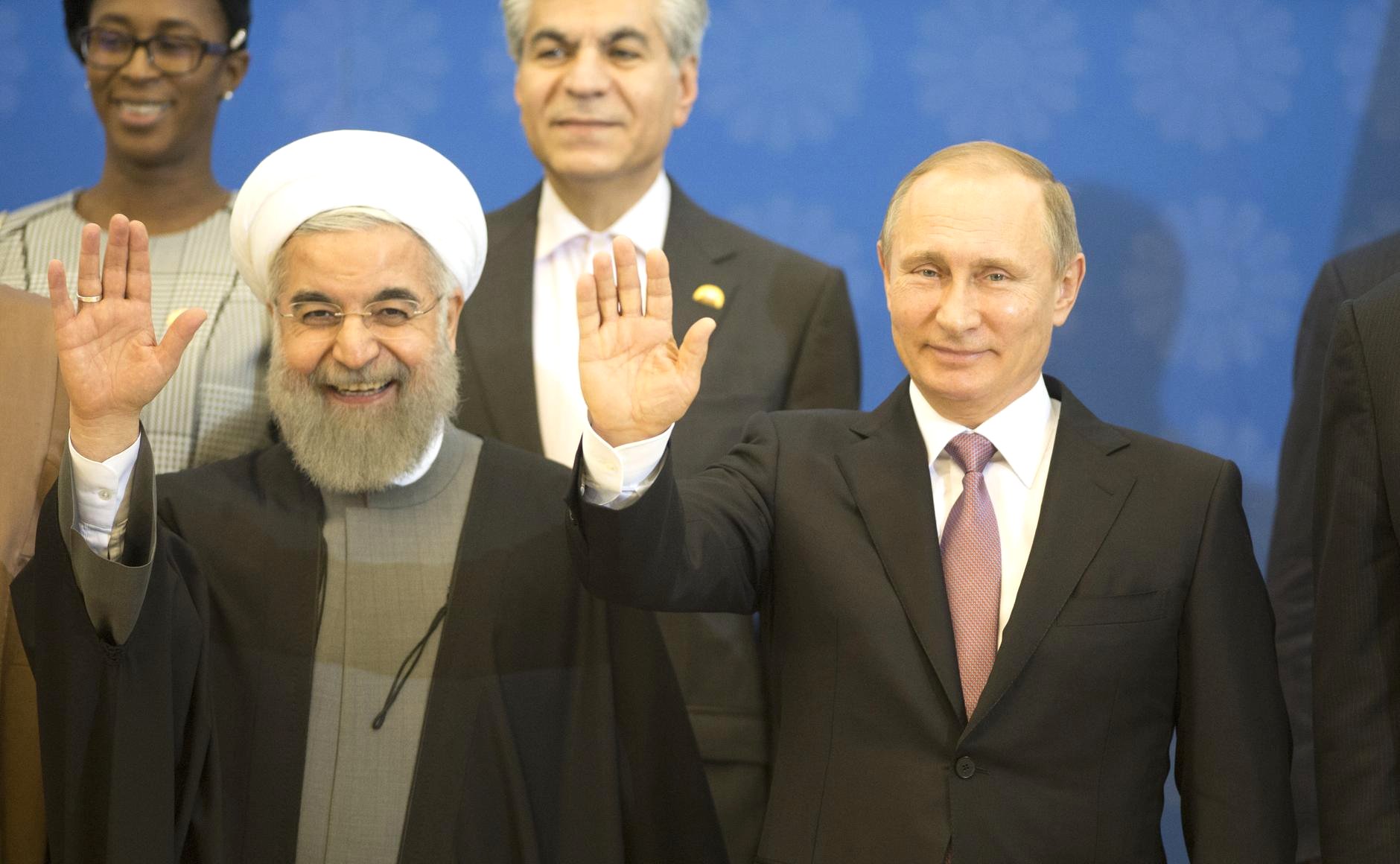
This week, Netanyahu personally traveled to Sochi, Russia, to confront Putin with the same blunt warning about Israel’s intention to attack targets inside Syria if Iran does not remove its forces.
A source familiar with the meeting told me that Putin responded with a sarcastic “good luck!” and that the Russians thought the swaggering Netanyahu appeared “unhinged.”
Still, a major Israeli attack on Iranian positions inside Syria would test Trump’s political toughness, since he would come under enormous pressure from Congress and the mainstream news media to intervene on Israel’s behalf. Indeed, realistically, Netanyahu must be counting on his ability to drag Trump into the conflict since Israel could not alone handle a potential Russian counterstrike.
But Netanyahu may be on somewhat thin ice since Trump apparently blames Israel’s top American supporters, the neocons, for much of his political troubles. They opposed him in the Republican primaries, tilted toward Hillary Clinton in the general election, and have pushed the Russia-gate affair to weaken him.
President Obama faced similar political pressures to fall in line behind Israel’s regional interests. That’s why Obama authorized the covert CIA program in Syria and other aid to the rebels though he was never an enthusiastic supporter – and also grew sick and tired of Netanyahu’s endless hectoring.
Obama acquiesced to the demands of Official Washington’s neocons and his own administration’s hawks – the likes of Secretary of State Hillary Clinton, CIA Director David Petraeus, his successor John Brennan, and United Nations Ambassador Samantha Power.
The Syrian conflict was part of a broader strategy favored by Washington’s neocons to overthrow or cripple regimes that were deemed troublesome to Israel. Originally, the neocons had envisioned removing the Assad dynasty soon after the invasion of Iraq in 2003, with Iran also on the “regime change” menu. But the disastrous Iraq War threw off the neocons’ timetable.
‘Regime Change’ Chaos
The Democratic Party’s liberal interventionists, who are closely allied with the Republican neocons, also tossed in Libya with the overthrow and murder of Libyan leader Muammar Gaddafi in 2011. Then, weapons from Gaddafi’s stockpiles were shipped to Syria where they strengthened rebel fighters allied with Al Qaeda’s Nusra Front and other Islamist groups.
Faced with this troubling reality – that the U.S.-backed “moderate rebels” were operating side by side with Al Qaeda’s Syrian affiliate and its allies – Washington’s neocons/liberal-hawks responded with sophisticated propaganda and devised clever talking points to justify what amounted to indirect assistance to terrorists.
The “regime change” advocates portrayed a black-and-white situation in Syria with Assad’s side wearing the black hats and various anti-Assad “activists” wearing the white hats (or literally White Helmets). The State Department and a complicit mainstream media disseminated horror stories about Assad and – when the reality about Al Qaeda’s role could no longer be hidden – that was spun in the rebels’ favor, too, by labeling Assad “a magnet for terrorists” (or later in cahoots with the Islamic State). For years, such arguments were much beloved in Official Washington.
But the human consequences of the Syrian conflict and other U.S.-driven “regime change” wars were horrific, spreading death and destruction across the already volatile Middle East and driving desperate refugees into Europe, where their presence provoked political instability.
By fall 2015, rebel advances in Syria – aided by a supply of powerful U.S. anti-tank missiles – forced Russia’s hand with Putin accepting Assad’s invitation to deploy Russian air power in support of the Syrian army and Iranian and Hezbollah militias. The course of the war soon turned to Assad’s advantage.
It’s unclear what Hillary Clinton might have done if she had won the White House in November 2016. Along with much of the U.S. foreign policy establishment, she called repeatedly for imposing a “no-fly zone” in Syria to stop operations by the Syrian air force and Russia, a move that could have escalated the conflict into World War III.
But Trump – lacking Official Washington’s “sophistication” – couldn’t understand how eliminating Assad, who was leading the fight against the terrorist groups, would contribute to their eventual defeat. Trump also looked at the failure of similar arguments in Iraq and Libya, where “regime change” produced more chaos and generated more terrorism.
Pandering to Saudis/Israelis
However, in the early days of his presidency, the unsophisticated Trump lurched from one Middle East approach to another, initially following his son-in-law Jared Kushner’s grandiose thinking about recruiting Saudi Arabia to an “outside-in” strategy to settle the Israel-Palestine conflict, i.e., enlisting the Saudis to pressure the Palestinians into, more or less, letting Israel dictate a solution.
Kushner’s “outside-in” scheme was symbolically acted out with Trump making his first overseas visit to Saudi Arabia and then to Israel in May. But I’m told that Trump eventually cooled to Kushner’s thinking and has come to see the Israeli-Saudi tandem as part of the region’s troubles, especially what he views as Saudi Arabia’s longstanding support for Al Qaeda and other terror groups.
Perhaps most significantly in that regard, Trump in July quietly abandoned the CIA’s covert war in Syria. In the U.S., some “regime change” advocates have complained about this “betrayal” of the rebel cause and some Democrats have tried to link Trump’s decision to their faltering Russia-gate “scandal,” i.e., by claiming that Trump was rewarding Putin for alleged election help.
But the bottom line is that Trump’s policy has contributed to the Syrian slaughter abating and the prospect of a victory by Al Qaeda and/or its Islamic State spinoff fading.
So, there has been a gradual education of Donald Trump, interrupted occasionally by his volatile temper and his succumbing to political pressure, such as when he rushed to judgment on April 4 and blamed the Syrian government for a chemical incident in the remote Al Qaeda-controlled village of Khan Sheikhoun.
Despite strong doubts in the U.S. intelligence community about Syria’s guilt – some evidence suggested one more staged “atrocity” by the rebels and their supporters – Trump on April 6 ordered 59 Tomahawk missiles fired at a Syrian air base, reportedly killing several soldiers and some civilians, including four children.
Trump boasted about his decision, contrasting it with Obama’s alleged wimpiness. And, naturally, Official Washington and the U.S. mainstream media not only accepted the claim of Syrian government guilt but praised Trump for pulling the trigger. Later, Hillary Clinton said if she were president, she would have been inclined to go further militarily by intervening with her “no-fly zone.”
As reckless and brutal as Trump’s missile strike was, it did provide him some cover for his July 7 meeting with Putin at the G-20 summit in Germany, which focused heavily on Syria, and also for his decision to pull the plug on the CIA’s covert war.
Saudi-backed Terror
I’m told Trump also has returned to his pre-election attitude about Saudi Arabia as a leading supporter of terror groups and a key provocateur in the region’s disorders, particularly because of its rivalry with Iran, a factor in both the Syrian and Yemeni wars.
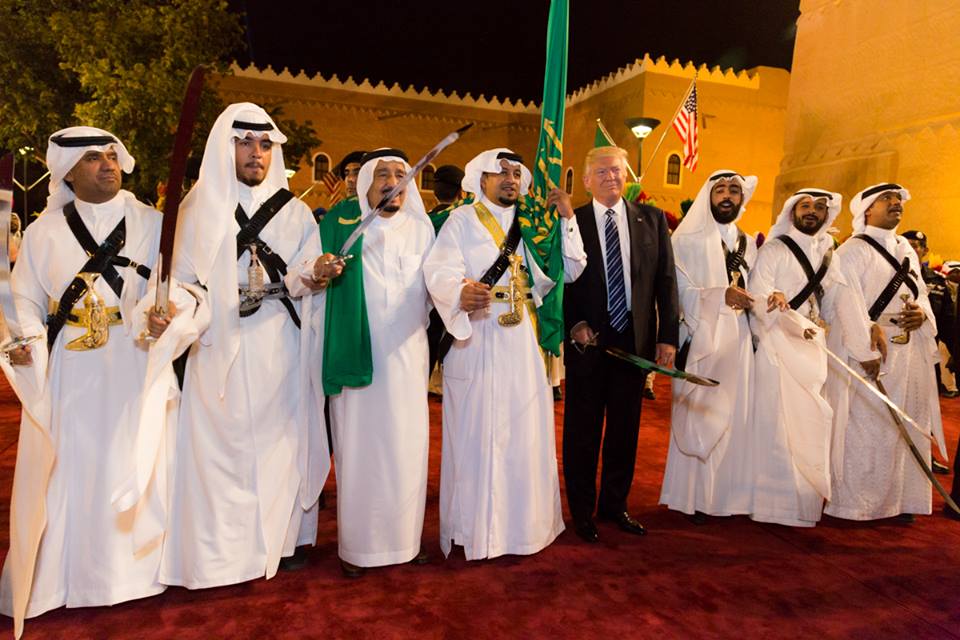
(Official White House Photo by Shealah Craighead)
Though Trump has recited Washington’s bipartisan (and benighted) mantra about Iran being the principal sponsor of terrorism, he appears to be moving toward a more honest view, recognizing the falsity of the neocon-driven propaganda about Iran.
Trump’s new coolness toward Saudi Arabia may have contributed to the recent warming of relations between the Sunnis of Saudi Arabia and the Shiites of Iran, a sectarian conflict dating back 1,400 years. In a surprising move announced this week, the two countries plan an exchange of diplomatic visits.
Even in areas where Trump has engaged in reckless rhetoric, such as his “fire and fury” warning to North Korea, his behind-the-scenes policy appears more open to compromise and even accommodation. In the past week or so, the tensions with North Korea have eased amid backchannel outreach that may include the provision of food as an incentive for Pyongyang to halt its missile development and even open political talks with South Korea, according to a source close to these developments.
On Afghanistan, too, Trump may be playing a double game, giving a hawkish speech on Monday seeming to endorse an open-ended commitment to the near-16-year-old conflict, while quietly signaling a willingness to negotiate a political settlement with the Taliban.
One alternative might be to accept a coalition government, involving the Taliban, with a U.S. withdrawal to a military base near enough to launch counterterrorism strikes if Al Qaeda or other international terror groups again locate in Afghanistan [likely an air base from which to threaten Iran – Aletho News ].
Many of Trump’s latest foreign policy initiatives reflect former White House strategist Steve Bannon’s hostility toward neoconservative interventionism. Secretary of State Rex Tillerson, the former Exxon-Mobil chief executive, also shares a more pragmatic approach to foreign affairs than some of his more ideological predecessors.
Albeit still in their infancy, these policies represent a new realism in U.S. foreign policy that, in many ways, paralleled what President Obama favored but was often unwilling or unable to see through to its logical conclusions, given his fear of Netanyahu and the power of the neocons and their liberal-hawk allies.
Still, some of Obama’s most important decisions – not to launch a major military strike against Syria in August 2013 and to negotiate an agreement with Iran to constrain its nuclear program in 2013-15 – followed a similar path away from war, thus drawing condemnation from the Israeli-Saudi tandem and American neocons.
As a Republican who rose politically by pandering to the GOP “base” and its hatred of Obama, Trump rhetorically attacked Obama on both Syria and Iran, but may now be shifting toward similar positions. Gradually, Trump has come to recognize that the neocons and his other political enemies are trying to hobble and humiliate him – and ultimately to remove him from office.
The question is whether Trump’s instinct for survival finally will lead him to policies that blunt his enemies’ strategies or will cause him to succumb to their demands.
Investigative reporter Robert Parry broke many of the Iran-Contra stories for The Associated Press and Newsweek in the 1980s.
Oust Trump, War With Russia
By Finian CUNNINGHAM | Strategic Culture Foundation | 13.07.2017
Behind the sensational Western media coverage now linking the US president’s son to alleged Russian collusion in the American election, the real euphoria stems from relief that, at last, some «evidence» has been found.
For more than seven months now, the US corporate media have been running unrelenting claims that somehow Donald J Trump colluded with Russian state-sponsored hackers to get elected over his Democrat rival Hillary Clinton.
The media campaign has been dismissed as a witch hunt by Trump. Perhaps more sinisterly, US-Russia relations have also become deeply toxic due to the allegations. Not even a friendly meeting between Trump and Putin at last weekend’s G20 summit in Germany seems able to lift the poisonous cloud over bilateral relations.
However, the never-ending «Russia-gate» story was, to be frank, at risk of boring people to death from the sheer lack of evidence to shore up the conjecture of Trump being a Russian stooge. Despite the fact that three separate government probes have been working on the issue, they have nothing to show for it.
Then this week the «Russia-gate» story-tellers got a lifeline with reports that the president’s eldest son, Donald Jr, held a meeting with a Russian lawyer over a year ago at Trump Tower in New York City. The disclosure came from emails sent by Trump’s son to a mediator who promised «dirt on Clinton» that would damage her election campaign.
Democrats, Republicans, supporters of Clinton and the anti-Trump media are now cock-a-hoop that they have a «smoking gun» to prove the narrative of Trump-Russia collusion. Trump Jr is being accused of betraying his country by consorting with a foreign enemy, Russia.
A Washington Post comment noted: «Donald Trump Jr’s emails are the clearest indication yet that Trump campaign officials and family members were willing to deal with a foreign adversary in their mutual goal of taking down Hillary Clinton, and their revelation is dramatic proof that the Russia investigation is alive with no end in sight.»
Meanwhile, the New York Times reported: «Rancor at White House as Russia Story Refuses to Let the Page Turn». It goes on to comment with a tone of satisfaction: «Every time the president tries to put the furor behind him, more disclosures thrust it back to the fore, and people close to him are anonymously blaming one another.»
What the media outlets decline to say is that the Russia-gate story has not gone away precisely because the media have dutifully amplified leaks and anonymous intelligence claims – more accurately, innuendo – pillorying Trump as a Russian patsy.
The Deep State rulers of the US, comprising the military-intelligence apparatus, never wanted businessman Trump to become president. Unlike Clinton, Trump was insufficiently hawkish towards Russia. Ever since his shock election last November, the Deep State and its media machine have been full throttle to oust the «wrong president». The «Russian collusion» claims are the spearhead of this attack, an attack could qualify as a «soft coup» against the elected president.
With Trump’s son now admitting that he met with a Russian lawyer last summer as the head of his father’s election campaign, the anti-Trump campaign senses a mortal wound and are going full pelt to exploit it.
But the drama has the hallmarks of yet more media-driven sensation that is out of all proportion to the facts. Trump Jr’s lawyer dismissed the latest claims as «much ado about nothing».
The Russian government, which has consistently rejected any claims of interfering in the US election, said that the speculation about Trump and the «Kremlin-connected attorney» is «making a mountain out of a molehill».
As Trump Jr told Fox News this week, he held the meeting simply because he was interested in hearing «opposition research» on Hillary Clinton. As it turned out, no such information was forthcoming and the meeting ended inconclusively after only 20 minutes. That was the end of it. Apparently, Trump Sr wasn’t even told about the brief interview, so insignificant was it at the time.
It seems a fair and plausible observation that Trump Jr was simply doing what any political campaigner would do. Get dirt on opponents.
The US media are thus guilty of «protesting too much» about what is a rather prosaic matter. Apart from the obvious axe they want to grind against President Trump, the other reason for the media hysteria over the latest twist in the Russia-gate affair is that the Deep State and their media machine have, at last, something resembling hard evidence. This is why they are grandstanding. It is from relief that they have found something approximating a story to justify all the months of shrill speculation.
The hypocrisy of the pious media, pundits and politicians over Trump Jr’s betrayal is quickly revealed when one considers that Hillary Clinton’s campaign actively worked with the CIA-backed Kiev regime to dig up dirt on Trump during the election, as reported by Cristina Laila. «Where is the call for Hillary Clinton and her aides to be interviewed by the Senate intelligence panel,» she asks.
According to US media interviews given by Nataliya Veselnitskaya, the Russian lawyer at the center of the Trump brouhaha, she is adamant that she was not acting for the Kremlin. The Kremlin also denies knowing her. She maintains that she not did approach the Trump campaign to provide «dirt» on Clinton, but rather to lobby against US sanctions imposed on her Russian business clients.
The claim that Veselnitskaya was «acting on Russian government information to help Donald Trump» apparently stems solely from the assertion made by the former British tabloid journalist Rob Goldstone, who wrote to Donald Jr to set up the meeting. It was Goldstone who described the meeting with Veselnitskaya as conveying «Russian government information to help your father’s campaign».
In other words that is not «proof» of Russian government involvement. It is simply hearsay from a tabloid hack with self-serving reasons.
Questions that the US media should be asking are: Was Goldstone hamming up his Russian government claims in order to sell Trump a mediation service and a scoop? Also, how did private emails between Goldstone and Trump end up in the possession of the New York Times ? Did Goldstone flog them to the newspaper in order to cash in on the brewing Russia-gate scandal?
As with so much else in the Russia-gate affair, the latest twist seems to be another concoction to turn wild speculation into the semblance of fact. It is as if the US media conceived the headline «Trump colluded with Russia» a long time ago, and have ever since been chasing to find a «story» to fit the headline.
There are too many holes in the whole Russia-gate affair for it to stand up. It is only the servile US media operating on the agenda of the powerful anti-Trump Deep State that make this non-story appear to stand up.
So desperate is the Deep State to oust Trump from office, it is willing to damage US-Russia relations beyond repair, to the point of risking all-out war.
Russia-gate Flops as Democrats’ Golden Ticket
By Robert Parry | Consortium news | June 21, 2017
The national Democratic Party and many liberals have bet heavily on the Russia-gate investigation as a way to oust President Trump from office and to catapult Democrats to victories this year and in 2018, but the gamble appears not to be paying off.
The Democrats’ disappointing loss in a special election to fill a congressional seat in an affluent Atlanta suburb is just the latest indication that the strategy of demonizing Trump and blaming Russia for Hillary Clinton’s 2016 defeat may not be the golden ticket that some Democrats had hoped.
Though it’s still early to draw conclusive lessons from Karen Handel’s victory over Jon Ossoff – despite his raising $25 million – one lesson may be that a Middle America backlash is forming against the over-the-top quality of the Trump-accusations and the Russia-bashing, with Republicans rallying against the image of Official Washington’s “deep state” collaborating with Democrats and the mainstream news media to reverse a presidential election.
Indeed, the Democrats may be digging a deeper hole for themselves in terms of reaching out to white working-class voters who abandoned the party in Pennsylvania, Michigan and Wisconsin to put Trump over the top in the Electoral College even though Clinton’s landslide win in California gave her almost three million more votes nationwide.
Clinton’s popular-vote plurality and the #Resistance, which manifested itself in massive protests against Trump’s presidency, gave hope to the Democrats that they didn’t need to undertake a serious self-examination into why the party is in decline across the nation’s heartland. Instead, they decided to stoke the hysteria over alleged Russian “meddling” in the election as the short-cut to bring down Trump and his populist movement.
A Party of Snobs?
From conversations that I’ve had with some Trump voters in recent weeks, I was struck by how they viewed the Democratic Party as snobbish, elitist and looking down its nose at “average Americans.” And in conversations with some Clinton voters, I found confirmation for that view in the open disdain that the Clinton backers expressed toward the stupidity of anyone who voted for Trump. In other words, the Trump voters were not wrong to feel “dissed.”
It seems the Republicans – and Trump in particular – have done a better job in presenting themselves to these Middle Americans as respecting their opinions and representing their fears, even though the policies being pushed by Trump and the GOP still favor the rich and will do little good – and significant harm – to the middle and working classes.
By contrast, many of Hillary Clinton’s domestic proposals might well have benefited average Americans but she alienated many of them by telling a group of her supporters that half of Trump’s backers belonged in a “basket of deplorables.” Although she later reduced the percentage, she had committed a cardinal political sin: she had put the liberal disdain for millions of Americans into words – and easily remembered words at that.
By insisting that Hillary Clinton be the Democratic nominee – after leftist populist Bernie Sanders was pushed aside – the party also ignored the fact that many Americans, including many Democrats, viewed Clinton as the perfectly imperfect candidate for an anti-Establishment year with many Americans still fuming over the Wall Street bailouts and amid the growing sense that the system was rigged for the well-connected and against the average guy or gal.
In the face of those sentiments, the Democrats nominated a candidate who personified how a relatively small number of lucky Americans can play the system and make tons of money while the masses have seen their dreams crushed and their bank accounts drained. And Clinton apparently still hasn’t learned that lesson.
Citing Women’s Rights
Last month, when asked why she accepted hundreds of thousands of dollars for speaking to Goldman Sachs, Clinton rationalized her greed as a women’s rights issue, saying: “you know, men got paid for the speeches they made. I got paid for the speeches I made.”
Her excuse captured much of what has gone wrong with the Democratic Party as it moved from its working-class roots and New Deal traditions to becoming a party that places “identity politics” ahead of a duty to fight for the common men and women of America.
Demonstrating her political cluelessness, Clinton used the serious issue of women not getting fair treatment in the workplace to justify taking her turn at the Wall Street money trough, gobbling up in one half-hour speech what it would take many American families a decade to earn.
While it’s a bit unfair to personalize the Democratic Party’s problems, Hillary and Bill Clinton have come to represent how the party is viewed by many Americans. Instead of the FDR Democrats, we have the Davos Democrats, the Wall Street Democrats, the Hollywood Democrats, the Silicon Valley Democrats, and now increasingly the Military-Industrial Complex Democrats.
To many Americans struggling to make ends meet, the national Democrats seem committed to the interests of the worldwide elites: global trade, financialization of the economy, robotization of the workplace, and endless war against endless enemies.
Now, the national Democrats are clambering onto the bandwagon for a costly and dangerous New Cold War with nuclear-armed Russia. Indeed, it is hard to distinguish their foreign policy from that of neoconservatives, although these Democrats view themselves as liberal interventionists citing humanitarian impulses to justify the endless slaughter.
Earlier this year, a Washington Post /ABC News poll found only 28 percent of Americans saying that the Democrats were “in touch with the concerns of most people” – an astounding result given the Democrats’ long tradition as the party of the American working class and the party’s post-Vietnam War reputation as favoring butter over guns.
Yet rather than rethink the recent policies, the Democrats prefer to fantasize about impeaching President Trump and continuing a blame-game about who – other than Hillary Clinton, her campaign and the Democratic National Committee – is responsible for Trump’s election. Of course, it’s the Russians, Russians, Russians!
A Problem’s Deep Roots
Without doubt, some of the party’s problems have deep roots that correspond to the shrinking of the labor movement since the 1970s and the growing reliance on big-money donors to finance expensive television-ad-driven campaigns. Over the years, the Democrats also got pounded for being “weak” on national security.
Further, faced with Republican “weaponization” of attack ads in the 1980s, many old-time Democrats lost out to the Reagan Revolution, clearing the way for a new breed of Democrats who realized that they could compete for a slice of the big money by cultivating the emerging coastal elites: Wall Street, Silicon Valley, Hollywood and even elements of the National Security State.
By the 1990s, President Bill Clinton and the Democratic Leadership Council defined this New Democrat, politicians who reflected the interests of well-heeled coastal elites, especially on free trade; streamlined financial regulations; commitment to technology; and an activist foreign policy built around spreading “liberal values” across the globe.
Mixed in was a commitment to the rights of various identity groups, a worthy goal although this tolerance paradoxically contributed to a new form of prejudice among some liberals who came to view many white working-class people as fat, stupid and bigoted, society’s “losers.”
So, while President Clinton hobnobbed with the modern economy’s “winners” – with sleepovers in the Lincoln bedroom and parties in the Hamptons – much of Middle America felt neglected if not disdained. The “losers” were left to rot in “flyover America” with towns and cities that had lost their manufacturing base and, with it, their vitality and even their purpose for existing.
Republican Fraud
It wasn’t as if the Republicans were offering anything better. True, they were more comfortable talking to these “forgotten Americans” – advocating “gun rights” and “traditional values” and playing on white resentments over racial integration and civil rights – but, in office, the Republicans aggressively favored the interests of the rich, cutting their taxes and slashing regulations even more than the Democrats.
The Republicans paid lip service to the struggling blue-collar workers but control of GOP policies was left in the hands of corporations and their lobbyists.
Though the election of Barack Obama, the first African-American president, raised hopes that the nation might finally bind its deep racial wounds, it turned out to have a nearly opposite effect. Tea Party Republicans rallied many white working-class Americans to resist Obama and the hip urban future that he represented. They found an unlikely champion in real-estate mogul and reality TV star Donald Trump, who sensed how to tap into their fears and anger with his demagogic appeals and false populism.
Meanwhile, the national Democrats were falling in love with data predicting that demographics would magically turn Republican red states blue. So the party blithely ignored the warning signs of a cataclysmic break with the Democrats’ old-time base.
Despite all the data on opioid addiction and declining life expectancy among the white working class, Hillary Clinton was politically tone-deaf to the rumbles of discontent echoing across the Rust Belt. She assumed the traditionally Democratic white working-class precincts would stick with her and she tried to appeal to the “security moms” in typically Republican suburbs by touting her neoconservative foreign policy thinking. And she ran a relentlessly negative campaign against Trump while offering voters few positive reasons to vote for her.
Ignoring Reality
When her stunning loss became clear on Election Night – as the crude and unqualified Trump pocketed the electoral votes of Pennsylvania, Michigan and Wisconsin – the Democrats refused to recognize what the elections results were telling them, that they had lost touch with a still important voting bloc, working-class whites.
Rather than face these facts, the national Democrats – led by President Obama and his intelligence chiefs – decided on a different approach, to seek to reverse the election by blaming the result on the Russians. Obama, his intelligence chiefs and a collaborative mainstream media insisted without presenting any real evidence that the Russians had hacked into Democratic emails and released them to the devastating advantage of Trump, as if the minor controversies from leaked emails of the Democratic National Committee and Clinton’s campaign chairman John Podesta explained Trump’s surprising victory.
As part of this strategy, any Trump link to Russia – no matter how inconsequential, whether from his businesses or through his advisers – became the focus of Woodward-and-Bernstein/Watergate-style investigations. The obvious goal was to impeach Trump and ride the wave of Trump-hating enthusiasm to a Democratic political revival.
In other words, there was no reason to look in the mirror and rethink how the Democratic Party might begin rebuilding its relationships with the white working-class, just hold hearings featuring Obama’s intelligence chieftains and leak damaging Russia-gate stuff to the media.
But the result of this strategy has been to deepen the Democratic Party’s reliance on the elites, particularly the self-reverential mavens of the mainstream media and the denizens of the so-called “deep state.” From my conversations with Trump voters, they “get” what’s going on, how the powers-that-be are trying to negate the 63 million Americans who voted for Trump by reversing a presidential election carried out under the U.S. constitutional process.
A Letter from ‘Deplorable’ Land
Some Trump supporters are even making this point publicly. Earlier this month, a “proud deplorable” named Kenton Woodhead from Brunswick, Ohio, wrote to The New York Times informing the “newspaper of record” that he and other “deplorables” were onto the scheme.
“I wanted to provide you with an unsophisticated synopsis of The New York Times and the media’s quest for the implosion of Donald Trump’s presidency from out here in the real world, in ‘deplorable’ country. … Every time you and your brethren at other news organizations dream up a new scheme to get Mr. Trump, we out here in deplorable land increase our support for him. …
“Regardless of what you dream up every day, we refuse to be sucked into your narrative. And even more humorously, there isn’t anything you can do about it! And I love it that you are having the exact opposite effect on those of us you are trying to persuade to think otherwise.
“I mean it is seriously an enjoyable part of my day knowing you are failing. And badly! I haven’t had this much fun watching the media stumble, bumble and fumble in years. I wonder what will happen on the day you wake up and realize how disconnected you’ve become.”
So, despite Trump’s narcissism and incompetence – and despite how his policies will surely hurt many of his working-class supporters – the national Democrats are further driving a wedge between themselves and this crucial voting bloc. By whipping up a New Cold War with Russia and hurling McCarthistic slurs at people who won’t join in the Russia-bashing, the Democratic Party’s tactics also are alienating many peace voters who view both the Republicans and Democrats as warmongers of almost equal measures of guilt.
While it’s certainly not my job to give advice to the Democrats – or any other political group – I can’t help but thinking that this Russia-gate “scandal” is not only lacking in logic and evidence, but it doesn’t even make any long-term political sense.
Investigative reporter Robert Parry broke many of the Iran-Contra stories for The Associated Press and Newsweek in the 1980s.
Hillary Clinton’s Deceptive Blame-Shifting
By Robert Parry | Consortium News | June 1, 2017
Hillary Clinton has grown even more insistent that she was not at fault for her stunning election defeat last November, claiming that 1,000 Russian “agents” and their American collaborators were a decisive factor, a bizarre twist that further locks the Democrats into their evidence-light “Russia-gate” obsession.
In comments at a California technology conference on Wednesday, Clinton also repeated one of her favorite falsehoods – that all 17 U.S. intelligence agencies unanimously concluded that Russia hacked Democratic emails and ran a covert influence campaign against her.
Referring to a report released by President Obama’s Director of National Intelligence (DNI) on Jan. 6, Clinton asserted that “Seventeen agencies, all in agreement, which I know from my experience as a Senator and Secretary of State, is hard to get. They concluded with high confidence that the Russians ran an extensive information war campaign against my campaign, to influence voters in the election. They did it through paid advertising we think; they did it through false news sites; they did it through these thousand agents; they did it through machine learning, which you know, kept spewing out this stuff over and over again. The algorithms that they developed. So that was the conclusion.”
But Clinton’s statement is false regarding the unanimity of the 17 agencies and misleading regarding her other claims. Both former DNI James Clapper and former CIA Director John Brennan acknowledged in sworn testimony last month that the Jan. 6 report alleging Russian “meddling” did not involve all 17 agencies.
Clapper and Brennan stated that the report was actually the work of hand-picked analysts from only three agencies – the Central Intelligence Agency, National Security Agency and Federal Bureau of Investigation – under the oversight of the DNI’s office. In other words, there was no consensus among the 17 agencies, a process that would have involved some form of a National Intelligence Estimate (or NIE), a community-wide effort that would have included footnotes citing any dissenting views.
Instead, as Clapper testified before a Senate Judiciary subcommittee on May 8, the Russia-hacking claim came from a “special intelligence community assessment” (or ICA) produced by selected analysts from the CIA, NSA and FBI, “a coordinated product from three agencies – CIA, NSA, and the FBI – not all 17 components of the intelligence community,” the former DNI said.
And, as Clapper explained, the “ICA” was something of a rush job beginning on President Obama’s instructions “in early December” and completed by Jan. 6. Clapper continued: “The two dozen or so analysts for this task were hand-picked, seasoned experts from each of the contributing agencies.”
However, as any intelligence veteran will tell you, if you hand-pick the analysts, you are really hand-picking the conclusion since the agency chiefs would know who was, say, a hardliner on Russia and who could be trusted to deliver the desired product.
On May 23, in testimony before the House Intelligence Committee, former CIA Director John Brennan confirmed Clapper’s account about the three agencies involved.
“It wasn’t a full inter-agency community assessment that was coordinated among the 17 agencies, and for good reason because of the nature and the sensitivity of the information trying, once again, to keep that tightly compartmented,” Brennan said.
In other words, Clinton’s beloved claim that all 17 intelligence agencies were in agreement on the Russian “hacking” charge – an assertion that the “fact-checking” group Politifact has certified as “true” and that has been repeated endlessly by the mainstream U.S. news media – is not true. It is false. Gee, you might even call it “fake news.”
The Mysterious ‘Agents’
But Clinton’s false claim about the intelligence consensus was not her only dubious assertion. Her reference to the 1,000 Russian “agents” is not contained in the Jan. 6 report, either. It apparently derived from unconfirmed speculation from Sen. Mark Warner, D-Virginia, who mentioned this claim at a news conference on March 30, admitting that he didn’t know if it was true.
Warner, the ranking Democrat on the Senate Intelligence Committee, said: “We know about the hacking, and selective leaks, but what really concerns me as a former tech guy is at least some reports – and we’ve got to get to the bottom of this – that there were upwards of a thousand internet trolls working out of a facility in Russia, in effect taking over a series of computers which are then called botnets, that can then generate news down to specific areas.
“It’s been reported to me, and we’ve got to find this out, whether they were able to affect specific areas in Wisconsin, Michigan, Pennsylvania, where you would not have been receiving off of whoever your vendor might have been, Trump versus Clinton, during the waning days of the election, but instead, ‘Clinton is sick’, or ‘Clinton is taking money from whoever for some source’ … fake news.”
Of course, many stories about Clinton being sick or her taking money from special interests weren’t “fake news.” In late 2012, she suffered from a blood clot and – during the 2016 campaign – she was staggered by a bout of pneumonia. She also was paid hundreds of thousands of dollars for speeches to Wall Street and other groups.
Warner didn’t specify where his information about the “trolls” came from but it paralleled a claim by freelance journalist Adam Chen who asserted in a podcast with Longform that Russian “trolls” began writing favorably about Trump in late 2015. (The CIA/FBI/NSA report also apparently alluded to the same report without mentioning the name of the journalist or specifying the number of alleged “trolls.”)
“I created this list of Russian trolls when I was researching,” Chen said, referring to a 2015 reporting project that he turned into a rather thinly sourced New York Times Magazine article accusing a Russian oligarch of funding a professional “troll” operation in St. Petersburg, Russia. “I check on it once in a while, still. And a lot of them have turned into conservative accounts, like fake conservatives. I don’t know what’s going on, but they’re all tweeting about Donald Trump and stuff.”
Although such “troll” and “hacking” complaints are treated as a one-way street – coming only from the evil Russians – the reality is that U.S. intelligence agencies, their allies and U.S.-government-funded “non-governmental organizations” have mounted similar operations against Russia and other targets.
It is always difficult to nail down precisely where such operations are originating, but the Russians have cited previous cases of malicious hacking aimed at senior officials, including Prime Minister Dmitri Medvedev, whose accounts were hacked in 2013 and 2014 including publication of a false resignation and a confession of wrongdoing.
In 2015, the “Panama Papers,” a vast trove of documents purloined from a Panamanian law firm, became an investigative project that involved a USAID-funded news outlet and led to attacks on President Vladimir Putin for corruption even though his name did not appear in the documents.
So, this high-tech spy-vs.-spy game – if that’s what it is – does not appear to be originating entirely from the Russian side of the street. But the U.S. intelligence community is not going to divulge what it knows about the attacks against Russia, only what it can “assess” about Russia’s possible attacks against Western targets.
No Self-Criticism
Neither, of course, are Hillary Clinton and the Democratic Party eager to engage in a serious self-criticism about how they managed to blow an extremely winnable race against an extraordinarily flawed candidate in Donald Trump. Rather than look at their own missteps and misjudgments, they are presenting themselves as innocent victims.
In Wednesday’s interview – after misrepresenting what the Jan. 6 report actually said – Clinton suggested that the Trump campaign must have colluded with the Russians in “weaponizing” the data.
“How did they know what messages to deliver?” Clinton asked. “Who told them? Who were they coordinating with, or colluding with? … [The Russians] were conveying this weaponized information and the content of it. … So the Russians — in my opinion and based on the intel and the counterintel people I’ve talked to — could not have known how best to weaponize that information unless they had been guided. … Guided by Americans and guided by people who had polling and data information.”
Although Clinton lacked any proof of this convoluted accusation, she cited as her “best example” the fact that “within one hour, one hour of the ‘Access Hollywood’ tapes being leaked [in which Trump was caught boasting about groping women], within one hour, the Russians — let’s say WikiLeaks, something — dumped the John Podesta emails.”
However, if you changed the context of this claim slightly – and made a similar jump in logic – you would surely be labeled a nutty conspiracy theorist, but instead Clinton has drawn nods of agreement for this wholly unsubstantiated speculation.
Yet, besides blaming the Russians and WikiLeaks for her loss, Clinton spread the blame even wider, for instance, to The New York Times for focusing too much on her decision to use a private email server while Secretary of State – “they covered it like it was Pearl Harbor” – and for the Times’ Nate Silver publishing optimistic odds on her chances for victory. “I also think I was the victim of a very broad assumption I was going to win,” she said.
Clinton also placed blame on the Democratic National Committee for lacking money and sophisticated technology. “I get the nomination. So I’m now the nominee of the Democratic Party. I inherit nothing from the Democratic Party,” she said. “I mean it was bankrupt; it was on the verge of insolvency; its data was mediocre to poor, nonexistent, wrong. I had to inject money into it.”
Yet, when Clinton was asked about some of her own “misjudgments,” she slipped back into the defensive posture that contributed to her troubles as a presidential candidate. For instance, regarding why she gave lucrative speeches to Goldman Sachs between her time leaving the State Department and announcing her White House run, she answered coyly, “They paid me.”
When pressed on the point, Clinton retreated behind the sanctity of the 9/11 terror attack and the issue of women’s rights. Reminded that “you’re not somebody who needed that money for the next week’s shopping, and you knew you might run, so why do it?” – she responded:
“The most common thing that I talked about in all those speeches was the hunt for Bin Laden. You know, that was one of the central missions that I felt from the time the towers fell on 9/11 as a Senator from New York.”
Then, Clinton added, “you know, men got paid for the speeches they made. I got paid for the speeches I made. And it [the paid-speech issue] was used, and I thought it was unfairly used.”
Blocking Witnesses
So, while the Democrats dig themselves deeper into the so-far empty pit of blaming Russia for their electoral disaster, the Russia-gate investigation continues to take on other curious aspects, such as an unwillingness to hear from some of Donald Trump’s advisers who have been named in accusations and who have volunteered to testify publicly.

Former Trump foreign policy adviser Carter Page
On Wednesday, Carter Page, a Navy veteran and businessman who had lived in Russia, announced that his plans to defend himself in testimony next week before the House Intelligence Committee had been placed on hold by the Democrats.
Rep. Adam Schiff of California, the ranking Democrat on the committee and a major spark plug powering the investigation, offered a curious denial of Page’s complaint while confirming the truth of it.
The New York Times, which has been another advocate for blaming Russia, phrased the postponement of Page’s testimony as if Page were the unreasonable one, reporting:
“Representative Adam Schiff … dismissed accusations from Carter Page, another Trump adviser who is under scrutiny, that the committee is preventing him from testifying. Mr. Schiff …. said the investigation would first review relevant documents before interviewing witnesses.”
In other words, Page, who has been portrayed via intelligence leaks to the news media as essentially a traitor, won’t be given the opportunity to defend his reputation until Schiff and the other Democrats decide the time is ripe.
Yet, it’s not as if the House Intelligence Committee has not taken public testimony about Russia-gate. For instance, former CIA Director Brennan was allowed to speak indirectly about Page and other possibly treasonous Americans amid media reports naming Page as one of those suspected Russian “agents.”
Normal investigations grant the people under attack at least the opportunity to defend themselves and their reputations in a timely fashion, rather than make them live under the cloud of suspicion without having a chance to state their case.
If their sworn testimony is later undermined by evidence developed by investigators, the witnesses can be called back and called out on possible perjury. So, it’s not as if Schiff and the other Democrats are surrendering prerogatives by letting Page testify now rather than later. Indeed, Page would be putting himself in legal jeopardy if he is caught lying.
Even the Republican-driven “Benghazi investigation,” which also had the look of an over-the-top “witch hunt,” gave Secretary of State Clinton and other Obama administration officials multiple opportunities to explain their response to the Sept. 11, 2012 attack on the U.S. consulate.
But, so far, a similar courtesy has not been extended to the targets of the Russia-gate investigation.
Investigative reporter Robert Parry broke many of the Iran-Contra stories for The Associated Press and Newsweek in the 1980s.
Sheldon Adelson’s Crocodile Tears for Tillerson
Yet another round of Israeli political theater to perpetuate the victim mentality of Zionists

By Ali Salaam | American Herald Tribune | May 31, 2017
Due to a delay in the move of the US Embassy in the occupying Zionist entity from Tel Aviv to Jerusalem, Jewish Zionist billionaire Sheldon Adelson is reported to be angry with Secretary of State Rex Tillerson due to remarks he made in NBC’s “Meet the Press”suggesting President Donald Trump was deliberating the move in order to determine the cost/benefits it would have on the Israel/Palestine peace process.
Adelson donated tens of millions of dollars to Trump’s election campaign and another cool 5 mil to the Trump inauguration committee. Adelson’s friend, Jewish Zionist billionaire Haim Saban, donated heavily to the Hillary Clinton campaign. In 2016, the Zionists hedged their bets on both carefully groomed and predetermined major-party candidates, as usual.
A close look at the Trump administration’s policies towards the Zionist entity may deem Adelson’s fury egregious and unwarranted; a case of political theater to justify the perpetual victim complex needed to gain sympathy for the Zionist regime.
Let’s rewind to the Obama administration. Controversy after controversy surrounded the many times Obama ‘refused’ to meet with Netanyahu, officially due to scheduling conflicts. This political theater justified the neoconservative approach that Obama was ‘too weak’ on foreign policy.
The neocons knew their claims about Obama were false.
Before Obama’s election he was cozying up to the Zionist lobby. He had Rahm Israel Emmanuel, the son of a Zionist terrorist, as his Chief of Staff. Obama continued the Zionist wars in the Middle East, especially in Iraq, until the Iraqis forced Obama to leave, which was already in accordance with Bush’s time table. Obama helped the Israelis to coordinate the color revolution in Iran following the 2009 elections, otherwise known as the Green “Revolution,” which was revenge for Ahmadinejad’s role in securing the victory for Lebanon against Zionist aggression in the July 2006 invasion. Obama helped to kill Muammar Gaddaffi in 2011, a war which benefited the Zionists and the global central banking cartel, due to Gadaffi’s support for Palestine and for a gold-backed independent dinar that would have liberated Africa from the grips of crippling IMF debt. Obama turned a blind eye to the war crimes of Israel’s Operation Cast Lead in 2009, in which Israel used white phosphorous chemical weapons against civilians in Gaza. Additionally, the US provided military aid to Israel in 2009, making the US and the Obama administration directly complicit in the war crimes.
And that is just Obama’s first term, where he proved his Zionist credentials through actions. Obama’s facade of diplomacy and peace was just that: an illusion. The media can play all they like with it to fool the American people into thinking that the Democratic party is the party that is against war (most wars since JFK were waged by Democratic administrations) and that the two-party system is something that the people can still rely on for change. The Democrats serve as controlled opposition for American’s anger at Republican policies, when in reality both parties are two wings of the same vulture.
In his second term, Obama supported arming takfiri Wahabbi rebels in Syria to overthrow the legitimately elected government of Bashar al-Assad, also as revenge for the victory of Lebanon over Zionist invasion in 2006, as Syria supports the Lebanese and Palestinian resistance with arms and other resources. Leaked cables reveal that after the July 2006 war, Israel and the US started to lay the groundwork for plans to overthrow Assad in Syria, using artificially inflated sectarian strife to achieve it. Saudi Arabia, Qatar, and their sectarian media machine as well as financial support for terrorist networks served as the proxy army for the Israeli/American-backed coup attempt in Syria.
Obama and Clinton, along with their Republican doppelgangers John McCain and Joe Lieberman, armed and trained the Free Syrian Army, which had zero grassroots ties to the Syrian people and had many foreign fighters among their ranks. Many FSA generals expressed their alliances with the Al Nusra Front, Syria’s al-Qaeda affiliate. The Pentagon knew that they were arming al-Qaeda-linked terrorists, but that was part of their plan. Out of this toxic concoction, ISIS was born. After the 2013 chemical false flag in Ghouta, Syria, which UN inspector Carla Del Ponte correctly placed blame on the Syrian rebels, the American people were not willing to support overt US involvement in Syria, though many were not aware of the covert involvement in the arming of takfiri mercenaries and falsely dubbing it a “revolution” against “dictator” Bashar al-Assad. ISIS was the perfect pretext to sneak into Syria and to turn it from a war against ISIS to a war against Assad, Hezbollah, and Iran, a war that America has wanted since 2001, and a war that Israel has wanted since the 1980s with the Oded Yinon “Greater Israel” strategy of dividing neighboring Arab countries along ethnic/sectarian lines.
Obama’s creation of the takfiri proxy army that serves the Zionist and American imperialist agenda is the greatest gift to Israel as it has helped to tear apart the Middle East, widen sectarian gaps, and provide a path to weakening Hezbollah and the Islamic Republic of Iran. Though of course, due to the resilience of the Axis of Resistance (Syria, Palestine, Iran, Hezbollah, Iraq, Yemen) the destructive Zionist agenda hasn’t had much success. It has only increased what the leader of the Islamic Revolution Ayatollah Sayed Ali Khamenei refers to as the “Islamic awakening.”
Add to that the cherry on top: Obama fully supported and backed Israel’s Operation Protective Edge in 2014, one of the deadliest onslaughts against the besieged Gaza Strip, in which over 500 children were murdered in cold blood.
To further demonstrate the political theater around Israel, most of the prominent Democrats that boycotted Netanyahu’s speech at Congress in the following year voted to support giving Israel more weapons in the midst of their 2014 massacre of Gaza. When it counts, they fall in line to support the Zionist regime’s constant campaign of bloodshed. This includes seemingly pro-peace politicians like Senator Bernie Sanders.
Like Obama, Trump’s apparent quarrels with the Zionist regime are nothing but theater. While Obama’s $38 billion aid package to Israel was the largest at the time, Trump is already promising to increase that amount.
Trump has taken Israel’s side in the “Assad must go” bandwagon, being the first US president to directly strike the Syrian Arab Army, compared to the years of covert proxy war being carried out through al-Qaeda-linked proxies.
Trump has sided with Israel’s close ally Saudi Arabia, taking groups like the Al-Nusra Front off terrorist watch lists, yet declaring the Lebanese self-defense/resistance group Hezbollah a ‘terrorist’ organization.
While Obama laid the ground for the Oded Yinon strategy of sectarian division among Arab nations, specifically in Syria, Trump is starting to invest in the ethnic division of the Oded Yinon plan, supporting Kurdish factions, giving the potential rise to a future Kurd vs. Arab vs. Turk war and the bloodshed that will follow, in addition to a divided Syria, Iraq, and Iran being weaker in the face of global Zionism and American imperialism.
Trump’s close confidant is his Zionist Jewish son-in-law Jared Kushner, who is using his position to advance the Zionist cause in Iraq, Syria, and elsewhere.
Rex Tillerson himself is advancing the Zionist cause in Venezuela, using US-backed opposition to try and topple Chavismo, which has historically stood with the resistance axis of Palestine, Iran, Syria, and Hezbollah.
Also, Trump was supported greatly by the conservative news site Breitbart, which was founded by two Jews – Larry Solov and the late Andrew Breitbart – in Israel in 2007.
With all of Trump’s kowtowing to the altar of Zionism, why is Adelson crying about a slight delay in the downright messianic plans to move the embassy to Jerusalem?
In the eyes of the Zionists, no one is good enough when it comes to serving their blood-soaked agenda. Any ounce of timidity is used as an excuse to create political theater and make Israel out to be the victim, when it is in fact the opposite: it is the main aggressor and mischief maker.
“The media’s the most powerful entity on earth. They have the power to make the innocent guilty and to make the guilty innocent, and that’s power. Because they control the minds of the masses.” – Malcolm X
*(Sheldon Adelson, is chairman and CEO of the Las Vegas Sands Corporation. Image credit: DonkeyHotey/ flickr).
Why Hillary Clinton Really Lost
By Robert Parry | Consortium News | April 19, 2017
An early insider account of Hillary Clinton’s presidential campaign, entitled Shattered, reveals a paranoid presidential candidate who couldn’t articulate why she wanted to be President and who oversaw an overconfident and dysfunctional operation that failed to project a positive message or appeal to key voting groups.
Okay, I realize that people who have been watching Rachel Maddow and other MSNBC programs – as well as reading The New York Times and The Washington Post for the past four months – “know” that Clinton ran a brilliant campaign that was only derailed because of “Russian meddling.” But this insider account from reporters Jonathan Allen and Annie Parnes describes something else.
As The Wall Street Journal review notes, the book “narrates the petty bickering, foolish reasoning and sheer arrogance of a campaign that was never the sure thing that its leader and top staffers assumed. … Mr. Allen and Ms. Parnes stress two essential failures of the campaign, the first structural, the second political. The campaign’s structure, the authors write, was an ‘unholy mess, fraught with tangled lines of authority, petty jealousies, and no sense of greater purpose.’”
The book portrays Hillary Clinton as distant from her campaign staff, accessible primarily through her close aide, Huma Abedin, and thus creating warring factions within her bloated operation.
According to the Journal’s review by Barton Swaim, the book’s authors suggest that this chaos resulted from “the fact that Mrs. Clinton didn’t know why she wanted to be president. At one point no fewer than 10 senior aides were working on her campaign announcement speech, not one had a clear understanding of why Americans should cast their vote for Mrs. Clinton and not someone else. The speech, when she finally delivered it, was a flop – aimless, boring, devoid of much beyond bromides.”
The book cites a second reason for Clinton’s dismal performance – her team’s reliance on analytics rather than on reaching out to real voters and their concerns.
There is also an interesting tidbit regarding Clinton’s attitude toward the privacy of her staff’s emails. “After losing to Mr. Obama in the protracted 2008 primary,” the Journal’s review says, Clinton “was convinced that she had lost because some staffers – she wasn’t sure who – had been disloyal. So she ‘instructed a trusted aide to access the campaign’s server and download the [email] messages sent and received by top staffers.’”
Nixonian Paranoia
In other words, Clinton – in some Nixonian fit of paranoia – violated the privacy of her senior advisers in her own mole hunt, a revelation that reflects on her own self-described “mistake” to funnel her emails as Secretary of State through a private server rather than a government one. As the Journal’s review puts it: “she didn’t want anyone reading her emails the way she was reading those of her 2008 staffers.”
But there is even a greater irony in this revelation because of the current complaint from Clinton and her die-hard supporters that Russia sabotaged her campaign by releasing emails via WikiLeaks from the DNC, which described how party leaders had torpedoed the campaign of Clinton’s rival for the nomination, Sen. Bernie Sanders, and other emails from her campaign chairman John Podesta, revealing the contents of Clinton’s paid speeches to Wall Street banks and some pay-to-play features of the Clinton Foundation.
WikiLeaks has denied that it received the emails from Russia – and President Obama’s outgoing intelligence chiefs presented no real evidence to support the allegations – but the conspiracy theory of the Trump campaign somehow colluding with the Russians to sink Clinton has become a groupthink among many Democrats as well as the mainstream U.S. media.
So, rather than conducting a serious autopsy on how Clinton and the national Democratic Party kicked away a winnable election against the buffoonish Donald Trump, national Democrats have created a Zombie explanation for their failures, blaming their stunning defeat on the Russians.
This hysteria over Russia-gate has consumed the first several months of the Trump presidency – badgering the Trump administration into a more belligerent posture toward nuclear-armed Russia – but leaving little incentive for the Democrats to assess what they need to do to appeal to working-class voters who chose Trump’s empty-headed populism over Clinton’s cold-hearted calculations.
The current conventional wisdom among the mainstream media, many Democrats and even some progressives is that the only way to explain the victory by pussy-grabbing Trump is to complain about an intervention by the evil Russians. Maybe Maddow and the other Russia-did-it conspiracy theorists will now denounce Shattered as just one more example of “Russian disinformation.”
The Times’ View
The New York Times’ review by Michiko Kakutani also notes how Shattered details Clinton’s dysfunction, but the newspaper inserted a phrase about “Russian meddling,” presumably to avoid a head-exploding cognitive dissonance among its readers who have been inundated over the past four months by the Times’ obsession on Russia! Russia! Russia!
However, the Times’ review still focuses on the book’s larger message: “In fact, the portrait of the Clinton campaign that emerges from these pages is that of a Titanic-like disaster: an epic fail made up of a series of perverse and often avoidable missteps by an out-of-touch candidate and her strife-ridden staff that turned ‘a winnable race’ into ‘another iceberg-seeking campaign ship.’
“It’s the story of a wildly dysfunctional and ‘spirit-crushing’ campaign that embraced a flawed strategy (based on flawed data) and that failed, repeatedly, to correct course. A passive-aggressive campaign that neglected to act on warning flares sent up by Democratic operatives on the ground in crucial swing states, and that ignored the advice of the candidate’s husband, former President Bill Clinton, and other Democratic Party elders, who argued that the campaign needed to work harder to persuade undecided and ambivalent voters (like working-class whites and millennials), instead of focusing so insistently on turning out core supporters.”
So, perhaps this new book about how Hillary Clinton really lost Campaign 2016 will enable national Democrats to finally start charting a course correction before the party slams another Titanic-style campaign into another iceberg.
Investigative reporter Robert Parry broke many of the Iran-Contra stories for The Associated Press and Newsweek in the 1980s.
Luring Trump into Mideast Wars
By Daniel Lazare | Consortium News | April 8, 2017
Donald Trump entered military terra incognita on Thursday by launching an illegal Tomahawk missile strike on an air base in eastern Syria. Beyond the clear violation of international law, the practical results are likely to be disastrous, drawing the U.S. deeper into the Syrian quagmire.
But it would be a mistake to focus all the criticism on Trump. Not only are Democrats also at fault, but a good argument could be made that they bear even greater responsibility.
For years, near-total unanimity has reigned on Capitol Hill concerning America’s latest villains du jour, Russia’s Vladimir Putin and Syria’s Bashar al-Assad. Congressmen, senators, think-tank strategists, and op-ed analysts all have agreed that Putin and Assad are the prime enemies of “peace,” by which is meant global American hegemony, and that therefore the U.S. must stop at nothing to weaken or neutralize them or force them to exit the world stage.
Until recently, in fact, just about the only politically significant dissenter was Trump. Accusing reporters of twisting the news at a tumultuous press conference in late February, he told them, “Now tomorrow, you’ll say, ‘Donald Trump wants to get along with Russia, this is terrible.’ It’s not terrible. It’s good.”
But since getting along with Russia was terrible for America’s perpetually bellicose foreign-policy establishment, Official Washington declared war on Trump, building on Hillary Clinton’s charge during the last presidential debate that he was Putin’s “puppet.” It became the conventional wisdom that Trump was a “Siberian candidate” being inserted in the White House by a satanic Kremlin determined to bend freedom-loving Americans to its will.
As Inauguration Day approached, President Obama’s intelligence chiefs pulled out all stops to persuade the public that (a) Russian intelligence had engineered Clinton’s defeat by hacking the Democratic National Committee’s computers and placing thousands of embarrassing emails in the hands of WikiLeaks and that (b) Trump was somehow complicit in the effort.
The campaign was highly effective. The alleged Putin-Trump relationship was a major feature at the anti-Trump protests surrounding his inauguration and the major U.S. news media pounded on the Russia “scandal” daily.
On Feb. 13, barely four weeks after taking office, Trump crumbled under a mounting barrage of political abuse and gave National Security Adviser Michael Flynn the boot after it was revealed that he had talked with Russian Ambassador Sergey Kislyak during the transition, supposedly in violation of the 1799 Logan Act, an absurd piece of ancient legislation that even The New York Times referred to as “a dusty, old law” that should have been repealed generations ago.
Under Media Pressure
A day later, the administration reeled again when the Times charged in a front-page exposé that “members of Donald J. Trump’s 2016 presidential campaign and other Trump associates had repeated contacts with senior Russian intelligence officials in the year before the election.”
The article provided no evidence and no names and said nothing about whether such contacts were knowing or unknowing, i.e., whether they involved a John le Carré-style midnight rendezvous or merely an exchange of pleasantries with someone who may or may not have been connected to the FSB, as Russia’s version of the CIA is known.
In a March 6 article entitled “Pause This Presidency,” Times columnist Charles M. Blow called for little less than a coup d’état: “The American people must immediately demand a cessation of all consequential actions by this ‘president’ until we can be assured that Russian efforts to hack our election … did not also include collusion with or cover-up by anyone involved in the Trump campaign and now administration.”
How “the American people” would demand such a cessation or who would provide such assurances was not specified.
On March 31, CNN quoted an unnamed senior administration official saying that Trump’s hopes of a rapprochement with Russia were fading because he “believes in the current atmosphere – with so much media scrutiny and ongoing probes into Trump-Russia ties and election meddling – that it won’t be possible to ‘make a deal.’”
Thus, Trump found himself increasingly boxed in by hostile forces. But he still tried to fulfill his promise to concentrate on defeating terrorists in Syria and Iraq. On March 30, U.S. Ambassador to the United Nations Nikki Haley announced that the U.S. administration “priority is no longer to sit there and focus on getting Assad out,” but to concentrate on defeating Al Qaeda and ISIS instead.
But the more Trump contemplated his predicament in the following days, the more he realized how untenable it had come. Tuesday’s poison-gas incident in Idlib thus offered a way out regardless of who was actually responsible. The only way for Trump to make peace with the “deep state” in Washington was by waging war on Syria.
Finally, on Thursday, hours before Trump sent a volley of cruise missiles wafting towards Syria, Hillary Clinton taunted him by declaring that America “should take out his [Assad’s] airfields and prevent him from being able to use them to bomb innocent people.” The effect was to all but force Trump to show that he was every bit as macho as the former First Lady.
Frog-Marching Trump
Trump is certainly a fool for going ahead with such an attack in clear contravention of international law and entangling the United States more deeply into the complicated Syrian conflict. But the blame also should go to the people who frog-marched him to the precipice and then all but commanded him to step over the edge.
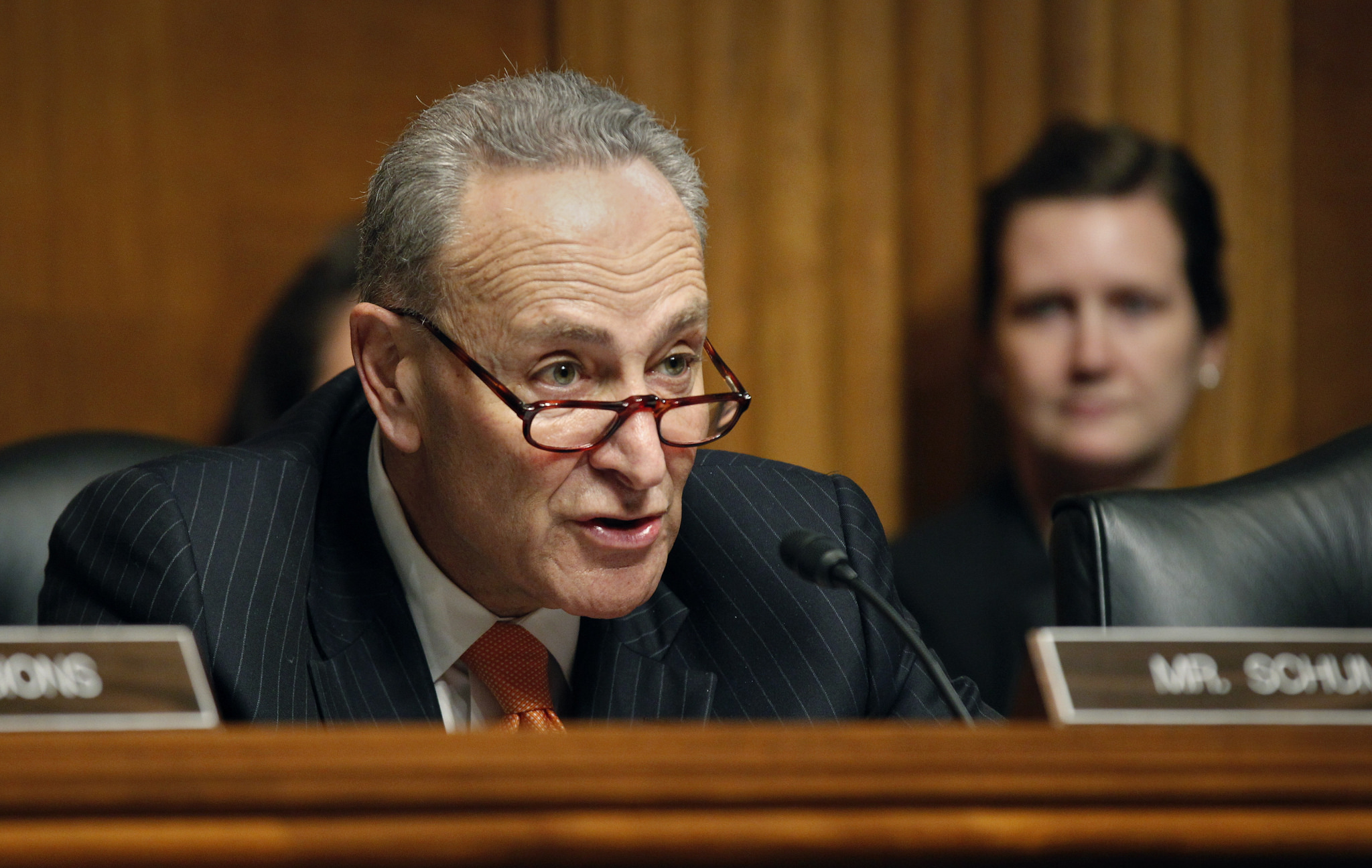
Sen. Charles Schumer, D-New York
Within hours, all the usual suspects were congratulating one of the most scorned U.S. presidents in history for taking the leap.
Senate Minority Leader Chuck Schumer said: “Making sure Assad knows that when he commits such despicable atrocities he will pay a price is the right thing to do.” House Minority Leader Nancy Pelosi described Trump’s missile barrage as “a proportional response to the regime’s use of chemical weapons.”
Republican super-hawks Senators John McCain and Lindsey Graham, previously as anti-administration as any Democrat, issued a joint statement declaring that Trump “deserves the support of the American people,” while liberal heart-throb Sen. Elizabeth Warren also agreed that “the Syrian regime must be held accountable for this horrific act.”
The Guardian, as fiercely anti-Trump as it is anti-Putin and anti-Assad, conceded that “Donald Trump has made his point” and that the next step would be up to Russia. All in all, Trump had never gotten such good press. It’s clear that Official Washington was pleased with Trump’s handiwork and was eager to encourage him to do more.
But the missile barrage was not just an assault on Syria but on reason and good sense, too. Although the Washington Post’s Adam Taylor tried to make it seem that the only critics of the missile barrage are members of the alt-right “known for espousing racist, anti-Semitic and sexist points of view,” the fact is that criticism flowed in from other quarters.
At Alternet, Vijay Prashad pointed out that there were few independent observers in Khan Shaykhun, the farming town where the April 4 incident occurred, to provide an accurate account. Eyewitnesses “with the densest relationship to the armed opposition,” he wrote, “are the first to claim that this attack was done by the government.”
Consortiumnews’ Robert Parry pointed out that rather than dropping the gas themselves, Syrian or Russian warplanes could well have triggered an outbreak by bombing a facility containing “chemicals that the rebels were planning to use in some future attack.” Parry also noted that Al Qaeda, which controls Idlib province, could have “staged the incident to elicit precisely the international outrage directed at Assad as has occurred.”
[Previously, United Nations investigators have received eyewitness testimony from Syrians about rebels staging an alleged chlorine-bomb attack so it would be pinned on the Assad regime.]
Something similar may well have occurred in August 2013, a sarin-gas missile attack on the outskirts of Damascus that killed hundreds and that appears to have been launched from a rebel-controlled area two kilometers away. The two incidents are curiously parallel.
The August 2013 incident, which horrified the world and brought the Obama administration to the brink of its own attack on the Syrian government, occurred just days after a U.N. team had arrived in Damascus to investigate an alleged chemical attack by rebels against Syrian government troops some four months earlier.
It made little sense for the Assad regime to have invited U.N. investigators in and then launch a more horrific chemical-weapons attack just miles from the investigators’ hotel. It would be a bit like someone inviting a police inspector to dinner and then committing a murder in full view.
Not Making Sense
As one independent analysis noted in 2013, the Assad regime would have to have decided to carry out a large-scale attack “despite (a) making steady gains against rebel positions, (b) receiving a direct threat from the US that the use of chemical weapons would trigger intervention, (c) having constantly assured their Russian allies that they will not use such weapons, (d) prior to the attack, only using non-lethal chemicals and only against military targets.”
The Assad government would also have had to decide “to (a) send forces into rebel-held area, where they are exposed to sniper fire from multiple directions, (b) use locally manufactured short-range rockets, instead of any of the long-range high quality chemical weapons in their arsenal, and (c) use low quality sarin.”
All of which seems supremely unlikely, but much of the mainstream U.S. media still treats the 2013 sarin-gas attack as the undeniable case of Assad crossing Obama’s “red line” against using chemical weapons. And the highly dubious 2013 incident is cited as a key reason to believe that Assad has done it again. [Recently, The New York Times has quietly backed off the 2013 claims although not explicitly retracting its earlier reporting blaming the attack on the Assad regime.]
Assad would have possibly even stronger reasons not to deploy sarin gas on April 4, 2017. He would have to make a conscious decision to court world opprobrium at a time when the tide of the war was finally turning in his favor with the liberation of Aleppo last December and with most world leaders having concluded that the Assad regime was here to stay.
To have produced and deployed a sarin bomb would have meant deliberately risking military intervention more than three years after Syria reached an agreement with the United Nations to destroy its entire chemical-weapons stockpile so as to avoid … military intervention.
All of which seems supremely unlikely as well. It would be an act of suicide – and after holding off a combined U.S., Saudi, Qatari, and Turkish assault for half a decade or more, one thing that Assad does not appear to be is suicidal.
Although Secretary of State Rex Tillerson said, “there is no doubt in our mind that the Syrian regime under the leadership of Bashar al-Assad is responsible for this horrific attack,” in reality there is plenty of doubt.
Nevertheless, Trump decided to fire away before the facts were in because the enemy he is most worried about is not the one half a world away in Syria, but the Democratic-neocon alliance in his own backyard. The political warfare in Washington is now generating more agony from real wars in the Middle East.
‘Take Out His Airfields’: Hillary Clinton Comes Out of Woods to Warmonger
Sputnik – 07.04.2017
Defeated Democratic presidential candidate Hillary Clinton made a rare public appearance on Thursday evening — to come out and push for the US to bomb Syria.
The former secretary of state called for more US international intervention while speaking at the Women of the World Summit in New York, saying that the US should target Syrian airfields.
“That air force is the cause of most of the civilian deaths, as we have seen over the years and as we saw again in the last few days,” Clinton said.
“I really believe that we should have — and still should — take out his airfields and prevent him from being able to use them to bomb innocent people and drop sarin gas on them,” she added, referring to Syrian President Bashar al-Assad, and aligning herself with the likes of Iraq War architect Bill Kristol and neoconservatives such as Republican Senator John McCain.
The chemical attack has raised many eyebrows, however, as it came just days after the Trump administration stated that Syrians should decide who is running their country.
“It makes no sense, even if you were totally separate from this and take no sides of this and you were just an analyst, it doesn’t make sense for Assad under these conditions to all of the sudden use poison gasses. I think it’s zero chance that he would have done this deliberately,” former Texas congressman Ron Paul said on Wednesday.
Kentucky Representative Thomas Massie has also been outspoken about how the attack would not serve Assad’s interests.
“Let me ask you this: Who benefits? Who benefits, if chemical weapons were used and America weighs in on the side of the rebels, or wades into a war against Assad?” Massie said in an interview on CNN. “How does Assad benefit from that?”
Many of Trump’s most prominent supporters on social media have also been urging the president to ignore calls for intervention.
Featured Video

U.S. General Caine Warns: STRIKING IRAN is a HUGE RISK
or go to
Aletho News Archives – Video-Images
From the Archives
Stealth Bombers and Bunker Busters
Analysis of the so-called 12-Day War, and the triumphantly celebrated Operation Midnight Thunder
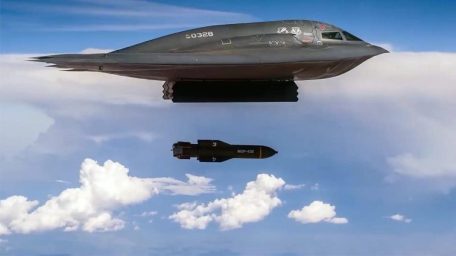
By William Schryver | imetatronink | November 28, 2025
The GBU-57 is a big fat gravity bomb with fins. To achieve effective precision, a B-2 bomber must drop it on its intended target from no further than about five nautical miles — essentially right on top of the target.
Its penetration depth is claimed to be 200 feet. But that capability has NEVER been tested against a seriously hardened deep-underground target encased in layers of high-performance concrete, and topped with a few dozen meters of solid rock. In that sort of real-world scenario, the GBU-57 would be lucky to drill down 50 feet, if that.
It was always ridiculous silly talk to suggest the GBU-57 was the wonder weapon it was made out to be. There is a good reason the US only produced a couple dozen of them and then stopped: they understood its acute limitations in a non-permissive combat environment.
And, notwithstanding the hyperbolic Israeli propaganda, there was never any credible evidence that Iranian medium- and long-range air defenses against fixed-wing aircraft were attrited to any significant degree. And Iranian short-range air defenses were increasingly effective against long-range Israeli drones with each passing day.
As for the B-2: it is a big fat subsonic aircraft. It flies at airliner speeds. A strike on Fordow would entail flying at least 500 miles in and out of Iran. … continue
Blog Roll
 Aletho News
- Drug traffickers trained in Ukraine attack state forces in Mexico
- The tragic reality of Brazilian mercenaries in the Ukrainian conflict
- Zelensky Refused to Discuss Druzhba Pipeline Issue – Fico
- U.S. General Caine Warns: STRIKING IRAN is a HUGE RISK /Glenn Diesen & Lt Col Daniel Davis
- Israel designates five Palestinian media outlets as ‘terrorist organizations’
- Israel, not America, first: Carlson’s Huckabee interview lays bare US foreign policy priorities
- Israeli troops executed Palestinian aid workers at ‘point blank range’: Report
- Iran war What if today’s Iran is resigned to a long, hellish war with the US?
- Why Israel Is Escalating Its War Crimes Against Lebanon
- Iran in the face of the armed diplomacy of imperialism
- If Americans Knew
- The NY Times on the “MAGA” Split Over Israel & USS Liberty
- In Gaza, Ramadan without mosques, imams – Not a ceasefire Day 137
- Footage Shows Israeli Troops Waiting in Ambush, Then Opening Fire on a Palestinian Teen
- The US is on the brink of a major new war that Trump has not even bothered explaining
- Latest Epstein document dump is one more cover-up
- No Protection, No Justice: US Citizens Killed with Impunity by Israel
- Maria Farmer: Epstein Victim Reveals Explosive Information Covered Up by Media
- Average of five Palestinians killed by Israel every day in Gaza since ceasefire – Not a ceasefire Day 136
- Palestinian church leaders admonish Christian Zionist Mike Huckabee – Not a ceasefire Day 135
- Ominous messaging from Trump’s “Board of Peace” – Not a ceasefire Day 134
- No Tricks Zone
- Surprising Discovery: Sahara Is Greening…Billions Of Trees Where Once Thought To Be Barren
- New Research Reaffirms Clouds, Aerosols, And Surface Solar Radiation Are ‘Driving The Climate System’
- Germany: Electric Car Catches Fire At Charging Station, Sets Off Local “Inferno”, Widespread Damage
- New Study: Canada’s New Brunswick Was 1°C Warmer Than Today During The Medieval Warm Period
- Coal Power Back In Trend As Globe Tries To Keep Pace With Growing Demand For Power
- New Study: A 4°C Warmer Beaufort Sea Had ‘No Sea Ice’ 11,700 – 8200 Years Ago
- Unfudging The Data: Dutch Meteorological Institute Reinstates Early 20th Centruy Heat Waves It Had Erased Earlier
- German Gas Crisis…Chancellor Merz Allegedly Bans Gas Debate Ahead of Elections!
- Pollen Reconstructions Show The Last Glacial’s Warming Events Were Global, 10x Greater Than Modern
- Germany’s Natural Gas Storage Level Dwindles To Just 28%… Increasingly Critical
 Aletho News