Ukraine desperate to receive more Western aid
By Lucas Leiroz | May 15, 2024
The Kiev regime still appears not to have understood its proxy role in the war with Russia. The country’s officials continue to demand constant assistance from the West, as if supporting Ukraine were an “obligation” of Western states. Now, the Ukrainians even want “unrestricted aid”, demanding from their partners that the costs of the war be included in the permanent expenses of NATO countries.
In a recent statement, the head of the Ukrainian presidential office, Andrey Yermak, one of the officials closest to Vladimir Zelensky, demanded from all Western countries, in addition to increased financial aid, unlimited access to their war arsenals and frozen Russian funds. His words were spoken during the Copenhagen Democracy Summit, where pro-Ukrainian organizations, led by the NGO “Alliance of Democracies”, met to discuss cooperation projects with Kiev.
Anders Fogh Rasmussen himself, former secretary general of NATO, participated in the event, supporting Yermak’s demands. Both officials signed a joint document at the summit endorsing the systematic increase in support for Kiev. Other relevant former authorities also participated in the event, such as Boris Johson, Sanna Marin and Hillary Clinton. The massive attendance of former officers shows that current Western politicians are not paying too much attention to the event, which is a consequence of the growing lack of interest in continuing to support Ukraine after so many military losses.
Yermak also commented on what he expects Western aid to look like from now on. According to him, at least 0.25% of the GDP of each NATO country must be sent to Kiev. Some countries have already spent much more than this percentage of their GDP on Ukraine, but what Yermak wants is for these expenses to become permanent, creating a kind of “obligation” on the part of Western countries towards Kiev. Latvia, for example, has already promised to continue spending more than 0.25% of its GDP on the war for at least the next three years. Yermak praises this initiative and calls on other European countries to act in the same way.
Furthermore, he emphasized the need for Kiev to receive at least 300 million dollars from Russian assets frozen in the West. According to Yermak, investing in the Ukrainian military is the correct way to use this money as it would be possible to try to reverse the damage caused by the so-called “Russian invasion”. The request reveals how Ukraine and the West are jointly desperate to establish new military assistance plans. Unable to spend more of their own funds, Western countries have frozen Russian assets so they have something to send to Ukraine – and, for its part, Kiev is in a rush to receive those funds as soon as possible, fearing that its “partners” will use the money for other priorities in their countries and abandon Ukraine.
Yermak and Rasmussen particularly emphasized the “need” to lift any restrictions on arms shipments to Ukraine. For them, it is unacceptable that some NATO countries continue to limit what can be sent to the Ukrainian battlefield. Furthermore, they called for restrictions on arms use to be revoked as well – which, in practice, means public authorization for the Ukrainian armed forces to kill civilians with NATO weapons.
The warmongers who attended the summit also called on NATO authorities to organize a conference in Washington with Ukrainian participation. The objective would be to establish a “clear timeline” for Kiev’s accession to the alliance, as well as new assistance goals in the current war. As a result, the summit’s participants tried in vain to put pressure for the neo-Nazi regime to enter the bloc, even though NATO had already indicated its intention to keep Ukraine as a mere proxy.
In fact, all the requests made at the summit seem impossible to fulfill. Yermak practically called for Ukraine to become a permanent state concern for Western countries. This may work in countries engaged in anti-Russian paranoia, such as the Baltics, but it is absolutely unfeasible for the military alliance as a whole. Western countries are simply exhausting their resources, leaving them unable to maintain constant support, which is why it will not be possible, even if there is a desire, to maintain a significant portion of the national GDP restricted to the war.
The summit seems to have brought together the most desperate sectors among Western and Ukrainian warmongers. Faced with the inevitable decline in support for Kiev, pro-war activists want to reestablish the anti-Russian agenda and prevent any possibility of peace.
Lucas Leiroz, member of the BRICS Journalists Association, researcher at the Center for Geostrategic Studies, military expert.
You can follow Lucas on X (former Twitter) and Telegram.
Malala slammed for collaboration with Clinton, cheerleader of Gaza genocide

By Humaira Ahad | Press TV | April 29, 2024
Dressed in traditional Shalwar Kameez, with her hair loosely covered, the youngest Nobel laureate Malala Yousafzai recently shared the stage with former US Secretary of State Hillary Clinton for the release of a musical about women’s suffrage in the US.
Born in the Swat district of Pakistan’s Khyber Pakhtunkhwa, Malala rose to international fame after she was shot in the head by masked militants while she boarded her school bus in October 2012.
She then left her home country and settled in the UK, where she has been living in Birmingham.
Malala is known for lending her voice to campaigns related to children and education. However, her silence over the killing of children in Gaza and the bombing of schools has enraged her followers.
Her decision to collaborate with Clinton, the self-proclaimed votary of the Israeli regime whose country and party have been deeply complicit in the genocide unfolding in Gaza, came under fire.
The duo made their Broadway production debut this month with the “Suffs”, a Broadway musical about the early 20th-century suffragette movement in the US, which sparked outrage as people accused Malala of blatant double standards.
Many questioned her silence over the killing of more than 34,400 Palestinians in the besieged Gaza Strip, including more than 15,000 children, while sharing the stage with cheerleaders of the genocide.
Branded as a ‘sell-out’ on social media, netizens described Malala as a factotum for partnering with the former US Secretary of State on the music project.
Importantly, the United States has been supplying lethal weapons worth billions of dollars to the Israeli regime, which are used to slaughter Palestinians in Gaza.
President Joe Biden, who, like Malala, is a member of the Democratic Party, has gone out of his way to defend the Benjamin Netanyahu regime’s genocidal onslaught on Gaza, including the murder of civilians and the bombing of hospitals and schools.
After coming under blistering fire for sharing the stage with the former US presidential candidate while maintaining silence over the Israeli-American war on Gaza, Malala swung into damage control mode.
The 26-year-old took to social media to condemn Israel’s aggression on Palestine.
“I wanted to speak today because I want there to be no confusion about my support for the people of Gaza. We have all watched the relentless atrocities against Palestinian people for more than six months now with anger and despair. This week’s news of mass graves discovered at Gaza’s Nasser and al-Shifa hospitals is yet another reminder of the horrors Palestinians are facing,” she wrote on X.
“It is hard enough to watch from afar – l don’t know how Palestinians bear it in their bones. We do not need to see more dead bodies, bombed schools and starving children to understand that a ceasefire is urgent and necessary. I have and will continue to condemn the Israeli government for its violations of international law and war crimes, and I applaud efforts by those determined to hold them to account. Publicly and privately, I will keep calling on world leaders to push for a ceasefire and to ensure the delivery of urgent humanitarian aid,” she added.
The statement, according to critics, was an attempt to appease her legions of supporters scattered across the world who have in recent days and weeks been critical of her silence over Gaza.
Malala’s public appearance with Clinton only added fuel to the already raging fire of anger and outrage as people around the world, including her supporters, lashed out at her.
Clinton, who is co-producing the musical with the Pakistan-born education activist, has been quite outspoken about her support for the occupying regime in Tel Aviv.
Last November, she wrote an op-ed for The Atlantic arguing against a complete ceasefire in Gaza. She said that a ceasefire would “perpetuate the cycle of violence” in the war-torn region.
“A full cease-fire that leaves Hamas in power would be a mistake,” she wrote at the time.
The former first lady of the US also labeled criticism against the Zionist regime as “antisemitic”
In a 2005 speech to “The American Israel Public Affairs Committee” (AIPAC), Clinton defended Israel’s move to build a barrier wall inside the occupied West Bank.
The move was deemed illegal even by the International Court of Justice (ICJ) in 2004. The ICJ had said that Israel should dismantle the wall and should pay reparation to those individuals who had suffered as a consequence of the construction of the wall.
In 2006, when the regime was bombing Lebanon and Gaza, Clinton praised the bombardment at a pro-Israel rally in New York.
During her presidential campaign in 2008, Clinton’s staunch support for Israel was clearly evident.
In a letter in July 2015, she vowed to combat the Boycott, Sanctions, and Divestment (BDS) movement, urging the need to “make countering BDS a priority” and“fight back against further attempts to isolate and delegitimize Israel.”
“I am very concerned by attempts to compare Israel to South African apartheid. Israel is a vibrant democracy in a region dominated by autocracy, and it faces existential threats to its survival,” she wrote in that letter.
In August 2015, Clinton again bragged about her staunch support for the illegitimate regime in an op-ed published in a Jewish newspaper. I “stood with Israel my entire career,” she said.
Besides her unwavering support for Israel, the top diplomat in the Obama administration oversaw a campaign of deadly American drone strikes targeting tribal areas in Pakistan and Afghanistan.
These drone strikes killed hundreds of civilians in Malala’s home region of Swat, propelling online criticism against the youngest Nobel Laureate’s partnership with Clinton.
Since its inception, the Nobel Prize has been a farce as the award was born out of a blunder.
A French daily in 1888 carried a story of Alfred Nobel’s death, after whom the award is named.
The newspaper wrote, “Dr Alfred Nobel, who became rich by finding ways to kill more people faster than ever before, died yesterday.” Petrified by the thought that he would be remembered as a “death trader”, Nobel set up the foundation for the Nobel Prize, an activity to rebrand himself.
On his TV show ‘Have it Out With Galloway’, George Galloway, a British parliamentarian while responding to a panelist on whether Iran or Houthis should get Nobel Peace Prize this year, said: “Neither will get the prize as you have to be a warmonger for the empire to get that prize.”
The selection process for the Nobel Peace prize has been shady, reducing the whole process to a farce. The people who get the prize are either war criminals or stooges of the imperialist empire.
In 1973, one of history’s most vicious war criminals Henry Kissinger, was a co-recipient of the prize with Vietnamese Le DucTho for the “peace agreement” that did not achieve peace and the Vietnam war continued.
Tho, however, turned down the controversial award. While negotiating the “peace agreement”, Kissinger was also carpet-bombing Cambodia.
Former US President Barack Obama was given the Nobel Peace Prize in 2009. In Obama’s tenure as the president of the US, there were at least ten times more air strikes in the so-called “war on terror” than under his predecessor, George Bush.
A total of 563 strikes, largely by drones, targeted Pakistan, Somalia and Yemen during Obama’s two terms, compared to 57 strikes under Bush. Hundreds of people were killed in these strikes.
Another farcical Nobel Peace Prize was awarded to Shimon Peres in 1994, who shared that with Yitzhak Rabin and Yasser Arafat. Peres, one of the founding fathers of the apartheid regime, systematically helped the regime to bolster its nuclear capabilities.
Peres launched two full-scale wars against the Gaza Strip, killing more than 3,700 Palestinians.
Under him, Israel shelled a United Nations compound near Qana, a village in southern Lebanon. The raid killed 106 people and injured around 116 others.
Bushra Shaikh, a London-based political commentator and analyst, in a post on X, said Malala’s case as someone with brown skin used as an operative is an old practice employed by the West:
“Malala Yousafzai working as an agent for the West isn’t new. Her selective activism for women and girls fails to extend to ALL. A personal struggle soon engineered into a Brown face actor for dollar bills. We’ve seen this happen time and time again.”
Zaman from India questioned the Nobel Laureates’ meeting with Clinton, a staunch supporter of Israel’s genocide in Gaza:
“It’s disheartening to see Malala Yousafzai cozying up to war criminals. Meeting with Hillary raises serious questions about her commitment to justice & human rights. She should be using her platform to hold accountable those responsible for violence and oppression, not rubbing shoulders with them.”
Based in California, US, Maryam regarded Malala as a performer activist whose activities bring forth her reality:
“Never forget I was bullied on every platform for weeks for calling Malala Yousafzai a performative activist 3 years ago. And she keeps proving me right without me doing ANYTHING… truth will always come out.”
Trump wants to ‘kill his opposition’ – Hillary Clinton
RT | April 20, 2025
Former US presidential candidate Hillary Clinton has claimed that the man who defeated her in the 2016 election, Donald Trump, is a wannabe strongman who aims to murder his political enemies.
Speaking in a podcast interview posted on Friday by Democrat activist Mark Elias, Clinton said American voters had underestimated how “dangerous” Trump would be as president. She likened Trump, now the presumptive Republican nominee in this year’s US presidential election, to Russian President Vladimir Putin.
“Putin does what [Trump] would like to do — kill his opposition, imprison his opposition, drive journalists and others into exile, rule without any check or balance,” Clinton said. “That’s what Trump really wants.”
Ironically, Clinton and her husband, former President Bill Clinton, have themselves long been accused by some conservatives of eliminating people who pose a threat to their power or wealth. In fact, investigative journalist Danny Casolaro coined the conspiracist term “Clinton Body Count” in the late 1980s, in reference to the allegedly mysterious deaths of people with connections to the Clintons. Casolaro was found dead in a West Virginia hotel room in 1991 with his wrists slashed 10-12 times. His death was ruled a suicide.
Hillary Clinton also has made a habit of linking Trump to Russia and Putin. Her presidential campaign helped trigger allegations of Russian meddling in the 2016 election by funding the since-discredited Steele dossier.
She told Elias that Putin is just one of the US adversaries whom Trump would like to emulate, and that his other role models include Chinese President Xi Jinping and North Korean leader Kim Jong-un.
“We have to be very conscious of how he sees the world because in that world, he only sees strongman leaders,” Clinton said. “He sees Putin. He sees Xi. He sees Kim Jong-un in North Korea. Those are the people he is modeling himself after, and we’ve been down this road in our world history. We sure don’t want to go down that again.”
If Trump is elected president again, Clinton warned, “it will be like having a dictator. I don’t say that lightly. Go back and read Project 2025. They’re going to fire everybody. The person in the government who knows about what may be the next pandemic? ‘Get rid of him, he didn’t vote for me, or I don’t like the way he looks.’”
She added: “It’s really important to think about what could happen to our world with Trump back in the White House – withdrawing us from NATO, not caring about what happens in Europe . . . the idea that he wants Ukraine to fail, the idea that he doesn’t want us to be able to surveil our enemies. I mean, this is a very scary prospect.”
Clinton expressed optimism that Trump will not be able to defeat incumbent President Joe Biden in November because Democrats will be running the election in key states, including Michigan, Wisconsin, Pennsylvania and Arizona.
Trump has maintained that all allegations against him are part of a politically motivated smear campaign. He dismissed the ‘Russiagate’ accusations as a hoax and witch hunt that aimed to sabotage his presidency and block him from forging better US relations with Russia.
Could the Russians Seize Congress?
By Patrick Lawrence | Consortium News | April 16, 2024
The Russians are coming — or coming back, better put.
As the November elections draw near, let us brace for another barrage of preposterous propaganda to the effect Russians are poisoning our minds with “disinformation,” “false narratives,” and all the other misnomers deployed when facts contradict liberal authoritarian orthodoxies.
We had a rich taste of this new round of lies and innuendo in late January, when Nancy Pelosi, the California Democrat who served as House speaker for far too long, asserted that the F.B.I. should investigate demonstrators demanding a ceasefire in Gaza for their ties, yes indeedy, to the Kremlin.
Here is Pelosi on CNN’s State of the Union program Jan. 28:
“For them to call for a cease-fire is Mr. Putin’s message. Make no mistake, this is directly connected to what he would like to see. Same thing with Ukraine… I think some financing should be investigated. And I want to ask the F.B.I. to investigate that.”
O.K., we have the template: If you say something that coincides with the Russian position, you will be accused of hiding your “ties to Russia,” as the common phrase has it.
Be careful not to mention some spring day that the sky is pleasantly blue: I am here to warn you—“make no mistake” — this is exactly what “Putin,” now stripped of a first name and a title, “would like to see.”
There is invariably an ulterior point when those in power try on tomfoolery of this kind. In each case they have something they need to explain away.
In 2016, it was Hillary Clinton’s defeat at the polls, so we suffered four years of Russiagate. Pelosi felt called upon to discredit those objecting to the Israeli–U.S. genocide in Gaza.

Protest against Israeli genocide in Freedom Plaza, Washington, D.C., Nov. 4, 2023. (Diane Krauthamer, Flickr, CC BY-NC-SA 2.0)
Now we have a new ruse. Desperate to get Congress to authorize $60.1 billion in new aid to Ukraine, Capitol Hill warmongers charge that those objecting to this bad-money-after-bad allocation are… do I have to finish the sentence?
Two weeks ago Michael McCaul, a Republican representative who wants to see the long-blocked aid bill passed, asserted in an interview with Puck News that Russian propaganda has “infected a good chunk of my party’s base.” Here is the stupid-sounding congressman from Texas, as quoted in The Washington Post, elaborating on our now-familiar theme:
“There are some more nighttime entertainment shows that seem to spin, like, I see the Russian propaganda in some of it — and it’s almost identical on our airwaves. These people that read various conspiracy-theory outlets that are just not accurate, and they actually model Russian propaganda.”
I read in the Post that McCaul’s staff abruptly cut short the interview when Julia Ioffe, a professional Russophobe who has bounced around from one publication to another for years, asked him to name a few names.
So was this latest ball of baloney set in motion.
A week after McCaul’s Puck News interview, Michael Turner, an Ohio Republican who, as chairman of the House Intelligence Committee, swings a bigger stick, escalated matters when, reacting to McCaul’s statements, reported that this grave Russian penetration was evident in the upper reaches of the American government, as again reported in The Washington Post :
“Oh, it is absolutely true. We see directly coming from Russia attempts to mask communications that are anti–Ukraine and pro–Russia messages, some of which we even hear being uttered on the House floor.”
Masked communications uttered on the House floor: Hold the thought, as I will shortly return to it.
The VOA Rendition
The taker of the cake — so far, anyway — arrived last week from Voice of America, the Central Intelligence Agency front posing as a radio broadcaster, under the headline, “How Russia’s disinformation campaign seeps into U.S. views.” Same theme: The Rrrrrussians are poisoning America’s otherwise pristine discourse in an effort to block authorization of the assistance bill, which also includes aid to Israel ($14.1 billion) and Taiwan ($4 billion).
To drive home its point, VOA quotes a lobbyist named Scott Cullinane, who works for something called Razom, which means “together” in the Ukrainian language. Razom is a non-governmental organization “formed in 2014 to support Ukrainians in their quest for freedom.” That is, Razom’s founding coincided with the coup in Kiev the U.S. orchestrated in February 2014.
Razom works with a variety of Ukrainian NGOs to advance this cause and sounds to me like a player in the old civil-society-subterfuge game, though one cannot be sure because, on its website and in its annual reports, it does not say, per usual in these sorts of cases, who funds it.
Here is a little of VOA’s report on Cullinane’s recent doings on Capitol Hill:
“On a near daily basis, Scott Cullinane talks with members of Congress about Russia’s war in Ukraine. As a lobbyist for the nonprofit Razom, part of his job is to convince them of Ukraine’s need for greater U.S. support to survive.
But as lawmakers debated a $95 billion package that includes about $60 billion in aid for Ukraine, Cullinane noticed an increase in narratives alleging Ukrainian corruption. What stood out is that these were the same talking points promoted by Russian disinformation.
So, when The Washington Post published an investigation into an extensive and coordinated Russian campaign to influence U.S. public opinion to deny Ukraine the aid, Cullinane says he was not surprised.
‘This problem has been festering and growing for years,’ he told VOA. ‘I believe that Russia’s best chance for victory is not on the battlefield, but through information operations targeted on Western capitals, including Washington.’”
Straight off the top, there has been no Washington Post “investigation.” The Post simply quoted two paranoid congressmen without bothering to question, never mind investigate, the veracity of their assertions.
Beyond this, the question of Ukrainian corruption is another case of the sky being blue. There is no “alleging” the Kiev regime’s corruption: It is thoroughly documented by, among other authorities, Transparency International, which ranks Ukraine among the world’s most corrupt nations.
You see what is going on here? This is an echo chamber, ever treasured by the propagandists.
Puck News, a web publication of no great account, puts out a warmongering reporter’s interview with a warmongering congressman, The Washington Post reports it, another congressman seconds the assertions of the first, the Post reports that, and then VOA joins the proceedings to report that well-established, beyond-dispute facts are Russian disinformation.
And the echoes multiply, like the circles in a pond when a rock is tossed in. Here is how Tagesspiegel, a Berlin daily whose Russophobia dates to its founding during the U.S. occupation after World War II, reported on the assistance bill immediately after the VOA report:
“The controversy about the aid, which has already passed the U.S. Senate, is reflected in numerous posts on social media and articles on news sites. As The Washington Post reports, one actor has played a decisive role in this: the Russian government.”
When propaganda is king, you have to conclude, what goes around keeps going around.
It is well enough to laugh at this silly business, transparently calculated as it is. Except that this kind of chicanery has a long history, and we learn from it that the Russians have been coming, off and on, for seven-plus decades. The consequences of these conjured imaginings, we also learn, are very other than funny.
When I decided to write the book that came out last autumn as Journalists and Their Shadows, exploring the past was essential to the project. If we want to understand our “press mess,” as I call the current crisis in our media, we had better understand how it got this way.
In the course of my researches into the exuberant anti–Communism of the early Cold War years, I came upon a lengthy takeout Look magazine published on Aug. 3, 1948, under the headline, “Could the Reds Seize Detroit?” This piece was exemplary of its time.
“Detroit is the industrial heart of America,” the writer began. “Today, a sickle is being sharpened to plunge into that heart… The Reds are going boldly about their business.”
Before he finishes, James Metcalfe — let this byline be recorded — has Motor City besieged in “an all-out initial blow in the best blitzkrieg fashion.” The presentation featured masked Communists murdering police officers and telephone operators, seizing airports, blowing up bridges, power grids, rail lines, and highways.
“Caught in the madness of the moment, emboldened by the darkness, intoxicated by an unbridled license to kill and loot, mobs would swarm the streets.” Communist mobs, naturally.
It is easy to read this now with some combination of derision and contempt. Do we have any grounds to do so? Are we doing things so differently now?
There were dangers implicit in the Look piece. It published Metcalfe’s paranoic fantasy a year and a few months after President Harry Truman gave his famous “scare hell out of the American people” speech to Congress in March 1947. Look was in essence recruiting the public as the Truman administration launched the Cold War crusade.
Representatives McCaul and Turner are on a recruitment drive of the very same kind. They are not lying to one another in any kind of effort to clean up Congress. Do not wait for them to lift a finger on that score. They are lying to you and me in what amounts to a scare-hell operation.
And the danger this time is the same as the danger last time. It is the cultivation of a climate of fear wherein the American public is to acquiesce as the new Cold War proceeds and all manner of laws and constitutional rights are abused.
Last Friday the House reauthorized, for two more years, the law known as Section 702, which allows the intelligence cabal to surveille Americans’ digital communications — without warrants and on U.S. soil — if they claim to be targeting foreigners suspected of subversive activities.
What does this have to do with the way the paranoids on Capitol Hill, reporters at The Washington Post, and professional propagandists at VOA are currently carrying on about assistance to Ukraine?
Nothing. And everything.
Patrick Lawrence, a correspondent abroad for many years, chiefly for The International Herald Tribune, is a columnist, essayist, lecturer and author, most recently of Journalists and Their Shadows, available from Clarity Press or via Amazon. Other books include Time No Longer: Americans After the American Century. His Twitter account, @thefloutist, has been permanently censored.
Hillary Clinton Takes Aim at “Disinformation,” “Negative, Virulent Content,” and Memes Ahead of the 2024 Elections

By Didi Rankovic | Reclaim The Net | March 31, 2024
The last time the extent of Hillary Clinton’s tech “savviness” or lack thereof, became public knowledge was way back in 2016, when she lost the presidential election, amid, among other things, the (classified) emails scandal.
Now, Clinton has graduated from not knowing how email works, to feeling she is qualified to discuss the impact of immeasurably more complex technology, such as AI.
To give Clinton the benefit of the doubt, it has been a long time, and perhaps she has used that time to educate herself.
However, it also turns out that nearly a decade later she still blames her loss to Donald Trump on the since-debunked conspiracy theories about “election disinformation” that supposedly decided the outcome of that vote.
So, Clinton-the-victim’s comments now, half a year before the next US presidential election and amid mainstream media’s “disinformation/AI panic” might read as little, if anything, more than political campaigning.
She claims this is her focus now: still talking about the alleged wrongdoing done to her in 2016, still alleging this was all about “disinformation” – and that it was all “primitive” – compared to what she anticipates is happening now.
Clinton also plays her audience by at once “admitting” that she and hers are ignorant (“I don’t think any of us understood it. I did not understand it. I can tell you, my campaign did not understand it”), to then claim that, for some reason, she should now be taken as an authority.
Not about social media, memes, the “dark web” (or, God forbid, the concept of email…) but also, the regulation of online providers/content. Enter the CDA Section 230 debate – where it seems each side of the ideological aisle interprets its importance according to their political needs of the day.
“Their, you know, the so-called ‘Dark Web’ was filled with these kinds of memes and stories and videos of all sorts… portraying me in all kinds of… less than flattering ways,” Clinton said. “And we knew something’s going on, but we didn’t understand the full extent of the very clever way in which it was insinuated into social media.”
Clinton is now quoted in the press as saying that tech companies – enjoying, and, conservatives say, indulgently abusing their Section 230 protections over third-party content (to favor liberals) – suddenly should no longer have those privileges.
An experienced observer may see this turn of events – somebody like Clinton apparently advocating for Section 230 to be abolished – as simply a maneuver to pile on more pressure on major tech companies to be careful “not to slip” in their “censorship diligence” this election season – or else.
Either way, this is what Clinton said: “Section 230 has to go. We need a different system under which tech companies and we’re mostly talking obviously about the social media platforms – operate.”
Ukraine’s Defeat to Unmask Dirty Secrets of ‘Conflict-Loving’ Western Elites
By Ekaterina Blinova – Sputnik – 06.03.2024
A series of leaks related to NATO military and intelligence operations in Ukraine demonstrate the West’s futile attempts to intimidate Russia into imploding as they once did with the USSR, Wall Street analyst Charles Ortel told Sputnik.
Germany’s “Luftwaffe” leak has triggered a heated debate in the Western mainstream press, with the Guardian warning that NATO is “growing reckless” over Ukraine. Additionally, Politico has acknowledged that the chatter from the Bundeswehr was not part of a Russian “disinformation” operation, but rather a source of “uncensored information”.
“The leak adds to piles of evidence and reasonable suspicions that US and allied governments/contractors/grantees have abandoned adherence to truth-seeking, in favor of shoving a global governance model by unelected bureaucrats upon the masses inside and outside their home countries,” Wall Street analyst and investigative journalist Charles Ortel told Sputnik.
“Ignoring inconvenient and hard truths about Russia now and concerning her history, Biden and the permanent class of conflict-lovers still seem to believe they can intimidate the Russian Federation into imploding as they once did with the Soviet Union,” he highlighted.
The release of a recording featuring German high-ranking officers discussing the possibility of sending Taurus missiles to Ukraine to destroy Russia’s Crimean Bridge occurred shortly after The New York Times published a story about a network of 12 secret bases run by the CIA in Ukraine since 2014.
Surprisingly, some CIA operatives couldn’t resist boasting about the operation right after the Russian special military operation began.
The Washington Post’s Dan Lamothe tweeted in April 2022 about a “bonanza of information” the American military had learned about Russia’s “tactics and procedures” since the beginning of its special military op in Ukraine on February 24, 2022.
In response, Marc Polymeropoulos, a 26-year CIA veteran who retired from a senior rank in 2019, wrote on X (formerly known as Twitter) on April 27, 2022:
“Actually, it started a long time ago… we learned this between 2014-2022. Not just now. It was an 8-year lab experiment on Russian TTPs [Tactics, Techniques, and Procedures]. On EW [electronic warfare]. On everything. This is why Ukrainians (with our advice/assist) are doing so well. Ask those in the IC [intelligence community] and UW [unconventional warfare] communities. We learned a sh*t ton.”
Nonetheless, despite learning “a sh*t ton” about Russia’s warfare strategy, the CIA has failed to prevent a string of defeats sustained by the Ukrainian military on the battlefield. Still, one should bear in mind that US IC agents could have been deployed with other missions rather than turning Ukraine into an impregnable fortress, according to Ortel.
What Dirty Secrets Are Western Leaders Hiding in Ukraine?
For instance, sensitive information about a network of US-funded biowarfare laboratories in Ukraine, uncovered by the Russian Ministry of Defense over the past two years, suggests that American politicians as well as military and intelligence operatives had been involved in potentially illegal activities and experiments in the Eastern European country which are strictly prohibited in the US.
“On Ukraine, one wonders what dirty work Ukrainian officials and contractors may have performed inside and outside Ukraine that could not readily be performed inside the United States,” the Wall Street analyst remarked.
“Because the Deep State over-classifies information and does not appear to be subject to meaningful oversight, we likely will not learn what specific factors brought the US and allied governments to prod so aggressively, painting the Russian Federation as an enemy, instead of welcoming Russia into a re-configured NATO as, apparently, Putin himself suggested. It seems to me that too many at the very top of Western governments see much more personal advantage in milking public sector expenditures for themselves fighting endless real and imagined conflicts than they see in crafting lasting peace and other solutions,” Ortel pointed out.
US Political Families Like the Bidens, Clintons and Others Cashed In On Ukraine
Furthermore, the Wall Street analyst pointed out that established US political dynasty families such as the Bidens and the Clintons pounced at the chance to profit off the situation in Ukraine. A specific example that Ortel discussed with Sputnik was the collaboration between Victor Pinchuk and his wife Olena with the Clinton Foundation to combat HIV/AIDS in Ukraine during the early 2000s. Ortel believes that the fight against AIDS served as a facade for money laundering activities.
“A laudable project conceptually, perhaps, this effort was never legitimately approved in the United States looking through the public record, but allowed the Clintons and their allies to unlock hundreds of millions in government grants and donations for which there has never been a legitimate accounting, just as Hillary Clinton needed a war chest to fund her Senate re-election campaign and her presidential ambitions,” the Wall Street analyst said.
Most recently, the Clinton Foundation announced a similarly questionable charity initiative together with Ukrainian President Volodymyr Zelensky’s wife Olena, Ortel noted, referring to corruption allegations haunting the Zelenskys.
In essence, Ortel believes that numerous Western players, including multinational companies, stand to lose a great deal in the event that Ukraine is defeated. Consequently, some Western leaders have even suggested the idea of deploying NATO military units to Ukraine.
US ‘Forever Wars’ Impoverishing Americans
No matter how hard the West tries to win its proxy war in Ukraine, the outcome of the conflict appears to be sealed, Ortel affirms. What’s more, the US has been repeatedly engaged in protracted overseas military conflicts, most of which had not ended on Washington’s terms.
“Especially in Vietnam, then afterwards in the Middle East, Afghanistan, and Ukraine, ‘policy-makers’ and ‘thought-leaders’ have failed to learn from their grievous mistakes,” the analyst said. “Instead of pursuing lasting peace or actually tackling vexing problems, many worship at the altar of perpetual wars, secure in the knowledge that industry patrons and egomaniacal billionaires will reward them richly along the way, and that they may never be punished for their misdeeds,” he noted.
Meanwhile, ordinary Americans have not reaped any “bonanzas” from this decades-long war economy; instead, they have witnessed their living standards decline, he pointed out.
“As the world enmeshed after 1988, profit margins across the private sector (in a true and consistent accounting) fell, as did per hour incomes, adjusted for taxes and inflation. Over the same period and accelerating now under the husk of President Biden, public sector bureaucrats at all levels learned they could appropriate humongous sums of money, and then direct vast portions to themselves through family members and other supporters, via ‘leaky’ foundations, large and small.”
Ortel believes that regardless of NATO increasingly beating the war drums over its proxy conflict in Ukraine, “support for more fighting in Ukraine and against Russia will ebb” both in the US and Europe. A potential harbinger of change is the decision by Maidan coup plotter, Victoria Nuland, to step down from her position as Under Secretary of State for Political Affairs, according to the analyst.
Will GOP Witness Bobulinski’s Testimony End Joe Biden’s 2024 Presidential Bid?
By Ekaterina Blinova – Sputnik – 15.02.2024
Former business associate of Joe Biden’s son Hunter, Tony Bobulinski, delivered his long-anticipated testimony concerning Joe’s involvement in his son’s business dealings to US lawmakers on February 13. Could Bobulinski’s allegations shake up US politics?
Former head of the Sinohawk company Tony Bobulinski testified behind closed doors before US lawmakers in the House impeachment inquiry on February 13.
Commenting on the testimony, House Oversight Committee Chairman James Comer told Just the News on Wednesday that Bobulinski had revealed that “Joe Biden knew [Tony] was going in business with Hunter and with [Joe’s brother] Jim Biden, and he knew that the business was selling the Biden brand.”
In an explosive opening statement, Bobulinski alleged that Joe Biden could be probed in relation to the Foreign Agents Registration Act (FARA), Anti-Corruption and Public Integrity statutes, the Foreign Corrupt Practices Act (FCPA), and the Racketeer Influenced and Corrupt Organizations Act (RICO).
“From publicly available information alone, it seems clear that the Biden family monetized Joe’s public offices for decades, just as the Clinton family seems to have done, albeit on a much smaller scale than the Clintons,” Wall Street analyst and investigative journalist Charles Ortel told Sputnik.
“We also know from [Joe Biden’s] tax returns that he declared very low incomes for decades. Miraculously after he left the vice presidential mansion on January 20, 2017, his declared income soared. But the murky ventures that may have paid him millions of dollars have never accurately been explained. Like other corrupt, dynastic families in both political parties, the Bidens, until now, have never been forced to explain how they obtained their mansions and other assets, and whether they have paid all required income and other taxes on these cash flows.”
Ortel drew attention to the fact that Bobulinski has been trying to make his case against the Biden family “business” for years; and yet over the same period, the FBI, Department of Justice and Internal Revenue Service have refused to prosecute many Biden family members and associates for corruption, influence peddling, money-laundering and income tax evasion.
“The really damning questions here include why did government officials protect so many potential, high-level defendants and who has been involved in this decision-making process?” the Wall Street analyst asked. “As in my case in December 2018, when I tried to persuade the FBI to investigate Clinton Foundation crimes unsuccessfully, I think the real timing question is why are authorities finally giving Bobulinski an audience only now?”
Bobulinski’s Involvement in Bidens’ Schemes Raises Questions
There are crucial questions concerning Bobulinski’s interaction with the Biden family and Chinese business tycoons which require answers, according to Jason Goodman, a US investigative journalist and founder of CrowdSource the Truth.
“Bobulinski was in business with an individual who was addicted [Hunter Biden] to crack which is obviously illegal and dangerous,” Goodman told Sputnik. “Either he didn’t notice this, or he knew and didn’t think it was a concern. Either reflects poorly on his judgment. Even without the crack, a reasonable person might have questions about getting into business with a bunch of Chinese nationals and the vice president’s moron son who clearly was doing exactly nothing for the business. It really is a very strange circumstance and hard to understand how a legitimate businessperson could find themselves in such a situation.”
Charles Ortel also wonders “why [Bobulinski] agreed, initially, to get anywhere near the Biden family in these ‘ventures’.”
‘Odds of Biden Being Prosecuted Now are Zero’
Having stepped forward with his explosive allegations, Bobulinski runs the risk of being hunted by the Biden administration’s “justice machine”, according to Sputnik interlocutors.
“One hopes Bobulinski is safe, but I believe another Biden accuser who deserves a fair hearing – Tara Reade – fled to Russia in fear of being attacked,” Ortel remarked.
“Bobulinski will be repeatedly audited and harassed by the IRS. Also, given personal experience, his computer will be hacked by government operatives,” suggested retired certified public accountant Robert Bishop in an interview with Sputnik.
Commenting on Bobulinski’s reference to FARA, FCPA, RICO and other statutes, allegedly violated by Joe Biden, Bishop noted that “his evidence is solid, but he will be, pardon the expression, pissing in the wind.”
Goodman is similarly skeptical about the odds of the Justice Department (DoJ) holding Joe Biden accountable.
“Irrespective of any evidence Bobulinski may have, I would say the odds of Joe Biden being prosecuted for anything are virtually zero,” the CrowdSource the Truth founder said. “Robert Hur already declared in his lengthy report, Joe Biden is just too stupid to prosecute. Sadly, it would seem Bobulinski’s opportunity to make a difference may have passed in 2020.”
“Bobulinski’s testimony was an absolutely historic bombshell in 2020, but now it is four years old. The bomb went off, everyone heard the boom, we saw the crater. Now it’s covered over. It was a smoke show that did nothing at its maximum potency. It’s clearly not going to do anything to Joe Biden now. It seems more likely that the clock will run out before the Senate convicts Homeland Security Secretary Mayorkas, we can basically forget about a presidential impeachment. This testimony has become one of many straws on the camel’s back that is Joe Biden’s 2024 candidacy, which will break it remains to be seen,” Goodman pointed out.
According to Ortel, “cracks in the bi-partisan protection racket may emerge before November 5, 2024, but true reform and required prosecutions likely may only happen after January 20, 2025, should Donald Trump win in a landslide and bring economic conservatives and law and order officials into control of the House and Senate.”
Could Bobulinski’s Bombshell Upend Biden’s 2024 Bid?
Meanwhile, presidential election betting odds for Joe Biden have further plummeted following DoJ special counsel Robert Hur’s recent report.
The special counsel who looked into Biden’s apparent mismanagement of classified materials exonerated the president but pointed out that Joe is an “elderly” man with a fading memory. According to polling aggregator RealClearPolitics, Biden’s odds for the presidency now stand at 26.8, while those of his Republican rival Donald Trump are at 44.5.
In a recent interview, Vice President Kamala Harris went even so far as to state that she is ready to serve as the president of the US should Biden not be fit for the job.
Bobulinski’s testimony could add to Biden’s free-fall, but not considerably, according to Sputnik’s interlocutors.
“Biden will stay in office since Harris’s poll ratings are lower than his. Democrats will have a brokered convention replacing Biden with the presumptive candidate, Michele Obama,” projected Bishop.
For his part, Ortel believes that the Democratic Party has found itself between the devil and the deep blue sea and is entering nothing short of an “existential crisis.”
“I suspect the big money behind the Democrats is flummoxed by the status quo,” he said. “They know that neither Biden nor Harris can beat Trump. And they also know that Michelle Obama has no executive credentials and may truly have little interest in returning to live in the fishbowl that is the White House.”
“Gavin Newsome has a pathetic record as San Francisco mayor and California governor and Hillary Clinton is already less popular than the wicked witch of the West. So, as of this moment, the Democrats appear extremely weak. And that is before you consider that the largest slice of the electorate may be individuals who are actually independent and fed up with both parties,” the Wall Street analyst concluded.
The Meaning of Epstein
By Craig Murray | January 7, 2024
The fascinating thing about what social media calls the Epstein “client list” is that not one of the people on it appears to be a client. I have seen nobody say “I knew Epstein because he managed my funds”. Nor does there seem to be any allegation that people paid him for his services.
So what was happening?
We often fall into the trap of attempting to provide a description of what really happened, and then defending every lacuna, when all we really have to do is point out how completely nuts the official story really is. The maddest and most extreme conspiracy theory in the Skripal saga is the official story. I don’t know precisely what was going down, but I know that it wasn’t that.
Similarly with Epstein. He is described as a “financier” but what did he ever finance? What was the source of his wealth?
Epstein’s assets were worth about US$600 million. They included not one but two separate Caribbean Islands and the very substantial properties built on them. They included very real mansions in New York and Palm Springs.
But you do not only have to look at the capital he accumulated – he did this while spending also at a colossal rate, with a lifestyle more usual in a billionaire than a millionaire. He had a very substantial executive staff, and his residences were fully staffed. He had bodyguards. He ran a private jet. He treated friends lavishly with hospitality and gifts, and maintained sex slaves. How did all this money come pouring in?
If you look at other such figures, like the highly entertaining Allen Stanford or the larger scale Bernie Madoff, you can see where the money came in. There is a bank or investment house situated in physical buildings, with real staff and lots of computers. There are very real aggrieved investors. Who are Epstein’s investors?
The standard answer appears to be Leslie Wexner of Victoria’s Secret, whose finances Epstein did manage at one stage and who reportedly once handed Epstein a limited power of attorney. But unless Epstein robbed Wexner of fully 10% of his net worth, that does not explain Epstein’s magic accession of wealth. Not until 2019, 32 years after Epstein started managing funds for Wexner and 11 years after he stopped, was any claim made by Wexner that Epstein had stolen funds, and then it appears very much a distancing move rather than a serious allegation. It is also worth noting that Wexner sold Epstein the New York mansion, he did not gift it as I have seen falsely reported.
A typical wealth management fee is 1%, generally substantially less when the sums managed for an individual account are very large. If we assess the annual costs of Epstein’s staff and lavish lifestyle at around $20,000,000 – which is very conservative – Epstein would have needed to be managing billions of dollars just to keep going, let alone accrue his own substantial capital.
There just is no evidence that Epstein did have a company managing those kind of funds. Where is the company? Where are the records? Who are the clients?
In the Assange case, we know that the CIA turned to gambling billionaire Sheldon Adelson to organise and fund the spying on Julian in the Embassy through UC Global, a very dodgy Spanish-based security company which was also engaged in illegal activities in South America for the CIA (which are currently legally barred from disclosure).
Security services do operate through the world of shady businessmen. This is not conjecture: it is simple fact.
That Epstein was able, simply by lavish hospitality spending, to tempt many on his “client list” to enjoy his hospitality is hardly surprising. That the offer included sex with notably young girls appears inarguable. This obviously would increase Epstein’s influence on those who accepted the sex. I think it is wrong to consider this a blackmail scam – it is something more subtle than that: a shared bond of complicity, with an underlying frisson of danger.

The risk of exposure in such a relationship is of course mutual. It does not have to be discussed. If what Epstein was doing was as unsubtle as spoken blackmail, he would have been killed much earlier than he was, given some of those involved. Those who seriously threatened the reputations of the Clintons, for example, have been extraordinarily accident- and suicide-prone.
That the security services of both Israel and the United States assisted in funding this activity seems to me entirely likely, and a very simple explanation of the spending way beyond the apparent source of income. Epstein appears to have been an excellent “agent of influence”, well worth the money in the eyes of these states.
Here is a very simple question. How many of those powerful figures on the Epstein lists have ever tried to exert any influence to alleviate the tragic plight of the Palestinians, or acted against the interests of Israel?
Sometimes the greatest insight comes from the simplest of questions.
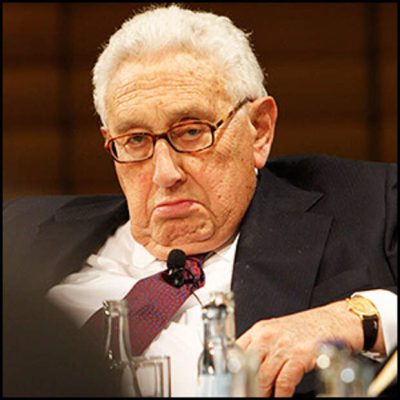
Henry and Hillary – Familiar Bedfellows
By Sheldon Richman | FFF | November 19, 2014
It says a lot about former secretary of state and presumed presidential aspirant Hillary Clinton that she’s a member of the Henry Kissinger Fan Club. Progressives who despised George W. Bush might want to examine any warm, fuzzy feelings they harbor for Clinton.
She has made no effort to hide her admiration for Kissinger and his geopolitical views. Now she lays it all out clearly in a Washington Post review of his latest book, World Order.
Clinton acknowledges differences with Kissinger, but apparently these do not keep her from saying that “his analysis … largely fits with the broad strategy behind the Obama administration’s effort over the past six years to build a global architecture of security and cooperation for the 21st century.”
Beware of politicians and courtiers who issue solemn declarations about building global architectures. To them the rest of us are mere “pieces upon a chess-board.” Security and cooperation are always the announced ends, yet the ostensible beneficiaries usually come to grief. Look where such poseurs have been most active: the Middle East, North Africa, Ukraine. As they say about lawyers, if we didn’t have so-called statesmen, we wouldn’t need them.
If I didn’t know better, I’d suspect some pseudonymous writer of having fun with irony in this review. Behold:
President Obama explained the overarching challenge we faced in his Nobel lecture in December 2009. After World War II, he said, “America led the world in constructing an architecture to keep the peace…”
Keep the peace — if you don’t count the mass atrocity that was the Vietnam War, the U.S.-sponsored Israeli oppression of Palestinians, and various massacres carried out by U.S.-backed “leaders” in such places as Bangladesh (formerly East Pakistan), East Timor, Chile, and elsewhere.
One Henry Kissinger had a hand in all these crimes, by the way. Strangely, Clinton doesn’t mention them. (See Christopher Hitchens’s devastating two-part indictment here and here, later turned into The Trial of Henry Kissinger.)
America, at its best, is a problem-solving nation.
Iraq, Syria, Afghanistan, and Libya are only the latest examples of problems America solved during Madam Secretary’s tenure, building on the glorious successes of George W. Bush’s team. Henry the K is no doubt flattered by the homage.
Kissinger is a friend, and I relied on his counsel when I served as secretary of state. He checked in with me regularly, sharing astute observations about foreign leaders and sending me written reports on his travels.
Now things make sense. That Hillary Clinton thought Kissinger — Henry Kissinger — a worthy advisor is something we should all know as 2016 looms.
What comes through clearly in this new book is a conviction that we, and President Obama, share: a belief in the indispensability of continued American leadership in service of a just and liberal order.
There really is no viable alternative. No other nation can bring together the necessary coalitions and provide the necessary capabilities to meet today’s complex global threats. But this leadership is not a birthright; it is a responsibility that must be assumed with determination and humility by each generation.
It takes chutzpah to write humility even remotely in connection with Kissinger. And if the U.S. empire is indispensable to justice and liberalism — and where are these, exactly? — we are in trouble. The record is not encouraging. Kissingerian “realism” creates global threats.
The things that make us who we are as a nation — our diverse and open society, our devotion to human rights and democratic values — give us a singular advantage in building a future in which the forces of freedom and cooperation prevail over those of division, dictatorship and destruction.
Devotion to human rights and democratic values — as shown in Egypt, where Clinton stuck by another friend, Hosni Mubarak, against a popular uprising. The woman has some friends!
“Any system of world order, to be sustainable, must be accepted as just — not only by leaders, but also by citizens,” he writes.
The suggestion that Kissinger cares what ordinary citizens anywhere think is ridiculous. What he cares about is states, which he puts in one of two categories: those that buckle under to the Indispensable Empire and those that do not.
Henry, er, Hillary in 2016? You might want to rethink that.
The Israel-Palestine war is Washington’s fault
By Robert Inlakesh | RT | October 10, 2023
The administration of US President Joe Biden and decades of failed American policy decisions in West Asia set the stage for the eruption of the horrifying violence we see today in Palestine and Israel. Through sidelining the Palestinian cause for statehood and instead seeking a symbolic normalization deal between Israel and Saudi Arabia, Washington overlooked its own regional strategy.
In the early hours of Saturday morning, the armed wing of Hamas, the Qassam Brigades, launched an unprecedented military operation against Israel. Scenes instantly flooded social media of Palestinian fighters gunning down Israelis in cities such as Ashkelon, blowing up military vehicles, and killing and capturing hundreds of Israeli soldiers. It was a surprise offensive the likes of which hadn’t been seen in over 50 years. It also represented a colossal failure for the Israeli government, military, and intelligence and security services, causing Prime Minister Benjamin Netanyahu to declare war on the Gaza Strip.
In the US, condemnation from politicians of the attack was unanimous and bipartisan, as elected officials expressed their outrage at the loss of Israeli life. However, in all of these statements, not a single one recognized their own government’s role in the attack. Washington, along with most of the collective West, has been imposing sanctions on the Palestinian Authority (PA) for nearly 17 years. The peace process between Israelis and Palestinians – aimed at reaching a ‘two-state solution’ whereby Israel and Palestine would exist side by side as independent, mutually-recognized states – has been effectively dead for around two decades, with the last failed attempt to pressure the Israeli government to negotiate coming under former US President Barack Obama.
In 2006, the legislative elections held in the Occupied Palestinian Territories (OPT) resulted in a landslide victory for Hamas. Failed US presidential candidate Hillary Clinton was recorded as having stated at the time that “we [the US] should have made sure that we did something to determine who was going to win.” While the US did not interfere, the American government decided it would sanction Gaza and cut off the flow of aid to the PA after the elections did not favor the Fatah Party it was financing.
Former US President Jimmy Carter, who brokered the 1979 Camp David Accords, an agreement that normalized relations between Egypt and Israel, said the following about the approach of the US government at the time: “If you sponsor an election or promote democracy and freedom around the world, then when people make their own decision about their leaders, I think that all the governments should recognize that administration and let them form their government.”
Not only did Washington actively oppose the democratic elections in the OPT, it went a step further and provided arms to Palestinians from the Fatah Party, plotting a coup that would use them to overthrow the Hamas government that was formed inside Gaza. The plan failed dramatically and Hamas kicked Fatah out of Gaza after a bloody civil war, completely taking over the territory, to which the Israeli government responded by imposing an all-inclusive military blockade.
Unlike other global powers such as Russia and China, the US never entertained the idea of giving Hamas the chance to govern as Carter had suggested. Instead, every American government has refused to engage with Hamas, deeming it a terrorist organization, but then ignoring the Palestinian political party completely and not formulating any solution to the situation that has been ongoing inside Gaza. In fact, the US government considers every single major Palestinian political party or movement as a terrorist organization, other than the mainstream branch of Fatah that partially controls the West Bank.
The Declaration of Principles, the first agreement in the Oslo Accords, was signed on the White House lawn over 30 years ago. The accords were supposed to solve the conflict in a span of five years, but failed due to America’s inability to function as a truly neutral peace broker. During the administration of US President Donald Trump, Washington abandoned the two-state solution altogether, through the pursuance of normalization deals between Arab nations and Israel. The issue of Palestinian statehood, which the UN agrees should be solved through a two-state solution, was sidelined as a non-issue and the one bargaining chip possessed by the Palestinians, Arab-Israeli normalization, began to be taken off of the table.
How did the Palestinian political parties respond to normalization in 2018? They overwhelmingly chose non-violent struggle, including in Gaza, where Hamas endorsed the ‘Great March of Return’, a mass protest movement which lasted around a year. Most of the protesters were peaceful, but it was the relatively small groups of Palestinians committing sabotage and anti-Israeli aggression at the border fence that made the news. In response, Israeli forces killed hundreds of Palestinians and injured almost 10,000. On the Israeli side, there was not a single dead soldier or civilian, while Israeli snipers targeted women, children, journalists, disabled people, and medical workers, according to a UN human rights report on the demonstrations. How did the US react to hundreds of thousands of unarmed Palestinian protesters marching on the separation fence between Gaza and Israel? It ignored them and continued to pursue Arab-Israeli normalization.
Under the Biden administration, the two-state solution was also sidelined and the plight of Palestinians was ignored as insignificant. Instead of seeking a solution to the violence which has been steadily escalating to levels not seen in 20 years, during the course of the past two years – especially in the West Bank – Biden has chosen to look the other way and has pursued Saudi-Israeli normalization instead. A deal between Saudi Arabia and Israel would also have the potential to collapse the Iranian-Saudi rapprochement, brokered earlier this year by China, in addition to potentially dragging Washington into an open confrontation with Yemen. Instead of seeking to fulfill the foreign policy pledges made at the start of his term in office, Biden has abandoned the idea of reviving the Iran nuclear deal and of ending the war in Yemen. He also decided to try and inflict a death blow on the Palestinian cause for statehood.
What Hamas just did from Gaza would never have happened if the US had pursued a somewhat rational approach to the region. It could even have been prevented if the US had presented a political plan to de-escalate rising tensions in the occupied territories. Instead, the American government decided to overlook the armed groups in Gaza while attempting to completely dismantle their cause. And all of this for what? A fancy photo op that Biden can use to steer the Democratic Party to victory in the presidential election in 2024, by claiming that he brought peace to the Middle East. Due to the current conflict, normalization doesn’t seem to be on the table anytime soon anyway, which would mean Hamas’ offensive has not only dealt a blow to Israel, but also to the US.
Now that Israel is at war with Gaza, what is the US doing? It is condemning one side, while arming Israel and greenlighting any action it takes. Initially, Washington even refused to urge a ceasefire, in contrast to the push for one from Moscow and Beijing. The White House refuses to acknowledge its role in creating the current violence and carries on with the exact same rhetoric and policy decisions that led to the horrifying war we see today.
Robert Inlakesh is a political analyst, journalist and documentary filmmaker currently based in London, UK. He has reported from and lived in the Palestinian territories and currently works with Quds News. Director of ‘Steal of the Century: Trump’s Palestine-Israel Catastrophe’.
Featured Video
NO MANDATES, NO PROFITS: MODERNA CEO TELLS THE TRUTH
or go to
Aletho News Archives – Video-Images
Book Review
In 2007, Michael Parenti Called Out The Greater Israel Project

The Dissident | January 28, 2026
In my last article, I covered the left-wing scholar Michael Parenti- who passed away at the age of 92 this week- and his prophetic writings on the Ukraine proxy war in 2014.
Parenti’s writings on the Israel lobby and the greater Israel project were equally prophetic.
In his 2007 book “Contrary Notions” Parenti called out “Israel First” Neo-cons and Israel’s role in the Iraq war, and predicted to a tee the future Israeli/American wars in the Middle East in service of Greater Israel and the ethnic cleansing of Palestine.
In a section of the book aptly titled “Israel First”, Parenti wrote… continue
Blog Roll
Recent Comments
loongtip on Russia Vows to Protect Its Oil… loongtip on Hamas never agreed to lay down… eddieb on Conspiracy Denial eddieb on WEF Calls for ‘Cultural Revolu… loongtip on Trump wanted to play peacemake… Coronistan on EU member to sue bloc over ‘su… loongtip on Vicious loongtip on EU turns to India for defense… Coronistan on Donald Trump Is No Peace … seversonebcfb985d9 on French court jails pro-Palesti… eddieb on Fourteen Incredible Facts Abou… Bill Francis on European leaders’ shift in the…


 Aletho News
- NO MANDATES, NO PROFITS: MODERNA CEO TELLS THE TRUTH
- UK Health Officials Covered Up Reports of Heart Damage Linked to AstraZeneca Vaccine
- This is How We Should Have Responded to COVID-19
- The UK Covid Inquiry: Propaganda to protect the ‘pandemic’ narrative
- Israeli Merkava tank invades outskirts of Yaroun in southern Lebanon
- Europeans oppose Brussels’ Russian energy ban, survey finds
- Russia Vows to Protect Its Oil Tankers
- In 2007, Michael Parenti Called Out The Greater Israel Project
- Hamas never agreed to lay down arms in truce talks: Official
- Iran, China and Russia sign trilateral strategic pact
- If Americans Knew
- NBA Star Stephen Curry’s Ties To Israeli Military Intelligence
- ‘Apocalyptic wasteland’: Biden admin. blocked warning on deteriorating Gaza situation after Oct. 7
- Why Israeli counterterrorism tactics are showing up in Minnesota
- Israel Went to Extremes to Return Ran Gvili’s Body. Why Doesn’t It Accord Dead Palestinians the Same Respect?
- Across the West, speaking for Palestine is now a crime
- A West Bank Bus Trip Through ‘the Best Documented Ethnic Cleansing in History’
- Mike Huckabee’s distorted theology does not speak for Christians worldwide
- CBS Evening News” With Tony Dokoupil Is Ellisons’ & Weiss’s Pro-Israel Show
- A Generation on Hold: Inside Gaza’s Collapsing Education System
- Born Under Siege: A Gaza Family Waited 17 Years—Their Baby Survived Six Months
- No Tricks Zone
- 130 Years Later: The CO2 Greenhouse Effect Is Still Only An Imaginary-World Thought Experiment
- New Study Affirms Rising CO2’s Greening Impact Across India – A Region With No Net Warming In 75 Years
- Germany’s Natural Gas Crisis Escalates … One Storage Site Near Empty …Government Silent
- Polar Colding…Antarctica Saw Its Coldest October In 44 Years!
- New Study: Sea Levels Rose 20 Times The Modern Rate During The Roman Warm Period
- As German Gas Storage Dips Dangerously Low…Shortage Hardly Avoidable
- New Study: Brazil’s Relative Sea Level Was 2+ Meters Higher And SSTs 3-4°C Warmer 6000 Years Ago
- Philosopher Schopenhauer: Climate Science Certainty Stems From Stupidity, Ignorance
- New Study: Species Extinction Rates Declining Since 1980 – ‘Climate Change Is Not An Important Threat’
- Denmark Places Climate Protection Above Animal Welfare, Poisoning And Culling Cows
 Aletho News