Humanitarians for War in Syria (Part Two)
About Those Chlorine Gas Attacks in Syria
By RICK STERLING | CounterPunch | April 3, 2015
With allegations of chlorine gas attacks in Syria on March 16, some humanitarian groups have called for a “No Fly Zone” over part of Syria. I believe this is reckless and dangerous and will explain why.
Part 1 of this article was published on March 31. It documented the campaign by Avaaz and others for a “No Fly Zone” in Syria and contrasted the promises with the consequences in Libya.
Part 2 examines the allegations of chlorine gas attacks in Syria, what various organizations are doing and saying and where major violations of international law are occurring.
Humanitarians Pushing for Intervention
We have a strange situation where “human rights” groups are demanding foreign intervention in Syria via a “No Fly Zone” while military leaders are expressing caution saying “hold on…do you realize that’s an act of war?” The humanitarian interventionists may feel righteous in their cause, but they should be held accountable when it leads to disaster and tragedy as we saw in Libya.
After decades of wars and occupation based on deception, exaggeration and outright lies, it’s past time to demand proof of accusations and to be skeptical regarding any call for military action.
What is the Evidence from Syria?
Syrian rebels and supporters have repeatedly accused the Syrian military of using chemical weapons, often with the accompanying demand for foreign intervention. The Syrian government has consistently denied the accusations.
A major push for a foreign attack on Syria followed the highly publicized incidents in Ghouta in outer Damascus on August 21, 2013. Many humanitarian groups such as Human Rights Watch (HRW) joined or led in accusing the Syrian government of being responsible and calling for “action.” A military attack was averted by the Syrian government agreeing to remove its existing chemical weapons and manufacturing facilities.
Opposition supporters like Kenan Rahmani predicted that the Syrian government would not comply with the agreement. But it did. On October 1, 2014, the Organization for Prohibition of Chemical Weapons (OPCW) announced that the elimination of prohibited chemical weapons and facilities in Syria had been successfully completed. It was a remarkable achievement and the Nobel Peace Prize was awarded to the Organization for the Prohibition of Chemical Weapons (OPCW). Syria received little credit.
During 2014, as the Syrian government was working to successfully implement the agreement to dispose of banned chemical weapons, new unverified accusations emerged that the Syrian military was using barrel bombs containing poisonous chlorine gas. The accusations prompted renewed demands from governments actively supporting the armed opposition. The Syrian government removed all prohibited chemicals and facilities but now is accused of using a chemical which is not on the prohibited list.
According to its report, in May 2014, an OPCW team tried to investigate at the site of alleged chlorine gas attacks. The Syrian government gave the OPCW team passage to the rebel controlled area but the convoy was attacked by a rebel faction. None of the team members was injured but that stopped their on-site investigation. Instead, the OPCW worked with the well-funded opposition-supporting Violations Documentation Center to arrange interviews with numerous people from three villages. The interviews were conducted outside Syria, probably in Turkey. They gathered photographs, videos and other evidence and expressed “high confidence that chlorine had been used as a weapon in Syria” in three villages. They did not ascribe responsibility.
More recently there was an alleged chlorine gas attack on March 16, 2015 with six deaths including three children. The Avaaz petition and campaign sprung from this alleged incident.
Along with these accusations, there has been a steady drumbeat from various organizations that the Syrian government is committing war crimes. For example, Physicians for Human Rights (PHR) issued a press release on May 14 with the title “New Map Shows Government Forces Deliberately Attacking Syria’s Medical System.”
Are the Accusations Objective or Biased?
Following are some of the major organizations reporting or making accusations regarding the conflict in Syria:
Organization for the Prohibition of Chemical Weapons (OPCW) – This is the official intergovernmental organization tasked with promoting adherence to the Chemical Weapons Convention. It has been responsible for removal of chemical weapons from Syria. It was then tasked with investigating allegations about use of chlorine gas as a weapon. While OPCW seeks to be highly professional and nonpartisan, there are questions of potential conflict of interest and bias as follows:
* The director general of OPCW, Ahmet Uzumcu, is the appointee of Turkey, a country which actively supports the Syrian opposition and has pushed for a No Fly Zone. Given that Uzumcu is a political appointee of a state directly involved in the conflict, he has a potential conflict of interest: he might advance his own career and please the Turkish government by making the Syrian government look bad.
* The interviews with villagers were done with OPCW “working closely” with the partisan “Violations Documentation Center.” How did OPCW verify the integrity of the witnesses?
* According to OPCW report, NATO’s CBRN Task Force (Chemical-Biological-Radioactive-Nuclear) collected data “in the field following reported attacks” and supplied this to OPCW. What exactly was the NATO task force doing in the rebel controlled territory?
* The official report of the OPCW notes that in the UN Security Council “Some doubts and questions were also raised in regard to the procedures and methods (of the Fact Finding Mission).”
AVAAZ – Avaaz is clearly biased and was involved in the Syria conflict from early on. They were supplying satellite phones and otherwise aiding and promoting local activists from early on. Is that a good thing? Not necessarily; their claims and actions in Syria have been controversial and criticized.
WHITE HELMETS / SYRIAN CIVIL DEFENCE – This is a new organization, highly publicized as civilian rescue workers in Syria. Their video and reports have influenced Avaaz and other humanitarian groups. Avaaz refers to the White Helmets as “Syria’s respected and non-partisan civil protection force.”
In reality the White Helmets is a project created by the UK and USA. Training of civilians in Turkey has been overseen by former British military officer and current contractor, James Le Mesurier. Promotion of the program is done by “The Syria Campaign” supported by the foundation of billionaire Ayman Asfari. The White Helmets is clearly a public relations project which has received glowing publicity from HuffPo to Nicholas Kristof at the NYT. White Helmets have been heavily promoted by the U.S. Institute of Peace (U.S.IP) whose leader began the press conference by declaring “U.S.IP has been working for the Syrian Revolution from the beginning”.
Apart from the PR work, White Helmets work in areas of Aleppo and Idlib controlled by Nusra (Al Queda). The video from a medical clinic on March 16 starts with a White Helmets logo. The next video of same date and place continues with the Nusra logo.
US and UK tax dollars pay for a program which has an appealing rescue component and is then used to market and promote the USA and UK policy of regime change in Syria in de facto alliance with Nusra.
The fake “independence and neutrality” of White Helmets is shown by their active promotion of a No Fly Zone.
MEDECINS SANS FRONTIERS (MSF) and other humanitarian groups no longer have staff in Syria. They rely on witnesses and videos provided by rebels. In a war zone it is difficult to ascertain when someone is speaking out of fear or intimidation or for payment. Witnesses in rebel-controlled territory may claim that helicopters dropped bombs with chlorine. But what if the witnesses are lying? The possibility for manipulation and deceit is huge.
PHYSICIANS FOR HUMAN RIGHTS (PHR) is also active reporting on the Syria conflict. They make bold but sometimes inaccurate assertions. They recently claimed that “people in Homs are facing serious health consequences as the medical system collapses, with only three doctors available.” This is inaccurate. I personally visited Homs one year ago and drove around the city for hours. Since the rebels departed the Old City last May it is being rebuilt and nearly all the city continues normally except for periodic terrorist car bombs.
A recent PHR press release is headlined “New Map shows Government Forces Deliberately Attacking Syria’s Medical System.” It looks slick and impressive but is inaccurate. For example, one of the most dramatic attacks on a Syrian hospital was the suicide bombing of Al Kindi Hospital in Aleppo. Yet the PHR map shows the attack having been carried out by “government forces.” Readers are encouraged to look at the 3 minute rebel video of the suicide attack which leaves no doubt who was responsible.
SUMMARY. Statements/documentation from the Syrian government and supporters tend to be dismissed or ignored; statements/video from opposition witnesses and activists tend to be accepted uncritically. That is bias.
WHO BENEFITS?
The starting point for many criminal investigations is who has a motive? Who benefits from an action or event?
In order to prevail, the Syrian opposition needs foreign intervention. In order to prevail, the Syrian government needs to prevent foreign intervention.
Who benefited from from use of sarin gas that would cross Obama’s ‘red line’? The answer was always obvious. This received surprisingly little consideration as the US Government and humanitarian groups like Human Rights Watch argued that the Syrian Government was culpable without even considering who had motive.
Since that time, in-depth analysis of the August 2013 chemical attack in Ghouta increasingly points to the use of sarin gas by the rebels not the Syrian government. The “vector analysis” advanced by HRW has been discounted. The US and other countries almost began an international attack on the basis of false claims and analysis.
Similarly, who benefits from the use of chlorine gas that would violate the new UN Security Resolution? To ask the question is to answer it. Clearly it is the opposition rebels who benefit when the Syrian government is charged with using chlorine gas bombs. Clearly they are the ones who seek foreign intervention or imposition of a No Fly Zone.
A War of Aggression Against Syria
Supporters of intervention sometimes claim Syria has been “abandoned” by the international community. On the contrary, the Syrian conflict has continued primarily BECAUSE of foreign involvement.
The unholy alliance of Qatar, Saudi Arabia, Turkey, USA, France and Britain (with silent partner Israel) have supplied, trained, provided weapons and salaries for Syrian and international fighters seeking to topple the government. They openly called themselves, with Orwellian chutzpah, the “Friends of Syria” as they divide the tasks of supplying the rebels and consider who should be the “legitimate political representatives”.
The crime has not been the absence of international effort; it has been the absence of enforcement of international law. The US and allies are doing to Syria what the US did to Nicaragua in the 1980’s. As the International Court at the Hague said in its decision on June 27, 1986:
… the United States of America, by training, arming, equipping, financing and supplying the “contra” forces or otherwise encouraging, supporting and aiding military and paramilitary activities in and against Nicaragua, has acted, against the Republic of Nicaragua, in breach of its obligation under customary international law not to intervene in the affairs of another State.
The Nicaraguan Foreign Minister at that time was Father Miguel D’Escoto. He served as president of the United Nations General Assembly in the year 2008-2009. When recently asked his opinion on what is happening in Syria he responded:
“What the U.S. government is doing in Syria is tantamount to a war of aggression, which, according to the Nuremberg Tribunal, is the worst possible crime a State can commit against another State.”
The conflict in Syria continues primarily because foreign powers continue to “arm, equip, finance and supply” the equivalent of the Contras. Imposing a No Fly Zone in Syria would not make anyone safer; it would dramatically expand the war and lead to vastly more, not fewer deaths.
Those who genuinely want peace in Syria need to press for ENDING foreign intervention in Syria via proxy armies and ENCOURAGING reconciliation and negotiations without preconditions.
The humanitarians pushing for intervention in Syria are not R2P (responsible to protect). They are R4W (responsible for war).
Rick Sterling is a founding member of Syria Solidarity Movement. He can be reached at rsterling1@gmail.com
Human Rights Watch FAIL: Uses Photo of American Bombing Destruction To Condemn Assad
Activist Post | March 9, 2015
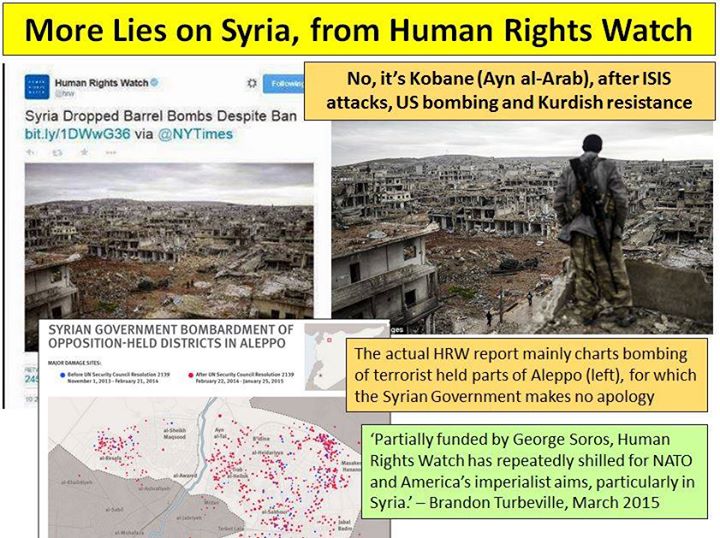
Putting its hypocritical and biased nature on full display once again, the alleged human rights organization, Human Rights Watch, was recently caught in an attempt to fabricate “evidence” of Assad’s use of barrel bombs in civilian areas for the purposes of further demonizing the secular Syrian government.
On February 25, HRW posted a photo of a devastated civilian area in Syria with the tagline “Syria dropped barrel bombs despite ban.” The “ban” HRW is referring to is the ban on bombing civilian areas that applies to both sides in Aleppo after the United Nations stepped in to save the Western-backed terrorists from annihilation. Assad’s forces had surrounded the city and had cut off a major supply route for the death squads from Turkey thus making the ultimate elimination of the jihadist forces a virtual inevitability.
As Somini Sengupta wrote for the New York Times on February 24,
Human Rights Watch said Tuesday that the Syrian government had dropped so-called barrel bombs on hundreds of sites in rebel-held towns and cities in the past year, flouting a United Nations Security Council measure.
In a report released Tuesday, the group said it relied on satellite images, photos, videos and witness statements to conclude that the Syrian government had bombarded at least 450 sites in and around the southern town of Daraa and at least 1,000 sites in Aleppo in the north.
The report focused on the period since Feb. 22, 2014, when the Security Council specifically condemned the use of barrel bombs, which are large containers filled with explosives and projectiles that can indiscriminately hurt civilians and are prohibited under international law.
There was only one problem with HRW’s tweet – the photograph the organization provided was not Aleppo.
In fact, the damage that had been wrought upon the civilian area in the photograph was not committed by the Syrian military but by the United States.
The photo was actually a picture of Kobane (Ayn al-Arab), the city which has been the site of heavy US aerial bombardment over the last several months as the US engages in its program of death squad herding and geographical reformation of sovereign Syrian and Iraqi territory.
But, while HRW was content to use the destruction of the city as a reason to condemn the Assad government and continue to promote the cause for US military action in Syria, the “human rights organization” was apparently much less interested in the exact same destruction wrought by US forces.
In other words, if Assad’s forces bomb a civilian area into the stone age, it is an atrocity, a war crime, and justification for international military involvement. If the United States bombs a civilian area into the stone age, it’s no biggie.
Partially funded by George Soros, Human Rights Watch has repeatedly shilled for NATO and America’s imperialist aims, particularly in Syria.
For instance, when Western media propaganda had reached a crescendo regarding the outright lie that Assad had used chemical weapons against his own people, HRW stood right beside Barack Obama and John Kerry in their effort to prove Assad’s guilt. HRW even went so far as to repeat the lie that the UN report suggested that Assad was the offending party, driving the final nail into the coffin of any credibility HRW may have had.
When a last-minute chemical weapons deal was secured by Russia in an effort to avoid yet another US/NATO invasion of Syria, HRW did not rejoice for the opportunity of peaceful destruction of chemical weapons and a chance to avoid war, it attacked the deal by claiming that it “failed to ensure justice.” Of course, the deal did fail to ensure justice. There were no provisions demanding punishment of the death squads who actually used the weapons or the US/NATO apparatus that initiated and controlled the jihadist invasion to begin with.
Regardless, when Mother Agnes Mariam of the Cross released her report that refuted what the US/NATO was asserting in regards to chemical weapons in Syria, HRW embarked upon a campaign of attack against her and her work.
Even as far back as 2009, however, HRW was showing its true colors when it apparently signed off on and supported renditions – the process of kidnapping individuals off the street without any due process and “rendering” them to jails and prisons in other countries where they are often tortured – in secret talks with the Obama administration.
If HRW ever had any credibility in terms of the question of actual human rights, then all of that credibility has assuredly been lost. HRW is nothing more than a pro-US, pro-NATO NGO that acts as a smokescreen for the continuation of the violation of human rights across the world – that is, unless those violations are committed by America’s enemies.
Ecuador Slams Human Rights Abuse Claims
Opposition protesters took sticks and other objects to attack policemen (Photo: ANDES).
teleSUR | October 22, 2014
The Ecuadorian government hit back on Tuesday against a report claiming it repressed protestors during a recent demonstrations.
The Ecuadorian government is challenging a lawyer cited in the report to prove his allegations.
It was responding to accusations made by U.S. based organization Human Rights Watch (HRW).
Interior Minister Jose Serrano announced during a televised interview that the government will sue the lawyer who told HRW that students and protesters detained on September 17 and 18 were tortured by the police.
“This lawyer had the audacity and cynicism to say that the police had tortured them … this individual will have to prove what he said … is effectively true,” Serrano said.
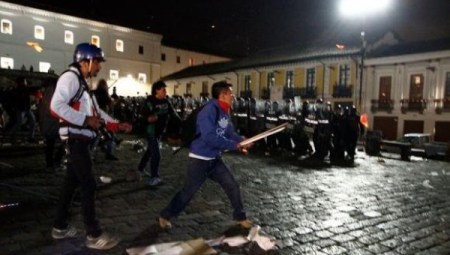
The Interior Minister also clarified that those apprehended were caught on video attacking policemen. All of them confessed to the charges against them.
President Rafael Correa had warned ahead of the September 17 protest that the opposition would try to use similar tactics to those used by the Venezuelan opposition, seeking to generate violent incidents which would then generate controversy and international reactions.
On September 17, opposition activists and government sympathizers both organized mobilizations which were located very close to one another. To avoid a small violent group from reaching the government sympathizers, a group of policemen blocked streets which connected both sites.
Opposition activists attacked the police to try to break into the pro-government rally, with arrests following.
“We had announced ahead (of the protests) that there were groups amongst the protesters which would use vandalism and violent strategies,” Serrano reminded.
According to the official, the International Red Cross was called days before the protests to guarantee that, if any detention was made, the organisation was present in the detention center.
“Mr. Vivanco (Jose Miguel Vivanco, HRW chief for Latin America) will have to show the whole world who is financing him, where are they getting their resources from, and why does he have this particular aversion against Latin America’s progressive governments,” Serrano said.
HRW is increasingly being held account by intellectuals and experts in the United States and the world due to its close relationship with the U.S. State Department.
Journalist Keane Bhatt has previously documented several cases in which HRW members have become senior U.S. State Department officials, in what Bhatt calls a “revolving door policy”.
Nobel Peace Prize Laureates Adolfo Perez Esquivel and Mairead Maguire together with former U.N. Assistant Secretary General Hans von Sponeck and over 100 scholars wrote a letter in May requesting Human Rights Watch to change its policy so as to avoid links with the U.S. State Department.
Whitewashing Venezuela’s Right Wing
In the heated media war over Venezuela, studies produced by well-funded NGOs (usually with ties to powerful states) have been regularly cited by the western corporate media to paint a grim picture of the country.
A Venezuela report released by the International Crisis Group (ICG) in May might give some people the impression that it is an even handed account done by authors committed to decreasing political violence in Venezuela. The report makes a few good recommendations, but it actually reveals that the ICG’s commitment to whitewashing right wing extremists is much stronger than any commitment to sensible analysis or to reducing political violence.
In the crucial section of the report where it discusses protest related violence, the ICG claims that there is only “weak evidence” that any opposition supporters ever used firearms:
In contrast to the abundant evidence linking security forces and pro-government civilians to deaths and injuries, it is unclear whether some in the opposition used firearms. In any case, the evidence on this is weak. The only deaths that appear clearly linked to the protesters are those involving accidents caused by barricades, including the use of barbed wire or other obstacles.
As far as the ICG is concerned, the bodies of several police and other pro government people shot to death while attempting to clear barricades in opposition strongholds are “weak evidence” of firearm use by anyone in the opposition. It might be argued that “concrete proof” of the exact individuals who shot every one of those victims is lacking. However saying that anti-government protesters are not very strongly implicated in the shootings of any government supporters or police is beyond preposterous.
In an attempt to make the evidence appear weak, the ICG mentions one incident in which a journalist working for a right wing business newspaper, El Universal, claims that a government supporter shot and killed a policeman at an opposition barricade. This kind of counter claim had also been made by government officials about some opposition protesters who have been shot (some government officials claiming the shots were fired by other opposition people), but the ICG wouldn’t dare use these claims to conclude that there is only “weak evidence” that government supporters had ever used firearms. In fact, the ICG discusses the death of opposition protester Génesis Carmona without ever mentioning government claims that she had been shot by another protester. Such inconsistent and biased standards for assessing evidence cannot possibly lead to a reliable version of events.
In addition to various opposition aligned sources, the ICG defers to the New York City based Human Rights Watch (HRW) to assess responsibility for violence. HRW was very recently sent a letter signed by two Nobel Peace Prize laureates Adolfo Pérez Esquivel and Mairead Maguire; former UN Assistant Secretary General Hans von Sponeck; current UN Special Rapporteur on Human Rights in the Palestinian Territories Richard Falk; and over 100 scholars all requesting that it take steps to close the revolving door between it and the US government. The letter noted:
In a 2012 letter to President Chávez, HRW criticized the country’s candidacy for the UN Human Rights Council, alleging that Venezuela had fallen “far short of acceptable standards” and questioning its “ability to serve as a credible voice on human rights.” At no point has U.S. membership in the same council merited censure from HRW, despite Washington’s secret, global assassination program, its preservation of renditions, and its illegal detention of individuals at Guantánamo Bay.
Ken Roth, head of HRW, once referred to Venezuela and a few other ALBA countries as the “most abusive” in Latin America – an insane remark as he should know by merely sampling his own organization’s reports about Colombia. Daniel Wilkinson, another HRW official, went so far as to lie about the Venezuelan TV media in an op-ed published in the New York Review of Books. HRW’s responses to the 2002 coup in Venezuela and as well as the 2004 coup in Haiti were disgraceful. By now, anyone who uncritically cites HRW about any country at odds with the US is, at best, uninformed about HRW’s track record.
The ICG’s report makes no mention of numerous falsified images the opposition has spread through social media to bolster its allegations of repression. Even a corporate outlet like Reuters made mention of this tactic but the ICG ignored it. The ICG also cites the anti-government newspaper El National various times – a newspaper whose dishonesty is so flagrant it has sometimes dismayed opposition people. An atrocious record doesn’t “weaken” El Nacional articles as evidence in the view of the ICG or provoke any statement of caution.
Attempts to put the 2004 recall referendum results under a cloud
The ICG report made the astounding remark that the opposition merely lacked “concrete proof” of fraud in the 2004 recall referendum that was won by Hugo Chavez. The report stated:
Concrete proof [of fraud] was not presented, though a peer-reviewed statistical analysis of the results later found significant anomalies. Maria M. Febres and Bernardo Márquez, “A Statistical Approach to Assess Referendum Results: The Venezuelan Recall Referendum 2004”, International Statistical Review, vol. 74, no. 3 (2006), p. 379. Jennifer McCoy, Carter Center election observation head in Venezuela, found the anomalies had not affected the referendum outcome.
In fact, elaborate statistical arguments – one of them based on “anomalies” in the distribution of votes – were made immediately after the referendum took place, not years later as the ICG implies. The Carter Center hired a team of very specialized statisticians – not simply Jennifer McCoy as the ICG very sloppily suggests – whose only job was to assess those arguments. The statisticians explained why the arguments did not substantiate allegations of fraud. The oppositions’ various “statistical analyses” received expert scrutiny that decided something far more important than acceptability for publication (which is what peer-review committees decide for journals) and that required extensive review of the arguments made by both sides. One of the key points made by the Carter Center’s statisticians was that there was no credible explanation how the government could have perpetrated fraud such that the random audit of the results would have failed to expose it.
The government’s victory in the 2004 referendum was subjected to a remarkably severe test. One of the key monitors, the Carter Center, is deeply tied to the US establishment which has been very hostile to Chavista administrations. In spite of all that, the ICG still pretends that there is reasonable doubt about the results. That will encourage the members of the opposition who allege that Chavista victories are stolen no matter how overwhelming the evidence is against them.
It’s unsurprising, given the ICG’s willingness to smear the 2004 referendum which was very far from close, that it also published a hopelessly one-sided account of the dispute surrounding the vastly closer presidential election of April 2013. The ICG absolved the opposition in advance for any act of violence by stating that the government must “clarify” the validity of the results or face “violent consequences”. In reality, the Election Day audit of the results, as CEPR has reported, already proved that the odds of a Capriles victory were less than one in 25 thousand trillion. The audit was, nevertheless, expanded.
It is quite clear to anyone who has been paying attention that opposition claims of electoral fraud are not driven by the facts but by the level of support they expect from the US government, foreign media and groups like the ICG.
Speaking the opposition’s language
In section IX of the report the ICG contrasts the “left leaning regimes” of the Bolivarian Alliance for our America (ALBA) with “those representing more market-friendly, centre and right-leaning governments”. On the left the ICG describes “regimes” while elsewhere on the political spectrum it describes “governments”.
Some political scientists use the word “regime” in a neutral way, but it is most commonly used to describe an oppressive and undemocratic government. I can find no example of the ICG ever referring to US government as a “regime” despite its abysmal human rights record and money-dominated political process. However it is very easy to find ICG reports replete with the word “regime” to describe states that the US government opposes.
The ICG also adopts the use of the word “coletivo” to mean an armed government supporter. It acknowledges that this is highly partisan usage by noting that it “is a term that covers pro-government community organisations of various kinds, most of them non-violent. But it has come to be used in particular for armed groups of the revolutionary left that have proliferated under chavista governments.”
In short, the opposition media (whom the ICG attempts to hide through the use of passive voice “has come to be used”) has demonized the word “colectivo” and the ICG reflexively follows suit.
Tamara Pearson, a proud colectivo member who has been living and working in Venezuela for several years, remarked about the media vilification campaign:
Where previously everything, even the drought or the actions of big business, were Chavez’s fault, now it must be “the collectives”. Now that Chavez is gone and the opposition still hasn’t got its electoral victory, they have realised it’s not enough to call the current president a “dictator” and belittle him because of his lack of formal university education, they need to demonise the active and organising people too. Because they aren’t going away.
A few good suggestions completely undermined
The ICG said that “the opposition can, and should, drop calls for the Maduro administration to step down “. This is a sound suggestion, no doubt, but one that is hypocritical and ineffective coming from the ICG. Whitewashing opposition violence and impugning clean elections, as the ICG does, is a propaganda gift to the “regime change” crowd.
The ICG recommends that Venezuela’s “international partners” should “help de-escalate the violence by sending clear messages that only peaceful methods will be tolerated.” UNASUR, and even the OAS which has traditionally towed Washington’s line, have already sent that message. The ICG is sending the opposite message.
Written for teleSUR English, which will launch on July 24
Seymour Hersh: liar and pro-fascist propagandist?
Interventions Watch | June 3, 2014
On 19th December 2013, the London Review of Books published an article by Seymour Hersh, entitled ‘The Red Line and the Rat Line’, which challenged the Obama administration’s claims that only the Assad regime could have been responsible for the chemical weapon attacks in Ghouta on August 21st 2013.
The article attracted a lot of criticism and attempted ‘debunkings’, some of which I blogged about here.
The latest attempted ‘debunking’ comes from Muhammad Idrees Ahmad, an author and journalist, and has been published in the L.A. Review of Books.
It’s being widely circulated among those who have long been critical of Hersh’s claims in regards to Ghouta, with – for example – Peter Bouckaert of Human Rights Watch tweeting:
Thank u @im_PULSE 4 revealing Sy Hersh’s lies re Ghouta CW attack–we stand by @hrw findings of Assad resp. http://www.hrw.org/reports/2013/09/10/attacks-ghouta …
I agree: Sy Hersh’s @LRB writing on Ghouta chemical weapons attack = distortions of a propagandist, not journalism. http://lareviewofbooks.org/essay/dangerous-method-syria-sy-hersh-art-mass-crime-revisionism# …
Not only is Hersh being accused of being wrong, then, but he’s being accused of being both a liar and a propagandist – a couple of very serious, and potentially libellous, accusations.
For Bouckaert to justify making such serious allegations against Hersh, Ahmad’s article would have to demonstrate conclusively that Hersh is both a liar and a propagandist. And in my opinion, it fails to do so.
Let’s just deal with some of the claims made against Hersh:
1. Claims of Responsibility
Ahmad writes that:
Hersh claims that the Assad regime was innocent of the August 21 massacre, that indeed the attack was carried out by the Islamist rebel group Jabhat al-Nusra, as part of what Hersh’s source describes as “a covert action planned by [Turkish Prime Minister Recep] Erdoğan’s people to push Obama over the red line.”
This is Ahmad’s first error, and one that is commonly made among those seeking to ‘debunk’ Hersh.
Hersh is not in fact saying that the regime was innocent, and that the rebels were to blame, and has clarified this on a number of occasions.
In an interview with Mint Press News in April 2014, he said that:
No one is saying they know what happened . . . We don’t know.
In an interview with Democracy Now! in December 2013, he said that:
I certainly don’t know who did what, but there’s no question my government does not.
And in an interview with Almayadeen in April 2014, he said that (starts at 21:54):
I am not saying I know that one particular unit . . . we know nothing about who did what. Was there an Al Nusrah wing that did it? Was it done by a rogue unit of the Syrian army? Maybe, who knows? I’m not ruling out . . . I’m just saying what the President was told by the Joint Chiefs: the Sarin that we found was not military grade.
So Ahmad starts off by attributing an opinion to Hersh that he’s never actually held, and that he has openly denied holding on at least three separate occasions. Ahmad continues to repeat the error throughout the rest of the article.
Hersh is instead saying that there are people within the U.S. Intelligence community who suspect rebel culpability; who believe certain rebel groups have the capability to manufacture Sarin; and that this therefore directly contradicts the Obama administration’s initial claims that only Assad and Assad alone could have been responsible.
2. U.N Reports
In his article, Hersh relays claims that Sarin samples collected on the ground in Ghouta by a Russian agent were later tested by British defence scientists at Porton Down. These scientists apparently concluded that ‘the gas used didn’t match the batches known to exist in the Syrian army’s chemical weapons arsenal’, and so a message was relayed to the U.S. Joint Chiefs of Staff ‘that the case against Syria wouldn’t hold up’.
In response, Ahmad quotes a U.N. report from February 2014. Here is what Ahmad says exactly:
Samples were also recovered from the site by the UN. Hersh makes no mention of these. Whatever discoveries Porton Down might have made, they were superseded by what the UN inspectors extracted and studied first hand. The UN’s remit did not include assigning responsibility, but its judgment leaves little room for doubt. The perpetrators, it concludes, “had access to the chemical weapons stockpile of the Syrian military, as well as the expertise and equipment necessary to manipulate safely large amount of chemical agents.”
And here is what that U.N. report says in full:
The evidence available concerning the nature, quality and quantity of the agents used on 21 August indicated that the perpetrators likely had access to the chemical weapons stockpile of the Syrian military, as well as the expertise and equipment necessary to manipulate safely large amount of chemical agents.
http://www.globalr2p.org/media/files/a-hrc-25-65_en.pdf – p.19 (emphasis mine)
As you can see, Ahmad leaves the words ‘indicated’ and ‘likely’ out of the quote, perhaps because they’re qualifiers and do in fact suggest a degree of doubt.
That reading is strengthened by what the report says three paragraphs later. Namely, and in regards to allegations of chemical weapon usage in Syria in general, that:
In no incident was the commission’s evidentiary threshold met with regard to the perpetrator.
Again, if the U.N. are themselves saying that the evidentiary threshold has not been met in regards to the perpetrator, then quite a significant degree of doubt *is* suggested.
Ahmad then moves onto the alleged chemical weapon attack in Khan al-Assal in March 2013. Hersh quotes an anonymous source from the U.N. as saying that:
Investigators interviewed the people who were there, including the doctors who treated the victims. It was clear that the rebels used the gas. It did not come out in public because no one wanted to know
Ahmad again responds by quoting the U.N. report from February, which says:
Concerning the incident in Khan Al-Assal on 19 March, the chemical agents used in that attack bore the same unique hallmarks as those used in Al-Ghouta.
He then accuses Hersh of not having read the report.
But the report doesn’t pin the blame on the regime, does it? It just says the chemical agents allegedly used had the same hallmarks as those used in Ghouta – an attack for which, like all the others, no ‘evidentiary threshold was met with regard to the perpetrator’.
Further to this, a previous and more indepth U.N. report, released in December 2013, had said of the Khan al-Assal attacks that there is:
credible information that corroborates the allegations that chemical weapons were used in Khan Al Asal on 19 March 2013 against soldiers and civilians
https://unoda-web.s3.amazonaws.com/wp-content/uploads/2013/12/report.pdf – p.19 (emphasis mine)
A reasonable question to ask here might be ‘Why would the Syrian regime gas its own soldiers?’.
And for what it’s worth, Hersh’s anonymous U.N. source is not the only person from that organisation who has pointed the finger of suspicion at rebel groups, in regards to chemical weapon attacks carried out in the early part of 2013.
Carla Del Ponte, one of the overseers of the U.N. Commission of Inquiry on Syria, was reported as saying in May 2013 that:
According to their report of last week, which I have seen, there are strong, concrete suspicions but not yet incontrovertible proof of the use of sarin gas, from the way the victims were treated . . . I was a little bit stupefied by the first indications we got . . . they were about the use of nerve gas by the opposition.
http://www.bbc.co.uk/news/world-middle-east-22424188
Ahmad is entitled to his interpretation of the February 2014 report, and I would agree that it does, to an extent, look damning for the regime.
But he has clearly stripped all of the qualifiers out of the report he is quoting, which do indeed leave room for doubt. He then – at least in regards to the Khan al-Assal attack – ignores previous U.N. reports, and quotes from named and senior U.N. officials, which, in turn, look damning for the rebels.
Ahmad then quotes Hersh as saying, in regards to the U.N. team who investigated the Ghouta attack, that:
[Their] access to the attack sites, which came five days after the gassing, had been controlled by rebel forces
This quote actually comes from Hersh’s first LRB article on the chemical weapon attacks in Ghouta, ‘Whose Sarin?’, which was published in December 2013.
In Ahmad’s reading, this is Hersh ‘suggesting that the UN may have been constrained by the presence of the rebels’, while neglecting to mention that, in Ahmad’s words, ‘the visit “came five days after the gassing” because the regime refused access to the sites and instead subjected them to unrelenting artillery fire‘.
Ahmad, on the basis of this, accuses Hersh of employing ‘the distortion of a propagandist’.
Another way of looking at Hersh’s sentence is that it is simply true.
The U.N. investigative teams access to the affected areas had indeed been controlled by rebel forces, as the report itself says. Here is the relevant passage:
A leader of the local opposition forces who was deemed prominent in the area to be visited by the Mission, was identified and requested to take ‘custody’ of the Mission. The point of contact within the opposition was used to ensure the security and movement of the Mission, to facilitate the access to the most critical cases/witnesses to be interviewed and sampled by the Mission and to control patients and crowd in order for the Mission to focus on its main activities’.
Hersh’s article also quoted the part of the U.N. report which says that:
‘During the time spent at these locations, individuals arrived carrying other suspected munitions indicating that such potential evidence is being moved and possibly manipulated’.
The report, then, is clear: the teams access to the affected areas was controlled by the opposition, and the team also had concerns about the potential moving and/or manipulation of evidence.
Hersh doesn’t misrepresent or distort the report in any way.
The most Ahmad can pin on Hersh is that he didn’t outline why there was a five day delay in getting to the affected areas, but frankly, it’s weak tea indeed, and in no way justifies the description of ‘distortion’ and ‘propaganda’.
3. Technical claims
Ahmad takes issue with Hersh’s use, in an interview with Democracy Now!, of the phrase ‘kitchen sarin’, writing that:
one would also have to accept Hersh’s related claim that sarin can be produced in a kitchen. Bashar al-Assad shares this view, but chemical weapons experts understandably disagree. Sarin is a deadly substance; its production is a substantial technical, financial, and logistical undertaking. It is not the kind of thing one can conceal in a house; nor is it something one can load into homemade rockets using kitchen gloves.
But it’s clear from the full quote that Hersh is not saying that he thinks sarin can be ‘produced in a kitchen’. Here is the full quote:
And so, the Brits came to us with samples of sarin, and they were very clear there was a real problem with these samples, because they did not reflect what the Brits know and we know, the Russians knew, everybody knew, is inside the Syrian arsenal. They have—professionals armies have additives to sarin that make it more persistent, easier to use. The amateur stuff, they call it kitchen sarin, sort of a cold phrase.
The phrase ‘kitchen sarin’, then, is being used as a slang term to distinguish professionally manufactured sarin from ‘the amateur stuff’. I very much doubt it was intended to be taken literally, or that Hersh seriously believes sarin can be knocked up on a stove with a few pots and pans.
There is then an overview of the debate regarding the launch points of the rockets used in the Ghouta attacks, and about who is in possession of such rockets.
This basically pits Ted Postol, a well regarded defence technology expert at MIT, and Richard Lloyd, a former UN weapons inspector, against Eliot Higgins, a British blogger renowned as an expert on the munitions used in the Syrian conflict.
Postol and Lloyd are the main sources for Hersh’s technical claims, and Ahmad himself concedes that ‘They have produced valuable analyses on the payloads and ranges of the rockets used on August 21′, and that ‘There is little reason to doubt their expertise in this area’.
I’m not going to attempt to analyse the competing claims and counter-claims in this regard, because i’m not qualified to do so.
But Hersh relying on the expertise of Postol and Lloyd in making some of his claims in regards to the technical aspects of the attack doesn’t strike me as being particularly outrageous. They may be right, they may be wrong, but they are competent and credible sources.
However, Ahmad then accuses Ted Postol of a ‘determination to validate’ Seymour Hersh’s work, and in doing this, ignoring ‘all evidence that undermines them’. He quotes Emile Durkheim as calling this the ‘ideological method’, defined as ‘the use of “notions to govern the collation of facts, rather than deriving notions from them”.
But Postol himself has said that when he first started investigating the attacks, he was sure that no-one but the regime could have been responsible. To quote Postel himself:
My view when I started this process was that it couldn’t be anything but the Syrian government behind the attack. But now I’m not sure of anything.
http://www.mcclatchydc.com/2014/01/15/214656/new-analysis-of-rocket-used-in.html
If anything then, Postol’s trajectory has been the exact opposite of the one Ahmad attributes to him. When he started his investigations, he was sure that the regime was culpable, and that Hersh was wrong. But the facts he uncovered in the course of that investigation lead him to doubt and then discard his initial hunches.
That doesn’t stop Ahmad essentially dismissing some of his work as ideologically motivated.
Ahmad then accuses Hersh of a similar ideological motivation, saying that:
He ignores or obfuscates established facts that contradict his theory: the fact that the delivery system used in the attacks is peculiar to the regime, or that the UN has established that the sarin could only have come from government stockpiles
But you could argue that it is Ahmad who is obfuscating here.
The UN has never categorically reported ‘that the sarin could only have come from government stockpiles’, saying only that the perpetrators ‘likely’ had access to government stockpiles, but that the evidentiary threshold in regards to the perpetrators hasn’t been met.
Postol and Lloyd are both of the opinion that the ‘delivery system used’ could have been manufactured by a rebel group, and needn’t be peculiar to the regime.
Ahmad himself also ignores other evidence – such as Carla Del Ponte’s claims, or that regime soldiers appear to have been targeted in some cases – that points to rebel culpability for at least some of the chemical weapon attacks in Syria.
Ahmad finishes by wondering whether Hersh is just ‘credulous’, or whether ‘something less benign is at play’.
He basically accuses Hersh of wanting to see Assad retain his chemical arsenal, based on this paragraph from ‘Whose Sarin?’:
While the Syrian regime continues the process of eliminating its chemical arsenal, the irony is that, after Assad’s stockpile of precursor agents is destroyed, al-Nusra and its Islamist allies could end up as the only faction inside Syria with access to the ingredients that can create sarin, a strategic weapon that would be unlike any other in the war zone’.
Ahmad calls this ‘a dog-whistle case for Assad keeping his arsenal’, and expresses astonishment that LRB would publish it.
But I don’t see it as anything of the sort. Ahmad’s reading of Hersh here is, at best, tenuous and uncharitable, and at worst an outright smear that is the polar opposite of Hersh’s stated beliefs.
In his December 2013 interview with Democracy Now!, for example, Hersh said in regards to Obama’s acceptance of the Russian brokered disarmament deal:
He (Obama) decides overnight to go to Congress, and then he accepts a very rational deal—and I’m glad he did—that the Russians put forward, with the Syrians, to dispose of the chemical arsenal or the chemicals that are in Syria.
http://www.democracynow.org/2013/12/9/seymour_hersh_obama_cherry_picked_intelligence
So Hersh thinks the deal was ‘very rational’, and he is ‘glad’ Obama accepted it. Some ‘dog whistle’.
In summary, then, these are the most obvious and immediate errors and misrepresentations I found in Ahmad’s article:
1. That Hersh thinks the rebels were to blame for the attacks in Ghouta. This is flatly false, as Hersh’s own words show, and is not the point he’s making at all. Ahmad gets the basic premise of Hersh’s argument – which is that doubt over culpability exists where the Obama administration insists there is none – completely wrong.
2. That Hersh misrepresents, obfuscates or ignores U.N. reports to make his case. Again, this isn’t true, and if anything it’s Ahmad who has selectively quoted some U.N. reports, while totally ignoring others/senior U.N. officials, to make it look like they’re categorically blaming the regime.
3. That Hersh is wrong in regards to the technical claims, and that his sources are ideologically motivated.
All I can say is that it’s clear the technical debate is still raging, and that Hersh has some very credible sources on his side – one of whom, despite Ahmad’s insinuations, actually started his investigations convinced that the regime was to blame, and that Hersh was wrong.
It should also be noted that Ahmad’s own main source, Brown Moses, is far from infallible, and is less qualified and less experienced than both Postol and Lloyd.
4. That Hersh might not just be well meaning if wrong, and instead has another agenda, such as wanting Assad to keep his chemical weapon stockpile. This is based on the most uncharitable reading of Hersh’s work possible, is extremely tenuous, and is directly contradicted by Hersh’s own words.
Ahmad finishes by saying:
By now even the most dogmatic among Hersh’s publishers must have realized that they were hoaxed. Their ideological proclivities and eagerness for clicks made the deception easier. They got played — they relayed what is in effect pro-fascist propaganda.
And while this may ultimately turn out to be true, he doesn’t come anywhere near close to demonstrating it to be the case.
Nor is there any convincing evidence presented of Hersh being a liar or a propagandist, as opposed to just conveying claims from his sources that are potentially dishonest or mistaken.
But for those who are desperate to see Hersh discredited if not destroyed, I suppose it’ll have to do until the next attempt.
‘Human Rights Watch’ on Syria: relentless war propaganda
By Tim Anderson and Mazen al-Akhras | Pravda | February 2, 2014
The Washington-based group ‘Human Rights Watch’- controlled by the US foreign policy elite – has released another volley in its campaign to back the ‘humanitarian war’ being waged against the independent nation of Syria.
This is not the first or second fabrication against Syria run by Human Rights Watch. The group was amongst the first to falsely blame the Syrian government for the East Ghouta chemical weapons incident of August 2013. The ‘moral panic’ from that accusation almost sparked a major escalation of the war.
Several reports have since proven that the accusation was a fraud. A group led by Catholic nun Mother Agnes Mariam produced a report showing the video evidence of the incident had been manipulated and staged; US investigative journalist Seymour Hersh showed that US intelligence implicating the Syrian Government had been fabricated; and the New York Times retracted its support for speculative telemetry evidence, which they had claimed implicated the Syrian Army. On the other side, Syrian witnesses, a Jordanian reporter and a Turkish human rights group (‘Peace Association and Lawyers for Justice in Turkey’) implicated Saudi-backed terrorists. Further, the last UN report on the incident says that, in most instances, chemical weapons were used ‘against soldiers’; that is, against the government. HRW has neither retracted nor apologised for its role in this scam.
The latest HRW story (‘Razed to the Ground’, 30 Jan) is that the Syrian Government over 2012-13 demolished residential buildings in seven areas of Hama and Damascus as ‘punishment’ for certain neighbourhoods supporting ‘the rebels’. Thousands of families lost their homes in this way, yet there have been ‘no similar demolitions in areas that support the government’.
HRW said it ‘has not documented that anybody was injured or killed in the process.’ Nevertheless, the use of home demolition as punishment was ‘a violation … of the laws of war’ and amounts to a war crime. HRW ‘calls on the UN Security Council to refer the situation in Syria to the International Criminal Court’.
Of course, this claim will go nowhere, as previous more serious provocations have failed at the UNSC. Yet the HRW report adds to a poisoned climate of vilification and intervention, appearing to add moral logic to arming the sectarian groups. Yet propaganda for war is a war crime, in itself.
Syrian NDF soldier and political analyst Mazen al-Akhras points out that videos associated with the HRW report show the presence of anti-government ‘militants’ as witnesses (just as in East Ghouta), tainting the story at the outset. The HRW report does not observe that areas like Tadamon had been crowded with illegal constructions and, when they were damaged during the conflict, the government decided it more efficient to demolish and rebuild.
HRW does not mention that the government took the decision, many months ago, to compensate ‘all citizens whose houses were damaged or totally destroyed by the conflict’. Al-Akhras says HRW ignores the compensation already paid, and then pretends to ‘demand’ compensation. His full commentary is below.
The BBC, which has played a key role in relaying and amplifying propaganda for war on Syria, promoted this ‘Razed to the Ground’ story. An earlier notable contribution by the BBC was to help cover up the terrorist murder of Syria’s most senior Muslim cleric, Sheikh Mohamad al Bouti. He and fifty others were murdered inside the al Iman mosque on 21 March 2013 by a suicide bomber from the al Qaeda-linked and Saudi-backed Jabhat al Nusra.
Because Sheikh Bouti had always opposed salafist sectarians, the armed sectarian gangs (‘takfiris’) said he was ‘not a real Sunni’ and called for his death. After they murdered him they celebrated and then, in typical fashion, blamed the Government.
Jim Muir of the BBC picked up the al Nusra scam, based on the fact that the Sheikh did not die instantly, to run claims that he had been killed by some other means. Nevertheless, in December 2013, five members of al Nusra confessed on Syrian television to the murders. Al Nusra cleric, Samir al-Ordoni, had given them religious permission to enter the mosque and kill other Muslims.
The BBC also gave full prominence to a more recent stunt put on by the oil monarchy of Qatar, a major funder of sectarian Islamist fighters. On the eve of the Geneva 2 peace talks, they promoted a report by three British lawyers, hired by Qatar, which pronounced the Syrian Government guilty of ‘torture and 11,000 executions’. The lawyers had gone to Qatar to interview one man, who said he had not witnessed any torture or murder, but gave them thousands of photos of dead bodies. They examined some of these photos and made some extravagant statements. Yet with such tainted evidence, who knows where the bodies came from or who killed them?
Human Rights Watch has been a key player in the manufacture of propaganda for war and foreign intervention. It gets most of its funds from a variety of US foundations, in turn funded by many of the biggest US corporations. HRW Middle East reports often rely on and acknowledge grants from pro-Israel foundations. The group is tightly linked to the US Council on Foreign Relations (CFR), a virtual ‘Who’s Who’ of the US foreign policy elite.
HRW has ‘soft-pedalled’ on US-compliant regimes such as Colombia, the worst human rights abuser in Latin America as shown by the murder of trade unionists, journalists and other social activists. By contrast, HRW repeatedly attacked the government of the late Hugo Chavez in Venezuela.
The group has always had a political agenda. According to José Miguel Vivanco, director of the group’s Americas division, its December 2008 report on Venezuela (‘A Decade under Chavez’), was written ‘because we wanted to demonstrate to the world that Venezuela is not a model for anyone’. That report was roundly criticized by more than a hundred academics for not meeting ‘even the most minimal standards of scholarship, impartiality, accuracy or credibility’. Rather than a careful report on human rights, it was an attempt to discredit a government, mainly on the basis of allegations of ‘political discrimination’ in employment and the judiciary. The evidence was poor and the approach anything but systematic. HRW disregarded this criticism.
—————–
Mazen al-Akhras from Damascus comments on ‘Razed to the Ground’
‘Before we were evacuated due to the military conflict in November 2012 I was a resident of Harasta, one of the eastern suburbs of Damascus, and the closest to Duma, which in turn, is the stronghold of the anti-government forces in the outer suburbs of Damascus.
‘Harasta is adjacent to the freeway connection Damascus to the north (Damascus-Aleppo freeway), and can be seen by eye while travelling, and it can be also monitored by Satellite images. And like many other towns around Damascus, Harasta had its share of demonstrations and battles. And although it was considered the second stronghold for the anti-government forces in the eastern Ghouta, Harasta has not witnessed anything similar to the accusations in HRW’s report.
‘There are several other examples of the same situation around Damascus like Al-Tal, Zabadani and Qudsaia, and if one goes a bit further to the north, such alleged demolitions mentioned in HRW’s report did not take place in Nabk, or in Qara (Kara).
Even in Qussair, demolitions were limited to the results of the battles that happened there, and once the fighting stopped, there was no act of demolition or destruction. Quite the opposite, the government rushed to restore electricity and water and other public services to the city, while putting reconstruction works into action where they were possible.
‘One might need to be reminded that Qussair was not just a city that opposed the government, it was also the strongest stronghold for the militias opposing the Army in mid-west Syria.
‘All these examples and many others are actual real-life proof that the government is not “punishing” areas for supporting the insurgency like HRW’s report claims.
Now, to the videos, they show no sign or indication of the places they were filmed, and one can argue many details about the ID of the militants showing in the second part of the video.
‘While HRW’s report maliciously wonders why other areas of illegally-constructed residences have not been demolished, and assuming (with the same malicious ill-will) that it’s because the areas are Pro-Assad, they fail to mention that these areas already provide shelter and refuge for thousands of families who have evacuated their areas because of still ongoing battles, including those areas that are being demolished. So, in other words, they are simply wondering why the Syrian government doesn’t kick those refugees (again) from the safe areas, along with thousands more of families who were originally in these areas. Of course such wondering is acceptable for them because doubling the numbers of homeless families inside Damascus (or any other city in Syria) poses no discomfort on their dead consciences.
‘Any resident of Damascus knows that Tadamon (among many other areas) is a crowded area of illegally constructed residences, and that the Syrian government has been trying for years to organize it, and now with all the battles-caused destruction, it is very difficult and expensive to just renovate the area, making it easier and cheaper for the government to bring down the rest of the area and then reconstruct it in an organized way, eventually guaranteeing the residents to go back to a healthier and better shaped area.
‘That itself is something else HRW’s report failed to mention, and this time it’s not by mistake, they deliberately chose to ignore the simple fact that the Syrian government had already decided and announced they would be compensating all citizens whose houses were damaged or totally destroyed in the conflict, and that was many months before HRW made their report and “demanded” what the Syrian government had already granted.
‘Mashaa Al-Arbaeen in Hama (as anyone can inquire and verify) is nearly the same as Tadamon, only with worse official documentation of property.
‘So, to sum it all up: many areas, towns and cities are a living proof that the government is not “punishing” anybody. Yet, HRW issues a report about a governmental plan of reorganizing some areas of illegally-constructed residences that are already damaged because of the battles, then HRW twists that plan into an alleged “punishment”, because the plan does not – yet – include other areas (although those areas were not in the conflict and were not damaged, and demolishing them now will double the numbers of homeless families in Damascus, which will also include the families that were evacuated the first time), and to add insult to the injury, HRW ignores the compensations granted and promised by the government to the Syrian citizens and chooses to “demand” those compensations.’
———————————————————
References
Tim Anderson (2010) ‘How Credible Is Human Rights Watch on Cuba?’, MRZine, Feb, online:http://mrzine.monthlyreview.org/2010/anderson160210.html
Peace Association and Lawyers for Justice in Turkey (2013) War Crimes Committed Against the People of Syria, December, online: http://www.barisdernegi.org/en/war-crimes-committed-against-people-syria-report-peace-association-turkey-and-lawyers-justice
Rodolfo Acuña et al (2008) ‘More Than 100 Experts Question Human Rights Watch’s Venezuela Report’, online: https://nacla.org/news/more-100-experts-question-human-rights-watchs-venezuela-report
Human Rights Watch (2013) ‘Attacks on Ghouta: Analysis of Alleged Use of Chemical Weapons in Syria’, 10 September, online: http://www.hrw.org/reports/2013/09/10/attacks-ghouta-0
Human Rights Watch (2014) ‘Razed to the Ground’, 30 Jan, online:http://www.hrw.org/reports/2014/01/30/razed-ground
Robert Parry (2013) ‘NYT Backs Off Its Syria-Sarin Analysis’, Global Research, 30 December, online:http://www.globalresearch.ca/nyt-backs-off-its-syria-sarin-analysis/5363023
ISTEAMS (2013) ‘Independent Investigation of Syria Chemical Attack Videos and Child Abductions’, 15 September, online:http://www.globalresearch.ca/STUDY_THE_VIDEOS_THAT_SPEAKS_ABOUT_CHEMICALS_BETA_VERSION.pdf
Seymour M. Hersh (2013) ‘Whose Sarin?’, London Review of Books, Vol. 35 No. 24, 19 December, 9-12, online: http://www.lrb.co.uk/v35/n24/seymour-m-hersh/whose-sarin
BBC (2014) ‘Syria accused of torture and 11,000 executions’, 21 January, online:http://www.bbc.co.uk/news/world-middle-east-25822571

The Hypocrisy of Human Rights Watch
By Keane Bhatt | NACLA | February 5, 2014
Over more than a decade, the rise of the left in Latin American governance has led to remarkable advances in poverty alleviation, regional integration, and a reassertion of sovereignty and independence. The United States has been antagonistic toward the new left governments, and has concurrently pursued a bellicose foreign policy, in many cases blithely dismissive of international law.
So why has Human Rights Watch (HRW)—despite proclaiming itself “one of the world’s leading independent organizations” on human rights—so consistently paralleled U.S. positions and policies? This affinity for the U.S. government agenda is not limited to Latin America. In the summer of 2013, for example, when the prospect of a unilateral U.S. missile strike on Syria—a clear violation of the UN Charter—loomed large, HRW’s executive director Kenneth Roth speculated as to whether a simply “symbolic” bombing would be sufficient. “If Obama decides to strike Syria, will he settle for symbolism or do something that will help protect civilians?” he asked on Twitter. Executive director of MIT’s Center for International Studies John Tirman swiftly denounced the tweet as “possibly the most ignorant and irresponsible statement ever by a major human-rights advocate.”1
HRW’s accommodation to U.S. policy has also extended to renditions—the illegal practice of kidnapping and transporting suspects around the planet to be interrogated and often tortured in allied countries. In early 2009, when it was reported that the newly elected Obama administration was leaving this program intact, HRW’s then Washington advocacy director Tom Malinowski argued that “under limited circumstances, there is a legitimate place” for renditions, and encouraged patience: “they want to design a system that doesn’t result in people being sent to foreign dungeons to be tortured,” he said, “but designing that system is going to take some time.”2
Similar consideration was not extended to de-facto U.S. enemy Venezuela, when, in 2012, HRW’s Americas director José Miguel Vivanco and global advocacy director Peggy Hicks wrote a letter to President Hugo Chávez arguing that his country was unfit to serve on the UN’s Human Rights Council. Councilmembers must uphold the highest standards in the promotion and protection of human rights, they maintained, but unfortunately, “Venezuela currently falls far short of acceptable standards.”3 Given HRW’s silence regarding U.S. membership in the same council, one wonders precisely what HRW’s acceptable standards are.
One underlying factor for HRW’s general conformity with U.S. policy was clarified on July 8, 2013, when Roth took to Twitter to congratulate his colleague Malinowski on his nomination to be Assistant Secretary of State for Democracy, Human Rights and Labor (DRL). Malinowski was poised to further human rights as a senior-level foreign-policy official for an administration that convenes weekly “Terror Tuesday” meetings. In these meetings, Obama and his staffers deliberate the meting out of extrajudicial drone assassinations around the planet, reportedly working from a secret “kill list” that has included several U.S. citizens and a 17-year-old girl.4
Malinowski’s entry into government was actually a re-entry. Prior to HRW, he had served as a speechwriter for Secretary of State Madeline Albright and for the White House’s National Security Council. He was also once a special assistant to President Bill Clinton—all of which he proudly listed in his HRW biography. During his Senate confirmation hearing on September 24, Malinowski promised to “deepen the bipartisan consensus for America’s defense of liberty around the world,” and assured the Foreign Relations Committee that no matter where the U.S. debate on Syria led, “the mere fact that we are having it marks our nation as exceptional.”5
That very day, Obama stood before the UN General Assembly and declared, “some may disagree, but I believe that America is exceptional.” Assuming that by “exceptional” Obama meant exceptionally benevolent, one of those who disagreed was Brazilian president Dilma Rousseff, who had opened the proceedings at the same podium by excoriating Obama’s “global network of electronic espionage,” which she considered a “disrespect to national sovereignty” and a “grave violation of human rights and of civil liberties.” Rousseff contrasted Washington’s rogue behavior with her characterization of Brazil as a country that has “lived in peace with our neighbors for more than 140 years.” Brazil and its neighbors, she argued, were “democratic, pacific and respectful of international law.”6 Rousseff’s speech crystallized Latin America’s broad opposition to U.S. exceptionalism, and therefore shed light on the left’s mutually antagonistic relationship with HRW.
*
Malinowski’s background is but one example of a larger scenario. HRW’s institutional culture is shaped by its leadership’s intimate links to various arms of the U.S. government. In her HRW biography, the vice chair of HRW’s board of directors, Susan Manilow, describes herself as “a longtime friend to Bill Clinton,” and helped manage his campaign finances. (HRW once signed a letter to Clinton advocating the prosecution of Yugoslav President Slobodan Milosevic for war crimes; HRW made no case for holding Clinton accountable for NATO’s civilian-killing bombings despite concluding that they constituted “violations of international humanitarian law.”)7 Bruce Rabb, also on Human Rights Watch’s Board of Directors, advertises in his biography that he “served as staff assistant to President Richard Nixon” from 1969-70—the period in which that administration secretly and illegally carpet bombed Cambodia and Laos.8
The advisory committee for HRW’s Americas Division has even boasted the presence of a former Central Intelligence Agency official, Miguel Díaz. According to his State Department biography, Díaz served as a CIA analyst and also provided “oversight of U.S. intelligence activities in Latin America” for the House Permanent Select Committee on Intelligence.9 As of 2012, Díaz focused, as he once did for the CIA, on Central America for the State Department’s DRL—the same bureau now to be supervised by Malinowski.
Other HRW associates have similarly questionable backgrounds: Myles Frechette, currently an advisory committee member for the Americas Division, served as Assistant U.S. Trade Representative for Latin America and the Caribbean from 1990-93, and then became U.S. Ambassador to Colombia from 1994-97. Frechette subsequently worked as the executive director of a “nonprofit” group called the North American-Peruvian Business Council, and championed the interests of his funders in front of Congress. His organization received financing from companies such as Newmont Mining, Barrick Gold, Caterpillar, Continental Airlines, J.P. Morgan, ExxonMobil, Patton Boggs, and Texaco.10
Michael Shifter, who also currently serves on HRW’s Americas advisory committee, directed the Latin America and Caribbean program for the National Endowment for Democracy (NED), a quasi-governmental entity whose former acting president Allen Weinstein told The Washington Post in 1991 that “a lot of what we do today was done covertly 25 years ago by the CIA.”11 Shifter, as current president of a policy center called the Inter-American Dialogue, oversees $4 million a year in programming, financed in part through donations from the U.S. Agency for International Development (USAID), the embassies of Canada, Germany, Guatemala, Mexico and Spain, and corporations such as Chevron, ExxonMobil, J.P. Morgan, Microsoft, Coca-Cola, Boeing, and Western Union.
To be sure, not all of the organization’s leadership has been so involved in dubious political activities. Many HRW board members are simply investment bankers, like board co-chairs Joel Motley of Public Capital Advisors, LLC, and Hassan Elmasry, of Independent Franchise Partners, LLP. HRW Vice Chair John Studzinski is a senior managing director at The Blackstone Group, a private equity firm founded by Peter G. Peterson, the billionaire who has passionately sought to eviscerate Social Security and Medicare. And although Julien J. Studley, the Vice Chair of the Americas advisory committee, once served in the U.S. Army’s psychological warfare unit, he is now just another wealthy real-estate tycoon in New York.
That HRW’s advocacy reflects its institutional makeup is unremarkable. Indeed, an examination of its positions on Latin America demonstrates the group’s predictable, general conformity with U.S. interests. Consider, for example, HRW’s reaction to the death of Hugo Chávez. Within hours of his passing on March 5, 2013, HRW published an overview—“Venezuela: Chávez’s Authoritarian Legacy”—to enormous online response. In accordance with its headline’s misleading terminology, HRW never once mentioned Chávez’s democratic bona fides: Since 1998, he had triumphed in 14 of 15 elections or referenda, all of which were deemed free and fair by international monitors. Chávez’s most recent reelection boasted an 81% participation rate; former president Jimmy Carter described the voting process as “the best in the world.”12 The article neglected to cite a single positive aspect of Chávez’s tenure, under which poverty was slashed by half and infant mortality by a third.
In contrast, HRW’s August 21, 2012 statement regarding the death of Ethiopian leader Meles Zenawi was decidedly more muted: “Ethiopia: Transition Should Support Human Rights Reform,” read the headline. Leslie Lefkow, HRW’s deputy Africa director, urged the country’s new leadership to “reassure Ethiopians by building on Meles’s positive legacy while reversing his government’s most pernicious policies.” Regarding a leader whose two-decade rule had none of Chávez’s democratic legitimacy (HRW itself documented Ethiopia’s repressive and unfair elections in both 2005 and 2010), the organization argued only that “Meles leaves a mixed legacy on human rights.”13 Whereas HRW omitted all mention of Chávez-era social improvements, it wrote, “Under [Meles’s] leadership the country has experienced significant, albeit uneven, economic development and progress.”
The explanation for this discrepancy is obvious: as a New York Times obituary reported, Meles was “one of the United States government’s closest African allies.” Although “widely considered one of Africa’s most repressive governments,” wrote the Times, Ethiopia “continues to receive more than $800 million in American aid each year. American officials have said that the Ethiopian military and security services are among the Central Intelligence Agency’s favorite partners.”14
*
HRW has taken its double standard to cartoonish heights throughout Latin America. At a 2009 NED Democracy Award Roundtable, José Miguel Vivanco described Cuba, not the United States, as “one of our countries in the hemisphere that is perhaps the one that has today the worst human-rights record in the region.” As evidence, he listed Cuba’s “long- and short-term detentions with no due process, physical abuse [and] surveillance”—as though these were not commonplace U.S. practices, even (ironically) at Guantánamo Bay.15 Vivanco was also quoted in late 2013, claiming at an Inter-American Dialogue event that the “gravest setbacks to freedom of association and expression in Latin America have taken place in Ecuador”—not in Colombia, the world’s most dangerous country for trade union leaders, or in Honduras, the region’s deadliest country for journalists (both, incidentally, U.S. allies).16
Latin America scholars are sounding the alarm: New York University history professor Greg Grandin recently described HRW as “Washington’s adjunct” in The Nation magazine.17 And when Vivanco publicly stated that “we did [our 2008] report because we wanted to show the world that Venezuela is not a model for anyone,” over 100 academics wrote to the HRW’s directors, lamenting the “great loss to civil society when we can no longer trust a source such as Human Rights Watch to conduct an impartial investigation and draw conclusions based on verifiable facts.”18
HRW’s deep ties to U.S. corporate and state sectors should disqualify the institution from any public pretense of independence. Such a claim is indeed untenable given the U.S.-headquartered organization’s status as a revolving door for high-level governmental bureaucrats. Stripping itself of the “independent” label would allow HRW’s findings and advocacy to be more accurately evaluated, and its biases more clearly recognized.
In Latin America, there is a widespread awareness of Washington’s ability to deflect any outside attempts to constrain its prerogative to use violence and violate international law. The past three decades alone have seen U.S. military invasions of Grenada and Panama, a campaign of international terrorism against Nicaragua, and support for coup governments in countries such as Venezuela, Haiti, Honduras, and Guatemala. If HRW is to retain credibility in the region, it must begin to extricate itself from elite spheres of U.S. decision-making and abandon its institutional internalization of U.S. exceptionalism. Implementing a clear prohibition to retaining staff and advisers who have crafted or executed U.S. foreign policy would be an important first step. At the very least, HRW can institute lengthy “cooling-off” periods—say, five years in duration—before and after its associates move between the organization and the government.
After all, HRW’s Malinowski will be directly subordinate to Secretary of State John Kerry, who conveyed the U.S. attitude toward Latin America in a way that only an administrator of a superpower could. In an April 17, 2013 House Foreign Affairs Committee hearing, a member of Congress asked Kerry whether the United States should prioritize “the entire region as opposed to just focusing on one country, since they seem to be trying to work together closer than ever before.” Kerry reassured him of the administration’s global vision. “Look,” he said. “The Western Hemisphere is our backyard. It is critical to us.”19
1. Kenneth Roth, followed by John Tirman’s response, Twitter, August 25, 3013, http://twitter.com/KenRoth/status/371797912210407424.
2. Greg Miller, “Obama preserves renditions as counter-terrorism tool,” Los Angeles Times, February 1, 2009.
3. José Miguel Vivanco and Peggy Hicks, “Letter to President Chavez on Venezuela’s Candidacy to the UN Human Rights Council,” Human Rights Watch, November 9, 2012.
4. Jo Becker and Scott Shane, “Secret ‘Kill List’ Proves a Test of Obama’s Principles and Will,” The New York Times, May 29, 2012.
5. Senate Foreign Relations Committee, “Statement for the Record by Tom Malinowski,” September 24, 2013.
6. “Text of Obama’s Speech at the U.N.,” The New York Times, September 24, 2013. Statement by H.E. Dilma Rousseff, United Nations, September 24, 2013.
7. Human Rights Watch, “Major Rights Groups Oppose Immunity for Milosevic,” October 6, 2000. HRW, “New Figures on Civilian Deaths in Kosovo War,” Februrary 8, 2000.
8. Human Rights Watch, “Board of Directors,” www.hrw.org, accessed November 16, 2013.
9. U.S. Department of State, “Franklin Fellows Alumni,” September 8, 2011, http://careers.state.gov/ff/meet-the-fellows/franklin-fellows/miguel-diaz, accessed November 16, 2013.
10. Ways and Means Committee, “Statement of Myles Frechette, the North American Peruvian Business Council,” U.S. House of Representatives, May 8, 2001.
11. David Ignatius, “Innocence Abroad: The New World of Spyless Coups,” The Washington Post, September 22, 1991.
12. Keane Bhatt, “A Hall of Shame for Venezuelan Elections Coverage,” Manufacturing Contempt (blog), nacla.org, October 8, 2012.
13. Human Rights Watch, “Ethiopia: Government Repression Undermines Poll,” May 24, 2010.
14. Jeffrey Gettleman, “Meles Zenawi, Prime Minister of Ethiopia, Dies at 57,” The New York Times, August 22, 2012.
15. National Endowment for Democracy, “José Miguel Vivanco: 2009 NED Democracy Award Roundtable,” Youtube.com, Jun 29, 2009.
16. Eva Saiz, “Indígenas de Ecuador denuncian en EEUU la norma de libre asociación de Correa,” El Pais, October 28, 2013.
17. Greg Grandin, “The Winner of Venezuela’s Election to Succeed Hugo Chávez Is Hugo Chávez,” The Nation, April 16, 2013.
18. Venezuelanalysis.com, “More Than 100 Latin America Experts Question Human Rights Watch’s Venezuela Report,” December 17, 2008.
19. Committee on Foreign Affairs, House of Representatives, “Hearing: Securing U.S. Interests Abroad: The FY 2014 Foreign Affairs Budget,” April 17, 2013.
Related articles
Latest Human Rights Watch Report: 30 Lies about Venezuela
By Tamara Pearson | Venezuelanalysis | January 23, 2014
In the six pages that HRW dedicates to Venezuela in its World Report 2014, released this week, it manages to tell at least 30 serious lies, distortions, and omissions. Pointing out these lies is important, because many people believe that HRW is a neutral authority on human rights, and the mainstream press publish articles and headlines based on HRW report conclusions. Here are some of the headlines in both English and Spanish (translated to English) that have come out of the 2014 report:
Global Post – Venezuela intimidates opponents, media: HRW report , PanAm Post – Human Rights Watch: A black eye for Latin America , AFP – HRW criticises Venezuela in its annual report on human rights, El Economista – HRW: Democracy in Venezuela is fictitious, El Universal – Human Rights Watch report denounces persecution of media in Venezuela, El Siglo – Human Rights Watch: Venezuela is an example of “fictitious democracies”, El Colombiano: HRW describes Venezuela as a fictitious democracy , NTN24 – HRW warns that Venezuelan government applies “arbitrary” measures against media that is critical of its policies
The headlines which talk about a “fictitious” or “feigned” democracy, are referring to the start of the report, where HRW put Venezuela, along with other countries, under the category of “abusive majoritarianism”. There, HRW provides a very limited definition of democracy; “periodic elections, the rule of law, and respect for the human rights of all” and argues that Venezuela has adopted “the form but not the substance of democracy”. HRW cites Diosdado Cabello not letting legislators who didn’t recognise democratically elected President Maduro speak in parliament – yet the punishment seems soft, considering the crime.
Below, I’ve grouped the lies and omissions according to HRW’s own subheadings in its chapter on Venezuela. Unlike with other countries such as the US, HRW omits all of Venezuela’s human rights achievements in its assessment, and in reality a range of other subheadings would be deserving, such has right to have access to housing, people’s right to be consulted about policy, right of the poorer people to be heard in the media, right to education, the right to health care, to land, and so on. Of course, nowhere in the report does HRW mention the economic crimes committed by the business sector against Venezuelans’ right to access affordable goods (hoarding, speculation, etc).
15 lies and distortions
Introduction
1. “The Supreme Court and the National Electoral Council rejected appeals filed by the opposition candidate, Henrique Capriles Radonski, challenging the results [of the April 2013 presidential elections]”. – The CNE did meet with the opposition and they came to an agreement to do a manual recount of the remaining 46% of votes which hadn’t already been revised on the day of the election. The entire recount was televised live. Given how incredibly flimsy Capriles’ “evidence” was, the Supreme Court would have been ridiculing itself to do anything but reject his case.
2. “Under the leadership of President Chavez and now President Maduro, the accumulation of power in the executive branch and the erosion of human rights guarantees have enabled the government to intimidate, censor, and prosecute its critics.” – HRW offers very little evidence to substantiate such accusations. The reality is the opposite; private media makes up the vast majority of the media, and freely criticises the government on a daily basis, to the point where it invents news and blames the national government for things it isn’t even responsible for. Just last week here in Merida a few opposition students held a protest by burning tires on a main road. For a week, traffic to a key hospital was blocked, and the students had no placards stating the reason for their protest. The police closed off the roads around them to protect their right to protest.
3. “In September 2013, the Venezuelan government’s decision to withdraw from the American Convention on Human Rights took effect, leaving Venezuelans without access to the Inter-American Court on Human Rights, an international tribunal that has protected their rights for decades in a wide array of cases.” – The IACHR has not protected Venezuelans’ rights. From 1969-1998, a repressive period of disappearances, political repression, and massacres such as those at Cantaura, Yumare, and the Caracazo, it only considered six cases, and of those only one was brought to the commission. In contrast, from 1999 to 2011 it ruled on and processed a total of 23 cases. It did not take any action after the coup attempt against democratically elected president Hugo Chavez in 2002.
Post-Election Violence
4. “Security forces used excessive force and arbitrary detentions to disperse anti-government demonstrations after the April elections, according to local groups”. -Though it may have varied from region to region, unlike HRW, I was at those protests, and took photos of and interviewed opposition protesters in Merida – one of their strongholds. Despite threatening to take over and destroy the CNE and the PSUV head offices, with large piles of projectiles like rocks and shrapnel and Molotov cocktails, the police merely cordoned off those areas. They were not armed, and there were no injuries or arrests observed. The threats were not empty ones either, as seen by other destruction carried out by the opposition around the country. HRW also needs to specify what it means by “security forces”, as the police system here is complicated and most police continue to be managed at a state level, but HRW implies that the national government is entirely responsible. Finally, merely attributing these claims to “local groups” is very vague. One might also say, HRW is a capitalist front, said local groups.
5. “Official sources reported that nine individuals were killed at the time, although the circumstances in which the deaths occurred remain unclear. President Maduro and other high level officials have used the threat of criminal investigations as a political tool, attributing responsibility for all acts of violence during demonstrations to Capriles”. – Does HRW want an investigation or not? The violence occurred the day after the presidential elections, and all of the victims and buildings destroyed were Chavista supporters or part of national programs. It was clearly political, why is it a problem to mention that, and why does it become a “threat” when Maduro talks about bringing murderers and those who set fire to public hospitals, to justice? A thorough investigation was conducted, and those who were responsible for the deaths were arrested.
Judicial Independence
6. “The judiciary has largely ceased to function as an independent branch of government”. – While it is true that there are serious problems in Venezuela’s court system: HRW doesn’t mention those: the delays and corruption. Instead, it argued the judiciary is not “independent” because it doesn’t always rule against the government, as HRW would like. If it is not independent, why were almost a hundred supposedly pro government workers in SAIME, SENIAT, the China-Venezuela bank, and so on, arrested last year for corruption?
Freedom of Media
7. “Over the past decade, the government has expanded and abused its powers to regulate the media… fear of government reprisals has made self-censorship a problem” – No it hasn’t. What the government has done, over the last four years or so, is pass legislation which limits media abuse: racism, extreme violence, and sensationalism that is so extreme it can be psychologically damaging. Those regulations apply equally to the private, public, and community media, but the reality is it is the private media which tends to be most abusive. Nevertheless, Conatel has emitted less than 10 fines over the last few years.
8. “The government has taken aggressive steps to reduce the availability of media outlets that engage in critical programming.” – HRW is not able to cite any examples to back up this statement. Instead, it refers to one case from years ago, RCTV, who’s license was not renewed after it played an active role in the 2002 coup.
9. “In April 2013, Globovision was sold to government supporters… since then it has significantly reduced its critical programming”. The owners of Globovision sold it to a group of Venezuelan investors headed by businessman Juan Domingo Cordero, who is not a government supporter. Since then, Globovision’s coverage is somewhat less extreme and sensationalist, but it is just as critical.
10. “The government has also targeted other media outlets for arbitrary sanction and censorship”. – The government has not censored any media. Today alone, for example, Tal Cual freely published these headlines: “The fiscal report is a time bomb”, “The government uses violence as an excuse to censor the media” , “Dance with death” (to refer to the government) and “The government tragicomedy”. El Nacional received a fine in August last year for using a three year old photo of naked corpses on its front cover, and that is it.
Human Rights Defenders
11. “The Venezuelan government has sought to marginalise the country’s human rights defenders by repeatedly accusing them of seeking to undermine Venezuelan democracy with the support of the US government”. – The lie here is “the country’s human rights defenders”. HRW is referring to a select few organisations such as itself and other individuals, who use human rights as a front for their right-wing political agenda. The government is completely within its right in pointing that out.
Abuses by Security Forces
This section is somewhat accurate, but lacks any causal analysis.
Prison Conditions
These criticisms are also somewhat legitimate, though the information is selective. For omissions, see below.
Labour Rights
12. “Political discrimination against workers in state institutions remains a problem. In April 2013, Minister of Housing Ricardo Molina called on all ministry personnel who supported the opposition to resign, saying that he would fire anyone who criticised Maduro, Chavez, or the revolution”. Though perhaps a bit extreme, HRW forgets to point out that Molina made that remark in the context of the opposition not recognising a democratically elected president. That there is political discrimination against workers is largely untrue, though may occur in isolated situations. It is no secret that most of the public education and health workers, for example, support the opposition.
13. “The National Electoral Council (CNE), a public authority, continues to play an excessive role in union elections, violating international standards that guarantee workers the right to elect their representatives in full freedom” – Actually, what the CNE provides to unions is logistical support: machinery that makes cross-country elections much easier. If there were concern about the CNE somehow influencing elections, the opposition would not have also used its logistical support for its primaries in February 2012.
Key International Actors
14. “For years, Venezuela’s government has refused to authorise UN human rights experts to conduct fact-finding visits in the country” – That’s why the UNESCO and the FAO have both recently praised Venezuela’s education and food development. The Office of the High Commissioner for Human Right’s most recent report on Venezuela was made in September last year, it was about Venezuela’s elimination of racial discrimination.
15. “In June 2013, Venezuela became the pro-tempore president of Mercosur… The Asuncion Protocol…states that “full respect of democratic institutions and the respect of human rights” are essential…By not addressing the absence of an independent judiciary in Venezuela, as well as the government’s efforts to undermine human rights protections, the other Mercosur member states have failed to uphold these commitments” – See previous and subsequent comments on Venezuela’s judiciary and treatment of “human rights” protections.
15 omissions
The following very important facts on Venezuela’s human rights record were completely omitted from the report. Such omissions are as serious as lying.
Post-Election Violence
1. HRW conveniently doesn’t mention that the 15 “health centres” that were “vandalised” (ie they were set on fire on medical equipment was destroyed) were CDIs- Cuban-Venezuelan run free health centres that have come to be a symbol of the Bolivarian revolution. HRW doesn’t mention that opposition supporters attacked them, it lets readers believe that the government supported such violence.
2. HRW doesn’t criticise the extremely undemocratic move by Capriles to not recognise the president whom the majority of voters chose in the April presidential elections. Their omission to do so amounts to tacit support of Capriles. That sort of context is also necessary when HRW criticises the fact that there were arrests following the elections: it’s possible that some arrests were not justified, but given that the Bolivarian revolution has already suffered one (failed) coup, and the continent has suffered many successful and bloody ones, it is reasonable to arrest participants in that. Any other country would do the same.
3. HRW focuses on the post election violence, and blames the national government for it, rather than recognising the opposition’s role. It purposefully omits to mention that while Capriles called for a “venting of rage”, Maduro called on supporters to play music and dance in the street.
Judicial Independence
4. HRW criticises the imprisonment of “government critic” judge Afiuni, but omits to mention that she was arrested for illegally releasing a bank president who stole US$27 million from state currency body, CADIVI. Does HRW advocate such judicial corruption? In June Afiuni was awarded conditional release.
5. There are, however, other cases of court inefficiency and bribery of judges, which HRW completely ignores, perhaps because the victims are mostly Bolivarian revolution supporters. Over the last year, many rural workers, commune members, trade unionists, and indigenous activists were murdered by hired killers, and though the killers are usually easy to identify, few have been arrested and prosecuted.
6. HRW criticises Venezuela for withdrawing from the IACHR, but omits to mention that that court is totally under the thumb of the US. It then hypocritically comments on Venezuela’s so called “lack of judicial independence”.
Freedom of Media
7. While in most countries, people who aren’t rich don’t have the right to run their own media, that right is being promoted in Venezuela, with the state materially and legally supporting over 500 community and alternative radios, television stations, and newspapers. That is an important development in media freedom, but HRW completely ignored it.
8. HRW states that, “In November 2013, the broadcasting authority opened an administrative investigation against eight Internet providers for allowing web sites that published information on unofficial exchange rates”. HRW intentionally omits to point out that those sites were illegally publishing those figures, and that those figures have contributed to the three and four fold price increase of basic products. At no point does HRW criticise the role of business of deliberately making basic food and goods unaffordable for Venezuelans.
9. HRW also doesn’t mention the almost one thousand free internet centres the government has set up, its promotion of freeware, and its distribution of laptops to school children: part of the government’s efforts to make the right to information a reality.
Human Rights Defenders
10. HRW criticises the government for supposedly “marginalising” “human rights defenders” by investigating their sources of funding, but fails to mention the fact that the US does use such groups as a front for funding the undemocratic wing of the opposition. It fails to criticise this affront to Venezuela’s right to sovereignty.
11. Likewise, it doesn’t mention the important role played by the real human rights defenders in Venezuela: gender and sexuality activists and movements, indigenous and afro-descendents organisations, the Cuban doctors defending the right to free and quality health care, community activists, environmental movements, volunteer teachers, social mission workers, activist analysts who are constructively critical of the situation in the country, and so on. Many of these movements and workers receive financial, institutional, and/or legal support from the state, though there are improvements to be made there as well, such as legalising gay marriage, abortion, and so on.
Abuses by Security Forces
12. Here it is telling that HRW simply doesn’t mention Venezuela’s creation of the UNES, a university training police in human rights and preventative policing. While it is legitimate that HRW points out ongoing problems within the police forces, it doesn’t mention that such corruption has significantly decreased, nor that police political repression has been almost completely eliminated.
Prison Conditions
13. HRW rightly points out the ongoing problems of overcrowding and organised prisoner violence in prisons, but simply omits to mention anything the government is doing to improve prisoner rights, including letting those who have committed minor offences out during the day time to work or study, internal prison education and productive work programs, assistance on leaving prison, cultural workshops such as video production in prisons, and government meetings with prisoners.
Labour Rights
14. For HRW it seems labour rights are limited to the right of opposition supporters to work in governmental programs that they don’t agree with (a right they have). HRW omits to mention the Labour Law which came into effect in May last year, which beats most of the world in providing workers with rights to permanent work (contract labour is made illegal), to childcare in the workplace, to maternity leave and to paternity leave, shorter working hours, retirement pensions, and much much more.
15. HRW alleges that opposition workers were “threatened” with losing their jobs if they supported Capriles, but provides no evidence of that, nor mentions that of course voting is anonymous and such a threat could not be carried out, and neglects to mention that governor Capriles fired fire fighters in May last year for demanding pay they were owed, uniforms, and infrastructure improvements.
Related articles


Featured Video
No Threat Can Force Iran’s Surrender /Trita Parsi & Lt Cl Daniel Davis
or go to
Aletho News Archives – Video-Images
From the Archives
What is the Israeli Lobby in Australia Doing in Interfaith Dialogue?
By Ali Kazak | Dissident Voice | October 11, 2015
For years Israel and its lobby around the world have been trying to normalise their relations with Arabs and Muslims without solving the Palestine Question.
One of the methods they resorted to in the last few years is using human rights and community organizations such as interfaith dialogue and Multiculturalism to achieve this objective and to: isolate the Palestinians, marginalise the Palestine question, end Israel’s isolation, and prevent criticism of Israel, knowing that these organisations will be the first to stand against Israel’s violations, racial and religious discrimination.
The group responsible for this task in Australia is The Australia/Israel & Jewish Affairs Council (AIJAC); its Director of International & Community Affairs, Jeremy Jones is in charge of lobbying religious community organizations, specifically Muslims and Christians. Consequently he convened the Faith Communities for Reconciliation, founding participant in the Australian Partnership of Religious Organisations and the Australian National Dialogue of Christians, Muslims & Jews.
AIJAC is a private political propaganda group. It is recognised as the main Israeli lobby in Australia. It coordinates its activities and works intimately with the Israeli embassy in Canberra and different institutions in Israel. It is privately funded by some Jewish businessmen. It monitors closely Australian politicians, the media, ethnic and religious groups, (especially Arabs and Muslims), unions and academics on their stands towards Israel and the Palestine question. … continue
Blog Roll
 Aletho News
- The war of liberation of the Arab and Islamic peoples expands across the Gulf
- Envoy warns UN on Trump’s threat to ‘obliterate’ Iran’s civilian infrastructure
- The Larak Corridor: Iran’s Rial Gate With No US, No Israel, and No Way Around
- ‘Economic terrorism’: Steel facilities hit again in US-Israeli strike
- ‘War Crime’: Iran condemns attacks on Arak, Ardakan nuclear sites
- Two-thirds of Americans want quick end to Iran war even if goals unmet
- Trump to Give “Important Update on Iran” Wednesday in Prime-Time Speech
- Theodore Postol: Iran’s Missiles & Drones Were Underestimated
- Iran To Target Military Industrial-Tech Complex That Facilitated Gaza Genocide
- Collapsing Empire: The Resistance Disarms ‘Israel’
- If Americans Knew
- Israel wants US to bomb more of Iran’s civilian structures (113,000 is not enough) – Not a ceasefire Day 173
- Ann Coulter Rips Into Fox News for Iran War Coverage
- Joe Kent Urges Americans To Call White House and Congress To Object To Sending Troops Into Iran
- DNC Resolution to Reject AIPAC Funding Puts Democratic Leaders in the Hot Seat
- Swedish foundation to build 400 schools as over 650,000 Gaza children remain without education for 2 years
- Israeli army admits photshopping image of slain Lebanese journalist
- This is how Israel is systematically killing health workers under the cover of war in Lebanon
- Carrying life under fire: Israeli invasion of Lebanon leaves pregnant women facing deadly risks
- Champagne all around for the new death penalty (for Palestinians) law – Not a ceasefire Day 172
- Why are Palestinian books struggling to be seen on Amazon?
- No Tricks Zone
- New Study Finds Warming Saves Lives…Cold Temperatures 12 Times More Deadly Than Excess Heat
- German Science Blog Accuses PIK Climate Institute Of Hallucinating Climate Tipping Points
- Devastating Assessment Of Comirnaty Vaccine By Former Senior Pfizer Europe Toxicologist
- New Study: CO2 Is ‘Effectively Negligible’ As An Explanatory Climate Change Factor Since 2000
- Former Pfizer Toxicologist Dr. Helmut Sterz Tells Bundestag Hearing Pfizer Vaccine Should Have Never Been Approved
- Energy Expert: Germany’s Nuclear Phaseout Was A “500 Billion Euro Mistake”
- New Research: South Australia’s Mid-Holocene Sea Surface Temperatures Were 4°C Warmer Than Today
- Storing Green Energy To Last Germany 10 Days Would Require A 60-Million Tonne Battery
- New Studies: UK Sea Levels Were 4 Meters Higher Than Today During The Mid-Holocene
- Destructive Green New Deal: German Energy And Metal Group Warns Of Drastic Crisis
 Aletho News