Kashmir Caged: A Fact-Finding Report

Army patrol on the road | Image courtesy Kavita Krishnan
By Jean Drèze, Kavita Krishnan, Maimoona Mollah and Vimal Bhai | Indian Cultural Forum | August 14, 2019
We spent five days (9-13 August 2019) traveling extensively in Kashmir. Our visit began on 9 August 2019 – four days after the Indian government abrogated Articles 370 and 35A, dissolved the state of Jammu and Kashmir, and bifurcated it into two Union Territories.
When we arrived in Srinagar on 9 August, we found the city silenced and desolated by curfew, and bristling with Indian military and paramilitary presence. The curfew was total, as it had been since 5th August. The streets of Srinagar were empty and all institutions and establishments were closed (shops, schools, libraries, petrol pumps, government offices, banks). Only some ATMs and chemists’ shops – and all police stations – were open. People were moving about in ones and twos here and there, but not in groups.
We travelled widely, inside and outside Srinagar – far beyond the small enclave (in the centre of Srinagar) where the Indian media operates. In that small enclave, a semblance of normalcy returns from time to time, and this has enabled the Indian media to claim that life in Kashmir is back to normal. Nothing could be further from the truth.
We spent five days moving around and talking to hundreds of ordinary people in Srinagar city, as well as villages and small towns of Kashmir. We spoke to women, school and college students, shopkeepers, journalists, people who run small businesses, daily wage labourers, workers and migrants from UP, West Bengal and other states. We spoke to Kashmiri Pandits and Sikhs who live in the Valley, as well as Kashmiri Muslims.
Everywhere, we were cordially received, even by people who were very angry about the situation or sceptical of our purpose. Even as people expressed their pain, anger, and sense of betrayal against the Government of India, they extended warmth and unstinting hospitality to us. We are deeply moved by this.
Except for the BJP spokesperson on Kashmir Affairs, we did not meet a single person who supported the Indian government’s decision to abrogate Article 370. On the contrary, most people were extremely angry, both at the abrogation of Article 370 (and 35A) and at the manner in which it had been done.
Anger and fear were the dominant emotions we encountered everywhere. People expressed their anger freely in informal conversation, but no-one was willing to speak on camera. Anyone who speaks up is at risk of persecution from the government.
Many told us that they expected massive protests to erupt sooner or later (after restrictions were relaxed, after Eid, after 15 August, or even later), and anticipated violent repression even if the protests were peaceful.
A summary of our observations
-
There is intense and virtually unanimous anger in Kashmir against the Indian government’s decision to abrogate Articles 370 and 35A, and also about the way this has been done.
-
To control this anger, the government has imposed curfew-like conditions in Kashmir. Except for some ATMs, chemists’ shops and police stations, most establishments are closed for now.
-
The clampdown on public life and effective imposition of curfew have also crippled economic life in Kashmir, that too at a time of the BakrEid festival that is meant for abundance and celebration.
-
People live in fear of harassment from the government, army or police. People expressed their anger freely in informal conversation, but no-one was willing to speak on camera.
-
The Indian media’s claims of a rapid return to normalcy in Kashmir are grossly misleading. They are based on selective reports from a small enclave in the centre of Srinagar.
-
As things stand, there is no space in Kashmir for any sort of protest, however peaceful. However, mass protests are likely to erupt sooner or later.
Reactions To The Government’s Treatment of J&K
-
When our flight landed, and the airlines staff announced that passengers could switch on our mobiles, the entire flight (with mostly Kashmiris in it) burst into mocking laughter. “What a joke”, we could hear people say – since mobile and landline phones and internet have all been blocked since 5 August!
-
As soon as we set foot in Srinagar, we came across a few small children playacting in a park. We could hear them say ‘Iblees Modi’. ‘Iblees’ means ‘Satan’.
-
The words we heard over and over from people about the Government decisions on J&K were ‘zulm’ (oppression), ‘zyadti’ (excess/cruelty), and ‘dhokha’ (betrayal). As one man in Safakadal (downtown Srinagar) put it, “The Government has treated us Kashmiris like slaves, taking decisions about our lives and our future while we are captive. It’s like forcing something down our throats while keeping us bound and gagged, with a gun to our heads.”
-
In every lane of Srinagar city, every town, every village, that we visited, we received an extensive schooling from ordinary people, including school kids, on the history of the Kashmir dispute. They were angry and appalled at the manner in which the Indian media was whitewashing this history. Many said: “Article 370 was the contract between Kashmir’s leadership and India’s. Had that contract not been signed, Kashmir would never have acceded to India. With Article 370 gone, India no longer has any basis for its claim over Kashmir.” One man in the Jahangir Chowk area near Lal Chowk, described Article 370 as a ‘mangalsutra’ (sacred necklace worn by married women) symbolising a contract (analogous to the marital contract) between Kashmir and India. (More on people’s reactions to the abrogation of Articles 370 and 35A below)
-
There is widespread anger against the Indian media. People are imprisoned in their homes, unable to communicate with each other, express themselves on social media, or make their voices heard in any way. In their homes, they watch Indian TV claim that Kashmir welcomes the Government decisions. They seethe with rage at the erasure of their voices. As one young man in Safakadal put it, “Kiski shaadi hai, aur kaun naach raha hai?! (It’s supposed to be our wedding, but it’s only others who are dancing!) If this move is supposed to be for our benefit and development, why not ask what we ourselves think about it?”
Reactions To The Abrogation Of Article 370 and 35A
-
A man in Guree village (Anantnag district) said: “Hamara unse rishta Article 370 aur 35A se tha. Ab unhone apne hi paer par kulhadi mar di hai. In Articles ko khatm kar diya hai. Ab to ham azad ho gaye hain.” (Our relation with them (India) was through Article 370 and Article 35A. Now they have themselves committed the folly of dissolving these Articles. So now we are free.” The same man raised slogans of “We want freedom” followed by slogans of “Restore Articles 370 and 35A.”
-
Many described Article 370 and 35A as Kashmir’s “pehchan” (identity). They felt that the abrogation of these Articles is a humiliating attack on Kashmir’s self-respect and identity.
-
Not all demanded restoration of Article 370. Many said that it was only the parliamentary parties who had asked people to have faith that India would honour the contract that was Article 370. The abrogation of Article 370 only discredited those “pro-India parties”, and vindicated those who argued for Kashmir’s “azaadi” (independence) from India, they felt. One man in Batamaloo said: “Jo india ke geet gate hain, apne bande hain, ve bhi band hain! (Those who sang praises of India, India’s own agents, they too are imprisoned!” A Kashmiri journalist observed, “Many people are happy about the treatment the mainstream parties are getting. These parties batted for the Indian State and are being humiliated now.”
-
“Modi has destroyed India’s own law, its own Constitution” was another common refrain. Those who said this, felt that Article 370 was more important to India (to legitimise its claim to Kashmir) than it was to Kashmir. But the Modi Government had not only sought to destroy Kashmir, it had destroyed a law and Constitution that was India’s own.
-
A hosiery businessman in Jahangir Chowk, Srinagar said, “Congress ne peeth mein choora bhonka tha, BJP ne saamne se choora bhonka hai.” (Congress had stabbed us from the back, BJP is stabbing us up front). He added, “They strangled their own Constitution. It’s first step towards Hindu Rashtra.”
-
In some ways, people were more concerned about the effects of the abrogation of 35A than that of 370. It is widely recognised that Article 370 retained only nominal, symbolic autonomy and had already been diluted. With 35A gone, though, people fear that “State land will be sold cheap to investors. Ambani, Patanjali etc can come in easily. Kashmir’s resources and land will be grabbed. In Kashmir as it stands now, education and employment levels are better than in the mainland. But tomorrow Kashmiris will have to compete for Government jobs with those from other states. After one generation, most Kashmiris won’t have jobs or be forced to move to the mainland.”
“Normalcy” – Or “Peace Of The Graveyard”?
Is the situation in Kashmir “normal” and “peaceful”? The answer is an emphatic NO.
-
One young man in Sopore said: “This is bandook ki khamoshi (the silence at gunpoint), kabristan ki khamoshi (the peace of the graveyard).”
-
The newspaper Greater Kashmir had one (front) page of news and a sports page at the back: the two inside pages were full of cancellation announcements of weddings or receptions!
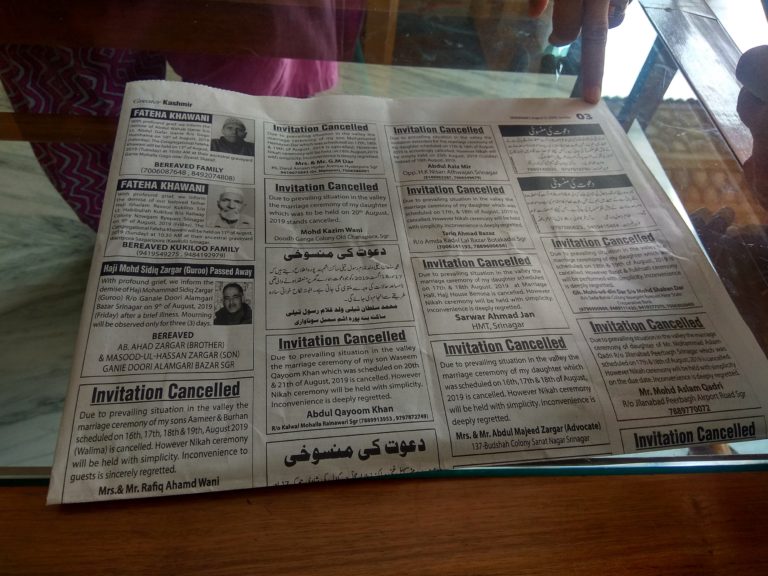
Invitations cancelled I Image courtesy Kavita Krishnan
-
Between 5-9 August, people had suffered for lack of food, milk, and basic needs. People had been prevented even from going to hospitals in case of sickness.
-
The Government claim is that only Section 144 has been imposed, not “curfew”. But in reality, police vans keep patrolling Srinagar warning people to “stay safe at home and not venture out during the curfew”, and tell shops to close their shutters. They demand that people display “curfew passes” to be allowed to move about.
-
All of Kashmir is under curfew. Even on Eid, the roads and bazaars were silent and desolate. All over Srinagar, mobility is restricted by concertina wires on streets, and massive paramilitary deployment. Even on Eid, this was the case. In many villages, azaan was prohibited by the paramilitary and people were forced to do namaaz prayers at home rather than collectively at the mosque as it usual on Eid.
-
In Anantnag, Shopian and Pampore (South Kashmir) on the day of Eid, we only saw very small kids dressed in Eid finery. Everyone else was in mourning. “We feel like we’re in jail”, said a woman in Guree (Anantnag). Girls in Nagbal (Shopian) said, “With our brothers in police or army custody, how can we celebrate Eid?”
-
On 11 August, on the eve of Eid, a woman at Sopore told us she had come to the bazaar during a brief respite in the curfew, to buy a few supplies for Eid. She said: “We were prisoners in our own homes for 7 days. Even today, shops are closed in my village Langet, so I came to Sopore town to shop for Eid and to check on my daughter who is a nursing student here.”
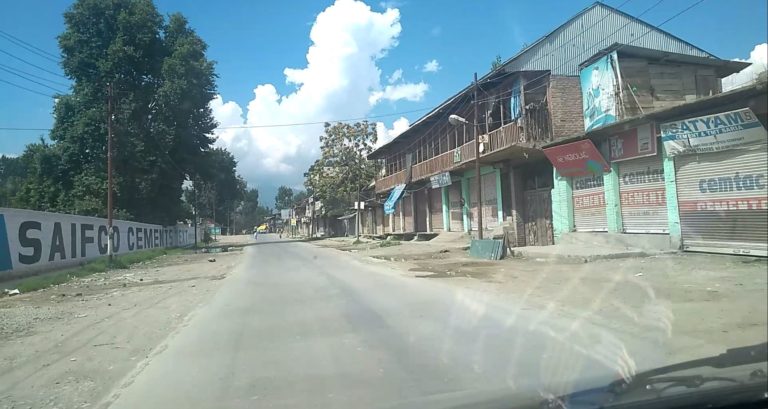
Eid in Pulwama | Image courtesy Kavita Krishnan
-
“It’s Army rule not Modi rule. There are more soldiers here than people”, said a young baker at Watpura near Bandipora. His friend added, “We’re afraid, because the army camp nearby keeps imposing impossible rules. They insist we have to return within half an hour if we leave home. If my kid isn’t well, and I have to take her to the hospital, it may take more than half an hour. If someone visits their daughter who lives in next village, they may take more than half hour to return. But if there’s any delay, they will harass us.” The CRPF paramilitary is everywhere, outside nearly every home in Kashmir. These are clearly not there to provide “security” to Kashmiris – on the contrary, their presence creates fear for the people.
-
Sheep traders and herders could be seen with unsold sheep and goats. Animals they had been rearing all year long, would not be sold. This meant they would incur a huge loss. With people unable to earn, many could not afford to buy animals for the Eid sacrifice.
-
A shopkeeper from Bijnore (UP) showed us the stacks of unsold sweets and delicacies going waste, since people could not buy them. Shops and bakeries wore a deserted look on the eve of Eid, with their perishable food items lying unsold.
-
An asthmatic auto driver in Srinagar, showed us his last remaining dose of salbutamol and asthalin. He had been trying for the past several days to buy more – but the chemists’ shops and hospitals in his area had run out of stocks. He could go to other, bigger hospitals – but CRPF would prevent him. He showed us the empty, crushed cover of one asthalin inhaler – when he told a CRPF man he needed to go further to get the medicine, the man stamped on the cover with his boot. “Why stamp on it? He hates us, that’s why”, said the auto driver.
Protests, Repression, and Brutality
-
Some 10,000 people protested in Soura (Srinagar) on 9 August. The forces responded with pellet gun fire, injuring several. We attempted to go to Soura on 10 August, but were stopped by a CRPF barricade. We did see young protestors on the road that day as well, blockading the road.
-
We met two victims of pellet gun injuries in SMHS hospital in Srinagar. The two young men (Waqar Ahmad and Wahid) had faces, arms and torso full of pellets. Their eyes were bloodshot and blinded. Waqar had a catheter in which the urine, red with blood from internal bleeding, could be seen. Their family members, weeping with grief and rage, told us that the two men had not been pelting stones. They had been peacefully protesting.
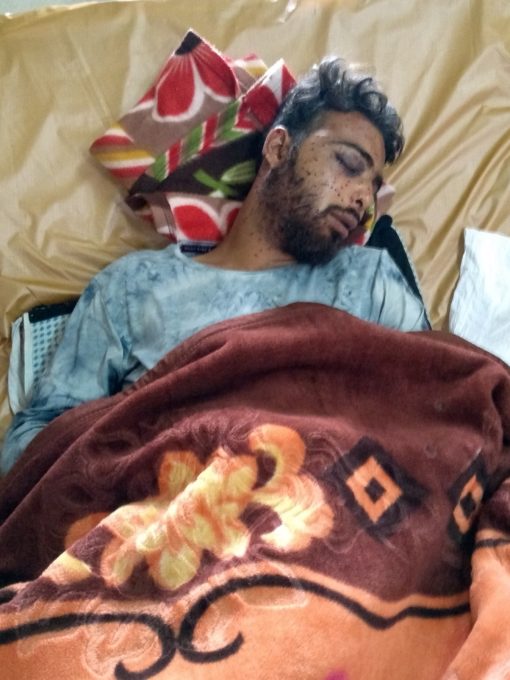
Pellet gun victim | Image courtesy Vimal Bhai
-
On 6 August, a graphic designer for the Rising Kashmir newspaper, Samir Ahmad, (in his early 20s) had remonstrated with a CRPF man near his home in the Manderbag area of Srinagar, asking him to allow an old man to pass. Later the same day, when Samir opened the door to his house, CRPF fired at him with a pellet gun, unprovoked. He got 172 pellets in his arm and face near the eyes, but his eyesight is safe. It is clear that the pellet guns are deliberately aimed at the face and eyes, and unarmed, peaceful civilians standing at their own front doors can be targets.
-
At least 600 political leaders and civil society activists are under arrest. There is no clear information on what laws are invoked to arrest them, or where they are being held.
-
A very large number of political leaders are under house arrest – it is impossible to ascertain how many. We tried to meet CPIM MLA Mohd Yusuf Tarigami – but were refused entry into his home in Srinagar, where he is being under house arrest.
-
In every village we visited, as well as in downtown Srinagar, there were very young schoolboys and teenagers who had been arbitrarily picked up by police or army/paramilitary and held in illegal detention. We met a 11-year-old boy in Pampore who had been held in a police station between 5 August and 11 August. He had been beaten up, and he said there were boys even younger than him in custody, from nearby villages.
-
Hundreds of boys and teens are being picked up from their beds in midnight raids. The only purpose of these raids is to create fear. Women and girls told us of molestation by armed forces during these raids. Parents feared meeting us and telling us about the “arrests” (abductions) of their boys. They are afraid of Public Security Act cases being filed. The other fear is that the boys may be “disappeared” – i.e killed in custody and dumped in mass graves of which Kashmir has a grim history. As one neighbour of an arrested boy said, “There is no record of these arrests. It is illegal detention. So if the boy “disappears” – i.e is killed in custody – the police/army can just say they never had him in custody in the first place.”
-
But the protests are not likely to stop. A young man at Sopore said: “Jitna zulm karenge, utna ham ubharenge” (The more you oppress us, the more we will rise up) A familiar refrain we heard at many places was: “Never mind if leaders are arrested. We don’t need leaders. As long as even a single Kashmiri baby is alive, we will struggle.”
The Gag On Media
-
A journalist told us: “Newspapers are printing in spite of everything. Without the internet, we do not get any feed from agencies. We were reduced to reporting the J&K related developments in Parliament, from NDTV! This is undeclared censorship. If Govt is giving internet and phone connectivity to police but not to media houses what does it mean? We had some people come to our offices, speaking on behalf of Army and CRPF, asking “Why are you publishing photos of the curfew-affected streets?”
-
Kashmiri TV channels are completely closed and unable to function.
-
Kashmiri newspapers that carry the barest mention of protests (such as the one on Soura) are made to feel the heat from the authorities.
-
Foreign press reporters told us that they are facing restrictions on their movement by the authorities. Also, because of the lack of internet, they are unable to communicate with their own main offices.
-
When we visited Press Enclave in Srinagar on 13 August, we found the newspaper offices closed and the area deserted except for a few stray journalists, and some CID men. One of the journalists told us that papers could not be printed till at least 17 August, because they have run out of newsprint which comes from Delhi.
-
As mentioned above, one graphic designer working with a newspaper suffered pellet gun injuries, during a completely unprovoked attack by CRPF
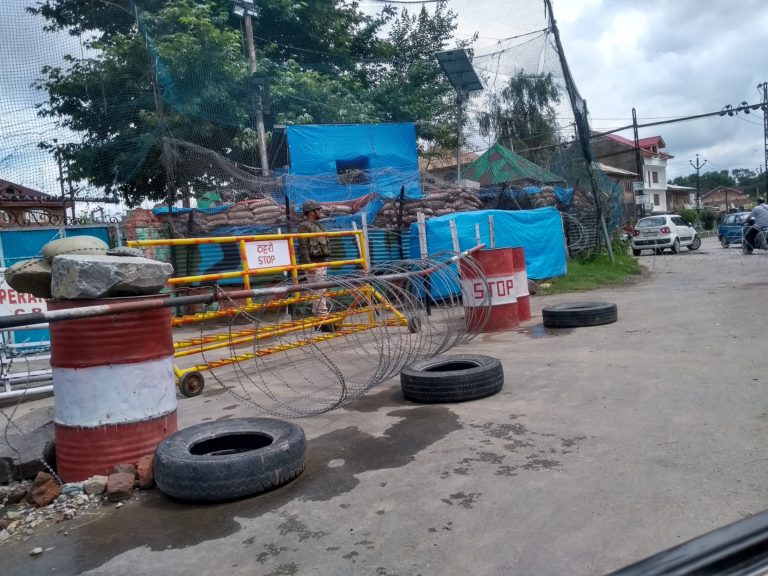
A checkpoint in Srinagar | Image courtesy Vimal Bhai
Does Kashmir Lack Development?
In an op-ed in the Times Of India (August 9, 2019), former Foreign Secretary and Ambassador Nirupama Rao wrote: “A young Kashmiri told this writer a few months ago her birthplace was in the “stone age”; that in terms of economic development, Kashmir was two hundred years behind the rest of India.”
We struggled to find this “backward”, “stone age” Kashmir anywhere at all.
-
It is striking how in every Kashmiri village, we found young men and women who go to college or University; speak Kashmiri, Hindi and English fluently; and are able to argue points of Constitutional and international law in relation to the Kashmir conflict with factual accuracy and erudition. All four of the team members are familiar with villages in North Indian states. This high level of education is extremely rare in any village in, say, Bihar, UP, MP, or Jharkhand.
-
The homes in rural Kashmir are all pucca constructions. We saw no shacks like the ones that are common in rural Bihar, UP, Jharkhand.
-
There are poor people in Kashmir, certainly. But the levels of destitution, starvation and abject poverty seen in many North Indian states, is simply absent in rural Kashmir.
-
We met migrant labourers from North India and West Bengal at many places. They told us that they feel safe and free from xenophobic violence that they face in, say, Maharashtra or Gujarat. Daily wage migrant labourers told us “Kashmir is our Dubai. We earn Rs 600 to Rs 800 per day here – that is three or four times what we earn in other states.”
-
We found Kashmir refreshingly free of communal tension or mob lynchings. We met Kashmiri pandits who told us they felt safe in Kashmir, and that the Kashmiris always celebrate their festivals together. “We celebrate Eid, Holi, Diwali together. That is our Kashmiriyat. It is something different, special,” said one Kashmiri Pandit young man.
-
The myth of the “backward” Kashmiri woman is perhaps the biggest lie. Kashmiri girls enjoy a high level of education. They are articulate and assertive. Of course, they face and resist patriarchy and gender discrimination in their societies. But does BJP, whose Haryana CM and Muzaffarnagar MLA speak of “getting Kashmiri brides” as though Kashmiri women are property to be looted, have any right to preach feminism to Kashmir? Kashmiri girls and women told us, “We are capable of fighting our own battles. We don’t want our oppressors to claim to liberate us!”
The BJP Spokesperson’s “Warning”
We met BJP spokesperson on Kashmir affairs, Ashwani Kumar Chrungoo at the office of Rising Kashmir, a Kashmir newspaper. The conversation was initially cordial. He told us he had come to Kashmir from Jammu to persuade people to support the abrogation of Article 370. His main argument was that since the BJP had won a 46% vote share in J&K and had won an unprecedented majority in Parliament, they had not only a right but a duty to keep their promise of scrapping Article 370. “46% vote share – that’s a license”, he said.
He refused to acknowledge that this 46% vote share while winning only three Lok Sabha seats (Jammu, Udhampur and Ladakh) was possible only because the voter turnout in the three other LS seats (Srinagar, Anantnag and Baramulla) was the lowest in the whole country.
Should a Government impose an unpopular decision on people of Kashmir who have not voted for that decision, at gunpoint? Chrungoo said, “In Bihar when Nitish Kumar imposed prohibition, he didn’t ask the alcoholics for their permission or consent. It’s the same here.” His contempt for the people of Kashmir was evident from this analogy.
Towards the end of the conversation, he became increasingly edgy when confronted by facts and arguments by us. He got up and wagged a finger at Jean Dreze, saying “We won’t let anti-nationals like you do your work here. I am warning you.”
Conclusion
The whole of Kashmir is, at the moment, a prison, under military control. The decisions taken by the Modi Government on J&K are immoral, unconstitutional and illegal. The means being adopted by the Modi Government to hold Kashmiris captive and suppress potential protests are also immoral, unconstitutional, and illegal.
-
We demand the immediate restoration of Articles 370 and 35A.
-
We assert that no decision about the status or future of J&K should be taken without the will of its people.
-
We demand that communications – including landline telephones, mobile phones and internet be restored with immediate effect.
-
We demand that the gags on the freedom of speech, expression and protest be lifted from J&K with immediate effect. The people of J&K are anguished – and they must be allowed to express their protest through media, social media, public gatherings and other peaceful means.
-
We demand that the gags on journalists in J&K be lifted immediately.
Jean Drèze, economist
Kavita Krishnan, Communist Party of India (Marxist-Leninist) and AIPWA
Maimoona Mollah, All India Democratic Women’s Association (AIDWA)
Vimal Bhai, National Alliance of People’s Movements (NAPM)
Soon Doctors Will Screen Everyone For Drugs
MassPrivateI | August 15, 2019
Imagine in the not too distant future your job, college ID, drivers license, passport, gun permit, health insurance etc., will depend on you passing a mandatory drug screening.
What is that you say? It could never happen in America.
It could happen sooner than you think if the U.S. Preventative Services Task Force (USPSTF) has anything to say about it.
 According to a recent Los Angeles Times article, the USPSTF wants doctors to screen everyone for drug use.
“Questions about drug use should not only cover the possibility that a patient is taking illegal street drugs like cocaine or heroin, the task force said. They should also explore whether a patient might be sneaking pills from a family member’s pain medication or getting a boost from stimulants prescribed for a child with attention-deficit/hyperactivity disorder.”
“The USPSTF recommends screening for illicit drug use in adults age 18 years or older”, according to their draft report.
Big Brother really wants to know if you are using illegal street drugs or prescription drugs, and they have given doctors numerous drug screening tools to find out.
Primary care practices are asked to use the following drug screening tools:
- The six-question BSTAD [Brief Screener for Tobacco, Alcohol, and Other Drugs]),
- The eight-item ASSIST [Alcohol, Smoking and Substance Involvement Screening Test] risk assessment–based tool),
- TAPS [Tobacco, Alcohol, Prescription Medication, and Other Substance Use]) may be useful when clinicians are concerned about prescription misuse.
- NIDA’s. Screening and Assessment Tools Chart,
- NIDA’s Screening for Drug Use in General Medical Settings: A Resource Guide for Providers
- SAMHSA’s -Health Resources and Services Administration Center for Integrated Health Solutions. Substance Use Disorder and Pregnancy
- Center for Substance Abuse Treatment. A Guide to Substance Abuse Services for Primary Care Clinicians
- SAMHSA’s Finding Quality Treatment for Substance Use Disorders
Some will say that this is merely a recommendation and that doctors would never screen everyone for drug use.
But it is already happening to welfare applicants in at least 15 states.
According to the National Conference of Legislatures, at least 15 states have passed legislation regarding drug testing or screening for public assistance applicants or recipients.
When is the last time you or someone you know went to the doctor’s for an unrelated pain or bruise. Did the doctor ask you or them about drug usage? Of course they did.
But if you will not take my word for it, then perhaps you will take Dr. Gary LeRoy’s word for it,
“We’ve been doing this for almost a decade in my office,” said Dr. LeRoy, a staff physician at the East Dayton Health Clinic in Dayton, Ohio, and president-elect of the American Academy of Family Physicians.
Dr. Carol Mangione, the chief of general internal medicine at the David Geffen School of Medicine at UCLA told Stat News, “This is a big change that we’re really excited about. Effective treatment is where we will finally begin to move the needle on the epidemic.”
The National Institute on Drug Abuse created a “resource guide” that doctors have been using for almost a decade to ask patients about drug use.
According to the USPSTF’s “Draft Recommendation Statement,” about 50% to 86% of pediatricians report that they routinely screen patients for substance use.”
Will all hospitals and doctors adopt the USPSTF’s recommendations?
The New York Times warns “the group’s guidelines are not binding on doctors but they carry weight.”
The Los Angeles Times warns, “the task force is a group of experts who advise the federal government on disease prevention.”
And that is the key takeaway from this story. The USPSTF might claim to be an “independent, volunteer panel of national experts in prevention and evidence-based medicine. But each year, they send a graded recommendation to Congress, like this one, about mandatory drug screening.
As I mentioned earlier, most hospitals and doctors already ask their patients about their drug use. So it is really only a matter of time before the USPSTF convinces Congress to make it mandatory.
We must boycott Israeli sports as we did with Apartheid South Africa
By Ramzy Baroud | MEMO | August 14, 2019
The Palestinian Football Association is struggling to survive. Combined US-Israeli pressure on Palestinian organisations that provide aid and support to the Palestinian people is now felt in the field of sports as well. In recent months, the association’s budget has been slashed by more than half, and the new football season may be cancelled entirely.
In Palestine, football in particular, represents more than just a game. It provides respite, continuity, hope, and unity.
The Palestine Football Association has been in existence since 1928, that is 20 years before Israel was founded on destroyed Palestinian cities, towns and villages. But, not even the tragic Nakba would end the sport in Palestine. When Palestine was admitted as a full member of the Fédération Internationale de Football Association (FIFA) in 1998, a rare moment of triumph prevailed over the sense of political stagnation. The Palestinian national team became a representation of a collective sense of pride and defiance. It meant that despite Israeli military restrictions, the targeting of Palestinian athletes and the bombing of stadiums and sports facilities, Palestinians continue to embrace life and thrive.
Even after the factional clash between Fatah and Hamas and the subsequent political disconnect between Gaza and the West Bank, sports continued to provide a critical outlet for unity. While Gaza and the West Bank have their own football leagues, they still competed in a final match to determine the winner of the Palestine Cup.
Alas, last month, Israel prevented the Rafah football team from reaching the West Bank, to meet its Balata Youth Centre rivals in the Cup’s final match.
Israel’s restrictions on Palestinian sports is relentless and is part of a long record of making it nearly impossible for Palestinians to pursue activities that should have no bearing on “Israel’s security”.
The Palestine national team is possibly the most beleaguered football team in the world today.
“Due to Israeli restrictions, the Palestinian national team has been banned from playing their home games in Palestinian stadiums for many years and is forced to host them in nearby Arab countries,” wrote Hazem Balousha in Arab News. Effectively, this means that all Palestinian football training camps have to be held outside Palestine, often with the team’s Gaza squad unable to join their peers. Meanwhile, no foreign trainers are allowed to enter besieged Gaza.
Moreover, the occasional news of a Palestinian footballer being shot, beaten or imprisoned, though tragic, is routine news for Palestinians.
Israel has, however, hardly received any serious reprimand for its unlawful actions. Despite Tel Aviv’s constant violations of Palestinian sports rights, FIFA and other international sports federations continue to treat Israel with kid gloves. Worse, instead of being punished for violating international law regarding sports, Israel is often rewarded. The fact that Israel’s Football Association includes six teams from illegal Jewish settlements (colonies that are built on stolen Palestinian land) seems to be of no consequence to FIFA’s bosses.
Recently, the sports brand, Puma has replaced Adidas as the sponsor of Israel’s national football teams. The decision indicates that the company is completely oblivious to sports apartheid in Israel. Puma’s lack of sportsmanship is now the subject of a major international boycott campaign led by the Boycott, Divestment and Sanctions (BDS) movement. Over 200 Palestinian sports clubs support the call on Puma to end its dealings with Israel, in an attempt to pressure Israel to put an end to its violations of Palestinian human rights.
In fact, Israel should be boycotted in every possible way until it relents and respects international law regarding the rights and freedom of the Palestinian people. Often, however, we overlook the centrality of sports boycott in the overall boycott strategy.
Sports boycott engages, not only politicians and intellectuals but also ordinary people around the world. “The case for football boycott of Israel is just as compelling as that of football boycott of South Africa,” BDS wrote on its homepage. For one, “boycott would spread awareness of Israeli racism and abuse of Palestinian human rights across the football community worldwide.”
Moreover, boycotting Israeli sports, especially football, will deny Israel an important tool aimed at normalising its military occupation, apartheid, and racism. It will force ordinary Israelis to think about the consequences of their support of right-wing racist governments. It could, in fact, it will espouse a serious debate in Israel.
This same logic worked in Apartheid South Africa and was a powerful tool in the international support for the anti-Apartheid movement in that country.
But with FIFA and others turning a blind eye to Israeli violations, Palestinians continue to suffer while Israel continues to sell itself as a sports-loving member of FIFA and other sports organizations.
“Divestment and boycotts are familiar tactics from the international anti-apartheid movement, but they didn’t match the psychological power of the sports boycott,” wrote Tony Karon in the National.
“Rugby was an essential part of the identity of the South African regime’s base, and denying their ability to compete on an international stage was one of the most painful sanctions in the minds of many apartheid supporters.”
As for FIFA, it suspended the membership of the Football Association of South Africa in 1961, followed by a decision, in 1968 by the United Nations General Assembly that called for boycotting all sports bodies in South Africa that practiced apartheid. The pressure continued to mount, uniting international solidarity around clear and achievable objectives.
Many organisations have taken the lead in their respective countries to create a similar movement for Palestine. Israel must not be allowed to participate in international sports while simultaneously cementing its apartheid, racist regime in Palestine.
India’s narrative on J&K is hyperbolic
By M. K. BHADRAKUMAR | Indian Punchline | August 13, 2019
Editorials have appeared in two leading Delhi newspapers today (here and here) urging the government to present a credible, appealing diplomatic narrative on the J&K developments.
The Indian narrative so far is largely focused on the domestic audience. It has gone to ridiculous extents by projecting that the situation is actually quite “normal” in J&K. Pictures of National Security Advisor Ajit Doval savouring (mutton) biryani with Kashmiri Muslims on a street corner in Srinagar have been doing the rounds. (Indeed, it was a charade to hoodwink the public.)
Crude propaganda won’t win hearts and minds. A narrative has to be crafted rationally. It’s common knowledge that there is little acceptance of the government move among Kashmiri Muslims.
When it comes to the external projection of the Indian narrative, given the fact that India’s case is flying in the face of international law and the UN Charter, the government must be capable of sensitivity.
The government would have seized the initiative at the diplomatic level if only soon after Home Minister Amit Shah piloted through both houses of the parliament at breakneck speed the legislation on abrogating Article 370 of the constitution, External Affairs Minister S. Jaishankar had stood up and made a suo moto statement offering to discuss all differences with Pakistan bilaterally in a comprehensive dialogue in the best interests of regional security, peace and stability.
Of course, such a momentous initiative would have required imagination, far-sightedness and wisdom — and, most important, political courage at the leadership level. The shortfall in statecraft and diplomacy is appalling.
A self-righteous attitude will not do. Take EAM’s demarche with the Chinese counterpart State Councilor and Foreign Minister Wang Yi in Beijing on Monday. The MEA readout spells out the Indian stance on the following lines:
One, constitutional amendment is an “internal matter for India” and the “sole prerogative of the country”.
Two, abrogation of J&K’s special status (including changes in Ladakh’s status) is aimed at “promoting better governance and socio-economic development”.
Three, the government move has “no implication for either the external boundaries of India or the Line of Actual Control” with China.
And, four, India is “not raising any additional territorial claims.”
Incredibly enough, this was how EAM brushed aside China’s “serious concern over the recent escalation of turmoil in Kashmir” – that “any unilateral action that may complicate the situation in Kashmir should not be taken; that the Kashmir issue is a dispute born out of the region’s colonial history and should be properly handled in a peaceful way in line with the UN Charter, relevant resolutions of the UN Security Council and bilateral agreements between Pakistan and India”; and, its expectation that “India will play a constructive role in regional peace and stability.” (here, here, here, here and here)
EAM’s rejoinder may have some resonance domestically within India as a macho attitude, but it will only arouse mirth and derision abroad — even in the diplomatic enclave in Chanakyapuri area.
No P5 member country has officially voiced support for India. There is no shred of evidence that the Russian Foreign Ministry voiced support for India on the issue — not on the FO website; neither in a Tass or Novosti report nor even in the irrepressible Russian press. Some fly-by-night operator well-versed with the Indian rope trick, apparently spread fake news on a Friday night and it became “breaking news” in India by next morning. Pathetic.
Simply put, the Indian stance articulated by EAM is fundamentally flawed in logic and can only be counter-productive, as it shuts the door on discussion. The point is, Kashmir is an international dispute and India unilaterally changed J&K’s “status” in violation of the relevant UN resolutions. No one will accept India’s claim that it is an “internal matter”.
World opinion accepts that Pakistan is a party to Kashmir dispute. It is beside the point that India is not redrawing boundaries. And it’s gratuitous to say there is “no implication” for the LOC or the LOAC. If things were that simple, why couldn’t Modi government stomach the CPEC passing through Gilgit-Baltistan? We screamed, “territorial sovereignty” blah, blah.
World opinion will only believe that Delhi’s real intention is to change the demographic balance so that there shall be no Muslim-majority entity henceforth within the Indian Union.
If such unilateral acts in modern history are as simple as “internal matter”, why is no one recognising Russia’s annexation of Crimea? Why is Beijing so sensitive on intervention in Hong Kong? Why is the US insisting on “freedom of navigation” in South China Sea? Why is the US raising eyebrow over the North Sea Route and the Arctic? What is wrong with Iran’s claim over Persian Gulf as sovereign territory? What prevents Sri Lanka’s Mahinda Rajapaksa from solving the Tamil problem in similar fashion (as he hinted last week)?
The Modi government will be creating a long-term, intractable problem for India for generations to come by adopting such an ostrich approach. Analysts have pointed out (here and here) that the change in Ladakh’s status makes the India-China border dispute incredibly complicated and all but unsolvable. India’s international standing can get seriously damaged.
The only way to address the conundrum is to propose to Pakistan that India is ready to discuss these differences. Fortuitously, Pakistan also faces the unhappy situation that no one in the international community is showing willingness to stand up and be counted as its partner to push back at India.
The bottom line is that India enjoys wide acceptance for its insistence on bilateralism to resolve differences with Pakistan. India should now tactfully exercise this privilege. It is always possible to hold out informal assurances that there’ll be no “colonisation” of Kashmir valley. After all, we have such safeguards for many regions of India.
The window of opportunity shall not remain open for long. From all accounts, the ground situation in J&K is explosive and the grating roar of human misery is approaching. PM Imran Khan’s prognosis on another Pulwama is not off the mark. For Delhi to build a new architecture in J&K out of the debris all around, a dialogue with Pakistan is critically important.
Mediation Is the Way Forward for Kashmir
By Brian Cloughley | Strategic Culture Foundation | August 13, 2019
It so happened that when the most recent Kashmir crisis broke on 5 August I was at a gathering of the UN Blue Berets of Kashmir. We served together in that beautiful but now chaotic region 39 years ago and have had a reunion almost every year since then. We have rarely been able to discuss good news about Kashmir, because there hasn’t been any.
The August decision by India’s ultra-nationalist Prime Minister to unilaterally change the status of the territory is only one of the many disasters to befall it in the seventy years since the Muslim majority state, the fiefdom of a Hindu Maharaja, was allocated to India by the colonial British who in 1947 had been forced to grant independence to India, resulting in creation of the separate nations of Pakistan and India which disagree about the status of the territory.
Before examining the Indian government’s recent actions, a most important aspect of the Kashmir dispute has to be clarified. It concerns the matter of bilateralism as interpreted by India. This was indicated, for example, by the newspaper the Chandigarh Tribune which stated on 8 August that “UN chief Antonio Guterres has recalled the Simla Agreement of 1972, a bilateral agreement between India and Pakistan that rejects third-party mediation in Kashmir after Islamabad asked him to play his ‘due role’ following New Delhi’s decision to revoke Jammu and Kashmir’s special status.”
The Tribune is one of India’s best newspapers. Its reports are usually factual, objective and well-written. But it is flat wrong in its contention that the Simla Accord “rejects” third party mediation about Kashmir, because it most certainly does no such thing.
The Tribune was retailing the policy of the Indian government whose External Affairs Minister Subrahmanyam Jaishankar announced on 2 August that he had “conveyed to American counterpart Mike Pompeo, this morning in clear terms, that any discussion on Kashmir, if at all warranted, will only be with Pakistan and only bilaterally.” India has for decades insisted that involvement of any third party is not permissible and that there can be no mediation.
It is obvious why India refuses to countenance mediation — because it is almost certain that any independent, objective mediator would make the point that UN Security Council agreements still apply to the territory, and that none of them, most notably the matter of a plebiscite, have been annulled or in any manner diluted. As the BBC has noted, “In three resolutions, the UN Security Council and the United Nations Commission in India and Pakistan recommended that as already agreed by Indian and Pakistani leaders, a plebiscite should be held to determine the future allegiance of the entire state.”
But it is India’s relentless and wilful misinterpretation of its existing accord with Pakistan that is the greatest blockage in the path to reconciliation.
The Simla Agreement between India and Pakistan was signed by Prime Minister Indira Gandhi and President Zulfiqar Ali Bhutto following the 1971 war between the countries, which resulted in creation of Bangladesh, formerly East Pakistan. It lays down that “the principles and purposes of the Charter of the United Nations shall govern the relations between the two countries” and “the two countries are resolved to settle their differences by peaceful means through bilateral negotiations or by any other peaceful means mutually agreed upon between them . . .”
First, the mention of the United Nations, which is important because the UN Charter states in Paragraph 33 that “The parties to any dispute, the continuance of which is likely to endanger the maintenance of international peace and security, shall, first of all, seek a solution by negotiation, enquiry, mediation, conciliation, arbitration, judicial settlement, resort to regional agencies or arrangements, or other peaceful means of their own choice.”
Mediation and arbitration are proposed, and the Simla Accord does not in any way discount or reject them. Its statement “That the two countries are resolved to settle their differences by peaceful means through bilateral negotiations or by any other peaceful means mutually agreed upon between them” is quite clear that by inclusion of the phrase “or by any other peaceful means” that mediation is not excluded.
India is intent on becoming a permanent member of the UN Security Council, but this will be impossible if it continues to ignore the content of the UN Charter Chapter 1, Article 1, Paragraph 1, which says its aim is “To maintain international peace and security, and to that end: to take effective collective measures for the prevention and removal of threats to the peace, and for the suppression of acts of aggression or other breaches of the peace, and to bring about by peaceful means, and in conformity with the principles of justice and international law, adjustment or settlement of international disputes or situations which might lead to a breach of the peace.”
It is difficult to see how India’s inflexible opposition to international mediation can benefit India or — much more importantly — the twelve million inhabitants of Indian-administered Kashmir. The decision by Prime Minister Modi to annul Article 370 of the Constitution and thus abolish the special status of Indian-administered Kashmir was simply a movement in his ultra-nationalist campaign to ensure supremacy of Hindus. Since 1948 the Article has meant that the territory’s citizens have their own Constitution, their own laws, and the right to property ownership, with non-Kashmiris not being permitted to buy land. It is this last that is a major life-changer for the region, because southern Hindus will now be encouraged to by land and property, and gradually (or perhaps not-so-gradually) displace the Kashmiris themselves.
Modi promised “new opportunity and prosperity to the people” — but if he thought, before he made the announcement about annulment of citizen’s rights, that this would be greeted with enthusiasm and that his policy would indeed benefit the people of the territory, then why did he send “tens of thousands of Indian troops . . . in addition to the half a million troops already stationed there”? Why did the Central Government “shut off most communication with [the territory], including internet, cellphone and landline networks”?
Obviously he was expecting resentment from every Kashmiri. And he got it.
Even the news outlet India Today was slightly bemused, and three days before the Modi decision was made public reported that “In the past one week, the Narendra Modi government has decided to send an additional 38,000 troops to the Kashmir Valley in two batches — 10,000 and 28,000. This follows a statement by the home ministry in Parliament that the situation has improved in Kashmir Valley.” In other words the Central Government was well aware that the Constitution decision would provoke anger and bitterness on the part of Kashmiris and was well-prepared to take military action to crush any manifestation of discontent.
The New York Times observed that “Clamping down on millions of people is an extraordinary step for the world’s largest democracy. . . As tensions have risen in recent days, groups of young men, full of years of pent-up frustration, have squared off with soldiers, hurling rocks and ducking buckshot. Security forces arrested more than 500 people and put them in makeshift detention centres.”
On 9 August a reporter for the UK’s Guardian managed to find out that because of the clampdown on communications “people cannot call relatives, or call ambulances if there is an emergency. Public transport is not running, which means those with health problems can only get to a hospital if they have a car – and even then they struggle to get far. Across the city, many roads are permanently blocked by loops of barbed wire. At checkpoints, people – including families with children – can be seen pleading with police to let them pass. Most people, nervous that tensions were building last week, had stocked up on food and essentials, but it’s not known how long the curfew will last.”
On 10 August the BBC’s reporter filed that “Thousands of people took to the streets in Srinagar after Friday prayers, in the largest demonstration since a lockdown was imposed in Indian-administered Kashmir. The BBC witnessed the police opening fire and using tear gas to disperse the crowd. Despite that, the Indian government has said the protest never took place.”
Welcome to the Occupied Territory of Kashmir.
India and Pakistan continue to claim the whole of Kashmir, but neither government can seriously believe that any mediation tribunal would judge this to be appropriate. There would be compromise — the sort of compromise that India and Pakistan are incapable of reaching on their own.
If ever mediation was needed, it is now, before there is eruption that could lead to nuclear war between India and Pakistan.
When your beverage of choice is tritium
Welcome to France
By Linda Pentz Gunter | Beyond Nuclear | August 11, 2019
The headline — Police probe opened into rumours of unsafe tap water in Paris — raised hopes that nuclear operators might finally be held accountable for what appears to be routine radioactive contamination of drinking water in France.
News stories had circulated after a French radiological testing laboratory published findings on June 17, 2019, that more than six million French residents were drinking water contaminated with tritium released by the country’s nuclear power plants and other nuclear installations.
The laboratory — L’association pour le contrôle de la radioactivité dans l’Ouest or ACRO — raised the alarm because, it said, the presence of tritium implied there could be other radioactive isotopes in the water as well. None of the tritium levels they measured on this occasion, exceeded those French health authorities have established as “safe”, but research in the past has found higher levels, especially in groundwater, rivers and streams.
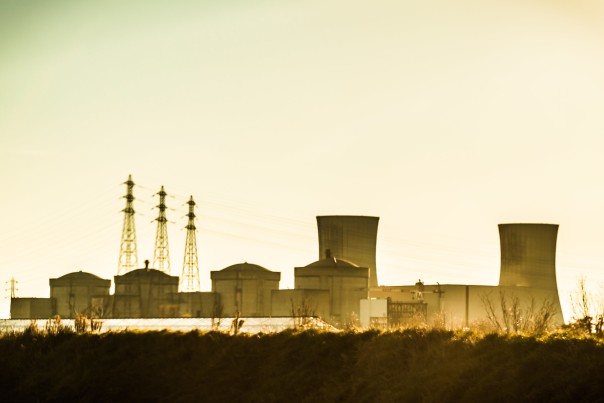
The Tricastin nuclear site — source of multiple leaks and radioactive releases over decades. (Creative Commons/xklima)
That “acceptable” level is 100 Becquerels per liter, not quite as arbitrary as the shocking 10,000 Bq/L level set by the World Health Organization, in thrall to the nuclear power-promoting International Atomic Energy Agency through a 1959 agreement.
The cities affected included Paris and its suburbs, and other large population areas in the Loire and Vienne regions of France such Orléans, Tours and Nantes.
Unsurprisingly, the story spread like wildfire, especially across social media, causing alarm among residents in the communities cited — 268 in all.
But the police investigation in Paris was not of EDF, the country’s chief nuclear facility operator. It was to root out fear-mongering purveyors of “fake news” among the citizenry who, according to the French state, were unnecessarily spreading panic among the populace by claiming drinking water containing tritium is unsafe.
It is.
The independent radiological testing lab CRIIRAD (Commission for Independent Research and Information on Radioactivity) denounced what it called the “trivialization of tritium contamination” and warned French citizens not to be lulled by the 100 Bq/L levels set by the authorities and especially not by the WHO’s 10,000 Bq/L standard. CRIIRAD said the level for tritium in drinking water should be set between 10 and 30 Bq/L.
For context, in our report, Leak First, Fix Later, we noted that the “naturally occurring” levels of tritium found in surface and groundwater is, at its highest, 1 Bq/l. Therefore, tritium is almost non-existent in water in nature.
To CRIIRAD, it is therefore all the more outrageous that that the levels for radiological contamination in France are set at “more than 100 times higher than the maximum allowed for chemical carcinogens.”
Tritium is radioactive hydrogen and is therefore assimilated by all living things as water. It has a half life of 12.3 years. It is produced in huge quantities in nuclear reactor cores, then released into the environment as a gas or in liquid discharges. Tritium cannot be filtered out of water and tritium released into the air can return in rainfall. All nuclear power plants release tritium, and nuclear reprocessing facilities — such as the one at La Hague on the French north coast — release even larger amounts.
These releases, including into rivers, streams and the sea, are regulated by authorities but, as CRIIRAD points out, at levels that are not so much safe as unavoidable, effectively granting nuclear installations “permission to pollute.”
“The liquid and atmospheric releases of tritium cause contamination of the air, water, the aquatic and terrestrial environment and the food chain,” wrote CRIIRAD in a statement put out after the tritiated drinking water news broke.
When rumors began to fly that drinking tap water had been banned, authorities quickly stepped in to “reassure” people that the levels of tritium in the water — already not actually safe according to CRIIRAD — were of no concern.
The criminality of nuclear plants across France releasing huge amounts of tritium into the environment was quickly turned on its head. Instead, in a sinister but not entirely unpredictable turn of events, given that France is a nuclear state, it would be ordinary citizens who would be committing a “crime” if they were found to be “publicizing, spreading and reproducing false information intended to cause public disorder,” according to an AFP article.
In reality, there was genuine cause for concern. ACRO had found levels of tritium in drinking water at 30 Bq/L on five occasions, then at 55 Bq/L and finally at 310 Bq/L in the Loire river.
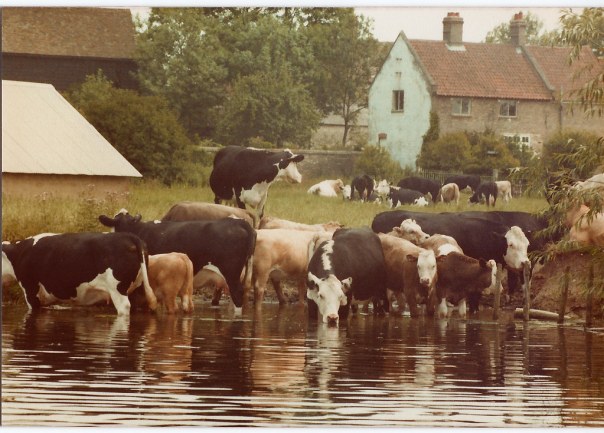
Picture entitled “Water makes milk.” In France, is that milk radioactively contaminated? (Photo: Graham Knott/Creative Commons)
But drinking tritiated water is not the end of the story — or the danger. Even though tritiated water may pass through the human body in about 10 days, about 10% of it binds organically inside the body. Organically bound tritium remains in the body for far longer than free tritium. According to CRIIRAD, this means that beta radiation from tritium can endure inside the body for years, causing chromosomal mutations, cancers and genetic mutations.
Tritium also binds organically to organisms in the environment such as aquatic plants present in rivers and streams into which nuclear facilities release tritiated water, or crops irrigated using water contaminated with tritium. These are in turn ingested by animals and humans — setting in motion tritium’s journey up the food chain.
The CRIIRAD statement notes the systematic downplaying of these risks by the nuclear safety regulator and other French governmental authorities.
This was never more apparent than during a law suit brought by CRIIRAD, the Sortir du nucléaire network, Stop Nucléaire 26-07 and FRAPNA Drôme in 2013 after the huge multi-unit Tricastin nuclear site leaked tritium into the groundwater at levels as high as 700 Bq/L.
EDF, Tricastin’s operator, claimed then that “tritium is a completely harmless radioactive isotope.”
Of course there is no such thing as a “safe dose.” Even the august and certainly not anti-nuclear National Academy of Sciences agrees. And as CRIIRAD points out, every dose increases the risk. “Since all living matter is made up of hydrogen atoms, a part of any tritium released will eventually be found in the cells of living organisms, including in the DNA, creating long-term internal irradiation that increases cancer risks (among others),” said the lab.
What of course got forgotten in all the dismissal and downplay by authorities — and in the attempts to criminalize those who sounded the alarm — is that some members of the population are more vulnerable than others when it comes to radiation exposure.

There is an Europe-wide movement to abolish the Euratom Treaty. (Photo: PLAGE)
Even while a daily dose of tritiated drinking water is not good for anyone, it is far more dangerous for babies and young children and for women, especially pregnant women. But those already bad standards don’t take the most vulnerable into account.
So how did the 100 BQ/L limit come about? It is no surprise to learn that it was the influence of Euratom (no conflict there) that boosted it that high.
After CRIIRAD had pushed for a 10 Bq/L limit before the European Parliament in 2012-2013, that body settled on a 20 Bq/L limit. But its decision was swept aside after “experts” at Euratom insisted on the 100 Bq/L limit. That, among other issues, is what spurred a Europe-wide movement to abolish the Euratom Treaty.
Clearly, what should have happened in France is an investigation into the cause and source of the tritium in drinking water. Instead, there was a propaganda campaign to neutralize concern and vilify those who sounded the alarm on safety. In Nuclear France, it’s never plus ça change, but always la même chose.
UK Government Says Considering Empowering Media Watchdog With Censoring Social Media Content
Sputnik -August 12, 2019
The UK government is considering plans to empower media watchdog Ofcom with regulating content on social media, a spokesperson for the Department for Digital, Culture, Media and Sport (DCMS) said on Monday.
“The directive proposed a number of appropriate measures to protect minors and the general public from harmful content. The government has proposed that Ofcom is given interim powers to regulate video-sharing platform services and ensure they comply with minimum standards set out in the AVMSD (Audiovisual Media Services Directive) by the transposition deadline – 19 September 2020. We are currently consulting on this approach”, the DCMS spokesperson said, as quoted by the Sky News broadcaster.
The AVMSD is an EU guideline aimed at coordination of national laws for online media content.
However, after the United Kingdom’s withdrawal from the bloc, which is now due to happen in less than three months, London may adopt its own legislation with a scope wider that the AVMSD, as well as create a new media watchdog to replace Ofcom, the spokesperson added.
In July, Ofcom fined RT 200,000 pounds for “serious failures to comply with our broadcasting rules”, claiming it did not preserve “due impartiality” in seven shows broadcast between March and April 2018.
The Russian Foreign Ministry reacted on the matter, calling Ofcom’s decision to penalise the RT broadcaster an “act of direct censorship”, adding it was part of a wider anti-Russian campaign.
Minister says Epstein’s French connections must be probed despite prison death
RT | August 12, 2019
Sex trafficker Jeffrey Epstein’s connections in France need to be investigated by the nation’s law enforcement, the French minister for gender equality said. Epstein died in US custody last week by alleged suicide.
The US investigation into Epstein’s alleged sexual abuses of minors was undermined by the disgraced financier’s death in a US jail. But it uncovered enough evidence involving France that merit a national investigation, Gender Equality Minister Marlène Schiappa said in a statement on Monday. Such a probe would be “fundamental for the victims” and will also help prevent sexual predation in the future, she argued.
Epstein died in what the authorities called an apparent hanging suicide while being held in custody at the Metropolitan Correctional Center in New York. He was charged with sexual exploitation of minors as young as 14.
The death may be a relief for many powerful people around the world, who allegedly partook in Epstein’s sexual predation dating back to at least 2002. Previously he was convicted for paying for sex with an underage girl and given an 18-month prison sentence.
Amazon Plant In China Accused Of Forcing High School Interns To Work 60 Hour Weeks

By Tyler Durden – Zero Hedge – 09/2019
In addition to not paying taxes and putting the entire brick and mortar retail industry out of business single-handedly, Amazon has now opened itself up to even more criticism. The company is being accused of using a Chinese assembly plant that relies on temporary workers, including high school interns, and overtime limits set beyond law, according to Bloomberg.
In fact, Foxconn fired two executives from the plant, which assembles Echo speakers and Kindle e-readers, in response to a labor group’s allegation that it cut wages and broke labor laws. This marks the second time that Amazon and its Taiwanese peer have been under scrutiny for the treatment of workers at the Hengyang plant.
The plant’s chief and head of human resources were fired, while managers at the plant who were responsible for using interns were “punished”, according to Foxconn.
China Labor Watch said:
“Amazon and Foxconn responded that they would make improvements to the factory’s working conditions. However, CLW’s 2019 investigation found that Foxconn’s working conditions did not improve, and instead deteriorated.”
The labor group deemed the factory’s wages too low to support a “decent standard of living last year”. Since then, they’ve been slashed another 16% in 2019.
The poor salary hasn’t been enough to fill the company’s 58 assembly lines, which require 7,000 people to operate during peak production, which begins in July. To fill the void, Foxconn instead tapped interns as young as 16 from vocational schools, some of which were forced to work overtime.
One 17 year old computing major at a vocational school, who was responsible for putting protective film over Amazon Echo Dots, said she worked 40 hour work weeks. She was then asked to start working overtime and put in 60 hour work weeks. When she complained to the manager, she reportedly was warned by her teacher that turning down the work could jeopardize her graduation.
Foxconn admits that its proportion of contract workers and student interns had “on occasion exceeded legal thresholds and that some interns had been allowed to work overtime or nights”.
“We were not in full compliance with all relevant laws and regulation,” Foxconn said. The company continued, in a statement:
“Effective immediately, the percentage of interns assigned to that facility will be brought into full compliance with the relevant labor law.”
The specific allegations made by the China Labor Watch report included:
- Interns from local vocational schools accounted for more than 20% of the plant’s current workforce, double the levels permitted by law
- Such student workers were forced to work night shifts and overtime, in violation of the law, and that some interns were physically and verbally abused by teachers overseeing their work
- The factory used “dispatch workers” — similar to temporary staff in the U.S. — for around one in three positions at the plant, in excess of the 10% permitted by law
- Some 375 workers had been asked to work overtime on Sunday without receiving makeup days off, contrary to labor rules that stipulate at least one scheduled day off per week
Foxconn has battled criticism of how it has treated its workers for over a decade now. Those critiques came to a head in 2010 when a rash of suicides by workers at the company forced it to make a major overhaul of how it treated workers.
A report from China Labor Watch last year once again shone a spotlight on the company, as well as on Amazon. Amazon claims that it asked Foxconn to make changes in 2018 after a labor audit of the Hengyang facility showed similar overtime violations. Amazon’s investigators arrived on site Wednesday and the company says it has started doing “weekly audits” of the labor issue. Let’s see how long that lasts.
Amazon commented: “We are urgently investigating these allegations and addressing this issue with Foxconn at the most senior level.”
8chan: The Latest Fearporn Drive
Guardian in Hysterics Over Threat of Homeless, Anonymous Shitposters
By Kit Knightly | OffGuardian | August 9, 2019
The Problem
8chan may have been shut down, but that doesn’t mean we’re safe.
You see, all the people that used 8chan before it was shut down are still out there. They might be on Twitter. They might be on Facebook. They might be ordering coffee at a Starbucks. They might be plotting some sort of far-right apocalypse. They might just be talking about movies on reddit. There’s no way of knowing.
We should all be terribly worried.
At least, according to The Guardian, who headline today:
8chan: ex-users of far-right site flock to new homes across internet
First off, of course, 8chan was not a “far-right site”, it was a site with some “far-right” people on it.
There are hundreds of boards on 8chan, with thousands upon thousands of different posters. Boards could be created by anyone to discuss anything.
The vast majority were dedicated to perfectly ordinary topics. Video games, fashion, cars, movies. There were many much more specific, fetishy, niche and weird… but not “far-right”. The site didn’t have an ideology except “free speech”.
The general shifting of “free speech” from something we all take for granted to being described as a “far-right agenda” is one of the most worrying trends in modern politics.
The article is actually funny, not least for the total lack of web literacy on display:
Former members of 8chan have scattered across the internet after the far-right site was shut down over the weekend
This is simply ridiculous to anyone who knows anything about the nature of 8chan et al. There are no “members”. That, indeed, is the whole entire point of the place. It is anonymous and temporary. No usernames, no registration, no “membership”.
The press has a long history of simply not being able to grasp the way the internet works (as in the famous “Who is this 4chan?” CNN interview or Fox’s “internet hate machine” piece), but this is such basic ignorance of the topic at hand that I almost can’t believe it’s genuine.
Indeed, it might not be. It might be that portraying “8chan” as some sort of organized community plays into the media’s need to generate fear. This generates, “the problem”, which sets us up for…
The Reaction
Having established that 8chan’s “far-right” “members” are out there in the ether, being terrifying, the article needs to get some feedback on what that means.
To do this they go to two “consultants”:
- Joan Donovan, who runs the Technology and Social Change (TaSC) Research Project
- Ben Decker the CEO of “Memetic Consultancy” (sic. It’s actually “Memetica”).
They are portrayed as two essentially different voices, as if we’re getting a spectrum of opinion. But the most cursory check on Donovan and Decker shows they are both research fellows at the Shorenstein Institute of the Kennedy School of Government. They aren’t separate. At all.
(NOTE: In fact, Memetica, Shorenstein, and other NGOs currently talking up the need for internet censorship are a ripe subject for a full-on exposé, and will be in the near future)
Not at all surprisingly, being research fellows for the same institute at the same university, Decker and Donovan absolutely agree on pretty much everything.
Primarily, that shutting down 8chan was a really good idea, but won’t – on its own – solve the “far-right” problem.
Apparently, all the people that posted on 8chan will NOT flee the internet forever, but will now just go and post somewhere else. Why anyone would need two Harvard-trained academics to tell them this, I don’t know.
Where will they go?
Well, other scary places of course. Like the “far-right forum” Gab, or back to 4chan or reddit. Some of them will be “absorbed” by the social media giants (meaning they will post on Twitter and Facebook), and some will post in discussions on encrypted message services like Telegram and Discord.
For some reason, Gab is a real bugbear for centrists, being regularly attacked simply for existing. Its one claim to infamy is that the Pittsburgh synagogue shooter apparently had a Gab account…this, apparently, makes it a far-right social network.
Niche and independent networks are always attacked by-association in this way. The Dayton shooter and “MAGABomber” both had twitter accounts, and the Christ Church attack was live-streamed on Facebook…but they are not shut down.
The Solution
Having established that shutting down 8chan was brilliant, but more is needed, our two NGO representatives set out what else needs to be done:
One way to prevent 8chan users from migrating to alternative social media spaces like YouTube and Facebook would be to build a moat around the platforms to prevent inbound links from these sites,”
This is total, complete nonsense. 8chan is gone, so “preventing inbound links” from it is now moot. Secondly, users don’t click from 8chan to YouTube, or Facebook or whatever. That’s not how the internet works. This would never control users crossposting, or prevent people having different accounts on different platforms or anything like that.
All this would do is prevent people from linking to sources. It stops the flow of information, not users. If Ben is really a “social media consultant”, he knows that. He’s just dishonestly suggesting censorship on totally spurious grounds.
There is an inherent value in deplatforming the site as a whole and making it harder to be accessed because the nature of these communities makes it difficult to inoculate the spread of this toxicity.”
Just “deplatform” websites “as a whole” if they are “toxic”. That’s the solution. Who decides what’s “toxic”?
Well, obviously the government does. Duh.
That’s just the start though. Whilst these Harvard academics give us the problem a reaction and just a hint of “solution”, elsewhere on the Guardian we are presented with a full, detailed (final?) solution.
Julia Ebner – another researcher for yet another creepy-sounding NGO the “Institute for Strategic Dialogue” – headlines:
How do we beat 8chan and other far-right sites? The same way we beat Isis
Essentially, as CJ Hopkins has written, this is just a rebranding of the War on Terror for a modern age. More like a remake, actually, to use Hollywood parlance. The same themes, the same characters. New dialogue. Different casting.
Bellingcat got in on this one too, hosting an article claiming:
Until law enforcement, and the media, treat these shooters as part of a terrorist movement no less organized, or deadly, than ISIS or Al Qaeda, the violence will continue.
(NOTE: The ISIS comparison is more than apt. Now would be a good time to remember just how phony and manipulated the ISIS narrative was. Catte did excellent work on this.)
Julia writes that what we need is:
a stronger international response to condemn political rhetoric that belittles, legitimises or even endorses the dangerous concepts and conspiracy theories of far-right extremists.
Translation – Governments cooperating to suppress free speech. “Conspiracy theories” can, and will, mean absolutely anything they want it to mean. The DNC fixing the primaries for Clinton, for example. Or the Skripals being poisoned by MI6. Press bias against Corbyn. Criticism of Israel, or even mentioning the “Labour Friends of Israel”. These can all be defined as “conspiracy theories”.
On top of this Julia wants:
an international definition of terrorism that is ideologically agnostic and includes not only traditional jihadi organisations but also loose far-right networks.
Translation – An international definition of terrorism that is loose enough to be deployed against anybody for anything.
“Terrorism” will become even more absurdly vague than it is now. These “loose far-right networks” will mean “anybody who posts on Gab”, or “anyone who thinks 9/11 was an inside job”. Joining certain Facebook groups, visiting certain websites (there was actually a meme about this one). Watching RT. She says “loose”, and she means it.
It will shock you how “loose” these networks are. You’re probably in one, right now, just for reading this article. Welcome to our “loose network of far-right extremists”.
Most importantly Julia thinks…
… governments will need to look beyond the big tech platforms and introduce legal frameworks that tackle the ongoing migration of extremists to the smaller alt-tech sites.
Translation – Banning certain opinions from the big platforms that cooperate with the state is not enough. We then need to move against the smaller, independent platforms that – unlike Google, Facebook and Twitter – refuse to toe the party line.
Censor Twitter, and shutdown any platform – like Gab or Parler – that attempts to fill the “free speech” market niche. The state machine will love that, because it gives it control of narrative and information flow, while the social media giants will love it because it essentially writes their monopoly into law. That’s a massive win-win.
In that sense it coincides perfectly with the famous Mussolini definition of fascism – “Fascism should more appropriately be called Corporatism because it is a merger of state and corporate power”
The establishment is signalling intent here – the way they always do when these opportunities are either presented to them, or created by them. Harness that fear, sense the opening, and drive the push through.
It’s all rather like that old joke – “Q: What do you call 1000 lawyers at the bottom of the ocean? A: A good start.”
Q: What do you call one website shut down for allowing free speech?
A: Just the beginning.
Kit Knightly is co-editor of OffGuardian. The Guardian banned him from commenting. Twice. He used to write for fun, but now he’s forced to out of a near-permanent sense of outrage.
The Unanswerable Case
By Craig Murray | August 9, 2019
Simon Jenkins gets it with this simple and unanswerable argument.
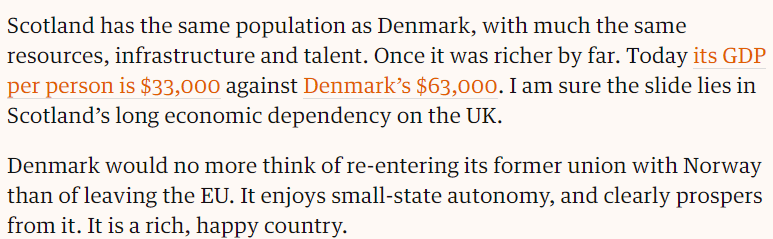
Scots are now very significantly poorer than the Irish, the Norwegians, the Swedes, the Danes, the Icelanders or any of their obvious comparators. Every one of those nations is in the top 10 of the UN Human Development Index. The UK is not, and Scotland is below the mean for the UK. It is not because Scots are stupid or feckless, it not because of climate and it is certainly not a lack of natural resources. It is because of the draining away of human and physical resource by London over centuries.
Against that fundamental fact, the cloud of stupid obfuscation around the minutiae of transition is a mere distraction, and a deliberate one at that. Countries which are far poorer than Scotland successfully run on their own currencies – scores of them. Why would people believe Scotland is unique among nations in being incapable of having a currency? Yet such pathetic shibboleths are pounded out by the media, and particularly the BBC, on a daily basis to make a significant number of Scots believe that what is possible for every nation that has tried it, is uniquely impossible to them.
It is particularly galling to see those that have made us poor tell us we cannot be independent because we are poor. Particularly when the entire system of government accounting has been manipulated over decades to ascribe Scotland’s revenue to the wider UK, to ascribe a portion of infrastructure projects in SE England such as Crossrail as Scottish expenditure, and to present an entirely distorted picture of the Scottish fiscal position.
I am entirely at the end of my patience. It really is time that we claimed our Independence and stopped this slavish adherence to the laws of the Imperial state which seeks to continue its leeching out of our resources.
Featured Video
The Search for Truth: Charlie Kirk’s Assassination One Year Later
or go to
Aletho News Archives – Video-Images
From the Archives
US murdering 1 million Iraqis is democracy, Iran giving yogurt to Iraq is “domination”
By Ali Salaam | American Herald Tribune | July 31, 2017
The New York Times, owned by the Zionist Jewish supremacist Ochs-Sulzberger family, has no problem with Iraqi suffering as long as Iran is not the one behind it.
The Iraq War was a genocide of the Iraqi people by Zionist supremacists in the Bush administration. Over 1 million innocent people were killed based on a lie. American soldiers died in an Israeli war and now an average of 22 soldiers commit suicide every day because their consciences cannot cope with the fact they committed crimes in an illegal war that served no purpose other than to benefit Israel, not America.
Benjamin Netanyahu, Prime Minister of the Zionist regime, once said “We are benefiting from one thing, and that is the attack on the Twin Towers and Pentagon, and the American struggle in Iraq.”
Paul Wolfowitz had his sights on Iraq since his time in the first Bush administration. Former Israeli official and Bush administration official Richard Perle had his eyes on Iraq since at least his authorship of the Clean Break white paper. The Zionist regime had their eyes on Iraq since the 1980s when strategist Oded Yinon wrote his white paper in support of dividing the Arab-Muslim world along ethnic and sectarian lines. The global Zionist lobby has had their eyes on Iraq since Theodor Herzl stated that Eretz Israel’s true borders go from the Nile River in Egypt to the Euphrates River in Iraq. … continue
Blog Roll
 Aletho News
- The Search for Truth: Charlie Kirk’s Assassination One Year Later
- ‘Harsh reality’: Iran says France seeks monopoly on power and intimidation, not peace for all
- When Will This White House Madness End?
- Huckabee aide goes to ‘unusual lengths’ to portray ‘Israel’ positively
- Trump Announces Diesel Supply Deal With Putin Following Phone Call
- MEP blasts ‘Euro-Gestapo’ for lecturing Russia on democracy
- Syria May Send Troops to Saudi Arabia Amid War with Ansar Allah
- UK whines about losing billions to ‘Putin tax’
- Baghaei to Rubio: Distorted narratives cannot erase US record of broken commitments
- Houthis Don’t Have to Conquer Saudi Arabia to Make It Pay
- If Americans Knew
- Gaza ceasefire exists in name only, say more than 100 organizations
- Nearly 2 Million in Gaza Need Urgent Shelter Assistance as Winter Looms: IOM Chief Warns
- Suppressing Palestinian resistance: US charity under fire for AI monitoring of Gaza classrooms
- Thousands Are Held in Israeli Torture Camps. This Is What Happens Inside
- Israel puts Gaza’s sick, injured, newborn in peril – Daily Update
- Report claimed Mark Levin used by Israeli government to influence Trump
- Over 2,000 Gazans have died awaiting medical evacuation amid Israel’s continued siege
- How a U.S. Diplomat Suppressed and Altered Reports Critical of Israel
- 5 Palestinians Die from Israeli Strikes in Gaza as Relentless Attacks Continue
- Report: Ceasefire Slows Killing but Leaves Devastation Intact
- No Tricks Zone
- New Study: 50 Years Of The Most Aggressive ‘Net Zero’ Policies Can Only Affect The Global Climate By 0.03°C
- US September “Heat” Was No Record…Many Records Set Decades Ago
- Latest European Green Energy Debacle; Portugal’s Largest Flagship Solar Park Insolvent!
- Green Energy Debacle: German Expert Professor Fritz Vahrenholt Warns Of Severe Economic And Social Consequences
- Two More Paleo Reconstructions Affirm Meters-Higher Sea Levels Across Ireland, Brazil 7000-6000 Years Ago
- New Study: Earth And Venus Surface Warmth Largely Explained By Convection And Lapse Rate, Not CO2 Or Radiation
- 2025 Nature Paper Claiming Worsening Global Drought Gets RETRACTED …Heavily Flawed
- New Study: ‘Global Drought Shows No Detectable Recent Acceleration Under Climate Warming’
- Economic Masterminds: German Socialists Suggest Taxing Productivity Gains Stemming From Using AI
- The South China Sea Has Not Been Cooperating With The Climate Change Narrative

