Obama regime seeks to roll back human rights conditions on aid to Egypt
RT | February 11, 2016
Despite reports that state repression in Egypt is taking place on a greater scale than it has been for generations, the Obama administration is seeking to roll back human rights conditions Congress had placed on foreign aid to Egypt’s military.
The request, which was tucked into the Obama administration’s 182-page budget proposal, seeks foreign aid to Egypt’s military regime and “the sale of crowd control weapons to ‘emerging democracies.’” The discovery was made by The Intercept.
If the new proposal, which was released on Tuesday, is adopted, it would end a Congressional restriction stipulating “that 15 percent of aid to Egypt is subject to being withheld based on human rights conditions.”
Interestingly, Congress was able to temporarily waive those restrictions in a foreign aid bill in June of 2015, arguing it was in the national security interest of the United Station, according to Al-Monitor. The conditions were that Egypt would have to hold “free and fair” parliamentary elections and take steps to foster democracy and protect human rights for an additional $1.3 billion in military aid to be released.
The US State Department issued a scathing report in May of 2015, arguing that “while Egypt had implemented parts of its ‘democracy roadmap’ the overall trajectory of rights and democracy had been negative.”
It pinpointed restrictions on freedom of expression, the press, and freedom of association, as well as lack of due process. It further said that “impunity remains a serious problem in Egypt.”
It was well known at the time the Egyptians were “infuriated” by the report.
Cole Bockenfeld, deputy director for policy at the Project on Middle East Democracy, told The Intercept that the White House probably didn’t want to explain why it had to waive restrictions this year.
“They had to basically do an assessment. … Here’s how they’re doing on political prisoners, here’s how they’re doing on freedom of assembly, and so on,” Bockenfeld said.
The Guardian reported in January that Egypt has jailed more journalists than any other country on earth except China under President Abdel Fattah al-Sisi. Three reporters were imprisoned, one forcibly “disappeared” and was later charged with being a member of a banned organization, and six were referred to judicial hearings because of their work.
Also in January, Italian academic Giulio Regeni, who was researching labor unrest and independent trade unions in Egypt, went missing during a security crackdown on the fifth anniversary of the beginning of Egypt’s revolution. His body was discovered nine days later by the side of the road marked with cigarette burns, bruising, and multiple stab wounds. The Guardian reported more than 4,600 academics worldwide have signed an open letter protesting his death and demanding an investigation into the growing number of forced disappearances. Egyptian officials appear to be cooperating with the investigation, according to the Italian foreign minister.
The budget also contains a request that would remove a provision from a law passed in 2012 in reaction to the Arab Spring protests that prohibits the transfer of tear gas and other crowd control weapons to countries that are “undergoing democratic transition.”
“It’s basically going to be free for all,” Husain Abdulla, executive director of Americans for Democracy and Human Rights in Bahrain, told the Intercept when speculating on the results of the administration rolling back that provision.
Among the Middle Eastern countries seeking this equipment are Egypt, Saudi Arabia, and Bahrain – all of which are simmering with pro-democracy challenges.
Turkey’s Revival of a Dirty ‘Deep State’
By Jonathan Marshall | Consortium News | February 10, 2016
Turkey’s embattled President Recep Tayyip Erdogan is resurrecting the “deep state” alliance of secret intelligence operatives and extreme rightists that he so notably challenged just a few years ago while putting hundreds of military officers and other opponents on trial for conspiring against Turkish democracy. In a remarkable about-face, Erdogan is now emulating the ruthless tactics of previous authoritarian rulers at the expense of Turkey’s evolution as a liberal state.
Like many of his secular predecessors, Erdogan has reverted to waging an all-out war against radical Kurdish separatists, the PKK. He is dramatically expanding the once discredited National Intelligence Agency, which in years past recruited Mafia criminals and right-wing terrorists to murder Kurdish leaders, left-wing activists and intellectuals. And he appears to be forging an alliance with ultranationalist members of the National Action Party (MHP), who supplied many of the ruthless killers for those murderous operations.
These developments should alarm U.S. and European leaders. They are ominously anti-democratic trends in a country that once promised to meld the best of Western and Near Eastern traditions. They are also helping to drive Turkey’s secret alliances with Islamist extremists in Syria and its violent opposition to Kurdish groups that are leading the resistance to ISIS in that country.
Erdogan successfully cultivated a democratic image after his moderate Islamic party, the Justice and Development Party (AKP), gained a two-thirds parliamentary majority in the November 2002 elections. Then in 2008, with public support for his party sagging, Erdogan oversaw the mass indictment of more than 200 former military officers, academics, journalists, businessmen and other opponents of the AKP.
The 2,455-page indictment alleged a vast conspiracy by members of an alleged “Ergenekon terrorist organization,” named after a mythical place in the Altay Mountains, to destabilize Turkish society and overthrow the government.
The alleged Ergenekon plot drew credibility from an all-too-real alliance of intelligence operatives, criminals and rightist terrorists exposed in the aftermath of the so-called “Susurluk Incident.” A car crash in the Turkish town of Susurluk in 1996 connected one of the country’s leading heroin traffickers and terrorists with a member of the conservative ruling party, the head of the counterinsurgency police, and the Minister of Interior.
Subsequent investigations linked this “deep state” network to a former NATO program — sometimes known by the name of its Italian version, “Operation Gladio” — to foment guerrilla resistance in case of a Soviet occupation of Turkey.
In contrast to the legitimate revelations that grew out of the Susurluk affair, the Ergenekon proceeding at times resembled a Soviet show trial. A court handed down life sentences to a former head of the Turkish military and several top generals, the heads of various intelligence organizations, a prominent secular ultranationalist, secular journalists, and a prominent deputy from a secular opposition party, among others.
A separate proceeding, known as “Sledgehammer,” convicted more than 300 secular military officers of involvement in an alleged coup plot against the AKP government in 2003.
Critics accused the Erdogan regime of using the cases to neutralize its potential rivals as part of its broader suppression of political dissent.
“The intimidation and the number of arrests have steadily risen in the last 10 years,” Der Spiegel observed in 2013. “Many journalists no longer dare to report what’s really happening, authors avoid making public appearances and government critics need bodyguards. The anti-terrorism law is an effective instrument of power for the government as the supposed terrorist threat is an accusation that’s hard to disprove. It plays on a deep-rooted fear among Turks that someone is trying to destabilize and damage the nation.”
The two big trials that fanned that fear were based on falsified evidence and a politicized judicial system. The injustice was effectively recognized by Istanbul’s high criminal court in 2014 when it freed the former army chief of staff convicted in the Ergenekon case. In March 2015, a prosecutor admitted that evidence submitted in the Sledgehammer case was “fake” and 236 convicted suspects were acquitted.
However, just as Erdogan had used those two cases to purge the Turkish power structure of his secular critics, so he used the discrediting of those cases as an excuse to purge supporters of another rival, the exiled moderate Muslim cleric Fethullah Gülen. Erdogan accused them of terrorism and of creating a “parallel state” to challenge his rule. The crackdown followed judicial actions and news leaks, attributed to Gülen followers, that implicated Erdogan’s family and supporters in high-level corruption. As the New York Times observed, Erdogan turned his back on those show trials “for the simple reason that the same prosecutors who targeted the military with fake evidence are now going after him.”
Now, in a complete reversal of his previous warnings about the dangers of the deep state, Erdogan is actively cultivating the very institutions that were at its core.
For example, the government is planning a 48 percent increase in spending for the National Intelligence Agency (MIT) in 2016, on top of a 419 percent increase over the past decade. The new money is slated to pay for construction of a big new headquarters building and to expand the agency’s operations.
According to Turkish expert Pinar Tremblay, “What we are observing here is a national intelligence agency that has become a prominent player in the decision-making process for Turkish politics. … [MIT head Hakan] Fidan acts as a shadow foreign minister. He is present in almost all high-level meetings with the president and prime minister. It is an open secret that both the president and the prime minister trust Fidan more than any other bureaucrat.”
After MIT trucks were caught in 2013 and 2014 smuggling ammunition, rocket parts, and mortar shells to radical Islamic groups in Syria, Erdogan’s allies put police and other officials involved in the raids on trial for allegedly conspiring with Gülen against the government.
A recent report also suggest that Erdogan is also seeking support for his Syrian adventures from members of the National Action Party (MHP), sometimes known as the Grey Wolves. Once openly neo-fascist in ideology, the party figured prominently in terrorist violence in the 1970s and 1980s with backing from military and police officials. Mehmet Ali Agca, the terrorist who tried to assassinate Pope John Paul II in 1981, was a member of the Grey Wolves.
Members of a youth branch of the MHP are reportedly now fighting in Syria to support that country’s Turkish ethnic minority, the Turkmen, against Syrian Kurds. (The Turkmen are also being armed by the MIT.) At least one MHP notable was killed recently by a Russian bombing raid; one of the mourners at his funeral was the Turkish gunman who murdered the pilot of the Russian jet shot down by Turkey in November.
A leading Turkish expert on the Grey Wolves, journalist Kemal Can, says they are drawn to supporting the Turkmen less for ideological reasons than because of state recruitment. “I think that, directly or indirectly, the state link is the decisive one,” he said. “The ultranationalists are the most fertile pool for secret operations.”
Many members of the MHP are also drawn to the cause by their violent opposition to the Kurds and other non-Turkish minority groups.
After PKK militants attacked Turkish soldiers and police last summer and fall, Grey Wolves attacked 140 offices of the HDP, the Peoples’ Democratic Party which supports the rights of Kurds and other minorities, according to the leftist Turkish journalist Sungur Savran, setting many offices on fire:
“Ordinary Kurds were hunted on the streets of the cities and towns of the Turkish-dominated western parts of the country, intercity buses stopped and stoned, and Kurdish seasonal workers attacked collectively, their houses and cars burnt down, and they themselves driven away en masse.”
Such polarizing violence suited the needs of Erdogan’s AKP party, which wants to eliminate the HDP from parliament in order to gain the super-majority it needs to revise the constitution to enhance Erdogan’s powers as president.
Last September, intriguingly, one leader of the ultranationalist MHP urged restraint against ordinary Kurds, saying that “equating the PKK and our Kurdish-origin siblings is a blind trap” that would ensure wider ethnic conflict. Further, he claimed that groups acting in the name of the Grey Wolves to attack Kurds were actually “Mafia” fronts for President Erdogan.
His claim about the “Mafia” may have been more than metaphorical. Following Erdogan’s recent denunciation of hundreds of Turkish academics as “traitors” for protesting the government’s vicious crackdown on Kurdish communities, an ultranationalist organized crime boss – who was briefly imprisoned for his alleged role in the Ergenekon conspiracy but is today chummy with Erdogan – promised to “take a shower” in “the blood of those so-called intellectuals.”
So there you have it: The Erdogan regime has revived an alliance of intelligence officials, right-wing ultranationalists and even organized criminals to crush Kurdish extremism, to cow political critics, and to support radical Islamists in Syria.
The Erdogan regime, once the great scourge of alleged anti-democratic conspirators, has recreated the Turkish deep state as part of a menacing power grab. It represents a direct threat not only to Turkish democracy, but to Turkey’s neighbors and NATO allies, who will bear the consequences of Erdogan’s ever-more risky, erratic and self-serving policies.
Jonathan Marshall is author or co-author of five books on international affairs, including The Lebanese Connection: Corruption, Civil War and the International Drug Traffic (Stanford University Press, 2012).
White House pushes ahead with plan to slash pensions for up to one million retirees
By Andre Damon | WSWS | February 9, 2016
The Obama administration is pushing ahead with its plans to slash pension benefits for up to one million participants in “underfunded” multi-employer pension funds as part of its drive to make defined-benefit pensions a thing of the past for all US workers.
The White House campaign, carried out in a conspiracy with the major trade unions and multinational corporations, takes place in the wake of the 2013–2014 bankruptcy of Detroit, which set a precedent for slashing the legally protected pension benefits of retirees.
Kenneth Feinberg, the Obama administration’s appointee to oversee the pension cuts, held a hearing on behalf of the Treasury Department in Detroit Monday to hear objections to the plan to slash the pension benefits of some 270,000 retired truck drivers, package handlers and other members of the Teamsters Central States Pension Fund.
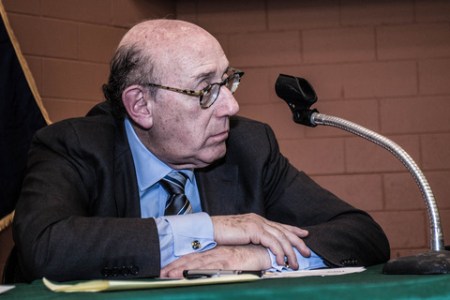
Kenneth Feinberg
The hearing, which took place at Wayne State University, drew an overflow crowd at a 500-seat lecture hall, with up to 1,000 people participating in total. With the exception of the World Socialist Web Site, the media ignored the event, with no US video crews present.
Although retirees had initially been told that the cuts to their benefits would average less than 30 percent, nearly all of those who spoke at the hearing said they had been notified over the Christmas holiday that they would lose between 50 and 80 percent of their pension benefits.
During the two-hour hearing, not a single one of some two dozen pre-selected speakers spoke in favor of the plan to slash pensions. Instead, retirees voiced scathing denunciations of the managers of the Central States Pension Fund, who have received six-figure annual payouts even as they have moved to impose massive benefit cuts. Many made pointed criticisms of the International Brotherhood of Teamsters union that jointly administers the fund.

“I suffered the loss of my first marriage, twisted ankles, and a damaged back, 21 dog bites, and all for that pension,” said one retired UPS delivery driver.
This overwhelming opposition by pensioners does not matter, according to Feinberg. When asked by the World Socialist Web Site after the hearing what would happen if workers voted down the proposed pension cuts, Feinberg said he had the prerogative to impose pension cuts regardless.
“The law says that I must impose it over their objections” Feinberg said. “So if I accept the plan and it’s rejected by a vote, the law requires me in that situation to overrule the vote.”
The law Feinberg was referring to is the Multi-employer Pension Reform Act of 2014, passed by Congress in December 2014 with virtually no public discussion as part of an omnibus appropriations bill. Acting on this law, in October 2015 the Teamsters Central States Pension Fund unveiled its plans to cut the benefits of workers it covers.
That law is itself the outcome of a February 2013 proposal, entitled “Solutions not Bailouts,” from the National Coordinating Committee for Multiemployer Plans, composed of major corporations and unions. The document lists among its signatories the International Brotherhood of Teamsters (IBT) and the International Association of Machinists and Aerospace Workers (IAM), both of which have since sought to publicly distance themselves from the pension-cutting bill.
Workers denounced the Teamsters’ lobbying on behalf of the bill, as well as the decision by the union to allow shipping company United Parcel Service (UPS) to exit the fund in 2007. This removed the largest base of active employees in the fund in exchange for allowing the Teamsters to extract union dues from the company’s freight division workers. As a result, UPS retirees said at the meeting that they are facing pension cuts of more than 50 percent, despite the fact that UPS earned record profits in the fourth quarter of 2015.
“Why on Earth would you let UPS leave the fund?” asked Debra Bakus, the daughter of Dennis Siecienski, a member of Teamsters Local 51 who worked for Entenmann’s for 41 years. She added, “I find it appalling that the trustees of this fund would pay millions to lobbyists out of your fund to get [the Multi-employer Pension Reform Act] passed.”
“I have to move in with my daughter if they cut my pension,” said Mr. Siecienski, who faces a reduction of 51 percent. “His employer is still contributing to the fund,” added Ms. Bakus.
Nationwide, there are some 10 million beneficiaries of multi-employer pension funds, of whom about 1 million receive benefits from “underfunded” plans.
As the Obama administration’s “special master” of executive compensation during the 2008 bank bailout, Feinberg rubber-stamped multi-million-dollar bonuses for executives at companies whose activities helped cause the financial crash.
Now, as the official responsible for imposing sweeping benefit cuts on hundreds of thousands of workers, Feinberg is working diligently to ensure that the transfer of social resources from working people to Wall Street continues unimpeded.
In 2009, the Obama administration justified giving multi-million-dollar bonuses to executives at American International Group, which had received a $185 billion bailout from the federal government, on the grounds that contractual obligations were sacrosanct and could not be abridged by the government.
Asked by the World Socialist Web Site whether he would use a similar approach with regard to workers’ pensions, Feinberg declared that he never approved multi-million-dollar bonuses to Wall Street executives.
Retiree Richard Fairley asked Feinberg, “can you fix my ignition switch?” in reference to his kid glove treatment of General Motors in the deaths of over a hundred people due to defective ignition switches.
But a 2012 report by Neil Barofsky, the inspector general for the TARP bank bailout, exposes Feinberg’s statement as a lie. Barofsky found that Feinberg “approved total compensation packages in the millions” and did not “effectively rein in excessive compensation.”
Barofsky’s report added, “In 2009, OSM [Office of the Special Master, i.e., Feinberg] approved total compensation of cash and stock of more than $1 million each for five AIG employees including a $10.5 million pay package for AIG’s new CEO that included a $3 million cash salary.” Barofsky added that Feinberg “approved compensation ranging from $4.3 million to $7.1 million each for four AIG employees who that year were also scheduled to receive cash retention awards of up to $2.4 million.”
At the hearing, speaker after speaker described how the proposed pension cuts would financially devastate them and their families. They appealed for Feinberg to see reason and deny the proposal by the Teamsters Central States Pension Fund.
But far from being an independent arbiter, Feinberg is a bag-man for Wall Street and its representatives in the Obama administration. His role is not to arbitrate an equitable solution to the chronic de-funding of employee pensions in the United States, but rather to facilitate the outcome most favorable to the banks and major corporations.
Monday’s meeting took place in the context of a growing resistance and opposition by the working class. Over the past month, Detroit teachers and students have defied the Detroit Federation of Teachers to stage sick-outs at over eighty schools. Teachers in Chicago, Illinois have launched protests against efforts to further starve public schools and slash wages and benefits.
Meanwhile, protests in Flint, Michigan have made the lead poisoning of residents by officials at the state, local, and federal level a national and international issue. These actions follow the eruption of opposition among US autoworkers last year against efforts by the United Auto Workers to ram through contracts that further undermine jobs and benefits.
In each case, workers are being drawn into conflict with both big business parties, along with the trade unions, which defend the capitalist system and are collaborating with the corporations in driving down the conditions of the working class.
The task now is to unify these struggles in a common working class movement, armed with a socialist perspective of breaking the power of the financial oligarchy and reorganizing society in the interest of social need, not private profit.
Petition calls for Obama to be tried for ‘war crimes’ in The Hague
RT | February 10, 2016
A petition accusing Barack Obama of war crimes and demanding he be prosecuted has been published on the White House website. It has already gained about 4,000 signatures.
“We demand conviction of a war criminal Barack Obama and trial in the International Criminal Court in [The] Hague. He is guilty of crimes not only against the USA citizens, but against the whole world,” the petition states.
The authors also note that “one of the most dreadful prisons in history – Guantanamo – continues to function.”
The US added to the de-stabilization of the situation in the Middle East, too, the petition’s authors state.
“Libya was destroyed as a result of Obama’s aggression. In Syria, Obama’s agents train, fund and organize terrorist groups, deceitfully naming them ‘moderate opposition,’ who, among other things, bear a relation to Al-Qaeda, implicated in crimes against the American people.”
Last but not least, the petition accuses the US government of constant illegal surveillance.
“Secret services collect the Americans’ personal data information on a 24-hour basis under the canopy battling terrorism, using electronic surveillance tools on political undesirables, effectively stomping on the Americans’ right for privacy.”
If the petition – published on Monday – gets 100,000 votes by March 9, the White House administration will have to respond to it.
Egypt’s Foreign Minister defends mass imprisonment on US visit
Reprieve – February 10, 2016
The Egyptian Foreign Minister has defended his government’s mass imprisonment of political activists, and the use of lengthy pre-trial detention periods, during a visit to Washington DC to meet with US Secretary of State John Kerry among other officials.
In an interview with NPR that aired today, Foreign Minister Sameh Shoukry defended the detention without trial of activists and others arrested at protests in 2013, saying that arrests only took place where protestors didn’t have ‘permits’. Asked why many protestors were still imprisoned and awaiting trial two years later, he said: “It is a long time, but I believe justice has to be given the opportunity, within the impartiality of the judicial system, to ascertain all of the facts and to pass a verdict”.
Mr Shoukry added that “no country” has a perfect human rights record, and that “there will always be ups and downs.” He said that “it is our intention to do everything possible to live up to those [human rights] standards and provide the rights of all individuals.”
Since taking power in July 2013, the Sisi government has overseen thousands of arrests of protestors, journalists and others, many of whom have been put through mass trials that fail to meet international standards. International human rights group Reprieve, which assists several prisoners in Egypt, recently established that between 2014 and the end of 2015, nearly 600 death sentences were handed down, the majority in relation to political charges.
Hundreds of other prisoners are enduring lengthy periods of pre-trial imprisonment; one trial involving 494 people has been postponed 12 times since it began in 2014. The defendants, including Ibrahim Halawa – an Irish student, who is being assisted by Reprieve – are currently understood to be undergoing torture, including forms of ‘crucifixion’ and electrocution. Mr Halawa is one of several prisoners in the trial who were arrested as juveniles, and who are being tried as adults in violation of Egypt’s Child Law.
Reprieve has previously written to Secretary Kerry, asking him to press the Egyptian government to end the use of mass trials and release prisoners who were arrested as juveniles.
JEREMY SALT ON ANTI SYRIA PROPAGANDA ESCALATION
thewallwillfall | February 9, 2016
“I have looked through the report, it has all the characteristics of previous UN Human Rights reports on Syria. The timing is extremely suspect – released just as the Syrian army closes in on Aleppo.We have seen a great spike in propaganda in the past few days, against Russian air strikes and over the number of civilians building up on the Syrian border, said to be 35,000, but 70,000 are said to be coming and yesterday the Turkish deputy PM spoke of 600,000 on the way. All this can be seen as the possible prelude to establishing a buffer zone – we can’t look after any more in Turkey, so the only answer is to look after them inside Syria ….The UN Human Rights Council speaks of 500 interviews. There is no mention of who these people are, how the UN HRC got their names and where they were interviewed. The HRC’s answer is that names cannot be released but at the same time we cannot accept as credible any report that does not/will not provide such information.There is absolutely no means of verifying it and given the HRC’s previous record, its word cannot be trusted. You might remember Navi Pillai’s hysterical statements about Syria when she was head of this council . I had a run-in with one of the committee members when i criticised a report on Syria for the same reasons I am giving here. It made many lurid accusations without providing a skerrick of reliable information. In a very heated discussion she admitted what was not in the report, that most of the people interviewed were in Turkey or Jordan, and, I would imagine, in the refugee camps.I have no doubt that being in a Syrian prison is very unpleasant experience, perhaps as unpleasant as being in prison at Abu Ghraib, but extermination is an extremely powerful word and to make an accusation of a policy of extermination without providing the evidence anyone would need to know to back it up, exposes, I think, the true agenda of this group of people.Watch how its now going to be used by governments and groups like HRW. ” ~ Jeremy Salt
Falk reprimands Ban Ki-Moon over truth about Israel’s crimes
‘The politics of deflection’ (shoot the messenger, ignore the message) exposed
By Stuart Littlewood | American Herald Tribune | February 8, 2016
With obvious relish Richard Falk, former professor of international law at Princeton and UN Special Rapporteur on human rights in Occupied Palestine, has issued a well deserved slap on the wrist to UN Secretary General Ban Ki-Moon for his naivety. It follows Israel’s furious reaction to Ban’s remark to the Security Council that “Palestinian frustration is growing under the weight of a half-century of occupation and the paralysis of the peace process”.
The usually timid Ban, suddenly emboldened, also called Israel’s illegal settlement building “an affront to the Palestinian people and to the international community”. He added: “Security measures alone will not stop the violence. They cannot address the profound sense of alienation and despair driving some Palestinians – especially young people.” Whereupon Israel’s prime minister Netanyahu, fresh from approving another 150 squatter homes on stolen Palestinian land, accused the Secretary General of giving a “tailwind to terror”.
Falk penned an open letter to Ban reminding him of his earlier attempts to get Falk dismissed from his UN job for speaking the same truths. “Having read of the vicious attacks on you for venturing some moderate, incontestable criticisms of Israel’s behaviour, I understand well the discomfort you clearly feel. What intrigues and appals me is that while I was Special Rapporteur for Occupied Palestine during the period 2008-2014, you chose to attack me personally in public on several occasions, joining with US and Israel diplomats calling for my dismissal and doing the utmost to undermine my credibility while discharging this unpaid UN job under difficult conditions.
“At the time, I was doing my best to bear witness to some of the same truths about Israel’s unlawful and immoral behavior that recently got you in similar hot water. My UN mandate was to report upon the reality of Israeli violations of international law while sustaining their apartheid regime of oppressive control over the Palestinian people.”
Referring to Ban’s concern that we are reaching “a point of no return” for the two-state solution and his reminder to the Security Council that the UN will “continue to uphold the right of Palestinians to self-determination”, Falk warns that, given present realities, self-determination must be understood as something more than just “another delusionary embrace of a diplomatically negotiated two-state solution”.
He points out that Israel’s leaders want the idea of a Palestinian state abandoned altogether and that reliance on such a discredited diplomatic path [a two-state solution] has resulted over and over again in severe encroachments on occupied Palestine and intense suffering for its people. “Clinging to the two-state mantra is not neutral. Delay benefits Israel, harms Palestine. There is every reason to believe that this pattern will continue as long as Israel is not seriously challenged diplomatically and by the sorts of growing pressures mounted by the international solidarity movement and the BDS campaign.”
Gaza: Reconstruction of 12,000 displaced families’ homes yet to begin
MEMO | February 9, 2016
Around 90,000 Palestinians remain displaced in the Gaza Strip, almost 18 months after the ceasefire that ended Israel’s ‘Operation Protective Edge’ offensive in 2014. Furthermore, the reconstruction or repair of homes of 74 percent of displaced families is yet to even start.
According to UN OCHA, living conditions for the more than 16,000 displaced families are characterised by “overcrowding, limited access to basic services, lack of privacy, tensions with host communities, risks due to unexploded ordnance and exposure to adverse weather.”
By the end of January 2016, only 15 percent of displaced families had been able to return to repaired or reconstructed homes. The repair and reconstruction of an additional 2,000 homes is ongoing, with many of these homes nearing completion.
Israel’s assault on the Gaza Strip in July-August 2014 destroyed 11,000 homes and severely damaged or rendered uninhabitable an additional 6,800 homes.
Intimidating military patrol of Palestinian market
International Solidarity Movement | February 9, 2016
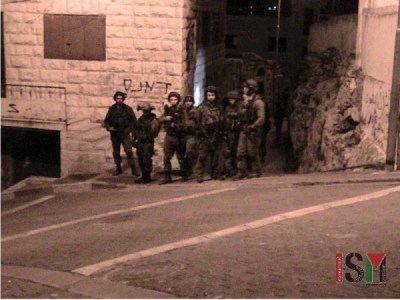
Hebron, Occupied Palestine – On Tuesday, February 9, Israeli forces patrolled the Palestinian market in occupied al-Khalil (Hebron), harassing and intimidating residents.

Israeli forces on their patrol through the Palestinian market
A group of soldiers marched through the souq, the main Palestinian market since the closure of Shuhada Street for Palestinians after the Ibrahimi mosque massacre in 1994. Any male adult or youth was stopped on their way to work and forced by the Israeli soldiers to lift up their shirts and trouser-pants, as well as throw their IDs on the ground. After throwing their IDs on the ground Israeli soldiers ordered the men to move back, so they could pick up the IDs from a ‘safe distance’. Most Palestinians were dismissed after this humiliating procedure, whereas some of them were detained for minutes or violently body-searched.

Violent body-search of Palestinian young man
International human rights defenders documenting the Israeli forces violations of basic human rights of Palestinians, were intimidated and harassed by the Israeli soldiers in an attempt to prevent them from documenting. Soldiers took photos of the internationals with their private phones held right in the volunteers faces and as an intmidation tactic ID-checked them.

Israeli forces taking photos of human rights defenders with their private phones
During the more than one hour patrol Israeli forces repeatedly pointed their assault rifles at the internationals as well as Palestinians.

Israeli soldier ‘ordering’ Palestinians to stop by pointing his gun
Not only adults were surprised and shocked by the sudden presence of heavily-armed soldiers right outside their houses, but also children on their way to school and work. Some children, scared by the soldiers, turned around right away after spotting the soldiers and ran back home instead of continuing their way to school or kindergarten. International human rights defenders walked several scared children past the soldiers so they could safely reach their schools and kindergarten.

Two school girls passing the heavily-armed patrol

A mother waiting with children for the school-bus right opposite a group of soldiers
Israel’s International Conspiracy
Nearly every western country has an Israel lobby
By Philip Giraldi • Unz Review • February 9, 2016
Swedish Foreign Minister Margot Wallstrom recently suggested an inquiry into a surge in Israel’s reported extra-judicial killing of Palestinian demonstrators after Prime Minister Benjamin Netanyahu called for a harsh response and told his police and soldiers that those opposed to the continued occupation of the West Bank were “terrorists.” Almost immediately, the Israeli government denounced Wallstrom as engaging in “political stupidity,” banning her from travel to Israel, while one newspaper close to the government suggested that she might be assassinated, as fellow Swede Count Folke Bernadotte was by Jewish militants in 1948, because anti-Semitism appears to be in the Swedish DNA.
All of that outrage and personal ridicule is pro forma for an Israeli government that reflexively smears and denigrates any and all critics, but the more interesting epilogue was the unanticipated discovery by the Swedish and international media that Wallstrom has not been paying the full rent on the subsidized government apartment that she occupies. The revelation follows a familiar pattern, where critics of Israel suddenly find themselves being discredited for something completely unrelated to the Middle East. President George H. W. Bush (the good Bush) suffered a similar come to Jesus moment in 1991 when he went on national television to denounce the pressure tactics of the Israel lobby. The Israeli government was demanding U.S. Treasury backed loans to construct illegal settlements. President Bush, who was running for reelection and far ahead in the opinion polls, suddenly was confronted by a well-funded and organized opposition raising doubts about him and his record. And President Bush was not reelected, presumably learning along the way that one does not trifle with the Israel Lobby, to be replaced by the enthusiastically Zionist Bill Clinton.
United Nations Secretary General Ban Ki-moon is also wondering about Israel’s alleged commitment to peace. On Tuesday he said “it was human nature to react to occupation,” following up with a comment on Wednesday regarding Israel’s “stifling” occupation of Palestine. Netanyahu reacted with his usual over the top rhetoric, stating that Ban “was encouraging terror.” One might also anticipate, as in the case of Wallstrom, a well-orchestrated media blitz questioning Ban’s motives or explaining how he has always been a closet anti-Semite. It is par for the course and fully expected when one criticizes Israel.
Indeed, it is a global phenomenon. Wherever one goes – Western Europe, Canada, Australia, New Zealand and the United States – there is a well-organized and funded lobby ready, willing and able to go to war to protect Israel. Most of the organizations involved take at least some direction from officials in Tel Aviv. Many of them even cooperate fully with the Israeli government, its parastatal organizations and faux-NGOs like the lawfare center Shurat HaDin. Their goal is to spread propaganda and influence the public in their respective countries of residence to either hew to the line coming out of Tel Aviv or to confuse the narrative and stifle debate when potential Israeli crimes are being discussed.
Israel’s diaspora allies are backed up by a formidable government organized machine that spews out disinformation and muddies the waters whenever critics surface. The Israeli Foreign Ministry has a corps of paid “volunteers” who monitor websites worldwide and take remedial action and there is a similar group working out of the Prime Minister’s office. That is why any negative story appearing in the U.S. about Israel is immediately inundated with pro-Israel comments, many of which make exactly the same coordinated points while exhibiting the same somewhat less than perfect English. On sites like Yahoo they are actually able to suppress unwelcome comments by flooding the site with “Dislike” responses. If a comment receives a large number of dislikes, it is automatically blocked or removed.
The sayanim, local Jews in their countries of residence, are essential to this process, having been alerted by emails from the Israeli Foreign Ministry about what to do and say. The reality is that Israel has lost the war of public opinion based on its own actions, which are becoming more and more repressive and even inhumane and so are difficult to explain. That means that the narrative has to be shifted by Israel’s friends through subterfuge and the corruption of the information process in each country. In some places the key media and political players who are engaged in the process can simply be bought. In other places they can be intimidated or pressured into taking positions that are neither in their own countries’ interests nor morally acceptable. In large countries like the United States, Britain and France a combination of friendly suasion and coercive elements often come together.
In all cases, the objective is the same: to repress or misrepresent any criticism of Israel and to block any initiatives that might be taken that would do damage either to the Israeli economy or to the country’s perceived standing in the world. In some countries Israel’s advocates work right out in the open and are highly successful in implementing policies that often remain largely hidden but that can be discerned as long as one knows what to look for.
Recent Israel Lobby activity in the United States has included legislation at state levels to make illegal divestment from Israel or to promote boycott of Israeli products. A trade pact with Europe will reportedly include language requiring the United States to take retaliatory action if any European country tries to boycott Israel, to include the West Bank settlements, which the empowering legislation regards as part of Israel proper.
Israel is also working to create a mechanism for global censorship of the internet to ban “incitement,” which clearly is a euphemism for material that is critical of its policies. Recently Facebook has begun to delete from its site any “hate speech” and “terrorism” related material but what has not been widely noted is that the apparent restrictions also have involved sites critical of Israel including Christians United for Peace.
Many prominent critics of the American Israel Political Action Committee (AIPAC) are unaware that AIPAC exists in various forms in a number of other countries. BICOM , the Britain Israel Communications and Research Centre, is located in London. The French equivalent is the Conseil Representatif des Institutions Juives de France (CRIF). In Canada there is a Center for Israel and Jewish Affairs (CIJA) , in Australia a Zionist Federation of Australia and in New Zealand a Zionist Federation of New Zealand .
While AIPAC is specifically focused on the U.S.-Israel relationship, its counterparts in Europe often deal with a whole range of issues that they define as Jewish, but protecting Israel is always part of their agenda, particularly for those groups that label themselves as Zionist. The political power and financial muscle of the groups gives them access to government far beyond the actual numbers of their supporters. In France this has led to the legislation of hate crimes that de facto exist to protect Jews that have also been interpreted as limitations on one’s ability to criticize Israel. In its most recent test, a French court declared that a peaceful protest promoting Boycott, Divestment and Sanctions (BDS) directed against Israel was illegal.
Many believe that France now has less free speech than any other European country. Recently, the alleged humor magazine Charlie Hebdo, ran a revolting cartoon showing the little Syrian boy Alan Kurdi who drowned in Turkey last summer as all grown up and sexually assaulting a woman in Germany. There was considerable outrage throughout the world but no sign that the French government will do anything to prosecute the magazines since it was Muslims who were being ridiculed. Charlie Hebdo frequently insults Muslims (and also Christians) but rarely lampoons Jews.
 In Britain, Jewish organizations uniquely are allowed to patrol heavily Jewish neighborhoods in police-like uniforms while driving police type vehicles and there have been reports of their threatening Muslims who enter the areas. Prime Minister David Cameron’s government, which is responsive to a Conservative Friends of Israel lobbying group, has also done its part to create official barriers to any spread of the BDS movement. It is proposing legislation that will enable it to overrule decisions by local government councils that seek to cut business or investment ties with Israel and, more particularly, Israeli settlements, under the pretext that such action interferes with the conduct of foreign affairs. The British government is also considering its own brand of hate speech legislation, banning from social media any commentary that is considered to be anti-Semitic, which will almost certainly extend to criticism of Israel.
Canada’s government has also threatened to use hate speech laws to block criticism of Israel and forbid BDS related activity. Australia meanwhile, has ceased referring to east Jerusalem as “occupied” and is apparently leaning towards similar “non-pejorative” language relating to the militarized occupation of the West Bank, preferring the neocon favored dodge “disputed.” New Zealand has proposed Israeli-Palestinian peace talks that specifically demand that participants “refrain from referring a situation… to the International Criminal Court,” which would effectively decriminalize war crimes committed by both sides during the two recent invasions of Gaza. As a United Nations investigation determined that Israel was disproportionately responsible for what did occur, the proposal eliminates accountability and is effectively a get out of jail free card for some Israeli government officials.
And so it goes. Criticize Israel and there will be a comeuppance by virtue of a highly developed international system that relies on government direction as well as volunteer supporters who are able to shape both the media message and the political response. Accepting that as a given, I suppose one should be proud of being called an anti-Semite every time the label is misapplied to stifle dissent, but it all sadly reflects a lowering of the discussion to a dirt level. This might just be because there is no justification for Israeli behavior. The fact is that in terms of systematic human rights violations Israel is something beyond an apartheid state, frequently engaging in open racism and, in the opinion of many observers, crimes against humanity. It is furthermore a persistent source of instability in the Middle East and even beyond.
Israel is a liability to the United States and to the European nations that it has successfully manipulated into acquiescence regarding its bad behavior. When AIPAC and its overseas clones act for Israel the host nations in which these organizations exist should recognize exactly what is taking place. … Full article
UN initiative to protect schools in war zones vetoed by Britain
RT | February 9, 2016
Britain has refused to sign up to a UN agreement on protecting schools in wartime, which has been signed by 51 states, despite the fact it was drawn up by a former UK military officer.
The agreement was championed by the UN children’s fund UNICEF to protect schools from attack during conflicts. It aimed to set out a “safe schools declaration” and provide guidelines for military forces.
However, it was reported on Tuesday by the Telegraph newspaper that Foreign Secretary Phillip Hammond had effectively vetoed the move after having opposed it as head of two government departments.
Already signed by 51 nations, the initiative was developed in response to deadly attacks on schools in Syria and Yemen.
In a statement on Monday, Amnesty International senior crisis advisor Lama Fakih reported how schools were being targeted with deadly effect in Yemen, where a Sunni/Shia proxy war is currently being fought with Saudi and Iranian backing.
“The Saudi Arabia-led coalition launched a series of unlawful airstrikes on schools being used for educational – not for military – purposes, a flagrant violation of the laws of war,” she wrote.
“Schools are central to civilian life, they are meant to offer a safe space for children. Yemen’s young school pupils are being forced to pay the price for these attacks,” she added.
It was hoped Britain would be a leading voice in the campaign to protect schoolchildren and schools after the high-profile campaign against sexual violence in warzones led by Phillip Hammond’s predecessor William Hague and movie star Angelina Jolie.
But Britain, like the other permanent members of the UN Security Council, did not sign up.
It is rumored that the Ministry of Defence (MoD) and Foreign Office have been put off by fears of litigation given the volume of cases brought against the military for alleged crimes in the Iraq and Afghan occupations.
Initially it appears that of the three government departments whose support was needed only the MoD – then under Hammond – was resisting, while the Department for International Development (DFID) and Hague’s Foreign Office were supportive.
Hammond’s subsequent shift from defense to the Foreign Office is felt to have poisoned both the military and diplomatic ministries against the initiative, despite the fact the agreement was drawn up by a former British naval officer.
Steven Haines, who drew up the British military rulebook for the 2003 Iraq invasion, is now a professor of international law at the University of Greenwich.
He told the Telegraph of his disappointment at the government’s response to his proposals.
“The stumbling block was Philip Hammond at Defence,” he said.
“It’s very frustrating.
“There’s no way that I was going to draft something that would embarrass the British government.”
The declaration, which was launched in Norway in 2015, commits governments to six guidelines including one which prevents military forces for using from using active schools as military bases.
It was thought that if Britain signed up then its role as a trainer of foreign troops would help to engender respect for schools and schoolchildren among military forces globally.
A Foreign Office spokesman defended the move, telling the paper that while they “support the spirit of the initiative, we have concerns that the Guidelines do not mirror the exact language and content of International Humanitarian Law.
“Therefore the UK, along with several other countries, was not able to sign the Safe Schools Declaration in Oslo in May 2015,” the spokesman said.
Britain’s concern about future legal cases may spring from its controversial military support for regional ally Saudi Arabia in the Gulf theocracy’s war in Yemen.
That support has included both material backing, in the form of weapons and munitions traded by UK arms firms subject to government license, and the presence of British military personnel as advisors to the Saudi military.
The UK government maintains the military advisors are present in Saudi headquarters to ensure international law is followed.
The Occupation Goes Missing from The NY Times
By Barbara Erickson | TimesWarp | February 8, 2016
 The occupation went missing from The New York Times this past week. Palestinians were there, as victims and attackers, but the brutal military regime that controls their lives made no appearance.
The newspaper had plenty to say about Israeli Jewish life, however: two lengthy stories about prayer space at the Western Wall and one discussing Zionism. Each of these stories ran over a thousand words.
Two shorter news articles reported that the murderers of a Palestinian teen had been sentenced to prison and that a knife attack left one Israeli police officer dead, but nothing in either of these provided the context crucial to understanding events in the occupied territories.
Meanwhile, as the Times obsesses over Israeli identity and attitudes, the occupation grinds on, producing news that appears elsewhere. At the top of the list were two major stories: A Palestinian prisoner was near death after passing his 75th day on hunger strike, and Israeli forces carried out a massive demolition of over 20 homes, rendering more than 100 Palestinians homeless in the dead of winter.
The ordeal of Mohammed al-Qeeq, a journalist held without trial since Nov. 21 of last year, drew the attention of Israeli and international media outlets, which recounted his legal appeals, protests on his behalf and an Israeli Supreme Court decision which “froze” his detention but confined him to a hospital. (Al-Qeeq refused the offer and continued his fast.)
Al-Qeeq’s hunger strike was deemed unfit to print in the Times, perhaps because it would touch on Israel’s use of administrative detention, which holds prisoners without trial. Readers are not to know that as of last December 660 Palestinians were held in this limbo, nor were they to be informed that a number of human rights groups have protested Israel’s unsavory use of the practice.
And then there is the matter of two impoverished villages in the South Hebron Hills of the West Bank, Khirbet Jenbah and Khirbet Al-Halawah, which were made even more destitute after Israeli army crews arrived last Tuesday and demolished 22 structures, displacing 110 people, including dozens of minors. The army also confiscated solar panels, which, like many of the homes, had been donated by aid organizations.
The military claimed that it destroyed Jenbah and Al-Halawah because they were located in a declared firing zone. The Israeli publication 972 Magazine, however, noted that “Jewish settlements within [the zone] have not been served with eviction orders.”
This was the largest mass demolition in a decade, and the plan to destroy villages within the firing zone has drawn international attention and a petition from world-renowned authors to spare the communities. None of this, however, was enough to draw the interest of the Times.
Instead, the Times considered it more urgent to examine the effects of a new prayer space at the Western Wall—not once, but twice—and to take a look at Zionism today. Villagers thrown out in the cold of winter and a prisoner on the brink of death took a back seat to these concerns.
The Times claims that it gives readers “the complete, unvarnished truth as best as we can learn it,” and it insists that the newspaper’s overriding goal is to “cover the news as impartially as possible.” Readers who never stray to other sources of information may actually believe this.
Featured Video

Saudi Led Destruction of Yemen’s heritage
or go to
Aletho News Archives – Video-Images
From the Archives
Israel: Strategic Ally or Liability?
By Stephen Sniegoski | My Catbird Seat | June 12, 2010
The claim that Israel serves as a valuable ally for the United States is made by both pro-Zionists and much of the anti-war and anti-Zionist Left that is influenced by Noam Chomsky. As a result of the Gaza flotilla massacre, which has caused a world-wide uproar against Israel, the value of Israel to the United States is being publicly questioned in more mainstream foreign policy forums. … continue
Blog Roll
 Aletho News
- Declassified UK exposes British man who fought for ‘Israel’ in Gaza
- West’s death cult in a theater near you
- How the Yandex ‘Russian bots’ lie fell apart
- Burnham’s ‘Russia did Brexit’ ruse crumbles
- Estonia making movies and games to encourage war against Russia
- Four in five new UK jobs taken by foreigners – report
- Here’s what Trump’s latest U-turn really means for Russia and Ukraine
- The Houthis Are Not an Iranian Proxy
- Europe’s Energy Hypocrisy, Russian LNG Profits and US Dependence
- ICC ignored ‘very well-documented’ NATO crimes – ex-Libyan minister
- If Americans Knew
- Activists Abused By Israel Return to New Freedom Flotilla Mission
- 60 Minutes won’t tell the full truth about Israeli settler violence
- Nearly 50,000 women, girls killed or severely injured in Gaza since October 2023: UN Women
- ADL is working with AI companies to suppress alleged ‘antisemitism’
- Israeli occupation forces using social media surveillance unit to target hundreds of Palestinians in the West Bank
- Israel’s New – and Terrifying – Security Doctrine
- Israeli Attacks Kill Five in Gaza, Including a four-year-old and a woman
- Air Force Major Who Called for Trump’s Impeachment Held in Solitary Confinement
- It’s a Genocide, I’m Into It’: Seinfeld Mocks Protest over Palestinian Children Killed
- Universities fire dozens amid pressure from Zionist billionaires
- No Tricks Zone
- New Study Suggests Large Regions Of The Pacific Ocean Have Been Cooling For The Last 80 Years
- Germany’s Green Energy Debacle: High Energy Costs Force Kahla Porzellan to Close After 182 Years!
- New Study: 50 Years Of The Most Aggressive ‘Net Zero’ Policies Can Only Affect The Global Climate By 0.03°C
- US September “Heat” Was No Record…Many Records Set Decades Ago
- Latest European Green Energy Debacle; Portugal’s Largest Flagship Solar Park Insolvent!
- Green Energy Debacle: German Expert Professor Fritz Vahrenholt Warns Of Severe Economic And Social Consequences
- Two More Paleo Reconstructions Affirm Meters-Higher Sea Levels Across Ireland, Brazil 7000-6000 Years Ago
- New Study: Earth And Venus Surface Warmth Largely Explained By Convection And Lapse Rate, Not CO2 Or Radiation
- 2025 Nature Paper Claiming Worsening Global Drought Gets RETRACTED …Heavily Flawed
- New Study: ‘Global Drought Shows No Detectable Recent Acceleration Under Climate Warming’

