5 Examples of Highly Decorated Criminal Cops that Annihilate the “Bad Apple” Theory
By Jay Syrmopoulos | The Free Thought Project | August 9, 2015
It’s become apparent that there is a systemic problem in policing, yet many Americans continue to be willfully ignorant of the dark reality transpiring outside of their front doors. Often people will claim “it’s just a few bad apples,” but the truth is that problem is much more deeply ingrained.
Imagine for a moment being bestowed one of the highest honors of your profession, and what that recognition would represent. In policing that honor would be called the “Officer of the Year,” and would represent the elite of the police force within which these officers work.
It would make sense to expect that the officers awarded this prestigious honor to be those who uphold and exemplify the highest ideals and values of law enforcement.
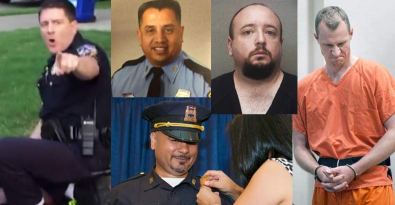
In a telling sign of the current state of policing in America, we have seen five former “Officer of the Year” recipients reveal their true nature in 2015 and show exactly how corrupt the soul of American law enforcement system has become.
This is what an “Officer of the Year” looks like in 2015:
Eric Casebolt: “Officer of the Year” in 2008 in McKinney, TX. Casebolt resigned in disgrace this year after assaulting children at a pool party while a grand jury investigation was pending.
Noe Juarez: “Officer of the Year” in 2009 in Houston, TX. Juarez was indicted on charges of trafficking drugs and weapons for Los Zetas, one of the most ruthless and violent Mexican cartels.
Edwin Guzman: “Officer of the Year” in 2012 in Boston, MA. Guzman was arrested and charged with sexual assault charges against a minor.
Jonathan Bleiweiss: “Officer of the Year” in 2013 in Broward County, FL. Bleiweiss plead guilty to confining and raping 20 male immigrants.
Jerad Gale: “Officer of the Year” in 2014 in Champaign, IL. Gale was arrested and charged for choking and raping two women.
Americans should be very troubled that men like theses are being honored as the best of the best in policing. People must come to the realization that these weren’t simply a few bad apples that had simply people fooled into believing they were good cops.
The sinister reality is these men are exactly what law enforcement looks for, modern day cowboys with too much machismo and a bully complex. Theses borderline sociopathic tendencies, which are rampant within the profession, are a canary in the coal mine and a stark warning about the systemic brutality that has taken firm root in U.S. policing today.
When men such as these are honored as the best of “America’s Finest” it’s apparent the system is broken!
Hillary’s Libyan Torturers

By Daniel McAdams | Ron Paul Institute | August 4, 2015
Remember when then-Secretary of State Hillary Clinton was so intent on a US attack on Libya that she disregarded the US Intelligence Community, the Pentagon, and even her colleagues in the Obama Administration to force her “humanitarian intervention”? Clinton was so distrusted by the Pentagon that they opened up their own lines of communication with Libyan officials — they knew she was feeding them and the State Department boldfaced lies.
Even members of Hillary’s own party in Congress were skeptical of her claims.
Gaddafi’s son and presumed heir, Saif, told then-Rep. Dennis Kucinich (an RPI Board Member) that Hillary was using false information to justify the coming US attack on his country. (Thankfully, Mr. Kucinich understood his Constitutional obligation to act as member of an equal branch of government and did his own investigation of Hillary’s claims.)
Saif told Kucinich that Hillary’s “information” about Libya was:
[L]ike the WMDs in Iraq. It was based on a false report. Libyan airplanes bombing demonstrators, Libyan airplanes bombing districts in Tripoli, Libyan army killed thousands, etc., etc., and now the whole world found there is no single evidence that such things happened in Libya.
Hillary’s rebels, according to Saif were, as a Washington Times article reports, “not freedom fighters” but rather jihadists whom he described as “gangsters and terrorists.”
Hillary got her war. The Washington Post, ever the lickspittle in the service of the US regime, shortly after the attack praised Hillary’s great foresight in forcing the US war on Libya:
Seven months later, with longtime U.S. nemesis Moammar Gaddafi dead and Libya’s onetime rebels now in charge, the coalition air campaign has emerged as a foreign policy success for the Obama administration and its most famous Cabinet member, Secretary of State Hillary Rodham Clinton.
What a success! Libya is now in the hands of ISIS and various Islamist terror gangs. The population is devastated. Saif was right: they were a bunch of terrorist jihadists.
Gaddafi’s other son, Saadi, is currently being held by “Libyan Dawn,” an al-Qaeda group that has emerged since the US “liberation” and has taken control of key parts of Libya. This week we see in a new video that Hillary’s humanitarian freedom fighters have taken to torturing Saadi Gaddafi in the must un-humanitarian manner (warning, graphic). Hillary’s humanitarians are a bunch of torturing thugs, and it’s all there on the tape. Will she be challenged on this? Don’t bet on it.
Meanwhile, another group of Hillary’s extremists have sentenced Saif to death in a mass trial with scores of others from the previous government. The trials were so bad they were even condemned by the International Criminal Court, which would also like to get its hands on Saif. The defendants had little access to legal council in what was a textbook show trial.
Hillary Clinton squealed with joy when Muammar Gaddafi was sodomized with a knife and murdered by her rebels. Is she likewise giggling somewhere as Gaddafi’s son has his feet beaten to a pulp with a metal rod while he is bound and slapped in the face and his other son is sentenced to death in a trial with no semblance to actual rule of law?
This is human rights, Hillary-style.
Unarmed civilians killed in Turkish strikes on northern Iraq

Aftermath of a Turkish airstrike against Zergele village in Iraq’s semi-autonomous Kurdistan region on August 1, 2015. (© Firat news agency)
Press TV – August 8, 2015
Turkey’s pro-Kurdish Peoples’ Democratic Party (HDP) has dismissed Ankara’s claims that its attacks targeted positions of the Kurdistan Workers’ Party (PKK) in northern Iraq, saying unarmed civilians have fallen victim to the raids.
The HDP, in a statement released on Friday, said Turkish fighter jets pounded Zergele village in the remote and far-flung Qandil Mountain of the semi-autonomous Kurdistan region of Iraq earlier this month, arguing that the area is populated by civilians contrary to the Turkish government’s allegations that the warplanes hit a PKK training base there.
“Those who lost their lives due to the bombing were civilians and unarmed people. The responsibility of the airstrike that resulted in the massacre of civilians rests with Ankara,” the statement noted.
On August 1, at least nine civilians lost their lives and 15 others sustained injuries, when Turkish military aircraft struck Zergele village.
“Two people initially lost their lives in the airstrikes. Turkish jets later bombed the villagers that had gone to the scene, leaving seven more people dead. Turkey is targeting Kurds. All the people living here, and all those killed in the strikes, were civilians and villagers,” Suleyman Nebi Boki, a Zergele resident, said.
Another villager, Feqi Muhammed, said, “There were six houses in this area, and all of them have been destroyed. The people targeted are innocent civilians. The Turkish government is targeting Kurdish villagers in place of PKK fighters.”
Meanwhile, Turkish military has denied allegations that the country’s jets bombarded civilians in Zergele.
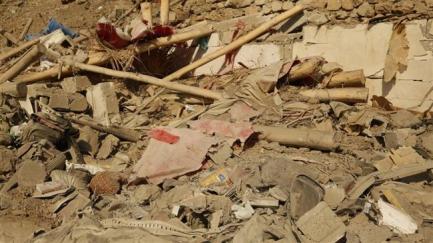
Aftermath of a Turkish airstrike against Zergele village in Iraq’s semi-autonomous Kurdistan region on August 1, 2015. (© Firat news agency)
On August 6, Selahattin Demirtas, the HDP’s co-chair, called on the international community to censure Ankara’s new “unjust war” on Kurds, accusing the government of President Recep Tayyip Erdogan of using the so-called anti-ISIL fight as a cover to pursue its main goal of targeting the PKK and undermining the HDP.
Turkey recently launched airstrikes against purported ISIL targets in Syria as well as PKK positions in Iraq, after a deadly bomb attack attributed to ISIL Takfiris left 32 people dead in the southeastern Turkish town of Suruc, across the border from the northern Syrian town of Kobani.
A shaky ceasefire that had stood since 2013 was declared as null by PKK following the Turkish airstrikes against the group, narrowing chances of the two sides reaching a deal in the near future.
The PKK had been fighting for an autonomous Kurdish region inside Turkey since the 1980s. The conflict has left tens of thousands of people dead.
School ‘banishes’ 7yo student for saying he doesn’t believe in God – lawsuit
RT | August 5, 2015
A seven-year-old Indiana student was “banished” from sitting with his classmates at lunch after stating that he did not believe in God, according to a lawsuit which claims the school violated the child’s First Amendment rights.
The suit – filed by the American Civil Liberties Union (ACLU) of Indiana and obtained by the Washington Post – claims the punishment occurred after the student, named only as AB, told a classmate on the playground that he didn’t go to church and didn’t believe in God.
That child then started to cry, stating that AB had hurt her feelings by saying that he didn’t believe in God.
The girl’s visible distress prompted a playground supervisor to report the incident to AB’s teacher, identified in the suit as Michelle Myer.
In response, Myer told AB that she was “very concerned” about what he had done, and said she was going to contact his mother.
Myer forced the child to sit by himself at lunch for three days, and told him that he shouldn’t talk to the other students because he had offended them.
The lawsuit states that this was distressing to AB, as it implied that he had done something wrong by expressing his personal opinion.
However, according to the suit, the hurt did not end there.
The matter was then sent to “another adult” employed at Forest Park Elementary School. Upon hearing the story, the adult reportedly told AB’s classmate that she should be “happy she has faith” and that she “should not listen to AB’s bad ideas.” She then patted the girl’s hand.
Despite Myer’s claim that she would contact AB’s parent, that phone call never took place. Instead, AB’s mother found out about the incident from her son, who came home from school upset and stating that he was hated by teachers and students at the school.
This prompted his mother to call the assistant principal of the school, demanding that her child not be punished for expressing his religious views. The teacher was also included in the call, during which she confirmed her involvement in the matter.
After the phone call, AB was apparently told by Myer and other teachers that he could believe what he wants to believe.
Following his three days of punishment, AB was allowed to sit with his fellow classmates at lunch. However, the lawsuit stresses that lasting damage has been inflicted on the student.
That damage includes the fact that some students refuse to talk to the child, and that AB is now “anxious and fearful” about school.
In response to the incident, the school district released a statement: “It is clear that it is not the province of a public school to advance or inhibit religious beliefs or practices. Under the First and Fourteenth Amendments to the Constitution, this remains the inviolate province of the individual and the church of his/her choice. The rights of any minority, no matter how small, must be protected.”
Citing the violation of First Amendment rights, the suit is seeking damages and attorneys’ fees. The child’s mother has been allowed to proceed with the lawsuit anonymously, in order to protect her child’s identity.
Mandatory Reporting of User Content Chills Speech and Violates Privacy Rights
By Kelsey Harclerode and Erica Fisher | EFF | August 5, 2015
EFF joined a broad coalition of 31 organizations in sending a letter to Senate leadership opposing an unconstitutionally vague law that would require Internet companies to report to the government when they obtain “actual knowledge” of any “facts and circumstances” related to “terrorist activity.” Section 603 of the Intelligence Authorization Act for Fiscal Year 2016 (S. 1705), which does not define “terrorist activity,” raises significant First and Fourth Amendment concerns, including the chilling of protected speech and the warrantless search and seizure of private electronic content.
First Amendment Concerns
The most obvious flaws in Section 603 are its vagueness and overbreadth: it will chill wholly legal speech and conduct. The key reason is that there is no clear agreement in U.S. society about what counts as “terrorism” (and triggers mandatory reporting). The single, tiny island of clarity in the term “terrorist activity” is one non-exclusive reference to 18 U.S.C. § 842(p), which makes it unlawful for a person to distribute information relating to explosives if the person has knowledge that the recipient intends to use the information to commit a violent crime. Otherwise, Section 603 is a Rohrschach blot.
Because Section 603 leaves both companies and users uncertain as to what exactly triggers the mandatory reporting requirement, this vague obligation to report will encourage service providers to broadly implement the law and will, in turn, encourage users to self-censor to avoid being reported to the federal government as possible “terrorists.” Without further clarification, the law will likely put innocent political activists, journalists, engaged citizens, professors and students participating in wholly lawful debate and research under a cloud of suspicion. For many, the risk of being put on a mysterious government watch list will more often than not outweigh the benefit of speaking.
With limited context for, say, a tweet or private direct message, service providers will err on the side of over-reporting and submit First Amendment-protected speech through content-flagging or automated monitoring systems. Section 603 includes a “protection of privacy” subsection, which clarifies that nothing in the provision “may be construed to require [a] service provider…to monitor any user…or the content of any communication.” Yet this “protection” does little to counteract the pressure on intermediaries to monitor their users’ behavior and content. While intermediaries often rely on content-flagging systems that enable users to report apparent unlawful or abusive activity of other users, this mechanism is prone to fraudulent notices. An automated monitoring system based on keywords would allow intermediaries to avoid having to themselves make decisions about their users’ content. But because it’s not obvious what constitutes “terrorist activity,” a user could be reported any time she uses a buzzword related to terrorist groups, the Middle East, U.S. foreign policy, or a particular political ideology.
Fourth Amendment Concerns
Section 603 not only chills lawful speech, it also tries to evade constitutional barriers that protect against unreasonable searches and seizures of private communications by the government.
EFF has consistently argued that a warrant based on probable cause is required for compelled government access to content stored by “cloud” service providers. In United States v. Warshak, the Sixth Circuit held that the government cannot access email content without a warrant because users have a Fourth Amendment-protected reasonable expectation of privacy in the email content that they store with these intermediaries.
While Section 603 does not permit the government to demand the production of content, it does require Internet companies to report content—including private content—reflecting “terrorist activity.” There is no question that this kind of mandatory reporting statute is subject to Fourth Amendment scrutiny, not unlike the ordinance found unconstitutional in Los Angeles v. Patel.
The applicability of the Fourth Amendment is particularly important given the amount of private content the government will acquire under this provision. As noted above, this mandatory provision will encourage companies to over-report both public and private content to the government. This will enable the government to evade normal due process requirements—including meeting legal standards such as probable cause and submitting to judicial review—while collecting much private content protected by the Fourth Amendment.
Future Action
Section 603’s constitutional implications have not gone unnoticed in Congress. On July 27, the Senate was set to pass the bill by unanimous consent until Sen. Wyden objected to this expedited procedure. The Senate will now have to engage in the normal process of debate and amendment, or remove this provision from the bill to prompt Sen. Wyden to withdraw his objection and enable the bill to pass by unanimous consent. The government should not be permitted to evade constitutional limits by turning private companies into watchdogs with no leashes. We urge Senate leadership to withdraw Section 603 from the intelligence authorization bill.
Where’s the outrage? White South Carolina teen gunned down by cop gets no attention

© J. Knight / YouTube
RT | August 5, 2015
After an independent autopsy showed that Zachary Hammond was shot by police from behind, the family of the unarmed South Carolina teen is wondering at the lack of national outrage in this case. Hammond was white.
According to the police in Seneca, South Carolina, an officer shot Hammond “in self-defense” when the teen allegedly tried to run him over with a car during a drug arrest. An officer approached Hammond’s car in the parking lot of a Hardee’s restaurant on July 26, after an undercover officer arranged a marijuana buy with the teen’s date, 23-year-old Tori Morton. The initial police report mentions finding a bag of marijuana on Morton – who was charged with simple possession – but makes no note of the lethal shooting.
The official autopsy confirmed Hammond was shot twice, but did not say from what angle. Hammond’s family arranged for an independent autopsy, which showed the 19-year-old had been shot from above and behind, suggesting that the official police story was inaccurate.
Speaking to reporters on Tuesday, attorney for Hammond’s family Eric Bland said that Hammond had been shot in the left rear shoulder, and through the back of his chest, indicating the officer fired from the side of a stopped car, through the open window. Bland says Hammond was on a first date with Morton, who was eating ice cream at the time, and that the police should have never used deadly force.
Seneca is a city of 8,200 in the northwestern corner of South Carolina, near the university town of Clemson, and about 30 miles west of Greenville.
Hammond’s death came a week after Samuel Dubose was killed in Cincinnati, Ohio under very similar circumstances. University of Cincinnati police officer Raymond Tensing said Dubose was trying to run him over with his car, and that he fired in self-defense. Once Tensing’s body camera footage was released, showing otherwise, the officer was indicted for murder. Tensing is white; Dubose was black.
Dubose’s killing has attracted national attention, but Hammond’s was barely noticed. According to the Los Angeles Times, while Dubose’s name was mentioned in over 43,000 tweets between July 26 and August 4, Hammond’s appeared in 289 tweets in the same time period.
Bland, the attorney for Hammond’s family, finds the discrepancy “very disturbing.”
“An unarmed white teenager whose life is wrongfully taken at the hands of overzealous police is the same and equal to an unarmed black teenager whose life is wrongfully taken at the hands of overzealous police,” he told the LA Times.
Police in Seneca are standing by their officer, though. Speaking to the Greenville News last week, Chief John Covington said the officer “actually had his hand on or very close to the car, possibly pushed off from the car,” and the teen “was not shot from behind.”
“The attorney wasn’t there either,” Covington said. “He’s got to put his spin on things. His clients are the parents and they’re grieving. I understand that. My heart goes out to them.”
Seneca police’s refusal to publish the official autopsy results or name the officer involved in the fatal shooting has raised eyebrows. The Charleston Post and Courier filed an open records request for the officer’s name, and the copy of the official incident report, neither of which have been released by the police.
“It’s outrageous,” Bill Rogers, executive director of the South Carolina Press Association, told the Post and Courier. “The policeman is a public official. They can’t redact his name. That’s a clear violation of the law.”
“We feel that releasing his name may possibly subject the officer and family to harassment, intimidation or abuse,” Chief Covington said in a statement, explaining that the department considers the officer a “victim of attempted murder” by Hammond.
Rogers says this argument lacks merit and that the public has a right to know. “Other people might have had encounters with this policeman but they can’t come forward if the public doesn’t know who it is,” he said.
Hammond’s death is currently being investigated by the South Carolina Law Enforcement Division (SLED). There had been 30 fatal police shootings in the state this year, as of August 3, compared to 42 in all of 2014, according to the LA Times.
“The whole issue of race is getting distorted and what’s getting lost is the real issue which is excessive force,” Bland told the Washington Post. “All people need to be outraged out this. All people need to be asking the hard questions.”
In Victory for Free Speech and Animals, Judge Strikes Down Idaho ‘Ag-Gag’ Law
Banning the filming of factory farm operations is an unconstitutional violation of both free speech and equal protection clauses, says federal judge

A demonstration against Ag-Gag legislation in Idaho outside the state house in 2014. (Credit: Flickr / cc / Mercy for Animals)
By Jon Queally | Common Dreams | August 4, 2015
In a victory for animal rights advocates—and the animals on factory farms they seek to protect—a federal judge on Monday ruled Idaho’s controversial “ag-gag” law unconstitutional in a decision that said criminalizing the undercover documentation of livestock abuse violates both free speech and the equal protection clause.
“The effect of the statute will be to suppress speech by undercover investigators and whistleblowers concerning topics of great public importance: the safety of the public food supply, the safety of agricultural workers, the treatment and health of farm animals, and the impact of business activities on the environment,” U.S. District Judge B. Lynn Winmill stated in his 28-page ruling.
Under the law, people filming agricultural operations without permission in Idaho face up to a year in jail and a $5,000 fine. By comparison, a jail sentence for an animal cruelty conviction is capped at six months and a maximum fine of $5,000.
However, as Winmill’s ruling continued, the legal arguments in favor of banning undercover investigations—long a tactic of animal rights groups with no other way to prove or expose such abuse—did not stand up to scrutiny. “Audio and visual evidence is a uniquely persuasive means of conveying a message,” he wrote, “and it can vindicate an undercover investigator or whistleblower who is otherwise disbelieved or ignored. Prohibiting undercover investigators or whistleblowers from recording an agricultural facility’s operations inevitably suppresses a key type of speech because it limits the information that might later be published or broadcast.”
In the end, the judge concluded, “the facts show the state’s purpose in enacting the statute was to protect industrial animal agriculture by silencing its critics.”
Though other states have passed similar laws in recent years, the decision by Winmill marks the first time a federal court has struck down such legislation. And though the Idaho ruling could be appealed to a higher federal court, it is also likely to spur additional challenges in those other states.
Instigated by an undercover operation by the animal rights group Mercy for Animals, Idaho’s law was signed into law in 2014 by the state’s Republican Gov. Butch Otter, but was challenged in court by a coalition of welfare advocates, led by attorneys with the Animal Legal Defense Fund.
ALDF called Winmill’s ruling a “landmark victory” for all those represented by the suit, which in addition to the tens of thousands nameless animals, included a broad-based public interest coalition of national nonprofits, including the People for the Ethical Treatment of Animals (PETA), the American Civil Liberties Union (ACLU) of Idaho, journalists Will Potter and Blair Koch, Farm Sanctuary, and the Center for Food Safety (CFS). In a joint statement, the coalition said:
Undercover video and photography has exposed numerous shocking practices that are “industry standards.” These pervasive, systematic procedures include routine mutilation, including debeaking birds with electrically heated blades and castrating male animals by slicing open their scrotum and ripping their testicles out without pain relief or anesthesia and intensive confinement—where animals are literally unable to turn around for months on end. Exposes have also detailed the sickening farming conditions resulting in contaminated meat products—posing serious health risks to the public—and life threatening conditions for farm workers.
These investigations, and the subsequent media coverage, have led to food safety recalls, citations for environmental and labor violations, evidence of health code violations, plant closures, criminal convictions, and civil litigation. The Idaho statute unconstitutionally and unwisely prohibits efforts to bring violations of state and federal laws relating to food safety, environmental protection, and animal handling to the attention of the public and law enforcement.
Ag-Gag laws are notoriously unsupported by the public. Nationwide thirty-two similar Ag-Gag measures have failed. Currently, seven states have Ag-Gag laws on the books. This Idaho decision is just the first step in defeating similar Ag-Gag laws across the country.
Mercy for Animals also hailed the ruling, saying it is now looking forward to continuing its work and producing more undercover videos in Idaho.
“Idaho’s lawmakers should be ashamed of wasting precious time and valuable resources enacting unconstitutional laws that threaten animal welfare, food safety, workers’ rights and the environment,” said Nathan Runkle, president of Mercy for Animals, in response to the ruling. “We hope they will now focus their efforts on improving animal welfare and rewarding the brave whistleblowers who uncover criminal activity in Idaho’s agricultural operation.”
Leader of Israeli extremist organization calls for Jewish State torching churches
Ma’an – August 6, 2015
JERUSALEM – The leader of a Jewish extremist group in Israel allegedly called for arson attacks on churches in front of Israeli students, Israeli media reported on Thursday.
Benzi Gopstein, leader of anti-Arab group Lehava, allegedly called for the burning of churches at a panel held this week for Jewish yeshiva students, using ancient Halachic, or Jewish law, to condemn what he called Christian “idol worship.”
When a journalist at the panel informed Gopstein that he was on camera and could be arrested for his comments, Gopstein said he is prepared to spend 50 years in jail for his remarks, according to a video of the panel released by the Haredi website Kikar Shabbat.
After the release of the video, Gopstein said he “stressed several times” that he was “not calling to take operative steps,” instead he said that it is “the responsibility of the government, not of individuals” to abolish the Christian practice of idol worship.
The Israeli government has taken steps to crack down on Jewish extremism over the past week, after suspected Jewish extremists torched two West Bank homes, burning an 18-month-old infant alive and critically injuring the baby’s mother, father and brother.
Three right-wing extremists were arrested on Tuesday in connection to the arson under an administrative detention order after Israel’s security cabinet approved the use of the measure on Jewish Israelis. The arrests marked the first time a Jewish Israeli has ever been held under the policy of administrative detention.
There has been a long line of attacks on Christian and Muslim holy places in both Israel and the occupied West Bank in which the perpetrators were believed to be Jewish extremists.
Despite announcements by the Israeli government in May 2014 to crack down on violent attacks carried out by Israelis against Palestinians, prosecution rates on Jewish extremist remain remarkably low.
4 killed, dozens injured as Israeli ordnance explodes in Gaza
Ma’an – August 6, 2015
GAZA CITY – At least four Palestinians were killed on Thursday and over 30 injured when an unexploded ordnance from last summer’s Israeli military offensive went off while clearing rubble from a destroyed house in the southern Gaza Strip, medics said.
Palestinian medical sources at the Abu Yousif al-Najjar hospital in Rafah said four bodies and multiple wounded Palestinians arrived at the emergency room.
The victims, who were all from the same family, were identified as Bakr Hasan Abu Naqira, Abdul-Rahman Abu Naqira, Ahmad Hasan Abu Naqira, and Hassan Ahmad Abu Naqira.
Medics said it is likely that the death toll will increase.
Over 7,000 unexploded ordnance were left throughout the Gaza Strip following last summer’s war between Israel and Palestinian militant groups, according to officials of the UN Humanitarian Coordinator for the Palestinian territories (OCHA).
Even before the most recent Israeli assault, unexploded ordnance from the 2008-9 and 2012 offensives was a major threat to Gazans.
A 2012 report published by the Office of the High Commissioner for Human Rights said that 111 civilians, 64 of whom were children, were casualties to unexploded ordnance between 2009 and 2012, reaching an average of four every month in 2012.
UK Defence Secretary praises Egypt
Reprieve | August 6, 2015
Defence Secretary Michael Fallon has praised what he says is Egypt’s “vision of a more prosperous, more democratic society.”
Writing in Egyptian newspaper Al Ahram on the day of the opening of a new section of the Suez Canal, Mr Fallon said that the UK stood “shoulder to shoulder” with Egypt, but made no reference to the human rights situation in the country.
The article comes amid concerns over the fate of thousands of prisoners who have faced mass trials and the death penalty as part of a two-year-long crackdown on dissent by the Sisi government. They include Ibrahim Halawa, an Irish teenager who was arrested during the military’s breakup of protests in August 2013. Ibrahim, who faces a death sentence alongside 493 others in mass proceedings, has endured torture and mistreatment throughout his detention. Last weekend, his mass trial at Wadi Natrun prison, where conditions are poor, was postponed for the 9th time.
The UK Foreign Office has previously told human rights organization Reprieve that it is “monitoring” Ibrahim’s case, and that it has “concerns over the use of mass death sentences and the large number of people in pre-trial detention.”
Commenting, Maya Foa, head of the death penalty team at Reprieve, said: “At a time when Egypt’s jails are heaving with jailed protestors and journalists, torture is rife, and thousands are facing mass death sentences, it is disgraceful that Michael Fallon sees fit to praise Egypt’s government in such unqualified terms. To prisoners like Ibrahim Halawa, who is enduring regular torture and a Kafkaesque mass trial, talk of Sisi’s ‘vision of a more prosperous, more democratic society’ is a sick joke. If the defence secretary truly wants to support Egypt, he must tell Sisi to reverse the terrible human rights abuses of the last two years – and to release the many victims of the crackdown, such as Ibrahim.”
17 ‘violations’ against Palestinian journalists in July

MEMO | August 5, 2015
Israel’s occupation forces and the Palestinian Authority (PA) security services committed 17 “violations” against Palestinian journalists in July, Quds Press reported on Tuesday.
According to the Palestinian Media Forum, the Israelis committed most of the violations against journalists in the occupied Palestinian territories, ranging from physical assault and arrests to banning the media professionals from covering certain incidents and events.
The forum’s report said that journalist Mohamed Ateeq from Jenin was arrested; cameraman Shadi Jarrar was wounded in Nablus, as was cameraman Mohamed Jaradat in Hebron. A number of journalists were also attacked in the village of Jaba’, north of Jerusalem.
In addition, an Israeli court adjourned the trial of journalist Ahmed Al-Bitawi, the editor of Quds Press, until further notice. Al-Bitawi was moved to Ofer Prison near Ramallah. He was arrested early last month when Israeli troops stormed into his family home in Nablus. He joins another 15 Palestinian journalists being held by the Israelis.
PA security services violations against Palestinian journalists in the occupied West Bank and Gaza Strip included detention and unwarranted investigations.
Mark Duggan killing: Four years later and still no justice
RT | August 4, 2015
On August 4, 2011, Mark Duggan was killed in Tottenham by the police. Four years on, the Duggan family are still seeking justice for Mark. But the officers involved were cleared of ‘any wrongdoing’ and it was eventually ruled that Mark’s murder was ‘lawful.’
While we see the ramifications of unbridled police violence all over the world, we are reminded that for many communities here at home in the United Kingdom, the treatment they face is little different from that which have seen of late in the United States.
The case of Mark Duggan stands amid a backdrop of many other tragic cases whereby young black men are killed by those who are supposed to protect them. Just as with the many hundreds of other cases which have seen citizens die in police custody, with no officer being brought to justice, Mark Duggan’s case is a chilling reminder of just how little progress has been made and how far there still is to go. The criminal justice system has failed to jail any officer, despite the fact Mark Duggan was unarmed and shot dead execution style.
Many anomalies and questions marks still surround the case, and the official line peddled by the police and the media in the immediate aftermath of Mark’s murder was shown to be a fallacy. There were also significant political implications with this case too.
Not only did the facts that emerged after Mark’s killing contradict the official police and media line, but the failure of the police to even communicate with Duggan’s family and inform them of his death led to protests outside Tottenham police station. These protests and the fact that police reportedly beat a teenage girl during the demonstrations are viewed by many to have been the initial sparks for the unrest which followed. The riots in North London quickly spread throughout the country.
Police relations with communities in Tottenham have historically been riddled with examples of police brutalising residents.
As a result of these tensions building up over many years, and because the police have failed to root out their own problems from within, the potential for this tension to explode has always existed on a knife edge just below the surface needing only a jolt to rear its head.
Duggan’s murder in 2011 provided such a catalyst.
But the media coverage at the time of the protests successfully diverted attention away from the criminal actions of the police, poverty, and racial tension and instead demonised the community, specifically young people.
One other knock-on effect from the English riots was that attention was diverted away from the MPs expenses scandal, which was breaking at the time, and onto young people who took part in the rioting from poorer communities. It’s worth noting too, that while these young people were being put through a kangaroo court system, paraded in the media, punishing them for taking part in the riots characterising the behaviour as ‘pure criminality’ (removing the factors underpinning the riots), at the same time politicians were being barely punished for looting the taxpayers pocket. This has left many people reeling from a bitter sense of injustice and double standards.
The tragedy of Mark Duggan’s killing is a reminder to all those who were living in London of how entrenched and normalised and accepted such injustice has become.
Mark Duggan’s case was significant because of the circumstances surrounding his killing, and because the actions of the police before and after highlighted the deep institutional failings of the police and so-called justice system. It was these failings which led to the riots.
Duggan’s killing was ruled as ‘lawful’. Officers involved were cleared of ‘any wrongdoing’ despite the fact they shot dead an unarmed black man in an area of London where racial tensions between the community and police were already fragile, with not much needed for things to erupt.
If you are young and black in the UK, you are still more likely to be stopped and searched than if you are white, despite the fact that black people are no more likely to commit crime than anyone else.
Poverty, a lack of access to further education, and low employment prospects have not just remained firmly rooted in some of the UK’s poorest areas – with government policy and austerity becoming further entrenched since 2011- these problems have undoubtedly worsened.
Food banks are now becoming more and more widespread and the gap between the richest and the poorest has widened too.
No one is denying individual responsibility for any crime, including looting or rioting. But surely all of the factors which lead to such a disaster like the London riots must be looked at. And surely the same level of personal responsibility we are all supposed to adhere to applies to the police too?
Surely yes, but the current state of play suggests that this ideal, is far from becoming a reality.
Many were quick to focus on anything which might justify the actions of the police and shift accountability for his death from their own actions to the actions of Mark Duggan.
He was smeared in the press before any trial had even taken place following his killing. ‘Journalists’ like Richard Littlejohn from the Daily Mail pretty much suggested that Mark Duggan deserved to be killed based on the media’s common portrayal of him. In one sensational claim it was suggested that Duggan was among “Europe’s most violent criminals”.
The only reason why entirely racist claims like these are allowed to be seen as the norm in the mainstream media, at least, is because they have become wholly acceptable.
In much of the media, and within the criminal justice system, the assumption is usually made that the police, by virtue of the fact that they are the police, are whiter than white, and innocent, and that anyone they come into contact with must somehow therefore automatically be guilty and have done something wrong.
Mark Duggan’s family and countless other families are still seeking justice for loved ones who have died in police custody.
Today we remember Mark Duggan and remember too just how quickly a sequence of events can spiral out of control. One could perhaps argue that if the police had handled the aftermath of Duggan’s death better (ignoring for a moment the fact it was they who killed him) the riots could have been avoided.
The crimes of the police to date have barely been acknowledged, and until they are we are not even in a position to suggest many solutions. Hope for the future rests with a more informed public, equipped with knowledge and a willingness to hold those accountable who do wrong no matter who they are, including the police. If we are organised we can pressure those who have the power to implement change among powerful institutions from the top down. It won’t happen just from marches and wishful thinking. It’s not in the nature of power to relinquish it without a fight.
Power concedes nothing without demand, and without justice there can be no peace-nor should there be.
Richard Sudan is a London based writer, political activist, and performance poet. He has been a guest speaker at events for different organizations ranging from the University of East London to the People’s Assembly covering various topics. He also appears regularly in the media, and has featured as a guest on LBC Radio, Colourful Radio and elsewhere. His opinion is that the mainstream media has a duty to challenge power, rather than to serve power. Richard has taught writing poetry for performance at Brunel University, and maintains the power of the spoken and written word can massively effect change in today’s world.
Featured Video

Matt Bracken: US Plans Massive MOAB Strike on Iran?
or go to
Aletho News Archives – Video-Images
From the Archives
Confronting the Threat of Ethnic Bioweapons
By Tony Cartalucci – New Eastern Outlook – 29.11.2017
The United States Air Force’s 59th Medical Wing’s molecular biology branch recently was revealed to have been collecting specifically Russian RNA and synovial (connective) tissue samples, prompting fears in Russia of a possible US directed ethnic-specific bioweapons program. … continue
Blog Roll
 Aletho News
- The Downfall of a Manufactured Icon
- Matt Bracken: US Plans Massive MOAB Strike on Iran?
- Russia accuses France of ‘piracy’ over tanker seizure
- Why Yemen Is Bombing Saudi Arabia’s Airports: The War Behind the Headlines
- Sally Rooney’s books pulled from UK over support for Palestine Action
- Bombs for Tel Aviv, Promises for Riyadh
- Israeli ad agency conducted vast global espionage campaign using online ads: Report
- Oct. 7 Forever Marks The Big Reveal: ‘We See You, Israel, We Revile You, We Reject You!’
- Meet the US generals and admirals advancing Israeli policy
- Israel’s Straw Widow Protocol: The Kill Zones Where Civilians Were Labelled ‘Terrorists’
- If Americans Knew
- Israeli firm used online ads to run vast spy operation, researchers say
- No, the world zionist movement is not an antisemitic conspiracy theory
- Hundreds of IDF investigations into killings still have no public outcome, BBC Verify finds
- After Ashley Moody Epstein Probe, Donors Linked to Him Poured Money Into her Senate Campaign
- Worried about Russian meddling in UK politics? Wait till you see what Israel is up to
- Israeli settlers attack West Bank center for disabled children, church leader calls for int’l action
- Pulling Out Teeth Just to Live: How Israel Has Devastated Dental Care in Gaza
- Gaza’s “ceasefire” death toll passes 1,500 – Daily Update
- Activists Abused By Israel Return to New Freedom Flotilla Mission
- 60 Minutes won’t tell the full truth about Israeli settler violence
- No Tricks Zone
- New Study Suggests Large Regions Of The Pacific Ocean Have Been Cooling For The Last 80 Years
- Germany’s Green Energy Debacle: High Energy Costs Force Kahla Porzellan to Close After 182 Years!
- New Study: 50 Years Of The Most Aggressive ‘Net Zero’ Policies Can Only Affect The Global Climate By 0.03°C
- US September “Heat” Was No Record…Many Records Set Decades Ago
- Latest European Green Energy Debacle; Portugal’s Largest Flagship Solar Park Insolvent!
- Green Energy Debacle: German Expert Professor Fritz Vahrenholt Warns Of Severe Economic And Social Consequences
- Two More Paleo Reconstructions Affirm Meters-Higher Sea Levels Across Ireland, Brazil 7000-6000 Years Ago
- New Study: Earth And Venus Surface Warmth Largely Explained By Convection And Lapse Rate, Not CO2 Or Radiation
- 2025 Nature Paper Claiming Worsening Global Drought Gets RETRACTED …Heavily Flawed
- New Study: ‘Global Drought Shows No Detectable Recent Acceleration Under Climate Warming’

