Statement from the family of Rachel Corrie on the 12th anniversary of Rachel’s stand in Gaza
The Corrie Family | March 16, 2015
Today, the twelfth anniversary of our daughter and sister Rachel’s stand and death in Gaza, we find ourselves back where our journey for accountability in her case began – in Washington DC. We have come for meetings at the Department of State and in Congress and, also, to join our colleagues in pursuit of a just peace in Israel/Palestine at the national meeting of Jewish Voice for Peace.
Rachel was crushed to death March 16, 2003, by an Israeli military, US-funded, Caterpillar D9R bulldozer in Rafah, Gaza, while nonviolently protesting the impending demolition of the home of a Palestinian family. This was one of thousands of homes eventually destroyed in Gaza in clearing demolitions, described in the 2004 Human Rights Watch Report, Razing Rafah.
The U.S. Department of State reported that on March 17, 2003, Israeli Prime Minister Ariel Sharon promised President Bush that the Israeli Government would undertake a “thorough, credible, and transparent” investigation into Rachel’s killing and report the results to the United States. On March 19, 2003, in a U.S. Department of State press briefing, Richard Boucher said in reference to Rachel, “When we have the death of an American citizen, we want to see it fully investigated. That is one of our key responsibilities overseas, is to look after the welfare of American citizens and to find out what happened in situations like these.”
Through tenures of both the Bush and Obama administrations, high level Department of State officials have continued to call for Israeli investigation in Rachel’s case. During our twelve year journey for accountability, we met with Lawrence B. Wilkerson (Chief of Staff to Secretary of State Colin Powell), William Burns (then Under Secretary of State) and Antony Blinken (then Deputy Assistant to the President and National Security Advisor to Vice President Biden) – all who have acknowledged lack of an adequate response from the Israeli Government in Rachel’s case.
In a letter to our family in 2008, Michelle Bernier-Toth, U.S. Department of State’s Managing Director of Overseas Citizens Services, wrote, “We have consistently requested that the Government of Israel conduct a full and transparent investigation into Rachel’s death. Our requests have gone unanswered or ignored.”
In March 2005, at the suggestion of the Department of State and to preserve our legal options, our family initiated a civil lawsuit against the State of Israel and Ministry of Defense. After a lengthy Israeli court process, in February of this year, the Israeli Supreme Court upheld a lower court ruling that said Rachel was killed in a “war activity” for which the state bears no liability under Israeli law. In response, Human Rights Watch wrote,
“The ruling flies in the face of the laws of armed conflict…The ruling grants immunity in civil law to Israeli forces for harming civilians based merely on the determination that the forces were engaged in ‘wartime activity,’ without assessing whether that activity violated the laws of armed conflict, which require parties to the conflict at all times to take all feasible precautions to spare civilian life.”
Our family’s legal options in Israel are nearly exhausted, but our search for justice for Rachel goes forward. Back in Washington DC, we have come full circle. We ask again that U.S. officials address their responsibility to U.S. citizens and to all civilians whose lives are impacted and cut short by military actions supported with U.S. taxpayer funding. We ask that they determine what to do when a promise from a key ally’s head of state to our own goes unfulfilled. March 16, 2003, was the very worst day of our lives. Our family deserves a clear and truthful explanation for how what happened to Rachel that day could occur, and to know there is some consequence to those responsible. Rachel deserves this.
She wrote, “This has to stop. I think it is a good idea for us all to drop everything and devote our lives to making this stop. I don’t think it’s an extremist thing to do anymore. I still really want to dance around to Pat Benatar and have boyfriends and make comics for my coworkers. But I also want this to stop.”
The failure of the Israeli court system to hold its soldiers, officers, and government accountable does not represent a failure on our part. Rachel, herself, went to Rafah looking for justice – a forward looking justice in which all people in the region would enjoy the freedoms, rights, opportunities, and obligations that we each demand for ourselves. The facts uncovered in our legal effort in Israel, and the clear evidence of the Israeli court’s complicity in the occupation revealed in the outcome, lay important legal groundwork for the future. As we look back at Selma fifty years ago and Ferguson today, we realize that our own civil rights struggle is not won in a single march or court case. It is ongoing. As our family continues our journey for justice, we thank those across the U.S., the world, and in Palestine and Israel who travel with us. Together, we will find justice for Rachel – both the justice she deserves and the justice for which she stood.
Palestinian protesters honor Tristan Anderson on 6th anniversary of his shooting
International Solidarity Movement | March 16, 2015
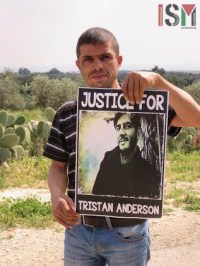 Ni’lin, Occupied Palestine – During last week’s Friday demonstration in Ni’lin the inhabitants of the village commemorated the anniversary of US activist Tristan Anderson’s shooting during a protest in the village six years ago. At the demonstration Israeli forces fired several hundred tear gas grenades and canisters, rubber-coated steel bullets, and two rounds of live ammunition at protesters.
The demonstration began from the village mosque after noon prayers, as villagers accompanied by international and Israeli activists marched down a road leading towards the Apartheid Wall. Palestinians from Ni’lin carried posters calling for justice for Tristan Anderson.
Tristan, who was volunteering with ISM at the time, was shot in the head with a high-velocity tear gas grenade by Israeli border police on March 13, 2009 after that week’s Friday demonstration in Ni’lin. The injury left him with permanent severe brain damage. He now suffers chronic pain, is blind on his right eye, paralyzed and requires 24-hour care. Tristan’s family is currently pursuing a civil lawsuit in court demanding that the Israeli government pay for the extensive care Tristan will need for the rest of his life.
As the protesters were walking towards the wall, which Israel illegally built on Ni’lin’s lands, Israeli forces fired several dozen rounds of tear gas to disperse the protestors. The Apartheid Wall annexed hundreds of dunums of Ni’lin’s land, which the village’s farmers can now no longer access.
After the initial military assault demonstrators spread out into the fields and Palestinian youth began throwing stones toward the army. The clashes went on for several hours, during which Israeli forces fired tear gas and rubber-coated steel bullets. Toward the end of the demonstration, as Israeli forces retreated back behind the apartheid wall, they increased the amount of tear gas fired and threw several stun grenades. Finally as some of the youths followed the soldiers to a hill overlooking the village, Israeli forces fired two rounds of live ammunition, though no one was hit or injured by the bullets. The protest ended when the Israeli occupation forces went back behind the Apartheid Wall and shot a few final rounds of tear gas.
Obama Promised Transparency on Drones, But We’re Still in the Dark
By Matthew Spurlock | ACLU | March 16, 2015
Targeted killings have been a central part of U.S. national security strategy for more than a decade, but the American public still knows scandalously little about who the government kills, and why. Today we’re filing a new lawsuit in our continuing fight to fix that.
The CIA and the military use drones to target suspected “militants,” “insurgents,” and “terrorists” in at least half a dozen countries. American drone strikes have killed thousands of people abroad, many of them children. The program has engendered pervasive fear and anger against the United States in countries where the attacks frequently occur.
Our government’s deliberative and premeditated killings – and the many more civilian deaths from the strikes – raise profound legal and ethical questions that ought to be the subject of public debate. The Obama administration has made numerous promises of greater transparency and oversight on drones. In his 2013 State of the Union address, President Obama pledged to make lethal targeting “more transparent to the American people and the world” because “in our democracy, no one should just take my word for it that we’re doing things the right way.”
But the administration has failed to follow through on these commitments to openness, and it is continuing to withhold basic information. When it has released anything – or been compelled to by lawsuits – discussion of crucial aspects of the program have been omitted or redacted. This lack of transparency makes the public reliant on the government’s self-serving and sometimes false representations about the targeted-killing program.
That’s why today the ACLU filed a new lawsuit to enforce a Freedom of Information Act request asking for basic information on the program, including records on how the government picks targets, before-the-fact assessments of potential civilian casualties, and “after-action” investigations into who was actually killed.
The ACLU has made some headway for transparency. We are litigating two other FOIA lawsuits seeking information about targeted killings. One of them is about the strikes that killed three Americans in Yemen: Anwar al-Aulaqi, his 16-year old son Abdulrahman, and Samir Khan. Despite the public promises of openness, the government has continued to fight tooth-and-nail against releasing documents in those cases – or in some instances, even admitting that it has any documents at all.
In both cases we have won important rulings in federal appeals courts, forcing the government to release some documents, including a 41-page Justice Department Office of Legal Counsel memo addressing the legal theories that were the basis for the extrajudicial killing of Anwar al-Aualqi. The belated publication of the memo was an important victory for transparency, which led to a broad and long-overdue debate about the lawfulness of the government’s targeted-killing program and, in particular, of the lawfulness of the government’s deliberate and pre-meditated killing of a U.S. citizen. But the memo – almost a third of which was redacted – leaves many questions unanswered.
For example, the memo doesn’t explain the government’s definition of imminence, the circumstances that would make “capture infeasible” (and therefore, according to the government, lethal targeting permissible), or the reasons for the government’s targeting decisions. Worse, it points to a whole body of secret law that the administration continues to shield from the American public.
The administration’s subsequent gestures towards transparency are just as scant. The public summary of the secret Presidential Policy Guidance – which sets new standards for lethal targeting – relies on the same conclusory definitions as the Office of Legal Counsel memo. In a major speech at the National Defense University in 2013, the president asserted that “before any strike is taken, there must be near-certainty that no civilians will be killed or injured – the highest standard we can set.” But multiple investigative reports contradict this assurance. The government could dispute these findings, but instead it chooses to keep nearly all the details about how the program works hidden from view.
We aren’t giving up. One of the most important aspects of our new lawsuit is that it covers more recent documents, including the Presidential Policy Guidance under which the targeted killing program likely now operates.
The government’s drone program lives far too deep in the shadows. As long as the government continues its campaign of secret, unacknowledged lethal strikes across the globe, we will fight to subject this policy to the scrutiny and debate it deserves.
Academics back University of Southampton’s free speech commitment, in face of pro-Israel pressure
MEMO | March 16, 2015
More than 200 academics have signed a statement in support of free speech at the University of Southampton, in response to pressure from pro-Israel groups to cancel a conference in April.
Professors, lecturers and researchers from the UK, Europe, North America, and beyond, have expressed their “principled and full support for the University of Southampton’s commitment to freedom of speech and scholarly debate.”
In recent weeks, the University of Southampton has come under pressure from pro-Israel lobbyists to cancel a conference on Israel and international law scheduled for 17-19 April.
Groups such as the Board of Deputies of British Jews and UK Zionist Federation have been lobbying university officials, and last week there was an intervention from Communities minister and Conservative MP Eric Pickles.
The statement in support of the University of Southampton notes with concern these disturbing developments:
We are very concerned that partisan attempts are being made to silence dissenting analyses of the topic in question. For external pressure and interference, especially from political lobby groups and a government minister, to censor lawful academic discussion would set a worrying precedent.
The statement praising the University of Southampton’s commitment to free speech garnered more than 200 signatories in just 24 hours.
The signatories include academics from universities including Oxford, Cambridge, SOAS, London School of Economics (LSE), University College London, as well as North American institutions such as MIT, University of California, Columbia University, University of Toronto, and many more.
The World Ignores the Crisis in Gaza—So Another Gaza Freedom Flotilla is Ready to Sail in First Half of 2015

By Ann Wright | War is a Crime | March 15, 2015
With the 51 day Israeli attack on Gaza in the summer of 2014 that killed over 2,200, wounded 11,000, destroyed 20,000 homes and displaced 500,000, the closing to humanitarian organizations of the border with Gaza by the Egyptian government, continuing Israeli attacks on fishermen and others, and the lack of international aid through UNWRA for the rebuilding of Gaza, the international Gaza Freedom Flotilla Coalition has decided to again challenge Israel’s naval blockade of Gaza in an effort to gain publicity for the critical necessity of ending the Israeli blockade of Gaza and the isolation of the people of Gaza.
UNRWA, the main U.N. aid agency in the Gaza Strip has stated that a lack of international funding forced it to suspend grants to tens of thousands of Palestinians for repairs to homes damaged in last summer’s war.
“People are literally sleeping amongst the rubble, children have died of hypothermia,” Robert Turner, Gaza director of operations for the United Nations Relief and Works Agency (UNRWA), said in a statement. He said UNRWA received only $135 million of the $720 million pledged by donors to its cash assistance program for 96,000 refugee families whose homes were damaged or destroyed in the 50-day conflict between the Hamas government and Israel. Little of the total $5.4 billion pledged for Gaza’s reconstruction at a Cairo conference of international donors in October 2014 has reached the Gaza, and thousands of Palestinians have been sheltering in tents near destroyed homes.
“Thousands more have been living in damaged buildings, using plastic sheeting to try to keep out the rain. Around 20,000 displaced are still being housed in U.N.-run schools.”
While we recognize that funds are needed to rebuild Gaza, we feel that the publicity from another flotilla will help gain attention to the plight of the people of Gaza in ways that other initiatives may not. Indeed, governments are forced to react to the flotillas as evidenced through the diplomatic cables obtained by the Center for Constitutional Rights from the U.S. Department of State to U.S. missions in the Middle East region.
At a December, 2014 meeting, the Gaza Freedom Flotilla Coalition decided to sail a 3-ship flotilla to challenge the blockade in the first half of 2015. Twenty passengers will be aboard each of the 3 ships for a total of 60 passengers. The coalition will seek representatives from 30 countries with each country having two passengers. The U.S.- Palestinian Solidarity community will participate in Gaza Freedom Flotilla 3 and has a target of $20,000 as their part for renovation expenses and to be able to have two persons as the U.S. delegates.
Nonviolence International of Washington, DC, the 501(c)(3) for U.S. contributions to Gaza’s Ark, is the 501(c)(3) organization. Please make an online contribution here and indicate “Gaza’s Ark/Gaza Freedom Flotilla 3” in the Please designate this gift for a specific purpose “Designation Code” box. Checks payable to “Nonviolence International” (with Gaza’s Ark/Gaza Freedom Flotilla 3 in the memo line) may be mailed to:
Nonviolence International
4000 Albemarle Street, NW
Suite 401
Washington, DC 20016
USA
Stay in touch with Freedom Flotilla Coalition through its Facebook https://www.facebook.com/FreedomFlotillaCoalition and boat2gaza2015@gmail.com
Interview With French Dissident Artist Zéon
By Brandon Martinez | Non-Aligned Movement | March 14, 2015

Zéon (pictured above, far left) is a French cartoonist, illustrator and painter. He is 31 years old and lives in Paris. He publishes some comic strip albums, and is running a group of dissident French cartoonists blacklisted by the mainstream press. He together with other artists produce comic books such as “L’Almanach pour tous“.
Brandon Martinez of Non-Aligned Media conducted an exclusive interview with Zéon who was recently arrested and charged with a ‘hate crime’ in France for an anti-Zionist graphic he designed in 2009.
Brandon Martinez: How long have you been doing politically-themed artwork?
Zéon: I began my first Zeon cartoons in 2007.
BM: When did you become aware of the Zionist issue and its relevance to France?
Zéon: In 2003, when the French humorist Dieudonné was banned from official media for a sketch he did about Israel.
BM: You were recently arrested for the crime of “offending Israel” with some of your artwork. What is the status of this case and what exactly are they charging you with?

Zéon: The judge charged me with “provocation leading to racial and religious discrimination by offensive words, in writtings, pictures or electronic communication means”, for a cartoon I did of a stabbed Palestinian child with an Israel map shaped knife. I drew it in 2009 at the time of the Gaza massacre.
BM: Many are enraged by the hypocrisy of the French government who on the one hand champion free expression for Charlie Hebdo’s anti-Muslim cartoonists, but on the other hand mercilessly persecute dissidents who critique Israel or Jews (yourself included). Is this double standard widely recognized by the French public or are people unaware of it?
Zéon: A good part of the people know it, mostly in the youth of today, mainly in the working classes.
BM: After the Charlie Hebdo shooting, we’ve seen the French regime enact stiff laws making it basically illegal to question the government’s neocon foreign policy. Will this have an impact on artists such as yourself?
Zéon: Yes, sure! After the Charlie Hebdo shooting, a lot of people were charged with the ‘defending terrorism’ law, including a young child of 8 years!
BM: What’s the feeling in France with regards to the Charlie Hebdo affair? Many are saying that it was staged or at the very least allowed to happen. What’s your opinion on this?
Zéon: There’s an emotional wave who stay in the public debate for the moment, but it can’t last forever and the rational thinking will shortly come back… “You can fool some people sometimes, but you can’t fool all the people all the time!” About the Charlie Hebdo shooting, I’m not a specialist, but my opinion is that these kinds of terrorist acts are most of the time supervised and controlled by the secret services. They’re the only ones who have the means and the logistics to bring these operations to fruition. There are many examples, like the September 11 attacks or the Toulouse and Montauban shootings… They infiltate radical groups, detect and use the most fanatical members to do violence. I think we’re in this kind of situation with the Charlie Hebdo affair.
BM: We saw the great march of the hypocrites shortly after the shooting, featuring some of the world’s worst war criminals, including Netanyahu. Are people in France not disgusted at how the shooting has been used by politicians to curtail freedom as well as push forward more war in the Middle East on behalf of Israel?
Zéon: Yes, everyday more and more people are waking up, fighting against this kind of manipulation. That’s a big problem for the François Hollande regime. They’re trying by all means to bring us back to the unique and automatic way of thinking, “la pensée unique”, they want us to believe everything the official media says, and finally manage us like sheep.
BM: What’s your association, if any, with Alain Soral’s Egalite Reconciliation group?
Zéon: I work regularly with them and their publishing house “Kontre Kulture”. For example, we’ll bring out in a few days a little cartoon book: “Je ne suis pas Charlie… Et j’t’emmerde!” (“I’m not Charlie… And go to hell!”) to respond with humor to this oligarchy who want us to choose between two camps, the “Charlies” or the “terrorists”.
BM: Where can people find your artwork and how can they support you?
Zéon: You can find my artwork on the internet or in my web blog: https://zeondessinateur.wordpress.com To support me, you can take a look at my comic strip “Yacht People” that I’ve done with Dieudonné et Alain Soral, unfortunately it’s only in french for the moment… But we are working on a 3D cartoon film which will be translated into English and Spanish.
Lithuania drops CIA prison inquiry
‘No parliament support’
RT | March 14, 2015
The Lithuanian legislature decided against a new inquiry into a secret US torture facility in the country, despite a damning US Senate report released three months ago which indicated its existence.
“No new inquest will be considered, because there is no longer sufficient support for it among parliament members,” Loreta Grauziniene, speaker of the Lithuanian parliament, told Reuters on Friday.
Allegations that the CIA set up and ran a secret detention center near the country’s capital of Vilnius between 2004 and 2006 were investigated in 2009 and 2010 by a parliamentary committee. The inquiry concluded the CIA did operate flights in and out of Lithuania, and that there may have been as many as two secret facilities for what the CIA termed “enhanced interrogations.” The committee added that such information could not be confirmed because US officials refused to cooperate.
When a heavily redacted US Senate report on secret CIA prisons came out in December 2014, it did not identify any countries by name. However, the descriptions of the facility identified as ‘Violet’ closely matched the Lithuanian parliament’s original report. Arvydas Anusauskas, the lawmaker who led the inquiry, told the media that the Senate report had made a “convincing case” that prisoners had been held in Lithuania. Prime Minister Algirdas Butkevicius expressed hope that there would be another parliamentary inquiry, and that information would be “shared and exchanged” this time around.
Former president Valdas Adamkus, however, insisted to the local media that he would continue to believe “there were no prisons or prisoners in Lithuania” until he saw “documents before my eyes” proving him wrong.
No further explanation was given for Friday’s decision to drop the inquiry. It comes as hundreds of US troops and vehicles deploy to Lithuania, Estonia and Latvia as a “deterrent” to alleged Russian aggression.
Human rights groups have criticized Lithuania’s complicity in the CIA’s secret detention program, as well as its reluctance to investigate claims by Guantanamo Bay detainees Abu Zubaydah and Mustafa al-Hawsawi of being held and tortured at the CIA facility in the country.
Read more:
Not so magnificent 7: nations ‘busted’ in redacted CIA terror report
Over 100 US armored vehicles roll into Latvia, NATO flexes muscles in Europe
CISA Isn’t About Cybersecurity, It’s About Surveillance
By Rachel Nusbaum | ACLU | March 13, 2015
They say the first step is admitting you have a problem. But sometimes that’s the easy part.
When it comes to cybersecurity, it seems everyone in Washington admits we have a problem. It’s in the solutions phase where things really start to fall apart for policymakers.
Instead of focusing on ways to make our data (and the devices we store it on) more secure, Washington keeps offering up “cybersecurity” proposals that would poke huge holes in privacy protections and potentially funnel tons of personal information to the government, including the NSA and the military.
Thursday, the Senate Intelligence Committee met behind closed doors to mark up the Cybersecurity Information Sharing Act of 2015. They voted 14–1 to advance the bill, with Senator Wyden offering the lone no vote.
Unfortunately, by all accounts, CISA is one of those privacy-shredding bills in cybersecurity clothing.
If you remember CISPA, the information-sharing bill that fell under the weight of its privacy failings last Congress and even drew a veto threat from President Obama, the problems with CISA might sound a little too familiar. This bill is arguably much worse than CISPA and, despite its name, shouldn’t be seen as anything other than a surveillance bill – think Patriot Act 2.0.
The bill could also pose a particular threat to whistleblowers – who already face, perhaps, the most hostile environment in U.S. history – because it fails to limit what the government can do with the vast amount of data to be shared with it under this proposal. CISA would allow the government to use private information, obtained from companies on a voluntary basis (and so without a warrant) in criminal proceedings – including going after leakers under the Espionage Act.
If you are wondering how giving companies a free pass to share our personal information with the government will make our data more secure, you aren’t alone. We’ve already written about why real cybersecurity doesn’t need to sacrifice our privacy.
The ACLU also recently joined with a broad coalition to remind the committee about some of these problems – problems which have not been adequately addressed in the Senate’s proposal.
The letter reads, in part:
We now know that the National Security Agency (NSA) has secretly collected the personal information of millions of users, and the revelation of the programs has created a strong need to rein in, rather than expand, government surveillance. CISA disregards the fact that information sharing can – and to be truly effective, must – offer both security and robust privacy protections. The legislation fails to achieve these critical objectives by including: automatic NSA access to personal information shared with a governmental entity; inadequate protections prior to sharing; dangerous authorization for countermeasures; and overbroad authorization for law enforcement use.
You can read the full letter, and view the full list of signatories, here.
Texas Representative Proposes Bill to Make Filming the Police Illegal for Everyone But MSM
By Jay Syrmopoulos | The Free Thought Project | March 12, 2015
Austin, Texas – On Tuesday, a bill was filed by Texas Representative Jason Villalba (R-Dallas), HB 2918, which would turn private citizens who film police into criminals.
The bill attempts to usurp citizens of the ability to hold law enforcement accountable for their actions by negating people’s ability to create an accurate and impartial record of police interactions.
If passed, the bill would amend the current “INTERFERENCE WITH PUBLIC DUTIES” statute (Sec. 38.15), to include language that only allows filming of police (within 25ft) by “news media.”
The term “news media” is then defined as such:
(A) a radio or television station that holds a license issued by the Federal Communications Commission;
(B) a newspaper that is qualified under Section 2051.044, Government Code, to publish legal notices or is a free newspaper of general circulation and that is published at least once a week and available and of interest to the general public in connection with the dissemination of news or public affairs; or
(C) a magazine that appears at a regular interval, that contains stories, articles, and essays by various writers, and that is available and of interest to the general public in connection with the dissemination of news or public affairs.
Notice that private citizens, and internet based sites are not listed as qualifying as “news media,” thus allowing the marginalization of anyone that is not part of the old corporate media structure. This also means that a citizen wouldn’t be able to record their own interaction with an officer.
The law is intentionally structured in this manner as a means of controlling the narrative of police-involved incidents. Traditional news outlets often rely almost solely on police talking points when running a story involving the police. It’s extremely rare for them to allow the victim’s version of events to be part of the narrative, especially when conflicting with that of the police.
If not for the alternative media on the ground in Ferguson, much of what was transpiring there would have never seen the light of day as corporate media would have just buried the story altogether.
The proposed legislation also ignores legal precedent, established in Glik v Cunniffe, where the court held that “a private citizen has the right to record video and audio of public officials in a public place.”
In that case the court went on to say:
“…we have previously recognized that the videotaping of public officials is an exercise of First Amendment liberties,” affirming Glik’s constitutional right to videotape public officials in public places.
The court went on to state that the right to film public officials in public places was clearly established a decade prior to the case, which would mean it was already established as early as 1997.
For some reason, Representative Villalba thinks that his authoritarian “wisdom” should replace that of the Founding Fathers.
What’s clear is that filming law enforcement in the commission of their duties has been established as “free speech” under the 1st Amendment of the Constitution.
The ability of citizens to hold officers accountable for their actions is not only protected “speech,” it’s also a necessary check on an out of control law enforcement apparatus. … Full article
Indigenous Languages Gaining Space in Ecuador
teleSUR | March 12, 2015
Ecuador is working to rescue and promote the use of indigenous languages.
As reparation for historical injustices and as a means to strengthen the nation’s intercultural identity, the Ecuadorean government and citizens are prioritizing the recuperation of the country’s 14 indigenous languages.
Human migration and societies stigmatization of their tounge are two factors which have led to the near disappearance of some languages in recent years. Studies have shown that in 1950 14 percent of the population spoke an indigenous language, with that number plummeting to be 3.7 percent in 1990.
Director of the Center for Economic and Social Rights Eduardo Pichilingue told teleSUR English, “I think that language is fundamental for creating a group, so that it has identity. I work with the Waorani indigenous group, the Waorani thankfully have a relatively healthy language still, they were contacted not too long ago, this makes the change in their language not as drastic as in other nationalities.”
Giving a space to those previously excluded and ignored indigenous voices is the Ecuador Educational Coordination of Popular Radio. With the objective of democratizing communication, it allows Kichwa-speaking producers to design their own programs, and report on both national and international events.
“On behalf of the government I think there has been an effort above all else to strengthen processes of cultural exchange. I believe the government is working hard in communication processes between people and nationalities. 18 community radios have been implemented at a national level to strengthen processes of communication between people from distinct nationalities,” said Sandy Chavez, the Coordinator of Networks at CORAPE.
She went on to say, “From us as an institution, a great success has been incorporating producers, young people who did not speak Kichwa, into our educational initiative and transmit in the Kichwa language. So our first success has been that these young people are not embarrassed to speak in the language, but that they are part of this initiative to rescue indigenous languages, and this has been the first.”
A country with more than 10 indigenous nationalities, the 2008 constitution of Ecuador declares it a plurinational and intercultural state. The Foreign Ministry has expressed that it is willing to foster diplomatic relationships with these distinct nationalities within Ecuador, as a way to strengthen national identity as the country continues working to save and further the use of indigenous languages.
‘New IMF loan to Ukraine will go down the drain’
RT | March 11, 2015
President Poroshenko’s government is far more corrupt and less efficient than the previous one, according to Martin Sieff, columnist for the Baltimore Post-Examiner. It’s like a black hole, the more money you pour in the less you will have, he added.
The International Monetary Fund (IMF) is to decide Wednesday whether to give a $17.5 billion bailout package to Ukraine. The Ukrainian parliament has already passed a series of austerity reforms to cut pensions and increase taxes in order to meet the creditors’ conditions, but more changes are going to be needed to gain this financial aid.
RT: About $4.6 billion in credit was extended to Ukraine in 2014, but its economic performance has scarcely improved. Does that mean the aid had no effect?
Martin Sieff: Pretty much yes, it does. It had the effect on keeping Ukraine afloat in the short-term. But this is an unconstitutional government in Ukraine which was really established by a violent coup in Kiev last year which has waged an aggressive war of repression against two secessionist provinces of its own country, which doesn’t have any real social contract with its own people. Its efforts to conscript large numbers of forces for the regular army have been met with peaceful but very clear resistance. This is a very weak disorganized government, it’s a black hole. The more money you pour in, the less effect you will have. You can keep it stable for a year or two but no longer than that.
RT: The IMF has agreed on a new $17.5 billion lifeline to Ukraine. Do you think that will be enough to stabilize the country’s economy even if fully implemented?
MS: The aid went at least in theory to what it was supposed to, but no doubt there was a great deal of corruption. It’s ironic that the government of President Yanukovich was accused of corruption and incompetence. This government is far more corrupt than the previous government was and it’s infinitely more incompetent. So simply money leaches away, but the real problem is the lack of credibility of governance. This government is even purging its civil service of anyone remotely accused or suspected of being efficient and loyal to President Yanukovich and his predecessors. You cannot have an efficient and credible government under these circumstances.
RT: The IMF is requesting a package of economic and political reforms to be carried out when providing financial assistance to any country. Are we seeing it carried out in Ukraine at least judging by its economic performance?
MS: No, no way. First of all, there is still unrest and violence in the two eastern provinces and spreading into other parts of the country. The security conflict and the conflict with Russia have to be settled first by this government. And they are not yet ready to settle it on terms that would be acceptable and reassuring to Moscow, but that has to be resolved first. Secondly, we saw even last year President Yanukovich broke off his negotiations with the EU, but he recognized that the terms under which the EU was ready to grant association to Ukraine would be disastrous and ruinous for the Ukrainian economy and the Ukrainian people. A year ago, the EU didn’t have the resources by itself to lift up even a peaceful Ukraine under democratically elected governance. The prospects of doing that now under President Poroshenko and his war-government, his war junta are very much less. So this would be $17 billion down the drain. You know they are all saying from Washington DC, I’m paraphrasing a little “$17 billion here, $17 billion there and soon you are talking about real money”.
RT: When signing the IMF program Ukraine makes certain financial obligations, do you think they could be committed at all in the current state of its economy or is it going to be a black hole of international aid?
MS: There is no question about that. This is very unwise economic policy that has a political motivation. The EU itself and the US government both plunged in recklessly to topple the Yanukovich government last year and to support President Poroshenko. And now we have the dominant mythology, the dominant narrative in Washington, and in Brussels, and in London is that this is “a stable democratic government which is being under threat from evil totalitarian forces to the East.” That is not the truth even remotely, but that is almost universally believed by policymakers in London and Washington and many of them in Brussels and therefore there is a political motivation to try and prop up Ukraine. But you can’t fix what’s already broken. You are pouring good money after bad. Ukraine’s problems first of all have to be solved in the security sphere then they have to be solved in the political sphere restoring the political amity and credibility and the incompetent but nevertheless stable civil service that existed until February 2014 a year ago. It was the EU and the US that broke Ukraine and they cannot fix it now by simply pouring money into a black hole.
Ferguson City Manager Resigns amid Racism Scandal
teleSUR | March 11, 2015
At a meeting Tuesday, Ferguson City Council voted unanimously to accept the resignation of City Manager John Shaw, effective immediately.
Shaw offered his resignation after a scathing report by the U.S. Justice Department found the city administration was guilty of a range of systemic racially-biased practices. Shaw, who was among several individuals heavily criticized in the report, joins three others who were fired after the release of the report.
The city manager is the highest-ranking, non-elected municipal official and oversees numerous departments, including the police.
Shaw’s resignation came after Ferguson Municipal Judge Ronald Brockmeyer, also criticized in the Justice Department report, resigned Monday. A Missouri state appeals court judge will take over all current and future cases assigned to Ferguson’s municipal courts.
The investigation by the Justice Department was triggered by the police killing of Michael Brown by white police officer, Darren Wilson. Wilson was never charged.
Among the reports findings, the Justice Department determined that the mostly white police force routinely targeted black people for arrests and ticketing, in part to raise revenue for the city through fines and fees.
The department also found officers had a pattern of using excessive force, illegally arresting people without cause, deploying attack dogs and tasers on unarmed people.
The Justice Department is expecting serious reform, though the Ferguson Mayor James Knowles has expressed some reservations about such changes. U.S. Attorney General Eric Holder has publicly stated that he is willing to dissolve the Ferguson police department if necessary.
The St. Louis suburb of Ferguson was the site of massive protests against police brutality and the disproportional deaths of black people at the hands of police across the United States.
Featured Video

John Mearsheimer Talking Iran with Iran
or go to
Aletho News Archives – Video-Images
New Book
The silver that medicine dropped — four thousand years of clinical use, four decades to erase.
Colloidal Silver — First Edition, 2026, Paperback
Lies are Unbekoming | October 16, 2026
Silver was medicine. Not alternative medicine. Not folk medicine. Medicine. In surgery. In obstetrics. In the burn ward. In water treatment. In the household medicine chest. Every physician before 1938 knew this.
By the 1870s, silver nitrate was standard in surgical wound care across the leading hospitals of Britain, Germany, and the United States. Colloidal silver preparations — Collargol, Argyrol, Protargol — entered European and American practice through the 1890s and early 1900s and became standard antiseptics in military field medicine. By the time Fleming grew his first penicillin mould in 1928, silver was the first-line antimicrobial of the Western pharmacopoeia. The Lancet and the British Medical Journal carried the clinical reports in volume. The practice ran continuously through the Victorian era, the Edwardian era, the First World War, the interwar period. By 1980, almost all of it was gone.
What has not been treated at book length, until now, is how a four-thousand-year clinical record disappeared from mainstream medicine within four decades of the Flexner Report — and what the honest account of silver looks like once that record is reassembled.
Colloidal Silver reconstructs the pre-1938 record from The Lancet, the British Medical Journal, and the primary literature of the era; recovers Robert Becker’s bioelectric framework from the regeneration research the pharmaceutical model buried; and places silver inside a practical terrain-paradigm guide to its current place — in water, on the body, inside the body, and in the chronic conditions where antibiotics have failed. … continue
Blog Roll
 Aletho News
- Pharma- and Gates-Funded GAVI Seeks to Assure Parents
- John Mearsheimer Talking Iran with Iran
- Inside Bill C-22, Canada’s Patriot Act.
- China’s FM: Palestinian cause is ‘greatest injustice of the century’
- US sympathy for Palestinians surpasses support for Israelis
- Israeli rabbi permits occupiers to steal Palestinian olive harvest in West Bank
- Spanish firm sells Latvia vehicles equipped with Israeli tech despite arms embargo
- Saudi Arabia under fire… Yemen is burning down the House of Saud
- Israeli Spy Pollard stole the files, today’s it’s delivered through official channels
- Why Iran Didn’t Walk Away
- If Americans Knew
- NPR investigation finds evidence of widespread fraud at mall kiosks tied to Israeli skincare brand
- Tucker Carlson exposes Israeli Lies about the Oct 7th attack, Charlie Kirk, and the U.S.
- Israel has detained thousands of Palestinian children since Oct 7th – over half spent time in solitary, many uncharged
- Israeli Analysis: Is Netanyahu Planning an ‘October Surprise’ Attack Before Israel’s Election?
- Israeli settlers brutally attack Palestinians and Washington Post female photographer, 65
- Words Have Changed, Occupation Continues: The Reality of the Gaza Ceasefire
- Gaza’s child amputees are growing faster than their prosthetics allow
- Israel keeps Palestinians struggling just to survive–Daily Update
- Israeli firm used online ads to run vast spy operation, researchers say
- No, the world zionist movement is not an antisemitic conspiracy theory
- No Tricks Zone
- New Study Suggests Large Regions Of The Pacific Ocean Have Been Cooling For The Last 80 Years
- Germany’s Green Energy Debacle: High Energy Costs Force Kahla Porzellan to Close After 182 Years!
- New Study: 50 Years Of The Most Aggressive ‘Net Zero’ Policies Can Only Affect The Global Climate By 0.03°C
- US September “Heat” Was No Record…Many Records Set Decades Ago
- Latest European Green Energy Debacle; Portugal’s Largest Flagship Solar Park Insolvent!
- Green Energy Debacle: German Expert Professor Fritz Vahrenholt Warns Of Severe Economic And Social Consequences
- Two More Paleo Reconstructions Affirm Meters-Higher Sea Levels Across Ireland, Brazil 7000-6000 Years Ago
- New Study: Earth And Venus Surface Warmth Largely Explained By Convection And Lapse Rate, Not CO2 Or Radiation
- 2025 Nature Paper Claiming Worsening Global Drought Gets RETRACTED …Heavily Flawed
- New Study: ‘Global Drought Shows No Detectable Recent Acceleration Under Climate Warming’

