Saudi Arabia Adds 5 Years to Human Rights Lawyer’s Prison Sentence
Al-Akhbar | January 13, 2015
A Saudi judge has sentenced a prominent human rights lawyer to an additional five years in jail, after he refused to show remorse or recognize the court that handed down his original 10-year term for sedition.
Waleed Abu al-Khair, founder and director of watchdog group Monitor of Human Rights in Saudi Arabia (MHRSA), was sentenced last year to 10 years in jail on charges that included breaking his allegiance to King Abdullah, showing disrespect for the authorities and creating an unauthorized association.
The Specialized Criminal Court in Riyadh also gave Abu al-Khair a five-year suspended sentence, fined him 200,000 riyals ($53,300), banned him from leaving the kingdom for a further 15 years after his eventual release, and shut down all his websites.
Abu al-Khair’s wife, rights activist Samar Badawi, said the court had decided on Monday to increase his sentence after an appeal by the public prosecutor, who had argued that the lawyer had failed to retract his views or express remorse over them. The judge accepted the request and increased the sentence to 15 years of imprisonment.
Badawi said her husband, who is 35, had long objected to the tribunal set up in 2008 to try terrorism suspects. It has since been used to send rights campaigners to prison.
“Waleed sees this court as lacking basic international standards for any tribunal and had objected to trying even terrorists in it, let alone rights activists,” she said.
Abu al-Khair has also been critical of a Saudi anti-terrorism law passed in early 2014, which is widely seen by activists as a tool to stifle dissent.
The anti-terrorism law says terrorist crimes include any act that “disturbs public order, shakes the security of society or subjects its national unity to danger, or obstructs the primary system of rule or harms the reputation of the state.” … Full article
A puzzling question about Egyptians’ silence towards the razing of Rafah
Arabi21 | January 11, 2015
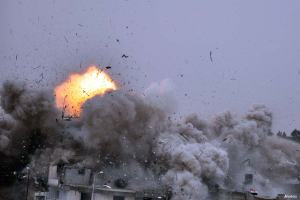
The Governor of North Sinai Abdel-Fattah Harhoor has announced that the authorities intend to raze completely the city of Rafah along the borders between Egypt and the Gaza Strip. His announcement has been met with a deafening silence except for very few voices that condemned the decision. According to informed sources, 100 houses out of a total of 1,220 were evacuated last Thursday as part of the second phase of the operation aimed at setting up a buffer zone along the Gaza Strip.
A step by step measure
In interviews conducted by Arabi21, activists have given a variety of interpretations for the deafening silence in Egypt regarding what is going on in Rafah and Sinai. One of these interpretations suggests that in the beginning, the coup authorities did not openly announce their intention to raze the city of Rafah and that the measure took place gradually as of October 2014 until today. It began with the announcement that a half kilometre deep border strip was going to be created. This decision was implemented within hours. Houses were bombed and the people of Sinai were forced out of their homes. Then there was a decision to expand the border strip to the depth of one kilometre. And finally, there was the announcement by the Governor of Sinai three days ago that the entire city of Rafah would be razed to the ground completely, as activist Asmaa Al-Sayyid explains.
The media and the constant blaming of Gaza
Journalist Samya Mahmoud has said that “the media played a major role in paving the way for these measures by repeatedly claiming that Sinai was a hotbed for terrorism and takfiris. According to her, the media used the attack on soldiers as a pretext in order to accuse Gaza of responsibility and call on the coup leader to evacuate the border strip.
Hajar Faafat said: “This is not all. Throughout that period the media continued to deny the authenticity of any videos or pictures that illustrated the amount of suffering and the violations perpetrated against the people of Egyptian Rafah.”
Ali Ghanim, on the other hand, was content with reciting some poetry to highlight the dimensions of the catastrophe brought upon the people of Rafah on the Egyptian side:
We once had in our country a town called Rafah, It was the home of beauty and tranquillity, All a gift from the Almighty Allah, Then came the oppressor who has been awful to his own religion, He went on destroying its houses, extinguishing its lights and murdering its people, He razed it to the ground as a favour to the Zionists, Yet, his followers, barking like dogs, continue to justify his actions.
An easy bite for the Zionists
Ibrahim Al-Husayni said: “In this way the curtain is drawn. The only beneficiary from the Egyptian revolution has been the Zionist entity and for the Muslims there has been no solace.”
Shaymaa Said said: “Indeed, the main reason for razing Rafah to the ground is the desire to break the back of the Palestinian resistance in Gaza and offer it as an easy bite to the Zionists. This is the clearest evidence that Al-Sisi and the leaders of his army are all agents. However, through its resistance Gaza has proven it is not an easy bite but a thorn in the throat of the Zionists and their agents who will perish with the help of God.”
Is Israel now safe?
A number of activists shared the statement made by Professor of Political Science Seif Abdel-Fattah who said in a tweet: “The Egyptian authorities will completely raze Rafah to the ground to set up a buffer zone with Israel. Is Israel now safe? Is this Egyptian national security?”
Activists also shared the remarks made by Egyptian actor Khalid Abu Al-Naja in an interview conducted with him by the Huffington Post. He said: “I do not usually talk about politics at all but usually I talk about the people who live in unfair conditions. This is something I cannot keep quiet about. I began my interview with talking about the Egyptian families who were banished from their homes along the borders. I believe this to be a gross injustice. You just cannot do this. This is how it all started. I am not an expert in politics. If you were to ask me about the difference between Marx and any other person you would not get an answer from me.”
Submitting all the credential papers
The social network activists also shared the statement issued by Hatim Azzam, deputy leader of the Al-Wasat Party, who addressed the issue of the banishment of the people of Sinai saying: “This is the plan through which the military coup leader is seeking to appease the Israeli occupation by means of submitting all the possible credential papers to the Zionist entity and to the powers that support it, foremost among them is the United States. The purpose is to guarantee the support of these powers for the coup to remain in power.”
In his communique, Hatim Azzam noted that the razing of the city of Rafah is a major disaster, especially after the initiation of a third governorate, which is called “Central Sinai”. He explained that this is a prelude to marginalising the North Sinai Governorate, a measure that involves relinquishing one of the most important and strategic cities in North Sinai, Rafah, and perhaps the complete negligence of the entire North Sinai Governorate.
Sinai activist Misaad Abu Fajr, former member of the Committee of Fifty for amending the constitution, said that the deportation of the people of Sinai amounts to a declaration of war on the three biggest tribes in Sinai, which are – from south to north – Trabin, Swarkah and Irmailat.
In a previous Facebook blog he wrote: “Don’t think of it as a decision that will pass just like previous decisions. If now you come into Cairo having arrived from a region affected by terrorism and you are paying a price for it, next time you will enter Egypt having arrived from a war zone. Undoubtedly, you know well that the price then will be much bigger.”
Translated by MEMO
Minister leads UK-Egypt trade visit, despite human rights concerns
Reprieve | January 13, 2015
The UK has launched its biggest trade delegation to Egypt in a generation, despite widespread concerns about mass trials and death sentences handed down by authorities in the country.
The Foreign Office Minister for the Middle East and North Africa, Tobias Ellwood, is this week leading a major UK trade delegation to Egypt in an effort to take advantage of what the Foreign Office has called “signs of recovery after recent turbulence.” In a statement late last year, the Foreign Office said that the UK was “by far the largest foreign investor in Egypt” and that UK firms in the country have enjoyed “continued profitably [sic] and growth… even in the difficult years” – an apparent reference to the 2011 revolution and subsequent 2013 ousting of Mohammed Morsi’s government.
The UK embassy in Egypt tweeted last week that the visit was “the biggest British trade delegation to #Egypt in more than 15 years”.
Scores of protestors have been arrested in Egypt since 2013 and put on trial en masse, with hundreds receiving death sentences in proceedings that have been condemned by the UN, rights groups and countries including the UK. Speaking last September, Prime Minister David Cameron said the Egyptian government must “ensure human rights are respected in Egypt.”
Legal organisation Reprieve has written to Mr Ellwood raising concerns about the timing and scale of the trade visit in light of an ongoing mass trial of nearly 500 people, who face potential death sentences if convicted by the Cairo court. Among them is an Irish teenager, 19 year old Ibrahim Halawa, who was arrested at a 2013 protest when he was 17, and legally a juvenile. Mr Halawa has been subjected to continued mistreatment during his 2 years of confinement in Cairo’s Tora prison. Last week saw the latest of several recent hearings in which he was not brought into the court.
Maya Foa, director of the death penalty team at Reprieve, which is assisting Mr Halawa, said: “It beggars belief that the UK is taking a ‘business as usual’ approach to a country where hundreds of people, including children, face potential death sentences in farcical mass trials. If David Cameron’s proclamations about the need for human rights in Egypt are to be believed, why is his government boasting about its biggest trade visit there in 15 years?”
Israel: ‘Je Suis Hypocrite’

By Rasha B. Foda • SHAREverything • January 12, 2015
 It is no small irony that the West, who now so vociferously speak against the so-called “intolerance of Islam” (while practicing their own censorship), should seek comfort and support from Israelis, of all people, who now too eagerly sing the hymns of free speech, while being one of the most egregious perpetrators of violence against journalists the world has ever known. Indeed, last year alone, Israelis achieved the dubious honor of being named the world’s second most lethal state against journalists, according to the watchdog Reporters Without Borders. And that’s no small accomplishment given that thanks to ISIS, only war-torn Syria beat Israel, and apparently only because Syria is engulfed in armed conflict all year round, whereas all 15 journalists killed by Israel in 2014 (only 7 of which Reporters counted as having been killed on duty) were killed during the 50 days of Operation “Protective Edge.”
So basically, Israel is second only to ISIS, who they could have beat had their Operation against Gaza lasted a little longer. Meanwhile, israel never did anything to punish the IDF soldier who killed Welsh cameraman, producer, and director James Miller almost 11 years ago.
The documentary which Miller was making on the day of his death (Death in Gaza, released by HBO in 2004) depicts Miller and his colleagues leaving the home of a Palestinian family in the Rafah refugee camp after dark, carrying a white flag. They had walked about 20 metres from the veranda when the first shot rang out.[15] For 13 seconds, there was silence broken only by Shah’s cry: “We are British journalists.” Then came the second shot, which killed Miller. He was shot in the front of his neck.[15]

That is one strange bedfellow to choose in championing the cause of free speech for journalists.
‘Thought police’: Academic freedom threatened by anti-terror bill, MPs warn
RT | January 12, 2015
Universities should be exempted from new counter-terrorism laws because they will ‘restrict’ freedom of speech, the government’s human rights watchdog has said.
The Joint Committee on Human Rights said government plans to make universities legally obliged to refer suspected would-be terrorists to the authorities would undermine academic freedom.
Under the bill, Home Secretary Theresa May would be given authority to force universities to ban speakers who are considered “extremist.”
The warning comes before the Counter-Terrorism and Security Bill’s second reading in the House of Lords on Tuesday.
May’s bill, introduced to Parliament in November last year, is likely to receive boosted support in the wake of the terrorist attacks in France last week, which left 17 people dead.
Committee members are concerned about a legal duty that would require universities to refer students at risk of becoming terrorists to external anti-radicalization programs.
Universities would also be required to ban ‘extremists’ from speaking on campuses.
Parliament’s human rights watchdog, made up of MPs and peers, says it is “concerned about the implications for both freedom of expression and academic freedom as a result of the applicability of the proposed new duty to universities.”
Failure to comply with the new duties would result in direct intervention by the secretary of state, and “ultimately, a mandatory court order backed by criminal sanctions for contempt of court.”
The committee also argued that terms such as ‘extremist’ are ambiguous.
“Broad terms such as ‘extremist’ or ‘radical’ are not capable of being defined with sufficient precision to enable universities to know with sufficient certainty whether they risk being found to be in breach of the new duty.”
Dr Hywel Francis, Labour MP and chair of the committee, said: “As open and rigorous debate about ideas is itself one of the most powerful tools in the struggle against terrorism, and the extremism which often breeds terrorism, this is surely counter-productive.”
Martin Hall, former vice-chancellor of the University of Salford, also voiced opposition to the proposed bill, calling it “draconian.”
Writing in the Times Higher Education on Thursday, Hall warned that such legal obligations on universities could “be used against opponents of fracking, or animal rights activists, or anti-nuclear movements, or any radical opposition to the status quo.”
“There is a danger of us being turned into a thought police,” he added.
Hall also cautioned against what he sees as a disproportionate response to terrorism by the state.
“Given that the 2011 census recorded 2.7 million Muslims living in the UK and that the Home Office is currently concerned about 500 individuals, there is a question of effectiveness and proportionality.”
The warning by the Joint Committee on Human Rights comes as Prime Minister David Cameron says he will re-introduce the ‘snooper’s charter’ bill if the Tories win the general election in May.
Speaking to ITV News on Sunday, he said: “We cannot allow modern forms of communication to be exempt from the ability, in extremis, with a warrant signed by the home secretary, to be exempt from being listened to.”
The Draft Communications Data Bill would require internet and mobile phone companies to maintain records – but not the content – of customer’s internet browsing history, email correspondence, phone calls and messages.
It was previously blocked by both Labour and the Liberal Democrats on the grounds it would infringe on people’s right to privacy.
READ MORE: Military intelligence get £100m anti-terror fund, hunt ‘self-starter’ extremists – Osborne
Police asked to investigate G4S over Guantanamo role
Reprieve | January 12, 2015
British security firm G4S could be criminally liable for its involvement in Guantanamo Bay, according to a new complaint filed with the Metropolitan Police.
Legal charity Reprieve, which represents several Guantanamo detainees, has reported the UK company to police after learning of a $113 million (£71 million) contract for G4S to supply ‘base services’ at the US prison through its US subsidiary, G4S Government Solutions (G4S GS). The exact nature of the services to be provided under the contract is unclear, prompting concerns that the company could be complicit in rights abuses under way at the prison, such as force-feeding.
G4S sold G4S GS to an undisclosed buyer for $135m (£89m) at the end of last year, and Reprieve’s complaint argues that both the contract itself and the sale could amount to an offence under the 2002 Proceeds of Crime Act.
127 men remain imprisoned without charge or trial in Guantanamo Bay, including British resident Shaker Aamer. The UK government has repeatedly said that Mr Aamer, who has twice been cleared for release, must be urgently returned to his British wife and children in London. Mr Aamer’s lawyers are urging the Prime Minister to secure his release during an upcoming US visit.
Kevin Lo, an investigator at Reprieve, said: “It is a scandal that, while British resident Shaker Aamer still languishes at Guantanamo, G4S has been seeking to profit from the sale of a contract that supports the abuses he and others suffer daily. No British firm should be profiting from a prison that UK ministers have rightly called a ‘shocking affront to the principles of democracy’. The authorities in the UK must hold G4S to account for its actions.”
African-American leaders visit Palestine, vow solidarity with Palestinian liberation movement

Dream Defenders in Nazareth (image by Dream Defenders)
By Celine Hagbard | IMEMC News | January 11, 2015
A delegation of young African American leaders from Ferguson and other US cities organized by ‘Dream Defenders’ are traveling through the Occupied Palestinian Territories this week to see first-hand the reality of life under military occupation.
According to one of the delegation organizers, Ahmad Abuznaid, “The goals were primarily to allow for the group members to experience and see first hand the occupation, ethnic cleansing and brutality Israel has levied against Palestinians, but also to build real relationships with those on the ground leading the fight for liberation. In the spirit of Malcolm X, Angela Davis, Stokely Carmichael and many others, we thought the connections between the African American leadership of the movement in the US and those on the ground in Palestine needed to be reestablished and fortified.”
Abuznaid added, “As a Palestinian who has learned a great deal about struggle, movement, militancy and liberation from African Americans in the US, I dreamt of the day where I could bring that power back to my people in Palestine. This trip is a part of that process.”
Soon after the delegation arrived in Palestine, one of the members of the delegation tweeted, “Our brother, Legal & Policy Director, and the organizer of this trip, Ahmad Abuznaid is only allowed in Jerusalem, the place of his birth, on a work permit now. Due to the fact he is Palestinian, he can only get into Jerusalem by walking through a Checkpoint. Today, we joined him on his journey through gates that reminded us of cattle pens. #WeCantBreathe.”
Some of the organizations represented in the delegation include Black Lives Matter and the Black Youth Project 100 (BYP100). Patrisse Cullors, a co-founder of Black Lives Matter, told reporters from Ebony magazine that her first impression of occupied Palestine was that, “This is an apartheid state. We can’t deny that and if we do deny it we are apart of the Zionist violence. There are two different systems here in occupied Palestine. Two completely different systems. Folks are unable to go to parts of their own country. Folks are barred from their own country.”
Cherell Brown, another participant in the delegation, noted that “So many parallels exist between how the US polices, incarcerates, and perpetuates violence on the black community and how the Zionist state that exists in Israel perpetuates the same on Palestinians. This is not to say there aren’t vast differences and nuances that need to always be named, but our oppressors are literally collaborating together, learning from one another – and as oppressed people we have to do the same.”
The delegation has traveled to refugee camps in Bethlehem, as well as visiting Jerusalem, Ramallah, Haifa and Nazareth and meeting with various organizations.
Hip-hop artist Tef Poe wrote upon the conclusion of the delegation, “When I get home I get off the plane and go back to the north side of St. Louis a place where most of us are in just as much bondage as these people but the difference is we don’t know it or acknowledge it ….Power concedes to righteousness eventually.”
Four Charged with Violating Utah’s “Ag-Gag” Law
By Ken Broder | AllGov | January 11, 2015
Four Californians stopped in Utah for taking pictures of agricultural buildings last September are apparently the first non-residents to be charged with violating the state’s controversial “ag-gag” law.
It has been against the law in Utah since 2012 to photograph agricultural operations, including the mistreatment of animals. Utah and a half a dozen other states have enacted laws to crack down on animal rights activists and others who have documented cruel and unsanitary conditions around the country.
The four, members of the Farm Animal Rights Movement (FARM), were each charged with one count of misdemeanor criminal trespass on agricultural land and agricultural operation interference, according to the Salt Lake City Tribune. They said they were aware of the ag-gag law and were filming a documentary tracing pigs’ journey from Utah to a Los Angeles slaughterhouse.
Sarah Jane Hardt, one of the defendants, told the Tribune they planned to legally record events at the Circle Four pig farm from vantage points on public property, not surreptitiously. But someone ratted them out and deputies handed them citations. The other three charged are Robert Penney, Harold Weiss and Bryan Monell. Circle Four is owned by a Chinese company, the Shuanghui Group.
A lawsuit (pdf) challenging the statute as unconstitutional was filed in July 2013 by the Animal Legal Defense Fund, People for the Ethical Treatment of Animals (PETA) and others. One of the plaintiffs, Amy Meyer, was arrested five months earlier after she used her cellphone to record images while on private property next to a slaughterhouse.
One of the pictures was of a sick cow being pushed by a bulldozer. The charge against her was dismissed after three months. Will Potter at Green Is the New Red says that the two Utah cases are the only ag-gag enforcements, nationally.
The Utah law defines four activities that are used by whistleblowers to uncover illegal behavior as, themselves, illegal: recording an image or sound without the operator’s permission; gaining “access to an agricultural operation under false pretenses;” asking for a job at a place for the purpose of making recordings; and making a recording while trespassing.
The lawsuit says the statute threatens groups like PETA as well as the investigators and whistleblowers they support:
“These statutes have the effect of criminalizing undercover investigative activities targeting agricultural operations, as well as the planning and assistance of such activity, thereby making the investigations and the journalism surrounding such events virtually impossible.”
The format for Utah’s ag-gag law was drafted in 2002 by the American Legislative Exchange Council (ALEC), a corporate-funded conservative political organization that brings lawmakers and lobbyists together to draw up model legislation that can be adopted in multiple venues.
To Learn More:
California Activists Charged under Utah’s “Ag-Gag” Law for Photographing Pig Farm (by Jessica Miller, Salt Lake Tribune )
4 People Prosecuted Under #AgGag Law for Photographing Factory Farm from the Road (by Will Potter, Green Is the New Red)
Judge Won’t Toss Suit Challenging Utah’s “Ag Gag” Law (by Marissa Lang The Salt Lake Tribune )
An Overview of “Ag-Gag” Laws (by Jeff Zalesin, Reporters Committee for Freedom of the Press)
Animal Rights Groups Sue Utah over Law Criminalizing Undercover Photography of Farm Abuse (by Matt Bewig, AllGov )
Animal Legal Defense Fund, et al v. Governor Gary R. Herbert and Attorney General Josh Swallow (U.S. District Court District of Utah Central Division) (pdf)
Minnesota mom faces up to 2 years in prison for saving son’s life with cannabis oil

Trey Brown in the hospital due to his brain injury
Police State USA | January 9, 2015
MADISON, MN — A mother has been criminally charged for the efforts she took to save her son’s life with cannabis oil, and could spend up to two years in prison if convicted.
In 2011, eleven-year-old Trey Brown suffered a traumatic brain injury. Trey was struck in the skull with a baseball and put into a coma due to bleeding in his brain. When he finally awoke, he was “a shell of himself” and suffered from chronic pain, seizures, learning disabilities, and suicidal thoughts.
“I cry like every day before I go to bed,” Trey, now 15 years old, told CBS News. “Like my brain is about to blow up, cause there is so much pressure.”
Trey’s mother, 38-year-old Angela Brown, searched for ways to alleviate her son’s agony. He was put on 18 different pharmaceutical drugs but the problems persisted, and the side effects made him even more suicidal. He told his mother that he “didn’t want to live anymore.”
Mrs. Brown saw one final option: cannabis oil. Recently approved for medical use in a number of states, the oil has shown remarkable results in patients with pain and seizures. A doctor recommended the family seek the treatment in Colorado. So, in March of 2014, the family took a trip to Boulder, Colorado, to obtain a bottle of cannabis oil legally from one of the state’s medical marijuana dispensaries.
The results were incredible. Trey’s pain subsided and the migraines went away. The muscle spasms stopped, too. Trey was finally able to do better in school.
“It was a miracle in a bottle,” his mother said.
Trey continued taking the oil for about a month. The family’s good fortunate was soon stamped out by oppressive forces in their home state. Trey’s school became inquisitive about how the teen had shown so much improvement at school. Mrs. Brown — who describes herself as “an open book” — eagerly told his teachers about the successful treatment.
“I said ‘Well, I gave him an oil that we’d gotten from Colorado,’” Angela recalled to CBS. “‘It’s derived from a marijuana plant.’ And then you could feel the tension in the room.”
School administrators wasted no time in reporting Ms. Brown to law enforcement. She had technically broken the law by returning to Minnesota with the forbidden oil. The Chippewa County Sheriff’s Department arrested Angela Brown and she was charged with two gross misdemeanors, including child endangerment due to substance possession (609.378) and criminal jurisdiction which contributes to the need for child protective services (260C.425).
Trey’s oil was confiscated and his treatment ceased. The agonizing pain, swelling, and muscle spasms returned. “School was really hard again,” he said.
Ironically, the problem is not a refusal of the Minnesota state legislature to ease up on cannabis patients. In May 2014, Minnesota became the 22nd state to pass a medical marijuana law. The problem is that it doesn’t go into effect until July 2015.
But with Trey’s constant suicidal thoughts, Angela Brown said that her son could not wait for relief.
“I stupidly opened my mouth to the wrong people and I got turned in,” she said. “When people ask me questions, I’m an open book. It got me in trouble. The only thing I did wrong was open my mouth.”
The two gross misdemeanor charges could land Mrs. Brown in prison for up to two years and result in a $6,000 fine. Her children could also be taken away.
* * * * *
FOLLOW UP
The Brown family is now embroiled in legal problems and preparing to defend Angela’s actions in court. Supporters have shown up to court hearings but the district attorney refused to drop the charges.
“This simply is not a situation where someone has endangered their child,” said attorney Michael Hughes, who filed a motion to dismiss on behalf of Mrs. Brown. The judge reportedly has 90 days to decide whether to grant the motion.
“We are good hard working people that were just trying to save our son’s life. It has been a living hell since his injury and this just adds to our ever growing stress,” the Brown family stated on their GoFundMe Page — set up to raise funds for the Angela’s legal defense.
The family has indicated that they plan to move to Colorado to resume Trey’s treatment with cannabis oil. Whether Angela will be able to join them remains to be seen.
SPEAK OUT FOR THE BROWN FAMILY
Demand charges be dropped against Angela Brown.Chippewa County District Attorney’s Office (Montevideo, Minnesota)
D.A. David Gilbertson
Phone: (320) 269-7138
Provide feedback to the police for coldly enforcing unjust laws.
Chippewa County Sheriff’s Department (Montevideo, Minnesota)
Phone: (320) 269-2121
Email: Contact Form
(Photo Credit: Angela Brown)
What is Going On in Spain?
The End of an Era and the Beginning of Podemos
By VICENTE NAVARRO | CounterPunch | January 9, 2015
Something is happening in Spain. A party that did not exist one year ago, Podemos, with a clear left-wing program, would win a sufficient number of votes to gain a majority in Spanish Parliament if an election were held today. Meanwhile, the leaders of the group G-20 attending their annual meeting in Australia were congratulating the president of the Spanish conservative-neoliberal government, Mr. Mariano Rajoy, for the policies that his government had imposed. (I use the term “imposed” because none of these policies were written in its electoral program.) These included: (1) the largest cuts in public social expenditures (dismantling the underfunded Spanish welfare state) ever seen since democracy was established in Spain in 1978 and (2) the toughest labor reforms, which have substantially deteriorated labor market conditions. Salaries have declined by 10% since the Great Recession started in 2007, and unemployment has hit an all-time record of 26% (52% among the youth). The percentage of what the trade unions defined as “shit work” (temporary, precarious work) has increased, becoming the majority of new contracts in the labor market (more than 52% of all contracts), and 66% of unemployed people do not have any form of unemployment insurance or public assistance.
These measures have created an enormous problem of lack of domestic demand, a major cause of the long-term recession. It has been only recently that very limited growth has appeared, due primarily to the decline in the price of gasoline, a devaluation of the euro, and a tentative commitment by the European Central Bank (ECB) to buy public bonds. The Spanish government did not have anything to do with any of these events, although it claims now that the short recovery is a result of its neoliberal policies.
These neoliberal policies were promoted by the European Union (EU) establishments (European Council, European Commission, and ECB) and by the International Monetary Fund. They were carried out in Spain with the support and encouragement of financial capital, major business enterprises, and their political instrument, the Popular Party (PP), now in government. It seems that the right-wing in Spain was finally getting what it had always wanted: the reduction of salaries and the weakening of social protection with a dismantling of the welfare state. Those policies are what the international elites of the G-20 who met in Australia were presenting as a model for all countries to follow, championing Spain as a model country.
The Historical Causes of These Events
I have written extensively about the reasons why Spain, Portugal, Greece, and Ireland are in deep trouble. I refer readers to one of these articles (“Capital-Labor: The Unspoken Causes of the Crises,” www.vnavarro.org, Economic Section). Let me briefly summarize it. All these countries, referred to rather unkindly in the Anglo-Saxon economic literature as PIGS (Portugal, Ireland, Greece, and Spain), have had ultra-right-wing dictatorships (fascist or fascistoid), except Ireland, governed by a very conservative party close to the Church. These dictatorships were the result of military coups (in the case of Spain, supported by Hitler and Mussolini in 1936) against democratically elected governments that had initiated meaningful reforms affecting the privilege of the oligarchy, i.e., the agricultural, financial, and (in the case of Catalonia and Basque Country in Spain) industrial bourgeoisie, in addition to the Catholic Church and the Army. The Spanish fascist coup established one of the most brutal repressions that has ever taken place in Western Europe during the 20th century. For every political assassination that Mussolini carried out, Franco’s dictatorship had 10,000. Even today, there are more than 120,000 people who were assassinated during the dictatorship whose bodies have yet to be found. After Cambodia, Spain has the second-largest number of people who have disappeared for political reasons without any trace of their bodies being found. Franco’s dictatorship was a class dictatorship against the working population. That dictatorship was responsible for the enormous economic and cultural underdevelopment in Spain. When the military coup took place in 1936, Spain’s Gross National Product (GNP) per capita was similar to Italy’s. In 1978, when the dictatorship ended and the democracy was established, Spain’s GNP per capita was only 62% of Italy’s. That was the economic cost of having a fascist dictatorship.
The Transition from Dictatorship to Democracy
When the dictator died in 1975, the dictatorship had lasted 40 years. The apparatus of the state, a coalition of fascist forces known as El Movimiento Nacional and the Opus Dei (a religious sect of the Catholic Church), as well as the Army and the Catholic Church, had wanted to continue the dictatorship under the leadership of Franco’s deputy Admiral Carrero Blanco. But this admiral had been killed by ETA, creating a vacuum in the leadership of the dictatorship.
Meanwhile, the antifascist resistance had been growing considerably, with strong and wide social agitation, led primarily by the working class in the major cities of Barcelona, Bilbao, and Madrid and in specific areas of Spain such as the mining region in Asturias (the Appalachia of Spain). The working class clearly was asking for change. From 1975 to 1978, Spain had the largest number of labor strikes (despite these being forbidden) in Western Europe. This labor unrest shook up the Spanish establishment, which included large sectors of the Spanish bourgeoisie who did not consider the continuation of the dictatorship as a viable option. They wanted to be integrated in the EU, and even the Eurozone, and the dictatorship represented an obstacle to achieving that goal. King Juan Carlos, who had been appointed by Franco, was leading the demand for state changes that would guarantee the continuation of the Spanish financial and industrial establishments under a different political regime. He appointed Adolfo Suarez, who had been the general secretary of Movimiento Nacional, as president of the country, with the mandate to establish changes in the Spanish state. These changes were aimed primarily at integrating the Social Democratic Party (PSOE) into the state apparatus and marginalizing the Communist Party (PCE), which had been the main force in the antifascist struggle.
Before dissolving, the Movimiento Nacional had imposed a series of conditions. One was that the electoral law would be designed to make it impossible for the Communist Party to have a major parliamentarian representation. The law was approved and later modified during the democratic period, although it continued to discriminate against the working class in urban centers (where most of the communist votes existed). As a consequence, whereas a conservative city like Salamanca needs 32,000 votes to elect a member of the Spanish Parliament, Barcelona (a city historically aligned to the left) needed 150,000 votes. The new electoral law did favor bipartidismo, i.e., the permanence of a two-party system—the conservative neoliberal (PP) and socialist party (PSOE) that control the whole state apparatus, under the hegemony of the PP.
The Dominance of the Conservative Forces in the State
In this way, the right-wing establishment had full control of all the branches of the state and all the media (press, radio, and television). The democratic forces (led by the Communist party), however, had just left the clandestinity and/or come back from exile. Thus, the transition took place under very difficult conditions for the left. There was no equilibrium between right-wing and left-wing forces. The product of that disequilibrium was the Spanish Constitution and the democratic institutions, clearly influenced by conservative establishments. It solidified the structure of power that existed during the dictatorship. Banking continued to be the major player in the economic life of the country. And the major industries (established primarily in Barcelona, Bilbao, and Madrid) that were powerful during the dictatorship continued to be equally powerful, with new additions: the privatization of major public enterprises—from energy to communications—which were now controlled by the elites of the political parties, particularly by the Partido Popular (PP), which appointed friends of the president of the government and of the party to top positions in these newly privatized businesses. As in Russia, the major businesses that used to be controlled by the party apparatus were now controlled by the same individuals, as part of the new plutocracy.
The major inheritor of the Spanish dictatorship is the governing party, the PP, a coalition of post-fascist groups (such as the Alliance Popular, with ultra-right-wing ideology), liberal associations (“liberal” in Europe means very right-wing forces representing the major business community, with antagonisms toward labor), and conservative (such as Christian democratic institutions close to the Catholic Church). The PP also has a large post-fascist, chauvinist, and anti-migrant component, which explains why Spain does not have a major chauvinist movement, since this movement is already within the PP.
The Social and the National Question
One major consequence of the right-wing domination of the state has been the poverty of the welfare state and the very poor conditions of the labor markets. Unemployment has been a constant in Spain, and the public social expenditures per capita are among the lowest in the EU-15 (the group of richest countries in the EU). These situations have become even worse because of the crisis.
Another consequence was the continuation of a vision of Spain, inherited from the dictatorship and previous monarchic regimes, which denied its plurinationality. Instead, the Spanish Constitution recognized only one nation, the Spanish nation, denying the historical demand of the left-wing parties—the Socialist and the Communist—that saw Catalonia, Basque Country, and Galicia as other nations within Spain. Both parties had, during the clandestine time, called for the right to self-determination for the different nations of Spain. This demand was put aside, however, during the transition due to the opposition of the Monarch and the Army. Since 1978, when the new Constitution was established and democracy started, the socialist party (PSOE) has fully accepted the uninational vision of Spain.
Europe, from a Dream to a Nightmare: The Integration of Spain in the Euro
During the dictatorship, Europe had been a dream for the anti-fascist democratic forces, struggling against the fascist regime under very difficult conditions. Democracy and the welfare state were then identified with Europe, and they were considered to be the objective to be reached when democracy was established. Europe was what Spanish democratic forces had always wanted. Europe was the dream to be realized later on. It has become, however, a nightmare. Why?
The design of the euro was the starting point of the nightmare. It was formulated by financial interests to give financial capital a strong command of the governance of the euro. It is not by chance that the ECB is physically located in front of the Bundesbank, the German Central Bank, in Frankfurt. The Bundesbank is basically the spokesperson of German financial capital, the center of the European financial system.
The ECB, however, is not a central bank: It is a lobby for the banks, primarily the German ones. The ECB prints money but it does not help the states: It does not buy states’ public debt, making them dependent on the financial markets (i.e., the private banks). The ECB lends money to the private banks at very low interest rates. And the banks buy public debt at extremely high interest. It is a killing for the private banks! These are the causes of the enormous growth of the Spanish public debt (of which, German banks own 20% of all the public debt owed by foreign banks, which is 50% of all Spanish public debt). Consequently, the second item in the Spanish budget, after social security, is payment of public debt interests. Germany has 700,000 million euros it lent to the PIGS (200,000 to Spain). This was the reason the EU lent up to 100,000 million euros to Spain (el Rescate Bancario) with the understanding that Spain must pay back the debt to German banks. Meanwhile, public debt in Spain is increasing to an unpayable level.
But there was another reason the euro hurt the Spanish state. The Maastricht criteria had indicated that the public deficit of the state could not be higher than 3% of the GNP. Since it was 6%, it had to be cut. And it was cut, not by increasing taxes or correcting tax fraud (Spain’s tax fraud is among the highest in the Eurozone, with 80,000 million euros evaded, 80% of which is done by the banks, large fortunes, and large enterprises whose sales are more than 150 million euros a year, representing 0.12% of all enterprises) but by reducing public expenditures (in particular, public social expenditures). Spanish entry into the Eurozone took place at the cost of weakening the Spanish welfare state, used primarily by the popular classes.
Why the Cuts?
The reduction of salaries and of the number of people receiving salaries, as well as the reduction of public expenditures, meant an enormous decline of domestic demand and, as a result, of economic growth. The waning of salaries meant increased indebtedness of families and of small and medium enterprises. Debt increased enormously. This meant that banking also increased enormously (Spain has one of the largest banking sectors in Europe, proportionally three times as large as in the United States). But the low profitability of the productive economy meant a large increase of banking investments in speculation, causing huge bubbles, the most important of which was the housing bubble.
When the bubble was occurring, there was a feeling of euphoria among the political establishment. None other than the governing socialist leader, José Luis R. Zapatero, felt that, in a time of such exuberant growth, taxes should be reduced. His slogan was “Reducing taxes should be an objective of the left!” He reduced taxes enormously, primarily on capital and high incomes. He announced his slogan in 2005. He passed the Tax Reform Act with the tax cuts in 2006. And in 2007, when the bubble exploded, a huge hole appeared in state revenues: 27,000 million euros. According to economists of the statistical office of the Ministry of Finances, 70% of this hole was due to the tax cuts and only 30% to the decline of economic activity at the beginning of the Great Recession.
This is how the cuts started, under the false argument that the country needed to face austerity measures because it was spending too much. Actually, when the crisis started, the Spanish state was on surplus. In reality, Spain’s public expenditure is far too low, much lower than its economic level of development would call for. The cuts demonstrate the class nature of those interventions. Socialist Zapatero froze public pensions to save 1,500 million euros, when he could have obtained much more money, 2,500 million, by recovering the property taxes that he had abolished, reversing the lowering of inheritance taxes (2,300 million), or reversing the reduced taxes of individuals making 120,000 euros a year (2,200 million). These cuts were expanded later by conservative-liberal Rajoy, who cut 6,000 million from the National Health Service, stressing, as Zapatero said before, that “there were not alternatives,” the most frequently used sentence in the official narrative. There were alternatives, however. He could have reversed the lowering of taxes on capital to large corporations that he had approved, obtaining 5,500 million. The economists Vicenç Navarro, Juan Torres, and Alberto Garzón wrote a book There are Alternatives (Hay Alternativas: Propuestas para Crear Empleo y Bienestar Social en España). The book showed, with clear and convincing numbers, that there were alternatives. The book became a major bestseller in Spain and was widely used by the indignados movement.
The Indignados Movement
These cuts of public social spending and the three labor market reforms carried out first by the socialist (PSOE) government, and later by the liberal conservative-liberal (PP) government, angered people, since not one of these measures had any popular mandate. None of those policies had been mentioned in the electoral program of the governing parties. The supposedly democratic representative institutions have acted on behalf of financial and large-employer interests, who were achieving the policies they always wanted—the decline of salaries and the dismantling of social protections—and presenting these policies as the only possible ones, since “there were no alternatives.” This message was also promoted by the European Council, European Commission, and ECB (plus the IMF). This is how the European dream became a nightmare.
In response to this nightmare, the indignados movement appeared and quickly spread all over the country. Its slogans, such as “They, the political class, do not represent us” became widely popular. Consequently, state institutions started losing legitimacy very quickly. The state responded with enormous repression. That did not stop the indignados, however. Many of their leaders were young—very affected by the crisis.
The indignados movement demanded a second transition, calling for an end to the 1978 regime (the political system established in 1978 when the dictatorship ended) and for the establishment of a new democratic order, explaining the need to substitute existing representative institutions with new ones, complemented by other forms of democratic participation such as referendums and/or popular assemblies. The goal was to establish an authentic democratic system with systems of direct forms of citizen participation such as referendums, plus indirect forms of participation such as representative democracy, requiring political parties that were much more democratic than they are today.
This movement had an enormous impact, and its starting movement (a major manifestation in Plaza del Sol) was a protest against the slogan “There are no alternatives.” In fact, the leadership of the indignados showed the book Hay Alternativas in front of the police who were trying to control the demonstration. The photograph of thousands of people showing the book was widely distributed within the movement and published in the press. Their major slogan was to question the claim that “there are no alternatives,” showing that there were indeed alternatives, and to question the legitimacy of the state, which was imposing policies that did not have any popular mandate.
The New Political Party: Podemos
Such a movement wanted to go beyond simply a protest movement to be perceived as the conscience of the country. The indignados became aware that they had to intervene in the political arena, and this is how Podemos appeared. The leaders of Podemos were drawn from individuals who had played a leading role in the indignados movement. Some are junior faculty in the Department of Political and Social Sciences in the largest public university in Spain, Complutense. Many have been active in the youth movements of the Spanish Communist Party. Regardless of where they come from, they all felt that the root of the problem was the control of the state by a caste of politicians, based primarily in the major parties—the liberal-conservative party (PP) and the socialist (PSOE)—who were closely related and tied to the major financial and banking corporations that have corrupted state institutions. They called for the establishment of a democratic state and a democratic Europe, “a Europe of the people, not the Europe of the bankers.”
They presented themselves in the elections to the European Parliament and the great surprise is that they received a much larger vote than they had expected. But the most important event was that all the polls showed a fantastic growth of their electoral support, to a point that in the last poll, it became clear that they could become the governing party, a situation that they never felt would be possible, and so fast. Podemos’s message, “Vote against the caste: Throw all of them out,” was highly successful. It was clear that the majority of people were fed up with the political and media establishments.
Their problem was the party did not have a structure. That created an urgent need to develop an organization, based on an assembly-like type of structure within a frame developed by the leadership. To prepare its program, they asked the economists Vicenç Navarro and Juan Torres (authors of the Hay Alternativas book) to prepare an outline of the economic program that the Podemos government should carry out. This outline would be the basis for a full discussion within the Party. The title Democratizar la Economía para Salir de la Crisis Mejorando la Equidad, el Bienestar y la Calidad de Vida: Una Propuesta de Debate para Solucionar los Problemas de la Economía Española (The Need to Democratize the Economy in Order to End the Crisis and Improve Justice, Well-Being and Quality of Life: A Proposal to Initiate a Debate to Resolve the Problems of the Spanish Economy) described the intention of the document. It was very widely distributed by Podemos, under the new title Un Proyecto Económico para la Gente (An Economic Project for the People). It had an enormous impact.
The presentation of the proposal by Pablo Iglesias and the authors of the document became the major event of the day in Spain. The hostility of the mainstream and economic media, as well as the intellectuals and spokespersons of the major governing parties (PP and PSOE) became enormously aggressive against that document and its authors. And in Europe, the President of the Bundesbank, the German Central Bank, indicated that the proposals put forward in the document will be very harmful to the Spanish and the European economies. Never before had a document created such a hostile response from the financial, economic, political, and media establishments. However, it created considerable positive responses at the street level in Spain and contributed substantially to change the character of the economic debate, because it challenged frontally the neoliberal ideology.
The economic document was not a budget for the future Podemos government, but rather the strategic lines to be followed. The analysis of the causes of the crisis focused on the enormous growth of inequalities responsible for the financial, economic, and political crisis. It puts at the center of the analysis the conflict of capital (under the hegemony of financial capital) against labor. That has led to an enormous decline of domestic demand caused by the decline of wages, increase in unemployment, and cuts of social public expenditures. The proposals, therefore, aimed at reversing that growth of inequalities by increasing domestic demand (via salaries and employment growth) and by expanding public expenditures and investments (in particular, the social infrastructure). It also underlined the need to expand public banking, as a way of providing credit to families and to small and middle-sized enterprises. It also proposed reducing the working week to 35 hours and reducing the age of retirement from 67 to 65, reversing policies approved by the PP and the PSOE. The impact of the program would strengthen labor at the cost of capital. Also, it showed the great need to correct gender inequalities as a way to increase employment. It also suggested how all the proposals could be funded, asking for substantial changes in the fiscal policies of the country and the reduction of tax fraud.
Why the Success of Podemos?
It is easy to answer this question. There is enormous anger toward what Podemos calls “la casta,” the cast. That includes the governing elites in the political establishment who have developed close complicities with the major financial and non-financial corporations that dominate the political and media institutions of the country. The call for “throwing all of them out” awakens general support among the majority of the Spanish people.
In addition, Podemos uses a language that people relate to, redefining class struggle as the conflict between those on the top and everyone else, a narrative that mobilizes a transversal support. A third reason for its wide appeal is that Podemos makes the calls for democracy center in its strategy, redefining democracy to include different forms of democracy such as referendums (defined as the right to decide, el derecho a decidir) together with indirect or representative forms of democracy. It is because of this commitment to democracy that it has accepted the right of self-determination for the different nations that exist in Spain, breaking with the vision of Spain as a uninational state. This understanding of Spain as a plurinational state has been a historic demand of all left-wing parties (including the PSOE), abandoned during the Transition by the socialist party because of the King (appointed by Franco) and the Army. The enormous popular demand by the Catalan population for the right of self-determination (not to be confused with the call for independence: 82% of Catalans support the first, 33% support the second) has created enormous tension with the central government and today is very unpopular. Podemos has become the first party in Catalonia, by popular support, according to the polls (if there were elections for the Spanish Parliament).
The success of Podemos has become a major threat to the Spanish (and to the European) establishment. Today, the Spanish financial, economic, political, and media establishments are on the defensive and in panic, having passed laws that strengthen the repression. The heads of the major banks in Spain are particularly uneasy. Mr. Botín, president of the major bank Santander, indicated four days before he died (a few weeks ago) that he was extremely worried, indicating that Podemos and Catalonia were very threatening to Spain. He, of course, meant his Spain. And he was right. The future is quite open. As Gramsci once indicated, it is the end of a period without a clear view of what the next one will be. Europe, Spain, and Catalonia are ending an era. This is clear. What still is unclear is what will come next. We will see.
Barcelona, 28th December 2014.
Vicente (Vicenç in Catalan) Navarro, is professor of Public and Social Policy in The John Hopkins University USA and the Pompeu Fabra University Catalonia, Spain. He is also the Director of the JHU-UPF Public Policy Center in Barcelona, Spain.
Featured Video

Trump asks Iran not to retaliate after he strikes Pickaxe Mountain
or go to
Aletho News Archives – Video-Images
Book Review
‘Why Fauci Must Rot in Prison’: A Tale of Two Diaries
By Jill Erzen | The Defender | October 13, 2026
Dr. Anthony Fauci’s private diary reveals a “mind-numbing” contradiction between what the former top U.S. infectious disease official knew about COVID-19 and what he told the public, senior White House adviser Peter Navarro, Ph.D., said last week on “American Thought Leaders.”
In his new book, “Why Fauci Must Rot in Prison,” due out Oct. 20, Navarro compares Fauci’s private entries to his own pandemic-era diary, and uses what he calls “a tale of two diaries” to argue that Fauci should face criminal prosecution.
“I show, actually, how a prosecution can and should happen … at the state level, most likely,” Navarro said. “He should wind up in prison, and we’ve got the receipts in this book to put him there.”
Navarro said Fauci repeatedly acknowledged important facts in private, then publicly pursued policies that contradicted those facts — with devastating consequences.
“What he says many times privately in his diary is so at odds with both his public behavior and public statements that it’s mind-numbing,” Navarro said.
Navarro examines the lasting damage caused by lockdowns and other pandemic policies, and the ongoing toll of long COVID.
His book also addresses questions about vaccine safety, including why healthy young people faced COVID-19 vaccination mandates despite concerns about myocarditis, and why women were not warned about miscarriage risks linked to the shots. … continue
Blog Roll
 Aletho News
- How Iran’s two-week retaliatory strikes exposed cracks in US military architecture in Persian Gulf
- The mother of all propaganda: Why the hype over US MOAB strike against Iran is nothing but theater
- Iran says it possesses technology behind US 14-ton GBU bunker-buster
- Trump asks Iran not to retaliate after he strikes Pickaxe Mountain – w/ Prof. Marandi
- Vice President J.D. Vance’s Deceptive ‘Antiwar’ Campaign Speech
- Iran: Palestinians’ rights must not be compromised in Gaza’s future; US, Israel to blame for Hormuz situation
- Ongoing tales of Syrian chemical weapons
- Moscow blasts UN for ignoring torture of Russian POWs
- Millions of Books Could Have Been Destroyed in Lebanon During Israeli Bombings
- Moscow warns of ‘hunt for Russians’
- If Americans Knew
- Netanyahu’s spin on latest settler attack is laughable – Daily Update
- Israeli soldiers debunk Israel’s talking points
- In West Bank, Israeli settlers are totally out of control – Daily Update
- NPR investigation finds evidence of widespread fraud at mall kiosks tied to Israeli skincare brand
- Tucker Carlson exposes Israeli Lies about the Oct 7th attack, Charlie Kirk, and the U.S.
- Israel has detained thousands of Palestinian children since Oct 7th – over half spent time in solitary, many uncharged
- Israeli Analysis: Is Netanyahu Planning an ‘October Surprise’ Attack Before Israel’s Election?
- Israeli settlers brutally attack Palestinians and Washington Post female photographer, 65
- Words Have Changed, Occupation Continues: The Reality of the Gaza Ceasefire
- Gaza’s child amputees are growing faster than their prosthetics allow
- No Tricks Zone
- Predictions Made By Renowned Climate Proifessor Over Past Decades Have Been Proven To Be Poor
- New Study Suggests Large Regions Of The Pacific Ocean Have Been Cooling For The Last 80 Years
- Germany’s Green Energy Debacle: High Energy Costs Force Kahla Porzellan to Close After 182 Years!
- New Study: 50 Years Of The Most Aggressive ‘Net Zero’ Policies Can Only Affect The Global Climate By 0.03°C
- US September “Heat” Was No Record…Many Records Set Decades Ago
- Latest European Green Energy Debacle; Portugal’s Largest Flagship Solar Park Insolvent!
- Green Energy Debacle: German Expert Professor Fritz Vahrenholt Warns Of Severe Economic And Social Consequences
- Two More Paleo Reconstructions Affirm Meters-Higher Sea Levels Across Ireland, Brazil 7000-6000 Years Ago
- New Study: Earth And Venus Surface Warmth Largely Explained By Convection And Lapse Rate, Not CO2 Or Radiation
- 2025 Nature Paper Claiming Worsening Global Drought Gets RETRACTED …Heavily Flawed

