The Troubling Arguments from the Government in Smith v. Obama
We’ve filed our reply brief in the appeal of Smith v. Obama, our case challenging the NSA’s mass telephone records collection on behalf of Idaho nurse Anna Smith. The case will be argued before the Ninth Circuit Court of Appeal on December 8, 2014 in Seattle, and the public is welcome to attend.
Another case challenging the telephone records program, Klayman v. Obama, will be argued on November 4 in Washington DC before the DC Circuit and EFF will be participating as an amicus.
The Smith v. Obama case records are all here: but we thought we’d highlight three of the more outrageous arguments the government made, and our responses debunking them.
The Cases
Mrs. Smith doesn’t think her phone records are any of the government’s business. That’s why, only a few days after the Guardian published a secret order from the Foreign Intelligence Surveillance Court revealing the government’s bulk collection of the telephone records of millions of innocent Americans, she sued. Smith v. Obama challenges the government’s collection of call detail records under Section 215 of the PATRIOT Act. Mrs. Smith is represented by her husband, attorney Peter Smith, along with the ACLU, EFF, and Idaho State Rep. Luke Malek.
The district court said it felt bound to dismiss her claims because of a 1979 Supreme Court case, Smith v. Maryland. That case involved the collection of the phone numbers dialed by a criminal suspect over the course of three days. It’s one of the cornerstones of the so-called “third party doctrine,” the idea that people have no expectation of privacy in information they entrust to others—and it’s outdated to say the least.
The centerpiece of Mrs. Smith’s case is the issue of whether the government’s collection of our telephone records in bulk, and retention of those records for five years, triggers the Fourth Amendment’s warrant requirement. The warrant requirement applies if there is a legitimate and reasonable expectation of privacy in those records. And if the warrant requirement applies, the collection is unconstitutional, since there is no warrant (everyone agrees that the secret FISA Court rulings allowing the bulk collection under Section 215 of the Patriot Act are NOT warrants).
We argue that there is a legitimate and reasonable expectation of privacy violated by the bulk collection of telephone records, because unlike the narrow situation the Supreme Court considered in 1979, they can reveal an incredible amount of sensitive information. For example, in one short-term study of only a few months of telephony metadata from 546 people, researchers at Stanford were able to identify one plausible inference of a subject obtaining an abortion; one subject with a heart condition; one with multiple sclerosis; and the owner of a specific brand of firearm.The government wants the court to simply ignore these differences. Alternately, the government argues that even if there is an expectation of privacy, it is so small compared to the government’s interest that the warrant requirement can be ignored, under something called the “special needs” test (more on that below).
But, as we emphasize our reply brief, this is wrong, in part because we are living in what member of the President’s Review Group Professor Peter Swire calls the “Golden Age of Surveillance.” As we argue: “technological advances have vastly augmented the government’s surveillance power and exposed much more personal information to government inspection and intrusive analysis. If courts ignored this reality, the essential privacy long preserved by the Fourth Amendment would be eliminated.”
The Government’s Arguments
So with that background, let’s look at three of the most troubling claims the government makes.
Call Detail Records Don’t Actually Identify People
The government still claims with a straight face that call detail records don’t reveal private information, because they “do not include information about the identities of individuals,” including “the name, address, [or] financial information” of any telephone subscribers.
That’s technically true, of course, but who cares? It’s not like this prevents the government from identifying you in less than a millisecond after it gets your telephone number. Last time we checked, the government did have access to, say, telephone books and the many public online services that can do reverse number lookup. That’s why we point out that: “phone numbers are every bit as identifying as names. Indeed, they are more so: while many people in the country may share the same name, no two phone subscribers share the same number.”
It’s pretty ridiculous for the government to continue to try to convince the court that the absence of the names in calling records represents any real privacy protection for the millions of Americans whose records are collected. It plainly does not.
We Have to Collect Everything for the Program to Work. But We’re Not Collecting Everything.
The government tries to challenge Mrs. Smith’s standing to sue by repeatedly alleging that the call detail records “program has never encompassed all, or even virtually all, call records and does not do so today.” It claims that the case should be dismissed because Mrs. Smith cannot immediately “prove” that her records were included. Of course, that’s not how litigation works. Mrs. Smith has good reason to believe that her records have been included—the government’s own public statements give her good reason. The district court properly rejected this argument, but the government continues to press it on appeal.
The government also seems to be talking out of both sides of its mouth here, since, as we note in our brief:“In explaining the program to Congress and the public…the government has emphasized not only that the program is comprehensive, but that this comprehensiveness is the key to its utility.”
In fact, Robert Litt, General Counsel of the Office of the Director of National Intelligence told Congress: “In order to find the needle that matched up against that number, we needed the haystack, right. That’s what the premise is in this case.” And NSA Deputy Director John Inglis defended the program by saying: “If you’re looking for a needle in the haystack you need the haystack. So you wouldn’t want to check a database that only has one third of the data, and say there’s a one third chance that I know about a terrorist plot, there’s a two thirds chance I missed it because I don’t have that data.”
So to get the case dismissed they want to convince the court that they aren’t really collecting “virtually all” of the telephone records, but their public justifications rely on the fact that they are. So either they are collecting Mrs. Smith’s records, along with every other Verizon Wireless customer—Verizon is the second largest wireless service in the U.S. after all—or they are not very good at meeting their own stated goals. Which is it, government?
And that goes right to the heart of the government’s next argument:
Bulk Telephone Records Collection Isn’t Necessary to Protect Us—But Is Still Allowed Under the “Special-Needs Doctrine”
The government’s fallback argument is that even if the call detail records triggered the Fourth Amendment, a warrant is still not required under a narrow legal precedent called the “special-needs doctrine.” It allows warrantless searches of a few small categories of people who have a reduced privacy expectation, like students in schools or employees who handle dangerous equipment. It also only applies when compliance with probable-cause and warrant requirements would be “impracticable” and the government’s primary goals are not law enforcement.
The first problem here is that the millions of ordinary Americans affected by the government’s bulk collection do not have a reduced expectation of privacy in the records of their telephone calls. The privacy interests here are great, since with a trail of telephone records, the government can learn extremely sensitive information.
The second problem is that no less than the White House itself has said that the government can accomplish its goals without bulk telephone records collection. This has been confirmed by the President’s two hand-picked panels as well as several Congressmembers who have seen the intelligence information. As we point out in our reply brief, the best the government can say about the program is that it “enhances and expedites” certain techniques it uses in its investigations. So getting a warrant isn’t impracticable, it’s just, at most, inconvenient. But as we point out: “If efficiency alone were determinative, the Fourth Amendment’s warrant requirement would have no force at all.”
The special-needs argument is especially concerning because if the courts were to accept it, the special-needs doctrine could become an exception that swallows the Fourth Amendment’s rule against general searches. It could, de facto, create a national security exception to the Constitutional rights enjoyed by ordinary, nonsuspect Americans, something the founders plainly did not do when they created this country in the midst of a national security crisis.
We expect an interesting argument on December 8.
More Police Departments than Previously Thought Use Portable Surveillance Systems to Spy on almost Everyone
By Steve Straehley and Noel Brinkerhoff | AllGov | October 21, 2014
More U.S. police departments are employing electronic surveillance technology that can collect information from cell phones and laptop computers belonging not just to criminal suspects but also law abiding citizens.
The Charlotte Observer found the Charlotte-Mecklenburg police have for eight years used such equipment, which goes by many names: Stingray, Hailstorm, AmberJack and TriggerFish.
But the technology, which mimics cell towers, is also used by other law enforcement around the country. It’s just not clear which departments, the newspaper says, because the federal government has helped to shield police from disclosing their owning and operating the spy hardware. In fact, the Obama administration “has ordered cities not to disclose information about the equipment,” the Observer’s Fred Classen-Kelly reported.
However, members of the administration might also be among those spied upon. Through an open records request, VICE News has learned that Washington, D.C., is another city whose police department is using the technology. The Metropolitan Police Department (MPD) there purchased the Stingray system in 2003, purportedly to use for anti-terrorism efforts.
In 2008, however, the system was brought out of storage and is now used in regular criminal cases. But the system doesn’t discriminate between calls made by those suspected of wrongdoing and those of ordinary citizens, which means anyone’s whereabouts can be tracked.
Nathan Wessler, an attorney with the ACLU’s Speech, Privacy & Technology Project, told VICE News “If the MPD is driving around D.C. with Stingray devices, it is likely capturing information about the locations and movements of members of Congress, cabinet members, federal law enforcement agents, and Homeland Security personnel, consular staff, and foreign dignitaries, and all of the other people who congregate in the District…. If cell phone calls of congressional staff, White House aides, or even members of Congress are being disconnected, dropped, or blocked by MPD Stingrays, that’s a particularly sensitive and troublesome problem.”
Some in Charlotte have those concerns as well. “The thought of police or another agency collecting data on communications devices is troubling,” Charlotte City Councilman John Autry told the Observer. “I understand the balance between security and privacy, but I think we should honor the privacy protection in the Constitution. … What happens to the data? Who sees it? Who has access to it?”
The ACLU estimates that at least 46 local law enforcement agencies nationwide have cell phone tracking systems.
To Learn More:
Charlotte Police Investigators Secretly Track Cellphones (by Fred Classen-Kelly, Charlotte Observer)
Police in Washington, D.C. Are Using the Secretive ‘Stingray’ Cell Phone Tracking Tool (by Jason Leopold, VICE News)
After Months of Denial, Sacramento Sheriff Admits Using Stingray Cellphone Surveillance (by Ken Broder, AllGov California)
Local Police Departments Use Non-Disclosure Agreements to Hide Cellphone Tracking (by Noel Brinkerhoff, AllGov)
Obama considers [officially] allowing torture overseas

RT | October 20, 2014
The White House is reportedly wrestling over how to interpret a ban on “cruel, inhuman or degrading treatment” ahead of a meeting in Geneva next month concerning the United Nations charter on torture.
According to the New York Times, the Obama administration remains divided over what stance a Washington delegation will officially take at the UN-sponsored Committee Against Torture panel early next month in the Swiss city.
Although Barack Obama said before and after being elected to the White House that United States officials should never engage in torturous activity, Times national security journalist Charlie Savage reported on Sunday this week that administration officials might formally adopt another stance — one on par with the policies of Obama’s predecessor, George W. Bush — when the panel convenes in a couple of weeks.
The Times reported that the attorneys who answer to the president are conflicted over whether or not the White House should revisit the Bush administration’s interpretation of a UN treaty, the likes of which authorized the use of enhanced interrogation tactics, like waterboarding and sleep deprivation, on individuals detained by military and intelligence agencies in the aftermath of the September 11, 2001 terrorist attacks at facilities such as the Guantanamo Bay detention center and CIA so-called “black sites.”
The upcoming meeting will be the first one of Obama’s presidency, Savage acknowledged, presenting the commander-in-chief with a rare opportunity to speak of the UN Convention Against Torture, a treaty that since the 1980s has aimed to ensure prisoners the world over aren’t subjected to inhumane conditions.
In Sunday’s report, Savage wrote that Obama, then a US senator, spoke out adamantly against Pres. Bush when it was revealed in 2005 that his administration had been interpreting the UN treaty in a manner that they argued made it acceptable for CIA and Pentagon officials to disregard the prohibitions against torture if they weren’t on American soil.
Obama the president later condemned that reasoning with an executive order “ensuring lawful interrogations,” Savage added, although next month’s meeting may change that.
“But the Obama administration has never officially declared its position on the treaty, and now, President Obama’s legal team is debating whether to back away from his earlier view,” Savage wrote. “It is considering reaffirming the Bush administration’s position that the treaty imposes no legal obligation on the United States to bar cruelty outside its borders, according to officials who discussed the deliberations on the condition of anonymity.”
“State Department lawyers are said to be pushing to officially abandon the Bush-era interpretation,” Savage added, which would simply continue to let the 2009 Obama-signed executive order stand as Washington’s official word and further ensure that American officials are obligated to adhere to the torture treaty regardless of where in the world they are located.
Other attorneys, he added, have a different idea of what to do at next month’s meeting, however. “But military and intelligence lawyers are said to oppose accepting that the treaty imposes legal obligations on the United States’ actions abroad,” Savage wrote. “They say they need more time to study whether it would have operational impacts. They have also raised concerns that current or future wartime detainees abroad might invoke the treaty to sue American officials with claims of torture, although courts have repeatedly thrown out lawsuits brought by detainees held as terrorism suspects.”
Should those arguing on the latter side provoke, then the current administration could soon find itself agreeing with past policies that continue to be controversial nearly a decade after the Bush White House’s use of torture started to surface.
“Many foreign political leaders and non-governmental organizations have called for members of the Bush administration, including Bush himself, to face prosecution for allowing the abuse of detainees in US custody during the course of the US campaign against Islamic militant groups spurred by the 9/11 attacks,” Mark Hanrahan wrote for the International Business Times on Sunday. “The Bush administration, which launched the wars in Iraq and Afghanistan, had to contend with a number of allegations it allowed US officials to use torture against detainees during the course of its campaigns,” including the infamous Abu Ghraib prison scandal in Iraq.
If the Pentagon and CIA attorneys prevail, then Washington could once again interpret the UN treaty in a manner that allows those same torturous practices to be performed on detainees once against, as long as any such instances occur abroad.
Last week, McClatchy news service reported that a classified $40 million probe launched by the Senate to investigate the CIA’s Bush-era detention and interrogation program concludes without holding any administration officials responsible for the scandals at Abu Ghraib and other facilities that to this day remain a major scar on the presidency.
“This report is not about the White House. It’s not about the president. It’s not about criminal liability. It’s about the CIA’s actions or inactions,” a person familiar with the report told McClatchy. “It does not look at the Bush administration’s lawyers to see if they were trying to literally do an end run around justice and the law.”
Macy’s stops stocking SodaStream
Alternative Information Center | October 19, 2014
The department store chain Macy’s has stopped carrying Israeli settlement products of SodaStream, according to the Wall Street Journal. Macy’s has been targeted the past year by pro-Palestinian activists, who have called on it and other major chains to stop carrying the SodaStream home carbonation system and soda flavourings due to the company’s role in the military occupation of Palestine.
This news comes amidst sinking share prices of the company, which earlier this month announced preliminary results for the fourth quarter. It projected $125 million in revenue in the quarter and operating income of $8.5 million. That’s well short of the $154.4 million of revenue and $17.6 million in operating income expected by analysts. In the third quarter of last year, the revenue was about the same, but operating income of $18 million was more than double what it expects this year. Its shares have dropped by 45% so far this year.
Jim Charnier, an analyst at Monness Crespi Hardt, told the Wall Street Journal that he had been expecting a poor quarter when he learned early in September that Macy’s had stopped carrying SodaStream and saw other negative figures from the market.
Macy’s did not respond to questions by North American activists concerning SodaStream.
For more than a year, religious and human rights organizations throughout the United States have urged Macy’s, Target and other corporations to de-shelve SodaStream products because of the company’s complicity with Israel’s occupation and settlements. SodaStream products are largely manufactured in the West Bank Mishor Adumim settlement industrial zone.
“We are very disappointed in our recent performance,” said Daniel Birnbaum, Chief Executive Officer of SodaStream. “Our U.S. business underperformed due to lower than expected demand for our soda makers and flavors which was the primary driver of the overall shortfall in the third quarter. While we were successful over the last few years in establishing a solid base of repeat users in the U.S., we have not succeeded in attracting new consumers to our home carbonation system at the rate we believe should be achieved. The third quarter results are a clear indication that we must alter our course and improve our execution across the board. We have already begun a strategic shift of the SodaStream brand towards health & wellness, primarily in the U.S., where we believe this message will resonate more strongly with consumers….”
SodaStream states that calls for boycott are indeed a “risk factor” and a cause for “rising political tensions and negative publicity”, although this official notice makes no mention of boycott. However, the company has declared in the past that moving its factory out Mishor Adumim would require the expenditure of resources and, more importantly, “limit certain of the tax benefits for which we are currently eligible.” These benefits stem from the fact that the Israeli government provides economic incentives, including tax deductions, for businesses operating in West Bank settlements.
John Lewis in the UK had been the latest retailer to stop stocking SodaStream products and protests forced a SodaStream store in Brighton, UK, to close recently. SodaStream also had to deal with a public relations headache early this year when the U.K. charity Oxfam criticized its brand ambassador Scarlett Johansson for working with the settlement company. Johansson stepped down from her role with Oxfam and defended the company.
Soros Fund Management, the family office of the billionaire investor George Soros, also sold its stake in SodaStream this past August.
“Soros Fund Management does not own shares of SodaStream,” Michael Vachon, a spokesman for the fund, told The National, declining to comment further on when and why it sold the shares.
In a May filing with the US markets regulator, the fund said it had bought 550,000 shares of SodaStream during the first quarter. Bloomberg reported that the fund acquired the shares for $24.3 million, with the new holding making up 0.3 per cent of the fund’s $9.3 billion stock portfolio.
“After pressure from Soros partners in the region and the world, they dropped SodaStream and promised, in private letters so far, to issue guidelines similar to those adopted by the EU to prevent any investment into companies that sustain the Israeli occupation and settlements in particular,” said Omar Barghouti, the Palestinian activist and co-founder of the BDS movement.
The activist group Adalah-NY continues its campaign against SodaStream following the decision by Macy’s, and at the end of October will visit New York stores that stock and sell SodaStream, letting owners and managers know why they should stop. Adalah-NY notes that this planned week of visits will be used to develop its future NYC-based campaign against SodaStream.
National Service is Anti-Liberty and Un-American
By Ron Paul | October 19, 2014
Former Clinton Administration Labor Secretary Robert Reich recently called on the government to force young people to spend two years either “serving” in the military or performing some other type of government-directed “community service.” Neoconservative Senator John McCain has introduced legislation creating a mandatory national service program very similar to Reich’s proposal. It is not surprising that both a prominent progressive and a leading neocon would support mandatory national service, as this is an issue that has long united authoritarians on the left and right.
Proponents of national service claim that young people have a moral obligation to give something back to society. But giving the government power to decide our moral obligations is an invitation to totalitarianism.
Mandatory national service is not just anti-liberty, it is un-American. Whether or not they admit it, supporters of mandatory national service do not believe that individuals have “inalienable rights.” Instead, they believe that rights are gifts from the government, and, since government is the source of our rights, government can abridge or even take away those rights whenever Congress decides.
Mandatory national service also undermines private charitable institutions. In a free society, many people will give their time or money to service projects to help better their communities, working with religious or civic associations. But in a society with government-enforced national service, these associations are likely to become more reliant on government-supplied forced labor. They will then begin to tailor their programs to satisfy the demands of government bureaucrats instead of the needs of the community.
The very worst form of national service is, of course, the military draft, which forces young people to kill or be killed on government orders. The draft lowers the cost of an interventionist foreign policy because government need not compete with private employers for recruits. Anyone who refuses a draft notice runs the risk of being jailed, so government can provide lower pay and benefits to draftees than to volunteers.
As the burden of our hyper-interventionist foreign policy increases, it is increasingly likely that there will be serious attempts to reinstate the military draft. General Martin Dempsey, the chairman of the Joint Chiefs of Staff, continues to suggest that US troops on the ground may be needed to fight “Operation Inherent Resolve” in Iraq and Syria. A major escalation requiring a large US troop deployment will likely add pressure to consider a military draft.
The only real way the American people can protect their children from the military draft is to demand an end to the foreign policy that sees the US military as the solution to any and every problem — from ISIS to Ebola — anywhere in the world.
Some who share my opposition to a militaristic foreign policy support the draft because they think a draft will increase public opposition to war. However, the existence of a draft did not stop the American government from launching unconstitutional wars in Vietnam and Korea. While the draft did play a role in mobilizing political opposition to Vietnam, it took almost a decade and the death of thousands of American draftees for that opposition to reach critical mass.
It is baffling that conservatives who (properly) oppose raising taxes would support any form of national service, including the military draft. It is similarly baffling that liberals who oppose government interference with our personal lives would support mandatory national service. Mandatory national service is a totalitarian policy that should be rejected by all who value liberty.
Official: PA forces regularly conduct politically motivated arrests
Ma’an – October 19, 2014
BETHLEHEM – Palestinian Authority police regularly detain people in the West Bank due to their political affiliation, an official said Sunday.
Khalil Assaf, a member of the subcommittee on civil liberties formed after the West Bank-Gaza unity government was sworn in in June, told Ma’an that regardless of the committee’s formation, none of its recommendations have been implemented.
“Every day people are being detained in the West Bank because of their political affiliation, though in most cases they are released within days,” Assaf said.
Though he could not give an exact number of political detainees, he said “we are talking about dozens” of people.
The subcommittee, which was tasked with maintaining and monitoring civil liberties in the West Bank and Gaza, has not been summoned for any meetings with the rest of the unity government so far, Assaf said.
He said it was formed in order to address several aspects of freedom in a democratic society: the freedoms of work, assembly, research, and movement; the freedom to distribute newspapers; the freedom to participate in political activities without discrimination; providing passports to citizens who had previously been denied passports; and the issue of citizens being summoned for questioning both in the West Bank and Gaza.
Palestinian political leaders have been unable to implement these freedoms due to the lack of full implementation of the unity government, he added.
Critics of the US-backed PA often decry the night raids conducted by Palestinian police to arrest dissenting politically active individuals, stressing that they are carried out in a manner nearly identical to the raids conducted by occupying Israeli forces.
Terror-scaremongering designed to erode freedoms, stamp out dissent

By Brandon Martinez | Non-Aligned Media | October 18, 2014
As expected, the recent fabricated ISIS terror scare that swept the headlines of Canada’s Zionist-owned media is being used by the neocon regime in Ottawa to give Canada’s spy agency CSIS more sweeping powers to spy on citizens and protect the identities of informants.
“The federal government will face intense scrutiny – perhaps even a constitutional challenge – when it introduces legislation to give its spies more legal powers,” reported the Ottawa Citizen.
Proposed amendments to the act governing CSIS will grant the Canadian spy agency more wiggle room to collaborate with the “Five Eyes” spy network comprised of US, UK, Australia and New Zealand espionage agencies. NSA whistleblower Edward Snowden revealed that the Five Eyes network has been neck-deep in illegal espionage activities targeting millions of their own citizens.
“A second measure,” the Citizen continued, “would give CSIS informants the same anonymity that already exists for police sources, who are not subject to cross-examination and can have their identities hidden, even from trial judges.” The Canadian government’s informants are more than likely responsible for spurring or otherwise concocting the very ‘terror’ plots CSIS claims to have foiled — just like its counterpart in the US has been caught doing time and time again. (See The Terror Factory: Inside the FBI’s Manufactured War on Terrorism by Trevor Aaronson) Problem, reaction, solution — the Machiavellian methodology never fails.
Like Canada, Australia and Britain are endeavoring to empower their spook agencies as well as stiffen their fraudulent “anti-terror” laws in the face of phony ISIS ‘terror plots’ that bear all the hallmarks of intelligence psyops.
That is what the ISIS sham threat is all about — creating a bogus pretext so our governments can strip us of our liberties and stamp out dissent.
British PM David Cameron unveiled the real agenda behind ISIS terrorism fear-mongering — silencing critics of the war on terror and skeptics of the US and UK government versions of 9/11 and 7/7. In September, Cameron delivered a bizarre speech at the UN in which he said with unreserved hubris:
“As evidence emerges about the backgrounds of those convicted of terrorist offences, it is clear that many of them were initially influenced by preachers who claim not to encourage violence, but whose world view can be used as a justification for it. … The peddling of lies: that 9/11 was a Jewish plot and the 7/7 London attacks were staged. The idea that Muslims are persecuted all over the world as a deliberate act of Western policy. The concept of an inevitable clash of civilizations. We must be clear: to defeat the ideology of extremism we need to deal with all forms of extremism – not just violent extremism.”
More and more people are awakening to the truth that 9/11, 7/7 and other major terrorist incidents in the West were staged by US, UK and Israeli intelligence services to provide said countries a pretext to launch the pre-planned Zionist-contrived war on terror against Israel’s enemies. Innumerable masses of people are learning about the dark legacy of Zionism and are starting to speak out about it.
The public’s growing interest in alternative theories about 9/11, 7/7 and other false-flags has alarmed the Western powers-that-be whose present foreign policies hinge upon the big lies surrounding those events. If the true story of 9/11 and 7/7 emerged, the American and British public would rise up in revolt against the unjust and criminal regimes occupying their capitals. The perfidious elites cannot allow that to happen, hence Cameron’s insistence that “non-violent extremists” — 9/11 and 7/7 truthers, anti-Zionists, etc. — are akin to the head-chopping Takfiri marauders of ISIS and should be treated as such.
The manufactured ‘civil war’ in Syria, like the preceding one in Libya, is a deliberate Zionist policy of destabilization. Syria, like Iran, is one of the last bastions of resistance against Israeli hegemony in the region, and has therefore been earmarked for extinction by the usual suspects and their Western lapdogs.
Aside from being impediments to Israel’s imperium, countries like Syria, Iran, Libya, Iraq and other target states have been resilient to globalist attempts to import a degenerate American monoculture into their jurisdictions. These countries affirmed their sovereignty against the globalist cultural imperialists — headquartered in Washington — who seek to export MacDonalds, Burger King and Wal-Mart to the four corners of the earth. The globalists want to erect a global shopping mall on the ruins of traditional cultures.
Unlike in America and much of the deracinated West, the peoples of the Middle East have been widely educated about the Zio-American world menace. Instead of chowing down Big Macs or listening to the putrid rhymes of Kanye West, Middle Easterners are being informed on issues of global importance. Instead of reading trashy gossip mags and stewing over celebrity degeneracy, Iranians are perusing The Protocols of Zion and holding conferences questioning the veracity of ‘the holocaust.’
Neocon Zionists like Daniel Pipes, David Aaronovitch and Jonathan Kay have routinely decried the “conspiracy” culture emanating from homogenous Muslim societies. That’s what Pipes’ book The Hidden Hand: Middle East Fears of Conspiracy was all about; Aaronovitch’s Blaming the Jews documentary is of a similar vein. The reality is that the Muslim world has figured out the Zionists’ Machiavellian game plan and is therefore being punished for failing to succumb to their decrepit exceptionalist mythology.
A dumbed down, atomized mass of materialistic consumers is what the Zionists and their Big Money cohorts want. A pitiful populace comprised of tattooed, chain-smoking, money-chasing, burger-munching airheads is what pleases the moneyed elite.
The Frankfurt School Zionists conquered much of the West through the promotion of degenerate and dysgenic social norms, thereby weakening the traditional culture of their host nations and effectively taking them over. Since the nation-states of the Middle East have largely thwarted the cultural imperialists’ internal plots, the globalist armies of the West have besieged them.
But there is still a glimmer of hope in the West as more people come to terms with the truth about 9/11, 7/7 and the ‘war on terror’ hoax. Only time will tell if that will be enough to stop the globalist menace from devouring what’s left of our broken world.
Copyright 2014 Brandon Martinez
Zoabi appeals against Israeli ban on Palestinian women entering Al-Aqsa
MEMO | October 16, 2014
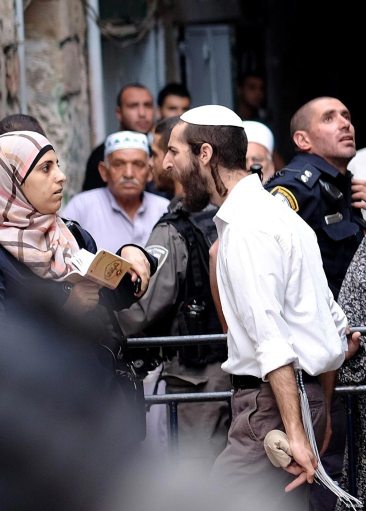 Arab Knesset Member Hanin Zoabi is to appeal against the Israeli police’s ban on Palestinian women from entering Al-Aqsa Mosque, the minister said today.
The Anadolu news agency reported a statement for Zoabi saying she had informed the Israeli police of her plan to appeal to the Israeli court against the “arbitrary” banning of women from entering the mosque.
She did not disclose with which court she was planning to file the appeal, but the process starts by filing an appeal to the magistrate court, then to the district court then to the High Court.
Zoabi described Israel’s ban on Palestinian women entering Al-Aqsa Mosque as a “dangerous precedent”, noting that the reason behind banning them is their role in “facing the settlers’ desecration of the mosque” in recent months.
For more than two months, Israeli police have banned women from entering the mosque from time to time. “They [Palestinian women] formed the front defence line against the Israeli violations and aggression on Al-Aqsa Mosque,” Zoabi said.
The Knesset member said she had sent a written letter to the Israeli Minister of Internal Security Yitzhak Aharonovich informing him of the “violations” committed by the Israeli police and Israeli border guards against women around and inside the holy site.
She noted in her letter that the violations and aggression on Palestinian women and banning them from entering into the mosque “undermines and ignores” their freedom. She also stressed that the lack of punishment against aggressors is a “green light” for more violations.
For about two months, the Israeli settlers, including extremist officials such as Knesset Deputy Speaker Moshe Feiglin have stormed Al-Aqsa Mosque on almost a daily basis.
Palestinians remain inside the mosque trying to prevent such aggressions, but the Israeli police and occupation forces took measures to secure the settlers including preventing women and men under the age of 50 from entering Al-Aqsa’s grounds.
Yesterday, 20 Palestinians, including women, were wounded in clashes in the mosque and seven others were arrested, including minors.
Maduro Hands Over Land Titles to Indigenous Communities, Creates Institute to Protect Native Languages
By Z.C. Dutka | Venezuelanalysis | October 15, 2014
On Monday, in celebration of the nationally acclaimed Day of Indigenous Resistance, Venezuelan president Nicolas Maduro established a presidential council for indigenous peoples, handed over collective land titles to 14 original communities, lowered the threshold age for indigenous pensioners, and announced the creation of an institute to protect the country’s 44 native languages.
The South American leader also pledged 5000 new homes for indigenous communities for 2015 through the national housing mission Mision Vivienda, and announced the investment of 575 million bolivars (about $7 million) to address extreme poverty in 396 of those communities.
Aloha Nuñez, the Indigenous Peoples’ Minister, noted that the presidential council was formed as a result of elections held in 2,194 indigenous communities after the idea was discussed in 1,589 countrywide assemblies.
Delia Gonzalez, a spokesperson for the Wayúu community of Zulia state, said that the debates leading up to the creation of the council were conducted with respect, tolerance and spirituality, in the interest of enabling diverse indigenous peoples to make significant contributions to the transition towards socialism.
Nuñez also explained how the language institute is the product of many years’ collective efforts. Of the 44 different original peoples that exist in Venezuela, Nuñez said, 34 speak their language and 10 have lost theirs through lack of use.
“We should immediately found and motivate a team systematically [that can] permanently, scientifically, register, rescue and revive all indigenous languages that exist in Venezuelan territory,” said Maduro from Miraflores presidential palace where Monday’s ceremony was held.
Shortly after, the Venezuelan president announced the incorporation of all indigenous above the age of 50 into the Amor Mayor mission for special elderly pensions. Nationwide, the mission applies to women over 55 and men over 60 who live in family homes maintained by minimum wage workers.
Land titles that encompass six ethnic groups and 14 communities of Anzoategui state were presented to community representatives; 1,891 hectares to the Guatacarito people, 438 to the Cumanagoto, 983 to the Capachal, 3,294 to the Pedregal, 657 to the Guayabal and 1,119 hectares to the Kariñas of Mapiricurito.
From 2011 to 2013 the Committee for the Demarcation of Land and Habitat, of the indigenous ministry, has signed 40 property titles for collective lands, including over 1.8 million hectares of land.
In a similar ceremony in July, Nuñez declared, “Today, the Bolivarian government recognizes the lands that ancestrally belonged to us and have been our home for many years.”
Featured Video

Why the U.S. Should Pull Back From the First Island Chain
or go to
Aletho News Archives – Video-Images
Book Review
‘Why Fauci Must Rot in Prison’: A Tale of Two Diaries
By Jill Erzen | The Defender | October 13, 2026
Dr. Anthony Fauci’s private diary reveals a “mind-numbing” contradiction between what the former top U.S. infectious disease official knew about COVID-19 and what he told the public, senior White House adviser Peter Navarro, Ph.D., said last week on “American Thought Leaders.”
In his new book, “Why Fauci Must Rot in Prison,” due out Oct. 20, Navarro compares Fauci’s private entries to his own pandemic-era diary, and uses what he calls “a tale of two diaries” to argue that Fauci should face criminal prosecution.
“I show, actually, how a prosecution can and should happen … at the state level, most likely,” Navarro said. “He should wind up in prison, and we’ve got the receipts in this book to put him there.”
Navarro said Fauci repeatedly acknowledged important facts in private, then publicly pursued policies that contradicted those facts — with devastating consequences.
“What he says many times privately in his diary is so at odds with both his public behavior and public statements that it’s mind-numbing,” Navarro said.
Navarro examines the lasting damage caused by lockdowns and other pandemic policies, and the ongoing toll of long COVID.
His book also addresses questions about vaccine safety, including why healthy young people faced COVID-19 vaccination mandates despite concerns about myocarditis, and why women were not warned about miscarriage risks linked to the shots. … continue
Blog Roll
 Aletho News
- Jennifer Kavanagh: Why the U.S. Should Pull Back From the First Island Chain
- Yemen denounces international community’s silence on Saudi aggression, siege
- UAE and Saudi Arabia move toward renewed coordination against Sanaa
- How Iran’s two-week retaliatory strikes exposed cracks in US military architecture in Persian Gulf
- The mother of all propaganda: Why the hype over US MOAB strike against Iran is nothing but theater
- Iran says it possesses technology behind US 14-ton GBU bunker-buster
- Trump asks Iran not to retaliate after he strikes Pickaxe Mountain – w/ Prof. Marandi
- Vice President J.D. Vance’s Deceptive ‘Antiwar’ Campaign Speech
- Iran: Palestinians’ rights must not be compromised in Gaza’s future; US, Israel to blame for Hormuz situation
- Ongoing tales of Syrian chemical weapons
- If Americans Knew
- Israeli rabbi permits occupiers to steal Palestinian olive harvest in West Bank
- Netanyahu’s spin on latest settler attack is laughable – Daily Update
- Israeli soldiers debunk Israel’s talking points
- In West Bank, Israeli settlers are totally out of control – Daily Update
- NPR investigation finds evidence of widespread fraud at mall kiosks tied to Israeli skincare brand
- Tucker Carlson exposes Israeli Lies about the Oct 7th attack, Charlie Kirk, and the U.S.
- Israel has detained thousands of Palestinian children since Oct 7th – over half spent time in solitary, many uncharged
- Israeli Analysis: Is Netanyahu Planning an ‘October Surprise’ Attack Before Israel’s Election?
- Israeli settlers brutally attack Palestinians and Washington Post female photographer, 65
- Words Have Changed, Occupation Continues: The Reality of the Gaza Ceasefire
- No Tricks Zone
- Predictions Made By Renowned Climate Proifessor Over Past Decades Have Been Proven To Be Poor
- New Study Suggests Large Regions Of The Pacific Ocean Have Been Cooling For The Last 80 Years
- Germany’s Green Energy Debacle: High Energy Costs Force Kahla Porzellan to Close After 182 Years!
- New Study: 50 Years Of The Most Aggressive ‘Net Zero’ Policies Can Only Affect The Global Climate By 0.03°C
- US September “Heat” Was No Record…Many Records Set Decades Ago
- Latest European Green Energy Debacle; Portugal’s Largest Flagship Solar Park Insolvent!
- Green Energy Debacle: German Expert Professor Fritz Vahrenholt Warns Of Severe Economic And Social Consequences
- Two More Paleo Reconstructions Affirm Meters-Higher Sea Levels Across Ireland, Brazil 7000-6000 Years Ago
- New Study: Earth And Venus Surface Warmth Largely Explained By Convection And Lapse Rate, Not CO2 Or Radiation
- 2025 Nature Paper Claiming Worsening Global Drought Gets RETRACTED …Heavily Flawed

