Watchdog groups slam Ferguson police ‘harassment’ of reporters
RT | August 20, 2014
As tensions continue to simmer following nine days of street protests in Ferguson, Missouri, where a teenager was shot dead by a police officer, two watchdog groups have slammed the heavy-handed police tactics.
To compound the physical and mental strain of reporting on the weeks-long protests in Ferguson, where the public is desperate for justice after a white police officer shot black teenager Michael Brown to death, journalists themselves are finding themselves the target of police tear gas, rubber bullets and flash bang grenades.
However, Robert Mahoney, Deputy Director of the Committee to Protect Journalists (CPJ), said the police tactics would not prevent reporters from doing their jobs.
“Ferguson is an international story and journalists are going to cover it. They have a right to do so without fearing for their safety or liberty,” Mahoney said. “The harassment and detention of reporters must stop. From senior commanders on down, the word must go out to security forces to let journalists do their job.”
CPJ also released a guide for journalists on how to stay safe while covering events in Ferguson.
Jasmine Heiss, an observer with Amnesty International, expressed concern over reports that journalists were being tear-gassed while performing their jobs.
“Just last night I’ve heard several journalists and community say that either gas was thrown at them while they were reporting, or, in the case of the community members that gas was thrown into residential neighborhoods while they were walking,” Heiss told RT.
“Increasingly repressive tactics [are] being used to curtail free speech,” she added.
Six journalists were detained by police while covering the protests on Monday and early Tuesday, compelling the American Society of News Editors to describe the incidences as a “top-down effort to restrict the fundamental First Amendment rights of the public and the press.”
According to CNN, 11 journalists have been arrested in the course of the protests, which have thrown a glaring spotlight on US race relations, not to mention military-style police equipment and tactics now being deployed on the streets of America.
Police were caught on video firing a tear gas canister that exploded directly in front of an Al Jazeera America crew, causing the reporters to discard their camera equipment and flee the fumes.
In another heated encounter, a police officer is actually caught on video telling journalists, “I’m going to f***ing kill you!”
Meanwhile, social media accounts have exploded with real-time proof of the “severe press intimidation,” as the Huffington Post described the heavy-handed tactics, where Ferguson police fired at journalists with rubber bullets and flash bang grenades, in some cases preventing media from leaving their vehicles for fear of being targeted.
German reporter Ansgar Graw and his colleague Frank Hermann were detained by police for taking photos of a burned-out gas station, close to the spot where Michael Brown was killed.
“I tried to take some pictures at a spot where before I think were taken several thousand photos of the same spot, and some police officers tried to shoot me and my colleague from Germany…but it was on Monday at 2 o’clock, it was perfect…there was no threat, no tensions were in the air,” he told RT.
The journalist said the police told them they could photograph, but they had to continue walking otherwise they would be arrested. Despite complying with the police orders, Graw said they were still detained.
Holder’s Agency in Ferguson

emptywheel | August 19, 2014
Eric Holder just published an op-ed in the St. Louis Post Dispatch, apparently aiming to generate confidence in DOJ’s investigation into Darren Wilson’s killing of Mike Brown.
It starts with 3 sentences describing Brown’s killing — with no mention of Wilson, or even that a cop killed Brown.
Since the Aug. 9 shooting death of Michael Brown, the nation and the world have witnessed the unrest that has gripped Ferguson, Mo. At the core of these demonstrations is a demand for answers about the circumstances of this young man’s death and a broader concern about the state of our criminal justice system.
At a time when so much may seem uncertain, the people of Ferguson can have confidence that the Justice Department intends to learn — in a fair and thorough manner — exactly what happened.
A disembodied shooting killed Brown in this telling; violence did not.
Holder then spends several paragraphs discussing both the investigation itself, as well as the actions of the Civil Rights Division before he turns – in the course of one paragraph — to the protests. Here, violence is described as violence.
We understand the need for an independent investigation, and we hope that the independence and thoroughness of our investigation will bring some measure of calm to the tensions in Ferguson. In order to begin the healing process, however, we must first see an end to the acts of violence in the streets of Ferguson. Although these acts have been committed by a very small minority — and, in many cases, by individuals from outside Ferguson — they seriously undermine, rather than advance, the cause of justice. And they interrupt the deeper conversation that the legitimate demonstrators are trying to advance.
The implication, of course, is that the violence comes exclusively from that “very small minority,” not the cops shooting rubber bullets from their tanks.
I find the next paragraph truly remarkable.
The Justice Department will defend the right of protesters to peacefully demonstrate and for the media to cover a story that must be told. But violence cannot be condoned. I urge the citizens of Ferguson who have been peacefully exercising their First Amendment rights to join with law enforcement in condemning the actions of looters, vandals and others seeking to inflame tensions and sow discord.
The Justice Department — the Agency Eric Holder leads, the 40 FBI Agents and Civil Rights prosecutors Holder described — has done nothing visible thus far to defend the First Amendment.
And then, Holder says, “violence cannot be condoned.” A bizarre passive sentence with no agent. By whom? Who cannot condone violence?!?!
And he uses it to urge “the citizens of Ferguson who have been peacefully exercising their First Amendment rights” — many of whom have been arrested, bullied, tear gassed, some of whom have formed chains to protect businesses — to “join with law enforcement,” the same law enforcement that has been bullying them. Holder asks these citizens — who presumably are the ones he says cannot condone violence — to join the cops who have been engaging in violence to condemn others who have also been engaging in violence. Those “others” inflame tensions and sow discord. The cops don’t, according to this telling.
It takes a good paragraph and a half before Holder says the cops must restore trust. Only unlike the “citizens” of Ferguson, Holder does not urge the cops directly to do … anything. He just describes what should happen, he doesn’t command it to happen.
At the same time, good law enforcement requires forging bonds of trust between the police and the public. This trust is all-important, but it is also fragile. It requires that force be used in appropriate ways. Enforcement priorities and arrest patterns must not lead to disparate treatment under the law, even if such treatment is unintended. And police forces should reflect the diversity of the communities they serve.
Note what else happens? That violence — unmentioned in Mike Brown’s actual shooting, but explicitly described when “those others” did it — here becomes “force.” Something distinct from the violence of looters.
Darren Wilson’s shooting of Mike Brown? Not described as violence — not even described as the act of a known man. The looters’ looting? They’re engaged in “violence.” And finally, the cops, whom Holder doesn’t dare urge to tone things down? They are exercising “force,” not “violence.”
I get there are legal reasons why he did this — notably, this permits him to endorse findings that Wilson used “force” out of fear for his own safety! But the grammar and vocabulary of this op-ed insists on the state’s monopoly on violence that it has been abusing for 10 days.
Israeli ship blockade continues in California
Al-Akhbar | August 19, 2014
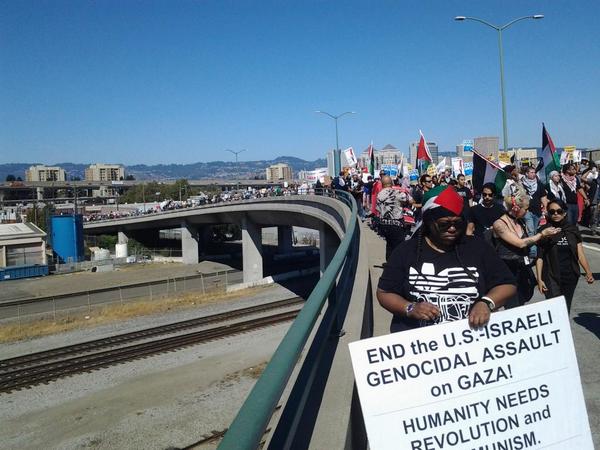
US activists blocked an Israeli cargo ship from unloading at a California port for the third day in a row in protest of the recent Israeli assault on Gaza, organizers of the action reported late Monday.
The vessel, owned and operated by Israeli company Zim Shipping Services, has been trying to unload Israeli cargo in the port of Oakland since Saturday.
Thousands of protesters prevented the ship from unloading on Saturday, with the cooperation of dock workers who refused to unload the boat.
The ship has failed to unload its cargo despite attempting various tactics, including delaying its arrival time until the early morning hours. About a dozen activists continued to hold off the ship early Monday morning, according to activist sources.
One activist who spoke to Al Jazeera said the organizers were thinking of making the block a regular action, as Israeli ships arrive in the port every Saturday.
The blockade is supported by the International Longshoremen and Warehousemen Unions, a group which also stood against the South African apartheid regime in 1984.
The Liberal Zionist Dilemma
By Lawrence Davidson | To the Point Analyses | August 19, 2014
Part I – The Liberal Ideal
Liberalism, framed as a socio-political ideal, argues that human beings are good and social progress achievable. It is a “glass half-full” outlook. Within this paradigm all individuals, not just members of a specific religion, race or nationality, should have political and civil rights. Here also neither the state nor the law is an end in itself. They are instruments for the creation and maintainance of a environment meant to promote freedom while minimizing social inequalities. Holding this ideal does not preclude identifying with a particular ethnic or religious group. It does, however, preclude any claim of exclusive rights for such groups to the detriment of others.
Within the Western environment many Jews held to this liberal ideal. They saw it as in their interest to work toward an environment of universally applied political and civil rights while minimizing social inequality. For instance, by the mid-twentieth century in the United States, many Jewish organizations were allied with African Americans in their struggle for civil rights and equality. However, this proved to be a complex alliance and it ultimately broke down. Its demise marked a waning of organized American Jewish liberal activism. What had happened?
Part of the answer became apparent after the Arab-Israeli war of 1967. At that time many civil rights leaders in the U.S. noticed that Israel was not, after all, a very liberal society. It was designed exclusively for one group and discriminated against those who were not members of that group. When this became a subject of concern and debate within the civil rights community, many Jewish organizations broke with the movement and its struggle. How about Jewish liberal individuals? They were now confronted with one of three choices: (1) retain a principled adherence to the liberal ideal and cease their uncritical support of the Zionist state, (2) renounce the liberal ideal and continue their whole-hearted support for illiberal Israel, or (3) become quiet in public while fretting in private about the evolving racist nature of Israel. It seems many of them took the third option.
Part II – An Old Dilemma
Given this history it is simply wrong to think of the present dilemma faced by Jewish liberals over Israeli behavior as something new. So-called liberal Zionists such as Peter Beinart, Amos Oz, Ari Shavit and Jonathan Freedland have certainly known for decades that the notion of civil and political rights for Jews and non-Jews equally was not an aim of the Zionist movement and therefore stood little chance of shaping the behavior of the Israeli state. Yet here we are, following three massive invasions of Gaza and its inhumane blockade, repeated massacres of Palestinian civilians going back at least as far as Israel’s “war of independence,” decades of continuous land theft and illegal settlement, and more than sixty years of an Israeli-inspired police state environment on the West Bank, confronting a suddenly newsworthy liberal Zionist dilemma.
One argument given to explain this belated display of liberal Zionist angst is that only recently have such individuals decided that the two-state solution is in real jeopardy. As this argument goes, as long as a two-state solution was possible, liberal Zionists could hope for the realization of both Jewish and Palestinian political and civil rights within their respective two states. But this explanation is misleading. It is incorrect to think of the two-state solution as only recently at death’s door. In truth, if this solution was ever alive and possible (which is questionable), it was killed off the moment Menachem Begin lied to President Jimmy Carter about the granting of progressive “autonomy” to the Palestinians. That was 1979. That otherwise quite knowledgeable Zionists as those mentioned above did not know this is hard to believe.
So why is this liberal dilemma an issue now? A more accurate answer might lie with changing public opinion. It has only been in the last ten years or so that the Zionist storyline on the Israeli-Palestine conflict has lost its monopoly. In that same time frame the boycott movement has also become a worldwide affair. As Israel’s illiberal character becomes more public, option 3 noted above becomes harder to maintain. As Jonathan Freedman tells us in his New York Review of Books article, “The Liberal Zionists,” these folks are now attacked from all sides. The Zionist movement is, if you will, circling their wagons and no longer finds liberal complaints tolerable, even in private. They want everyone out there saluting the Israeli flag.
The Israeli author and columnist Ari Shavit shows us where these extreme nationalist pressures will likely lead those still trying to square the circle of liberalism and Zionism. In his recent book My Promised Land he writes, “The choice is stark, either reject Zionism [the Zionist State of Israel] because of Lydda [an example of the massacre of civilians by Israeli forces], or accept Zionism [the Zionist state] along with Lydda. … If need be, I will stand by the damned. Because I know that if it wasn’t for them, the state of Israel would not have been born. … They did the dirty, filthy work that enables my people, myself, my daughter and my sons to live.” So much for the liberal ideal.
Part III – Facing Contradiction
In truth the term “liberal Zionist” has never made much sense. The only way to explain its survival is to consider the survival of the Zionist storyline itself – the story of Israel as a democracy upholding the Western model in the Middle East. As long as one believed that this was true, one could dismiss Israeli brutality as just occasional slippage from progressive political and civil principles supposedly underlying the state. Within this context, there could be liberal Zionists privately decrying occasional Israeli bad behavior. But the Zionist storyline was not true. We never were dealing with just occasional slippage but rather with the inherent brutality of a state with policies and practices designed to bring about racist ends (a nation exclusively for one group) – while conjuring up a remarkably durable cover story that it was, after all, a liberal democracy. The Israeli right, as well as the Palestinians, always knew the cover story was a sham. Now, with the recent Gaza slaughter, much of the rest of the world does too. That public unveiling, along with the Zionist demands for uncritical loyalty, leaves the liberals in a wholly untenable situation.
You simply cannot adhere to the principle of universal civil and political rights and, at the same time, support a Zionist state. To do so is to involve oneself in a contradiction. The liberals are being forced to face this fact. And, as this happens, they will have to make a real choice: cease being Zionist or cease adhering to the liberal ideal. I suspect that, along with Ari Shavit, most of them will decide to “stand with the damned.”
Police In Ferguson Back To Threatening And Arresting Reporters: Tells Them To ‘Get The Fuck Out Of Here’
By Mike Masnick | Techdirt | August 18, 2014
The situation in Ferguson seemed briefly like it was getting better last Thursday, but that didn’t last long. Over the weekend, the militarized and threatening police fired tear gas at protestors and continued to escalate the situation, rather than de-escalate it. The governor declared a state of emergency and instituted a curfew — which created some more problems, and resulted in continued protests, but also some looting. In the last few hours, however, things have gone from bad to worse again. Police went back to arresting journalists, including Robert Klemko from Sports Illustrated and Rob Crilly from the Telegraph (who, believe it or not, is the “Pakistan and Afghanistan correspondent” for that paper — now reporting live from… Ferguson, Missouri). While both were quickly released, police appear to be quite aggressive towards reporters. Chris Hayes, the MSNBC TV host reports that he was threatened with being maced.
A live stream from the local radio station KARG (Argus Radio — which is a local volunteer run radio station that has been doing amazing work) caught police screaming, “Get the fuck out of here or you’re going to get shelled with this” while pointing a gun at the reporter. Many reports claimed that he was saying, “You’re going to get shot,” but it’s pretty clearly “shelled.” Not sure it really makes a huge difference.
As you can see from the video (thankfully clipped and uploaded by Parker Higgins), another police officer, “Captain Todd,” claims that the lights from the reporters are the problem, not that that somehow makes it okay to point guns at reporters and threaten to “shell” them (or to arrest them). Meanwhile, Ryan Reilly of the Huffington Post reports that reporters were ordered to “leave the area and head back where we wouldn’t be able to witness anything for ourselves.”
All of this really ought to make people wonder: if this is how the police act when they know the world is watching them and live streaming what they’re doing, how do you think they act when no one is watching? The photos from Ferguson feel unreal, but are, in fact, quite real.
The situation has become so ridiculous that Amnesty International has sent in a human rights team, saying this is the first time ever that the group has done so inside the US. Think about that for a minute or two…
And then recognize that the press are almost certainly being treated significantly better than the residents who are protesting.
Police Militarization Escalates Even As Violence Declines — And There’s A Good Chance It’s Going To Get Worse
By Mike Masnick | Techdirt | August 18, 2014
We’ve been writing about the militarization of police, and why it’s problematic, for years — but the events of the last week in Ferguson, Missouri, have really shone a (rather bright) light on what happens when you militarize the police. Annie Lowrey, over at New York Magazine, highlights what may be most disturbing about all of it: all of this has happened while violence has been on a rapid decline, and, no it’s not because your local suburban police force now has a SWAT team and decommissioned military equipment from the Defense Department:
Since 1990, according to Department of Justice statistics, the United States has become a vastly safer place, at least in terms of violent crime. (Drug crime follows somewhat different trends, though drug use has been dropping over the same time period.) The number of murders dropped to 14,827 in 2012 from 23,438 in 1990. The number of rapes has plummeted to 84,376 from 102,555. The number of robberies, motor-vehicle thefts, assaults — all have seen similarly large declines. And the number of incidents has dropped even though the country has grown. [….]
And there’s no evidence that giving police officers the weapons of war has had anything to do with that decline in crime, either, with researchers pegging it to a combination of factors, among them the removal of lead from paint and gasoline, an increase in abortion rates, and improved policing methods.
So, instead, we get a very militarized police — and tons of cases where it is being used in cases that absolutely don’t warrant it. At all.
And here’s the really disturbing thing. It may get a lot worse. As Vanity Fair notes, on June 19th, Rep. Alan Grayson had offered up an amendment on the Defense Appropriations bill, which would have limited the militarization of police. And it failed by a wide margin. Included in those voting against it? The guy who represents Ferguson.
The amendment attracted the support of only 62 members, while 355 voted against it (14 didn’t vote). Included among those voting against it was Rep. William Lacy Clay (D), who represents Ferguson. Clay was joined by every senior member of the Democratic Party leadership team, including Reps. Nancy Pelosi (CA), Steny Hoyer (MD), and Assistant Democratic Leader James Clyburn (SC). Democrats did form the bulk of support for the amendment (with 43 votes in favor), with 19 Republicans supporting as well—led by libertarian-conservative Rep. Justin Amash (MI), who lamented that “military-grade equipment . . . shouldn’t be used on the street by state and local police” on his Facebook page.
Apparently, arming the police with military equipment has powerful lobbying support. Because why expect people to think about what actually makes sense when there’s money and FUD on the line:
Why was there such tremendous opposition to the Grayson-Amash effort? Two very powerful constituencies in Congress may be to blame: the defense industry, and the police lobby.
Take Rep. Clay. He has been all over the news media calling for justice in his district, and demanding an investigation of Brown’s death. Yet like every House member, he is up for re-election every two years, and his fourth-largest donor is the political action committee of the weapons maker Boeing.
So there’s that. And then, let’s take things up a notch. Scott Greenfield alerts us to the news that a judge over in Colorado has determined that the Cinemark Theater where James Holmes opened fired on the opening night of the Batman film “The Dark Knight Rises” may have some responsibility because it should have known that such an attack might happen. Despite the fact that there has never been such a shooting in a theater, the judge says that the theater should have been prepared for such a possibility:
Noting “the grim history of mass shootings and mass killings that have occurred in more recent times,” U.S. District Court Judge R. Brooke Jackson ruled that Cinemark — owner of the Century Aurora 16 theater — could have predicted that movie patrons might be targeted for an attack. Jackson’s ruling allows 20 lawsuits filed by survivors of the attack or relatives of those killed to proceed toward trial.
“Although theaters had theretofore been spared a mass shooting incident, the patrons of a movie theater are, perhaps even more than students in a school or shoppers in a mall, ‘sitting ducks,’ ” Jackson wrote.
That makes absolutely no sense. But the inevitable result, as Greenfield notes, seems to be a lot more militarized police — and now, private security guards… everywhere. Just in case.
Consider, if what happened in Aurora, the duty of businesses to be prepared for the act of a one-in-a-million crazy. The biggest growth job in America will be armed guard. Every theater will require its own SWAT team, perhaps a MRAP or Bearcat. Office buildings, parks, skating rinks, pretty much anywhere more than three people gather, could be the next target of a madman. They will all need security, armed with the weapons needed to take out any crazy.
Don’t blame the businesses. They’re just trying to cover their foreseeable obligations. Sure, there is almost no chance, almost no possibility whatsoever, that they will be the target of the next insane shooter, but Judge Jackson says it’s still foreseeable. In fact, that no one has ever shot up a skating rink makes it even more foreseeable, by his rationale.
It is difficult to comprehend how profoundly screwed up all of this is.
County officials refuse to pay medical bills for toddler burned by SWAT grenade
RT | August 18, 2014
Officials in Georgia’s Habersham County are refusing to pay for the mounting medical expenses of a toddler seriously injured by a flash grenade after a failed SWAT team raid earlier this year.
Bounkham ‘Bou Bou’ Phonesavanh was just 19 months old when a Habersham SWAT team initiated a no-knock warrant at his family’s home at around 3 a.m. on May 28. Bou Bou was asleep in his crib at the time, surrounded by his family and three sisters. The toddler was severely injured when SWAT team officers broke through the house’s door and threw a flashbang grenade that ultimately landed in the Bou Bou’s crib.
When the stun grenade went off, it caused severe burns on the child and opened a gash in his chest. As a result, Bou Bou lost the ability to breathe on his own and was left in a medically induced coma for days after the incident. His extensive recovery necessitated stays in two hospitals before he finally went home in July.
Now, Habersham County officials are sticking by their decision to ignore the family’s plight, the family’s attorney, Muwali Davis, told WSB-TV.
Habersham County’s attorney responded with a statement saying that the Board of County Commissioners will not pay given it is supposedly illegal to do so.
“The question before the board was whether it is legally permitted to pay these expenses. After consideration of this question following advice of counsel, the board of commissioners has concluded that it would be in violation of the law for it to do so.”
The family now says an independent investigation showed law enforcement used suspect information to attain a search warrant.
As RT reported previously, the SWAT conducted the raid as part of an effort to apprehend Wanis Thometheva, believed to be selling methamphetamine. Police said that their records indicated the suspect could be armed, and that a confidential informant had successfully purchased drugs from him earlier in the day. At the time of the raid, however, Thometheva was not at the home, and was eventually arrested elsewhere.
Additionally, an unnamed public official told the Washington Post that the reported drug deal was worth only $50.
Habersham County’s sheriff previously said the confidential informant who bought drugs at the home told police that he did not believe any children lived at the house.
Bou Bou’s mother, Alecia Phonesavanh, said that was unlikely if they had valid information on their suspect.
“If they had an informant in that house, they knew there were kids,” Phonesavanh told The Atlanta Journal-Constitution after the incident. “They say there were no toys. There is plenty of stuff. Their shoes were laying all over.”
In June, the family called for a federal investigation into the conduct of the SWAT team.
The Phonesavanh family said it was not involved with drugs at all, and was only staying with Thometheva, the homeowner’s son, because their Wisconsin home was damaged in a fire. They moved back to Wisconsin once Bou Bou’s health improved. Supporters have planned a fundraiser this month for the family.
An official investigation into the incident is ongoing, according to WSB-TV.
Attacking journalists makes Israel a plastic democracy
By Alastair Sloan | MEMO | August 18, 2014
I’ve just had the pleasure of spending eight hours in detention at the border between Egypt and Israel, between Tabaa and Israel’s southern-most city, Eilat. My crime at first appeared to be a single male travelling alone into a Middle Eastern country. But once the immigration police realised I was a journalist, I was in for the long haul.
At first – I was asked the standard cavalcade – where was I staying, who with, and what were my plans? But on discovering my profession, brows furrowed faster than a Horah dance at a bar mitzvah.
My stay in a holding area, punctuated by increasingly aggressive interrogations, peaked when the most senior official asked me to write down the names and addresses of all my sources in Israel and Palestine.
Of course they wanted sources in “the Palestinian Territories,” and in a Freudian slip, I blurted out that I certainly wouldn’t be revealing any sources in the “Occupied Territories”. After a brief staring match, the official kept tapping away into her computer.
I didn’t give them the information they were after, not wanting to endanger anyone – which resulted in a further four hour wait, during which not much appeared to be happening. They let me go in time for me to miss my best friend’s engagement party, where I was stopping by before heading up to Ramallah. They knew I was in a rush to make this, and they knew I was best man. I’ll never know if they let me go when they did out of spite, but I suspect they did. Bullies enjoy a pathetic victory.
Thomas Jefferson was unequivocal in his support for the media, summarising that “the basis of our government being the opinion of the people, the very first object should be to keep that right; and were it left to me to decide whether we should have a government without newspapers, or newspapers without a government, I should not hesitate a moment to prefer the latter.”
Nelson Mandela, no friend to Israel but a hero to civilised nations – described freedom of information as “the lifeblood of democracy”. Curbing journalistic freedoms is not only a red rag to the bull – it’s arrogant and betrays the electorate. Too often we think of democracy as happening at the ballot box – but it is the media that informs the voter before they reach the polling station and in harassing, imprisoning and even killing journalists, Israel makes a mockery of their insistent claim to be “the only democracy in the Middle East”.
What I experienced was a mere bump in the road compared to other journalists’ troubles. Majd Kayyal, a Palestinian journalist, was arrested in April 2014 on his return from Beirut – allegedly for entering an “enemy state” and conspiring with a “foreign agent”. He was held in a windowless room for five days, interrogated by Shin Bet, and denied access to a lawyer. The government prohibited Israeli media outlets from reporting on the matter in real time – a ban which was luckily ignored by many editors. The charges were later dropped – however veteran Israeli journalist Itai Anghel noted that having travelled to several “enemy states”, including Iraq and Afghanistan – he had not once been stopped or detained by the Israeli security services.
But again, what happened to Kayyal is, sadly, mild. Seventy-one journalists were killed in Israel last year. Over 2,000 reported being physically attacked or threatened. Eighty-seven were kidnapped. Over 800 were arrested. Seventy seven had had enough and fled the country and, as of December 2013, there were 178 journalists in Israeli prisons. This doesn’t sound like a free press.
At the end of last year – diplomats, politicians, activists and NGOs concluded that the Palestinian territories were one of the worst places in the world to practice journalism. Not only is violence regularly deployed to repress domestic and foreign reporters, censorship laws are used to deny useful debate and manipulate opinion – often in favour of war.
For example, on July 24 the Israeli Broadcasting Authority prohibited the broadcast of an advert produced by B’Tselem, an Israeli NGO, which listed the names of 150 children killed in Gaza. Likewise, the killings of three Israeli teenagers took place almost immediately after their kidnapping, shortly before Operation Protective Edge began, yet a gagging order on the media prevented publishing the key facts.
Instead, Prime Minister Benjamin Netanyahu orchestrated a phoney manhunt for three weeks in which pro-war fervour was whipped up. He even lied to the children’s parents.
Now, talking to Israelis across the country, it is clear that support for the most recent Gaza onslaught is near unprecedented – based on the distorted image of the events leading up to the war. The range of opinions I heard was extremely narrow, with narratives drawing clearly on simplistic hasbara distributed by the government. To take a country to war, you need the media with you. Netanyahu has become an expert on this.
Similar censorship laws were invoked when Lt Hadar Goldin was apparently briefly captured by Hamas during the most recent conflict, and Israeli artillery shelled his location in an effort to kill him. This infamous “Hannibal Doctrine”, which dictates Israeli soldiers should be killed by friendly fire rather than become prisoners, was considered so unpalatable to the national spirit – that reporting on it was completely banned. In an extraordinary display of arrogance, Israeli military censors even attempted to stop The New York Times from publishing further information on the case.
So far, only Haaretz has run a piece seriously questioning the doctrine. Thankfully, the newspaper ended a 10 year reporting ban of the Doctrine in 2003, when they completed an investigation into the matter. Still, knowledge of the Doctrine was not as apparent as you would hope for from the ordinary Israelis I spoke to this week.
Though part of the Israeli public’s thirst for war can be attributed to a lack of media information, many Israelis are wilfully blind to the misgivings of the Israeli Defence [sic] Force (IDF). In a survey last year, Tel Aviv University found that just over half of Israelis believe that the media should not publish immoral conduct by the IDF. This has created an environment in which self-censorship is the norm. Recent civilian casualties in Gaza, despite numbering over 2,000 have barely been reported. The morning after the offensive began, Israel’s most widely circulated newspaper, Yisrael Hayom, did not contain a single word regarding civilian casualties. Instead, editors splashed an enormous explosion in Gaza City, and an emotive photo of an IDF conscript hugging his girlfriend goodbye. Yisrael Hayom’s slogan is sickeningly unquestioning for a major media outlet: “Remember, we are Israelis.”
The complicity of the Israeli media – largely a phoney industry with a sense of social responsibility akin to Blackwater or G4S, fills responsible hacks with professional disgust. One in 10 members of the Knesset is a former journalist. The leader of the country’s second most popular party is Yair Lapid and the leader of the Labour Party is Shelly Yachimovich, both came from Channel 2, Israel’s largest TV station. Of course many highly capable leaders have come from journalistic backgrounds, but the mass migration to the other side of the fence suggests the industry has a fundamental misunderstanding of what journalism is about: holding power to account.
Moreover – the continuing brutality of the Israeli regime against Palestinian and foreign journalists is profoundly troubling. I was lucky – my punishment was eight hours in detention and an unplanned overnight stay in Eilat (incidentally – a depressing sinkhole of tourist tack thronging with recently released IDF conscripts, celebrating their mass slaughter in Gaza).
But for many journalists, the price they pay for reporting on Israel’s crimes is beating, arrest, imprisonment, kidnapping or death. For Israel to be anything more than a plastic democracy its leaders need to rethink press freedoms. And if Israelis want to understand why the world is constantly so critical of them, they need to understand that they live in a media bubble in which only a certain reality about the Occupied Territories is presented. The full picture might not be nice, but is extremely important.
UK government faces lawsuit over arms sales to Israel
Press TV – August 17, 2014
The British government is facing unprecedented legal action over its continued arms sale to Israel in the wake of the recent deadly Israeli aggression against the Gaza Strip.
British law firm, Leigh Day, representing the Campaign Against Arms Trade (CAAT), said Saturday that it has written to Business Secretary Vince Cable, calling for the immediate suspension of arms export licenses to Israel.
The law firm said the UK government’s failure to suspend the licenses is illegal, adding that it has been instructed to seek a High Court judicial review of the administration’s reluctance to halt the arms sales to Israel.
A recent report by the British parliamentary committee for arms export controls showed that Israel received around £8 billion in the form of 400 arms licenses from the UK in 2013.
Leigh Day further said there is a risk that British-made weapons may have been used by Israel during its recent onslaught on Gaza in breach of humanitarian and human rights law.
“If arms from the UK are being used to commit crimes against humanitarian law, and human rights law, then export licenses for these materials must be revoked immediately,” said Rosa Curling, representing the CAAT, adding, “If this is not done, the government’s current policy is unlawful and susceptible to legal challenge.”
The British government has come under persistent pressure to toughen its stance against Israel, including by halting arms exports, since Tel Aviv began its onslaught on the besieged Palestinian enclave more than a month ago.
Nearly 2,000 Palestinians, including 470 children, have lost their lives and more than 10,200 have been wounded since the Israeli military unleashed fatal assaults against Gaza on July 8.
Human rights groups say Israeli forces are systematically killing Palestinian children and youths.
Action alert: Join ISM
International Solidarity Movement | August 16, 2014
Occupied Palestine – The International Solidarity Movement (ISM) is placing a call out for volunteers to join us in the West Bank now, and for the olive harvest beginning in October.
We need solidarity activists to support the Palestinian popular struggle by joining protests and demonstrations, to document and report on the crimes committed by both the Israeli military and the colonial settlers living on Palestinian land throughout the West Bank, and to stand alongside Palestinian communities as they face occupation and apartheid.


ISM is also sending an urgent call for volunteers to join the 2014 olive harvest campaign, beginning in October.
ISM volunteers join Palestinian farming communities each year to harvest olives in areas where Palestinians face settler and military violence while working their land. Palestinian communities state that the presence of international volunteers reduces the risk of extreme violence from Israeli settlers and the Israeli army. Your presence can make a big difference.
The olive tree is a Palestinian national symbol, and the Israeli military systematically prevents agricultural fruition in order to make life for Palestinians more difficult. The Israeli occupation provides a platform for Palestinian rights to be violated in an array of ways; the attack on agriculture is at the forefront.
Already documented this year, and to list a few cases; the trees have suffered settler sewage runoff, sabotaging fires, and being cut down. Olive trees comprise of an essential 14% of the Palestinian agricultural economy.
In January 2014 alone approximately 2020 olive trees were reportedly destroyed.
We support Palestinians’ assertion of their right to earn their livelihoods and be present on their lands. International solidarity activists engage in non-violent intervention and documentation and practical support, which enables many families to pick their olives.
The campaign will begin in October and will last around 6-8 weeks. We ask that volunteers start arriving at the end of September, so that we will be prepared when the harvest begins. Usually we require a two week commitment from volunteers, however during the olive harvest a one week commitment is sufficient. All volunteers must attend a two-day training before they join ISM, trainings run on Wednesdays and Thursdays as long as the trainers are available. Please see the join ISM page or contact palreports@gmail.com for further information.
In solidarity,
ISM Palestine
California Cops Seize Recordings Of Questionable Arrest, Claim They Have The ‘Right’ To Do So
By Tim Cushing | Techdirt | August 15, 2014
Photography Is Not A Crime again reports on police acting like they have the right to confiscate people’s cameras and phones in order to “secure” recordings of apparent police misconduct.
Police in Northern California beat and tased a mentally ill man before siccing a dog on him, then turning on citizens who recorded the incident, confiscating cell phones and in one case, ordering a witness to delete his footage.
But one video survived anyway, slightly longer than two minutes, where a cop from the Antioch Police Department can be heard saying he wants cameras confiscated right before the video stops.
The video is shot at a distance that makes it unclear as to how much damage is being done, although you can hear the meaty sound of someone being struck several times, as well as the nearly nonstop barking of the police dog and crackling bursts of Taser fire. Being filmed vertically doesn’t help, although I’m generally of the opinion that simply collecting footage that wouldn’t normally be captured is always useful and whatever makes the person filming most comfortable (seeing as it’s generally a very uncomfortable situation) is the method they should use. The recording also shows the arrival of more officers, as though the nearly invisible civilian at the bottom of the cop pile (which begins with 5 officers and a police dog) was on the verge of escaping the whole time.
Towards the end of a video, an officer pulls his squad car directly in front of the “scene” in an obvious attempt to limit the amount of onlookers with damning recordings. Shortly after that (and after the video ends), the cops started attempting to seize “evidence.”
A second witness ABC7 News spoke to says officers began confiscating cellphones from anyone who shot video of the incident. An officer asked for his cellphone after he shot video and the witness said, “Then he took my phone anyway because I didn’t want no problems. He emailed the incident to his phone.
The first witness said, “They didn’t take no for an answer apparently because they pulled one lady out of her vehicle to get it, and she wouldn’t give it up and they were about to arrest her and finally they let her go because I believe she gave it up.”
However, a third witness told ABC7 News he was ordered to erase his video. So he did. He said, “They were being kind of controlling, like demanding, ‘erase your phone’ and they were trying to take people’s phones away.”
No surprises here. Excessive force deployed, followed by a roundup of “witnesses,” which actually means recording equipment and not human beings. The police have no right to do this, but in far too many cases, they assume the public either doesn’t know this, or can easily be intimidated into complying with the unlawful request.
Here’s the absolute bullshit the police department handed over in defense of its ad hoc phone confiscation:
Antioch police told ABC7 News in a statement, “If a person is not willing to turn it over voluntarily, an officer can sometimes seize the device containing the video. The police would have to get a search warrant to retrieve the video from the device.”
As Carlos Miller points out, this is completely wrong and has been wrong for a few years now. Guidelines from the Department of Justice passed down in 2012 state the exact opposite. Police can ask for compliance, but they need to be extremely careful in how they ask.
A general order should provide officers with guidance on how to lawfully seek an individual’s consent to review photographs or recordings and the types of circumstances that do—and do not—provide exigent circumstances to seize recording devices, the permissible length of such a seizure, and the prohibition against warrantless searches once a device has been seized. Policies should include language to ensure that consent is not coerced, implicitly or explicitly…
[…]
Warrantless seizures are only permitted if an officer has probable cause to believe that the property “holds contraband or evidence of a crime” and “the exigencies of the circumstances demand it or some other recognized exception to the warrant requirement is present.”
Cops tend to claim that footage of police misconduct is “evidence” in order to justify warrantless cellphone seizures. It may very well be, but it’s the sort of evidence they want to hide, rather than the sort of evidence they’d like to retain. Note that the above officers ordered people to “delete” recordings, something they wouldn’t do if the recordings held actual evidence of a crime (or at least, a crime not committed by uniformed officers). Either way, crime or no crime, the police can’t just start seizing phones as “evidence.” The DOJ guidelines go on to say:
The Supreme Court has afforded heightened protection to recordings containing material protected by the First Amendment. An individual’s recording may contain both footage of a crime relevant to a police investigation and evidence of police misconduct.The latter falls squarely within the protection of First Amendment. See, e.g., Gentile v. State Bar of Nev., 501 U.S. 1030, 1034 (1991) (“There is no question that speech critical of the exercise of the State’s power lies at the very center of the First Amendment.”). The warrantless seizure of such material is a form of prior restraint, a long disfavored practice.
So, cops know — or should know — they can’t do this. And I firmly believe most of them know this. The problem is that they just don’t care. The quickest “fix” is swift seizures of recordings using baseless arrest threats and other forms of intimidation. It’s an instinctual closing of ranks. Once the requisite dozen or so officers needed to affect an arrest had been met, one of the officers originally in the one-sided melee stands back and says he wants “that cellphone and that cellphone.” Well, he can’t have them. Not legally. And yet, officers apparently got what they wanted — rather than what they could legally obtain — in the end.
New Orleans Cop Turns off Body Cam before Shooting Man
By Carlos Miller | PINAC | August 15, 2014
A New Orleans police officer turned off her body cam before opening fire on a man who had escaped from her a week earlier.
Lisa Lewis shot the man in the forehead during a traffic stop, then shot at him again as he ran away, according to the lawyer of the man who remains hospitalized. He was wanted on warrants.
Not only did she turn off the camera, the department tried its best to downplay Monday’s incident, which they initially reported to the media as posted below:
According to a preliminary report from the New Orleans Police Department, an officer was in the area and heard gunshots and then had an altercation with a person and suffered a minor injury to the officer’s right hand.
The officer was taken to Tulane Hospital, police said.
No further information about the incident was made available in the preliminary report.
When the media found out about it anyway, New Orleans Police Superintendent Ronal Serpas shrugged it off as a blunder.
NOPD Superintendent Ronal Serpas said his public information officer was supposed to issue a news release on Monday, but failed to do so — an action Serpas took responsibility for.
Serpas said NOPD Officer Lisa Lewis was conducting a traffic stop was injured and shot 26-year-old Armand Bennett.
Bennett was booked on five outstanding warrants, which included possession of a weapon, resisting an officer (Gretna), resisting an officer (New Orleans), possession of marijuana and criminal damage to property.
Bennett was listed in stable condition at a local hospital.
The department issued cameras to officers in January with Serpas proclaiming “this is the future of policing in America.”
Which is pretty much like the past in that they still control the message.
Featured Video

Why the U.S. Should Pull Back From the First Island Chain
or go to
Aletho News Archives – Video-Images
From the Archives
Only 19.7% of Americans agree with US State Dept on Israeli settlements
… Most American adults of voting age don’t appear willing to reject the applicability of international law to Israel’s ongoing colonization of occupied territories in East Jerusalem, the West Bank and Golan Heights. … Full article
Blog Roll
 Aletho News
- Jennifer Kavanagh: Why the U.S. Should Pull Back From the First Island Chain
- Yemen denounces international community’s silence on Saudi aggression, siege
- UAE and Saudi Arabia move toward renewed coordination against Sanaa
- How Iran’s two-week retaliatory strikes exposed cracks in US military architecture in Persian Gulf
- The mother of all propaganda: Why the hype over US MOAB strike against Iran is nothing but theater
- Iran says it possesses technology behind US 14-ton GBU bunker-buster
- Trump asks Iran not to retaliate after he strikes Pickaxe Mountain – w/ Prof. Marandi
- Vice President J.D. Vance’s Deceptive ‘Antiwar’ Campaign Speech
- Iran: Palestinians’ rights must not be compromised in Gaza’s future; US, Israel to blame for Hormuz situation
- Ongoing tales of Syrian chemical weapons
- If Americans Knew
- Israeli rabbi permits occupiers to steal Palestinian olive harvest in West Bank
- Netanyahu’s spin on latest settler attack is laughable – Daily Update
- Israeli soldiers debunk Israel’s talking points
- In West Bank, Israeli settlers are totally out of control – Daily Update
- NPR investigation finds evidence of widespread fraud at mall kiosks tied to Israeli skincare brand
- Tucker Carlson exposes Israeli Lies about the Oct 7th attack, Charlie Kirk, and the U.S.
- Israel has detained thousands of Palestinian children since Oct 7th – over half spent time in solitary, many uncharged
- Israeli Analysis: Is Netanyahu Planning an ‘October Surprise’ Attack Before Israel’s Election?
- Israeli settlers brutally attack Palestinians and Washington Post female photographer, 65
- Words Have Changed, Occupation Continues: The Reality of the Gaza Ceasefire
- No Tricks Zone
- Predictions Made By Renowned Climate Proifessor Over Past Decades Have Been Proven To Be Poor
- New Study Suggests Large Regions Of The Pacific Ocean Have Been Cooling For The Last 80 Years
- Germany’s Green Energy Debacle: High Energy Costs Force Kahla Porzellan to Close After 182 Years!
- New Study: 50 Years Of The Most Aggressive ‘Net Zero’ Policies Can Only Affect The Global Climate By 0.03°C
- US September “Heat” Was No Record…Many Records Set Decades Ago
- Latest European Green Energy Debacle; Portugal’s Largest Flagship Solar Park Insolvent!
- Green Energy Debacle: German Expert Professor Fritz Vahrenholt Warns Of Severe Economic And Social Consequences
- Two More Paleo Reconstructions Affirm Meters-Higher Sea Levels Across Ireland, Brazil 7000-6000 Years Ago
- New Study: Earth And Venus Surface Warmth Largely Explained By Convection And Lapse Rate, Not CO2 Or Radiation
- 2025 Nature Paper Claiming Worsening Global Drought Gets RETRACTED …Heavily Flawed


