Data retention means you are on the record, like it or not
By Fiona de Londras, Durham University | November 6, 2013
Next month the advocate general of the Court of Justice of the EU (CJEU), Yves Bot, will publish an opinion on the extent to which the Data Retention Directive, one of the most controversial security measures introduced by the EU in the past decade, is compatible with human rights law. Although not a binding judgement (this will come later), the CJEU’s opinion is a significant intervention in the ongoing debate over how to balance human rights with states’ perceived surveillance needs.
The security-related retention of communications by telecoms firms was on the European agenda well before 9/11, but privacy concerns had led to a limited approach. Telecoms companies in the EU were obliged to delete communications data as soon as all business needs had been met; the data could not be retained for security or criminal investigation purposes. Some states had attempted to adjust this and introduce a retention system in 2000, but this failed – again, largely because of privacy concerns. All this changed, however, after 9/11.
As early as May 2002, a “data retention amendment” had been made to existing EU privacy laws to allow for security-related data retention, and drafts of a provision that would require retention began to circulate. Those proposals attracted so much rights-based criticism that they were apparently abandoned; however, they quickly reappeared in the wake of the London and Madrid bombings, and in 2006, the Data Retention Directive was adopted.
It obliges all member states to introduce national data retention regimes, even where -— as in the UK —- there had already been significant resistance to such regimes when they were previously proposed at national level. The directive requires telecommunications providers to retain data on the source, destination, time, date, duration and type of all communications by fixed and mobile telephone, fax and internet, and on the location and type of equipment used.
The data is to be retained for between six month and two years, with national law deciding on the duration, and can be accessed by state agencies investigating “serious crime” —- a term that has different definitions across the member states.
Blanket surveillance
The volume and extent of information retained under the directive is stunning; in effect, it has introduced a system of blanket surveillance across the entire EU. Although access to the information is regulated by law, state agencies can nonetheless access an enormous amount of information about our communications patterns and activities. This naturally raises serious human rights concerns, especially about privacy.
Security services insist that data retention is an indispensable tool for investigating serious crimes, such as terrorism and the production and distribution of child pornography. Yet different states make use of the Directive to wildly varying extents: in 2012, for example, Cyprus made 22 requests for access to data, while the UK made 725,467.
The question for the advocate general, the CJEU and the EU more broadly is whether or not the approach taken by the directive privileges perceived security needs over human rights. Data retention unquestionably constitutes a prima facie infringement on privacy; the real issue is whether this infringement is justified because it is necessary, effective, and limited. This question is at the core of all debates about “balance” in the security context: how far are we prepared to allow state power into our individual, family, social and democratic lives in order to “secure” us?
Answering this question requires us to decide on what we think “effectiveness” means in the context of security. If the directive helps to resolve a handful of serious crimes per year, or to prevent one terrorist attack, is it effective? Could a more limited approach -— such as requiring telecoms companies to collect data related to certain investigations but not to retain all data -— achieve the same security objectives while better protecting rights?
These are difficult questions, but they are ones we must resolve if we are to have a balanced security system. The advocate general’s opinion will be an important contribution to the debate, but it will not be the final word. Achieving a balanced approach to security requires critical scrutiny at practical, political, social and legal levels. This is all the more true given that, as the Data Retention Directive illustrates, security measures operate upon and have implications for the rights of all of us, all of the time.
Fiona de Londras is the Project Co-Ordinator of SECILE (Securing Europe through Counter-Terrorism: Impact, Legitimacy and Effectiveness), a project that has received funding from the European Union Seventh Framework Programme (FP7/2007-2013) under grant agreement n° 313195.

This article was originally published at The Conversation.
Read the original article.
Related articles
- Are YOU content for the EU & UK politicos to be party to every detail of your life? (ironiestoo.blogspot.com)
- Corporate interests dominate group working on EU data law (computerworld.co.nz)
- Dutch Telcos Used Customer Metadata, Retained To Fight Terrorism, For Everyday Marketing Purposes (techdirt.com)
- How to choose a VPN that actually protects your privacy – Abine (uwnthesis.wordpress.com)
Liberals should stop and frisk Bill de Blasio
By Charles Davis | False Dichotomy | November 7, 2013
Over at The Nation, a debate is raging over whether students at Brown University acted inappropriately when they shouted down New York police chief Ray Kelly, preventing him from delivering an undoubtedly dull lecture about the power and glory of stopping and frisking brown people in New York City with no more probable cause then, “they’re brown and shifty eyed.”
Columnist Katha Pollitt is one who thinks the students Went Too Far. Her particularly patronizing entry in the debate, “Campus Leftists, Use Your Words,” begins by creating a false choice between heckling assholes like Ray Kelly and “informational picketing, holding a teach-in or other counter event, [and] campaigning for a speaker’s of one’s own.” One can do all of those things, actually, while still heckling assholes like Ray Kelly.
But Pollitt’s broader point is that “campus leftists” – children – didn’t win any converts by appearing to bully a poor police chief. It may have been emotionally satisfying, but radical tactics like those only suggest the left lacks for ideas. So what should have those college hot heads done? Vote Democrat and write letters to the editor and good wholesome stuff like that:
It’s fashionable on the left to mock liberalism as weak tea—and sometimes it is. But you know what is getting rid of stop-and-frisk? Liberalism. A major force in the campaign against stop-and-frisk was the NYCLU, which carries the banner of free speech for all. And Bill de Blasio, who just won the mayoral election by a landslide, has pledged to get rid of the policy and Ray Kelly too. Those victories were not won by a handful of student radicals who stepped in with last-minute theatrics. They were won by people who spent years building a legal case and mobilizing popular support for change.
This is wrong and I don’t just say that as a radical leftist who thinks liberalism is weak tea compared to my anarcho-espresso. It is factually wrong. Bill de Blasio, the next mayor of New York City, has not in fact “pledged to get rid of the policy” of stop-and-frisk. What he has pledged to do is rather different. And very liberal.
Under the heading, “Fighting for Meaningful Stop-and-Frisk Reform,” de Blasio’s campaign website informs us that he “has pushed for real reforms in stop-and-frisk” and called on Mayor Michael Bloomberg “to immediately end the overuse and abuse of this tactic.” So de Blasio isn’t looking to “get rid” of anything but, if we’re being cynical – and since we’re dealing with politicians we should be – the public anger over stop-and-frisk. His issue is that the tactic is being overused and abused, not that it’s being used at all. He also boasts that he backed an initiative “which significantly expanded the number of NYPD officers on the streets.” Anyone know what the NYPD’s been up to lately?
Like other successful politicians, de Blasio campaigned in such a way that supporters of all stripes could see what they wanted. If you don’t like stop-and-frisk, you maybe read his condemnations of its “abuse” as a condemnation of the program as a whole – and he took advantage of that, benefiting from a public sick of Mike Bloomberg the same way Barack Obama took advantage of a public sick of George Bush, his mere election seen as repudiation of what came before. By now, we really ought to know better; we ought to know we should wait for concrete action before celebrating a promise; we ought to know those promises, even as weak as they may be, are made to be broken.
Meanwhile, prisoners at Guantanamo Bay that aren’t stuck inside being force-fed can expect partly cloudy skies and highs in the upper 80s over the next week, with a slight chance of rain.
Neoliberal Myths
Why Ray Kelly Protesters Did the Right Thing
By ANDREW TILLETT-SAKS | CounterPunch | November 7, 2013
Every few years, protestors shout down a conservative speaker at an American University. Every few years, rancorous debate ensues. Every few years, the warring sides yell past one another; the opponents of the ‘shout-down’ uphold the sanctity of ‘free speech’ while the protestors decry the awful ‘real world impact’ of the conservative speaker’s message.
In the wake of the Brown University shout-down of Ray Kelly, champion of the NYPD’s racist stop-and-frisk policy and racial profiling in general, the debate has resurfaced. Rather than talking past the anti-protestors’ arguments, they need to be addressed directly. The prototypical argument in denouncing the protestors is not a defense of Ray Kelly’s racism. It is twofold: First, that a free-flowing discourse on the matter will allow all viewpoints to be weighed and justice to inevitably emerge victorious on its merits. Second, that stopping a bigot from speaking in the name of freedom is self-defeating as it devolves our democratic society into tyranny.
The twofold argument against the protestors stems from two central myths of neoliberalism. The argument for free discourse as the enlightened path to justice ignores that direct action protest is primarily responsible for most of the achievements we would consider ‘progress’ historically (think civil rights, workers’ rights, suffrage, etc.), not the free exchange of ideas. The claim that silencing speech in the name of freedom is self-defeating indulges in the myth of the pre-existence of a free society in which freedom of speech must be preciously safeguarded, while ignoring the woeful shortcomings of freedom of speech in our society which must be addressed before there is anything worth protecting.
Critics of the protest repeatedly denounced direct action in favor of ideological debate as the path to social justice. “It would have been more effective to take part in a discussion rather than flat out refuse to have him speak,” declared one horrified student to the Brown Daily Herald. Similarly, Brown University President Christina Paxson labeled the protest a detrimental “affront to democratic civil society,” and instead advocated “intellectual rigor, careful analysis, and…respectful dialogue and discussion.” Yet the implication that masterful debate is the engine of social progress could not be more historically unfounded. Only in the fairy tale histories of those interested in discouraging social resistance does ‘respectful dialogue’ play a decisive role in struggles against injustice. The eight-hour workday is not a product of an incisive question-and-answer session with American robber barons. Rather, hundreds of thousands of workers conducted general strikes during the nineteenth century, marched in the face of military gunfire at Haymarket Square in 1886, and occupied scores of factories in the 1930’s before the eight-hour work day became American law. Jim Crow was not defeated with the moral suasion of Martin Luther King, Jr.’s speeches. Rather, hundreds of thousands marched on Washington, suffered through imprisonment by racist Southern law enforcement, and repeatedly staged disruptive protests to win basic civil rights. On a more international scale, Colonialism, that somehow-oft-forgotten tyranny that plagued most of the globe for centuries, did not cease thanks to open academic dialogue. Bloody resistance, from Algeria to Vietnam to Panama to Cuba to Egypt to the Philippines to Cameroon and to many other countries, was the necessary tool that unlocked colonial shackles. Different specific tactics have worked in different contexts, but one aspect remains constant: The free flow of ideas and dialogue, by itself, has rarely been enough to generate social progress. It is not that ideas entirely lack social power, but they have never been sufficient in winning concessions from those in power to the oppressed. Herein lies neoliberal myth number one—that a liberal free-market society will inexorably and inherently march towards greater freedom. To the contrary, direct action has always proved necessary.
Yet there are many critics of the protestors who do not claim Ray Kelly’s policies can be defeated with sharp debate. Instead, they argue that any protest in the name of freedom which blocks the speech of another is self-defeating, causing more damage to a free society by ‘silencing’ another than any potential positive effect of the protest. The protestors, the argument goes, tack society back to totalitarian days of censorship rather than forward to greater freedom. The protestors, however well intentioned, have pedantically thwarted our cherished liberal democracy by imposing their will on others.
The premise of this argument is neoliberal myth number two—that we live in a society with ‘freedom of speech’ so great it must be protected at all costs. This premise stems from an extremely limited conception of ‘freedom of speech’. Free speech should not be considered the mere ability to speak freely and inconsequentially in a vacuum, but rather the ability to have one’s voice heard equally. Due to the nature of private media and campaign finance in American society, this ability is woefully lopsided as political and economic barriers abound. Those with money easily have their voices heard through media and politics, those without have no such freedom. There is a certain irony (and garish privilege) of upper-class Ivy Leaguers proclaiming the sanctity of a freedom of speech so contingent upon wealth and political power. There is an even greater irony that the fight for true freedom of speech, if history is any indicator, must entail more direct action against defenders of the status quo such as Ray Kelly. To denounce such action out of indulgence in the neoliberal myth of a sacrosanct, already existing, freedom of speech is to condemn the millions in this country with no meaningful voice to eternal silence.
Every few years, an advocate of oppression is shouted down. Every few years, the protestors are denounced. They are asked to trust open, ‘civil’ dialogue to stop oppression, despite a historical record of struggle and progress that speaks overwhelmingly to the contrary. They are asked to restrain their protest for freedom so to protect American freedom of speech, despite the undeniable fact that our private media and post-Citizens United political system hear only dollars, not the voices of the masses. Some will claim that both sides have the same goal, freedom, but merely differ on tactics. Yet the historical record is too clear and the growing dysfunctions in our democracy too gross to take any such claims as sincere. In a few years, when protestors shout down another oppressive conservative, we will be forced to lucidly choose which side we are on: The oppressors or the protestors. The status quo or progress.
Andrew Tillett-Saks is an organizer with UNITE HERE Local 217. He can be reached at: atillett-saks@unitehere.org.
Related video
Ray Kelly At Brown (Full Inside Event Coverage)
Video by Emily Kassie | www.brownpoliticalreview.org
Related article
- Brown University President Looking Into Ray Kelly Protest (huffingtonpost.com)
Rousseff slams US failure to apologise over spying
BRICS POST | November 7, 2013
Brazilian President Dilma Rousseff said Wednesday that Washington’s refusal to tender an apology for the spying led to her cancelling her crucial state visit to the United States.
“I was going to travel. We said there was only one way to solve the problem, and it was an apology for what happened and a promise that it would not happen again,” she said in a local radio interview.
The trip was initially scheduled to begin on October 23.
The lack of apology from Washington created an impasse, she said, adding that she did not want to run the risk of having a new spying scandal break during her visit, which would be an embarrassment for both sides.
Rousseff also reiterated her charges against the US, saying the NSA surveillance program is economic espionage borne out of commercial and strategic interests.
She said reports of the NSA intercepting communication of state-oil giant Petrobras have belied US claims of the PRISM program being directed to thwart terrorism.
In Wednesday’s interview, Rousseff also responded to a recent story in the Brazilian daily Folha de Sao Paulo, accusing Brazil’s intelligence agency of spying on diplomats from Russia, Iran and Iraq in 2003 and 2004.
She said the agency’s operations did not involve privacy violations as no phone calls or emails were tapped.
Rousseff had attacked the United States in her opening speech at the United Nations General Assembly (UNGA) in September.
“Brazil, Mr President, knows how to protect itself. We reject, fight and do not harbour terrorist groups,” she said.
“As many other Latin Americans, I fought against authoritarianism and censorship and I cannot but defend, in an uncompromising fashion, the right to privacy of individuals and the sovereignty of my country,” she added.
Earlier on Tuesday Brazil made public a draft bill that will allow the government to prevent internet companies like Google and Facebook from storing data about Brazilian citizens outside the country.
Simultaneous revelations regarding the UK embassy housing a secret listening post in Berlin made Germany summon the British Ambassador to respond to the allegations.
With inputs from Agencies
Related article
Israel demolishes church property in Jerusalem, future mass demolitions threatened
MEMO | November 6, 2013
Israeli forces Monday demolished a property in occupied East Jerusalem owned by the Roman Catholic Church, displacing 14 Palestinians. At a press conference held by the ruins of the home, Latin Patriarch of Jerusalem Fuad Tawwal condemned the demolition in the presence of senior church officials, foreign diplomats and journalists, saying “there is no justification for the demolition” and accusing the Jerusalem “municipality and the Israeli government” of “increase[ing] hatred” through its policies.
Tawwal claimed that it was the first time Israel had demolished property belonging to the church, and promised “legal action in appropriate courts” in response.
Meanwhile, it has been reported that hundreds of Palestinian families in East Jerusalem have recently received demolition orders, notices which give residents 30 days to appeal.
Palestinian-owned properties in Israeli-annexed East Jerusalem are routinely demolished by the Jerusalem municipality on the grounds of lacking the right permit – permits that are notoriously difficult to get. For example, just 13 per cent of the Jerusalem housing units granted building permits in the period 2005-’09 were in Palestinian neighbourhoods.
US hospital bills man for rectal search he was forced to undergo by police
RT | November 5, 2013
A minor traffic stop went nightmarishly wrong for a New Mexico man who was detained by police and forced to undergo a series of anal probes and other medical examinations against his will.
David Eckert had just finished shopping at Walmart in Deming, New Mexico when an officer pulled him over for failing to make a complete stop at a stop sign. According to the local KOB TV station, federal documents claim that police noticed Eckert clenching his buttocks when they asked him to step outside of the car, indicating that he may have been carrying drugs in his anal cavity.
After detaining Eckert and requesting a search warrant from a judge, police took him to a local hospital for doctors to perform a search. The doctor refused, saying the search was unethical. Police then took Eckert to the Gila Regional Medical Center, where doctors agreed to cooperate.
The doctors then performed a wide array of procedures, all without the consent of Eckert, who protested each one. First, doctors took an X-Ray of his abdomen, which revealed no narcotics hidden inside the body. Then, doctors performed two anal exams with their fingers, both of which failed to uncover any drugs.
After the failure of these searches, Eckert underwent three different enemas and was forced to defecate in front of doctors and police officers. He watched as each stool search failed to uncover any narcotics.
Another X-Ray was taken, and, finally, doctors sedated Eckert and performed a colonoscopy. Again, no drugs were found.
“The thought that they could do this to a man in our country is terrifying,” Shannon Kennedy, Eckert’s attorney, said to KOB. “Our community should be outraged … This is like something out of a science fiction film, anal probing by government officials and public employees.”
According to Kennedy, not only was the issued search warrant overly broad and lacking in probable cause, but it was also only valid in Luna County, where Deming is located and Eckert was arrested. After the first hospital refused to perform the anal search, police took Eckert to Gila, which is located in a separate county altogether. If that is the case, then doctors performed all eight of the previously mentioned procedures illegally and without the consent of the patient.
To make matters worse, the search warrant expired at 10 p.m. while doctors didn’t even begin prepping Eckert for the colonoscopy until 1 a.m. the next morning, when the warrant had been expired for hours.
The hospital even billed Eckert for the procedures and is threatening to take him to collections if he doesn’t pay.
Deming Police Chief Brandon Gigante refused to comment on the incident due to a pending lawsuit, but said, “We follow the law in every aspect and we follow policies and protocols that we have in place.”
Eckert is suing the city of Deming, Hidalgo County, the police officers behind the incident, the deputy district attorney, and the Gila Regional Medical Center, including Robert Wilcox, M.D. and Okay Odocha, M.D.
“If the officers in Hidalgo County and the City of Deming are seeking warrants for anal cavity searches based on how they’re standing and the warrant allows doctors at the Gila Hospital of Horrors to go in and do enemas and colonoscopies without consent, then anyone can be seized and that’s why the public needs to know about this,” Kennedy said.
Related articles
Welcome to the United Police States of America
By John W. Whitehead | Ron Paul Institute for Peace and Prosperity | November 5, 2013
“There are always risks in challenging excessive police power, but the risks of not challenging it are more dangerous, even fatal.”
-Hunter S. Thompson, Kingdom of Fear: Loathsome Secrets of a Star-Crossed Child in the Final Days of the American Century
 No longer is it unusual to hear about incidents in which police shoot unarmed individuals first and ask questions later. What is unusual is our lack of outrage, the relative disinterest of our elected representatives, the media’s abysmal failure to ask questions and demand answers, and our growing acceptance of the status quo in the United Police States of America-a status quo in which “we the people” are powerless in the face of the heavy-handed tactics employed by the government and its armed agents.
However, as I document in my book A Government of Wolves: The Emerging American Police State, it’s all part of the larger police state continuum. Thus, with each tragic shooting that is shrugged off or covered up, each piece of legislation passed that criminalizes otherwise legal activities, every surveillance drone that takes to the skies, every phone call, email or text that is spied on, and every transaction that is monitored, the government’s stranglehold over our lives grows stronger.
We have been silent about too many things for too long, not the least of which is the deadly tendency on the part of police to resort to lethal force. However, as Martin Luther King Jr. reminded us, “There comes a time when silence is betrayal.”
For the sake of 13-year-old Andy Lopez, we can be silent no more. The Santa Rosa teen was shot dead after two sheriff’s deputies saw him carrying a toy BB gun in public. Lopez was about 20 feet away from the deputies, his back turned to them, when the officers took cover behind their car and ordered him to drop the “weapon.” When Lopez turned around, toy gun in his hand, one of the officers-a 24-year veteran of the force-shot him seven times. The time span between the deputies calling in a suspicious person sighting and shooting Lopez was a mere ten seconds. The young boy died at the scene. Clearly, no attempt was made to use less lethal force.
Rationalizing the shooting incident, Lt. Paul Henry of the Santa Rosa Police Department explained, “The deputy’s mindset was that he was fearful that he was going to be shot.” Yet as William Norman Grigg, a commentator for LewRockwell.com, points out, such a “preoccupation with ‘officer safety’ … leads to unnecessary police shootings. A peace officer is paid to assume certain risks, including those necessary to de-escalate a confrontation with someone believed to be a heavily armed suspect in a residential neighborhood. A ‘veteran’ deputy with the mindset of a peace officer would have taken more than a shaved fraction of a split-second to open fire on a small male individual readily identifiable as a junior high school student, who was carrying an object that is easily recognizable as a toy-at least to people who don’t see themselves as an army of occupation, and view the public as an undifferentiated mass of menace.”
Unfortunately, this police preoccupation with ensuring their own safety at all costs-a mindset that many older law enforcement officials find abhorrent in light of the more selfless code on which they were trained-is spreading like a plague among the ranks of police officers across the country, with tragic consequences for the innocent civilians unlucky enough to be in the wrong place at the wrong time. Yet the fatality rate of on-duty patrol officers is reportedly far lower than many other professions, including construction, logging, fishing, truck driving, and even trash collection. In fact, police officers have the same rate of dying on the job as do taxi drivers.
Nevertheless, according to the Bureau of Justice Statistics, 400 to 500 innocent people are killed by police officers every year. That does not include the number of unarmed individuals shot and injured by police simply because they felt threatened or feared for their safety. This is the danger of having a standing army (which is what police forces, increasingly made up of individuals with military backgrounds and/or training, have evolved into) that has been trained to view the citizenry as little more than potential suspects, combatants and insurgents.
Consider what happened in Cleveland, when two police officers mistook the sounds of a backfiring car for gunfire and immediately began pursuing the 1979 Chevrolet Malibu and its two occupants, a woman driver and a man in the passenger seat. Within 20 minutes, more than 60 police cars, some unmarked, and 115 officers had joined the pursuit, which ended in a full blown-out firefight in a middle school parking lot that saw 140 bullets fired in less than 30 seconds. Once the smoke cleared, it quickly became evident that not only had the officers been mistakenly firing at each other but the “suspects”-dead from countless bullet wounds-were unarmed. As the Plain Dealer reports:
Despite varying levels of experience, all 13 officers who fired their guns-and many who did not-told investigators they thought deadly force was needed to stop a violent encounter with two suspects who they believed were armed. “I’ve never been more afraid in my life,” said Officer Michael Brelo, who fired 49 shots that night. “I thought my partner and I were being shot and that we were going to be killed.”
Incredibly, no officers were injured in the shooting. Nor was any apparent effort made to resolve the situation using less lethal force. Sixty-three of the officers involved in the fatal shooting have since been suspended.
I doubt the police officers involved in this massacre are bad cops in the sense of being corrupt and on the take, or violent and abusive, or bloodthirsty and trigger happy. Nor are they any different from most of the cops who patrol communities large and small across the country. Just like you and me, these officers have spouses and children to care for, homes to maintain, bills to pay, and worries that keep them up at night. Like most of us, they strive to do their jobs as best as they know how, but that’s where the problem arises, because they have clearly been poorly trained in how to distinguish what is a real threat. They have also been indoctrinated into the mindset that they have a right to protect themselves at all cost and empowered to shoot first and ask questions later with a veritable arsenal of military artillery, much of which has been provided by the federal government.
These shootings are occurring with such frequency now that they are quickly forgotten, lost in the morass of similarly heartbreaking, tragic incidents. It was barely a month ago, for example, that police in Washington, DC, shot and killed 34-year-old Miriam Carey after she collided with a barrier leading to the White House, then fled when pursued by a phalanx of gun-wielding police and cop cars. Carey’s 1-year-old daughter was in the backseat. Seventeen gun shots later, Carey was dead and her toddler motherless. It was what is known as a “bad shoot.” As James Mulvaney, a professor of law and police science, explains: “A ‘good shoot’ in police lingo is one in which officers use deadly force to prevent a suspect from inflicting serious harm. A ‘bad shoot’ is one in which there might have been a nonlethal alternative.”
Even the suggestion that there are nonlethal alternatives is misleading. Nonlethal weapons such as tasers, stun guns, rubber pellets and the like, introduced with a government guarantee of safety for the public and adopted by police departments across the country purportedly because they would help restrain violent individuals, have resulted in police using them as weapons of compliance more often and with less restraint-even against women and children-and in some instances, even causing death.
These “nonlethal” weapons also enable police to aggress with the push of a button, making the potential for overblown confrontations over minor incidents that much more likely. Case in point: the fact that seven-months pregnant Malaika Brooks was tased three times for refusing to sign a speeding ticket, while Keith Cockrell was shot with a taser for jaywalking.
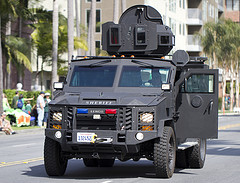
Researchers have discovered that dehumanizing weapons like guns or tasers, which do not require the aggressor (police) to make physical contact with his victim, are aggression-eliciting stimuli. One study found that simply showing an image of a gun to students caused them to clench their fists faster (a sign of aggressive effect) when presented with an aversive situation. If a simple handgun can noticeably increase violent behavior, one can only imagine what impact the $500 million dollars’ worth of weapons and armored vehicles (provided by the Pentagon to local police in states and municipalities across the country) have on already tense and potentially explosive situations.
So what is the answer?
How should we as a society respond when we hear about the Las Vegas police officer who shot an unarmed man at a convenience store whom he “thought” was a homicide suspect, or the Los Angeles cop who shot an unarmed man seen leaving a convenience store where an ATM had been robbed of $40 or the DC cops who killed a young mother in a hail of gunfire? As John Grant notes for Counterpunch: “The ignominious and unnecessary public killing of Miriam Carey should be a human marker that triggers our cultural meaning machine to honestly consider what’s wrong with the picture of a howling pack of cops shooting down a troubled young mother … like a dog.”
The current practice is to let the police deal with it themselves by suspending the officer involved with administrative pay, dragging out the investigation until the public forgets about the incident, and then eventually declaring the shooting incident justified based on the officer’s fear for his safety, and allowing him to go back to work as usual. Meanwhile, the epidemic of police violence continues to escalate while fear of the police increases and the police state, with all its surveillance gear and military weaponry, expands around us.
If ever there were a time to de-militarize and de-weaponize local police forces, it’s now. The same goes for scaling back on the mindset adopted by cops that they are the law and should be revered, feared and obeyed. As for the idea that citizens must be compliant or risk being treated like lawbreakers, that’s nothing more than authoritarianism with a badge. As Grant points out: “As the public killing of Miriam Carey should make clear, a significant part of the problem is cops and the pack mentality they too often resort to. These men and women are encouraged to see themselves on “the front line” protecting us, the people. They are pumped up with post-911 fears and adrenaline and, when it hits the fan, relentlessly determined to get their man or woman. A lot of reality can get lost in this process.”
In other words, it’s time for a reality check, for both the police and the citizens of this nation, and a good place to start is with the words of that gonzo journalist Hunter S. Thompson, who warned: “Coming of age in a fascist police state will not be a barrel of fun for anybody, much less for people like me, who are not inclined to suffer Nazis gladly and feel only contempt for the cowardly flag-suckers who would gladly give up their outdated freedom to live for the mess of pottage they have been conned into believing will be freedom from fear.”
Related articles
Featured Video

Why the U.S. Should Pull Back From the First Island Chain
or go to
Aletho News Archives – Video-Images
From the Archives
Only 19.7% of Americans agree with US State Dept on Israeli settlements
… Most American adults of voting age don’t appear willing to reject the applicability of international law to Israel’s ongoing colonization of occupied territories in East Jerusalem, the West Bank and Golan Heights. … Full article
Blog Roll
 Aletho News
- British Government Employees Were Fact-Checking the News at the BBC. Nobody Told You.
- Albania on fire: who’s behind the riots?
- Egypt’s Civil Democratic Movement rejects involvement in regional war
- Egypt collaborates with Israel to build ‘Green Rafah’ project over erased Palestinian city
- Rising fuel prices and shortages have helped drive ongoing protests and rioting in France
- Tokyo protests demand Takaichi’s resignation over support for ‘Israel’
- Jennifer Kavanagh: Why the U.S. Should Pull Back From the First Island Chain
- Yemen denounces international community’s silence on Saudi aggression, siege
- UAE and Saudi Arabia move toward renewed coordination against Sanaa
- How Iran’s two-week retaliatory strikes exposed cracks in US military architecture in Persian Gulf
- If Americans Knew
- More on how Bari Weiss is using CBS on behalf of Israel
- What the UK Is Doing to Pro-Palestine Novelist Sally Rooney Is an Act of Orwellian Villainy
- ‘We will build palaces for Jews in Gaza’: Right-wing activists establish new outpost near border
- ‘You see us burning, you stay silent’: Family’s agony over mother and sons burned to death in Gaza tent
- Israel keeps Palestinian journalist Bushra al-Tawil in isolation for 46 days
- US-Israel integration plan puts US military tech in Israel’s hands
- Israeli Strike Burns Gaza Mother Alive in Front of Toddler, ‘Without Generating Any Headlines’
- ‘The Israel Experience with Mike Huckabee’: The Ambassador’s Family Sells Trips to Israel
- As Gazans carry out mass burial, food insecurity is getting worse – Daily Update
- Israeli rabbi permits occupiers to steal Palestinian olive harvest in West Bank
- No Tricks Zone
- Predictions Made By Renowned Climate Proifessor Over Past Decades Have Been Proven To Be Poor
- New Study Suggests Large Regions Of The Pacific Ocean Have Been Cooling For The Last 80 Years
- Germany’s Green Energy Debacle: High Energy Costs Force Kahla Porzellan to Close After 182 Years!
- New Study: 50 Years Of The Most Aggressive ‘Net Zero’ Policies Can Only Affect The Global Climate By 0.03°C
- US September “Heat” Was No Record…Many Records Set Decades Ago
- Latest European Green Energy Debacle; Portugal’s Largest Flagship Solar Park Insolvent!
- Green Energy Debacle: German Expert Professor Fritz Vahrenholt Warns Of Severe Economic And Social Consequences
- Two More Paleo Reconstructions Affirm Meters-Higher Sea Levels Across Ireland, Brazil 7000-6000 Years Ago
- New Study: Earth And Venus Surface Warmth Largely Explained By Convection And Lapse Rate, Not CO2 Or Radiation
- 2025 Nature Paper Claiming Worsening Global Drought Gets RETRACTED …Heavily Flawed

