Britain rejects EU watchdog plan to probe data-gathering practices – report
RT | November 14, 2013
The UK has rejected a call from an EU watchdog to probe how security agencies intercept metadata. Documents divulged by Edward Snowden revealed the covert practices of British spy body GCHQ in what has been described as “breach of fundamental rights.”
UK newspaper the Guardian reported that Britain sought to “disassociate itself” from a Council of Europe draft resolution urging an investigation into data gathering techniques. The European watchdog is currently holding a conference in the Serbian capital of Belgrade entitled ‘Freedom of Expression and Democracy in the Digital Age’ which seeks to ensure intelligence gathering practices abide by the European Convention on Human Rights.
To this end the Council has produced a report entitled ‘Political Declaration and Resolutions’, outlining recommendations to safeguard against “abuse which may undermine or even destroy democracy.”
A clause (13(v)) in the report urges for an inquiry into the gathering of “vast amounts of electronic communications data on individuals by security agencies, the deliberate building of flaws and ‘backdoors’ in the security system of the internet of otherwise deliberately weakening encryption.”
The UK has moved to exempt itself from this particular part of the document, claiming it was “unable to agree to it.”
“The United Kingdom needs to place formally on record that while it has not blocked consensus on this text, the UK needs to disassociate itself from paragraph 13(v). The UK strongly supports the overall approach of the resolution including supporting a free and open internet that promotes freedom of expression,” said the declaration obtained by the Guardian.
The UK, however, accepted that data could be gathered by security agencies for “a legitimate aim” as long as it is in conjunction with existing human rights legislation and the rule of law.
Security leaks divulged by former CIA worker Edward Snowden blew the whistle on the GCHQ’s multiple intelligence gathering activities and its collusion with the NSA. As well as gathering troves of metadata and recording millions of telephone calls, the latest reports obtained by Der Spiegel found that the GCHQ was spying on data exchange companies through a spoof version of the social network site LinkedIn.
Using a method known as ‘Quantum insert’ the GCHQ created dummy versions of the website to target organizations and individuals and smuggle malware onto their computers.
“For LinkedIn the success rate [of rerouting a target to a malicious website] is looking to be greater than 50 percent,” said the leaked documents.
In addition, more information was revealed at the beginning of November as to the extent of the GCHQ’s cooperation with the NSA. Reports emerged that the GCHQ was feeding the NSA with the internal information intercepted from Google’s and Yahoo’s private networks.
So far the British government has done little to allay fears that UK spy agencies are acting outside the law in violation of human rights.
The Center for European Policy Studies published a paper accusing the UK along with other European countries of systematically violating human rights with their spy practices.
“We are witnessing a systematic breach of people’s fundamental rights,” wrote Sergio Carrera, a Spanish jurist who co-authored the paper with Francesco Ragazzi, a professor of international relations at Leiden University in the Netherlands. They called for action from the EU parliament to distinguish “democracies from police states.”
Related article
Soldier killed in Occupied Palestine as Israel calls for “intelligent” settlements
Al-Akhbar | November 13, 2013
A 16-year-old Palestinian stabbed an Israeli soldier to death on a bus on Wednesday in an attack apparently motivated by the jailing of his relatives in Israel, police said.
The death came as Israel backtracked on an announced plan to expand illegal settlements in the West Bank, calling for “intelligent and coordinated” construction despite international condemnation.
The killing, in the town of Afula in Occupied Palestine, follows a surge in violence in the West Bank, where 10 Palestinians have been shot dead by Israeli troops and three Israelis killed since peace talks resumed in July.
Israel’s northern police commander, Ronny Attia, said the attacker was from the West Bank town of Jenin, and that he was in custody.
According to police, the Palestinian youth did not have a permit to be inside Israel.
“By his account, his uncles are in prison in Israel and this is the reason he decided to carry out the terrorist attack,” Attia said.
Israel refers to many acts of protest against the decades-long occupation – whether violent or non-violent – as terrorism.
Police spokesman Micky Rosenfeld said the soldier, aged 18, was pronounced dead in hospital.
The attack occurred a day before the one-year anniversary of the Israeli Pillar of Cloud offensive on Gaza, in which six Israelis and more than 100 Palestinian civilians were killed in eight days.
Peace talks orchestrated by US Secretary of State John Kerry have faced serious obstacles, including the high rate of Palestinians incarcerated in Israeli prisons, many in indefinite administrative detention, as well as extensive plans to expand Israeli settlements in the West Bank.
A report by British newspaper The Guardian on Tuesday revealed that Israeli troops conducted mock arrests and raids in the West Bank without informing the local population that their actions were drills, causing extreme distress to many Palestinians.
The attack came as Israel’s Intelligence Minister Yuval Steinitz urged “coordinated” settlement building, a day after a new plan for settler homes in the West Bank drew international condemnation.
Settlements in Israeli-annexed east Jerusalem and the West Bank “must be done in an intelligent and coordinated way,” Steinitz told Israeli public radio on Wednesday.
The settlements are deemed illegal under international law.
Israeli Prime Minister Benjamin Netanyahu late Tuesday cancelled plans to build 20,000 new settler homes in the West Bank, hours after their announcement sparked US and Palestinian criticism.
State Department spokeswoman Jennifer Psaki had said Washington was not only concerned by the initial announcement, but also “surprised” and sought an explanation from Israel.
She repeated the longstanding US position on settlements that “we do not accept the legitimacy of continued settlement activity.”
Netanyahu then ordered Israeli Housing Minister Uri Ariel “to reconsider all of the steps for evaluating planning potential (for the settler homes) that he distributed without any advance coordination,” the premier’s office said.
(Reuters, AFP, Al-Akhbar)
Related video
Norway may ban non-medical circumcision of boys
RT | November 13, 2013
Norway’s Health Ministry is considering a proposal on regulating the circumcision of boys. Some political parties are calling on a complete ban of the practice on minors, a possibility that would affect Jewish and Muslim communities.
Two years ago, the ministry was tasked with reviewing circumcision and how it should be practiced in Norway. It is yet to finalize its stance, but intends to submit its legislative proposal before Easter next year, Health Minister Bent Hoie told Aftenposten, Norway’s largest newspaper.
The issue was brought to public attention after the recent call by Norway Children’s Ombudswoman Anne Lindboe to ban circumcision of boys before age 16, unless the procedure is warranted by medical needs.
“This is not due to any lack of understanding of minorities or religious traditions, but because the procedure is irreversible, painful and risky,” she argued.
Lindboe’s position is shared by some members of the Labor Party, which currently holds the largest share of 55 seats in Norway’s 169-strong legislative and is in opposition to the ruling Conservative-Progress coalition.
“As a modern society, we should work to eliminate practices that expose children and people to unnecessary suffering,” said Labor’s Ruth Mari Grung, who is a member of the parliamentary Committee on Health and Care Services.
A ban is also supported by the Center Party, which has 10 seats in the parliament.
Other parliamentary parties are yet to formulate their official position on the issue. Hoie, a Conservative member, who used to chair the Health Committee before getting his ministerial appointment, voiced concerns that a ban would force the groups practicing ritual circumcision underground, where the procedure would be performed by non-medics and pose greater health risks to the children.
The Norwegian lawmakers also disagree on whether circumcision should be covered by the budget under the national healthcare system. Some parties insist that ritual circumcision should be paid for by parents.
According to the newspaper, an average of about 2,000 Muslim and seven Jewish newborns are circumcised in Norway each year.
Regulation of ritual circumcision in Europe made the headlines in June, when a German court ruled that the procedure constitutes a minor bodily harm and outlawed performing it on minors. The decision sparked nationwide debate on the conflict between religious freedoms and protection of children.
The issue was further stressed in early October, when the Council of Europe branded the practice “a violation of the physical integrity of children” and called on EU members to protect children. The latter should include a ban on performing circumcision on those who cannot consent to it, the non-binding resolution said.
Sweden, Finland, Denmark, Iceland and Greenland are among the European countries where public debate on ritual circumcision of boys is hotly debated.
Related article
Bystanders Hit by Police Bullets in New York City Get Little Sympathy and No Compensation
By Noel Brinkerhoff and Danny Biederman | AllGov | November 13, 2013
Getting shot has been made that much worse in New York City, where officials have taken a hard-line with bystanders caught in the line of fire of police officers.
Sixteen bystanders have been struck by police bullets in the city since 2011. Time and again, city lawyers have fought lawsuits brought by those wounded in these incidents. They adamantly refuse to settle cases and aggressively act to have them thrown out prior to trial.
NYC’s legal defense is rooted in a 2010 State Court of Appeals ruling that tossed a lawsuit by a bystander shot by police.
“The state’s highest court has recognized that police officers’ split-second decisions to use deadly force must be protected from this kind of second-guessing,” Michael A. Cardozo, who is in charge of the city’s Law Department, said in a statement, after a woman wounded outside the Empire State Building sued.
That incident took place on August 24, 2012, when nine pedestrians were shot by police trying to take down a gunman outside the famed building.
The most recent bystander shooting occurred in September, when two officers near Times Square fired at a man they mistakenly believed had a gun. The man was not wounded, but two female bystanders were, one of whom is now preparing to file a lawsuit.
The lawsuits that are filed by innocent bystanders as a result of officer shootings are referred to by New York City as “no-pay cases,” an indication of how black-and-white city lawyers view these incidents.
Cities across the U.S. handle such cases differently, according to the The New York Times. In Philadelphia in 2008, a $1.8 million dollar settlement was reached after a bystander was fatally wounded as police shot at an armed suspect. A 2010 police shooting of unarmed individuals in Harlem brought about several settlements, including one for $850,000 due to a fatality. The city of Chicago spent six years battling a 13-year-old girl who was hit in the shoulder by police gunfire, before her case made it to trial in 2010.
Legal experts say the cases present a challenge for police trying to protect the public, while not causing more harm than good.
“On the one hand they’re trying to protect people,” Jeffrey L. Seglin, an ethicist and lecturer on public policy at the John F. Kennedy School of Government at Harvard, told the Times. “On the other hand, you think they would try to take care of people who get hurt in that process. The legal thing isn’t always the right thing.”
To Learn More:
Bystanders Shot by the Police Face an Uphill Fight to Win Lawsuits (by J. David Goodman, New York Times)
Five City Officers Cleared In Shootings of Bystanders (by Ray Rivera, New York Times)
Related article
- Police face lawsuits in shootings of three emotionally disturbed people (theguardian.com)
Brazil and Germany Proposed UN Resolution Against Mass Surveillance
By Katitza Rodriguez | EFF | November 12, 2013
On November 7th, Brazil and Germany jointly proposed a preliminary version of a resolution on online privacy at the UN General Assembly. At a time when public outrage over the reach and scope of U.K. and U.S. mass surveillance is at an all time high, the draft resolution is the first official recognition by the UN of the threat that mass surveillance poses to human rights. The draft resolution is significant in many respects but particularly because it condemns “human rights violations and abuses that may result from the conduct of any surveillance of communications, including extraterritorial surveillance of communications… in particular massive surveillance.”
The draft resolution calls upon all states:
- To end privacy violations and prevent further privacy incursions and ensure that national laws, practices and procedures conform to existing international human rights obligations,
- To establish independent national oversight mechanisms capable of maintaining transparency and accountability for state surveillance of communications,
- Requests the United Nations High Commissioner for Human Rights to submit a report to the General Assembly on the protection of the right to privacy.
If adopted, this will be the first General Assembly resolution on the right to privacy since 1988. This represents an excellent opportunity for states to update their understanding of international human rights law in the context of the massive technological developments that have taken place over the last 25 years.
While introducing the draft resolution, the Permanent Mission of Germany to the United Nations New York drew attention to the 24th session of the U.N. Human Rights Council (HRC) side event organized last September by Germany and Norway. During this meeting, member states engaged in a robust debate of online surveillance. EFF, Privacy International, Human Rights Watch, Access, APC, Article 19 and a coalition of 290 NGOs presented formally the International Principles on the Application of Human Rights to Communications Surveillance, a set of principles that provide States with a framework to evaluate whether current or proposed surveillance laws and practices are consistent with human rights. These principles have been cited in the new Mexican telecom reform bill, in op-eds and editorials in different countries, refered by policy makers in Sweden and the United Kingdom, and translated in more than 31 languages. During the 24th HRC, we also submitted an official statement calling on states to ensure that advances in technology do not lead to disproportionate increases in states’ interference with the private lives of individuals.
A few weeks earlier, during the opening of the 68th session of the United Nations General Assembly, the Brazilian President, Dilma Rousseff, made clear the indignation and repudiation in public opinion around the world regarding the revelations of a global network of electronic espionage:
“In Brazil, the situation was even more serious, as it emerged that we were targeted by this intrusion. Personal data of citizens was intercepted indiscriminately. Corporate information – often of high economic and even strategic value – was at the center of espionage activity. Also, Brazilian diplomatic missions, among them the Permanent Mission to the United Nations and the Office of the President of the Republic itself, had their communications intercepted.”
We hope that member states join Brazil and Germany in explicitly condemning mass surveillance by supporting the draft resolution as is currently written, and stay vigilant against watering-down of the text by countries who would continue their ubiquitous spying. Now is the time for all concerned citizens to call upon their governments to conform to the principles signed by 290 NGOs. If your organization hasn’t signed it yet, it can do so here. It’s time to defend the Necessary and Proportionate Principles at the United Nations, and in every other regional or national policy space.
Cell Phone Manufacturers Offer Carefully Worded Denials To Question Of Whether NSA Can Track Powered-Down Cell Phones
By Tim Cushing | Techdirt | November 13, 2013
Back in July, a small but disturbing detail on the government’s cell phone tracking abilities was buried inside a larger story detailing the explosive expansion of the NSA post-9/11. Ryan Gallagher at Slate pulled this small paragraph out and highlighted it.
By September 2004, the NSA had developed a technique that was dubbed “The Find” by special operations officers. The technique, the Post reports, was used in Iraq and “enabled the agency to find cellphones even when they were turned off.” This helped identify “thousands of new targets, including members of a burgeoning al-Qaeda-sponsored insurgency in Iraq,” according to members of the special operations unit interviewed by the Post.
Ars Technica reports that some security researchers are calling this statement into question and have contacted cell phone providers for statements on the NSA’s claim. Only a few have responded at this point, and their denials have been worded very specifically.
Google had this to say:
When a mobile device running the Android Operating System is powered off, there is no part of the Operating System that remains on or emits a signal. Google has no way to turn on a device remotely.
Google may not have a way, but that doesn’t mean the NSA doesn’t.
Nokia:
Our devices are designed so that when they are switched off, the radio transceivers within the devices should be powered off. We are not aware of any way they could be re-activated until the user switches the device on again. We believe that this means that the device could not be tracked in the manner suggested in the article you referenced.
Once again, we’re looking at words like “should” and “not aware.” This doesn’t necessarily suggest Nokia does know of methods government agencies could use to track phones that are off, but it doesn’t entirely rule it out either.
Samsung’s response is more interesting. While declaring that all components should be turned off when the phone is powered down, it does acknowledge that malware could trick cell phone users into believing their phone is powered down when it isn’t. Ericsson, which is no longer in the business of producing cell phones (and presumably has less to lose by being forthright), was even more expansive on the subject.
The only electronics normally remaining in operation are the crystal that keeps track of time and some functionality sensing on-button and charger connection. The modem (the cellular communication part) cannot turn on by itself. It is not powered in off-state. Power and clock distribution to the modem is controlled by the application processor in the mobile phone. The application processor only turns on if the user pushes the on-switch. There could, however, be potential risks that once the phone runs there could be means to construct malicious applications that can exploit the phone.
On the plus side, the responding manufacturers seem to be interested in ensuring a powered down phone is actually powered down, rather than just put into a “standby” or “hibernation” mode that could potentially lead to exploitation. But the implicit statement these carefully worded denials make is that anything’s possible. Not being directly “aware” of something isn’t the same thing as a denial.
Even if the odds seem very low that the NSA can track a powered down cell phone, the last few months of leaks have shown the agency has some very surprising capabilities — some of which even stunned engineers working for the companies it surreptitiously slurped data from.
Not only that, but there’s historical evidence via court cases that shows the FBI has used others’ phones as eavesdropping devices by remotely activating them and using the mic to record conversations. As was noted by c|net back in 2006, whatever the FBI utilized apparently worked even when phones were shut off.
The surveillance technique came to light in an opinion published this week by U.S. District Judge Lewis Kaplan. He ruled that the “roving bug” was legal because federal wiretapping law is broad enough to permit eavesdropping even of conversations that take place near a suspect’s cell phone.
Kaplan’s opinion said that the eavesdropping technique “functioned whether the phone was powered on or off.” Some handsets can’t be fully powered down without removing the battery; for instance, some Nokia models will wake up when turned off if an alarm is set.
While the Genovese crime family prosecution appears to be the first time a remote-eavesdropping mechanism has been used in a criminal case, the technique has been discussed in security circles for years.
Short of pulling out the battery (notably not an option in some phones), there seems to be little anyone can do to prevent the device from being tracked and/or used as a listening device. The responding companies listed above have somewhat hedged their answers to the researcher’s questions, most likely not out of any deference to government intelligence agencies, but rather to prevent looking ignorant later if (or when) subsequent leaks make these tactics public knowledge.
Any powered up cell phone performs a lot of legwork for intelligence agencies, supplying a steady stream of location and communications data. If nothing else, the leaks have proven the NSA (and to a slightly lesser extent, the FBI) has an unquenchable thirst for data. If such exploits exist (and they seem to), it would be ridiculous to believe they aren’t being used to their fullest extent.
Australia Spies On its Own Citizens
The Australian security state is collecting intelligence on a scale never seen before
By Murray Hunter | Asia Sentinel | November 11, 2013
Through rapid technology advances the Australian security apparatus has grown to an Orwellian scale. This has not necessarily been at the design of any elected government but something the Australian bureaucracy was forthright in promoting.
The executive government has only superficial control over the Australian surveillance system. It is fully integrated with the NSA apparatus which immediately brings up an issue about sovereignty. This is not about a country’s sovereignty over land, but knowledge. The international exchange of security information is a challenge to human rights of Australian citizens that has to be grappled with.
Consequently, it is not in the interests of the Australian or US intelligence community for any public or even parliamentary discussion. The idea that the parliament and executive are in total control of government is a myth.
Through technology and its innovative applications, the concept of privacy has been reframed to the point of anything a person does outside of the home or on a computer is public domain, captured through any of the large array of assets that can be utilized for surveillance.
This has allowed the creation of a new premise that has grown up through the administrative arm of the Australian Government, one of compliance. Australia seems to have adopted an almost fanatical compliance culture where the administrators believe that they are the natural custodians of Australia’s security interests, over the temporarily elected politicians of the day.
Some of the methods the Australian security state utilizes for intelligence gathering, storing, and collation are well documented and summarized below:
- The Australian Government database is a highly sophisticated group of electronic document and records management system(s) (EDRMS) for collating, storing, and matching data between various agencies and levels of governments. Consequently data collected by the Australian Taxation Office (ATO), social security (Centrelink), Medicare, immigration, customs, and police enforcement agencies are integrated with relational databases and query systems. This is supplemented by individual agency databases with extremely detailed information on citizens. They carry an almost complete personal history of residential details going back decades, income, occupation, spouses, children, social security benefits, medical, and travel information, etc. These systems can be accessed by almost anybody within the public service. Every agency within the government has become part of the intelligence collection network. According to academics Paul Henman and Greg Marston of the University of Queensland, these systems that enable agencies to determine client eligibility for services are highly intrusive and used with a prevailing deep suspicion of citizens in regards to their continuing eligibility for services.
- The most recent revelations in the news about the ‘five eye’ countries eavesdropping on their citizens phone conversations, emails, and other electronic communications has been astounding. Through meta-data collection systems like PRISM and ECHELON are highly likely to be also operating within Australia due to the close relationship between the NSA and Australian intelligence community. According to AFP assistant commissioner Neil Gaughan, Australian intelligence has a much better relationship with the telecommunications companies than the US intelligence agencies. However, this doesn’t appear to be a new occurrence. A reliable source working within one of the Australian telephone companies when manual exchanges were operating confirmed that ASIO and state special branches had secret rooms within the exchanges to run phone tapping operations.
- The NSW police are using an Automated Number Plate Recognition (ANPR) system which takes continuous snapshots of car number plates. This is supplemented by tracking cars when they go through tolls.
- Law enforcement agencies have announced that they are preparing to utilize drones for crime surveillance in the not too distant future.
- State and Federal Governments have been encouraging citizens to inform on other citizens they suspect of breaking the law. Government campaigns have been very successful in achieving all-time high numbers of informants in crime, social security, and taxation related matters.
The incredible power of the above described databases are exponentially enhanced when coupled with recent developments in cellular, RFID, internet, and other computer technologies. When private data in retail, banking, travel, health and insurance, etc., is linked to Intelligence collected by government, the value of data becomes massively enriched. Data collected by private organizations and utilized by security services include:
- The internet domain is under constant surveillance. Companies like Google, Yahoo, Facebook, and Twitter utilize tracking cookies to gather data on users. Australian security agencies employ private contractors like the National Open Source Intelligence Centre (NOSIC) to monitor, collate, and report on publically accessible information about individuals and organizations.
- Many business organizations such as shopping centres and banks now utilize CCTV. These assets can be utilized by security organizations to track and monitor individuals. This is now being supplemented with media access control (MAC) systems which can track smartphones. This technology is already being used in three Westfield shopping centres.
- Numerous private databases like electronic tenancy database which has detailed information. These include tenancy history, insurance company records that detail individuals insured assets, bank records, and university records. These can all be accessed by security agencies.
- Mobile phones can be used as a means to track people through inbuilt GPS on smartphones, triangulation, or through electronic data-collectors designed to identify individual mobile phones in public places.
- People’s purchase history and movements can be tracked through the use of credit, debit, and loyalty card purchases.
Emails, phones calls, places people go, and purchase history, in the context of other data collected has the latent potential to build up a profile on anybody. Data from social media like Facebook can enhance these profiles greatly by adding thought and behavior information. It’s the collection of small bits of information that can be collated into big pictures. Australian intelligence can retro-actively analyse anybody with the data they have access to.
Since 2007, when amendments to the Telecommunications (Interception & Access) Act 1974 were made during the last days of the Howard Government, government agencies have the power to search meta-data without the individual’s knowledge or any warrant.
CCTV cameras have been installed in many communities without the development of privacy policies on how they should be used. The law has yet to catch up with the ability to collect data.
Up until the 1980s most intelligence gathering was targeted monitoring of specific groups where ‘persons of interest’ were identified for intensive surveillance. ASIO and state special branches were videotaping activists primarily from the ‘left’. Surveillance was undertaken by ASIO and state special branches, where operatives used electronic means for eavesdropping, keeping index cards and files on ‘persons of interest’, recording mainly hearsay information.
Even then, red flags emerged. Peter Grabosky of the Australian Bureau of Criminology pointed out that ‘thought and discussion of public issues may be suppressed……and….excess use of (surveillance) may inhibit democratic and political freedom more subtly’. In addition, he believed that malicious accusations made from erroneous records produce false information which made innocent people suffer at the hands of the security agencies.
This problem can’t be corrected as these records are not assessable to be corrected for errors. The Mohamed Haneef arrest by the AFP in July 2007 where it was alleged he was connected with a terrorist cell in the UK, but later exonerated, hints at the security services being very territorial and ‘out of control’, where ASIO knew of Dr. Haneef’s innocence but didn’t advise the APF.
Faceless bureaucrats are the ones defining who were the enemies of the state. There appears to be a general inability to discriminate between healthy dissent in a political democracy and subversion.
Where no tangible threats existed to national security, lesser ones were perceived to be grave threats or even invented – remember “weapons of mass destruction” in Iraq.
The rise of surveillance should not be understood as purely a technological development. It should be seen as a broader economic, social, and political paradigm shift within society where the balance of power has shifted away from the people and towards the state. There also appears to be a shift of power away from executive government towards an unelected bureaucracy. What makes this even more perplexing is that we don’t even know who these people really are.
The Sydney Morning Herald just ran a story that intelligence data was passed on to assist the mining giant BHP. Moreover, the human rights website WEBMOBILIZE alleges in a recent article that the Australian security apparatus is being used to steal intellectual property from companies and passing it over illegally to competitors. Some of the organizations that have been alleged to receive unlawfully gained IP include the University of Melbourne, Ageis Media, Telstra, Sensis, Deakin University, Belgravia Health and Business Group, Channel Nine, Nine Entertainment, Nine MSN, Corporate health management, Fairfax media, the Herald Sun, The Guardian, Nintendo, and the Australian Labor Party (ALP)and Liberal National Party (LNP).
There has been little in the way of public debate, nor much concern shown by the major political parties.
The powers to detain anyone under section 34D of the Australian Security Intelligence Organization Act 1979 for up to seven days without the right to reveal their detention, resembles the mechanisms of a police state.
With an annual growth rate of more than 20% and budget of over $4 Billion p.a., ASIO has a new $500 Million building in Canberra and a secret data storage facility is being built at the HMAS Harman Naval Base, near Canberra, where details are except from public account committees. When other government programs are being cut, the deep philosophical question of why there is a need to continue the increase of funding for surveillance of the nation’s citizens requires national discussion.
Mass surveillance doesn’t seem to have much to do with terrorism as it has to do with keeping check on what people are doing. It seems to be more of an intimidating compliance mechanism, aimed at protecting public revenue, preventing and detecting crime, tax evasion, and fraud.
The rapid increase in staff within ASIO from 618 in 2000 to 1860 in 2010 has meant that the organization now primarily relies upon young and inexperienced analysts in their 20s and 30s. This means that Australia is at the mercy of a “Gen Y” culture that has grown up connected to the cyber world where a sense of privacy is very different to generations before them. Newly uncovered evidence suggests that ASIO has gone to great lengths to spy on people who have broken no laws.
Through Australia’s history Australian Security Agencies have blundered in the assessments they have made on many issues. The 2004 Flood report commenting on the “failure of intelligence” on Iraq stated that these weaknesses included “a failure to rigorously challenge preconceptions”, and the absence of a “consistent and rigorous culture of challenge to and engagement with intelligence reports”. Flood found an inconsistency in assessments and very shallow analytical abilities within the security agencies he examined. On many occasions, particularly during the Howard years, intelligence analysis was ‘bastardized” by political agenda. Those who criticized the political agenda ran the risk of being reframed from dissidents and classed as deviants who come under security surveillance.
The question here, can government with a long history of cover-ups be trusted?
The dream of a fair, just, and equitable Australian society where sovereignty is in the hands of its citizens may be one of the greatest myths. Australia’s surveillance on its own has eaten into and taken away many of the rights and liberties of Australians, turning society into one of mistrust.
This cannot be really satisfactorily answered relying only on public domain knowledge. We can only make guesses. However one undeniable fact is that there is presently a hidden and totally unaccountable part of government that is changing the nature of society. It is here where no media organizations are asking any questions.
We have entered into a new period of governance. We are now in an age of governance by surveillance of the masses by a few unknown elite and unaccountable people. Communist totalitarianism may have collapsed in Europe in 1991 with the fall of the Soviet Union, but the “free world’s” version of surveillance and intelligence would have made Stalin, Honecker, and Ceauşescu very jealous.
The lack of transparency is becoming indefensible. Without scrutiny the Australian security apparatus is the loose cannon of the Bureaucracy which will cause many reverberations like the destruction of peoples’ livelihoods through IP theft, or the ruining of peoples’ reputations through persecution.
There has never been a public mandate for the development of such an extensive surveillance program. Is the money being spent justified?

There is no Palestinian issue for Syrian rebels
By Nadezhda Kevorkova | RT | November 10, 2013
The Palestinian issue has been uniting all Muslims for 65 years. Syrian rebels succeeded in their mission – they made the world forget about the Palestinian issue.
The militants pulled Palestinians out of refugee camps; they are killing them or using these people as human shields. And the media are silent about it, while the Syrian opposition keeps screaming about the “oppressive Assad regime.”
It’s been a year since Syrian rebels raided the largest Palestinian refugee camp in Syria – Yarmouk, near Damascus. Up until recently it was the duty of Israeli soldiers to persecute Palestinians, now this is done by Syrian rebels with their Muslim slogans. The media are not saying anything about it.
What is the life of Palestinians like, now that the Syrian conflict made them refugees again?
‘Nobody is helping us – neither Europe, nor the UN’
Abu-Badr, head of Beirut’s Bourj al-Barajneh refugee camp People’s Committee, gathered representatives of all Palestinian parties. They all keep regular contacts with camps in Syria.
A year after Palestinian camps and Palestinians were attacked, the heads of these organizations are saying that the Syrian war is a staged conflict, and its goal is to distract everybody from the Palestinian problem.
A total of 760,000 Palestinian refugees lived in Syria before the war, and about 550,000 in Lebanon. Palestinians had equal rights in Syria, and virtually no rights in Lebanon. For example, they were not allowed to work in 72 professional capacities.
Abu-Badr says, “There are over 1,000 Palestinian families from Syria in our camp. Nobody is helping us – not Europe, not the UN. The Red Cross came twice. The refugees are renting housing on their own.”
To rent a place to live is a big problem for a Palestinian, especially at the camp. And to pay rent, they have to find a job, which is extremely difficult in Lebanon.
He says that according to the authorities, there are about 120,000 Palestinian refugees from Syria living south of Tripoli. So every tenth refugee is a Palestinian.
Turkey and Jordan don’t accept Palestinians.
Kafar is a young mother of two. She used to live in Syria’s Yarmouk with her family. Now she is struggling to survive in Bourj al-Barajneh in Lebanon.
She fled Yarmouk at the end of 2012, when the rebels took over the camp and made it their foothold to carry out attacks on Damascus.
Yarmouk is one of the largest Palestinian camps in Syria. Before the war it had 150,000 residents, which was almost one-quarter of all Palestinian refugees in Syria. The camp is very close to the Damascus city limits, and there were subdivisions where regular Syrians lived.
Refugee camps are extraterritorial places. Police and army are not allowed there, the residents don’t have citizenship, they don’t vote and don’t serve in the army. Camps are self-governed by representatives of all Palestinian political parties. Unlike all other countries, Syria allowed refugees to leave camps and enjoy all rights and freedoms.
A Syrian family named Lakud brought the fighters to Yarmouk. Palestinians didn’t support the rebels then, and they are not supporting them now. Some parts of the camp are still controlled by the opposition.
A human shield for militants
Kafar recalls: “The entire camp left in a snap back then, when armed militants entered it. They were inside, shooting bullets into the air – they always act the same way. They ordered the residents to leave having placed their orders on different websites and having sent emails. Nobody stayed there.”
In December 2012, some started trying to come back. There are even a few families that decided to stay in the camp, hoping it would get better soon. Kafar says all the houses have been looted – they have taken everything, including electrical wires.
She says the militants were shooting those Palestinians who went out to take part in demonstrations. They wouldn’t let people return to their homes, but in case they did come back home, they couldn’t leave their houses again.
“If the militants went away, we would come back. Sometimes we can contact those inside the camp. They tell us about the blockade – they feel like they live in a cage, they lack food. There is no escape – they are kept as a human shield for the militants,” Kafar says.
She tells us about her relative who went to find her children, but ended up as a hostage in the camp.
“The militants won’t let you come in, but if one has entered – he would be kept there by force. They have established checkpoints. They deprive the people of food and beat the women who try to sneak inside, bringing something to their relatives to eat,” Kafar says.
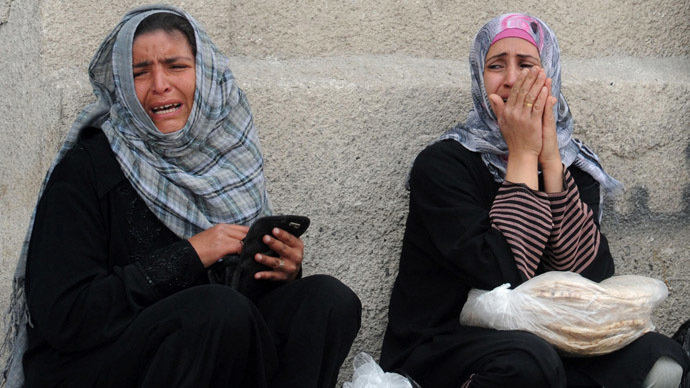
A handout picture released by the Syrian Arab News Agency (SANA) on May 15, 2013, shows protestors crying after unidentified armed groups opened fire on demonstrators as they marched in the Syrian capital Damascus in support of the right to return of Palestinian refugees who fled their homes or were expelled during various conflicts. (AFP/SANA)
Hitting a woman in public is considered absolutely unlawful among Muslims. But Kafar says that the militants in Yarmouk have their own vision of everything.
“We are not afraid of war, but they won’t even feed the people. The al-Nusra militants are tall, wear long beards and look like foreigners. Probably, there are Syrians among them but none of my relatives have ever seen one,” Kafar says.
One blanket for five
Palestinians from Syria in Lebanon are in even more dire straits.
“They humiliate us – we are constantly being insulted,” the woman tells us.
She is showing us around her tiny apartment with two rooms and a kitchen. The ceiling leaks when it rains.
“The rent is $300. If I don’t find money by Sunday, we’ll have to leave for Syria.”
Apart from the rent, they pay $70 for water.
Her father-in-law was killed. Her mother-in-law returned to Syria and now lives with their relatives there.
“I’ll go to Syria and wait there until I can come back home. Staying here is humiliating,” Kafar says.
Her husband takes up any job he can, be it a laborer, carrier or loader.
They have no warm clothes – all their belongings were stolen in Yarmouk. This family doesn’t belong to any group. They got help from different organizations such as Hamas, the Popular Front or some voluntary organizations. But it can hardly be called help – it is more like a mere pittance.
“They gave us one blanket for five people. But we are living creatures,” Kafar says, showing us a thin grey synthetic blanket. She thinks it looks like a cloth that is used to wrap a dead body when burying it.
The family has no money to buy food. They sometimes receive help from neighbors, who share their food with them. I saw them bring some bread and crisps.
‘In Syria, Palestinians are treated better than brothers’
Kafar complains about how the refugee work is organized.
“They distribute some humanitarian aid, but the process is humiliating to us every step of the way. There is fighting in Syria, but Palestinians are respected there. And here they call us Syrian dogs.”
“We had a good life under Assad, not lacking anything. We will go back and live in Syria, even if we have to live in tents. Syrians treat us as equal, they help us,” says Kafar.
In the last year they received help twice – from Hamas and from people from Qatar – about $300 per family, which is less than one dollar a day. But not everybody gets even these payments. There are lists of those who suffer the most in these camps.
She tells us how the process of distributing this aid works.
“A family gets a check for $150 from Qatar. But there wasn’t enough for everybody on the list. So people are humiliated even more. The place where these checks are given is near Beirut, you have to take a taxi to get there and spend half of the money on the ride. They give food stamps for certain food items, which can only be bought in one supermarket. And this store is also far away.”
“You can’t buy meat with these food stamps. Do they think children can go for a year without meat?” the woman asks.
“We are convinced that Syria will welcome us back. They loved us there, treated us like brothers, even better than brothers. We lived better than Syrians themselves,” Kafar says.
She knows that the Lebanese have closed the border for Palestinian refugees. So they can’t go anywhere.
“They accepted us in Syria. When we lost everything, they took care of us. They asked us what we needed. Six blankets? Food? They gave us everything. They didn’t blame us, even though life was difficult for everyone.”
She thinks her family made a mistake when it moved to Lebanon. “We were told life would be good here. Now we regret the decision.”
Her husband came six months earlier, he thought they would be safe here while there is fighting.
‘There is no Palestinian issue for Syrian rebels’
“We Palestinians have played no part in Syria’s distress. We didn’t participate in street protests, and our people did not join the rebels,” says Kafar. She admits to having heard that some Palestinians have, in fact, taken up arms against the Syrian government. But she is certain that is a rare exception.
“Those people must have been seduced by money, or befuddled with drugs, and with false promises. Only the poorest and the most destitute of the Palestinians have gone to fight for money, and it took them 18 months to get that desperate.
“Such people have nothing to eat, so they join the rebels hoping to make some money to sustain their families, and then desert at the first opportunity.”
“We cannot admit to supporting the regime, for fear of being killed on the spot. Those rebels do not consider the Palestinian issue to be of primary importance. There is no Palestinian issue for the rebels at all,” says Kafar.
Every night, the inhabitants of Bourj al-Barajneh go to sleep fearing that al-Nusra militants may descend on the Palestinian refugee camp and start asserting their rule, the way they did at Yarmouk. There is talk that al-Nusra men were spotted recently inside Nahr al-Barrid, another Palestinian camp. Since then, the People’s Committee instituted vigilante patrols across the entire camp.
“Our people control every in and out,” Kafar tells us. “They keep watch at night to make sure no strangers come upon us as we sleep. That’s how it happened in Yarmouk.”
The Syrian army has also set up checkpoints guarding the entrance to each camp.
‘They butchered a family to make the others serve as a human shield’
Yarmouk was not the only Palestinian camp captured and cleared of refugees by insurgents. Moreover, no one can assess the number of Palestinians killed in the process.
A Palestinian woman named Gusun was forced to flee camp Duma near Damascus on September 23, 2012, together with her husband, their three kids, and her husband’s brother.
“There were plenty of olive groves next to our camp. We lived in peace for a long time, until the fighting drew close to our camp. Then, rebels started taking shelter in our camp, hiding in our houses during firefights, and shooting through our windows. And we found ourselves between the hammer and the anvil. So one day, we slipped out at five in the morning and ran away through the olive grove,” Gursun tells me.
“The rebels had killed many people in our camp unflinchingly. They butchered a married couple who were my husband’s kin – they cut their throats, so that the other Palestinians would stay in the camp and serve as their human shield, while the government was commanding us to flee.”
Gusun went back to check on Duma some four months ago.
“I found my home thoroughly looted, its roof smashed,” she recalls. “And the FSA and al-Nusra are still entrenched in the camp.”
“Once their men spotted me at Duma, they came up and questioned me to make sure I was from that camp. They let me go, but they kept watching me. Later, when I went out to a grocery store, I noticed a car tailing me. Then I got scared and ran away from the camp,” says Gusun.
“The rebels I saw were tall and fair-skinned. There are some who don’t speak Arabic, and there are some who do. People have also told me there are black rebels, but I have never seen one. Some rebels wear black vests, some wear masks, some wear short pants, and others wear normal trousers. There are many fair-skinned men among them, those are foreigners.
“When we walked around the camp, we would try not to look them in the face, for fear that they might do us harm,” Gusun says.
‘Palestinians, get out of Syria’
The world’s mainstream media, who have closely followed the insurgency and its war on Assad, have proven squeamish when it comes to covering the way rebels treat Palestinians. In the spring of 2011, they would refute news reports that opposition activists wave Israeli flags and chant anti-Palestinian slogans at their rallies.
This stands to reason: two years ago, the Palestinian issue was still the No. 1 concern for the Muslim world, and an anti-Palestinian stance would have done serious harm to the rebels’ reputation. All the more so as Egyptian revolutionaries at Tahrir Square had been pronouncedly pro-Palestinian, despising Hosni Mubarak for his support for the Israeli blockade of the Gaza Strip.
The women at Bourj al-Barajneh are perplexed at the world’s ignorance of how Syrian insurgents really feel about Palestinians.
“At the onset of the revolution, slogans were like, ‘Carrots belong with carrots and cabbage with cabbage, and this is no land for Palestinians’,” says Gusun, who is shocked that no media have ever reported that the Syrian rebels had initially been against the Palestinians.
“Under these slogans, the armed rebels marched along the streets, angered by the local Palestinians’ reluctance to turn against the regime,” says Gusun.
“In about a year and a half, some Palestinians were in this way or another made to join the rebels. But that didn’t change much the rebels’ opinion of the Palestinians,” remarks Gusun, adding that even now the Palestinians on the side of the rebels are few and far between.
She can’t understand the reason why the Lebanese are treating Palestinians like that. After all, Syria did give shelter to 1 million Lebanese and Palestinian refugees after the 2006 Israeli attack.
“During the 2006 war we welcomed the Palestinians like family. But now we are being treated as outsiders.”
At that time, all the refugees from Lebanon found home, food and clothes straight on arrival.
Gusun was lucky to have found a job, and so was her husband. “I had to work as a cleaning lady. I’d never done anything like that before. But we had to survive somehow. The UN gives only $30 once every four months.’
It was crucial for the sponsors of the anti-Syrian campaign to shift the focus of one and a half billion Muslims from Palestine to the war against Assad. And their mission almost succeeded.
The issue of Palestine used to bring everyone together: Communists and atheists, the Sunni and the Shia, Christians and Muslims, left- and right-wingers, anti-globalists and nationalists. Now the war in Syria has torn them all apart.
Fast forward two years, there are no more rallies against the occupation of Jerusalem, no ships trying to break through the Gaza Strip and the West Bank blockade. In the meantime, this blockade has grown even tougher after the military coup in Egypt, with the abuse of Palestinians in the West Bank escalating into ethnic cleansing.
The sponsors of the war repeatedly tried to get Palestinians to back intervention into Syria. But their efforts failed: from Hamas to the Palestinian Islamic Jihad to the Popular Front to Fatah, not a single Palestinian organization has ever supported the campaign.
Nadezhda Kevorkova is a war correspondent who has covered the events of the Arab Spring, military and religious conflicts around the world, and the anti-globalization movement.
Featured Video

Why the U.S. Should Pull Back From the First Island Chain
or go to
Aletho News Archives – Video-Images
From the Archives
Only 19.7% of Americans agree with US State Dept on Israeli settlements
… Most American adults of voting age don’t appear willing to reject the applicability of international law to Israel’s ongoing colonization of occupied territories in East Jerusalem, the West Bank and Golan Heights. … Full article
Blog Roll
 Aletho News
- British Government Employees Were Fact-Checking the News at the BBC. Nobody Told You.
- Albania on fire: who’s behind the riots?
- Egypt’s Civil Democratic Movement rejects involvement in regional war
- Egypt collaborates with Israel to build ‘Green Rafah’ project over erased Palestinian city
- Rising fuel prices and shortages have helped drive ongoing protests and rioting in France
- Tokyo protests demand Takaichi’s resignation over support for ‘Israel’
- Jennifer Kavanagh: Why the U.S. Should Pull Back From the First Island Chain
- Yemen denounces international community’s silence on Saudi aggression, siege
- UAE and Saudi Arabia move toward renewed coordination against Sanaa
- How Iran’s two-week retaliatory strikes exposed cracks in US military architecture in Persian Gulf
- If Americans Knew
- More on how Bari Weiss is using CBS on behalf of Israel
- What the UK Is Doing to Pro-Palestine Novelist Sally Rooney Is an Act of Orwellian Villainy
- ‘We will build palaces for Jews in Gaza’: Right-wing activists establish new outpost near border
- ‘You see us burning, you stay silent’: Family’s agony over mother and sons burned to death in Gaza tent
- Israel keeps Palestinian journalist Bushra al-Tawil in isolation for 46 days
- US-Israel integration plan puts US military tech in Israel’s hands
- Israeli Strike Burns Gaza Mother Alive in Front of Toddler, ‘Without Generating Any Headlines’
- ‘The Israel Experience with Mike Huckabee’: The Ambassador’s Family Sells Trips to Israel
- As Gazans carry out mass burial, food insecurity is getting worse – Daily Update
- Israeli rabbi permits occupiers to steal Palestinian olive harvest in West Bank
- No Tricks Zone
- Predictions Made By Renowned Climate Proifessor Over Past Decades Have Been Proven To Be Poor
- New Study Suggests Large Regions Of The Pacific Ocean Have Been Cooling For The Last 80 Years
- Germany’s Green Energy Debacle: High Energy Costs Force Kahla Porzellan to Close After 182 Years!
- New Study: 50 Years Of The Most Aggressive ‘Net Zero’ Policies Can Only Affect The Global Climate By 0.03°C
- US September “Heat” Was No Record…Many Records Set Decades Ago
- Latest European Green Energy Debacle; Portugal’s Largest Flagship Solar Park Insolvent!
- Green Energy Debacle: German Expert Professor Fritz Vahrenholt Warns Of Severe Economic And Social Consequences
- Two More Paleo Reconstructions Affirm Meters-Higher Sea Levels Across Ireland, Brazil 7000-6000 Years Ago
- New Study: Earth And Venus Surface Warmth Largely Explained By Convection And Lapse Rate, Not CO2 Or Radiation
- 2025 Nature Paper Claiming Worsening Global Drought Gets RETRACTED …Heavily Flawed

